EP0495381B1 - Heteroaromatische Polyether - Google Patents
Heteroaromatische Polyether Download PDFInfo
- Publication number
- EP0495381B1 EP0495381B1 EP92100207A EP92100207A EP0495381B1 EP 0495381 B1 EP0495381 B1 EP 0495381B1 EP 92100207 A EP92100207 A EP 92100207A EP 92100207 A EP92100207 A EP 92100207A EP 0495381 B1 EP0495381 B1 EP 0495381B1
- Authority
- EP
- European Patent Office
- Prior art keywords
- polyether
- formula
- mmol
- production
- phenylene
- Prior art date
- Legal status (The legal status is an assumption and is not a legal conclusion. Google has not performed a legal analysis and makes no representation as to the accuracy of the status listed.)
- Expired - Lifetime
Links
- 0 Cc1nnc(C)[O]1C Chemical compound Cc1nnc(C)[O]1C 0.000 description 4
- YVDWFZIVIIKYBQ-UHFFFAOYSA-N Cc1nnc(C)[o]1 Chemical compound Cc1nnc(C)[o]1 YVDWFZIVIIKYBQ-UHFFFAOYSA-N 0.000 description 2
- JXQGICFGPUAVLJ-UHFFFAOYSA-N Cc1nnc(C)[s]1 Chemical compound Cc1nnc(C)[s]1 JXQGICFGPUAVLJ-UHFFFAOYSA-N 0.000 description 1
Classifications
-
- C—CHEMISTRY; METALLURGY
- C08—ORGANIC MACROMOLECULAR COMPOUNDS; THEIR PREPARATION OR CHEMICAL WORKING-UP; COMPOSITIONS BASED THEREON
- C08G—MACROMOLECULAR COMPOUNDS OBTAINED OTHERWISE THAN BY REACTIONS ONLY INVOLVING UNSATURATED CARBON-TO-CARBON BONDS
- C08G65/00—Macromolecular compounds obtained by reactions forming an ether link in the main chain of the macromolecule
- C08G65/34—Macromolecular compounds obtained by reactions forming an ether link in the main chain of the macromolecule from hydroxy compounds or their metallic derivatives
- C08G65/38—Macromolecular compounds obtained by reactions forming an ether link in the main chain of the macromolecule from hydroxy compounds or their metallic derivatives derived from phenols
- C08G65/40—Macromolecular compounds obtained by reactions forming an ether link in the main chain of the macromolecule from hydroxy compounds or their metallic derivatives derived from phenols from phenols (I) and other compounds (II), e.g. OH-Ar-OH + X-Ar-X, where X is halogen atom, i.e. leaving group
- C08G65/4006—(I) or (II) containing elements other than carbon, oxygen, hydrogen or halogen as leaving group (X)
-
- B—PERFORMING OPERATIONS; TRANSPORTING
- B01—PHYSICAL OR CHEMICAL PROCESSES OR APPARATUS IN GENERAL
- B01D—SEPARATION
- B01D71/00—Semi-permeable membranes for separation processes or apparatus characterised by the material; Manufacturing processes specially adapted therefor
- B01D71/06—Organic material
- B01D71/52—Polyethers
- B01D71/522—Aromatic polyethers
- B01D71/5222—Polyetherketone, polyetheretherketone, or polyaryletherketone
-
- C—CHEMISTRY; METALLURGY
- C08—ORGANIC MACROMOLECULAR COMPOUNDS; THEIR PREPARATION OR CHEMICAL WORKING-UP; COMPOSITIONS BASED THEREON
- C08G—MACROMOLECULAR COMPOUNDS OBTAINED OTHERWISE THAN BY REACTIONS ONLY INVOLVING UNSATURATED CARBON-TO-CARBON BONDS
- C08G65/00—Macromolecular compounds obtained by reactions forming an ether link in the main chain of the macromolecule
- C08G65/34—Macromolecular compounds obtained by reactions forming an ether link in the main chain of the macromolecule from hydroxy compounds or their metallic derivatives
- C08G65/38—Macromolecular compounds obtained by reactions forming an ether link in the main chain of the macromolecule from hydroxy compounds or their metallic derivatives derived from phenols
- C08G65/40—Macromolecular compounds obtained by reactions forming an ether link in the main chain of the macromolecule from hydroxy compounds or their metallic derivatives derived from phenols from phenols (I) and other compounds (II), e.g. OH-Ar-OH + X-Ar-X, where X is halogen atom, i.e. leaving group
- C08G65/4012—Other compound (II) containing a ketone group, e.g. X-Ar-C(=O)-Ar-X for polyetherketones
- C08G65/4031—(I) or (II) containing nitrogen
- C08G65/4037—(I) or (II) containing nitrogen in ring structure, e.g. pyridine group
-
- C—CHEMISTRY; METALLURGY
- C08—ORGANIC MACROMOLECULAR COMPOUNDS; THEIR PREPARATION OR CHEMICAL WORKING-UP; COMPOSITIONS BASED THEREON
- C08G—MACROMOLECULAR COMPOUNDS OBTAINED OTHERWISE THAN BY REACTIONS ONLY INVOLVING UNSATURATED CARBON-TO-CARBON BONDS
- C08G65/00—Macromolecular compounds obtained by reactions forming an ether link in the main chain of the macromolecule
- C08G65/34—Macromolecular compounds obtained by reactions forming an ether link in the main chain of the macromolecule from hydroxy compounds or their metallic derivatives
- C08G65/38—Macromolecular compounds obtained by reactions forming an ether link in the main chain of the macromolecule from hydroxy compounds or their metallic derivatives derived from phenols
- C08G65/40—Macromolecular compounds obtained by reactions forming an ether link in the main chain of the macromolecule from hydroxy compounds or their metallic derivatives derived from phenols from phenols (I) and other compounds (II), e.g. OH-Ar-OH + X-Ar-X, where X is halogen atom, i.e. leaving group
- C08G65/4012—Other compound (II) containing a ketone group, e.g. X-Ar-C(=O)-Ar-X for polyetherketones
- C08G65/4043—(I) or (II) containing oxygen other than as phenol or carbonyl group
- C08G65/405—(I) or (II) containing oxygen other than as phenol or carbonyl group in ring structure, e.g. phenolphtalein
Definitions
- polymers with aromatics in the main chain are distinguished by good mechanical properties, high thermal dimensional stability and resistance to oxidation and various chemicals. It is also generally known that the incorporation of heteroaromatic groups can reduce the flammability of polymers. It is also known that polycondensates of aliphatic or alicyclic diol, dithiol or diamino compounds with bis (4-fluoro-5-trifluoromethyl-oxazolyl) phenylene or bis (4-fluoro-5-trifluoromethyl-thiazolyl) phenylene are almost insoluble (K. Geith, dissertation 1988, TU Kunststoff).
- the property profile of the abovementioned polymers for example in terms of solubility, is still in need of improvement.
- the task is therefore to synthesize suitable polymers with improved solubility.
- Suitable divalent arylene radicals A are 1,2-, 1,3- and 1,4-phenylene, 2,6-naphthylene and their ring-alkylated (alkyl groups with 1 to 4 carbon atoms) or ring-halogenated (fluorine, chlorine or bromine) derivatives, as well as structural units of the formula: wherein R1 is CH2, O, CO, SO2, C (CH3) 2, C (CF3) 2, phenylene, or a direct bond, and B is halogen or C1-C4-alkyl and the individual phenylene rings are substituted by 0, 1 or 2 groups B.
- Suitable divalent heteroarylene residues A are:
- radicals A are arylene radicals, in particular those of the formula wherein R1 is CH2, O, CO, SO2, C (CH3) 2, C (CF3) 2, phenylene, or a direct bond, and B, if present, is halogen, preferably Cl or Br, or C1-C4-alkyl, preferably CH3.
- the radicals B are preferably in the 3- or 3,5-position to the bridge R 1.
- X is preferably O.
- Suitable radicals Z are, for example or - (CF2) 1 ⁇ 4-, wherein R is CH2, O, CO, SO2, C (CH3) 2 or C (CF3) 2.
- the radical Z is preferably phenylene.
- Particularly preferred polyethers, or polyether ketones, according to the invention are those having repeat units of the formula Ia: wherein R1 is CH2, CO, C (CH3) 2 or C (CF3) 2.
- polyethers according to the invention can be prepared by processes known per se, for example by nucleophilic polycondensation of fluorine compounds of the formula II wherein X and Z have the meaning given above, with aromatic or heteroaromatic dihydroxy compounds of the formula III HO-A-OH (III), wherein A has the meaning given above, in the presence of a base.
- the reaction is preferably carried out in strongly polar organic solvents, such as DMSO, which are inert under the reaction conditions, at temperatures of 50-200.degree. C., preferably at 60-150.degree.
- strongly polar organic solvents such as DMSO
- Bases to be used preferably are trialkylamines.
- reaction of hexafluoroacetone with the diamide IV is conveniently carried out in strongly polar organic solvents, e.g. DMSO, from which the product V is isolated by precipitation with water.
- strongly polar organic solvents e.g. DMSO
- Other heteroaromatic dicarboxylic acids e.g. various furandicarboxylic acids
- dihydroxy compounds of formula III are known throughout.
- Preferred dihydroxy compounds are compounds of the formula IIIa wherein R1 is CH2, O, CO, SO2, C (CH3) 2, C (CF3) 2, phenylene, or a direct bond, and B is halogen, in particular Cl, F or Br, or C1-C4-alkyl and the individual phenylene rings are substituted by 0, 1 or 2 groups B.
- radicals B are preferably in the 3- or 3,5-position to R1. Particularly preferred are compounds of formula IIIa in which B is H and R1 is CH2, CO, C (CH3) 2 or C (CF3) 2.
- mol% can be used to limit the molecular weight of the resulting polymers and to close the chain ends with aryloxy groups.
- the molecular weight can be controlled by the temperature control.
Landscapes
- Chemical & Material Sciences (AREA)
- Chemical Kinetics & Catalysis (AREA)
- Health & Medical Sciences (AREA)
- Medicinal Chemistry (AREA)
- Polymers & Plastics (AREA)
- Organic Chemistry (AREA)
- Crystallography & Structural Chemistry (AREA)
- Polyethers (AREA)
- Paints Or Removers (AREA)
- Compositions Of Macromolecular Compounds (AREA)
- Manufacture Of Macromolecular Shaped Articles (AREA)
Description
- Die Erfindung betrifft neue heteroaromatische Polyether und Polyetherketone, ein Verfahren zu deren Herstellung sowie deren Verwendung.
- Es ist allgemein bekannt, daß Polymere mit Aromaten in der Hauptkette sich durch gute mechanische Eigenschaften, hohe thermische Formstabilität und Beständigkeit gegen Oxidation und diverse Chemikalien auszeichnen. Es ist auch allgemein bekannt, daß durch den Einbau von heteroaromatischen Gruppen die Entflammbarkeit von Polymeren herabgesetzt werden kann. Es ist ferner bekannt, daß Polykondensate aus aliphatischen oder alicyclischen Diol-, Dithiol- oder Diaminoverbindungen mit Bis-(4-fluor-5-trifluormethyl-oxazolyl)-phenylen oder Bis-(4-fluor-5-trifluormethyl-thiazolyl)-phenylen nahezu unlöslich sind (K. Geith, Dissertation 1988, TU München).
- Für einige Anwendungsgebiete, beispielsweise für Beschichtungen, ist das Eigenschaftsprofil der vorgenannten Polymeren zum Beispiel hinsichtlich der Löslichkeit noch verbesserungsbedürftig.
- Aufgabe ist es daher, geeignete Polymere mit verbesserter Löslichkeit zu synthetisieren.
- Gegenstand der Erfindung sind Polyether bestehend aus Wiederholeinheiten der Formel I

- A
- einen divalenten Arylen- oder Heteroarylen-Rest,
- X
- O, S oder NR,
- Z
- einen divalenten Arylen- oder Heteroarylenrest, die Ethinylen-, Azo- oder (CF₂)n-Gruppe, wobei n eine ganze Zahl von 1 bis 4 ist,
- R
- Aryl, vorzugsweise Phenyl,
- Geeignete divalente Arylenreste A sind 1,2-, 1,3- und 1,4-Phenylen, 2,6-Naphthylen und deren kernalkylierte (Alkylgruppen mit 1 bis 4 C-Atomen) oder kernhalogenierte (Fluor, Chlor oder Brom) Derivate, sowie Struktureinheiten der Formel:


- Geeignete divalente Heteroarylenreste A sind:

- Bevorzugte Reste A sind jedoch Arylenreste, insbesondere solche der Formel


- Die Reste B befinden sich bevorzugt in 3- oder 3,5-Stellung zur Brücke R¹.
- X steht vorzugsweise für O. Geeignete Reste Z sind z.B.

-(CF₂)₁₋₄- ,
worin R gleich CH₂, O, CO, SO₂, C(CH₃)₂ oder C(CF₃)₂ ist. - Der Rest Z steht vorzugsweise für Phenylen.
- Besonders bevorzugte Polyether, beziehungsweise Polyetherketone, gemäß der Erfindung sind solche mit Wiederholeinheiten der Formel Ia:

- Die Polyether gemäß der Erfindung können nach an sich bekannten Verfahren hergestellt werden, so z.B. durch nucleophile Polykondensation von Fluorverbindungen der Formel II

HO-A-OH (III),
worin A die obengenannte Bedeutung hat, in Gegenwart einer Base. - Die Umsetzung erfolgt vorzugsweise in stark polaren unter den Reaktionsbedingungen jedoch indifferenten organischen Lösungsmitteln wie DMSO, bei Temperaturen von 50-200 °C, vorzugsweise bei 60-150 °C.
- Bevorzugt einzusetzende Basen sind Trialkylamine.
- Hervorzuheben ist, daß die Herstellung der Polymeren gemäß der Erfindung ohne die Bildung größerer Mengen von Nebenprodukten verläuft. Die nucleophile Polykondensation ist damit bekannten ringbildenden Polykondensationen, die häufig zu unerwünschten Kettenverzweigungen und -vernetzungen führen, technisch deutlich überlegen.
- Einige der Verbindungen der Formel II sind bekannt (Burger et al., Synthesis (3) 1988, 199-203), andere in an sich bekannter Weise leicht zugänglich. Die vorzugsweise eingesetzten Verbindungen II mit Z = Arylen und X = O erhält man z.B. dadurch, daß man 2 Mol Hexafluoraceton mit einem Diamid der Formel IV
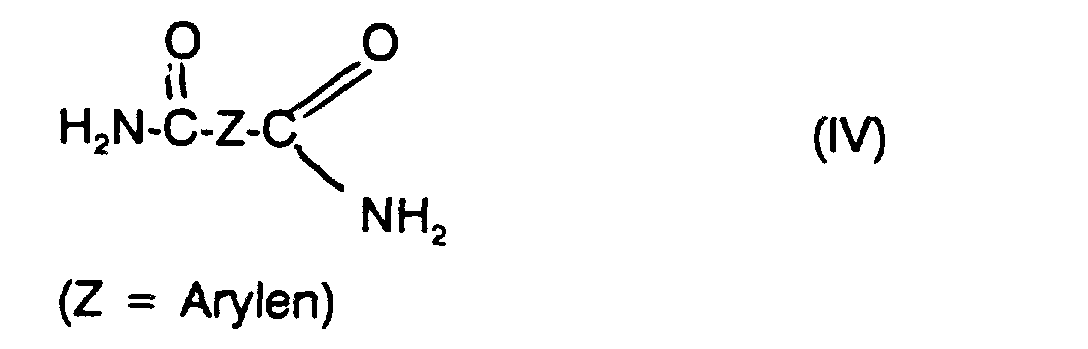


- Die Umsetzung von Hexafluoraceton mit dem Diamid IV erfolgt zweckmäßigerweise in stark polaren organischen Lösungsmitteln, z.B. DMSO, aus denen das Produkt V durch Ausfällen mit Wasser isoliert wird.
- Die Wasserabspaltung wird unter Kühlung, vorzugsweise bei Temperaturen von 0-(-40) °C, beispielsweise mit Hilfe von Pyridin/Trifluoressigsäureanhydrid, durchgeführt.
- Der Ringschluß der Acylimingruppen in VI unter Bildung von II erfolgt vorteilhaft mit wasserfreien Zinn(II)chlorid in siedendem Toluol.
- Säureamideder Formel IV sind aus den entsprechenden Dicarbonsäuren Z(COOH)₂ erhältlich; Azodicarbonamid (H₂N-CO-N=N-CO-NH₂), Acetylendicarbonsäure (OH-CO-C≡C-CO-OH), Perfluoradipinsäure, und Perfluorbernsteinsäure sowie verschiedene Pyridincarbonsäuren sind kommerziell erhältlich und können leicht nach allgemein bekannten Methoden in die entsprechenden Amide übergeführt werden. Andere heteroaromatische Dicarbonsäuren (z.B. verschiedene Furandicarbonsäuren) sind in der chemischen Literatur beschrieben.
- Die Dihydroxyverbindungen der Formel III sind durchweg bekannt. Bevorzugte Dihydroxyverbindungen sind Verbindungen der Formel IIIa


- Die Reste B befinden sich bevorzugt in 3- oder 3,5-Stellung zu R¹. Besonders bevorzugt sind Verbindungen der Formel IIIa in denen B gleich H und R¹ gleich CH₂, CO, C(CH₃)₂ oder C(CF₃)₂ ist.
- Zur Begrenzung des Molgewichts der anfallenden Polymeren sowie zum Verschließen der Kettenenden durch Aryloxy-Gruppen kann man bis zu 5 Mol-% eines Kettenabbrechers (bezogen auf Diphenole) zusetzen. Als Kettenabbrecher werden vorzugsweise Phenol oder substituierte Phenole, Hydroxydiphenyl oder Naphthole in Mengen von 0,01 bis 5 Mol.-% (bezogen auf Diphenole) verwendet. Darüberhinaus kann das Molekulargewicht durch die Temperaturführung gesteuert werden.
- Die Polymeren gemäß der Erfindung sind amorph und besitzen im allgemeinen Glastemperaturen von 120 °C bis 170 °C. Einige können bei Temperaturen oberhalb 280 °C unter Luft oder Stickstoff einen Gewichtsverlust erleiden, der von einer Energieaufnahme (endotherme Reaktion) begleitet ist.
- Die erfindungsgemäßen heteroaromatischen Polyether sind in diversen organischen Lösungsmitteln wie Aceton, Ethylacetat, THF, Toluol und Chloroform gut löslich und zeichnen sich somit gegenüber bekannten Polymeren durch eine wesentlich verbesserte Löslichkeit aus. Die Polyether gemäß der Erfindung können in verschiedenster Weise verwendet werden. Einige mögliche Anwendungen sind z.B.
- 1) als Thermoplast zur Herstellung von Spritzgußartikeln und Extrudaten z.B. für Stäbe, Rohre, Faser, Folien
- 2) Herstellung von Beschichtungen, z.B. aus Lösung
- 3) Herstellung von Filmen und Membranen aus Lösung
- 4) Herstellung von Polymerlegierungen mit Polyarylenen (Polyetherketone, Polyethersulfone, Polyether, Polysulfone), Polyamiden (Polyaramide, partiell aromatische Polyamide, Nylon-6, Nylon-6,6), Polyestern (®Durel, PET, PDT), Polyolefinen (PP, PE, Cycloolefincopolymere), Vinylpolymeren (Polystyrol, Poly(α-methylstyrol), PMMA, Polyacrylnitril), Polycarbonaten (z.B. auf Basis von Bisphenol-A).
- Die Erfindung wird durch die nachstehenden Beispiele erläutert.
- Die Molmassen wurden mit einem Gelpermeationschromatographen der Firma Waters-Millipore, Eschborn, Bundesrepublik Deutschland, Modell 150-C relativ zu kommerziell erhältlichen Polystyrol-Standards ermittelt.
- Die Bestimmung der Glasübergangstemperatur (TG) erfolgte mittels eines Differentialkalorimeters DSC7 der Fa. Perkin Elmer, Überlingen, Bundesrepublik Deutschland, bei einer Aufheizrate von 20 °C/Minute.
- Die in den Beispielen verwendeten Dihydroxyverbindungen besitzen die Formeln:


- 622 mg (1,6 mmol) Monomer der Formel 1 und 369 mg (1,6 mmol) Bisphenol A (s. Formel 2) werden in 12 ml absolutem DMSO gelöst. Zur Bildung des Phenolates in situ und zum Abfangen des bei der Polymerisation gebildeten Fluorwasserstoffs werden 388 mg (3,86 mmol) Tri-ethylamin zugegeben. Die Mischung wird in einem geschlossenen Gefäß für 3 h auf 80 °C erhitzt. Gegen Ende der Reaktion fällt das Polymer aus. Nach der Reaktion wird das Polymer abfiltriert, in Toluol gelöst, aus Methanol gefällt und anschließend getrocknet. Das Produkt besitzt eine Molmasse Mw = 124000 g/mol. Seine Glasübergangstemperatur liegt bei 150 °C.
- 427 mg (1,1 mmol) Monomer der Formel 1 und 373 mg (1,1 mmol) Hexafluorbisphenol A (s. Formel 3) werden in 10 ml absoluten DMSO gelöst. Als Base zur Bildung des Phenolates in situ und zum Abfangen des Fluorwasserstoffes, der bei der Polymerisation gebildet wird, werden 267 mg (2,64 mmol) Triethylamin zugegeben. Die Mischung wird für 2 h in einem druckbeständigen geschlossenen Gefäß auf 140 °C erhitzt. Beim Abkühlen nach Beendigung der Reaktion fällt das Polymer aus. Es wird in Toluol gelöst, aus Methanol gefällt und getrocknet. Das Produkt besitzt eine Molmasse von M = 17600 g/mol, seine Glasübergangstemperatur liegt bei 147 °C.
- Herstellung des Monomers der Formel 1

- a) Auf eine Suspension von 16,4 g (100 mmol) Terephthalsäurediamid in 250 ml absolutem DMSO wird bei Raumtemperatur in eine mit Trockeneisrückflußkühler und Überdruckventil versehene Apparatur unter kräftigem Rühren Hexafluoraceton geleitet. Nach beendeter Gasabsorption wird das Reaktionsgemisch auf 300 ml Wasser gegeben, wobei das Produkt ausfällt. (Dieser Schritt stellt eine wesentliche Verbesserung gegenüber dem bekannten Verfahren (K. Geith, Dissertation 1988, TU München) dar, nach dem das Produkt mit einem großen Überschuß an Methylenchlorid aus wäßrigem DMSO extrahiert wird, da das neue Verfahren Ausbeuten > 95 %, gegenüber < 70 % beim bekannten Verfahren ermöglicht). Das Produkt wird abfiltriert, mehrmals mit destilliertem Wasser gewaschen, um restliches DMSO zu entfernen, und schließlich bei vermindertem Druck ( < 1 bar) über Phosphorpentoxid getrocknet. Ausbeute: > 95 %, farblose Kristalle, Zersetzung > 265 °C.
- b) 15 g (30 mmol) des Produktes aus a) werden in 250 ml absolutem Ether gelöst. Dann werden bei -10 °C (Eis/Kochsalz-Kältemischung) gleichzeitig 8,4 ml (60 mmol) Trifluoressigsäureanhydrid und 9,8 ml (120 mmol) Pyridin innerhalb einer Stunde zugetropft. Es wird noch eine Stunde bei 0 °C gerührt, danach wird der Reaktionsansatz für zwei Tage bei einer Temperatur von -30 °C stehengelassen. Dann wird das ausgefallene Pyridiniumtrifluoracetat abfiltriert, das Lösungsmittel bei vermindertem Druck (< 1 bar) abgezogen und der Rückstand in Hexan aufgenommen. Die Hexanlösung wird filtriert und eingeengt. Bei -30 °C kristallisiert das Produkt aus. Ausbeute: 52 %, farblose Kristalle, Fp.: 78 °C.
- c) 6,9 g (15 mmol) des Produktes aus b) werden in 70 ml absolutem Toluol gelöst, 5,7 g (30 mmol) wasserfreies Zinn(II)chlorid zugegeben und die Reaktionsmischung für 48 h zum Rückfluß erhitzt. Nach Beendigung der Reaktion wird der unlösliche Rückstand abfiltriert und das Lösungsmittel im Vakuum entfernt. Das Rohprodukt wird zunächst durch Säulenchromatographie gereinigt und anschließend aus Chloroform umkristallisiert. Ausbeute: 40 %, gelbliche Kristalle, Fp.: 149 °C.
- 635,2 mg (1,65 mmol) Monomer der Formel 1 und 413,7 mg (1,65 mmol) 4,4'-Dihydroxydiphenylsulfon werden in 6 ml absolutem N-Methylpyrrolidon (NMP) gelöst. Zur Bildung des Phenolates und zum Abfangen des bei der Polymerisation gebildeten Fluorwasserstoffes werden 0,6 ml absolutes Triethylamin zugegeben. Die Reaktionsmischung wird anschließend in einem druckbeständigen geschlossenen Gefäß für 20 h auf 50 °C erwärmt. Danach wird die Mischung mit 10 ml THF verdünnt und das Polymer durch Eingießen in Methanol gefällt. Das Polymer wird abfiltriert, mit Methanol und Wasser gewaschen und im Vakuum bei 80 °C bis zur Gewichtskonstanz getrocknet.
- Das so erhaltene Polymer ist schwach gelb gefärbt. Es ist bei Raumtemperatur löslich in DMSO, NMP, DMAc und THF. Seine Molmasse beträgt


- 634,0 mg (1,65 mmol) Monomer der Formel 1 und 353,5 mg (1,65 mmol) 4,4'-Dihydroxybenzophenon werden in 6 ml absolutem NMP (= N-Methylpyrrolidon) gelöst. Zur Phenolatbildung und zum Abfangen des durch die Reaktion gebildeten Fluorwasserstoffes werden 0,6 ml absolutes Triethylamin zugesetzt. Diese Mischung wird für 7 h auf 50 °C erwärmt. Danach wird mit 10 ml NMP verdünnt und das Polymer durch Eingießen in Methanol gefällt. Das Polymer wird abfiltriert, mit Methanol und Wasser gewaschen und im Vakuum bei 80 °C bis zur Gewichtskonstanz getrocknet.
- Das so erhaltene Polymer ist schwach gelb gefärbt. Es ist bei erhöhter Temperatur löslich in NMP und DMAc. Seine Glasübergangstemperatur liegt bei Tg = 167 °C (Heizrate 20 K/min). Daneben besitzt es einen Kristallitschmelzpunkt vom Tm = 278 °C. Das Polymer zeigt an Luft eine Beginn des Gewichtsverlustes bei 310 °C (Heizrate 10 K/min) in einer exothermen Reaktion.
- 646,7 mg (1,68 mmol) Monomer der Formel 1 und 384,1 mg (1,68 mmol) Bisphenol A werden in 6 ml absolutem N,N-Dimethylacetamid (DMAc) gelöst. Zur Phenolatbildung und zum Abfangen des bei der Reaktion gebildeten Fluorwasserstoffs werden 0,6 ml absolutes Triethylamin zugegeben. Diese Mischung wird in einem geschlossenen druckbeständigen Gefäß für 20 h auf 50 °C erwärmt. Anschließend wird die Mischung mit 10 ml THF verdünnt und das Polymer durch Eingießen in Methanol gefällt. Das Polymer wird abfiltriert, mit Methanol und Wasser gewaschen und im Vakuum bei 80 °C bis zur Gewichtskonstanz getrocknet.
- Das so erhaltene Polymer ist gelb gefärbt. Es ist bei Raumtemperatur löslich in Aceton, Chloroform, NMP, DMAc, THF und Toluol. Seine Molmasse beträgt


-


Claims (9)
- Polyether mit Wiederholeinheiten der Formel I
 A einen divalenten Arylen- oder Heteroarylen-Rest,X O, S oder NR,Z einen divalenten Arylen- oder Heteroarylenrest, die Ethinylen-, Azo- oder (CF₂)n-Gruppe, wobei n eine ganze Zahl von 1 bis 4 ist,R Aryl, vorzugsweise Phenyl,bedeuten.
 - Polyether gemäß Anspruch 1, dadurch gekennzeichnet, daß A = 1,2-, 1,3- oder 1,4-Phenylen, 2,6-Naphthylen oder deren kernalkylierte oder kernhalogenierte Derivate, oder


X = 0, und
Z =
-(CF₂)₁₋₄- ,
mit R gleich CH₂, O, CO, SO₂, C(CH₃)₂ oder C(CF₃)₂
ist. - Polyether gemäß Anspruch 1 mit Wiederholeinheiten der Formel la

- Verfahren zur Herstellung von Polyethern gemäß Anspruch 1 dadurch gekennzeichnet, daß man Halogenverbindungen der Formel II

HO-A-OH (III),
worin A die obengenannte Bedeutung hat, in Gegenwart einer Base polykondensiert. - Verfahren nach Anspruch 4, dadurch gekennzeichnet, daß man die Polykondensation mittels Trialkylaminen als Base durchführt.
- Verwendung der Polyether gemäß Anspruch 1 als Thermoplast zur Herstellung von Spritzgußartikeln und Extrudaten.
- Verwendung der Polyether gemäß Anspruch 1 zur Herstellung von Beschichtungen.
- Verwendung der Polyether gemäß Anspruch 1 zur Herstellung von Filmen und Membranen aus Lösung.
- Verwendung der Polyether gemäß Anspruch 1 zur Herstellung von Polymeriegierungen.
Applications Claiming Priority (2)
| Application Number | Priority Date | Filing Date | Title |
|---|---|---|---|
| DE4100802 | 1991-01-14 | ||
| DE4100802A DE4100802A1 (de) | 1991-01-14 | 1991-01-14 | Heteroaromatischer polyether |
Publications (3)
| Publication Number | Publication Date |
|---|---|
| EP0495381A2 EP0495381A2 (de) | 1992-07-22 |
| EP0495381A3 EP0495381A3 (en) | 1992-11-25 |
| EP0495381B1 true EP0495381B1 (de) | 1996-04-17 |
Family
ID=6422931
Family Applications (1)
| Application Number | Title | Priority Date | Filing Date |
|---|---|---|---|
| EP92100207A Expired - Lifetime EP0495381B1 (de) | 1991-01-14 | 1992-01-08 | Heteroaromatische Polyether |
Country Status (4)
| Country | Link |
|---|---|
| US (1) | US5300625A (de) |
| EP (1) | EP0495381B1 (de) |
| JP (1) | JPH0586177A (de) |
| DE (2) | DE4100802A1 (de) |
Families Citing this family (5)
| Publication number | Priority date | Publication date | Assignee | Title |
|---|---|---|---|---|
| US5998876A (en) * | 1997-12-30 | 1999-12-07 | International Business Machines Corporation | Reworkable thermoplastic hyper-branched encapsulant |
| US6111323A (en) * | 1997-12-30 | 2000-08-29 | International Business Machines Corporation | Reworkable thermoplastic encapsulant |
| JP5562567B2 (ja) * | 2009-03-06 | 2014-07-30 | 株式会社Kri | フラン系樹脂 |
| US9447243B2 (en) * | 2012-12-03 | 2016-09-20 | The Scripps Research Institute | Polymerization method and polymers formed therewith |
| WO2016062597A1 (en) * | 2014-10-24 | 2016-04-28 | Solvay Specialty Polymers Usa, Llc | Method for the manufacture of poly(aryl ethers) using at least one organic base |
Family Cites Families (4)
| Publication number | Priority date | Publication date | Assignee | Title |
|---|---|---|---|---|
| DE2844394A1 (de) * | 1978-10-12 | 1980-04-30 | Hoechst Ag | Neue 4-chloroxazole und verfahren zu deren herstellung |
| DE3414144A1 (de) * | 1984-04-14 | 1985-10-24 | Basf Ag, 6700 Ludwigshafen | Temperaturbestaendige aromatische polyether |
| DE3641229A1 (de) * | 1986-12-02 | 1988-06-16 | Schering Ag | Trifluormethylsubstituierte azole, verfahren zu ihrer herstellung und ihre verwendung als mittel mit herbizider wirkung |
| US4843143A (en) * | 1987-03-05 | 1989-06-27 | Ashland Oil, Inc. | Copolymerization of bisoxazoline and polyphenolic compound with a hydrocarbon halide catalyst |
-
1991
- 1991-01-14 DE DE4100802A patent/DE4100802A1/de not_active Withdrawn
-
1992
- 1992-01-08 DE DE59205980T patent/DE59205980D1/de not_active Expired - Fee Related
- 1992-01-08 EP EP92100207A patent/EP0495381B1/de not_active Expired - Lifetime
- 1992-01-10 US US07/819,061 patent/US5300625A/en not_active Expired - Lifetime
- 1992-01-14 JP JP4004828A patent/JPH0586177A/ja active Pending
Also Published As
| Publication number | Publication date |
|---|---|
| US5300625A (en) | 1994-04-05 |
| EP0495381A2 (de) | 1992-07-22 |
| DE4100802A1 (de) | 1992-07-16 |
| DE59205980D1 (de) | 1996-05-23 |
| JPH0586177A (ja) | 1993-04-06 |
| EP0495381A3 (en) | 1992-11-25 |
Similar Documents
| Publication | Publication Date | Title |
|---|---|---|
| DE3382700T2 (de) | Verwendung eines amorphen aromatischen thermoplastischen Polymeren. | |
| DE3788891T2 (de) | Arylcyclobuten enthaltende Zusammenstellungen und polymerische Zusammenstellungen, die daraus hergestellt werden. | |
| DE2453485B2 (de) | Phenylensulfidpolymere, Verfahren zu ihrer Herstellung und ihre Verwendung | |
| DE2202168A1 (de) | Verfahren zur Herstellung von Cyanaryloxy-Polymeren und die davon abgeleiteten Produkte | |
| EP0363760A1 (de) | Aromatische Ether | |
| DE3877421T2 (de) | Polyamidbenzazole. | |
| US4209458A (en) | Fluorinated phthalonitriles | |
| DE3730690C2 (de) | ||
| EP0495381A2 (de) | Heteroaromatische Polyether | |
| DE4208005C2 (de) | Aromatische Polyamide und Verfahren zu deren Herstellung | |
| DE2220079A1 (de) | Verfahren zur Herstellung von polymeren Verbindungen | |
| EP0467847A1 (de) | Polyarylenether mit Tetraphenylethylen-Einheiten | |
| DE4237768A1 (en) | New polyarylene ether derivs. with reduced viscosity - used to prepare moulded bodies, foils, fibres and membranes, as matrix resins, adhesives or coating agents or as polymer additives | |
| US3736293A (en) | Polyethers containing repeating perchloroaromatic units | |
| EP0451556A2 (de) | Stabilisierte Polyaryletherketon-Formmassen | |
| DE4108587C2 (de) | Polyätherimidimide und Verfahren zu deren Herstellung | |
| EP0193741A1 (de) | Blockcopolymere aus gegebenenfalls substituierten Poly(oxy-1,4-phenylen)Segmenten und flüssig-kristallinen Segmenten | |
| DE19532195B4 (de) | Elektrische Widerstandszusammensetzung und elektrisches Widerstandsmaterial | |
| DE2106396C3 (de) | Verfahren zur Herstellung von Polyphenylenen | |
| DE3784403T2 (de) | Thermoplastische, aromatische polyetherpyridine und verfahren zu deren herstellung. | |
| DE3727254A1 (de) | Neue aromatische polyester, verfahren zu deren herstellung sowie deren verwendung zur herstellung von molekular verstaerkten polymeren | |
| DE2009494C3 (de) | Verfahren zur Herstellung hxxochmolekularer linearer aromatischer Polyestercarbonate und deren Verwendung | |
| EP0500493A1 (de) | Neue Polyarylenetherketone | |
| RU2625158C1 (ru) | Термостойкий полиариленфталид и способ его получения | |
| DE3688675T2 (de) | Thermoplastische lineare aromatische Polyetherdiketone und Verfahren zu deren Herstellung. |
Legal Events
| Date | Code | Title | Description |
|---|---|---|---|
| PUAI | Public reference made under article 153(3) epc to a published international application that has entered the european phase |
Free format text: ORIGINAL CODE: 0009012 |
|
| AK | Designated contracting states |
Kind code of ref document: A2 Designated state(s): DE FR GB |
|
| PUAL | Search report despatched |
Free format text: ORIGINAL CODE: 0009013 |
|
| AK | Designated contracting states |
Kind code of ref document: A3 Designated state(s): DE FR GB |
|
| 17P | Request for examination filed |
Effective date: 19930130 |
|
| 17Q | First examination report despatched |
Effective date: 19950626 |
|
| GRAH | Despatch of communication of intention to grant a patent |
Free format text: ORIGINAL CODE: EPIDOS IGRA |
|
| GRAA | (expected) grant |
Free format text: ORIGINAL CODE: 0009210 |
|
| AK | Designated contracting states |
Kind code of ref document: B1 Designated state(s): DE FR GB |
|
| REF | Corresponds to: |
Ref document number: 59205980 Country of ref document: DE Date of ref document: 19960523 |
|
| GBT | Gb: translation of ep patent filed (gb section 77(6)(a)/1977) |
Effective date: 19960709 |
|
| ET | Fr: translation filed | ||
| PLBE | No opposition filed within time limit |
Free format text: ORIGINAL CODE: 0009261 |
|
| STAA | Information on the status of an ep patent application or granted ep patent |
Free format text: STATUS: NO OPPOSITION FILED WITHIN TIME LIMIT |
|
| 26N | No opposition filed | ||
| REG | Reference to a national code |
Ref country code: GB Ref legal event code: 732E |
|
| REG | Reference to a national code |
Ref country code: FR Ref legal event code: TP |
|
| REG | Reference to a national code |
Ref country code: GB Ref legal event code: IF02 |
|
| REG | Reference to a national code |
Ref country code: GB Ref legal event code: 732E |
|
| REG | Reference to a national code |
Ref country code: FR Ref legal event code: TP |
|
| PGFP | Annual fee paid to national office [announced via postgrant information from national office to epo] |
Ref country code: DE Payment date: 20090122 Year of fee payment: 18 |
|
| PGFP | Annual fee paid to national office [announced via postgrant information from national office to epo] |
Ref country code: GB Payment date: 20090122 Year of fee payment: 18 |
|
| PGFP | Annual fee paid to national office [announced via postgrant information from national office to epo] |
Ref country code: FR Payment date: 20090115 Year of fee payment: 18 |
|
| REG | Reference to a national code |
Ref country code: FR Ref legal event code: CD Ref country code: FR Ref legal event code: CA Ref country code: FR Ref legal event code: CJ |
|
| GBPC | Gb: european patent ceased through non-payment of renewal fee |
Effective date: 20100108 |
|
| REG | Reference to a national code |
Ref country code: FR Ref legal event code: ST Effective date: 20100930 |
|
| PG25 | Lapsed in a contracting state [announced via postgrant information from national office to epo] |
Ref country code: FR Free format text: LAPSE BECAUSE OF NON-PAYMENT OF DUE FEES Effective date: 20100201 |
|
| PG25 | Lapsed in a contracting state [announced via postgrant information from national office to epo] |
Ref country code: DE Free format text: LAPSE BECAUSE OF NON-PAYMENT OF DUE FEES Effective date: 20100803 |
|
| PG25 | Lapsed in a contracting state [announced via postgrant information from national office to epo] |
Ref country code: GB Free format text: LAPSE BECAUSE OF NON-PAYMENT OF DUE FEES Effective date: 20100108 |