EP0488554A2 - Bande TAB, boîtier d'une bande TAB et son procédé de fixation - Google Patents
Bande TAB, boîtier d'une bande TAB et son procédé de fixation Download PDFInfo
- Publication number
- EP0488554A2 EP0488554A2 EP91310540A EP91310540A EP0488554A2 EP 0488554 A2 EP0488554 A2 EP 0488554A2 EP 91310540 A EP91310540 A EP 91310540A EP 91310540 A EP91310540 A EP 91310540A EP 0488554 A2 EP0488554 A2 EP 0488554A2
- Authority
- EP
- European Patent Office
- Prior art keywords
- chip
- tab tape
- pads
- opening
- leads
- Prior art date
- Legal status (The legal status is an assumption and is not a legal conclusion. Google has not performed a legal analysis and makes no representation as to the accuracy of the status listed.)
- Withdrawn
Links
Images


Classifications
-
- H—ELECTRICITY
- H10—SEMICONDUCTOR DEVICES; ELECTRIC SOLID-STATE DEVICES NOT OTHERWISE PROVIDED FOR
- H10W—GENERIC PACKAGES, INTERCONNECTIONS, CONNECTORS OR OTHER CONSTRUCTIONAL DETAILS OF DEVICES COVERED BY CLASS H10
- H10W70/00—Package substrates; Interposers; Redistribution layers [RDL]
- H10W70/40—Leadframes
- H10W70/453—Leadframes comprising flexible metallic tapes
-
- H—ELECTRICITY
- H10—SEMICONDUCTOR DEVICES; ELECTRIC SOLID-STATE DEVICES NOT OTHERWISE PROVIDED FOR
- H10W—GENERIC PACKAGES, INTERCONNECTIONS, CONNECTORS OR OTHER CONSTRUCTIONAL DETAILS OF DEVICES COVERED BY CLASS H10
- H10W72/00—Interconnections or connectors in packages
- H10W72/071—Connecting or disconnecting
- H10W72/077—Connecting of TAB connectors
-
- H—ELECTRICITY
- H10—SEMICONDUCTOR DEVICES; ELECTRIC SOLID-STATE DEVICES NOT OTHERWISE PROVIDED FOR
- H10W—GENERIC PACKAGES, INTERCONNECTIONS, CONNECTORS OR OTHER CONSTRUCTIONAL DETAILS OF DEVICES COVERED BY CLASS H10
- H10W72/00—Interconnections or connectors in packages
- H10W72/701—Tape-automated bond [TAB] connectors
-
- H—ELECTRICITY
- H10—SEMICONDUCTOR DEVICES; ELECTRIC SOLID-STATE DEVICES NOT OTHERWISE PROVIDED FOR
- H10W—GENERIC PACKAGES, INTERCONNECTIONS, CONNECTORS OR OTHER CONSTRUCTIONAL DETAILS OF DEVICES COVERED BY CLASS H10
- H10W72/00—Interconnections or connectors in packages
- H10W72/071—Connecting or disconnecting
- H10W72/0711—Apparatus therefor
-
- H—ELECTRICITY
- H10—SEMICONDUCTOR DEVICES; ELECTRIC SOLID-STATE DEVICES NOT OTHERWISE PROVIDED FOR
- H10W—GENERIC PACKAGES, INTERCONNECTIONS, CONNECTORS OR OTHER CONSTRUCTIONAL DETAILS OF DEVICES COVERED BY CLASS H10
- H10W72/00—Interconnections or connectors in packages
- H10W72/071—Connecting or disconnecting
- H10W72/072—Connecting or disconnecting of bump connectors
- H10W72/07251—Connecting or disconnecting of bump connectors characterised by changes in properties of the bump connectors during connecting
-
- H—ELECTRICITY
- H10—SEMICONDUCTOR DEVICES; ELECTRIC SOLID-STATE DEVICES NOT OTHERWISE PROVIDED FOR
- H10W—GENERIC PACKAGES, INTERCONNECTIONS, CONNECTORS OR OTHER CONSTRUCTIONAL DETAILS OF DEVICES COVERED BY CLASS H10
- H10W72/00—Interconnections or connectors in packages
- H10W72/20—Bump connectors, e.g. solder bumps or copper pillars; Dummy bumps; Thermal bumps
-
- Y—GENERAL TAGGING OF NEW TECHNOLOGICAL DEVELOPMENTS; GENERAL TAGGING OF CROSS-SECTIONAL TECHNOLOGIES SPANNING OVER SEVERAL SECTIONS OF THE IPC; TECHNICAL SUBJECTS COVERED BY FORMER USPC CROSS-REFERENCE ART COLLECTIONS [XRACs] AND DIGESTS
- Y10—TECHNICAL SUBJECTS COVERED BY FORMER USPC
- Y10T—TECHNICAL SUBJECTS COVERED BY FORMER US CLASSIFICATION
- Y10T29/00—Metal working
- Y10T29/49—Method of mechanical manufacture
- Y10T29/49002—Electrical device making
- Y10T29/49117—Conductor or circuit manufacturing
- Y10T29/49121—Beam lead frame or beam lead device
-
- Y—GENERAL TAGGING OF NEW TECHNOLOGICAL DEVELOPMENTS; GENERAL TAGGING OF CROSS-SECTIONAL TECHNOLOGIES SPANNING OVER SEVERAL SECTIONS OF THE IPC; TECHNICAL SUBJECTS COVERED BY FORMER USPC CROSS-REFERENCE ART COLLECTIONS [XRACs] AND DIGESTS
- Y10—TECHNICAL SUBJECTS COVERED BY FORMER USPC
- Y10T—TECHNICAL SUBJECTS COVERED BY FORMER US CLASSIFICATION
- Y10T29/00—Metal working
- Y10T29/49—Method of mechanical manufacture
- Y10T29/49002—Electrical device making
- Y10T29/49117—Conductor or circuit manufacturing
- Y10T29/49124—On flat or curved insulated base, e.g., printed circuit, etc.
- Y10T29/4913—Assembling to base an electrical component, e.g., capacitor, etc.
- Y10T29/49144—Assembling to base an electrical component, e.g., capacitor, etc. by metal fusion
Definitions
- This invention relates to TAB (Tape Automated Bonding) tape techniques, and more specifically to TAB tapes, TAB tape packages and methods of bonding the same.
- TAB Transmission Automated Bonding
- TAB tape is widely used in manufacturing semiconductor integrated circuit packages.
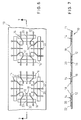
- a conventional TAB tape 10, Figures 6 and 7 comprises an insulating tape 11 of a material such as polyimide, through which tape there is a multiplicity of openings 12, each shaped to receive a semiconductor chip 24.
- the insulating tape 11 has an opening 12 at each chip attaching position and leads 14 are formed on the tape 11 around each opening 12.
- Four elongated slots 16 are formed on the tape 11 around each opening 12.
- Each lead 14 has an inner lead portion 18 projecting into opening 12 and an outer lead portion 20 extending across slot 16.
- the outer lead portions 20 terminate in test pads 22 which are used for circuitry testing.
- a semiconductor chip When a chip is to be attached to a TAB tape, a semiconductor chip is positioned in opening 12, and inner lead portions 18 are connected to the pads of the chip by the use of a bonding tool 28 (Figure 8) called Thermode.
- the tape 10 is placed so that leads 14 face downward ( Figure 8 (A)), and tape 11 and chip 24 are so positioned that inner lead portions 18 and electrode pads 26 of the chip 24 are aligned with each other. All the inner lead portions 18 are thermocompressively bonded simultaneously to chip pads 26 by means of the bonding tool 28.
- the top end of the bonding tool 28 is formed of a hard material such as a sintered diamond, and the leads 14, are usually formed of copper, plated with tin.
- This bonding method is satisfactory when the number of leads is small, but a problem of lift-up of chips occurs as the number of leads is increased.
- the bonding tool is raised after the bonding, it may happen that chip 24 ( Figure 8 (B)) is lifted up at the same time, making the leads deform, whereby the inner lead portions 18 are brought in contact with the edge of chip 24.
- a surface of a chip is usually covered with a surface protecting layer such as polyimide, it is not always completely covered to its edge portion.
- a surface protecting layer such as polyimide
- this invention seeks to provide a TAB tape, package and bonding method for preventing a chip from being lifted up by adhesion of the bonding tool with the leads in the bonding of the TAB leads.
- This invention also seeks to provide a TAB package which can prevent contact between the leads and the chip.
- the invention provides a TAB tape which includes insulating tape having openings at respective chip attaching positions, and leads formed on the insulating tape and extending into respective openings to be connected to pads of the respective chips when the chips are attached, characterised by chip pressure means on the insulating tape extending into each opening to prevent passage of a chip therethrough.
- the attachment of the chips is by a bonding tool pressing the lead extensions against the chip pads, and the chip pressure means extends into each opening to prevent a chip from being lifted up by adhesion between the bonding tool and the leads when the chip is attached.
- the invention extends to a TAB tape package comprising such a TAB tape, in which the leads have inner lead portions extending into the opening and outer lead portions extending from the insulating tape, a chip is disposed in the opening and has pads connected to the inner lead portions, and the chip pressure means extends into the opening to prevent contact between the inner lead portion and the chip by engagement with the surface of the chip at the side of the pad.
- the invention includes a method of bonding a TAB tape, comprising preparing such a tape, aligning the tape with respect to a chip so that the lead portions in a selected opening are positioned on the pads of the chip to be attached and projecting portions of the chip pressure means in the opening are positioned on the surface at the side of the pads, moving a bonding tool downwardly to the selected opening, the bonding tool having a bottom surface for thermocompressively bonding the lead portions to the pads and inclined surfaces for engaging the projecting portions and bending the projecting portions towards the surface at the side of the pads by engagement of the inclined surfaces with the projecting portions during the downward movement of said bonding tool.
- the TAB tape is so formed as to have chip pressure means extending into the openings in which chips are to be attached.
- the chip pressure means are preferably formed of the same material as the leads and provided at the same side as the leads and in the four corners of the openings in which the chips are to be attached.
- the chip pressure means act to engage with the surface of a chip at the side of the pads thereby preventing the chip from lifting or moving to the leads.
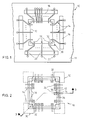
- a TAB tape 10 ( Figure 1) includes a length of insulating tape 11 of polyimide, which is 125 microns thick. A multiplicity of openings 12 are formed through the tape 11 in the positions in which chips are to be attached. A total of two hundred and sixty-eight leads 14 is provided for each opening 12 and these are formed on the tape 11 of 35 micron-thick copper having a tin surface coating. Detailed structures such as sprocket holes are omitted in the figure.
- each chip pressure member 30 is provided in each of the four corners of each opening 12 ( Figure 1).
- a portion 32 of each chip pressure member 30 extends into opening 12.
- Leads 14 are usually formed by patterning a copper layer bonded to the polyimide tape.
- the chip pressure members 30 are preferably formed on the same side of the tape 11 and of the same material as leads 14, conveniently by patterning the copper layer so as simultaneously to form leads 14 and chip pressure members 30.
- the tape 10 ( Figure 2) and chip 24 are aligned so that inner lead portions 18 and electrode pads 26 of semiconductor chip 24 align with each other at the time of bonding.
- the tape is placed so that the leads face downward.
- Projecting portions 32 of chip pressure members 30 overhang the four corners of chip 24 so as to be capable of engaging with the surface of chip 24 at the side of pads 26.
- the chip pressure member portions 32 extend to such an extent as to overlap slightly the bottom of the bonding tool 28, whose shape is represented by the broken line 34.
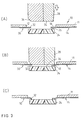
- the shape 34 of the bottom of the tool 28 is such that, during bonding ( Figure 3) the bottom contacts with all the inner lead portions 18.
- the corners of the bottom are cut away to form inclined surfaces 36 so as not to engage the main part of the projecting portions 32 of chip pressure members 30, but only the extremities.
- the inclined surfaces 36 are provided in the corners of the bottom surface 34 of the bonding tool 28 corresponding to the chip pressure members 30.
- the projecting portions 32 of the chip pressure members 30 engage with the upper surface of the chip at the side of the pads to block further movement, and thus lifting-up of the chip and hence the deformation of the leads can be prevented.
- the projecting portions 32 which were bent act as spacers to maintain the spacing between the chip surface and the lead portions 18.
- a difference needs to occur between the height of the chip pressure members 30 and that of the bottom surface of the tool in its lowest position. If gold is used as the material for chip pads 26, the thickness of the gold pads is ordinarily reduced by a factor of several numbers. Thus, the design needs to be made such that the necessary difference in height is obtained, considering the thickness change.
- chip pressure member 30 Two alternative forms of chip pressure member 30 are shown in Figure 4.
- the projecting portion has two protrusions 38.
- the projecting portion 32 is substantially rectangular. It will be apparent that the shape of the chip pressure members 30 is not limited to these forms, but they can be formed to any suitable shape.
- the chip pressure members may be formed on the surface of the insulating tape which is opposite to that on which the leads are formed.
- the chip pressure members in the four corners need not always be separated.
- the chip pressure members need not always be provided in the four corners of a chip if the lead density is relatively small and if space for engagement of the chip pressure members can be secured in positions other than the four corners.
- the chip pressure members need not be of the same material as the leads.
- the TAB tape was bonded with the leads facing downward, it may be bonded with the leads facing upward.
- a chip can easily and securely be prevented from being lifted up by the adhesion between the bonding tool and the leads at the time of bonding.
- a TAB package structure can be obtained wherein the spacing between the leads and the chip surface can be maintained and thus the contact of the leads with the chip can be prevented even after the bonding.
- the chip pressure members are so called because, if the chip starts to lift lip by reason of adhesion between the bonding tool and the leads thermocompressively bonded to the chip pads, the chip pressure members engage the chip and prevent such lift-up, pressing against the chip as the bonding tool rises.
- the tips of the chip pressure members should be engaged by the inclined surfaces of the corners of the bottom of the tool and bent into contact with the surface of the chip, but no further. Such an arrangement ensures that the leads are not damaged by lift-up of the chip.
- the chip pressure members may be formed simultaneously with the leads on the insulating tape by appropriate etching of a metallisation layer on the tape.
Landscapes
- Wire Bonding (AREA)
Applications Claiming Priority (2)
| Application Number | Priority Date | Filing Date | Title |
|---|---|---|---|
| JP323424/90 | 1990-11-28 | ||
| JP2323424A JPH088282B2 (ja) | 1990-11-28 | 1990-11-28 | Tabテープ、半導体チップの結合方法 |
Publications (2)
| Publication Number | Publication Date |
|---|---|
| EP0488554A2 true EP0488554A2 (fr) | 1992-06-03 |
| EP0488554A3 EP0488554A3 (en) | 1993-06-02 |
Family
ID=18154534
Family Applications (1)
| Application Number | Title | Priority Date | Filing Date |
|---|---|---|---|
| EP19910310540 Withdrawn EP0488554A3 (en) | 1990-11-28 | 1991-11-14 | Tab tape, tab tape package and method of bonding same |
Country Status (3)
| Country | Link |
|---|---|
| US (2) | US5243141A (fr) |
| EP (1) | EP0488554A3 (fr) |
| JP (1) | JPH088282B2 (fr) |
Cited By (2)
| Publication number | Priority date | Publication date | Assignee | Title |
|---|---|---|---|---|
| US5638596A (en) * | 1992-06-04 | 1997-06-17 | Lsi Logic Corporation | Method of employing multi-layer tab tape in semiconductor device assembly by selecting, breaking, downwardly bending and bonding tab tape trace free ends to a ground or power plane |
| US6124547A (en) * | 1997-02-17 | 2000-09-26 | Seiko Epson Corporation | Tape carrier package |
Families Citing this family (9)
| Publication number | Priority date | Publication date | Assignee | Title |
|---|---|---|---|---|
| JP2852178B2 (ja) * | 1993-12-28 | 1999-01-27 | 日本電気株式会社 | フィルムキャリアテープ |
| US5477082A (en) * | 1994-01-11 | 1995-12-19 | Exponential Technology, Inc. | Bi-planar multi-chip module |
| US5938038A (en) * | 1996-08-02 | 1999-08-17 | Dial Tool Industries, Inc. | Parts carrier strip and apparatus for assembling parts in such a strip |
| US5925926A (en) * | 1997-03-19 | 1999-07-20 | Nec Corporation | Semiconductor device including an inner lead reinforcing pattern |
| KR100252051B1 (ko) * | 1997-12-03 | 2000-04-15 | 윤종용 | 휨 방지막을 구비하는 탭 테이프 |
| US5967328A (en) * | 1998-01-22 | 1999-10-19 | Dial Tool Industries, Inc. | Part carrier strip |
| US6404067B1 (en) | 1998-06-01 | 2002-06-11 | Intel Corporation | Plastic ball grid array package with improved moisture resistance |
| JP2007098409A (ja) * | 2005-09-30 | 2007-04-19 | Toshiba Corp | 板材分断方法、金型、プリント基板、および電子機器 |
| US9548283B2 (en) * | 2012-07-05 | 2017-01-17 | Taiwan Semiconductor Manufacturing Company, Ltd. | Package redistribution layer structure and method of forming same |
Family Cites Families (9)
| Publication number | Priority date | Publication date | Assignee | Title |
|---|---|---|---|---|
| US4330790A (en) * | 1980-03-24 | 1982-05-18 | National Semiconductor Corporation | Tape operated semiconductor device packaging |
| JPS57121142U (fr) * | 1981-01-23 | 1982-07-28 | ||
| FR2498814B1 (fr) * | 1981-01-26 | 1985-12-20 | Burroughs Corp | Boitier pour circuit integre, moyen pour le montage et procede de fabrication |
| JPS5831566A (ja) * | 1981-08-18 | 1983-02-24 | Nec Corp | 半導体装置 |
| US4466183A (en) * | 1982-05-03 | 1984-08-21 | National Semiconductor Corporation | Integrated circuit packaging process |
| JPS614263A (ja) * | 1984-06-19 | 1986-01-10 | Nippon Mining Co Ltd | 自動ギヤングボンデイング用接続テ−プ |
| US4758927A (en) * | 1987-01-21 | 1988-07-19 | Tektronix, Inc. | Method of mounting a substrate structure to a circuit board |
| JPH0669610B2 (ja) * | 1989-03-14 | 1994-09-07 | カシオ計算機株式会社 | ヒータチップおよびこれを用いたボンディング方法 |
| JP2779245B2 (ja) * | 1990-01-11 | 1998-07-23 | オリエント時計株式会社 | バンプ付きtabテープの製造方法 |
-
1990
- 1990-11-28 JP JP2323424A patent/JPH088282B2/ja not_active Expired - Lifetime
-
1991
- 1991-11-14 EP EP19910310540 patent/EP0488554A3/en not_active Withdrawn
- 1991-11-18 US US07/793,897 patent/US5243141A/en not_active Expired - Lifetime
-
1993
- 1993-04-02 US US08/042,218 patent/US5394675A/en not_active Expired - Fee Related
Cited By (2)
| Publication number | Priority date | Publication date | Assignee | Title |
|---|---|---|---|---|
| US5638596A (en) * | 1992-06-04 | 1997-06-17 | Lsi Logic Corporation | Method of employing multi-layer tab tape in semiconductor device assembly by selecting, breaking, downwardly bending and bonding tab tape trace free ends to a ground or power plane |
| US6124547A (en) * | 1997-02-17 | 2000-09-26 | Seiko Epson Corporation | Tape carrier package |
Also Published As
| Publication number | Publication date |
|---|---|
| US5243141A (en) | 1993-09-07 |
| JPH088282B2 (ja) | 1996-01-29 |
| US5394675A (en) | 1995-03-07 |
| JPH04196142A (ja) | 1992-07-15 |
| EP0488554A3 (en) | 1993-06-02 |
Similar Documents
| Publication | Publication Date | Title |
|---|---|---|
| EP0704896B1 (fr) | Montage automatique sur bande pour dispositif semi-conducteur | |
| US5195023A (en) | Integrated circuit package with strain relief grooves | |
| US5291375A (en) | Printed circuit board and electric device configured to facilitate bonding | |
| EP0228869A2 (fr) | Méthode de fabrication d'un paquetage pour un composant électronique | |
| US20030001289A1 (en) | Resin-sealed semiconductor device and manufacturing method thereof | |
| US5394675A (en) | Tab tape, method of bonding tab tape and tab tape package | |
| GB1591223A (en) | Semiconductor devices | |
| US6774027B2 (en) | Semiconductor device and method for manufacturing the same | |
| US3998377A (en) | Method of and apparatus for bonding workpieces | |
| KR0175676B1 (ko) | 티에이비용 필름캐리어 테이프 | |
| KR100546364B1 (ko) | 유연성 필름을 이용한 반도체 패키지 및 그 제조방법 | |
| EP0210371A1 (fr) | Dispositif semi-conducteur ayant plusieurs conducteurs | |
| KR950014677B1 (ko) | Ic 실장장치 | |
| TW419756B (en) | Process for producing BGA type semiconductor device, TAB tape for BGA type semiconductor device, and BGA type semiconductor device | |
| JPH0785486B2 (ja) | パッケージング | |
| JP2772828B2 (ja) | ダイボンディング方法 | |
| US6300231B1 (en) | Method for creating a die shrink insensitive semiconductor package and component therefor | |
| US4778564A (en) | Process for producing an assembly tape for bonding metal fingers to electronic devices | |
| JP2961839B2 (ja) | 集積回路装置 | |
| KR19990062524A (ko) | 와이어본딩 방법 및 장치 | |
| JP2770566B2 (ja) | 熱圧着用ボンディングヘッド | |
| JP3314412B2 (ja) | ボンディングツール | |
| JP3157249B2 (ja) | 半導体装置実装体及び実装方法 | |
| JP2001291729A (ja) | 半導体素子の孔版印刷樹脂封止方法、及び該方法に用いる孔版及びスキージ | |
| JPH08181251A (ja) | セラミック多層基板 |
Legal Events
| Date | Code | Title | Description |
|---|---|---|---|
| PUAI | Public reference made under article 153(3) epc to a published international application that has entered the european phase |
Free format text: ORIGINAL CODE: 0009012 |
|
| AK | Designated contracting states |
Kind code of ref document: A2 Designated state(s): DE FR GB |
|
| PUAL | Search report despatched |
Free format text: ORIGINAL CODE: 0009013 |
|
| AK | Designated contracting states |
Kind code of ref document: A3 Designated state(s): DE FR GB |
|
| STAA | Information on the status of an ep patent application or granted ep patent |
Free format text: STATUS: THE APPLICATION IS DEEMED TO BE WITHDRAWN |
|
| 18D | Application deemed to be withdrawn |
Effective date: 19931202 |