EP0483003B1 - Laser mit gemischten Yttrium- und Lanthanidsilicateneinkristallen - Google Patents
Laser mit gemischten Yttrium- und Lanthanidsilicateneinkristallen Download PDFInfo
- Publication number
- EP0483003B1 EP0483003B1 EP91402828A EP91402828A EP0483003B1 EP 0483003 B1 EP0483003 B1 EP 0483003B1 EP 91402828 A EP91402828 A EP 91402828A EP 91402828 A EP91402828 A EP 91402828A EP 0483003 B1 EP0483003 B1 EP 0483003B1
- Authority
- EP
- European Patent Office
- Prior art keywords
- laser
- ions
- silicates
- silicate
- lanthanide
- Prior art date
- Legal status (The legal status is an assumption and is not a legal conclusion. Google has not performed a legal analysis and makes no representation as to the accuracy of the status listed.)
- Expired - Lifetime
Links
Images
Classifications
-
- H—ELECTRICITY
- H01—ELECTRIC ELEMENTS
- H01S—DEVICES USING THE PROCESS OF LIGHT AMPLIFICATION BY STIMULATED EMISSION OF RADIATION [LASER] TO AMPLIFY OR GENERATE LIGHT; DEVICES USING STIMULATED EMISSION OF ELECTROMAGNETIC RADIATION IN WAVE RANGES OTHER THAN OPTICAL
- H01S3/00—Lasers, i.e. devices using stimulated emission of electromagnetic radiation in the infrared, visible or ultraviolet wave range
- H01S3/14—Lasers, i.e. devices using stimulated emission of electromagnetic radiation in the infrared, visible or ultraviolet wave range characterised by the material used as the active medium
- H01S3/16—Solid materials
- H01S3/1688—Stoichiometric laser compounds, i.e. in which the active element forms one component of a stoichiometric formula rather than being merely a dopant
-
- C—CHEMISTRY; METALLURGY
- C09—DYES; PAINTS; POLISHES; NATURAL RESINS; ADHESIVES; COMPOSITIONS NOT OTHERWISE PROVIDED FOR; APPLICATIONS OF MATERIALS NOT OTHERWISE PROVIDED FOR
- C09K—MATERIALS FOR MISCELLANEOUS APPLICATIONS, NOT PROVIDED FOR ELSEWHERE
- C09K11/00—Luminescent materials, e.g. electroluminescent or chemiluminescent
- C09K11/08—Luminescent materials, e.g. electroluminescent or chemiluminescent containing inorganic luminescent materials
- C09K11/77—Luminescent materials, e.g. electroluminescent or chemiluminescent containing inorganic luminescent materials containing rare earth metals
- C09K11/7766—Luminescent materials, e.g. electroluminescent or chemiluminescent containing inorganic luminescent materials containing rare earth metals containing two or more rare earth metals
- C09K11/77742—Silicates
-
- C—CHEMISTRY; METALLURGY
- C30—CRYSTAL GROWTH
- C30B—SINGLE-CRYSTAL GROWTH; UNIDIRECTIONAL SOLIDIFICATION OF EUTECTIC MATERIAL OR UNIDIRECTIONAL DEMIXING OF EUTECTOID MATERIAL; REFINING BY ZONE-MELTING OF MATERIAL; PRODUCTION OF A HOMOGENEOUS POLYCRYSTALLINE MATERIAL WITH DEFINED STRUCTURE; SINGLE CRYSTALS OR HOMOGENEOUS POLYCRYSTALLINE MATERIAL WITH DEFINED STRUCTURE; AFTER-TREATMENT OF SINGLE CRYSTALS OR A HOMOGENEOUS POLYCRYSTALLINE MATERIAL WITH DEFINED STRUCTURE; APPARATUS THEREFOR
- C30B15/00—Single-crystal growth by pulling from a melt, e.g. Czochralski method
-
- C—CHEMISTRY; METALLURGY
- C30—CRYSTAL GROWTH
- C30B—SINGLE-CRYSTAL GROWTH; UNIDIRECTIONAL SOLIDIFICATION OF EUTECTIC MATERIAL OR UNIDIRECTIONAL DEMIXING OF EUTECTOID MATERIAL; REFINING BY ZONE-MELTING OF MATERIAL; PRODUCTION OF A HOMOGENEOUS POLYCRYSTALLINE MATERIAL WITH DEFINED STRUCTURE; SINGLE CRYSTALS OR HOMOGENEOUS POLYCRYSTALLINE MATERIAL WITH DEFINED STRUCTURE; AFTER-TREATMENT OF SINGLE CRYSTALS OR A HOMOGENEOUS POLYCRYSTALLINE MATERIAL WITH DEFINED STRUCTURE; APPARATUS THEREFOR
- C30B29/00—Single crystals or homogeneous polycrystalline material with defined structure characterised by the material or by their shape
- C30B29/10—Inorganic compounds or compositions
- C30B29/34—Silicates
-
- H—ELECTRICITY
- H01—ELECTRIC ELEMENTS
- H01S—DEVICES USING THE PROCESS OF LIGHT AMPLIFICATION BY STIMULATED EMISSION OF RADIATION [LASER] TO AMPLIFY OR GENERATE LIGHT; DEVICES USING STIMULATED EMISSION OF ELECTROMAGNETIC RADIATION IN WAVE RANGES OTHER THAN OPTICAL
- H01S3/00—Lasers, i.e. devices using stimulated emission of electromagnetic radiation in the infrared, visible or ultraviolet wave range
- H01S3/10—Controlling the intensity, frequency, phase, polarisation or direction of the emitted radiation, e.g. switching, gating, modulating or demodulating
- H01S3/106—Controlling the intensity, frequency, phase, polarisation or direction of the emitted radiation, e.g. switching, gating, modulating or demodulating by controlling devices placed within the cavity
- H01S3/1062—Controlling the intensity, frequency, phase, polarisation or direction of the emitted radiation, e.g. switching, gating, modulating or demodulating by controlling devices placed within the cavity using a controlled passive interferometer, e.g. a Fabry-Perot etalon
Definitions
- the present invention relates to laser emitters made up of mixed single-phase yttrium and lanthanide silicates, obtained in particular in the form of single crystals. It finds an application in the field of microlasers for integrated optics, telecommunications by optical fibers, medicine (microsurgery, treatment of the skin and eyes), the study of semiconductors and scientific research (spectroscopy of molecules and materials) as well as in the field of power lasers to perform remote analyzes of the atmosphere, space communications.
- These lasers emit at room temperature in the ocular safety zone around 1.55 and 2 ”m. They have a certain degree of tunability in wavelength.
- laser emitters delivering a wavelength close to 1.55 "m can be obtained by doping with Er3+ ions of a matrix transparent to this wavelength: crystal or glass.
- the transition between the excited state 4I 13/2 and the ground state 4I 15/2 of the Er3+ ions leads to a laser at 3 levels.
- Lasers tunable around 2 ”m, operating at room temperature, have already been produced from well known laser materials: Y3Al5O12, Y3Sc2Ga3O12, YAlO3, LiYF4 doped with Tm3+ and / or Ho3+ ions. These lasers respectively use the electronic transitions between the level 3F4 and the fundamental level 3H6 of the Tm3+ ions and between the level 5I7 and the fundamental level 5I8 of the Ho3+ ions; these are therefore 3-level lasers for which the population of the fundamental level at ambient temperature plays a preponderant role.
- Er3+ doped glasses and silica fibers seem to partially remedy the drawbacks of the monocrystalline materials mentioned above. Besides the fact that these Er3+ doped matrices have a stimulated emission in the maximum ocular safety range (Table I), the greens and the fibers have a high density of phonons, which makes it possible to depopulate the electronic levels of the Er3+ ions, possibly populated by energy transfers between these ions, by relaxation processes not radiative. Unfortunately the thermomechanical properties, the thermal conductivity in particular, of glasses and fibers, much weaker than those of the monocrystalline materials above, are not sufficient to allow the construction of a laser of high average power.
- the production of a power laser emitting around 1.55 and 2 "m necessarily involves the use in the laser cavity of a monocrystalline material (for its good thermomechanical properties) capable of being doped by Er3+, Tm3+ and Ho3+ ions and presenting for these dopings only a very low probability of energy transfer between these ions.
- One of the solutions to minimize or even eliminate these energy transfers is to isolate the active ions Er3+, Ho3+ and Tm3+ from each other by using host matrices based on very bulky anion-cation groups such as silicates. .
- silicates have, like glasses and fibers, the property of having significant phonon densities. Therefore, the electronic levels of the active ions possibly populated by "cross-relaxation” and / or by "up-conversion” preferentially de-excite by non-radiative relaxation processes assisted by phonons, up to the upper level of the laser transition. in the infrared, which further increases the efficiency of the stimulated emissions around 1.5 and 2 ”m.
- the monocrystals of yttrium oxyorthosilicate Y2SiO5, hereinafter called YSO, doped with a rare earth have quite interesting luminescent properties.
- the YSO single crystals are codoped with Er3+ and Tm3+ ions in order to increase the average absorption coefficient of this material in the lamp emission area.
- the Er3+ and Tm3+ ions are used as sensitizers for the stimulated emission of effectively active Ho3+ ions.
- the Er3+ and Tm3+ ions are in fact intermediaries between the pump light emitted by the lamps and the Ho3+ ions alone responsible for the stimulated emission around 2.1 ”m.
- the probability of energy transfer between the Er3+ and Tm3+ ions on the one hand and the Ho3+ ions on the other hand is very high; no stimulated emission from the Er3+ and Tm3+ ions was observed by A.M. Morozov.
- YSO crystals have been produced doped with Nd3+ ions having an effective stimulated emission at 0.912 and 1.075 "m as described in the article by K.S. Bagdasarov et al, Sov. PHys. Dokl., Vol 18, 10 (74), p. 664.
- the subject of the invention is new laser emitters made up of mixed single-phase yttrium and lanthanide silicates, in particular monocrystalline, which in particular make it possible to remedy the various drawbacks mentioned above.
- these silicates have an emission stimulated effective at room temperature usable in lasers of high average power emitting in the infrared.
- the subject of the invention is a laser emitter consisting of a mixed silicate of yttrium and of single-phase lanthanide, having the following formula (II): Y 2-2x-2y Er 2x Yb 2y SiO5 in which x and y are numbers such that O ⁇ x ⁇ 0.15 and 0 ⁇ y ⁇ 0.2. or the following formula (III): Y 2-2x Tm 2x SiO5 (III) where x is a number such that 0 ⁇ x ⁇ 0.2.
- the doped mixed yttrium silicates corresponding to formulas (II) and (III) can be produced easily in the form of single crystals by the conventional methods of drawing from a molten bath such as the Czochralski or Bridgman method.
- the ionic radii of the Er3+ and Tm3+ ions are close to those of the Y3+ ions and the segregation coefficient of these lanthanide ions is close to 1; the fusion of these silicates is said to be congruent. This facilitates the crystal growth of these silicates, thus making it possible to obtain large, good quality crystals by the Czochralski method used industrially for the manufacture of power lasers.
- thermomechanical properties of YSO and in particular the thermal conductivity are closer to those of yttrium and aluminum garnet of formula Y3Al5O12 than to those of glasses. This good thermal conductivity allows good heat dissipation from the emitting single crystal, which is necessary for the production of a power laser.
- Lasers using single crystals silicates of the invention can be optically pumped by lamps or one or more laser diodes.
- laser diodes are used for optical pumping.
- these laser diodes have the advantage of being extremely small, considerably reducing the total dimensions of the laser.
- they offer a certain tunability in wavelengths and excellent efficiency, which improves the efficiency of the laser effect from electric current compared to pumping by lamp.
- the laser activator is the Er3+ or Tm3+ ion and the laser sensitizer is the Yb3+ ion.
- the mixed yttrium and lanthanide silicates having the formula (II) are single-phase and intended to be manufactured in monocrystalline form for the production of lasers emitting in the infrared around 1.55 "m with a certain tunability.
- the YSO: Er3+ single crystals are characterized in particular by a fluorescence band wide from 1.45 to 1.7 ”m with a maximum fluorescence around 1.545” m, area of maximum eye safety.
- the optimal is for values of x varying from 0.01 to 0.03.
- Coding with ytterbium makes it possible to increase the pumping efficiency of lasers based on YSO: Er when the latter are pumped using a laser diode emitting at 0.79 or 0.98 »M or lamps.
- This codoping already used in phosphate-doped Er3+ glasses, has the advantage of associating with the fine absorption bands of Er3+ ions a wide absorption band around 0.99 "m capable of being populated either by non-radiative de-excitation of the upper levels of Er3+ ions, ie by pumping using a laser diode at 0.98 »m.
- the mixed yttrium-thulium silicates of formula (III) When the mixed yttrium-thulium silicates of formula (III) are produced in the form of single crystals and placed in a laser cavity, they exhibit a very intense and very wide fluorescence band from 1.5 to 2.1 ”m with several maximum around 1.72, 1.8, 1.94 and 2.02 ”m when excited with a 0.79” m laser diode.
- This laser is in particular a laser tunable in wavelengths and therefore includes tunability means.
- this molten bath starting from a hydroxide coprecipitate, in an aqueous solvent or not, of the ions Y3+, Si4+, Er3+ or Tm3+ and possibly Yb3+.
- the coprecipitate can be obtained by the action of ammonia on nitrates or chlorides of the various metallic elements, available on the market.
- the coprecipitate obtained is then treated at 400 ° C. in a ventilated atmosphere until complete dehydration and then calcined at 1500 ° C.
- the product obtained is then placed in an iridium crucible to form the molten bath.
- a monocrystalline seed of the same composition as the molten bath and for example cut parallel to the direction b of the crystalloraphic mesh is then brought into contact with the bath and then raised upwards while being animated by a movement of rotation on itself.
- the single crystal is thus gradually formed at the end of the seed in the direction imposed by the latter.
- the drawing speed is chosen from 0.3 to 2 mm / h and the rotation speed is chosen from 5 to 40 revolutions / minute.
- Table II appended gives examples of monocrystals of silicates of the invention obtained by the Czochralski method from oxide powders of the various ions.
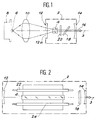
- Figure 1 there is shown schematically a continuous power laser using a single crystal of a silicate according to the invention.
- This laser comprises a laser cavity 2 containing a bar 4 of a silicate of the invention.
- a laser diode 6 supported by a heat dissipating element 8 makes it possible to irradiate the bar 4, via a convergence lens 10 and thus ensure the optical pumping of the bar 4.
- a device for cooling the bar 4 of the water circulation type can be expected around the latter.
- the laser cavity 2 is composed of a dichroic input mirror 12, placed near the bar 4 and of an output mirror 14.
- the input mirror 12 is transparent to the light emitted by the laser diode 6 and opaque to that emitted by the single crystal 4.
- the output mirror 14 is partially transparent to the light emitted by the single crystal 4.
- the excitation of the bar 4 leads to a stimulated emission from the latter which is reflected on the mirror 14 then again crosses the bar 4 where it is amplified.
- the amplified laser beam is then reflected by the mirror 12 towards the bar 4 and so on.
- Wavelength tunability can be obtained using a wavelength selection system 18, interposed between the bar 4 and the outlet 14, of the Brewster angle prism type or a Lyot filter formed by several blades of birefringent material.
- a solid standard 20, of the blade type with parallel faces can be interposed between the bar 4 and the wave selector 18 to fix the emission wavelength.
- silicates of the invention in a power laser as shown in FIG. 2.
- the cavity 2 of this laser comprises, as previously, an inlet mirror 12, an outlet mirror 14 and a bar 4 of a monocrystalline silicate of the invention.
- gas lamps 22 and 24 On either side of the bar 4 are arranged gas lamps 22 and 24 and in particular xenon or krypton flash lamps, of high intensity. These lamps have an elongated shape and are oriented parallel to the axis 3 of the laser to ensure longitudinal optical pumping of the bar 4.
- a device for circulating water around the bar 4 can be provided to cool it.
- the laser cavity 2 further comprises a wavelength selector 18 when a laser tunable in wavelengths is desired.
- a 5mm thick wafer was cut from single crystal n ° 1 in table II, perpendicular to the drawing axis b , then polished. A bar with a diameter of 5mm is then cored along the axis b and then placed in a laser cavity 2 similar to that shown in FIG. 1.
- the rod is pumped using a laser diode 6 emitting either around 0.79-0.80 “m, or around 0.97-0.98” m or either around 1.45-1.48 “m ; the face 12a of the input mirror 12 must be treated with anti-reflection for one or the other of these wavelengths.
- the reflectivity R1 of the input mirror at 1.56 ”m must be maximum, ie R1 ⁇ 99.8%, while that of the output mirror, noted R2, varies between 95 and 99%.
- the laser beam 16 delivered by this cavity has a wavelength of 1.56 "m and is single mode; its output power depends linearly on the power emitted by the laser diode.
- the faces of the bar 4 parallel to the mirror 12 are anti-reflective treated at 1.56 "m.
- a bar whose diameter can vary between 4 and 10mm and whose length is imposed by the useful length of single crystal produced is cored along the axis b in the sample n ° 3.
- the two faces of the bar are then polished, respecting a very good parallelism, then treated anti-reflective at 1.56 "m.
- This bar is placed in a cavity of the type shown in FIG. 2 and pumped using lamps 22, 24 continuous or pulsed with xenon or krypton.
- the reflectivity R1 of the input mirror 12 is maximum at 1.56 ”m, ie R1 ⁇ 99.8% while that of the output mirror R2 can vary between 95 and 99%.
- the energy or the output power of this laser at 1.56 ”m varies linearly with the energy or the power emitted by the lamps.
- a plate 5mm thick is cut perpendicular to the drawing axis b of crystal No. 5, then polished.
- a 5mm diameter rod is then cored along the b axis and anti-reflective treatment in the area 1.7-2.05 ”m.
- This bar is then placed in a cavity 2 identical to that shown in Figure 1, and pumped using a laser diode emitting at 0.791 »m.
- the face 12a of the input mirror is anti-reflective treated at 0.791 ”m.
- the reflectivity R1 of the input mirror 12 in the tunable range of the laser between 1.7 and 2.05 ”m must be maximum, that is R1 ⁇ 99.8% while that of the output mirror R2 can vary between 92 and 99% in the same wavelength range.
- the tunability of the laser beam between 1.7 and 2.05 ”m is achieved using the standard blade 20 and / or a Lyot filter 18 themselves treated with anti-reflection between 1.7 and 2.1” m.
- the power delivered by this laser varies linearly with the power emitted by the laser diode and is maximum around 1.7-1.96 ”m.
Landscapes
- Chemical & Material Sciences (AREA)
- Engineering & Computer Science (AREA)
- Physics & Mathematics (AREA)
- Electromagnetism (AREA)
- Materials Engineering (AREA)
- Organic Chemistry (AREA)
- Plasma & Fusion (AREA)
- Optics & Photonics (AREA)
- Inorganic Chemistry (AREA)
- Crystallography & Structural Chemistry (AREA)
- Metallurgy (AREA)
- Lasers (AREA)
Claims (13)
- Laseremitter, gebildet durch ein einphasiges Mischsilikat aus Yttrium und Lanthanid, das folgende Formel (II) aufweist:
Y2-2x-2yEr2xYb2ySiO₅
in der x und y Zahlen sind wie 0<x≦0,15 und 0≦y≦0,2. - Laseremitter nach Anspruch 1, dadurch gekennzeichnet, daß x die Gleichung 0,005≦x≦0,15 erfüllt.
- Laseremitter nach Anspruch 1 oder 2, dadurch gekennzeichnet, daß x die Gleichung 0,01≦x≦0,03 erfüllt.
- Laseremitter nach einem der Ansprüche 1 bis 3, dadurch gekennzeichnet, daß y die Gleichung 0,08≦y≦0,2 erfüllt.
- Laseremitter nach Anspruch 1, dadurch gekennzeichnet, daß das Silikat die Formel Y1,98ER0,02SiO₅ aufweist.
- Emitter nach Anspruch 1, dadurch gekennzeichnet, daß das Silikat die Formel Y1,74ER0,06Yb0,20SiO₅ aufweist.
- Laseremitter, gebildet durch ein einphasiges Yttrium- und Lanthanide-Mischsilikat, das folgende Formel (III) aufweist:
Y2-2xTm2xSiO₅ (III)
in der x eine Zahl wie 0<x≦0,2 ist. - Emitter nach Anspruch 7, dadurch gekennzeichnet, daß x die Gleichung 0,005≦x≦0,2 erfüllt.
- Emitter nach Anspruch 7, dadurch gekennzeichnet, daß das Silikat die Formel Y1,76Tm0,24SiO₅ aufweist.
- Laser, umfassend einen Laserresonator (2), der einen lichtemittierenden Monokristall (4) einschließt, Verstärkungseinrichtungen (12, 14) des vom Monokristall ausgehenden Lichts, Austrittseinrichtungen (14) des Lichts aus dem Laserresonator und Einrichtungen für optisches Pumpen (6, 22, 24),
dadurch gekennzeichnet, daß der Monokristall die folgende Formel (I) aufweist:
Y2-2x-2yM2xYb2ySiO₅ (I)
in der M ein Lanthanid darstellt, gewählt zwischen Erbium und Thulium, und x und y Zahlen wie 0<x≦0,2 und 0≦y≦0,2 darstellen. - Laser nach Anspruch 10, dadurch gekennzeichnet, daß die Einrichtungen zum optischen Pumpen aus wenigstens einer Laserdiode bestehen.
- Laser nach Anspruch 10 oder 11, wellenlängenmäßig abstimmbar im Infrarotbereich, dadurch gekennzeichnet, daß er Abstimmeinrichtungen umfaßt und dadurch, daß M Tr darstellt mit 0<x≦0,2 und y=0.
- Laser nach Anspruch 10 oder 11, mit 1,55»m emittierend, dadurch gekennzeichnet, daß M Er darstellt mit 0<x≦0,15 und 0≦y≦0,2.
Applications Claiming Priority (2)
| Application Number | Priority Date | Filing Date | Title |
|---|---|---|---|
| FR9013231A FR2668464B1 (fr) | 1990-10-25 | 1990-10-25 | Silicates mixtes d'yttrium et de lanthanide et laser utilisant des monocristaux de ces silicates. |
| FR9013231 | 1990-10-25 |
Publications (2)
| Publication Number | Publication Date |
|---|---|
| EP0483003A1 EP0483003A1 (de) | 1992-04-29 |
| EP0483003B1 true EP0483003B1 (de) | 1995-03-01 |
Family
ID=9401555
Family Applications (1)
| Application Number | Title | Priority Date | Filing Date |
|---|---|---|---|
| EP91402828A Expired - Lifetime EP0483003B1 (de) | 1990-10-25 | 1991-10-23 | Laser mit gemischten Yttrium- und Lanthanidsilicateneinkristallen |
Country Status (6)
| Country | Link |
|---|---|
| US (1) | US5173911A (de) |
| EP (1) | EP0483003B1 (de) |
| JP (1) | JPH0613693A (de) |
| CN (1) | CN1032319C (de) |
| DE (1) | DE69107777T2 (de) |
| FR (1) | FR2668464B1 (de) |
Cited By (2)
| Publication number | Priority date | Publication date | Assignee | Title |
|---|---|---|---|---|
| US7629621B2 (en) | 1996-06-26 | 2009-12-08 | Osram Gmbh | Light-radiating semiconductor component with a luminescence conversion element |
| US7709852B2 (en) | 1996-09-20 | 2010-05-04 | Osram Gmbh | Wavelength-converting casting composition and light-emitting semiconductor component |
Families Citing this family (13)
| Publication number | Priority date | Publication date | Assignee | Title |
|---|---|---|---|---|
| US5299215A (en) * | 1991-09-25 | 1994-03-29 | Amoco Corporation | Rare earth ion upconversion laser system |
| US5295146A (en) * | 1992-04-10 | 1994-03-15 | Polaroid Corporation | Solid state gain mediums for optically pumped monolithic laser |
| CN1035146C (zh) * | 1994-08-24 | 1997-06-11 | 电子部第11研究所 | Q开关微微秒脉冲激光器 |
| US5541948A (en) * | 1994-11-28 | 1996-07-30 | The Regents Of The University Of California | Transition-metal doped sulfide, selenide, and telluride laser crystal and lasers |
| RU2186162C2 (ru) * | 1999-07-13 | 2002-07-27 | Кубанский государственный университет | Монокристаллический лазерный материал на основе оксисиликатов редкоземельных элементов |
| US20010021215A1 (en) * | 1999-07-30 | 2001-09-13 | Udo Bunting | Compact ultra fast laser |
| US6891878B2 (en) * | 2003-05-01 | 2005-05-10 | Raytheon Company | Eye-safe solid state laser system and method |
| CN101319395B (zh) * | 2008-06-25 | 2011-11-02 | 福州高意通讯有限公司 | 一种掺钕钒酸镧钇激光晶体及其制备方法和应用 |
| JP5947148B2 (ja) * | 2012-08-15 | 2016-07-06 | 日本電信電話株式会社 | 光素子の製造方法 |
| JP5952130B2 (ja) * | 2012-08-15 | 2016-07-13 | 日本電信電話株式会社 | 光素子の製造方法 |
| CN105776232B (zh) * | 2016-01-29 | 2018-06-22 | 陕西科技大学 | 一种片状Y2SiO5的制备方法 |
| CZ308384B6 (cs) * | 2017-11-29 | 2020-07-15 | Crytur, Spol. S R.O. | Zdroj nekoherentního záření |
| CN114204396A (zh) * | 2020-09-17 | 2022-03-18 | 中国科学院上海光学精密机械研究所 | 基于掺铥离子晶体的全固态蓝绿光激光器 |
Family Cites Families (5)
| Publication number | Priority date | Publication date | Assignee | Title |
|---|---|---|---|---|
| US3632523A (en) * | 1969-09-22 | 1972-01-04 | Westinghouse Electric Corp | Calcium-yttrium silicate oxyapatite laser materials |
| FR2599733B1 (fr) * | 1986-06-10 | 1988-08-26 | Centre Nat Rech Scient | Gallates mixtes de lanthanide-magnesium, laser utilisant des monocristaux de ces gallates |
| FR2600055B1 (fr) * | 1986-06-16 | 1988-08-26 | Commissariat Energie Atomique | Aluminates mixtes de lanthanide-magnesium, lasers utilisant des monocristaux de ces aluminates |
| EP0253589A1 (de) * | 1986-07-14 | 1988-01-20 | AT&T Corp. | Anzeigevorrichtung mit Kristall- und Pulverphosphoren |
| US4954211A (en) * | 1988-03-04 | 1990-09-04 | Litton Systems, Inc. | Monocrystalline lanthanum orthogallate laser material |
-
1990
- 1990-10-25 FR FR9013231A patent/FR2668464B1/fr not_active Expired - Fee Related
-
1991
- 1991-10-22 JP JP3301203A patent/JPH0613693A/ja active Pending
- 1991-10-23 EP EP91402828A patent/EP0483003B1/de not_active Expired - Lifetime
- 1991-10-23 DE DE69107777T patent/DE69107777T2/de not_active Expired - Fee Related
- 1991-10-24 CN CN91109846A patent/CN1032319C/zh not_active Expired - Fee Related
- 1991-10-25 US US07/782,534 patent/US5173911A/en not_active Expired - Fee Related
Cited By (4)
| Publication number | Priority date | Publication date | Assignee | Title |
|---|---|---|---|---|
| US7629621B2 (en) | 1996-06-26 | 2009-12-08 | Osram Gmbh | Light-radiating semiconductor component with a luminescence conversion element |
| US9196800B2 (en) | 1996-06-26 | 2015-11-24 | Osram Gmbh | Light-radiating semiconductor component with a luminescence conversion element |
| US7709852B2 (en) | 1996-09-20 | 2010-05-04 | Osram Gmbh | Wavelength-converting casting composition and light-emitting semiconductor component |
| US8071996B2 (en) | 1996-09-20 | 2011-12-06 | Osram Gmbh | Wavelength-converting casting composition and light-emitting semiconductor component |
Also Published As
| Publication number | Publication date |
|---|---|
| US5173911A (en) | 1992-12-22 |
| FR2668464B1 (fr) | 1993-01-08 |
| CN1032319C (zh) | 1996-07-17 |
| EP0483003A1 (de) | 1992-04-29 |
| FR2668464A1 (fr) | 1992-04-30 |
| JPH0613693A (ja) | 1994-01-21 |
| CN1059882A (zh) | 1992-04-01 |
| DE69107777T2 (de) | 1995-09-21 |
| DE69107777D1 (de) | 1995-04-06 |
Similar Documents
| Publication | Publication Date | Title |
|---|---|---|
| EP0451001B1 (de) | Strontium und Lanthanid Mischoxide und Laser der Einkristalle dieser Oxide verwendet | |
| Lu et al. | Highly efficient 2% Nd: yttrium aluminum garnet ceramic laser | |
| EP0483003A1 (de) | Laser mit gemischten Yttrium- und Lanthanidsilicateneinkristallen | |
| CN1589513A (zh) | 中红外微芯片激光器:带有可饱和吸收材料的ZnS:Cr2+激光器 | |
| EP3850715B1 (de) | Laserkristall mit mindestens zwei co-dotierstoffen | |
| FR2826519A1 (fr) | Commutateur de facteur de qualite a absorbeur saturable dope au cobalt et systeme laser | |
| Mikhailov et al. | Tm3+: GdVO4—a new efficient medium for diode-pumped 2—μm lasers | |
| Wang et al. | 978 nm LD side-pumped Er: LuYSGG CW laser with 16.7 W output power at 2797 nm | |
| Sudesh et al. | Pulsed laser action in Tm, Ho: LuLiF/sub 4/and Tm, Ho: YLiF/sub 4/crystals using a novel quasi-end-pumping technique | |
| CN114108072A (zh) | 稀土离子掺杂的GdScO3激光晶体制备及其应用 | |
| FR2773000A1 (fr) | Cavite laser a declenchement passif a polarisation controlee, microlaser comprenant cette cavite, et procede de fabrication de ce microlaser | |
| Borik et al. | Lasing characteristics of ZrO2-Y2O3-Ho2O3 crystal | |
| Ebendorff-Heidepriem et al. | Properties of Er3+-doped glasses for waveguide and fiber lasers | |
| FR2771107A1 (fr) | Procede de preparation par croissance par epitaxie en phase liquide de couches monocristallines d'aluminate de lanthane et de magnesium (lma) et composants optiques comprenant ces couches | |
| FR2678648A1 (fr) | Cristal de gehlenite dopee au neodyme et laser utilisant ce cristal. | |
| Zhao et al. | Crystal growth, spectroscopic characterization, and continuous wave laser operation of Nd3+‐doped LiLuF4 crystal | |
| RU2738096C1 (ru) | Компактный твердотельный лазер красного диапазона спектра | |
| Slimi et al. | Growth, spectroscopy and laser operation of in-band pumped Ho3+-doped Yttrium Gallium Garnet | |
| Zavartsev et al. | Diode-pumped Tm: Sc2SiO5 laser (λ= 1.98 μm) | |
| CN102978705A (zh) | 铥钬共掺钼酸钆锂激光晶体及其制备方法和用途 | |
| Urata et al. | Laser performance of neodymium-doped lanthanum tungstate crystals | |
| Sudesh et al. | Growth and characterization of Tm, Ho-doped LuLiF4 and YLiF4 crystals | |
| Veselský et al. | The influence of low Gd3+ codoping on spectroscopic and laser properties of diode pumped Tm, Gd: SrF2 laser | |
| US6937630B2 (en) | Laser oscillation method and laser device | |
| JP2001223423A (ja) | レーザー装置 |
Legal Events
| Date | Code | Title | Description |
|---|---|---|---|
| PUAI | Public reference made under article 153(3) epc to a published international application that has entered the european phase |
Free format text: ORIGINAL CODE: 0009012 |
|
| AK | Designated contracting states |
Kind code of ref document: A1 Designated state(s): CH DE GB IT LI NL |
|
| 17P | Request for examination filed |
Effective date: 19921001 |
|
| 17Q | First examination report despatched |
Effective date: 19931004 |
|
| GRAA | (expected) grant |
Free format text: ORIGINAL CODE: 0009210 |
|
| AK | Designated contracting states |
Kind code of ref document: B1 Designated state(s): CH DE GB IT LI NL |
|
| PG25 | Lapsed in a contracting state [announced via postgrant information from national office to epo] |
Ref country code: NL Free format text: LAPSE BECAUSE OF NON-PAYMENT OF DUE FEES Effective date: 19950301 |
|
| REF | Corresponds to: |
Ref document number: 69107777 Country of ref document: DE Date of ref document: 19950406 |
|
| ITF | It: translation for a ep patent filed | ||
| GBT | Gb: translation of ep patent filed (gb section 77(6)(a)/1977) |
Effective date: 19950512 |
|
| NLV1 | Nl: lapsed or annulled due to failure to fulfill the requirements of art. 29p and 29m of the patents act | ||
| PLBE | No opposition filed within time limit |
Free format text: ORIGINAL CODE: 0009261 |
|
| STAA | Information on the status of an ep patent application or granted ep patent |
Free format text: STATUS: NO OPPOSITION FILED WITHIN TIME LIMIT |
|
| 26N | No opposition filed | ||
| PGFP | Annual fee paid to national office [announced via postgrant information from national office to epo] |
Ref country code: CH Payment date: 19961015 Year of fee payment: 6 |
|
| PGFP | Annual fee paid to national office [announced via postgrant information from national office to epo] |
Ref country code: GB Payment date: 19971016 Year of fee payment: 7 |
|
| PGFP | Annual fee paid to national office [announced via postgrant information from national office to epo] |
Ref country code: DE Payment date: 19971027 Year of fee payment: 7 |
|
| PG25 | Lapsed in a contracting state [announced via postgrant information from national office to epo] |
Ref country code: LI Free format text: LAPSE BECAUSE OF NON-PAYMENT OF DUE FEES Effective date: 19971031 Ref country code: CH Free format text: LAPSE BECAUSE OF NON-PAYMENT OF DUE FEES Effective date: 19971031 |
|
| REG | Reference to a national code |
Ref country code: CH Ref legal event code: PL |
|
| PG25 | Lapsed in a contracting state [announced via postgrant information from national office to epo] |
Ref country code: GB Free format text: LAPSE BECAUSE OF NON-PAYMENT OF DUE FEES Effective date: 19981023 |
|
| GBPC | Gb: european patent ceased through non-payment of renewal fee |
Effective date: 19981023 |
|
| PG25 | Lapsed in a contracting state [announced via postgrant information from national office to epo] |
Ref country code: DE Free format text: LAPSE BECAUSE OF NON-PAYMENT OF DUE FEES Effective date: 19990803 |
|
| PG25 | Lapsed in a contracting state [announced via postgrant information from national office to epo] |
Ref country code: IT Free format text: LAPSE BECAUSE OF NON-PAYMENT OF DUE FEES;WARNING: LAPSES OF ITALIAN PATENTS WITH EFFECTIVE DATE BEFORE 2007 MAY HAVE OCCURRED AT ANY TIME BEFORE 2007. THE CORRECT EFFECTIVE DATE MAY BE DIFFERENT FROM THE ONE RECORDED. Effective date: 20051023 |