EP0483003B1 - Laser using mixed yttrium and lanthanide silicates single crystals - Google Patents
Laser using mixed yttrium and lanthanide silicates single crystals Download PDFInfo
- Publication number
- EP0483003B1 EP0483003B1 EP91402828A EP91402828A EP0483003B1 EP 0483003 B1 EP0483003 B1 EP 0483003B1 EP 91402828 A EP91402828 A EP 91402828A EP 91402828 A EP91402828 A EP 91402828A EP 0483003 B1 EP0483003 B1 EP 0483003B1
- Authority
- EP
- European Patent Office
- Prior art keywords
- laser
- ions
- silicates
- silicate
- lanthanide
- Prior art date
- Legal status (The legal status is an assumption and is not a legal conclusion. Google has not performed a legal analysis and makes no representation as to the accuracy of the status listed.)
- Expired - Lifetime
Links
Images
Classifications
-
- H—ELECTRICITY
- H01—ELECTRIC ELEMENTS
- H01S—DEVICES USING THE PROCESS OF LIGHT AMPLIFICATION BY STIMULATED EMISSION OF RADIATION [LASER] TO AMPLIFY OR GENERATE LIGHT; DEVICES USING STIMULATED EMISSION OF ELECTROMAGNETIC RADIATION IN WAVE RANGES OTHER THAN OPTICAL
- H01S3/00—Lasers, i.e. devices using stimulated emission of electromagnetic radiation in the infrared, visible or ultraviolet wave range
- H01S3/14—Lasers, i.e. devices using stimulated emission of electromagnetic radiation in the infrared, visible or ultraviolet wave range characterised by the material used as the active medium
- H01S3/16—Solid materials
- H01S3/1688—Stoichiometric laser compounds, i.e. in which the active element forms one component of a stoichiometric formula rather than being merely a dopant
-
- C—CHEMISTRY; METALLURGY
- C09—DYES; PAINTS; POLISHES; NATURAL RESINS; ADHESIVES; COMPOSITIONS NOT OTHERWISE PROVIDED FOR; APPLICATIONS OF MATERIALS NOT OTHERWISE PROVIDED FOR
- C09K—MATERIALS FOR MISCELLANEOUS APPLICATIONS, NOT PROVIDED FOR ELSEWHERE
- C09K11/00—Luminescent materials, e.g. electroluminescent or chemiluminescent
- C09K11/08—Luminescent materials, e.g. electroluminescent or chemiluminescent containing inorganic luminescent materials
- C09K11/77—Luminescent materials, e.g. electroluminescent or chemiluminescent containing inorganic luminescent materials containing rare earth metals
- C09K11/7766—Luminescent materials, e.g. electroluminescent or chemiluminescent containing inorganic luminescent materials containing rare earth metals containing two or more rare earth metals
- C09K11/77742—Silicates
-
- C—CHEMISTRY; METALLURGY
- C30—CRYSTAL GROWTH
- C30B—SINGLE-CRYSTAL GROWTH; UNIDIRECTIONAL SOLIDIFICATION OF EUTECTIC MATERIAL OR UNIDIRECTIONAL DEMIXING OF EUTECTOID MATERIAL; REFINING BY ZONE-MELTING OF MATERIAL; PRODUCTION OF A HOMOGENEOUS POLYCRYSTALLINE MATERIAL WITH DEFINED STRUCTURE; SINGLE CRYSTALS OR HOMOGENEOUS POLYCRYSTALLINE MATERIAL WITH DEFINED STRUCTURE; AFTER-TREATMENT OF SINGLE CRYSTALS OR A HOMOGENEOUS POLYCRYSTALLINE MATERIAL WITH DEFINED STRUCTURE; APPARATUS THEREFOR
- C30B15/00—Single-crystal growth by pulling from a melt, e.g. Czochralski method
-
- C—CHEMISTRY; METALLURGY
- C30—CRYSTAL GROWTH
- C30B—SINGLE-CRYSTAL GROWTH; UNIDIRECTIONAL SOLIDIFICATION OF EUTECTIC MATERIAL OR UNIDIRECTIONAL DEMIXING OF EUTECTOID MATERIAL; REFINING BY ZONE-MELTING OF MATERIAL; PRODUCTION OF A HOMOGENEOUS POLYCRYSTALLINE MATERIAL WITH DEFINED STRUCTURE; SINGLE CRYSTALS OR HOMOGENEOUS POLYCRYSTALLINE MATERIAL WITH DEFINED STRUCTURE; AFTER-TREATMENT OF SINGLE CRYSTALS OR A HOMOGENEOUS POLYCRYSTALLINE MATERIAL WITH DEFINED STRUCTURE; APPARATUS THEREFOR
- C30B29/00—Single crystals or homogeneous polycrystalline material with defined structure characterised by the material or by their shape
- C30B29/10—Inorganic compounds or compositions
- C30B29/34—Silicates
-
- H—ELECTRICITY
- H01—ELECTRIC ELEMENTS
- H01S—DEVICES USING THE PROCESS OF LIGHT AMPLIFICATION BY STIMULATED EMISSION OF RADIATION [LASER] TO AMPLIFY OR GENERATE LIGHT; DEVICES USING STIMULATED EMISSION OF ELECTROMAGNETIC RADIATION IN WAVE RANGES OTHER THAN OPTICAL
- H01S3/00—Lasers, i.e. devices using stimulated emission of electromagnetic radiation in the infrared, visible or ultraviolet wave range
- H01S3/10—Controlling the intensity, frequency, phase, polarisation or direction of the emitted radiation, e.g. switching, gating, modulating or demodulating
- H01S3/106—Controlling the intensity, frequency, phase, polarisation or direction of the emitted radiation, e.g. switching, gating, modulating or demodulating by controlling devices placed within the cavity
- H01S3/1062—Controlling the intensity, frequency, phase, polarisation or direction of the emitted radiation, e.g. switching, gating, modulating or demodulating by controlling devices placed within the cavity using a controlled passive interferometer, e.g. a Fabry-Perot etalon
Definitions
- the present invention relates to laser emitters made up of mixed single-phase yttrium and lanthanide silicates, obtained in particular in the form of single crystals. It finds an application in the field of microlasers for integrated optics, telecommunications by optical fibers, medicine (microsurgery, treatment of the skin and eyes), the study of semiconductors and scientific research (spectroscopy of molecules and materials) as well as in the field of power lasers to perform remote analyzes of the atmosphere, space communications.
- These lasers emit at room temperature in the ocular safety zone around 1.55 and 2 ”m. They have a certain degree of tunability in wavelength.
- laser emitters delivering a wavelength close to 1.55 "m can be obtained by doping with Er3+ ions of a matrix transparent to this wavelength: crystal or glass.
- the transition between the excited state 4I 13/2 and the ground state 4I 15/2 of the Er3+ ions leads to a laser at 3 levels.
- Lasers tunable around 2 ”m, operating at room temperature, have already been produced from well known laser materials: Y3Al5O12, Y3Sc2Ga3O12, YAlO3, LiYF4 doped with Tm3+ and / or Ho3+ ions. These lasers respectively use the electronic transitions between the level 3F4 and the fundamental level 3H6 of the Tm3+ ions and between the level 5I7 and the fundamental level 5I8 of the Ho3+ ions; these are therefore 3-level lasers for which the population of the fundamental level at ambient temperature plays a preponderant role.
- Er3+ doped glasses and silica fibers seem to partially remedy the drawbacks of the monocrystalline materials mentioned above. Besides the fact that these Er3+ doped matrices have a stimulated emission in the maximum ocular safety range (Table I), the greens and the fibers have a high density of phonons, which makes it possible to depopulate the electronic levels of the Er3+ ions, possibly populated by energy transfers between these ions, by relaxation processes not radiative. Unfortunately the thermomechanical properties, the thermal conductivity in particular, of glasses and fibers, much weaker than those of the monocrystalline materials above, are not sufficient to allow the construction of a laser of high average power.
- the production of a power laser emitting around 1.55 and 2 "m necessarily involves the use in the laser cavity of a monocrystalline material (for its good thermomechanical properties) capable of being doped by Er3+, Tm3+ and Ho3+ ions and presenting for these dopings only a very low probability of energy transfer between these ions.
- One of the solutions to minimize or even eliminate these energy transfers is to isolate the active ions Er3+, Ho3+ and Tm3+ from each other by using host matrices based on very bulky anion-cation groups such as silicates. .
- silicates have, like glasses and fibers, the property of having significant phonon densities. Therefore, the electronic levels of the active ions possibly populated by "cross-relaxation” and / or by "up-conversion” preferentially de-excite by non-radiative relaxation processes assisted by phonons, up to the upper level of the laser transition. in the infrared, which further increases the efficiency of the stimulated emissions around 1.5 and 2 ”m.
- the monocrystals of yttrium oxyorthosilicate Y2SiO5, hereinafter called YSO, doped with a rare earth have quite interesting luminescent properties.
- the YSO single crystals are codoped with Er3+ and Tm3+ ions in order to increase the average absorption coefficient of this material in the lamp emission area.
- the Er3+ and Tm3+ ions are used as sensitizers for the stimulated emission of effectively active Ho3+ ions.
- the Er3+ and Tm3+ ions are in fact intermediaries between the pump light emitted by the lamps and the Ho3+ ions alone responsible for the stimulated emission around 2.1 ”m.
- the probability of energy transfer between the Er3+ and Tm3+ ions on the one hand and the Ho3+ ions on the other hand is very high; no stimulated emission from the Er3+ and Tm3+ ions was observed by A.M. Morozov.
- YSO crystals have been produced doped with Nd3+ ions having an effective stimulated emission at 0.912 and 1.075 "m as described in the article by K.S. Bagdasarov et al, Sov. PHys. Dokl., Vol 18, 10 (74), p. 664.
- the subject of the invention is new laser emitters made up of mixed single-phase yttrium and lanthanide silicates, in particular monocrystalline, which in particular make it possible to remedy the various drawbacks mentioned above.
- these silicates have an emission stimulated effective at room temperature usable in lasers of high average power emitting in the infrared.
- the subject of the invention is a laser emitter consisting of a mixed silicate of yttrium and of single-phase lanthanide, having the following formula (II): Y 2-2x-2y Er 2x Yb 2y SiO5 in which x and y are numbers such that O ⁇ x ⁇ 0.15 and 0 ⁇ y ⁇ 0.2. or the following formula (III): Y 2-2x Tm 2x SiO5 (III) where x is a number such that 0 ⁇ x ⁇ 0.2.
- the doped mixed yttrium silicates corresponding to formulas (II) and (III) can be produced easily in the form of single crystals by the conventional methods of drawing from a molten bath such as the Czochralski or Bridgman method.
- the ionic radii of the Er3+ and Tm3+ ions are close to those of the Y3+ ions and the segregation coefficient of these lanthanide ions is close to 1; the fusion of these silicates is said to be congruent. This facilitates the crystal growth of these silicates, thus making it possible to obtain large, good quality crystals by the Czochralski method used industrially for the manufacture of power lasers.
- thermomechanical properties of YSO and in particular the thermal conductivity are closer to those of yttrium and aluminum garnet of formula Y3Al5O12 than to those of glasses. This good thermal conductivity allows good heat dissipation from the emitting single crystal, which is necessary for the production of a power laser.
- Lasers using single crystals silicates of the invention can be optically pumped by lamps or one or more laser diodes.
- laser diodes are used for optical pumping.
- these laser diodes have the advantage of being extremely small, considerably reducing the total dimensions of the laser.
- they offer a certain tunability in wavelengths and excellent efficiency, which improves the efficiency of the laser effect from electric current compared to pumping by lamp.
- the laser activator is the Er3+ or Tm3+ ion and the laser sensitizer is the Yb3+ ion.
- the mixed yttrium and lanthanide silicates having the formula (II) are single-phase and intended to be manufactured in monocrystalline form for the production of lasers emitting in the infrared around 1.55 "m with a certain tunability.
- the YSO: Er3+ single crystals are characterized in particular by a fluorescence band wide from 1.45 to 1.7 ”m with a maximum fluorescence around 1.545” m, area of maximum eye safety.
- the optimal is for values of x varying from 0.01 to 0.03.
- Coding with ytterbium makes it possible to increase the pumping efficiency of lasers based on YSO: Er when the latter are pumped using a laser diode emitting at 0.79 or 0.98 »M or lamps.
- This codoping already used in phosphate-doped Er3+ glasses, has the advantage of associating with the fine absorption bands of Er3+ ions a wide absorption band around 0.99 "m capable of being populated either by non-radiative de-excitation of the upper levels of Er3+ ions, ie by pumping using a laser diode at 0.98 »m.
- the mixed yttrium-thulium silicates of formula (III) When the mixed yttrium-thulium silicates of formula (III) are produced in the form of single crystals and placed in a laser cavity, they exhibit a very intense and very wide fluorescence band from 1.5 to 2.1 ”m with several maximum around 1.72, 1.8, 1.94 and 2.02 ”m when excited with a 0.79” m laser diode.
- This laser is in particular a laser tunable in wavelengths and therefore includes tunability means.
- this molten bath starting from a hydroxide coprecipitate, in an aqueous solvent or not, of the ions Y3+, Si4+, Er3+ or Tm3+ and possibly Yb3+.
- the coprecipitate can be obtained by the action of ammonia on nitrates or chlorides of the various metallic elements, available on the market.
- the coprecipitate obtained is then treated at 400 ° C. in a ventilated atmosphere until complete dehydration and then calcined at 1500 ° C.
- the product obtained is then placed in an iridium crucible to form the molten bath.
- a monocrystalline seed of the same composition as the molten bath and for example cut parallel to the direction b of the crystalloraphic mesh is then brought into contact with the bath and then raised upwards while being animated by a movement of rotation on itself.
- the single crystal is thus gradually formed at the end of the seed in the direction imposed by the latter.
- the drawing speed is chosen from 0.3 to 2 mm / h and the rotation speed is chosen from 5 to 40 revolutions / minute.
- Table II appended gives examples of monocrystals of silicates of the invention obtained by the Czochralski method from oxide powders of the various ions.
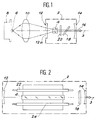
- Figure 1 there is shown schematically a continuous power laser using a single crystal of a silicate according to the invention.
- This laser comprises a laser cavity 2 containing a bar 4 of a silicate of the invention.
- a laser diode 6 supported by a heat dissipating element 8 makes it possible to irradiate the bar 4, via a convergence lens 10 and thus ensure the optical pumping of the bar 4.
- a device for cooling the bar 4 of the water circulation type can be expected around the latter.
- the laser cavity 2 is composed of a dichroic input mirror 12, placed near the bar 4 and of an output mirror 14.
- the input mirror 12 is transparent to the light emitted by the laser diode 6 and opaque to that emitted by the single crystal 4.
- the output mirror 14 is partially transparent to the light emitted by the single crystal 4.
- the excitation of the bar 4 leads to a stimulated emission from the latter which is reflected on the mirror 14 then again crosses the bar 4 where it is amplified.
- the amplified laser beam is then reflected by the mirror 12 towards the bar 4 and so on.
- Wavelength tunability can be obtained using a wavelength selection system 18, interposed between the bar 4 and the outlet 14, of the Brewster angle prism type or a Lyot filter formed by several blades of birefringent material.
- a solid standard 20, of the blade type with parallel faces can be interposed between the bar 4 and the wave selector 18 to fix the emission wavelength.
- silicates of the invention in a power laser as shown in FIG. 2.
- the cavity 2 of this laser comprises, as previously, an inlet mirror 12, an outlet mirror 14 and a bar 4 of a monocrystalline silicate of the invention.
- gas lamps 22 and 24 On either side of the bar 4 are arranged gas lamps 22 and 24 and in particular xenon or krypton flash lamps, of high intensity. These lamps have an elongated shape and are oriented parallel to the axis 3 of the laser to ensure longitudinal optical pumping of the bar 4.
- a device for circulating water around the bar 4 can be provided to cool it.
- the laser cavity 2 further comprises a wavelength selector 18 when a laser tunable in wavelengths is desired.
- a 5mm thick wafer was cut from single crystal n ° 1 in table II, perpendicular to the drawing axis b , then polished. A bar with a diameter of 5mm is then cored along the axis b and then placed in a laser cavity 2 similar to that shown in FIG. 1.
- the rod is pumped using a laser diode 6 emitting either around 0.79-0.80 “m, or around 0.97-0.98” m or either around 1.45-1.48 “m ; the face 12a of the input mirror 12 must be treated with anti-reflection for one or the other of these wavelengths.
- the reflectivity R1 of the input mirror at 1.56 ”m must be maximum, ie R1 ⁇ 99.8%, while that of the output mirror, noted R2, varies between 95 and 99%.
- the laser beam 16 delivered by this cavity has a wavelength of 1.56 "m and is single mode; its output power depends linearly on the power emitted by the laser diode.
- the faces of the bar 4 parallel to the mirror 12 are anti-reflective treated at 1.56 "m.
- a bar whose diameter can vary between 4 and 10mm and whose length is imposed by the useful length of single crystal produced is cored along the axis b in the sample n ° 3.
- the two faces of the bar are then polished, respecting a very good parallelism, then treated anti-reflective at 1.56 "m.
- This bar is placed in a cavity of the type shown in FIG. 2 and pumped using lamps 22, 24 continuous or pulsed with xenon or krypton.
- the reflectivity R1 of the input mirror 12 is maximum at 1.56 ”m, ie R1 ⁇ 99.8% while that of the output mirror R2 can vary between 95 and 99%.
- the energy or the output power of this laser at 1.56 ”m varies linearly with the energy or the power emitted by the lamps.
- a plate 5mm thick is cut perpendicular to the drawing axis b of crystal No. 5, then polished.
- a 5mm diameter rod is then cored along the b axis and anti-reflective treatment in the area 1.7-2.05 ”m.
- This bar is then placed in a cavity 2 identical to that shown in Figure 1, and pumped using a laser diode emitting at 0.791 »m.
- the face 12a of the input mirror is anti-reflective treated at 0.791 ”m.
- the reflectivity R1 of the input mirror 12 in the tunable range of the laser between 1.7 and 2.05 ”m must be maximum, that is R1 ⁇ 99.8% while that of the output mirror R2 can vary between 92 and 99% in the same wavelength range.
- the tunability of the laser beam between 1.7 and 2.05 ”m is achieved using the standard blade 20 and / or a Lyot filter 18 themselves treated with anti-reflection between 1.7 and 2.1” m.
- the power delivered by this laser varies linearly with the power emitted by the laser diode and is maximum around 1.7-1.96 ”m.
Landscapes
- Chemical & Material Sciences (AREA)
- Engineering & Computer Science (AREA)
- Physics & Mathematics (AREA)
- Electromagnetism (AREA)
- Materials Engineering (AREA)
- Organic Chemistry (AREA)
- Plasma & Fusion (AREA)
- Optics & Photonics (AREA)
- Inorganic Chemistry (AREA)
- Crystallography & Structural Chemistry (AREA)
- Metallurgy (AREA)
- Lasers (AREA)
Description
La présente invention a pour objet des émetteurs lasers constitués de silicates mixtes d'yttrium et de lanthanide monophasés, obtenus en particulier sous forme de monocristaux. Elle trouve une application dans le domaine des microlasers pour l'optique intégrée, les télécommunications par fibres optiques, la médecine (microchirurgie, traitement de la peau et des yeux), l'étude des semi-conducteurs et la recherche scientifique (spectroscopie des molécules organiques et des matériaux) ainsi que dans le domaine des lasers de puissance pour effectuer des analyses à distance de l'atmosphère, des communications spatiales.The present invention relates to laser emitters made up of mixed single-phase yttrium and lanthanide silicates, obtained in particular in the form of single crystals. It finds an application in the field of microlasers for integrated optics, telecommunications by optical fibers, medicine (microsurgery, treatment of the skin and eyes), the study of semiconductors and scientific research (spectroscopy of molecules and materials) as well as in the field of power lasers to perform remote analyzes of the atmosphere, space communications.
Ces lasers émettent à température ambiante dans la zone de sécurité occulaire autour de 1,55 et de 2»m. Ils présentent un certain degré d'accordabilité en longueur d'onde.These lasers emit at room temperature in the ocular safety zone around 1.55 and 2 ”m. They have a certain degree of tunability in wavelength.
De façon connue, des émetteurs lasers délivrant une longueur d'onde voisine de 1,55»m peuvent être obtenus par le dopage par des ions Er³⁺ d'une matrice transparente à cette longueur d'onde : cristal ou verre. La transition entre l'état excité ⁴I13/2 et l'état fondamental ⁴I15/2 des ions Er³⁺ conduit à un laser à 3 niveaux. La longueur d'onde émise par cette transition, à température ambiante, dépend fortement de l'environnement cristallographique des ions Er³⁺, comme le montre le tableau I ci-joint.In known manner, laser emitters delivering a wavelength close to 1.55 "m can be obtained by doping with Er³⁺ ions of a matrix transparent to this wavelength: crystal or glass. The transition between the excited state ⁴I 13/2 and the ground state ⁴I 15/2 of the Er³⁺ ions leads to a laser at 3 levels. The wavelength emitted by this transition, at room temperature, strongly depends on the crystallographic environment of the Er³⁺ ions, as shown in Table I attached.
Des lasers accordables autour de 2»m, fonctionnant à température ambiante, ont déjà été réalisés à partir de matériaux lasers bien connus :
Y₃Al₅O₁₂, Y₃Sc₂Ga₃O₁₂, YAlO₃, LiYF₄
dopés avec des ions Tm³⁺ et/ou Ho³⁺. Ces lasers utilisent respectivement les transitions électroniques entre le niveau ³F₄ et le niveau fondamental ³H₆ des ions Tm³⁺ et entre le niveau ⁵I₇ et le niveau fondamental ⁵I₈ des ions Ho³⁺ ; ce sont donc des lasers à 3 niveaux pour lesquels la population du niveau fondamental à température ambiante joue un rôle prépondérant.Lasers tunable around 2 ”m, operating at room temperature, have already been produced from well known laser materials:
Y₃Al₅O₁₂, Y₃Sc₂Ga₃O₁₂, YAlO₃, LiYF₄
doped with Tm³⁺ and / or Ho³⁺ ions. These lasers respectively use the electronic transitions between the level ³F₄ and the fundamental level ³H₆ of the Tm³⁺ ions and between the level ⁵I₇ and the fundamental level ⁵I₈ of the Ho³⁺ ions; these are therefore 3-level lasers for which the population of the fundamental level at ambient temperature plays a preponderant role.
Une proprièté très importante des ions Er³⁺, Ho³⁺ et Tm³⁺ est la forte probabilité de transferts d'énergie entre ces ions excités qui conduit aux processus de relaxation croisée et de conversion vers le haut ("Cross-relaxation" et "up-conversion" en terminologie anglo-saxonne) limitant souvent l'efficacité laser des transitions dans l'infrarouge.A very important property of the Er³⁺, Ho³⁺ and Tm³⁺ ions is the high probability of energy transfers between these excited ions which leads to the processes of cross relaxation and up conversion ("Cross-relaxation" and "up- conversion "in Anglo-Saxon terminology) often limiting the laser efficiency of transitions in the infrared.
Il est ainsi possible d'obtenir un laser émettant de la lumière verte à partir des monocristaux de YAlO₃, Y₃Al₅O₁₂, Y₃Sc₂Ga₃O₁₂, LiYF₄ ou YF₃ dopés par les ions Er³⁺ et un laser émettant dans le bleu à partir de cristaux de LiYF₄ dopés avec des ions Tm³⁺ lorsque les monocristaux sont pompés dans le proche infrarouge. Il est alors évident que le rendement des émissions stimulés infrarouges caractéristiques de ces ions autour de 1,55 et de 2»m s'en trouve notablement affecté.It is thus possible to obtain a laser emitting green light from the YAlO₃, Y₃Al₅O₁₂, Y₃Sc₂Ga₃O₁₂, LiYF₄ or YF₃ monocrystals doped with Er³⁺ ions and a laser emitting in blue from LiYF₄ crystals doped with Tm³⁺ ions when the single crystals are pumped in the near infrared. It is then obvious that the efficiency of the stimulated infrared emissions characteristic of these ions around 1.55 and 2 ”m is notably affected.
Les verres et les fibres de silice dopés Er³⁺ semblent remédier en partie aux inconvénients des matériaux monocristallins précédemment cités. Outre le fait que ces matrices dopées Er³⁺ présentent une émission stimulée dans la gamme de sécurité occulaire maximale (tableau I), les vertes et les fibres présentent une forte densité de phonons, ce qui permet de dépeupler les niveaux électroniques des ions Er³⁺, éventuellement peuplés par transferts d'énergie entre ces ions, par des processus de relaxation non radiative. Hélas les propriétés thermomécaniques, la conductivité thermique notamment, des verres et des fibres, beaucoup plus faibles que celles des matériaux monocristallins ci-dessus, ne sont pas suffisantes pour permettre la construction d'un laser de forte puissance moyenne.Er³⁺ doped glasses and silica fibers seem to partially remedy the drawbacks of the monocrystalline materials mentioned above. Besides the fact that these Er³⁺ doped matrices have a stimulated emission in the maximum ocular safety range (Table I), the greens and the fibers have a high density of phonons, which makes it possible to depopulate the electronic levels of the Er³⁺ ions, possibly populated by energy transfers between these ions, by relaxation processes not radiative. Unfortunately the thermomechanical properties, the thermal conductivity in particular, of glasses and fibers, much weaker than those of the monocrystalline materials above, are not sufficient to allow the construction of a laser of high average power.
Aussi, La réalisation d'un laser de puissance émettant autour de 1,55 et de 2»m passe nécessairement par l'utilisation dans la cavité laser d'un matériau monocristallin (pour ses bonnes propriétés thermomécaniques) susceptible d'être dopé par des ions Er³⁺ , Tm³⁺ et Ho³⁺ et ne présentant pour ces dopages qu'une très faible probabilité de transfert d'énergie entre ces ions.Also, the production of a power laser emitting around 1.55 and 2 "m necessarily involves the use in the laser cavity of a monocrystalline material (for its good thermomechanical properties) capable of being doped by Er³⁺, Tm³⁺ and Ho³⁺ ions and presenting for these dopings only a very low probability of energy transfer between these ions.
Une des solutions pour minimiser voire même éliminer ces transferts d'énergie est d'isoler les ions actifs Er³⁺ , Ho³⁺ et Tm³⁺ les uns des autres en utilisant des matrices hôtes à base de groupements anion-cation très volumineux tels que les silicates. De plus, les silicates ont, comme les verres et les fibres, la propriété de présenter des densités de phonons importantes. De ce fait, les niveaux électroniques des ions actifs éventuellement peuplés par "cross-relaxation" et/ou par "up-conversion" se désexcitent préférentiellement par des processus de relaxations non radiatives assistées par phonons, jusqu'au niveau supérieur de la transition laser dans l'infrarouge, ce qui augmente d'autant le rendement des émissions stimulées autour de 1,5 et 2»m.One of the solutions to minimize or even eliminate these energy transfers is to isolate the active ions Er³⁺, Ho³⁺ and Tm³⁺ from each other by using host matrices based on very bulky anion-cation groups such as silicates. . In addition, silicates have, like glasses and fibers, the property of having significant phonon densities. Therefore, the electronic levels of the active ions possibly populated by "cross-relaxation" and / or by "up-conversion" preferentially de-excite by non-radiative relaxation processes assisted by phonons, up to the upper level of the laser transition. in the infrared, which further increases the efficiency of the stimulated emissions around 1.5 and 2 ”m.
Parmi les silicates, les monocristaux d'oxyorthosilicate d'yttrium Y₂SiO₅, ci-après dénommés YSO, dopés par une terre rare présentent des propriétés luminescentes tout à fait intéressantes.Among the silicates, the monocrystals of yttrium oxyorthosilicate Y₂SiO₅, hereinafter called YSO, doped with a rare earth have quite interesting luminescent properties.
Les propriétés luminescentes des ions Ho³⁺ dans les monocristaux de YSO codopés Er³⁺ et codopés Er³⁺ et Tm³⁺ ont déjà été étudiées par A.M. Morozov et al. (Opt. Spectrosc., vol. 41, 6 (76), p. 641-642) et ont été utilisées pour réaliser un laser pompé par des lampes flash autour de 2,1»m qui ne fonctionne que pour T<220K.The luminescent properties of the Ho³⁺ ions in Y³ single crystals coded Er³⁺ and codoped Er³⁺ and Tm³⁺ have already been studied by AM Morozov et al. (Opt. Spectrosc., Vol. 41, 6 (76), p. 641-642) and have been used to make a laser pumped by flash lamps around 2.1 ”m which only works for T <220K.
Pour accroître le rendement de pompage et par là même le rendement global du laser à base d'ions actifs Ho³⁺, les monocristaux des YSO sont codopés avec des ions Er³⁺ et Tm³⁺ afin d'augmenter le coefficient d'absorption moyen de ce matériau dans la zone d'émission des lampes. Les ions Er³⁺ et Tm³⁺ sont utilisés comme sensibilisateurs de l'émission stimulée des ions Ho³⁺ effectivement actifs. Ces codopages ont également été étudiés dans les cristaux de YAG et de LiYF₄, (E.P. Chicklio et al., IEEE J. of Quant. Electr., vol. QE 8, 2 (1972), p. 225-234).To increase the pumping efficiency and thereby the overall efficiency of the laser based on active ions Ho³⁺, the YSO single crystals are codoped with Er³⁺ and Tm³⁺ ions in order to increase the average absorption coefficient of this material in the lamp emission area. The Er³⁺ and Tm³⁺ ions are used as sensitizers for the stimulated emission of effectively active Ho³⁺ ions. These codopages have also been studied in YAG and LiYF₄ crystals, (E.P. Chicklio et al., IEEE J. of Quant. Electr., Vol.
Les ions Er³⁺ et Tm³⁺ sont en fait des intermédiaires entre la lumière de pompe émise par les lampes et les ions Ho³⁺ seuls responsables de l'émission stimulée autour de 2,1»m. La probabilité de transfert d'énergie entre les ions Er³⁺ et Tm³⁺ d'une part et les ions Ho³⁺ d'autre part est très importante ; aucune émission stimulée à partir des ions Er³⁺ et Tm³⁺ n'a été observée par A.M. Morozov.The Er³⁺ and Tm³⁺ ions are in fact intermediaries between the pump light emitted by the lamps and the Ho³⁺ ions alone responsible for the stimulated emission around 2.1 ”m. The probability of energy transfer between the Er³⁺ and Tm³⁺ ions on the one hand and the Ho³⁺ ions on the other hand is very high; no stimulated emission from the Er³⁺ and Tm³⁺ ions was observed by A.M. Morozov.
Par ailleurs, on a réaliser des cristaux de YSO dopés avec des ions Nd³⁺ présentant une émission stimulée efficace à 0,912 et 1,075»m comme décrit dans l'article de K.S. Bagdasarov et al, Sov. PHys. Dokl., vol 18, 10 (74), p. 664.Furthermore, YSO crystals have been produced doped with Nd³⁺ ions having an effective stimulated emission at 0.912 and 1.075 "m as described in the article by K.S. Bagdasarov et al, Sov. PHys. Dokl.,
L'invention a pour objet de nouveaux émetteurs lasers constitués de silicates mixtes d'yttrium et de lanthanide monophasés, en particulier monocristallins, qui permettent notamment de remédier aux différents inconvénients mentionnés ci-dessus. En particulier, ces silicates présentent une émission stimulée efficace à température ambiante utilisable dans des lasers de forte puissance moyenne émettant dans l'infrarouge.The subject of the invention is new laser emitters made up of mixed single-phase yttrium and lanthanide silicates, in particular monocrystalline, which in particular make it possible to remedy the various drawbacks mentioned above. In particular, these silicates have an emission stimulated effective at room temperature usable in lasers of high average power emitting in the infrared.
De façon plus précise, l'invention a pour objet un émetteur laser constitué d'un silicate mixte d'yttrium et de lanthanide monophasé, présentant la formule (II) suivante:
Y2-2x-2yEr2xYb2ySiO₅
dans laquelle x et y sont des nombres tels que O<x≦0,15 et 0≦y≦0,2.
ou la formule (III) suivante :
Y2-2xTm2xSiO₅ (III)
dans laquelle x est un nombre tel que 0<x≦0,2.More specifically, the subject of the invention is a laser emitter consisting of a mixed silicate of yttrium and of single-phase lanthanide, having the following formula (II):
Y 2-2x-2y Er 2x Yb 2y SiO₅
in which x and y are numbers such that O <x ≦ 0.15 and 0 ≦ y ≦ 0.2.
or the following formula (III):
Y 2-2x Tm 2x SiO₅ (III)
where x is a number such that 0 <x ≦ 0.2.
Les silicates mixtes d'yttrium dopés répondant aux formules (II) et (III) peuvent être réalisés aisément sous forme de monocristaux par les méthodes classiques de tirage à partir d'un bain fondu telles que la méthode de Czochralski ou de Bridgman.The doped mixed yttrium silicates corresponding to formulas (II) and (III) can be produced easily in the form of single crystals by the conventional methods of drawing from a molten bath such as the Czochralski or Bridgman method.
Les rayons ioniques des ions Er³⁺ et Tm³⁺ sont proches de ceux des ions Y³⁺ et le coefficient de ségrégation de ces ions lanthanides est proche de 1 ; la fusion de ces silicates est dite congruente. Ceci facilite la croissance cristalline de ces silicates permettant ainsi l'obtention de cristaux de grande dimensions de bonne qualité par la méthode Czochralski utilisée industriellement pour la fabrication des lasers de puissance.The ionic radii of the Er³⁺ and Tm³⁺ ions are close to those of the Y³⁺ ions and the segregation coefficient of these lanthanide ions is close to 1; the fusion of these silicates is said to be congruent. This facilitates the crystal growth of these silicates, thus making it possible to obtain large, good quality crystals by the Czochralski method used industrially for the manufacture of power lasers.
Les propriétés thermomécaniques du YSO et en particulier la conductivité thermique se rapprochent plus de celles du grenat d'yttrium et d'aluminium de formule Y₃Al₅O₁₂ que de celles des verres. Cette bonne conductivité thermique permet une bonne évacuation de la chaleur du monocristal émetteur, ce qui est nécessaire pour la réalisation d'un laser de puissance.The thermomechanical properties of YSO and in particular the thermal conductivity are closer to those of yttrium and aluminum garnet of formula Y₃Al₅O₁₂ than to those of glasses. This good thermal conductivity allows good heat dissipation from the emitting single crystal, which is necessary for the production of a power laser.
Les lasers utilisant les monocristaux des silicates de l'invention peuvent être pompés optiquement par des lampes ou une ou plusieurs diodes lasers. De préférence, on utilise des diodes lasers pour le pompage optique. En effet, ces diodes lasers ont l'avantage d'être extrêmement petites, diminuant de façon considérable les dimensions totales du laser. En outre, elles offrent une certaine accordabilité en longueurs d'onde et un rendement excellent, ce qui améliore le rendement de l'effet laser à partir du courant électrique par rapport à un pompage par lampe.Lasers using single crystals silicates of the invention can be optically pumped by lamps or one or more laser diodes. Preferably, laser diodes are used for optical pumping. Indeed, these laser diodes have the advantage of being extremely small, considerably reducing the total dimensions of the laser. In addition, they offer a certain tunability in wavelengths and excellent efficiency, which improves the efficiency of the laser effect from electric current compared to pumping by lamp.
Dans les silicates mixtes de l'invention, l'activateur laser est l'ion Er³⁺ ou Tm³⁺ et le sensibilisateur laser est l'ion Yb³⁺.In the mixed silicates of the invention, the laser activator is the Er³⁺ or Tm³⁺ ion and the laser sensitizer is the Yb³⁺ ion.
Les silicates mixtes d'yttrium et de lanthanide présentant la formule (II) sont monophasés et destinés à être fabriqués sous forme monocristalline pour la réalisation de lasers émettant dans l'infrarouge autour de 1,55»m avec une certaine accordabilité.The mixed yttrium and lanthanide silicates having the formula (II) are single-phase and intended to be manufactured in monocrystalline form for the production of lasers emitting in the infrared around 1.55 "m with a certain tunability.
Excités à l'aide d'une diode laser, les monocristaux de YSO:Er³⁺ se caractérisent notamment par une bande de fluorescence large de 1,45 à 1,7»m avec un maximum de fluorescence autour de 1,545»m, zone de sécurité occulaire maximale.Excited using a laser diode, the YSO: Er³⁺ single crystals are characterized in particular by a fluorescence band wide from 1.45 to 1.7 ”m with a maximum fluorescence around 1.545” m, area of maximum eye safety.
La durée de vie de l'état excité ⁴I13/2 d'un monocristal de YSO de formule (I) pour x=0,1 et y=0 est égale à 9,2ms, ce qui permet de stocker une énergie considérable lorsque ces cristaux sont pompés à l'aide de lampes au xénon ou au krypton, de diodes lasers émettant soit vers 0,79»m, soit vers 0,98»m ou encore vers 1,45-1,48»m.The lifetime of the excited state ⁴I 13/2 of a YSO single crystal of formula (I) for x = 0.1 and y = 0 is equal to 9.2 ms, which makes it possible to store considerable energy when these crystals are pumped using xenon or krypton lamps, laser diodes emitting either around 0.79 "m, or around 0.98" m or even around 1.45-1.48 ”m.
Selon l'invention, le taux de dopage en ions Er³⁺ varie de x=0,003, pour le pompage par une diode laser vers 1,45-1,48»m, à x=0,15, pour le pompage par lampes. L'optimal se situe pour des valeurs de x variant de 0,01 à 0,03.According to the invention, the doping rate in Er³⁺ ions varies from x = 0.003, for pumping by a laser diode around 1.45-1.48 "m, to x = 0.15, for pumping by lamps. The optimal is for values of x varying from 0.01 to 0.03.
Le codopage à l'ytterbium selon l'invention permet d'accroître l'efficacité de pompage des lasers à base de YSO:Er lorsque ces derniers sont pompés à l'aide d'une diode laser émettant à 0,79 ou 0,98»m ou de lampes. Ce codopage, déjà utilisé dans les verres phosphatés dopés Er³⁺, a l'avantage d'associer aux bandes d'absorption fines des ions Er³⁺ une bande d'absorption large autour de 0,99»m susceptible d'être peuplée soit par désexcitation non radiative des niveaux supérieurs des ions Er³⁺, soit par pompage à l'aide d'une diode laser à 0,98»m. Le taux de codopage par l'ytterbium peut aller de y=0,08 à y=0,2, lorsque ce codopage est utilisé.Coding with ytterbium according to the invention makes it possible to increase the pumping efficiency of lasers based on YSO: Er when the latter are pumped using a laser diode emitting at 0.79 or 0.98 »M or lamps. This codoping, already used in phosphate-doped Er³⁺ glasses, has the advantage of associating with the fine absorption bands of Er³⁺ ions a wide absorption band around 0.99 "m capable of being populated either by non-radiative de-excitation of the upper levels of Er³⁺ ions, ie by pumping using a laser diode at 0.98 »m. The rate of coding with ytterbium can range from y = 0.08 to y = 0.2, when this coding is used.
Lorsque les silicates mixtes d'yttrium-thulium de formule (III) sont réalisés sous forme de monocristaux et placés dans une cavité laser, ils présentent une bande de fluorescence très intense et très large de 1,5 à 2,1»m avec plusieurs maxima vers 1,72, 1,8, 1,94 et 2,02»m lorsqu'ils sont excités à l'aide d'une diode laser à 0,79»m. La durée de vie du niveau émetteur ³F₄ de l'émission stimulée est égale à 1,3ms pour un cristal de formule (III) avec x=0,1 et y=0, ce qui permet de stocker une énergie importante dans ce niveau lorsque ce cristal est pompé à l'aide de lampes ou de diodes lasers.When the mixed yttrium-thulium silicates of formula (III) are produced in the form of single crystals and placed in a laser cavity, they exhibit a very intense and very wide fluorescence band from 1.5 to 2.1 ”m with several maximum around 1.72, 1.8, 1.94 and 2.02 ”m when excited with a 0.79” m laser diode. The lifetime of the emitter level ³F₄ of the stimulated emission is equal to 1.3 ms for a crystal of formula (III) with x = 0.1 and y = 0, which makes it possible to store a significant energy in this level when this crystal is pumped using lamps or laser diodes.
L'émission stimulée d'un laser à base de YSO:Tm pompé par lampes ou par diode laser est accordable continûment de 1,7 à 2,05»m à température ambiante.The stimulated emission of a laser based on YSO: Tm pumped by lamps or by laser diode is continuously tunable from 1.7 to 2.05 ”m at room temperature.
Les émetteurs lasers de l'invention émettant dans l'infrarouge, dans la zone de sécurité oculaire, à température ambiante, l'invention a encore pour objet un laser comportant une cavité laser renfermant comme émetteur de lumière un monocristal, des moyens d'amplification de la lumière issue du monocristal, des moyens de sortie de la lumière hors de la cavité laser et des moyens de pompage optique, caractérisé en ce que le monocristal présente la formule (I) suivante :
Y2-2x-2yM2xYb2ySiO₅ (I)
dans laquelle M représente un lanthanide choisi parmi l'erbium et le thulium et x et y représentent des nombres tels que 0<x≦0,2 et 0≦y≦0,2.The laser emitters of the invention emitting in the infrared, in the ocular safety zone, at room temperature, the invention also relates to a laser comprising a laser cavity containing as a light emitter a single crystal, amplification means light from the single crystal, light output means from the laser cavity and optical pumping means, characterized in that the single crystal has the following formula (I):
Y 2-2x-2y M 2x Yb 2y SiO₅ (I)
in which M represents a lanthanide chosen from erbium and thulium and x and y represent numbers such as 0 <x ≦ 0.2 and 0 ≦ y ≦ 0.2.
Ce laser est en particulier un laser accordable en longueurs d'onde et comporte par conséquent des moyens d'accordabilité.This laser is in particular a laser tunable in wavelengths and therefore includes tunability means.
D'autres caractéristiques et avantages de l'invention ressortiront mieux de la description qui va suivre, donnée à titre illustratif et non limitatif, en référence aux dessins annexés, dans lesquels :
- la figure 1 représente schématiquement un laser de puissance fonctionnant en continu, conforme à l'invention, pompé par une diode laser, et
- la figure 2 représente schématiquement un laser de puissance conforme à l'invention pompé par lampes.
- FIG. 1 schematically represents a power laser operating continuously, in accordance with the invention, pumped by a laser diode, and
- FIG. 2 schematically represents a power laser according to the invention pumped by lamps.
On décrit ci-après la fabrication d'un monocristal d'un silicate conforme à l'invention par la technique de croissance Czochralski. Pour ce faire, des poudres du commerce, de haute pureté, des oxydes d'yttrium, de silicium, d'erbium ou de thulium et éventuellement d'ytterbium sont pesées dans les proportions désirées puis mélangées et calcinées à 1500°C. Le mélange de poudres ainsi obtenu est alors placé dans un creuset d'iridium ; il est ensuite porté à la température de fusion voisine de 2100°C, à l'abri de l'oxygène de l'air, de manière à former un bain fondu.The manufacture of a single crystal of a silicate according to the invention by the Czochralski growth technique. To do this, high-purity commercial powders, yttrium, silicon, erbium or thulium oxides and optionally ytterbium are weighed in the desired proportions and then mixed and calcined at 1500 ° C. The powder mixture thus obtained is then placed in an iridium crucible; it is then brought to the melting temperature close to 2100 ° C., away from the oxygen of the air, so as to form a molten bath.
Il est aussi possible de former ce bain fondu en partant d'un coprécipité d'hydroxyde, dans un solvant aqueux ou non, des ions Y³⁺, Si⁴⁺, Er³⁺ ou Tm³⁺ et éventuellement Yb³⁺. Le coprécipité peut être obtenu par action de l'ammoniac sur des nitrates ou chlorures des différents éléments métalliques, disponibles dans le commerce. Le coprécipité obtenu est ensuite traité à 400°C en atmosphère ventilée jusqu'à déshydratation complète puis calciné à 1500°C. Le produit obtenu est alors placé dans un creuset d'iridium pour former le bain fondu.It is also possible to form this molten bath starting from a hydroxide coprecipitate, in an aqueous solvent or not, of the ions Y³⁺, Si⁴⁺, Er³⁺ or Tm³⁺ and possibly Yb³⁺. The coprecipitate can be obtained by the action of ammonia on nitrates or chlorides of the various metallic elements, available on the market. The coprecipitate obtained is then treated at 400 ° C. in a ventilated atmosphere until complete dehydration and then calcined at 1500 ° C. The product obtained is then placed in an iridium crucible to form the molten bath.
Un germe monocristallin de même composition que le bain fondu et par exemple taillé parallèlement à la direction b de la maille cristalloraphique est alors amené au contact du bain puis remonté vers le haut tout en étant animé d'un mouvement de rotation sur lui-même. Le monocristal est ainsi formé progressivement au bout du germe selon la direction imposée par celui-ci. La vitesse de tirage est choisie de 0,3 à 2 mm/h et la vitesse de rotation est choisie de 5 à 40 tours/minute.A monocrystalline seed of the same composition as the molten bath and for example cut parallel to the direction b of the crystalloraphic mesh is then brought into contact with the bath and then raised upwards while being animated by a movement of rotation on itself. The single crystal is thus gradually formed at the end of the seed in the direction imposed by the latter. The drawing speed is chosen from 0.3 to 2 mm / h and the rotation speed is chosen from 5 to 40 revolutions / minute.
Le tableau II annexé donne des exemples de monocristaux de silicates de l'invention obtenus par la méthode Czochralski à partir des poudres d'oxyde des différents ions.Table II appended gives examples of monocrystals of silicates of the invention obtained by the Czochralski method from oxide powders of the various ions.
La partie gauche de ce tableau donne la composition en mole% initiale à partir de laquelle ont été fabriqués les monocristaux et la partie droite de ce tableau donne la formule du cristal obtenu.The left part of this table gives the initial mole% composition from which the single crystals were made and the right part of this table gives the formula of the crystal obtained.
Sur la figure 1, on a représenté schématiquement un laser de puissance, continu utilisant un monocristal d'un silicate conforme à l'invention.In Figure 1, there is shown schematically a continuous power laser using a single crystal of a silicate according to the invention.
Ce laser comprend une cavité laser 2 contenant un barreau 4 d'un silicate de l'invention. Une diode laser 6 supportée par un élément dissipateur de chaleur 8 permet d'irradier le barreau 4, via une lentille de convergence 10 et assurer ainsi le pompage optique du barreau 4. Un dispositif de refroidissement du barreau 4 du type à circulation d'eau peut être prévu autour de ce dernier.This laser comprises a
La cavité laser 2 se compose d'un miroir d'entrée 12 dichroïque, placé à proximité du barreau 4 et d'un miroir de sortie 14. Le miroir d'entrée 12 est transparent à la lumière émise par la diode laser 6 et opaque à celle émise par le monocristal 4. Le miroir 14 de sortie est quant à lui partiellement transparent à la lumière émise par le monocristal 4.The
L'excitation du barreau 4 conduit à une émission stimulée de ce dernier qui est réfléchie sur le miroir 14 puis traverse à nouveau le barreau 4 où elle est amplifiée. Le faisceau laser amplifié est alors réfléchi par le miroir 12 vers le barreau 4 et ainsi de suite.The excitation of the
Le faisceau laser 16 suffisamment amplifié dans la cavité laser 2 sort par le miroir 14 selon l'axe 3.The
L'accordabilité en longueurs d'onde peut être obtenue à l'aide d'un système de sélection en longueurs d'onde 18, intercalé entre le barreau 4 et le miroir de sortie 14, du type prisme à angle de Brewster ou un filtre de Lyot formé de plusieurs lames en matériau biréfringent. En outre, un étalon solide 20, du type lame à faces parallèles, peut être intercalé entre le barreau 4 et le sélecteur d'ondes 18 pour fixer la longueur d'onde d'émission.Wavelength tunability can be obtained using a
Il est aussi possible d'utiliser les silicates de l'invention dans un laser de puissance tel que représenté sur la figure 2.It is also possible to use the silicates of the invention in a power laser as shown in FIG. 2.
La cavité 2 de ce laser comporte comme précédemment un miroir d'entrée 12, un miroir de sortie 14 et un barreau 4 d'un silicate monocristallin de l'invention. De part et d'autre du barreau 4 sont disposées des lampes à gaz 22 et 24 et en particulier des lampes flash au xénon ou au krypton, de forte intensité. Ces lampes présentent une forme allongée et sont orientées parallèlement à l'axe 3 du laser pour assurer un pompage optique longitudinal du barreau 4. Un dispositif de circulation d'eau autour du barreau 4 peut être prévu pour assurer son refroidissement.The
La cavité laser 2 comprend en outre un sélecteur en longueurs d'onde 18 lorsque l'on souhaite un laser accordable en longueurs d'onde.The
Une plaquette de 5mm d'épaisseur a été découpée dans le monocristal n°1 du tableau II, perpendiculairement à l'axe b de tirage, puis polie. Un barreau de diamètre 5mm est ensuite carotté selon l'axe b puis placé dans une cavité laser 2 semblable à celle représentée sur la figure 1.A 5mm thick wafer was cut from single crystal n ° 1 in table II, perpendicular to the drawing axis b , then polished. A bar with a diameter of 5mm is then cored along the axis b and then placed in a
Le barreau est pompé à l'aide d'une diode laser 6 émettant soit vers 0,79-0,80»m, soit vers 0,97-0,98»m ou soit vers 1,45-1,48»m ; la face 12a du miroir d'entrée 12 doit être traitée antireflet pour l'une ou l'autre de ces longueurs d'onde.The rod is pumped using a
La réflectivité R1 du miroir d'entrée à 1,56»m doit être maximale, soit R1≧99,8%, alors que celle du miroir de sortie, notée R2, varie entre 95 et 99%.The reflectivity R1 of the input mirror at 1.56 ”m must be maximum, ie R1 ≧ 99.8%, while that of the output mirror, noted R2, varies between 95 and 99%.
Le faisceau laser 16 délivré par cette cavité a une longueur d'onde de 1,56»m et est monomode ; sa puissance de sortie dépend linéairement de la puissance émise par la diode laser.The
Avantageusement, les faces du barreau 4 parallèles au miroir 12 sont traitées antireflet à 1,56»m.Advantageously, the faces of the
Un barreau dont le diamètre peut varier entre 4 et 10mm et dont la longueur est imposée par la longueur utile de monocristal élaboré est carotté selon l'axe b dans l'échantillon n°3. Les deux faces du barreau sont alors polies, en respectant un très bon parallélisme, puis traitées antireflet à 1,56»m. Ce barreau est placé dans une cavité du type de celle représentée sur la figure 2 et pompé à l'aide de lampes 22, 24 continues ou pulsées au xénon ou au krypton.A bar whose diameter can vary between 4 and 10mm and whose length is imposed by the useful length of single crystal produced is cored along the axis b in the sample n ° 3. The two faces of the bar are then polished, respecting a very good parallelism, then treated anti-reflective at 1.56 "m. This bar is placed in a cavity of the type shown in FIG. 2 and pumped using
La réflectivité R1 du miroir d'entrée 12 est maximale à 1,56»m, soit R1≧99,8% alors que celle du miroir de sortie R2 peut varier entre 95 et 99%.The reflectivity R1 of the
L'énergie ou la puissance de sortie de ce laser à 1,56»m varie linéairement avec l'énergie ou la puissance émise par les lampes.The energy or the output power of this laser at 1.56 ”m varies linearly with the energy or the power emitted by the lamps.
Une plaquette d'épaisseur 5mm est découpée perpendiculairement à l'axe de tirage b du cristal n°5, puis polie. Un barreau de diamètre 5mm est ensuite carotté selon l'axe b et traité antireflet dans la zone 1,7-2,05»m. Ce barreau est alors placé dans une cavité 2 identique à celle représentée sur la figure 1, et pompé à l'aide d'une diode laser émettant à 0,791»m.A plate 5mm thick is cut perpendicular to the drawing axis b of crystal No. 5, then polished. A 5mm diameter rod is then cored along the b axis and anti-reflective treatment in the area 1.7-2.05 ”m. This bar is then placed in a
La face 12a du miroir d'entrée est traitée antireflet à 0,791»m. La réflectivité R1 du miroir d'entrée 12 dans la gamme d'accordabilité du laser entre 1,7 et 2,05»m doit être maximale, soit R1≧99,8% alors que celle du miroir de sortie R2 peut varier entre 92 et 99% dans la même gamme de longueurs d'onde.The face 12a of the input mirror is anti-reflective treated at 0.791 ”m. The reflectivity R1 of the
L'accordabilité du faisceau laser entre 1,7 et 2,05»m est réalisée grâce à la lame étalon 20 et/ou un filtre de Lyot 18 eux-mêmes traités antireflet entre 1,7 et 2,1»m.The tunability of the laser beam between 1.7 and 2.05 ”m is achieved using the
La puissance délivrée par ce laser varie linéairement avec la puissance émise par la diode laser et est maximale autour de 1,7-1,96»m.

Claims (13)
- Laser emitter constituted by a mixed monophase yttrium and lanthanide silicate of the following formula (II):
Y2-2x-2yEr2xYb2ySi0₅
in which x and y are numbers such that 0<x≦0.15 and 0≦y≦0.2. - Laser emitter according to claim 1, characterized in that x satisfies the equation 0.005≦x≦0.15.
- Laser emitter according to claim 1 or 2, characterized in that x satisfies the equation 0.01≦x≦0.03.
- Laser emitter according to any one of the claims 1 to 3, characterized in that y satisfies the equation 0.08≦y≦0.2.
- Laser emitter according to claim 1, characterized in that the silicate is of formula Y1.98Er0.02SiO₅.
- Laser emitter according to claim 1, characterized in that the silicate is of formula Y1.74Er0.06Yb0.20SiO₅.
- Laser emitter constituted by a mixed monophase yttrium and lanthanide silicate having the following formula (III):
Y2-2xTm2xSi0₅ (III)
in which x is a number such that 0<x≦0.2. - Emitter according to claim 7, characterized in that x satisfies the equation 0.005≦x≦0.2.
- Emitter according to claim 7, characterized in that the silicate is of formula Y1.76Tm0.24SiO₅.
- Laser having a laser cavity (2) containing as the light emitter a monocrystal (4), means (12, 14) for amplifying the light from the monocrystal, means (14) for removing light from the laser cavity and optical pumping means (6, 22, 24), characterized in that the monocrystal has the following formula (I):
Y2-2x-2yM2xYb2ySi0₅ (I)
in which M represents a lanthanide chosen from among erbium and thulium and x and y have numbers such that 0<x≦0.2 and 0≦y≦0.2. - Laser according to claim 10, characterized in that the pumping means (6) comprise at least one laser diode.
- Laser according to claim 10 or 11 which is wavelength tuneable in the infrared, characterized in that it has tuneability means and in that M represents Tm with 0<x≦0.2 and y=0.
- Laser according to claim 10 or 11, emitting at 1.55 »m, characterized in that M represents Er with 0<x≦0.15 and 0≦y≦0.2.
Applications Claiming Priority (2)
| Application Number | Priority Date | Filing Date | Title |
|---|---|---|---|
| FR9013231A FR2668464B1 (en) | 1990-10-25 | 1990-10-25 | MIXED YTTRIUM AND LANTHANIDE SILICATES AND LASER USING SINGLE CRYSTALS OF THESE SILICATES. |
| FR9013231 | 1990-10-25 |
Publications (2)
| Publication Number | Publication Date |
|---|---|
| EP0483003A1 EP0483003A1 (en) | 1992-04-29 |
| EP0483003B1 true EP0483003B1 (en) | 1995-03-01 |
Family
ID=9401555
Family Applications (1)
| Application Number | Title | Priority Date | Filing Date |
|---|---|---|---|
| EP91402828A Expired - Lifetime EP0483003B1 (en) | 1990-10-25 | 1991-10-23 | Laser using mixed yttrium and lanthanide silicates single crystals |
Country Status (6)
| Country | Link |
|---|---|
| US (1) | US5173911A (en) |
| EP (1) | EP0483003B1 (en) |
| JP (1) | JPH0613693A (en) |
| CN (1) | CN1032319C (en) |
| DE (1) | DE69107777T2 (en) |
| FR (1) | FR2668464B1 (en) |
Cited By (2)
| Publication number | Priority date | Publication date | Assignee | Title |
|---|---|---|---|---|
| US7629621B2 (en) | 1996-06-26 | 2009-12-08 | Osram Gmbh | Light-radiating semiconductor component with a luminescence conversion element |
| US7709852B2 (en) | 1996-09-20 | 2010-05-04 | Osram Gmbh | Wavelength-converting casting composition and light-emitting semiconductor component |
Families Citing this family (13)
| Publication number | Priority date | Publication date | Assignee | Title |
|---|---|---|---|---|
| US5299215A (en) * | 1991-09-25 | 1994-03-29 | Amoco Corporation | Rare earth ion upconversion laser system |
| US5295146A (en) * | 1992-04-10 | 1994-03-15 | Polaroid Corporation | Solid state gain mediums for optically pumped monolithic laser |
| CN1035146C (en) * | 1994-08-24 | 1997-06-11 | 电子部第11研究所 | Q-switched picosecond pulsed laser |
| US5541948A (en) * | 1994-11-28 | 1996-07-30 | The Regents Of The University Of California | Transition-metal doped sulfide, selenide, and telluride laser crystal and lasers |
| RU2186162C2 (en) * | 1999-07-13 | 2002-07-27 | Кубанский государственный университет | Single-crystal laser material based on oxy-silicates of rare-earth elements |
| US20010021215A1 (en) * | 1999-07-30 | 2001-09-13 | Udo Bunting | Compact ultra fast laser |
| US6891878B2 (en) * | 2003-05-01 | 2005-05-10 | Raytheon Company | Eye-safe solid state laser system and method |
| CN101319395B (en) * | 2008-06-25 | 2011-11-02 | 福州高意通讯有限公司 | Neodymium doped lanthanum yttrium vanadate laser crystal and preparation method and application thereof |
| JP5947148B2 (en) * | 2012-08-15 | 2016-07-06 | 日本電信電話株式会社 | Manufacturing method of optical element |
| JP5952130B2 (en) * | 2012-08-15 | 2016-07-13 | 日本電信電話株式会社 | Manufacturing method of optical element |
| CN105776232B (en) * | 2016-01-29 | 2018-06-22 | 陕西科技大学 | A kind of sheet Y2SiO5Preparation method |
| CZ308384B6 (en) * | 2017-11-29 | 2020-07-15 | Crytur, Spol. S R.O. | Source of incoherent radiation |
| CN114204396A (en) * | 2020-09-17 | 2022-03-18 | 中国科学院上海光学精密机械研究所 | All-solid-state blue-green laser based on thulium-doped ion crystal |
Family Cites Families (5)
| Publication number | Priority date | Publication date | Assignee | Title |
|---|---|---|---|---|
| US3632523A (en) * | 1969-09-22 | 1972-01-04 | Westinghouse Electric Corp | Calcium-yttrium silicate oxyapatite laser materials |
| FR2599733B1 (en) * | 1986-06-10 | 1988-08-26 | Centre Nat Rech Scient | MIXED LANTHANIDE-MAGNESIUM GALLATES, LASER USING SINGLE CRYSTALS OF THESE GALLATES |
| FR2600055B1 (en) * | 1986-06-16 | 1988-08-26 | Commissariat Energie Atomique | LANTHANIDE-MAGNESIUM MIXED ALUMINATES, LASERS USING MONOCRYSTALS OF SUCH ALUMINATES |
| EP0253589A1 (en) * | 1986-07-14 | 1988-01-20 | AT&T Corp. | Display devices utilizing crystalline and powder phosphors |
| US4954211A (en) * | 1988-03-04 | 1990-09-04 | Litton Systems, Inc. | Monocrystalline lanthanum orthogallate laser material |
-
1990
- 1990-10-25 FR FR9013231A patent/FR2668464B1/en not_active Expired - Fee Related
-
1991
- 1991-10-22 JP JP3301203A patent/JPH0613693A/en active Pending
- 1991-10-23 EP EP91402828A patent/EP0483003B1/en not_active Expired - Lifetime
- 1991-10-23 DE DE69107777T patent/DE69107777T2/en not_active Expired - Fee Related
- 1991-10-24 CN CN91109846A patent/CN1032319C/en not_active Expired - Fee Related
- 1991-10-25 US US07/782,534 patent/US5173911A/en not_active Expired - Fee Related
Cited By (4)
| Publication number | Priority date | Publication date | Assignee | Title |
|---|---|---|---|---|
| US7629621B2 (en) | 1996-06-26 | 2009-12-08 | Osram Gmbh | Light-radiating semiconductor component with a luminescence conversion element |
| US9196800B2 (en) | 1996-06-26 | 2015-11-24 | Osram Gmbh | Light-radiating semiconductor component with a luminescence conversion element |
| US7709852B2 (en) | 1996-09-20 | 2010-05-04 | Osram Gmbh | Wavelength-converting casting composition and light-emitting semiconductor component |
| US8071996B2 (en) | 1996-09-20 | 2011-12-06 | Osram Gmbh | Wavelength-converting casting composition and light-emitting semiconductor component |
Also Published As
| Publication number | Publication date |
|---|---|
| US5173911A (en) | 1992-12-22 |
| FR2668464B1 (en) | 1993-01-08 |
| CN1032319C (en) | 1996-07-17 |
| EP0483003A1 (en) | 1992-04-29 |
| FR2668464A1 (en) | 1992-04-30 |
| JPH0613693A (en) | 1994-01-21 |
| CN1059882A (en) | 1992-04-01 |
| DE69107777T2 (en) | 1995-09-21 |
| DE69107777D1 (en) | 1995-04-06 |
Similar Documents
| Publication | Publication Date | Title |
|---|---|---|
| EP0451001B1 (en) | Strontium and lanthanide mixed oxides and laser using single crystals of these oxides | |
| Lu et al. | Highly efficient 2% Nd: yttrium aluminum garnet ceramic laser | |
| EP0483003A1 (en) | Laser using mixed yttrium and lanthanide silicates single crystals | |
| CN1589513A (en) | Mid-ir microchip laser: ZnS:Cr2+ laser with saturable absorber material | |
| EP3850715B1 (en) | Laser crystal with at least two co-dopants | |
| FR2826519A1 (en) | COBALT DOPE SATURABLE ABSORBER QUALITY FACTOR SWITCH AND LASER SYSTEM | |
| Mikhailov et al. | Tm3+: GdVO4—a new efficient medium for diode-pumped 2—μm lasers | |
| Wang et al. | 978 nm LD side-pumped Er: LuYSGG CW laser with 16.7 W output power at 2797 nm | |
| Sudesh et al. | Pulsed laser action in Tm, Ho: LuLiF/sub 4/and Tm, Ho: YLiF/sub 4/crystals using a novel quasi-end-pumping technique | |
| CN114108072A (en) | Rare earth ion doped GdScO3Laser crystal preparation and application thereof | |
| FR2773000A1 (en) | PASSIVE RELEASE LASER CAVITY WITH CONTROLLED POLARIZATION, MICROLASER INCLUDING THIS CAVITY, AND METHOD FOR MANUFACTURING THIS MICROLASER | |
| Borik et al. | Lasing characteristics of ZrO2-Y2O3-Ho2O3 crystal | |
| Ebendorff-Heidepriem et al. | Properties of Er3+-doped glasses for waveguide and fiber lasers | |
| FR2771107A1 (en) | LIQUID EPITAXY GROWTH PREPARATION PROCESS OF MONOCRYSTALLINE LAYERS OF LANTHANE MAGNESIUM ALUMINATE (LMA) AND OPTICAL COMPONENTS COMPRISING SUCH LAYERS | |
| FR2678648A1 (en) | Neodymium-doped gehlenite crystal and laser employing this crystal | |
| Zhao et al. | Crystal growth, spectroscopic characterization, and continuous wave laser operation of Nd3+‐doped LiLuF4 crystal | |
| RU2738096C1 (en) | Compact solid-state laser of red spectrum range | |
| Slimi et al. | Growth, spectroscopy and laser operation of in-band pumped Ho3+-doped Yttrium Gallium Garnet | |
| Zavartsev et al. | Diode-pumped Tm: Sc2SiO5 laser (λ= 1.98 μm) | |
| CN102978705A (en) | Thulium and holmium co-doped gadolinium lithium molybdate laser crystal, and preparation method and application thereof | |
| Urata et al. | Laser performance of neodymium-doped lanthanum tungstate crystals | |
| Sudesh et al. | Growth and characterization of Tm, Ho-doped LuLiF4 and YLiF4 crystals | |
| Veselský et al. | The influence of low Gd3+ codoping on spectroscopic and laser properties of diode pumped Tm, Gd: SrF2 laser | |
| US6937630B2 (en) | Laser oscillation method and laser device | |
| JP2001223423A (en) | Laser equipment |
Legal Events
| Date | Code | Title | Description |
|---|---|---|---|
| PUAI | Public reference made under article 153(3) epc to a published international application that has entered the european phase |
Free format text: ORIGINAL CODE: 0009012 |
|
| AK | Designated contracting states |
Kind code of ref document: A1 Designated state(s): CH DE GB IT LI NL |
|
| 17P | Request for examination filed |
Effective date: 19921001 |
|
| 17Q | First examination report despatched |
Effective date: 19931004 |
|
| GRAA | (expected) grant |
Free format text: ORIGINAL CODE: 0009210 |
|
| AK | Designated contracting states |
Kind code of ref document: B1 Designated state(s): CH DE GB IT LI NL |
|
| PG25 | Lapsed in a contracting state [announced via postgrant information from national office to epo] |
Ref country code: NL Free format text: LAPSE BECAUSE OF NON-PAYMENT OF DUE FEES Effective date: 19950301 |
|
| REF | Corresponds to: |
Ref document number: 69107777 Country of ref document: DE Date of ref document: 19950406 |
|
| ITF | It: translation for a ep patent filed | ||
| GBT | Gb: translation of ep patent filed (gb section 77(6)(a)/1977) |
Effective date: 19950512 |
|
| NLV1 | Nl: lapsed or annulled due to failure to fulfill the requirements of art. 29p and 29m of the patents act | ||
| PLBE | No opposition filed within time limit |
Free format text: ORIGINAL CODE: 0009261 |
|
| STAA | Information on the status of an ep patent application or granted ep patent |
Free format text: STATUS: NO OPPOSITION FILED WITHIN TIME LIMIT |
|
| 26N | No opposition filed | ||
| PGFP | Annual fee paid to national office [announced via postgrant information from national office to epo] |
Ref country code: CH Payment date: 19961015 Year of fee payment: 6 |
|
| PGFP | Annual fee paid to national office [announced via postgrant information from national office to epo] |
Ref country code: GB Payment date: 19971016 Year of fee payment: 7 |
|
| PGFP | Annual fee paid to national office [announced via postgrant information from national office to epo] |
Ref country code: DE Payment date: 19971027 Year of fee payment: 7 |
|
| PG25 | Lapsed in a contracting state [announced via postgrant information from national office to epo] |
Ref country code: LI Free format text: LAPSE BECAUSE OF NON-PAYMENT OF DUE FEES Effective date: 19971031 Ref country code: CH Free format text: LAPSE BECAUSE OF NON-PAYMENT OF DUE FEES Effective date: 19971031 |
|
| REG | Reference to a national code |
Ref country code: CH Ref legal event code: PL |
|
| PG25 | Lapsed in a contracting state [announced via postgrant information from national office to epo] |
Ref country code: GB Free format text: LAPSE BECAUSE OF NON-PAYMENT OF DUE FEES Effective date: 19981023 |
|
| GBPC | Gb: european patent ceased through non-payment of renewal fee |
Effective date: 19981023 |
|
| PG25 | Lapsed in a contracting state [announced via postgrant information from national office to epo] |
Ref country code: DE Free format text: LAPSE BECAUSE OF NON-PAYMENT OF DUE FEES Effective date: 19990803 |
|
| PG25 | Lapsed in a contracting state [announced via postgrant information from national office to epo] |
Ref country code: IT Free format text: LAPSE BECAUSE OF NON-PAYMENT OF DUE FEES;WARNING: LAPSES OF ITALIAN PATENTS WITH EFFECTIVE DATE BEFORE 2007 MAY HAVE OCCURRED AT ANY TIME BEFORE 2007. THE CORRECT EFFECTIVE DATE MAY BE DIFFERENT FROM THE ONE RECORDED. Effective date: 20051023 |