EP0480186A1 - Fusion sealing materials - Google Patents
Fusion sealing materials Download PDFInfo
- Publication number
- EP0480186A1 EP0480186A1 EP91115337A EP91115337A EP0480186A1 EP 0480186 A1 EP0480186 A1 EP 0480186A1 EP 91115337 A EP91115337 A EP 91115337A EP 91115337 A EP91115337 A EP 91115337A EP 0480186 A1 EP0480186 A1 EP 0480186A1
- Authority
- EP
- European Patent Office
- Prior art keywords
- lead
- sealing material
- sealing
- glass
- accordance
- Prior art date
- Legal status (The legal status is an assumption and is not a legal conclusion. Google has not performed a legal analysis and makes no representation as to the accuracy of the status listed.)
- Withdrawn
Links
- 239000003566 sealing material Substances 0.000 title claims abstract description 24
- 230000004927 fusion Effects 0.000 title claims description 10
- XZTWHWHGBBCSMX-UHFFFAOYSA-J dimagnesium;phosphonato phosphate Chemical compound [Mg+2].[Mg+2].[O-]P([O-])(=O)OP([O-])([O-])=O XZTWHWHGBBCSMX-UHFFFAOYSA-J 0.000 claims abstract description 35
- 239000005394 sealing glass Substances 0.000 claims abstract description 19
- 239000000463 material Substances 0.000 claims abstract description 18
- 239000002178 crystalline material Substances 0.000 claims abstract description 8
- 239000011521 glass Substances 0.000 claims description 22
- 239000000203 mixture Substances 0.000 claims description 20
- 239000013078 crystal Substances 0.000 claims description 13
- 235000011180 diphosphates Nutrition 0.000 claims description 13
- XPPKVPWEQAFLFU-UHFFFAOYSA-J diphosphate(4-) Chemical compound [O-]P([O-])(=O)OP([O-])([O-])=O XPPKVPWEQAFLFU-UHFFFAOYSA-J 0.000 claims description 11
- XEEYBQQBJWHFJM-UHFFFAOYSA-N Iron Chemical compound [Fe] XEEYBQQBJWHFJM-UHFFFAOYSA-N 0.000 claims description 8
- 239000005385 borate glass Substances 0.000 claims description 8
- JQJCSZOEVBFDKO-UHFFFAOYSA-N lead zinc Chemical compound [Zn].[Pb] JQJCSZOEVBFDKO-UHFFFAOYSA-N 0.000 claims description 8
- HCHKCACWOHOZIP-UHFFFAOYSA-N Zinc Chemical compound [Zn] HCHKCACWOHOZIP-UHFFFAOYSA-N 0.000 claims description 6
- 150000001768 cations Chemical class 0.000 claims description 6
- 229910052725 zinc Inorganic materials 0.000 claims description 6
- 239000011701 zinc Substances 0.000 claims description 6
- 229910017052 cobalt Inorganic materials 0.000 claims description 5
- 239000010941 cobalt Substances 0.000 claims description 5
- GUTLYIVDDKVIGB-UHFFFAOYSA-N cobalt atom Chemical compound [Co] GUTLYIVDDKVIGB-UHFFFAOYSA-N 0.000 claims description 5
- ZPPSOOVFTBGHBI-UHFFFAOYSA-N lead(2+);oxido(oxo)borane Chemical compound [Pb+2].[O-]B=O.[O-]B=O ZPPSOOVFTBGHBI-UHFFFAOYSA-N 0.000 claims description 5
- 229910001374 Invar Inorganic materials 0.000 claims description 4
- QCWXUUIWCKQGHC-UHFFFAOYSA-N Zirconium Chemical compound [Zr] QCWXUUIWCKQGHC-UHFFFAOYSA-N 0.000 claims description 4
- 229910052782 aluminium Inorganic materials 0.000 claims description 4
- XAGFODPZIPBFFR-UHFFFAOYSA-N aluminium Chemical compound [Al] XAGFODPZIPBFFR-UHFFFAOYSA-N 0.000 claims description 4
- 229910052785 arsenic Inorganic materials 0.000 claims description 4
- RQNWIZPPADIBDY-UHFFFAOYSA-N arsenic atom Chemical compound [As] RQNWIZPPADIBDY-UHFFFAOYSA-N 0.000 claims description 4
- 229910052742 iron Inorganic materials 0.000 claims description 4
- 239000011777 magnesium Substances 0.000 claims description 4
- 229910052726 zirconium Inorganic materials 0.000 claims description 4
- -1 magnesium cations Chemical class 0.000 claims description 3
- 239000002245 particle Substances 0.000 claims description 3
- 229910052749 magnesium Inorganic materials 0.000 claims description 2
- NKZSPGSOXYXWQA-UHFFFAOYSA-N dioxido(oxo)titanium;lead(2+) Chemical compound [Pb+2].[O-][Ti]([O-])=O NKZSPGSOXYXWQA-UHFFFAOYSA-N 0.000 claims 1
- 238000007792 addition Methods 0.000 description 29
- 238000007789 sealing Methods 0.000 description 17
- 230000000694 effects Effects 0.000 description 10
- 239000000945 filler Substances 0.000 description 9
- 239000005355 lead glass Substances 0.000 description 8
- 229910001429 cobalt ion Inorganic materials 0.000 description 7
- XLJKHNWPARRRJB-UHFFFAOYSA-N cobalt(2+) Chemical group [Co+2] XLJKHNWPARRRJB-UHFFFAOYSA-N 0.000 description 7
- 150000002500 ions Chemical class 0.000 description 6
- JLVVSXFLKOJNIY-UHFFFAOYSA-N Magnesium ion Chemical compound [Mg+2] JLVVSXFLKOJNIY-UHFFFAOYSA-N 0.000 description 5
- VYPSYNLAJGMNEJ-UHFFFAOYSA-N Silicium dioxide Chemical compound O=[Si]=O VYPSYNLAJGMNEJ-UHFFFAOYSA-N 0.000 description 5
- 229910001425 magnesium ion Inorganic materials 0.000 description 5
- 239000000654 additive Substances 0.000 description 4
- 238000005259 measurement Methods 0.000 description 4
- 239000000919 ceramic Substances 0.000 description 3
- 229910052751 metal Inorganic materials 0.000 description 3
- 239000002184 metal Substances 0.000 description 3
- 238000006467 substitution reaction Methods 0.000 description 3
- 229910011255 B2O3 Inorganic materials 0.000 description 2
- NBIIXXVUZAFLBC-UHFFFAOYSA-N Phosphoric acid Chemical compound OP(O)(O)=O NBIIXXVUZAFLBC-UHFFFAOYSA-N 0.000 description 2
- 230000000996 additive effect Effects 0.000 description 2
- PNEYBMLMFCGWSK-UHFFFAOYSA-N aluminium oxide Inorganic materials [O-2].[O-2].[O-2].[Al+3].[Al+3] PNEYBMLMFCGWSK-UHFFFAOYSA-N 0.000 description 2
- 239000005388 borosilicate glass Substances 0.000 description 2
- 238000002425 crystallisation Methods 0.000 description 2
- 230000008025 crystallization Effects 0.000 description 2
- 238000004031 devitrification Methods 0.000 description 2
- 229910000174 eucryptite Inorganic materials 0.000 description 2
- HTUMBQDCCIXGCV-UHFFFAOYSA-N lead oxide Chemical compound [O-2].[Pb+2] HTUMBQDCCIXGCV-UHFFFAOYSA-N 0.000 description 2
- 239000000155 melt Substances 0.000 description 2
- 150000002739 metals Chemical class 0.000 description 2
- BASFCYQUMIYNBI-UHFFFAOYSA-N platinum Chemical compound [Pt] BASFCYQUMIYNBI-UHFFFAOYSA-N 0.000 description 2
- 239000000843 powder Substances 0.000 description 2
- 229910052845 zircon Inorganic materials 0.000 description 2
- GFQYVLUOOAAOGM-UHFFFAOYSA-N zirconium(iv) silicate Chemical compound [Zr+4].[O-][Si]([O-])([O-])[O-] GFQYVLUOOAAOGM-UHFFFAOYSA-N 0.000 description 2
- 229910000505 Al2TiO5 Inorganic materials 0.000 description 1
- 229910019142 PO4 Inorganic materials 0.000 description 1
- 238000002441 X-ray diffraction Methods 0.000 description 1
- 230000001464 adherent effect Effects 0.000 description 1
- 230000002411 adverse Effects 0.000 description 1
- 229910045601 alloy Inorganic materials 0.000 description 1
- 239000000956 alloy Substances 0.000 description 1
- 229910000147 aluminium phosphate Inorganic materials 0.000 description 1
- 239000006121 base glass Substances 0.000 description 1
- 150000001642 boronic acid derivatives Chemical class 0.000 description 1
- 230000005587 bubbling Effects 0.000 description 1
- 239000001506 calcium phosphate Substances 0.000 description 1
- 229910000389 calcium phosphate Inorganic materials 0.000 description 1
- 235000011010 calcium phosphates Nutrition 0.000 description 1
- 238000000576 coating method Methods 0.000 description 1
- 229910052878 cordierite Inorganic materials 0.000 description 1
- JKWMSGQKBLHBQQ-UHFFFAOYSA-N diboron trioxide Chemical compound O=BOB=O JKWMSGQKBLHBQQ-UHFFFAOYSA-N 0.000 description 1
- 238000007571 dilatometry Methods 0.000 description 1
- JSKIRARMQDRGJZ-UHFFFAOYSA-N dimagnesium dioxido-bis[(1-oxido-3-oxo-2,4,6,8,9-pentaoxa-1,3-disila-5,7-dialuminabicyclo[3.3.1]nonan-7-yl)oxy]silane Chemical compound [Mg++].[Mg++].[O-][Si]([O-])(O[Al]1O[Al]2O[Si](=O)O[Si]([O-])(O1)O2)O[Al]1O[Al]2O[Si](=O)O[Si]([O-])(O1)O2 JSKIRARMQDRGJZ-UHFFFAOYSA-N 0.000 description 1
- 238000004534 enameling Methods 0.000 description 1
- 238000007572 expansion measurement Methods 0.000 description 1
- 150000002222 fluorine compounds Chemical class 0.000 description 1
- 239000005350 fused silica glass Substances 0.000 description 1
- 238000007496 glass forming Methods 0.000 description 1
- 238000000227 grinding Methods 0.000 description 1
- 239000004615 ingredient Substances 0.000 description 1
- 229910000464 lead oxide Inorganic materials 0.000 description 1
- 238000002844 melting Methods 0.000 description 1
- 230000008018 melting Effects 0.000 description 1
- 238000000034 method Methods 0.000 description 1
- 238000002156 mixing Methods 0.000 description 1
- NBIIXXVUZAFLBC-UHFFFAOYSA-K phosphate Chemical compound [O-]P([O-])([O-])=O NBIIXXVUZAFLBC-UHFFFAOYSA-K 0.000 description 1
- 239000010452 phosphate Substances 0.000 description 1
- 239000005365 phosphate glass Substances 0.000 description 1
- 230000000704 physical effect Effects 0.000 description 1
- 229910052697 platinum Inorganic materials 0.000 description 1
- 230000000750 progressive effect Effects 0.000 description 1
- AABBHSMFGKYLKE-SNAWJCMRSA-N propan-2-yl (e)-but-2-enoate Chemical compound C\C=C\C(=O)OC(C)C AABBHSMFGKYLKE-SNAWJCMRSA-N 0.000 description 1
- 239000010453 quartz Substances 0.000 description 1
- 150000004760 silicates Chemical class 0.000 description 1
- 239000000377 silicon dioxide Substances 0.000 description 1
- HUAUNKAZQWMVFY-UHFFFAOYSA-M sodium;oxocalcium;hydroxide Chemical compound [OH-].[Na+].[Ca]=O HUAUNKAZQWMVFY-UHFFFAOYSA-M 0.000 description 1
- 229910052566 spinel group Inorganic materials 0.000 description 1
- QORWJWZARLRLPR-UHFFFAOYSA-H tricalcium bis(phosphate) Chemical compound [Ca+2].[Ca+2].[Ca+2].[O-]P([O-])([O-])=O.[O-]P([O-])([O-])=O QORWJWZARLRLPR-UHFFFAOYSA-H 0.000 description 1
- 238000009736 wetting Methods 0.000 description 1
- 229910000500 β-quartz Inorganic materials 0.000 description 1
Images


Classifications
-
- C—CHEMISTRY; METALLURGY
- C03—GLASS; MINERAL OR SLAG WOOL
- C03C—CHEMICAL COMPOSITION OF GLASSES, GLAZES OR VITREOUS ENAMELS; SURFACE TREATMENT OF GLASS; SURFACE TREATMENT OF FIBRES OR FILAMENTS MADE FROM GLASS, MINERALS OR SLAGS; JOINING GLASS TO GLASS OR OTHER MATERIALS
- C03C8/00—Enamels; Glazes; Fusion seal compositions being frit compositions having non-frit additions
- C03C8/14—Glass frit mixtures having non-frit additions, e.g. opacifiers, colorants, mill-additions
-
- C—CHEMISTRY; METALLURGY
- C03—GLASS; MINERAL OR SLAG WOOL
- C03C—CHEMICAL COMPOSITION OF GLASSES, GLAZES OR VITREOUS ENAMELS; SURFACE TREATMENT OF GLASS; SURFACE TREATMENT OF FIBRES OR FILAMENTS MADE FROM GLASS, MINERALS OR SLAGS; JOINING GLASS TO GLASS OR OTHER MATERIALS
- C03C8/00—Enamels; Glazes; Fusion seal compositions being frit compositions having non-frit additions
- C03C8/24—Fusion seal compositions being frit compositions having non-frit additions, i.e. for use as seals between dissimilar materials, e.g. glass and metal; Glass solders
- C03C8/245—Fusion seal compositions being frit compositions having non-frit additions, i.e. for use as seals between dissimilar materials, e.g. glass and metal; Glass solders containing more than 50% lead oxide, by weight
Definitions
- the field is fusion sealing materials composed of lead glasses and mill additions of crystalline materials.
- the crystalline materials have the crystal structure of magnesium pyrophosphate and the capability of lowering the effective coefficient of thermal expansion (CTE) of the glass.
- a fusion sealing material may be applied to a single sealing surface, as in glazing or enameling. Alternatively, the material may be employed to join two opposed surfaces. The result is then referred to as an intermediate seal or joint.
- the present invention is applicable to either type of sealing operation.
- the term "fusible sealing material” connotes material that may be thermally softened to flow and wet a surface, and that normally is composed of a base glass with or without a modifying additive.
- a “fused seal” is the result of fusing such material on, or between, sealing surfaces.
- Fusion sealing is a well cultivated art.
- numerous special sealing glasses have been developed for use in joining glass parts with each other, or with metals, alloys, or ceramics.
- the sealing glass In making a fusion seal, the sealing glass must be heated to a temperature where it becomes soft enough to wet the sealing surface and form an adherent, hermetic bond. For many purposes, it is desirable to maintain the sealing temperature as low as possible. This is particularly true in electrical and electronic articles where thermally sensitive parts or coatings are commonly employed.
- Lead sealing glasses are widely used in conjunction with materials having CTEs in the 70-100x10 -7 /°C range. These include soda lime type glasses and various ceramics and metals. However, lead glasses are ineffective for lower expansion materials, such as fused silica, borosilicate glasses, and alumina. Some degree of expansion mismatch may be tolerated in some circumstances, but must be limited, and is generally undesirable.
- the sealing art has recognized that high CTE values can be lowered by mill additions of materials having lower CTE values.
- Numerous additives have been proposed, particularly for use with the lead borate and lead zinc borate glasses. Among these are titanates, zircon and quartz. Also, crystalline materials having negative CTEs, such as beta-eucryptite, have been proposed.
- a mill addition for CTE control, various other factors must also be considered. For example, it is important that the material be relatively inert. In particular, a mill addition should not react with, or dissolve in, the glass to which it is added. Not only will the CTE control be lost or modified, but such undesirable effects as bubbling, devitrification, and/or physical property changes may occur. Some additives, especially if used in large amounts, may sharply raise viscosity. This adversely affects flow characteristics during sealing.
- a basic purpose is to provide an improved fusion sealing material that is useful with materials having low coefficients of thermal expansion.
- Another purpose is to provide a highly effective mill addition to lower the effective coefficient of thermal expansion of lead sealing glasses.
- a further purpose is to provide sealing materials that may be used with articles having CTEs below 70xlo-7/*C.
- Another purpose is to provide a fusion seal based on a lead sealing glass and having an effective CTE below 70x10 -7 /°C.
- One aspect of my invention is a sealing material comprising a lead sealing glass and a mill addition of a crystalline material having essentially the crystalline structure of magnesium pyrophosphate.
- the effective crystalline phase in the mill addition may be magnesium pyrophosphate.
- it may be magnesium pyrophosphate wherein a portion of the magnesium cations are substituted for by at least one cation selected from cobalt, arsenic, zinc, aluminum, iron and zirconium.
- United Kingdom Patent No. 1,376,393 discloses increasing the flow temperature during sealing by using a mixture of glasses that react.
- An example is a calcium phosphate glass mixed with a lead borate glass. There is no indication of any effect on CTE.
- the present invention provides a sealing material composed essentially of a lead sealing glass and a novel mill addition for such a glass.
- the invention is based on my discovery that certain pyrophosphate crystalline materials, because of their crystal inversion, are capable of effecting a strong decrease in the effective CTE of a seal made with a lead glass.
- lead glasses may be used in making seals with low expansion glasses and ceramics.
- lead sealing glasses There are several known families of lead sealing glasses, some of which can be thermally devitrified after producing a seal. These families include lead borates, lead borosilicates, lead zinc borates and lead titanates. The two common characteristics are: (1) a high lead oxide content which renders the glass soft, that is having a low melting temperature, and (2) a glass forming oxide, such as boric oxide or silica. Other modifying oxides and/or fluorides are optional. The present invention is generally applicable to all lead sealing glasses, the unique feature being the mill addition.
- the mill addition is a crystalline pyrophosphate having the crystal structure of magnesium pyrophosphate (Mg 2 P 2 0 7 ). These materials are of particular interest because of their large negative CTE values. As a result, an addition of 10% by weight of Mg 2 P 2 0 7 to a sealing glass can impart a net negative CTE up to about 125°C. This appears to be caused by a large change in volume in the vicinity of 68 °C, the inversion temperature of magnesium pyrophosphate.
- magnesium ion in magnesium pyrophosphate can be replaced by various other ions without altering the characteristic crystal structure of magnesium pyrophosphate.
- the replacement ions include cobalt, arsenic, zinc, aluminum, iron and zirconium in varying amounts.
- the significant feature of the ion substitution is that, in spite of unchanged crystal structure, the inversion temperature does change. The nature and degree of change depend on both the ion substituted and the amount of the substitution. Thus, cobalt increases the inversion temperature, while the other ions decrease the inversion temperature. As a result, inversion temperatures from below 50 ° C to near 300 ° C can be obtained. By proper selection and combination of pyrophosphate additions then, an essentially constant effective CTE can be achieved over this range.
- the amount of pyrophosphate that can be added is governed largely by its effect on the viscosity of the fusible mixture, whereby a sealing surface may not be well wet by the sealing mixture. In general, I prefer not to add more than about 20% by volume (about 15% by weight) as a mill addition.
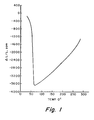
- FIGURE 1 of the appended drawing graphically represents the expansion curve for a lead zinc borate glass having an addition of 13% by weight (about 17% by volume) of crystalline magnesium pyrophosphate.
- the steep dip in the curve results from the crystal inversion that occurs in the magnesium pyrophosphate crystal.
- the actual inversion temperature coincides with the bottom of the dip at about 68 °C.
- expansion in parts per million (ppm), as measured by standard dilatometry means, is plotted on the vertical axis. Temperature, in ° C, is plotted on the horizontal axis.
- the lead glass composition in weight percent on an oxide basis, was: 83.0% PbO, 12.0% B 2 0 3 , 4.0% ZnO, 0.6% Si0 2 and 0.4% Sn0 2 .
- the magnesium pyrophosphate approximated stoichiometric proportions, that is, about 64% P 2 0 5 and 36% Mg0 by weight.
- FIGURE 2 is a graphical representation, similar to that of FIGURE 1, but showing a different expansion curve.
- the data for FIGURE 2 were obtained from measurements on the lead glass of FIGURE 1 having a mill addition of 13% by weight crystalline Mg 2 P 2 0 7 wherein 64% of the magnesium ions had been substituted for by cobalt ions. As a result, 32% of the total cation content (Mg + P + Co) content is cobalt ions. It will be observed that the inversion temperature now occurs at about 195°C, rather than the 68 ° C temperature with unsubstituted Mg 2 P 2 0 7 .
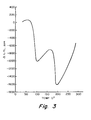
- FIGURE 3 is a graphical representation, also similar to that of FIGURE 1, but showing a still different expansion curve.
- expansion measurements were made on the same lead glass in which two different mill additions were made.
- One was 8% by weight Mg 2 P 2 0 7 wherein 16% of the magnesium ions (8% of the total cations) had been substituted for by cobalt ions; the other 8% by weight M 92 P 2 0 7 wherein 64% of the magnesium ions (32% of the total cations) had been substituted for by cobalt ions.
- FIGURE 4 is a graphical representation showing the manner in which the inversion temperature of crystalline Mg 2 P 2 0 7 is increased as cobalt ions are progressively substituted for magnesium ions.
- the inversion temperature in ° C, is plotted on the vertical axis, while cobalt ion content, as percent of total cation content (Mg + Co + P), is plotted on the horizontal axis.
- the pyrophosphates are of particular interest as mill additions because stress in a seal can be lowered to zero, and even beyond to create tension, by increasing the amount of the addition. Microcracking can occur in a seal, however. This is believed to be related to the presence of large particle size pyrophosphate. This suggests either fine grinding, or classification of the powder. These remedies are limited by a greater tendency for fine materials to dissolve during the sealing process. Also, the effect of the pyrophosphates appears to be largely lost if the average particle size falls below about 15 microns.
- a preferred mill addition is a combination of Invar powder and a fine phosphate addition.
- the Invar may be added in substantial amount before it interferes with surface wetting and glass flow. Accordingly, amounts on the order of 30 to 40 percent by volume may be added. However, I normally prefer no more than about 20%.
- compositions calculated in weight percent on an oxide basis, for several phosphate glasses that were melted and crystallized for use as fillers in the course of developing the invention.
- H3P04 phosphoric acid
- Sealing mixtures for CTE measurements were made from the lead zinc borate glass, with the several filler additions of TABLE I added in amounts of 13% by weight.
- a portion of a sealing mixture was placed in a metal die. The die was then heated to 400 ° C and a pressure of about 200 psi applied to the mixture. The resulting compressed body was cooled in the die to around 140°C and then removed. The body was then ground to 1 "x 1 ⁇ 4" x 1 ⁇ 4" dimensions for CTE measurements.
- TABLE II identifies the several sealing mixtures and the CTE measurements obtained.
- TABLE II shows the filler used (identified by the letter designations of TABLE I); the inversion temperature in ° C (temp.), and the average CTE ⁇ 10 -7 as measured over the temperature range of 25 °C to 150 C.
- composition B material after thermal crystallization, shows that it is almost completely a magnesium pyrophosphate (Mg 2 P 2 0 7 ) crystal phase.
- the oxide proportions closely correspond to the stoichiometric, 2:1 molar ratio of Mg 2 P 2 0 7 , thus confirming the essential purity of the material.
- compositions A and C of TABLE I show a magnesium pyrophosphate crystal phase.
- the non-stoichiometric ratio of Mg0 to P 2 0 5 in these compositions leads to other crystal and/or glass phases. This appears to impede the effect of the pyrophosphate, and to create the erratic effects noted. Accordingly, in producing a magnesium pyrophosphate type filler, it is desirable to adhere closely to a stoichiometric ratio, as in compositions, B, D, E, and F.
Landscapes
- Chemical & Material Sciences (AREA)
- Life Sciences & Earth Sciences (AREA)
- Engineering & Computer Science (AREA)
- Chemical Kinetics & Catalysis (AREA)
- General Chemical & Material Sciences (AREA)
- Geochemistry & Mineralogy (AREA)
- Materials Engineering (AREA)
- Organic Chemistry (AREA)
- Glass Compositions (AREA)
- Sealing Material Composition (AREA)
Applications Claiming Priority (2)
| Application Number | Priority Date | Filing Date | Title |
|---|---|---|---|
| US594629 | 1990-10-09 | ||
| US07/594,629 US5089445A (en) | 1990-10-09 | 1990-10-09 | Fusion sealing materials |
Publications (1)
| Publication Number | Publication Date |
|---|---|
| EP0480186A1 true EP0480186A1 (en) | 1992-04-15 |
Family
ID=24379704
Family Applications (1)
| Application Number | Title | Priority Date | Filing Date |
|---|---|---|---|
| EP91115337A Withdrawn EP0480186A1 (en) | 1990-10-09 | 1991-09-11 | Fusion sealing materials |
Country Status (4)
| Country | Link |
|---|---|
| US (1) | US5089445A (enExample) |
| EP (1) | EP0480186A1 (enExample) |
| JP (1) | JP3275182B2 (enExample) |
| CA (1) | CA2050516A1 (enExample) |
Cited By (3)
| Publication number | Priority date | Publication date | Assignee | Title |
|---|---|---|---|---|
| EP0812810A3 (en) * | 1996-06-13 | 1998-09-09 | Corning Incorporated | Optical device comprising substrate of betaeucryptite or fused silico, an optical component and a fusion seal comprising a low melting glass frit and a mill addition |
| US5926599A (en) * | 1996-06-13 | 1999-07-20 | Corning Incorporated | Optical device and fusion seal |
| US6603900B1 (en) | 1998-11-06 | 2003-08-05 | Corning Incorporated | Athermal optical waveguide grating device |
Families Citing this family (13)
| Publication number | Priority date | Publication date | Assignee | Title |
|---|---|---|---|---|
| US5246890A (en) * | 1992-08-03 | 1993-09-21 | Corning Incorporated | Non-lead sealing glasses |
| US5958100A (en) * | 1993-06-03 | 1999-09-28 | Micron Technology, Inc. | Process of making a glass semiconductor package |
| US5281560A (en) * | 1993-06-21 | 1994-01-25 | Corning Incorporated | Non-lead sealing glasses |
| US5516733A (en) * | 1994-03-31 | 1996-05-14 | Corning Incorporated | Fusion seal and sealing mixtures |
| US5465626A (en) * | 1994-04-04 | 1995-11-14 | Motorola, Inc. | Pressure sensor with stress isolation platform hermetically sealed to protect sensor die |
| US5552092A (en) * | 1994-05-31 | 1996-09-03 | Corning Incorporated | Waveguide coupler |
| US6432752B1 (en) | 2000-08-17 | 2002-08-13 | Micron Technology, Inc. | Stereolithographic methods for fabricating hermetic semiconductor device packages and semiconductor devices including stereolithographically fabricated hermetic packages |
| US6998776B2 (en) * | 2003-04-16 | 2006-02-14 | Corning Incorporated | Glass package that is hermetically sealed with a frit and method of fabrication |
| US20070281194A1 (en) * | 2006-05-31 | 2007-12-06 | Jeffrey Earl Cortright | Portable fuel cell assembly |
| US8084380B2 (en) * | 2009-02-27 | 2011-12-27 | Corning Incorporated | Transition metal doped Sn phosphate glass |
| CN105314850B (zh) * | 2015-09-06 | 2017-10-03 | 东南大学 | 一种耐高温磷酸盐透明玻璃及其制备方法 |
| CN110621617B (zh) * | 2017-05-12 | 2023-08-01 | 康宁股份有限公司 | 高温密封剂及其方法 |
| EP3938330B1 (en) * | 2019-06-05 | 2024-02-14 | Ferro Corporation | Glass frit system including dark-colored, low expansion fillers |
Citations (2)
| Publication number | Priority date | Publication date | Assignee | Title |
|---|---|---|---|---|
| DE1596995A1 (de) * | 1967-12-28 | 1971-04-01 | Siemens Ag | Glaslot |
| GB1552648A (en) * | 1976-08-17 | 1979-09-19 | Standard Telephones Cables Ltd | Low melting point glass |
Family Cites Families (5)
| Publication number | Priority date | Publication date | Assignee | Title |
|---|---|---|---|---|
| US3258350A (en) * | 1965-02-12 | 1966-06-28 | Corning Glass Works | Fusion seals and their production |
| NL7403034A (enExample) * | 1973-03-21 | 1974-09-24 | ||
| US3951669A (en) * | 1974-11-18 | 1976-04-20 | Corning Glass Works | Fusion seals and sealing compositions for their production |
| US4186023A (en) * | 1978-05-01 | 1980-01-29 | Technology Glass Corporation | Sealing glass composition |
| US4238704A (en) * | 1979-02-12 | 1980-12-09 | Corning Glass Works | Sealed beam lamp of borosilicate glass with a sealing glass of zinc silicoborate and a mill addition of cordierite |
-
1990
- 1990-10-09 US US07/594,629 patent/US5089445A/en not_active Expired - Fee Related
-
1991
- 1991-09-03 CA CA002050516A patent/CA2050516A1/en not_active Abandoned
- 1991-09-11 EP EP91115337A patent/EP0480186A1/en not_active Withdrawn
- 1991-10-01 JP JP25350591A patent/JP3275182B2/ja not_active Expired - Fee Related
Patent Citations (2)
| Publication number | Priority date | Publication date | Assignee | Title |
|---|---|---|---|---|
| DE1596995A1 (de) * | 1967-12-28 | 1971-04-01 | Siemens Ag | Glaslot |
| GB1552648A (en) * | 1976-08-17 | 1979-09-19 | Standard Telephones Cables Ltd | Low melting point glass |
Non-Patent Citations (2)
| Title |
|---|
| CERAMIC ENGINEERING AND SCIENCE PROCEEDINGS. vol. 8, no. 7-8, August 1987, WESTERVILLE,OHIO,US pages 839 - 847; R.H.MOORE ET AL: 'Metal Particle-Toughened Borosilicate Sealing Glass' * |
| WORLD PATENTS INDEX Section Ch, Week 7909, Derwent Publications Ltd., London, GB; Class L, AN 79-17441& SU-A-496 243 (PISHCH) 11 May 1978 * |
Cited By (5)
| Publication number | Priority date | Publication date | Assignee | Title |
|---|---|---|---|---|
| EP0812810A3 (en) * | 1996-06-13 | 1998-09-09 | Corning Incorporated | Optical device comprising substrate of betaeucryptite or fused silico, an optical component and a fusion seal comprising a low melting glass frit and a mill addition |
| US5926599A (en) * | 1996-06-13 | 1999-07-20 | Corning Incorporated | Optical device and fusion seal |
| AU715433B2 (en) * | 1996-06-13 | 2000-02-03 | Corning Incorporated | Optical device and fusion seal |
| US6122430A (en) * | 1996-06-13 | 2000-09-19 | Corning Incorporated | Optical device and fusion seal |
| US6603900B1 (en) | 1998-11-06 | 2003-08-05 | Corning Incorporated | Athermal optical waveguide grating device |
Also Published As
| Publication number | Publication date |
|---|---|
| US5089445A (en) | 1992-02-18 |
| JP3275182B2 (ja) | 2002-04-15 |
| JPH04288389A (ja) | 1992-10-13 |
| CA2050516A1 (en) | 1992-04-10 |
Similar Documents
| Publication | Publication Date | Title |
|---|---|---|
| US5089446A (en) | Sealing materials and glasses | |
| KR970000898B1 (ko) | 밀봉용 무연유리 및 이의 제품 | |
| US5089445A (en) | Fusion sealing materials | |
| US4186023A (en) | Sealing glass composition | |
| US4405722A (en) | Sealing glass compositions | |
| KR960010802B1 (ko) | 인산아연 저온유리 | |
| US3951669A (en) | Fusion seals and sealing compositions for their production | |
| KR100296471B1 (ko) | 밀봉용무연유리 | |
| JPH04231349A5 (enExample) | ||
| US5516733A (en) | Fusion seal and sealing mixtures | |
| JPH0585490B2 (enExample) | ||
| US4012263A (en) | Alkali-free glasses | |
| KR20170096026A (ko) | 무연 유리 및 실링 재료 | |
| JP3339647B2 (ja) | 無鉛系低融点ガラス及び封着用ガラス組成物 | |
| JPH0428657B2 (enExample) | ||
| JP3748533B2 (ja) | 低融点ガラス及びその製造方法 | |
| US4621064A (en) | Low temperature sealing composition with synthetic zircon | |
| US4251595A (en) | Low temperature sealing glasses | |
| KR100592506B1 (ko) | 융해 온도가 낮은 합성 결합제 유리, 충전재 및 사용 방법 | |
| RU1809823C (ru) | Порошкова композици дл пайки колб телевизионных кинескопов | |
| JPWO2001090012A1 (ja) | ガラス組成物及び該組成物を含むガラス形成材料 | |
| EP0045359B1 (en) | Sealing glass composition | |
| KR100924120B1 (ko) | 디스플레이 패널 봉착 재료 | |
| US4246034A (en) | Devitrifying solder sealing glasses | |
| JP2004059366A (ja) | 無鉛低融点ガラスおよび封着材料 |
Legal Events
| Date | Code | Title | Description |
|---|---|---|---|
| PUAI | Public reference made under article 153(3) epc to a published international application that has entered the european phase |
Free format text: ORIGINAL CODE: 0009012 |
|
| AK | Designated contracting states |
Kind code of ref document: A1 Designated state(s): BE DE FR GB IT NL |
|
| 17P | Request for examination filed |
Effective date: 19920923 |
|
| 17Q | First examination report despatched |
Effective date: 19930802 |
|
| STAA | Information on the status of an ep patent application or granted ep patent |
Free format text: STATUS: THE APPLICATION HAS BEEN WITHDRAWN |
|
| 18W | Application withdrawn |
Withdrawal date: 19940704 |