EP0479305B1 - Rate conversion apparatus - Google Patents
Rate conversion apparatus Download PDFInfo
- Publication number
- EP0479305B1 EP0479305B1 EP91116952A EP91116952A EP0479305B1 EP 0479305 B1 EP0479305 B1 EP 0479305B1 EP 91116952 A EP91116952 A EP 91116952A EP 91116952 A EP91116952 A EP 91116952A EP 0479305 B1 EP0479305 B1 EP 0479305B1
- Authority
- EP
- European Patent Office
- Prior art keywords
- signal
- phase
- frequency
- periodical
- output
- Prior art date
- Legal status (The legal status is an assumption and is not a legal conclusion. Google has not performed a legal analysis and makes no representation as to the accuracy of the status listed.)
- Expired - Lifetime
Links
- 238000006243 chemical reaction Methods 0.000 title claims description 29
- 238000001914 filtration Methods 0.000 claims description 3
- 238000000034 method Methods 0.000 description 10
- 230000005540 biological transmission Effects 0.000 description 7
- 238000010586 diagram Methods 0.000 description 7
- 230000006870 function Effects 0.000 description 4
- 238000004891 communication Methods 0.000 description 3
- 238000012545 processing Methods 0.000 description 3
- 238000012546 transfer Methods 0.000 description 3
- 238000005070 sampling Methods 0.000 description 2
- 230000008054 signal transmission Effects 0.000 description 2
- 230000015572 biosynthetic process Effects 0.000 description 1
- 238000012937 correction Methods 0.000 description 1
- 230000008878 coupling Effects 0.000 description 1
- 238000010168 coupling process Methods 0.000 description 1
- 238000005859 coupling reaction Methods 0.000 description 1
- 125000004122 cyclic group Chemical group 0.000 description 1
- 238000001514 detection method Methods 0.000 description 1
- 239000000284 extract Substances 0.000 description 1
- 238000004519 manufacturing process Methods 0.000 description 1
- 230000010355 oscillation Effects 0.000 description 1
- 230000000737 periodic effect Effects 0.000 description 1
- 230000001360 synchronised effect Effects 0.000 description 1
- 238000003786 synthesis reaction Methods 0.000 description 1
Images

Classifications
-
- H—ELECTRICITY
- H03—ELECTRONIC CIRCUITRY
- H03L—AUTOMATIC CONTROL, STARTING, SYNCHRONISATION OR STABILISATION OF GENERATORS OF ELECTRONIC OSCILLATIONS OR PULSES
- H03L7/00—Automatic control of frequency or phase; Synchronisation
- H03L7/06—Automatic control of frequency or phase; Synchronisation using a reference signal applied to a frequency- or phase-locked loop
- H03L7/16—Indirect frequency synthesis, i.e. generating a desired one of a number of predetermined frequencies using a frequency- or phase-locked loop
-
- H—ELECTRICITY
- H03—ELECTRONIC CIRCUITRY
- H03L—AUTOMATIC CONTROL, STARTING, SYNCHRONISATION OR STABILISATION OF GENERATORS OF ELECTRONIC OSCILLATIONS OR PULSES
- H03L7/00—Automatic control of frequency or phase; Synchronisation
- H03L7/06—Automatic control of frequency or phase; Synchronisation using a reference signal applied to a frequency- or phase-locked loop
- H03L7/08—Details of the phase-locked loop
- H03L7/099—Details of the phase-locked loop concerning mainly the controlled oscillator of the loop
- H03L7/0991—Details of the phase-locked loop concerning mainly the controlled oscillator of the loop the oscillator being a digital oscillator, e.g. composed of a fixed oscillator followed by a variable frequency divider
-
- H—ELECTRICITY
- H04—ELECTRIC COMMUNICATION TECHNIQUE
- H04L—TRANSMISSION OF DIGITAL INFORMATION, e.g. TELEGRAPHIC COMMUNICATION
- H04L25/00—Baseband systems
- H04L25/02—Details ; arrangements for supplying electrical power along data transmission lines
- H04L25/05—Electric or magnetic storage of signals before transmitting or retransmitting for changing the transmission rate
-
- H—ELECTRICITY
- H03—ELECTRONIC CIRCUITRY
- H03L—AUTOMATIC CONTROL, STARTING, SYNCHRONISATION OR STABILISATION OF GENERATORS OF ELECTRONIC OSCILLATIONS OR PULSES
- H03L2207/00—Indexing scheme relating to automatic control of frequency or phase and to synchronisation
- H03L2207/10—Indirect frequency synthesis using a frequency multiplier in the phase-locked loop or in the reference signal path
Definitions
- the present invention relates to a technique for converting a data sequence of a transmission rate f1 to another data sequence of another transmission rate f2, and more particularly to a rate conversion apparatus for generating from clock signals of a frequency f1 clock signals of another frequency f2.
- the signal transmission rate is often converted in communication systems, and conversion is frequently accomplished from a signal transmission rate of f1 (samples/sec) into another transmission rate f2 which is equal to n/m times (m and n are mutually prime natural numbers) f1.
- data received over a line whose transmission rate is f1 are sent out over another line whose transmission rate is f2, which is not equal to f1.
- data of f1 in transmission rate are subjected to error detection coding or error correction coding to be converted into data of f2 in transmission rate (f1 ⁇ f2 in this case).
- this frequency synthesizer is composed of an m frequency divider for frequency-dividing signals of the frequency f1 by m and a PLL to which the output of the m frequency divider is supplied.
- the PLL further consists of a phase comparator whose first input terminal is supplied with the output of the m frequency divider, a loop filter for filtering the output of the phase comparator, a voltage controlled oscillator (VCO) whose oscillation frequency varies around a center frequency of f2 according to the output of the loop filter, and the n frequency divider for frequency-dividing the output of the VCO by n and supplying the n frequency-divided output to a second terminal of the phase comparator.
- VCO voltage controlled oscillator
- the band-width of the loop filter should be sufficiently narrower than 8 kHz, for example, around 1 kHz.
- the pull-in time of the PLL in this instance will be about 1 msec, an undesirably long pull-in time.
- An object of the present invention is to provide a rate conversion apparatus taking short pull-in time irrespective of the n/m ratio between a first frequency f1 and a second frequency f2 and permitting ready realization of appropriate circuitry. This object is solved with the features of the claims.
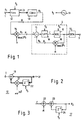
- FIG. 1 is a block diagram illustrating a first preferred embodiment of the invention.
- This embodiment involves a digital tank circuit 12 which is supplied with a first clock signal of f1 in frequency and supplies a complex signal, a read-only memory (ROM) 13 for converting the complex signal into an R-bit signal ⁇ 1 indicating the phase of the first clock signal, and a multiplier 14 for multiplying the phase signal ⁇ 1 by n (modulo 2 R ).
- ROM read-only memory
- This embodiment is also provided with a digital phase lock loop (PLL) 2 comprising a subtractor 15, a digital low-pass filter (LPF) 16, a numerically controlled oscillator (NCO) 17, and a multiplier 18 for multiplying the output of the NCO 17 by m (modulo 2 R ), wherein the NCO 17 supplies another phase signal ⁇ 2 indicating the phase of a second clock signal of f2 in frequency.
- the embodiment further involves a clock source 11 for supplying an operation clock of fs in frequency to the digital tank circuit 12, the LPF 16 and the NCO 17, and a clock generating circuit 10 for converting the signal ⁇ 2, which is supplied by the NCO 17, into the second clock signal.
- the frequency fs of the operation clock is determined by the level of accuracy required for the waveform of the second clock signal, and about 32 times the frequency f1 or f2, whichever is higher, is usually sufficient as fs.
- the first clock signal of f1 in frequency is supplied to the digital tank circuit 12, which extracts, an the basis of the operation clock from a clock generator, only the frequency f1 component from the first clock signal and, at the same time, converts the first clock signal into the complex signal x+jy whose phase angle indicates the phase of the first clock signal.
- the configuration of this digital tank circuit 12 will be described later in further detail.
- This complex signal is further converted by a converting circuit or the read only memory 13 into the first phase signal ⁇ 1, i.e. a signal indicating the phase of the first clock signal.
- This converting circuit 13 can be composed of a read-only memory (ROM), having the real and imaginary parts of the complex signal as addresses and a phase angle stored in each address.
- This first phase signal ⁇ 1 is represented by an R-bit digital signal.
- the first clock signal entered from a terminal 1 is thus converted into the first phase signal ⁇ 1 indicating the phase of the first clock signal.
- This first phase signal ⁇ 1 is n-multiplied by the mudulo 2 R multiplier 14 into n ⁇ 1 (mod 2 R ).
- the multiplier 14 supplies a third phase signal ⁇ 3 (R-bit) indicating the phase of a cyclic signal of nf1 in frequency, resulting from the n-multiplication of the first clock signal of fl in frequency, to the digital PLL 2.
- phase error signal ⁇ 3 is subtracted a fourth phase signal ⁇ 4 by the subtractor 15 to give a phase error signal.
- This phase error signal is smoothed by the LPF 16 into a smoothed phase error signal C.
- the NCO 17 supplies the phase signal ⁇ 2 to control the frequency and phase of the second clock signal, which is supplied from a clock generating circuit 10, on the basis of the smoothed phase error signal C and the operation clock.
- This phase signal ⁇ 2 thus represents the phase of the second clock signal.
- the configuration of the NCO 17 will be described later in further detail.
- the clock generating circuit 10 is supplied with the phase signal ⁇ 2 and supplies the second clock signal of f2 in frequency.
- This clock generating circuit 10 can be composed of a read-only memory in which amplitude values are stored correspondingly to phase signals. If a rectangular wave is required as the second clock signal, the most significant bit or the R-bit phase signal ⁇ 2 may as well be extracted and used as the second clock signal as it is.
- the phase signal ⁇ 2 is also supplied to the multiplier 18, which multiplies this phase signal ⁇ 2 by m (modulo 2 R ) into the fourth phase signal ⁇ 4.
- This fourth phase signal ⁇ 4 represents the phase of the periodic signal of mf2 in frequency, obtained by multiplying the second clock signal of f2 in frequency by m.
- the fourth phase signal ⁇ 4 is subtracted from the third phase signal ⁇ 3 by the subtractor 15 to give a phase error signal ( ⁇ 3 - ⁇ 4), which, as mentioned above, is supplied to the LPF 16.
- phase signal ⁇ 4 is phase-synchronized with the phase signal ⁇ 3.
- This is equivalent to the phase-synchronism between the periodical signal of nf1 in frequency corresponding to the phase signal ⁇ 3 and the periodical signal of mf2 in frequency corresponding to the phase signal ⁇ 4. Therefore, the function of this preferred embodiment is equivalent to the second method described previously.
- the operation of the preferred embodiment illustrated in FIG. 1 takes place wholly at the timings set by the operation clock fs.
- the frequency fs of this operation clock will be high enough if it is about 32 times the frequency fl or f2 whichever is the higher.
- fs may be about 65 MHz.
- the invention is free from the disadvantage of the second method described previously that the input frequency of the phase comparator becomes too high for ready production of the PLL.
- the operation rate of the digital PLL is relatively high, about 65 MHz, the bandwidth of the PLL, even if it is selected at 1/8 of fs, will be about 8 MHz. Therefore the pull-in action of the PLL will be quick enough to enable the disadvantage of the aforementioned first method to be overcome.
- the digital tank circuit 12 is provided with an adder 19, a one-sample delay circuit (Z -1 ) 20 and a multiplier 21.
- the one-sample delay circuit is supplied with the operation clock (fs).
- the digital tank circuit 12 is tuned to the frequency f1 and operates as a single-tuned circuit of ⁇ (1 - ⁇ )fs/2 ⁇ Hz in bandwidth.
- the digital tank circuit 12 is also a complex signal processing circuit, and the complex signal x + jy, which is its output, is a signal whose phase angle indicates the phase of the first clock signal.
- the NCO 17 is provided with adders 22 and 23 and a one-sample delay circuit 24. All these adders 22 and 23 and one-sample delay circuit 24 are binary R-bit digital signal processing circuits.
- the NCO 17 serves as a sort of oscillator.
- phase of the NCO 17 will be controlled by the phase control signal C.
- the first preferred embodiment of the present invention can make up a rate conversion apparatus capable of quick pull-in without having to make the PLL operate at an extremely high frequency even if the values of m and n are great.
- (n ⁇ 1 - m ⁇ 2) mod2 R to be supplied to the LPF 16 is represented by the following equation.
- (n ⁇ 1 - m ⁇ 2) mod2 R (n1 ⁇ 1 - m1 ⁇ 2) mod2 R + (n2 ⁇ 1 - m2 ⁇ 2) mod2 R + (n3 ⁇ 1 - m3 ⁇ 2) mod2 R + (n4 ⁇ 1 - m4 ⁇ 2) mod2 R Since every one of the numbers n1 through n4 and ml through m4 in Equation (5) is a prime number, in the modulo 2 R arithmetic operation, not all of the terms will identically give zero.
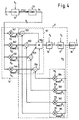
- FIG. 4 is a block diagram illustrating a second preferred embodiment of the present invention, which differs from the embodiment shown in FIG. 1 in the following three respects.
- the multipliers 141 through 144 perform the operations of n1 ⁇ 1(mod 2 R ), n2 ⁇ 1(mod 2 R ), n3 ⁇ 1(mod 2 R ) and n4 ⁇ 1(mod 2 R ), respectively.
- the multipliers 181 through 184 perform the operations of m1 ⁇ 2(mod 2 R ), m2 ⁇ 2(mod 2 R ), m3 ⁇ 2(mod 2 R ) and m4 ⁇ 2(mod 2 R ), respectively.
- the subtractors 151 through 154 perform the operations of (n1 ⁇ 1 - m1 ⁇ 2) (mod 2 R ), (n2 ⁇ 1 - m2 ⁇ 2) (mod 2 R ), (n3 ⁇ 1 - m302) (mod 2 R ), (n4 ⁇ 1 - m4 ⁇ 2) (mod 2 R ), respectively.
- the results of these operations are added by the adder 150 to perform the operation of Equation (5).
- Either the first or the second preferred embodiment of the present invention described above can constitute a rate conversion apparatus capable of quick pull-in without having to make the PLL operate at an extremely high frequency even if the values of m and n are great.
- both the first and the second embodiments require an operation clock frequency fs equal to about 32 times f1 or f2 whichever is the higher because of the necessity to ensure a sufficiently high level of time accuracy for the output waveform of the clock generator 10. Therefore, if the values of f1 and f2 are extremely high, that of fs will be correspondingly high to make it difficult to realize the circuitry.
- a third preferred embodiment of the invention to be described below with reference to FIG. 5, solves this problem.
- the first and third embodiments differ from each other in that the latter has a hybrid configuration while the former has a wholly digital configuration.
- the complex digital tank circuit 12 in FIG. 1 is replaced with a complex signal generating circuit 30.
- the digital PLL 2, too, is replaced with a PLL 2' having a partly analog configuration.
- a complex signal generating circuit 30 consists of an analog tank circuit 31, a phase shifter 32 and analog-to-digital (A/D) converters 33 and 34.
- the analog tank circuit 31 is tuned to the frequency f1 of the input clock signal, and outputs a sine wave phase-synchronized with the input clock signal. Incidentally, if the input clock signal is entered from the input terminal 1 as a sine wave, this analog tank circuit 31 can be dispensed with.
- the sine wave of f1 in frequency outputted from the analog tank circuit 31 is supplied to the A/D converter 33.
- the output of the A/D converter 33 is a signal identical with the real part x of the complex signal x + jy referred to in FIG. 1.
- the output of the analog tank circuit 31 is also supplied to the phase shifter 32 to be shifted in phase by ⁇ /2.
- This ⁇ /2 phase-shifted signal is digitalized by the A/D converter 34, and constitutes the imaginary part 6 of the complex signal x + jy referred to in FIG. 1.
- These signals x and y are supplied to the ROM 13 to give the first phase signal ⁇ 1 as in the first preferred embodiment.
- This first phase signal ⁇ 1 is multiplied by n (mod 2 R ) by the multiplier 14 into the third phase signal ⁇ 3. From this third phase signal ⁇ 3 is subtracted the fourth phase signal ⁇ 4, which is supplied by the multiplier 18, by the subtractor 15 to give the phase error signal, as in the first preferred embodiment.
- this phase error signal is converted by a digital-to-analog (D/A) converter 35 into an analog signal and outputted as an analog phase error signal.
- the analog phase error signal is filtered by an LPF 36 and supplied to a VCO 37 to control the oscillating frequency and phase of the VCO 37, from which a second clock signal of f2 in frequency is supplied.
- This second clock signal is converted by A/D converters 39 and 40 and a phase shifter 38 into a complex signal (x' + jy') whose phase angle indicates the phase of the second clock signal, and further converted by an ROM 41 into a second phase signal ⁇ 2.
- the operation of the circuit consisting of these A/D converters 39 and 40, phase shifter 38 and ROM 41 is the same as that of the circuit comprising the A/D converters 33 and 34, phase shifter 32 and ROM 13. If the output of the VCO 37 is a rectangular wave, there will be required an analog tank circuit tuned to the frequency f2 immediately at the coupling point between the input to the A/D converter 39 and that to the phase shifter 38.
- the second phase signal ⁇ 2 is multiplied by m (mod 2 R ) by the multiplier 18 and supplied as a fourth phase signal to the subtractor 15. In this way, the clock signal of f1 in frequency is converted into another clock signal of f2 in frequency.
- the present invention makes it possible to realize rate conversion of n/m in conversion ratio without having to set the operation frequency of the PLL extremely high or to reduce the equivalent bandwidth of the PLL even if the values of m and n are high. This results in the benefit of quicker pull-in, and the consequent freedom from the influence of the values of m and n enables the rate conversion apparatus according to the invention to be extensively applied to communications systems.
Landscapes
- Engineering & Computer Science (AREA)
- Power Engineering (AREA)
- Computer Networks & Wireless Communication (AREA)
- Signal Processing (AREA)
- Stabilization Of Oscillater, Synchronisation, Frequency Synthesizers (AREA)
- Synchronisation In Digital Transmission Systems (AREA)
Applications Claiming Priority (2)
| Application Number | Priority Date | Filing Date | Title |
|---|---|---|---|
| JP2266608A JP2674295B2 (ja) | 1990-10-05 | 1990-10-05 | 速度変換回路 |
| JP266608/90 | 1990-10-05 |
Publications (3)
| Publication Number | Publication Date |
|---|---|
| EP0479305A2 EP0479305A2 (en) | 1992-04-08 |
| EP0479305A3 EP0479305A3 (OSRAM) | 1994-02-09 |
| EP0479305B1 true EP0479305B1 (en) | 1997-03-05 |
Family
ID=17433183
Family Applications (1)
| Application Number | Title | Priority Date | Filing Date |
|---|---|---|---|
| EP91116952A Expired - Lifetime EP0479305B1 (en) | 1990-10-05 | 1991-10-04 | Rate conversion apparatus |
Country Status (6)
| Country | Link |
|---|---|
| US (1) | US5357447A (OSRAM) |
| EP (1) | EP0479305B1 (OSRAM) |
| JP (1) | JP2674295B2 (OSRAM) |
| AU (1) | AU637262B2 (OSRAM) |
| CA (1) | CA2052589C (OSRAM) |
| DE (1) | DE69124904T2 (OSRAM) |
Families Citing this family (9)
| Publication number | Priority date | Publication date | Assignee | Title |
|---|---|---|---|---|
| GR1002583B (el) * | 1996-01-30 | 1997-02-06 | Μεθοδος μετρησης διαφορας φασης. | |
| KR100251736B1 (ko) | 1997-12-29 | 2000-04-15 | 윤종용 | 직렬 데이터의 전송속도 변환 장치 |
| DE69821762T2 (de) * | 1998-10-07 | 2004-08-05 | Siemens Ag | Anordnung und Verfahren zur Umsetzung einer Datenrate |
| DE10308920A1 (de) * | 2003-02-28 | 2004-09-16 | Infineon Technologies Ag | Phasenregelanordnung zur Frequenzsynthese |
| US8510589B2 (en) | 2008-08-29 | 2013-08-13 | Intel Mobile Communications GmbH | Apparatus and method using first and second clocks |
| US8076977B2 (en) * | 2008-08-29 | 2011-12-13 | Infineon Technologies Ag | Device having digitally controlled oscillator |
| US9048846B2 (en) | 2008-08-29 | 2015-06-02 | Intel Mobile Communications, Gmbh | Device having digitally controlled oscillator |
| US8271568B2 (en) | 2008-08-29 | 2012-09-18 | Infineon Technologies Ag | Digital filter |
| GB2466521B (en) * | 2008-12-29 | 2013-08-07 | Wolfson Microelectronics Plc | Frequency generation |
Family Cites Families (11)
| Publication number | Priority date | Publication date | Assignee | Title |
|---|---|---|---|---|
| US3851251A (en) * | 1971-10-25 | 1974-11-26 | Martin Marietta Corp | Receiver method and apparatus |
| US4234929A (en) * | 1979-09-24 | 1980-11-18 | Harris Corporation | Control device for a phase lock loop vernier frequency synthesizer |
| US4310800A (en) * | 1979-11-07 | 1982-01-12 | General Motors Corporation | Digital frequency measuring circuitry |
| US4360788A (en) * | 1980-07-14 | 1982-11-23 | John Fluke Mfg. Co., Inc. | Phase-locked loop frequency synthesizer |
| US4715000A (en) * | 1985-08-06 | 1987-12-22 | General Electric Company | Digital phase-locked loop and frequency measuring device |
| US4672299A (en) * | 1986-05-23 | 1987-06-09 | American Telephone And Telegraph Co. | Clock control circuit for phase control |
| FR2615626B1 (fr) * | 1987-05-21 | 1989-07-28 | Alcatel Espace | Procede d'evaluation numerique de la frequence et de la phase de signaux et dispositifs de mise en oeuvre d'un tel procede |
| US4839603A (en) * | 1987-09-24 | 1989-06-13 | Unisys Corporation | Multiple-loop microwave frequency synthesizer using two phase lockloops |
| EP0364679B1 (de) * | 1988-10-18 | 1994-11-02 | Siemens-Albis Aktiengesellschaft | Frequenzsynthesegerät |
| EP0375880B1 (de) * | 1988-12-23 | 1994-06-22 | Siemens-Albis Aktiengesellschaft | Frequenzsynthesegerät |
| US4983906A (en) * | 1989-08-17 | 1991-01-08 | Hewlett-Packard Company | Frequency estimation system |
-
1990
- 1990-10-05 JP JP2266608A patent/JP2674295B2/ja not_active Expired - Fee Related
-
1991
- 1991-10-04 CA CA002052589A patent/CA2052589C/en not_active Expired - Fee Related
- 1991-10-04 AU AU85616/91A patent/AU637262B2/en not_active Ceased
- 1991-10-04 EP EP91116952A patent/EP0479305B1/en not_active Expired - Lifetime
- 1991-10-04 US US07/771,727 patent/US5357447A/en not_active Expired - Fee Related
- 1991-10-04 DE DE69124904T patent/DE69124904T2/de not_active Expired - Fee Related
Also Published As
| Publication number | Publication date |
|---|---|
| CA2052589A1 (en) | 1992-04-06 |
| JP2674295B2 (ja) | 1997-11-12 |
| JPH04144441A (ja) | 1992-05-18 |
| DE69124904D1 (de) | 1997-04-10 |
| EP0479305A3 (OSRAM) | 1994-02-09 |
| EP0479305A2 (en) | 1992-04-08 |
| DE69124904T2 (de) | 1997-06-19 |
| AU637262B2 (en) | 1993-05-20 |
| US5357447A (en) | 1994-10-18 |
| AU8561691A (en) | 1992-04-09 |
| CA2052589C (en) | 1997-12-23 |
Similar Documents
| Publication | Publication Date | Title |
|---|---|---|
| JP2926615B2 (ja) | Ssb信号発生器 | |
| EP1057252B1 (en) | Direct digital synthesis of precise, stable angle modulated rf signal | |
| JPH10510123A (ja) | 周波数シンセサイザー | |
| US20040037368A1 (en) | Variable rate modulator | |
| US5357447A (en) | Rate conversion apparatus | |
| AU639874B2 (en) | A demodulation circuit | |
| JP3866959B2 (ja) | 周波数差検知装置および周波数差検知方法 | |
| EP0306941B1 (en) | Variable bit rate clock recovery circuit | |
| EP3191912B1 (en) | Generation of high-rate sinusoidal sequences | |
| JPS63120538A (ja) | タイミング再生回路 | |
| US6347123B1 (en) | Low-current sample rate converter | |
| JPH09186727A (ja) | Fsk変調回路 | |
| JPH07264063A (ja) | 周波数シンセサイザ | |
| CA2079422C (en) | Phase-locked circuit capable of being quickly put in a phase-locked state | |
| US6166568A (en) | Method and arrangement for generating orthogonal sinusoidal signals | |
| JP3712141B2 (ja) | 位相同期ループ装置 | |
| JPH01144818A (ja) | 数値制御形発振回路 | |
| AU616506B2 (en) | Digital modulator | |
| JPH0316318A (ja) | 位相同期ループ | |
| JPS5890854A (ja) | サンプリング位相同期回路 | |
| JPH1174732A (ja) | 直交変調器によるfm変調装置 | |
| JP3802229B2 (ja) | Pll回路 | |
| JPH1155036A (ja) | 周波数発生回路 | |
| KR0142261B1 (ko) | 디지탈 정현파 발생방법 및 그 회로 | |
| JPS61257021A (ja) | 位相同期回路 |
Legal Events
| Date | Code | Title | Description |
|---|---|---|---|
| PUAI | Public reference made under article 153(3) epc to a published international application that has entered the european phase |
Free format text: ORIGINAL CODE: 0009012 |
|
| 17P | Request for examination filed |
Effective date: 19911030 |
|
| AK | Designated contracting states |
Kind code of ref document: A2 Designated state(s): DE FR GB |
|
| PUAL | Search report despatched |
Free format text: ORIGINAL CODE: 0009013 |
|
| AK | Designated contracting states |
Kind code of ref document: A3 Designated state(s): DE FR GB |
|
| 17Q | First examination report despatched |
Effective date: 19950614 |
|
| GRAG | Despatch of communication of intention to grant |
Free format text: ORIGINAL CODE: EPIDOS AGRA |
|
| GRAH | Despatch of communication of intention to grant a patent |
Free format text: ORIGINAL CODE: EPIDOS IGRA |
|
| GRAH | Despatch of communication of intention to grant a patent |
Free format text: ORIGINAL CODE: EPIDOS IGRA |
|
| GRAA | (expected) grant |
Free format text: ORIGINAL CODE: 0009210 |
|
| AK | Designated contracting states |
Kind code of ref document: B1 Designated state(s): DE FR GB |
|
| REF | Corresponds to: |
Ref document number: 69124904 Country of ref document: DE Date of ref document: 19970410 |
|
| ET | Fr: translation filed | ||
| PLBE | No opposition filed within time limit |
Free format text: ORIGINAL CODE: 0009261 |
|
| STAA | Information on the status of an ep patent application or granted ep patent |
Free format text: STATUS: NO OPPOSITION FILED WITHIN TIME LIMIT |
|
| 26N | No opposition filed | ||
| REG | Reference to a national code |
Ref country code: GB Ref legal event code: IF02 |
|
| PGFP | Annual fee paid to national office [announced via postgrant information from national office to epo] |
Ref country code: GB Payment date: 20031001 Year of fee payment: 13 |
|
| PGFP | Annual fee paid to national office [announced via postgrant information from national office to epo] |
Ref country code: FR Payment date: 20031003 Year of fee payment: 13 |
|
| PGFP | Annual fee paid to national office [announced via postgrant information from national office to epo] |
Ref country code: DE Payment date: 20031016 Year of fee payment: 13 |
|
| PG25 | Lapsed in a contracting state [announced via postgrant information from national office to epo] |
Ref country code: GB Free format text: LAPSE BECAUSE OF NON-PAYMENT OF DUE FEES Effective date: 20041004 |
|
| PG25 | Lapsed in a contracting state [announced via postgrant information from national office to epo] |
Ref country code: DE Free format text: LAPSE BECAUSE OF NON-PAYMENT OF DUE FEES Effective date: 20050503 |
|
| GBPC | Gb: european patent ceased through non-payment of renewal fee |
Effective date: 20041004 |
|
| PG25 | Lapsed in a contracting state [announced via postgrant information from national office to epo] |
Ref country code: FR Free format text: LAPSE BECAUSE OF NON-PAYMENT OF DUE FEES Effective date: 20050630 |
|
| REG | Reference to a national code |
Ref country code: FR Ref legal event code: ST |