EP0478975A2 - Verfahren zur Herstellung einer metall-organischen Polymerverbindung - Google Patents
Verfahren zur Herstellung einer metall-organischen Polymerverbindung Download PDFInfo
- Publication number
- EP0478975A2 EP0478975A2 EP91114906A EP91114906A EP0478975A2 EP 0478975 A2 EP0478975 A2 EP 0478975A2 EP 91114906 A EP91114906 A EP 91114906A EP 91114906 A EP91114906 A EP 91114906A EP 0478975 A2 EP0478975 A2 EP 0478975A2
- Authority
- EP
- European Patent Office
- Prior art keywords
- polymer
- metal
- plasma
- poly
- contacting
- Prior art date
- Legal status (The legal status is an assumption and is not a legal conclusion. Google has not performed a legal analysis and makes no representation as to the accuracy of the status listed.)
- Withdrawn
Links
Images
Classifications
-
- C—CHEMISTRY; METALLURGY
- C23—COATING METALLIC MATERIAL; COATING MATERIAL WITH METALLIC MATERIAL; CHEMICAL SURFACE TREATMENT; DIFFUSION TREATMENT OF METALLIC MATERIAL; COATING BY VACUUM EVAPORATION, BY SPUTTERING, BY ION IMPLANTATION OR BY CHEMICAL VAPOUR DEPOSITION, IN GENERAL; INHIBITING CORROSION OF METALLIC MATERIAL OR INCRUSTATION IN GENERAL
- C23C—COATING METALLIC MATERIAL; COATING MATERIAL WITH METALLIC MATERIAL; SURFACE TREATMENT OF METALLIC MATERIAL BY DIFFUSION INTO THE SURFACE, BY CHEMICAL CONVERSION OR SUBSTITUTION; COATING BY VACUUM EVAPORATION, BY SPUTTERING, BY ION IMPLANTATION OR BY CHEMICAL VAPOUR DEPOSITION, IN GENERAL
- C23C18/00—Chemical coating by decomposition of either liquid compounds or solutions of the coating forming compounds, without leaving reaction products of surface material in the coating; Contact plating
- C23C18/16—Chemical coating by decomposition of either liquid compounds or solutions of the coating forming compounds, without leaving reaction products of surface material in the coating; Contact plating by reduction or substitution, e.g. electroless plating
- C23C18/18—Pretreatment of the material to be coated
- C23C18/20—Pretreatment of the material to be coated of organic surfaces, e.g. resins
- C23C18/22—Roughening, e.g. by etching
-
- H—ELECTRICITY
- H05—ELECTRIC TECHNIQUES NOT OTHERWISE PROVIDED FOR
- H05K—PRINTED CIRCUITS; CASINGS OR CONSTRUCTIONAL DETAILS OF ELECTRIC APPARATUS; MANUFACTURE OF ASSEMBLAGES OF ELECTRICAL COMPONENTS
- H05K1/00—Printed circuits
- H05K1/02—Details
- H05K1/03—Use of materials for the substrate
- H05K1/0313—Organic insulating material
- H05K1/032—Organic insulating material consisting of one material
- H05K1/034—Organic insulating material consisting of one material containing halogen
-
- H—ELECTRICITY
- H05—ELECTRIC TECHNIQUES NOT OTHERWISE PROVIDED FOR
- H05K—PRINTED CIRCUITS; CASINGS OR CONSTRUCTIONAL DETAILS OF ELECTRIC APPARATUS; MANUFACTURE OF ASSEMBLAGES OF ELECTRICAL COMPONENTS
- H05K1/00—Printed circuits
- H05K1/02—Details
- H05K1/03—Use of materials for the substrate
- H05K1/0313—Organic insulating material
- H05K1/032—Organic insulating material consisting of one material
- H05K1/0346—Organic insulating material consisting of one material containing N
-
- H—ELECTRICITY
- H05—ELECTRIC TECHNIQUES NOT OTHERWISE PROVIDED FOR
- H05K—PRINTED CIRCUITS; CASINGS OR CONSTRUCTIONAL DETAILS OF ELECTRIC APPARATUS; MANUFACTURE OF ASSEMBLAGES OF ELECTRICAL COMPONENTS
- H05K3/00—Apparatus or processes for manufacturing printed circuits
- H05K3/10—Apparatus or processes for manufacturing printed circuits in which conductive material is applied to the insulating support in such a manner as to form the desired conductive pattern
- H05K3/18—Apparatus or processes for manufacturing printed circuits in which conductive material is applied to the insulating support in such a manner as to form the desired conductive pattern using precipitation techniques to apply the conductive material
- H05K3/181—Apparatus or processes for manufacturing printed circuits in which conductive material is applied to the insulating support in such a manner as to form the desired conductive pattern using precipitation techniques to apply the conductive material by electroless plating
-
- H—ELECTRICITY
- H05—ELECTRIC TECHNIQUES NOT OTHERWISE PROVIDED FOR
- H05K—PRINTED CIRCUITS; CASINGS OR CONSTRUCTIONAL DETAILS OF ELECTRIC APPARATUS; MANUFACTURE OF ASSEMBLAGES OF ELECTRICAL COMPONENTS
- H05K3/00—Apparatus or processes for manufacturing printed circuits
- H05K3/38—Improvement of the adhesion between the insulating substrate and the metal
- H05K3/381—Improvement of the adhesion between the insulating substrate and the metal by special treatment of the substrate
Definitions
- the technical field of the invention is surface functionalization of a polymer in a plasma to render it susceptible to seeding in a aqueous palladium salt solution without a supplemental sensitizer.
- the polymer is functionalized in a plasma and combined with an aqueous palladium salt solution the combination can be employed for the formation of an electroless metal coating using art known electroless coating baths.
- the electroless metal coating obtained has good adhesion to the polymer.
- the invention is directed to surface functionalization of a polymer in a plasma in order to improve its wettability.
- the activation bath containing the Sn+2 and Pd+2 ions is a standard catalyst employed in the deposition of electroless copper, the Sn+2 ions being used to reduce the Pd+2 ions to form colloidal Pd, the latter acting as a catalyst in the subsequent electroless copper deposition process. It has been theorized that the Sn+2 ions also form a protective layer around the colloidal Pd which have to be removed in order to expose the surface of the Pd so that it will be more readily available to effectively catalyze the subsequent electroless metal deposition. Without the protective coating afforded by the Sn+2 ions the colloidal Pd would be precipitated from the suspension which would present a problem in applying the catalyst evenly and uniformly to a surface that is to be subsequently plated by the electroless process.
- the acceleration bath employed by Ehrbar, et al removes the protective layer of Sn+2 ions around the colloidal particles of Pd thereby making the latter available to catalyze the subsequent electroless metal coating.
- the surface having the Pd particles on it is contacted with a conventional aqueous electroless copper coating solution.
- the electroless copper coating solution contains an aldehyde reducing agent such as formaldehyde which, in the presence of Pd, reduces Cu+2 ions in the electroless copper solution to copper metal.
- the copper metal plates out on the surface of the plastic and may have subsequent metal coatings applied to it by electrolytic means.
- U.S. Patent 4,422,907 describes a process for treating the surface of natural and synthetic plastic materials by ozone, thereafter applying a solution of a strong base in water or a polar organic solvent followed by the application of a conventional electroless plating coating.
- Ueno et al . U.S. 4,765,860 and 4,584,867; Polak U.S. 4, 337,279 and 4,382,101 and Lidel U.S. 4,072,769 teach exposing a polymeric surface to a plasma in order to obtain better adhesive bonding of either a metal foil or gelatin-containing photosensitive layer.
- microcircuits in some instances requires metal plating of high aspect ratio vias i.e. those that are more narrow than deep, which include through vias or blind vias.
- Blind vias are more difficult to plate.
- the latter are formed for example, by placing a polymer layer over a metal layer and then forming a trench in the polymer layer extending downward to the metal layer.
- the aspect ratio is defined as the ratio of the height of the trench to the width of the trench in the polymer layer.
- a high aspect ratio therefore signifies that the width of the trench is very narrow compared to the thickness of the polymer layer.
- the plating is used to establish an electrical contact in the via.
- the via is a blind via formed in a polymer to a metal substrate, the plating is used to establish electrical contact with the metal substrate.
- the trench is generally formed by an etching process and under ideal conditions the spacing between the walls of the trench from the bottom to the top would be about equal i.e. the walls of the trench would be substantially parallel to one another. If in practice the trench narrows as it extends from the surface of the polymer layer towards the metal layer, it becomes extremely more difficult to wet. Most water solutions of metal salts have more of a tendency to bridge the trench rather than wet the walls thereof. Accordingly, it is difficult to form electrical contacts by plating high aspect ratio vias by means of conventional aqueous electroless metal plating methods.
- the present invention resides in the discovery that a plasma can be used to functionalize the surface of a polymer.
- the functionalized surface can be used to combine with metal salts.
- the functionalized polymer can be employed in processes such as an electroless coating process whereby ionic species of a catalyst employed in an electroless process can be combined with the polymer surface that has been treated by a plasma.
- a conventional aqueous electroless coating containing a copper salt can then be brought into contact with the treated polymer and the copper salt reduced to copper metal directly.
- the invention differs from the conventional electroless processes in that the ionic species of the catalyst previously had to be reduced to a metal such as in the case of palladium salts which were reduced to palladium metal by stannous tin.
- the palladium in turn catalyzes the reduction of the electroless solution which conventionally contained a metal salt such as a copper salt in combination with a reducing agent such as an aldehyde.
- a metal salt such as a copper salt in combination with a reducing agent such as an aldehyde.
- a complex is formed between the functionalized polymer surface and the catalyst salt and when brought into contact with a conventional electroless coating containing a reducing agent, the catalyst salt is reduced by the reducing agent in the electroless coating to a catalyst metal and the catalyst metal then promotes the catalytic reduction of the electroless metal salt to a metal coating.
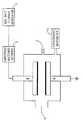
- the plasma system for producing a water vapor plasma (shown in the Figure) consists of a stainless steel vacuum chamber with parallel plate electrodes. Prior to processing, the chamber is evacuated to a base pressure in the 0.133 mPa (10 ⁇ 7 Torr) range using a 500 1/sec. turbomolecular pump. The plasma is generated between a grounded electrode (A) and an RF powered electrode (B) attached to an 800 Watt, 13.56 MHz generator (F), through an automatic impedence matching network (E). The electrodes are 25.4 cm (10 inches) in diameter and separated by 12.7 cm (5 inches) During typical operation, 50 Watts of RF power is applied to the system. Samples are placed on the grounded electrode (A), and both electrodes have graphite cover plates.
- Plasma supporting gas e.g. water-vapor is introduced into the chamber at point (D) using a heated liquid source (50-100°C) and a condensable vapor mass flow controller. All vapor transfer lines approaching the chamber are maintained at 100°C, and a refrigerated recirculator used to maintain both electrodes at 25° C.
- the present invention broadly relates to a process for producing a metal-organic polymer combination wherein the metal is either formed on the surface of the organic polymer or intermixed with the organic polymer starting at the surface of the organic polymer and extending to a depth beneath the surface depending on the various processing conditions and materials employed.
- a polymer can be functionalized by means of a plasma to render it susceptible to seeding in an aqueous metal salt solution whereby the metal salt is combined with the polymer thus treated.
- the polymers functionalized by the plasma treatment of the present invention have also been found to have improved wetting by water or water solutions of compounds such as metal salts and the like.
- the polymer that has been treated by the plasma according to the present invention in order to functionalize the polymer will be described herein after as a treated polymer.
- the plasma employed in the present invention is a typical plasma containing ionized gases consisting of equal numbers of positive and negative particles, a variety of neutral species including atoms, metastables, molecules, free radicals and photons.
- the plasma supporting gas comprises an oxidizing agent having oxygen such as water, peroxides, oxygen, the oxides of nitrogen such as nitrous oxide, and ozone.
- the plasma supporting gas may also comprise a hydrogen containing reducing species such as hydrogen, water, various peroxides described herein, NH3, H2S, hydrazine compounds comprising hydrazine as well as substituted hydrazines.
- a hydrogen containing reducing species such as hydrogen, water, various peroxides described herein, NH3, H2S, hydrazine compounds comprising hydrazine as well as substituted hydrazines.
- Mixtures of the gas or gases comprising an oxidizing agent with a gas or gases comprising a hydrogen containing reducing species can also be employed.
- the polymers that are employed according to the present invention comprises fluorinated ethylene polymers or polyimide type polymers both of which are known in the art.
- the fluorinated ethylene polymers include the various Teflon (trademark) polymers, including polytetrafluoroethylene (PTFE), fluorinated ethylene-propylene copolymers including copolymers of tetrafluorethylene (TFE) and hexafluorpropylene (HFP); the fluorinated ethylene-propylene copolymers sometimes referred to as FEP copolymers; copolymers of ethylene and tetrafluoroethylene (ETFE); tetrafluoroethylene copolymers with perfluorovinyl ethers produced by the copolymerization of TFE with a perflurovinyl ether to produce a PTFE polymer having a perfluoroalkoxy (PFA) side chain; polychlorotrifluoroethylene; polybromotrifluoroethylene; poly(vinylfluoride); poly(vinylidenefluoride); poly(fluorosilicones) and the like which are
- the various polyimides that may be employed as the polymer according to the present invention comprise those that are characterized by the presence of the phthalimide structure in the polymer backbone and are conventionally synthesized from dianhydrides and diamines to form poly(amic-acid)s which are thermally or chemically cyclized to the polyimide.
- the intermediate polyamic acid is generally soluble whereas the cyclized polyimide is insoluble.
- dianhydrides employed in this respect comprise pyromellitic dianhydride (PMDA) or benzophenonetetracarboxylic dianhydride (BTDA) whereas typical diamines comprises meta-or para-dianiline or 4,4'-diamino-diphenyl ether; 4,4'-diamino-diphenyl propane; 4,4'-diamino-diphenylmethane; 4,4'-diaminodiphenylether (ODA) and the like.
- PMDA pyromellitic dianhydride
- BTDA benzophenonetetracarboxylic dianhydride
- typical diamines comprises meta-or para-dianiline or 4,4'-diamino-diphenyl ether; 4,4'-diamino-diphenyl propane; 4,4'-diamino-diphenylmethane; 4,4'-diaminodiphenylether (ODA) and the like
- oxygen containing surface functionalities are generated on the polyimide polymer including the so-called catechols, hydroxyl groups, carboxylic acid groups, carbonyl groups and possibly peroxides or ester groups, where the plasma supporting gas is an oxidizing gas.
- the polymer comprises perfluoro polymers or per halo-fluoro polymers and the plasma supporting gas comprises an oxidizing gas
- oxygen containing reactive species are produced on the polymer.
- these reactive species may be free radicals.
- the polymers obtained from this type of plasma treatment have to be subsequently protonated in order to functionalize them according to the object of the present invention. Protonation can be effected either by immersing polymers obtained according to this aspect of the invention in water or by subsequently contacting them with a plasma containing a reducing species or mixtures of reducing species and an oxidizing agent as described herein.
- the aforesaid polymer containing free radicals may be contacted with a metal compound and especially a compound based on a metal (e.g. sodium) lower in the electro chemical series of elements than the cationic species subsequently used for combining with the treated polymer such as for example palladium and the like.
- a metal e.g. sodium
- the plasma is generated utilizing plasma generating devices that are well known in the art. Such a device is illustrated in the Figure included herewith.
- the plasma generating devices that may be employed according to the present invention may be operated at a frequency from about 50 KHz to 10GHz but especially at a frequency of 13.56 MHz, the latter being employed because of federal regulations since electro magnetic radiation is also employed for radio communication.
- the plasma is also generated at a pressure of from about 0.013 mPa to about 506.63 kPa (10 ⁇ 8T to about 5 atmospheres) of pressure especially from about 6.667 Pa to about 39.997 Pa (50 mT to about 300 mT).
- the apparatus employed for generating the plasma comprises electrodes placed either inside or outside of a plasma chamber which are connected to a power generator either by capacity coupling or by inductive coupling.
- the electrodes may be shaped as plates, rings, rods, cylinders or various art known equivalents thereof and may be in the same form or in a different form from one another.
- a conventional disposition of the electrodes is one in which the inner walls of the plasma chamber are made of a metal to serve as one of the electrodes which is usually electrically grounded and the other electrode is installed inside of the plasma chamber as electrically insulated from the chamber walls with an insulating coating on the surface thereof with an insulating material having a considerably high dielectric strength in order to maintain a stable electric glow discharge for generating the plasma.
- the density of power consumption on the surface of the power electrode may be anywhere from about 10 ⁇ 3 watts per cm2 to 1000 watts per cm2 a conventional operating wattage being about 100 watts RF.
- a specially selected gas is used for supporting the plasma discharge and is maintained in the plasma chamber as a flowing gas at below atmospheric pressure.
- the plasma-supporting gas is flowed through the plasma chamber at a rate up to about 10 liters per minute and especially from about 0.01 to about 1000 SCCM (standard cc's per minute of plasma supporting gas where the volume of gas is measured at standard temperature and pressure i.e. STP).
- SCCM standard cc's per minute of plasma supporting gas where the volume of gas is measured at standard temperature and pressure i.e. STP).
- the plasma supporting gas is flowed through the plasma chamber at one SCCM.
- the polymer is functionalized by exposing it to a plasma as described herein, functionalzation may also be effected by other methods including ion beam milling or reactive ion etching and techniques of this sort which are further described by Chapman, Glow Discharged Process, Sputtering and Plasma Etching , 1980, John Wiley & Sons, Inc. which is incorporated herein bv reference. Polymers obtained from these processes are also included within the group of treated polymers obtained according to the present invention.
- the plasma supporting gas may comprise an oxidizing agent having oxygen such as water, oxygen, the oxides of nitrogen such as nitrous oxide, ozone, hydrogen peroxide and other peroxides.
- oxygen such as water, oxygen, the oxides of nitrogen such as nitrous oxide, ozone, hydrogen peroxide and other peroxides.
- Those inorganic and organic peroxides that are suitable in this respect include those that exhibit some vapor pressure in the apparatus employed for functionalizing the polymer surface at the conditions employed in such apparatus.
- These peroxides include any of those generally and specifically listed as follows that have this characteristic. hydroperoxides (e.g. methylhydroperoxide, cyclohexylhydroperoxide etc.) alpha-oxy and alpha-peroxyhydroperoxides (e.g.
- dialkyl peroxides e.g. dimethylperoxide etc.
- peroxy acids e.g. performic and peracetic acid etc.
- peroxyesters e.g. t-butyl peroxyformate, t-amyl peracetate, t-butyl peroxybezenesulfonate etc.
- the plasma supporting gas comprising substituted hydrazines that may be used according to the invention has the formula: where R1 is alkyl, cycloalkyl, aryl, alkaryl, aralkyl, alkoxy, aryloxy or nitrogen containing heterocyclic radical and R2, R3 and R4 are hydrogen or the same as R1, and at least one of R1, R2, R3, R4 is hydrogen, said alkyl radicals including the alkyl portion of the alkaryl radical, cycloalkyl and aralkyl and alkoxy radicals containing from one to about ten carbon atoms including the isomeric configurations thereof, the ring structure of said cycloalkyl, aryl, alkaryl, aralkyl, aryloxy and heterocyclic radicals containing from 3 to about 17 carbon atoms including fused ring structures.
- the plasma supporting gas having hydrogen containing reducing species include diborane, metal acetylacetonates, lower alkyl metal complexes and lower n-alkanes.
- Lower alkyl compounds and alkanes comprise those having from one to about ten carbon atoms and the various isomeric configurations thereof.
- the plasma supporting gas based on an oxidizing agent containing oxygen, the reducing gas based on a reducing agent containing hydrogen and a mixture of at least an oxidizing agent containing oxygen and a reducing agent containing hydrogen can be contacted with the polymer individually or in any combination with one another and in any sequence where more than one is employed in the process of the invention.
- Especially preferred plasmas are those based on water, hydrogen and the oxides of nitrogen, especially nitrous oxide (N2O).
- the polymers that are especially of interest in the process of the present invention comprise the polyimide polymers and the fluorinated polymers such as PTFE polymers and the various equivalents thereof.
- the treated polymer thus obtained is contacted with cations of a metal, preferably in solution so that the cations are combined with the treated polymer.
- the cations that are used in this respect are those based on the Group VIII, IB, IIB, IIIA or IVA metals.
- the metals employed in this respect that are especially preferred are the Group VIII noble metals i.e. the platinum metals comprising platinum, iridium, osmium, palladium, rhodium and ruthenium (especially palladium) or the Group IB metals and especially gold.
- a palladium salt such as palladium nitrate in a water solution can be contacted with a polyimide or a fluorinated polyethylene surface that has been treated with either a nitrous oxide or water plasma.
- an aqueous electroless copper solution comprising a copper salt such as copper sulfate dissolved in water wherein said solution also contains an aldehyde reducing agent, will effect the deposit of an electroless copper coating.
- the aldehyde reducing agent reduces the palladium cation to zero valent palladium metal which in turn acts to catalyze the formaldehyde reducing agent in the reduction of the copper salt to copper metal.
- the palladium is also tightly bound to the polymer and depending on processing conditions will be intermixed with the polymer starting at the surface and extending to a depth beneath the surface.
- the treated polymer obtained according to the method of the present invention increases the wettability of these polymer surfaces and results in improved wetting of the treated polymer by water, water solutions of compounds, water dispersions or emulsions. Better plating results are thereby obtained for high aspect ratio vias in polymers. This is especially significant with respect to the fluorinated polymers described herein which are difficult to wet with water.
- a high aspect ratio via would be greater than about one; in circuit cards from about 8 to about 10, the upper limit being about 20. Accordingly by high aspect ratio vias, it is intended to include those falling within the range of greater than about one to about 20 and especially from greater than about one to about 10.
- high aspect ratio blind vias can be readily plated when the polymer layer employed in this respect is treated by the process of the invention e.g. exposed to a plasma as described herein followed by plating, especially in the case of polymer layers comprising either polyimides or fluorinated polymers and especially fluorinated polymers.
- a nitrous oxide plasma was produced in a "Plasmod” (trademark) plasma generator at 100W Rf, 1-5 SCCM nitrous oxide and 15.999 - 33.331 Pa (120-250 mT) pressure and 13.56 MHz.
- a polyimide was contacted with the plasma for about several minutes for subsequent plating.
- the polyimide is a condensation product of BTDA-ODA-MPDA which is commercially available from E.I. DuPont DeNemours and Company, Inc. sold under the trademark "Pyralin.”
- a seeding solution was then prepared comprising 100mg of palladium nitrate in 100mL of deionized water.
- the plasma treated samples were immersed in the seeding solution for 10-15 minutes followed by washing thoroughly with deionized water.
- the samples were then plated in a standard electroless copper plating bath at 73°C, pH 11.7 containing 2mL formaldehyde/L.
- the treated and seeded polyimide substrate was an active catalyst for copper deposition as noted by the formation of a bright copper film after several minutes in the electroless copper plating bath.
- the treated polyimide after contact with palladium nitrate, did not have to be reduced with a SnCl2 reducing agent which is conventional in the preparation of a palladium catalyst for the application of electroless copper.
- the samples were then removed from the plasma apparatus and were seeded with 800mg palladium nitrate in 800mL deionized water for 30 minutes, rinsed with deionized water for 30 minutes followed by electroless plating for 30 minutes in a conventional electroless bath. After the electroless copper was applied the samples were baked at 20 hours at 85°C in air and electroplated in a standard acidic cupric sulfate electroplating bath at 4mA/cm2 to 15 ⁇ m (microns) thickness. The 90° peel strength of the samples at 2.5 x 10 ⁇ 2mm/sec was 94 ⁇ 4g/2mm.
- BTDA-ODA-MPDA polyimide obtained from E.I. DuPont DeNemours and Co., Inc. were spin coated to a thickness of 0.051 mm (0.002 in.) on 31.103 g (2 once) copper and baked at 225°C for 30 minutes. The samples were then exposed to a water vapor plasma in accord with the method of Example 2 followed by seeding in a palladium nitrate bath at a concentration of 1mg palladium nitrate/mL for a period of 25 minutes followed by rinsing in deionized water for 15 minutes.
- the samples were then plated in a standard room temperature electroless bath and rinsed in flowing deionized water for 15 minutes followed by electroplating at 5-10mA/sq.cm in a bath described in Example 2, to a thickness of 25.4 ⁇ m (one mil (0.001 inch).
- the 90° peel of the samples at 4.064 mm/min (0.16 inch/min) was 53 ⁇ 11g/2mm.
- a nitrous oxide plasma is employed to create oxygen containing functionalities on the surface of a PTFE surface.
- the plasma generator of Example 1 was employed to generate a nitrous oxide plasma at 100W Rf at 1 SCCM nitrous oxide and 15.999 Pa (120 mT) pressure.
- the PTFE is contacted with the plasma for a period of 15 minutes and a surface is produced on the polymer that wets well with water and will pick up a palladium seed from an aqueous solution of palladium nitrate.
- Some surface oxidation improved wettability appears to occur after what appears to be protonation following nitrous oxide plasma treatment. This takes place in the aqueous seeding solution, or may alternately be accomplished in the plasma with the addition of hydrogen gas. In any event, it was observed that a change had occurred in the water contact angle on the PTFE from a value of approximately 100° for the untreated, pre-wet surface to a value of 20° for the plasma modified surface.
- the foregoing method is especially suitable for the treatment of high aspect ratio via walls in fluorinated polymer layers such as PTFE layers.
Landscapes
- Chemical & Material Sciences (AREA)
- General Chemical & Material Sciences (AREA)
- Chemical Kinetics & Catalysis (AREA)
- Engineering & Computer Science (AREA)
- Materials Engineering (AREA)
- Mechanical Engineering (AREA)
- Metallurgy (AREA)
- Organic Chemistry (AREA)
- Chemically Coating (AREA)
- Processes Of Treating Macromolecular Substances (AREA)
- Treatments Of Macromolecular Shaped Articles (AREA)
Applications Claiming Priority (2)
| Application Number | Priority Date | Filing Date | Title |
|---|---|---|---|
| US59275490A | 1990-10-04 | 1990-10-04 | |
| US592754 | 1996-01-26 |
Publications (2)
| Publication Number | Publication Date |
|---|---|
| EP0478975A2 true EP0478975A2 (de) | 1992-04-08 |
| EP0478975A3 EP0478975A3 (en) | 1993-05-19 |
Family
ID=24371936
Family Applications (1)
| Application Number | Title | Priority Date | Filing Date |
|---|---|---|---|
| EP19910114906 Withdrawn EP0478975A3 (en) | 1990-10-04 | 1991-09-04 | Process for producing a metal-organic polymer combination |
Country Status (2)
| Country | Link |
|---|---|
| EP (1) | EP0478975A3 (de) |
| JP (1) | JPH04234437A (de) |
Cited By (7)
| Publication number | Priority date | Publication date | Assignee | Title |
|---|---|---|---|---|
| DE4343753A1 (de) * | 1992-12-22 | 1994-06-23 | Director General Of Ind Scienc | Verfahren zur Oberflächenmodifizierung eines Fluorkohlenstoffpolymer-Formgegenstandes und Verfahren zum chemischen Plattieren der Oberfläche mit einem UV-Laser |
| FR2719604A1 (fr) * | 1994-05-03 | 1995-11-10 | Thomson Csf | Procédé de métallisation de pièces en matière plastique. |
| WO1996035824A1 (fr) * | 1994-05-03 | 1996-11-14 | Thomson-Csf | Procede de metallisation de pieces en matiere plastique |
| WO1999067321A3 (de) * | 1998-06-19 | 2000-10-12 | Miba Gleitlager Ag | Verfahren zum aufbringen einer metallischen schicht auf eine polymeroberfläche eines werkstückes |
| US6537411B1 (en) | 1999-06-29 | 2003-03-25 | The National University Of Singapore | Method for low temperature lamination of metals to polyimides |
| EP1364984A4 (de) * | 2000-12-05 | 2004-09-08 | Shipley Co Llc | Harzverbundmaterial und verfahren zu seiner herstellung |
| CN107710889A (zh) * | 2015-05-06 | 2018-02-16 | 哈钦森技术股份有限公司 | 用于硬盘驱动器的挠曲部的等离子体处理 |
Families Citing this family (5)
| Publication number | Priority date | Publication date | Assignee | Title |
|---|---|---|---|---|
| JPH11181098A (ja) * | 1997-12-25 | 1999-07-06 | Daikin Ind Ltd | 含フッ素重合体の改質方法 |
| JP4918123B2 (ja) | 2009-09-17 | 2012-04-18 | トヨタ自動車株式会社 | 無電解めっき素材の製造方法 |
| JP4930804B2 (ja) * | 2009-09-17 | 2012-05-16 | トヨタ自動車株式会社 | 無電解めっき素材の製造方法 |
| JP5721254B2 (ja) * | 2010-09-17 | 2015-05-20 | 国立大学法人大阪大学 | 誘電体基材表面の触媒フリー金属化方法及び金属膜付き誘電体基材 |
| JP6925814B2 (ja) * | 2017-02-02 | 2021-08-25 | 株式会社電子技研 | 樹脂および樹脂の製造方法 |
Family Cites Families (14)
| Publication number | Priority date | Publication date | Assignee | Title |
|---|---|---|---|---|
| US3949121A (en) * | 1973-12-12 | 1976-04-06 | Western Electric Company, Inc. | Method of forming a hydrophobic surface |
| US3954570A (en) * | 1974-11-11 | 1976-05-04 | Amp Incorporated | Sensitized polyimides and circuit elements thereof |
| US4021314A (en) * | 1976-03-25 | 1977-05-03 | Western Electric Company, Inc. | Method of depositing a metal on a surface |
| JPS5719128A (en) * | 1980-07-10 | 1982-02-01 | Nomura Tokin:Kk | Preparation of mold for continuous casting |
| US4382101A (en) * | 1981-01-23 | 1983-05-03 | Uop Inc. | Method for increasing the peel strength of metal-clad polymers |
| JPS57210696A (en) * | 1981-06-20 | 1982-12-24 | Toshiba Chem Prod | Method of producing flexible printed circuit board |
| JPS585984A (ja) * | 1981-07-03 | 1983-01-13 | 日産自動車株式会社 | 内燃機関用点火プラグ |
| JPS59218789A (ja) * | 1983-05-06 | 1984-12-10 | 信越化学工業株式会社 | フレキシブルプリント配線基板およびその製造方法 |
| JPH0676668B2 (ja) * | 1986-10-17 | 1994-09-28 | 三菱マテリアル株式会社 | プラスチツクめつき方法 |
| JPS63111180A (ja) * | 1986-10-27 | 1988-05-16 | インタ−ナショナル・ビジネス・マシ−ンズ・コ−ポレ−ション | 無電解メッキ用基板コンディショニング方法 |
| US4731156A (en) * | 1987-02-25 | 1988-03-15 | Itt Avionics, A Division Of Itt Corporation | Plasma processes for surface modification of fluoropolymers using ammonia |
| JPH021911A (ja) * | 1988-06-13 | 1990-01-08 | Toshiba Corp | 有機被膜の除去装置 |
| US5242713A (en) * | 1988-12-23 | 1993-09-07 | International Business Machines Corporation | Method for conditioning an organic polymeric material |
| US4946903A (en) * | 1989-03-27 | 1990-08-07 | The Research Foundation Of State University Of Ny | Oxyfluoropolymers having chemically reactive surface functionality and increased surface energies |
-
1991
- 1991-08-21 JP JP20900291A patent/JPH04234437A/ja active Pending
- 1991-09-04 EP EP19910114906 patent/EP0478975A3/en not_active Withdrawn
Cited By (11)
| Publication number | Priority date | Publication date | Assignee | Title |
|---|---|---|---|---|
| DE4343753A1 (de) * | 1992-12-22 | 1994-06-23 | Director General Of Ind Scienc | Verfahren zur Oberflächenmodifizierung eines Fluorkohlenstoffpolymer-Formgegenstandes und Verfahren zum chemischen Plattieren der Oberfläche mit einem UV-Laser |
| US5580616A (en) * | 1992-12-22 | 1996-12-03 | Director-General Of Agency Of Industrial Science And Technology | Method for surface modifying a fluorocarbonpolymer |
| FR2719604A1 (fr) * | 1994-05-03 | 1995-11-10 | Thomson Csf | Procédé de métallisation de pièces en matière plastique. |
| WO1996035824A1 (fr) * | 1994-05-03 | 1996-11-14 | Thomson-Csf | Procede de metallisation de pieces en matiere plastique |
| WO1999067321A3 (de) * | 1998-06-19 | 2000-10-12 | Miba Gleitlager Ag | Verfahren zum aufbringen einer metallischen schicht auf eine polymeroberfläche eines werkstückes |
| US6506293B1 (en) | 1998-06-19 | 2003-01-14 | Atotech Deutschland Gmbh | Process for the application of a metal film on a polymer surface of a subject |
| KR100586206B1 (ko) * | 1998-06-19 | 2006-06-07 | 아토테크 도이칠란드 게엠베하 | 작업재료의 고분자 표면에 금속성 층을 침착하는 방법 |
| US6537411B1 (en) | 1999-06-29 | 2003-03-25 | The National University Of Singapore | Method for low temperature lamination of metals to polyimides |
| EP1364984A4 (de) * | 2000-12-05 | 2004-09-08 | Shipley Co Llc | Harzverbundmaterial und verfahren zu seiner herstellung |
| CN107710889A (zh) * | 2015-05-06 | 2018-02-16 | 哈钦森技术股份有限公司 | 用于硬盘驱动器的挠曲部的等离子体处理 |
| US12129567B2 (en) | 2015-05-06 | 2024-10-29 | Hutchinson Technology Incorporated | Plasma treatments for flexures of hard disk drives |
Also Published As
| Publication number | Publication date |
|---|---|
| EP0478975A3 (en) | 1993-05-19 |
| JPH04234437A (ja) | 1992-08-24 |
Similar Documents
| Publication | Publication Date | Title |
|---|---|---|
| US5340451A (en) | Process for producing a metal organic polymer combination | |
| EP0478975A2 (de) | Verfahren zur Herstellung einer metall-organischen Polymerverbindung | |
| US5945486A (en) | Fluoropolymeric substrates with metallized surfaces and methods for producing the same | |
| EP1366207B1 (de) | Verfahren zur abscheidung eines metallfilms auf der oberfläche eines polymers | |
| JP2524436B2 (ja) | 表面処理方法 | |
| US6221440B1 (en) | Process for plating metal coating | |
| TWI683032B (zh) | 無電極銅電鍍組成物 | |
| JPH01259170A (ja) | 絶縁体上に金属構造を製造する方法 | |
| JP2012046781A (ja) | 高周波回路用ポリテトラフルオロエチレン基板の銅メッキ方法 | |
| TW583274B (en) | Polyimide resin precursor solution, laminates for electronic components made by using the solution and process for production of the laminates | |
| CN104250731B (zh) | 含五元杂环氮化合物的化学镀金属化催化剂 | |
| US4598022A (en) | One-step plasma treatment of copper foils to increase their laminate adhesion | |
| US5527566A (en) | Conditioning of a polymeric substrate | |
| JP4647954B2 (ja) | フレキシブルプリント配線板用積層体の製造方法 | |
| RU2020777C1 (ru) | Способ металлизации подложки из фторопласта | |
| US5183692A (en) | Polyimide coating having electroless metal plate | |
| US4096043A (en) | Method of selectively depositing a metal on a surface of a substrate | |
| KR100575424B1 (ko) | 금속화된 기판 물질의 제조 방법 | |
| EP0268821B1 (de) | Verfahren zur Vorbehandlung eines Substrates für die stromlose Metallisierung | |
| Cho et al. | Polyimide surface modification by using microwave plasma for adhesion enhancement of Cu electroless plating | |
| JPH01255670A (ja) | 不導体上に金属構造を製造する方法 | |
| JPH02125873A (ja) | 銀皮膜の固着性析出方法、銀皮膜及びこれから構成される導電性、反射性または装飾的皮膜 | |
| JP4408295B2 (ja) | ポリイミド樹脂前駆体溶液を用いた電子部品用基材及びその基材の製造方法 | |
| KR20160144963A (ko) | 유전체 기재 표면의 금속화 방법 및 금속막 부착 유전체 기재 | |
| RU2071192C1 (ru) | Способ изготовления печатных плат |
Legal Events
| Date | Code | Title | Description |
|---|---|---|---|
| PUAI | Public reference made under article 153(3) epc to a published international application that has entered the european phase |
Free format text: ORIGINAL CODE: 0009012 |
|
| AK | Designated contracting states |
Kind code of ref document: A2 Designated state(s): DE FR GB |
|
| PUAL | Search report despatched |
Free format text: ORIGINAL CODE: 0009013 |
|
| AK | Designated contracting states |
Kind code of ref document: A3 Designated state(s): DE FR GB |
|
| STAA | Information on the status of an ep patent application or granted ep patent |
Free format text: STATUS: THE APPLICATION IS DEEMED TO BE WITHDRAWN |
|
| 18D | Application deemed to be withdrawn |
Effective date: 19931120 |