EP0476629B1 - Vorrichtung zum Aufzeichnen und Wiedergeben von Video- und Audiodaten - Google Patents
Vorrichtung zum Aufzeichnen und Wiedergeben von Video- und Audiodaten Download PDFInfo
- Publication number
- EP0476629B1 EP0476629B1 EP91115862A EP91115862A EP0476629B1 EP 0476629 B1 EP0476629 B1 EP 0476629B1 EP 91115862 A EP91115862 A EP 91115862A EP 91115862 A EP91115862 A EP 91115862A EP 0476629 B1 EP0476629 B1 EP 0476629B1
- Authority
- EP
- European Patent Office
- Prior art keywords
- signal
- frequency
- video
- data
- recording
- Prior art date
- Legal status (The legal status is an assumption and is not a legal conclusion. Google has not performed a legal analysis and makes no representation as to the accuracy of the status listed.)
- Expired - Lifetime
Links
Images




Classifications
-
- H—ELECTRICITY
- H04—ELECTRIC COMMUNICATION TECHNIQUE
- H04N—PICTORIAL COMMUNICATION, e.g. TELEVISION
- H04N5/00—Details of television systems
- H04N5/76—Television signal recording
- H04N5/91—Television signal processing therefor
- H04N5/92—Transformation of the television signal for recording, e.g. modulation, frequency changing; Inverse transformation for playback
- H04N5/928—Transformation of the television signal for recording, e.g. modulation, frequency changing; Inverse transformation for playback the sound signal being pulse code modulated and recorded in time division multiplex with the modulated video signal
-
- H—ELECTRICITY
- H04—ELECTRIC COMMUNICATION TECHNIQUE
- H04N—PICTORIAL COMMUNICATION, e.g. TELEVISION
- H04N5/00—Details of television systems
- H04N5/76—Television signal recording
- H04N5/91—Television signal processing therefor
- H04N5/92—Transformation of the television signal for recording, e.g. modulation, frequency changing; Inverse transformation for playback
- H04N5/926—Transformation of the television signal for recording, e.g. modulation, frequency changing; Inverse transformation for playback by pulse code modulation
- H04N5/9265—Transformation of the television signal for recording, e.g. modulation, frequency changing; Inverse transformation for playback by pulse code modulation with processing of the sound signal
Definitions
- This invention relates to a video and audio data apparatus usable in combination with a digital audio interface, in particular to a digital VTR (video tape recorder), which can record, reproduce, and edit video data and audio data.
- VTR video tape recorder
- US-patent US-A-4,816,926 relates to an information signal recording apparatus which can be used also as an audio tape recorder only.
- the audio signal is sampled with a frequency m times the sampling frequency of an audio signal which is used upon recording a video signal and the thus sampled PCM digital audio signal is diffusively recorded on at least two recording intervals thereby to improve the tone quality of the audio signal.
- the compatibility with the audio tape recorder using a video tape recorder of the same kind can be established.
- the document EP-A-0 206 752 discloses an apparatus for recording and reproducing a video signal and an audio signal which are recorded in different areas or portions of a tape.
- the apparatus includes a circuit for supplying a new audio signal from an input terminal to the rotary heads for recording, a signal generator for generating a pre-determined signal to be substituted for the processed luminance component, and a muting circuit for muting the reproduced chrominance component.
- the predetermined signal from the signal generator is substituted for the processed luminance component, and the chrominance component is muted by the muting circuit during recording of the audio signal in place of a previously recorded audio signal, thereby suppressing noise bars which might otherwise appear in the reproduced picture.
- the object of the invention is to provide an improved video and audio data recording apparatus.
- Fig. 1 is a timing diagram showing the waveforms of components of an output signal from a digital audio interface.
- Fig. 2 is a block diagram of a video and audio data recording and reproducing apparatus according to a first embodiment of this invention.
- Fig. 3 is a timing diagram showing the waveforms of signals in the apparatus of Fig. 2.
- Fig. 4 is a block diagram showing the details of the frequency converting circuit and the video reference generating circuit of Fig. 2.
- Fig. 5 is a timing diagram showing the waveforms of signals in the frequency converting circuit of Fig. 4.
- Fig. 6 is a timing diagram showing the waveforms of signals in the frequency converting circuit of Fig. 4.
- Fig. 7 is a block diagram of a part of a video and audio data recording and reproducing apparatus according to a second embodiment of this invention.
- Fig. 8 is a timing diagram showing the waveforms of signals in the apparatus of Fig. 7.
- Fig. 9 is a block diagram of a part of a video and audio data recording and reproducing apparatus according to a third embodiment of this invention.
- Fig. 11 is a block diagram of a decoder section of a digital audio interface in a digital VTR.
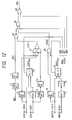
- Fig. 12 is a block diagram of a circuit for generating a control signal AUDL.
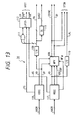
- Fig. 13 is a block diagram of the decoder of Fig. 4.
- Fig. 14 is a timing diagram showing the waveforms of various signals in the decoder of Fig. 13 which occur during a head of an odd field in a video field sequence.
- Fig. 15 is a timing diagram showing the waveforms of the signals in the decoder of Fig. 13 which occur during a head of an even field in the video field sequence.
- Fig. 16 is a block diagram of the video recording processing circuit of Fig. 2.
- a clock signal having a frequency "64fas” is used in the conversion of output serial data from a digital audio interface into 16-bit audio data.
- the clock signal having a frequency "64fas” is reproduced from a preamble of one sub frame by a clock reproducing circuit using a PLL (a phase-locked loop).
- An audio-data sampling clock signal having a frequency fas can be easily obtained by detecting the phase of the serial data, and by frequency-dividing the clock signal of a frequency "64fas” in synchronism with the detected phase.
- recorded audio information is automatically synchronized with recorded video information.
- audio information outputted from a digital audio equipment is recorded by a digital VTR, it is necessary to provide synchronization between the reproducing operation of the digital audio equipment and the recording operation of the digital VTR.
- a first prior art way of such synchronization has a step of feeding a reference video signal to both a digital audio equipment and a digital VTR.
- the speed of reproduction of audio information is controlled in response to the horizontal sync components of the reference video signal so that the previously-mentioned frequency relation (1) or (2) will be satisfied.
- the timing of recording of the audio information is controlled so as to correspond to the timing of recording of the reference video signal.
- Such a problem can be resolved by providing a digital audio equipment with a function of obtaining synchronization with a video signal.
- providing a digital audio equipment with a synchronizing function necessitates a large additional circuit.
- a fourth prior art way of synchronization has the step of generating a horizontal-frequency signal of reference video information on the basis of an audio sampling clock signal according to the previously-mentioned frequency relation (1) or (2).
- the horizontal-frequency signal is used as a reference for the recording operation of a digital VTR.
- the sampling frequency fs (13.5 MHz) related to component video data has the following relation with the horizontal frequency fh of NTSC and PALM television signals.
- fs 858fh
- the sampling frequency fs related to component video data has the following relation with the horizontal frequency fh of PAL television signals.
- fs 864fh
- a sampling clock signal used in the conversion of an analog video signal into digital video data is generated from a suitable-frequency signal, such as a composite sync signal, which has a frequency equal to a horizontal frequency fh.
- the positions of recording of digital data on a tape, the positions of the boundaries between audio data and video data on the tape, and the timing of recording of the digital data are determined by a video reference synchronous with a video sampling clock signal.
- composite-type digital VTRs require the generation of a signal of a video sampling frequency fsc which is related to an audio sampling frequency fas by the previously-mentioned equations (1), (2), (5), and (6). Accordingly, a large circuit tends to be necessary for synchronizing the recording operation of the digital VTR with the audio sampling clock signal.
- Fig. 11 shows a decoder section of a digital audio interface in a digital VTR.
- Fig. 1 shows the waveform of signals outputted from the decoder section of Fig. 11.
- the decoder section includes a clock reproducing circuit 100, serial decoders 101 and 102, serial-to-parallel (S/P) converters 103 and 104, and a multiplexer 105.
- the first serial data CH1/CH2 DATA and the second serial data CH3/CH4 DATA are synchronous with each other, and the clock reproducing circuit 100 generates the clock signal CLOCK on the basis of one of the first serial data CH1/CH2 DATA and the second serial data CH3/CH4 DATA.
- the present serial data is preferentially used in generating the clock signal CLOCK.
- the clock reproducing circuit 100 generates a sync signal ASYNC in response to the first serial data CH1/CH2 DATA and the second serial data CH3/CH4 DATA.
- a complete digital audio output signal from the digital VTR has a parallel form including 8 bits for audio information data, 1 bit for a 48-KHz sync signal ASYNC, and 1 bit for a 768-KHz clock signal CLOCK.
- the 8-bit audio information data, the 48-KHz sync signal ASYNC, and the 768-KHz clock signal CLOCK are in a fixed timing relation with each other.
- Each 16-bit audio data corresponding to a sample is divided into a byte "0" and a byte "1" before being transmitted.
- a byte "3" and a byte "4" are allotted to data for bit-number expansion, mode designation, and other purposes. Discrimination between channels is performed by referring to the 48-KHz sync signal ASYNC.
- video and audio data recording and reproducing apparatus includes a video recording processing circuit 1, an audio recording processing circuit 2, a multiplexer 3, a recording head 4, a magnetic tape 5, a reproducing head 6, a video reproducing processing circuit 7, an audio reproducing processing circuit 8, a burst lock oscillator 9, a video reference generating circuit 10, a servo circuit 11, a frequency converting circuit 12, and switches 13, 14, 15, and 16.
- a signal REF1 is a composite video signal which constitutes an output reference of a reproduced video signal, and which is inputted from an external signal source via a terminal (no reference character).
- the reference video signal REF1 contains sync and burst signals.
- the reference video signal REF1 is equal to or higher in level than a black burst in which all video information corresponds to a black level.
- the reference video signal REF1 is selected by the switch 15 as a reference video signal REF2 which is fed to the video reference generating circuit 10.
- the video reference generating circuit 10 detects horizontal and vertical sync signals, and a color framing phase and a subcarrier phase in a burst signal from the reference video signal REF2, and outputs signals of reproduction reference timings to the servo circuit 11, the audio reproducing processing circuit 8, and the video reproducing processing circuit 7.
- the video reference generating circuit 10 also outputs a black burst signal B.B. which is remade from a timing of the reference video signal REF2, and which includes sync and burst components having phases synchronous with the reference video signal REF2.
- Audio data (audio-information data) ADATA to be recorded is inputted from a digital audio interface (not shown) via a terminal (no reference character).
- Video data (video-information data) VDATA is inputted via another terminal (no reference character).
- the video data VDATA is fed from a video digital interface, or is obtained by the analog-to-digital conversion of a recording video signal which includes a process of sampling the recording video signal with a predetermined sampling clock signal.
- the audio recording processing circuit 2 receives the input audio data ADATA, which has four channels and which is transmitted while being separated into eight bits.
- the audio recording processing circuit 2 separates the input audio data ADATA into data of a channel "1", data of a channel "2", data of a channel "3", and data of a channel "4".
- the audio recording processing circuit 2 encodes the data of each channel into codes of a predetermined format, such as error-correcting codes, and outputs the audio-data codes to the multiplexer 3.
- the audio-data codes are fed to the recording head 4 via the multiplexer 3, being recorded on the magnetic tape 5 by the recording head 4.
- the recorded positions of the audio-data codes on the magnetic tape 5 are separated from the recorded positions of video data on the magnetic tape 5 by the operation of the multiplexer 3.
- a servo-control reference for a normal recording process is generated on the basis of the recording video data VDATA.
- the video recording processing circuit 1 receives the input video data VDATA via the switch, and converts the input video data VDATA into codes of a predetermined format similarly to the encoding of the audio data ADATA. In addition, the video recording processing circuit 1 generates a recording servo reference timing signal SVIN on the basis of the input video data VDATA, and feeds the reference signal SVIN to the servo circuit 11 via the switch 16.
- the switch 16 allows the transmission of the reference signal SVIN from the video recording processing circuit 1 to the servo circuit 11, and the switch 13 selects the externally-fed video data VDATA as recording video data RECDATA fed to the video recording processing circuit 1.
- the reference video signal REF2 transmitted via the switch 15 is also fed to the burst lock oscillator 9.
- the burst lock oscillator 9 generates a clock signal 4FSC1 on the basis of the burst signal in the reference video signal REF2.
- the clock signal 4FSC1 has a frequency equal to four times a color subcarrier frequency, and is phase-locked to the burst signal.
- the output clock signal 4FSC1 is selected by the switch 14 as a clock signal 4FSC fed to the video reference generating circuit 10.
- the video reference generating circuit 10 remakes a signal representative of a reference video reproduction timing in response to the clock signal 4FSC and the reference video signal REF2, and generates the black burst signal B.B.
- the video reference generating circuit 10 feeds a timing start pulse signal VRST for video output and a video processing clock signal 4FSC to the video reproducing processing circuit 7. Furthermore, the video reference generating circuit 10 feeds a timing start pulse signal ARST for audio output and an audio processing clock signal ARCK to the audio reproducing processing circuit 8.
- the video timing start pulse signal VRST, the audio timing start signal ARST, the video processing clock signal 4FSC, and the audio processing clock signal ARCK are synchronous with the black burst signal B.B.
- an editing process in this embodiment is different from that in the prior art recording and reproducing apparatus.
- the editing process is equal to a process of inserting new video information into recorded video information on a magnetic tape, or a process of re-recording a part of recorded information on the magnetic tape.
- recording video signal data VDATA or a reference video signal REF1 is used as a reference in such an editing process.
- This embodiment has a new mode of operation which is not taught by the prior art. During the new mode of operation, a recording timing is controlled in response to an input sync signal or an input clock signal from a digital audio interface.
- the switches 13, 14, and 15 are changed by a control signal AUDL.
- the switch 14 is changed so as to feed an output clock signal 4FSC2 from the frequency converting circuit 12 to the video reference generating circuit 10 as a clock signal 4FSC.
- the frequency converting circuit 12 receives sync components ASYNC of the input audio data ADATA from the digital audio interface, and generates the clock signal 4FSC2 on the basis of the sync components ASYNC of the audio data ADATA.
- the clock signal 4FSC2 has a frequency equal to four times the color subcarrier frequency fsc.
- the relation between the color subcarrier frequency fsc and the horizontal frequency fh is given by the previously-mentioned equation (5).
- the relation between the color subcarrier frequency fsc and the horizontal frequency fh is given by the previously-mentioned equation (6).
- the sync components ASYNC have a frequency equal to the audio signal sampling frequency fas, that is, 48 KHz.
- the relation between the frequency 4fsc of the clock signal 4FSC2 and the audio signal sampling frequency fas is given as follows.
- the frequency converting circuit 12 includes a combination of a frequency divider and a frequency multiplier cooperating to provide a frequency ratio in the equation (7) or (8).
- the frequency multiplier includes a PLL (phase-locked loop).
- the clock signal 4FSC2 may be generated by converting the frequency of a clock signal fed from a digital audio interface.
- the equations (7), (8), and (9) give the relation between the frequency fack of the digital-interface clock signal and the frequency 4fsc of the clock signal 4FSC2 in the NTSC system or the PAL system. This frequency ratio is used in the frequency converting circuit 12.
- the frequency converting circuit 12 compares the frequency of the first pulse signal and the frequency of the second pulse signal, and controls the frequency of the output clock signal 4FSC2 in response to the result of the frequency comparison so that the frequency of the first pulse signal will be locked to the frequency of the second pulse signal.
- the switch 13 is changed together with the switch 14. Specifically, the switch 13 is changed so as to feed timing data B.B.DATA from the video reference generating circuit 10 to the video recording processing circuit 1 instead of the recording video data VDATA.
- the timing data B.B.DATA is a base for the black burst signal B.B.
- the switch 13 may be changed so that the black burst signal B.B. will be fed instead of the analog video signal.
- the switch 15 is changed together with the switch 13.
- the switch 15 is opened so that the feed of the reference video signal REF2 to the video reference generating circuit 10 will be interrupted.
- the operation of the video reference generating circuit 10 moves into an internal mode or a self-running mode where a continuous video reference timing signal is internally and automatically generated.
- Fig. 12 shows a circuit for generating the control signal AUDL.
- sync signal separating circuits 70 and 74 serve to separate sync signals from the reference signal REF1 and the analog video signal respectively.
- Detection circuits 71 and 75 following the sync signal separating circuits 70 and 74 serve to detect the presence and absence of the separated sync signals. Specifically, the detection circuits 71 and 75 output "H" when video signals having normal sync signals are inputted. Otherwise, the detection circuits 71 and 75 output "L”.
- An analog-to-digital (A/D) converter 73 converts the analog input recording video signal into a corresponding digital signal.
- the selector 79 serves to select one of the digital input video signal and the analog input video signal.
- a selector 80 serves to select one of the externally-applied digital audio signal and the output digital audio signal from the P/S converter 78 as recording audio data ADATA. In other words, the selector 80 serves to select one of the digital input audio signal and the analog input audio signal.
- a gate 81 executes a predetermined logic operation among the output signals from the detection circuits 72 and 75 and a signal VSEL, and thereby outputs a signal VDET.
- the signal VSEL is fed from a system controller SYSCON (not shown) which provides an interface in the operation of the digital VTR.
- a gate 82 executes a predetermined logic operation between the output signal from the detection circuit 76 and a signal ASEL.
- the signal ASEL is fed from the system controller SYSCON.
- a gate 83 executes a predetermined logic operation between the output signals from the detection circuit 71 and the gate 81.
- the gate 84 executes a predetermined logic operation among the output signals from the gates 82 and 83 and a signal REC.
- the signal REC is fed from the system controller SYSCON.
- a gate 85 executes a predetermined logic operation between the output signal from the gate 84 and a signal AREF, and thereby outputs the control signal AUDL.
- the signal AREF is fed from the system controller SYSCON.
- the data selections by the selectors 79 and 80 are controlled in response to the signals VSEL and ASEL respectively. Specifically, the digital input signals are selected by the selectors 79 and 80 when the signals VSEL and ASEL are "H". Video data and audio data having a plurality of channels can be recorded. Simultaneously recording analog channels and digital channels can be done. For simplicity, a further description will be given of the case of one channel.
- the detection circuit 71 outputs a signal RDET which represents the presence and absence of the reference signal REF1.
- the gate 81 outputs a signal VDET which represents the presence and absence of an input video signal. specifically, the signal VDET assumes "H" in the presence of an input video signal. Otherwise, the signal VDET assumes "L".
- the gate 82 outputs a signal DADET.
- the signal DADET assumes "H” in the case where data from a digital interface is selected as recorded audio data and also the input signal is present. Otherwise, the signal DADET assumes "L". In the case of recording data of a plurality of channels, the signal DADET assumes "H” when at least one channel satisfies the above-mentioned conditions, and the signal DADET assumes "L” otherwise.
- the signal REC remains “H” during the recording process.
- the signal AREF is "H” when data from a digital interface is preferentially used as a reference for the record and reproduction.
- the black burst signal B.B. for a video output reference is generated from the clock signal 4FSC.
- the horizontal period given by the signal FH corresponds to 910 clock pulses as shown in Fig. 3, and the frequency of the burst signal is equal to one fourth of the clock signal.
- the switch 14 is changed by the control signal AUDL so that the output clock signal 4FSC2 from the frequency converting circuit 12 will be selected as the clock signal 4FSC fed to the video reference generating circuit 10.
- the black burst signal B.B. is continuously generated from the clock signal 4FSC.
- the output timing data B.B.DATA from the vide reference generating circuit 10 is selected by the switch 13 as the recording video data RECDATA fed to the video recording processing circuit 1.
- an internal recording video reference is generated in synchronism with a fixed-timing component of the audio data from the digital audio interface, and the internal recording video reference is fed to the video recording processing circuit 1.
- the multiplexer 3 and the servo circuit 11 can be prevented from operating asynchronously with the audio data, and it is possible to prevent the recorded audio data from partially dropping out or being discontinuous.
- the frequency converter 20 converts the sync signal ASYNC into a horizontal pulse signal AFH having a frequency equal to the horizontal frequency fh.
- the frequency converter 20 uses a frequency conversion ratio of 375/1144 in the case of the NTSC television system.
- the horizontal pulse signal AFH is fed to the phase comparator 21.
- the phase comparator 21, the low pass filter 22, the voltage-controlled oscillator 23, the switch 14, and a part of the video reference generating circuit 10 compose a PLL circuit 24.
- the output signal from the phase comparator 21 is fed to the voltage-controlled oscillator 23 via the low pass filter 22.
- the voltage-controlled oscillator 21 generates the clock signal 4FSC2 in response to the output signal from the phase comparator 21, and outputs the clock signal 4FSC2 to the video reference generating circuit 10 via the switch 14.
- the clock signal 4FSC2 is converted into a pulse signal FH through a frequency dividing process, the pulse signal FH having a frequency corresponding to the horizontal frequency fh.
- the pulse signal FH is outputted to the phase comparator 21.
- the phase of the pulse signal AFH and the phase of the pulse signal FH are compared by the phase comparator 21 so that the frequency of the clock signal 4FSC2 will have a fixed relation with the frequency of the sync component ASYNC of the input audio data.
- the subcarrier generating circuit 31 In the video reference generating circuit 10, the subcarrier generating circuit 31 generates a subcarrier FSC in response to the clock signal 4FSC fed via the switch 14.
- the horizontal counter 32 generates horizontal phase information data HADR in response to the clock signal 4FSC.
- the vertical counter 33 generates vertical phase information data VADR in response to the clock signal 4FSC.
- the subcarrier FSC, the horizontal phase information data HADR, and the vertical phase information data VADR constitute basic video references.
- the decoder 34 generates the horizontal pulse signal FH, timing data VTIM, a servo-control timing signal SVREF, a video reproducing reset pulse signal VRST, a field number signal FN, a composite sync signal CSYNC, and a burst flag signal BF on the basis of the horizontal phase information data HADR and the vertical phase information data VADR.
- the field number signal FN represents video phase information for matching the audio reproduction phase to the video reproduction phase.
- the burst gate 35 gates the subcarrier FSC in response to the burst flag signal BF, generating a burst signal from the subcarrier FSC and outputting the burst signal to the adder 36.
- the adder 36 combines the burst signal and the composite sync signal CSYNC into the black burst signal B.B. which is a video reference signal fed to an external equipment (not shown).
- the black burst signal B.B. has a waveform such as shown in Fig. 3.
- the reset pulse generating circuit 30 detects desired timings of resetting the subcarrier generating circuit 31, the horizontal counter 32, and the vertical counter 33 by referring to the reference video signal REF2, and generates reset timing signals representative thereof.
- the reference video signal REF2 is absent and the reset pulse generating circuit 30 does not output any reset timing signals.
- the subcarrier generating circuit 31 and the counters 32 and 33 move into a self-running mode of operation where suitable reset signals are internally generated.
- the frequency converter 38 converts the horizontal pulse signal FH into the digital-audio reproduced clock signal ARCK.
- the frequency converter 38 uses a frequency conversion ratio of 1144/375 in the case of the NTSC television system.
- the gate 37 gates the clock signal ARCK in response to the field number signal FN, generating the reset pulse signal ARST from the clock signal ARCK.
- the reset pulse signal ARST determines the digital audio reproduction phase.
- the digital data generating circuit 39 generates the recording video data B.B.DATA on the basis of the clock signal 4FSC and the timing data VTIM fed from the decoder 34.
- the contents of the recording video data B.B.DATA are equal to the contents of data obtained by the analog-to-digital conversion of the black burst signal B.B. which is executed at a sampling frequency equal to the frequency 4fsc.
- the recording video data B.B.DATA is used as a recording reference in a process of recording audio data during, for example, the after-recording of the audio data.
- the video data B.B.DATA is recorded as a reproduction reference for stably reproducing audio data.
- the decoder 34 includes a vertical address decoder 106, a horizontal address decoder 107, a multiplexer 108, frequency dividers 109 and 110, a NAND gate 111, a latch circuit 112, and a delay circuit 113.
- Fig. 14 shows the waveforms of various signals in the decoder 34 which occur during a head of an odd field in a video field sequence.
- Fig. 15 shows the waveforms of the signals in the decoder 34 which occur during a head of an even field in the video field sequence.
- the multiplexer 108 selects the pulse signal VSP. During the absence of a pulse of the signal VP and the presence of a pulse of the signal VD, the multiplexer 108 selects the equalizing pulse signal EQP. These processes by the multiplexer 108 causes the generation of the composite sync signal CSYNC of Figs. 14 and 15. In addition, the multiplexer 108 inhibits or blocks the pulse signal BFO in response to the pulse signal VD at a burst position in a horizontal period, and thereby generates the burst flag signal BF which is fed to the burst gate 35 of Fig. 4.
- the delay circuit 113 generates the reproduction reference timing signal SVREF by suitably delaying the output signal from the frequency divider 109.
- the speed of a drum provided with a rotary head is controlled in synchronism with a video field, and the reproduction timing is controlled by suitably setting the phase of the field number signal FN.
- the pulse signals CSYNC, BF, and LAL compose the timing data VTIM which is used by the digital data generating circuit 39 of Fig. 4 in generating the black burst data B.B.DATA.
- the digital data generating circuit 39 includes a counter and a ROM storing inclination data.
- the counter serves to detect an interval of several clocks in response to variation points of the pulse signals CSYNC and BF, and the inclination data is read out from the ROM by using the output signal from the counter as an address fed to the ROM. As a result of this process, burst envelope data and composite sync data having an inclination are obtained.
- the black burst data B.B.DATA can be obtained by multiplying the burst envelope data and color subcarrier data to generate burst data, and by adding the burst data and the composite sync data.
- the color subcarrier data agrees with data representing sinusoidal waves having a period equal to the color subcarrier period.
- the generation of the black burst data B.B.DATA is shown, for example, in U.S. Application Serial Number 789,069, U.S. Application Serial Number 853,304, or Japanese published unexamined patent application 62-18586, the disclosure of which is hereby incorporated by reference.
- the pulse signal LAL is used in determining the phase relation between the composite sync data and the color subcarrier data.
- the time portions of the black burst data B.B.DATA except the sync and burst parts agree with blanking level data, and thus they can be generated easily.
- the digital data generating circuit 39 for generating the black burst data B.B.DATA representing a video signal containing burst components may be omitted, and be replaced by another simple circuit.
- This circuit in the video reference generating circuit 10 is used in common for the PLL circuit 24, and thus it is unnecessary to provide the frequency converting circuit 12 with a circuit for generating a horizontal pulse signal FH from the clock signal 4FSC2. Accordingly, the combination of the frequency converting circuit 12 and the video reference generating circuit 10 can be made on a small scale.
- the frequency converter 20 can be used in common for generating a reference signal of a horizontal frequency fh from a clock signal of a sampling frequency fas, the reference horizontal frequency signal being compared in phase to the horizontal pulse signal FH in a PLL for generating the sampling clock signal from the horizontal pulse signal FH, the sampling clock signal being used in the analog-to-digital conversion of an analog audio signal.
- a second embodiment of this invention is similar to the embodiment of Figs. 2-6 except for design changes indicated later.
- the second embodiment is designed for a PAL video signal.
- the horizontal pulse signal FH2 is fed to the phase comparator 21 within the frequency converting circuit 12.
- the decoder 34b generates timing data VTIMb, a field number signal FN, a composite sync signal CSYNC, and a burst flag signal BF on the basis of horizontal phase information data HADRb and vertical phase information data VADR fed from the horizontal counter 32b and the vertical counter 33.
- the timing data VTIMb constitutes a base for generating video signal data.
- the timing data VTIMb is fed to the decoder 34a.
- the field number signal FN represents video phase information for matching the audio reproduction phase to the video reproduction phase.
- the decoder 34a generates timing data VTIM on the basis of the timing data VTIMb and the horizontal phase information data HADRa.
- the output video data B.B.DATA from the ROM 52 is denoted by sampling-point circles which are positioned at corresponding analog levels for an easy understanding.
- the video data B.B.DATA has a given timing relation with the subcarrier phase data SCP as shown in Fig. 10.
- the horizontal frequency fh and the sampling clock frequency 4fsc have the offset relation expressed in the previously-mentioned equation (10). Therefore, as shown in Fig. 10, the waveform sampling points of the video data B.B.DATA gradually shift relative to the phase of the horizontal sync signal in each horizontal period. The rate of this shift corresponds to the period of the clock signal 4FSC which is multiplied by 4/625.
- the video data B.B.DATA is converted by the combination of the D/A converter 54 and the low pass filter 55 into the continuous-waveform black burst signal B.B. which has a constant horizontal period (see Fig. 10).
- the horizontal pulse signal FH outputted from the horizontal sync separating circuit 56 is free from an offset process, and has a fixed frequency relation with the clock signal 4FSC.
Landscapes
- Engineering & Computer Science (AREA)
- Multimedia (AREA)
- Signal Processing (AREA)
- Television Signal Processing For Recording (AREA)
- Signal Processing For Digital Recording And Reproducing (AREA)
Claims (8)
- Eine Video- und Audio-Datenaufnahme- und Wiedergabevorrichtung verwendbar in Kombination mit einer digitalen Audio-Schnittstelle, mit:einem Mittel (4) zum Aufnehmen von Videodaten und Audiodaten in einem Aufnahmemedium (5);einem Mittel (9) zum Erzeugen eines ersten Zeitbestimmungssignals (4FSC1) auf der Grundlage der Videodaten;einem Mittel (2) zum Extrahieren von Audiodaten aus einem Ausgangssignal (ADATA) der digitalen Audio-Schnittstelle und Speisen der extrahierten Audiodaten an das Aufnahmemittel (4);einem Mittel (12) zum Erzeugen eines zweiten Zeitbestimmungssignals (4FSC2) auf der Grundlage des Ausgangssignals der digitalen Audio-Schnittstelle in der Abwesenheit der Videodaten (VDATA) undeinem Servosteuermittel (11) zum Steuern des Aufnahmemittels (4) im Ansprechen auf das erste Zeitbestimmungssignal (4FSC1) in der Gegenwart der Videodaten (VDATA) und im Ansprechen auf das zweite Zeitbestimmungssignal (4FSC2) in der Abwesenheit der Videodaten (VDATA).
- Die Video- und Audio-Datenaufnahme- und Wiedergabevorrichtung von Anspruch 1, worin das zweite Zeitbestimmungssignalerzeugungsmittel (12) ein Mittel zum Erzeugen des zweiten Zeitbestimmungssignales (4FSC2) auf der Grundlage einer Komponente mit fester Frequenz (ASYNC) des Ausgangssignals (ADATA) der digitalen Audio-Schnittstelle umfaßt, wobei das zweite Zeitbestimmungssignal (4FSC2) eine feste Frequenzbeziehung zu der Komponente mit fester Frequenz (ASYNC) des Ausgangssignals (ADATA) der digitalen Audio-Schnittstelle aufweist.
- Die Video- und Audio-Datenaufnahme- und Wiedergabevorrichtung von Anspruch 1, weiter mit einem Videoaufnahme- und Verarbeitungsschaltkreis (1) zum Verarbeiten erster Videoaufnahmedaten (VDATA) in zweite Videoaufnahmedaten und Erzeugen eines Zeitbestimmungssteuersignals (SVIN) auf der Grundlage der ersten Videoaufnahmedaten; einem Audio-Aufnahmeverarbeitungsschaltkreis (2) zum Verarbeiten erster Audio-Aufnahmedaten (ADATA) in zweite Audio-Aufnahmedaten; wobei das Mittel (4) zum Aufnehmen angepaßt ist zum Aufnehmen der zweiten Videoaufnahmedaten und der zweiten Audio-Aufnahmedaten in dem Aufnahmemedium (5);einem Mittel zum Speisen von Ausgangsdaten (ADATA) aus der digitalen Audio-Schnittstelle an den Audio-Aufnahmeverarbeitungsschaltkreis (2) als die ersten Audio-Aufnahmedaten; wobeidas Mittel (12) zum Erzeugen eines zweiten Zeitbestimmungssignals zum Erzeugen des zweiten Zeitbestimmungssignals als ein Referenztaktsignal (4FSC2) auf der Grundlage einer Zeitbestimmungskomponente mit fester Frequenz (ASYNC) der Ausgangsdaten (ADATA) aus der digitalen Audio-Schnittstelle angepaßt ist, das Referenztaktsignal (4FSC2) eine feste Frequenzbeziehung zu der Zeitbestimmungskomponente mit fester Frequenz (ASYNC) der Ausgangs(ADATA)-Daten aus der digitalen Audio-Schnittstelle aufweist;einem Mittel (10) zur Erzeugung von Referenzdaten (B.B.DATA) auf der Grundlage des Referenztaktsignals (4FSC2), wobei die Referenzdaten einem Schwarz-Burst-Signal entsprechen; und einem Mittel (13) zum Speisen der Referenzdaten (B.B.DATA) an den Videoaufnahmeverarbeitungsschaltkreis (1) als die ersten Videoaufnahmedaten.
- Die Video- und Audio-Aufnahme- und Wiedergabevorrichtung von Anspruch 3, worin das Referenztaktsignal (4FSC2) eine Frequenz gleich einer vorbestimmten Frequenz eines Abtasttaktsignals aufweist, das auf die ersten Videoaufnahmedaten bezogen ist.
- Die Video- und Audio-Aufnahme- und Wiedergabevorrichtung von Anspruch 3, worin ein Videowiedergabeverarbeitungsschaltkreis (7) und ein Audio-Wiedergabeverarbeitungsschaltkreis (8) Daten verarbeitet, die von dem Aufnahmemedium wiedergegeben sind; und wiedergegebene Videodaten und wiedergegebene Audiodaten in Synchronismus mit einem Ausgangsreferenzvideosignal ausgegeben sind;wobei das Mittel zum Erzeugen eines ersten Zeitbestimmungssignals einen Oszillator (9) zum Erzeugen des ersten Zeitbestimmungssignals als ein erstes Taktsignal (4FSC1) der Videoabtastfrequenz umfaßt;das Mittel zum Erzeugen eines zweiten Zeitbestimmungssignals einen Frequenzwandelschaltkreis (12) umfaßt zum Erzeugen des Referenzsignals als zweites Taktsignal (4FSC2) einer Videoabtastfrequenz aus einem eines Taktsignals oder eines SYNC-Signals, das aus der digitalen Audio-Schnittstelle ausgegeben ist;das Mittel zum Erzeugen von Referenzdaten einen VideoReferenzerzeugungsschaltkreis (10) umfaßt zum Erzeugen eines Video-Zeitbestimmungssignals (4FSC.VRST), eines Audio-Zeitbestimmungssignal (ARCK.ARST), und von Schwarz-Burst-Daten (B.B.DATA) aus einem der Taktsignale, die von dem Frequenzwandelschaltkreis (12) und dem Oszillator (9) erzeugt werden, und aus dem Ausgangsreferenz-Videosignal (REF 1), wobeidas Mittel zum Speisen ein erstes Schaltmittel (13) umfaßt, zum, in Fällen, wo die Aufnahme-Audiodaten (ADATA) aufgenommen und editiert werden, Ersetzen der Videodaten (VDATA) durch die Schwarz-Burst-Daten (B.B.DATA) und Speisen der Schwarz-Burstdaten an den Video-Aufnahmeverarbeitungschaltkreis (1); wobeidie Vorrichtung weiter ein zweites Schaltmittel (14) umfaßt, zum, in Fällen, wo die Aufnahme-Audiodaten (ADATA) aufgenommen oder editiert werden, Ersetzen des ersten Video-Abtastfrequenztaktsignales (4FSC1) aus dem Oszillator (9) durch das zweite Video-Abtastfrequenztaktsignal (4FSC2) aus dem Frequenzwandelschaltkreis (12) und Speisen des zweiten Video-Abtastfrequenztaktsignales (4FSC2) aus dem Frequenzwandelschaltkreis (12) an den Video-Referenzerzeugsschaltkreis (10); undein drittes Schaltmittel (15), zum, in Fällen, wo die Aufnahme-Audiodaten (ADATA) aufgenommen oder editiert werden, Suspendieren der Detektion des Ausgangsreferenz-Videosignals (REF 1), das an den Video-Referenzerzeugungsschaltkreis (10) gespeist wird, und Unterdrücken eines Zeitbestimmungsrücksetzen des Video-Referenzerzeugungsschaltkreises (10).
- Die Video- und Audio-Datenaufnahme- und Wiedergabevorrichtung von Anspruch 5, worin der Oszillator (9) ein Mittel zum Erzeugen des ersten Videoabtastfrequenztaktsignals (4FSC1) von Burst-Komponenten des Ausgangsreferenz-Videosignals umfaßt, wobei die Videoabtastfrequenz gleich viermal einer Farbsubträgerfrequenz ist, worin der Frequenzwandelschaltkreis (12) einen Frequenzwandler (20) zum Ausführen eines Frequenzumwandlungsverfahrens auf dem Taktsignal oder dem SYNC-Signal umfaßt, das von der digitalen Audio-Schnittstelle ausgegeben wird, und Wandeln des Taktsignals oder des SYNC-Signals zu einem Horizontal-Frequenzsignal (AFH), ein PLL-Schaltkreis (24) ein Taktsignal (4FSC2) mit einer Frequenz ausgibt, welche im Ansprechen auf ein Ergebnis eines Vergleichs zwischen einer Phase des Horizontal-Frequenzsignals (AFH), das aus dem Frequenzwandler (12) ausgegeben ist, und einer Phase eines Horizontal-Frequenzsignals (FH) gesteuert ist, das aus dem Videoreferenzerzeugsschaltkreis (10) ausgegeben ist, und worin der Videoreferenzerzeugungsschaltkreis (10) ein Mittel (34) zum Frequenzteilen des Videoabtastfrequenztaktsignals (4FSC2) und Wandeln des Videoabtastfrequenztaktsignals (4FSC2) in das Horizontal-Frequenzsignal (FH), ein Mittel zum Speisen des Horizontal-Frequenzsignals (FH) an den Frequenzwandel-Schaltkreis (12) umfaßt.
- Die Video- und Audio-Datenaufnahme- und Wiedergabevorrichtung von Anspruch 5, worin der Oszillator (9) umfaßt ein Mittel zum Erzeugen des ersten Videoabtastfrequenztaktsignals (4FSC1) von Burst-Komponenten des Ausgangsreferenz-Videosignals (REF2), wobei die Videoabtastfrequenz gleich viermal einer Farbsubträgerfrequenz in einem PAL-Fernsehsystem ist, worin der Frequenzwandelschaltkreis (12) einen Frequenzwandler (20) zum Ausführen eines Frequenzwandelverfahrens auf dem Taktsignal oder SYNC-Signal, das aus der digitalen Audio-Schnittstelle ausgegeben wird, und Umwandeln des Taktsignals oder des SYNC-Signals in ein Horizontal-Frequenzsignal (AFH) umfaßt, wobei ein erster PLL-Schaltkreis (21, 22, 23) ein Taktsignal (4FSC2) mit einer Frequenz ausgibt, welche im Ansprechen auf ein Ergebnis eines Vergleichs zwischen einer Phase des Horizontal-Frequenzsignals (AFH), das aus dem Frequenzwandler (20) ausgegeben ist, und einer Phase eines Horizontal-Frequenzsignals (FH2), das aus dem Videoreferenzerzeugungsschaltkreis (10A) ausgegeben ist, gesteuert ist, und worin der Videoreferenzerzeugungsschaltkreis (10A) einen ersten Horizontalzähler (32A) zum Frequenzteilen des Videoabtastfrequenztaktsignals (4FSC2) und Erzeugen eines ersten Horizontal-Frequenzpulssignals (FH1) mit einer Phase näherungsweise gleich einer Phase eines Horizontal-SYNC-Signals umfaßt, einen zweiten PLL-Schaltkreis (40, 41, 42) zum Erzeugen eines Taktsignals (864FH) einer Frequenz gleich einem ganzen Vielfachen der Horizontal-Frequenz auf der Grundlage des ersten Horizontal-Frequenzpulssignals (FH1), und einen zweiten Horizontal-Zähler (32B) zum Erzeugen eines zweiten Horizontal-Frequenzpulssignals (FH2) von dem Taktsignal (864FH), das von dem zweiten PLL-Schaltkreis (40, 41, 42) erzeugt wird, und Speisen des zweiten Horizontal-Frequenzpulssignals (FH2) an den Frequenzumwandlungsschaltkreis (12).
- Die Video- und Audio-Datenaufnahme- und Wiedergabevorrichtung von Anspruch 5, worin der Oszillator (9) ein Mittel zum Erzeugen des ersten Videoabtastfrequenztaktsignales (4FSC1) aus Burst-Komponenten des Ausgangsreferenzvideosignals (REF 2) umfaßt, wobei die Videoabtastfrequenz gleich viermal einer Farbsubträgerfrequenz ist, worin der Frequenzwandelschaltkreis (12) einen Frequenzwandler (20) zum Ausführen eines Frequenzwandlungsverfahrens auf dem Taktsignal oder dem SYNC-Signal umfaßt, das aus der digitalen Audio-Schnittstelle ausgegeben wird, und Wandeln des Taktsignals oder des SYNC-Signals zu einem Horizontal-Frequenzsignal (AFH), wobei ein PLL-Schaltkreis (24) ein zweites Taktsignal (4FSC2) mit einer Frequenz ausgibt, welche im Ansprechen auf ein Ergebnis eines Vergleichs zwischen einer Phase des Horizontal-Frequenzsignals (AFH), das aus dem Frequenzwandler (12) ausgegeben ist, und einer Phase eines Horizontal-Frequenzsignals (FH), das aus dem Videoreferenzerzeugungsschaltkreis (10B) ausgegeben ist, gesteuert ist, und worin der Videoreferenzerzeugungsschaltkreis (10B) Zähler (32, 33, 51) zum Frequenzteilen des Videoabtastfrequenztaktsignales (4FSC) umfaßt und Zählen einer Farbsubträgerphase und Horizontal- und Vertikal-Phasen, einen ROM (52), der Ausgangssignale (HADR, VADR, SCP) aus den Zählern (32, 33, 51) als ein Adress-Signal empfängt und digitale Daten (B.B.DATA) eines Schwarz-BurstSignales ausgibt, einen Digital-zu-Analogwandler (54) zum Wandeln der digitalen Daten des Schwarz-Burst-Signals zu einem entsprechenden Schwarz-Burst-Signal (B.B.), einen Tiefpaßfilter(55) zum Entfernen von Hochfrequenzkomponenten aus dem analogen Schwarz-Burst-Signal (B.B.) und einen Horizontal- SYNC-Separierungsschaltkreis (56) zum Erzeugen des Horizontal-Frequenzsignals (FH), das an den Frequenzwandelschaltkreis (12) gespeist wird, und zwar auf der Grundlage eines Ausgangssignals aus dem Tiefpaßfilter (55).
Applications Claiming Priority (2)
| Application Number | Priority Date | Filing Date | Title |
|---|---|---|---|
| JP2249431A JP2529455B2 (ja) | 1990-09-18 | 1990-09-18 | 磁気記録再生装置 |
| JP249431/90 | 1990-09-18 |
Publications (3)
| Publication Number | Publication Date |
|---|---|
| EP0476629A2 EP0476629A2 (de) | 1992-03-25 |
| EP0476629A3 EP0476629A3 (en) | 1993-04-14 |
| EP0476629B1 true EP0476629B1 (de) | 1997-01-02 |
Family
ID=17192870
Family Applications (1)
| Application Number | Title | Priority Date | Filing Date |
|---|---|---|---|
| EP91115862A Expired - Lifetime EP0476629B1 (de) | 1990-09-18 | 1991-09-18 | Vorrichtung zum Aufzeichnen und Wiedergeben von Video- und Audiodaten |
Country Status (4)
| Country | Link |
|---|---|
| US (1) | US5208678A (de) |
| EP (1) | EP0476629B1 (de) |
| JP (1) | JP2529455B2 (de) |
| DE (1) | DE69123913T2 (de) |
Families Citing this family (20)
| Publication number | Priority date | Publication date | Assignee | Title |
|---|---|---|---|---|
| US5475421A (en) * | 1992-06-03 | 1995-12-12 | Digital Equipment Corporation | Video data scaling for video teleconferencing workstations communicating by digital data network |
| US5623690A (en) * | 1992-06-03 | 1997-04-22 | Digital Equipment Corporation | Audio/video storage and retrieval for multimedia workstations by interleaving audio and video data in data file |
| JP3431930B2 (ja) * | 1992-06-16 | 2003-07-28 | キヤノン株式会社 | 回転ヘッド型記録再生装置 |
| WO1994011985A2 (en) * | 1992-11-13 | 1994-05-26 | Ampex Systems Corporation | Programmable audio timing generator for digital video tape recording |
| JPH06327028A (ja) * | 1993-03-17 | 1994-11-25 | Sanyo Electric Co Ltd | カラーバースト信号を利用する調整回路 |
| US5465268A (en) * | 1994-01-14 | 1995-11-07 | The Grass Valley Group, Inc. | Digital decoding of biphase-mark encoded serial digital signals |
| US5598156A (en) * | 1995-01-13 | 1997-01-28 | Micron Display Technology, Inc. | Serial to parallel conversion with phase locked loop |
| US5638085A (en) * | 1995-01-13 | 1997-06-10 | Micron Display Technology, Inc. | Timing control for a matrixed scanned array |
| JPH08227560A (ja) * | 1995-02-21 | 1996-09-03 | Sony Corp | ディジタル信号記録/再生装置および方法 |
| KR100208710B1 (ko) * | 1995-12-27 | 1999-07-15 | 윤종용 | 비디오 신호처리시스템에서 비표준의 동기신호를 처리하기 위한 장치 및 그 방법 |
| JP3744092B2 (ja) * | 1996-12-26 | 2006-02-08 | ソニー株式会社 | データ転送記録装置およびその方法 |
| KR100240328B1 (ko) * | 1997-04-30 | 2000-01-15 | 전주범 | Dvcr의 오디오 재생 클럭 발생 장치 |
| US5999906A (en) * | 1997-09-24 | 1999-12-07 | Sony Corporation | Sample accurate audio state update |
| JP4200630B2 (ja) * | 2000-03-17 | 2008-12-24 | ソニー株式会社 | 映像記録再生装置及び映像記録再生方法 |
| JP2004120030A (ja) * | 2002-09-24 | 2004-04-15 | Hitachi Ltd | 電子装置の同期制御方法 |
| US7292902B2 (en) * | 2003-11-12 | 2007-11-06 | Dolby Laboratories Licensing Corporation | Frame-based audio transmission/storage with overlap to facilitate smooth crossfading |
| JP2006285300A (ja) * | 2005-03-31 | 2006-10-19 | Toshiba Corp | 信号転送装置及び信号転送方法 |
| US20080207123A1 (en) * | 2007-02-27 | 2008-08-28 | Andersen Jorgen W | Configurable means to provide wireless module customization |
| US9418259B2 (en) * | 2013-10-07 | 2016-08-16 | Electronics And Telecommunications Research Institute | Tag transmission apparatus and signal transmitting method thereof |
| DE102017123319B4 (de) * | 2017-10-09 | 2025-01-16 | Sennheiser Electronic Se & Co. Kg | Verfahren und System zur Erfassung und Synchronisation von Audio- und Videosignalen und Audio/Video-Erfassungs- und Synchronisationssystem |
Family Cites Families (11)
| Publication number | Priority date | Publication date | Assignee | Title |
|---|---|---|---|---|
| JPS60223079A (ja) * | 1984-04-18 | 1985-11-07 | Sony Corp | 情報信号の記録装置 |
| JPS6118288A (ja) * | 1984-07-04 | 1986-01-27 | Hitachi Ltd | 磁気記録装置 |
| GB2166278A (en) * | 1984-10-23 | 1986-04-30 | Peter John Court Marlow | Sound recording interface for a domestic video cassette recorder |
| JPS61289791A (ja) * | 1985-06-18 | 1986-12-19 | Sony Corp | 映像・音声記録再生装置 |
| JPH0782285B2 (ja) * | 1985-07-18 | 1995-09-06 | 大日本印刷株式会社 | 複写防止方法及び複写防止媒体 |
| US4663654A (en) * | 1985-09-27 | 1987-05-05 | Ampex Corporation | Blanking signal generator for a subcarrier locked digital PAL signal |
| JPS63246087A (ja) * | 1986-11-19 | 1988-10-13 | Pioneer Electronic Corp | 記録方式 |
| JPS63129791A (ja) * | 1986-11-20 | 1988-06-02 | Fuji Photo Film Co Ltd | 静止画記録装置 |
| US5087980A (en) * | 1988-01-22 | 1992-02-11 | Soundmaster International, Inc. | Synchronization of recordings |
| JPH01318390A (ja) * | 1988-06-17 | 1989-12-22 | Matsushita Electric Ind Co Ltd | 音声映像記録装置 |
| JPH02116064A (ja) * | 1988-10-25 | 1990-04-27 | Matsushita Electric Ind Co Ltd | 回転ヘッド方式ディジタルオーディオ信号記録方法 |
-
1990
- 1990-09-18 JP JP2249431A patent/JP2529455B2/ja not_active Expired - Fee Related
-
1991
- 1991-09-06 US US07/756,018 patent/US5208678A/en not_active Expired - Fee Related
- 1991-09-18 EP EP91115862A patent/EP0476629B1/de not_active Expired - Lifetime
- 1991-09-18 DE DE69123913T patent/DE69123913T2/de not_active Expired - Fee Related
Also Published As
| Publication number | Publication date |
|---|---|
| DE69123913D1 (de) | 1997-02-13 |
| US5208678A (en) | 1993-05-04 |
| JPH04127685A (ja) | 1992-04-28 |
| DE69123913T2 (de) | 1997-05-07 |
| EP0476629A2 (de) | 1992-03-25 |
| EP0476629A3 (en) | 1993-04-14 |
| JP2529455B2 (ja) | 1996-08-28 |
Similar Documents
| Publication | Publication Date | Title |
|---|---|---|
| US5208678A (en) | Audio and video data synchronization apparatus for recording and reproducing system | |
| US6108485A (en) | Audio data playback clock signal generating apparatus for use in digital VCR | |
| US5187589A (en) | Multiprogram video tape recording and reproducing device | |
| US5245430A (en) | Timebase corrector with drop-out compensation | |
| CA2071595C (en) | Method and apparatus for recording compressed audio data on a video recording medium | |
| JPH02192281A (ja) | 改良された映像システム、方法及び装置 | |
| US5260800A (en) | Apparatus and method for high-speed video tape duplication from master disk | |
| EP0176324B1 (de) | Gerät zur Synchronisierung verschiedener Fernsehsysteme | |
| JPH05244562A (ja) | 映像信号記録・再生装置 | |
| US5386323A (en) | Method and apparatus for reproducing independently recorded multi-channel digital audio signals simultaneously and in synchronization with video signals | |
| JP3135308B2 (ja) | ディジタルビデオ・オーディオ信号伝送方法及びディジタルオーディオ信号再生方法 | |
| EP0406595B1 (de) | Verfahren und Vorrichtung zum Aufzeichnen und Wiedergeben eines digitalen Signals | |
| EP0160398A2 (de) | Vorrichtung zum Verarbeiten von Signalen | |
| US4752835A (en) | Audio signal generating apparatus for generating an audio signal to be recorded on a video disc | |
| JPH06181580A (ja) | ディジタルvtr | |
| US5315446A (en) | Recording and reproducing method and apparatus for a digital audio signal and a reversed bit order digital video | |
| KR900001450B1 (ko) | 기록 재생 장치 | |
| KR100225414B1 (ko) | 표준 vhs 비디오테이프를 사용하는 고화질 녹화 및 재생장치 | |
| JP3456601B2 (ja) | 映像記録装置、映像再生装置及びその方法 | |
| EP0398423B1 (de) | Anordnung zum Aufzeichnen eines Videosignals auf einem Aufzeichnungsträger | |
| JP3459145B2 (ja) | ディジタル信号記録再生装置 | |
| JP2594182B2 (ja) | Museデコーダ | |
| EP0484144A2 (de) | Verfahren und Vorrichtung zur Verarbeitung eines Videosignals | |
| JP2805772B2 (ja) | 映像信号記録回路 | |
| JPH09298719A (ja) | 複数のディジタル信号の多重化方法およびその装置 |
Legal Events
| Date | Code | Title | Description |
|---|---|---|---|
| PUAI | Public reference made under article 153(3) epc to a published international application that has entered the european phase |
Free format text: ORIGINAL CODE: 0009012 |
|
| 17P | Request for examination filed |
Effective date: 19910918 |
|
| AK | Designated contracting states |
Kind code of ref document: A2 Designated state(s): DE FR GB |
|
| PUAL | Search report despatched |
Free format text: ORIGINAL CODE: 0009013 |
|
| AK | Designated contracting states |
Kind code of ref document: A3 Designated state(s): DE FR GB |
|
| 17Q | First examination report despatched |
Effective date: 19950320 |
|
| GRAG | Despatch of communication of intention to grant |
Free format text: ORIGINAL CODE: EPIDOS AGRA |
|
| GRAH | Despatch of communication of intention to grant a patent |
Free format text: ORIGINAL CODE: EPIDOS IGRA |
|
| GRAH | Despatch of communication of intention to grant a patent |
Free format text: ORIGINAL CODE: EPIDOS IGRA |
|
| GRAA | (expected) grant |
Free format text: ORIGINAL CODE: 0009210 |
|
| AK | Designated contracting states |
Kind code of ref document: B1 Designated state(s): DE FR GB |
|
| REF | Corresponds to: |
Ref document number: 69123913 Country of ref document: DE Date of ref document: 19970213 |
|
| ET | Fr: translation filed | ||
| PLBE | No opposition filed within time limit |
Free format text: ORIGINAL CODE: 0009261 |
|
| STAA | Information on the status of an ep patent application or granted ep patent |
Free format text: STATUS: NO OPPOSITION FILED WITHIN TIME LIMIT |
|
| 26N | No opposition filed | ||
| PGFP | Annual fee paid to national office [announced via postgrant information from national office to epo] |
Ref country code: DE Payment date: 20000911 Year of fee payment: 10 |
|
| PGFP | Annual fee paid to national office [announced via postgrant information from national office to epo] |
Ref country code: FR Payment date: 20000912 Year of fee payment: 10 |
|
| PGFP | Annual fee paid to national office [announced via postgrant information from national office to epo] |
Ref country code: GB Payment date: 20000913 Year of fee payment: 10 |
|
| PG25 | Lapsed in a contracting state [announced via postgrant information from national office to epo] |
Ref country code: GB Free format text: LAPSE BECAUSE OF NON-PAYMENT OF DUE FEES Effective date: 20010918 |
|
| REG | Reference to a national code |
Ref country code: GB Ref legal event code: IF02 |
|
| PG25 | Lapsed in a contracting state [announced via postgrant information from national office to epo] |
Ref country code: DE Free format text: LAPSE BECAUSE OF NON-PAYMENT OF DUE FEES Effective date: 20020501 |
|
| GBPC | Gb: european patent ceased through non-payment of renewal fee |
Effective date: 20010918 |
|
| PG25 | Lapsed in a contracting state [announced via postgrant information from national office to epo] |
Ref country code: FR Free format text: LAPSE BECAUSE OF NON-PAYMENT OF DUE FEES Effective date: 20020531 |
|
| REG | Reference to a national code |
Ref country code: FR Ref legal event code: ST |