EP0473625B1 - Einrichtung zum dosieren von desinfektionsmitteln - Google Patents
Einrichtung zum dosieren von desinfektionsmitteln Download PDFInfo
- Publication number
- EP0473625B1 EP0473625B1 EP90907022A EP90907022A EP0473625B1 EP 0473625 B1 EP0473625 B1 EP 0473625B1 EP 90907022 A EP90907022 A EP 90907022A EP 90907022 A EP90907022 A EP 90907022A EP 0473625 B1 EP0473625 B1 EP 0473625B1
- Authority
- EP
- European Patent Office
- Prior art keywords
- disinfectant
- arrangement
- analysis cell
- disinfectants
- dosing
- Prior art date
- Legal status (The legal status is an assumption and is not a legal conclusion. Google has not performed a legal analysis and makes no representation as to the accuracy of the status listed.)
- Expired - Lifetime
Links
Images


Classifications
-
- A—HUMAN NECESSITIES
- A61—MEDICAL OR VETERINARY SCIENCE; HYGIENE
- A61L—METHODS OR APPARATUS FOR STERILISING MATERIALS OR OBJECTS IN GENERAL; DISINFECTION, STERILISATION OR DEODORISATION OF AIR; CHEMICAL ASPECTS OF BANDAGES, DRESSINGS, ABSORBENT PADS OR SURGICAL ARTICLES; MATERIALS FOR BANDAGES, DRESSINGS, ABSORBENT PADS OR SURGICAL ARTICLES
- A61L2/00—Disinfection or sterilisation of materials or objects, in general; Accessories therefor
- A61L2/24—Apparatus using programmed or automatic operation
-
- A—HUMAN NECESSITIES
- A61—MEDICAL OR VETERINARY SCIENCE; HYGIENE
- A61L—METHODS OR APPARATUS FOR STERILISING MATERIALS OR OBJECTS IN GENERAL; DISINFECTION, STERILISATION OR DEODORISATION OF AIR; CHEMICAL ASPECTS OF BANDAGES, DRESSINGS, ABSORBENT PADS OR SURGICAL ARTICLES; MATERIALS FOR BANDAGES, DRESSINGS, ABSORBENT PADS OR SURGICAL ARTICLES
- A61L2/00—Disinfection or sterilisation of materials or objects, in general; Accessories therefor
- A61L2/16—Disinfection or sterilisation of materials or objects, in general; Accessories therefor using chemical substances
- A61L2/18—Liquid substances
-
- D—TEXTILES; PAPER
- D06—TREATMENT OF TEXTILES OR THE LIKE; LAUNDERING; FLEXIBLE MATERIALS NOT OTHERWISE PROVIDED FOR
- D06F—LAUNDERING, DRYING, IRONING, PRESSING OR FOLDING TEXTILE ARTICLES
- D06F33/00—Control of operations performed in washing machines or washer-dryers
- D06F33/30—Control of washing machines characterised by the purpose or target of the control
- D06F33/32—Control of operational steps, e.g. optimisation or improvement of operational steps depending on the condition of the laundry
- D06F33/37—Control of operational steps, e.g. optimisation or improvement of operational steps depending on the condition of the laundry of metering of detergents or additives
-
- D—TEXTILES; PAPER
- D06—TREATMENT OF TEXTILES OR THE LIKE; LAUNDERING; FLEXIBLE MATERIALS NOT OTHERWISE PROVIDED FOR
- D06F—LAUNDERING, DRYING, IRONING, PRESSING OR FOLDING TEXTILE ARTICLES
- D06F34/00—Details of control systems for washing machines, washer-dryers or laundry dryers
- D06F34/14—Arrangements for detecting or measuring specific parameters
- D06F34/22—Condition of the washing liquid, e.g. turbidity
-
- G—PHYSICS
- G01—MEASURING; TESTING
- G01F—MEASURING VOLUME, VOLUME FLOW, MASS FLOW OR LIQUID LEVEL; METERING BY VOLUME
- G01F25/00—Testing or calibration of apparatus for measuring volume, volume flow or liquid level or for metering by volume
- G01F25/0092—Testing or calibration of apparatus for measuring volume, volume flow or liquid level or for metering by volume for metering by volume
-
- G—PHYSICS
- G05—CONTROLLING; REGULATING
- G05D—SYSTEMS FOR CONTROLLING OR REGULATING NON-ELECTRIC VARIABLES
- G05D21/00—Control of chemical or physico-chemical variables, e.g. pH value
- G05D21/02—Control of chemical or physico-chemical variables, e.g. pH value characterised by the use of electric means
-
- D—TEXTILES; PAPER
- D06—TREATMENT OF TEXTILES OR THE LIKE; LAUNDERING; FLEXIBLE MATERIALS NOT OTHERWISE PROVIDED FOR
- D06F—LAUNDERING, DRYING, IRONING, PRESSING OR FOLDING TEXTILE ARTICLES
- D06F2103/00—Parameters monitored or detected for the control of domestic laundry washing machines, washer-dryers or laundry dryers
- D06F2103/20—Washing liquid condition, e.g. turbidity
- D06F2103/22—Content of detergent or additives
-
- D—TEXTILES; PAPER
- D06—TREATMENT OF TEXTILES OR THE LIKE; LAUNDERING; FLEXIBLE MATERIALS NOT OTHERWISE PROVIDED FOR
- D06F—LAUNDERING, DRYING, IRONING, PRESSING OR FOLDING TEXTILE ARTICLES
- D06F2105/00—Systems or parameters controlled or affected by the control systems of washing machines, washer-dryers or laundry dryers
- D06F2105/42—Detergent or additive supply
Definitions
- the invention relates to a dosing device of disinfectant in washing liquors with a dosing device, in particular an analysis cell that can be operated continuously in a branch of the flow of the washing liquor for detecting the content of unused disinfectant in the washing liquor, with a comparison device connected to the analysis cell and the dosing device for comparing the Measuring system output actual value with a predetermined setpoint.
- the dosing device is actuated by this comparison device when the actual value falls below the target value.
- a sample preparation part is connected upstream of the inlet area of the analysis cell.
- Such a device is known from EP-A1-0 239 468.
- the disinfectants include, in particular, those based on peracetic acid and hydrogen peroxide, such as. B. Ozonit R (registered trademark).
- the amount of the disinfectant to be used takes into account the fact that both the detergent used and the organic load on the wash liquor, namely dirt, blood and microorganisms in the broadest sense, result in consumption of the disinfectant, ie in the case of oxidizing disinfectants, oxygen is consumed .
- the dosage of the disinfectant must therefore contain a certain reserve, which is just sufficient in phases of peak loads, but in others Phases are more of a generous dosage. Therefore, peak loads on blood and microorganisms are associated with a certain residual risk, while unnecessarily much disinfectant is dosed at lower loads.
- FR-A-2 578 988 describes a control system for the concentration of disinfectant solutions in which measurements of the pH value, the conductivity and the redox potential of the solution are used.
- a further device for regulating the concentration of chemical liquids e.g. B. the chlorine content of swimming pools known.
- the device for treating waste water with oxygen mentioned in EP-A2-0 260 187 uses a sensor to detect the oxygen content.
- the concentration of disinfectant in solutions of this disinfectant to be used is also detected and monitored, as in the present application, although a conductivity measurement is used to determine freshly prepared solutions. No cloudy liquids are used, so that the problems mentioned above do not arise.
- a sample preparation using a dialysis membrane unit is not known from the documents mentioned.
- the dialysis machine described in DE-A1-3 216 527 contains one Dialysis membrane, which is used as intended to separate a blood flow from a dialysis solution.
- its concentration is measured by means of a conductivity measuring point. The document does not show that the membrane is used to prepare a measurement sample.
- the object of the present invention is to use a dosing device to dose the correct amount of disinfectant as a function of the load, in order to provide a sufficiently safe but not unnecessarily high amount of disinfectant in all cases. Excessive consumption of the disinfectant during the disinfection process should be recorded so that it can be replenished.
- the analysis cell is a photometric or nepholometric cell with which the color change or turbidity which occurs when the unused disinfectant reacts with a corresponding reagent can be measured, and in that the sample preparation part has a dialysis membrane unit as a retention device for solid substances.
- the color change or turbidity which occurs when the unused disinfectant reacts with a corresponding reagent is measured with the photometric or nepholometric cell.
- the disinfectant wash liquor supplied via the branch of the analysis cell is reacted with the reagents in the analysis cell, so that a change in color or turbidity occurs in the reagent solution, which is detected photometrically or nepholometrically and compared with a specific target value.
- This setpoint is given by the legally defined minimum amount of disinfectant.
- the device according to the invention in particular continuously records the content of unused disinfectant and, if necessary, automatically doses until the setpoint is set again.
- the device be clock-controlled and the cycle time sufficiently short to ensure the minimum content of disinfectant in the wash liquor.
- Such a device is particularly advantageous for continuous car washes.
- the cycle time be between 20 seconds and 5 minutes.
- the analysis cell contains a reagent which forms a redox system with the disinfectant.
- the following peroxo-redox systems are advantageous for a photometrically evaluable reaction, e.g. B. the system titanyl / peroxotitanylcation, chromium ions of oxidation levels 3 and 6, vanadium salts of oxidation levels 3 and 5, iodide / iodine systems, manganese (II) permanganate systems and organic redox systems, e.g. B. 8-hydroxyquinoline / oxyquinoline compounds.
- the extinction values recorded by the photometer are compared with the target values which are achieved with dosing suitable for disinfection. If the value falls below this setpoint, a pulse for additional dosing is triggered. In this case, the system continues to dispense disinfectant until the target quantity reached is analyzed by the continuous analytical recording of the oxygen concentration and Doser is switched off again. Alternatively, the amount to be added, which is added to the wash liquor by the metering device, can be calculated. This measurement process can be repeated every 30 seconds. It is therefore proposed in particular that the reagent forms the component of the redox system to be oxidized.
- the retention device has a filter.
- comparison device be designed as a microprocessor.
- the device according to the invention can be arranged separately and independently of a detergent dosing system, but a device integrated in a detergent dosing system is also possible.
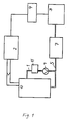
- a washing liquor 1 is pumped back into this washing machine 10 by a pump 9 from a commercial washing machine 10 via a filter 11.
- Disinfectant is added by a dosing device 2 into the commercial washing machine 10.
- the dosing device 2 is controlled by a comparison device 4 designed as a microprocessor, which receives its signals from a measuring system 3 having an analysis cell.
- the liquid to be analyzed by the measuring system 3 is branched off from the washing liquor 1 and runs through the branch 5 via a sample preparation part 7 to the analysis cell 3.
- This sample preparation part 7 is particularly important in the present invention and is shown in more detail in FIG.
- the wash liquor runs from the branch 5 via a multi-way valve 12 to a dialysis unit 8 and from there into the waste water line 13.
- a reagent solution is pumped by a further pump 14 through the reagent line 15 to the dialysis unit 8.
- the reagent solution flows on the other side of the dialysis membrane 6, which is opposite the wash liquor, in this way takes up liquid constituents from the wash liquor and reacts with them.
- the reagent liquid then flows via line 16 to the analyzer.
- standard solutions can be introduced into the dialysis unit 8 via the line 17 via the multi-way valve 12.
- FIG. 3 finally shows the course of the disinfectant concentration during the washing process.
- the upper curve shows the active oxygen content in the wash liquor in units of ppm.
- the two arrows 18 indicate an artificial disturbance of the dosage, which was carried out for test purposes.
- the lower curve represents the signal at the output of the comparison device 4. It can be clearly seen that the signal from the comparison device 4 represents the active oxygen content in the wash liquor well.
Landscapes
- Health & Medical Sciences (AREA)
- Engineering & Computer Science (AREA)
- Textile Engineering (AREA)
- Veterinary Medicine (AREA)
- Public Health (AREA)
- Epidemiology (AREA)
- Life Sciences & Earth Sciences (AREA)
- Animal Behavior & Ethology (AREA)
- General Health & Medical Sciences (AREA)
- General Physics & Mathematics (AREA)
- Physics & Mathematics (AREA)
- Chemical Kinetics & Catalysis (AREA)
- Chemical & Material Sciences (AREA)
- Automation & Control Theory (AREA)
- General Chemical & Material Sciences (AREA)
- Fluid Mechanics (AREA)
- Apparatus For Disinfection Or Sterilisation (AREA)
- External Artificial Organs (AREA)
- Investigating Or Analysing Materials By The Use Of Chemical Reactions (AREA)
- Nozzles (AREA)
- Manipulation Of Pulses (AREA)
- Investigating Or Analysing Biological Materials (AREA)
- Detail Structures Of Washing Machines And Dryers (AREA)
- Control Of Non-Electrical Variables (AREA)
- Agricultural Chemicals And Associated Chemicals (AREA)
Description
- Die Erfindung betrifft eine Dosiereinrichtung von Desinfektionsmittel in Waschflotten mit einem Dosierer, einer insbesondere kontinuierlich betreibbaren Analysezelle in einer Abzweigung der Strömung der Waschflotte zum Erfassen des Gehalts an nichtverbrauchtem Desinfektionsmittel in der Waschflotte, mit einer an die Analysezelle und den Dosierer angeschlossenen Vergleichseinrichtung zum Vergleichen des vom Meßsystem abgegebenen Istwerts mit einem vorgegebenem Sollwert. Der Dosierer wird von dieser Vergleichseinrichtung beim Unterschreiten des Istwerts unter den Sollwert betätigt. Dem Einlaßbereich der Analysenzelle ist ein Probenaufbereitungsteil vorgeschaltet. Eine solche Einrichtung ist aus EP-A1-0 239 468 bekannt.
- In Krankenhäusern und Heimen fällt infektiöse bzw. infektionsverdächtige Wäsche an, die desinfizierend gewaschen bzw. desinfiziert werden muß. Dies geschieht üblicherweise in gewerblichen oder institutionellen Wäschereien in der Regel durch ein desinfizierendes Waschverfahren, in dem ein Waschmittel und ein Desinfektionsmittel eingesetzt werden. Zu den Desinfektionsmitteln gehören insbesondere solche auf Peressigsäure- und Wasserstoffperoxidbasis wie z. B. OzonitR (eingetragenes Warenzeichen).
- Die auf das Wäschgewicht bezogene einzusetzende Menge des Desinfektionsmittels berücksichtigt, daß sowohl durch das eingesetzte Waschmittel als auch durch die organische Belastung der Waschflotte, nämlich Schmutz, Blut und Mikroorganismen im weitesten Sinne, ein Verbrauch des Desinfektionsmittels, d. h. im Fall von oxidierenden Desinfektionsmitteln eine Sauerstoffzehrung eintritt. Die Dosierung des Desinfektionsmittels muß daher eine gewisse Reserve enthalten, die in Phasen von Spitzenbelastungen gerade ausreicht, jedoch in sonstigen Phasen eher eine großzügige Dosierung darstellt. Daher sind Spitzenbelastungen an Blut und Mikroorganismen mit einem gewissen Restrisiko verbunden, während bei geringeren Belastungen unnötig viel Desinfektionsmittel dosiert wird.
- In FR-A-2 578 988 wird ein Regelsystem zur Konzentration von Desinfektionslösungen beschrieben, bei der Messungen des pH-Wertes, der Leitfähigkeit und des Redoxpotentials der Lösung verwendet wird. Aus FR-A-2 243 729 bzw. der dazu korrespondierenden DE-A-2 444 199 ist eine weitere Vorrichtung zum Regeln der Konzentration von chemischen Flüssigkeiten, z. B. des Chlorgehaltes von Schwimmbädern, bekannt. Die in EP-A2-0 260 187 genannte Einrichtung zum Behandeln von Abwasser mit Sauerstoff verwendet zum Erfassen des Sauerstoffgehaltes einen Sensor. Bei der in DE-A1-3 400 263 beschriebenen Einrichtung wird ebenfalls wie in der vorliegenden Anmeldung die Konzentration von Desinfektionsmittel in anzuwendenden Lösungen dieses Desinfektionsmittels erfaßt und überwacht, wobei jedoch eine Leitfähigkeitsmessung zum Bestimmen frisch hergestellter Lösungen verwendet wird. Dabei werden keine trübe Flüssigkeiten verwendet, so daß sich die oben genannten Probleme nicht stellen. Eine Probenaufbereitung unter Verwendung einer Dialysemembraneinheit ist aus den genannten Dokumenten nicht bekannt.
- Die in DE-A1-3 216 527 beschriebene Dialysevorrichtung enthält eine Dialysemembran, die bestimmungsgemäß zur Trennung eines Blutstroms von einer Dialysierlösung eingesetzt wird. Bei der Zubereitung der Dialysierlösung wird deren Konzentration mittels einer Leitfähigkeits-Meßstelle gemessen. Eine Verwendung der Membran zur Aufbereitung einer Meßprobe ist dem Dokument nicht zu entnehmen.
- In der vorliegenden Erfindung soll die Aufgabe gelöst werden, mit einer Dosiereinrichtung belastungsabhängig die richtige Desinfektionsmittelmenge zu dosieren, um in allen Fällen eine ausreichend sichere, aber nicht unnötig hohe Desinfektionsmittelmenge zur Verfügung zu stellen. Ein zu hoher Verbrauch des Desinfektionsmittels während des Desinfiziervorgangs soll erfaßt werden, damit nachdosiert werden kann.
- Diese Aufgabe wird dadurch gelöst, daß die Analysenzelle eine photometrische oder nepholometrische Zelle ist, mit der die bei der Reaktion des nichtverbrauchten Desinfektionsmittels mit einem entsprechenden Reagenz auftretende Farbänderung bzw. Trübung meßbar ist, und daß der Probenaufbereitungsteil eine Dialysemembraneinheit als Rückhalteeinrichtung für feste Stoffe aufweist.
- Die bei der Reaktion des nichtverbrauchten Desinfektionsmittels mit einem entsprechenden Reagenz auftretenden Farbänderung bzw. Trübung wird mit der photometrischen oder nepholometrischen Zelle gemessen. Die über die Abzweigung der Analysenzelle zugeführte desinfizierende Waschflotte wird in der Analysenzelle mit den Reagenzien umgesetzt, so daß in der Reagenzlösung eine Farbänderung bzw. Trübung eintritt, die photometrisch bzw. nepholometrisch erfaßt und mit einem bestimmten Sollwert verglichen wird. Dieser Sollwert ist vorgegeben durch die gesetzlich festgelegte Mindestmenge an Desinfektionsmittel.
- Die erfindungsgemäße Einrichtung erfaßt insbesondere kontinuierlich den Gehalt an nichtverbrauchtem Desinfektionsmittel und dosiert gegebenenfalls automatisch nach, bis daß der Sollwert wieder eingestellt ist.
- Damit bei einer nicht kontinuierlichen Dosierung die Desinfektion durch rechtzeitige Nachdosierung sichergestellt ist, wird vorgeschlagen, daß die Einrichtung taktgesteuert ist und die Taktzeit ausreichend kurz zum Sicherstellen des Mindestgehalts von Desinfektionsmitteln in,der Waschflotte ist. Eine solche Einrichtung ist besonders vorteilhaft bei kontinuierlichen Waschstraßen.
- Insbesondere wird vorgeschlagen, daß die Taktzeit zwischen 20 Sekunden und 5 Minuten liegt.
- Bei einer erfindungsgemäßen Einrichtung zum Dosieren von oxidierenden Desinfektionsmitteln, insbesondere Percarbonsäure und/oder Wasserstoffperoxid wird weiterhin vorgeschlagen, daß die Analysenzelle ein Reagenz enthält, das mit dem Desinfektionsmittel ein Redoxsystem bildet. Insbesondere sind für eine photometrisch auswertbare Reaktion folgende Peroxo-Redoxsysteme vorteilhaft, z. B. das System Titanyl/Peroxotitanylcation, Chromionen der Oxidationsstufen 3 und 6, Vanadinsalze der Oxidationsstufen 3 und 5, Jodid/Jodsysteme, Mangan(II)-Permanganatsysteme und organische Redoxsysteme, z. B. 8-Hydroxychinolin/Oxychinolinverbindungen. In allen diesen Fällen tritt eine Farbänderung bzw. Trübungsänderung ein, deren vom Photometer erfaßten Extinktionswerte mit den Sollwerten verglichen werden, die bei desinfektionsgerechter Dosierung erreicht werden. Bei Unterschreiten dieses Sollwerts wird ein Impuls zur Nachdosierung ausgelöst. Das System dosiert in diesem Fall so lange Desinfektionsmittel nach, bis durch die kontinuierliche analytische Erfassung der Sauerstoffkonzentration die erreichte Sollmenge analysiert wird und der Dosierer dadurch wieder ausgeschaltet wird. Alternativ kann die nachzudosierende Menge berechnet werden, die durch den Dosierer der Waschflotte zugegeben wird. Dieser Meßvorgang kann sich alle 30 Sekunden wiederholen. Es wird also insbesondere vorgeschlagen, daß das Reagenz die zu oxidierende Komponente des genannten Redoxsystems bildet.
- Vorteilhaft ist außerdem, wenn die Rückhalteeinrichtung einen Filter aufweist.
- Ferner wird vorgeschlagen, daß die Vergleichseinrichtung als Mikroprozessor ausgebildet ist.
- Die erfindungsgemäße Einrichtung kann separat und unabhängig von einer Waschmitteldosieranlage angeordnet sein, aber eine in eine Waschmitteldosieranlage integrierte Einrichtung ist ebenfalls möglich.
- Im folgenden wird ein Ausführungsbeispiel der Erfindung anhand der Zeichnungen naher erläutert. Es zeigen
- Figur 1
- ein Schema einer Waschmitteldosieranlage mit der erfindungsgemäßen Einrichtung zum Dosieren von Desinfektionsmitteln,
- Figur 2
- eine schematische Darstellung des Probenaufbereitungsteils in Figur 1 und
- Figur 3
- den Verlauf der Desinfektionsmittelkonzentration während des Waschprozesses bei einem Einsatz der erfindungsgemäßen Einrichtung zum Dosieren von Desinfektionsmitteln.
- Gemäß Figur 1 wird eine Waschflotte 1 von einer Pumpe 9 aus einer gewerblichen Waschmaschine 10 über einen Filter 11 wieder in diese Waschmaschine 10 zurückgepumpt. Desinfektionsmittel wird von einem Dosierer 2 in die gewerbliche Waschmaschine 10 zugegeben. Der Dosierer 2 wird von einer als Mikroprozessor ausgebildeten Vergleichseinrichtung 4 angesteuert, die ihre Signale von einem eine Analysenzelle aufweisenden Meßsystem 3 erhält. Die vom Meßsystem 3 zu analysierende Flüssigkeit wird von der Waschflotte 1 abgezweigt und läuft durch die Abzweigung 5 über einen Probenaufbereitungsteil 7 zur Analysenzelle 3.
- Dieser Probenaufbereitungsteil 7 ist in der vorliegenden Erfindung besonders wichtig und wird in Figur 2 ausführlicher dargestellt. Um sichere und reproduzierbare Ergebnisse zu erhalten und auf Grund solcher Ergebnisse den Dosierer 2 ansteuern zu können, ist es nämlich notwendig, daß die in die Analysenzelle 3 fließende Flüssigkeit von den groben Verunreinigungen der Waschflotte 1 befreit wird. Von der Abzweigung 5 läuft die Waschflotte über ein Mehrwegeventil 12 zu einer Dialyseeinheit 8 und von dort aus in die Abwasserleitung 13. Eine Reagenzlösung wird von einer weiteren Pumpe 14 durch die Reagenzleitung 15 zur Dialyseeinheit 8 gepumpt. In dieser Dialyseeinheit 8 fließt die Reagenzlösung auf der anderen Seite der Dialysemembran 6, die der Waschflotte gegenüber liegt, nimmt auf diese Weise flüssige Bestandteile aus der Waschflotte auf und reagiert mit diesen. Die Reagenzflüssigkeit fließt dann über die Leitung 16 weiter zum Analysator. Um die Einrichtung zum Dosieren von Desinfektionsmitteln zu eichen, können über das Mehrwegeventil 12 Standardlösungen über die Leitung 17 in die Dialyseeinheit 8 eingebracht werden.
- Figur 3 zeigt schließlich den Verlauf der Desinfektionsmittelkonzentration während des Waschprozesses. Dabei gibt die obere Kurve den Gehalt an Aktivsauerstoff in der Waschflotte in Einheiten ppm an. Die beiden Pfeile 18 weisen auf eine künstliche Störung der Dosierung hin, die zu Testzwecken durchgeführt wurde. Die untere Kurve stellt das Signal am Ausgang der Vergleichseinrichtung 4 dar. Es ist deutlich zu erkennen, daß das Signal der Vergleichseinrichtung 4 den Gehalt an Aktivsauerstoff in der Waschflotte gut repräsentiert.
-
- 1
- Waschflotte
- 2
- Dosierer
- 3
- Meßsystem, Analysenzelle
- 4
- Vergleichseinrichtung, Mikroprozessor
- 5
- Abzweigung
- 6
- Dialysemembran
- 7
- Probenaufbereitungsteil
- 8
- Rückhalteeinrichtung, Dialyseeinheit
- 9
- Pumpe
- 10
- gewerbliche Waschmaschine
- 11
- Filter
- 12
- Mehrwegeventil
- 13
- Abwasserleitung
- 14
- Pumpe
- 15
- Reagenzleitung
- 16
- Leitung
- 17
- Leitung
Claims (7)
- Dosiereinrichtung von Desinfektionsmittel in Waschflotten (1) mit einem Dosierer (2), einer insbesondere kontinuierlich betreibbaren Analysezelle (3) in einer Abzweigung (5) der Strömung der Waschflotte (1) zum Erfassen des Gehalts an nichtverbrauchtem Desinfektionsmittel in der Waschflotte (1), mit einer an die Analysezelle (3) und den Dosierer (2) angeschlossenen Vergleichseinrichtung (4) zum Vergleichen des vom Meßsystem abgegebenen Istwerts mit einem vorgegebenem Sollwert, wobei der Dosierer (2) von dieser Vergleichseinrichtung (4) beim Unterschreiten des Istwerts unter den Sollwert betätigt wird, und mit einem dem Einlaßbereich der Analysenzelle vorgeschalteten Probenaufbereitungsteil (7),
dadurch gekennzeichnet,
daß die Analysenzelle (3) eine photometrische oder nepholometrische Zelle ist, mit der die bei der Reaktion des nichtverbrauchten Desinfektionsmittels mit einem entsprechenden Reagenz auftretende Farbänderung bzw, Trübung meßbar ist, und daß der Probenaufbereitungsteil (7) eine Dialysemembraneinheit (8) als Rückhalteeinrichtung für feste Stoffe aufweist. - Einrichtung nach Anspruch 1,
dadurch gekennzeichnet,
daß die Einrichtung taktgesteuert und die Taktzeit ausreichend kurz zum Sicherstellen des Mindestgehalts von Desinfektionsmitteln in der Waschflotte (1) ist. - Einrichtung nach Anspruch 2,
dadurch gekennzeichnet,
daß die Taktzeit zwischen 20 Sekunden und 5 Minuten liegt. - Einrichtung zum Dosieren von oxidierenden Desinfektionsmitteln, insbesondere Percarbonsäure und/oder Wasserstoffperoxid, nach einem der Ansprüche 1 bis 3,
dadurch gekennzeichnet,
daß die Analysenzelle (3) ein Reagenz enthält, das mit dem Desinfektionsmittel ein Redoxsystem bildet. - Einrichtung nach Anspruch 4,
dadurch gekennzeichnet,
daß das Reagenz die zu oxidierende Komponente des Redoxsystems bildet. - Einrichtung nach einem der Ansprüche 1 bis 5,
dadurch gekennzeichnet,
daß die Rückhalteeinrichtung (8) einen Filter aufweist. - Einrichtung nach einem der Ansprüche 1 bis 6,
dadurch gekennzeichnet,
daß die Vergleichseinrichtung als Mikroprozessor (4) ausgebildet ist.
Applications Claiming Priority (2)
| Application Number | Priority Date | Filing Date | Title |
|---|---|---|---|
| DE3916910 | 1989-05-24 | ||
| DE3916910A DE3916910A1 (de) | 1989-05-24 | 1989-05-24 | Einrichtung zum dosieren von desinfektionsmitteln |
Publications (2)
| Publication Number | Publication Date |
|---|---|
| EP0473625A1 EP0473625A1 (de) | 1992-03-11 |
| EP0473625B1 true EP0473625B1 (de) | 1993-08-18 |
Family
ID=6381308
Family Applications (1)
| Application Number | Title | Priority Date | Filing Date |
|---|---|---|---|
| EP90907022A Expired - Lifetime EP0473625B1 (de) | 1989-05-24 | 1990-05-17 | Einrichtung zum dosieren von desinfektionsmitteln |
Country Status (7)
| Country | Link |
|---|---|
| EP (1) | EP0473625B1 (de) |
| JP (1) | JPH04506012A (de) |
| AT (1) | ATE93331T1 (de) |
| DE (2) | DE3916910A1 (de) |
| DK (1) | DK0473625T3 (de) |
| FI (1) | FI100830B (de) |
| WO (1) | WO1990014623A1 (de) |
Cited By (1)
| Publication number | Priority date | Publication date | Assignee | Title |
|---|---|---|---|---|
| US11225746B2 (en) | 2018-08-27 | 2022-01-18 | Ecolab Usa Inc. | System and technique for extracting particulate-containing liquid samples without filtration |
Families Citing this family (6)
| Publication number | Priority date | Publication date | Assignee | Title |
|---|---|---|---|---|
| US5329659A (en) * | 1993-05-10 | 1994-07-19 | Reinert Sr Gary L | Laundering facility and method |
| DE4436141A1 (de) * | 1994-10-10 | 1996-04-11 | E & S Automation Gmbh | Verfahren und Vorrichtung zum Reinigen und Sterilisieren von Gegenständen |
| US5770039A (en) * | 1996-05-03 | 1998-06-23 | Ecolab Inc. | Method and apparatus for measuring and controlling active oxygen concentration in a bleach environment |
| DE102009025158A1 (de) * | 2009-06-12 | 2010-12-16 | Herbert Kannegiesser Gmbh | Verfahren zur Ermittlung reinigungsaktiver Substanzen in einer Behandlungsflüssigkeit |
| CN111472131B (zh) * | 2020-04-03 | 2023-10-20 | 天津海尔洗涤电器有限公司 | 用于衣物处理设备的消毒控制方法 |
| DE102020002312A1 (de) * | 2020-04-16 | 2021-10-21 | Herbert Kannegiesser Gmbh | Verfahren zur Nassbehandlung von Wäsche |
Family Cites Families (9)
| Publication number | Priority date | Publication date | Assignee | Title |
|---|---|---|---|---|
| AU7334074A (en) * | 1973-09-18 | 1976-03-18 | Thomson R P Stiffe J E | Controlling chemical concentration |
| DE3118973A1 (de) * | 1981-05-13 | 1982-12-02 | Lang Apparatebau GmbH, 8227 Siegsdorf | "dosierverfahren zum versorgen einer waschmaschine mit waschmittelkonzentrat und vorrichtung zum durchfuehren des verfahrens" |
| DE3216527A1 (de) * | 1982-05-03 | 1983-11-10 | Extracorporeal GmbH, 6380 Bad Homburg | Dialysevorrichtung und -verfahren |
| DE3400263A1 (de) * | 1984-01-05 | 1985-07-18 | Göldner - Vieregge-Bruns Hygienetechnik GmbH, 3070 Nienburg | Einrichtung zur ueberwachung der anwendungskonzentration von desinfektionsmittelloesungen |
| FR2578988B1 (fr) * | 1985-03-18 | 1988-10-28 | Henkel France | Procede de regulation de la concentration de solutions de desinfection notamment oxydantes contenant des molecules desinfectantes |
| EP0231843B1 (de) * | 1986-02-05 | 1992-03-25 | Bosch-Siemens HausgerÀ¤te GmbH | Verfahren zum automatischen Zugeben von Waschmittel-Wirkstoffen |
| FR2595837B1 (fr) * | 1986-03-17 | 1988-07-15 | Henkel France | Dispositif de regulation de la concentration d'une solution oxydante par mesure du potentiel redox de cette solution |
| JPH0665399B2 (ja) * | 1986-09-09 | 1994-08-24 | 株式会社西原環境衛生研究所 | 間欠曝気式による活性汚泥処理方法およびその装置 |
| DE3713238C2 (de) * | 1987-04-18 | 1996-06-27 | Miele & Cie | Waschmaschine sowie Waschverfahren zur Behandlung von Reinraumkleidung in einer derartigen Maschine |
-
1989
- 1989-05-24 DE DE3916910A patent/DE3916910A1/de not_active Withdrawn
-
1990
- 1990-05-17 DK DK90907022.9T patent/DK0473625T3/da active
- 1990-05-17 AT AT90907022T patent/ATE93331T1/de not_active IP Right Cessation
- 1990-05-17 WO PCT/EP1990/000794 patent/WO1990014623A1/de not_active Ceased
- 1990-05-17 JP JP2507351A patent/JPH04506012A/ja active Pending
- 1990-05-17 DE DE9090907022T patent/DE59002403D1/de not_active Expired - Fee Related
- 1990-05-17 EP EP90907022A patent/EP0473625B1/de not_active Expired - Lifetime
-
1991
- 1991-11-22 FI FI915502A patent/FI100830B/fi active
Cited By (2)
| Publication number | Priority date | Publication date | Assignee | Title |
|---|---|---|---|---|
| US11225746B2 (en) | 2018-08-27 | 2022-01-18 | Ecolab Usa Inc. | System and technique for extracting particulate-containing liquid samples without filtration |
| US11739460B2 (en) | 2018-08-27 | 2023-08-29 | Ecolab Usa Inc. | System and technique for extracting particulate-containing liquid samples without filtration |
Also Published As
| Publication number | Publication date |
|---|---|
| DK0473625T3 (da) | 1993-11-29 |
| WO1990014623A1 (de) | 1990-11-29 |
| EP0473625A1 (de) | 1992-03-11 |
| DE3916910A1 (de) | 1990-11-29 |
| ATE93331T1 (de) | 1993-09-15 |
| JPH04506012A (ja) | 1992-10-22 |
| FI915502A0 (fi) | 1991-11-22 |
| DE59002403D1 (de) | 1993-09-23 |
| FI100830B (fi) | 1998-02-27 |
Similar Documents
| Publication | Publication Date | Title |
|---|---|---|
| DE69434836T2 (de) | Biosensor mit ausfallgesichertem Betriebsverfahren zur Vermeidung von falschen Anzeigen | |
| DE69715969T2 (de) | Verfahren zur Desinfektion einer Dialysemaschine | |
| EP1927370B1 (de) | Verfahren zur Bestimmung von Parametern der Hämodialyse und Blutbehandlungsvorrichtung mit einer Einrichtung zur Bestimmung von Parametern der Hämodialyse | |
| DE102016105770B4 (de) | Automatisches Analysegerät und Verfahren | |
| EP1053759B1 (de) | Verfahren zur Steuerung einer Vorrichtung zur partiellen Dialysatsammlung | |
| DE102011007011B4 (de) | Analysegerät zur automatisierten Bestimmung einer Messgröße einer Flüssigkeitsprobe und Verfahren zur Überwachung einer Messgröße | |
| DE102011088235A1 (de) | Probenvorbereitungseinrichtung für eine Analyseeinrichtung zur Bestimmung einer Messgröße einer flüssigen Probe | |
| DE112013005089T5 (de) | Gesamtchlor-Wassernachweissystem und Verfahren zur Behandlung medizinischer Fluide | |
| EP1068525B1 (de) | Automatische kontrolle und steuerung des tensidgehalts in wässrigen prozesslösungen | |
| DE69304542T2 (de) | On-line monitor zur uberwachung des prozessablaufs und der reaktion | |
| DE69609663T2 (de) | Automatische Analysevorrichtung | |
| WO1997009480A1 (de) | Dosiervorrichtung | |
| DE112015006435T5 (de) | Wasserqualitätsanalysevorrichtung | |
| DE69509566T2 (de) | Waschmaschine mit Waschmittelverbrauchssteuerung und Steuerungsverfahren | |
| DE2718330B2 (de) | Blutanalysegerät | |
| DE68909312T2 (de) | Vorrichtung zum Feststellen eines Bestandteils im Harn, sowie Klosettsitz mit einer Vorrichtung zur Urinanalyse. | |
| WO1990014623A1 (de) | Einrichtung zum dosieren von desinfektionsmitteln | |
| EP1109950A1 (de) | Automatische kontrolle und steuerung von reinigerbädern | |
| DE1965225A1 (de) | Verfahren und Vorrichtung zum Messen und Regeln der Konzentration chemischer Verbindungen in Loesungen | |
| DE68902258T2 (de) | Vorrichtung zur analyse und probenentnahme von aus industriellen anlagen stroemenden fluessigkeiten. | |
| WO1995028635A1 (de) | Sensorsystem zur desinfektionsmittelerfassung und dosierung in textilwaschanlagen (senking-anlagen) | |
| DE102019120415A1 (de) | Verfahren zur Bestimmung einer chemischen Aufnahmekapazität eines Prozessmediums in einer Messstelle sowie Messstelle zur Bestimmung einer chemischen Aufnahmekapazität eines Prozessmediums | |
| DE3128439A1 (de) | Verfahren und vorrichtung zur bestimmung von abwasserparametern | |
| AT508502B1 (de) | Verfahren und vorrichtung zur kontinuierlichen bestimmung des gehalts wenigstens einer cn-verbindung in einer wässrigen lösung | |
| DE1921486C3 (de) | Programmgesteuertes Gerät zur automatischen Durchführung von Titrationen |
Legal Events
| Date | Code | Title | Description |
|---|---|---|---|
| PUAI | Public reference made under article 153(3) epc to a published international application that has entered the european phase |
Free format text: ORIGINAL CODE: 0009012 |
|
| 17P | Request for examination filed |
Effective date: 19911115 |
|
| AK | Designated contracting states |
Kind code of ref document: A1 Designated state(s): AT BE CH DE DK FR GB IT LI LU NL SE |
|
| 17Q | First examination report despatched |
Effective date: 19920717 |
|
| GRAA | (expected) grant |
Free format text: ORIGINAL CODE: 0009210 |
|
| AK | Designated contracting states |
Kind code of ref document: B1 Designated state(s): AT BE CH DE DK FR GB IT LI LU NL SE |
|
| REF | Corresponds to: |
Ref document number: 93331 Country of ref document: AT Date of ref document: 19930915 Kind code of ref document: T |
|
| GBT | Gb: translation of ep patent filed (gb section 77(6)(a)/1977) |
Effective date: 19930817 |
|
| REF | Corresponds to: |
Ref document number: 59002403 Country of ref document: DE Date of ref document: 19930923 |
|
| ET | Fr: translation filed | ||
| ITF | It: translation for a ep patent filed | ||
| REG | Reference to a national code |
Ref country code: DK Ref legal event code: T3 |
|
| PLBE | No opposition filed within time limit |
Free format text: ORIGINAL CODE: 0009261 |
|
| STAA | Information on the status of an ep patent application or granted ep patent |
Free format text: STATUS: NO OPPOSITION FILED WITHIN TIME LIMIT |
|
| 26N | No opposition filed | ||
| EPTA | Lu: last paid annual fee | ||
| EAL | Se: european patent in force in sweden |
Ref document number: 90907022.9 |
|
| PGFP | Annual fee paid to national office [announced via postgrant information from national office to epo] |
Ref country code: GB Payment date: 19980508 Year of fee payment: 9 |
|
| PGFP | Annual fee paid to national office [announced via postgrant information from national office to epo] |
Ref country code: FR Payment date: 19980511 Year of fee payment: 9 |
|
| PGFP | Annual fee paid to national office [announced via postgrant information from national office to epo] |
Ref country code: AT Payment date: 19980514 Year of fee payment: 9 |
|
| PGFP | Annual fee paid to national office [announced via postgrant information from national office to epo] |
Ref country code: SE Payment date: 19980515 Year of fee payment: 9 Ref country code: DK Payment date: 19980515 Year of fee payment: 9 |
|
| PGFP | Annual fee paid to national office [announced via postgrant information from national office to epo] |
Ref country code: LU Payment date: 19980522 Year of fee payment: 9 Ref country code: DE Payment date: 19980522 Year of fee payment: 9 |
|
| PGFP | Annual fee paid to national office [announced via postgrant information from national office to epo] |
Ref country code: NL Payment date: 19980531 Year of fee payment: 9 |
|
| PGFP | Annual fee paid to national office [announced via postgrant information from national office to epo] |
Ref country code: CH Payment date: 19980610 Year of fee payment: 9 |
|
| PGFP | Annual fee paid to national office [announced via postgrant information from national office to epo] |
Ref country code: BE Payment date: 19980714 Year of fee payment: 9 |
|
| PG25 | Lapsed in a contracting state [announced via postgrant information from national office to epo] |
Ref country code: LU Free format text: LAPSE BECAUSE OF NON-PAYMENT OF DUE FEES Effective date: 19990517 Ref country code: GB Free format text: LAPSE BECAUSE OF NON-PAYMENT OF DUE FEES Effective date: 19990517 Ref country code: AT Free format text: LAPSE BECAUSE OF NON-PAYMENT OF DUE FEES Effective date: 19990517 |
|
| PG25 | Lapsed in a contracting state [announced via postgrant information from national office to epo] |
Ref country code: SE Free format text: LAPSE BECAUSE OF NON-PAYMENT OF DUE FEES Effective date: 19990518 |
|
| PG25 | Lapsed in a contracting state [announced via postgrant information from national office to epo] |
Ref country code: LI Free format text: LAPSE BECAUSE OF NON-PAYMENT OF DUE FEES Effective date: 19990531 Ref country code: DK Free format text: LAPSE BECAUSE OF NON-PAYMENT OF DUE FEES Effective date: 19990531 Ref country code: CH Free format text: LAPSE BECAUSE OF NON-PAYMENT OF DUE FEES Effective date: 19990531 Ref country code: BE Free format text: LAPSE BECAUSE OF NON-PAYMENT OF DUE FEES Effective date: 19990531 |
|
| BERE | Be: lapsed |
Owner name: HENKEL K.G.A.A. Effective date: 19990531 |
|
| PG25 | Lapsed in a contracting state [announced via postgrant information from national office to epo] |
Ref country code: NL Free format text: LAPSE BECAUSE OF NON-PAYMENT OF DUE FEES Effective date: 19991201 |
|
| REG | Reference to a national code |
Ref country code: CH Ref legal event code: PL |
|
| GBPC | Gb: european patent ceased through non-payment of renewal fee |
Effective date: 19990517 |
|
| EUG | Se: european patent has lapsed |
Ref document number: 90907022.9 |
|
| PG25 | Lapsed in a contracting state [announced via postgrant information from national office to epo] |
Ref country code: FR Free format text: LAPSE BECAUSE OF NON-PAYMENT OF DUE FEES Effective date: 20000131 |
|
| NLV4 | Nl: lapsed or anulled due to non-payment of the annual fee |
Effective date: 19991201 |
|
| PG25 | Lapsed in a contracting state [announced via postgrant information from national office to epo] |
Ref country code: DE Free format text: LAPSE BECAUSE OF NON-PAYMENT OF DUE FEES Effective date: 20000301 |
|
| REG | Reference to a national code |
Ref country code: FR Ref legal event code: ST |
|
| REG | Reference to a national code |
Ref country code: DK Ref legal event code: EBP |
|
| PG25 | Lapsed in a contracting state [announced via postgrant information from national office to epo] |
Ref country code: IT Free format text: LAPSE BECAUSE OF NON-PAYMENT OF DUE FEES;WARNING: LAPSES OF ITALIAN PATENTS WITH EFFECTIVE DATE BEFORE 2007 MAY HAVE OCCURRED AT ANY TIME BEFORE 2007. THE CORRECT EFFECTIVE DATE MAY BE DIFFERENT FROM THE ONE RECORDED. Effective date: 20050517 |