EP0473548B1 - Addukte aus hydroxylgruppenhaltigen Epoxidharzen und Isocyanaten und deren Verwendung - Google Patents
Addukte aus hydroxylgruppenhaltigen Epoxidharzen und Isocyanaten und deren Verwendung Download PDFInfo
- Publication number
- EP0473548B1 EP0473548B1 EP91810658A EP91810658A EP0473548B1 EP 0473548 B1 EP0473548 B1 EP 0473548B1 EP 91810658 A EP91810658 A EP 91810658A EP 91810658 A EP91810658 A EP 91810658A EP 0473548 B1 EP0473548 B1 EP 0473548B1
- Authority
- EP
- European Patent Office
- Prior art keywords
- epoxy resin
- adduct according
- isocyanate
- formula
- adduct
- Prior art date
- Legal status (The legal status is an assumption and is not a legal conclusion. Google has not performed a legal analysis and makes no representation as to the accuracy of the status listed.)
- Expired - Lifetime
Links
Classifications
-
- C—CHEMISTRY; METALLURGY
- C08—ORGANIC MACROMOLECULAR COMPOUNDS; THEIR PREPARATION OR CHEMICAL WORKING-UP; COMPOSITIONS BASED THEREON
- C08G—MACROMOLECULAR COMPOUNDS OBTAINED OTHERWISE THAN BY REACTIONS ONLY INVOLVING UNSATURATED CARBON-TO-CARBON BONDS
- C08G18/00—Polymeric products of isocyanates or isothiocyanates
- C08G18/06—Polymeric products of isocyanates or isothiocyanates with compounds having active hydrogen
- C08G18/28—Polymeric products of isocyanates or isothiocyanates with compounds having active hydrogen characterised by the compounds used containing active hydrogen
- C08G18/40—High-molecular-weight compounds
- C08G18/58—Epoxy resins
-
- C—CHEMISTRY; METALLURGY
- C08—ORGANIC MACROMOLECULAR COMPOUNDS; THEIR PREPARATION OR CHEMICAL WORKING-UP; COMPOSITIONS BASED THEREON
- C08G—MACROMOLECULAR COMPOUNDS OBTAINED OTHERWISE THAN BY REACTIONS ONLY INVOLVING UNSATURATED CARBON-TO-CARBON BONDS
- C08G18/00—Polymeric products of isocyanates or isothiocyanates
- C08G18/06—Polymeric products of isocyanates or isothiocyanates with compounds having active hydrogen
- C08G18/08—Processes
- C08G18/10—Prepolymer processes involving reaction of isocyanates or isothiocyanates with compounds having active hydrogen in a first reaction step
-
- C—CHEMISTRY; METALLURGY
- C08—ORGANIC MACROMOLECULAR COMPOUNDS; THEIR PREPARATION OR CHEMICAL WORKING-UP; COMPOSITIONS BASED THEREON
- C08G—MACROMOLECULAR COMPOUNDS OBTAINED OTHERWISE THAN BY REACTIONS ONLY INVOLVING UNSATURATED CARBON-TO-CARBON BONDS
- C08G18/00—Polymeric products of isocyanates or isothiocyanates
- C08G18/06—Polymeric products of isocyanates or isothiocyanates with compounds having active hydrogen
- C08G18/83—Chemically modified polymers
Definitions
- the invention relates to adducts obtainable by reacting certain hydroxyl-containing ones Epoxy resins with isocyanates with exclusion of moisture and in essentially without the presence of a catalyst, the stabilization of which can be stored Adducts by reaction with certain inhibitors, containing curable mixtures said adducts and those obtainable by thermal curing of the mixtures networked products.
- Heat-curable mixtures based on epoxy resins and di- or polyisocyanate compounds are known.
- As a curing agent for such mixtures for example in EP-A 130,454 and in EP-A 129,799 tertiary amines or Imidazoles, in particular addition complexes of boron trihalides with tertiary amines and imidazoles or onium salts of tertiary amines and imidazoles.
- DE-A 3,600,764 uses for thermosetting mixtures of epoxy resins and Polyisocyanate compounds tertiary or quaternary ammonium salts of alkylating acting or acidic esters of organic phosphonic acids or phosphoric acid. Furthermore, certain cyanoacetamides for the hardening of EP-A 319,473 Mixtures of epoxy resins and polyisocyanate compounds used.
- the present invention relates to storage-stable adducts containing isocyanate groups which can be obtained by reaction (a) an epoxy resin with a hydroxyl group content of 0.02-1.5 equivalents / kg and (b) a di- or polyisocyanate, the reaction being carried out with the exclusion of moisture and is carried out without the addition of a catalyst, and then reacting the product thus obtained with an inhibitor (c).
- the adducts according to the invention can be used with those known for EP / IC resin systems heat-activated catalytic curing agents in a less exothermic reaction networked products with excellent thermal, mechanical and electrical Properties are thermally hardened.
- the above-mentioned DE-A 3,600,764 discloses that the curing of the EP / IC resin systems with the curing catalysts used according to this reference interrupted at any time by cooling and at a later time Time can be continued again.
- the reaction becomes expedient interrupted at a time when the mixture obtained after cooling in a "B state", i.e. in a solid but still meltable at room temperature Condition, is present.
- an EP / IC resin system in the presence of a tertiary Amine is converted as a catalyst to an intermediate, and the reaction is at a conversion of a maximum of 65% of that in the starting mixture Isocyanate groups by adding certain alkylating agents, which as Catalyst poisons work, interrupted.
- Both the intermediate product according to EP-A 272,563 and the "B state" according to DE-A 3,600,764 have oxazolidinone and isocyanurate groups, which by Reaction of the epoxy groups of the epoxy resin with the isocyanate groups of the polyisocyanate arise in the presence of catalysts.
- Very pure see e.g. Example 6 of DE-A 3,600,764, i.e. epoxy resins that are as free of hydroxyl groups as possible, be used to avoid premature gelation.
- U.S. Patent No. 4,401,499 discloses storage-stable prepolymers free of isocyanate groups described by the reaction of polyisocyanates with an excess epoxy resins containing hydroxyl groups are prepared. These can be heated Prepolymers are split back into epoxides and isocyanates, which are then converted into Be cured in the presence of suitable catalysts.
- the present adducts are prepared by reacting epoxy resins and isocyanates essentially without the presence of a catalyst, ie no catalyst is specifically added to the reaction mixture in the preparation of the adducts.
- this does not exclude smaller amounts of a catalyst which may be present in the starting materials, in particular in the isocyanate component (b).
- the isocyanates available on the market, which are partially modified may be produced using a catalyst, and the residues of such a catalyst remain in the modified isocyanate product.
- the epoxy groups of the epoxy resin are not attacked, and the epoxy content of the reaction mixture therefore remains unchanged.
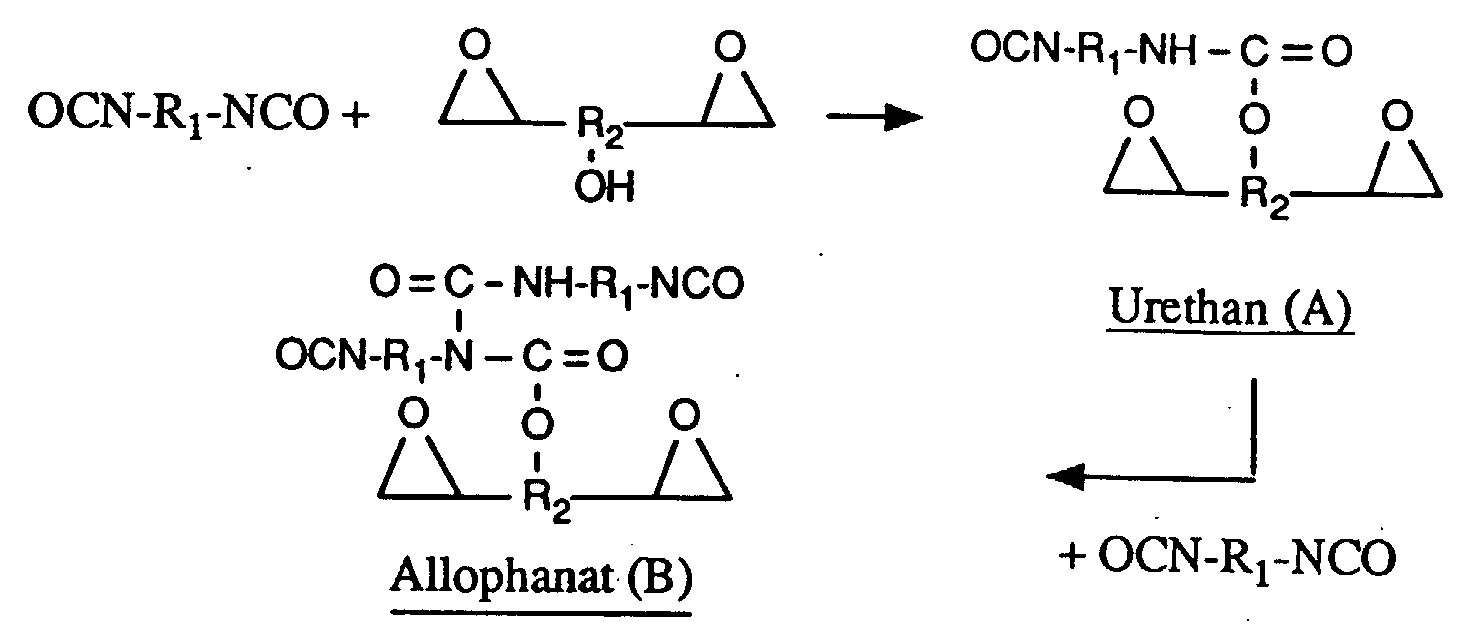
- reaction takes place by reacting the hydroxyl groups of the epoxy resin, which by definition must have a certain hydroxyl group content, with the isocyanate groups of the isocyanate. It is assumed that urethane formation occurs first and then allophanate formation, as shown schematically below:
- the adducts according to the invention can be reacted with be stabilized with an inhibitor and converted into storable adducts.
- Particularly suitable inhibitors are compounds which are in a Michael type 1,4-addition can be implemented with nucleophiles.
- Examples of more suitable Inhibitors are cinnamic acid, methacrylic acid and especially acrylic acid esters.
- Particularly suitable inhibitors are polyacrylates of dipentaerythritol, such as Dipentaerythritol hexaacrylate or a mixture of dipentaerythritol hexaacrylate and Dipentaerythritol monohydroxy pentaacrylate.
- Such products are commercially available for example as ARONIX® M-400 from Toagosei Chem. Ind., Japan. It will suspected that the effectiveness of the inhibitor on a Michael-like implementation of the NH group of the allophanate B and / or the urethane A with the acrylate groups is based.
- the amount of inhibitor is preferably chosen so that the per OH group Epoxy resin or per NH group of allophanate B and / or urethane A about 1 to 2, preferably about 1 to 1.2 cinnamic acid, methacrylic acid or acrylic acid ester groups available.
- the adducts reacted with the inhibitor (c) have a high storage stability. So for example, after 6 weeks at 50 ° C they show a viscosity increase of only about 15% on.
- the curable mixtures according to the invention, which the storage-stable Adducts and a heat-activated catalyst (d) have a satisfactory long service life and, depending on the catalyst, can easily last for 8 days or stored longer at room temperature.
- Preferred adducts of the present invention are those in the production of which Amounts of components (a) and (b) are chosen so that the Epoxy resin (a) 0.1-40, especially 0.2-10, isocyanate groups of di- or Polyisocyanate (b) are present.
- the reaction is preferably carried out at 50-150 ° C for 5-15 hours, especially at 80-120 ° C for 8-12 hours.
- epoxy resin (a) any known epoxy resin can be used as epoxy resin (a) with the definition according to Hydroxy group content can be used.
- epoxy resins examples are:
- Epoxy resins in which the 1,2-epoxy groups are attached to different ones can also be used Heteroatoms or functional groups are bound.
- About these connections include, for example, the N, N, O-triglycidyl derivative of 4-aminophenol, the Glycidyl ether-glycidyl ester of salicylic acid, N-glycidyl-N '- (2-glycidyloxypropyl) -5,5-dimethylhydantoin or 2-glycidyloxy-1,3-bis (5,5-dimethyl-1-glycidylhydantoin-3-yl) propane.
- Epoxy resins with an epoxy content of 2 to 10 equivalents / kg are preferably used. Aliphatic, cycloaliphatic or aromatic epoxy resins are preferred used.
- Polyglycidyl ethers of bisphenols are particularly preferred as epoxy resins of 2,2-bis (4-hydroxyphenyl) propane (bisphenol A) or bis (4-hydroxyphenyl) methane (Bisphenol F), of novolaks, which are formed by reacting formaldehyde with a phenol, or the above-mentioned aliphatic diols, in particular of butane-1,4-diol.
- aromatic epoxy resins especially those based from Bisphenol A.
- Suitable as di- or polyisocyanate (b) in the preparation of the inventive Adducts preferably aliphatic, cycloaliphatic or aromatic isocyanates.
- Isomer mixtures of 4,4'- and 2,4'-diisocyanatodiphenylmethane are preferred, polyol modified polyisocyanates and mixtures of liquid polyisocyanates with High molecular weight polyisocyanates or carbodiimide polyisocyanates used.
- polyisocyanates that can be used include hexane-1,6-diisocyanate and cyclohexane-1,3-diisocyanate and isomers, 4,4'-diisocyanatodicyclohexylmethane, 3-isocyanatomethyl-2,5,5-trimethylcyclohexyl isocyanate, 1,3-dimethylbenzene- ⁇ , ⁇ '-diisocyanate and Isomers, 1-methylbenzene-2,4-diisocyanate and isomers, naphthalene-1,4-diisocyanate, Diphenyl ether 4,4'-diisocyanate and isomers, diphenyl sulfone 4,4'-diisocyanate and isomers and trifunctional or higher-functional isocyanates, such as 3,3 ', 4,4'-diphenylmethane tetraisocyanate.
- isocyanates can also be used, which in are usually masked with phenol or cresol. Dimers and trimers of the above polyvalent isocyanates can also be used. Have such polyisocyanates contain free isocyanate groups and contain one or more uretdione and / or Isocyanurate rings. Process for the production of various types of such trimers and Uretdiones are described, for example, in U.S. Patents 3,494,888; 3,108,100 and 2,977,370.
- the present invention also relates to a method for producing the inventive Adducts in which an epoxy resin (a) with a hydroxyl group content of 0.02-1.5 equivalent / kg and a di- or polyisocyanate (b) with exclusion of moisture and are reacted essentially without the presence of a catalyst, and if necessary, the product thus obtained is subsequently reacted with an inhibitor (c) becomes.
- any compound known as a hardener for EP / IC resin systems is suitable.
- suitable hardeners are tertiary amines or imidazoles, in particular addition complexes of boron trihalides with tertiary amines and imidazoles or onium salts tertiary amines and imidazoles, as described in EP-A 130,454 and EP-A 129,799, or tertiary or quaternary ammonium salts of alkylating or acidic esters of organic phosphonic acids or phosphoric acid according to the DE-A 3,600,764, or certain cyanoacetamides according to EP-A 319,473.
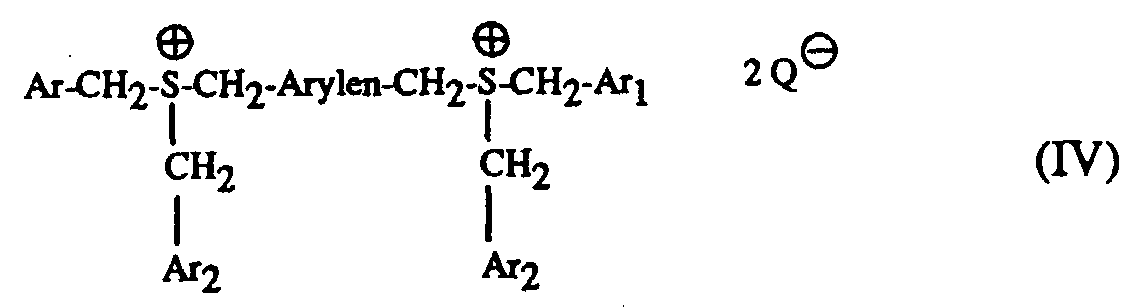
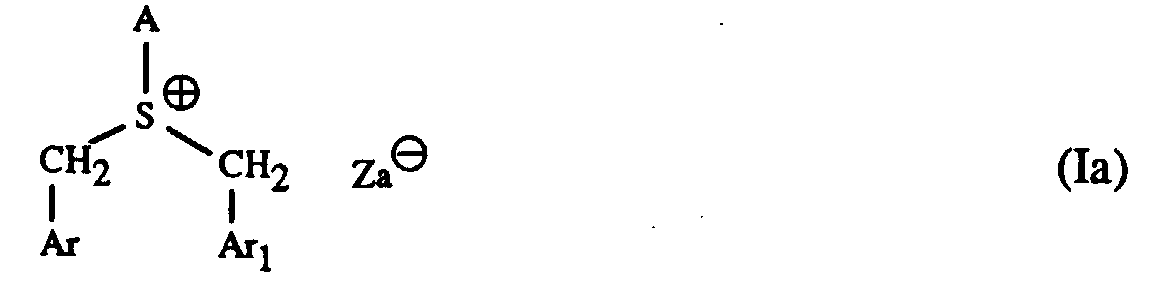
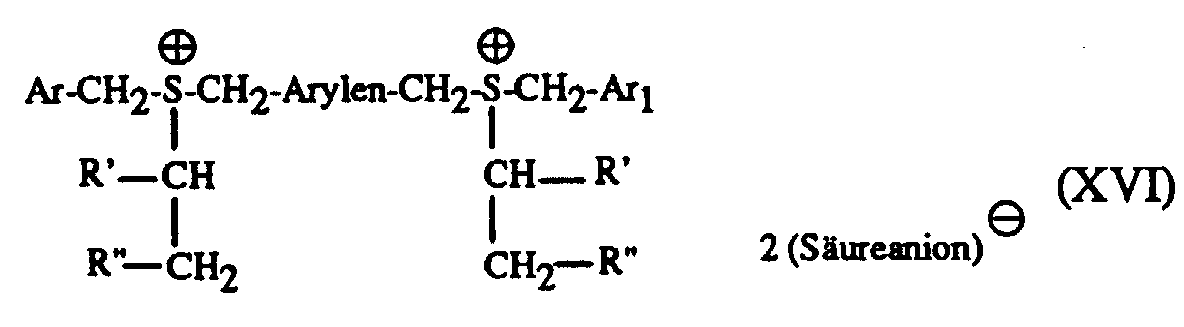
- Particularly suitable hardeners are sulfonium salts of the formula I to IV and wherein A is a C 1 -C 12 alkyl, C 3 -C 8 cycloalkyl, C 4 -C 10 cycloalkylalkyl, unsubstituted or by C 1 -C 8 alkyl, C 1 -C 4 alkoxy, halogen, nitro , Phenyl, phenoxy, alkoxycarbonyl with 1-4 C atoms in the alkoxy radical or acyl with 1-12 C atoms mono- or polysubstituted phenyl, Ar, Ar 1 and Ar 2 are each independently an unsubstituted or substituted by C 1 -C 8 -Alkyl, C 1 -C 4 -alkoxy, halogen, nitro, phenyl, phenoxy, alkoxycarbonyl with 1-4 C-atoms in the alkoxy radical or acyl with 1-12 C-atoms mono- or polysubsti
- a in the formulas I and III is preferably a C 1 -C 12 -alkyl
- Ar, Ar 1 and Ar 2 in the formulas I to IV are each independently an unsubstituted or by C 1 -C 8 -alkyl, C 1 - C 4 alkoxy, Cl or Br mono- or polysubstituted phenyl
- Q ⁇ stands for SbF 6 ⁇ or SbF 5 OH ⁇ , such as dibenzylethyl sulfonium hexafluoroantimonate.
- the mixtures according to the invention preferably contain as component (c) a sulfonium salt of the formula I or II with the preferred meaning of A, Ar, Ar 1 , Ar 2 and Q und above .
- Particularly preferred sulfonium salts are those of the formula II in which Ar, Ar 1 and Ar 2 independently of one another each represent an unsubstituted or substituted by C 1 -C 8 alkyl, C 1 -C 4 alkoxy, Cl or Br and Q ⁇ is SbF 6 ⁇ or SbF 5 OH ⁇ is, such as in particular tribenzylsulfonium hexafluoroantimonate or tris (p-methylbenzyl) sulfonium hexafluoroantimonate.
- a in formula I and III represents a C 1 -C 12 alkyl, this can be straight-chain or branched.
- A can be methyl, ethyl, isopropyl, n-butyl, sec-butyl, tert-butyl, n-octyl or n-dodecyl.
- Suitable cycloalkyls are, for example, cyclopropyl, cyclopentyl, cyclohexyl and Cyclooctyl.
- cycloalkyl alkyls for example, cyclohexylmethyl and cyclohexylethyl called.
- Ar, Ar 1 and Ar 2 in the formulas I to IV represent a substituted phenyl or naphthyl
- the same or different substituted phenyl or naphthyl may be present. Examples of these are p-tolyl, xylyl, ethylphenyl, methoxyphenyl, ethoxyphenyl, p-chlorophenyl, 2,4-, 3,4- or 2,6-dichlorophenyl, bromophenyl, acetylphenyl, trimethylphenyl, methylnapthyl, methoxynaphthyl, ethoxynaphthyl, chloronaphthyl, bromnaphthyl and biphenyl.
- arylene in the formulas III and IV is a substituted phenylene or naphthylene, for example, methylphenylene, ethylphenylene, methoxyphenylene, Ethoxyphenylene, chlorophenylene, dichlorophenylene, bromophenylene, acetylphenylene, trimethylphenylene, Methylnaphthylene, methoxynaphthylene, ethoxynaphthylene, chloronaphthylene or bromonaphthylene.
- Arylene preferably means unsubstituted Phenylene or naphthylene.
- Oxonium salts of the formula VII are, for example, from Houben-Weyl, volume 6/3, page 328 (1965), or known from U.S. Patent No. 3,585,227.
- Alkali metal salts or quaternary ammonium salts of the formula VIII such as NaSbF 6 , NaAsF 6 or NH 6 AsF 6 , are commercially available, for example, from Morton Thiokol.
- alcohols of the formula IX such as, for example, benzyl alcohol or chlorinated benzyl alcohols, are commercially available.
- Compounds of the formula X can be prepared in a known manner by, for example, 1 mol of an unsubstituted or substituted ⁇ , ⁇ '-dihalomethylarylene of the formula XI Hal-CH 2 aryl CH 2 Hal in the presence of alkali hydroxide solution with 2 mol of an unsubstituted or substituted mercaptan of the formula XII Ar-CH 2 -SH or Ar 1 -CH 2 -SH converts to compounds of formula X.
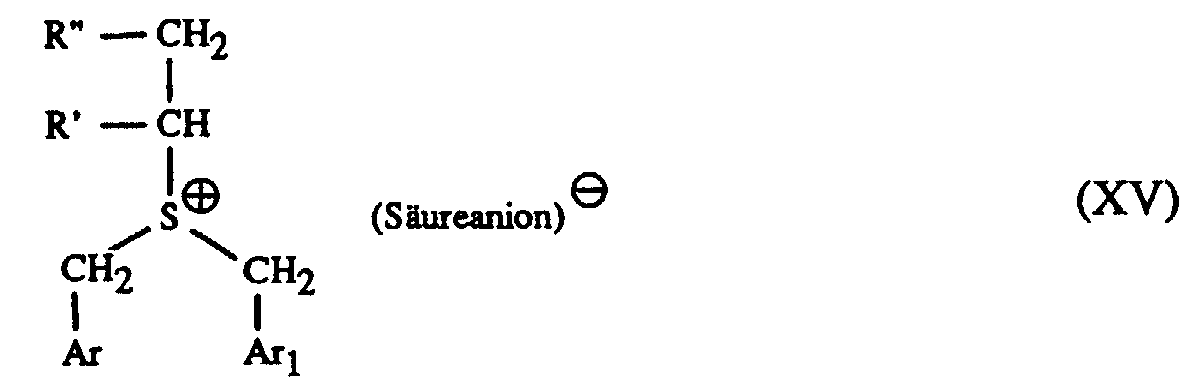
- the olefins of the formula XIV used are, for example, ethylene, propylene, butene- (1), butene- (2), isobutylene, pentene- (1), pentene- (2), cyclobutene, cyclopentene or cyclohexene and, for example, H 2 as strong acids SO 4 , HPF 6 , HBF 4 , HClO 4 or CF 3 SO 3 H.
- the heat-activatable Hardening agent (d) advantageously in amounts of 0.01 to 10 wt .-%, preferably of 0.1 to 5 wt .-%, in particular from 0.1 to 2.5 wt .-%, based on the amount of Adducts.
- the heat-curable mixtures according to the invention can also be other known and Additives commonly used in the art of polymerizable materials contain.
- additives are pigments, dyes, fillers and reinforcing agents, Flame retardants, antistatic agents, adhesion promoters, leveling agents, antioxidants and sunscreen.
- Mineral and fibrous materials are suitable as fillers Fillers, such as quartz powder, silica material, aluminum oxide, glass powder, mica, kaolin, Dolomite, graphite, carbon black, as well as carbon fibers and textile fibers.
- Preferred fillers are Quartz flour, quartz material, aluminum oxide or dolomite.
- the heat-curable mixtures according to the invention can be used in general for production of hardened products and can be used in the special Formulation adapted to the field of application, for example as coating compositions, Varnishes, molding compounds, immersion resins, casting resins, impregnating resins, laminating resins, 1- or 2-component adhesives or matrix resins can be used.
- Temperatures are generally used to cure the mixtures according to the invention in the range of 60 to 250 ° C, preferably 60 to 220 ° C, especially 80 to 200 ° C.
- the curing usually takes place with simultaneous shaping into shaped bodies, Impregnations, coatings or bonds.
- Example 1 (NCO: EP in the molar ratio 0.9: 1.0)
- Examples 2 to 6 are the same Reactants adducts prepared with other NCO: EP molar ratios:
- Example 2 (NCO: EP in a molar ratio of 6.0: 1.0)
- Example 4 (NCO: EP in a molar ratio of 1.53: 1.0)
- Example 6 (NCO: EP in a molar ratio of 0.26: 1.0)
- Example 8 Production of molded articles for test purposes (see Table 3)
- Example 8 is prepared according to the procedure of example 7. However, 2.5 parts by weight of dibenzylphenylsulfonium hexafluoroantimonate are used as the catalyst. Properties of the moldings example 8.2 8.3 8.4 8.1 8.5 8.6 Adduct I.
- Example 9 10th 11 12th Adduct IV IV II II NCO: EP ratio 0.9: 1 0.9: 1 2.8: 1 2.8: 1 catalyst like Ex.7 K like B.7 K Service life 48 pcs 30-110 m 48 pcs 30-110 m Gel time 5 M 4-9 sts 6 sts 4-9 sts Glass transition temp.
Landscapes
- Chemical & Material Sciences (AREA)
- Health & Medical Sciences (AREA)
- Chemical Kinetics & Catalysis (AREA)
- Medicinal Chemistry (AREA)
- Polymers & Plastics (AREA)
- Organic Chemistry (AREA)
- General Chemical & Material Sciences (AREA)
- Polyurethanes Or Polyureas (AREA)
- Epoxy Resins (AREA)
Description
Ether dieses Typs leiten sich beispielsweise ab von acyclischen Alkoholen, wie Ethylenglykol, Diethylenglykol und höheren Poly(oxyethylen)glykolen, Propan-1,2-diol oder Poly(oxypropylen)glykolen, Propan-1,3-diol, Butan-1,4-diol, Poly(oxytetramethylen)-glykolen, Pentan-1,5-diol, Hexan-1,6-diol, Hexan-2,4,6-triol, Glycerin, 1,1,1-Trimethylolpropan, Pentaerythrit, Sorbit, sowie von Polyepichlorhydrinen. Sie leiten sich aber auch beispielsweise ab von cycloaliphatischen Alkoholen, wie 1,4-Cyclohexandimethanol, Bis(4-hydroxycyclohexyl)methan oder 2,2-Bis(4-hydroxycyclohexyl)propan, oder sie besitzen aromatische Kerne, wie N,N-Bis(2-hydroxyethyl)-anilin oder p,p'-Bis(2-hydroxyethylamino)diphenylmethan.Die Epoxidverbindungen können sich auch von einkernigen Phenolen ableiten, wie beispielsweise von Resorcin oder Hydrochinon, oder sie basieren auf mehrkernigen Phenolen, wie beispielsweise Bis(4-hydroxyphenyl)methan, 4,4'-Dihydroxybiphenyl, Bis(4-hydroxyphenyl)sulfon, 1,1,2,2-Tetrakis-(4-hydroxyphenyl)ethan, 2,2-Bis(4-hydroxyphenyl)propan, 2,2-Bis(3,5-dibrom-4-hydroxyphenyl)propan, sowie von Novolaken erhältlich durch Kondensation von Aldehyden, wie Formaldehyd, Acetaldehyd, Chloral oder Furfuraldehyd, mit Phenolen, wie Phenol, oder mit Phenolen, die im Kern mit Chloratomen oder C1-C9Alkylgruppen substituiert sind, wie beispielsweise 4-Chlorphenol, 2-Methylphenol oder 4-tert-Butylphenol, oder durch Kondensation mit Bisphenolen, so wie oben beschrieben.







Nach 10 Stunden ist die Viskosität von ursprünglich 670 mPa·s (25°C) auf 1783 mPa·s (25°C) angestiegen, währenddem der NCO-Gehalt von 11,6 % auf 10,7 % sank. Der Epoxidgehalt der Reaktionsmischung bleibt bei 2,75 Val/kg unverändert.
Der Reaktionsmischung werden 3,78 Gew.-Teile Dipentaerythrit-hexaacrylat (ARONIX® M-400, Firma Toagosei Chemical Ind., Japan) bei 100°C beigegeben, und das Gemisch wird bei dieser Temperatur umgesetzt. Nach 60 Minuten ist die Reaktion abgeschlossen. Nach dem Abkühlen wird ein hellgelbes Epoxid-Isocyanataddukt IV mit den folgenden Eigenschaften erhalten:
Viskosität bei 25°C: 2250 mPa·s;
Epoxidgehalt: 2,75 Val/kg;
NCO-Gehalt: 10,5 %.
- Addukt I:
- Viskosität bei 25°C: 285 mPa·s;
Epoxidgehalt: 0,69 Val/kg ;
NCO-Gehalt: 20,4 %.
- Addukt II:
- Viskosität bei 25°C: 580 mPa·s;
Epoxidgehalt: 1,38 Val/kg;
NCO-Gehalt: 17,2 %.
- Addukt III:
- Viskosität bei 25°C: 1076 mPa·s;
Epoxidgehalt: 2,1 Val/kg;
NCO-Gehalt: 13,9 %.
- Addukt V:
- Viskosität bei 25°C: 2860 mPa·s;
Epoxidgehalt: 3,4 Val/kg;
NCO-Gehalt: 7,4 %.
- Addukt VI:
- Viskosität bei 25°C: 3960 mPa·s;
Epoxidgehalt: 4,1 Val/kg;
NCO-Gehalt: 4,1 %.
| Herstellung der Addukte I-VI | ||||||
| Beispiel | 2 | 3 | 4 | 1 | 5 | 6 |
| Addukt | I | II | III | IV | V | VI |
| Bisphenol-A- Epoxidharz (Gew.-Teile) | 50 | 100 | 150 | 200 | 250 | 300 |
| Isocyanatharz (NCO-Gehalt 26,1 %) (Gew.-Teile) | 164 | 139 | 114 | 89 | 64 | 39 |
| Isocyanatharz (NCO-Gehalt 23,0 %) (Gew.-Teile) | 164 | 139 | 114 | 89 | 64 | 39 |
| NCO: EP-Molverhältnis | 6:1 | 2,8:1 | 1,53:1 | 0,9:1 | 0,52:1 | 0,26:1 |
| Eigenschaften der Formkörper | ||||||
| Beispiel | 7.2 | 7.3 | 7.4 | 7.1 | 7.5 | 7.6 |
| Addukt | I | II | III | IV | V | VI |
| NCO:EP-Verhältnis | 6:1 | 2,8:1 | 1,53:1 | 0,9:1 | 0,52:1 | 0,26:1 |
| Glasumwandlungstemperatur (°C) (TMA) Mettler 4000 | 250 | 247 | 212 | 193 | 160 | 136 |
| Oxygen Index (%) ASTM D2863 | 43,7 | 37,0 | 37,7 | 39,3 | 46,2 | 43,1 |
| Brennbarkeit UL94-Stufe | 94 V-O | 94 V-O | 94 HB | 94 HB | 94 HB | 94 HB |
| Gelierzeit bei 140°C Gelnormgerät | 6'20" | 5'20" | 5' | 4'50" | 5'20" | 7'11" |
| E-Modul aus Biegeversuch ISO 178 (N/mm2) | 11760 | 11546 | 12094 | 11807 | 11657 | 10810 |
| Biegefestigkeit ISO 178 (N/mm2) | 126,9 | 134,5 | 139 | 151,7 | 154,6 | 159 |
| Randfaserdehnung (%) ISO 178 | 1,14 | 1,25 | 1,22 | 1,39 | 1,47 | 1,75 |
| Martens (°C) DIN 16945 | 263 | 241 | 221 | 188 | 167 | 153 |
| Kriechstromfestigkeit KA-Meth. (Stufe) DIN 53480 | KA 1 | KA 1 | KA 1 | KA 1/2 | KA 1/2 | KA 1/2 |
| Eigenschaften der Formkörper | ||||||
| Beispiel | 8.2 | 8.3 | 8.4 | 8.1 | 8.5 | 8.6 |
| Addukt | I | II | III | IV | V | VI |
| NCO:EP-Verhältnis | 6:1 | 2,8:1 | 1,53:1 | 0,9:1 | 0,52:1 | 0,26:1 |
| Glasumwandlungstemperatur (°C) (TMA) Mettler 4000 | 292 | 258 | 227 | 205 | 185 | 149 |
| E-Modul aus Biegeversuch ISO 178 (N/mm2) | 12800 | 12600 | 12100 | 11700 | 11500 | 11200 |
| Biegefestigkeit ISO 178 (N/mm2) | 112 | 126 | 131 | 137 | 148 | 156 |
| Randfaserdehnung (%) ISO 178 | 1,1 | 1,2 | 1,2 | 1,25 | 1,3 | 1,4 |
| Beispiel | 9 | 10 | 11 | 12 |
| Addukt | IV | IV | II | II |
| NCO:EP-Verhältnis | 0,9:1 | 0,9:1 | 2,8:1 | 2,8:1 |
| Katalysator | wie Bsp.7 | K | wie B.7 | K |
| Gebrauchsdauer | 48 St. | 30-110 M | 48 St. | 30-110 M |
| Gelierzeitdauer | 5 M | 4-9 M | 6 M | 4-9 M |
| Glasumwandlungstemp.°C | 240 | 220 | 250 | 230 |
| E-Modul aus Biegeversuch ISO 178 (N/mm2) | 11800 | 11200 | 12200 | 12000 |
| Biegefestigkeit ISO 178 (N/mm2) | 150 | 155 | 135 | 140 |
| K= Katalysator Dibenzylamin; M= Minuten. |
Claims (13)
- Lagerstabiles isocyanatgruppenhaltiges Addukt erhältlich durch Umsetzung (a) eines Epoxidharzes mit einem Hydroxylgruppengehalt von 0,02-1,5 Aequivalenten/kg und (b) eine Di- oder Polyiocyanats, wobei die Umsetzung unter Feuchtigkeitsausschluss und ohne Hinzufügung eines Katalysators durchgeführt wird, und anschließender Umsetzung des so erhaltenen Produkts mit einem Inhibitor (c).
- Addukt nach Anspruch 1, worin die Mengen der Komponenten (a) und (b) so gewählt werden, dass pro Epoxidgruppe des Epoxidharzes (a) 0,1-40, vorzugsweise 0,2-10, Isocyanatgruppen des Di- oder Polyisocyanats (b) vorhanden sind.
- Addukt nach Anspruch 1 oder 2, erhältlich durch Umsetzung bei 50-150°C während 5-15 Stunden.
- Addukt nach Anspruch 3, erhältlich durch Umsetzung bei 80-120°C während 8-12 Stunden.
- Addukt nach einem der Ansprüche 1 bis 4, worin das Epoxidharz (a) ein aliphatisches, cycloaliphatisches oder aromatisches Epoxidharz ist.
- Addukt nach Anspruch 5, worin das Epoxidharz (a) ein aromatisches Epoxidharz, insbesondere ein von Bisphenol A abgeleitetes Epoxidharz, ist.
- Addukt nach einem der Ansprüche 1 bis 5, worin das Isocyanat (b) ein aliphatisches, cycloaliphatisches oder aromatisches Isocyanat ist.
- Addukt nach Anspruch 7, worin das Isocyanat (b) ein Isomerengemisch aus 4,4'- und 2,4'-Diisocyanatodiphenylmethan, ein polyolmodifiziertes Polyisocyanat oder ein Gemisch von flüssigen Polyisocyanaten mit höhermolekularen Polyisocyanaten oder Carbodiimid-Polyisocyanaten darstellt.
- Addukt nach Anspruch 1, worin der Inhibitor (c) ein Zimtsäure-, Methacrylsäure- oder insbesondere Acrylsäureester ist.
- Addukt nach Anspruch 9, worin der Inhibitor (c) Dipentaerythrit-hexaacrylat oder eine Mischung aus Dipentaerythrit-hexaacrylat und Dipentaerythrit-monohydroxypentaacrylat ist.
- Verfahren zur Herstellung eines Adduktes nach Anspruch wonach(a) ein Epoxidharz mit einem Hydroxylgruppengehalt von 0,02-1,5 Aequivalenten/kg und(b) ein Di- oder Polyisocyanat unter Feuchtigkeitsausschluss und im wesentlichen ohne Dabeisein eines Katalysators umgesetzt werden, und das so erhaltene Produkt anschliessend mit einem Inhibitor (c) umgesetzt wird.
- Härtbares Gemisch enthaltend ein Addukt nach einem der Ansprüche 1 bis 10 und (d) einen wärmeaktivierbaren Katalysator.
- Vernetzte Produkte erhältlich durch thermische Härtung des Gemisches nach Anspruch 12.
Applications Claiming Priority (2)
| Application Number | Priority Date | Filing Date | Title |
|---|---|---|---|
| CH276690 | 1990-08-27 | ||
| CH2766/90 | 1990-08-27 |
Publications (3)
| Publication Number | Publication Date |
|---|---|
| EP0473548A2 EP0473548A2 (de) | 1992-03-04 |
| EP0473548A3 EP0473548A3 (en) | 1992-10-21 |
| EP0473548B1 true EP0473548B1 (de) | 1998-12-09 |
Family
ID=4241136
Family Applications (1)
| Application Number | Title | Priority Date | Filing Date |
|---|---|---|---|
| EP91810658A Expired - Lifetime EP0473548B1 (de) | 1990-08-27 | 1991-08-20 | Addukte aus hydroxylgruppenhaltigen Epoxidharzen und Isocyanaten und deren Verwendung |
Country Status (6)
| Country | Link |
|---|---|
| US (1) | US5272227A (de) |
| EP (1) | EP0473548B1 (de) |
| JP (1) | JP3163381B2 (de) |
| CA (1) | CA2049779C (de) |
| DE (1) | DE59109074D1 (de) |
| ES (1) | ES2126568T3 (de) |
Families Citing this family (3)
| Publication number | Priority date | Publication date | Assignee | Title |
|---|---|---|---|---|
| US7812101B2 (en) * | 2007-07-20 | 2010-10-12 | Ppg Industries Ohio, Inc. | Modified epoxy resins comprising the reaction product of a biomass derived compound and an epoxy resin, and aqueous dispersions and coatings comprising such resins |
| JP5379014B2 (ja) | 2007-10-15 | 2013-12-25 | 三井化学株式会社 | 粒子状ポリウレタン樹脂組成物およびその成形品 |
| CN103641989B (zh) | 2007-10-15 | 2016-05-18 | 三井化学株式会社 | 聚氨酯树脂 |
Family Cites Families (15)
| Publication number | Priority date | Publication date | Assignee | Title |
|---|---|---|---|---|
| US3108100A (en) * | 1957-06-12 | 1963-10-22 | Ici Ltd | Polymerization of organic isocyanates with organic hydroxides |
| US2977370A (en) * | 1959-04-13 | 1961-03-28 | Du Pont | Production of 2-oxazolidones |
| US3494888A (en) * | 1966-08-30 | 1970-02-10 | Wilbur R Mcelroy | Resin compositions from polyepoxides and isocyanate polymers |
| US3424719A (en) * | 1967-03-06 | 1969-01-28 | Celanese Coatings Co | Urethane modified epoxy resins |
| US3585227A (en) * | 1969-06-18 | 1971-06-15 | Goodrich Co B F | Trialkyl oxonium salts of the hpf6,hasf6 and hsbf6 acids |
| US4085161A (en) * | 1976-11-01 | 1978-04-18 | Desoto, Inc. | Electrodeposition of aqueous dispersions of copolymers of polyethylenically unsaturated epoxy adducts including blocked isocyanate monomer |
| US4134866A (en) * | 1977-06-03 | 1979-01-16 | Kansai Paint Company, Limited | Aqueous cationic coating from amine-epoxy adduct, polyamide, and semi-blocked polyisocyanate, acid salt |
| US4401499A (en) * | 1980-06-09 | 1983-08-30 | Sumitomo Bakelite Company Limited | Crosslinked resin of epoxy compound and isocyanate and process for producing same |
| DE3323123A1 (de) * | 1983-06-27 | 1985-01-10 | Siemens AG, 1000 Berlin und 8000 München | Hitzehaertbare reaktionsharzmischungen |
| DE3323122A1 (de) * | 1983-06-27 | 1985-05-23 | Siemens AG, 1000 Berlin und 8000 München | Verfahren zur herstellung von reaktionsharzformstoffen |
| AT380895B (de) * | 1984-12-14 | 1986-07-25 | Vianova Kunstharz Ag | Verfahren zur herstellung von ketl-bindemitteln auf basis von modifizierten epoxidharzen |
| DE3600764A1 (de) * | 1986-01-14 | 1987-07-16 | Bayer Ag | Waermehaertbare reaktionsharzgemische und ein verfahren zur herstellung von formkoerpern unter verwendung dieser gemische |
| DE3644382A1 (de) * | 1986-12-24 | 1988-07-07 | Bayer Ag | Verfahren zur zweistufigen herstellung von formkoerpern |
| US4855368A (en) * | 1987-07-17 | 1989-08-08 | Ashland Oil, Inc. | Thermoset resinous molding compositions |
| US4906722A (en) * | 1987-12-02 | 1990-03-06 | Ciba-Geigy Corporation | Thermosetting reactive systems |
-
1991
- 1991-08-20 EP EP91810658A patent/EP0473548B1/de not_active Expired - Lifetime
- 1991-08-20 US US07/747,594 patent/US5272227A/en not_active Expired - Fee Related
- 1991-08-20 DE DE59109074T patent/DE59109074D1/de not_active Expired - Fee Related
- 1991-08-20 ES ES91810658T patent/ES2126568T3/es not_active Expired - Lifetime
- 1991-08-23 CA CA002049779A patent/CA2049779C/en not_active Expired - Fee Related
- 1991-08-27 JP JP24062491A patent/JP3163381B2/ja not_active Expired - Fee Related
Also Published As
| Publication number | Publication date |
|---|---|
| JP3163381B2 (ja) | 2001-05-08 |
| DE59109074D1 (de) | 1999-01-21 |
| ES2126568T3 (es) | 1999-04-01 |
| CA2049779A1 (en) | 1992-02-28 |
| CA2049779C (en) | 2003-08-19 |
| JPH04233930A (ja) | 1992-08-21 |
| US5272227A (en) | 1993-12-21 |
| EP0473548A2 (de) | 1992-03-04 |
| EP0473548A3 (en) | 1992-10-21 |
Similar Documents
| Publication | Publication Date | Title |
|---|---|---|
| EP0232540B1 (de) | Wärmehärtbare Reaktionsharzgemische und ein Verfahren zur Herstellung von Formkörpern unter Verwendung dieser Gemische | |
| EP0130454A2 (de) | Verfahren zur Herstellung von Reaktionsharzformstoffen | |
| DE3644382A1 (de) | Verfahren zur zweistufigen herstellung von formkoerpern | |
| EP1114076A1 (de) | Beschleuniger für härtbare systeme | |
| EP3596147B1 (de) | Verfahren zur herstellung von oxazolidinongruppen aufweisenden verbindungen | |
| DE102014226842A1 (de) | Katalysator-Zusammensetzung zur Härtung von Epoxidgruppen-haltigen Harzen | |
| EP0146498A2 (de) | Härtbare Gemische, enthaltend ein Epoxidharz, ein Imid und einen Härtungskatalysator | |
| EP0816393A2 (de) | Härter für Epoxidharze | |
| DE69222886T2 (de) | Härtbare Zusammensetzung | |
| EP0473548A2 (de) | Addukte aus hydroxylgruppenhaltigen Epoxidharzen und Isocyanaten und deren Verwendung | |
| EP0383089B1 (de) | Kalthärtende Reaktionsharzmischung und deren Verwendung | |
| EP0682048B1 (de) | Wärmehärtbare Reaktionsharzgemische und deren Verwendung | |
| EP0603131A1 (de) | Aromatische Harnstoffverbindung als Härtungsbeschleuniger für eine Mischung aus Epoxiharz und Dicyandiamid | |
| EP0138769B1 (de) | Diurethandiharnstoffe und deren Verwendung | |
| EP0424314B1 (de) | Heisshärtbare Gemische | |
| EP0012963A1 (de) | Verfahren zur Herstellung von selbstvernetzenden Bindemitteln für kathodisch abscheidbare Elektrotauchlacke | |
| US5294582A (en) | Urea-superacid salts and their use as a curing catalyst of epoxy resins | |
| EP0415879A2 (de) | Carboxylterminierte Polyhydroxyester und deren Verwendung | |
| EP0319473B1 (de) | Hitzehärtbare Reaktivsysteme | |
| DE2856771A1 (de) | Cyanamide sekundaerer amine als haerter fuer epoxidharze | |
| EP0554728B1 (de) | Bei Raumtemperatur lagerfähige Gemische und ihre Verwendung als Bindemittel in Beschichtungsmitteln | |
| KR20190016303A (ko) | 양이온성 우레탄 경화제 및 이를 포함하는 전착 도료 조성물 | |
| EP0389433A1 (de) | Flammgehemmte Reaktionsharzmassen | |
| EP0417043A2 (de) | Neue Härter und Beschleuniger für Epoxid- und Isocyanatharze | |
| KR102940527B1 (ko) | 양이온성 우레탄 경화 첨가제 |
Legal Events
| Date | Code | Title | Description |
|---|---|---|---|
| PUAI | Public reference made under article 153(3) epc to a published international application that has entered the european phase |
Free format text: ORIGINAL CODE: 0009012 |
|
| 17P | Request for examination filed |
Effective date: 19910823 |
|
| AK | Designated contracting states |
Kind code of ref document: A2 Designated state(s): CH DE ES FR GB IT LI |
|
| PUAL | Search report despatched |
Free format text: ORIGINAL CODE: 0009013 |
|
| AK | Designated contracting states |
Kind code of ref document: A3 Designated state(s): CH DE ES FR GB IT LI |
|
| 17Q | First examination report despatched |
Effective date: 19960327 |
|
| RAP1 | Party data changed (applicant data changed or rights of an application transferred) |
Owner name: CIBA SC HOLDING AG |
|
| RAP3 | Party data changed (applicant data changed or rights of an application transferred) |
Owner name: CIBA SPECIALTY CHEMICALS HOLDING INC. |
|
| GRAG | Despatch of communication of intention to grant |
Free format text: ORIGINAL CODE: EPIDOS AGRA |
|
| GRAG | Despatch of communication of intention to grant |
Free format text: ORIGINAL CODE: EPIDOS AGRA |
|
| GRAH | Despatch of communication of intention to grant a patent |
Free format text: ORIGINAL CODE: EPIDOS IGRA |
|
| GRAH | Despatch of communication of intention to grant a patent |
Free format text: ORIGINAL CODE: EPIDOS IGRA |
|
| GRAA | (expected) grant |
Free format text: ORIGINAL CODE: 0009210 |
|
| AK | Designated contracting states |
Kind code of ref document: B1 Designated state(s): CH DE ES FR GB IT LI |
|
| REG | Reference to a national code |
Ref country code: CH Ref legal event code: EP |
|
| REF | Corresponds to: |
Ref document number: 59109074 Country of ref document: DE Date of ref document: 19990121 |
|
| GBT | Gb: translation of ep patent filed (gb section 77(6)(a)/1977) |
Effective date: 19990202 |
|
| ET | Fr: translation filed | ||
| REG | Reference to a national code |
Ref country code: ES Ref legal event code: FG2A Ref document number: 2126568 Country of ref document: ES Kind code of ref document: T3 |
|
| PLBE | No opposition filed within time limit |
Free format text: ORIGINAL CODE: 0009261 |
|
| STAA | Information on the status of an ep patent application or granted ep patent |
Free format text: STATUS: NO OPPOSITION FILED WITHIN TIME LIMIT |
|
| 26N | No opposition filed | ||
| REG | Reference to a national code |
Ref country code: CH Ref legal event code: PUE Owner name: CIBA SPECIALTY CHEMICALS HOLDING INC. TRANSFER- VA |
|
| REG | Reference to a national code |
Ref country code: GB Ref legal event code: 732E |
|
| REG | Reference to a national code |
Ref country code: GB Ref legal event code: IF02 |
|
| REG | Reference to a national code |
Ref country code: FR Ref legal event code: TP |
|
| PGFP | Annual fee paid to national office [announced via postgrant information from national office to epo] |
Ref country code: GB Payment date: 20030728 Year of fee payment: 13 Ref country code: CH Payment date: 20030728 Year of fee payment: 13 |
|
| PGFP | Annual fee paid to national office [announced via postgrant information from national office to epo] |
Ref country code: ES Payment date: 20030807 Year of fee payment: 13 |
|
| PGFP | Annual fee paid to national office [announced via postgrant information from national office to epo] |
Ref country code: DE Payment date: 20040805 Year of fee payment: 14 |
|
| PGFP | Annual fee paid to national office [announced via postgrant information from national office to epo] |
Ref country code: FR Payment date: 20040809 Year of fee payment: 14 |
|
| PG25 | Lapsed in a contracting state [announced via postgrant information from national office to epo] |
Ref country code: GB Free format text: LAPSE BECAUSE OF NON-PAYMENT OF DUE FEES Effective date: 20040820 |
|
| PG25 | Lapsed in a contracting state [announced via postgrant information from national office to epo] |
Ref country code: ES Free format text: LAPSE BECAUSE OF NON-PAYMENT OF DUE FEES Effective date: 20040821 |
|
| PG25 | Lapsed in a contracting state [announced via postgrant information from national office to epo] |
Ref country code: LI Free format text: LAPSE BECAUSE OF NON-PAYMENT OF DUE FEES Effective date: 20040831 Ref country code: CH Free format text: LAPSE BECAUSE OF NON-PAYMENT OF DUE FEES Effective date: 20040831 |
|
| GBPC | Gb: european patent ceased through non-payment of renewal fee |
Effective date: 20040820 |
|
| REG | Reference to a national code |
Ref country code: CH Ref legal event code: PL |
|
| PG25 | Lapsed in a contracting state [announced via postgrant information from national office to epo] |
Ref country code: IT Free format text: LAPSE BECAUSE OF NON-PAYMENT OF DUE FEES Effective date: 20050820 |
|
| REG | Reference to a national code |
Ref country code: ES Ref legal event code: FD2A Effective date: 20040821 |
|
| PG25 | Lapsed in a contracting state [announced via postgrant information from national office to epo] |
Ref country code: DE Free format text: LAPSE BECAUSE OF NON-PAYMENT OF DUE FEES Effective date: 20060301 |
|
| PG25 | Lapsed in a contracting state [announced via postgrant information from national office to epo] |
Ref country code: FR Free format text: LAPSE BECAUSE OF NON-PAYMENT OF DUE FEES Effective date: 20060428 |
|
| REG | Reference to a national code |
Ref country code: FR Ref legal event code: ST Effective date: 20060428 |