EP0473548A2 - Addukte aus hydroxylgruppenhaltigen Epoxidharzen und Isocyanaten und deren Verwendung - Google Patents
Addukte aus hydroxylgruppenhaltigen Epoxidharzen und Isocyanaten und deren Verwendung Download PDFInfo
- Publication number
- EP0473548A2 EP0473548A2 EP91810658A EP91810658A EP0473548A2 EP 0473548 A2 EP0473548 A2 EP 0473548A2 EP 91810658 A EP91810658 A EP 91810658A EP 91810658 A EP91810658 A EP 91810658A EP 0473548 A2 EP0473548 A2 EP 0473548A2
- Authority
- EP
- European Patent Office
- Prior art keywords
- adduct
- epoxy resin
- reaction
- adducts
- adduct according
- Prior art date
- Legal status (The legal status is an assumption and is not a legal conclusion. Google has not performed a legal analysis and makes no representation as to the accuracy of the status listed.)
- Granted
Links
- 239000003822 epoxy resin Substances 0.000 title claims abstract description 31
- 229920000647 polyepoxide Polymers 0.000 title claims abstract description 31
- 125000002887 hydroxy group Chemical group [H]O* 0.000 title claims abstract description 15
- 239000012948 isocyanate Substances 0.000 title claims description 25
- 150000002513 isocyanates Chemical class 0.000 title claims description 23
- LNEPOXFFQSENCJ-UHFFFAOYSA-N haloperidol Chemical compound C1CC(O)(C=2C=CC(Cl)=CC=2)CCN1CCCC(=O)C1=CC=C(F)C=C1 LNEPOXFFQSENCJ-UHFFFAOYSA-N 0.000 title description 14
- 238000006243 chemical reaction Methods 0.000 claims abstract description 27
- 239000003054 catalyst Substances 0.000 claims abstract description 26
- 239000005056 polyisocyanate Substances 0.000 claims abstract description 22
- 229920001228 polyisocyanate Polymers 0.000 claims abstract description 22
- 239000003112 inhibitor Substances 0.000 claims abstract description 15
- 230000007717 exclusion Effects 0.000 claims abstract description 7
- -1 aromatic isocyanate Chemical class 0.000 claims description 47
- 239000000203 mixture Substances 0.000 claims description 29
- 238000000034 method Methods 0.000 claims description 11
- MPIAGWXWVAHQBB-UHFFFAOYSA-N [3-prop-2-enoyloxy-2-[[3-prop-2-enoyloxy-2,2-bis(prop-2-enoyloxymethyl)propoxy]methyl]-2-(prop-2-enoyloxymethyl)propyl] prop-2-enoate Chemical compound C=CC(=O)OCC(COC(=O)C=C)(COC(=O)C=C)COCC(COC(=O)C=C)(COC(=O)C=C)COC(=O)C=C MPIAGWXWVAHQBB-UHFFFAOYSA-N 0.000 claims description 10
- IISBACLAFKSPIT-UHFFFAOYSA-N bisphenol A Chemical compound C=1C=C(O)C=CC=1C(C)(C)C1=CC=C(O)C=C1 IISBACLAFKSPIT-UHFFFAOYSA-N 0.000 claims description 8
- 238000002360 preparation method Methods 0.000 claims description 8
- 125000003118 aryl group Chemical group 0.000 claims description 6
- IQPQWNKOIGAROB-UHFFFAOYSA-N isocyanate group Chemical group [N-]=C=O IQPQWNKOIGAROB-UHFFFAOYSA-N 0.000 claims description 6
- 125000001931 aliphatic group Chemical group 0.000 claims description 5
- 238000001029 thermal curing Methods 0.000 claims description 4
- WBYWAXJHAXSJNI-VOTSOKGWSA-M .beta-Phenylacrylic acid Natural products [O-]C(=O)\C=C\C1=CC=CC=C1 WBYWAXJHAXSJNI-VOTSOKGWSA-M 0.000 claims description 3
- WBYWAXJHAXSJNI-SREVYHEPSA-N Cinnamic acid Chemical compound OC(=O)\C=C/C1=CC=CC=C1 WBYWAXJHAXSJNI-SREVYHEPSA-N 0.000 claims description 3
- CERQOIWHTDAKMF-UHFFFAOYSA-N Methacrylic acid Chemical compound CC(=C)C(O)=O CERQOIWHTDAKMF-UHFFFAOYSA-N 0.000 claims description 3
- 125000005396 acrylic acid ester group Chemical group 0.000 claims description 3
- 229930016911 cinnamic acid Natural products 0.000 claims description 3
- 235000013985 cinnamic acid Nutrition 0.000 claims description 3
- WBYWAXJHAXSJNI-UHFFFAOYSA-N methyl p-hydroxycinnamate Natural products OC(=O)C=CC1=CC=CC=C1 WBYWAXJHAXSJNI-UHFFFAOYSA-N 0.000 claims description 3
- LFSYUSUFCBOHGU-UHFFFAOYSA-N 1-isocyanato-2-[(4-isocyanatophenyl)methyl]benzene Chemical compound C1=CC(N=C=O)=CC=C1CC1=CC=CC=C1N=C=O LFSYUSUFCBOHGU-UHFFFAOYSA-N 0.000 claims description 2
- INXWLSDYDXPENO-UHFFFAOYSA-N [2-(hydroxymethyl)-3-prop-2-enoyloxy-2-[[3-prop-2-enoyloxy-2,2-bis(prop-2-enoyloxymethyl)propoxy]methyl]propyl] prop-2-enoate Chemical compound C=CC(=O)OCC(COC(=O)C=C)(CO)COCC(COC(=O)C=C)(COC(=O)C=C)COC(=O)C=C INXWLSDYDXPENO-UHFFFAOYSA-N 0.000 claims description 2
- 150000001718 carbodiimides Chemical class 0.000 claims description 2
- 239000007788 liquid Substances 0.000 claims description 2
- SYSQUGFVNFXIIT-UHFFFAOYSA-N n-[4-(1,3-benzoxazol-2-yl)phenyl]-4-nitrobenzenesulfonamide Chemical class C1=CC([N+](=O)[O-])=CC=C1S(=O)(=O)NC1=CC=C(C=2OC3=CC=CC=C3N=2)C=C1 SYSQUGFVNFXIIT-UHFFFAOYSA-N 0.000 claims 1
- 239000004848 polyfunctional curative Substances 0.000 abstract description 4
- 150000001252 acrylic acid derivatives Chemical class 0.000 abstract 1
- 150000001875 compounds Chemical class 0.000 description 30
- 229920005989 resin Polymers 0.000 description 26
- 239000011347 resin Substances 0.000 description 26
- 125000004432 carbon atom Chemical group C* 0.000 description 12
- 239000004593 Epoxy Substances 0.000 description 11
- 239000002253 acid Substances 0.000 description 10
- 125000003580 L-valyl group Chemical group [H]N([H])[C@]([H])(C(=O)[*])C(C([H])([H])[H])(C([H])([H])[H])[H] 0.000 description 9
- RWSOTUBLDIXVET-UHFFFAOYSA-N Dihydrogen sulfide Chemical class S RWSOTUBLDIXVET-UHFFFAOYSA-N 0.000 description 8
- 239000000047 product Substances 0.000 description 8
- 150000003242 quaternary ammonium salts Chemical class 0.000 description 8
- 125000000229 (C1-C4)alkoxy group Chemical group 0.000 description 7
- 125000004209 (C1-C8) alkyl group Chemical group 0.000 description 7
- 238000001723 curing Methods 0.000 description 7
- 239000010453 quartz Substances 0.000 description 7
- VYPSYNLAJGMNEJ-UHFFFAOYSA-N silicon dioxide Inorganic materials O=[Si]=O VYPSYNLAJGMNEJ-UHFFFAOYSA-N 0.000 description 7
- 150000003512 tertiary amines Chemical class 0.000 description 7
- 239000004841 bisphenol A epoxy resin Substances 0.000 description 6
- PXKLMJQFEQBVLD-UHFFFAOYSA-N bisphenol F Chemical compound C1=CC(O)=CC=C1CC1=CC=C(O)C=C1 PXKLMJQFEQBVLD-UHFFFAOYSA-N 0.000 description 6
- 150000002460 imidazoles Chemical class 0.000 description 6
- 150000007513 acids Chemical class 0.000 description 5
- 125000002252 acyl group Chemical group 0.000 description 5
- 125000004453 alkoxycarbonyl group Chemical group 0.000 description 5
- 238000005266 casting Methods 0.000 description 5
- 229910052736 halogen Inorganic materials 0.000 description 5
- 150000002367 halogens Chemical class 0.000 description 5
- 238000004519 manufacturing process Methods 0.000 description 5
- 125000000951 phenoxy group Chemical group [H]C1=C([H])C([H])=C(O*)C([H])=C1[H] 0.000 description 5
- 125000001997 phenyl group Chemical group [H]C1=C([H])C([H])=C(*)C([H])=C1[H] 0.000 description 5
- 239000000843 powder Substances 0.000 description 5
- NBIIXXVUZAFLBC-UHFFFAOYSA-N Phosphoric acid Chemical compound OP(O)(O)=O NBIIXXVUZAFLBC-UHFFFAOYSA-N 0.000 description 4
- 229910052783 alkali metal Inorganic materials 0.000 description 4
- WERYXYBDKMZEQL-UHFFFAOYSA-N butane-1,4-diol Chemical compound OCCCCO WERYXYBDKMZEQL-UHFFFAOYSA-N 0.000 description 4
- 239000003795 chemical substances by application Substances 0.000 description 4
- 238000001816 cooling Methods 0.000 description 4
- ISWSIDIOOBJBQZ-UHFFFAOYSA-N phenol group Chemical group C1(=CC=CC=C1)O ISWSIDIOOBJBQZ-UHFFFAOYSA-N 0.000 description 4
- 150000002989 phenols Chemical class 0.000 description 4
- 239000011541 reaction mixture Substances 0.000 description 4
- 150000003839 salts Chemical class 0.000 description 4
- 125000004400 (C1-C12) alkyl group Chemical group 0.000 description 3
- VPWNQTHUCYMVMZ-UHFFFAOYSA-N 4,4'-sulfonyldiphenol Chemical compound C1=CC(O)=CC=C1S(=O)(=O)C1=CC=C(O)C=C1 VPWNQTHUCYMVMZ-UHFFFAOYSA-N 0.000 description 3
- WVDDGKGOMKODPV-UHFFFAOYSA-N Benzyl alcohol Chemical compound OCC1=CC=CC=C1 WVDDGKGOMKODPV-UHFFFAOYSA-N 0.000 description 3
- BRLQWZUYTZBJKN-UHFFFAOYSA-N Epichlorohydrin Chemical compound ClCC1CO1 BRLQWZUYTZBJKN-UHFFFAOYSA-N 0.000 description 3
- JOYRKODLDBILNP-UHFFFAOYSA-N Ethyl urethane Chemical compound CCOC(N)=O JOYRKODLDBILNP-UHFFFAOYSA-N 0.000 description 3
- LYCAIKOWRPUZTN-UHFFFAOYSA-N Ethylene glycol Chemical compound OCCO LYCAIKOWRPUZTN-UHFFFAOYSA-N 0.000 description 3
- WSFSSNUMVMOOMR-UHFFFAOYSA-N Formaldehyde Chemical compound O=C WSFSSNUMVMOOMR-UHFFFAOYSA-N 0.000 description 3
- MUBZPKHOEPUJKR-UHFFFAOYSA-N Oxalic acid Chemical compound OC(=O)C(O)=O MUBZPKHOEPUJKR-UHFFFAOYSA-N 0.000 description 3
- 230000002378 acidificating effect Effects 0.000 description 3
- 150000001447 alkali salts Chemical class 0.000 description 3
- 125000000732 arylene group Chemical class 0.000 description 3
- MTHSVFCYNBDYFN-UHFFFAOYSA-N diethylene glycol Chemical compound OCCOCCO MTHSVFCYNBDYFN-UHFFFAOYSA-N 0.000 description 3
- 125000003700 epoxy group Chemical group 0.000 description 3
- 150000002148 esters Chemical class 0.000 description 3
- 239000000945 filler Substances 0.000 description 3
- 150000002334 glycols Chemical class 0.000 description 3
- 239000000463 material Substances 0.000 description 3
- 125000001624 naphthyl group Chemical class 0.000 description 3
- 125000004957 naphthylene group Chemical group 0.000 description 3
- ZUOUZKKEUPVFJK-UHFFFAOYSA-N phenylbenzene Natural products C1=CC=CC=C1C1=CC=CC=C1 ZUOUZKKEUPVFJK-UHFFFAOYSA-N 0.000 description 3
- 125000000843 phenylene group Chemical group C1(=C(C=CC=C1)*)* 0.000 description 3
- AVWRKZWQTYIKIY-UHFFFAOYSA-N urea-1-carboxylic acid Chemical compound NC(=O)NC(O)=O AVWRKZWQTYIKIY-UHFFFAOYSA-N 0.000 description 3
- XLYOFNOQVPJJNP-UHFFFAOYSA-N water Chemical class O XLYOFNOQVPJJNP-UHFFFAOYSA-N 0.000 description 3
- 125000004178 (C1-C4) alkyl group Chemical group 0.000 description 2
- VVHFXJOCUKBZFS-UHFFFAOYSA-N 2-(chloromethyl)-2-methyloxirane Chemical compound ClCC1(C)CO1 VVHFXJOCUKBZFS-UHFFFAOYSA-N 0.000 description 2
- UPMLOUAZCHDJJD-UHFFFAOYSA-N 4,4'-Diphenylmethane Diisocyanate Chemical compound C1=CC(N=C=O)=CC=C1CC1=CC=C(N=C=O)C=C1 UPMLOUAZCHDJJD-UHFFFAOYSA-N 0.000 description 2
- PAYRUJLWNCNPSJ-UHFFFAOYSA-N Aniline Chemical compound NC1=CC=CC=C1 PAYRUJLWNCNPSJ-UHFFFAOYSA-N 0.000 description 2
- 229930185605 Bisphenol Natural products 0.000 description 2
- ZOXJGFHDIHLPTG-UHFFFAOYSA-N Boron Chemical compound [B] ZOXJGFHDIHLPTG-UHFFFAOYSA-N 0.000 description 2
- RTZKZFJDLAIYFH-UHFFFAOYSA-N Diethyl ether Chemical compound CCOCC RTZKZFJDLAIYFH-UHFFFAOYSA-N 0.000 description 2
- LFQSCWFLJHTTHZ-UHFFFAOYSA-N Ethanol Chemical compound CCO LFQSCWFLJHTTHZ-UHFFFAOYSA-N 0.000 description 2
- PEDCQBHIVMGVHV-UHFFFAOYSA-N Glycerine Chemical compound OCC(O)CO PEDCQBHIVMGVHV-UHFFFAOYSA-N 0.000 description 2
- QIGBRXMKCJKVMJ-UHFFFAOYSA-N Hydroquinone Chemical compound OC1=CC=C(O)C=C1 QIGBRXMKCJKVMJ-UHFFFAOYSA-N 0.000 description 2
- DNIAPMSPPWPWGF-UHFFFAOYSA-N Propylene glycol Chemical compound CC(O)CO DNIAPMSPPWPWGF-UHFFFAOYSA-N 0.000 description 2
- UCKMPCXJQFINFW-UHFFFAOYSA-N Sulphide Chemical compound [S-2] UCKMPCXJQFINFW-UHFFFAOYSA-N 0.000 description 2
- KKEYFWRCBNTPAC-UHFFFAOYSA-N Terephthalic acid Chemical compound OC(=O)C1=CC=C(C(O)=O)C=C1 KKEYFWRCBNTPAC-UHFFFAOYSA-N 0.000 description 2
- LNWBFIVSTXCJJG-UHFFFAOYSA-N [diisocyanato(phenyl)methyl]benzene Chemical compound C=1C=CC=CC=1C(N=C=O)(N=C=O)C1=CC=CC=C1 LNWBFIVSTXCJJG-UHFFFAOYSA-N 0.000 description 2
- 239000000654 additive Substances 0.000 description 2
- WNLRTRBMVRJNCN-UHFFFAOYSA-N adipic acid Chemical compound OC(=O)CCCCC(O)=O WNLRTRBMVRJNCN-UHFFFAOYSA-N 0.000 description 2
- 150000001298 alcohols Chemical class 0.000 description 2
- 150000001336 alkenes Chemical class 0.000 description 2
- 230000002152 alkylating effect Effects 0.000 description 2
- 229910000147 aluminium phosphate Inorganic materials 0.000 description 2
- 150000001412 amines Chemical class 0.000 description 2
- 238000005349 anion exchange Methods 0.000 description 2
- 235000019445 benzyl alcohol Nutrition 0.000 description 2
- 230000015572 biosynthetic process Effects 0.000 description 2
- 239000004305 biphenyl Substances 0.000 description 2
- 235000010290 biphenyl Nutrition 0.000 description 2
- 229910052796 boron Inorganic materials 0.000 description 2
- 235000013877 carbamide Nutrition 0.000 description 2
- 125000003178 carboxy group Chemical group [H]OC(*)=O 0.000 description 2
- 239000000460 chlorine Substances 0.000 description 2
- 229910052801 chlorine Inorganic materials 0.000 description 2
- 238000000576 coating method Methods 0.000 description 2
- 238000009833 condensation Methods 0.000 description 2
- 230000005494 condensation Effects 0.000 description 2
- DGJMPUGMZIKDRO-UHFFFAOYSA-N cyanoacetamide Chemical class NC(=O)CC#N DGJMPUGMZIKDRO-UHFFFAOYSA-N 0.000 description 2
- 125000000753 cycloalkyl group Chemical group 0.000 description 2
- HGCIXCUEYOPUTN-UHFFFAOYSA-N cyclohexene Chemical compound C1CCC=CC1 HGCIXCUEYOPUTN-UHFFFAOYSA-N 0.000 description 2
- LPIQUOYDBNQMRZ-UHFFFAOYSA-N cyclopentene Chemical compound C1CC=CC1 LPIQUOYDBNQMRZ-UHFFFAOYSA-N 0.000 description 2
- 239000010459 dolomite Substances 0.000 description 2
- 229910000514 dolomite Inorganic materials 0.000 description 2
- 150000002170 ethers Chemical class 0.000 description 2
- 238000001879 gelation Methods 0.000 description 2
- 125000004435 hydrogen atom Chemical group [H]* 0.000 description 2
- 239000000543 intermediate Substances 0.000 description 2
- ZFSLODLOARCGLH-UHFFFAOYSA-N isocyanuric acid Chemical group OC1=NC(O)=NC(O)=N1 ZFSLODLOARCGLH-UHFFFAOYSA-N 0.000 description 2
- QQVIHTHCMHWDBS-UHFFFAOYSA-N isophthalic acid Chemical compound OC(=O)C1=CC=CC(C(O)=O)=C1 QQVIHTHCMHWDBS-UHFFFAOYSA-N 0.000 description 2
- 238000000465 moulding Methods 0.000 description 2
- JSBSYPCRQBTAGP-UHFFFAOYSA-N n,n-dimethyl-1-phenylmethanamine;trichloroborane Chemical compound ClB(Cl)Cl.CN(C)CC1=CC=CC=C1 JSBSYPCRQBTAGP-UHFFFAOYSA-N 0.000 description 2
- BDJRBEYXGGNYIS-UHFFFAOYSA-N nonanedioic acid Chemical compound OC(=O)CCCCCCCC(O)=O BDJRBEYXGGNYIS-UHFFFAOYSA-N 0.000 description 2
- 229920003986 novolac Polymers 0.000 description 2
- QWVGKYWNOKOFNN-UHFFFAOYSA-N o-cresol Chemical compound CC1=CC=CC=C1O QWVGKYWNOKOFNN-UHFFFAOYSA-N 0.000 description 2
- TWNQGVIAIRXVLR-UHFFFAOYSA-N oxo(oxoalumanyloxy)alumane Chemical compound O=[Al]O[Al]=O TWNQGVIAIRXVLR-UHFFFAOYSA-N 0.000 description 2
- 150000003009 phosphonic acids Chemical class 0.000 description 2
- XNGIFLGASWRNHJ-UHFFFAOYSA-N phthalic acid Chemical compound OC(=O)C1=CC=CC=C1C(O)=O XNGIFLGASWRNHJ-UHFFFAOYSA-N 0.000 description 2
- WLJVNTCWHIRURA-UHFFFAOYSA-N pimelic acid Chemical compound OC(=O)CCCCCC(O)=O WLJVNTCWHIRURA-UHFFFAOYSA-N 0.000 description 2
- YPFDHNVEDLHUCE-UHFFFAOYSA-N propane-1,3-diol Chemical compound OCCCO YPFDHNVEDLHUCE-UHFFFAOYSA-N 0.000 description 2
- GHMLBKRAJCXXBS-UHFFFAOYSA-N resorcinol Chemical compound OC1=CC=CC(O)=C1 GHMLBKRAJCXXBS-UHFFFAOYSA-N 0.000 description 2
- YGSDEFSMJLZEOE-UHFFFAOYSA-N salicylic acid Chemical compound OC(=O)C1=CC=CC=C1O YGSDEFSMJLZEOE-UHFFFAOYSA-N 0.000 description 2
- 238000003756 stirring Methods 0.000 description 2
- TYFQFVWCELRYAO-UHFFFAOYSA-N suberic acid Chemical compound OC(=O)CCCCCCC(O)=O TYFQFVWCELRYAO-UHFFFAOYSA-N 0.000 description 2
- 150000003866 tertiary ammonium salts Chemical class 0.000 description 2
- 229920001187 thermosetting polymer Polymers 0.000 description 2
- 239000013638 trimer Substances 0.000 description 2
- 125000006552 (C3-C8) cycloalkyl group Chemical group 0.000 description 1
- VYMPLPIFKRHAAC-UHFFFAOYSA-N 1,2-ethanedithiol Chemical compound SCCS VYMPLPIFKRHAAC-UHFFFAOYSA-N 0.000 description 1
- OUPZKGBUJRBPGC-UHFFFAOYSA-N 1,3,5-tris(oxiran-2-ylmethyl)-1,3,5-triazinane-2,4,6-trione Chemical compound O=C1N(CC2OC2)C(=O)N(CC2OC2)C(=O)N1CC1CO1 OUPZKGBUJRBPGC-UHFFFAOYSA-N 0.000 description 1
- PCHXZXKMYCGVFA-UHFFFAOYSA-N 1,3-diazetidine-2,4-dione Chemical compound O=C1NC(=O)N1 PCHXZXKMYCGVFA-UHFFFAOYSA-N 0.000 description 1
- SIZPGZFVROGOIR-UHFFFAOYSA-N 1,4-diisocyanatonaphthalene Chemical compound C1=CC=C2C(N=C=O)=CC=C(N=C=O)C2=C1 SIZPGZFVROGOIR-UHFFFAOYSA-N 0.000 description 1
- DMYOHQBLOZMDLP-UHFFFAOYSA-N 1-[2-(2-hydroxy-3-piperidin-1-ylpropoxy)phenyl]-3-phenylpropan-1-one Chemical compound C1CCCCN1CC(O)COC1=CC=CC=C1C(=O)CCC1=CC=CC=C1 DMYOHQBLOZMDLP-UHFFFAOYSA-N 0.000 description 1
- RTBFRGCFXZNCOE-UHFFFAOYSA-N 1-methylsulfonylpiperidin-4-one Chemical compound CS(=O)(=O)N1CCC(=O)CC1 RTBFRGCFXZNCOE-UHFFFAOYSA-N 0.000 description 1
- DAXRGSDCXVUHEW-UHFFFAOYSA-N 2-(benzhydrylamino)ethanol Chemical compound C=1C=CC=CC=1C(NCCO)C1=CC=CC=C1 DAXRGSDCXVUHEW-UHFFFAOYSA-N 0.000 description 1
- SZCFDTYKNQJQKT-UHFFFAOYSA-N 2-(oxiran-2-ylmethoxy)-6-oxabicyclo[3.1.0]hexane Chemical compound C1CC2OC2C1OCC1CO1 SZCFDTYKNQJQKT-UHFFFAOYSA-N 0.000 description 1
- IZXIZTKNFFYFOF-UHFFFAOYSA-N 2-Oxazolidone Chemical compound O=C1NCCO1 IZXIZTKNFFYFOF-UHFFFAOYSA-N 0.000 description 1
- XORJNZNCVGHBDZ-UHFFFAOYSA-N 2-[2-(6-oxabicyclo[3.1.0]hexan-2-yloxy)ethoxy]-6-oxabicyclo[3.1.0]hexane Chemical compound C1CC2OC2C1OCCOC1C2OC2CC1 XORJNZNCVGHBDZ-UHFFFAOYSA-N 0.000 description 1
- TXBCBTDQIULDIA-UHFFFAOYSA-N 2-[[3-hydroxy-2,2-bis(hydroxymethyl)propoxy]methyl]-2-(hydroxymethyl)propane-1,3-diol Chemical compound OCC(CO)(CO)COCC(CO)(CO)CO TXBCBTDQIULDIA-UHFFFAOYSA-N 0.000 description 1
- OJPDDQSCZGTACX-UHFFFAOYSA-N 2-[n-(2-hydroxyethyl)anilino]ethanol Chemical compound OCCN(CCO)C1=CC=CC=C1 OJPDDQSCZGTACX-UHFFFAOYSA-N 0.000 description 1
- QTWJRLJHJPIABL-UHFFFAOYSA-N 2-methylphenol;3-methylphenol;4-methylphenol Chemical compound CC1=CC=C(O)C=C1.CC1=CC=CC(O)=C1.CC1=CC=CC=C1O QTWJRLJHJPIABL-UHFFFAOYSA-N 0.000 description 1
- VEORPZCZECFIRK-UHFFFAOYSA-N 3,3',5,5'-tetrabromobisphenol A Chemical compound C=1C(Br)=C(O)C(Br)=CC=1C(C)(C)C1=CC(Br)=C(O)C(Br)=C1 VEORPZCZECFIRK-UHFFFAOYSA-N 0.000 description 1
- RXBBSTXUVVVWRC-UHFFFAOYSA-N 3-[3-[4,4-dimethyl-3-(oxiran-2-ylmethyl)-2,5-dioxoimidazolidin-1-yl]-2-(oxiran-2-ylmethoxy)propyl]-5,5-dimethyl-1-(oxiran-2-ylmethyl)imidazolidine-2,4-dione Chemical compound O=C1N(CC(CN2C(C(C)(C)N(CC3OC3)C2=O)=O)OCC2OC2)C(=O)C(C)(C)N1CC1CO1 RXBBSTXUVVVWRC-UHFFFAOYSA-N 0.000 description 1
- CUDIHEAKFVFZDP-UHFFFAOYSA-N 3-isocyanato-5-(isocyanatomethyl)-1,1,4-trimethylcyclohexane Chemical compound CC1C(CN=C=O)CC(C)(C)CC1N=C=O CUDIHEAKFVFZDP-UHFFFAOYSA-N 0.000 description 1
- YBRVSVVVWCFQMG-UHFFFAOYSA-N 4,4'-diaminodiphenylmethane Chemical compound C1=CC(N)=CC=C1CC1=CC=C(N)C=C1 YBRVSVVVWCFQMG-UHFFFAOYSA-N 0.000 description 1
- WXQZLPFNTPKVJM-UHFFFAOYSA-N 4-[(4-hydroxycyclohexyl)methyl]cyclohexan-1-ol Chemical compound C1CC(O)CCC1CC1CCC(O)CC1 WXQZLPFNTPKVJM-UHFFFAOYSA-N 0.000 description 1
- HDPBBNNDDQOWPJ-UHFFFAOYSA-N 4-[1,2,2-tris(4-hydroxyphenyl)ethyl]phenol Chemical compound C1=CC(O)=CC=C1C(C=1C=CC(O)=CC=1)C(C=1C=CC(O)=CC=1)C1=CC=C(O)C=C1 HDPBBNNDDQOWPJ-UHFFFAOYSA-N 0.000 description 1
- CDBAMNGURPMUTG-UHFFFAOYSA-N 4-[2-(4-hydroxycyclohexyl)propan-2-yl]cyclohexan-1-ol Chemical compound C1CC(O)CCC1C(C)(C)C1CCC(O)CC1 CDBAMNGURPMUTG-UHFFFAOYSA-N 0.000 description 1
- PLIKAWJENQZMHA-UHFFFAOYSA-N 4-aminophenol Chemical class NC1=CC=C(O)C=C1 PLIKAWJENQZMHA-UHFFFAOYSA-N 0.000 description 1
- WXNZTHHGJRFXKQ-UHFFFAOYSA-N 4-chlorophenol Chemical compound OC1=CC=C(Cl)C=C1 WXNZTHHGJRFXKQ-UHFFFAOYSA-N 0.000 description 1
- YWVFNWVZBAWOOY-UHFFFAOYSA-N 4-methylcyclohexane-1,2-dicarboxylic acid Chemical compound CC1CCC(C(O)=O)C(C(O)=O)C1 YWVFNWVZBAWOOY-UHFFFAOYSA-N 0.000 description 1
- QHPQWRBYOIRBIT-UHFFFAOYSA-N 4-tert-butylphenol Chemical compound CC(C)(C)C1=CC=C(O)C=C1 QHPQWRBYOIRBIT-UHFFFAOYSA-N 0.000 description 1
- YIROYDNZEPTFOL-UHFFFAOYSA-N 5,5-Dimethylhydantoin Chemical compound CC1(C)NC(=O)NC1=O YIROYDNZEPTFOL-UHFFFAOYSA-N 0.000 description 1
- OQAPYXJOOYQXDV-UHFFFAOYSA-N 5,5-dimethyl-3-[2-(oxiran-2-ylmethoxy)propyl]-1-(oxiran-2-ylmethyl)imidazolidine-2,4-dione Chemical compound C1OC1COC(C)CN(C(C1(C)C)=O)C(=O)N1CC1CO1 OQAPYXJOOYQXDV-UHFFFAOYSA-N 0.000 description 1
- SVLTVRFYVWMEQN-UHFFFAOYSA-N 5-methylcyclohex-3-ene-1,2-dicarboxylic acid Chemical compound CC1CC(C(O)=O)C(C(O)=O)C=C1 SVLTVRFYVWMEQN-UHFFFAOYSA-N 0.000 description 1
- YXALYBMHAYZKAP-UHFFFAOYSA-N 7-oxabicyclo[4.1.0]heptan-4-ylmethyl 7-oxabicyclo[4.1.0]heptane-4-carboxylate Chemical compound C1CC2OC2CC1C(=O)OCC1CC2OC2CC1 YXALYBMHAYZKAP-UHFFFAOYSA-N 0.000 description 1
- 239000005995 Aluminium silicate Substances 0.000 description 1
- 229910017048 AsF6 Inorganic materials 0.000 description 1
- ADAHGVUHKDNLEB-UHFFFAOYSA-N Bis(2,3-epoxycyclopentyl)ether Chemical compound C1CC2OC2C1OC1CCC2OC21 ADAHGVUHKDNLEB-UHFFFAOYSA-N 0.000 description 1
- OKTJSMMVPCPJKN-UHFFFAOYSA-N Carbon Chemical compound [C] OKTJSMMVPCPJKN-UHFFFAOYSA-N 0.000 description 1
- 229920000049 Carbon (fiber) Polymers 0.000 description 1
- FBPFZTCFMRRESA-FSIIMWSLSA-N D-Glucitol Natural products OC[C@H](O)[C@H](O)[C@@H](O)[C@H](O)CO FBPFZTCFMRRESA-FSIIMWSLSA-N 0.000 description 1
- FBPFZTCFMRRESA-JGWLITMVSA-N D-glucitol Chemical compound OC[C@H](O)[C@@H](O)[C@H](O)[C@H](O)CO FBPFZTCFMRRESA-JGWLITMVSA-N 0.000 description 1
- BWLUMTFWVZZZND-UHFFFAOYSA-N Dibenzylamine Chemical compound C=1C=CC=CC=1CNCC1=CC=CC=C1 BWLUMTFWVZZZND-UHFFFAOYSA-N 0.000 description 1
- VGGSQFUCUMXWEO-UHFFFAOYSA-N Ethene Chemical compound C=C VGGSQFUCUMXWEO-UHFFFAOYSA-N 0.000 description 1
- 229910004039 HBF4 Inorganic materials 0.000 description 1
- 229910004713 HPF6 Inorganic materials 0.000 description 1
- UFHFLCQGNIYNRP-UHFFFAOYSA-N Hydrogen Chemical compound [H][H] UFHFLCQGNIYNRP-UHFFFAOYSA-N 0.000 description 1
- VQTUBCCKSQIDNK-UHFFFAOYSA-N Isobutene Chemical group CC(C)=C VQTUBCCKSQIDNK-UHFFFAOYSA-N 0.000 description 1
- OYHQOLUKZRVURQ-HZJYTTRNSA-N Linoleic acid Chemical compound CCCCC\C=C/C\C=C/CCCCCCCC(O)=O OYHQOLUKZRVURQ-HZJYTTRNSA-N 0.000 description 1
- LSDPWZHWYPCBBB-UHFFFAOYSA-N Methanethiol Chemical class SC LSDPWZHWYPCBBB-UHFFFAOYSA-N 0.000 description 1
- ALQSHHUCVQOPAS-UHFFFAOYSA-N Pentane-1,5-diol Chemical compound OCCCCCO ALQSHHUCVQOPAS-UHFFFAOYSA-N 0.000 description 1
- 239000004146 Propane-1,2-diol Substances 0.000 description 1
- KDYFGRWQOYBRFD-UHFFFAOYSA-N Succinic acid Natural products OC(=O)CCC(O)=O KDYFGRWQOYBRFD-UHFFFAOYSA-N 0.000 description 1
- QAOWNCQODCNURD-UHFFFAOYSA-N Sulfuric acid Chemical compound OS(O)(=O)=O QAOWNCQODCNURD-UHFFFAOYSA-N 0.000 description 1
- 229920001079 Thiokol (polymer) Polymers 0.000 description 1
- ZJCCRDAZUWHFQH-UHFFFAOYSA-N Trimethylolpropane Chemical compound CCC(CO)(CO)CO ZJCCRDAZUWHFQH-UHFFFAOYSA-N 0.000 description 1
- FDLQZKYLHJJBHD-UHFFFAOYSA-N [3-(aminomethyl)phenyl]methanamine Chemical compound NCC1=CC=CC(CN)=C1 FDLQZKYLHJJBHD-UHFFFAOYSA-N 0.000 description 1
- YIMQCDZDWXUDCA-UHFFFAOYSA-N [4-(hydroxymethyl)cyclohexyl]methanol Chemical compound OCC1CCC(CO)CC1 YIMQCDZDWXUDCA-UHFFFAOYSA-N 0.000 description 1
- MSILJOYZYPRFDK-UHFFFAOYSA-N [4-[4-(sulfanylmethyl)phenoxy]phenyl]methanethiol Chemical compound C1=CC(CS)=CC=C1OC1=CC=C(CS)C=C1 MSILJOYZYPRFDK-UHFFFAOYSA-N 0.000 description 1
- IKHGUXGNUITLKF-XPULMUKRSA-N acetaldehyde Chemical compound [14CH]([14CH3])=O IKHGUXGNUITLKF-XPULMUKRSA-N 0.000 description 1
- NIXOWILDQLNWCW-UHFFFAOYSA-M acrylate group Chemical group C(C=C)(=O)[O-] NIXOWILDQLNWCW-UHFFFAOYSA-M 0.000 description 1
- 239000002318 adhesion promoter Substances 0.000 description 1
- 239000000853 adhesive Substances 0.000 description 1
- 230000001070 adhesive effect Effects 0.000 description 1
- 239000001361 adipic acid Substances 0.000 description 1
- 235000011037 adipic acid Nutrition 0.000 description 1
- 230000001476 alcoholic effect Effects 0.000 description 1
- 150000001299 aldehydes Chemical class 0.000 description 1
- 239000003513 alkali Substances 0.000 description 1
- 229910001854 alkali hydroxide Inorganic materials 0.000 description 1
- 150000008044 alkali metal hydroxides Chemical class 0.000 description 1
- 125000000217 alkyl group Chemical group 0.000 description 1
- 229940100198 alkylating agent Drugs 0.000 description 1
- 239000002168 alkylating agent Substances 0.000 description 1
- 235000012211 aluminium silicate Nutrition 0.000 description 1
- JFCQEDHGNNZCLN-UHFFFAOYSA-N anhydrous glutaric acid Natural products OC(=O)CCCC(O)=O JFCQEDHGNNZCLN-UHFFFAOYSA-N 0.000 description 1
- 239000003963 antioxidant agent Substances 0.000 description 1
- 239000002216 antistatic agent Substances 0.000 description 1
- 239000002585 base Substances 0.000 description 1
- 150000003938 benzyl alcohols Chemical class 0.000 description 1
- 125000006267 biphenyl group Chemical group 0.000 description 1
- VCCBEIPGXKNHFW-UHFFFAOYSA-N biphenyl-4,4'-diol Chemical group C1=CC(O)=CC=C1C1=CC=C(O)C=C1 VCCBEIPGXKNHFW-UHFFFAOYSA-N 0.000 description 1
- 125000004799 bromophenyl group Chemical group 0.000 description 1
- HQABUPZFAYXKJW-UHFFFAOYSA-N butan-1-amine Chemical compound CCCCN HQABUPZFAYXKJW-UHFFFAOYSA-N 0.000 description 1
- KDYFGRWQOYBRFD-NUQCWPJISA-N butanedioic acid Chemical compound O[14C](=O)CC[14C](O)=O KDYFGRWQOYBRFD-NUQCWPJISA-N 0.000 description 1
- 239000004202 carbamide Substances 0.000 description 1
- 239000006229 carbon black Substances 0.000 description 1
- 239000004917 carbon fiber Substances 0.000 description 1
- 230000003197 catalytic effect Effects 0.000 description 1
- 239000007795 chemical reaction product Substances 0.000 description 1
- 125000001309 chloro group Chemical group Cl* 0.000 description 1
- 239000011248 coating agent Substances 0.000 description 1
- 229930003836 cresol Natural products 0.000 description 1
- 238000004132 cross linking Methods 0.000 description 1
- 239000011353 cycloaliphatic epoxy resin Substances 0.000 description 1
- 125000001316 cycloalkyl alkyl group Chemical group 0.000 description 1
- CFBGXYDUODCMNS-UHFFFAOYSA-N cyclobutene Chemical compound C1CC=C1 CFBGXYDUODCMNS-UHFFFAOYSA-N 0.000 description 1
- IFDVQVHZEKPUSC-UHFFFAOYSA-N cyclohex-3-ene-1,2-dicarboxylic acid Chemical compound OC(=O)C1CCC=CC1C(O)=O IFDVQVHZEKPUSC-UHFFFAOYSA-N 0.000 description 1
- QSAWQNUELGIYBC-UHFFFAOYSA-N cyclohexane-1,2-dicarboxylic acid Chemical compound OC(=O)C1CCCCC1C(O)=O QSAWQNUELGIYBC-UHFFFAOYSA-N 0.000 description 1
- 125000000113 cyclohexyl group Chemical group [H]C1([H])C([H])([H])C([H])([H])C([H])(*)C([H])([H])C1([H])[H] 0.000 description 1
- 125000004210 cyclohexylmethyl group Chemical group [H]C([H])(*)C1([H])C([H])([H])C([H])([H])C([H])([H])C([H])([H])C1([H])[H] 0.000 description 1
- 125000000640 cyclooctyl group Chemical group [H]C1([H])C([H])([H])C([H])([H])C([H])([H])C([H])(*)C([H])([H])C([H])([H])C1([H])[H] 0.000 description 1
- 125000001511 cyclopentyl group Chemical group [H]C1([H])C([H])([H])C([H])([H])C([H])(*)C1([H])[H] 0.000 description 1
- 125000001559 cyclopropyl group Chemical group [H]C1([H])C([H])([H])C1([H])* 0.000 description 1
- 238000007033 dehydrochlorination reaction Methods 0.000 description 1
- KORSJDCBLAPZEQ-UHFFFAOYSA-N dicyclohexylmethane-4,4'-diisocyanate Chemical compound C1CC(N=C=O)CCC1CC1CCC(N=C=O)CC1 KORSJDCBLAPZEQ-UHFFFAOYSA-N 0.000 description 1
- 239000000539 dimer Substances 0.000 description 1
- 150000004662 dithiols Chemical class 0.000 description 1
- 239000000975 dye Substances 0.000 description 1
- 125000001495 ethyl group Chemical group [H]C([H])([H])C([H])([H])* 0.000 description 1
- 239000000835 fiber Substances 0.000 description 1
- 239000012765 fibrous filler Substances 0.000 description 1
- 239000003063 flame retardant Substances 0.000 description 1
- 238000009472 formulation Methods 0.000 description 1
- 125000000524 functional group Chemical group 0.000 description 1
- HYBBIBNJHNGZAN-UHFFFAOYSA-N furfural Chemical compound O=CC1=CC=CO1 HYBBIBNJHNGZAN-UHFFFAOYSA-N 0.000 description 1
- 239000000499 gel Substances 0.000 description 1
- 239000011521 glass Substances 0.000 description 1
- 235000011187 glycerol Nutrition 0.000 description 1
- 229910002804 graphite Inorganic materials 0.000 description 1
- 239000010439 graphite Substances 0.000 description 1
- 125000005842 heteroatom Chemical group 0.000 description 1
- RRAMGCGOFNQTLD-UHFFFAOYSA-N hexamethylene diisocyanate Chemical compound O=C=NCCCCCCN=C=O RRAMGCGOFNQTLD-UHFFFAOYSA-N 0.000 description 1
- WJSATVJYSKVUGV-UHFFFAOYSA-N hexane-1,3,5-triol Chemical compound CC(O)CC(O)CCO WJSATVJYSKVUGV-UHFFFAOYSA-N 0.000 description 1
- XXMIOPMDWAUFGU-UHFFFAOYSA-N hexane-1,6-diol Chemical compound OCCCCCCO XXMIOPMDWAUFGU-UHFFFAOYSA-N 0.000 description 1
- 150000001469 hydantoins Chemical class 0.000 description 1
- 229910052739 hydrogen Inorganic materials 0.000 description 1
- 239000001257 hydrogen Substances 0.000 description 1
- YAMHXTCMCPHKLN-UHFFFAOYSA-N imidazolidin-2-one Chemical compound O=C1NCCN1 YAMHXTCMCPHKLN-UHFFFAOYSA-N 0.000 description 1
- 238000007654 immersion Methods 0.000 description 1
- 238000005470 impregnation Methods 0.000 description 1
- 229910052500 inorganic mineral Inorganic materials 0.000 description 1
- 239000013067 intermediate product Substances 0.000 description 1
- DLMVDBDHOIWEJZ-UHFFFAOYSA-N isocyanatooxyimino(oxo)methane Chemical compound O=C=NON=C=O DLMVDBDHOIWEJZ-UHFFFAOYSA-N 0.000 description 1
- 125000001449 isopropyl group Chemical group [H]C([H])([H])C([H])(*)C([H])([H])[H] 0.000 description 1
- NLYAJNPCOHFWQQ-UHFFFAOYSA-N kaolin Chemical compound O.O.O=[Al]O[Si](=O)O[Si](=O)O[Al]=O NLYAJNPCOHFWQQ-UHFFFAOYSA-N 0.000 description 1
- 239000004922 lacquer Substances 0.000 description 1
- 238000010030 laminating Methods 0.000 description 1
- 239000004611 light stabiliser Substances 0.000 description 1
- OYHQOLUKZRVURQ-IXWMQOLASA-N linoleic acid Natural products CCCCC\C=C/C\C=C\CCCCCCCC(O)=O OYHQOLUKZRVURQ-IXWMQOLASA-N 0.000 description 1
- 235000020778 linoleic acid Nutrition 0.000 description 1
- 239000011159 matrix material Substances 0.000 description 1
- WSFSSNUMVMOOMR-NJFSPNSNSA-N methanone Chemical compound O=[14CH2] WSFSSNUMVMOOMR-NJFSPNSNSA-N 0.000 description 1
- 125000002496 methyl group Chemical group [H]C([H])([H])* 0.000 description 1
- 239000010445 mica Substances 0.000 description 1
- 229910052618 mica group Inorganic materials 0.000 description 1
- 239000012764 mineral filler Substances 0.000 description 1
- 239000012778 molding material Substances 0.000 description 1
- 125000004108 n-butyl group Chemical group [H]C([H])([H])C([H])([H])C([H])([H])C([H])([H])* 0.000 description 1
- ZMVMYBGDGJLCHV-UHFFFAOYSA-N n-methyl-4-[[4-(methylamino)phenyl]methyl]aniline Chemical compound C1=CC(NC)=CC=C1CC1=CC=C(NC)C=C1 ZMVMYBGDGJLCHV-UHFFFAOYSA-N 0.000 description 1
- 239000012038 nucleophile Substances 0.000 description 1
- JRZJOMJEPLMPRA-UHFFFAOYSA-N olefin Natural products CCCCCCCC=C JRZJOMJEPLMPRA-UHFFFAOYSA-N 0.000 description 1
- 235000006408 oxalic acid Nutrition 0.000 description 1
- 125000003854 p-chlorophenyl group Chemical group [H]C1=C([H])C(*)=C([H])C([H])=C1Cl 0.000 description 1
- 125000001037 p-tolyl group Chemical group [H]C1=C([H])C(=C([H])C([H])=C1*)C([H])([H])[H] 0.000 description 1
- FJKROLUGYXJWQN-UHFFFAOYSA-N papa-hydroxy-benzoic acid Natural products OC(=O)C1=CC=C(O)C=C1 FJKROLUGYXJWQN-UHFFFAOYSA-N 0.000 description 1
- WXZMFSXDPGVJKK-UHFFFAOYSA-N pentaerythritol Chemical compound OCC(CO)(CO)CO WXZMFSXDPGVJKK-UHFFFAOYSA-N 0.000 description 1
- RGSFGYAAUTVSQA-UHFFFAOYSA-N pentamethylene Natural products C1CCCC1 RGSFGYAAUTVSQA-UHFFFAOYSA-N 0.000 description 1
- VLTRZXGMWDSKGL-UHFFFAOYSA-N perchloric acid Chemical compound OCl(=O)(=O)=O VLTRZXGMWDSKGL-UHFFFAOYSA-N 0.000 description 1
- 239000000049 pigment Substances 0.000 description 1
- 239000002574 poison Substances 0.000 description 1
- 231100000614 poison Toxicity 0.000 description 1
- 229920002755 poly(epichlorohydrin) Polymers 0.000 description 1
- 229920000058 polyacrylate Polymers 0.000 description 1
- 230000002028 premature Effects 0.000 description 1
- 229960004063 propylene glycol Drugs 0.000 description 1
- 235000013772 propylene glycol Nutrition 0.000 description 1
- 239000000376 reactant Substances 0.000 description 1
- 230000035484 reaction time Effects 0.000 description 1
- 239000012744 reinforcing agent Substances 0.000 description 1
- 229960004889 salicylic acid Drugs 0.000 description 1
- 125000002914 sec-butyl group Chemical group [H]C([H])([H])C([H])([H])C([H])(*)C([H])([H])[H] 0.000 description 1
- 238000007493 shaping process Methods 0.000 description 1
- 229910001545 sodium hexafluoroantimonate(V) Inorganic materials 0.000 description 1
- 229910001542 sodium hexafluoroarsenate(V) Inorganic materials 0.000 description 1
- 239000007787 solid Substances 0.000 description 1
- 239000000243 solution Substances 0.000 description 1
- 239000000600 sorbitol Substances 0.000 description 1
- 230000006641 stabilisation Effects 0.000 description 1
- 238000011105 stabilization Methods 0.000 description 1
- 239000007858 starting material Substances 0.000 description 1
- 238000003860 storage Methods 0.000 description 1
- 239000000126 substance Substances 0.000 description 1
- 235000011149 sulphuric acid Nutrition 0.000 description 1
- 125000000999 tert-butyl group Chemical group [H]C([H])([H])C(*)(C([H])([H])[H])C([H])([H])[H] 0.000 description 1
- UFDHBDMSHIXOKF-UHFFFAOYSA-N tetrahydrophthalic acid Natural products OC(=O)C1=C(C(O)=O)CCCC1 UFDHBDMSHIXOKF-UHFFFAOYSA-N 0.000 description 1
- 239000004753 textile Substances 0.000 description 1
- 150000003568 thioethers Chemical class 0.000 description 1
- HFFLGKNGCAIQMO-UHFFFAOYSA-N trichloroacetaldehyde Chemical compound ClC(Cl)(Cl)C=O HFFLGKNGCAIQMO-UHFFFAOYSA-N 0.000 description 1
- ITMCEJHCFYSIIV-UHFFFAOYSA-N triflic acid Chemical compound OS(=O)(=O)C(F)(F)F ITMCEJHCFYSIIV-UHFFFAOYSA-N 0.000 description 1
- 150000003672 ureas Chemical class 0.000 description 1
- 125000005023 xylyl group Chemical group 0.000 description 1
Classifications
-
- C—CHEMISTRY; METALLURGY
- C08—ORGANIC MACROMOLECULAR COMPOUNDS; THEIR PREPARATION OR CHEMICAL WORKING-UP; COMPOSITIONS BASED THEREON
- C08G—MACROMOLECULAR COMPOUNDS OBTAINED OTHERWISE THAN BY REACTIONS ONLY INVOLVING UNSATURATED CARBON-TO-CARBON BONDS
- C08G18/00—Polymeric products of isocyanates or isothiocyanates
- C08G18/06—Polymeric products of isocyanates or isothiocyanates with compounds having active hydrogen
- C08G18/28—Polymeric products of isocyanates or isothiocyanates with compounds having active hydrogen characterised by the compounds used containing active hydrogen
- C08G18/40—High-molecular-weight compounds
- C08G18/58—Epoxy resins
-
- C—CHEMISTRY; METALLURGY
- C08—ORGANIC MACROMOLECULAR COMPOUNDS; THEIR PREPARATION OR CHEMICAL WORKING-UP; COMPOSITIONS BASED THEREON
- C08G—MACROMOLECULAR COMPOUNDS OBTAINED OTHERWISE THAN BY REACTIONS ONLY INVOLVING UNSATURATED CARBON-TO-CARBON BONDS
- C08G18/00—Polymeric products of isocyanates or isothiocyanates
- C08G18/06—Polymeric products of isocyanates or isothiocyanates with compounds having active hydrogen
- C08G18/08—Processes
- C08G18/10—Prepolymer processes involving reaction of isocyanates or isothiocyanates with compounds having active hydrogen in a first reaction step
-
- C—CHEMISTRY; METALLURGY
- C08—ORGANIC MACROMOLECULAR COMPOUNDS; THEIR PREPARATION OR CHEMICAL WORKING-UP; COMPOSITIONS BASED THEREON
- C08G—MACROMOLECULAR COMPOUNDS OBTAINED OTHERWISE THAN BY REACTIONS ONLY INVOLVING UNSATURATED CARBON-TO-CARBON BONDS
- C08G18/00—Polymeric products of isocyanates or isothiocyanates
- C08G18/06—Polymeric products of isocyanates or isothiocyanates with compounds having active hydrogen
- C08G18/83—Chemically modified polymers
Definitions
- Thermosetting mixtures based on epoxy resins and di- or polyisocyanate compounds are known.
- EP-A 130,454 and in EP-A 129,799 tertiary amines or imidazoles, in particular addition complexes of boron trihalides with tertiary amines and imidazoles or onium salts of tertiary amines and imidazoles, are used as curing agents for such mixtures.
- DE-A 3,600,764 uses tertiary or quaternary ammonium salts of alkylating or acidic esters of organic phosphonic acids or phosphoric acid for thermosetting mixtures of epoxy resins and polyisocyanate compounds. Furthermore, EP-A 319,473 determines. Cyanoacetamides used for curing mixtures of epoxy resins and polyisocyanate compounds
- the adducts obtained in this way can then be converted to storage-stable adducts, which are likewise the subject of the invention, by further reaction with an inhibitor (c).
- the adducts according to the invention can be thermally cured with the heat-activatable catalytic curing agents known for EP / IC resin systems in a less exothermic reaction to give crosslinked products with excellent thermal, mechanical and electrical properties.
- an EP / IC resin system is converted to an intermediate product in the presence of a tertiary amine as a catalyst, and the reaction is carried out when a maximum of 65% of the isocyanate groups present in the starting mixture are converted by adding certain alkylating agents which act as catalyst poisons , interrupted.
- Both the intermediate according to EP-A 272,563 and the "B-state" according to DE-A 3,600,764 have oxazolidinone and isocyanurate groups which are formed by reaction of the epoxy groups of the epoxy resin with the isocyanate groups of the polyisocyanate in the presence of catalysts.
- Very pure see e.g. example 6 of DE-A 3,600,764, i.e. epoxy resins that are as free from hydroxyl groups as possible are used to avoid premature gelation.
- the present adducts are prepared by reacting epoxy resins and isocyanates essentially without the presence of a catalyst, ie no catalyst is specifically added to the reaction mixture in the preparation of the adducts.
- this does not exclude smaller amounts of a catalyst which may be present in the starting materials, in particular in the isocyanate component (b).
- the isocyanates available on the market, which are partially modified may be produced using a catalyst, and the residues of such a catalyst remain in the modified isocyanate product.
- the epoxy groups of the epoxy resin are not attacked, and the epoxy content of the reaction mixture therefore remains unchanged.
- reaction takes place by reaction of the hydroxyl groups of the epoxy resin, which definitely has to have a certain hydroxyl group content, with the isocyanate groups of the isocyanate. It is assumed that urethane formation occurs first and then allophanate formation, as shown schematically below:
- the adducts according to the invention can be stabilized by reaction with an inhibitor and converted into storable adducts.
- Particularly suitable inhibitors are compounds which can be reacted with nucleophiles in a Michael-like 1,4-addition.
- suitable inhibitors are cinnamic acid, methacrylic acid and especially acrylic acid esters.
- Particularly suitable inhibitors are polyacrylates of dipentaerythritol, such as dipentaerythritol hexaacrylate or a mixture of dipentaerythritol hexaacrylate and dipentaerythritol monohydroxy pentaacrylate.
- dipentaerythritol such as dipentaerythritol hexaacrylate or a mixture of dipentaerythritol hexaacrylate and dipentaerythritol monohydroxy pentaacrylate.
- Such products are commercially available, for example as ARONIX® M-400 from Toagosei Chem. Ind., Japan. It is assumed that the effectiveness of the inhibitor is based on a Michael-
- the adducts reacted with the inhibitor (c) have a high storage stability. For example, after 6 weeks at 50 ° C they show a viscosity increase of only about 15%.
- the curable mixtures according to the invention which contain the storage-stable adducts and a heat-activatable catalyst (d), have a satisfactorily long useful life and, depending on the catalyst, can be stored at room temperature for 8 days or even longer without any problems.
- Preferred adducts of the present invention are those in the production of which the amounts of components (a) and (b) are selected such that 0.1-40, in particular 0.2-10, isocyanate groups of di per epoxy group of epoxy resin - or polyisocyanate (b) are present.
- the reaction is preferably carried out at 50-150 ° C for 5-15 hours, in particular at 80-120 ° C for 8-12 hours.
- epoxy resin (a) any known epoxy resin with the hydroxyl group content as defined can be used as epoxy resin (a).
- Polyglycidyl and poly ( ⁇ -methylglycidyl) esters obtainable by reacting a compound with at least two carboxyl groups in the molecule and epichlorohydrin or ⁇ -methyl-epichlorohydrin. The reaction is conveniently carried out in the presence of bases.
- Aliphatic polycarboxylic acids can be used as a compound having at least two carboxyl groups in the molecule.
- examples of such polycarboxylic acids are oxalic acid, succinic acid, glutaric acid, adipic acid, pimelic acid, suberic acid, azelaic acid or dimerized or trimerized linoleic acid.
- cycloaliphatic polycarboxylic acids can also be used, such as, for example, tetrahydrophthalic acid, 4-methyltetrahydrophthalic acid, hexahydrophthalic acid or 4-methylhexahydrophthalic acid.
- Aromatic polycarboxylic acids such as phthalic acid, isophthalic acid or terephthalic acid can also be used.
- Polyglycidyl or poly ( ⁇ -methylglycidyl) ether obtainable by reacting a compound with at least two free alcoholic hydroxyl groups and / or phenolic hydroxyl groups and epichlorohydrin or ⁇ -methyl-epichlorohydrin under alkaline conditions, or in the presence of an acidic catalyst and subsequent alkali treatment .
- cycloaliphatic alcohols such as 1,4-cyclohexanedimethanol, bis (4-hydroxycyclohexyl) methane or 2,2-bis (4-hydroxycyclohexyl) propane, or they have aromatic nuclei, such as N, N-bis (2-hydroxyethyl) aniline or p, p'-bis (2-hydroxyethylamino) diphenylmethane.
- the epoxy compounds can also be derived from mononuclear phenols, such as of resorcinol or hydroquinone, or they are based on polynuclear phenols, such as, for example, bis (4-hydroxyphenyl) methane, 4,4'-dihydroxybiphenyl, bis (4-hydroxyphenyl) sulfone, 1,1,2,2-tetrakis (4- hydroxyphenyl) ethane, 2,2-bis (4-hydroxyphenyl) propane, 2,2-bis (3,5-dibromo-4-hydroxyphenyl) propane, and of novolaks obtainable by condensation of aldehydes such as formaldehyde, acetaldehyde, chloral or Furfuraldehyde, with phenols, such as phenol, or with phenols which are substituted in the nucleus with chlorine atoms or C1-C9alkyl groups, such as 4-chlorophenol, 2-methylphenol or 4-tert-butylphenol, or by
- Poly (N-glycidyl) compounds obtainable by dehydrochlorination of the reaction products of epichlorohydrin with amines which contain at least two amine hydrogen atoms.
- amines are, for example, aniline, n-butylamine, bis (4-aminophenyl) methane, m-xylylenediamine or bis (4-methylaminophenyl) methane.
- the poly (N-glycidyl) compounds also include triglycidyl isocyanurate, N, N'-di-glycidyl derivatives of cycloalkylene ureas, such as ethylene urea or 1,3-propylene urea, and diglycidyl derivatives of hydantoins, such as of 5,5-dimethylhydantoin.
- Poly (S-glycidyl) compounds for example di-S-glycidyl derivatives, which are derived from dithiols, such as, for example, ethane-1,2-dithiol or bis (4-mercaptomethylphenyl) ether.
- Cycloaliphatic epoxy resins for example bis (2,3-epoxycyclopentyl) ether, 2,3-epoxycyclopentylglycidyl ether, 1,2-bis (2,3-epoxycyclopentyloxy) ethane or 3,4-epoxycyclohexylmethyl-3 ', 4'-epoxycyclohexane carboxylate.
- Epoxy resins in which the 1,2-epoxy groups are bonded to different heteroatoms or functional groups can also be used.
- These compounds include, for example, the N, N, O-triglycidyl derivative of 4-aminophenol, the glycidyl ether glycidyl esters of salicylic acid, N-glycidyl-N ′ - (2-glycidyloxypropyl) -5,5-dimethylhydantoin or 2-glycidyloxy-1, 3-bis (5,5-dimethyl-1-glycidylhydantoin-3-yl) propane.
- Epoxy resins with an epoxy content of 2 to 10 equivalents / kg are preferably used. Aliphatic, cycloaliphatic or aromatic epoxy resins are preferred used.
- epoxy resins are polyglycidyl ethers of bisphenols, such as, for example, 2,2-bis (4-hydroxyphenyl) propane (bisphenol A) or bis (4-hydroxyphenyl) methane (bisphenol F), of novolaks, which are formed by reacting formaldehyde with a Phenol are formed, or from the aliphatic diols mentioned above, in particular from butane-1,4-diol.
- bisphenols such as, for example, 2,2-bis (4-hydroxyphenyl) propane (bisphenol A) or bis (4-hydroxyphenyl) methane (bisphenol F)
- novolaks which are formed by reacting formaldehyde with a Phenol are formed, or from the aliphatic diols mentioned above, in particular from butane-1,4-diol.
- aromatic epoxy resins especially those based on bisphenol A.
- Aliphatic, cycloaliphatic or aromatic isocyanates are preferably suitable as the di- or polyisocyanate (b) in the preparation of the adducts according to the invention.
- Isomer mixtures of 4,4'- and 2,4'-diisocyanatodiphenylmethane, polyol-modified polyisocyanates and mixtures of liquid polyisocyanates with higher molecular weight polyisocyanates or carbodiimide polyisocyanates are preferably used.
- polyisocyanates that can be used include hexane-1,6-diisocyanate, cyclohexane-1,3-diisocyanate and isomers, 4,4'-diisocyanatodicyclohexylmethane, 3-isocyanatomethyl-2,5,5-trimethylcyclohexyl isocyanate, 1,3-dimethylbenzene- ⁇ , ⁇ '-diisocyanate and isomers, 1-methylbenzene-2,4-diisocyanate and isomers, naphthalene-1,4-diisocyanate, diphenyl ether-4,4'-diisocyanate and isomers, diphenylsulfone-4,4'-diisocyanate and isomers and tri - or higher-functional isocyanates, such as 3,3 ', 4,4'-diphenylmethane tetraisocyanate.
- isocyanates which are masked with phenol or cresol in the customary manner. Dimers and trimers of the polyvalent isocyanates mentioned can also be used. Such polyisocyanates have free isocyanate groups and contain one or more uretdione and / or isocyanurate rings. Methods of making various types of such trimers and uretdiones are described, for example, in U.S. Patents 3,494,888; 3,108,100 and 2,977,370.
- the present invention also relates to a process for the preparation of the adducts according to the invention, in which an epoxy resin (a) with a hydroxyl group content of 0.02-1.5 equivalent / kg and a di- or polyisocyanate (b) with exclusion of moisture and essentially without being present a catalyst are implemented, and the product thus obtained is then optionally reacted with an inhibitor (c).
- an epoxy resin (a) with a hydroxyl group content of 0.02-1.5 equivalent / kg and a di- or polyisocyanate (b) with exclusion of moisture and essentially without being present a catalyst are implemented, and the product thus obtained is then optionally reacted with an inhibitor (c).
- any compound known as a hardener for EP / IC resin systems is suitable as the heat-activatable catalyst (d) for curing the adducts according to the invention.
- suitable hardeners are tertiary amines or imidazoles, in particular addition complexes of boron trihalides with tertiary amines and imidazoles or onium salts of tertiary amines and imidazoles, as described in EP-A 130,454 and EP-A 129,799, or tertiary or quaternary ammonium salts of alkylating or acidic Esters of organic phosphonic acids or phosphoric acid according to DE-A 3,600,764, or certain cyanoacetamides according to EP-A 319,473.
- Particularly suitable hardeners are sulfonium salts of the formula I to IV wherein A is a C1-C12 alkyl, C3-C8-cycloalkyl, C4-C10-cycloalkylalkyl, unsubstituted or by C1-C8-alkyl, C1-C4-alkoxy, halogen, nitro, phenyl, phenoxy, alkoxycarbonyl with 1-4 C atoms in the alkoxy radical or acyl with 1-12 C atoms is mono- or polysubstituted phenyl, Ar, Ar1 and Ar2 are each independently an unsubstituted or by C1-C8-alkyl, C1-C4-alkoxy, halogen, nitro, phenyl , Phenoxy, alkoxycarbonyl with 1-4 C atoms in the alkoxy radical or acyl with 1-12 C atoms simple or multiply substituted phenyl or an unsubstitute
- a in the formulas I and III is preferably a C1-C12 alkyl
- Ar, Ar1 and Ar2 in the formulas I to IV are each independently an unsubstituted or by C1-C8-alkyl, C1-C4-alkoxy, Cl or Br mono- or polysubstituted phenyl
- Q ⁇ is SbF6 ⁇ or SbF5OH ⁇ , such as dibenzylethyl sulfonium hexafluoroantimonate.
- the mixtures according to the invention preferably contain as component (c) a sulfonium salt of the formula I or II with the preferred meanings of A, Ar, Ar1, Ar2 and Q ⁇ .
- Particularly preferred sulfonium salts are those of the formula II in which Ar, Ar1 and Ar2 each independently represent an unsubstituted or substituted by C1-C8-alkyl, C1-C4-alkoxy, Cl or Br and Q ⁇ is SbF6 ⁇ or SbF5OH ⁇ , such as in particular tribenzylsulfonium hexafluoroantimonate or tris (p-methylbenzyl) sulfonium hexafluoroantimonate.
- a in formula I and III represents a C1-C12 alkyl, this can be straight-chain or branched.
- A can be methyl, ethyl, isopropyl, n-butyl, sec-butyl, tert-butyl, n-octyl or n-dodecyl.
- Suitable cycloalkyls are, for example, cyclopropyl, cyclopentyl, cyclohexyl and cyclooctyl.
- cycloalkylalkyls for example, cyclohexylmethyl and cyclohexylethyl are mentioned.
- Ar, Ar1 and Ar2 in the formulas I to IV represent a substituted phenyl or naphthyl
- the same or different substituted phenyl or naphthyl may be present. Examples of these are p-tolyl, xylyl, ethylphenyl, methoxyphenyl, ethoxyphenyl, p-chlorophenyl, 2,4-, 3,4- or 2,6-dichlorophenyl, bromophenyl, acetylphenyl, trimethylphenyl, methylnapthyl, methoxynaphthyl, ethoxynaphthyl, chloronaphthyl, bromnaphthyl and biphenyl.
- Arylene, in the formulas III and IV is a substituted phenylene or naphthylene, so can stand as such for example methylphenylene, ethylphenylene, methoxyphenylene, Ethoxyphenylen, chlorophenylene, dichlorophenylene, Bromphenylen, Acetylphenylen, trimethylphenyls, Methylnapthylen, Methoxynaphthylen, Ethoxynaphthylen, chloronaphthylene or Bromnaphthylen.
- Arylene preferably means unsubstituted phenylene or naphthylene.
- sulfides of the formula VI are described in Houben-Weyl, volume 9, page 93 (1955), or volume E 11, page 158 (1985) or are commercially available from Fluka and Aldrich.
- Oxonium salts of formula VII are known, for example, from Houben-Weyl, volume 6/3, page 328 (1965), or from US Pat. No. 3,585,227.
- Alkali metal salts or quaternary ammonium salts of the formula VIII such as NaSbF6, NaAsF6 or NH6AsF6, are commercially available e.g. available from Morton Thiokol.
- alcohols of the formula IX such as, for example, benzyl alcohol or chlorinated benzyl alcohols, are commercially available.
- Compounds of the formula X can be prepared in a known manner by, for example, 1 mol of an unsubstituted or substituted ⁇ , ⁇ ′-dihalomethylarylene of the formula XI Hal-CH2-arylene-CH2-Hal in the presence of alkali hydroxide solution with 2 mol of an unsubstituted or substituted mercaptan of the formula XII Ar-CH2-SH or Ar1-CH2-SH converts to compounds of formula X.
- the olefins of the formula XIV used are, for example, ethylene, propylene, butene- (1), butene- (2), isobutylene, pentene- (1), pentene- (2), cyclobutene, cyclopentene or cyclohexene and as strong acids, for example H2SO4, HPF6, HBF4, HClO4 or CF3SO3H.
- Hardening agents (d) expediently in amounts of 0.01 to 10% by weight, preferably 0.1 to 5% by weight, in particular 0.1 to 2.5% by weight, based on the amount of the adduct , used.
- the heat-curable mixtures according to the invention can also contain further known additives which are customarily used in polymerizable materials.
- additives are pigments, dyes, fillers and reinforcing agents, flame retardants, antistatic agents, adhesion promoters, leveling agents, antioxidants and light stabilizers.
- Suitable fillers are mineral and fibrous fillers, such as quartz powder, quartz material, aluminum oxide, glass powder, mica, kaolin, dolomite, graphite, carbon black, as well as carbon fibers and textile fibers.
- Preferred fillers are quartz powder, quartz material, aluminum oxide or dolomite.
- the heat-curable mixtures according to the invention can be used quite generally for the production of hardened products and can be used in the formulation adapted to the particular field of application, for example as coating compounds, lacquers, molding compounds, immersion resins, casting resins, impregnating resins, laminating resins, 1- or 2-component adhesives or Matrix resins can be used.
- Temperatures in the range from 60 to 250 ° C., preferably 60 to 220 ° C., in particular 80 to 200 ° C., are generally used to harden the mixtures according to the invention.
- Hardening usually takes place with simultaneous shaping into shaped bodies, impregnations, coatings or bonds.
- Example 1 (NCO: EP in the molar ratio 0.9: 1.0)
- the exothermic reaction is so weak that the set reaction temperature of 100 ° C in the mixture is not exceeded.
- the viscosity increased from originally 670 mPa ⁇ s (25 ° C) to 1783 mPa ⁇ s (25 ° C), while the NCO content dropped from 11.6% to 10.7%.
- the epoxy content of the reaction mixture remains unchanged at 2.75 Val / kg. 3.78 parts by weight of dipentaerythritol hexaacrylate (ARONIX® M-400, Toagosei Chemical Ind., Japan) are added to the reaction mixture at 100 ° C., and the mixture is reacted at this temperature. The reaction is complete after 60 minutes.
- Example 2 (NCO: EP in a molar ratio of 6.0: 1.0)
- Example 6 (NCO: EP in a molar ratio of 0.26: 1.0)
- test specimens have the properties listed in Table 2.
- Example 8 Production of molded articles for test purposes (see Table 3)
- Example 8 is prepared according to the procedure of example 7. However, 2.5 parts by weight of dibenzylphenylsulfonium hexafluoroantimonate are used as the catalyst.
Landscapes
- Chemical & Material Sciences (AREA)
- Health & Medical Sciences (AREA)
- Chemical Kinetics & Catalysis (AREA)
- Medicinal Chemistry (AREA)
- Polymers & Plastics (AREA)
- Organic Chemistry (AREA)
- General Chemical & Material Sciences (AREA)
- Polyurethanes Or Polyureas (AREA)
- Epoxy Resins (AREA)
Abstract
Description
- Die Erfindung betrifft Addukte erhätlich durch Umsetzung von bestimmten hydroxylgruppenhaltigen Epoxidharzen mit Isocyanaten unter Feuchtigkeitsausschluss und im wesentlichen ohne Dabeisein eines Katalysators, deren Stabilisierung zu lagerfähigen Addukten durch Reaktion mit bestimmten Inhibitoren, härtbare Gemische enthaltend die besagten Addukte sowie die durch thermische Härtung der Gemische erhältlichen vernetzten Produkte.
- Heisshärtbare Gemische auf Basis von Epoxidharzen und Di- oder Polyisocyanatverbindungen (EP/IC-Harze) sind bekannt. Als Härtungsmittel für solche Gemische werden beispielsweise in der EP-A 130,454 und in der EP-A 129,799 tertiäre Amine oder Imidazole, insbesondere Additionskomplexe von Bortrihalogeniden mit tertiären Aminen und Imidazolen oder Oniumsalze von tertiären Aminen und Imidazolen, eingesetzt.
- In der DE-A 3,600,764 verwendet man für heisshärtbare Gemische aus Epoxidharzen und Polyisocyanatverbindungen tertiäre oder quaternäre Ammoniumsalze von alkylierend wirkenden oder sauren Estern von organischen Phosphonsäuren oder der Phosphorsäure. Ferner werden in der EP-A 319,473 bestimmte. Cyanoacetamide zum Härten von Gemischen aus Epoxidharzen und Polyisocyanatverbindungen eingesetzt
- Die thermische Vernetzung dieser vorbekannten EP/IC-Harzsysteme ist stark exotherm, so dass dabei viel Wärme freigesetzt wird. Das führt zu hohen Temperaturspitzen während der Herstellung von Formkörpern. Diese Exothermiespitzen schädigen den Formstoff, vergrössern den Abkühlungsschwund und verursachen Spannungen und Risse im Formkörper.
- Es wurde nun gefunden, dass die geschilderten Probleme nicht auftreten, wenn statt einem Gemisch aus Epoxidharzen und Isocyanaten bestimmte Addukte dieser Verbindungen verwendet werden.
- Gegenstand vorliegender Erfindung sind Addukte erhältlich durch Umsetzung (a) eines Epoxidharzes mit einem Hydroxylgruppengehalt von 0,02-1,5 Aequivalenten/kg und (b) eines Di- oder Polyisocyanats, wobei die Umsetzung unter Feuchtigkeitsausschluss und im wesentlichen ohne Dabeisein eines Katalysators durchgeführt wird.
- Die so erhaltenen Addukte können, falls zweckmässig, anschliessend durch weitere Umsetzung mit einem Inhibitor (c) zu lagerstabilen Addukten, welche ebenfalls Gegenstand der Erfindung sind, übergeführt werden.
- Die erfindungsgemässen Addukte können mit den für EP/IC-Harzsysteme bekannten wärmeaktivierbaren katalytischen Härtungsmitteln in einer wenig exothermen Reaktion zu vernetzten Produkten mit ausgezeichneten thermischen, mechanischen und elektrischen Eigenschaften thermisch gehärtet werden.
- Weitere Gegenstände der Erfindung sind somit auch härtbare Gemische enthaltend ein erfindungsgemässes Addukt und (d) einen wärmeaktivierbaren Katalysator sowie die daraus durch thermische Härtung erhältlichen vernetzten Produkte.
- Zweistufige Härtungsverfahren für EP/IC-Harzsysteme sind in der Literatur bereits beschrieben. Diese Verfahren werden jedoch schon in der ersten Stufe in Gegenwart eines Katalysators durchgeführt und verlaufen über Zwischenprodukte, welche von den vorliegenden Addukten verschieden sind.
- So offenbart die bereits oben erwähnte DE-A 3,600,764, dass die Härtung der EP/IC-Harzsysteme mit den gemäss dieser Literaturstelle verwendeten Härtungskatalysatoren zu einem beliebigen Zeitpunkt durch Abkühlung unterbrochen und zu einem späteren Zeitpunkt wieder fortgesetzt werden kann. Dabei wird zweckmässig die Reaktion zu einem Zeitpunkt unterbrochen, zu dem die nach dem Abkühlen erhaltene Mischung in einem "B-Zustand", d.h. in einem bei Raumtemperatur festen jedoch noch schmelzbaren Zustand, vorliegt.
- Gemäss der EP-A 272,563 wird ein EP/IC-Harzsystem in Gegenwart eines tertiären Amins als Katalysator zu einem Zwischenprodukt umgesetzt, und die Reaktion wird bei einer Umsetzung von maximal 65 % der im Ausgangsgemisch vorliegenden Isocyanatgruppen durch Zugabe bestimmter Alkylierungsmittel, welche als Katalysatorgifte wirken, unterbrochen.
- Sowohl das Zwischenprodukt gemäss der EP-A 272,563 als auch der "B-Zustand" gemäss der DE-A 3,600,764 weisen Oxazolidinon- und Isocyanuratgruppen auf, welche durch Reaktion der Epoxidgruppen des Epoxidharzes mit den Isocyanatgruppen des Polyisocyanats in Gegenwart von Katalysatoren entstehen. Dabei müssen sehr reine (vgl. z.B. Beispiel 6 der DE-A 3,600,764), d.h. möglichst hydroxylgruppenfreie Epoxidharze, verwendet werden, um eine vorzeitige Gelierung zu vermeiden.
- Im Gegensatz zu diesen vorbeschriebenen Reaktionen werden die vorliegenden Addukte durch Umsetzung von Epoxidharzen und Isocyanaten im wesentlichen ohne Dabeisein eines Katalysators hergestellt, d.h. bei der Herstellung der Addukte wird dem Reaktionsgemisch kein Katalysator speziell beigefügt. Dies schliesst aber kleinere Mengen eines gegebenenfalls in den Edukten, insbesondere in der Isocyanatkomponente (b), vorhandenen Katalysators nicht aus. Bekanntlich werden die auf dem Markt erhältlichen Isocyanate, welche teilweise modifiziert sind, unter Umständen unter Verwendung eines Katalysators hergestellt, und die Reste eines solchen Katalysators verbleiben im modifizierten Isocyanatprodukt. Bei der vorliegenden Herstellung der Addukte werden die Epoxidgruppen des Epoxidharzes nicht angegriffen, und der Epoxidgehalt des Reaktionsgemisches bleibt daher unverändert. Die Umsetzung erfolgt durch Reaktion der Hydroxylgruppen des Epoxidharzes, welches definitonsgemäss einen bestimmten Hydroxylgruppengehalt aufweisen muss, mit den Isocyanatgruppen des Isocyanats. Es wird vermutet, dass es dabei zuerst zur Urethanbildung und anschliessend zur Allophanatbildung kommt, wie im folgenden schematisch dargestellt:

- Wie eingangs erwähnt, können die erfindungsgemässen Addukte durch Umsetzung mit einem Inhibitor stabilisiert werden und zu lagerfähigen Addukten übergeführt werden.
- Als Inhibitor geeignet sind insbesondere Verbindungen, welche in einer Michael-artigen 1,4-Addition mit Nukleophilen umgesetzt werden können. Beispiele geeigneter Inhibitoren sind Zimtsäure-, Methacrylsäure- und insbesondere Acrylsäureester. Besonders geeignete Inhibitoren sind Polyacrylate des Dipentaerythrits, wie Dipentaerythrit-hexaacrylat oder eine Mischung aus Dipentaerythrit-hexaacrylat und Dipentaerythrit-monohydroxy-pentaacrylat. Solche Produkte sind im Handel erhältlich, beispielsweise als ARONIX® M-400 der Fa. Toagosei Chem. Ind., Japan. Es wird vermutet, dass die Wirksamkeit des Inhibitors auf einer Michael-artigen Umsetzung der NH-Gruppe des Allophanats B und/oder des Urethans A mit den Acrylatgruppen beruht.
- Die Menge des Inhibitors wird vorzugsweise so gewählt, dass pro OH-Gruppe des Epoxidharzes bzw. pro NH-Gruppe des Allophanats B und/oder des Urethans A etwa 1 bis 2, vorzugsweise etwa 1 bis 1,2 Zimtsäure-, Methacrylsäure- oder Acrylsäurestergruppen vorliegen.
- Die mit dem Inhibitor (c) umgesetzten Addukte weisen eine hohe Lagerstabilität auf. So zeigen sie beispielsweise nach 6 Wochen bei 50°C einen Viskositätsaufbau von nur etwa 15 % auf. Auch die erfindungsgemässen härtbaren Gemische, welche die lagerstabilen Addukte und einen wärmeaktivierbaren Katalysator (d) enthalten, haben eine zufriedenstellend lange Gebrauchsdauer und können je nach Katalysator problemlos über 8 Tage oder noch länger bei Raumtemperatur gelagert werden.
- Wegen der kleinen Exothermie während der Härtung können die vorliegenden Reaktionsgiessmassen problemlos in geschlossenen Systemen (Druckgelierverfahren) verarbeitet werden.
- Bevorzugte Addukte der vorliegenden Erfindung sind solche, bei deren Herstellung die Mengen der Komponenten (a) und (b) so gewählt werden, dass pro Epoxidgruppe des Epoxidharzes (a) 0,1-40, insbesondere 0,2-10, Isocyanatgruppen des Di- oder Polyisocyanats (b) vorhanden sind.
- Die Umsetzung erfolgt vorzugsweise bei 50-150°C während 5-15 Stunden, insbesondere bei 80-120°C während 8-12 Stunden.
- Als Epoxidharz (a) kann im Prinzip jedes bekannte Epoxidharz mit dem definitions-gemässen Hydroxygruppengehalt eingesetzt werden.
- I) Polyglycidyl- und Poly-(β-methylglycidyl)-ester erhältlich durch Umsetzung einer Verbindung mit mindestens zwei Carboxylgruppen im Molekül und Epichlorhydrin bzw. β-Methyl-epichlorhydrin. Die Umsetzung erfolgt zweckmässig in Gegenwart von Basen.
- Als Verbindung mit mindestens zwei Carboxylgruppen im Molekül können aliphatische Polycarbonsäuren verwendet werden. Beispiele solcher Polycarbonsäuren sind Oxalsäure, Bernsteinsäure, Glutarsäure, Adipinsäure, Pimelinsäure, Korksäure, Azelainsäure oder dimerisierte bzw. trimerisierte Linolsäure.
- Es können aber auch cycloaliphatische Polycarbonsäuren eingesetzt werden, wie beispielsweise Tetrahydrophthalsäure, 4-Methyltetrahydrophthalsäure, Hexahydrophthalsäure oder 4-Methylhexahydrophthalsäure.
- Weiterhin können aromatische Polycarbonsäuren Verwendung finden, wie beispielsweise Phthalsäure, Isophthalsäure oder Terephthalsäure.
- II) Polyglycidyl- oder Poly(β-methylglycidyl)ether erhältlich durch Umsetzung einer Verbindung mit mindestens zwei freien alkoholischen Hydroxygruppen und/oder phenolischen Hydroxygruppen und Epichlorhydrin bzw. β-Methyl-epichlorhydrin unter alkalischen Bedingungen, oder in Anwesenheit eines sauren Katalysators und anschliessende Alkalibehandlung.
Ether dieses Typs leiten sich beispielsweise ab von acyclischen Alkoholen, wie Ethylenglykol, Diethylenglykol und höheren Poly(oxyethylen)glykolen, Propan-1,2-diol oder Poly(oxypropylen)glykolen, Propan-1,3-diol, Butan-1,4-diol, Poly(oxytetramethylen)glykolen, Pentan-1,5-diol, Hexan-1,6-diol, Hexan-2,4,6-triol, Glycerin, 1,1,1-Trimethylolpropan, Pentaerythrit, Sorbit, sowie von Polyepichlorhydrinen. - Sie leiten sich aber auch beispielsweise ab von cycloaliphatischen Alkoholen, wie 1,4-Cyclohexandimethanol, Bis(4-hydroxycyclohexyl)methan oder 2,2-Bis(4-hydroxycyclohexyl)propan, oder sie besitzen aromatische Kerne, wie N,N-Bis(2-hydroxyethyl)anilin oder p,p′-Bis(2-hydroxyethylamino)diphenylmethan.
- Die Epoxidverbindungen können sich auch von einkernigen Phenolen ableiten, wie beispielsweise von Resorcin oder Hydrochinon, oder sie basieren auf mehrkernigen Phenolen, wie beispielsweise Bis(4-hydroxyphenyl)methan, 4,4′-Dihydroxybiphenyl, Bis(4-hydroxyphenyl)sulfon, 1,1,2,2-Tetrakis-(4-hydroxyphenyl)ethan, 2,2-Bis(4-hydroxyphenyl)propan, 2,2-Bis(3,5-dibrom-4-hydroxyphenyl)propan, sowie von Novolaken erhätlich durch Kondensation von Aldehyden, wie Formädehyd, Acetaldehyd, Chloral oder Furfuraldehyd, mit Phenolen, wie Phenol, oder mit Phenolen, die im Kern mit Chloratomen oder C₁-C₉Alkylgruppen substituiert sind, wie beispielsweise 4-Chlorphenol, 2-Methylphenol oder 4-tert-Butylphenol, oder durch Kondensation mit Bis-phenolen, so wie oben beschrieben.
- III) Poly(N-glycidyl) Verbindungen erhältlich durch Dehydrochlorierung der Reaktionsprodukte von Epichlorhydrin mit Aminen, die mindestens zwei Aminwasserstoffatome enthalten. Bei diesen Aminen handelt es sich zum Beispiel um Anilin, n-Butylamin, Bis-(4-aminophenyl)methan, m-Xylylendiamin oder Bis(4-methylaminophenyl)methan.
- Zu den Poly(N-glycidyl) Verbindungen zählen auch Triglycidylisocyanurat, N,N′-Di-glycidylderivate von Cycloalkylenharnstoffen, wie Ethylenharnstoff oder 1,3-Propylenharnstoff, und Diglycidylderivate von Hydantoinen, wie von 5,5-Dimethylhydantoin.
- IV) Poly(S-glycidyl) Verbindungen, beispielsweise Di-S-glycidylderivate, die sich von Dithiolen, wie beispielsweise Ethan-1,2-dithiol oder Bis(4-mercaptomethylphenyl)ether ableiten.
- V) Cycloaliphatische Epoxidharze, beispielsweise Bis(2,3-epoxycyclopentyl)ether, 2,3-Epoxycyclopentylglycidylether, 1,2-Bis(2,3-epoxycyclopentyloxy)ethan oder 3,4-Epoxycyclohexylmethyl-3′,4′-epoxycyclohexancarboxylat.
- Es lassen sich auch Epoxidharze verwenden, bei denen die 1,2-Epoxidgruppen an unterschiedliche Heteroatome bzw. funktionelle Gruppen gebunden sind. Zu diesen Verbindungen zählen beispielsweise das N,N,O-Triglycidylderivat des 4-Aminophenols, der Glycidylether-glycidylester der Salicylsäure, N-Glycidyl-N′-(2-glycidyloxypropyl)-5,5-dimethylhydantoin oder 2-Glycidyloxy-1,3-bis(5,5-dimethyl-1-glycidylhydantoin-3-yl)-propan.
- Bevorzugt verwendet werden Epoxidharze mit einem Epoxidgehalt von 2 bis 10 Aequivalenten/kg. Bevorzugt werden aliphatische, cycloaliphatische oder aromatische Epoxidharze eingesetzt.
- Besonders bevorzugt als Epoxidharze werden Polyglycidylether von Bisphenolen, wie beispielsweise von 2,2-Bis(4-hydroxyphenyl)propan (Bisphenol A) oder Bis(4-hydroxyphenyl)methan (Bisphenol F), von Novolaken, die durch Umsetzung von Formaldehyd mit einem Phenol gebildet werden, oder von den oben erwähnten aliphatischen Diolen, insbesondere von Butan-1,4-diol.
- Am meisten bevorzugt werden aromatische Epoxidharne, insbesondere solche auf Basis von Bisphenol A.
- Als Di- oder Polyisocyanat (b) eignen sich bei der Herstellung der erfindungsgemässen Addukte vorzugsweise aliphatische, cycloaliphatische oder aromatische Isocyanate.
- Bevorzugt werden Isomerengemische aus 4,4′- und 2,4′-Diisocyanatodiphenylmethan, polyolmodifizierte Polyisocyanate und Gemische von flüssigen Polyisocyanaten mit höhermolekularen Polyisocyanaten oder Carbodiimid-Polyisocyanaten eingesetzt.
- Weitere verwendbare Polyisocyanate sind beispielsweise Hexan-1,6-diisocyanat, Cyclohexan-1,3-diisocyanat und Isomere, 4,4′-Diisocyanatodicyclohexylmethan, 3-Isocyanatomethyl-2,5,5-trimethylcyclohexylisocyanat, 1,3-Dimethylbenzol-ω,ω′-diisocyanat und Isomere, 1-Methylbenzol-2,4-diisocyanat und Isomere, Naphthalin-1,4-diisocyanat, Diphenylether-4,4′-diisocyanat und Isomere, Diphenylsulfon-4,4′-diisocyanat und Isomere sowie tri- oder höherfunktionelle Isocyanate, wie beispielsweise 3,3′,4,4′-Diphenylmethantetraisocyanat. Ferner können auch Isocyanate verwendet werden, die in üblicher Weise mit Phenol oder Kresol maskiert sind. Dimere und Trimere der genannten mehrwertigen Isocyanate sind ebenfalls einsetzbar. Derartige Polyisocyanate besitzen entständige freie Isocyanatgruppen und enthalten einen oder mehrere Uretdion- und/oder Isocyanuratringe. Verfahren zur Herstellung verschiedener Arten solcher Trimerer und Uretdione sind beispielsweise in den US-Patentschriften 3,494,888; 3,108,100 und 2,977,370 beschrieben.
- Gegenstand vorliegender Erfindung ist auch ein Verfahren zur Herstellung der erfindungsgemässen Addukte, in dem ein Epoxidharz (a) mit einem Hydroxylgruppengehalt von 0,02-1,5 Aequivalent/kg und ein Di- oder Polyisocyanat (b) unter Feuchtigkeitsausschluss und im wesentlichen ohne Dabeisein eines Katalysators umgesetzt werden, und das so erhaltene Produkt gegebenenfalls anschliessend mit einem Inhibitor (c) umgesetzt wird.
- Als wärmeaktivierbarer Katalysator (d) für die Härtung der erfindungsgemässen Addukte eignet sich im Prinzip jede als Härter für EP/IC-Harzsysteme bekannte Verbindung. Beispiele geeigneter Härter sind tertiäre Amine oder Imidazole, insbesondere Additionskomplexe von Bortrihalogeniden mit tertiären Aminen und Imidazolen oder Oniumsalze von tertiären Aminen und Imidazolen, wie in den EP-A 130,454 und EP-A 129,799 beschrieben, oder tertiäre oder quaternäre Ammoniumsalze von alkylierend wirkenden oder sauren Estern von organischen Phosphonsäuren oder der Phosphorsäure gemäss der DE-A 3,600,764, oder bestimmte Cyanoacetamide gemäss der EP-A 319,473.
- Besonders geeignete Härter sind Sulfoniumsalze der Formel I bis IV

worin A für ein C₁-C₁₂-Alkyl, C₃-C₈-Cycloalkyl, C₄-C₁₀-Cycloalkylalkyl, unsubstituiertes oder durch C₁-C₈-Alkyl, C₁-C₄-Alkoxy, Halogen, Nitro, Phenyl, Phenoxy, Alkoxycarbonyl mit 1-4 C-Atomen im Alkoxyrest oder Acyl mit 1-12 C-Atomen einfach oder mehrfach substituiertes Phenyl steht, Ar, Ar₁ und Ar₂ unabhängig voneinander je ein unsubstituiertes oder durch C₁-C₈-Alkyl, C₁-C₄-Alkoxy, Halogen, Nitro, Phenyl, Phenoxy, Alkoxycarbonyl mit 1-4 C-Atomen im Alkoxyrest oder Acyl mit 1-12 C-Atomen einfach oder mehrfach substituiertes Phenyl oder ein unsubstituiertes oder durch C₁-C₈-Alkyl, C₁-C₄-Alkoxy, Halogen, Nitro, Phenyl, Phenoxy, Alkoxycarbonyl mit 1-4 C-Atomen im Alkoxyrest oder Acyl mit 1-12 C-Atomen einfach oder mehrfach substituiertes Naphthyl bedeuten, Arylen je ein unsubstituiertes oder durch C₁-C₈-Alkyl, C₁-C₄-Alkoxy, Halogen, Nitro, Phenyl, Phenoxy, Alkoxycarbonyl mit 1-4 C-Atomen im Alkoxyrest oder Acyl mit 1-12 C-Atomen einfach oder mehrfach substituiertes Phenylen oder ein unsubstituiertes oder durch C₁-C₈-Alkyl, C₁-C₄-Alkoxy, Halogen, Nitro, Phenyl, Phenoxy, Alkoxycarbonyl mit 1-4 C-Atomen im Alkoxyrest oder Acyl mit 1-12 C-Atomen einfach oder mehrfach substituiertes Naphthylen bedeutet und Q⊖ für SbF₆⊖, AsF₆⊖ oder SbF₅OH⊖ steht. - Vorzugsweise bedeutet A in den Formeln I und III ein C₁-C₁₂-Alkyl, Ar, Ar₁ und Ar₂ bedeuten in den Formeln I bis IV unabhängig voneinander je ein unsubstituiertes oder durch C₁-C₈-Alkyl, C₁-C₄-Alkoxy, Cl oder Br einfach oder mehrfach substituiertes Phenyl, und Q⊖ steht für SbF₆⊖ oder SbF₅OH⊖, wie beispielsweise Dibenzylethyl-sulfoniumhexafluoroantimonat.
- Die erfindungsgemässen Gemische enthalten als Komponente (c) vorzugsweise ein Sulfoniumsalz der Formel I oder II mit der oben bevorzugten Bedeutung von A, Ar, Ar₁, Ar₂ und Q⊖.
- Besonders bevorzugte Sulfoniumsalze sind solche der Formel II, worin Ar, Ar₁ und Ar₂ unabhängig voneinander je ein unsubstituiertes oder durch C₁-C₈-Alkyl, C₁-C₄-Alkoxy, Cl oder Br substituiertes Phenyl bedeuten und Q⊖ für SbF₆⊖ oder SbF₅OH⊖ steht, wie insbesondere Tribenzylsulfoniumhexafluoroantimonat oder Tris-(p-methylbenzyl)-sulfoniumhexafluoroantimonat.
- Steht A in Formel I und III für ein C₁-C₁₂-Alkyl, so kann dieses geradkettig oder verzweigt sein. Beispielsweise kann A für ein Methyl, Ethyl, Isopropyl, n-Butyl, sek.-Butyl, tert.-Butyl, n-Octyl oder n-Dodecyl stehen.
- Geeignete Cycloalkyle sind beispielsweise Cyclopropyl, Cyclopentyl, Cyclohexyl und Cyclooctyl.
- Als Cycloalkylalkyle seine beispielsweise Cyclohexylmethyl und Cyclohexylethyl genannt.
- Bedeuten A, Ar, Ar₁ und Ar₂ in den Formeln I bis IV ein substituiertes Phenyl bzw. Naphthyl, so können gleich oder verschieden substituiertes Phenyl oder Naphthyl vorliegen. Beispiele dafür sind p-Tolyl, Xylyl, Ethylphenyl, Methoxyphenyl, Ethoxyphenyl, p-Chlorphenyl, 2,4-, 3,4- oder 2,6-Dichlorphenyl, Bromphenyl, Acetylphenyl, Trimethylphenyl, Methylnapthyl, Methoxynaphthyl, Ethoxynaphthyl, Chlornaphthyl, Bromnaphthyl und Biphenyl.
- Bedeutet Arylen in den Formeln III und IV ein substituiertes Phenylen oder Naphthylen, so können als solche beispielsweise Methylphenylen, Ethylphenylen, Methoxyphenylen, Ethoxyphenylen, Chlorphenylen, Dichlorphenylen, Bromphenylen, Acetylphenylen, Trimethylphenylen, Methylnapthylen, Methoxynaphthylen, Ethoxynaphthylen, Chlornaphthylen oder Bromnaphthylen stehen. Vorzugsweise bedeutet Arylen unsubstituiertes Phenylen oder Naphthylen.
- Die in den erfindungsgemässen Gemischen enthaltenden Sulfoniumsalze der Formeln I und II können nach einem der in Houben-Weyl, Methoden der organischen Chemie, Band IX, Seiten 171 ff (1955), sowie Ergänzungsband E 11, Seiten 405 ff (1985), offenbarten Verfahren hergestellt werden, indem man beispielsweise ein Sulfid der Formel VI

- (a) mit molaren Mengen eines Oxoniumsalzes der Formel VII



- (b) in Gegenwart einer starken Säure mit mindestens einer molaren Menge eines Alkohols der Formel IX


- In analoger Weise können die erfindungsgemässen Verbindungen der Formeln III und IV hergestellt werden, indem man beispielsweise 1 Mol einer Verbindung der Formel X

- (a) mit 2 Mol eines Oxoniumsalzes der Formel VI zu Verbindungen der Formel III oder der Formel IIIa

- (b) in Gegenwart einer starken Säure mit 2 Mol eines Alkohols der Formel VIII zu einem Disulfoniumsalz dieser Säure gemäss Formel IVa

- Die Verbindungen der Formeln VI, VII, VIII, IX und X stellen bekannte Verbindungen dar, die zum Teil im Handel erhältlich sind.
- Beispielsweise werden Sulfide der Formel VI in Houben-Weyl, Band 9, Seite 93 (1955), oder Band E 11, Seite 158 (1985) beschrieben oder sind im Handel bei den Firmen Fluka und Aldrich erhältlich.
- Oxoniumsalze der Formel VII sind zum Beispiel aus Houben-Weyl, Band 6/3, Seite 328 (1965), oder aus dem US-Patent Nr. 3 585 227 bekannt.
- Alkalimetallsalze oder quaternäre Ammoniumsalze der Formel VIII, wie beispielsweise NaSbF₆, NaAsF₆ oder NH₆AsF₆, sind im Handel z.B. von der Firma Morton Thiokol erhältlich. Desgleichen sind Alkohole der Formel IX, wie beispielsweise Benzylalkohol oder chlorierte Benzylalkohole, im Handel erhältlich.
- Verbindungen der Formel X können in bekannter Weise hergestellt werden, indem man beispielsweise 1 Mol eines unsubstituierten oder substituierten α,α′-Dihalogenmethylarylens der Formel XI


- Verbindungen der Formel I oder III, worin A für den Rest der Formel XIII

steht, worin R′ und R˝ unabhängig voneinander je ein Wasserstoffatom oder zusammen mit dem Ethylenrest ein bis zu 12 C-Atome enthaltendes Alkyl oder ein bis zu 8 C-Atome enthaltendes Cycloalkyl bedeuten, können ferner so hergestellt werden, dass man ein Sulfid der Formel VI in Gegenwart einer starken Säure mit mindestens einer molaren Menge eines Olefins der Formel XIV
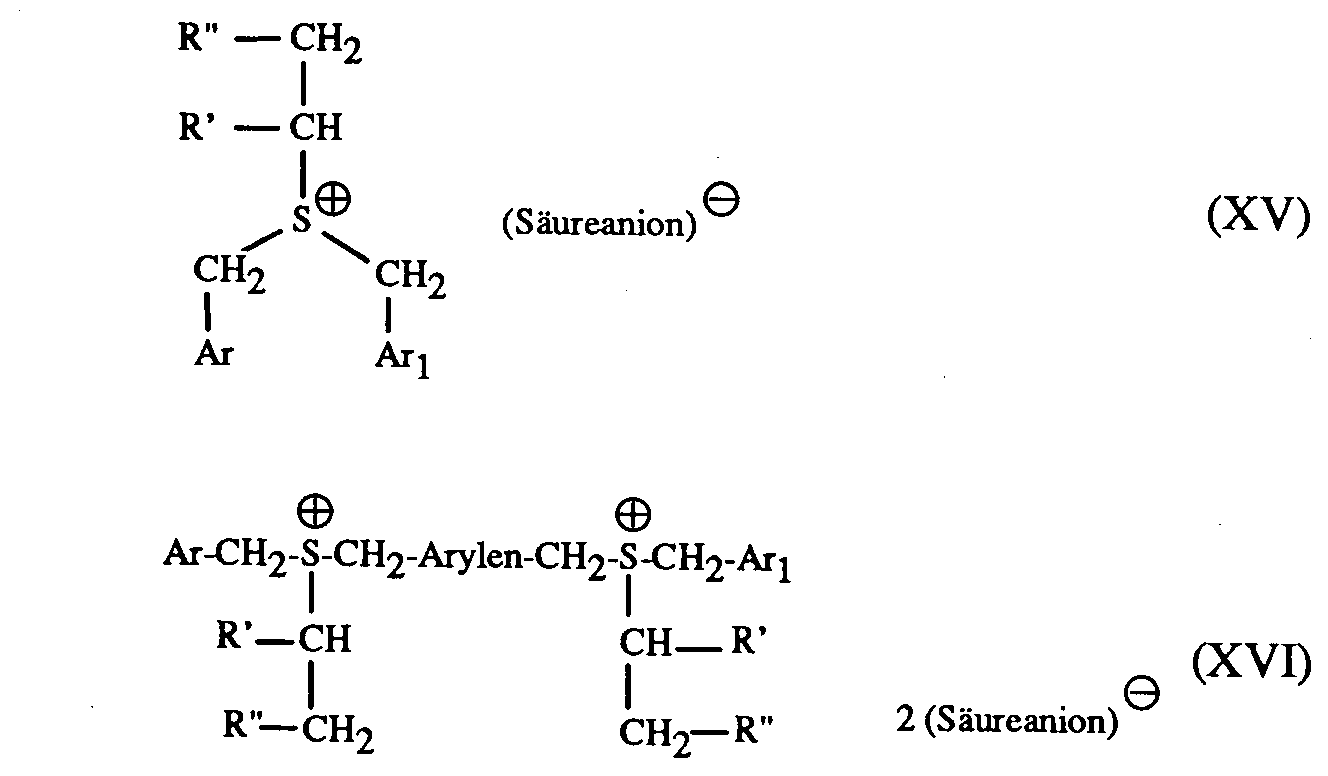
umsetzt und anschliessend das Sulfoniumsalz der Formel XV bzw. XVI mit einem Alkalisalz oder einem quaternären Ammoniumsalz der Formel VIII zu einer Verbindung der Formel I bzw. III, worin A den Rest der Formel XIII bedeutet, umsetzt. - Als Olefine der Formel XIV verwendet man beispielsweise Ethylen, Propylen, Buten-(1), Buten-(2), Isobutylen, Penten-(1), Penten-(2), Cyclobuten, Cyclopenten oder Cyclohexen und als starke Säuren beispielsweise H₂SO₄, HPF₆, HBF₄, HClO₄ oder CF₃SO₃H.
- In den erfindungsgemässen härtbaren Gemischen wird das wärmeaktivierbare Härtungsmittel (d) zweckmässig in Mengen von 0,01 bis 10 Gew.-%, vorzugsweise von 0,1 bis 5 Gew.-%, insbesondere von 0,1 bis 2,5 Gew.-%, bezogen auf die Menge des Addukts, eingesetzt.
- Die erfindungsgemässen heisshärtbaren Gemische können auch weitere, bekannte und üblicherweise in der Technik polymerisierbarer Materialien eingesetzte Zusatzstoffe enthalten. Beispiele für solche Zusatzstoffe sind Pigmente, Farbstoffe, Füllstoffe und Verstärkungsmittel, Flammhemmstoffe, Antistatika, Haftvermittler, Verlaufmittel, Antioxidantien und Lichtschutzmittel. Als Füllstoffe eignen sich mineralische und faserförmige Füllstoffe, wie Quarzmehl, Quarzgut, Aluminiumoxid, Glaspulver, Glimmer, Kaolin, Dolomit, Graphit, Russ, sowie Kohlefasern und Textilfasern. Bevorzugte Füllstoffe sind Quarzmehl, Quarzgut, Aluminiumoxid oder Dolomit.
- Die erfindungsgemässen heisshärtbaren Gemische lassen sich ganz allgemein zur Herstellung von gehärteten Produkten einsetzen und können in der dem jeweils speziellen Anwendungsgebiet angepassten Formulierung, beispielsweise als Beschichtungsmasssen, Lacke, Pressmassen, Tauchharze, Giessharze, Imprägnierharze, Laminierharze, 1- oder 2-Komponenten-Klebstoffe oder Matrixharze, eingesetzt werden.
- Zur Aushärtung der erfindungsgemässen Gemische wendet man im allgemeinen Temperaturen im Bereich von 60 bis 250°C, vorzugsweise 60 bis 220°C, insbesondere 80 bis 200°C, an.
- Die aus den erfindungsgemässen Gemischen durch thermische Härtung erhaltenen Produkte zeichnen sich durch ausgezeichnete thermische, mechanische und elektrische Eigenschaften aus.
- Die Aushärtung erfolgt in der Regel unter gleichzeitiger Formgebung zu Formkörpern, Imprägnierungen, Beschichtungen oder Verklebungen.
- Die folgenden Beispiele erläutern die Erfindung.
- 200 Gew.-Teile eines Bisphenol-A-Epoxidharzes mit einem Epoxidgehalt von 5,2 Val/kg und einem OH-Gruppengehalt von 216 Val/kg werden mit 89 Gew.-Teilen eines präpolymerisierten Diisocyanatodiphenylmethan-Harzes mit einem NCO-Gehalt von 26,1 % und einer Viskosität von 140 mPa·s bei 25°C (ISONATE® M340 der Fa. Dow) und 89 Gew.-Teilen eines Diisocyanatodiphenylmethans mit einem NCO-Gehalt von 23 % und einer Viskosität von 15 mPa·s bei 25°C (BAYMIDUR® KL-3-5002 der Fa. Bayer) zusammen gemischt und auf 100°C unter Feuchtigkeitsausschluss erhitzt. Während der 10-stündigen Reaktionszeit unter Rühren ist die exotherme Reaktion so schwach, dass die eingestellte Reaktionstemperatur von 100°C in der Mischung nicht überschritten wird.
Nach 10 Stunden ist die Viskosität von ursprünglich 670 mPa·s (25°C) auf 1783 mPa·s (25°C) angestiegen, währenddem der NCO-Gehalt von 11,6 % auf 10,7 % sank. Der Epoxidgehalt der Reaktionsmischung bleibt bei 2,75 Val/kg unverändert.
Der Reaktionsmischung werden 3,78 Gew.-Teile Dipentaerythrit-hexaacrylat (ARONIX® M-400, Firma Toagosei Chemical Ind., Japan) bei 100°C beigegeben, und das Gemisch wird bei dieser Temperatur umgesetzt. Nach 60 Minuten ist die Reaktion abgeschlossen. Nach dem Abkühlen wird ein hellgelbes Epoxid-Isocyanataddukt IV mit den folgenden Eigenschaften erhalten:
Viskosität bei 25°C: 2250 mPa·s;
Epoxidgehalt: 2,75 Val/kg;
NCO-Gehalt: 10,5 %. - Entsprechend Beispiel 1 werden in den Beispielen 2 bis 6 unter Verwendung der gleichen Reaktanden Addukte mit anderen NCO:EP-Molverhältnissen hergestellt:
- 50 Gew.-Teile Bisphenol-A-Epoxidharz
164 Gew.-Teile Isocyanatharz (NCO-Gehalt 26,1 %)
164 Gew.-Teile Isocyanatharz (NCO-Gehalt 23,0 %)
3,8 Gew.-Teile Dipentaerythrit-hexaacrylat. - Viskosität bei 25°C: 285 mPa·s;
Epoxidgehalt: 0,69 Val/kg ;
NCO-Gehalt: 20,4 %. - 100 Gew.-Teile Bisphenol-A-Epoxidharz
139 Gew.-Teile Isocyanatharz (NCO-Gehalt 26,1%)
139 Gew.-Teile Isocyanatharz (NCO-Gehalt 23,0 %)
3,8 Gew.-Teile Dipentaerythrit-hexaacrylat. - Viskosität bei 25°C: 580 mPa·s;
Epoxidgehalt: 1,38 Val/kg ;
NCO-Gehalt: 17,2 % - 150 Gew.-Teile Bisphenol-A-Epoxidharz
114 Gew.-Teile Isocyanatharz (NCO-Gehalt 26,1 %)
114 Gew.-Teile Isocyanatharz (NCO-Gehalt 23,0 %)
3,8 Gew.-Teile Dipentaerythrit-hexaacrylat. - Viskosität bei 25°C: 1076 mPa·s;
Epoxidgehalt: 2,1 Val/kg;
NCO-Gehalt: 13,9 %.
- 250 Gew.-Teile Bisphenol-A-Epoxidharz
64 Gew.-Teile Isocyanatharz (NCO-Gehalt 26,1 %)
64 Gew.-Teile Isocyanatharz (NCO-Gehalt 23,0 %)
3,8 Gew.-Teile Dipentaerythrit-hexaacrylat. - Viskosität bei 25°C: 2860 mPa·s;
Epoxidgehalt: 3,4 Val/kg;
NCO-Gehalt: 7,4 %.
- 300 Gew.-Teile Bisphenol-A-Epoxidharz
39 Gew.-Teile Isocyanatharz (NCO-Gehalt 26,1 %)
39 Gew.-Teile Isocyanatharz (NCO-Gehalt 23,0 %)
3,8 Gew.-Teile Dipentaerythrit-hexaacrylat. - Viskosität bei 25°C: 3960 mPa·s;
Epoxidgehalt: 4,1 Val/kg ;
NCO-Gehalt: 4,1 %.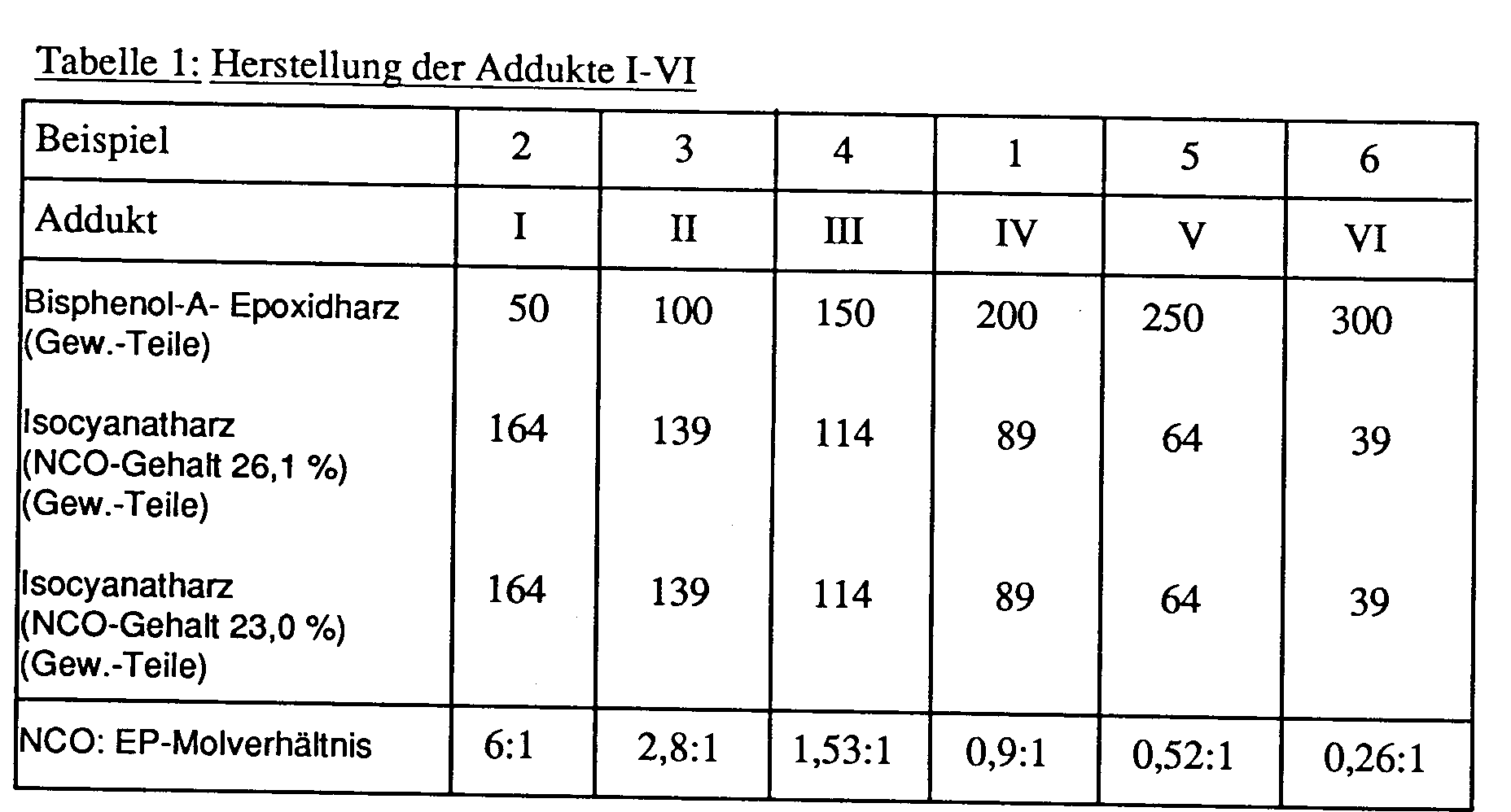
- 378 Gew.-Teile der gemäss den Beispielen 1 bis 6 hergestellten Addukte I bis VI werden jeweils in einem Rührkessel vorgelegt und auf 50°C erwärmt. Dann werden 686 Gew.-Teile Quarzmehl Typ W12 der Quarzwerke Frechen (BRD) zugegeben und innerhalb 10 Minuten homogen eingemischt. Zu dieser Vormischung, die durch die Friktionswärme des Rührvorgangs auf ca. 45°C bleibt, werden 2 Gewichtsteile Katalysator Dimethylbenzylamin-Bortrichlorid-Komplex eingelöst. Während 2 Stunden wird die Reaktionsgiessharzmasse im Vakuum bei 1-2 mbar entgast, um anschliessend in auf 120°C vorgeheizte Prüfkörperformen gegossen zu werden. Die Masse geliert bei 120°C in ca. 15 Minuten. Nach 2 Stunden wird entformt, und die Prüfkörper werden 4 Stunden bei 150°C und 16 Stunden bei 200°C nachgehärtet.
- Die Prüfkörper haben die in der Tabelle 2 aufgelisteten Eigenschaften.

- Die Aufbereitung des Beispiels 8 erfolgt gemäss der Prozedur des Beispiels 7. Als Katalysator werden jedoch 2,5 Gewichtsteile Dibenzyl-phenyl-sulfoniumhexafluor-antimonat verwendet.

- Verfährt man analog dem Beispiel 7, verwendet aber anstelle von 686 Gew.-Teile 610 Gew.-Teile Quarzmehl und für die Beispiele 10 und 12 anstelle von Dimethyl-benzyl-amin-Bortrichlorid-Komplex (als latenter Katalysator) eine entsprechende Menge des nicht-latenten Katalysators Dibenzylamins (nämlich 0,2 Gew.-Teile), so erhärt man mit den Addukten II bzw. IV gemäss den Beispielen 3 und 1 Formkörper mit gleichguten Eigenschaften und den in der folgenden Tabelle aufgelisteten Eigenschaften:

Claims (14)
- Addukt erhältlich durch Umsetzung (a) eines Epoxidharzes mit einem Hydroxylgruppengehalt von 0,02-1,5 Aequivalenten/kg und (b) eines Di- oder Polyisocyanats, wobei die Umsetzung unter Feuchtigkeitsausschluss und im wesentlichen ohne Dabeisein eines Katalysators durchgeführt wird.
- Addukt nach Anspruch 1, worin die Mengen der Komponenten (a) und (b) so gewählt werden, dass pro Epoxidgruppe des Epoxidharzes (a) 0,1-40, vorzugsweise 0,2-10, Isocyanatgruppen des Di- oder Polyisocyanats (b) vorhanden sind.
- Addukt nach Anspruch 1 oder 2, erhältlich durch Umsetzung bei 50-150°C während 5-15 Stunden.
- Addukt nach Anspruch 3, erhältlich durch Umsetzung bei 80-120°C während 8-12 Stunden.
- Addukt nach einem der Ansprüche 1 bis 4, worin das Epoxidharz (a) ein aliphatisches, cycloaliphatisches oder aromatisches Epoxidharz ist.
- Addukt nach Anspruch 5, worin das Epoxidharz (a) ein aromatisches Epoxidharz, insbesondere ein von Bisphenol A abgeleitetes Epoxidharz, ist.
- Addukt nach einem der Ansprüche 1 bis 5, worin das Isocyanat (b) ein aliphatisches, cycloaliphatisches oder aromatisches Isocyanat ist.
- Addukt nach Anspruch 7, worin das Isocyanat (b) ein Isomerengemisch aus 4,4′- und 2,4′-Diisocyanatodiphenylmethan, ein polyolmodifiziertes Polyisocyanat oder ein Gemisch von flüssigen Polyisocyanaten mit höhermolekularen Polyisocyanaten oder Carbodiimid-Polyisocyanaten darstellt.
- Lagerstabiles Addukt erhältlich durch Umsetzung eines Addukts nach einem der Ansprüche 1 bis 8 mit einem Inhibitor (c).
- Addukt nach Anspruch 9, worin der Inhibitor (c) ein Zimtsäure-, Methacrylsäure- oder insbesondere Acrylsäureester ist.
- Addukt nach Anspruch 10, worin der Inhibitor (c) Dipentaerythrit-hexaacrylat oder eine Mischung aus Dipentaerythrit-hexaacrylat und Dipentaerythrit-monohydroxypentaacrylat ist.
- Verfahren zur Herstellung eines Adduktes nach Anspruch 1 oder 9, wonach (a) ein Epoxidharz mit einem Hydroxylgruppengehalt von 0,02-1,5 Aequivalenten/kg und (b) ein Di- oder Polyisocyanat unter Feuchtigkeitsausschluss und im wesentlichen ohne Dabeisein eines Katalysators umgesetzt werden, und das so erhaltene Produkt gegebenenfalls anschliessend mit einem Inhibitor (c) umgesetzt wird.
- Härtbares Gemisch enthaltend ein Addukt nach einem der Ansprüche 1 bis 11 und (d) einen wärmeaktivierbaren Katalysator.
- Vernetzte Produkte erhältlich durch thermische Härtung des Gemisches nach Anspruch 13.
Applications Claiming Priority (2)
| Application Number | Priority Date | Filing Date | Title |
|---|---|---|---|
| CH276690 | 1990-08-27 | ||
| CH2766/90 | 1990-08-27 |
Publications (3)
| Publication Number | Publication Date |
|---|---|
| EP0473548A2 true EP0473548A2 (de) | 1992-03-04 |
| EP0473548A3 EP0473548A3 (en) | 1992-10-21 |
| EP0473548B1 EP0473548B1 (de) | 1998-12-09 |
Family
ID=4241136
Family Applications (1)
| Application Number | Title | Priority Date | Filing Date |
|---|---|---|---|
| EP91810658A Expired - Lifetime EP0473548B1 (de) | 1990-08-27 | 1991-08-20 | Addukte aus hydroxylgruppenhaltigen Epoxidharzen und Isocyanaten und deren Verwendung |
Country Status (6)
| Country | Link |
|---|---|
| US (1) | US5272227A (de) |
| EP (1) | EP0473548B1 (de) |
| JP (1) | JP3163381B2 (de) |
| CA (1) | CA2049779C (de) |
| DE (1) | DE59109074D1 (de) |
| ES (1) | ES2126568T3 (de) |
Families Citing this family (3)
| Publication number | Priority date | Publication date | Assignee | Title |
|---|---|---|---|---|
| US7812101B2 (en) * | 2007-07-20 | 2010-10-12 | Ppg Industries Ohio, Inc. | Modified epoxy resins comprising the reaction product of a biomass derived compound and an epoxy resin, and aqueous dispersions and coatings comprising such resins |
| JP5379014B2 (ja) | 2007-10-15 | 2013-12-25 | 三井化学株式会社 | 粒子状ポリウレタン樹脂組成物およびその成形品 |
| CN103641989B (zh) | 2007-10-15 | 2016-05-18 | 三井化学株式会社 | 聚氨酯树脂 |
Family Cites Families (15)
| Publication number | Priority date | Publication date | Assignee | Title |
|---|---|---|---|---|
| US3108100A (en) * | 1957-06-12 | 1963-10-22 | Ici Ltd | Polymerization of organic isocyanates with organic hydroxides |
| US2977370A (en) * | 1959-04-13 | 1961-03-28 | Du Pont | Production of 2-oxazolidones |
| US3494888A (en) * | 1966-08-30 | 1970-02-10 | Wilbur R Mcelroy | Resin compositions from polyepoxides and isocyanate polymers |
| US3424719A (en) * | 1967-03-06 | 1969-01-28 | Celanese Coatings Co | Urethane modified epoxy resins |
| US3585227A (en) * | 1969-06-18 | 1971-06-15 | Goodrich Co B F | Trialkyl oxonium salts of the hpf6,hasf6 and hsbf6 acids |
| US4085161A (en) * | 1976-11-01 | 1978-04-18 | Desoto, Inc. | Electrodeposition of aqueous dispersions of copolymers of polyethylenically unsaturated epoxy adducts including blocked isocyanate monomer |
| US4134866A (en) * | 1977-06-03 | 1979-01-16 | Kansai Paint Company, Limited | Aqueous cationic coating from amine-epoxy adduct, polyamide, and semi-blocked polyisocyanate, acid salt |
| US4401499A (en) * | 1980-06-09 | 1983-08-30 | Sumitomo Bakelite Company Limited | Crosslinked resin of epoxy compound and isocyanate and process for producing same |
| DE3323123A1 (de) * | 1983-06-27 | 1985-01-10 | Siemens AG, 1000 Berlin und 8000 München | Hitzehaertbare reaktionsharzmischungen |
| DE3323122A1 (de) * | 1983-06-27 | 1985-05-23 | Siemens AG, 1000 Berlin und 8000 München | Verfahren zur herstellung von reaktionsharzformstoffen |
| AT380895B (de) * | 1984-12-14 | 1986-07-25 | Vianova Kunstharz Ag | Verfahren zur herstellung von ketl-bindemitteln auf basis von modifizierten epoxidharzen |
| DE3600764A1 (de) * | 1986-01-14 | 1987-07-16 | Bayer Ag | Waermehaertbare reaktionsharzgemische und ein verfahren zur herstellung von formkoerpern unter verwendung dieser gemische |
| DE3644382A1 (de) * | 1986-12-24 | 1988-07-07 | Bayer Ag | Verfahren zur zweistufigen herstellung von formkoerpern |
| US4855368A (en) * | 1987-07-17 | 1989-08-08 | Ashland Oil, Inc. | Thermoset resinous molding compositions |
| US4906722A (en) * | 1987-12-02 | 1990-03-06 | Ciba-Geigy Corporation | Thermosetting reactive systems |
-
1991
- 1991-08-20 EP EP91810658A patent/EP0473548B1/de not_active Expired - Lifetime
- 1991-08-20 US US07/747,594 patent/US5272227A/en not_active Expired - Fee Related
- 1991-08-20 DE DE59109074T patent/DE59109074D1/de not_active Expired - Fee Related
- 1991-08-20 ES ES91810658T patent/ES2126568T3/es not_active Expired - Lifetime
- 1991-08-23 CA CA002049779A patent/CA2049779C/en not_active Expired - Fee Related
- 1991-08-27 JP JP24062491A patent/JP3163381B2/ja not_active Expired - Fee Related
Also Published As
| Publication number | Publication date |
|---|---|
| JP3163381B2 (ja) | 2001-05-08 |
| DE59109074D1 (de) | 1999-01-21 |
| ES2126568T3 (es) | 1999-04-01 |
| EP0473548B1 (de) | 1998-12-09 |
| CA2049779A1 (en) | 1992-02-28 |
| CA2049779C (en) | 2003-08-19 |
| JPH04233930A (ja) | 1992-08-21 |
| US5272227A (en) | 1993-12-21 |
| EP0473548A3 (en) | 1992-10-21 |
Similar Documents
| Publication | Publication Date | Title |
|---|---|---|
| KR101187975B1 (ko) | 폴리티오우레탄계 광학재료 제조용의 내부이형제 | |
| EP0232540A1 (de) | Wärmehärtbare Reaktionsharzgemische und ein Verfahren zur Herstellung von Formkörpern unter Verwendung dieser Gemische | |
| EP1114076A1 (de) | Beschleuniger für härtbare systeme | |
| DE102014226842A1 (de) | Katalysator-Zusammensetzung zur Härtung von Epoxidgruppen-haltigen Harzen | |
| EP0146498A2 (de) | Härtbare Gemische, enthaltend ein Epoxidharz, ein Imid und einen Härtungskatalysator | |
| WO2018167228A1 (de) | Verfahren zur herstellung von oxazolidinongruppen aufweisenden verbindungen | |
| DE69222886T2 (de) | Härtbare Zusammensetzung | |
| EP0473548B1 (de) | Addukte aus hydroxylgruppenhaltigen Epoxidharzen und Isocyanaten und deren Verwendung | |
| DE2440953A1 (de) | Verfahren zur herstellung hitzehaertbarer harze | |
| US4129554A (en) | Thermosettable, polymerizable resin composition comprising a polyepoxide and a polyisocyanate stabilized by incorporating an organic electron acceptor | |
| EP0682048B1 (de) | Wärmehärtbare Reaktionsharzgemische und deren Verwendung | |
| EP3569624A1 (de) | Verfahren zur herstellung von isocyanuratgruppen aufweisenden polyisocyanaten und ihre verwendung | |
| EP0424314B1 (de) | Heisshärtbare Gemische | |
| EP0603131A1 (de) | Aromatische Harnstoffverbindung als Härtungsbeschleuniger für eine Mischung aus Epoxiharz und Dicyandiamid | |
| EP0018949A1 (de) | Härtbare Epoxidharzgemische und Härtungsbeschleuniger dafür | |
| CA1229600A (en) | Diurethane diureas and the use thereof | |
| EP0012963A1 (de) | Verfahren zur Herstellung von selbstvernetzenden Bindemitteln für kathodisch abscheidbare Elektrotauchlacke | |
| EP0415879A2 (de) | Carboxylterminierte Polyhydroxyester und deren Verwendung | |
| US5294582A (en) | Urea-superacid salts and their use as a curing catalyst of epoxy resins | |
| DE2856771A1 (de) | Cyanamide sekundaerer amine als haerter fuer epoxidharze | |
| EP0554728B1 (de) | Bei Raumtemperatur lagerfähige Gemische und ihre Verwendung als Bindemittel in Beschichtungsmitteln | |
| EP0319473A2 (de) | Hitzehärtbare Reaktivsysteme | |
| EP0191926B1 (de) | Wärmehärtbare Epoxidharzmischungen | |
| DE2005693A1 (en) | Methylene-n-arylurethane-n'-amido cpds for cross-linking pol - with hydroxyl gps | |
| US20190040179A1 (en) | Composition polyisocyanate biuret |
Legal Events
| Date | Code | Title | Description |
|---|---|---|---|
| PUAI | Public reference made under article 153(3) epc to a published international application that has entered the european phase |
Free format text: ORIGINAL CODE: 0009012 |
|
| 17P | Request for examination filed |
Effective date: 19910823 |
|
| AK | Designated contracting states |
Kind code of ref document: A2 Designated state(s): CH DE ES FR GB IT LI |
|
| PUAL | Search report despatched |
Free format text: ORIGINAL CODE: 0009013 |
|
| AK | Designated contracting states |
Kind code of ref document: A3 Designated state(s): CH DE ES FR GB IT LI |
|
| 17Q | First examination report despatched |
Effective date: 19960327 |
|
| RAP1 | Party data changed (applicant data changed or rights of an application transferred) |
Owner name: CIBA SC HOLDING AG |
|
| RAP3 | Party data changed (applicant data changed or rights of an application transferred) |
Owner name: CIBA SPECIALTY CHEMICALS HOLDING INC. |
|
| GRAG | Despatch of communication of intention to grant |
Free format text: ORIGINAL CODE: EPIDOS AGRA |
|
| GRAG | Despatch of communication of intention to grant |
Free format text: ORIGINAL CODE: EPIDOS AGRA |
|
| GRAH | Despatch of communication of intention to grant a patent |
Free format text: ORIGINAL CODE: EPIDOS IGRA |
|
| GRAH | Despatch of communication of intention to grant a patent |
Free format text: ORIGINAL CODE: EPIDOS IGRA |
|
| GRAA | (expected) grant |
Free format text: ORIGINAL CODE: 0009210 |
|
| AK | Designated contracting states |
Kind code of ref document: B1 Designated state(s): CH DE ES FR GB IT LI |
|
| REG | Reference to a national code |
Ref country code: CH Ref legal event code: EP |
|
| REF | Corresponds to: |
Ref document number: 59109074 Country of ref document: DE Date of ref document: 19990121 |
|
| GBT | Gb: translation of ep patent filed (gb section 77(6)(a)/1977) |
Effective date: 19990202 |
|
| ET | Fr: translation filed | ||
| REG | Reference to a national code |
Ref country code: ES Ref legal event code: FG2A Ref document number: 2126568 Country of ref document: ES Kind code of ref document: T3 |
|
| PLBE | No opposition filed within time limit |
Free format text: ORIGINAL CODE: 0009261 |
|
| STAA | Information on the status of an ep patent application or granted ep patent |
Free format text: STATUS: NO OPPOSITION FILED WITHIN TIME LIMIT |
|
| 26N | No opposition filed | ||
| REG | Reference to a national code |
Ref country code: CH Ref legal event code: PUE Owner name: CIBA SPECIALTY CHEMICALS HOLDING INC. TRANSFER- VA |
|
| REG | Reference to a national code |
Ref country code: GB Ref legal event code: 732E |
|
| REG | Reference to a national code |
Ref country code: GB Ref legal event code: IF02 |
|
| REG | Reference to a national code |
Ref country code: FR Ref legal event code: TP |
|
| PGFP | Annual fee paid to national office [announced via postgrant information from national office to epo] |
Ref country code: GB Payment date: 20030728 Year of fee payment: 13 Ref country code: CH Payment date: 20030728 Year of fee payment: 13 |
|
| PGFP | Annual fee paid to national office [announced via postgrant information from national office to epo] |
Ref country code: ES Payment date: 20030807 Year of fee payment: 13 |
|
| PGFP | Annual fee paid to national office [announced via postgrant information from national office to epo] |
Ref country code: DE Payment date: 20040805 Year of fee payment: 14 |
|
| PGFP | Annual fee paid to national office [announced via postgrant information from national office to epo] |
Ref country code: FR Payment date: 20040809 Year of fee payment: 14 |
|
| PG25 | Lapsed in a contracting state [announced via postgrant information from national office to epo] |
Ref country code: GB Free format text: LAPSE BECAUSE OF NON-PAYMENT OF DUE FEES Effective date: 20040820 |
|
| PG25 | Lapsed in a contracting state [announced via postgrant information from national office to epo] |
Ref country code: ES Free format text: LAPSE BECAUSE OF NON-PAYMENT OF DUE FEES Effective date: 20040821 |
|
| PG25 | Lapsed in a contracting state [announced via postgrant information from national office to epo] |
Ref country code: LI Free format text: LAPSE BECAUSE OF NON-PAYMENT OF DUE FEES Effective date: 20040831 Ref country code: CH Free format text: LAPSE BECAUSE OF NON-PAYMENT OF DUE FEES Effective date: 20040831 |
|
| GBPC | Gb: european patent ceased through non-payment of renewal fee |
Effective date: 20040820 |
|
| REG | Reference to a national code |
Ref country code: CH Ref legal event code: PL |
|
| PG25 | Lapsed in a contracting state [announced via postgrant information from national office to epo] |
Ref country code: IT Free format text: LAPSE BECAUSE OF NON-PAYMENT OF DUE FEES Effective date: 20050820 |
|
| REG | Reference to a national code |
Ref country code: ES Ref legal event code: FD2A Effective date: 20040821 |
|
| PG25 | Lapsed in a contracting state [announced via postgrant information from national office to epo] |
Ref country code: DE Free format text: LAPSE BECAUSE OF NON-PAYMENT OF DUE FEES Effective date: 20060301 |
|
| PG25 | Lapsed in a contracting state [announced via postgrant information from national office to epo] |
Ref country code: FR Free format text: LAPSE BECAUSE OF NON-PAYMENT OF DUE FEES Effective date: 20060428 |
|
| REG | Reference to a national code |
Ref country code: FR Ref legal event code: ST Effective date: 20060428 |