EP0424314B1 - Heisshärtbare Gemische - Google Patents
Heisshärtbare Gemische Download PDFInfo
- Publication number
- EP0424314B1 EP0424314B1 EP90810773A EP90810773A EP0424314B1 EP 0424314 B1 EP0424314 B1 EP 0424314B1 EP 90810773 A EP90810773 A EP 90810773A EP 90810773 A EP90810773 A EP 90810773A EP 0424314 B1 EP0424314 B1 EP 0424314B1
- Authority
- EP
- European Patent Office
- Prior art keywords
- atoms
- phenyl
- formula
- unsubstituted
- substituted
- Prior art date
- Legal status (The legal status is an assumption and is not a legal conclusion. Google has not performed a legal analysis and makes no representation as to the accuracy of the status listed.)
- Expired - Lifetime
Links
- 239000000203 mixture Substances 0.000 title claims description 61
- -1 nitro, phenyl Chemical group 0.000 claims description 97
- 150000001875 compounds Chemical class 0.000 claims description 33
- 125000004432 carbon atom Chemical group C* 0.000 claims description 23
- 229920000647 polyepoxide Polymers 0.000 claims description 20
- 229920001228 polyisocyanate Polymers 0.000 claims description 20
- 239000005056 polyisocyanate Substances 0.000 claims description 20
- 125000000229 (C1-C4)alkoxy group Chemical group 0.000 claims description 19
- 239000003822 epoxy resin Substances 0.000 claims description 17
- 125000002252 acyl group Chemical group 0.000 claims description 15
- 125000004453 alkoxycarbonyl group Chemical group 0.000 claims description 15
- 229910052736 halogen Inorganic materials 0.000 claims description 15
- 150000002367 halogens Chemical class 0.000 claims description 15
- 125000000951 phenoxy group Chemical group [H]C1=C([H])C([H])=C(O*)C([H])=C1[H] 0.000 claims description 15
- 238000001723 curing Methods 0.000 claims description 14
- RWSOTUBLDIXVET-UHFFFAOYSA-N Dihydrogen sulfide Chemical class S RWSOTUBLDIXVET-UHFFFAOYSA-N 0.000 claims description 12
- 125000001997 phenyl group Chemical group [H]C1=C([H])C([H])=C(*)C([H])=C1[H] 0.000 claims description 11
- 239000003795 chemical substances by application Substances 0.000 claims description 10
- 239000012948 isocyanate Substances 0.000 claims description 7
- 125000004400 (C1-C12) alkyl group Chemical group 0.000 claims description 5
- 125000001931 aliphatic group Chemical group 0.000 claims description 5
- 125000003118 aryl group Chemical group 0.000 claims description 5
- 239000007788 liquid Substances 0.000 claims description 5
- 125000001624 naphthyl group Chemical group 0.000 claims description 5
- 125000000732 arylene group Chemical group 0.000 claims description 4
- 229910052801 chlorine Inorganic materials 0.000 claims description 4
- IQPQWNKOIGAROB-UHFFFAOYSA-N isocyanate group Chemical group [N-]=C=O IQPQWNKOIGAROB-UHFFFAOYSA-N 0.000 claims description 4
- 125000004957 naphthylene group Chemical group 0.000 claims description 4
- 125000000843 phenylene group Chemical group C1(=C(C=CC=C1)*)* 0.000 claims description 4
- 238000001029 thermal curing Methods 0.000 claims description 4
- 229910017048 AsF6 Inorganic materials 0.000 claims description 3
- 150000002118 epoxides Chemical class 0.000 claims description 2
- 125000006552 (C3-C8) cycloalkyl group Chemical group 0.000 claims 1
- LFSYUSUFCBOHGU-UHFFFAOYSA-N 1-isocyanato-2-[(4-isocyanatophenyl)methyl]benzene Chemical compound C1=CC(N=C=O)=CC=C1CC1=CC=CC=C1N=C=O LFSYUSUFCBOHGU-UHFFFAOYSA-N 0.000 claims 1
- YMWUJEATGCHHMB-UHFFFAOYSA-N Dichloromethane Chemical compound ClCCl YMWUJEATGCHHMB-UHFFFAOYSA-N 0.000 description 39
- XLYOFNOQVPJJNP-UHFFFAOYSA-N water Chemical class O XLYOFNOQVPJJNP-UHFFFAOYSA-N 0.000 description 15
- 239000013078 crystal Substances 0.000 description 14
- 239000000047 product Substances 0.000 description 13
- 125000004209 (C1-C8) alkyl group Chemical group 0.000 description 12
- WVDDGKGOMKODPV-UHFFFAOYSA-N Benzyl alcohol Chemical compound OCC1=CC=CC=C1 WVDDGKGOMKODPV-UHFFFAOYSA-N 0.000 description 12
- YXFVVABEGXRONW-UHFFFAOYSA-N Toluene Chemical compound CC1=CC=CC=C1 YXFVVABEGXRONW-UHFFFAOYSA-N 0.000 description 12
- RTZKZFJDLAIYFH-UHFFFAOYSA-N Diethyl ether Chemical compound CCOCC RTZKZFJDLAIYFH-UHFFFAOYSA-N 0.000 description 11
- 238000005160 1H NMR spectroscopy Methods 0.000 description 10
- LNEPOXFFQSENCJ-UHFFFAOYSA-N haloperidol Chemical compound C1CC(O)(C=2C=CC(Cl)=CC=2)CCN1CCCC(=O)C1=CC=C(F)C=C1 LNEPOXFFQSENCJ-UHFFFAOYSA-N 0.000 description 10
- 239000011541 reaction mixture Substances 0.000 description 10
- OKKJLVBELUTLKV-UHFFFAOYSA-N Methanol Chemical compound OC OKKJLVBELUTLKV-UHFFFAOYSA-N 0.000 description 9
- 239000002253 acid Substances 0.000 description 9
- CSNNHWWHGAXBCP-UHFFFAOYSA-L Magnesium sulfate Chemical compound [Mg+2].[O-][S+2]([O-])([O-])[O-] CSNNHWWHGAXBCP-UHFFFAOYSA-L 0.000 description 8
- HGCIXCUEYOPUTN-UHFFFAOYSA-N cyclohexene Chemical compound C1CCC=CC1 HGCIXCUEYOPUTN-UHFFFAOYSA-N 0.000 description 8
- 238000002844 melting Methods 0.000 description 8
- 230000008018 melting Effects 0.000 description 8
- 229920005989 resin Polymers 0.000 description 8
- 239000011347 resin Substances 0.000 description 8
- 239000000243 solution Substances 0.000 description 8
- ISWSIDIOOBJBQZ-UHFFFAOYSA-N phenol group Chemical group C1(=CC=CC=C1)O ISWSIDIOOBJBQZ-UHFFFAOYSA-N 0.000 description 7
- 150000003242 quaternary ammonium salts Chemical class 0.000 description 7
- 238000003756 stirring Methods 0.000 description 7
- QTBSBXVTEAMEQO-UHFFFAOYSA-N Acetic acid Chemical compound CC(O)=O QTBSBXVTEAMEQO-UHFFFAOYSA-N 0.000 description 6
- XEKOWRVHYACXOJ-UHFFFAOYSA-N Ethyl acetate Chemical compound CCOC(C)=O XEKOWRVHYACXOJ-UHFFFAOYSA-N 0.000 description 6
- CSCPPACGZOOCGX-WFGJKAKNSA-N acetone d6 Chemical compound [2H]C([2H])([2H])C(=O)C([2H])([2H])[2H] CSCPPACGZOOCGX-WFGJKAKNSA-N 0.000 description 6
- 238000006243 chemical reaction Methods 0.000 description 6
- 238000000921 elemental analysis Methods 0.000 description 6
- VYPSYNLAJGMNEJ-UHFFFAOYSA-N silicon dioxide Inorganic materials O=[Si]=O VYPSYNLAJGMNEJ-UHFFFAOYSA-N 0.000 description 6
- 239000002904 solvent Substances 0.000 description 6
- 235000019445 benzyl alcohol Nutrition 0.000 description 5
- 239000008367 deionised water Substances 0.000 description 5
- 229910021641 deionized water Inorganic materials 0.000 description 5
- 239000000706 filtrate Substances 0.000 description 5
- 125000004435 hydrogen atom Chemical group [H]* 0.000 description 5
- 150000002513 isocyanates Chemical class 0.000 description 5
- 229910052757 nitrogen Inorganic materials 0.000 description 5
- 239000010453 quartz Substances 0.000 description 5
- 150000003839 salts Chemical class 0.000 description 5
- 229910004039 HBF4 Inorganic materials 0.000 description 4
- HEDRZPFGACZZDS-MICDWDOJSA-N Trichloro(2H)methane Chemical compound [2H]C(Cl)(Cl)Cl HEDRZPFGACZZDS-MICDWDOJSA-N 0.000 description 4
- 229910052783 alkali metal Inorganic materials 0.000 description 4
- IISBACLAFKSPIT-UHFFFAOYSA-N bisphenol A Chemical compound C=1C=C(O)C=CC=1C(C)(C)C1=CC=C(O)C=C1 IISBACLAFKSPIT-UHFFFAOYSA-N 0.000 description 4
- 239000000460 chlorine Substances 0.000 description 4
- 239000000835 fiber Substances 0.000 description 4
- 239000000945 filler Substances 0.000 description 4
- 229910052943 magnesium sulfate Inorganic materials 0.000 description 4
- 235000019341 magnesium sulphate Nutrition 0.000 description 4
- 239000012074 organic phase Substances 0.000 description 4
- 239000000843 powder Substances 0.000 description 4
- 239000007787 solid Substances 0.000 description 4
- 239000000725 suspension Substances 0.000 description 4
- OKTJSMMVPCPJKN-UHFFFAOYSA-N Carbon Chemical compound [C] OKTJSMMVPCPJKN-UHFFFAOYSA-N 0.000 description 3
- LYCAIKOWRPUZTN-UHFFFAOYSA-N Ethylene glycol Chemical compound OCCO LYCAIKOWRPUZTN-UHFFFAOYSA-N 0.000 description 3
- MUBZPKHOEPUJKR-UHFFFAOYSA-N Oxalic acid Chemical compound OC(=O)C(O)=O MUBZPKHOEPUJKR-UHFFFAOYSA-N 0.000 description 3
- 150000007513 acids Chemical class 0.000 description 3
- 150000001298 alcohols Chemical class 0.000 description 3
- 150000001447 alkali salts Chemical class 0.000 description 3
- MTHSVFCYNBDYFN-UHFFFAOYSA-N diethylene glycol Chemical compound OCCOCCO MTHSVFCYNBDYFN-UHFFFAOYSA-N 0.000 description 3
- 150000002148 esters Chemical class 0.000 description 3
- 239000000499 gel Substances 0.000 description 3
- 150000002334 glycols Chemical class 0.000 description 3
- 150000002460 imidazoles Chemical class 0.000 description 3
- 239000000463 material Substances 0.000 description 3
- 238000000034 method Methods 0.000 description 3
- 239000012299 nitrogen atmosphere Substances 0.000 description 3
- FJKROLUGYXJWQN-UHFFFAOYSA-N papa-hydroxy-benzoic acid Natural products OC(=O)C1=CC=C(O)C=C1 FJKROLUGYXJWQN-UHFFFAOYSA-N 0.000 description 3
- 150000002989 phenols Chemical class 0.000 description 3
- ZUOUZKKEUPVFJK-UHFFFAOYSA-N phenylbenzene Natural products C1=CC=CC=C1C1=CC=CC=C1 ZUOUZKKEUPVFJK-UHFFFAOYSA-N 0.000 description 3
- 150000003512 tertiary amines Chemical class 0.000 description 3
- KGBYNVUSDGMXEO-UHFFFAOYSA-N 1-methyl-4-[(4-methylphenyl)methylsulfanylmethyl]benzene Chemical compound C1=CC(C)=CC=C1CSCC1=CC=C(C)C=C1 KGBYNVUSDGMXEO-UHFFFAOYSA-N 0.000 description 2
- UPMLOUAZCHDJJD-UHFFFAOYSA-N 4,4'-Diphenylmethane Diisocyanate Chemical compound C1=CC(N=C=O)=CC=C1CC1=CC=C(N=C=O)C=C1 UPMLOUAZCHDJJD-UHFFFAOYSA-N 0.000 description 2
- VPWNQTHUCYMVMZ-UHFFFAOYSA-N 4,4'-sulfonyldiphenol Chemical compound C1=CC(O)=CC=C1S(=O)(=O)C1=CC=C(O)C=C1 VPWNQTHUCYMVMZ-UHFFFAOYSA-N 0.000 description 2
- IJGRMHOSHXDMSA-UHFFFAOYSA-N Atomic nitrogen Chemical compound N#N IJGRMHOSHXDMSA-UHFFFAOYSA-N 0.000 description 2
- BRLQWZUYTZBJKN-UHFFFAOYSA-N Epichlorohydrin Chemical compound ClCC1CO1 BRLQWZUYTZBJKN-UHFFFAOYSA-N 0.000 description 2
- 239000004593 Epoxy Substances 0.000 description 2
- LFQSCWFLJHTTHZ-UHFFFAOYSA-N Ethanol Chemical compound CCO LFQSCWFLJHTTHZ-UHFFFAOYSA-N 0.000 description 2
- PEDCQBHIVMGVHV-UHFFFAOYSA-N Glycerine Chemical compound OCC(O)CO PEDCQBHIVMGVHV-UHFFFAOYSA-N 0.000 description 2
- QIGBRXMKCJKVMJ-UHFFFAOYSA-N Hydroquinone Chemical compound OC1=CC=C(O)C=C1 QIGBRXMKCJKVMJ-UHFFFAOYSA-N 0.000 description 2
- KFZMGEQAYNKOFK-UHFFFAOYSA-N Isopropanol Chemical compound CC(C)O KFZMGEQAYNKOFK-UHFFFAOYSA-N 0.000 description 2
- NBIIXXVUZAFLBC-UHFFFAOYSA-N Phosphoric acid Chemical compound OP(O)(O)=O NBIIXXVUZAFLBC-UHFFFAOYSA-N 0.000 description 2
- ATUOYWHBWRKTHZ-UHFFFAOYSA-N Propane Chemical compound CCC ATUOYWHBWRKTHZ-UHFFFAOYSA-N 0.000 description 2
- DNIAPMSPPWPWGF-UHFFFAOYSA-N Propylene glycol Chemical compound CC(O)CO DNIAPMSPPWPWGF-UHFFFAOYSA-N 0.000 description 2
- QAOWNCQODCNURD-UHFFFAOYSA-N Sulfuric acid Chemical compound OS(O)(=O)=O QAOWNCQODCNURD-UHFFFAOYSA-N 0.000 description 2
- UCKMPCXJQFINFW-UHFFFAOYSA-N Sulphide Chemical compound [S-2] UCKMPCXJQFINFW-UHFFFAOYSA-N 0.000 description 2
- LNWBFIVSTXCJJG-UHFFFAOYSA-N [diisocyanato(phenyl)methyl]benzene Chemical compound C=1C=CC=CC=1C(N=C=O)(N=C=O)C1=CC=CC=C1 LNWBFIVSTXCJJG-UHFFFAOYSA-N 0.000 description 2
- 230000002378 acidificating effect Effects 0.000 description 2
- 239000000654 additive Substances 0.000 description 2
- WNLRTRBMVRJNCN-UHFFFAOYSA-N adipic acid Chemical compound OC(=O)CCCCC(O)=O WNLRTRBMVRJNCN-UHFFFAOYSA-N 0.000 description 2
- 239000003513 alkali Substances 0.000 description 2
- 150000001336 alkenes Chemical class 0.000 description 2
- 125000000217 alkyl group Chemical group 0.000 description 2
- 238000005349 anion exchange Methods 0.000 description 2
- LUFPJJNWMYZRQE-UHFFFAOYSA-N benzylsulfanylmethylbenzene Chemical compound C=1C=CC=CC=1CSCC1=CC=CC=C1 LUFPJJNWMYZRQE-UHFFFAOYSA-N 0.000 description 2
- 239000004305 biphenyl Substances 0.000 description 2
- 235000010290 biphenyl Nutrition 0.000 description 2
- PXKLMJQFEQBVLD-UHFFFAOYSA-N bisphenol F Chemical compound C1=CC(O)=CC=C1CC1=CC=C(O)C=C1 PXKLMJQFEQBVLD-UHFFFAOYSA-N 0.000 description 2
- WERYXYBDKMZEQL-UHFFFAOYSA-N butane-1,4-diol Chemical compound OCCCCO WERYXYBDKMZEQL-UHFFFAOYSA-N 0.000 description 2
- 235000013877 carbamide Nutrition 0.000 description 2
- 238000005266 casting Methods 0.000 description 2
- 238000000576 coating method Methods 0.000 description 2
- 125000000753 cycloalkyl group Chemical group 0.000 description 2
- LPIQUOYDBNQMRZ-UHFFFAOYSA-N cyclopentene Chemical compound C1CC=CC1 LPIQUOYDBNQMRZ-UHFFFAOYSA-N 0.000 description 2
- 238000000354 decomposition reaction Methods 0.000 description 2
- GYZLOYUZLJXAJU-UHFFFAOYSA-N diglycidyl ether Chemical compound C1OC1COCC1CO1 GYZLOYUZLJXAJU-UHFFFAOYSA-N 0.000 description 2
- 239000010459 dolomite Substances 0.000 description 2
- 229910000514 dolomite Inorganic materials 0.000 description 2
- 238000001035 drying Methods 0.000 description 2
- 150000002170 ethers Chemical class 0.000 description 2
- 238000001914 filtration Methods 0.000 description 2
- HYBBIBNJHNGZAN-UHFFFAOYSA-N furfural Chemical compound O=CC1=CC=CO1 HYBBIBNJHNGZAN-UHFFFAOYSA-N 0.000 description 2
- SHFJWMWCIHQNCP-UHFFFAOYSA-M hydron;tetrabutylazanium;sulfate Chemical compound OS([O-])(=O)=O.CCCC[N+](CCCC)(CCCC)CCCC SHFJWMWCIHQNCP-UHFFFAOYSA-M 0.000 description 2
- WKNYUELYQQYMTN-UHFFFAOYSA-M hydron;tribenzylsulfanium;sulfate Chemical compound OS([O-])(=O)=O.C=1C=CC=CC=1C[S+](CC=1C=CC=CC=1)CC1=CC=CC=C1 WKNYUELYQQYMTN-UHFFFAOYSA-M 0.000 description 2
- QQVIHTHCMHWDBS-UHFFFAOYSA-N isophthalic acid Chemical compound OC(=O)C1=CC=CC(C(O)=O)=C1 QQVIHTHCMHWDBS-UHFFFAOYSA-N 0.000 description 2
- 238000004519 manufacturing process Methods 0.000 description 2
- 125000002496 methyl group Chemical group [H]C([H])([H])* 0.000 description 2
- 239000012778 molding material Substances 0.000 description 2
- BDJRBEYXGGNYIS-UHFFFAOYSA-N nonanedioic acid Chemical compound OC(=O)CCCCCCCC(O)=O BDJRBEYXGGNYIS-UHFFFAOYSA-N 0.000 description 2
- QWVGKYWNOKOFNN-UHFFFAOYSA-N o-cresol Chemical compound CC1=CC=CC=C1O QWVGKYWNOKOFNN-UHFFFAOYSA-N 0.000 description 2
- TWNQGVIAIRXVLR-UHFFFAOYSA-N oxo(oxoalumanyloxy)alumane Chemical compound O=[Al]O[Al]=O TWNQGVIAIRXVLR-UHFFFAOYSA-N 0.000 description 2
- WLJVNTCWHIRURA-UHFFFAOYSA-N pimelic acid Chemical compound OC(=O)CCCCCC(O)=O WLJVNTCWHIRURA-UHFFFAOYSA-N 0.000 description 2
- 239000001294 propane Substances 0.000 description 2
- YPFDHNVEDLHUCE-UHFFFAOYSA-N propane-1,3-diol Chemical compound OCCCO YPFDHNVEDLHUCE-UHFFFAOYSA-N 0.000 description 2
- GHMLBKRAJCXXBS-UHFFFAOYSA-N resorcinol Chemical compound OC1=CC=CC(O)=C1 GHMLBKRAJCXXBS-UHFFFAOYSA-N 0.000 description 2
- YGSDEFSMJLZEOE-UHFFFAOYSA-N salicylic acid Chemical compound OC(=O)C1=CC=CC=C1O YGSDEFSMJLZEOE-UHFFFAOYSA-N 0.000 description 2
- CXMXRPHRNRROMY-UHFFFAOYSA-N sebacic acid Chemical compound OC(=O)CCCCCCCCC(O)=O CXMXRPHRNRROMY-UHFFFAOYSA-N 0.000 description 2
- 238000003860 storage Methods 0.000 description 2
- TYFQFVWCELRYAO-UHFFFAOYSA-N suberic acid Chemical compound OC(=O)CCCCCCC(O)=O TYFQFVWCELRYAO-UHFFFAOYSA-N 0.000 description 2
- 239000013638 trimer Substances 0.000 description 2
- OYHQOLUKZRVURQ-NTGFUMLPSA-N (9Z,12Z)-9,10,12,13-tetratritiooctadeca-9,12-dienoic acid Chemical compound C(CCCCCCC\C(=C(/C\C(=C(/CCCCC)\[3H])\[3H])\[3H])\[3H])(=O)O OYHQOLUKZRVURQ-NTGFUMLPSA-N 0.000 description 1
- 125000004178 (C1-C4) alkyl group Chemical group 0.000 description 1
- VYMPLPIFKRHAAC-UHFFFAOYSA-N 1,2-ethanedithiol Chemical compound SCCS VYMPLPIFKRHAAC-UHFFFAOYSA-N 0.000 description 1
- OUPZKGBUJRBPGC-UHFFFAOYSA-N 1,3,5-tris(oxiran-2-ylmethyl)-1,3,5-triazinane-2,4,6-trione Chemical compound O=C1N(CC2OC2)C(=O)N(CC2OC2)C(=O)N1CC1CO1 OUPZKGBUJRBPGC-UHFFFAOYSA-N 0.000 description 1
- PCHXZXKMYCGVFA-UHFFFAOYSA-N 1,3-diazetidine-2,4-dione Chemical compound O=C1NC(=O)N1 PCHXZXKMYCGVFA-UHFFFAOYSA-N 0.000 description 1
- DEWLEGDTCGBNGU-UHFFFAOYSA-N 1,3-dichloropropan-2-ol Chemical compound ClCC(O)CCl DEWLEGDTCGBNGU-UHFFFAOYSA-N 0.000 description 1
- SIZPGZFVROGOIR-UHFFFAOYSA-N 1,4-diisocyanatonaphthalene Chemical compound C1=CC=C2C(N=C=O)=CC=C(N=C=O)C2=C1 SIZPGZFVROGOIR-UHFFFAOYSA-N 0.000 description 1
- DMHZDOTYAVHSEH-UHFFFAOYSA-N 1-(chloromethyl)-4-methylbenzene Chemical compound CC1=CC=C(CCl)C=C1 DMHZDOTYAVHSEH-UHFFFAOYSA-N 0.000 description 1
- DMYOHQBLOZMDLP-UHFFFAOYSA-N 1-[2-(2-hydroxy-3-piperidin-1-ylpropoxy)phenyl]-3-phenylpropan-1-one Chemical compound C1CCCCN1CC(O)COC1=CC=CC=C1C(=O)CCC1=CC=CC=C1 DMYOHQBLOZMDLP-UHFFFAOYSA-N 0.000 description 1
- ITVKOVQVBCQQGY-UHFFFAOYSA-N 1-chloro-4-[(4-chlorophenyl)methylsulfanylmethyl]benzene Chemical compound C1=CC(Cl)=CC=C1CSCC1=CC=C(Cl)C=C1 ITVKOVQVBCQQGY-UHFFFAOYSA-N 0.000 description 1
- RTBFRGCFXZNCOE-UHFFFAOYSA-N 1-methylsulfonylpiperidin-4-one Chemical compound CS(=O)(=O)N1CCC(=O)CC1 RTBFRGCFXZNCOE-UHFFFAOYSA-N 0.000 description 1
- DAXRGSDCXVUHEW-UHFFFAOYSA-N 2-(benzhydrylamino)ethanol Chemical compound C=1C=CC=CC=1C(NCCO)C1=CC=CC=C1 DAXRGSDCXVUHEW-UHFFFAOYSA-N 0.000 description 1
- VVHFXJOCUKBZFS-UHFFFAOYSA-N 2-(chloromethyl)-2-methyloxirane Chemical compound ClCC1(C)CO1 VVHFXJOCUKBZFS-UHFFFAOYSA-N 0.000 description 1
- SZCFDTYKNQJQKT-UHFFFAOYSA-N 2-(oxiran-2-ylmethoxy)-6-oxabicyclo[3.1.0]hexane Chemical compound C1CC2OC2C1OCC1CO1 SZCFDTYKNQJQKT-UHFFFAOYSA-N 0.000 description 1
- XORJNZNCVGHBDZ-UHFFFAOYSA-N 2-[2-(6-oxabicyclo[3.1.0]hexan-2-yloxy)ethoxy]-6-oxabicyclo[3.1.0]hexane Chemical compound C1CC2OC2C1OCCOC1C2OC2CC1 XORJNZNCVGHBDZ-UHFFFAOYSA-N 0.000 description 1
- OJPDDQSCZGTACX-UHFFFAOYSA-N 2-[n-(2-hydroxyethyl)anilino]ethanol Chemical compound OCCN(CCO)C1=CC=CC=C1 OJPDDQSCZGTACX-UHFFFAOYSA-N 0.000 description 1
- QTWJRLJHJPIABL-UHFFFAOYSA-N 2-methylphenol;3-methylphenol;4-methylphenol Chemical compound CC1=CC=C(O)C=C1.CC1=CC=CC(O)=C1.CC1=CC=CC=C1O QTWJRLJHJPIABL-UHFFFAOYSA-N 0.000 description 1
- CUDIHEAKFVFZDP-UHFFFAOYSA-N 3-isocyanato-5-(isocyanatomethyl)-1,1,4-trimethylcyclohexane Chemical compound CC1C(CN=C=O)CC(C)(C)CC1N=C=O CUDIHEAKFVFZDP-UHFFFAOYSA-N 0.000 description 1
- WXQZLPFNTPKVJM-UHFFFAOYSA-N 4-[(4-hydroxycyclohexyl)methyl]cyclohexan-1-ol Chemical compound C1CC(O)CCC1CC1CCC(O)CC1 WXQZLPFNTPKVJM-UHFFFAOYSA-N 0.000 description 1
- CDBAMNGURPMUTG-UHFFFAOYSA-N 4-[2-(4-hydroxycyclohexyl)propan-2-yl]cyclohexan-1-ol Chemical compound C1CC(O)CCC1C(C)(C)C1CCC(O)CC1 CDBAMNGURPMUTG-UHFFFAOYSA-N 0.000 description 1
- PLIKAWJENQZMHA-UHFFFAOYSA-N 4-aminophenol Chemical class NC1=CC=C(O)C=C1 PLIKAWJENQZMHA-UHFFFAOYSA-N 0.000 description 1
- WXNZTHHGJRFXKQ-UHFFFAOYSA-N 4-chlorophenol Chemical compound OC1=CC=C(Cl)C=C1 WXNZTHHGJRFXKQ-UHFFFAOYSA-N 0.000 description 1
- 229940090248 4-hydroxybenzoic acid Drugs 0.000 description 1
- KMTDMTZBNYGUNX-UHFFFAOYSA-N 4-methylbenzyl alcohol Chemical compound CC1=CC=C(CO)C=C1 KMTDMTZBNYGUNX-UHFFFAOYSA-N 0.000 description 1
- QHPQWRBYOIRBIT-UHFFFAOYSA-N 4-tert-butylphenol Chemical compound CC(C)(C)C1=CC=C(O)C=C1 QHPQWRBYOIRBIT-UHFFFAOYSA-N 0.000 description 1
- YIROYDNZEPTFOL-UHFFFAOYSA-N 5,5-Dimethylhydantoin Chemical compound CC1(C)NC(=O)NC1=O YIROYDNZEPTFOL-UHFFFAOYSA-N 0.000 description 1
- OQAPYXJOOYQXDV-UHFFFAOYSA-N 5,5-dimethyl-3-[2-(oxiran-2-ylmethoxy)propyl]-1-(oxiran-2-ylmethyl)imidazolidine-2,4-dione Chemical compound C1OC1COC(C)CN(C(C1(C)C)=O)C(=O)N1CC1CO1 OQAPYXJOOYQXDV-UHFFFAOYSA-N 0.000 description 1
- SVLTVRFYVWMEQN-UHFFFAOYSA-N 5-methylcyclohex-3-ene-1,2-dicarboxylic acid Chemical compound CC1CC(C(O)=O)C(C(O)=O)C=C1 SVLTVRFYVWMEQN-UHFFFAOYSA-N 0.000 description 1
- 239000005995 Aluminium silicate Substances 0.000 description 1
- ADAHGVUHKDNLEB-UHFFFAOYSA-N Bis(2,3-epoxycyclopentyl)ether Chemical compound C1CC2OC2C1OC1CCC2OC21 ADAHGVUHKDNLEB-UHFFFAOYSA-N 0.000 description 1
- 229930185605 Bisphenol Natural products 0.000 description 1
- ZOXJGFHDIHLPTG-UHFFFAOYSA-N Boron Chemical compound [B] ZOXJGFHDIHLPTG-UHFFFAOYSA-N 0.000 description 1
- 229920000049 Carbon (fiber) Polymers 0.000 description 1
- XDTMQSROBMDMFD-UHFFFAOYSA-N Cyclohexane Chemical compound C1CCCCC1 XDTMQSROBMDMFD-UHFFFAOYSA-N 0.000 description 1
- FBPFZTCFMRRESA-FSIIMWSLSA-N D-Glucitol Natural products OC[C@H](O)[C@H](O)[C@@H](O)[C@H](O)CO FBPFZTCFMRRESA-FSIIMWSLSA-N 0.000 description 1
- FBPFZTCFMRRESA-JGWLITMVSA-N D-glucitol Chemical compound OC[C@H](O)[C@@H](O)[C@H](O)[C@H](O)CO FBPFZTCFMRRESA-JGWLITMVSA-N 0.000 description 1
- IAZDPXIOMUYVGZ-WFGJKAKNSA-N Dimethyl sulfoxide Chemical compound [2H]C([2H])([2H])S(=O)C([2H])([2H])[2H] IAZDPXIOMUYVGZ-WFGJKAKNSA-N 0.000 description 1
- VGGSQFUCUMXWEO-UHFFFAOYSA-N Ethene Chemical compound C=C VGGSQFUCUMXWEO-UHFFFAOYSA-N 0.000 description 1
- 229910004713 HPF6 Inorganic materials 0.000 description 1
- VQTUBCCKSQIDNK-UHFFFAOYSA-N Isobutene Chemical group CC(C)=C VQTUBCCKSQIDNK-UHFFFAOYSA-N 0.000 description 1
- LSDPWZHWYPCBBB-UHFFFAOYSA-N Methanethiol Chemical class SC LSDPWZHWYPCBBB-UHFFFAOYSA-N 0.000 description 1
- ALQSHHUCVQOPAS-UHFFFAOYSA-N Pentane-1,5-diol Chemical compound OCCCCCO ALQSHHUCVQOPAS-UHFFFAOYSA-N 0.000 description 1
- 239000004146 Propane-1,2-diol Substances 0.000 description 1
- GOOHAUXETOMSMM-UHFFFAOYSA-N Propylene oxide Chemical group CC1CO1 GOOHAUXETOMSMM-UHFFFAOYSA-N 0.000 description 1
- KDYFGRWQOYBRFD-UHFFFAOYSA-N Succinic acid Natural products OC(=O)CCC(O)=O KDYFGRWQOYBRFD-UHFFFAOYSA-N 0.000 description 1
- 229920001079 Thiokol (polymer) Polymers 0.000 description 1
- ZJCCRDAZUWHFQH-UHFFFAOYSA-N Trimethylolpropane Chemical compound CCC(CO)(CO)CO ZJCCRDAZUWHFQH-UHFFFAOYSA-N 0.000 description 1
- 239000007983 Tris buffer Substances 0.000 description 1
- MSILJOYZYPRFDK-UHFFFAOYSA-N [4-[4-(sulfanylmethyl)phenoxy]phenyl]methanethiol Chemical compound C1=CC(CS)=CC=C1OC1=CC=C(CS)C=C1 MSILJOYZYPRFDK-UHFFFAOYSA-N 0.000 description 1
- IKHGUXGNUITLKF-XPULMUKRSA-N acetaldehyde Chemical compound [14CH]([14CH3])=O IKHGUXGNUITLKF-XPULMUKRSA-N 0.000 description 1
- 239000002318 adhesion promoter Substances 0.000 description 1
- 239000000853 adhesive Substances 0.000 description 1
- 230000001070 adhesive effect Effects 0.000 description 1
- 239000001361 adipic acid Substances 0.000 description 1
- 235000011037 adipic acid Nutrition 0.000 description 1
- 230000001476 alcoholic effect Effects 0.000 description 1
- 150000001299 aldehydes Chemical class 0.000 description 1
- 229910001854 alkali hydroxide Inorganic materials 0.000 description 1
- 150000008044 alkali metal hydroxides Chemical class 0.000 description 1
- 230000002152 alkylating effect Effects 0.000 description 1
- 229910000147 aluminium phosphate Inorganic materials 0.000 description 1
- 235000012211 aluminium silicate Nutrition 0.000 description 1
- JFCQEDHGNNZCLN-UHFFFAOYSA-N anhydrous glutaric acid Natural products OC(=O)CCCC(O)=O JFCQEDHGNNZCLN-UHFFFAOYSA-N 0.000 description 1
- 239000003963 antioxidant agent Substances 0.000 description 1
- 239000002216 antistatic agent Substances 0.000 description 1
- QVGXLLKOCUKJST-UHFFFAOYSA-N atomic oxygen Chemical compound [O] QVGXLLKOCUKJST-UHFFFAOYSA-N 0.000 description 1
- 150000003938 benzyl alcohols Chemical class 0.000 description 1
- LKMCJXXOBRCATQ-UHFFFAOYSA-N benzylsulfanylbenzene Chemical compound C=1C=CC=CC=1CSC1=CC=CC=C1 LKMCJXXOBRCATQ-UHFFFAOYSA-N 0.000 description 1
- 125000006267 biphenyl group Chemical group 0.000 description 1
- XUCHXOAWJMEFLF-UHFFFAOYSA-N bisphenol F diglycidyl ether Chemical compound C1OC1COC(C=C1)=CC=C1CC(C=C1)=CC=C1OCC1CO1 XUCHXOAWJMEFLF-UHFFFAOYSA-N 0.000 description 1
- 229910052796 boron Inorganic materials 0.000 description 1
- 125000004799 bromophenyl group Chemical group 0.000 description 1
- KDYFGRWQOYBRFD-NUQCWPJISA-N butanedioic acid Chemical compound O[14C](=O)CC[14C](O)=O KDYFGRWQOYBRFD-NUQCWPJISA-N 0.000 description 1
- 239000004202 carbamide Substances 0.000 description 1
- 150000001718 carbodiimides Chemical class 0.000 description 1
- 239000006229 carbon black Substances 0.000 description 1
- 239000004917 carbon fiber Substances 0.000 description 1
- 125000002843 carboxylic acid group Chemical group 0.000 description 1
- 239000003054 catalyst Substances 0.000 description 1
- 125000001309 chloro group Chemical group Cl* 0.000 description 1
- HEDRZPFGACZZDS-UHFFFAOYSA-N chloroform Substances ClC(Cl)Cl HEDRZPFGACZZDS-UHFFFAOYSA-N 0.000 description 1
- 239000011248 coating agent Substances 0.000 description 1
- 239000013065 commercial product Substances 0.000 description 1
- 238000001816 cooling Methods 0.000 description 1
- 229930003836 cresol Natural products 0.000 description 1
- 238000004132 cross linking Methods 0.000 description 1
- DGJMPUGMZIKDRO-UHFFFAOYSA-N cyanoacetamide Chemical class NC(=O)CC#N DGJMPUGMZIKDRO-UHFFFAOYSA-N 0.000 description 1
- 125000001316 cycloalkyl alkyl group Chemical group 0.000 description 1
- CFBGXYDUODCMNS-UHFFFAOYSA-N cyclobutene Chemical compound C1CC=C1 CFBGXYDUODCMNS-UHFFFAOYSA-N 0.000 description 1
- IFDVQVHZEKPUSC-UHFFFAOYSA-N cyclohex-3-ene-1,2-dicarboxylic acid Chemical compound OC(=O)C1CCC=CC1C(O)=O IFDVQVHZEKPUSC-UHFFFAOYSA-N 0.000 description 1
- QSAWQNUELGIYBC-UHFFFAOYSA-N cyclohexane-1,2-dicarboxylic acid Chemical compound OC(=O)C1CCCCC1C(O)=O QSAWQNUELGIYBC-UHFFFAOYSA-N 0.000 description 1
- 125000000113 cyclohexyl group Chemical group [H]C1([H])C([H])([H])C([H])([H])C([H])(*)C([H])([H])C1([H])[H] 0.000 description 1
- 125000004210 cyclohexylmethyl group Chemical group [H]C([H])(*)C1([H])C([H])([H])C([H])([H])C([H])([H])C([H])([H])C1([H])[H] 0.000 description 1
- 125000000640 cyclooctyl group Chemical group [H]C1([H])C([H])([H])C([H])([H])C([H])([H])C([H])(*)C([H])([H])C([H])([H])C1([H])[H] 0.000 description 1
- 125000001511 cyclopentyl group Chemical group [H]C1([H])C([H])([H])C([H])([H])C([H])(*)C1([H])[H] 0.000 description 1
- 125000001559 cyclopropyl group Chemical group [H]C1([H])C([H])([H])C1([H])* 0.000 description 1
- KORSJDCBLAPZEQ-UHFFFAOYSA-N dicyclohexylmethane-4,4'-diisocyanate Chemical compound C1CC(N=C=O)CCC1CC1CCC(N=C=O)CC1 KORSJDCBLAPZEQ-UHFFFAOYSA-N 0.000 description 1
- 239000000539 dimer Substances 0.000 description 1
- XNFVGEUMTFIVHQ-UHFFFAOYSA-N disodium;sulfide;hydrate Chemical compound O.[Na+].[Na+].[S-2] XNFVGEUMTFIVHQ-UHFFFAOYSA-N 0.000 description 1
- 150000004662 dithiols Chemical class 0.000 description 1
- 239000000975 dye Substances 0.000 description 1
- 125000001495 ethyl group Chemical group [H]C([H])([H])C([H])([H])* 0.000 description 1
- 239000002657 fibrous material Substances 0.000 description 1
- 239000003063 flame retardant Substances 0.000 description 1
- 238000009472 formulation Methods 0.000 description 1
- 239000007789 gas Substances 0.000 description 1
- 239000011521 glass Substances 0.000 description 1
- 230000009477 glass transition Effects 0.000 description 1
- 235000011187 glycerol Nutrition 0.000 description 1
- 229910002804 graphite Inorganic materials 0.000 description 1
- 239000010439 graphite Substances 0.000 description 1
- 238000010438 heat treatment Methods 0.000 description 1
- 125000005842 heteroatom Chemical group 0.000 description 1
- RRAMGCGOFNQTLD-UHFFFAOYSA-N hexamethylene diisocyanate Chemical compound O=C=NCCCCCCN=C=O RRAMGCGOFNQTLD-UHFFFAOYSA-N 0.000 description 1
- WJSATVJYSKVUGV-UHFFFAOYSA-N hexane-1,3,5-triol Chemical compound CC(O)CC(O)CCO WJSATVJYSKVUGV-UHFFFAOYSA-N 0.000 description 1
- XXMIOPMDWAUFGU-UHFFFAOYSA-N hexane-1,6-diol Chemical compound OCCCCCCO XXMIOPMDWAUFGU-UHFFFAOYSA-N 0.000 description 1
- 150000001469 hydantoins Chemical class 0.000 description 1
- 239000001257 hydrogen Substances 0.000 description 1
- 229910052739 hydrogen Inorganic materials 0.000 description 1
- 125000002887 hydroxy group Chemical group [H]O* 0.000 description 1
- 125000004029 hydroxymethyl group Chemical group [H]OC([H])([H])* 0.000 description 1
- YAMHXTCMCPHKLN-UHFFFAOYSA-N imidazolidin-2-one Chemical compound O=C1NCCN1 YAMHXTCMCPHKLN-UHFFFAOYSA-N 0.000 description 1
- 238000007654 immersion Methods 0.000 description 1
- 238000005470 impregnation Methods 0.000 description 1
- 229910052500 inorganic mineral Inorganic materials 0.000 description 1
- ZFSLODLOARCGLH-UHFFFAOYSA-N isocyanuric acid Chemical group OC1=NC(O)=NC(O)=N1 ZFSLODLOARCGLH-UHFFFAOYSA-N 0.000 description 1
- 125000001449 isopropyl group Chemical group [H]C([H])([H])C([H])(*)C([H])([H])[H] 0.000 description 1
- NLYAJNPCOHFWQQ-UHFFFAOYSA-N kaolin Chemical compound O.O.O=[Al]O[Si](=O)O[Si](=O)O[Al]=O NLYAJNPCOHFWQQ-UHFFFAOYSA-N 0.000 description 1
- 239000004922 lacquer Substances 0.000 description 1
- 238000010030 laminating Methods 0.000 description 1
- 239000004611 light stabiliser Substances 0.000 description 1
- 239000011159 matrix material Substances 0.000 description 1
- 229910052751 metal Inorganic materials 0.000 description 1
- 239000002184 metal Substances 0.000 description 1
- WSFSSNUMVMOOMR-NJFSPNSNSA-N methanone Chemical compound O=[14CH2] WSFSSNUMVMOOMR-NJFSPNSNSA-N 0.000 description 1
- 239000010445 mica Substances 0.000 description 1
- 229910052618 mica group Inorganic materials 0.000 description 1
- 239000011707 mineral Substances 0.000 description 1
- 235000010755 mineral Nutrition 0.000 description 1
- 238000000465 moulding Methods 0.000 description 1
- 125000004108 n-butyl group Chemical group [H]C([H])([H])C([H])([H])C([H])([H])C([H])([H])* 0.000 description 1
- 229920003986 novolac Polymers 0.000 description 1
- JRZJOMJEPLMPRA-UHFFFAOYSA-N olefin Natural products CCCCCCCC=C JRZJOMJEPLMPRA-UHFFFAOYSA-N 0.000 description 1
- 235000006408 oxalic acid Nutrition 0.000 description 1
- 239000001301 oxygen Substances 0.000 description 1
- 229910052760 oxygen Inorganic materials 0.000 description 1
- 125000003854 p-chlorophenyl group Chemical group [H]C1=C([H])C(*)=C([H])C([H])=C1Cl 0.000 description 1
- 125000001037 p-tolyl group Chemical group [H]C1=C([H])C(=C([H])C([H])=C1*)C([H])([H])[H] 0.000 description 1
- WXZMFSXDPGVJKK-UHFFFAOYSA-N pentaerythritol Chemical compound OCC(CO)(CO)CO WXZMFSXDPGVJKK-UHFFFAOYSA-N 0.000 description 1
- RGSFGYAAUTVSQA-UHFFFAOYSA-N pentamethylene Natural products C1CCCC1 RGSFGYAAUTVSQA-UHFFFAOYSA-N 0.000 description 1
- VLTRZXGMWDSKGL-UHFFFAOYSA-N perchloric acid Chemical compound OCl(=O)(=O)=O VLTRZXGMWDSKGL-UHFFFAOYSA-N 0.000 description 1
- 239000003444 phase transfer catalyst Substances 0.000 description 1
- NFBAXHOPROOJAW-UHFFFAOYSA-N phenindione Chemical class O=C1C2=CC=CC=C2C(=O)C1C1=CC=CC=C1 NFBAXHOPROOJAW-UHFFFAOYSA-N 0.000 description 1
- 150000003009 phosphonic acids Chemical class 0.000 description 1
- 239000000049 pigment Substances 0.000 description 1
- 229920002755 poly(epichlorohydrin) Polymers 0.000 description 1
- 239000002244 precipitate Substances 0.000 description 1
- 229960004063 propylene glycol Drugs 0.000 description 1
- 235000013772 propylene glycol Nutrition 0.000 description 1
- 230000001681 protective effect Effects 0.000 description 1
- 238000001953 recrystallisation Methods 0.000 description 1
- 239000012744 reinforcing agent Substances 0.000 description 1
- 229960004889 salicylic acid Drugs 0.000 description 1
- 125000002914 sec-butyl group Chemical group [H]C([H])([H])C([H])([H])C([H])(*)C([H])([H])[H] 0.000 description 1
- 238000007493 shaping process Methods 0.000 description 1
- 239000000741 silica gel Substances 0.000 description 1
- 229910002027 silica gel Inorganic materials 0.000 description 1
- 229910001545 sodium hexafluoroantimonate(V) Inorganic materials 0.000 description 1
- 229910001542 sodium hexafluoroarsenate(V) Inorganic materials 0.000 description 1
- 229910001495 sodium tetrafluoroborate Inorganic materials 0.000 description 1
- 239000000600 sorbitol Substances 0.000 description 1
- 125000004434 sulfur atom Chemical group 0.000 description 1
- 235000011149 sulphuric acid Nutrition 0.000 description 1
- 125000000999 tert-butyl group Chemical group [H]C([H])([H])C(*)(C([H])([H])[H])C([H])([H])[H] 0.000 description 1
- 150000003866 tertiary ammonium salts Chemical class 0.000 description 1
- UFDHBDMSHIXOKF-UHFFFAOYSA-N tetrahydrophthalic acid Natural products OC(=O)C1=C(C(O)=O)CCCC1 UFDHBDMSHIXOKF-UHFFFAOYSA-N 0.000 description 1
- 239000004753 textile Substances 0.000 description 1
- 229920001187 thermosetting polymer Polymers 0.000 description 1
- 150000003568 thioethers Chemical class 0.000 description 1
- HFFLGKNGCAIQMO-UHFFFAOYSA-N trichloroacetaldehyde Chemical compound ClC(Cl)(Cl)C=O HFFLGKNGCAIQMO-UHFFFAOYSA-N 0.000 description 1
- ITMCEJHCFYSIIV-UHFFFAOYSA-N triflic acid Chemical compound OS(=O)(=O)C(F)(F)F ITMCEJHCFYSIIV-UHFFFAOYSA-N 0.000 description 1
- 125000005023 xylyl group Chemical group 0.000 description 1
Classifications
-
- C—CHEMISTRY; METALLURGY
- C08—ORGANIC MACROMOLECULAR COMPOUNDS; THEIR PREPARATION OR CHEMICAL WORKING-UP; COMPOSITIONS BASED THEREON
- C08L—COMPOSITIONS OF MACROMOLECULAR COMPOUNDS
- C08L63/00—Compositions of epoxy resins; Compositions of derivatives of epoxy resins
-
- C—CHEMISTRY; METALLURGY
- C08—ORGANIC MACROMOLECULAR COMPOUNDS; THEIR PREPARATION OR CHEMICAL WORKING-UP; COMPOSITIONS BASED THEREON
- C08G—MACROMOLECULAR COMPOUNDS OBTAINED OTHERWISE THAN BY REACTIONS ONLY INVOLVING UNSATURATED CARBON-TO-CARBON BONDS
- C08G59/00—Polycondensates containing more than one epoxy group per molecule; Macromolecules obtained by polymerising compounds containing more than one epoxy group per molecule using curing agents or catalysts which react with the epoxy groups
- C08G59/18—Macromolecules obtained by polymerising compounds containing more than one epoxy group per molecule using curing agents or catalysts which react with the epoxy groups ; e.g. general methods of curing
- C08G59/40—Macromolecules obtained by polymerising compounds containing more than one epoxy group per molecule using curing agents or catalysts which react with the epoxy groups ; e.g. general methods of curing characterised by the curing agents used
- C08G59/4007—Curing agents not provided for by the groups C08G59/42 - C08G59/66
- C08G59/4014—Nitrogen containing compounds
- C08G59/4028—Isocyanates; Thioisocyanates
-
- C—CHEMISTRY; METALLURGY
- C08—ORGANIC MACROMOLECULAR COMPOUNDS; THEIR PREPARATION OR CHEMICAL WORKING-UP; COMPOSITIONS BASED THEREON
- C08G—MACROMOLECULAR COMPOUNDS OBTAINED OTHERWISE THAN BY REACTIONS ONLY INVOLVING UNSATURATED CARBON-TO-CARBON BONDS
- C08G18/00—Polymeric products of isocyanates or isothiocyanates
- C08G18/003—Polymeric products of isocyanates or isothiocyanates with epoxy compounds having no active hydrogen
-
- C—CHEMISTRY; METALLURGY
- C08—ORGANIC MACROMOLECULAR COMPOUNDS; THEIR PREPARATION OR CHEMICAL WORKING-UP; COMPOSITIONS BASED THEREON
- C08G—MACROMOLECULAR COMPOUNDS OBTAINED OTHERWISE THAN BY REACTIONS ONLY INVOLVING UNSATURATED CARBON-TO-CARBON BONDS
- C08G18/00—Polymeric products of isocyanates or isothiocyanates
- C08G18/06—Polymeric products of isocyanates or isothiocyanates with compounds having active hydrogen
- C08G18/08—Processes
- C08G18/16—Catalysts
- C08G18/22—Catalysts containing metal compounds
- C08G18/227—Catalysts containing metal compounds of antimony, bismuth or arsenic
-
- C—CHEMISTRY; METALLURGY
- C08—ORGANIC MACROMOLECULAR COMPOUNDS; THEIR PREPARATION OR CHEMICAL WORKING-UP; COMPOSITIONS BASED THEREON
- C08G—MACROMOLECULAR COMPOUNDS OBTAINED OTHERWISE THAN BY REACTIONS ONLY INVOLVING UNSATURATED CARBON-TO-CARBON BONDS
- C08G59/00—Polycondensates containing more than one epoxy group per molecule; Macromolecules obtained by polymerising compounds containing more than one epoxy group per molecule using curing agents or catalysts which react with the epoxy groups
- C08G59/18—Macromolecules obtained by polymerising compounds containing more than one epoxy group per molecule using curing agents or catalysts which react with the epoxy groups ; e.g. general methods of curing
- C08G59/68—Macromolecules obtained by polymerising compounds containing more than one epoxy group per molecule using curing agents or catalysts which react with the epoxy groups ; e.g. general methods of curing characterised by the catalysts used
- C08G59/687—Macromolecules obtained by polymerising compounds containing more than one epoxy group per molecule using curing agents or catalysts which react with the epoxy groups ; e.g. general methods of curing characterised by the catalysts used containing sulfur
Definitions
- the present invention relates to heat-curable mixtures based on epoxy resins and di- or polyisocyanate compounds which contain certain mono- or disulfonium salts as curing agents, and to the products obtained therefrom by thermal curing.
- Heat-curable mixtures based on epoxy resins and di- or polyisocyanate compounds are known.
- Tertiary amines or imidazoles in particular addition complexes of boron trihalides with tertiary amines and imidazoles or onium salts of tertiary amines and imidazoles, are used as curing agents for such mixtures, for example in EP application 130,454 and in DE-OS 33 23 084.
- DE-OS 36 00 764 uses tertiary or quaternary ammonium salts of alkylating or acidic esters of organic phosphonic acids or phosphoric acid for thermosetting mixtures of epoxy resins and polyisocyanate compounds. Furthermore, certain cyanoacetamides are used in EP application 319 473 for curing mixtures of epoxy resins and polyisocyanate compounds.
- the molding materials produced from these known heat-curable mixtures generally have good mechanical properties, but there is still a lot to be desired in terms of their heat resistance. It has now been found that when certain araliphatic mono- or disulfonium salts are used as curing agents for mixtures of epoxy resins and di- or polyisocyanate compounds, molding materials with a high crosslinking density and thus high heat resistance are obtained.
- the mixtures according to the invention preferably contain as epoxy resin (a) di- or polyepoxide compounds, in particular aliphatic, cycloaliphatic or aromatic di- or polyepoxide compounds or mixtures thereof.
- epoxy resins are suitable as epoxy resin (a), such as, for example, those which have groups of the formula V bonded directly to oxygen, nitrogen or sulfur atoms wherein either R6 and R8 each represent a hydrogen atom, in which case R7 then represents a hydrogen atom or a methyl group, or R6 and R8 together represent - CH2CH2- or -CH2CH2CH2-, in which case R7 then represents a hydrogen atom.
- polyglycidyl and poly ( ⁇ -methylglycidyl) esters which can be obtained by reacting a compound containing two or more carboxylic acid groups per molecule with epichlorohydrin, glycerol dichlorohydrin or ⁇ -methylepichlorohydrin in the presence of alkali.
- polyglycidyl esters can be derived from aliphatic polycarboxylic acids, e.g.
- cycloaliphatic polycarboxylic acids such as tetrahydrophthalic acid, 4-methyltetrahydrophthalic acid, hexahydrophthalic acid and 4-polycarboxylic acid, isophthalic acid, deduce.
- polyglyicidyl and poly ( ⁇ -methylglycidyl) ethers which are produced by reacting a compound containing at least two free alcoholic and / or phenolic hydroxyl groups per molecule with the corresponding epichlorohydrin under alkaline conditions, or in the presence of an acidic catalyst with the following Alkali treatment are available.
- ethers can be mixed with poly (epichlorohydrin) from acyclic alcohols such as ethylene glycol, diethylene glycol and higher poly (oxyethylene) glycols, propane-1,2-diol and poly- (oxypropylene) glycols, propane-1,3-diol , Butane-1,4-diol, poly (oxytetramethylene) glycols, pentane-1,5-diol, hexane-1,6-diol, hexane-2,4,6-triol, glycerin, 1,1,1 Trimethylolpropane, pentaerythritol and sorbitol, from cycloaliphatic alcohols such as resorcite, quinite, bis (4-hydroxycyclohexyl) methane, 2,2-bis (4-hydroxycyclohexyl) propane and 1,1-bis (hydroxymethyl) - cyclohexene-3, and from alcohols with aromatic nuclei
- phenols such as resorcinol and hydroquinone
- multinuclear phenols such as bis- (4-hydroxyphenyl) methane, 4,4-dihydroxydiphenyl, bis- (4-hydroxyphenyl) sulfone, 1,1,2, 2, -Tetrakis (4-hydroxyphenyl) ethane, 2,2-bis (4-hydroxyphenyl) propane (otherwise known as bisphenol A) and 2,2-bis (3,5-dibromo-4-hydroxyphenyl) ) -propane and from aldehydes, such as formaldehyde, acetaldehyde, chloral and furfural, with phenols, such as phenol itself and by chlorine atoms or alkyl groups with up to nine carbon atoms each substituted by phenol, such as 4-chlorophenol, 2-methylphenol and 4-tert.- Butylphenol, Novolaken formed.
- Poly (N-glycidyl) compounds include, for example, triglycidyl isocyanurate and N, N'-diglycidyl derivatives of cyclic alkylene ureas, such as ethylene urea and 1,3-propylene urea, and hydantoins, such as 5,5-dimethylhydantoin.
- Poly (S-glycidyl) compounds are, for example, the di-S-glycidyl derivatives of dithiols, such as ethane-1,2-dithiol and bis (4-mercaptomethylphenyl) ether.
- Examples of epoxy resins with groups of formula V, in which R6 and R8 together represent a -CH2-CH2 group, are bis (2,3-epoxycyclopentyl) ether, 2,3-epoxycyclopentyl glycidyl ether, 1,2-bis- (2,3-epoxycyclopentyloxy) ethane and 3,4-epoxycyclohexylmethyl 2 ', 4'-epoxycyclohexane carboxylate.
- Epoxy resins in which the 1,2-epoxy groups are bonded to heteroatoms of various types e.g. the N, N, O-triglycidyl derivative of 4-aminophenol, the glycidyl ether / glycidyl ester of salicylic acid or p-hydroxybenzoic acid, N-glycidyl-N '- (2-glycidyloxypropyl) -5,5-dimethylhydantoin and 2-glycidyloxy-1,3 -bis- (5,5-dimethyl-1-glycidylhydantoinyl-3) propane.
- various types e.g. the N, N, O-triglycidyl derivative of 4-aminophenol, the glycidyl ether / glycidyl ester of salicylic acid or p-hydroxybenzoic acid, N-glycidyl-N '- (2-glycidyloxypropyl) -5,5-d
- Aromatic epoxy resins such as novolak epoxy resins or diglycidyl ethers of bisphenols, are particularly preferred.
- the mixtures according to the invention preferably contain aliphatic, cycloaliphatic or aromatic isocyanates or mixtures thereof as di- or polyisocyanate compound (b).
- Isomer mixtures of 4,4'- and 2,4'-diisocyantodiphenylmethane, polyol-modified polyisocyanates and mixtures of liquid polyisocyanates or of liquid polyisocyanates with carbodiimide polyisocyanates are preferably used.
- polyisocyanates which can be used are, for example, hexane-1,6-diisocyanate, cyclohexane-1,3-diisocyanate and isomers, 4,4'-diisocyanatodicyclohexylmethane, 3-isocyanatomethyl-2,5,5-trimethylcyclohexyl isocyanate, 1,3-dimethylbenzene- ⁇ , ⁇ '-diisocyanate and isomers, 1-methylbenzene-2,4-diisocyanate and isomers, naphthalene-1,4-diisocyanate, diphenyl ether-4,4'-diisocyanate and isomers, diphenylsulfone-4,4'-diisocyanate and isomers and tri - or higher functional isocyanates such as 3,3 ', 4,4'-diphenylmethane tetraisocyanate.
- isocyanates which are masked with phenol or cresol in the customary manner. Dimers and trimers of the polyvalent isocyanates mentioned can also be used. Such polyisocyanates have free isocyanate groups and contain one or more uretdione and / or isocyanurate rings. Methods for making various types of such trimers and uretdiones are described, for example, in U.S. Patents 3,494,888, 3,108,100 and 2,977,370.
- a in the formulas I and III is preferably a C1-C12-alkyl
- Ar, Ar1 and Ar2 in the formulas I to IV each independently represent an unsubstituted or by C1-C8-alkyl, C1-C4-alkoxy, Cl or Br mono- or polysubstituted phenyl and Q ⁇ is SbF6 ⁇ or SbF5OH ⁇ , such as dibenzylethylsulfonium hexafluoroantimonate .
- the mixtures according to the invention preferably contain as component (c) a sulfonium salt of the formula I or II with the preferred meaning of A, Ar, Ar1, Ar2 and Q ⁇ .
- Particularly preferred sulfonium salts are those of the formula II in which Ar, Ar1 and Ar2 each independently represent an unsubstituted or substituted by C1-C8-alkyl, C1-C4-alkoxy, Cl or Br and Q ⁇ is SbF6 ⁇ or SbF5OH ⁇ , such as in particular tribenzylsulfonium hexafluoroantimonate or tris (p-methylbenzyl) sulfonium hexafluoroantimonate.
- a in formula I and III represents a C1-C12 alkyl, this can be straight-chain or branched.
- A can be methyl, ethyl, isopropyl, n-butyl, sec-butyl, tert-butyl, n-octyl or n-dodecyl.
- Suitable cycloalkyls are, for example, cyclopropyl, cyclopentyl, cyclohexyl and cyclooctyl.
- Cycloalkylalkyls such as cyclohexylmethyl and cyclohexylethyl may be mentioned.
- Ar, Ar1 and Ar2 in the formulas I to IV represent a substituted phenyl or naphthyl
- the same or different substituted phenyl or naphthyl may be present. Examples of these are p-tolyl, xylyl, ethylphenyl, methoxyphenyl, ethoxyphenyl, p-chlorophenyl, 2,4-, 3,4- or 2,6-dichlorophenyl, bromophenyl, acetylphenyl, trimethylphenyl, methylnapthyl, methoxynaphthyl, ethoxynaphthyl, chloronaphthyl, bromnaphthyl and biphenyl.
- Arylene, in the formulas III and IV is a substituted phenylene or naphthylene, so can stand as such for example methylphenylene, ethylphenylene, methoxyphenylene, Ethoxyphenylen, chlorophenylene, Dichlonphenylen, Bromphenylen, Acetylphenylen, trimethylphenyls, Methylnapthylen, Methoxynaphthylen, Ethoxynaphthylen, chloronaphthylene or Bromnaphthylen.
- Arylene preferably denotes an unsubstituted phenylene or naphthylene.
- the sulfonium salts of the formulas I and II contained in the mixtures according to the invention can be prepared by one of the methods disclosed in Houben-Weyl, Methods of Organic Chemistry, Volume IX, pages 171 ff (1955), and Supplementary Volume E 11, pages 405 ff (1985) can be prepared by, for example, a sulfide of the formula VI Ar-CH2-S-CH2-Ar1 (VI), wherein Ar and Ar1 have the same meaning as in formula I or II, either (a) with molar amounts of an oxonium salt of formula VII wherein A has the same meaning as in formula I and Z ⁇ for Q ⁇ , SbCl6 ⁇ , BF4 # SDF # or PF6 ⁇ , to compounds of formula I or formula Ia is implemented in which Za ⁇ is SbCl6 ⁇ , BF4 ⁇ or PF6 ⁇ , and then the compounds of the formula Ia by anion exchange with an alkali metal salt or a
- the compounds of the formulas III and IV according to the invention can be prepared in an analogous manner by, for example, 1 mol of a compound of the formula X Ar-CH2-S-CH2-arylene-CH2-S-CH2-Ar1 (X), wherein Ar and Ar1 have the same meaning as in formula III or IV, either (a) with 2 mol of an oxonium salt of formula VI to give compounds of formula III or formula IIIa is implemented, wherein Za ⁇ is SbCl6 ⁇ , BF4 ⁇ or PF6 ⁇ , and then the compound of the formula IIIa is converted into a compound of the formula III by anion exchange with an alkali metal salt or a quaternary ammonium salt of the formula VIII, or (b) in the presence of a strong acid with 2 moles of an alcohol of formula VIII to a disulfonium salt of this acid of formula IVa and then reacting the disulfonium salt of the formula IVa with an alkali salt or a quaternary ammonium
- sulfides of formula VI are described in Houben-Weyl, volume 9, page 93 (1955), or volume E 11, page 158 (1985) or are commercially available from Fluka and Aldrich.
- Oxonium salts of formula VII are known for example from Houben-Weyl, volume 6/3, page 328 (1965), or from US Pat. No. 3,585,227.
- Alkali metal salts or quaternary ammonium salts of the formula VIII such as NaSbF6, NaAsF6 or NH6AsF6, are commercially available, for example, from Morton Thiokol.
- alcohols of the formula IX such as, for example, benzyl alcohol or chlorinated benzyl alcohols, are commercially available.
- Compounds of the formula X can be prepared in a known manner by, for example, 1 mol of an unsubstituted or substituted ⁇ , ⁇ '-dihalomethylarylene of the formula XI Hal-CH2-arylene-CH2-Hal (XI) in the presence of alkali hydroxide solution with 2 mol of an unsubstituted or substituted mercaptan of the formula XII Ar-CH2-SH or Ar1-CH2-SH (XII) converts to compounds of formula X.
- the olefins of the formula XIV used are, for example, ethylene, propylene, butene- (1), butene- (2), isobutylene, pentene- (1), pentene- (2), cyclobutene, cyclopentene or cyclohexene and as strong acids, for example H2SO4, HPF6, HBF4, HClO4 or CF3SO3H.
- the heat-curable mixtures according to the invention preferably contain components (a) and (b) in amounts such that the mixture has an equivalent ratio of epoxy to isocyanate groups of 0.3 to 2.5, in particular one of 0.4 to 1 .
- the curing agent (c) is preferably used in amounts of 0.1 to 5% by weight, in particular 0.1 to 2.5% by weight, based on the amount of components (a) and (b ), used.
- the heat-curable mixtures according to the invention can be obtained in any form, e.g. as a homogeneous liquid mixture or in a homogeneous or inhomogeneous glassy form.
- Homogeneous glassy products can be prepared in a manner known per se, for example by liquefying the solid components (a) and (b), if appropriate with the addition of suitable solvents, heating to temperatures above their glass transition point, adding the curing agent according to formula I or IV and cooling the resulting mixtures be preserved.
- the heat-curable mixtures according to the invention can also contain other known additives which are customarily used in polymerizable materials.
- additives are pigments, dyes, fillers and reinforcing agents, flame retardants, antistatic agents, adhesion promoters, leveling agents, antioxidants and light stabilizers.
- Mineral and fibrous materials are suitable as fillers Fillers such as quartz powder, quartz material, aluminum oxide, glass powder, mica, kaolin, dolomite, graphite, carbon black, as well as carbon fibers and textile fibers.
- Preferred fillers are quartz powder, quartz material, aluminum oxide or dolomite.
- the heat-curable mixtures according to the invention can be used very generally for the production of hardened products and can be used in the formulation adapted to the particular field of application, for example as coating compounds, lacquers, molding compounds, immersion resins, casting resins, impregnating resins, laminating resins, 1-component or 2-component adhesives or Matrix resins can be used.
- Temperatures in the range from 60 to 250 ° C., preferably 60 to 220 ° C., in particular 80 to 200 ° C., are generally used for curing the mixtures according to the invention.
- the mixtures according to the invention can also be precured at lower temperatures until the curable composition has gelled, which is then followed by curing at higher temperatures.
- the products obtained from the mixtures according to the invention by thermal curing are distinguished above all by a high heat resistance.
- the invention thus also relates to the products obtained by thermal curing of the mixtures according to the invention, which are solid, insoluble and infusible, three-dimensionally crosslinked products. Hardening usually takes place with simultaneous shaping to form bodies, impregnations, coatings or bonds.
- the reaction mixture is stirred at RT for 2 h.
- the reaction mixture is diluted with methylene chloride and extracted 4 times with deionized water (pH 5-6).
- the organic phase is dried with MgSO4 and the methylene chloride is removed on a rotary evaporator.
- the product which has not been completely freed from methylene chloride, is stirred in 250 ml of toluene for about 1 h at RT and then for 1 h at 0-5 ° C.
- the crystals that have now precipitated are filtered off and washed with a little toluene.
- the product is dried under high vacuum at room temperature for 19 h.
- the orange-colored reaction mixture is stirred for 1 h at RT, 10 ml of cyclohexene are added and stirring is continued for 2 h, another 10 ml of cyclohexene and 1 ml of HBF4 solution are added and the mixture is stirred for a further 2 h at RT.
- the reaction solution is diluted with 100 ml of methylene chloride and shaken 3 times with deionized water (pH 5-6).
- the organic phase is dried over magnesium sulfate, filtered and the solvent is removed on a rotary evaporator. 200 ml of cyclohexane are added to the residue (90.3 g / 94% crude yield) and the mixture is stirred at RT.
- Example 1 The resin mixture, consisting of 200 g bisphenol F-diglycidyl ether with an epoxy content of 6.1 equivalents / kg and a viscosity of 1200 mPa ⁇ s at 25 ° C, 90 g diisocyanatodiphenylmethane, prepolymerized, with an isocyanate content of 6.05 Equivalents / kg and a viscosity of 120 mPa ⁇ s at 25 ° C (available under the trade name ISONATE ®M 340 from DOW) and 90 g diisocyanatodiphenylmethane with an isocyanate content of 7.92 equivalents / kg and a viscosity of 12 mPa ⁇ s at 25 ° C (available under the trade name BAYMIDUR® KU 3-5002 from BAYER), is mixed at room temperature with 686 g of quartz powder W 12 (commercial product from Quarzwerke Frechen), which is preheated to 120 ° C, and mixed De
- Example 1 is repeated and instead of tris (p-methylbenzyl) sulfonium hexafluoroantimonate, 6 g of tribenzylsulfonium hexafluoroantimonate (Example 2) or 2.5 g of dibenzylphenylsulfonium hexafluoroantimonate (Example 3) are used as curing agents. After curing the mixtures according to Example 1, test specimens with the following properties are obtained.
- Example 1 is repeated and instead of tris (p-methylbenzyl) sulfonium hexafluoroantimonate, 3.8 g of di- (4-chlorobenzyl) benzylsulfonium hexafluoroantimonate (Example 4) or 3.8 g of dibenzylcyclohexylsulfonium hexafluoroantimonate ( Example 5) used. After curing of the mixtures according to Example 1, test specimens with the following properties are obtained.
Landscapes
- Chemical & Material Sciences (AREA)
- Health & Medical Sciences (AREA)
- Chemical Kinetics & Catalysis (AREA)
- Medicinal Chemistry (AREA)
- Polymers & Plastics (AREA)
- Organic Chemistry (AREA)
- Epoxy Resins (AREA)
- Polyurethanes Or Polyureas (AREA)
Description
- Die vorliegende Erfindung betrifft heisshärtbare Gemische auf Basis von Epoxidharzen und Di- oder Polyisocyanatverbindungen, welche als Härtungsmittel bestimmte Mono-oder Disulfoniumsalze enthalten, sowie die daraus durch thermische Härtung erhaltenen Produkte.
- Heisshärtbare Gemische auf Basis von Epoxidharzen und Di- oder Polyisocyanatverbindungen sind bekannt. Als Härtungsmittel für solche Gemische werden beispielsweise in der EP-Anmeldung 130,454 und in der DE-OS 33 23 084 tertiäre Amine oder Imidazole, insbesondere Additionskomplexe von Bortrihalogeniden mit tertiären Aminen und Imidazolen oder Oniumsalze von tertiären Aminen und Imidazolen, eingesetzt.
- In der DE-OS 36 00 764 verwendet man für heisshärtbare Gemische aus Epoxidharzen und Polyisocyanatverbindungen tertiäre oder quaternäre Ammoniumsalze von alkylierend wirkenden oder sauren Estern von organischen Phosphonsäuren oder der Phosphorsäure. Ferner werden in der EP-Anmeldung 319 473 zum Härten von Gemischen aus Epoxidharzen und Polyisocyanatverbindungen bestimmte Cyanoacetamide eingesetzt.
- Die aus diesen bekanten heisshärtbaren Gemischen hergestellten Formstoffe weisen im allgemeinen gute mechanische Eigenschaften auf, doch bezüglich ihrer Wärmeformbeständigkeit lassen sich noch zu wünschen übrig. Es wurde nun gefunden, dass man bei Verwendung von bestimmten araliphatischen Mono- oder Disulfoniumsalzen als Härtungsmittel für Gemische aus Epoxidharzen und Di- oder Polyisocyanatverbindungen Formstoffe mit einer hohen Vernetzungsdichte und somit hoher Wärmeformbeständigkeit erhält.
- Gegenstand vorliegender Erfindung sind somit heisshärtbare Gemische, enthaltend
- (a) ein Epoxidharz mit durchschnittlich mehr als einer 1,2-Epoxidgruppe im Molekül,
- (b) eine Di- oder Polyisocyanatverbindung und
- (c) ein Sulfoniumsalz der Formeln I bis IV

- Vorzugsweise enthalten die erfindungsgemässen Gemische als Epoxidharz (a) Di- oder Polyepoxidverbindungen, insbesondere aliphatische, cycloaliphatische oder aromatische Di- oder Polyepoxidverbindungen oder Mischungen davon.
- Als Epoxidharz (a) eignen sich alle Typen von Epoxidharzen, wie beispielsweise solche, die direkt an Sauerstoff-, Stickstoff- oder Schwefelatome gebundene Gruppen der Formel V
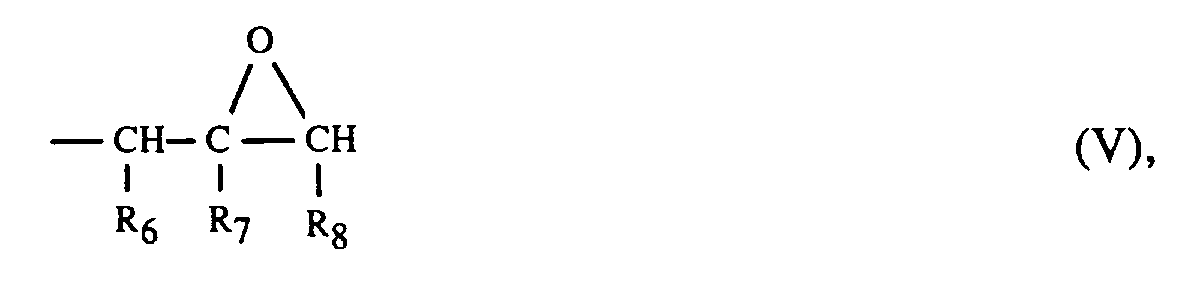
worin entweder R₆ und R₈ je ein Wasserstoffatom darstellen, in welchem Fall R₇ dann ein Wasserstoffatom oder eine Methylgruppe bedeutet, oder R₆ und R₈ zusammen - CH₂CH₂- oder -CH₂CH₂CH₂- darstellen, in welchem Fall R₇ dann ein Wasserstoffatom bedeutet, enthalten. - Als Beispiele solcher Harze seien Polyglycidyl- und Poly-(β-methylglycidyl)-ester genannt, die man durch Umsetzung einer zwei oder mehrere Carbonsäuregruppen pro Molekül enthaltenden Verbindung mit Epichlorhydrin, Glycerindichlorhydrin oder β-Methylepichlorhydrin in Gegenwart von Alkali erhalten kann. Solche Polyglycidylester können sich von aliphatischen Polycarbonsäuren, z.B. Oxalsäure, Bernsteinsäure, Glutarsäure, Adipinsäure, Pimelinsäure, Korksäure, Azelainsäure, Sebacinsäure oder dimerisierter oder trimerisierter Linolsäure, von cycloaliphatischen Polycarbonsäuren, wie Tetrahydrophthalsäure, 4-Methyltetrahydrophthalsäure, Hexahydrophthalsäure und 4-Methylhexahydrophthalsäure, und von aromatischen Polycarbonsäuren, wie Phthalsäure, Isophthalsäure und Terephthalsäure, ableiten.
- Weitere Beispiele sind Polyglyicidyl- und Poly-(β-methylglycidyl)-ether, die durch Umsetzung einer mindestens zwei freie alkoholische und/oder phenolische Hydroxylgruppen pro Molekül enthaltenden Verbindung mit dem entsprechenden Epichlorhydrin unter alkalischen Bedingungen, oder auch in Gegenwart eines sauren Katalysators mit nachfolgender Alkalibehandlung, erhältlich sind. Diese Ether lassen sich mit Poly-(epichlorhydrin) aus acyclischen Alkoholen wie Ethylenglykol, Diethylenglykol und höheren Poly-(oxyethylen)-glykolen, Propan-1,2-diol und Poly-(oxypropylen)-glykolen, Propan-1,3-diol, Butan-1,4-diol, Poly-(oxytetramethylen)-glykolen, Pentan-1,5-diol, Hexan-1,6-diol, Hexan-2,4,6-triol, Glycerin, 1,1,1-Trimethylolpropan, Pentaerythrit und Sorbit, aus cycloaliphatischen Alkoholen, wie Resorcit, Chinit, Bis-(4-hydroxycyclohexyl)-methan, 2,2-Bis-(4-hydroxycyclohexyl)-propan und 1,1-Bis-(hydroxymethyl)-cyclohexen-3, und aus Alkoholen mit aromatischen Kernen, wie N,N-Bis-(2-hydroxyethyl)-anilin und p,p'-Bis-(2-hydroxyethylamino)-diphenylmethan, herstellen. Man kann sie ferner aus einkernigen Phenolen, wie Resorcin und Hydrochinon, sowie mehrkernigen Phenolen, wie Bis-(4-hydroxyphenyl)-methan, 4,4-Dihydroxydiphenyl, Bis-(4-hydroxyphenyl)-sulfon, 1,1,2,2,-Tetrakis-(4-hydroxyphenyl)-ethan, 2,2-Bis-(4-hydroxyphenyl)-propan (sonst als Bisphenol A bekannt) und 2,2-Bis-(3,5-dibrom-4-hydroxyphenyl)-propan sowie aus Aldehyden, wie Formaldehyd, Acetaldehyd, Chloral und Furfurol, mit Phenolen, wie Phenol selbst und durch Chloratome oder Alkylgruppen mit jeweils bis zu neun Kohlenstoffatomen ringsubstituiertem Phenol, wie 4-Chlorphenol, 2-Methylphenol und 4-tert.-Butylphenol, gebildeten Novolaken herstellen.
- Poly-(N-glycidyl)-verbindungen umfassen beispielsweise Triglycidylisocyanurat sowie N,N'-Diglycidylderivate von cyclischen Alkylenharnstoffen, wie Aethylenharnstoff und 1,3-Propylenharnstoff, und Hydantoinen, wie 5,5-Dimethylhydantoin.
- Poly-(S-glycidyl)-verbindungen sind zum Beispiel die Di-S-glycidylderivate von Dithiolen, wie Aethan-1,2-dithiol und Bis-(4-mercaptomethylphenyl)-ether.
- Beispiele für Epoxidharze mit Gruppen der Formel V, worin R₆ und R₈ zusammen eine -CH₂-CH₂-Gruppe bedeuten, sind Bis-(2,3-epoxycyclopentyl)-ether, 2,3-Epoxycyclopentyl-glycidylether, 1,2-Bis-(2,3-epoxycyclopentyloxy)-ethan und 3,4-Epoxycyclohexylmethyl-2',4'-epoxycyclohexancarboxylat.
- In Betracht kommen auch Epoxidharze, in welchen die 1,2-Epoxidgruppen an Heteroatome verschiedener Art gebunden sind, z.B. das N,N,O-Triglycidylderivat des 4-Aminophenols, der Glycidylether/Glycidylester der Salicylsäure oder p-Hydroxybenzoesäure, N-Glycidyl-N'-(2-glycidyloxypropyl)-5,5-dimethylhydantoin und 2-Glycidyloxy-1,3-bis-(5,5-dimethyl-1-glycidylhydantoinyl-3)propan.
- Speziell bevorzugt werden aromatische Epoxidharze, wie Novolak-Epoxidharze oder Diglycidylether von Bisphenolen.
- Als Di- oder Polyisocyanatverbindung (b) enthalten die erfindungsgemässen Gemische vorzugsweise aliphatische, cycloaliphatische oder aromatische Isocyanate oder Mischungen davon.
- Bevorzugt werden Isomerengemische aus 4,4'- und 2,4'-Diisocyantodiphenylmethan, polyolmodifizierte Polyisocyanate und Gemische von flüssigen Polyisocyanaten oder von flüssigen Polyisocyanaten mit Carbodiimid-Polyisocyanaten eingesetzt.
- Weitere verwendbare Polyisocyanate sind beispielsweise Hexan-1,6-diisocyanat, Cyclohexan-1,3-diisocyanat und Isomere, 4,4'-Diisocyanatodicyclohexylmethan, 3-Isocyanatomethyl-2,5,5-trimethylcyclohexylisocyanat, 1,3-Dimethylbenzol-ω,ω'-diisocyanat und Isomere, 1-Methylbenzol-2,4-diisocyanat und Isomere, Naphthalin-1,4-diisocyanat, Diphenylether-4,4'-diisocyanat und Isomere, Diphenylsulfon-4,4'-diisocyanat und Isomere sowie tri- oder höherfunktionelle Isocyanate, wie beispielsweise 3,3',4,4'-Diphenylmethantetraisocyanat. Ferner können auch Isocyanate verwendet werden, die in üblicher Weise mit Phenol oder Kresol maskiert sind. Dimere und Trimere der genannten mehrwertigen Isocyanate sind ebenfalls einsetzbar. Derartige Polyisocyanate besitzen entständige freie Isocyanatgruppen und enthalten einen oder mehrere Uretdion-und/oder Isocyanuratringe. Verfahren zur Herstellung verschiedener Arten solcher Trimerer und Uretdione sind beispielsweise in den US-Patentschriften 3 494 888, 3 108 100 und 2 977 370 beschrieben.
- Vorzugsweise bedeutet A in den Formeln I und III ein C₁-C₁₂-Alkyl, bedeuten Ar, Ar₁ und Ar₂ in den Formeln I bis IV unabhängig voneinander je ein unsubstituiertes oder durch C₁-C₈-Alkyl, C₁-C₄-Alkoxy, Cl oder Br einfach oder mehrfach substituiertes Phenyl und steht Q⊖ für SbF₆⊖ oder SbF₅OH⊖, wie beispielsweise Dibenzylethylsulfoniumhexafluoroantimonat.
- Die erfindungsgemässen Gemische enthalten als Komponente (c) vorzugsweise ein Sulfoniumsalz der Formel I oder II mit der bevorzugten Bedeutung von A, Ar, Ar₁, Ar₂ und Q⊖.
- Besonders bevorzugte Sulfoniumsalze sind solche der Formel II, worin Ar, Ar₁ und Ar₂ unabhängig voneinander je ein unsubstituiertes oder durch C₁-C₈-Alkyl, C₁-C₄-Alkoxy, Cl oder Br substituiertes Phenyl bedeuten und Q⊖ für SbF₆⊖ oder SbF₅OH⊖ steht, wie insbesondere Tribenzylsulfoniumhexafluoroantimonat oder Tris-(p-methylbenzyl)-sulfoniumhexafluoroantimonat.
- Steht A in Formel I und III für ein C₁-C₁₂-Alkyl, so kann dieses geradkettig oder verzweigt sein. Beispielsweise kann A für ein Methyl, Ethyl, Isopropyl, n-Butyl, sek.-Butyl, tert.-Butyl, n-octyl oder n-Dodecyl stehen.
- Geeignete Cycloalkyle sind beispielsweise Cyclopropyl, Cyclopentyl, Cyclohexyl und Cyclooctyl.
- Als Cycloalkylalkyle seien beispielsweise Cyclohexylmethyl und Cyclohexylethyl genannt.
- Bedeuten A, Ar, Ar₁ und Ar₂ in den Formeln I bis IV ein substituiertes Phenyl bzw. Naphthyl, so können gleich oder verschieden substituiertes Phenyl oder Naphthyl vorliegen. Beispiele dafür sind p-Tolyl, Xylyl, Ethylphenyl, Methoxyphenyl, Ethoxyphenyl, p-Chlorphenyl, 2,4-, 3,4- oder 2,6-Dichlorphenyl, Bromphenyl, Acetylphenyl, Trimethylphenyl, Methylnapthyl, Methoxynaphthyl, Ethoxynaphthyl, Chlornaphthyl, Bromnaphthyl und Biphenyl.
- Bedeutet Arylen in den Formeln III und IV ein substituiertes Phenylen oder Naphthylen, so können als solche beispielsweise Methylphenylen, Ethylphenylen, Methoxyphenylen, Ethoxyphenylen, Chlorphenylen, Dichlonphenylen, Bromphenylen, Acetylphenylen, Trimethylphenylen, Methylnapthylen, Methoxynaphthylen, Ethoxynaphthylen, Chlornaphthylen oder Bromnaphthylen stehen. Vorzugsweise bedeutet Arylen ein unsubstituiertes Phenylen oder Naphthylen.
- Die in den erfindungsgemässen Gemischen enthaltenen Sulfoniumsalze der Formeln I und II können nach einem der in Houben-Weyl, Methoden der organischen Chemie, Band IX, Seiten 171 ff (1955), sowie Ergänzungsband E 11, Seiten 405 ff (1985), offenbarten Verfahren hergestellt werden, indem man beispielsweise ein Sulfid der Formel VI
Ar-CH₂-S-CH₂-Ar₁ (VI),
worin Ar und Ar₁ die gleiche Bedeutung wie in Formel I oder II haben, entweder (a) mit molaren Mengen eines Oxoniumsalzes der Formel VII
worin A die gleiche Bedeutung wie in Formel I hat und Z⊖ für Q⊖, SbCl₆⊖, BF₄#SDF# oder PF₆⊖ steht, zu Verbindungen der Formel I oder der Formel Ia
umsetzt, worin Za⊖ für SbCl₆⊖, BF₄⊖ oder PF₆⊖ steht, und anschliessend die Verbindungen der Formel Ia durch Anionenaustausch mit einem Alkalimetallsalz oder einem quaternären Ammoniumsalz der Formel VIII
Y⊕Q⊖ (VIII),
worin Y für ein Alkalimetallkation oder N(R₄)⊕ steht, wobei R ein Wasserstoff oder ein C₁-C₄-Alkyl bedeutet, und Q⊖ die gleiche Bedeutung wie in Formel I hat, zu einer Verbindung der Formel I umsetzt, oder
(b) in Gegenwart einer starken Säure mit mindestens einer molaren Menge eines Alkohols der Formel IX
Ar₂-CH₂-OH (IX),
worin Ar₂ die gleiche Bedeutung wie in Formel II hat, zu einem Sulfoniumsalz dieser Säure der Formel IIa
umsetzt und anschliessend das Sulfoniumsalz der Formel IIa mit einem Alkalisalz oder einem quaternären Ammoniumsalz der Formel VIII zu einer Verbindung der Formel II umsetzt. - In analoger Weise können die erfindungsgemässen Verbindungen der Formeln III und IV hergestellt werden, indem man beispielsweise 1 Mol einer Verbindung der Formel X
Ar-CH₂-S-CH₂-Arylen-CH₂-S-CH₂-Ar₁ (X),
worin Ar und Ar₁ die gleiche Bedeutung wie in Formel III oder IV haben, entweder (a) mit 2 Mol eines Oxoniumsalzes der Formel VI zu Verbindungen der Formel III oder der Formel IIIa
umsetzt, worin Za⊖ für SbCl₆⊖, BF₄⊖ oder PF₆⊖ steht, und anschliessend die Verbindung der Formel IIIa durch Anionenaustausch mit einem Alkalimetallsalz oder einem quaternären Ammoniumsalz der Formel VIII zu einer Verbindung der Formel III umsetzt, oder
(b) in Gegenwart einer starken Säure mit 2 Mol eines Alkohols der Formel VIII zu einem Disulfoniumsalz dieser Säure der Formel IVa
umsetzt und anschliessend das Disulfoniumsalz der Formel IVa mit einem Alkalisalz oder einem quaternären Ammoniumsalz der Formel VIII zu einer Verbindung der Formel IV umsetzt. - Die Verbindungen der Formeln VI, VII, VIII, IX und X stellen bekannte Verbindungen dar, die zum Teil im Handel erhältlich sind.
- Beispielsweise werden Sulfide der Formel VI in Houben-Weyl, Band 9, Seite 93 (1955), oder Band E 11, Seite 158 (1985) beschrieben oder sind im Handel von den Firmen Fluka und Aldrich erhältlich.
- Oxoniumsalze der Formel VII sind zum Beispiel aus Houben-Weyl, Band 6/3, Seite 328 (1965), oder aus dem US-Patent 3 585 227 bekannt.
- Alkalimetallsalze oder quaternäre Ammoniumsalze der Formel VIII, wie beispielsweise NaSbF₆, NaAsF₆ oder NH₆AsF₆, sind im Handel z.B. von der Firma Morton Thiokol erhältlich. Desgleichen sind Alkohole der Formel IX, wie beispielsweise Benzylalkohol oder chlorierte Benzylalkohole, im Handel erhältlich.
- Verbindungen der Formel X können in bekannter Weise hergestellt werden, indem man beispielsweise 1 Mol eines unsubstituierten oder substituierten α,α'-Dihalogenmethylarylens der Formel XI
Hal-CH₂-Arylen-CH₂-Hal (XI)
in Gegenwart von Alkalilauge mit 2 Mol eines unsubstituierten oder substituierten Mercaptans der Formel XII
Ar-CH₂-SH bzw. Ar₁-CH₂-SH (XII)
zu Verbindungen der Formel X umsetzt. - Verbindungen der Formel I oder III, worin A für den Rest der Formel XIII

steht, worin R' und R'' unabhängig voneinander je ein Wasserstoffatom oder zusammen mit dem Ethylenrest ein bis zu 12 C-Atome enthaltendes Alkyl oder ein bis zu 8 C-Atome enthaltendes Cycloalkyl bedeuten, können ferner hergestellt werden, indem ein Sulfid der Formel VI in Gegenwart einer starken Säure mit mindestens einer molaren Menge eines Olefins der Formel XIV
R'-CH = CH-R'' (XIV)
zu einem Sulfoniumsalz der Formel XV bzw. XVI

umsetzt und anschliessend das Sulfoniumsalz der Formel XV bzw. XVI mit einem Alkalisalz oder einem quaternären Ammoniumsalz der Formel VIII zu einer Verbindung der Formel I bzw. III, worin A den Rest der Formel XIII bedeutet, umsetzt. - Als Olefine der Formel XIV verwendet man beispielsweise Ethylen, Propylen, Buten-(1), Buten-(2), Isobutylen, Penten-(1), Penten-(2), Cyclobuten, Cyclopenten oder Cyclohexen und als starke Säuren beispielsweise H₂SO₄, HPF₆, HBF₄, HClO₄ oder CF₃SO₃H.
- Die erfindungsgemässen heisshärtbaren Gemische enthalten die Komponenten (a) und (b) vorzugsweise in solchen Mengen, dass im Gemisch ein Aequivalentverhältnis der Epoxid-zu den Isocyanatgruppen von 0,3 bis 2,5, insbesondere ein solches von 0,4 bis 1, vorliegt.
- In den erfindungsgemässen Gemischen wird das Härtungsmittel (c) vorzugsweise in Mengen von 0,1 bis 5 Gew.-%, insbesondere von 0,1 bis 2,5 Gew.-%, bezogen auf die Menge der Komponenten (a) und (b), eingesetzt.
- Die erfindungsgemässen heisshärtbaren Gemische lassen sich in beliebiger Form erhalten, z.B. als homogene flüssige Gemische oder in homogener oder inhomogener glasiger Form. Homogene glasige Produkte können in an sich bekannter Weise zum Beispiel durch Verflüssigung der festen Komponenten (a) und (b), gegebenenfalls unter Zusatz geeigneter Lösungsmittel, Erhitzen auf Temperaturen über ihren Glasumwandlungspunkt, Zugabe des Härtungsmittels gemäss Formel I oder IV und Abkühlung der entstandenen Gemische erhalten werden.
- Die erfindungsgemässen heisshärtbaren Gemische können auch weitere, bekannte und üblicherweise in der Technik polymerisierbarer Materialien eingesetzte Zusatzstoffe enthalten. Beispiele für solche Zusatzstoffe sind Pigmente, Farbstoffe, Füllstoffe und Verstärkungsmittel, Flammhemmstoffe, Antistatika, Haftvermittler, Verlaufmittel, Antioxidantien und Lichtschutzmittel. Als Füllstoffe eignen sich mineralische und faserförmige Füllstoffe, wie Quarzmehl, Quarzgut, Aluminiumoxid, Glaspulver, Glimmer, Kaolin, Dolomit, Graphit, Russ, sowie Kohlefasern und Textilfasern. Bevorzugte Füllstoffe sind Quarzmehl, Quarzgut, Aluminiumoxid oder Dolomit.
- Die erfindungsgemässen heisshärtbaren Gemische lassen sich ganz allgemein zur Herstellung von gehärteten Produkten einsetzen und können in der dem jeweils speziellen Anwendungsgebiet angepassten Formulierung, beispielsweise als Beschichtungsmasssen, Lacke, Pressmassen, Tauchharze, Giessharze, Imprägnierharze, Laminierharze, 1-oder 2-Komponenten-Klebstoffe oder Matrixarze, eingesetzt werden.
- Zur Aushärtung der erfindungsgemässen Gemische wendet man im allgemeinen Temperaturen im Bereich von 60 bis 250°C, vorzugsweise 60 bis 220°C, insbesondere 80 bis 200°C, an.
- Man kann an den erfindungsgemässen Gemischen auch erst eine Vorhärtung bei tieferen Temperaturen bis zum Gelieren der härtbaren Zusammensetzung durchführen, an die sich dann eine Aushärtung bei höheren Temperaturen anschliesst.
- Die aus den erfindungsgemässen Gemischen durch thermische Härtung erhaltenen Produkte zeichnen sich vor allem durch eine hohe Wärmeformbeständigkeit aus.
- Ein weiterer Gegenstand der Erfindung sind somit auch die durch thermische Härtung der erfindungsgemässen Gemische erhaltenen Produkte, die feste, unlösliche und unschmelzbare, dreidimensional vernetzte Produkte darstellen. Die Aushärtung erfolgt in der Regel unter gleichzeitiger Formgebung zu Formköpern, Imprägnierungen, Beschichtungen oder Verklebungen.
-
a) In ein Reaktionsgefäss, versehen mit Rührer und Thermometer, gibt man die Lösung von 269,0 g (1,12 Mol) Natriumsulfid-hydrat und 12,0 g Tetrabutylammoniumhydrogensulfat (Phasentransferkatalysator) in 300 ml Wasser. Unter intensivem Rühren werden unterhalb von 40°C 212,6 g (1,52 Mol) 4-Methylbenzylchlorid innerhalb 30 Minuten (Min.) zugetropft. Das Reaktionsgemisch wird 4 1/2 Stunden (h) bei Raumtemperatur (RT) und anschliessend 1/2 h bei 50-60°C gerührt. Das Reaktionsgemisch wird auf 0-5°C abgekühlt und 1/2 h bei dieser Temperatur gehalten. Das Reaktionsgemisch wird filtriert, und der Rückstand in etwa 2 Liter Essigsäureethylester gelöst. Die organische Phase wird 2 mal mit deionisiertem Wasser ausgeschüttelt (pH ∼6) und über MgSO₄ getrocknet. Man entfernt den Essigsäureethylester am Rotationsverdampfer. Der Rückstand wird am Hochvakuum über Nacht bei RT getrocknet. Man erhält 174,8 g (95 % der Theorie) Di-(p-methylbenzyl)-sulfid als leicht gelblich weisse Kristalle mit einem Smp. von 74-76°C.Elementaranalyse für C₁₆H₁₈S: Berechnet: (%) C = 79,29 H = 7,49 S = 13,23 Bestimmt : (%) C = 79,16 H = 7,3 S = 13,47.
2,33 (Singulett, 6 H); 3,56 (Singulett, 4 H); 7,15 (Singulett, 8 H).
b) In einem Reaktionsgefäss (750 ml), versehen mit Rührer und Thermometer, werden unter N₂-Atmosphäre 85,1 g (0,351 Mol) Di-(p-methylbenzyl)-sulfid und 51,5 g (0,421 Mol) p-Methylbenzylalkohol in 250 ml Methylenchlorid vorgelegt. Unter Rühren tropft man innerhalb von 40 Min. 142,7 g einer etwa 54 gew.-%igen HBF₄-Lösung in Diethylether bei 20-30°C Innentemperatur zu. Das Reaktionsgemisch wird bei RT während 2 h gerührt. Das Reaktionsgemisch wird mit Methylenchlorid verdünnt, und 4 mal mit deionisiertem Wasser ausgeschüttelt (pH 5-6). Man trocknet die organische Phase mit MgSO₄ und entfernt das Methylenchlorid am Rotationsverdampfer. Das nicht vollständig vom Methylenchlorid befreite Produkt wird in 250 ml Toluol während etwa 1 h bei RT und anschliessend 1 h bei 0-5°C verrührt. Die nun ausgefallenen Kristalle werden abgenutscht und mit wenig Toluol nachgewaschen. Das Produkt wird am Hochvakuum bei Raumtemperatur während 19 h getrocknet. Man erhält 118,6 g Tris-(p-methylbenzyl)-sulfoniumtetrafluoroborat als weisse Kristalle mit einem Smp. von 168-170°C.
¹H-NMR (100 MHz, d₆-Aceton) in ppm:
2,33 (Singulett, 9 H); 4,83 (Singulett, 6 H); 7,25 (Quartett, 12 H).
c) Die Mischung aus 100 g (230 mMol) Tris-(p-methylbenzyl)-sulfoniumtetrafluoroborat in 500 ml Methylenchlorid wird bei RT unter N₂-Atmosphäre in einem 3-Liter Rundkolben gelöst und dann werden 119,0 g (460 mMol) Natriumhexafluoroantimonat zugegeben. Die Mischung wird während 3 h bei RT gerührt und dann filtriert. Das Filtrat wird am Rotationsverdampfer vom Lösungsmittel befreit und das zurückbleibende, zähflüssige Oel über Nacht bei Raumtemperatur stehen gelassen. Das kristallisierte Produkt wird während 2 h bei RT verrührt, erneut filtriert und am Hochvakuum trockengesaugt.
Nach dem Umkristallisieren in Isopropanol erhält man 117,1 g (87 % der Theorie) Tris-(p-methylbenzyl)-sulfoniumhexafluoroantimonat als weisse Kristalle mit einem Smp. von 88-91°C.Elementaranalyse für C₁₆H₁₈S: Berechnet: (%) C = 49,29 H = 4,67 S = 5,5 Bestimmt : (%) C = 99,8 H = 4,6 S = 6,4.
2,34 (Singulett, 9 H); 4,85 (Singulett, 6 H); 7,25 (Quartett, 12 H). -
a) In einem 750 ml Reaktionsgefäss, versehen mit Rührer, Thermometer und Tropftrichter, werden 21,4 g (0,1 Mol) Dibenzylsulfid und 10,8 g (0,1 Mol) Benzylalkohol in 300 ml Essigsäure vorgelegt.
Unter Rühren tropft man 20 ml konzentrierte Schwefelsäure innerhalb von 5 Minuten (Min.) zu. Anschliessend erwärmt man das Reaktionsgemisch mit einem Oelbad auf 70°C Innentemperatur und rührt während 2 h. Die Hauptmenge Essigsäure wird abdestilliert und der Rückstand auf 200 ml Wasser gegossen. Man belässt die Suspension 1/2 h bei 0-5°, filtriert und trocknet den kristallinen Rückstand im Vakuum bei RT. Es verbleiben 36,5 g (91 % der Theorie) Tribenzylsulfoniumhydrogensulfat als farblose Kristalle mit einem Smp. 170°C (Zersetzung).
b) 16,64 g (0,041 Mol) Tribenzylsulfoniumhydrogensulfat werden in 750 ml Methanol warm gelöst. Zur trüben Lösung gibt man 16,04 g (0,062 Mol) festes Natriumhexafluoroantimonat und rührt 1 h bei RT. Nach Zugabe von 1 Spatel Aktivkohle wird filtriert und das klare Filtrat mit 750 ml Wasser versetzt. Die ausgefallenen Kristalle werden abfiltriert, getrocknet, mit 100 ml Ether gewaschen und nochmals getrocknet. Man gewinnt 16,41 g (74 % der Theorie) Tribenzylsulfoniumhexafluoroantimonat als farblose Kristalle mit einem Smp. vom 170°C (Zersetzung).Elementaranalyse für C₂₁H₂₁SSbF₆: Berechnet: (%) C = 46,61 H = 3,91 S = 5,92. Gefunden : (%) C = 47,44 H = 3,99 S = 6,09.
4,78 (Singulett, 6 H); 7,32 (Singlettoid, 15 H). -
a) In ein Reaktionsgefäss, versehen mit Rührer und Thermometer gibt man die Lösung von 75,0 g (0,374 Mol) Benzylphenylsulfid, 60,73 g (0,561 Mol) Benzylalkohol und 350 ml Methylenchlorid. Unter Rühren tropft man innerhalb von 35 Min. 182,45 g (1,12 Mol) 54 gew.-%ige HBF₄ in Diethylether bei einer Innentemperatur von 20-30°C zu. Das Reaktionsgemisch wird anschliessend bei RT 2 h gerührt. Man verdünnt das Reaktionsgemisch mit 300-400 ml Methylenchlorid und extrahiert 4 mal mit Wasser (pH ∼6). Anschliessend trocknet man die organische Phase über MgSO₄ und entfernt am Rotationsverdampfer das Lösungsmittel. Das zurückgebliebene gelbbraune Oel wird in 400 ml Toluol verrührt, und bei 0-5°C etwa 1 h kristallisieren gelassen. Man filtriert die Suspension und wäscht den Rückstand mit wenig, gekühltem Toluol (0-5°C) nach. Das reine Produkt wird am Hochvakuum bei RT über Nacht getrocknet. Man erhält 123,8 g (87 % der Theorie) Dibenzylphenylsulfoniumtetrafluoroborat als weisse Kristalle mit einem Smp. von 110-115°C.
¹H-NMR (in d₆-Aceton, 100 MHz) in ppm:
5,30 (Quartett, 4 H); 7,22-8,02 (Multiplett, 15 H).
b) Die Mischung aus 123,0 g (0,325 Mol) Dibenzylsulfoniumtetrafluoroborat in 400 ml Methylenchlorid wird in einem 2 Liter Rundkolben bei RT unter N₂ klar gelöst. Anschliessend werden 117,8 g Natriumhexafluoroantimonat zugegeben und bei RT während 3 1/2 h gerührt. Man filtriert nun die Suspension über Kieselgel und entfernt vom Filtrat das Lösungsmittel mit dem Rotationsverdampfer. Den leicht rötlichen viskosen Rückstand löst man erneut in 250 ml Methanol und nach der Zugabe von 250 ml Wasser lässt man das Produkt 1-2 h bei RT kristallisieren. Die Suspension wird filtriert und man wäscht den Rückstand mit Wasser nach. Anschliessend trocknet man das Produkt am Hochvakuum bei RT über Nacht. Man erhält 163,9 g (95 % der Theorie) Dibenzylphenylsulfoniumhexafluoroantimonat als weisse Kristalle mit einem Smp. von 105-109°C.Elementaranalyse Berechnet: (%) C = 45,6 H = 3,63 S = 6,08 Sb = 23,09 F = 21,62 Gefunden : (%) C = 46,5 H = 3,7 S = 6,1 Sb = 22,4 F = 20,6.
5,37 (Quartett, 4 H); 7,25-8,04 (Multiplett, 15 H). -
a) Man setzt 5,66 g (20 mMol) Di-(4-chlorbenzyl)-sulfid mit 2,6 g (24 mMol) Benzylalkohol und 8,13 g (50 mMol) 54 gew.-%iger HBF₄ in 20 ml Methylenchlorid wie in Beispiel 3a) angegeben ist um. Man erhält 7,44 g (80 % der Theorie) Di-(4-chlorbenzyl)-benzylsulfoniumtetrafluoroborat als weisse Kristalle mit einem Smp. von 123-125°C.
¹H-NMR (100 MHz, CDCl₃) in ppm:
4,71 (Singulett, 6 H); 7,27 (Dublett, 12 H).
b) Eine Mischung aus 7,0 g (15,2 mMol) Di-(4-chlorbenzyl)-phenylsulfoniumtetrafluoroborat und 25 ml Methylenchlorid wird unter N₂ in einem 100 ml Rundkolben klar gelöst und auf 0-5°C abgekühlt. Bei dieser Temperatur werden 5,9 g (22,8 mMol) Natriumhexafluoroantimonat zugegeben und etwa 3 h lang gerührt. Das Reaktionsgemisch wird filtriert und das Filtrat am Rotationsverdampfer vom Lösungsmittel befreit. Man gibt nun zum Rückstand 50 ml deionisiertes Wasser und kristallisiert das Produkt aus. Man lässt es 1-2 h bei 0-5°C kristallisieren. Die nun durch eine Filtration gewonnenen Kristalle werden mit Wasser gewaschen und am Hochvakuum bei RT über Nacht getrocknet. Man erhält 8,26 g Di-(4-chlorbenzyl)-benzylsulfoniumhexafluoroantimonat als weisse Kristalle mit einem Smp. von 75-77°C.Elementaranalyse Berechnet: (%) C = 41,34 H = 3,14 S = 5,26 Cl = 11,62 Gefunden: (%) C = 41,24 H = 3,15 S = 5,08 Cl = 12,37.
5,0 (Multiplett, 6 H); 7,44 (Multiplett, 13 H). -
a) In einem Reaktionsgefäss (350 ml), versehen mit Rührer und Thermometer, werden unter N₂-Atmosphäre 53,6 g (0,25 Mol) Dibenzylsulfid und 23,33 g (0,28 Mol) Cyclohexen in 100 ml Methylenchlorid gelöst. Unter Rühren tropft man innerhalb einer Stunde 48,8 g einer etwa 54 gew.-%igen HBF₄-Lösung in Diethylether bei 20 - 30°C Innentemperatur zu. Das orange gefärbte Reaktionsgemisch wird 1 h bei RT gerührt, es werden 10 ml Cyclohexen nachgegeben und 2 h weitergerührt, nochmals 10 ml Cyclohexen und 1 ml HBF₄-Lösung nachgegeben und weitere 2 h bei RT gerührt.
Man verdünnt die Reaktionslösung mit 100 ml Methylenchlorid und schüttelt 3 mal mit deionisiertem Wasser aus (pH 5 - 6). Die organische Phase trocknet man über Magnesiumsulfat, filtriert und entfernt das Lösungsmittel am Rotationsverdampfer. Zum Rückstand (90,3 g / 94% Rohausbeute) gibt man 200 ml Cyclohexan und verrührt das Gemisch bei RT. Es bildet sich ein farbloser Niederschlag, der nach Abfiltrieren und Trocknen im Vakuum bei RT farblose Kristalle vom Smp. 95 - 100°C ergibt. Man erhält 61,45 g (64 % Ausbeute) Dibenzylcyclohexylsulfoniumtetrafluoroborat.
¹H-NMR (100 MHz, d₆-Aceton) in ppm:
1,1 - 2,3 (Multiplett + d₆-Aceton); 3,3 - 4,2 (Multiplett, 1 H); 4,7 - 5,2 (Multiplett, 4 H); 7,2 - 7,8 (Multiplett, 10 H).
b) 61,2 g (0,16 Mol) Dibenzylcyclohexylsulfoniumtetrafluoroborat werden in 250 ml Methylenchlorid unter N₂-Schutzgas gelöst und mit 61,9 g (0,24 Mol) Natriumhexafluoroantimonat versetzt. Man rührt 2,5 h bei RT und filtriert anschliessend vom gebildeten Natriumtetrafluoroborat ab. Das Filtrat wird 2 mal mit deionisiertem Wasser ausgeschüttelt, über Magnesiumsulfat getrocknet und abrotiert. Der feste Rückstand (89,19 g / 104 % Rohausbeute) wird aus 500 ml Methanol heiss umkristallisiert und ergibt nach dem Trocknen im Vakuum bei RT farblose Kristalle vom Smp. 111-115°C. Man erhält 53,9 g (63 % Ausbeute) Dibenzylcyclohexylsulfoniumhexafluoroantimonat.Elementaranalyse für C₂₀H₂₅SSbF₆: Berechnet (%) C = 45,05 H = 4,73 S = 6,01 Gefunden (%) C = 45,13 H = 4,51 S = 6,27
1,2 - 2,4 (Multiplett, 10 H); 3,56 (Multiplett, 1 H); 4,28 - 4,67 (Quartett, 4 H); 7,35 (Singulett, 10 H). - Beispiel 1: Das Harzgemisch, bestehend aus 200 g Bisphenol F-diglycidylether mit einem Epoxidgehalt von 6,1 Aequivalenten/kg und einer Viskosität von 1200 mPa·s bei 25°C, 90 g Diisocyanatodiphenylmethan, präpolymerisiert, mit einem Isocyanatgehalt von 6,05 Aequivalenten/kg und einer Viskosität von 120 mPa·s bei 25°C (erhältlich unter der Handelsbezeichnung ISONATE ®M 340 von der Firma DOW) und 90 g Diisocyanatodiphenylmethan mit einem Isocyanatgehalt von 7,92 Aequivalenten/kg und einer Viskosität von 12 mPa·s bei 25°C (erhältlich unter der Handelsbezeichnung BAYMIDUR® KU 3-5002 von der Firma BAYER), wird bei Raumtemperatur mit 686 g Quarzmehl W 12 (Handelsprodukt der Firma Quarzwerke Frechen), welches auf 120°C vorgewärmt ist, vermengt und über Nacht bei etwa 80°C unter Rühren im Vakuum bei 1,3-2,6 mbar entgast. Zu dieser Vormischung werden 4 g Tris-(p-methylbenzyl)-sultoniumhexafluoroantimonat eingerührt und das Gemisch nochmals unter Vakuum während 30 Minuten weitergerührt. Die erhaltene homogene, etwa 80°C warme Giessharzmischung wird in auf 80°C vorgewärmte Metallformen gegossen und in einem Umluftofen bei 150°C innerhalb 4 Stunden soweit gehärtet, dass eine Entformung der Prüfkörper leicht möglich ist. Die Nachhärtung der Prüfkörper erfolgt 16 Stunden bei 200°C. Die erhaltenen Prüfkörper weisen folgende Eigenschaften auf:
Gelierzeit bei 140°C (Minuten, Sekunden) = 4′50˝ Biegefestigkeit gemäss ISO 178 (N/mm²) = 117,8 Randfaserdehnung gemäss ISO 178 (%) = 1,08 Schlagbiegefestigkeit gemäss ISO R 179 (J/m²) = 7,4 Wärmeformbeständigkeit gemäss ISO 75 (°C) = > 250 Torsionsmodulabfall gemäss ISO R 537, angegeben als Wendepunkt in °C = 218 - Beispiele 2 und 3: Beispiel 1 wird wiederholt und anstelle von Tris-(p-methylbenzyl)-sulfoniumhexafluoroantimonat werden als Härtungsmittel nun 6 g Tribenzylsulfoniumhexafluoroantimonat (Beispiel 2) bzw. 2,5 g Dibenzylphenylsulfoniumhexafluoroantimonat (Beispiel 3) eingesetzt. Nach Härtung der Gemische gemäss Beispiel 1 erhält man Prüfkörper mit den folgenden Eigenschaften.
Beispiel 2 Beispiel 3 Gelierzeit bei 140°C (Minuten, Sekunden) 5′51˝ 4′50˝ Biegefestigkeit gemäss ISO 178 (N/mm²) 128,5 129,3 Randfaserdehnung gemäss ISO 178 (%) 1,13 1,14 Schlagbiegefestigkeit gemäss ISO R 179 (J/m²) 6,4 8,0 Brennbarkeit gemäss UL 94 nach Lagerung der Prüfkörper 2 Tage bei 23°C HB *) HB und 7 Tage bei 70°C HB HB Wärmeformbeständigkeit gemäss ISO 75 (°C) > 250 > 250 *) Stufe HB = horizontal burning - Beispiele 4 und 5: Beispiel 1 wird wiederholt und anstelle von Tris-(p-methylbenzyl)-sulfoniumhexafluoroantimonat werden als Härtungsmittel nun 3,8 g Di-(4-chlorbenzyl)-benzylsulfoniumhexafluoroantimonat (Beispiel 4) bzw. 3,8 g Dibenzylcyclohexylsulfoniumhexafluoroantimonat (Beispiel 5) eingesetzt. Nach Härtung der Gemische gemäss Beispiel 1 erhält man Prüfkörper mit folgenden Eigenschaften.
Beispiel 4 Beispiel 5 Gelierzeit bei 140°C (Minuten) 18′ 32′ Biegefestigkeit gemäss ISO 178 (N/mm²) 123,8 117,8 Randfaserdehnung gemäss ISO 178 (%) 1,20 1,07 Brennbarkeit gemäss UL 94 nach Lagerung der Prüfkörper 2 Tage bei 23°C HB *) HB und 7 Tage bei 70°C HB HB Wärmeformbeständigkeit gemäss ISO 75 (°C) 238 239 *) Stufe HB = horizontal burning
Claims (10)
- Heisshärtbare Gemische, enthaltend(a) ein Epoxidharz mit durchschnittlich mehr als einer 1,2-Epoxidgruppe im Molekül,(b) eine Di- oder Polyisocyanatverbindung und(c) ein Sulfoniumsalz der Formeln I bis IV

- Gemische gemäss Anspruch 1, worin das Epoxidharz (a) eine aliphatische, cycloaliphatische oder aromatische Di- oder Polyepoxidverbindung darstellt.
- Gemische gemäss Anspruch 1, worin das Epoxidharz (a) ein aromatisches Epoxidharz ist.
- Gemische gemäss Anspruch 1, worin die Di- oder Polyisocyanatverbindung (b) ein aliphatisches, cycloaliphatisches oder aromatisches Isocyanat darstellt.
- Gemische gemäss Anspruch 1, worin die Di- oder Polyisocyanatverbindung (b) ein Isomerengemisch aus 4,4'- und 2,4'-Diisocyanatodiphenylmethan, polyolmodifiziertes Polyisocyanat, ein Gemisch von flüssigen Polyisocyanaten oder von flüssigen Polyisocyanaten mit Carbodiimid-Polyisocyanaten darstellt.
- Gemische gemäss Anspruch 1, worin die Komponente (c) ein Sulfoniumsalz der Formel I oder II darstellt.
- Gemische gemäss Anspruch 1, worin die Komponente (c) ein Sulfoniumsalz der Formel I oder II ist, worin A ein C₁-C₁₂-Alkyl bedeutet, Ar, Ar₁ und Ar₂ unabhängig voneinander je ein unsubstituiertes oder durch C₁-C₈-Alkyl, C₁-C₄-Alkoxy, Cl oder Br einfach oder mehrfach substituiertes Phenyl bedeuten und Q⊖ für SbF₆⊖ oder SbF₅OH⊖ steht.
- Gemische gemäss Anspruch 1, worin die Komponente (c) ein Sulfoniumsalz der Formel II ist, worin Ar, Ar₁ und Ar₂ unabhängig voneinander je ein unsubstituiertes oder durch C₁-C₈-Alkyl, C₁-C₄-Alkoxy, Cl oder Br substituiertes Phenyl bedeuten und Q⊖ für SbF₆⊖ oder SbF₅OH⊖ steht.
- Gemische gemäss Anspruch 1, enthaltend als Komponente (c) Tris-(p-methylbenzyl)-sulfoniumhexafluoroantimonat, Tribenzylsulfoniumhexafluoroanumonat oder Dibenzylphenylsulfoniumhexafluoroantimonat.
- Die durch thermische Härtung der Gemische gemäss Anspruch 1 erhaltenen Produkte.
Applications Claiming Priority (2)
| Application Number | Priority Date | Filing Date | Title |
|---|---|---|---|
| CH3788/89 | 1989-10-18 | ||
| CH378889 | 1989-10-18 |
Publications (3)
| Publication Number | Publication Date |
|---|---|
| EP0424314A2 EP0424314A2 (de) | 1991-04-24 |
| EP0424314A3 EP0424314A3 (en) | 1992-04-15 |
| EP0424314B1 true EP0424314B1 (de) | 1994-12-07 |
Family
ID=4263485
Family Applications (1)
| Application Number | Title | Priority Date | Filing Date |
|---|---|---|---|
| EP90810773A Expired - Lifetime EP0424314B1 (de) | 1989-10-18 | 1990-10-09 | Heisshärtbare Gemische |
Country Status (7)
| Country | Link |
|---|---|
| US (1) | US5149767A (de) |
| EP (1) | EP0424314B1 (de) |
| JP (1) | JP2943008B2 (de) |
| KR (1) | KR910008065A (de) |
| CA (1) | CA2027768C (de) |
| DE (1) | DE59007932D1 (de) |
| ZA (1) | ZA908279B (de) |
Families Citing this family (2)
| Publication number | Priority date | Publication date | Assignee | Title |
|---|---|---|---|---|
| JP3626302B2 (ja) * | 1996-12-10 | 2005-03-09 | Jsr株式会社 | 光硬化性樹脂組成物 |
| BRPI0600782A (pt) * | 2006-02-24 | 2007-11-20 | Phb Ind Sa | composição para preparo de poliol poliéster degradável, processo para obtenção de poliol poliéster, de elastÈmero, de espumas, de tintas e de adesivos, e espuma degradável de um poliol poliéster |
Citations (1)
| Publication number | Priority date | Publication date | Assignee | Title |
|---|---|---|---|---|
| EP0130454A2 (de) * | 1983-06-27 | 1985-01-09 | Siemens Aktiengesellschaft | Verfahren zur Herstellung von Reaktionsharzformstoffen |
Family Cites Families (11)
| Publication number | Priority date | Publication date | Assignee | Title |
|---|---|---|---|---|
| US4038232A (en) * | 1972-12-19 | 1977-07-26 | Ppg Industries, Inc. | Electrodepositable compositions containing sulfonium resins and capped polyisocyanates |
| US3935087A (en) * | 1972-12-22 | 1976-01-27 | Ppg Industries, Inc. | Method for electrodeposition of self-crosslinking cationic compositions |
| CA1063295A (en) * | 1975-03-21 | 1979-09-25 | Joseph F. Bosso | N-heterocyclic-containing quaternary and ternary onium salt resins for cationic electrodeposition |
| US4390644A (en) * | 1981-05-18 | 1983-06-28 | The Dow Chemical Company | Isocyanurate foams using a sulfonium zwitterion/metal carbonylate mixture as catalyst |
| DE3323084A1 (de) * | 1983-06-27 | 1985-01-10 | Siemens AG, 1000 Berlin und 8000 München | Verfahren zur herstellung von formstoffen |
| DE3600764A1 (de) * | 1986-01-14 | 1987-07-16 | Bayer Ag | Waermehaertbare reaktionsharzgemische und ein verfahren zur herstellung von formkoerpern unter verwendung dieser gemische |
| US4740539A (en) * | 1986-04-21 | 1988-04-26 | Ashland Oil, Inc. | Flexible two-component epoxy structural adhesives |
| US4906722A (en) * | 1987-12-02 | 1990-03-06 | Ciba-Geigy Corporation | Thermosetting reactive systems |
| EP0379464B1 (de) * | 1989-01-16 | 1993-02-10 | Ciba-Geigy Ag | Araliphatische Sulfoniumsalze und deren Verwendung |
| JP2709625B2 (ja) | 1989-06-14 | 1998-02-04 | 三新化学工業株式会社 | カチオン重合触媒および重合性組成物、その重合方法 |
| JP2592686B2 (ja) | 1989-10-31 | 1997-03-19 | 三新化学工業株式会社 | ジベンジルスルホニウム化合物 |
-
1990
- 1990-10-09 DE DE59007932T patent/DE59007932D1/de not_active Expired - Fee Related
- 1990-10-09 EP EP90810773A patent/EP0424314B1/de not_active Expired - Lifetime
- 1990-10-11 US US07/595,918 patent/US5149767A/en not_active Expired - Fee Related
- 1990-10-16 CA CA002027768A patent/CA2027768C/en not_active Expired - Fee Related
- 1990-10-17 ZA ZA908279A patent/ZA908279B/xx unknown
- 1990-10-17 KR KR1019900016552A patent/KR910008065A/ko not_active Withdrawn
- 1990-10-18 JP JP2281681A patent/JP2943008B2/ja not_active Expired - Fee Related
Patent Citations (1)
| Publication number | Priority date | Publication date | Assignee | Title |
|---|---|---|---|---|
| EP0130454A2 (de) * | 1983-06-27 | 1985-01-09 | Siemens Aktiengesellschaft | Verfahren zur Herstellung von Reaktionsharzformstoffen |
Also Published As
| Publication number | Publication date |
|---|---|
| CA2027768C (en) | 2001-07-03 |
| EP0424314A3 (en) | 1992-04-15 |
| ZA908279B (en) | 1991-07-31 |
| KR910008065A (ko) | 1991-05-30 |
| DE59007932D1 (de) | 1995-01-19 |
| EP0424314A2 (de) | 1991-04-24 |
| US5149767A (en) | 1992-09-22 |
| JP2943008B2 (ja) | 1999-08-30 |
| JPH03153725A (ja) | 1991-07-01 |
| CA2027768A1 (en) | 1991-04-19 |
Similar Documents
| Publication | Publication Date | Title |
|---|---|---|
| EP0379464B1 (de) | Araliphatische Sulfoniumsalze und deren Verwendung | |
| DE60108271T2 (de) | Mittel zur flammschutzausrüstung | |
| EP0146498B1 (de) | Härtbare Gemische, enthaltend ein Epoxidharz, ein Imid und einen Härtungskatalysator | |
| EP1114076B1 (de) | Beschleuniger für härtbare systeme | |
| EP0253770B1 (de) | Neue Oxazolidine | |
| JP2736787B2 (ja) | 低重合シアノグアニジン及びその製造方法 | |
| EP0087394A2 (de) | Verfahren zur Herstellung von N-substituierten N-Cyancarbonsäure-amiden und deren Verwendung | |
| EP3596147B1 (de) | Verfahren zur herstellung von oxazolidinongruppen aufweisenden verbindungen | |
| EP0108712A1 (de) | Heisshärtbare Epoxidharzmischungen | |
| EP1200502B1 (de) | Aminhärter für epoxidharze | |
| EP0424314B1 (de) | Heisshärtbare Gemische | |
| DE2154624A1 (de) | Neue diglycidylderivate von zwei nheterocyclische ringe enthaltenen verbindungen, verfahren zu ihrer herstellung und anwendung | |
| EP0603131A1 (de) | Aromatische Harnstoffverbindung als Härtungsbeschleuniger für eine Mischung aus Epoxiharz und Dicyandiamid | |
| EP0319473B1 (de) | Hitzehärtbare Reaktivsysteme | |
| EP0018949A1 (de) | Härtbare Epoxidharzgemische und Härtungsbeschleuniger dafür | |
| EP0473548B1 (de) | Addukte aus hydroxylgruppenhaltigen Epoxidharzen und Isocyanaten und deren Verwendung | |
| DE2319815C2 (de) | Propionsäureglycidylestergruppen enthaltende Cycloalkanone, Verfahren zu deren Herstellung und Verwendung derselben | |
| CH629230A5 (de) | Verfahren zur herstellung von metallsalz-aminkomplexen und ihre verwendung. | |
| US5247113A (en) | Araliphatic sulfonium and their use | |
| EP0682048A1 (de) | Wärmehärtbare Reaktionsharzgemische und deren Verwendung | |
| DE2856771A1 (de) | Cyanamide sekundaerer amine als haerter fuer epoxidharze | |
| EP0191926B1 (de) | Wärmehärtbare Epoxidharzmischungen | |
| EP0417043A2 (de) | Neue Härter und Beschleuniger für Epoxid- und Isocyanatharze | |
| EP0389433A1 (de) | Flammgehemmte Reaktionsharzmassen | |
| EP0323406A2 (de) | Härtbare Gemische |
Legal Events
| Date | Code | Title | Description |
|---|---|---|---|
| PUAI | Public reference made under article 153(3) epc to a published international application that has entered the european phase |
Free format text: ORIGINAL CODE: 0009012 |
|
| AK | Designated contracting states |
Kind code of ref document: A2 Designated state(s): CH DE FR GB IT LI NL SE |
|
| PUAL | Search report despatched |
Free format text: ORIGINAL CODE: 0009013 |
|
| AK | Designated contracting states |
Kind code of ref document: A3 Designated state(s): CH DE FR GB IT LI NL SE |
|
| 17P | Request for examination filed |
Effective date: 19901012 |
|
| 17Q | First examination report despatched |
Effective date: 19930903 |
|
| RBV | Designated contracting states (corrected) |
Designated state(s): CH DE FR GB IT LI |
|
| GRAA | (expected) grant |
Free format text: ORIGINAL CODE: 0009210 |
|
| ITF | It: translation for a ep patent filed | ||
| AK | Designated contracting states |
Kind code of ref document: B1 Designated state(s): CH DE FR GB IT LI |
|
| REF | Corresponds to: |
Ref document number: 59007932 Country of ref document: DE Date of ref document: 19950119 |
|
| GBT | Gb: translation of ep patent filed (gb section 77(6)(a)/1977) |
Effective date: 19950116 |
|
| ET | Fr: translation filed | ||
| PLBE | No opposition filed within time limit |
Free format text: ORIGINAL CODE: 0009261 |
|
| STAA | Information on the status of an ep patent application or granted ep patent |
Free format text: STATUS: NO OPPOSITION FILED WITHIN TIME LIMIT |
|
| 26N | No opposition filed | ||
| REG | Reference to a national code |
Ref country code: CH Ref legal event code: PUE Owner name: CIBA-GEIGY AG TRANSFER- CIBA SC HOLDING AG |
|
| REG | Reference to a national code |
Ref country code: CH Ref legal event code: PFA Free format text: CIBA SC HOLDING AG TRANSFER- CIBA SPECIALTY CHEMICALS HOLDING INC. |
|
| REG | Reference to a national code |
Ref country code: GB Ref legal event code: 732E |
|
| REG | Reference to a national code |
Ref country code: FR Ref legal event code: TP |
|
| PGFP | Annual fee paid to national office [announced via postgrant information from national office to epo] |
Ref country code: GB Payment date: 19980903 Year of fee payment: 9 |
|
| PG25 | Lapsed in a contracting state [announced via postgrant information from national office to epo] |
Ref country code: GB Free format text: LAPSE BECAUSE OF NON-PAYMENT OF DUE FEES Effective date: 19991009 |
|
| GBPC | Gb: european patent ceased through non-payment of renewal fee |
Effective date: 19991009 |
|
| REG | Reference to a national code |
Ref country code: CH Ref legal event code: PUE Owner name: CIBA SPECIALTY CHEMICALS HOLDING INC. TRANSFER- VA |
|
| REG | Reference to a national code |
Ref country code: FR Ref legal event code: TP |
|
| PGFP | Annual fee paid to national office [announced via postgrant information from national office to epo] |
Ref country code: CH Payment date: 20031001 Year of fee payment: 14 |
|
| PGFP | Annual fee paid to national office [announced via postgrant information from national office to epo] |
Ref country code: FR Payment date: 20031009 Year of fee payment: 14 |
|
| PG25 | Lapsed in a contracting state [announced via postgrant information from national office to epo] |
Ref country code: LI Free format text: LAPSE BECAUSE OF NON-PAYMENT OF DUE FEES Effective date: 20041031 Ref country code: CH Free format text: LAPSE BECAUSE OF NON-PAYMENT OF DUE FEES Effective date: 20041031 |
|
| REG | Reference to a national code |
Ref country code: CH Ref legal event code: PL |
|
| PG25 | Lapsed in a contracting state [announced via postgrant information from national office to epo] |
Ref country code: FR Free format text: LAPSE BECAUSE OF NON-PAYMENT OF DUE FEES Effective date: 20050630 |
|
| REG | Reference to a national code |
Ref country code: FR Ref legal event code: ST |
|
| PG25 | Lapsed in a contracting state [announced via postgrant information from national office to epo] |
Ref country code: IT Free format text: LAPSE BECAUSE OF NON-PAYMENT OF DUE FEES;WARNING: LAPSES OF ITALIAN PATENTS WITH EFFECTIVE DATE BEFORE 2007 MAY HAVE OCCURRED AT ANY TIME BEFORE 2007. THE CORRECT EFFECTIVE DATE MAY BE DIFFERENT FROM THE ONE RECORDED. Effective date: 20051009 |
|
| PGFP | Annual fee paid to national office [announced via postgrant information from national office to epo] |
Ref country code: DE Payment date: 20051014 Year of fee payment: 16 |
|
| PG25 | Lapsed in a contracting state [announced via postgrant information from national office to epo] |
Ref country code: DE Free format text: LAPSE BECAUSE OF NON-PAYMENT OF DUE FEES Effective date: 20070501 |