EP0473434A2 - Gerät mit Auftragsintegrität und -sicherheit - Google Patents
Gerät mit Auftragsintegrität und -sicherheit Download PDFInfo
- Publication number
- EP0473434A2 EP0473434A2 EP91307921A EP91307921A EP0473434A2 EP 0473434 A2 EP0473434 A2 EP 0473434A2 EP 91307921 A EP91307921 A EP 91307921A EP 91307921 A EP91307921 A EP 91307921A EP 0473434 A2 EP0473434 A2 EP 0473434A2
- Authority
- EP
- European Patent Office
- Prior art keywords
- sheets
- printing
- printing station
- sheet
- printing machine
- Prior art date
- Legal status (The legal status is an assumption and is not a legal conclusion. Google has not performed a legal analysis and makes no representation as to the accuracy of the status listed.)
- Granted
Links
Images

Classifications
-
- G—PHYSICS
- G03—PHOTOGRAPHY; CINEMATOGRAPHY; ANALOGOUS TECHNIQUES USING WAVES OTHER THAN OPTICAL WAVES; ELECTROGRAPHY; HOLOGRAPHY
- G03G—ELECTROGRAPHY; ELECTROPHOTOGRAPHY; MAGNETOGRAPHY
- G03G15/00—Apparatus for electrographic processes using a charge pattern
- G03G15/50—Machine control of apparatus for electrographic processes using a charge pattern, e.g. regulating differents parts of the machine, multimode copiers, microprocessor control
- G03G15/5012—Priority interrupt; Job recovery, e.g. after jamming or malfunction
-
- G—PHYSICS
- G03—PHOTOGRAPHY; CINEMATOGRAPHY; ANALOGOUS TECHNIQUES USING WAVES OTHER THAN OPTICAL WAVES; ELECTROGRAPHY; HOLOGRAPHY
- G03G—ELECTROGRAPHY; ELECTROPHOTOGRAPHY; MAGNETOGRAPHY
- G03G15/00—Apparatus for electrographic processes using a charge pattern
- G03G15/50—Machine control of apparatus for electrographic processes using a charge pattern, e.g. regulating differents parts of the machine, multimode copiers, microprocessor control
-
- G—PHYSICS
- G03—PHOTOGRAPHY; CINEMATOGRAPHY; ANALOGOUS TECHNIQUES USING WAVES OTHER THAN OPTICAL WAVES; ELECTROGRAPHY; HOLOGRAPHY
- G03G—ELECTROGRAPHY; ELECTROPHOTOGRAPHY; MAGNETOGRAPHY
- G03G15/00—Apparatus for electrographic processes using a charge pattern
- G03G15/70—Detecting malfunctions relating to paper handling, e.g. jams
-
- G—PHYSICS
- G06—COMPUTING OR CALCULATING; COUNTING
- G06K—GRAPHICAL DATA READING; PRESENTATION OF DATA; RECORD CARRIERS; HANDLING RECORD CARRIERS
- G06K17/00—Methods or arrangements for effecting co-operative working between equipments covered by two or more of main groups G06K1/00 - G06K15/00, e.g. automatic card files incorporating conveying and reading operations
Definitions
- This invention relates generally to a printing machine, and more particularly to an apparatus and method for maintaining job integrity and security, for use in a printing machine.
- an electrophotographic printing machine includes a photoconductive member which is charged to a substantially uniform potential so as to sensitize its surface. Then the charged portion of the photoconductive surface is exposed to a light image that discharges the charged portion to create a latent image. After the electrostatic latent image is recorded on the photoconductive member, the latent image is developed by bringing a developer material into contact therewith.
- the developer material comprises toner particles adhering triboelectrically to carrier granules. The toner particles are attracted from the carrier granules to the latent image forming a toner powder image on the photoconductive member. The toner powder image is then transferred from the photoconductive member to a sheet. Finally, the toner particles are heated to permanently affix the powder image to the sheet.
- printing machines are used to encode checks and other negotiable documents.
- the integrity and security of the printed documents are at a minimum when the printing machine cycles down because the current machines do not count each sheet fed to a printing station, each sheet delivered from the printing station, and any sheets that may have been removed by an operator during a cycle down. Only sheets that are on a jam switch will be readily detected and can be counted as removed. The remaining sheets within the printing machine will not be accounted for.
- Another problem with the current printing machines is that there are no mechanisms providing a second level of security to prevent operator theft or error. The operator is completely entrusted and must make sure that every sheet used in the printing machine including sheets cleared by the operator following the cycle down is accounted for.
- US-A-4,163,897 discloses an automatic job recovery process for a copying machine which computes the total number of replacement copies that need to be reproduced when a paper jam defaces copy sheets during a production run.
- the job recovery process involves 1) keeping a separate count of the total number of copies made for each respective image; 2) decrementing this count one-by-one as finished copy sheets exit a sheet transport pathway; and 3) computing the number of images which must be recopied and the total number copies to be reproduced for each respective image in the production.
- US-A-4,229,100 discloses an automatic job recovery process for a copying machine which computes the total number of replacement copies that need to be reproduced when a paper jam defaces copy sheets during plural production runs
- US-A-4,511,241 discloses a job recovery method for a copying machine which restores the number of copy sheets lost or removed from a paper transport pathway when a paper jam occurs.
- the process involves storing in respective first and second counters the number of sheets fed into and discarded from a paper transport pathway. A paper jam is detected when the values stored within the counters do not agree at the end of a production run. Then, the first counter assumes the value stored within the second counter and additional sheets are fed into the machine up to a predetermined value to replace those lost or damaged during the jam.
- US-A-4,521,102 discloses a job recovery method for a copying machine that includes the steps of counting the copy paper, terminating the feed of the copy paper when the counting value becomes equal to a predetermined number, counting the discharged copy paper, and detecting a paper jam.
- an apparatus for maintaining job integrity and security for each sheet transported to and from a printing station including periods when the printing machine has cycled down enabling an operator to remove sheets therefrom.
- the apparatus includes a first means for counting each sheet transported to the printing station and a second means for counting each sheet delivered from the printing station.
- a means, responsive to the first counting means, the second counting means, and to the input means compares the number of sheets transported to the printing station with the the number of sheets delivered from the printing station and number of sheets removed by the operator during cycle down.
- Operation of the printing machine is inhibited when the number of sheets transported to the printing station does not equal the number of sheets delivered from the printing station and the number of sheets removed by the operator. Conversely, operation of the printing machine will be enabled when the number of sheets transported to the printing station equals the number of sheets delivered from the printing station and the number of sheets removed by the operator.
- the printing machine may have an output tray and an output bin receiving sheets delivered from the printing station.
- Apparatus in accordance with the invention may further comprise means for producing a report of printing parameters after each completed job.
- the printing parameters may comprise at least the number sheets fed, delivered, and removed.
- an electrophotographic printing machine of the type having a sheet feeding module, a printing station for inputting indicia on each sheet, and a sheet receiving module, for maintaining job integrity and security for each sheet transported to and from a printing station. Job integrity and security is maintained during periods wherein the printing machine has cycled down enabling an operator to remove sheets therefrom.
- the improvement includes first means for counting each sheet transported to the printing station from the sheet feeding module and a second means for counting each sheet delivered from the printing station to the sheet receiving module. Operator input means are provided for entering the number of sheets removed from the printing machine by the operator during the cycle down.
- Means responsive to the first counting means, the second counting means, and to the operator input means are provided for comparing the number of sheets transported to the printing station from the sheet feeding module with the number of sheets delivered to the sheet receiving module from the printing station and the number of any sheets removed by the operator during the cycle down. Operation of the printing machine is inhibited when the number of sheets transported to the printing station does not equal the number of sheets delivered to the sheet receiving module and the number of sheets removed by the operator. Conversely, operation of the printing machine will be enabled when the number of sheets transported to the printing station equal the number of sheets delivered to the sheet receiving module and the number of any sheets removed by the operator.
- the printing machine may further comprise means for removing each sheet that was transported to the printing station until the time of the cycle down to the sheet receiving module.
- the sheet receiving module of the machine may have an output tray and an output bin receiving sheets delivered from the printing station and from the sheet receiving module.
- the machine may further comprise means for displaying a first error message when a cycle down has occurred.
- the display means generates a second error message that a security problem has been detected and requests that a security identification number be entered into said operator input means, said second error message being generated as said comparing means inhibits operation of the printing station.
- This embodiment further comprises a nonvolatile memory storing valid security codes, and said comparing means compares the entered security identification number to a security identification number stored in said nonvolatile memory. Said comparing means continues to inhibit operation of the printing machine when the entered security identification number does not match the stored security identification number, said comparing means enabling operation of the printing machine when the entered security identification number matches the stored security identification.
- Another aspect of this invention is a method for maintaining integrity and security for each sheet transported to and delivered from a printing station wherein the printing machine has cycled down causing an operator to remove sheets therefrom.
- the method includes counting each sheet transported to the printing station from a sheet feeding module and counting each sheet delivered from the printing station to a sheet receiving module. The number of sheets removed by the operator from the printing machine during the cycle down is entered through an operator input means.
- the method further includes comparing the number of sheets transported to the printing station from the sheet feeding module with the number of sheets delivered from the printing station to the sheet receiving module and the number of any sheets removed by the operator during the cycle down.
- the method may further comprise displaying a message on a display unit that a security problem has been detected and requesting that a security identification number be entered into an input means.
- the method may also comprise comparing the entered security identification number to a security identification number stored in a nonvolatile memory.
- a method in accordance with the invention may further comprise producing a printout of printing parameters, said printing parameters comprising at least sheets fed, sheets delivered, and sheets removed.
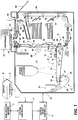
- Figure 1 schematically depicts the various components of the illustrative electrophotographic printing machine. It will become evident from the following discussion that the apparatus and method for maintaining job integrity and security utilized in the machine, are well suited for use in a wide variety of printing machines, and are not necessarily limited in their application to the particular printing machine described herein.
- Figure 1 shows a conventional electrophotographic printing machine with processing stations A, B, C, D, and E, attached to a system controller 5.
- System controller 5 outputs commands to electrophotographic printing machine 10 through an output device controller 6.
- Electrophotographic printing machine 10 employs a belt 11 having a photoconductive surface 12 deposited on a conductive substrate 13.
- photoconductive surface 12 is made from a selenium alloy with conductive substrate 13 being made from an aluminum alloy.
- conductive substrate 13 being made from an aluminum alloy.
- Other suitable photoconductive materials and conductive substrates may also be employed.
- Belt 11 moves in the direction of arrow 14 to advance successive portions of photoconductive surface 12 sequentially through the various processing stations disposed about the path of movement thereof.
- Belt 11 is entrained about a stripping roller 16, a tensioning roller 18, and a drive roller 20.
- Stripping roller 16 is mounted rotatably so as to be rotated with the movement of belt 11 .
- Tensioning roller 18 is resiliently urged against belt 11 to maintain belt under the desired tension.
- Drive roller 20 is rotated by a motor 22 coupled thereto by suitable means such as a belt drive. As roller 20 rotates, it advances belt 11 in the direction of arrow 14.
- a portion of photoconductive surface 12 passes through charging station A, wherein a corona generating device 26 charges photoconductive surface 12 to a relatively high substantially uniform potential.
- the charged portion of photoconductive surface is advanced through imaging station B wherein the uniformally charged photoconductive surface 12 is selectively discharged by a raster output scanner 27 creating a latent image of information that is to be printed.
- the raster output scanner includes a laser, a polygon surface, lenses, and mirrors.
- the laser generates a laser beam which places information on photoconductive surface 12 by switching the laser on and off as it moves, or scans, across belt 11.
- the image recorded on photoconductive surface 12 is actually a very close pattern of on/off dots that corresponds to the desired information.
- the rotating polygon surface sweeps the laser beam across the belt causing the information to be printed in a pattern of on/off dots.
- the lenses ensure that the beam shape is circular and that the beam scan is straight across the belt.
- the mirrors ensure that the optical system can fit into a small space Thereafter, belt 11 advances the recorded electrostatic latent image to development station C.
- a magnetic brush development system 28 advances the developer material into contact with the electrostatic latent image.
- magnetic brush development system 28 includes two magnetic brush developer rollers 30 and 31. These rollers each advance developer material into contact with the latent image.
- Each developer roller forms a brush comprising carrier granules and toner particles.
- the latent image attracts the toner particles from the carrier granules forming a toner powder image on the latent image.
- toner particles are depleted from the developer.
- a toner particle dispenser 32 is arranged to furnish additional toner particles to developer housing 34 for subsequent use by developer rollers 30 and 31, respectively.
- Toner dispenser 32 includes a container storing a supply of toner particles.
- a foam roller disposed in a sump coupled to the container dispenses toner particles into an auger.
- the toner particles are dispensed from the apertures in the tube into developer housing 34.
- Belt then advances the toner powder image to transfer station D wherein a sheet is moved into contact with the powder image.
- Transfer station D includes a corona generating device 36 which sprays ions onto the backside of sheets sent from either paper tray 60 or 61 This attracts the toner powder image from photoconductive surface 12 to the sheet. After a powder image has been transferred to a sheet, conveyor 42 advances the sheet to fusing station E.
- Fusing station E includes a fuser assembly 44 which permanently affixes the transferred powder image to the sheet.
- fuser assembly includes a heated fuser roller 46 and back-up roller 48 with the powder image contacting fuser roller 46. In this manner, the powder image is permanently affixed to the sheet.
- the sheets are fed to gate 50 which functions as an inverter selector.
- the sheets will be deflected into sheet inverter 52, or will bypass inverter and be fed directly to a second decision gate 54.
- the sheets which bypass inverter 52 turn a 90° corner in the sheet path before reaching gate 54.
- the sheet is in a face-up orientation with the imaged side, which has been fused, face-up. If inverter path 52 is selected, the opposite is true, i.e., the last printed side is face-down.
- Decision gate 54 either deflects the sheet directly into an open output tray 55 or deflects the sheets into transport path which carries them onto a third decision gate 56.
- Gate 56 either passes the sheet to an output bin 58 or deflects the sheet onto a duplex inverter roll 64.
- Roll 64 inverts and stacks the sheets to be duplexed in duplex tray 66 when gate 56 so directs.
- Duplex tray 66 provides an intermediate or buffer storage for those sheets which have been printed on one side on which an image will be subsequently printed on the second, opposed, side thereof, i.e. the sheets being duplexed. Due to sheet inverting by roller 56 , the buffer sheets are stacked in tray 66 face down on top of one another in the order in which they are copied.
- the simplex sheets in tray 66 are fed in seriatim, by bottom feeder 68 from tray 66 back to transfer station D for transfer of the toner powder image to the opposite side of the sheet.
- Conveyors 69 advance the sheet along the path which produces an inversion thereof.
- the proper or clean side of the sheet is positioned in contact with belt 11 at transfer station D so that the toner powder image is transferred thereto.
- the duplex tray is then fed through the same path as if the simplex sheets were to be stacked in either tray 55 or in output bin 58.
- Cleaning station F includes a rotatably mounted fibrous brush 70 which comes in contact with photoconductive surface 12 of belt 11. The particles are cleaned from photoconductive surface 12 by placing the surface in contact with the rotating brush 70. Subsequent to cleaning, a discharge lamp (not shown) floods photoconductive surface 12 with light to dissipate any residual electrostatic charge remaining thereon prior to the charging thereof for the next successive imaging cycle.
- Controller 72 which is preferably a programmable microprocessor controls all the machine functions hereinbefore described.
- the controller provides a comparison of sheets delivered to sheets transported, the number of sheets being recirculated, the number of sheets selected by the operator, time delays, jam correction, etc.
- the control of all exemplary systems heretofore described may be accomplished by conventional control switch inputs from the printing machine console selected by the operator.
- Conventional sheet path sensors or switches 78 may be utilized for keeping track of the position of sheets.
- controller 72 regulates the various positions of the decision gates which is dependent upon the mode of operation selected.
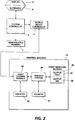
- FIG 2 shows a general block diagram of printing machine 10 shown in Figure 1.
- Sheet feeding module 82 comprises paper tray 60 and auxiliary paper tray 61 .
- the printing station 84 for inputting indicia on each sheet 84 includes all of the elements from stations A, B, C, D, E, and F, which are schematically shown in Figure 1 and were described earlier.
- the sheet receiving module 86 includes output tray 55 and output bin 58.
- Figure 2 further comprises the system controller 5 and the output device controller 6, together with, a keyboard 9, a display 8 and, a non-volatile memory 7, (also shown in Figure 1).
- Controller 5 compares the entered identification number and password to valid identification numbers and passwords stored in non-volatile memory 7 which prevents unauthorized users from accessing the printing machine. If the entered identification number and password are not valid controller 5 inhibits printing through output device controller 6. However, if the entered identification number and password are valid controller 5 enables the security printing job through output device controller 6. The authorized user is then held responsible for completing the printing job.
- counter 92 initiates a print count for each sheet transported from sheet feeding module 82 to printing station 84 and counter 93 initiates a count of the sheets delivered from the printing station to sheet receiving module 86.
- the print count of counter 92 is incremented as each sheet is fed from sheet feeding module 82 to printing station 84 and the delivery count of counter 93 is incremented as each sheet is delivered from the printing station to sheet receiving module 86.
- the print count and the delivery count is maintained throughout the security printing job until either a printing jam or fault shutdown condition occurs and cycles down print machine 10.
- the printing jam or fault shutdown condition are detected by sensors 78 located within the printing machine as shown in Figure 1 .
- Sensors 78 generate a signal to controller 72 that a printer fault mode exists which in turn cycles down the printing machine and interrupts the security printing job.
- controller 72 enables the display to generate a message to the operator that there is either a printing jam or a fault condition present and requests that the sections where a jam fault condition has been detected be cleared.
- Counter 93 will not account for the sheets that have been removed by the operator and therefore the delivery count will not reflect the correct amount of sheets that have actually been transported to printing station 84.
- the display requests that the operator enter into the keyboard the number of sheets removed from the printing machine.
- controller 5 After the operator has entered the number of sheets that were removed from printing machine 10, controller 5 enables printing station 84 to purge all sheets therefrom to sheet receiving module 82. As the sheets are purged from printing station 84 counter 93 increments the delivery count for each sheet being purged in order to determine the total number of sheets sent from the printing station to the sheet receiving module. Sheet receiving module 86 includes sheet output tray 55 and sheet output bin 58. As printing station 84 purges all sheets to sheet receiving module 86 in response to the cycle down, sheets that are past decision gate 54 are sent to output tray 58 and sheets that have not reached decision gate 54 are sent to output bin 55.
- the print count of counter 92 reflects the total number of sheets transported to printing station 84 before the cycle down and the delivery count represents the number of sheets delivered to sheet receiving module 86.
- Controller 5 compares the number of sheets transported to printing station 84 with the number of sheets removed from the printing machine 10 by the operator and the number of sheets delivered to sheet receiving module 86. If the number of sheets transported to printing station 84 does not equal the number of sheets removed from the printing machine 10 by the operator and the number of sheets delivered to sheet receiving module 86, controller 5 will continue to inhibit operation of the printing machine. Then controller 5 would enable display 8 to generate a message that there is a security problem and would request a security inspection.
- a security inspection permits an authorized security person to adjust the print count and delivery count totals registered in counter 92 and 93 so that they equal each other. Before the authorized security person can adjust the counts a security code must be entered into keyboard 9. Controller 5 compares the entered security code to a valid security code stored in non-volatile memory 7. If the entered security code does not match the valid security code then the authorized security person cannot adjust the count totals and printing machine 10 remains inhibited. Conversely, when the entered security code does match a valid security code stored in non-volatile memory 7, controller 5 permits the authorized security person to adjust the count totals. After the count totals have been properly adjusted controller 5 enables printing machine 10 to continue the security printing job.
- controller 5 would enable operation of the printing machine so that the security printing job can be continued.
- controller 5 continuously compares the number of sheets transported to printing station 84 with the number of sheets delivered to sheet receiving module 86. If the counts do not equal each other the controller will cycle down printing machine 10 and prompt a security inspection in the manner stated above. If the counts do equal each other printing machine 10 maintains the security printing job.
- controller 5 At the end of each security printing job, controller 5 generates a printing report of the particular user identification number.
- the report provides a listing of printing parameters for that particular job which include at least the user identification number, the number of sheets transported to the printing station, the number of sheets delivered to the sheet receiving module, and the number of any sheets removed by the operator.
- the controller of the present invention maintains the integrity and security for each security printing job.
- the counters keep a count of the number of sheets transported to the printing station and the number of sheets delivered from the printing station. If the printing machine cycles down because of a sheet jam, an opening of printing machine doors, or a fault condition, the controller requests that the operator enter the number of any sheets that were removed from the printing machine. Then the controller compares the number of sheets transported to the printing station to the number of sheets delivered from the printing station and the number of any sheets removed by the operator. If the number of sheets delivered to the printing station does not equal the number of sheets transported from the printing station and the number of sheets removed by the operator, the controller will continue to inhibit operation of the printing machine.
- the controller will prompt a security inspection requiring an authorized security person to adjust the counts of the number of sheets transported to and delivered from the printing station, thus enabling the printing machine.
- the controller will enable the printing machine to finish the printing job. Even if the printing machine does not cycle down the controller still maintains job integrity and security by continuously comparing sheets transported to the printing station to sheets delivered from the printing station.
- a printout of the number of sheets transported to the printing station, the number of sheets delivered from the printing station, and the number of sheets removed by the operator are provided.
Landscapes
- Physics & Mathematics (AREA)
- General Physics & Mathematics (AREA)
- Engineering & Computer Science (AREA)
- Microelectronics & Electronic Packaging (AREA)
- Theoretical Computer Science (AREA)
- Control Or Security For Electrophotography (AREA)
- Handling Of Sheets (AREA)
- Handling Of Cut Paper (AREA)
- Accessory Devices And Overall Control Thereof (AREA)
- Paper Feeding For Electrophotography (AREA)
- Controlling Sheets Or Webs (AREA)
- Inking, Control Or Cleaning Of Printing Machines (AREA)
Applications Claiming Priority (2)
| Application Number | Priority Date | Filing Date | Title |
|---|---|---|---|
| US07/574,824 US5034770A (en) | 1990-08-30 | 1990-08-30 | Job integrity and security apparatus |
| US574824 | 1990-08-30 |
Publications (3)
| Publication Number | Publication Date |
|---|---|
| EP0473434A2 true EP0473434A2 (de) | 1992-03-04 |
| EP0473434A3 EP0473434A3 (en) | 1993-02-24 |
| EP0473434B1 EP0473434B1 (de) | 1995-06-07 |
Family
ID=24297802
Family Applications (1)
| Application Number | Title | Priority Date | Filing Date |
|---|---|---|---|
| EP91307921A Expired - Lifetime EP0473434B1 (de) | 1990-08-30 | 1991-08-29 | Gerät mit Auftragsintegrität und -sicherheit |
Country Status (5)
| Country | Link |
|---|---|
| US (1) | US5034770A (de) |
| EP (1) | EP0473434B1 (de) |
| JP (1) | JP3221615B2 (de) |
| CA (1) | CA2047128C (de) |
| DE (1) | DE69110215T2 (de) |
Cited By (1)
| Publication number | Priority date | Publication date | Assignee | Title |
|---|---|---|---|---|
| EP0768579A3 (de) * | 1995-08-31 | 1997-07-02 | Toshiba Kk | Bilderzeugungsgerät |
Families Citing this family (14)
| Publication number | Priority date | Publication date | Assignee | Title |
|---|---|---|---|---|
| US5708908A (en) * | 1990-06-22 | 1998-01-13 | Minolta Co., Ltd. | Copying machine control system with improved reliability of communication function among copying machiines and centralized control unit |
| US5034770A (en) * | 1990-08-30 | 1991-07-23 | Xerox Corporation | Job integrity and security apparatus |
| US5270773A (en) * | 1992-11-27 | 1993-12-14 | Xerox Corporation | Image producing device with security to prevent disclosure of sensitive documents |
| US5602973A (en) * | 1993-09-30 | 1997-02-11 | Ricoh Company, Ltd. | Printer providing security for printout |
| US5528374A (en) * | 1993-11-22 | 1996-06-18 | Eastman Kodak Company | Networked reproduction apparatus with security feature |
| JPH07148997A (ja) * | 1993-11-29 | 1995-06-13 | Canon Inc | 画像形成装置 |
| US5797030A (en) * | 1994-08-30 | 1998-08-18 | International Business Machines Corporation | System for output record handler with logon request processor that receives first request that is validated by comparision with first and second ID/password pairs |
| JPH0980979A (ja) * | 1995-09-13 | 1997-03-28 | Sharp Corp | 原稿循環装置を備えた画像形成装置 |
| JPH09190139A (ja) * | 1996-01-09 | 1997-07-22 | Canon Inc | プロセスカートリッジ、現像装置及び電子写真画像形成装置 |
| US6112039A (en) * | 1999-10-14 | 2000-08-29 | Xerox Corporation | Auditing system for a digital copier-printer |
| US7408656B2 (en) * | 2003-03-10 | 2008-08-05 | Hewlett-Packard Development Company, L.P. | Controlling printer macro usage based on printer identification information |
| JP4858002B2 (ja) * | 2006-08-10 | 2012-01-18 | 富士ゼロックス株式会社 | 連続紙印刷システムおよび印刷方法 |
| US8400671B2 (en) * | 2007-05-10 | 2013-03-19 | Kabushiki Kaisha Toshiba | System and method for selectively disabling document rendering |
| EP2068201B1 (de) * | 2007-12-03 | 2012-10-03 | Océ-Technologies B.V. | Druckvorrichtung |
Family Cites Families (7)
| Publication number | Priority date | Publication date | Assignee | Title |
|---|---|---|---|---|
| US3588472A (en) * | 1966-11-18 | 1971-06-28 | Xerox Corp | Logic control apparatus |
| US3813157A (en) * | 1973-04-06 | 1974-05-28 | Xerox Corp | Control logic for trouble detection and recovery |
| US4163897A (en) * | 1977-10-19 | 1979-08-07 | International Business Machines Corporation | Automatic copy recovery |
| US4229100A (en) * | 1978-07-03 | 1980-10-21 | International Business Machines Corporation | Automatic copy recovery |
| JPS5636660A (en) * | 1979-09-03 | 1981-04-09 | Mita Ind Co Ltd | Method for counting number of copies in copier |
| EP0070741B1 (de) * | 1981-07-21 | 1986-03-12 | Mita Industrial Co. Ltd. | Kopiervorrichtung |
| US5034770A (en) * | 1990-08-30 | 1991-07-23 | Xerox Corporation | Job integrity and security apparatus |
-
1990
- 1990-08-30 US US07/574,824 patent/US5034770A/en not_active Expired - Lifetime
-
1991
- 1991-07-16 CA CA002047128A patent/CA2047128C/en not_active Expired - Fee Related
- 1991-08-26 JP JP21396891A patent/JP3221615B2/ja not_active Expired - Fee Related
- 1991-08-29 EP EP91307921A patent/EP0473434B1/de not_active Expired - Lifetime
- 1991-08-29 DE DE69110215T patent/DE69110215T2/de not_active Expired - Fee Related
Cited By (2)
| Publication number | Priority date | Publication date | Assignee | Title |
|---|---|---|---|---|
| EP0768579A3 (de) * | 1995-08-31 | 1997-07-02 | Toshiba Kk | Bilderzeugungsgerät |
| US5839014A (en) * | 1995-08-31 | 1998-11-17 | Kabushiki Kaisha Toshiba | Image forming method and apparatus for copying images on both sides of an image forming medium |
Also Published As
| Publication number | Publication date |
|---|---|
| CA2047128C (en) | 1994-10-18 |
| DE69110215D1 (de) | 1995-07-13 |
| DE69110215T2 (de) | 1996-01-18 |
| US5034770A (en) | 1991-07-23 |
| EP0473434B1 (de) | 1995-06-07 |
| JP3221615B2 (ja) | 2001-10-22 |
| CA2047128A1 (en) | 1992-03-01 |
| JPH04288272A (ja) | 1992-10-13 |
| EP0473434A3 (en) | 1993-02-24 |
Similar Documents
| Publication | Publication Date | Title |
|---|---|---|
| EP0473434B1 (de) | Gerät mit Auftragsintegrität und -sicherheit | |
| US4589765A (en) | Sheet feeder control for reproduction machines | |
| JPS61174063A (ja) | シ−ト分配装置 | |
| US6484934B2 (en) | Method and apparatus for charging for printing operations on an electrophotographic printing machine | |
| EP0269266B1 (de) | System für die Steuerung der Tonerabgabe | |
| US5013026A (en) | Sheet stacking and inverting apparatus | |
| US4824090A (en) | Automatically setting the paper path components of a reproduction machine in accordance with the size copy sheet being processed | |
| US6640061B2 (en) | Sensing system for detecting a full condition within a waste developer system | |
| US6477443B2 (en) | Method and apparatus for charging for printing mixed sheet sizes on an electrophotographic printing machine | |
| US5406606A (en) | Counter | |
| CA2155883C (en) | Scanner mounting apparatus for an electrostatographic printing machine | |
| EP0227243A1 (de) | Bilderzeugungsgerät | |
| JPS6113137A (ja) | 電子写真式複写機 | |
| US6728510B1 (en) | Sheet copy documents production machine having an unload-while-run safety shield | |
| JPH0192764A (ja) | 複写機等の情報出力装置 | |
| JPH02132021A (ja) | 用紙カセットの給紙方向切換装置 | |
| EP0620503A2 (de) | Papierkapazitätsindikationssystem | |
| JPH0132138B2 (de) | ||
| JPH01166065A (ja) | 画像形成装置 | |
| JPH01172139A (ja) | 給紙制御装置 | |
| JPH0192766A (ja) | 複写機等の情報出力装置 | |
| JPH08211680A (ja) | 画像生成装置 | |
| CA2334504A1 (en) | Method and apparatus for charging for printing of oversize sheets on an electrophotographic printing machine | |
| JPH0332067B2 (de) | ||
| JPS6216169A (ja) | 印字機能付静電複写機 |
Legal Events
| Date | Code | Title | Description |
|---|---|---|---|
| PUAI | Public reference made under article 153(3) epc to a published international application that has entered the european phase |
Free format text: ORIGINAL CODE: 0009012 |
|
| AK | Designated contracting states |
Kind code of ref document: A2 Designated state(s): DE FR GB |
|
| PUAL | Search report despatched |
Free format text: ORIGINAL CODE: 0009013 |
|
| AK | Designated contracting states |
Kind code of ref document: A3 Designated state(s): DE FR GB |
|
| 17P | Request for examination filed |
Effective date: 19930803 |
|
| 17Q | First examination report despatched |
Effective date: 19940722 |
|
| GRAA | (expected) grant |
Free format text: ORIGINAL CODE: 0009210 |
|
| AK | Designated contracting states |
Kind code of ref document: B1 Designated state(s): DE FR GB |
|
| REF | Corresponds to: |
Ref document number: 69110215 Country of ref document: DE Date of ref document: 19950713 |
|
| ET | Fr: translation filed | ||
| PLBE | No opposition filed within time limit |
Free format text: ORIGINAL CODE: 0009261 |
|
| STAA | Information on the status of an ep patent application or granted ep patent |
Free format text: STATUS: NO OPPOSITION FILED WITHIN TIME LIMIT |
|
| 26N | No opposition filed | ||
| REG | Reference to a national code |
Ref country code: GB Ref legal event code: IF02 |
|
| REG | Reference to a national code |
Ref country code: GB Ref legal event code: 746 Effective date: 20050512 |
|
| PGFP | Annual fee paid to national office [announced via postgrant information from national office to epo] |
Ref country code: FR Payment date: 20060808 Year of fee payment: 16 |
|
| PGFP | Annual fee paid to national office [announced via postgrant information from national office to epo] |
Ref country code: GB Payment date: 20060823 Year of fee payment: 16 |
|
| PGFP | Annual fee paid to national office [announced via postgrant information from national office to epo] |
Ref country code: DE Payment date: 20060824 Year of fee payment: 16 |
|
| GBPC | Gb: european patent ceased through non-payment of renewal fee |
Effective date: 20070829 |
|
| REG | Reference to a national code |
Ref country code: FR Ref legal event code: ST Effective date: 20080430 |
|
| PG25 | Lapsed in a contracting state [announced via postgrant information from national office to epo] |
Ref country code: DE Free format text: LAPSE BECAUSE OF NON-PAYMENT OF DUE FEES Effective date: 20080301 |
|
| PG25 | Lapsed in a contracting state [announced via postgrant information from national office to epo] |
Ref country code: FR Free format text: LAPSE BECAUSE OF NON-PAYMENT OF DUE FEES Effective date: 20070831 |
|
| PG25 | Lapsed in a contracting state [announced via postgrant information from national office to epo] |
Ref country code: GB Free format text: LAPSE BECAUSE OF NON-PAYMENT OF DUE FEES Effective date: 20070829 |