EP0472355A1 - Wasserstrahlverfilzung von Vliesstoff aus Kunstfasern in Streifenform mit verzahntem Querschnitt und das Herstellverfahren - Google Patents
Wasserstrahlverfilzung von Vliesstoff aus Kunstfasern in Streifenform mit verzahntem Querschnitt und das Herstellverfahren Download PDFInfo
- Publication number
- EP0472355A1 EP0472355A1 EP19910307496 EP91307496A EP0472355A1 EP 0472355 A1 EP0472355 A1 EP 0472355A1 EP 19910307496 EP19910307496 EP 19910307496 EP 91307496 A EP91307496 A EP 91307496A EP 0472355 A1 EP0472355 A1 EP 0472355A1
- Authority
- EP
- European Patent Office
- Prior art keywords
- fibers
- fabric
- web
- synthetic fibers
- wet
- Prior art date
- Legal status (The legal status is an assumption and is not a legal conclusion. Google has not performed a legal analysis and makes no representation as to the accuracy of the status listed.)
- Withdrawn
Links
- 229920002994 synthetic fiber Polymers 0.000 title claims abstract description 48
- 239000012209 synthetic fiber Substances 0.000 title claims abstract description 47
- 239000004745 nonwoven fabric Substances 0.000 title claims abstract description 18
- 238000000034 method Methods 0.000 title claims description 38
- 239000000835 fiber Substances 0.000 claims abstract description 126
- 239000004744 fabric Substances 0.000 claims abstract description 66
- 239000000203 mixture Substances 0.000 claims abstract description 30
- XLYOFNOQVPJJNP-UHFFFAOYSA-N water Substances O XLYOFNOQVPJJNP-UHFFFAOYSA-N 0.000 claims abstract description 30
- 229920002522 Wood fibre Polymers 0.000 claims abstract description 12
- 239000002025 wood fiber Substances 0.000 claims abstract description 12
- 229920000728 polyester Polymers 0.000 claims description 34
- 239000002562 thickening agent Substances 0.000 claims description 11
- 239000006185 dispersion Substances 0.000 claims description 10
- 239000007788 liquid Substances 0.000 claims description 8
- 239000004094 surface-active agent Substances 0.000 claims description 6
- 239000004952 Polyamide Substances 0.000 claims description 3
- NIXOWILDQLNWCW-UHFFFAOYSA-N acrylic acid group Chemical group C(C=C)(=O)O NIXOWILDQLNWCW-UHFFFAOYSA-N 0.000 claims description 3
- 239000011159 matrix material Substances 0.000 claims description 3
- 229920000178 Acrylic resin Polymers 0.000 claims 1
- 229920006122 polyamide resin Polymers 0.000 claims 1
- 229920001225 polyester resin Polymers 0.000 claims 1
- 229920005672 polyolefin resin Polymers 0.000 claims 1
- 230000003993 interaction Effects 0.000 abstract description 3
- 229920001131 Pulp (paper) Polymers 0.000 description 8
- -1 etc. Substances 0.000 description 8
- 230000000704 physical effect Effects 0.000 description 8
- 230000008569 process Effects 0.000 description 7
- 239000005020 polyethylene terephthalate Substances 0.000 description 6
- 229920002125 Sokalan® Polymers 0.000 description 5
- 230000008901 benefit Effects 0.000 description 5
- 229920004934 Dacron® Polymers 0.000 description 4
- 239000012530 fluid Substances 0.000 description 4
- 239000011122 softwood Substances 0.000 description 4
- 239000004753 textile Substances 0.000 description 4
- 229920002972 Acrylic fiber Polymers 0.000 description 3
- 229920000742 Cotton Polymers 0.000 description 3
- DNIAPMSPPWPWGF-UHFFFAOYSA-N Propylene glycol Chemical compound CC(O)CO DNIAPMSPPWPWGF-UHFFFAOYSA-N 0.000 description 3
- 230000015572 biosynthetic process Effects 0.000 description 3
- 229920001577 copolymer Polymers 0.000 description 3
- 230000000694 effects Effects 0.000 description 3
- 239000000463 material Substances 0.000 description 3
- 239000006254 rheological additive Substances 0.000 description 3
- JOYRKODLDBILNP-UHFFFAOYSA-N Ethyl urethane Chemical compound CCOC(N)=O JOYRKODLDBILNP-UHFFFAOYSA-N 0.000 description 2
- 229920000297 Rayon Polymers 0.000 description 2
- 229920001400 block copolymer Polymers 0.000 description 2
- 239000002657 fibrous material Substances 0.000 description 2
- 230000006872 improvement Effects 0.000 description 2
- 229920001778 nylon Polymers 0.000 description 2
- 238000000059 patterning Methods 0.000 description 2
- 229920002647 polyamide Polymers 0.000 description 2
- 229920000139 polyethylene terephthalate Polymers 0.000 description 2
- 229920000642 polymer Polymers 0.000 description 2
- 229920000098 polyolefin Polymers 0.000 description 2
- 238000003825 pressing Methods 0.000 description 2
- 239000002964 rayon Substances 0.000 description 2
- 239000002002 slurry Substances 0.000 description 2
- 239000007787 solid Substances 0.000 description 2
- 238000009827 uniform distribution Methods 0.000 description 2
- OAYXUHPQHDHDDZ-UHFFFAOYSA-N 2-(2-butoxyethoxy)ethanol Chemical compound CCCCOCCOCCO OAYXUHPQHDHDDZ-UHFFFAOYSA-N 0.000 description 1
- 240000005020 Acaciella glauca Species 0.000 description 1
- NLHHRLWOUZZQLW-UHFFFAOYSA-N Acrylonitrile Chemical compound C=CC#N NLHHRLWOUZZQLW-UHFFFAOYSA-N 0.000 description 1
- 229920002466 Dynel Polymers 0.000 description 1
- IAYPIBMASNFSPL-UHFFFAOYSA-N Ethylene oxide Chemical compound C1CO1 IAYPIBMASNFSPL-UHFFFAOYSA-N 0.000 description 1
- 229920000271 Kevlar® Polymers 0.000 description 1
- VVQNEPGJFQJSBK-UHFFFAOYSA-N Methyl methacrylate Chemical compound COC(=O)C(C)=C VVQNEPGJFQJSBK-UHFFFAOYSA-N 0.000 description 1
- 235000008578 Pinus strobus Nutrition 0.000 description 1
- 240000007320 Pinus strobus Species 0.000 description 1
- 239000004743 Polypropylene Substances 0.000 description 1
- 241000218638 Thuja plicata Species 0.000 description 1
- 229920004935 Trevira® Polymers 0.000 description 1
- 229920006397 acrylic thermoplastic Polymers 0.000 description 1
- 239000002518 antifoaming agent Substances 0.000 description 1
- 229920003235 aromatic polyamide Polymers 0.000 description 1
- 238000005452 bending Methods 0.000 description 1
- 239000011230 binding agent Substances 0.000 description 1
- 238000003490 calendering Methods 0.000 description 1
- 229920002678 cellulose Polymers 0.000 description 1
- 239000001913 cellulose Substances 0.000 description 1
- 239000003795 chemical substances by application Substances 0.000 description 1
- 230000001427 coherent effect Effects 0.000 description 1
- 230000007423 decrease Effects 0.000 description 1
- 229940028356 diethylene glycol monobutyl ether Drugs 0.000 description 1
- 239000002270 dispersing agent Substances 0.000 description 1
- 238000001035 drying Methods 0.000 description 1
- 238000005187 foaming Methods 0.000 description 1
- 238000009472 formulation Methods 0.000 description 1
- 239000013505 freshwater Substances 0.000 description 1
- 229920001519 homopolymer Polymers 0.000 description 1
- 239000004761 kevlar Substances 0.000 description 1
- 239000000314 lubricant Substances 0.000 description 1
- 238000004519 manufacturing process Methods 0.000 description 1
- 238000002074 melt spinning Methods 0.000 description 1
- 239000002184 metal Substances 0.000 description 1
- 238000002156 mixing Methods 0.000 description 1
- 238000012986 modification Methods 0.000 description 1
- 230000004048 modification Effects 0.000 description 1
- JCGNDDUYTRNOFT-UHFFFAOYSA-N oxolane-2,4-dione Chemical compound O=C1COC(=O)C1 JCGNDDUYTRNOFT-UHFFFAOYSA-N 0.000 description 1
- 229920003229 poly(methyl methacrylate) Polymers 0.000 description 1
- 229920001155 polypropylene Polymers 0.000 description 1
- 235000003499 redwood Nutrition 0.000 description 1
- 229920001059 synthetic polymer Polymers 0.000 description 1
- ISXSCDLOGDJUNJ-UHFFFAOYSA-N tert-butyl prop-2-enoate Chemical compound CC(C)(C)OC(=O)C=C ISXSCDLOGDJUNJ-UHFFFAOYSA-N 0.000 description 1
- 238000009736 wetting Methods 0.000 description 1
- 239000000080 wetting agent Substances 0.000 description 1
- 239000002023 wood Substances 0.000 description 1
Images
Classifications
-
- D—TEXTILES; PAPER
- D21—PAPER-MAKING; PRODUCTION OF CELLULOSE
- D21H—PULP COMPOSITIONS; PREPARATION THEREOF NOT COVERED BY SUBCLASSES D21C OR D21D; IMPREGNATING OR COATING OF PAPER; TREATMENT OF FINISHED PAPER NOT COVERED BY CLASS B31 OR SUBCLASS D21G; PAPER NOT OTHERWISE PROVIDED FOR
- D21H15/00—Pulp or paper, comprising fibres or web-forming material characterised by features other than their chemical constitution
- D21H15/02—Pulp or paper, comprising fibres or web-forming material characterised by features other than their chemical constitution characterised by configuration
-
- D—TEXTILES; PAPER
- D04—BRAIDING; LACE-MAKING; KNITTING; TRIMMINGS; NON-WOVEN FABRICS
- D04H—MAKING TEXTILE FABRICS, e.g. FROM FIBRES OR FILAMENTARY MATERIAL; FABRICS MADE BY SUCH PROCESSES OR APPARATUS, e.g. FELTS, NON-WOVEN FABRICS; COTTON-WOOL; WADDING ; NON-WOVEN FABRICS FROM STAPLE FIBRES, FILAMENTS OR YARNS, BONDED WITH AT LEAST ONE WEB-LIKE MATERIAL DURING THEIR CONSOLIDATION
- D04H1/00—Non-woven fabrics formed wholly or mainly of staple fibres or like relatively short fibres
- D04H1/40—Non-woven fabrics formed wholly or mainly of staple fibres or like relatively short fibres from fleeces or layers composed of fibres without existing or potential cohesive properties
- D04H1/44—Non-woven fabrics formed wholly or mainly of staple fibres or like relatively short fibres from fleeces or layers composed of fibres without existing or potential cohesive properties the fleeces or layers being consolidated by mechanical means, e.g. by rolling
- D04H1/46—Non-woven fabrics formed wholly or mainly of staple fibres or like relatively short fibres from fleeces or layers composed of fibres without existing or potential cohesive properties the fleeces or layers being consolidated by mechanical means, e.g. by rolling by needling or like operations to cause entanglement of fibres
- D04H1/48—Non-woven fabrics formed wholly or mainly of staple fibres or like relatively short fibres from fleeces or layers composed of fibres without existing or potential cohesive properties the fleeces or layers being consolidated by mechanical means, e.g. by rolling by needling or like operations to cause entanglement of fibres in combination with at least one other method of consolidation
- D04H1/49—Non-woven fabrics formed wholly or mainly of staple fibres or like relatively short fibres from fleeces or layers composed of fibres without existing or potential cohesive properties the fleeces or layers being consolidated by mechanical means, e.g. by rolling by needling or like operations to cause entanglement of fibres in combination with at least one other method of consolidation entanglement by fluid jet in combination with another consolidation means
-
- D—TEXTILES; PAPER
- D04—BRAIDING; LACE-MAKING; KNITTING; TRIMMINGS; NON-WOVEN FABRICS
- D04H—MAKING TEXTILE FABRICS, e.g. FROM FIBRES OR FILAMENTARY MATERIAL; FABRICS MADE BY SUCH PROCESSES OR APPARATUS, e.g. FELTS, NON-WOVEN FABRICS; COTTON-WOOL; WADDING ; NON-WOVEN FABRICS FROM STAPLE FIBRES, FILAMENTS OR YARNS, BONDED WITH AT LEAST ONE WEB-LIKE MATERIAL DURING THEIR CONSOLIDATION
- D04H1/00—Non-woven fabrics formed wholly or mainly of staple fibres or like relatively short fibres
- D04H1/40—Non-woven fabrics formed wholly or mainly of staple fibres or like relatively short fibres from fleeces or layers composed of fibres without existing or potential cohesive properties
- D04H1/44—Non-woven fabrics formed wholly or mainly of staple fibres or like relatively short fibres from fleeces or layers composed of fibres without existing or potential cohesive properties the fleeces or layers being consolidated by mechanical means, e.g. by rolling
- D04H1/46—Non-woven fabrics formed wholly or mainly of staple fibres or like relatively short fibres from fleeces or layers composed of fibres without existing or potential cohesive properties the fleeces or layers being consolidated by mechanical means, e.g. by rolling by needling or like operations to cause entanglement of fibres
- D04H1/492—Non-woven fabrics formed wholly or mainly of staple fibres or like relatively short fibres from fleeces or layers composed of fibres without existing or potential cohesive properties the fleeces or layers being consolidated by mechanical means, e.g. by rolling by needling or like operations to cause entanglement of fibres by fluid jet
-
- D—TEXTILES; PAPER
- D21—PAPER-MAKING; PRODUCTION OF CELLULOSE
- D21H—PULP COMPOSITIONS; PREPARATION THEREOF NOT COVERED BY SUBCLASSES D21C OR D21D; IMPREGNATING OR COATING OF PAPER; TREATMENT OF FINISHED PAPER NOT COVERED BY CLASS B31 OR SUBCLASS D21G; PAPER NOT OTHERWISE PROVIDED FOR
- D21H13/00—Pulp or paper, comprising synthetic cellulose or non-cellulose fibres or web-forming material
- D21H13/10—Organic non-cellulose fibres
- D21H13/12—Organic non-cellulose fibres from macromolecular compounds obtained by reactions only involving carbon-to-carbon unsaturated bonds
- D21H13/14—Polyalkenes, e.g. polystyrene polyethylene
-
- D—TEXTILES; PAPER
- D21—PAPER-MAKING; PRODUCTION OF CELLULOSE
- D21H—PULP COMPOSITIONS; PREPARATION THEREOF NOT COVERED BY SUBCLASSES D21C OR D21D; IMPREGNATING OR COATING OF PAPER; TREATMENT OF FINISHED PAPER NOT COVERED BY CLASS B31 OR SUBCLASS D21G; PAPER NOT OTHERWISE PROVIDED FOR
- D21H13/00—Pulp or paper, comprising synthetic cellulose or non-cellulose fibres or web-forming material
- D21H13/10—Organic non-cellulose fibres
- D21H13/12—Organic non-cellulose fibres from macromolecular compounds obtained by reactions only involving carbon-to-carbon unsaturated bonds
- D21H13/16—Polyalkenylalcohols; Polyalkenylethers; Polyalkenylesters
-
- D—TEXTILES; PAPER
- D21—PAPER-MAKING; PRODUCTION OF CELLULOSE
- D21H—PULP COMPOSITIONS; PREPARATION THEREOF NOT COVERED BY SUBCLASSES D21C OR D21D; IMPREGNATING OR COATING OF PAPER; TREATMENT OF FINISHED PAPER NOT COVERED BY CLASS B31 OR SUBCLASS D21G; PAPER NOT OTHERWISE PROVIDED FOR
- D21H13/00—Pulp or paper, comprising synthetic cellulose or non-cellulose fibres or web-forming material
- D21H13/10—Organic non-cellulose fibres
- D21H13/20—Organic non-cellulose fibres from macromolecular compounds obtained otherwise than by reactions only involving carbon-to-carbon unsaturated bonds
- D21H13/24—Polyesters
-
- D—TEXTILES; PAPER
- D21—PAPER-MAKING; PRODUCTION OF CELLULOSE
- D21H—PULP COMPOSITIONS; PREPARATION THEREOF NOT COVERED BY SUBCLASSES D21C OR D21D; IMPREGNATING OR COATING OF PAPER; TREATMENT OF FINISHED PAPER NOT COVERED BY CLASS B31 OR SUBCLASS D21G; PAPER NOT OTHERWISE PROVIDED FOR
- D21H13/00—Pulp or paper, comprising synthetic cellulose or non-cellulose fibres or web-forming material
- D21H13/10—Organic non-cellulose fibres
- D21H13/20—Organic non-cellulose fibres from macromolecular compounds obtained otherwise than by reactions only involving carbon-to-carbon unsaturated bonds
- D21H13/26—Polyamides; Polyimides
-
- D—TEXTILES; PAPER
- D21—PAPER-MAKING; PRODUCTION OF CELLULOSE
- D21H—PULP COMPOSITIONS; PREPARATION THEREOF NOT COVERED BY SUBCLASSES D21C OR D21D; IMPREGNATING OR COATING OF PAPER; TREATMENT OF FINISHED PAPER NOT COVERED BY CLASS B31 OR SUBCLASS D21G; PAPER NOT OTHERWISE PROVIDED FOR
- D21H25/00—After-treatment of paper not provided for in groups D21H17/00 - D21H23/00
- D21H25/005—Mechanical treatment
-
- Y—GENERAL TAGGING OF NEW TECHNOLOGICAL DEVELOPMENTS; GENERAL TAGGING OF CROSS-SECTIONAL TECHNOLOGIES SPANNING OVER SEVERAL SECTIONS OF THE IPC; TECHNICAL SUBJECTS COVERED BY FORMER USPC CROSS-REFERENCE ART COLLECTIONS [XRACs] AND DIGESTS
- Y10—TECHNICAL SUBJECTS COVERED BY FORMER USPC
- Y10T—TECHNICAL SUBJECTS COVERED BY FORMER US CLASSIFICATION
- Y10T428/00—Stock material or miscellaneous articles
- Y10T428/29—Coated or structually defined flake, particle, cell, strand, strand portion, rod, filament, macroscopic fiber or mass thereof
- Y10T428/2913—Rod, strand, filament or fiber
- Y10T428/2933—Coated or with bond, impregnation or core
- Y10T428/2964—Artificial fiber or filament
- Y10T428/2965—Cellulosic
-
- Y—GENERAL TAGGING OF NEW TECHNOLOGICAL DEVELOPMENTS; GENERAL TAGGING OF CROSS-SECTIONAL TECHNOLOGIES SPANNING OVER SEVERAL SECTIONS OF THE IPC; TECHNICAL SUBJECTS COVERED BY FORMER USPC CROSS-REFERENCE ART COLLECTIONS [XRACs] AND DIGESTS
- Y10—TECHNICAL SUBJECTS COVERED BY FORMER USPC
- Y10T—TECHNICAL SUBJECTS COVERED BY FORMER US CLASSIFICATION
- Y10T442/00—Fabric [woven, knitted, or nonwoven textile or cloth, etc.]
- Y10T442/60—Nonwoven fabric [i.e., nonwoven strand or fiber material]
- Y10T442/608—Including strand or fiber material which is of specific structural definition
- Y10T442/627—Strand or fiber material is specified as non-linear [e.g., crimped, coiled, etc.]
- Y10T442/632—A single nonwoven layer comprising non-linear synthetic polymeric strand or fiber material and strand or fiber material not specified as non-linear
- Y10T442/633—Synthetic polymeric strand or fiber material is of staple length
-
- Y—GENERAL TAGGING OF NEW TECHNOLOGICAL DEVELOPMENTS; GENERAL TAGGING OF CROSS-SECTIONAL TECHNOLOGIES SPANNING OVER SEVERAL SECTIONS OF THE IPC; TECHNICAL SUBJECTS COVERED BY FORMER USPC CROSS-REFERENCE ART COLLECTIONS [XRACs] AND DIGESTS
- Y10—TECHNICAL SUBJECTS COVERED BY FORMER USPC
- Y10T—TECHNICAL SUBJECTS COVERED BY FORMER US CLASSIFICATION
- Y10T442/00—Fabric [woven, knitted, or nonwoven textile or cloth, etc.]
- Y10T442/60—Nonwoven fabric [i.e., nonwoven strand or fiber material]
- Y10T442/689—Hydroentangled nonwoven fabric
Definitions
- This invention relates to nonwoven fabrics.
- this invention relates to such fabrics of improved strength and which contain synthetic fibers having a ribbon-shaped crenulated transverse cross-section, and a method of producing such fabrics
- U.S. Patent No. 3,485,706 discloses a nonwoven fabric of randomly inter-entangled fibers in a repeating pattern of localized entangled regions interconnected by fibers extending between entangled regions, which does not use a binder material or the like.
- the process for making such fabric is described as supporting a layer of fibrous material, e.g., a web, batt, etc.
- U.S. Patent No. 3,620,903 discloses a nonpatterned nonwoven fabric which can be a blend of at least 20 per cent by weight of staple textile fibers, e.g., polyesters, acrylics, rayon, cotton, etc., and papermaking fibers, e.g., wood pulp and cotton linters, which have been hydroentangled. Exemplified are fabrics formed of tissue grade paper of wood-pulp fibers hydroentangled on a web of polyester textile fibers.
- U.S. Patent No. 4,442,161 discloses the hydroentanglement of wood-pulp and synthetic organic fibers. A layer of wood-pulp fiber is placed on top of a polyester layer and then the layers are hydroentangled using closely spaced jets to produce a nonwoven fabric having one side with relatively more wood pulp near its surface than the other.
- U.S. Patent No. 4,498,956 discloses the manufacture of a nonwoven fibrous web from a dispersion of fibers in a foamed liquid.
- a water-surfactant solution is formed into a foamed liquid containing bubbles of air.
- the fibers are then dispersed in the foamed liquid to form a foamed furnish which is used to form a wet-laid web.
- U.S. Patent No. 4,783,231 discloses the formation of a nonwoven web of spun bonded continuous synthetic filaments which are crimped and which may have a circular, noncircular or trilobal cross-section.
- U.S. Patent No. 4,753,834 discloses nonwoven webs formed of bilobal monofilaments which, after drawing, are laid down on a moving belt to form the web.
- U.S. Patent No. 4,753,834 to Hagy et al. and U.S. Patent No. 4,808,467 to Suskind et al. disclose the hydrogentanglement of a nonwoven web formed of a blend of wood pulp fibers and staple synthetic fibers. Such nonwoven webs are disclosed to be produced by conventional wet or dry papermaking methods.
- U.S. Patent No. 4,440,579 discloses a hydroentangled nonwoven fabric of 100% ribbon-shaped polyester staple fibers having improved disentanglement resistance. Such polyester fibers are disclosed as being generally rectangular or oval in shape, and the ratio of the length of the major axis to the length of the minor axis of the fiber cross-section is in the range of 1.8:1 to 3:1. The final nonwoven fabric is wormed by hydroentangling an air-laid web of the polyester fibers.
- Patent 4,410,579 (see Figure 2 thereof which shows that grab strength decreases as aspect ratio increases).
- a wet-laid web containing ribbon-shaped crenulated fibers does not respond to hydroentanglement in the same manner as a web of fibers which have carded or been air-laid and have a round, oval or smooth ribbon-shaped cross-section.
- the denier of the synthetic fibers has a significant influence upon the physical properties of a hydroentangled fabric.
- the wet-laying method of forming the initial web to be hydroentangled significantly improves both the physical properties of the hydroentangled fabric and the effectiveness of the hydroentanglement treatment. Based upon the above findings, I have developed the present invention.
- the present invention provides an improved nonwoven fabric and a method of producing the same which utilizes a selected type of staple synthetic fibers having a ribbon-like crenulated cross-section and which have been wet-laid. Accordingly, a general object of the present invention is to provide a nonwoven fabric of improved strength.
- the fabric of the present invention is useful for clothing and is particularly useful as a medical fabric.
- Another object of the present invention is a high-strength nonwoven fabric which can be produced more economically.
- a further object of the present invention is a method of forming a high-strength nonwoven fabric wherein a web containing staple length synthetic fibers having a ribbon-like crenulated cross-section can be more effectively hydroentangled to provide a fabric of improved strength and at a lower cost.
- Still a further object of the present invention is a more economical nonwoven fabric formed of a blend of the above synthetic staple fibers and short natural fibers and having a greater resistance to disentanglement and resistance to piling.
- a high-strength nonwoven fabric is formed by wet-laying a web of at least 15% by weight, based upon the total weight of the fabric, of staple synthetic fibers having a ribbon-like crenulated transverse cross-section, which fibers are randomly interlocked with each other in a three dimensional matrix.
- such fabric is formed of a blend of the above staple synthetic fibers and short natural fibers, preferably containing from about 15% to about 100%, by weight, of such staple synthetic fibers and from about 85% to about 0%, by weight, of short natural fibers, both based upon the total weight of the fabric.
- a wet-laid web formed from a water furnish of fibers containing at least 15% by weight of staple synthetic fibers having a ribbon-shaped crenulated transverse cross-section.
- the water furnish is made un using an "associative thickener", as will be described hereinbelow.
- a foamed furnish of water, a surfactant and fibers is employed.
- the synthetic fibers should lay substantially flat relative to the plane of the fabric.
- the wet-laid web is then efficiently subjected to hydroentanglement using streams of water.
- the present invention utilizes staple synthetic fibers which are typically shaped like a ribbon, i.e., elongated fibers wherein the width, or the longer dimension transverse to the longitudinal axis thereof, is greater than the thickness, or the shorter dimension transverse to the longitudinal axis of the fibers.
- the outline of the transverse cross-secticn of the fibers is crenulated, i.e., it is wary or serrated. Sometimes such fibers may be referred to herein as having a scalloped oval transverse cross-section.
- crenulated fibers is extremely important to the attainment of a fabric having the desired properties and advantages. Such fibers are sometimes hereinafter referred to as "crenulated fibers.”
- the crenulated synthetic fibers employed in the present invention may be made from synthetic polymers such as polyesters, e.g., polyethylene terephthalate; polyolefins, e.g., homopolymers and copolymers of polypropylene; acrylic, e.g., acrylonitrile or methyl methacrylate; polyamides, e.g., any of the various nylons; and polyaramids, e.g., Kevlar (E.I. duPont de Nemours & Co.), or from semi-synthetic materials such as rayon. Polyester fibers are a preferred type of synthetic fibers for use in the present invention.
- crenulated fibers can be produced by well-known techniques, such as melt spinning from generally rectangular orifices having a crenulated, or scalloped, periphery.
- One especially suitable crenulated fiber is D-195 Dacron, manufactured by E.I. duPont de Nemours & Co., which is a polyester fiber made from polyethylene terephthalate.
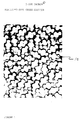
- the transverse cross-sections of the D-195 Dacron fibers 10 have outlines which are crenulated, or scalloped, with a larger, central portion flanked by smaller lateral portions.
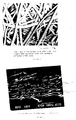
- Another suitable crenulated synthetic fiber is TM 14N, manufactured by Teijin Limited, which is a polyester ribbon-like fiber !2, as shown in Figure 2 having four striations along its broader flat surface.
- the crenulated synthetic fibers used in the fabric of the present invention are of staple length and typically have a denier in the range of about 0.5 to 5 and a length in the range of about 1/2 inch to 2 inches. Preferably, however, such fibers are in the size range of about 0.5 to 4.0 denier by about 1/2 inch to about 1 inch long. Particularly desirable are crenulated polyester fibers of about 1.2 denier x 3/4 inch long. In general, fibers of smaller deniers and longer lengths result in more desirable physical properties.
- the above ribbon-shaped crenulated staple synthetic fibers should constitute at least 15% by weight of the total weight of the fabric, and up to 100% by weight may be used in the present invention. It is, however, advantageous to use a blend of the crenulated synthetic fibers and short natural fibers, the blend containing from about 15% to 90% by weight of the crenulated fibers and from about 85% to 10% by weight of the short natural fibers, and preferably, the blend contains from about 30% to 50% by weight of the crenulated fibers and from about 50% to about 70% by weight of the short natural fibers, all based upon the total weight of the fabric.
- a particularly suitable blend has been found to be one containing about 40% by weight of crenulated polyester fibers and about 60% by weight of northern softwood pulp.
- the short natural fibers used in forming the blended fabric should be long, thin and flexible, since such fibers will more readily become entangled and interlocked with the crenulated staple synthetic fibers.
- wood fibers obtained from northern softwoods such as redwood, western red cedar or eastern white pine are used as the source of the short material fibers.
- Cotton linters or other papermaking fibers can also be used.
- the short natural fibers preferably have an average length of from about 3 to 6 millimeters.
- wet laying results in a substantial portion of the crenulated synthetic fibers and the wood fibers lying substantially flat, or parallel, to the plane of the web. This results in an optimal configuration for subsequent hydroentanglement, because the water is jetted against the broader, flatter surface of a ribbon-like fiber in a stream which is substantially perpendicular to the flat surface. Therefore, the fiber will have minimal bending stiffness, while having maximum interaction with the water, due to a maximal area of the fiber being contacted by the water jets striking the web.
- a dispersion of fibers in water is made up with a small amount of an "associative thickener" which acts both as a surfactant (or dispersant) and as a thickener, slightly increasing the viscosity of the water carrier medium and acting as a lubricant for the fibers.
- an "associative thickener” which acts both as a surfactant (or dispersant) and as a thickener, slightly increasing the viscosity of the water carrier medium and acting as a lubricant for the fibers.
- Such materials are hereinafter referred to as "associative thickeners”.
- One class of nonionic associative thickeners preferred in the process of this invention comprises relatively low (10,000 to 200,000) molecular weight ethylene oxide based urethane block copolymers and is disclosed in U.S. Patent Nos. 4,079,028 and 4,155,892.
- Acrysol RM-825 is a 35 percent solids grade of polymer in a mixture of 25 percent butyl carbitol (a diethylene glycol monobutyl ether) and 75 percent water.
- Acrysol Rheology Modifier QR-708 a 35 percent solids grade in a mixture of 60 percent propylene glycol and 40 percent water, has been found to produce excellent results.
- the aqueous dispersion, and the ultimate fabric typically comprises at least about 15 percent, preferably from about 15 to about 90 percent, by weight, of staple length ribbon-shaped crenulated synthetic fibers and from 85 to 10 percent, preferably from about 70 to about 30 percent, by weight, wood fibers.
- Synthetic fibers in the size range of about 0.7 to 1.5 denier by about 1/2 to 3/4 inch are preferred.
- Especially suitable staple fibers include polyester fibers, e.g., those sold under the trade names Trevira, Dacron, Kodel, Fortrel, etc.; acrylic fibers, e.g.
- polyamide fibers e.g., nylons
- polyolefin fibers e.g., polypronylene
- modified acrylic fibers including those sold under the trade name Dynel.
- the wood fibers are dispersed in water prior to adding the associative thickener, followed by the addition of the associative thickener in an amount in the range of from 1 to 150 pounds per ton of dry fiber making up the furnish and then the addition and dispersion of the staple length fibers.
- the dispersion of mixed fibers in an unfoamed water carrier is diluted to the desired headbox consistency and dispensed onto the forming wire of a conventional papermaking machine.
- An anti-foam agent may be added to the dispersion to prevent foaming, if necessary, and a wetting agent may be employed to assist in wetting the staple length fibers if desired.
- the fibers preferably are made up into an aqueous dispersion suitable for wet forming on a moving wire former in the following manner.
- the wood pulp is first dispersed in water or in recycled white water to a consistency of about 1 to 2 percent.
- a nonionic associative thickener is added to the resulting slurry in an amount within the range of about 100 to 500 ppm, preferably in. the range of 25 to 100 ppm, followed by the addition of the textile length fibers with continuous mixing under low shear conditions.
- the slurry is further diluted with fresh water and white water to the final headbox furnish consistency, preferable to a consistency in the range of 0.01 to 0.5 percent with a nascent viscosity in the range of 1.21 to 2.54 centiposes at 30°C, and supplied to the headbox of a papermaking machine.
- the pre-blend web may be formed from the fiber furnish on high speed conventional Foudrinier papermaking machines to produce a strong, uniform product of excellent formation. And in which the fibers forming the wet-laid product lie substantially flat, i.e., the broader surfaces of the fibers are substantially parallel to the plane of the web.
- the pre-blend web is preferably formed to have a basic weight of from about 1 oz./yd.2 up to about 4 oz./yd.2. If lighter than 1 oz./yd.2, during the hydroentanglement treatment the water jets tend to cut the web, and, if heavier than 4 oz./yd.2, the water jets tend not to penetrate the web uniformly and this results in a less uniform fabric.
- the wet-laid pre-blend web After the wet-laid pre-blend web is formed it may, if desired, be subjected to additional treatment, such as drying and/ or calendering prior to the hydroentanglement treatment to provide a "two-stage" process for forming the final fabric.
- additional treatment such as drying and/ or calendering prior to the hydroentanglement treatment
- a "one-stage” process may be employed wherein the wet-laid web is passed directly, after pressing if so-required, to the hydroentanglement step.
- a single wet-laid web is hydroentangled to form the final fabric; however, depending upon the basis weight of the web, if so-desired a plurality of, e.g., two, such webs may be laid one upon the other and subjected to hydroentanglement.
- the wet-laid web, or webs is supported on a suitable apertured forming surface and multiple streams, e.g., jets of a fluid, such as water, are directed under high pressure onto one of the planar surfaces of the web, usually the top surface, to rearrange the fibers of the web so that they become randomly entangled, or interlocked, with one another in a three-dimensional matrix so as to result in a strong, coherent fabric.
- the forming surface is a wire mesh screen, ranging from 150 mesh to 20 mesh, depending upon the pattern desired in the final fabric.
- the sheets were hydroentangled by passing them under the water jets at a standard speed of 240 feet per minute. Following the hydroentanglement, the sheets were dried unrestrained and without pressing.
- the above webs were made with various D-195 Dacron polyester fibers having a range of deniers of from 0.5 to 1.5, a range of lengths of from 0.5 to 1.0 inch and with two different cross-sections, round and ribbon-shaped crenulated, i.e., scalloped oval.
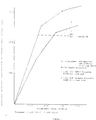
- Table 2 summarizes physical property data for fabrics made with 1/2 inch and 1 inch long 1.5 denier polyester fibers having round and scalloped oval cross-sections. As seen in Table 2, there was a improvement in both wet and dry tensile values for the fabrics made with the polyester fibers having scalloped oval cross-sections, and the longer 1 inch long fibers resulted in significantly greater tensile values.
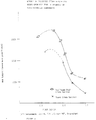
- Figure 5 is a plot of the hydroentanglement energy versus the geometric mean wet tensile breaking length in meters for two hydroentangled fabrics, each made of a blend of 60% northern softwood fibers and 3/4 inch long polyester fibers. Both fabrics were made from wet-laid webs, but one contained scalloped oval polyester fibers, while the other contained round polyester fibers.
- the geometric mean tensile mean breaking length is the square root of the product of the machine direction (MD) tensile breaking length times the cross direction (CD) tensile breaking length.
- MD machine direction
- CD cross direction
- G.M. geometric mean
- breaking length is used to normalize the data for slight changes that might occur in the basis weight.
- the fabrics made with the scalloped oval cross-section polyester fibers entangles and achieves a higher strength level more easily than a similar fabric made with polyester fibers having a round cross-section.
- the shaded area shown in Figure 5 represents the hydroentanglement energy and physical properties for a fabric similar to the fabric of the present invention, but made in accordance with Example 2B of U.S. Patent No. 4,442,161 (referred to herein or as "Example 2B"), which was formed from a dry-laid web of a blend of wood fibers and crimped round polyester staple fibers.
- Table 3 provides more complete data on the comparison tests referred to above and which was used in plotting the curve shown in Figure 5.
- Example 2B which is representative of a premium commercial fabric, can be obtained by hydroentangling a wet-laid web formed of a blend of wood fibers and staple length ribbon-shaped synthetic fibers which have a crenulated cross-section, for example scalloped oval polyester fiber (1.2 denier x 3/4 inch length), while using less than one-half the hydroentanglement energy.
Landscapes
- Engineering & Computer Science (AREA)
- Chemical & Material Sciences (AREA)
- Chemical Kinetics & Catalysis (AREA)
- Mechanical Engineering (AREA)
- Textile Engineering (AREA)
- Nonwoven Fabrics (AREA)
- Paper (AREA)
Applications Claiming Priority (2)
| Application Number | Priority Date | Filing Date | Title |
|---|---|---|---|
| US569975 | 1990-08-20 | ||
| US07/569,975 US5106457A (en) | 1990-08-20 | 1990-08-20 | Hydroentangled nonwoven fabric containing synthetic fibers having a ribbon-shaped crenulated cross-section and method of producing the same |
Publications (1)
| Publication Number | Publication Date |
|---|---|
| EP0472355A1 true EP0472355A1 (de) | 1992-02-26 |
Family
ID=24277678
Family Applications (1)
| Application Number | Title | Priority Date | Filing Date |
|---|---|---|---|
| EP19910307496 Withdrawn EP0472355A1 (de) | 1990-08-20 | 1991-08-14 | Wasserstrahlverfilzung von Vliesstoff aus Kunstfasern in Streifenform mit verzahntem Querschnitt und das Herstellverfahren |
Country Status (2)
| Country | Link |
|---|---|
| US (1) | US5106457A (de) |
| EP (1) | EP0472355A1 (de) |
Cited By (5)
| Publication number | Priority date | Publication date | Assignee | Title |
|---|---|---|---|---|
| US5284703A (en) * | 1990-12-21 | 1994-02-08 | Kimberly-Clark Corporation | High pulp content nonwoven composite fabric |
| US5516572A (en) * | 1994-03-18 | 1996-05-14 | The Procter & Gamble Company | Low rewet topsheet and disposable absorbent article |
| US5573841A (en) * | 1994-04-04 | 1996-11-12 | Kimberly-Clark Corporation | Hydraulically entangled, autogenous-bonding, nonwoven composite fabric |
| US6103061A (en) * | 1998-07-07 | 2000-08-15 | Kimberly-Clark Worldwide, Inc. | Soft, strong hydraulically entangled nonwoven composite material and method for making the same |
| US6784126B2 (en) | 1990-12-21 | 2004-08-31 | Kimberly-Clark Worldwide, Inc. | High pulp content nonwoven composite fabric |
Families Citing this family (26)
| Publication number | Priority date | Publication date | Assignee | Title |
|---|---|---|---|---|
| ATE173309T1 (de) * | 1994-07-13 | 1998-11-15 | Sca Hygiene Paper Ab | Verfahren zur herstellung eines vliesstoffes |
| SE503606C2 (sv) * | 1994-10-24 | 1996-07-15 | Moelnlycke Ab | Nonwovenmaterial innehållande en blandning av massafibrer och långa hydrofila växtfibrer samt förfarande för framställning av nonwovenmaterialet |
| US5587225A (en) * | 1995-04-27 | 1996-12-24 | Kimberly-Clark Corporation | Knit-like nonwoven composite fabric |
| JPH09327982A (ja) * | 1996-06-10 | 1997-12-22 | Lintec Corp | 綴じ用テープ用紙および綴じ用テープ |
| US6022447A (en) * | 1996-08-30 | 2000-02-08 | Kimberly-Clark Corp. | Process for treating a fibrous material and article thereof |
| US6074966A (en) * | 1996-09-09 | 2000-06-13 | Zlatkus; Frank P. | Nonwoven fabric composite having multi-directional stretch properties utilizing a cellular or foam layer |
| US5780369A (en) * | 1997-06-30 | 1998-07-14 | Kimberly-Clark Worldwide, Inc. | Saturated cellulosic substrate |
| US6120888A (en) * | 1997-06-30 | 2000-09-19 | Kimberly-Clark Worldwide, Inc. | Ink jet printable, saturated hydroentangled cellulosic substrate |
| SE9703886L (sv) * | 1997-10-24 | 1999-04-25 | Sca Hygiene Paper Ab | Metod för framställning av ett nonwovenmaterial och framställt enligt metoden |
| WO1999064676A1 (en) | 1998-06-10 | 1999-12-16 | Bba Nonwovens Simpsonville, Inc. | High efficiency thermally bonded wet laid milk filter |
| US6177370B1 (en) | 1998-09-29 | 2001-01-23 | Kimberly-Clark Worldwide, Inc. | Fabric |
| GB0013302D0 (en) * | 2000-06-02 | 2000-07-26 | B & H Res Ltd | Formation of sheet material using hydroentanglement |
| US20030124942A1 (en) * | 2001-10-12 | 2003-07-03 | Charles Fuller | Differentially entangled nonwoven fabric for use as wipes |
| GB0128692D0 (en) * | 2001-11-30 | 2002-01-23 | B & H Res Ltd | Formation of sheet material using hydroentanglement |
| US20040068849A1 (en) * | 2002-10-11 | 2004-04-15 | Polymer Group, Inc. | Differentially entangled nonwoven fabric for use as wipes |
| ITPD20030260A1 (it) * | 2003-10-24 | 2005-04-25 | Orv Spa | Prodotto stratiforme a base di tessuto non tessuto, |
| US7416638B2 (en) * | 2003-11-18 | 2008-08-26 | Georgia-Pacific Consumer Products Lp | Apparatus and method for manufacturing a multi-layer web product |
| US20110135900A1 (en) * | 2004-11-02 | 2011-06-09 | Wm. T. Burnett Ip, Llc | Lightweight nonwoven fire retardant barrier |
| EP1932892B1 (de) * | 2006-12-13 | 2009-10-28 | Scapa France | Drahtbinderband |
| EP2045303A1 (de) * | 2007-10-05 | 2009-04-08 | Scapa France | Abriebresistentes Klebeband |
| US11034817B2 (en) | 2013-04-17 | 2021-06-15 | Evrnu, Spc | Methods and systems for processing mixed textile feedstock, isolating constituent molecules, and regenerating cellulosic and polyester fibers |
| US12281441B2 (en) | 2013-04-17 | 2025-04-22 | Evrnu, Spc | Methods and systems for forming composite fibers |
| NZ743252A (en) * | 2015-12-01 | 2019-09-27 | Essity Hygiene & Health Ab | Process for producing nonwoven with improved surface properties |
| KR102107102B1 (ko) | 2016-12-22 | 2020-05-06 | 킴벌리-클라크 월드와이드, 인크. | 폼 형성 공정에서 섬유를 재배향하는 공정 및 시스템 |
| US11248347B2 (en) | 2017-07-18 | 2022-02-15 | Gpcp Ip Holdings Llc | Embossing pattern with a continuous contour plateau having emboss elements thereon and products and methods of using the same |
| US20210381166A1 (en) * | 2020-06-09 | 2021-12-09 | Evrnu, Spc | Processing cellulose-containing materials for paper or packaging materials |
Citations (4)
| Publication number | Priority date | Publication date | Assignee | Title |
|---|---|---|---|---|
| US4410579A (en) * | 1982-09-24 | 1983-10-18 | E. I. Du Pont De Nemours And Company | Nonwoven fabric of ribbon-shaped polyester fibers |
| EP0108621A2 (de) * | 1982-11-04 | 1984-05-16 | E.I. Du Pont De Nemours And Company | Verfahren zur Herstellung von keine Öffnungen aufweisenden Stoffbahnen des "spun-laced"-Typs |
| FR2588286A1 (fr) * | 1985-10-07 | 1987-04-10 | Kimberly Clark Co | Voile non tisse ayant une douceur amelioree |
| EP0308320A2 (de) * | 1987-09-15 | 1989-03-22 | Fiberweb North America, Inc. | Fester Vliesstoff |
Family Cites Families (19)
| Publication number | Priority date | Publication date | Assignee | Title |
|---|---|---|---|---|
| US3156607A (en) * | 1961-05-31 | 1964-11-10 | Du Pont | Lobed filament |
| US3620903A (en) * | 1962-07-06 | 1971-11-16 | Du Pont | Lightweight nonpatterned nonwoven fabric |
| US3485706A (en) * | 1968-01-18 | 1969-12-23 | Du Pont | Textile-like patterned nonwoven fabrics and their production |
| US3914488A (en) * | 1973-09-24 | 1975-10-21 | Du Pont | Polyester filaments for fur-like fabrics |
| US4079028A (en) * | 1975-10-03 | 1978-03-14 | Rohm And Haas Company | Polyurethane thickeners in latex compositions |
| US4155892A (en) * | 1975-10-03 | 1979-05-22 | Rohm And Haas Company | Polyurethane thickeners for aqueous compositions |
| GB1550955A (en) * | 1975-12-29 | 1979-08-22 | Johnson & Johnson | Textile fabric and method of manufacturing the same |
| US4152480A (en) * | 1976-06-28 | 1979-05-01 | Mitsubishi Rayon Company, Limited | Method for making nonwoven fabric and product |
| CA1116363A (en) * | 1977-01-26 | 1982-01-19 | Bobby M. Phillips | Fracturable textile filaments for producing yarns having free protruding ends and process |
| US4196245A (en) * | 1978-06-16 | 1980-04-01 | Buckeye Cellulos Corporation | Composite nonwoven fabric comprising adjacent microfine fibers in layers |
| US4498956A (en) * | 1981-09-25 | 1985-02-12 | James River-Norwalk, Inc. | Apparatus and method for the manufacture of a non-woven fibrous web |
| US4735849A (en) * | 1985-08-26 | 1988-04-05 | Toray Industries, Inc. | Non-woven fabric |
| US4778460A (en) * | 1985-10-07 | 1988-10-18 | Kimberly-Clark Corporation | Multilayer nonwoven fabric |
| US4753834A (en) * | 1985-10-07 | 1988-06-28 | Kimberly-Clark Corporation | Nonwoven web with improved softness |
| US4783231A (en) * | 1985-10-07 | 1988-11-08 | Kimberly-Clark Corporation | Method of making a fibrous web comprising differentially cooled/thermally relaxed fibers |
| US4612237A (en) * | 1985-12-13 | 1986-09-16 | E. I. Du Pont De Nemours And Company | Hydraulically entangled PTFE/glass filter felt |
| US4822452A (en) * | 1987-04-06 | 1989-04-18 | James River Corporation Of Virginia | Manufacture of wet laid nonwoven webs |
| US4775579A (en) * | 1987-11-05 | 1988-10-04 | James River Corporation Of Virginia | Hydroentangled elastic and nonelastic filaments |
| US5009747A (en) * | 1989-06-30 | 1991-04-23 | The Dexter Corporation | Water entanglement process and product |
-
1990
- 1990-08-20 US US07/569,975 patent/US5106457A/en not_active Expired - Lifetime
-
1991
- 1991-08-14 EP EP19910307496 patent/EP0472355A1/de not_active Withdrawn
Patent Citations (4)
| Publication number | Priority date | Publication date | Assignee | Title |
|---|---|---|---|---|
| US4410579A (en) * | 1982-09-24 | 1983-10-18 | E. I. Du Pont De Nemours And Company | Nonwoven fabric of ribbon-shaped polyester fibers |
| EP0108621A2 (de) * | 1982-11-04 | 1984-05-16 | E.I. Du Pont De Nemours And Company | Verfahren zur Herstellung von keine Öffnungen aufweisenden Stoffbahnen des "spun-laced"-Typs |
| FR2588286A1 (fr) * | 1985-10-07 | 1987-04-10 | Kimberly Clark Co | Voile non tisse ayant une douceur amelioree |
| EP0308320A2 (de) * | 1987-09-15 | 1989-03-22 | Fiberweb North America, Inc. | Fester Vliesstoff |
Cited By (6)
| Publication number | Priority date | Publication date | Assignee | Title |
|---|---|---|---|---|
| US5284703A (en) * | 1990-12-21 | 1994-02-08 | Kimberly-Clark Corporation | High pulp content nonwoven composite fabric |
| US5389202A (en) * | 1990-12-21 | 1995-02-14 | Kimberly-Clark Corporation | Process for making a high pulp content nonwoven composite fabric |
| US6784126B2 (en) | 1990-12-21 | 2004-08-31 | Kimberly-Clark Worldwide, Inc. | High pulp content nonwoven composite fabric |
| US5516572A (en) * | 1994-03-18 | 1996-05-14 | The Procter & Gamble Company | Low rewet topsheet and disposable absorbent article |
| US5573841A (en) * | 1994-04-04 | 1996-11-12 | Kimberly-Clark Corporation | Hydraulically entangled, autogenous-bonding, nonwoven composite fabric |
| US6103061A (en) * | 1998-07-07 | 2000-08-15 | Kimberly-Clark Worldwide, Inc. | Soft, strong hydraulically entangled nonwoven composite material and method for making the same |
Also Published As
| Publication number | Publication date |
|---|---|
| US5106457A (en) | 1992-04-21 |
Similar Documents
| Publication | Publication Date | Title |
|---|---|---|
| US5106457A (en) | Hydroentangled nonwoven fabric containing synthetic fibers having a ribbon-shaped crenulated cross-section and method of producing the same | |
| JP2817006B2 (ja) | 繊維エンタングルされた不織ウェブ材料の製造方法 | |
| US5254399A (en) | Nonwoven fabric | |
| KR100972896B1 (ko) | 부직 복합 직물의 형성 방법 및 그로부터 생성된 직물 | |
| US5167764A (en) | Wet laid bonded fibrous web | |
| US5167765A (en) | Wet laid bonded fibrous web containing bicomponent fibers including lldpe | |
| EP1341953A2 (de) | Wasserstrahlverfestigte vliesstoffe mit synthesefaserrecyclat | |
| US20020115370A1 (en) | Hydroentangled nonwoven composite structures containing recycled synthetic fibrous materials | |
| US3973067A (en) | Short-fibered nonwoven fabrics | |
| KR20010015762A (ko) | 텍스쳐드 부직 복합 재료 및 그의 제조 방법 | |
| JPH04263699A (ja) | バリヤー性不織布とその製造法 | |
| JP2852526B2 (ja) | 寸法安定性に優れた湿式不織布及びその製造方法 | |
| US20030171056A1 (en) | Hydroentangled nonwoven web containing recycled synthetic fibrous materials | |
| JP2871888B2 (ja) | 不織布およびその製造法 | |
| JP2871864B2 (ja) | 地合の良好なスパンレース不織布およびその製造法 | |
| JPH05214653A (ja) | 水流交絡不織布の製造法 | |
| JPH05214649A (ja) | 柔軟な不織布およびその製造法 | |
| AU2002230632B2 (en) | Hydroentangled nonwoven composite structures containing recycled synthetic fibrous materials | |
| JP2871869B2 (ja) | 地合の良好なスパンレース不織布およびその製造法 | |
| JP3081853B2 (ja) | 地合の良好な水流交絡不織布およびその製造法 | |
| AU2002230627B2 (en) | Hydroentangled nonwoven web containing recycled synthetic fibrous materials | |
| JPH0533252A (ja) | 水流交絡用ウエブ、水流交絡不織布および水流交絡不織布の製造法 | |
| JP2951431B2 (ja) | 不織布およびその製造法 | |
| JPS633064B2 (de) | ||
| AU2002230632A1 (en) | Hydroentangled nonwoven composite structures containing recycled synthetic fibrous materials |
Legal Events
| Date | Code | Title | Description |
|---|---|---|---|
| PUAI | Public reference made under article 153(3) epc to a published international application that has entered the european phase |
Free format text: ORIGINAL CODE: 0009012 |
|
| AK | Designated contracting states |
Kind code of ref document: A1 Designated state(s): AT BE CH DE DK ES FR GB GR IT LI LU NL SE |
|
| 17P | Request for examination filed |
Effective date: 19920523 |
|
| 17Q | First examination report despatched |
Effective date: 19940425 |
|
| STAA | Information on the status of an ep patent application or granted ep patent |
Free format text: STATUS: THE APPLICATION IS DEEMED TO BE WITHDRAWN |
|
| 18D | Application deemed to be withdrawn |
Effective date: 19940905 |