EP0465987A2 - Verfahren zur schnellen Messung lebendiger Mikroorganismen und Satz zur Messung - Google Patents
Verfahren zur schnellen Messung lebendiger Mikroorganismen und Satz zur Messung Download PDFInfo
- Publication number
- EP0465987A2 EP0465987A2 EP91110913A EP91110913A EP0465987A2 EP 0465987 A2 EP0465987 A2 EP 0465987A2 EP 91110913 A EP91110913 A EP 91110913A EP 91110913 A EP91110913 A EP 91110913A EP 0465987 A2 EP0465987 A2 EP 0465987A2
- Authority
- EP
- European Patent Office
- Prior art keywords
- microorganisms
- coloring matter
- solution
- filter
- hydrophobic filter
- Prior art date
- Legal status (The legal status is an assumption and is not a legal conclusion. Google has not performed a legal analysis and makes no representation as to the accuracy of the status listed.)
- Granted
Links
Images
Classifications
-
- C—CHEMISTRY; METALLURGY
- C12—BIOCHEMISTRY; BEER; SPIRITS; WINE; VINEGAR; MICROBIOLOGY; ENZYMOLOGY; MUTATION OR GENETIC ENGINEERING
- C12Q—MEASURING OR TESTING PROCESSES INVOLVING ENZYMES, NUCLEIC ACIDS OR MICROORGANISMS; COMPOSITIONS OR TEST PAPERS THEREFOR; PROCESSES OF PREPARING SUCH COMPOSITIONS; CONDITION-RESPONSIVE CONTROL IN MICROBIOLOGICAL OR ENZYMOLOGICAL PROCESSES
- C12Q1/00—Measuring or testing processes involving enzymes, nucleic acids or microorganisms; Compositions therefor; Processes of preparing such compositions
- C12Q1/02—Measuring or testing processes involving enzymes, nucleic acids or microorganisms; Compositions therefor; Processes of preparing such compositions involving viable microorganisms
- C12Q1/04—Determining presence or kind of microorganism; Use of selective media for testing antibiotics or bacteriocides; Compositions containing a chemical indicator therefor
- C12Q1/06—Quantitative determination
-
- Y—GENERAL TAGGING OF NEW TECHNOLOGICAL DEVELOPMENTS; GENERAL TAGGING OF CROSS-SECTIONAL TECHNOLOGIES SPANNING OVER SEVERAL SECTIONS OF THE IPC; TECHNICAL SUBJECTS COVERED BY FORMER USPC CROSS-REFERENCE ART COLLECTIONS [XRACs] AND DIGESTS
- Y10—TECHNICAL SUBJECTS COVERED BY FORMER USPC
- Y10S—TECHNICAL SUBJECTS COVERED BY FORMER USPC CROSS-REFERENCE ART COLLECTIONS [XRACs] AND DIGESTS
- Y10S436/00—Chemistry: analytical and immunological testing
- Y10S436/825—Pretreatment for removal of interfering factors from sample
-
- Y—GENERAL TAGGING OF NEW TECHNOLOGICAL DEVELOPMENTS; GENERAL TAGGING OF CROSS-SECTIONAL TECHNOLOGIES SPANNING OVER SEVERAL SECTIONS OF THE IPC; TECHNICAL SUBJECTS COVERED BY FORMER USPC CROSS-REFERENCE ART COLLECTIONS [XRACs] AND DIGESTS
- Y10—TECHNICAL SUBJECTS COVERED BY FORMER USPC
- Y10S—TECHNICAL SUBJECTS COVERED BY FORMER USPC CROSS-REFERENCE ART COLLECTIONS [XRACs] AND DIGESTS
- Y10S436/00—Chemistry: analytical and immunological testing
- Y10S436/826—Additives, e.g. buffers, diluents, preservatives
-
- Y—GENERAL TAGGING OF NEW TECHNOLOGICAL DEVELOPMENTS; GENERAL TAGGING OF CROSS-SECTIONAL TECHNOLOGIES SPANNING OVER SEVERAL SECTIONS OF THE IPC; TECHNICAL SUBJECTS COVERED BY FORMER USPC CROSS-REFERENCE ART COLLECTIONS [XRACs] AND DIGESTS
- Y10—TECHNICAL SUBJECTS COVERED BY FORMER USPC
- Y10T—TECHNICAL SUBJECTS COVERED BY FORMER US CLASSIFICATION
- Y10T436/00—Chemistry: analytical and immunological testing
- Y10T436/25—Chemistry: analytical and immunological testing including sample preparation
- Y10T436/25375—Liberation or purification of sample or separation of material from a sample [e.g., filtering, centrifuging, etc.]
Definitions
- the present invention relates to a method for measuring, rapidly and in a simplified manner, the number of living microorganisms in a sample, and a measuring kit, which can be utilized in a wide variety of fields including metal working, paints and foodstuffs in which a problem of spoilage will arise, and diagnosis in which bacteria in urine will become a problem.
- Water-soluble metal working fluids such as cutting fluids, rolling coolants or polymer quenchants, liquid foodstuffs such as liquid flavoring matters, liquid foods and drinks or alcohols, water-soluble paints, and the like are under conditions suitable for growth of microorganisms. Thus, depending on the degree of administration, they are sometimes spoiled as a result of considerable growth of microorganisms.
- This method however, has disadvantages in that special equipment, such as an incubator, is needed, and a long time, usually 48 hours, is needed until the results of measurement are obtained.
- U.S. Patent 4,336,337 discloses an apparatus in which urine, for example, is dyed with safranine in the presence of EDTA and adsorbed on a positively charged filter and, thereafter, after washing with a cleaner of pH 2.7-4.0, the number of living microorganisms is determined according to the intensity of color.
- the present invention is intended to overcome the above problems, and an object of the present invention is to provide a method for measuring rapidly and in a simplified manner the number of living microorganisms without use of specified equipment, and a measuring kit.
- the present invention relates to a method for measuring the number of living microorganisms in a specimen in which the microorganisms are grasped on a hydrophobic filter after dyeing or alternatively after grasping on the hydrophobic filter, the microorganisms are dyed, excessive dye is removed by washing, and based on the degree of coloration of the microorganisms, the number of living microorganisms in the specimen is determined.
- the method of the present invention can be carried out with ease by the use of a kit for measuring the number of living microorganisms, comprising a hydrophobic filter, a syringe to which the filter can be fitted, a coloring matter solution, a cleaning solution, and a color reference table.
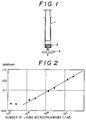
- the reference numeral 1 indicates the syringe
- the reference numeral 2 indicates the specimen
- the reference numeral 3 indicates the hydrophobic filter.
- the specimen to which the present invention is applicable is not critical; the present invention can be applied to, for example, water-soluble metal working fluids such as cutting fluids, rolling coolants, and polymer quenchants; liquid foodstuffs such as liquid flavoring matters, liquid foods, and drinks, and alcohols; water-soluble paints; and further water such as river water, pond water, water in tanks, or waste water from home.
- water-soluble metal working fluids such as cutting fluids, rolling coolants, and polymer quenchants
- liquid foodstuffs such as liquid flavoring matters, liquid foods, and drinks, and alcohols
- water-soluble paints such as river water, pond water, water in tanks, or waste water from home.
- Microorganisms which are measured according to the present invention include fungi, yeasts, bacteria, etc., particularly aerobic bacteria, existing in metal working fluids, paints, urine, etc.
- microorganisms in the specimen are dyed and then caught by the hydrophobic filter, or alternatively, after catching by the hydrophobic filter, the microorganisms are dyed. That is, the microorganisms are caught by the hydrophobic filter either before or after dyeing thereof.
- any coloring matter can be used as long as it is capable of dyeing the microorganisms.
- fuchsine, safranine, Victoria Blue, etc. can be used. From a viewpoint of ease of removal of excessive coloring matter, fuchsine and safranine are particularly preferred.
- the coloring matter is used in the form of an aqueous solution (coloring matter solution).
- aqueous solution coloring matter solution
- ethanol for example, can be added, if necessary.
- the concentration of the coloring matter solution is usually in a range of 0.0005 to 2.0%, with the range of 0.002 to 1% being preferred. If the coloring matter concentration is less than 0.0005%, coloration is achieved only insufficiently. On the other hand, if it is more than 2.0%, excessive coloring matter becomes difficult to remove.
- a surfactant may be added, if necessary.
- the amount of the surfactant added is 0.0001 to 1%.
- the coloring matter solution it is possible that a predetermined concentration of coloring matter solution is prepared in advance, and that the coloring matter solution is diluted with a cleaning solution as described later to the desired concentration.
- the ratio of the amount of the coloring matter solution to that of the specimen solution is at least 1:1 and preferably at least 5:1. If the ratio is less than 1:1, poor coloration undesirably results.
- hydrophobic filter those made of polymers such as polyfluoroethylene, olefin-based polymers, and fluorine-based polymers can be used.
- polymers such as polyfluoroethylene, olefin-based polymers, and fluorine-based polymers
- polyfluoroethylene trade name: Teflon
- olefin-based polymers are preferably used in that they permit easy removal of excessive coloring matter.
- the pore diameter of the hydrophobic filter can be determined appropriately depending on the type of the microorganisms to be tested. For example, in the case of bacteria, the pore diameter is preferably 0.22 to 0.50 m ⁇ .
- the hydrophobic filter is not always critical in size; usually, since the hydrophobic filter is fitted to the syringe, its diameter is preferably in a range of 13 to 25 mm.
- a color permitting easy determination is chosen taking into consideration the color of the coloring matter to be used.
- a white filter is preferably used.
- a transparent filter and a translucent filter can be used. In the case of these filters, if the filter is placed on white paper, determination can be made easily.
- the major feature of the present invention resides in that microorganisms in the specimen are caught by the use of the aforementioned hydrophobic filter.
- the hydrophobic filter is fitted to the syringe, and the specimen which has been dyed or before dyeing is introduced into the syringe and then filtered under pressure through the hydrophobic filter to seize the microorganisms.
- the specimen before dyeing is introduced, it is dyed with the colorling matter after the filtration.
- the amount of the cleaning solution used varies with the diameter of the hydrophobic filter; for example, when the diameter of the hydrophobic filter is 13 mm, the amount of the cleaning solution used is in a range of 1 to 5 ml, with the range of 2 to 3 ml being preferred. If the amount of the cleaning solution used is less than 1 ml, washing is achieved only insufficiently. On the other hand, if the amount of the cleaning solution used is more than 5 ml, the coloring matter may leak from the microorganisms. From a viewpoint of minimizing an error, it is preferred that the amount of the cleaning solution used in preparation of the color reference table and a calibration curve be made equal to that used in the washing of the unknown specimen.
- the cleaning solution as described above is introduced into the syringe in which the specimen dyed and seized on the hydrophobic filter is introduced, and then filtered under pressure to wash and remove the excessive coloring matter.
- the number of living microorganisms in the specimen is determined.
- the number of living microorganisms is measured: (1) with the eye, or (2) by colorimetry based on the measurement of optical density (O.D.).
- the degree of coloration i.e., intensity of color of the microorganisms on the hydrophobic filter, is compared with the color reference table which has been previously prepared using specimens containing known numbers of living microorganisms.
- the color reference table which shows a relation between the number of living microorganisms in the specimen and the corresponding degree of coloration resulting from the dyeing thereof, can be prepared by taking color photographs of filters which have been dyed and washed according to the method of the present invention except that the specimens containing known numbers of microorganisms have been used,or by dyeing filter papers, for example, with colors of the same intensity as the filters.
- specimens containing known numbers of living microorganisms are chosen. It is usually said that if the number of living microorganisms is 1x10⁴ to 1x10⁵ per milliliter of the specimen, the specimen is not spoiled, whereas if it is more than 1x10⁷, the specimen is spoiled. Thus, in determining the degree of spoilage of the specimen, it is sufficient to prepare the color reference table in which there are shown the corresponding colors at fours points, for example, of 1x10⁴ or less, about 1x10⁵, about 1x10⁶, and 1x10⁷ or more, all being per milliliter of the specimen.
- the hydrophobic filter, the syringe to which the hydrophobic filter is fittable, the coloring matter solution, and the cleaning solution are combined together to produce a measuring kit which enables to measure, rapidly and conveniently, the number of living microorganisms.
- Any syringe can be used as long as it is capable of filtering under pressure in combination with the hydrophobic filter.
- the syringe may be made of either glass or plastics.
- the volume of the syringe can be determined appropriately depending on the amount of the cleaning solution, for example.
- the coloring matter attached onto the microorganisms which have been seized on the hydrophobic filter is eluted with an organic solvent, the elute thus obtained is measured in absorbance, and based on the absorbance, the number of living microorganisms is determined using the calibration curve of optical density vs. number of living microorganisms, which has been previously prepared.
- the absorbance can be determined appropriately depending on the type of the coloring matter to be used.
- Various alcohols can be used as the organic solvents, with ethanol being particularly preferred.
- the hydrophobic filter is used and, therefore, the problem that excessive coloring matter firmly attaches to the filter and is difficult to removed by washing, as encountered in the prior art methods, can be overcome. Accordingly, for removal of the excessive coloring matter, neither a vacuum pump nor suction equipment is needed, and a washing operation can be simplified.
- the method of the present invention enables to measure the number of living microorganisms in the specimen, rapidly and conveniently, and further without use of special equipment. In accordance with the method of the present invention, the measurement is usually completed within 10 minutes.
- the method of the present invention is applicable to all microorganisms including fungi, yeasts, and bacteria.
- the measuring kit of the present invention is very simple and unexpensive, and furthermore, since no special equipment is needed, it can be used at any locations.
- the present invention is greatly effective in measuring the number of living microorganisms growing in the specimen, particularly water-soluble metal working fluid, and thus it can be utilized in various fields such as metal working fluid paints and foodstuffs, both giving rise to a problem of spoilage, and diagnosis in which bacteria in urine cause problems.
- the calibration curve was prepared according to the method described below.
- Metal working fluid (microemulsion type) was diluted with the same fresh fluid to prepare specimens with various concentrations.
- a fuchsine solution prepared by diluting a fuchsine dyeing solution (concentration: 20 mg/100 ml) with a cleaning solution (PBS buffer solution with 0.0025% Tween 20 added, pH 7.8) to 1/4 of the original concentration, was placed in a 5 ml volume tube, and 50 ⁇ l of the above specimens was introduced into the tube to dye aerobic bacteria contained therein.
- the specimen was introduced into a 5 ml volume syringe barrel fitted with a Teflon filter (trade name: DISMIC-13JP, produced by Advantech Toyo Co., Ltd.) having a diameter of 13 mm and then filtered under pressure to seize the aerobic bacteria on the Teflon filter.
- a Teflon filter trade name: DISMIC-13JP, produced by Advantech Toyo Co., Ltd.
- the syringe and the filter were separated from each other. After 2.5 ml of the same cleaning solution as used above was introduced into the syringe, the filter was again fitted to the syringe. The filter was washed with the cleaning solution by injecting it to thereby remove excessive coloring matter.
- the coloring matter attaching onto the bacteria which were seized on the filter fitted to the 5 ml volume syringe, was eluted with or dissolved in 1 ml of ethanol.
- a 200 ⁇ l (microliter) portion was placed on a 96 multi well plate and measured for an optical density (O.D.) at 492 nm, as a degree of coloration, by the use of a microplate reader (produced by Corona Co., Ltd.).
- the number of living aerobic bacteria in specimen solutions with various concentrations was calculated by the agar plate method. That is, a predetermined amount of the specimen solution was inoculated onto a medium containing 0.5% of meat extract, 1.0% of peptone, 0.5% of sodium chloride, and 1.5% of agar (pH 7.0), cultivated at 30°C for 48 hours, and from the number of colonies formed, the number of the living aerobic bacteria was determined.
- a fuchsine solution obtained by diluting a fuchsine dyeing solution (concentration: 20 mg/100 ml) with a cleaning solution (PBS buffer solution with 0.0025% of Tween 20 added thereto, pH 7.8) to 1/4 of the original concentration, was placed in a 5 ml volume tube, and 50 ⁇ l of metal working fluid B (microemulsion type) was introduced thereinto to dye aerobic bacteria.
- a cleaning solution PBS buffer solution with 0.0025% of Tween 20 added thereto, pH 7.8
- the solution was introduced into a 5 ml volume syringe barrel fitted with a Teflon filter (trade name: DISMIC-13JP, produced by Advantech Toyo Co., Ltd.) having a diameter of 13 mm, and then filtered under pressure to seize the aerobic bacteria on the Teflon filter (see Fig. 1).
- a Teflon filter trade name: DISMIC-13JP, produced by Advantech Toyo Co., Ltd.
- the syringe was separated from the filter, and 2.5 ml of the same cleaning solution as used above was introduced into the syringe.
- the filter was again fitted to the syringe, and excessive coloring matter was removed by washing with the cleaning solution.
- a 200 ⁇ l portion was placed on a 96 multi well plate and measured for optical density at 492 nm, as a degree of coloration, by the use of a microplate reader (produced by Corona Co., Ltd.).
- the optical density of the elute or solution was 0.665, and the number of aerobic bacteria as determined with the calibration curve was 5.0x10⁷/ml.
- Metal working fluid A in which the number of living bacteria was known was diluted with a fresh fluid to prepare standard samples containing living bacteria in the number of: (1) 107/ml or more; (2) about 106/ml; (3) about 105/ml; and (4) 104/ml or less. For these samples, the same operation as in Example 1 was applied until the step of removal of the excessive coloring matter by washing.
- metal working fluids B to F used in Examples 1 to 5
- metal working fluid G microemulsion type
- metal working fluid H soluble type
- Example 2 According to the same operation as in Example 1 except that an olefin-based filter (trade name: Chromatodisk 13AI, produced by Kurabo Co., Ltd.) was used in place of the Teflon filter as the hydrophobic filter, the number of living bacteria of the metal working fluid B (emulsion type) was determined. The optical density was 0.510, and the number of living aerobic bacteria as determined by the calibration curve was 3.0x10⁷/ml. The number of living bacteria in the same specimen as above, as determined by the agar plate method, for comparison, was 2.3x10⁷/ml.
- an olefin-based filter trade name: Chromatodisk 13AI, produced by Kurabo Co., Ltd.
- metal working fluid B microemulsion type
- 100 ⁇ l of metal working fluid B 100 ⁇ l was diluted with 1 ml of water.
- a 0.5 ml portion was filtered under pressure through the same filter as used in Example 1 (Teflon filter fitted with a 5 ml volume syringe barrel) to seize aerobic bacteria on the filter.
- Example 2 2 ml of the same fuchsine solution as used in Example 1 was introduced into the above 5 ml volume syringe, and passed under pressure through the filter to dye the aerobic bacteria.
- Example 2 Then, 2.5 ml of the same cleaning solution as used in Example 1 was introduced into the above 5 ml volume syringe, and passed under pressure through the filter to remove excessive coloring matter.
- the coloring matter attaching onto the microorganisms which were seized on the filter fitted to the above 5 ml volume syringe, was eluted with or dissolved in 1 ml of ethanol.
- a 200 ⁇ l portion was placed on a 96 multi well plate and measured for optical density at 492 nm, as a degree of coloration, by the use of a microplate reader (produced by Corona Co., Ltd.).
- the optical density was 0.546, and the number of living aerobic bacteria as determined by the calibration curve was 3.6x10⁷/ml.
- the number of living bacteria as determined by the agar plate method for comparison was 2.3x10⁷/ml.
Landscapes
- Chemical & Material Sciences (AREA)
- Life Sciences & Earth Sciences (AREA)
- Health & Medical Sciences (AREA)
- Organic Chemistry (AREA)
- Engineering & Computer Science (AREA)
- Zoology (AREA)
- Wood Science & Technology (AREA)
- Proteomics, Peptides & Aminoacids (AREA)
- Analytical Chemistry (AREA)
- Toxicology (AREA)
- Immunology (AREA)
- Microbiology (AREA)
- Molecular Biology (AREA)
- Biophysics (AREA)
- Physics & Mathematics (AREA)
- Biotechnology (AREA)
- Biochemistry (AREA)
- Bioinformatics & Cheminformatics (AREA)
- General Engineering & Computer Science (AREA)
- General Health & Medical Sciences (AREA)
- Genetics & Genomics (AREA)
- Measuring Or Testing Involving Enzymes Or Micro-Organisms (AREA)
- Apparatus Associated With Microorganisms And Enzymes (AREA)
Applications Claiming Priority (4)
| Application Number | Priority Date | Filing Date | Title |
|---|---|---|---|
| JP181667/90 | 1990-07-11 | ||
| JP18166790 | 1990-07-11 | ||
| JP27636/91 | 1991-01-30 | ||
| JP3027636A JPH0728758B2 (ja) | 1990-07-11 | 1991-01-30 | 微生物生菌数の迅速測定方法および測定キット |
Publications (3)
| Publication Number | Publication Date |
|---|---|
| EP0465987A2 true EP0465987A2 (de) | 1992-01-15 |
| EP0465987A3 EP0465987A3 (en) | 1993-05-12 |
| EP0465987B1 EP0465987B1 (de) | 1996-03-27 |
Family
ID=26365594
Family Applications (1)
| Application Number | Title | Priority Date | Filing Date |
|---|---|---|---|
| EP91110913A Expired - Lifetime EP0465987B1 (de) | 1990-07-11 | 1991-07-02 | Verfahren zur schnellen Messung lebendiger Mikroorganismen und Satz zur Messung |
Country Status (4)
| Country | Link |
|---|---|
| US (1) | US5403720A (de) |
| EP (1) | EP0465987B1 (de) |
| JP (1) | JPH0728758B2 (de) |
| DE (1) | DE69118255T2 (de) |
Cited By (6)
| Publication number | Priority date | Publication date | Assignee | Title |
|---|---|---|---|---|
| WO1994023296A1 (en) * | 1993-04-07 | 1994-10-13 | Knight Scientific Limited | Method of separating particles from a filter |
| EP0612850A3 (de) * | 1993-02-10 | 1995-06-28 | Nihon Millipore Kogyo Kk | Verfahren zur Bestimmung der Zahl lebender Mikroorganismen unter Benutzung eines hydrophoben Membranfilters. |
| FR2719602A1 (fr) * | 1994-05-05 | 1995-11-10 | Biocom Sa | Procédé et installation pour la numérisation de cellules et micro-organismes, notamment des produits alimentaires ou des fluides biologiques. |
| EP0841403A3 (de) * | 1996-11-08 | 1998-07-29 | Idemitsu Kosan Company Limited | Farbzusammensetzung für Microorganismen, Filtervorrichtung zum Einfangen von Bakterien, sowie Ausrüstung zum Messen der Anzahl von Bakterien |
| US5897993A (en) * | 1995-03-28 | 1999-04-27 | Idemitsu Kosan Company Limited | Method of determining the number of bacteria quickly and a device for determining the number of bacteria |
| EP2734280A4 (de) * | 2011-07-22 | 2015-04-15 | Bio Merieux Inc | Verfahren und kit zur isolierung von mikroorganismen aus kultur |
Families Citing this family (15)
| Publication number | Priority date | Publication date | Assignee | Title |
|---|---|---|---|---|
| US5750357A (en) * | 1994-05-18 | 1998-05-12 | Microquest Diagnostics, Inc. | Method of rapid analyte detection |
| US6143247A (en) * | 1996-12-20 | 2000-11-07 | Gamera Bioscience Inc. | Affinity binding-based system for detecting particulates in a fluid |
| US5851777A (en) * | 1996-02-05 | 1998-12-22 | Dade Behring Inc. | Homogeneous sol-sol assay |
| US5817032A (en) * | 1996-05-14 | 1998-10-06 | Biopath Automation Llc. | Means and method for harvesting and handling tissue samples for biopsy analysis |
| DE19812551C2 (de) * | 1998-03-21 | 2002-01-24 | Jakob Hois | Vorrichtung zum Prüfen der mikrobiologischen Qualität eines gasförmigen Mediums |
| US6090572A (en) * | 1998-06-26 | 2000-07-18 | Biostar, Incorporated | Filtration and extraction device and method of using the same |
| US6908770B1 (en) * | 1998-07-16 | 2005-06-21 | Board Of Regents, The University Of Texas System | Fluid based analysis of multiple analytes by a sensor array |
| US6541260B1 (en) | 2001-04-19 | 2003-04-01 | Blake Pariseau | Device for detecting and indicating fluid properties |
| US8101431B2 (en) * | 2004-02-27 | 2012-01-24 | Board Of Regents, The University Of Texas System | Integration of fluids and reagents into self-contained cartridges containing sensor elements and reagent delivery systems |
| US8105849B2 (en) | 2004-02-27 | 2012-01-31 | Board Of Regents, The University Of Texas System | Integration of fluids and reagents into self-contained cartridges containing sensor elements |
| WO2007053186A2 (en) | 2005-05-31 | 2007-05-10 | Labnow, Inc. | Methods and compositions related to determination and use of white blood cell counts |
| JP5218153B2 (ja) * | 2009-02-26 | 2013-06-26 | 株式会社日立プラントテクノロジー | 微生物検出装置、検出方法、及びそれに用いられる試料容器 |
| JP5711279B2 (ja) * | 2013-01-08 | 2015-04-30 | 株式会社日立製作所 | 微生物検出装置、検出方法、及びそれに用いられる試料容器 |
| JP5711278B2 (ja) * | 2013-01-08 | 2015-04-30 | 株式会社日立製作所 | 微生物検出装置、検出方法、及びそれに用いられる試料容器 |
| EP4350000A4 (de) | 2021-05-26 | 2025-05-21 | Kabushiki Kaisha Yakult Honsha | Verfahren zum nachweis von lebenden milchsäurebakterien mit kohlenhydratstoffwechselaktivität |
Family Cites Families (6)
| Publication number | Priority date | Publication date | Assignee | Title |
|---|---|---|---|---|
| US4336337A (en) * | 1978-09-25 | 1982-06-22 | Baylor College Of Medicine | Detection of bacteria |
| JPS594998B2 (ja) * | 1980-10-14 | 1984-02-02 | 出光興産株式会社 | 水溶性金属加工油の防腐管理方法 |
| US4333337A (en) * | 1980-10-09 | 1982-06-08 | Sun Electric Corporation | Method for determining the gasoline mileage for a vehicle |
| US4731260A (en) * | 1984-12-18 | 1988-03-15 | American Hospital Supply Corporation | Hydrophobic filter material and method |
| JPS62138185A (ja) * | 1985-12-12 | 1987-06-20 | Matsushita Seiko Co Ltd | 微生物カウンタ− |
| JPH01124767A (ja) * | 1987-05-01 | 1989-05-17 | Applied Polytechnol Inc | 細菌の凝集、固定および染色方法とその装置 |
-
1991
- 1991-01-30 JP JP3027636A patent/JPH0728758B2/ja not_active Expired - Lifetime
- 1991-07-02 EP EP91110913A patent/EP0465987B1/de not_active Expired - Lifetime
- 1991-07-02 DE DE69118255T patent/DE69118255T2/de not_active Expired - Fee Related
-
1993
- 1993-12-06 US US08/162,790 patent/US5403720A/en not_active Expired - Fee Related
Cited By (12)
| Publication number | Priority date | Publication date | Assignee | Title |
|---|---|---|---|---|
| EP0612850A3 (de) * | 1993-02-10 | 1995-06-28 | Nihon Millipore Kogyo Kk | Verfahren zur Bestimmung der Zahl lebender Mikroorganismen unter Benutzung eines hydrophoben Membranfilters. |
| US5766868A (en) * | 1993-02-10 | 1998-06-16 | Millipore Corporation | Method of determining a viable count using a hydrophobic membrane |
| WO1994023296A1 (en) * | 1993-04-07 | 1994-10-13 | Knight Scientific Limited | Method of separating particles from a filter |
| US5830359A (en) * | 1993-04-07 | 1998-11-03 | Knight Scientific Limited | Method of separating particles from a filter |
| FR2719602A1 (fr) * | 1994-05-05 | 1995-11-10 | Biocom Sa | Procédé et installation pour la numérisation de cellules et micro-organismes, notamment des produits alimentaires ou des fluides biologiques. |
| WO1995030768A1 (fr) * | 1994-05-05 | 1995-11-16 | Biocom S.A. | Procede et installation pour la numeration de cellules et micro-organismes, notamment des produits alimentaires ou des fluides biologiques |
| US5976892A (en) * | 1994-05-05 | 1999-11-02 | Biocom, S.A. | Method and apparatus for counting cells and microorganisms, particularly in food and biological fluids |
| US5897993A (en) * | 1995-03-28 | 1999-04-27 | Idemitsu Kosan Company Limited | Method of determining the number of bacteria quickly and a device for determining the number of bacteria |
| EP0818540A4 (de) * | 1995-03-28 | 2004-09-15 | Idemitsu Kosan Co | Verfahren und apparatur zur schnellbestimmung von bakterienanzahl |
| EP0841403A3 (de) * | 1996-11-08 | 1998-07-29 | Idemitsu Kosan Company Limited | Farbzusammensetzung für Microorganismen, Filtervorrichtung zum Einfangen von Bakterien, sowie Ausrüstung zum Messen der Anzahl von Bakterien |
| EP2734280A4 (de) * | 2011-07-22 | 2015-04-15 | Bio Merieux Inc | Verfahren und kit zur isolierung von mikroorganismen aus kultur |
| US10774300B2 (en) | 2011-07-22 | 2020-09-15 | Biomerieux, Inc. | Methods and kits for isolating microorganisms from culture |
Also Published As
| Publication number | Publication date |
|---|---|
| JPH0728758B2 (ja) | 1995-04-05 |
| DE69118255D1 (de) | 1996-05-02 |
| DE69118255T2 (de) | 1996-08-22 |
| EP0465987A3 (en) | 1993-05-12 |
| US5403720A (en) | 1995-04-04 |
| JPH04218392A (ja) | 1992-08-07 |
| EP0465987B1 (de) | 1996-03-27 |
Similar Documents
| Publication | Publication Date | Title |
|---|---|---|
| EP0465987B1 (de) | Verfahren zur schnellen Messung lebendiger Mikroorganismen und Satz zur Messung | |
| DE2823916C2 (de) | ||
| Jenkinson et al. | The effects of biocidal treatments on metabolism in soil—III. The relationship between soil biovolume, measured by optical microscopy, and the flush of decomposition caused by fumigation | |
| US4336337A (en) | Detection of bacteria | |
| EP1405918B1 (de) | Verfahren, Vorrichtung und Reagenziensatz zum Zählen von Bakterien | |
| US5897993A (en) | Method of determining the number of bacteria quickly and a device for determining the number of bacteria | |
| DE2739421A1 (de) | Diagnostische einrichtung | |
| DE763130T1 (de) | Biologischer test auf mikrobielle kontamination | |
| DE2657150A1 (de) | Verfahren und vorrichtung zum nachweis von mikroorganismen | |
| WO1998037227A1 (en) | Detection of fish spoilage by colorimetry | |
| Huppert et al. | Combined methenamine-silver nitrate and hematoxylin & eosin stain for fungi in tissues | |
| EP0841403A2 (de) | Farbzusammensetzung für Microorganismen, Filtervorrichtung zum Einfangen von Bakterien, sowie Testsatz zum Bestimmung von Bakterienanzahl | |
| US5827680A (en) | Three reagent gram staining method and kit | |
| Peng et al. | Detection of honeybee tracheal mites (Acarapis woodi) by simple staining techniques | |
| EP0736104B1 (de) | Drei reagenzien umfassendes gram-färbeverfahren und -kit | |
| JP3252921B2 (ja) | 菌体数の測定方法 | |
| JPH08140698A (ja) | 細菌数の迅速測定方法 | |
| RU2006836C1 (ru) | Способ количественного определения солей полигексаметиленгуанидина в воздухе | |
| US20040053341A1 (en) | Method for treating histological and biological samples | |
| Pettipher et al. | Rapid membrane filtration epifluorescent microscopic technique for the direct enumeration of somatic cells in fresh and formalin-preserved milk | |
| JPH06253893A (ja) | 動物細胞数の迅速測定方法及び測定キット | |
| JPH05308997A (ja) | 細菌数及びグラム陽性細菌数の迅速測定方法、並びに測定キット | |
| JPH06209790A (ja) | 微生物菌数の測定方法および測定キット | |
| SU1725098A1 (ru) | Способ определени очаговых повреждений миокарда на гистологическом препарате | |
| JPH07143898A (ja) | 細菌数の迅速測定方法及び測定キット |
Legal Events
| Date | Code | Title | Description |
|---|---|---|---|
| PUAI | Public reference made under article 153(3) epc to a published international application that has entered the european phase |
Free format text: ORIGINAL CODE: 0009012 |
|
| AK | Designated contracting states |
Kind code of ref document: A2 Designated state(s): DE FR GB IT |
|
| PUAL | Search report despatched |
Free format text: ORIGINAL CODE: 0009013 |
|
| AK | Designated contracting states |
Kind code of ref document: A3 Designated state(s): DE FR GB IT |
|
| 17P | Request for examination filed |
Effective date: 19930615 |
|
| 17Q | First examination report despatched |
Effective date: 19931015 |
|
| GRAH | Despatch of communication of intention to grant a patent |
Free format text: ORIGINAL CODE: EPIDOS IGRA |
|
| GRAA | (expected) grant |
Free format text: ORIGINAL CODE: 0009210 |
|
| AK | Designated contracting states |
Kind code of ref document: B1 Designated state(s): DE FR GB IT |
|
| REF | Corresponds to: |
Ref document number: 69118255 Country of ref document: DE Date of ref document: 19960502 |
|
| ITF | It: translation for a ep patent filed | ||
| ET | Fr: translation filed | ||
| PLBE | No opposition filed within time limit |
Free format text: ORIGINAL CODE: 0009261 |
|
| STAA | Information on the status of an ep patent application or granted ep patent |
Free format text: STATUS: NO OPPOSITION FILED WITHIN TIME LIMIT |
|
| 26N | No opposition filed | ||
| PGFP | Annual fee paid to national office [announced via postgrant information from national office to epo] |
Ref country code: GB Payment date: 19980623 Year of fee payment: 8 |
|
| PGFP | Annual fee paid to national office [announced via postgrant information from national office to epo] |
Ref country code: FR Payment date: 19980709 Year of fee payment: 8 |
|
| PGFP | Annual fee paid to national office [announced via postgrant information from national office to epo] |
Ref country code: DE Payment date: 19980713 Year of fee payment: 8 |
|
| PG25 | Lapsed in a contracting state [announced via postgrant information from national office to epo] |
Ref country code: GB Free format text: LAPSE BECAUSE OF NON-PAYMENT OF DUE FEES Effective date: 19990702 |
|
| PG25 | Lapsed in a contracting state [announced via postgrant information from national office to epo] |
Ref country code: FR Free format text: THE PATENT HAS BEEN ANNULLED BY A DECISION OF A NATIONAL AUTHORITY Effective date: 19990731 |
|
| GBPC | Gb: european patent ceased through non-payment of renewal fee |
Effective date: 19990702 |
|
| PG25 | Lapsed in a contracting state [announced via postgrant information from national office to epo] |
Ref country code: DE Free format text: LAPSE BECAUSE OF NON-PAYMENT OF DUE FEES Effective date: 20000503 |
|
| REG | Reference to a national code |
Ref country code: FR Ref legal event code: ST |
|
| PG25 | Lapsed in a contracting state [announced via postgrant information from national office to epo] |
Ref country code: IT Free format text: LAPSE BECAUSE OF NON-PAYMENT OF DUE FEES Effective date: 20050702 |