EP0456497B1 - Lösliches Calixarenderivat und Filme von diesem - Google Patents
Lösliches Calixarenderivat und Filme von diesem Download PDFInfo
- Publication number
- EP0456497B1 EP0456497B1 EP91304191A EP91304191A EP0456497B1 EP 0456497 B1 EP0456497 B1 EP 0456497B1 EP 91304191 A EP91304191 A EP 91304191A EP 91304191 A EP91304191 A EP 91304191A EP 0456497 B1 EP0456497 B1 EP 0456497B1
- Authority
- EP
- European Patent Office
- Prior art keywords
- film
- calix
- arene
- calixarene
- formula
- Prior art date
- Legal status (The legal status is an assumption and is not a legal conclusion. Google has not performed a legal analysis and makes no representation as to the accuracy of the status listed.)
- Expired - Lifetime
Links
- VTJUKNSKBAOEHE-UHFFFAOYSA-N calixarene Chemical class COC(=O)COC1=C(CC=2C(=C(CC=3C(=C(C4)C=C(C=3)C(C)(C)C)OCC(=O)OC)C=C(C=2)C(C)(C)C)OCC(=O)OC)C=C(C(C)(C)C)C=C1CC1=C(OCC(=O)OC)C4=CC(C(C)(C)C)=C1 VTJUKNSKBAOEHE-UHFFFAOYSA-N 0.000 title description 37
- 238000000034 method Methods 0.000 claims description 26
- 239000003960 organic solvent Substances 0.000 claims description 25
- 150000001875 compounds Chemical class 0.000 claims description 20
- 239000000758 substrate Substances 0.000 claims description 17
- 150000004945 aromatic hydrocarbons Chemical class 0.000 claims description 15
- 125000003118 aryl group Chemical group 0.000 claims description 6
- 125000000217 alkyl group Chemical group 0.000 claims description 4
- 238000010884 ion-beam technique Methods 0.000 claims description 4
- 125000004432 carbon atom Chemical group C* 0.000 claims description 3
- 238000010894 electron beam technology Methods 0.000 claims description 3
- 229910007161 Si(CH3)3 Inorganic materials 0.000 claims description 2
- 125000001246 bromo group Chemical group Br* 0.000 claims description 2
- WBLIXGSTEMXDSM-UHFFFAOYSA-N chloromethane Chemical compound Cl[CH2] WBLIXGSTEMXDSM-UHFFFAOYSA-N 0.000 claims description 2
- 230000001678 irradiating effect Effects 0.000 claims description 2
- 125000000449 nitro group Chemical group [O-][N+](*)=O 0.000 claims description 2
- 239000010408 film Substances 0.000 description 52
- 239000000243 solution Substances 0.000 description 24
- 238000006243 chemical reaction Methods 0.000 description 15
- 239000002904 solvent Substances 0.000 description 15
- WFDIJRYMOXRFFG-UHFFFAOYSA-N Acetic anhydride Chemical compound CC(=O)OC(C)=O WFDIJRYMOXRFFG-UHFFFAOYSA-N 0.000 description 12
- 238000004528 spin coating Methods 0.000 description 12
- JUJWROOIHBZHMG-UHFFFAOYSA-N Pyridine Chemical compound C1=CC=NC=C1 JUJWROOIHBZHMG-UHFFFAOYSA-N 0.000 description 10
- LFQSCWFLJHTTHZ-UHFFFAOYSA-N Ethanol Chemical compound CCO LFQSCWFLJHTTHZ-UHFFFAOYSA-N 0.000 description 9
- WSFSSNUMVMOOMR-UHFFFAOYSA-N Formaldehyde Chemical compound O=C WSFSSNUMVMOOMR-UHFFFAOYSA-N 0.000 description 9
- KWYUFKZDYYNOTN-UHFFFAOYSA-M Potassium hydroxide Chemical compound [OH-].[K+] KWYUFKZDYYNOTN-UHFFFAOYSA-M 0.000 description 9
- YXFVVABEGXRONW-UHFFFAOYSA-N Toluene Chemical compound CC1=CC=CC=C1 YXFVVABEGXRONW-UHFFFAOYSA-N 0.000 description 9
- 239000000047 product Substances 0.000 description 9
- JHIVVAPYMSGYDF-UHFFFAOYSA-N cyclohexanone Chemical compound O=C1CCCCC1 JHIVVAPYMSGYDF-UHFFFAOYSA-N 0.000 description 8
- XLYOFNOQVPJJNP-UHFFFAOYSA-N water Substances O XLYOFNOQVPJJNP-UHFFFAOYSA-N 0.000 description 8
- CTQNGGLPUBDAKN-UHFFFAOYSA-N O-Xylene Chemical compound CC1=CC=CC=C1C CTQNGGLPUBDAKN-UHFFFAOYSA-N 0.000 description 6
- 239000008096 xylene Substances 0.000 description 6
- 230000021736 acetylation Effects 0.000 description 5
- 238000006640 acetylation reaction Methods 0.000 description 5
- IWDCLRJOBJJRNH-UHFFFAOYSA-N p-cresol Chemical compound CC1=CC=C(O)C=C1 IWDCLRJOBJJRNH-UHFFFAOYSA-N 0.000 description 5
- 239000002244 precipitate Substances 0.000 description 5
- UMJSCPRVCHMLSP-UHFFFAOYSA-N pyridine Natural products COC1=CC=CN=C1 UMJSCPRVCHMLSP-UHFFFAOYSA-N 0.000 description 5
- CSCPPACGZOOCGX-UHFFFAOYSA-N Acetone Chemical compound CC(C)=O CSCPPACGZOOCGX-UHFFFAOYSA-N 0.000 description 4
- 229930040373 Paraformaldehyde Natural products 0.000 description 4
- XUIMIQQOPSSXEZ-UHFFFAOYSA-N Silicon Chemical compound [Si] XUIMIQQOPSSXEZ-UHFFFAOYSA-N 0.000 description 4
- 239000012295 chemical reaction liquid Substances 0.000 description 4
- 238000001914 filtration Methods 0.000 description 4
- -1 for example Substances 0.000 description 4
- 239000000463 material Substances 0.000 description 4
- 238000002844 melting Methods 0.000 description 4
- 230000008018 melting Effects 0.000 description 4
- 229920002866 paraformaldehyde Polymers 0.000 description 4
- 238000007670 refining Methods 0.000 description 4
- 239000010703 silicon Substances 0.000 description 4
- 229910052710 silicon Inorganic materials 0.000 description 4
- UHOVQNZJYSORNB-UHFFFAOYSA-N Benzene Chemical compound C1=CC=CC=C1 UHOVQNZJYSORNB-UHFFFAOYSA-N 0.000 description 3
- YMWUJEATGCHHMB-UHFFFAOYSA-N Dichloromethane Chemical compound ClCCl YMWUJEATGCHHMB-UHFFFAOYSA-N 0.000 description 3
- HEMHJVSKTPXQMS-UHFFFAOYSA-M Sodium hydroxide Chemical compound [OH-].[Na+] HEMHJVSKTPXQMS-UHFFFAOYSA-M 0.000 description 3
- ZMANZCXQSJIPKH-UHFFFAOYSA-N Triethylamine Chemical compound CCN(CC)CC ZMANZCXQSJIPKH-UHFFFAOYSA-N 0.000 description 3
- 150000008044 alkali metal hydroxides Chemical class 0.000 description 3
- 230000015572 biosynthetic process Effects 0.000 description 3
- 238000006482 condensation reaction Methods 0.000 description 3
- 150000002500 ions Chemical class 0.000 description 3
- 239000008204 material by function Substances 0.000 description 3
- WSFSSNUMVMOOMR-NJFSPNSNSA-N methanone Chemical compound O=[14CH2] WSFSSNUMVMOOMR-NJFSPNSNSA-N 0.000 description 3
- 238000001953 recrystallisation Methods 0.000 description 3
- RYHBNJHYFVUHQT-UHFFFAOYSA-N 1,4-Dioxane Chemical compound C1COCCO1 RYHBNJHYFVUHQT-UHFFFAOYSA-N 0.000 description 2
- VHYFNPMBLIVWCW-UHFFFAOYSA-N 4-Dimethylaminopyridine Chemical compound CN(C)C1=CC=NC=C1 VHYFNPMBLIVWCW-UHFFFAOYSA-N 0.000 description 2
- QHPQWRBYOIRBIT-UHFFFAOYSA-N 4-tert-butylphenol Chemical compound CC(C)(C)C1=CC=C(O)C=C1 QHPQWRBYOIRBIT-UHFFFAOYSA-N 0.000 description 2
- HEDRZPFGACZZDS-UHFFFAOYSA-N Chloroform Chemical compound ClC(Cl)Cl HEDRZPFGACZZDS-UHFFFAOYSA-N 0.000 description 2
- IMNFDUFMRHMDMM-UHFFFAOYSA-N N-Heptane Chemical compound CCCCCCC IMNFDUFMRHMDMM-UHFFFAOYSA-N 0.000 description 2
- ISWSIDIOOBJBQZ-UHFFFAOYSA-N Phenol Chemical compound OC1=CC=CC=C1 ISWSIDIOOBJBQZ-UHFFFAOYSA-N 0.000 description 2
- 238000000862 absorption spectrum Methods 0.000 description 2
- VSCWAEJMTAWNJL-UHFFFAOYSA-K aluminium trichloride Chemical compound Cl[Al](Cl)Cl VSCWAEJMTAWNJL-UHFFFAOYSA-K 0.000 description 2
- 239000007864 aqueous solution Substances 0.000 description 2
- 239000007795 chemical reaction product Substances 0.000 description 2
- 238000001035 drying Methods 0.000 description 2
- 230000002349 favourable effect Effects 0.000 description 2
- 238000001819 mass spectrum Methods 0.000 description 2
- 239000000203 mixture Substances 0.000 description 2
- 238000000655 nuclear magnetic resonance spectrum Methods 0.000 description 2
- 150000007530 organic bases Chemical class 0.000 description 2
- 229920000642 polymer Polymers 0.000 description 2
- 238000006116 polymerization reaction Methods 0.000 description 2
- 238000003786 synthesis reaction Methods 0.000 description 2
- 230000002194 synthesizing effect Effects 0.000 description 2
- ISAVYTVYFVQUDY-UHFFFAOYSA-N 4-tert-Octylphenol Chemical compound CC(C)(C)CC(C)(C)C1=CC=C(O)C=C1 ISAVYTVYFVQUDY-UHFFFAOYSA-N 0.000 description 1
- 241001120493 Arene Species 0.000 description 1
- IJGRMHOSHXDMSA-UHFFFAOYSA-N Atomic nitrogen Chemical compound N#N IJGRMHOSHXDMSA-UHFFFAOYSA-N 0.000 description 1
- WCIUSHJSTDUWJS-UHFFFAOYSA-N CC[O](c1cc(C)c(C)cc1)=C Chemical compound CC[O](c1cc(C)c(C)cc1)=C WCIUSHJSTDUWJS-UHFFFAOYSA-N 0.000 description 1
- 229920000858 Cyclodextrin Polymers 0.000 description 1
- 238000001074 Langmuir--Blodgett assembly Methods 0.000 description 1
- 230000001133 acceleration Effects 0.000 description 1
- 150000001242 acetic acid derivatives Chemical class 0.000 description 1
- WETWJCDKMRHUPV-UHFFFAOYSA-N acetyl chloride Chemical compound CC(Cl)=O WETWJCDKMRHUPV-UHFFFAOYSA-N 0.000 description 1
- 239000003463 adsorbent Substances 0.000 description 1
- 239000003513 alkali Substances 0.000 description 1
- 230000001588 bifunctional effect Effects 0.000 description 1
- 238000009835 boiling Methods 0.000 description 1
- 229910052792 caesium Inorganic materials 0.000 description 1
- MMYYTPYDNCIFJU-UHFFFAOYSA-N calix[6]arene Chemical compound C1C(C=2)=CC=CC=2CC(C=2)=CC=CC=2CC(C=2)=CC=CC=2CC(C=2)=CC=CC=2CC(C=2)=CC=CC=2CC2=CC=CC1=C2 MMYYTPYDNCIFJU-UHFFFAOYSA-N 0.000 description 1
- 239000003054 catalyst Substances 0.000 description 1
- MVPPADPHJFYWMZ-UHFFFAOYSA-N chlorobenzene Chemical compound ClC1=CC=CC=C1 MVPPADPHJFYWMZ-UHFFFAOYSA-N 0.000 description 1
- 239000011248 coating agent Substances 0.000 description 1
- 238000000576 coating method Methods 0.000 description 1
- 238000009833 condensation Methods 0.000 description 1
- 230000005494 condensation Effects 0.000 description 1
- 239000003431 cross linking reagent Substances 0.000 description 1
- 150000003983 crown ethers Chemical class 0.000 description 1
- 125000004122 cyclic group Chemical group 0.000 description 1
- 230000007547 defect Effects 0.000 description 1
- 230000000593 degrading effect Effects 0.000 description 1
- 229910001873 dinitrogen Inorganic materials 0.000 description 1
- WYICGPHECJFCBA-UHFFFAOYSA-N dioxouranium(2+) Chemical compound O=[U+2]=O WYICGPHECJFCBA-UHFFFAOYSA-N 0.000 description 1
- 238000011978 dissolution method Methods 0.000 description 1
- 230000002708 enhancing effect Effects 0.000 description 1
- 230000001747 exhibiting effect Effects 0.000 description 1
- 229910052730 francium Inorganic materials 0.000 description 1
- 239000011521 glass Substances 0.000 description 1
- 229910001385 heavy metal Inorganic materials 0.000 description 1
- XLYOFNOQVPJJNP-UHFFFAOYSA-M hydroxide Chemical compound [OH-] XLYOFNOQVPJJNP-UHFFFAOYSA-M 0.000 description 1
- 238000002329 infrared spectrum Methods 0.000 description 1
- 238000002164 ion-beam lithography Methods 0.000 description 1
- 238000006317 isomerization reaction Methods 0.000 description 1
- 239000007788 liquid Substances 0.000 description 1
- 150000002989 phenols Chemical class 0.000 description 1
- 229920001721 polyimide Polymers 0.000 description 1
- 239000009719 polyimide resin Substances 0.000 description 1
- 229910052700 potassium Inorganic materials 0.000 description 1
- 238000002360 preparation method Methods 0.000 description 1
- 238000000425 proton nuclear magnetic resonance spectrum Methods 0.000 description 1
- 239000010453 quartz Substances 0.000 description 1
- 238000011084 recovery Methods 0.000 description 1
- 238000010992 reflux Methods 0.000 description 1
- 230000007261 regionalization Effects 0.000 description 1
- 239000011369 resultant mixture Substances 0.000 description 1
- 229910052701 rubidium Inorganic materials 0.000 description 1
- HFHDHCJBZVLPGP-UHFFFAOYSA-N schardinger α-dextrin Chemical compound O1C(C(C2O)O)C(CO)OC2OC(C(C2O)O)C(CO)OC2OC(C(C2O)O)C(CO)OC2OC(C(O)C2O)C(CO)OC2OC(C(C2O)O)C(CO)OC2OC2C(O)C(O)C1OC2CO HFHDHCJBZVLPGP-UHFFFAOYSA-N 0.000 description 1
- 239000013535 sea water Substances 0.000 description 1
- VYPSYNLAJGMNEJ-UHFFFAOYSA-N silicon dioxide Inorganic materials O=[Si]=O VYPSYNLAJGMNEJ-UHFFFAOYSA-N 0.000 description 1
- 229910052708 sodium Inorganic materials 0.000 description 1
- 239000011734 sodium Substances 0.000 description 1
- 238000003756 stirring Methods 0.000 description 1
- 239000000126 substance Substances 0.000 description 1
- 238000006467 substitution reaction Methods 0.000 description 1
- 239000010409 thin film Substances 0.000 description 1
- 239000002351 wastewater Substances 0.000 description 1
Images
Classifications
-
- C—CHEMISTRY; METALLURGY
- C08—ORGANIC MACROMOLECULAR COMPOUNDS; THEIR PREPARATION OR CHEMICAL WORKING-UP; COMPOSITIONS BASED THEREON
- C08J—WORKING-UP; GENERAL PROCESSES OF COMPOUNDING; AFTER-TREATMENT NOT COVERED BY SUBCLASSES C08B, C08C, C08F, C08G or C08H
- C08J5/00—Manufacture of articles or shaped materials containing macromolecular substances
- C08J5/18—Manufacture of films or sheets
-
- C—CHEMISTRY; METALLURGY
- C07—ORGANIC CHEMISTRY
- C07C—ACYCLIC OR CARBOCYCLIC COMPOUNDS
- C07C69/00—Esters of carboxylic acids; Esters of carbonic or haloformic acids
-
- C—CHEMISTRY; METALLURGY
- C07—ORGANIC CHEMISTRY
- C07C—ACYCLIC OR CARBOCYCLIC COMPOUNDS
- C07C69/00—Esters of carboxylic acids; Esters of carbonic or haloformic acids
- C07C69/02—Esters of acyclic saturated monocarboxylic acids having the carboxyl group bound to an acyclic carbon atom or to hydrogen
- C07C69/12—Acetic acid esters
- C07C69/21—Acetic acid esters of hydroxy compounds with more than three hydroxy groups
-
- C—CHEMISTRY; METALLURGY
- C07—ORGANIC CHEMISTRY
- C07C—ACYCLIC OR CARBOCYCLIC COMPOUNDS
- C07C2603/00—Systems containing at least three condensed rings
-
- C—CHEMISTRY; METALLURGY
- C07—ORGANIC CHEMISTRY
- C07C—ACYCLIC OR CARBOCYCLIC COMPOUNDS
- C07C2603/00—Systems containing at least three condensed rings
- C07C2603/92—Systems containing at least three condensed rings with a condensed ring system consisting of at least two mutually uncondensed aromatic ring systems, linked by an annular structure formed by carbon chains on non-adjacent positions of the aromatic system, e.g. cyclophanes
-
- C—CHEMISTRY; METALLURGY
- C08—ORGANIC MACROMOLECULAR COMPOUNDS; THEIR PREPARATION OR CHEMICAL WORKING-UP; COMPOSITIONS BASED THEREON
- C08J—WORKING-UP; GENERAL PROCESSES OF COMPOUNDING; AFTER-TREATMENT NOT COVERED BY SUBCLASSES C08B, C08C, C08F, C08G or C08H
- C08J2361/00—Characterised by the use of condensation polymers of aldehydes or ketones; Derivatives of such polymers
- C08J2361/04—Condensation polymers of aldehydes or ketones with phenols only
- C08J2361/06—Condensation polymers of aldehydes or ketones with phenols only of aldehydes with phenols
- C08J2361/08—Condensation polymers of aldehydes or ketones with phenols only of aldehydes with phenols with monohydric phenols
- C08J2361/10—Phenol-formaldehyde condensates
-
- Y—GENERAL TAGGING OF NEW TECHNOLOGICAL DEVELOPMENTS; GENERAL TAGGING OF CROSS-SECTIONAL TECHNOLOGIES SPANNING OVER SEVERAL SECTIONS OF THE IPC; TECHNICAL SUBJECTS COVERED BY FORMER USPC CROSS-REFERENCE ART COLLECTIONS [XRACs] AND DIGESTS
- Y10—TECHNICAL SUBJECTS COVERED BY FORMER USPC
- Y10S—TECHNICAL SUBJECTS COVERED BY FORMER USPC CROSS-REFERENCE ART COLLECTIONS [XRACs] AND DIGESTS
- Y10S430/00—Radiation imagery chemistry: process, composition, or product thereof
- Y10S430/143—Electron beam
-
- Y—GENERAL TAGGING OF NEW TECHNOLOGICAL DEVELOPMENTS; GENERAL TAGGING OF CROSS-SECTIONAL TECHNOLOGIES SPANNING OVER SEVERAL SECTIONS OF THE IPC; TECHNICAL SUBJECTS COVERED BY FORMER USPC CROSS-REFERENCE ART COLLECTIONS [XRACs] AND DIGESTS
- Y10—TECHNICAL SUBJECTS COVERED BY FORMER USPC
- Y10S—TECHNICAL SUBJECTS COVERED BY FORMER USPC CROSS-REFERENCE ART COLLECTIONS [XRACs] AND DIGESTS
- Y10S430/00—Radiation imagery chemistry: process, composition, or product thereof
- Y10S430/167—X-ray
- Y10S430/168—X-ray exposure process
-
- Y—GENERAL TAGGING OF NEW TECHNOLOGICAL DEVELOPMENTS; GENERAL TAGGING OF CROSS-SECTIONAL TECHNOLOGIES SPANNING OVER SEVERAL SECTIONS OF THE IPC; TECHNICAL SUBJECTS COVERED BY FORMER USPC CROSS-REFERENCE ART COLLECTIONS [XRACs] AND DIGESTS
- Y10—TECHNICAL SUBJECTS COVERED BY FORMER USPC
- Y10T—TECHNICAL SUBJECTS COVERED BY FORMER US CLASSIFICATION
- Y10T428/00—Stock material or miscellaneous articles
- Y10T428/26—Web or sheet containing structurally defined element or component, the element or component having a specified physical dimension
- Y10T428/263—Coating layer not in excess of 5 mils thick or equivalent
- Y10T428/264—Up to 3 mils
- Y10T428/265—1 mil or less
Definitions
- This invention relates to a novel calixarene derivative which is soluble in organic solvents, films of the novel compound and a method of forming a pattern in a film formed by applying a solution of the novel compound to a substrate.
- Calixarenes are cyclic oligomers formed by condensation of phenols and formaldehyde, and some calixarene derivatives can be obtained by substitution reactions after the condensation reaction.
- calixarenes and their derivatives like cyclodextrine and crown ethers, have the ability to form inclusion compounds.
- Synthesis of water soluble calixarenes has achieved a limited success, and it is under study to use calixarene derivatives as adsorbents for the recovery of, for example, uranyl ion from seawater or heavy metal ions from waste water.
- calixarenes and their derivatives will serve as advantageous functional materials. From a practical point of view, functional materials are generally required to be soluble in ordinary organic solvents and capable of providing films from solutions. However, known calixarenes and their derivatives are very low in solubilities in organic solvent, viz. below 1 wt%, and hence it is hardly conceivable to practically use these compounds in the form of films as functional materials. J. Am. Chem. Soc., Vol. 119 (1989), 8192-8200 shows to form very thin, monolayer-like films of some calixarene derivatives by using the Langmuir-Blodgett technique, but practical applications of such films will be quite limited.
- the present invention provides acetylated methyl-calix[n]arene represented by the formula (I): where n is an integer from 4 to 8.
- the novel compound (I) is obtained by first forming methyl-calix[n]arene by reaction of p-methylphenol with formaldehyde in the presence of an alkali catalyst and then reacting methyl-calix[n]arene with, for example, acetic anhydride in the presence of an organic base.
- the calixarene derivative (I) exhibits high solubilities in various organic solvents including widely used solvents such as, for example, pyridine, chloroform, dichloromethane, toluene, xylene and monochlorobenzene.
- the present invention includes a film of the calixarene derivative (I).
- the film can be formed by applying a solution of the calixarene derivative (I) in an organic solvent to a substrate by a suitable method such as a spin coating method and drying or baking the coating film at a mildly elevated temperature.
- the solidified film is hard and very high in heat resistance and remains unchanged up to a temperature close to 400°C. By virtue of such high heat resistance in film form and good solubilities in organic solvents, the calixarene derivative (I) is useful as a functional material for various purposes.
- An important merit of a heat-resistant film according to the invention is that the film can easily be removed, either entirely or selectively, by using an organic solvent since the film-forming process does not include any chemical reaction of the compound (I).
- heat-resistant films are formed by chemical curing, and the cured films can hardly be removed by a dissolution method.
- the present invention further provides a method of forming a pattern in a film of the calixarene derivative (I).
- the method comprises the steps of selectively irradiating the film with a high-energy ray thereby to polymerize and insolubilize selected regions of the film and thereafter removing the unirradiated regions of the film by dissolving in an organic solvent.
- calixarenes and calixarene derivatives which are low in solubilities as mentioned hereinbefore, can be formed into films thicker than 10 nm by a spin coating method using low-concentration solutions.
- the first step is the condensation reaction of p-methylphenol and formaldehyde or an aldehyde compound which gives formaldehyde, such as paraformaldehyde by way of example.
- the condensation reaction is carried out in a nonaqueous solvent such as, for example, benzene, toluene, xylene, heptane or dioxane in the presence of an alkali metal hydroxide such as hydroxide of Na, K, Rb, Cs or Fr.
- the quantity of the nonaqueous solvent is 5 to 30 parts by weight per 1 part by weight of p-methylphenol.
- the reaction of 1 mol of p-methylphenol it is suitable to use 1.2-3.0 mols of formaldehyde, and the quantity of the alkali metal hydroxide is 0.05-0.5 mol% of the phenol.
- the alkali metal hydroxide is dissolved in water amounting to 0.1-1.0 wt% of the nonaqueous solvent in advance of the addition to the nonaqueous solvent.
- the reaction is carried out at a temperature ranging from 100 to 150°C and preferably from 130 to 140°C, for 4 to 30 hr. After the reaction the precipitated product is separated from the solvent by filtration, washed with water and/or ethanol and dried preferably in vacuum at about 60°C.
- the next step is the acetylation of methyl-calix[n]arene by reaction with an active derivative of acetic acid such as acetic anhydride or acetic acid chloride.
- the reaction is carried out in a suitable organic base such as pyridine or triethylamine. If the reaction does not smoothly proceed, 4-dimethylaminopyridine may be added.
- the reaction is carried out at a temerature ranging from room temperature to 110°C for 0.5 to 2 hr with continuous stirring. After the reaction the reaction liquid is poured into a large quantity of water to precipitate the reaction product, and the precipitate is collected by filtration, washed with water and dried.
- Acetylated methyl-calixarene (I) is well soluble in various organic solvents as described hereinbefore.
- the compound (I) is an oligomer relatively low in molecular weight, we have found that this compound can be formed into a film on a substrate by a spin coating method which is usually employed for forming films of high polymers.
- a solution of the compound (I) suitable for use in a conventional spin coating method can easily be prepared. After forming a film of the solution on a suitable substrate the film is solidified by simple drying, for example, at about 100°C to completely dissipate the solvent. The solidified film is hard and highly heat-resistant.
- a solidified film of acetylated methyl-calixarene can be dissolved in an organic solvent as explained hereinbefore. However, it is possible to three-dimensionally polymerize and insolubilize this film by exposure to a high-energy ray such as ion beam, electron beam or X-ray. If a known photosensitive bifunctional cross-linking agent is added to the solution for forming the film it is possible to accomplish cross-linked polymerization of the solidified film by exposure to actinic light.
- acetylated methyl-calixarene (I) By using the solubilities and polymerizability of acetylated methyl-calixarene (I), it is possible to form a fine pattern in a film of this compound formed on a suitable substrate.
- a fundamentally known pattern-forming method is used. First, the film is selectively irradiated with a high-energy ray for polymerization of the calixarene in the desired regions of the film. Next, the film is treated with a suitable organic solvent to dissolve the calixarene in the unirradiated regions. The polymerized regions remain undissolved, so that a pattern of negative type is formed.
- the organic solvent for the developing treatment may be a good solvent for acetylated methyl-calixarene such as the one used in preparing the solution of the calixarene.
- a poor solvent for the calixarene such as an alcohol
- the developing solvent because a relatively large quantity of the solvent is used for this purpose. If a good solvent is used there is a possibility of degrading the obtained pattern, for example, in respect of rectangularity.
- Acetylated methyl-calix[6]arene was dissolved in toluene to obtain a 10 wt% solution, and the solution was passed through a filter having 0.2 »m openings. Then the solution was applied to a silicon substrate by a spin coating method, which was performed initially at 300 rpm for 5 sec and thereafter at 1500 rpm for 60 sec. The coated substrate was heated in nitrogen gas at 100°C for 30 min. As the result, a uniformly hard film having a thickness of about 0.45 »m was formed on the substrate.
- the film formed in Example 2 was selectively irradiated with an ion beam by using a focusing ion-beam lithography apparatus to polymerize the film material in the irradiated regions.
- the ion was Be++; acceleration energy was 260 KeV; beam current was 9.6 pA; beam diameter was about 0.1 »m; exposure dose was 4.0 x 10¹³ ions/cm2.
- the film was dipped in ethanol for 30 min to dissolve and remove the unirradiated regions. After that the remaining portion of the film was baked at 80°C for 30 min.
- the obtained pattern was very good in rectangularity and very accurate even in areas where the line width was 0.1 »m.
- the pattern was heated at 300°C for 30 min, but there was no change in the shape of the pattern elements.
- the pattern-forming process was modified by alternately using electron beam and X-ray in place of the ion beam, and similarly good results were obtained in both cases.
- calixarenes and calixarene derivatives are far inferior in solubilities in various organic solvents. Nevertheless, we have tried to form films of calixarenes and calixarene derivatives represented by the general formula (II) from their dilute solutions by spin coating and, unexpectedly, have discovered that films thicker than 10 nm can be formed on various substrates by spin coating if the solvent and the spin coating conditions are suitably chosen. Films thinner than 10 nm are liable to have defects and hence may not be suitable for practical uses.
- an organic solvent which has a relatively high boiling point and is good in the ability to wet the employed substrate.
- pyridine is favorable in respect of solubilities but is not favorable for application to glass, quartz or silicon substrates.
- cyclohexanone and dioxane are preferable solvents.
- the coated substrate After applying a dilute solution of a selected calixarene or its derivative to a substrate by a spin coating method, the coated substrate is baked at a temperature not higher than 400°C, that is, a temperature at which the film material is still stable.
- the obtained film is high in heat resistance and has a high hardness compared with films of popular polymers.
- tert-Butyl-calix[8]arene was prepared by the reaction of p-tert-butylphenol with paraformaldehyde in xylene in the presence of potassium hydroxide. After refining by recrystallization the product had a melting point of 411-412°C.
- the obtained tert-butyl-calix[8]arene was dissolved in cyclohexanone to prepare a 0.25 wt% solution, and the solution was passed through a filter with 0.2 »m openings.
- the solution was applied to a silicon substrate by spin coating, which was performed initially at 300 rpm for 10 sec and thereafter at 800 rpm for 60 sec.
- the coated substrate was baked at 150°C for 30 min.
- the solidified film was hard and had a thickness of about 60 nm.
- This compound was prepared by the reaction of p-tert-butylphenol with aqueous solution of formaldehyde in the presence of sodium hydroxide. After refining by recrystallization the product had a melting point of 344-346°C.
- This compound was prepared by the reaction of p-tert-octylphenol with paraformaldehyde in xylene in the presence of potassium hydroxide. After refining by recrystallization the product had a melting point of 338-340°C.
- This compound was prepared by the reaction of tert-butyl-calix[6]arene with phenol in xylene in the presence of aluminum chloride. After refining the product had a melting point of 380-381°C.
- This compound was prepared by the reaction of t-butyl-calix[8]arene with acetic anhydride in pyridine.
- acetylated tert-butyl-calix[6]arene exhibits good solubilities in organic solvents. It was possible to prepare 10 wt% solution of tert-butyl-calix[6]arene in a suitable solvent such as cyclohexanone, but the heat resistance of the film formed from the solution was below 200°C.
Landscapes
- Chemical & Material Sciences (AREA)
- Organic Chemistry (AREA)
- Engineering & Computer Science (AREA)
- Manufacturing & Machinery (AREA)
- Materials Engineering (AREA)
- Health & Medical Sciences (AREA)
- Chemical Kinetics & Catalysis (AREA)
- Medicinal Chemistry (AREA)
- Polymers & Plastics (AREA)
- Organic Low-Molecular-Weight Compounds And Preparation Thereof (AREA)
- Phenolic Resins Or Amino Resins (AREA)
Claims (10)
- Acetyliertes Methyl-Calix[n]aren der Formel (I):

- Film von acetyliertem Methyl-Calix[n]aren der Formel (I)

und der Film aus einer Lösung von acetyliertem Methyl-Calix[n]aren in einem organischen Lösungsmittel gebildet wird. - Film nach Anspruch 2, wobei n in der Formel (I) 6 ist.
- Verfahren zur Bildung eines Musters, daß die Schritte aufweist:a) Bildung eines Filmes von acetyliertem Methyl-Calix[n]aren der Formel (I) auf einem Substrat aus einer Lösung des acetylierten Methyl-Calix[n)arens;b) selektive Bestrahlung des Films mit einer hochenergetischen Strahlung, um die bestrahlten Bereiche des Films unlöslich zu machen; undc) Entfernung der unbestrahlten Bereiche des Films durch Lösen in einem organischen Lösungsmittel;

- Verfahren nach Anspruch 4, wobei n in der Formel (I) 6 ist.
- Verfahren nach Anspruch 4, wobei die hochenergetische Strahlung ein Ionenstrahl ist.
- Verfahren nach Anspruch 4, wobei die hochenergetische Strahlung ein Elektronenstrahl ist.
- Verfahren nach Anspruch 4, wobei die hochenergetische Strahlung Röntgenstrahlung ist.
- Film einer Verbindung der allgemeinen Formel (II)
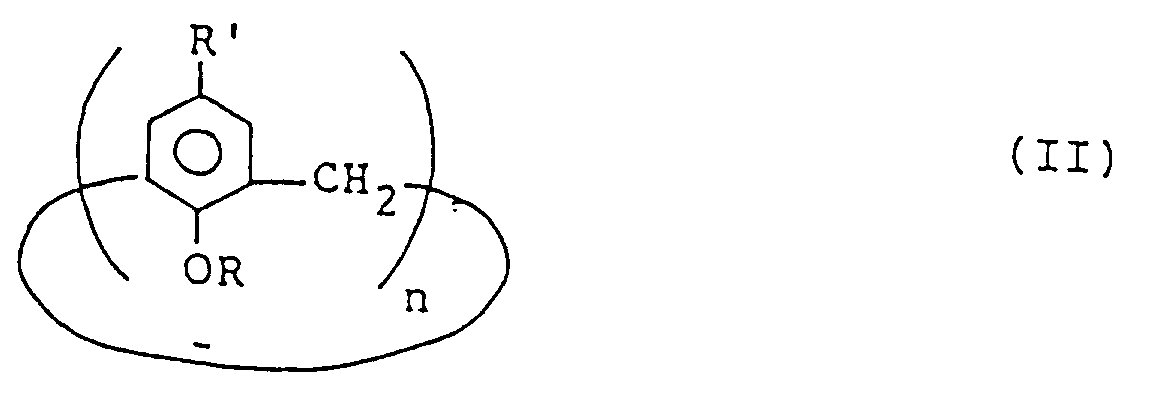
wobei der Film aus einer Lösung der Verbindung in einem organischen Lösungsmittel gebildet wird und dicker als 10 nm ist. - Film nach Anspruch 9, wobei R in der Formel (II) -H oder -COCH₃ ist, und R' in der Formel (II) eine Alkylgruppe mit 2 bis 10 Kohlenstoffatomen ist.
Applications Claiming Priority (4)
| Application Number | Priority Date | Filing Date | Title |
|---|---|---|---|
| JP120310/90 | 1990-05-10 | ||
| JP2120310A JPH0653819B2 (ja) | 1990-05-10 | 1990-05-10 | カリックスアレーンおよび/またはカリックスアレーン誘導体のフィルムおよびその製造法 |
| JP249151/90 | 1990-09-19 | ||
| JP24915190A JPH0723340B2 (ja) | 1990-09-19 | 1990-09-19 | カリックスアレーン誘導体およびそのフィルムおよびそのパターン形成方法 |
Publications (3)
| Publication Number | Publication Date |
|---|---|
| EP0456497A2 EP0456497A2 (de) | 1991-11-13 |
| EP0456497A3 EP0456497A3 (en) | 1993-03-31 |
| EP0456497B1 true EP0456497B1 (de) | 1995-07-05 |
Family
ID=26457921
Family Applications (1)
| Application Number | Title | Priority Date | Filing Date |
|---|---|---|---|
| EP91304191A Expired - Lifetime EP0456497B1 (de) | 1990-05-10 | 1991-05-09 | Lösliches Calixarenderivat und Filme von diesem |
Country Status (3)
| Country | Link |
|---|---|
| US (1) | US5143784A (de) |
| EP (1) | EP0456497B1 (de) |
| DE (1) | DE69110975T2 (de) |
Families Citing this family (26)
| Publication number | Priority date | Publication date | Assignee | Title |
|---|---|---|---|---|
| WO1995016681A1 (en) * | 1993-12-14 | 1995-06-22 | The Trustees Of The University Of Pennsylvania | Derivatized polythiophenes and devices comprising same |
| US5656702A (en) * | 1994-11-04 | 1997-08-12 | Ibc Advanced Technologies, Inc. | Processes for separating cesium from industrial streams containing other alkali metals using poly(hydroxyarylene) polymeric resins |
| IT1282709B1 (it) * | 1996-02-28 | 1998-03-31 | Nec Corp | Procedimento di formazione di configurazione ultrafine e procedimento di incisione ultrafine utilizzando derivato di |
| GB2312178A (en) * | 1996-04-16 | 1997-10-22 | Univ Sheffield | New calixarenes and their use in waterproofing |
| US5840814A (en) * | 1996-08-07 | 1998-11-24 | The University Of Akron | Multi-arm star polymers having a well-defined core and methods for the synthesis thereof |
| AU1060599A (en) * | 1997-09-05 | 1999-03-29 | Lockheed Martin Energy Research Corporation | Solvent and process for extracting cesium from alkaline waste solutions |
| JP3486341B2 (ja) * | 1997-09-18 | 2004-01-13 | 株式会社東芝 | 感光性組成物およびそれを用いたパターン形成法 |
| DE19835604A1 (de) * | 1998-04-21 | 1999-10-28 | Ulrich Roth | Verfahren zur Trennung von polycyclischen aromatischen Kohlenwasserstoffen (PAK) durch den Einsatz von calixarenmodifizierten Trennphasen für die Chromatographie |
| US6174503B1 (en) | 1998-09-03 | 2001-01-16 | Lockheed Martin Energy Research Corporation | Calixarene crown ether solvent composition and use thereof for extraction of cesium from alkaline waste solutions |
| KR100352815B1 (ko) * | 1999-12-23 | 2002-09-16 | 김태선 | 신규한 캘릭스크라운 유도체, 그의 제조 방법, 그를이용하여 제조된 자기조립 단분자층 및 그의 자기조립단분자층을 이용하는 단백질 단분자층의 고정화 방법 |
| US20040034223A1 (en) * | 2002-02-07 | 2004-02-19 | Covalent Partners, Llc. | Amphiphilic molecular modules and constructs based thereon |
| WO2003067286A2 (en) * | 2002-02-07 | 2003-08-14 | Covalent Partners, Llc | Nanofilm and membrane compositions |
| JP2005517017A (ja) * | 2002-02-07 | 2005-06-09 | コバレント パートナーズ, エルエルシー | 大環状モジュール組成物 |
| WO2003084679A1 (en) * | 2002-04-04 | 2003-10-16 | The Regents Of The University Of California | Immobilized calixarenes |
| WO2004022513A1 (ja) * | 2002-09-09 | 2004-03-18 | Nec Corporation | レジスト及びレジストパターン形成方法 |
| US20040106741A1 (en) * | 2002-09-17 | 2004-06-03 | Kriesel Joshua W. | Nanofilm compositions with polymeric components |
| WO2005030711A2 (en) * | 2003-08-06 | 2005-04-07 | Covalent Partners Llc | Bridged macrocyclic module compositions |
| US7993812B2 (en) * | 2009-07-23 | 2011-08-09 | International Business Machines Corporation | Calixarene blended molecular glass photoresists and processes of use |
| CN102597034A (zh) * | 2009-08-31 | 2012-07-18 | 三菱瓦斯化学株式会社 | 环状化合物、其制造方法、辐射敏感组合物及抗蚀图案形成方法 |
| CN102596874A (zh) * | 2009-09-09 | 2012-07-18 | 三菱瓦斯化学株式会社 | 环状化合物、其制造方法、辐射敏感组合物及抗蚀图案形成方法 |
| KR101801523B1 (ko) * | 2009-11-27 | 2017-11-27 | 미쯔비시 가스 케미칼 컴파니, 인코포레이티드 | 환상 화합물, 그 제조 방법, 감방사선성 조성물 및 레지스트 패턴 형성 방법 |
| JP5798964B2 (ja) * | 2012-03-27 | 2015-10-21 | 富士フイルム株式会社 | パターン形成方法、及び、これらを用いる電子デバイスの製造方法 |
| ITUB20153049A1 (it) * | 2015-08-10 | 2017-02-10 | Eni Spa | Composti metallici di calixareni, composizioni detergenti che li contengono e loro impiego in composizioni lubrificanti |
| WO2020072594A1 (en) * | 2018-10-02 | 2020-04-09 | The Penn State Research Foundation | Thin-film composite membrane and methods of making and using the same |
| CN114085298B (zh) * | 2021-11-30 | 2022-09-16 | 扬州大学 | 一种水溶性超分子包合物dpg及其制备方法和应用 |
| CN114957301B (zh) * | 2022-05-05 | 2024-01-19 | 陕西师范大学 | 一种基于杯[4]芳烃的荧光纳米薄膜及其可控制备方法和对气相二氧化氯的传感应用 |
Family Cites Families (1)
| Publication number | Priority date | Publication date | Assignee | Title |
|---|---|---|---|---|
| US4636539A (en) * | 1984-01-30 | 1987-01-13 | Loctite (Ireland) Limited | Instant adhesive composition utilizing calixarene accelerators |
-
1991
- 1991-05-02 US US07/694,491 patent/US5143784A/en not_active Expired - Lifetime
- 1991-05-09 DE DE69110975T patent/DE69110975T2/de not_active Expired - Lifetime
- 1991-05-09 EP EP91304191A patent/EP0456497B1/de not_active Expired - Lifetime
Also Published As
| Publication number | Publication date |
|---|---|
| US5143784A (en) | 1992-09-01 |
| DE69110975D1 (de) | 1995-08-10 |
| EP0456497A3 (en) | 1993-03-31 |
| EP0456497A2 (de) | 1991-11-13 |
| DE69110975T2 (de) | 1995-11-16 |
Similar Documents
| Publication | Publication Date | Title |
|---|---|---|
| EP0456497B1 (de) | Lösliches Calixarenderivat und Filme von diesem | |
| JP2562178B2 (ja) | 感光層形成材料用の放射線感応性混合物 | |
| JP2659055B2 (ja) | 高感度の乾式現像可能な深uv光用ホトレジスト | |
| JP2008247780A (ja) | オキシムスルホン酸化合物、及びそれを用いた感光性組成物 | |
| KR960014054B1 (ko) | 고에너지 방사선용 양성 방사선 민감성 혼합물 및 이로부터 제조된 방사선 민감성 기록물질 | |
| JP2002504577A (ja) | 改質多環式ポリマー | |
| KR100948213B1 (ko) | 감광성 화합물, 감광성 조성물, 레지스트 패턴의 형성방법및 디바이스의 제조방법 | |
| JP2540199B2 (ja) | デバイスの製造方法 | |
| US4301231A (en) | Negative resist for high energy radiation | |
| US4734481A (en) | Novel organometallic polymers | |
| US3950173A (en) | Electron beam recording article with o-quinone diazide compound | |
| JP2001249457A (ja) | 高塩基濃度水溶液の現像液とともに使用でき、架橋可能な高解像度フォトレジスト組成物、および該組成物を用いるフォトレジスト・パターンの形成方法 | |
| KR100198408B1 (ko) | 레지스트 물질 및 그의 사용방법 | |
| JPH0415232A (ja) | カリックスアレーンおよび/またはカリックスアレーン誘導体のフィルムおよびその製造法 | |
| CA2011728A1 (en) | Positive radiation-sensitive mixture, and radiation-sensitive recording material produced therefrom for high-energy radiation | |
| JPH0558446B2 (de) | ||
| Maekawa et al. | Design of High-sensitive Resist Materials Based on Polyacetals | |
| JP2964109B2 (ja) | ポジ型レジスト材料 | |
| JPH0723340B2 (ja) | カリックスアレーン誘導体およびそのフィルムおよびそのパターン形成方法 | |
| US20240319599A1 (en) | Gas releasing underlayers for photopatternable organometallic resist | |
| JPS63113021A (ja) | ポリシラン及びそれを用いた感光性組成物 | |
| JPS5983156A (ja) | 微細画像形成法 | |
| Bonetti | Preparation and Characterization of Light Sensitive Tetrafluoro-λ⁶-Sulfanyl-Containing Polymers | |
| JPS63234249A (ja) | ポジ型フオトレジスト組成物 | |
| WO2012133050A1 (ja) | チアカリックス[4]アレーン誘導体 |
Legal Events
| Date | Code | Title | Description |
|---|---|---|---|
| PUAI | Public reference made under article 153(3) epc to a published international application that has entered the european phase |
Free format text: ORIGINAL CODE: 0009012 |
|
| 17P | Request for examination filed |
Effective date: 19910521 |
|
| AK | Designated contracting states |
Kind code of ref document: A2 Designated state(s): DE FR GB |
|
| PUAL | Search report despatched |
Free format text: ORIGINAL CODE: 0009013 |
|
| AK | Designated contracting states |
Kind code of ref document: A3 Designated state(s): DE FR GB |
|
| 17Q | First examination report despatched |
Effective date: 19941114 |
|
| GRAA | (expected) grant |
Free format text: ORIGINAL CODE: 0009210 |
|
| AK | Designated contracting states |
Kind code of ref document: B1 Designated state(s): DE FR GB |
|
| REF | Corresponds to: |
Ref document number: 69110975 Country of ref document: DE Date of ref document: 19950810 |
|
| ET | Fr: translation filed | ||
| PLBE | No opposition filed within time limit |
Free format text: ORIGINAL CODE: 0009261 |
|
| STAA | Information on the status of an ep patent application or granted ep patent |
Free format text: STATUS: NO OPPOSITION FILED WITHIN TIME LIMIT |
|
| 26N | No opposition filed | ||
| REG | Reference to a national code |
Ref country code: GB Ref legal event code: IF02 |
|
| PGFP | Annual fee paid to national office [announced via postgrant information from national office to epo] |
Ref country code: GB Payment date: 20100329 Year of fee payment: 20 |
|
| PGFP | Annual fee paid to national office [announced via postgrant information from national office to epo] |
Ref country code: FR Payment date: 20100525 Year of fee payment: 20 |
|
| PGFP | Annual fee paid to national office [announced via postgrant information from national office to epo] |
Ref country code: DE Payment date: 20100512 Year of fee payment: 20 |
|
| REG | Reference to a national code |
Ref country code: DE Ref legal event code: R071 Ref document number: 69110975 Country of ref document: DE |
|
| REG | Reference to a national code |
Ref country code: GB Ref legal event code: PE20 Expiry date: 20110508 |
|
| PG25 | Lapsed in a contracting state [announced via postgrant information from national office to epo] |
Ref country code: GB Free format text: LAPSE BECAUSE OF EXPIRATION OF PROTECTION Effective date: 20110508 |
|
| PG25 | Lapsed in a contracting state [announced via postgrant information from national office to epo] |
Ref country code: DE Free format text: LAPSE BECAUSE OF EXPIRATION OF PROTECTION Effective date: 20110509 |