EP0453764A1 - Wärmedehnungsfuge - Google Patents
Wärmedehnungsfuge Download PDFInfo
- Publication number
- EP0453764A1 EP0453764A1 EP91104336A EP91104336A EP0453764A1 EP 0453764 A1 EP0453764 A1 EP 0453764A1 EP 91104336 A EP91104336 A EP 91104336A EP 91104336 A EP91104336 A EP 91104336A EP 0453764 A1 EP0453764 A1 EP 0453764A1
- Authority
- EP
- European Patent Office
- Prior art keywords
- layer
- thermal
- chip
- thermal joint
- set forth
- Prior art date
- Legal status (The legal status is an assumption and is not a legal conclusion. Google has not performed a legal analysis and makes no representation as to the accuracy of the status listed.)
- Withdrawn
Links
Images


Classifications
-
- H10W40/77—
-
- F—MECHANICAL ENGINEERING; LIGHTING; HEATING; WEAPONS; BLASTING
- F28—HEAT EXCHANGE IN GENERAL
- F28F—DETAILS OF HEAT-EXCHANGE AND HEAT-TRANSFER APPARATUS, OF GENERAL APPLICATION
- F28F13/00—Arrangements for modifying heat-transfer, e.g. increasing, decreasing
-
- H10W40/251—
-
- H10W40/258—
-
- F—MECHANICAL ENGINEERING; LIGHTING; HEATING; WEAPONS; BLASTING
- F28—HEAT EXCHANGE IN GENERAL
- F28F—DETAILS OF HEAT-EXCHANGE AND HEAT-TRANSFER APPARATUS, OF GENERAL APPLICATION
- F28F13/00—Arrangements for modifying heat-transfer, e.g. increasing, decreasing
- F28F2013/005—Thermal joints
- F28F2013/006—Heat conductive materials
-
- H10W72/07251—
-
- H10W72/20—
-
- H10W72/877—
Definitions
- the present invention relates to a thermal joint for transferring heat from a first surface such as a surface of an integrated circuit chip to a second surface such as a surface of a cooling hat.
- High speed computers and other fast electronic systems often require assemblies of many integrated circuit chips where each chip contains many active devices, and many chips are spaced closely together.
- the devices dissipate a very large power density, especially bipolar transistor devices.
- Proper electronic operation of the devices necessitates a cool operating temperature which, in turn, requires adequately cooling of the power density.
- the maximum allowable operating temperature of the devices and integrated circuit chips in combination with the limited cooling capability presently available limit the allowable power density, circuit density and system speed.
- Improved device and integrated circuit chip cooling results in increased permissible power density, circuit density and system speed.
- the prior art contains many forms of cooling.
- One form of cooling which has been proposed is the use of a metal plate held against circuit chips by springs, as is disclosed by Cutchaw in U.S. Patent No. 4,381,032.
- a heat exchanger incorporating a deflectably movable diaphragm in forced engagement with an integrated circuit package is disclosed by Cutchaw in U.S. Patent No. 4,341,432.
- Another form of heat exchanger for cooling electronic circuits provides for passages within which liquid coolant is circulated, the coolant contacting a flexible wall which is urged against the circuitry to be cooled as shown by Wilson et al, in U.S. Patent No. 4.072,188.
- heat exchanger employs coated metallic dendrites which are held by springs against a circuit chip as disclosed by Babuka et al in U.S. Patent No. 4,254,431.
- Yet another form of heat exchanger employs a pillow structure formed of a film and filled with a thermal liquid material for extracting heat from an electric circuit, as is disclosed by Spaight, in U.S. Patent No. 4,092,697.
- a malleable dimpled wafer is deformed by pressure between a heat source such as an electronic circuit and a heat sink, as is disclosed by Rhoades et al in U.S. patent No. 4,151,547.
- a well known thermal joint is a single thin layer of oil disposed between a chip and a cooling means.
- a crude thermal joint is a dry joint between a chip and a cooling means. Such a thermal joint provides contact only at tiny asperities, and everywhere else there are tiny air gaps and poor thermal conduction.
- the heat is conducted from the back of the chip, across a small gas-filled gap to the tip of the piston, along the length of the piston, across another gap to the socket, through the metal block, and finally is removed by convection into the flowing water.
- the piston tip is made flat for better thermal contact with the chip, there is oil between the chip and the piston, and there is a thermal paste between the piston and the socket.
- the modifications provide a certain degree of improved cooling ability.
- the piston is designed for movement within its socket to compensate for manufacturing tolerances and thermal distortions. To compensate for chip height variations, the piston is made to slide in the socket in a direction perpendicular to the chip surface. To compensate for chip tilt variations, the piston is designed to tilt within the socket.
- the piston tip is able to slide laterally over the chip surface or alternatively to slightly rotate or slide laterally in its socket.
- the various compliance modes prevent chip-to-chip variations from causing large stresses and hence damage.
- achieving the compliance modes requires sufficient clearance between the chip and the piston, and between the piston and the socket. Each clearance adds thermal resistance to the design.
- the prior art cooling schemes contain shortcomings and limitations. In order to effectively remove heat from high power density chips, where many chips are closely packaged on a multichip module, a "tight" thermal path is required from each chip to the coolant. The tight thermal path requirement conflicts with a "loose” path requirement such as is required for the above described compliance modes. In order to protect the fragile C4 connectors, the cooling system must not apply large stresses. Unfortunately, manufacturing variations result in significantly different chip heights and tilts. Also, differential thermal expansion significantly distorts the geometry of the system components so that a completely rigid system would develop excessive stresses. Temperature changes cause thermal expansion or contraction of the chips, substrate and cooling hat. The thermal expansion depends on the material involved, and is generally different for each element.
- One partial solution is to use oil or thermally enhanced paste in the gaps between elements (i.e., between the chip and the piston, or between the piston and the socket).
- Another partial solution is to design a more sophisticated geometry in which the piston and block are reshaped to increase their contact area. For example, the piston may be reshaped to increase the area adjacent to the metal block. Nevertheless these partial solutions while beneficial do not fully resolve the design conflict.
- a single chip module in combination with a printed circuit board may also be employed to package many chips close together.
- An example is a dual in-line package containing one chip, attached leads, and a plastic housing.
- the single chip modules are mounted on a common printed circuit board.
- Some applications might employ single chip modules with a printed circuit board to achieve close chip packing density and high chip power density. Even using such designs, when there is very high performance, a design conflict is manifest between the requirements of a "tight path" for high thermal conductivity and a "loose path” for mechanical compliance of the cooling system element.
- Patent applications entitled “Convection Transfer System” and “Compliant Fluidic Cooling Hat", U.S. Serial Nos. 515,802 and 515,889 both filed on April 27, 1991 and assigned to the same assignee as the present application, also concern heat transfer and cooling.
- the present invention as claimed overcomes the limitations found in the prior art by providing a thermal joint exhibiting the characteristics of superior heat conduction or transfer from a chip to a cooling hat, superior manufacturability including assembly, and the provision of a thermal joint which provides compensation for chip-to-chip manufacturing variations and thermal effects including manufacturing variation in chip height and chip tilt, and thermal distortions and the like caused thereby.
- the thermal joint will be described in terms of cooling integrated circuit chips on a horizontally disposed printed circuit substrate. However the joint applies equally as well to other types of electronic components, to other substrate orientations, and to transferring heat between non-electronic components. For example, the joint is applicable to cooling individually packaged chips on a printed circuit card or board. The thermal joint can also be used to transfer heat from hot fluid to cool components.
- a preferred embodiment of a thermal joint according to the present invention is the locating of a thermal joint between the top surface of an integrated circuit chip and the bottom surface of a cooling hat or other cooling means.
- the thermal joint comprises a high thermal conductivity planarized layer (sometimes hereafter referred to as a "shim") and a thin layer of a lubricant.
- a retainer preferably of plastic tape, covers the chip surface.
- the retainer is perforated at positions located over the center region of the chip and is sealed around the edges of the chip. In a one embodiment, the retainer is approximately 38 ⁇ m thick.
- the high thermal conductivity layer is preferably a solder which solidifies or freezes at a moderately low temperature.
- the layer is typically between 20 ⁇ m and 50 ⁇ m thick after planarization.
- the oil or lubricant layer is typically less than 1 ⁇ m thick.
- there is also an anti-adhesion coating which is a few molecules thick.
- the lubricant layers allow lateral movement in the joint thereby relieving lateral distortion and stress.
- the oil layer reduces dynamic friction and fills in any remaining gap.
- the anti-adhesion coating if added, reduces static friction.
- Each high thermal conductivity layer is planarized so that its top surface is at a standard location in the thermal joint. The layer therefore fills in variations in chip height and chip tilt.
- the bottom surface of the cooling hat is designed to be at a predetermined standard location. Thus each conductive layer mates accurately and gently with the adjacent cooling hat.
- Each part of the thermal joint forming the present invention has very good areal thermal conductivity.
- the conductive layer is relatively thick, but has high bulk thermal conductivity.
- the oil has poor bulk thermal conductivity, but is much thinner.
- the anti-adhesion coating is extremely thin.
- the retainer if present, does not cover the center of each chip, nor does the retainer cover a significant area of the chip top surface.
- the system including the thermal joint is highly self aligned in the vertical direction between the top surface of the chip and the bottom surface of the cooling hat.
- the cooling hat typically is closer than 50 ⁇ m to each chip.
- the planarized conductive layer fills the gap between the chip and cooling hat, leaving less than a l ⁇ m tolerance.
- the lubricant, particularly oil fills the 1 ⁇ m space.
- the resulting thermal joint complies with lateral distortions producing large stress by means of the lubricant and anti-adhesion coating facilitating lateral motion between elements of the system.
- a principal object of the present invention is therefore the provision of a thermal joint disposed between two surfaces which joint transfers heat from one surface to the other while compensating for manufacturing tolerances and thermal distortions.
- Another object of the invention is the provision of a thermal joint comprising a first layer of a high thermal conductivity material and second thin layer of a lubricant.
- a still another object of the invention is the provision of a thermal joint comprising a high thermal conductivity material layer and a lubricant layer and further includes a retainer.
- a further object of the invention is the provision of a thermal joint comprising a relatively thick solder layer and thin lubricant layer.
- a still further object of the invention is the provision of a thermal joint comprising a first layer of a high thermal conductivity material, a second thin layer of a lubricant and an anti-adhesion coating.
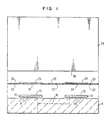
- FIGURE 1 in particular where there is shown a preferred embodiment of the thermal joint in accordance with the present invention. While the elements to be described in FIGURE 1 are shown separated from each other to facilitate a description of the invention, in operation the elements are in forced intimate contact with one another.
- An integrated circuit chip 10 having a top surface 12 is connected to a substrate or printed circuit board 14 by means of connections 16, for instance, C4 solder connectors.
- the printed circuit board 14 contains printed circuit wiring 18. While there is shown only two chips 10, it will be understood by those skilled in the art that any quantity of chips 10 may be attached in a two dimensional configuration to the printed circuit board 14.
- the preferred embodiment of the thermal joint itself comprises a retainer 20 which is disposed over the electronic assembly including chips 10 and substrate 14.
- the bottom surface of the retainer 20 as oriented in FIGURE 1 has a layer of low tack adhesive 22.
- the retainer is perforated according to a pattern such that a respective perforation appears in the retainer corresponding to the location of the center area of the top surface 12 of a respective chip 10.
- the adhesive 22 holds the retainer at the edges of the surface 12 and covers only a small portion of the top surface 12 of any chip 10.
- an individual perforated retainer 20 can be placed on the surface 12 of each chip 10 comprising the electronic assembly.
- a layer of high thermal conductivity planarized material 24 is disposed within each perforation and in contact with surface 12 .
- a thin layer of lubricant 26 is disposed adjacent to the material 24.
- the retainer 20 is a plastic tape such as a polyimide film and has a thickness in the range between 5 ⁇ m and 40 ⁇ m and preferably is approximately 38 ⁇ m thick.
- the high thermal conductivity planarized layer 24 is typically a solder which solidifies or freezes at a moderately low temperature in the range between 85°C and 183°C and is preferably a eutectic solder.
- the layer is typically between approximately 20 and 50 ⁇ m thick after planarization.
- the lubricant 26 is an oil layer such as poly-alyphatic olefin with an anti-oxidant additive and is less than approximately one ⁇ m thick.
- Box 28 represents a "cooling hat” or cooling means for transferring heat from the bottom surface 30 of the cooling hat to a fluid such as water or air flowing in the cooling means.
- means for urging the cooling hat into forced intimate contact with the thermal joining which is then urged into forced intimate contact with the top surface 12 of the chips 10 for providing a thermal path for the heat generated in the chips to travel to the cooling fluid.
- the means for urging the assembly into forced intimate contact also usually includes a locking mechanism which causes the applied force to maintain the joint closed, even during shock and vibration thereby preventing internal bouncing of the components and entrance of air or a gas into the joint.
- the construction of the means for urging and the locking mechanism are known in the art.
- the layer of high thermal conductive material 24 is bismuth and tin in the weight ratio of approximately 58:42.
- the material is eutectic, which melts at 138° and serves as a moderately low temperature solder.
- the melting point is selected to be between the chip operating temperature (typically 85°C) and the melting point of the electronic connectors 16. Typically the latter temperature is much hotter than 138°C.
- the Bi-Sn alloy Upon optical inspection, the Bi-Sn alloy maintains a smooth surface when it freezes in a mold and later stands alone. Apparently, Bi-Sn solder is little susceptible to roughening due to oxidation, density changes upon freezing, or elemental segregation. To prevent trapping air bubbles, the method taught in U.S. Patent No. 4,685,606 is employed.
- the material 24 can be any solder with similar properties, such as various indium alloys, or various bismuth alloys or other low temperature alloys. Also, the material 24 may be a metal mixture which slowly harden
- the thermal joint fabrication is facilitated by use of an alloy with a minimal oxide skin and minimal wrinkling upon freezing.
- Exemplary alloys are those containing bismuth and tin.
- chrome and certain other metals form a surface oxide which is self-limiting and self-possivating, thus minimizing the oxide skin.
- Metals such as bismuth, gallium and antimony expand upon freezing.
- gallium, indium, bismuth, and lead all have low melting temperature which is advantageous.
- Preferred alloys are those which contain a combination of metals that are self-passivating, expand upon freezing, contract upon freezing, and have a low melting temperature.
- Preferred alloys are tin or chrome for passivation and expansion; with bismuth or gallium or antimony for expansion; with gallium, indium, bismuth or lead for low melting temperature.
- the alloys include eutectic and non-eutectic alloys and alloys with two, three or more elements and include solid alloys, plastic-regime alloys and alloys which are solid, paste-like, or liquid alloys.
- the lubricant 26 is a low viscosity oil plus an anti-adhesion coating.
- the oil reduces dynamic friction and provides thermal conduction across an approximately one micron thick range gap.
- the coating reduces static friction and may enhance the wetting of the oil.
- a preferred oil is poly-alyphatic olefin with an anti-oxidant additive.
- the oil does not chemically attack near-by electronic components.
- the thermal joint must minimize adhesion / static friction. This is not automatically accomplished by use of a conventional liquid lubricant which reduces dynamic friction.
- the liquid lubricant might eventually be locally squeezed out an asperity (tiny protrusion) and hence cause adhesion/static friction.
- Anti-adhesion coatings are used in magnetic disk memories, and the techniques can be adapted from the disk technology to the present invention.
- a preferred embodiment of the invention has the anti-adhesion coating located on the bottom surface 30 of the cooling hat 28.
- a preferred anti-adhesion coating material is a PFPE (perfluropolyether) with an attachment group and a molecular weight of approximately 3000.
- Monte Edison Inc. of Italy manufacturers such a product under the name "Froblin Oil”.
- An example of a method for applying the coating is as follows. Make a dilute solution of the anti-adhesive in a solvent. Spread a thin layer of the solution on a chemically clean coldsheet surface. Bond the coating by baking or drying. Rinse off any unbonded coating with a solvent. The remaining bonded solution leaves a securely bonded coating.
- the thermal joint may use many types of anti-adhesion coatings. Many such coating have been used in magnetic disk systems and the same technology is transferable to the present invention.
- An alternative coating is hydrogenated amorphous carbon deposited over hydrogenated amorphous silicon, having a combined thickness of less than 100 ⁇ m and possibly much thinner.
- the coating can be applied by chemical vapor deposition to the bottom surface 30 of the cooling hat 20.
- An organic liquid lubricant readily wets the coating. In combination both the static and dynamic friction are reduced.
- the thermal joint may include many other oils and coatings having similar properties.
- oils include silicone oil, mineral oil, perflurocarbon oil, gallium or other liquid metal.
- Other anti-adhesion coating include perflurocarbon plastic (such as Teflon), graphite, molybdenum trioxide, or other layered materials. Molybdenum disulphide reduces adhesion, but unfortunately it also introduces sulfides, which might eventually chemically attack nearby electronics.
- the retainer 20 includes a polyimide (such as Kapton) film approximately 13 ⁇ m thick. Such a retainer easily tolerates the temperature necessary to melt the solder layer as will be described below.
- the adhesive 22 is a cured rubber such as synthetic polyisoprene, which is sometimes called "synthetic natural rubber". This is weakly adherent and can be peeled off cleanly, as will be described below. Clean peeling is important to prevent residues which later degrade the thermal conduction of the joint. Since the adhesive is synthetic, its chemical properties are better defined than true natural rubber. More generally, the retainer can use many other plastics and adhesives with similar properties.
- the thermal joint vertical dimensions of the adhesive layer 22 is typically 13 ⁇ m thick and the retainer 20 is typically 25 ⁇ m thick.
- the tilt of chips in an electronic assembly can vary within the range of ⁇ 60 ⁇ m compared to the nominal value.
- the height of the chips can vary within the range of ⁇ 20 ⁇ m height value.
- the minimum thickness of the high bulk thermal conductivity layer 24 is calculated to be the sum of the adhesive layer thickness, retainer thickness and maximum variation of tilt and height, or a total of 100 ⁇ m.
- the layer 24 may be tapered.
- the lubricant layer thickness is determined by considering several factors: surface texture of the top surface of the layer 24, the surface texture of the bottom surface 30 of the cooling hat 28, and the geometric mismatch between the two mentioned surfaces.
- the lubricant layer thickness is between 0.5 and 5 ⁇ m.
- the anti-adhesion coating minimizes the static friction.
- the coating is ultra-thin, typically between a few molecular layers and 0.1 ⁇ m.
- the joint lateral dimensions typically are as follows: the chips are 4.5 mm wide mounted on a 8.5 mm pitch, the retainer perforation is 3.5 mm wide yielding a border of 0.5 mm inboard of each edge.
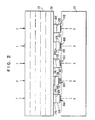
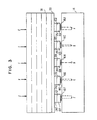
- FIGS 2 and 3 illustrate the concept of joint compliance. For clarity of the description, the manufacturing tolerances and thermal distortions are shown greatly exaggerated.
- Chip 10A illustrates an "ideal" chip.
- Chip 10B illustrates a chip which is too high.
- Chip 10C illustrates a tilted chip.
- Chip 10D illustrates a curved chip.
- Chip 10E illustrates a chip which is too low.
- these vertical variations are 0 to 50 ⁇ m thick.
- the dashed lines indicate the nature of each of these variations.
- each chip 10A to 10E there is a respective layer of thermal conductive material 24A to 24E between the top surface 12A to 12E of each respective chip and the bottom surface 30 of the cooling means 28.
- the assembly process (as explained below) readily achieves the required vertical compliance thereby eliminating large compression / tension stresses on the components.
- Figure 3 shows chips 10F to 10J having lateral variations in displacements ranging from far left in the case of chip 10F to far right in the case of chip 10J. Typically these horizontal displacements are less than 25 ⁇ m. Dashed lines and small arrows illustrate these displacements. Only chip 10H is in the ideal location. During repeated ON-OFF cycles of the electronic system non-uniform thermal expansion causes lateral differential motion between a chip and the adjacent cooling means. As a result of the lubricant layer disposed between high thermal conductivity material 24 and the bottom surface 30 of the cooling hat 28, there is sliding in the joint, which prevents shear stress in the connections 16F to 16J.
- thermal joint cannot provide all the compliance required for joining integrated circuit chips to ceramic substrates by means of C4 connectors.
- C4 connectors there are certain variations, such as distortions in a direction perpendicular to the substrate surface which occur after the layer 24 has been planarized and long range curvature in the substrate whose sagitta considerably exceeds the maximum layer 24 thickness.
- the use of a springy cooling hat is able to provide compliance for these substrate variations. Also, the springiness maintains the thermal joint in mild compression for reducing joint failures.
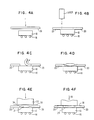
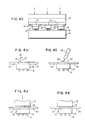
- FIGS 4A through 4K illustrate the preferred method of assembling a thermal joint in accordance with the present invention.
- the chips are attached to the substrate, the cooling hat is assembled, and the anti-adhesion coating is applied to the bottom surface of the cooling hat.
- the thermal joint is then ready to be assembled. While the following description refers to a single chip, it will be understood by those skilled in the art that a plurality of thermal joints are simultaneously being assembled for each chip in the electronic assembly.
- a retainer tape 20 with an adhesive layer 22 is held firmly above and in close proximity to the electronic assembly. Then a pneumatic force F is applied which causes the tape to contact the top surface 12 of a chip. Thereafter, the adhesive layer causes weak adhesion of the tape 20 to the top surface 12 of the chip.
- the tape 20 is perforated in a region adjoining the central area of the top surface of a respective chip.
- the perforation is achieved by UV laser ablation.
- the cut pieces of tape are removed, preferably by peeling back the material by use of a roller coated with a matching pattern of strong adhesive. It is highly desirable to peel the tape cleanly. Otherwise any residue must be carefully removed, since any remaining adhesive will degrade heat conduction.
- a small solder preform 24 is placed on the top surface 12 in approximately the center of each chip in the region where the tape was removed.
- a forming tool 32 having a smooth frontal surface 34 is placed over the entire assembly.
- the forming tool 32 is a smooth flat rigid plate at least the frontal surface of which is covered with a very smooth thin "release sheet" of plastic such as Kapton.
- An alternative embodiment of the forming with tool 32 has a metal frontal surface covered by an anti-adhesion coating.
- solder preform is heated, and the forming tool is urged towards the assembly in the direction of arrow 36.
- the entire assembly is heated slowly and uniformly.
- the temperature of all the elements is uniform, which minimizes some of the thermal distortions.
- solder liquifies and flows.
- Each solder preform is dimensioned to completely fill the gap within the perforated tape from the top surface of the chip to the frontal surface of the forming tool.
- the solder is planarized by reflow to match the forming tool geometry.
- any excess solder overflows from the chip to the adjacent retainer.
- the retainer adhering to the edge region of the chip keeps any excess solder away from the electronic assembly thereby avoiding any electrical short circuit.
- the solder is allowed to cool and freeze with the forming tool in place.
- the cooling is uniform in order to minimize thermal distortions.
- the forming tool 32 is removed from the assembly without disturbing the planarized solder surface.
- the tool is lifted off and then a release sheet 38 is peeled off the cooled solder.
- roll back of the release sheet is done with a sharp radius of curvature. Clean peeling is desired in order to prevent degradation of the thermal conduction of the joint.
- FIG. 5 shows a modification of the thermal joint assembly described above. Where the same components are shown in both Figures 1 and 5, the same reference numeral will be used to facilitate an understanding of the invention.
- the thermal joint shown in Figure 5 includes a thin metal foil 42.
- the thermal joint assembly includes a lubricant layer 26 disposed directly on the top surface 12 of chip 10.
- the high bulk thermal conductive layer 24 is located on the top surface of the foil 42 at locations corresponding to the location of the respective chips 10.
- the joint in Figure 5 does not contain a perforated retainer tape.
- heat is conducted directly through the foil 42.
- the foil is hermetically sealed to the substrate.
- the bottom surface of the foil 42 is made downwardly convex or the top of the chip 10 is made upwardly convex.
- the shape is achieved by embossing the foil in the regions over the centers of respective chips. The solder preform when melted will fill the gap between the embossment and the cooling means.
- the foil also serves the additional function of retaining any excess solder.
- FIG. 6 A modified embodiment of the thermal joint is shown in Figure 6, which includes metal buttons 60, 62 and a tape retainer layer 20.
- This embodiment compensates for large vertical differences, and can be pre-assembled or pre-fabricated, which facilitates final assembly. Also in this embodiment the high thermal conducting layer (eg. solder) is separated from the electronic components.
- the thermal joint assembly includes a lubricant layer 26 disposed directly on the top surface 12A and 12B of the chips 10A and 10B. Above each chip is a button 60, 62 of material with very high thermal conductivity, such as copper. The thicknesses of the buttons 60, 62 compensate for large pre-determined differences in the thicknesses of chips 10A, 10B.
- buttons 60, 62 and surrounding the electronic assembly there is a perforated retainer layer 20.
- a layer 24 with high bulk thermal conductivity, such as low melting soler there is a layer 24 with high bulk thermal conductivity, such as low melting soler.
- the button 60, 62 nevertheless allows the layer 24 to fill gaps, and the lubricant layer 26 permits sideways sliding movement.
- the adjacent button surface should be slightly convex. This can be done by inelastically bending ("coining") each button between a pair of dies, or by slightly grinding or polishing each button. To prevent the button from catching at the edge of the chip, the button size should be slightly different from the chip size. In order to make the retainer, in combination with the buttons, have very low chemical permeability, a very thin metal overcoat is deposited.
- the structure of oil-to-button-to-solder is particularily useful if chip bowing is small, or at least predeterminable (e.g. several microns variation in the sagitta).
- the retainer 20 and the buttons 60, 62 can be pre-assembled, for instance, by using methods analgous to those with chips.
- the retainer 20 and buttons 60, 62 can pre-fabricated like a printed circuit.
- a metal sheet e.g. copper 0.5 mm thick
- resist e.g. copper 0.5 mm thick
- the etch process should be chosen to minimize roughness, and may be followed by electrochemical polishing.
- the solder will eventually fill the surface roughness on one side.
- the result is a metal sheet with areas of various thicknesses which will eventually become the required button thicknesses.
- buttons are thus laminated to a polymer sheet. Apply resist to the polymer layer, lithographically mark the desired openings, and etch away unwanted polymer. This completes fabrication of the retainer and buttons. Finally apply a solder preform on top of the buttons and retainer.
- One skilled in the art of printed circuit processes can fabricate this retainer and buttons in many different ways (e.g. additive fabrication; dry etching of polymer).
- This pre-assembly or pre-fabrication of the retainer and buttons has advantages. These steps can be performed at a location remote from the chips, including tape lamination and cutting or etching. However to properly reflow the solder, the buttons must contact the chips. Even so, the pre-assembly facilitates keeping excess solder away from the electronics.
- Alternative thermal joint construction include: lubricant / button / foil / shim or lubricant / button / foil / retainer / solder or and lubricant / button / retainer / solder.
- foil embodiments are generally similar to embodiments with a perforated retainer. However foil provides tighter sealing but requires more complex fabrication.
- barrier layer refers both to a retainer with perforations and buttons, and also to a foil with large areal thermal conductivity but no perforations and with or without buttons.
- the barrier layer (foil 42 or retainer 20 with buttons 60, 62) and layer 24 may adhere to one another.
- the described embodiment permits layer "wetted metallurgical” adhesion, or a "non-wetted” weaker adhesion.
- the adherent high thermal conductvity layer does not impede sliding on the bottom of the barrier at the lubricant layer 26 adjacent to the chip.
- the system is separated at the lubricant layer, and the barrier, layer 24, and cooling means are removed as a single unit.
- the barrier and layer 24 must be renewed and planarized again.
- replacing the bottom surface may be required.
- the anti-adhesion coating is applied to top of the solder, instead of to the bottom of the cooling means.
- the lubricant layer is applied directly to the chip and underneath the layer 24 thereby alleviating stresses within the chip due to unequal thermal expansion between the chip and layer 24.
- the lubricant layer is applied to both the bottom of the cooling means and the top surface of the chip.
- the thermal joint structure is chip, high thermal conductivity layer, lubricant layer, high thermal conductivity layer and cooling means. That is, a second high bulk thermal conductivity layer is disposed between the lubricant layer and the cooling means.
- each solder layer is planarized independently using a method similar to that described above. It is also feasible that only the solder layer in contact with the chip is planarized.
- a new solder preform is used which is planarized in situ as described below. Such an arrangement facilitates field replacement with tight tolerances.
- a disadvantage of the arrangement is the complexity of the replacement process and the joint construction.
- the thermal resistance is increased.
- a further alternative joint construction is the forming of a stack in the form of a chip, a perforated retainer, a solder layer, a lubricant layer, foil layer, solder layer and the cooling means. Such an arrangement prevents the foil layer from contacting the corner or edge of the chip. The arrangement fills any gap between the foil layer and the cooling means and provides additional sealing.
- the assembly structure is unduly complex. In an arrangement where the solder layer only contacts with lubricant on the chip, the excess solder must not surround the chip edges to avoid joining of the chip to the bottom of the cooling means and thereby prevent lateral motion.
- the thermal joint with regard to the retainer tape.
- the electronic assembly is inverted while the solder is being planarized so that gravitational forces keep the excess solder against the frontal surface of the forming tool and away form the electronic assembly. Assembling the joint in this manner reduces the necessity for a retainer.
- Adhesive is not placed on the retainer tape. Pneumatic pressure difference maintains the retainer tape in position against the chip. Near the edge of each chip, the laser slightly melts the retainer tape to join the retainer to the chip. An IR laser is preferred laser in such a method. The plastic welding step may precede or coincide with the laser cutting process.
- the perforations are cut in the retainer tape before being placed over the chips.
- the retainer can be cut by inexpensive die cutting, thus eliminating the cut and peel steps described above.
- cutting and alignment tolerances become more critical requiring a wider margin region and smaller perforation area to achieve a reliable seal near the edges of each chip.
- the retainer is applied to the chips and custom cut, preferably with a laser. The more power generated in the chip, the larger the size of the cutout required to retain the reformed solder, and the better the thermal contact. The assembly is now complete.
- solder may be adequately planarized by plastic creep without melting. That is, the solder is merely pressed between the chip and the forming tool (or the cooling means). It is also possible in such case to warm the solder to a temperature below the melting point. In contrast with planarization by melting, planarization by plastic creep facilitates the maintaining of the excess solder away from the electronics assembly, hence reducing the need for the retainer.
- the amount of creep required occurs near room temperature or with only slight heating.
- Many soft solder alloys have a low yield strength at a temperature slightly below the melting temperature.
- most non-eutectic alloys have a "plastic regime" of temperatures, where the alloy is intermediate between a crystalline solid and a true liquid and when the alloy softens and creeps gradually, but does not liquify.
- Plastic creep allows planarization at an intermediate temperature, over a longer time, and without a tape retainer spacer.
- a eutectic solder alloy abruptly changes state from solid to liquid.
- planarizing the solder layer such as by using a mechanical process, such as cutting, polishing, or by a chemical - mechanical process.
- the alternative methods allow additional methods materials, particularly materials with very high thermal conductivity to fill very wide gaps. These materials include high conductivity copper, doped polyacetylene, or other electrically and thermally conducting plastics.
- the high thermal conductivity layers are planarized after being coupled to the electronic assembly. However, care is required to avoid the application of excessive force on the electronic connections and to prevent excess material from causing electrical short circuits.
- the non-coplanarity of each chip is measured and the thermal conductivity layer is mechanically shaped to match the non-coplanarity.
- a mechanically shape macroscopic layer is coupled with a planarized microscopic layer. While a mechanically shaped layer generally adds complexity, the filling of very wide gaps become possible. Shape layers are also useful where there is a large predictable non-coplanarity.
- Variations concerning the lubricant layer are also possible. For example, before applying the lubricant layer, the lubricant is dissolved in a solvent. A large drop of the resulting mixture is placed on each chip. The drop spreads and the solvent evaporates, leaving a thin layer of lubricant. This method is vulnerable to dust. Also, if the surface tension is not correct, then the thin lubricant layer will break into isolated microdroplets.
- the lubricant is applied by vapor transport from a warm lubricant bath to a cool surface of the cooling means or the high thermal conductive layer or the chip (depending on the thermal joint structure).
- the cooling means is used as a forming tool.
- the solder planarization and lubricant spreading are performed simultaneously in situ by urging the cooling means toward the electronic assembly.
- the planarized solder conforms to the bottom surface of the cooling means.
- this technique tends to form pockets of lubricant which degrade thermal conduction and degrades sliding.
- Another assembly modification permits the elimination of the retainer tape.
- any excess solder will be extruded from the chip and release sheet, and by virtue of gravitational forces the excess solder will flow away from the electronics assembly and adhere to the release sheet.
- the release sheet is subsequently peeled away the excess solder will adhere to the sheet, but the planarized solder disposed over each chip is not disturbed.
- the differential adhesion affect is achieved in any of several ways.
- a release sheet and forming tool which have a raised area over each chip and a recessed area outboard each chip can be employed. The recessed area surface promotes solder adhesion and gravitational forces drain away any excess solder.
- the cooling means is used as the forming tool, and the assembly is not separated after reflow.
- the lubricant layer should be disposed between the chip and the solder.
- Another way is to use release sheet with a pattern of anti-adhesion coatings over each chip, and pro-adhesion coating outboard of each chip.
- a further way is to use a release sheet with a cut-out blotter, instead of a retainer tape, surrounding each chip.
- the nominal shape of the cooling means and electronic assembly is not flat. Therefore, a forming tool which matches the nominal shape is used.
- the thickness may be different among memory and logic chips The difference of the gap may be too large for a solder layer alone to provide compensation.
- One solution is to selectively add a second high thermal conductivity layer.
- etched or plated copper foil which covers the electronic assembly is added to the assembly. The local foil thickness is matched to the nominal non-coplanarity.
- the thermal joint described above is not limited solely to applications of cooling by cooling means of integrated circuit chips mounted on a substrate or printed circuit board.
- One of these other applications is the provision of a heat conduction path between a discrete power component (such as a high power SCR) and an adjacent cooling unit (such as a large metal air cooled heat sink).
- the thermal joint allows better heat transfer and lower assembly force than conventional methods. Since this application often involves rough surfaces, and therefore a joint construction of high bulk conductivity material layer / lubricant layer / high bulk thermal conductivity material layer is preferred.
- conventional cooling techniques use thermally loaded elastomer as a thermal joint. Such a joint typically provides less thermal contact and requires substantial clamping force.
- Another prior technique is the use of a thermally loaded paste which provided less thermal contact and is messy to assemble and disassemble.
- FIG. 7 A further alternative embodiment is shown in Figure 7 when the thermal joint is combined with a piston linkage.
- the thermal joint is the same as that shown in Figure 1 with the cooling hat 28 replaced by a piston linkage.
- the thermal joint is disposed between the chip 10 and the face 44 of an associated piston 46.
- the same joint construction (indicated with prime notation) is used between the side of piston fin 48 and the adjacent block fin 50 in the cooled block 52.
- planarization by plastic creep and inverting the assembly during planarization, and perhaps the elimination of the retainer is preferred.
- the novel thermal joint facilitates heat conduction and provides some compliance between components forming the assembly.
- the thermal joint readily provides tilt compliance which is difficult to relieve with piston linkages.
- the described arrangement reduces the design conflict between good heat transfer and loose manufacturing clearance.
- thermal joint locations are preferable. There is considerable redundancy in the compliance provided by both the thermal joint between the chip and the piston 46, and the thermal joint between the piston fin 48 and block fin 50.
- the design may be simplified to a single joint of a solder layer with lubricant plus lubrication of a single joint with lubricant only, and the piston linkage.
- the thermal joint in accordance with the present invention can be used symbiotically with a cooling means whose bottom surface is a coldsheet made of a bendable metal sheet.
- a cooling means whose bottom surface is a coldsheet made of a bendable metal sheet.
- the present thermal joint compensates for lateral distortion by sliding of the lubricant layer, fills gaps in the range to 0.025 to 0.100 mm and complies with a substrate curvature having a radius in excess of several meters.
- a workable cooling system typically requires each of the three mentioned compliance modes. If any one of the modes is missing, proper cooling will be lacking. Therefore, the thermal joint in combination with the coldsheet forms a symbiotic cooling system.
- a "chip cube” structure contains multiple chips laminated together. The edges are grooved to form a flat face. Electrical connections are made through metallization along the chip edges.
- the chip cube is useful for very high density packaging of memory chips with few connections per chip and with low power per chip. Grinding the edges on the side opposite from the electrical connection result in flat surface through which heat can be removed through the thermal joint forming the present invention.
- electronic component or chip will be understood to include the chip cube structure.
- the thermal joint was describe in terms of cooling for nearly horizontal flat electronic components. Nevertheless the joint has more universal use. It can be used to conduct heat into a cool object, as well as to conduct heat form a warm object. It can be used in many heat transfer applications, to conduct heat between adjacent objects, not just components of an electronic systems.
- the present invention also provides for rework of the system. For example, consider a repair to a multichip module and cooling hat connected together by a quantity of thermal joints.
- the cooling hat can be removed from the thermal joint and module.
- the high conductivity pieces can be removed and the retainer peeled off of the chips.
- the module is now accessible for rework.
- the system can be subsequently reassembled by following the same procedure as the original construction of the thermal joint.
Landscapes
- Engineering & Computer Science (AREA)
- Physics & Mathematics (AREA)
- Thermal Sciences (AREA)
- Mechanical Engineering (AREA)
- General Engineering & Computer Science (AREA)
- Cooling Or The Like Of Semiconductors Or Solid State Devices (AREA)
- Cooling Or The Like Of Electrical Apparatus (AREA)
- Die Bonding (AREA)
Applications Claiming Priority (2)
| Application Number | Priority Date | Filing Date | Title |
|---|---|---|---|
| US07/515,906 US5291371A (en) | 1990-04-27 | 1990-04-27 | Thermal joint |
| US515906 | 1990-04-27 |
Publications (1)
| Publication Number | Publication Date |
|---|---|
| EP0453764A1 true EP0453764A1 (de) | 1991-10-30 |
Family
ID=24053265
Family Applications (1)
| Application Number | Title | Priority Date | Filing Date |
|---|---|---|---|
| EP91104336A Withdrawn EP0453764A1 (de) | 1990-04-27 | 1991-03-20 | Wärmedehnungsfuge |
Country Status (3)
| Country | Link |
|---|---|
| US (1) | US5291371A (de) |
| EP (1) | EP0453764A1 (de) |
| JP (1) | JP2699313B2 (de) |
Cited By (9)
| Publication number | Priority date | Publication date | Assignee | Title |
|---|---|---|---|---|
| EP0693780A3 (de) * | 1994-07-22 | 1997-05-28 | Ibm | Verfahren und Apparat,um einen Chip direct mit einer Wärmesenke zu verbinden |
| WO2000063968A1 (en) * | 1999-04-20 | 2000-10-26 | Tyco Electronics Corporation | Dissipation of heat from a circuit board having bare silicon chips mounted thereon |
| US6531771B1 (en) | 1999-04-20 | 2003-03-11 | Tyco Electronics Corporation | Dissipation of heat from a circuit board having bare silicon chips mounted thereon |
| EP1324388A3 (de) * | 2001-12-27 | 2004-06-16 | Polymatech Co., Ltd. | Kühlmethode elektronischer Komponenten und thermisch leitende Folie dafür |
| WO2004105129A1 (ja) * | 2003-05-23 | 2004-12-02 | Fujitsu Limited | プリント基板ユニットおよびその製造方法 |
| EP1976005A3 (de) * | 2007-03-29 | 2009-10-28 | Polymatech Co., Ltd. | Wärmeleitfähiges Folie und Herstellungsverfahren dafür |
| DE102009019029A1 (de) * | 2008-06-19 | 2009-12-31 | Infineon Technologies Ag | Sensormodul |
| GB2493019A (en) * | 2011-07-21 | 2013-01-23 | Control Tech Ltd | Heat sink adaptor or cooling hat |
| EP2466636A3 (de) * | 2010-12-20 | 2017-03-15 | Raytheon Company | Adaptives Wärmelückenpolster |
Families Citing this family (30)
| Publication number | Priority date | Publication date | Assignee | Title |
|---|---|---|---|---|
| US5373111A (en) * | 1993-11-19 | 1994-12-13 | Delco Electronics Corporation | Bond pad having a patterned bonding surface |
| US5801924A (en) * | 1996-02-22 | 1998-09-01 | Cray Research, Inc. | Method and apparatus for cooling daughter card modules |
| JPH1070219A (ja) * | 1996-08-27 | 1998-03-10 | Fujitsu Ltd | 実装モジュールの冷却装置 |
| US5848083A (en) * | 1996-10-24 | 1998-12-08 | Sdl, Inc. | Expansion-matched high-thermal-conductivity stress-relieved mounting modules |
| US6051888A (en) * | 1997-04-07 | 2000-04-18 | Texas Instruments Incorporated | Semiconductor package and method for increased thermal dissipation of flip-chip semiconductor package |
| KR100278137B1 (ko) | 1997-09-04 | 2001-01-15 | 가나이 쓰도무 | 반도체소자의 탑재방법 및 그 시스템, 반도체소자 분리장치 및ic카드의 제조방법 |
| JPH11307782A (ja) * | 1998-04-24 | 1999-11-05 | Semiconductor Energy Lab Co Ltd | 半導体装置およびその作製方法 |
| US6275381B1 (en) | 1998-12-10 | 2001-08-14 | International Business Machines Corporation | Thermal paste preforms as a heat transfer media between a chip and a heat sink and method thereof |
| US6343647B2 (en) * | 2000-01-11 | 2002-02-05 | Thermax International, Ll.C. | Thermal joint and method of use |
| DE50014427D1 (de) * | 2000-07-28 | 2007-08-02 | Infineon Technologies Ag | Verfahren zur Kontaktierung eines Halbleiterbauelementes |
| US6512183B2 (en) * | 2000-10-10 | 2003-01-28 | Matsushita Electric Industrial Co., Ltd. | Electronic component mounted member and repair method thereof |
| US6322257B1 (en) * | 2001-02-09 | 2001-11-27 | Lockheed Martin Corporation | Optical array chip packages with passive alignment features |
| US6601753B2 (en) * | 2001-05-17 | 2003-08-05 | Visteon Global Technologies, Inc. | Void-free die attachment method with low melting metal |
| US7682690B2 (en) | 2002-02-06 | 2010-03-23 | Parker-Hannifin Corporation | Thermal management materials having a phase change dispersion |
| US7208192B2 (en) * | 2002-05-31 | 2007-04-24 | Parker-Hannifin Corporation | Thermally or electrically-conductive form-in-place gap filter |
| US7416922B2 (en) * | 2003-03-31 | 2008-08-26 | Intel Corporation | Heat sink with preattached thermal interface material and method of making same |
| US7030485B2 (en) * | 2003-06-26 | 2006-04-18 | Intel Corporation | Thermal interface structure with integrated liquid cooling and methods |
| US6987671B2 (en) * | 2003-06-26 | 2006-01-17 | Intel Corporation | Composite thermal interface devices and methods for integrated circuit heat transfer |
| US7527090B2 (en) * | 2003-06-30 | 2009-05-05 | Intel Corporation | Heat dissipating device with preselected designed interface for thermal interface materials |
| US20050274489A1 (en) * | 2004-06-10 | 2005-12-15 | Brand Joseph H | Heat exchange device and method |
| US7687277B2 (en) * | 2004-12-22 | 2010-03-30 | Eastman Kodak Company | Thermally controlled fluidic self-assembly |
| US7362582B2 (en) * | 2005-06-14 | 2008-04-22 | International Business Machines Corporation | Cooling structure using rigid movable elements |
| US7355855B2 (en) * | 2005-06-14 | 2008-04-08 | International Business Machines Corporation | Compliant thermal interface structure utilizing spring elements |
| US7593228B2 (en) * | 2005-10-26 | 2009-09-22 | Indium Corporation Of America | Technique for forming a thermally conductive interface with patterned metal foil |
| JP4514722B2 (ja) * | 2006-02-20 | 2010-07-28 | 富士通セミコンダクター株式会社 | フィルム貼り付け方法、フィルム貼り付け装置および半導体装置の製造方法 |
| JP4934490B2 (ja) * | 2007-05-07 | 2012-05-16 | 株式会社リコー | 画像形成装置 |
| US9826662B2 (en) * | 2013-12-12 | 2017-11-21 | General Electric Company | Reusable phase-change thermal interface structures |
| EP3163611B1 (de) * | 2015-11-02 | 2021-06-30 | ABB Schweiz AG | Elektronische leistungsbaugruppe |
| CN112469219A (zh) * | 2020-11-16 | 2021-03-09 | 南京长峰航天电子科技有限公司 | 一种小型化Ka波段固态功放电路、组件和拼装件 |
| JP7327579B1 (ja) * | 2022-05-30 | 2023-08-16 | 富士電機株式会社 | 半導体装置及び電力変換装置 |
Citations (4)
| Publication number | Priority date | Publication date | Assignee | Title |
|---|---|---|---|---|
| US4384610A (en) * | 1981-10-19 | 1983-05-24 | Mcdonnell Douglas Corporation | Simple thermal joint |
| EP0193747A2 (de) * | 1985-03-04 | 1986-09-10 | Hitachi, Ltd. | Kühlungsanordnung für integrierten Schaltungschip |
| EP0344084A2 (de) * | 1988-05-26 | 1989-11-29 | International Business Machines Corporation | Kühlmodul hoher Leitfähigkeit mit internen Rippen und anpassbaren Stossflächen für VLSI Technologie |
| US4915167A (en) * | 1988-08-05 | 1990-04-10 | Westinghouse Electric Corp. | Thermal coupling to enhance heat transfer |
Family Cites Families (32)
| Publication number | Priority date | Publication date | Assignee | Title |
|---|---|---|---|---|
| US3405323A (en) * | 1967-03-20 | 1968-10-08 | Ibm | Apparatus for cooling electrical components |
| US3626252A (en) * | 1970-01-21 | 1971-12-07 | Keithley Instruments | Temperature equalization for printed circuits |
| US4072188A (en) * | 1975-07-02 | 1978-02-07 | Honeywell Information Systems Inc. | Fluid cooling systems for electronic systems |
| US4069497A (en) * | 1975-08-13 | 1978-01-17 | Emc Technology, Inc. | High heat dissipation mounting for solid state devices and circuits |
| US4092697A (en) * | 1976-12-06 | 1978-05-30 | International Business Machines Corporation | Heat transfer mechanism for integrated circuit package |
| US4151547A (en) * | 1977-09-07 | 1979-04-24 | General Electric Company | Arrangement for heat transfer between a heat source and a heat sink |
| US4233645A (en) * | 1978-10-02 | 1980-11-11 | International Business Machines Corporation | Semiconductor package with improved conduction cooling structure |
| US4323914A (en) * | 1979-02-01 | 1982-04-06 | International Business Machines Corporation | Heat transfer structure for integrated circuit package |
| US4258411A (en) * | 1979-05-21 | 1981-03-24 | Bell Telephone Laboratories, Incorporated | Electronic device packaging arrangement |
| US4226281A (en) * | 1979-06-11 | 1980-10-07 | International Business Machines Corporation | Thermal conduction module |
| US4254431A (en) * | 1979-06-20 | 1981-03-03 | International Business Machines Corporation | Restorable backbond for LSI chips using liquid metal coated dendrites |
| US4341432A (en) * | 1979-08-06 | 1982-07-27 | Cutchaw John M | Liquid cooled connector for integrated circuit packages |
| US4381032A (en) * | 1981-04-23 | 1983-04-26 | Cutchaw John M | Apparatus for cooling high-density integrated circuit packages |
| US4462462A (en) * | 1981-11-17 | 1984-07-31 | International Business Machines Corporation | Thermal conduction piston for semiconductor packages |
| US4607277A (en) * | 1982-03-16 | 1986-08-19 | International Business Machines Corporation | Semiconductor assembly employing noneutectic alloy for heat dissipation |
| US4546409A (en) * | 1982-04-02 | 1985-10-08 | Mitsubishi Denki Kabushiki Kaisha | Device for cooling semiconductor elements |
| US4494171A (en) * | 1982-08-24 | 1985-01-15 | Sundstrand Corporation | Impingement cooling apparatus for heat liberating device |
| US4561011A (en) * | 1982-10-05 | 1985-12-24 | Mitsubishi Denki Kabushiki Kaisha | Dimensionally stable semiconductor device |
| US4551787A (en) * | 1983-02-07 | 1985-11-05 | Sperry Corporation | Apparatus for use in cooling integrated circuit chips |
| JPS59200495A (ja) * | 1983-04-27 | 1984-11-13 | 株式会社日立製作所 | マルチチツプ・モジユ−ル |
| JPS59225547A (ja) * | 1983-06-06 | 1984-12-18 | Nippon Telegr & Teleph Corp <Ntt> | 熱伝導体 |
| US4730665A (en) * | 1983-07-14 | 1988-03-15 | Technology Enterprises Company | Apparatus for cooling high-density integrated circuit packages |
| US4531146A (en) * | 1983-07-14 | 1985-07-23 | Cutchaw John M | Apparatus for cooling high-density integrated circuit packages |
| US4602314A (en) * | 1983-10-14 | 1986-07-22 | Intel Corporation | Heat conduction mechanism for semiconductor devices |
| US4567505A (en) * | 1983-10-27 | 1986-01-28 | The Board Of Trustees Of The Leland Stanford Junior University | Heat sink and method of attaching heat sink to a semiconductor integrated circuit and the like |
| US4612601A (en) * | 1983-11-30 | 1986-09-16 | Nec Corporation | Heat dissipative integrated circuit chip package |
| US4639829A (en) * | 1984-06-29 | 1987-01-27 | International Business Machines Corporation | Thermal conduction disc-chip cooling enhancement means |
| US4561040A (en) * | 1984-07-12 | 1985-12-24 | Ibm Corporation | Cooling system for VLSI circuit chips |
| US4879632A (en) * | 1985-10-04 | 1989-11-07 | Fujitsu Limited | Cooling system for an electronic circuit device |
| US4758926A (en) * | 1986-03-31 | 1988-07-19 | Microelectronics And Computer Technology Corporation | Fluid-cooled integrated circuit package |
| US4730666A (en) * | 1986-04-30 | 1988-03-15 | International Business Machines Corporation | Flexible finned heat exchanger |
| JPS63100759A (ja) * | 1986-10-17 | 1988-05-02 | Hitachi Ltd | Icチツプの冷却装置 |
-
1990
- 1990-04-27 US US07/515,906 patent/US5291371A/en not_active Expired - Fee Related
-
1991
- 1991-02-28 JP JP3055537A patent/JP2699313B2/ja not_active Expired - Lifetime
- 1991-03-20 EP EP91104336A patent/EP0453764A1/de not_active Withdrawn
Patent Citations (4)
| Publication number | Priority date | Publication date | Assignee | Title |
|---|---|---|---|---|
| US4384610A (en) * | 1981-10-19 | 1983-05-24 | Mcdonnell Douglas Corporation | Simple thermal joint |
| EP0193747A2 (de) * | 1985-03-04 | 1986-09-10 | Hitachi, Ltd. | Kühlungsanordnung für integrierten Schaltungschip |
| EP0344084A2 (de) * | 1988-05-26 | 1989-11-29 | International Business Machines Corporation | Kühlmodul hoher Leitfähigkeit mit internen Rippen und anpassbaren Stossflächen für VLSI Technologie |
| US4915167A (en) * | 1988-08-05 | 1990-04-10 | Westinghouse Electric Corp. | Thermal coupling to enhance heat transfer |
Non-Patent Citations (3)
| Title |
|---|
| IBM TECHNICAL DISCLOSURE BULLETIN. vol. 22, no. 1, June 1979, NEW YORK US pages 97 - 98; J.R.LYNCH: "Air and liquid drop cooled module" * |
| IBM TECHNICAL DISCLOSURE BULLETIN. vol. 23, no. 06, November 1980, NEW YORK US page 2308 R.C.MILLER: "Structure for achieving thermal enhancement in a semiconductor package" * |
| IBM TECHNICAL DISCLOSURE BULLETIN. vol. 27, no. 7A, December 1984, NEW YORK US page 3915 J.L.HORVATH: "Cooling assembly for solder-bonded semiconductor devices" * |
Cited By (18)
| Publication number | Priority date | Publication date | Assignee | Title |
|---|---|---|---|---|
| EP0693780A3 (de) * | 1994-07-22 | 1997-05-28 | Ibm | Verfahren und Apparat,um einen Chip direct mit einer Wärmesenke zu verbinden |
| WO2000063968A1 (en) * | 1999-04-20 | 2000-10-26 | Tyco Electronics Corporation | Dissipation of heat from a circuit board having bare silicon chips mounted thereon |
| US6162663A (en) * | 1999-04-20 | 2000-12-19 | Schoenstein; Paul G. | Dissipation of heat from a circuit board having bare silicon chips mounted thereon |
| US6531771B1 (en) | 1999-04-20 | 2003-03-11 | Tyco Electronics Corporation | Dissipation of heat from a circuit board having bare silicon chips mounted thereon |
| KR100742521B1 (ko) * | 1999-04-20 | 2007-08-02 | 다우 코닝 코포레이션 | 베어 실리콘 칩을 기판상에 실장한 회로 기판의 열 방산 |
| EP1324388A3 (de) * | 2001-12-27 | 2004-06-16 | Polymatech Co., Ltd. | Kühlmethode elektronischer Komponenten und thermisch leitende Folie dafür |
| US7094459B2 (en) | 2001-12-27 | 2006-08-22 | Polymatech Co., Ltd. | Method for cooling electronic components and thermally conductive sheet for use therewith |
| WO2004105129A1 (ja) * | 2003-05-23 | 2004-12-02 | Fujitsu Limited | プリント基板ユニットおよびその製造方法 |
| EP1976005A3 (de) * | 2007-03-29 | 2009-10-28 | Polymatech Co., Ltd. | Wärmeleitfähiges Folie und Herstellungsverfahren dafür |
| KR100990693B1 (ko) | 2007-03-29 | 2010-10-29 | 폴리마테크 컴퍼니 리미티드 | 열전도성 시트 및 이의 제조방법 |
| TWI384937B (zh) * | 2007-03-29 | 2013-02-01 | 保力馬科技股份有限公司 | 導熱片及其製造方法 |
| US8691368B2 (en) | 2007-03-29 | 2014-04-08 | Polymatech Co., Ltd. | Thermally conductive sheet and method of manufacturing the same |
| DE102009019029A1 (de) * | 2008-06-19 | 2009-12-31 | Infineon Technologies Ag | Sensormodul |
| US8130506B2 (en) | 2008-06-19 | 2012-03-06 | Infineon Technologies Ag | Sensor module |
| DE102009019029B4 (de) * | 2008-06-19 | 2012-09-27 | Infineon Technologies Ag | Verfahren zur Herstellung eines Sensormoduls |
| US9177879B2 (en) | 2008-06-19 | 2015-11-03 | Infineon Technologies Ag | Sensor module |
| EP2466636A3 (de) * | 2010-12-20 | 2017-03-15 | Raytheon Company | Adaptives Wärmelückenpolster |
| GB2493019A (en) * | 2011-07-21 | 2013-01-23 | Control Tech Ltd | Heat sink adaptor or cooling hat |
Also Published As
| Publication number | Publication date |
|---|---|
| JPH05206180A (ja) | 1993-08-13 |
| US5291371A (en) | 1994-03-01 |
| JP2699313B2 (ja) | 1998-01-19 |
Similar Documents
| Publication | Publication Date | Title |
|---|---|---|
| US5291371A (en) | Thermal joint | |
| US4730666A (en) | Flexible finned heat exchanger | |
| US4993482A (en) | Coiled spring heat transfer element | |
| US5409157A (en) | Composite transversely plastic interconnect for microchip carrier | |
| CA1083261A (en) | Method for making conduction-cooled circuit package | |
| US5971253A (en) | Microelectronic component mounting with deformable shell terminals | |
| CA1093699A (en) | Conduction-cooled circuit package and method for making same | |
| US7429502B2 (en) | Integrated circuit device incorporating metallurgical bond to enhance thermal conduction to a heat sink | |
| EP0792573B1 (de) | Nachgiebige thermische verbinder und baugruppen | |
| US6849953B2 (en) | Microelectronic assemblies with composite conductive elements | |
| US20080042264A1 (en) | Apparatus and Methods for Cooling Semiconductor Integrated Circuit Package Structures | |
| EP2187440A2 (de) | Wärmestrahlungsmaterial, elektronische Vorrichtung und Verfahren zur Herstellung der elektronischen Vorrichtung | |
| JPS6323658B2 (de) | ||
| JPS6054785B2 (ja) | 集積回路アセンブリの製造方法 | |
| US6472305B1 (en) | Method of manufacturing bonded structure of film substrate and semiconductor chip | |
| US20090152713A1 (en) | Integrated circuit assembly including thermal interface material comprised of oil or wax | |
| TWI870871B (zh) | 半導體器件及其製造方法 | |
| JP7289889B2 (ja) | 熱応力補償接合層及びこれを包含するパワーエレクトロニクスアセンブリ | |
| JPH11354677A (ja) | 半導体装置の実装構造および実装方法 | |
| KR102574941B1 (ko) | 극저온 디바이스들 위한 열화 구조 | |
| US7645641B2 (en) | Cooling device with a preformed compliant interface | |
| JP2010118469A (ja) | 半導体装置及びその製造方法 | |
| JPH11135691A (ja) | 電子回路装置 | |
| WO1999016128A1 (fr) | Module a semiconducteur | |
| US5641114A (en) | Controlled temperature bonding |
Legal Events
| Date | Code | Title | Description |
|---|---|---|---|
| PUAI | Public reference made under article 153(3) epc to a published international application that has entered the european phase |
Free format text: ORIGINAL CODE: 0009012 |
|
| AK | Designated contracting states |
Kind code of ref document: A1 Designated state(s): DE FR GB IT |
|
| 17P | Request for examination filed |
Effective date: 19911219 |
|
| 17Q | First examination report despatched |
Effective date: 19940419 |
|
| STAA | Information on the status of an ep patent application or granted ep patent |
Free format text: STATUS: THE APPLICATION HAS BEEN WITHDRAWN |
|
| 18W | Application withdrawn |
Withdrawal date: 19980313 |
|
| R18W | Application withdrawn (corrected) |
Effective date: 19980408 |
|
| R18W | Application withdrawn (corrected) |
Effective date: 19980313 |