EP0451556B1 - Stabilisierte Polyaryletherketon-Formmassen - Google Patents
Stabilisierte Polyaryletherketon-Formmassen Download PDFInfo
- Publication number
- EP0451556B1 EP0451556B1 EP91104273A EP91104273A EP0451556B1 EP 0451556 B1 EP0451556 B1 EP 0451556B1 EP 91104273 A EP91104273 A EP 91104273A EP 91104273 A EP91104273 A EP 91104273A EP 0451556 B1 EP0451556 B1 EP 0451556B1
- Authority
- EP
- European Patent Office
- Prior art keywords
- polyaryl ether
- ether ketone
- weight
- component
- stabilized
- Prior art date
- Legal status (The legal status is an assumption and is not a legal conclusion. Google has not performed a legal analysis and makes no representation as to the accuracy of the status listed.)
- Expired - Lifetime
Links
- 229920006260 polyaryletherketone Polymers 0.000 title claims description 35
- 239000000206 moulding compound Substances 0.000 title 1
- 239000000203 mixture Substances 0.000 claims description 26
- 238000000465 moulding Methods 0.000 claims description 24
- 239000000835 fiber Substances 0.000 claims description 10
- 125000003118 aryl group Chemical group 0.000 claims description 9
- 238000004519 manufacturing process Methods 0.000 claims description 9
- 238000006068 polycondensation reaction Methods 0.000 claims description 8
- FSEXLNMNADBYJU-UHFFFAOYSA-N 2-phenylquinoline Chemical compound C1=CC=CC=C1C1=CC=C(C=CC=C2)C2=N1 FSEXLNMNADBYJU-UHFFFAOYSA-N 0.000 claims description 6
- WZJYKHNJTSNBHV-UHFFFAOYSA-N benzo[h]quinoline Chemical compound C1=CN=C2C3=CC=CC=C3C=CC2=C1 WZJYKHNJTSNBHV-UHFFFAOYSA-N 0.000 claims description 6
- IYYZUPMFVPLQIF-UHFFFAOYSA-N dibenzothiophene Chemical compound C1=CC=C2C3=CC=CC=C3SC2=C1 IYYZUPMFVPLQIF-UHFFFAOYSA-N 0.000 claims description 6
- RDOWQLZANAYVLL-UHFFFAOYSA-N phenanthridine Chemical compound C1=CC=C2C3=CC=CC=C3C=NC2=C1 RDOWQLZANAYVLL-UHFFFAOYSA-N 0.000 claims description 6
- 229920001169 thermoplastic Polymers 0.000 claims description 6
- 239000004416 thermosoftening plastic Substances 0.000 claims description 6
- 238000009835 boiling Methods 0.000 claims description 5
- 239000000126 substance Substances 0.000 claims description 5
- KLLLJCACIRKBDT-UHFFFAOYSA-N 2-phenyl-1H-indole Chemical compound N1C2=CC=CC=C2C=C1C1=CC=CC=C1 KLLLJCACIRKBDT-UHFFFAOYSA-N 0.000 claims description 4
- VIJYEGDOKCKUOL-UHFFFAOYSA-N 9-phenylcarbazole Chemical compound C1=CC=CC=C1N1C2=CC=CC=C2C2=CC=CC=C21 VIJYEGDOKCKUOL-UHFFFAOYSA-N 0.000 claims description 4
- 239000000945 filler Substances 0.000 claims description 4
- 150000002894 organic compounds Chemical class 0.000 claims description 4
- SKFLCXNDKRUHTA-UHFFFAOYSA-N phenyl(pyridin-4-yl)methanone Chemical compound C=1C=NC=CC=1C(=O)C1=CC=CC=C1 SKFLCXNDKRUHTA-UHFFFAOYSA-N 0.000 claims description 4
- BRIKLJCDBBFRAE-UHFFFAOYSA-N 1,2-diphenylindole Chemical compound C=1C=CC=CC=1N1C2=CC=CC=C2C=C1C1=CC=CC=C1 BRIKLJCDBBFRAE-UHFFFAOYSA-N 0.000 claims description 3
- SFWZZSXCWQTORH-UHFFFAOYSA-N 1-methyl-2-phenylindole Chemical compound C=1C2=CC=CC=C2N(C)C=1C1=CC=CC=C1 SFWZZSXCWQTORH-UHFFFAOYSA-N 0.000 claims description 3
- VEPOHXYIFQMVHW-XOZOLZJESA-N 2,3-dihydroxybutanedioic acid (2S,3S)-3,4-dimethyl-2-phenylmorpholine Chemical compound OC(C(O)C(O)=O)C(O)=O.C[C@H]1[C@@H](OCCN1C)c1ccccc1 VEPOHXYIFQMVHW-XOZOLZJESA-N 0.000 claims description 3
- PJUOHDQXFNPPRF-UHFFFAOYSA-N 2,6-diphenylpyridine Chemical compound C1=CC=CC=C1C1=CC=CC(C=2C=CC=CC=2)=N1 PJUOHDQXFNPPRF-UHFFFAOYSA-N 0.000 claims description 3
- VEKIYFGCEAJDDT-UHFFFAOYSA-N 2-pyridin-3-ylpyridine Chemical compound N1=CC=CC=C1C1=CC=CN=C1 VEKIYFGCEAJDDT-UHFFFAOYSA-N 0.000 claims description 3
- PCNDJXKNXGMECE-UHFFFAOYSA-N Phenazine Natural products C1=CC=CC2=NC3=CC=CC=C3N=C21 PCNDJXKNXGMECE-UHFFFAOYSA-N 0.000 claims description 3
- BGKXPCKKTMMEIJ-UHFFFAOYSA-N [2-[6-(2-benzoylphenyl)pyridin-2-yl]phenyl]-phenylmethanone Chemical compound C=1C=CC=C(C=2N=C(C=CC=2)C=2C(=CC=CC=2)C(=O)C=2C=CC=CC=2)C=1C(=O)C1=CC=CC=C1 BGKXPCKKTMMEIJ-UHFFFAOYSA-N 0.000 claims description 3
- IFJBGEVMTSSQSC-UHFFFAOYSA-N [4-[6-(4-benzoylphenoxy)pyridin-2-yl]oxyphenyl]-phenylmethanone Chemical compound C=1C=C(OC=2N=C(OC=3C=CC(=CC=3)C(=O)C=3C=CC=CC=3)C=CC=2)C=CC=1C(=O)C1=CC=CC=C1 IFJBGEVMTSSQSC-UHFFFAOYSA-N 0.000 claims description 3
- 229910052799 carbon Inorganic materials 0.000 claims description 3
- 229910052736 halogen Chemical class 0.000 claims description 3
- 150000002367 halogens Chemical class 0.000 claims description 3
- YRHRIQCWCFGUEQ-UHFFFAOYSA-N thioxanthen-9-one Chemical compound C1=CC=C2C(=O)C3=CC=CC=C3SC2=C1 YRHRIQCWCFGUEQ-UHFFFAOYSA-N 0.000 claims description 3
- 125000004209 (C1-C8) alkyl group Chemical class 0.000 claims 2
- 125000006736 (C6-C20) aryl group Chemical class 0.000 claims 2
- 230000006641 stabilisation Effects 0.000 claims 1
- 238000011105 stabilization Methods 0.000 claims 1
- 229920000642 polymer Polymers 0.000 description 9
- 238000000034 method Methods 0.000 description 7
- 239000003381 stabilizer Substances 0.000 description 6
- 239000002253 acid Substances 0.000 description 4
- 150000001875 compounds Chemical class 0.000 description 4
- 239000000155 melt Substances 0.000 description 4
- 125000004435 hydrogen atom Chemical group [H]* 0.000 description 3
- 238000005259 measurement Methods 0.000 description 3
- 239000002808 molecular sieve Substances 0.000 description 3
- URGAHOPLAPQHLN-UHFFFAOYSA-N sodium aluminosilicate Chemical compound [Na+].[Al+3].[O-][Si]([O-])=O.[O-][Si]([O-])=O URGAHOPLAPQHLN-UHFFFAOYSA-N 0.000 description 3
- -1 C20 aryl radicals Chemical class 0.000 description 2
- 238000005727 Friedel-Crafts reaction Methods 0.000 description 2
- 239000002841 Lewis acid Substances 0.000 description 2
- OFOBLEOULBTSOW-UHFFFAOYSA-N Malonic acid Chemical compound OC(=O)CC(O)=O OFOBLEOULBTSOW-UHFFFAOYSA-N 0.000 description 2
- GWEVSGVZZGPLCZ-UHFFFAOYSA-N Titan oxide Chemical compound O=[Ti]=O GWEVSGVZZGPLCZ-UHFFFAOYSA-N 0.000 description 2
- 239000000654 additive Substances 0.000 description 2
- 239000004760 aramid Substances 0.000 description 2
- 229920003235 aromatic polyamide Polymers 0.000 description 2
- TZCXTZWJZNENPQ-UHFFFAOYSA-L barium sulfate Chemical compound [Ba+2].[O-]S([O-])(=O)=O TZCXTZWJZNENPQ-UHFFFAOYSA-L 0.000 description 2
- 239000002585 base Substances 0.000 description 2
- USIUVYZYUHIAEV-UHFFFAOYSA-N diphenyl ether Chemical compound C=1C=CC=CC=1OC1=CC=CC=C1 USIUVYZYUHIAEV-UHFFFAOYSA-N 0.000 description 2
- 239000011888 foil Substances 0.000 description 2
- 150000007517 lewis acids Chemical class 0.000 description 2
- 229910044991 metal oxide Inorganic materials 0.000 description 2
- 150000004706 metal oxides Chemical class 0.000 description 2
- 238000002156 mixing Methods 0.000 description 2
- 125000002347 octyl group Chemical group [H]C([*])([H])C([H])([H])C([H])([H])C([H])([H])C([H])([H])C([H])([H])C([H])([H])C([H])([H])[H] 0.000 description 2
- 239000002904 solvent Substances 0.000 description 2
- XLYOFNOQVPJJNP-UHFFFAOYSA-N water Substances O XLYOFNOQVPJJNP-UHFFFAOYSA-N 0.000 description 2
- UVGPELGZPWDPFP-UHFFFAOYSA-N 1,4-diphenoxybenzene Chemical compound C=1C=C(OC=2C=CC=CC=2)C=CC=1OC1=CC=CC=C1 UVGPELGZPWDPFP-UHFFFAOYSA-N 0.000 description 1
- JFJNVIPVOCESGZ-UHFFFAOYSA-N 2,3-dipyridin-2-ylpyridine Chemical compound N1=CC=CC=C1C1=CC=CN=C1C1=CC=CC=N1 JFJNVIPVOCESGZ-UHFFFAOYSA-N 0.000 description 1
- NGNBDVOYPDDBFK-UHFFFAOYSA-N 2-[2,4-di(pentan-2-yl)phenoxy]acetyl chloride Chemical group CCCC(C)C1=CC=C(OCC(Cl)=O)C(C(C)CCC)=C1 NGNBDVOYPDDBFK-UHFFFAOYSA-N 0.000 description 1
- NEQFBGHQPUXOFH-UHFFFAOYSA-N 4-(4-carboxyphenyl)benzoic acid Chemical compound C1=CC(C(=O)O)=CC=C1C1=CC=C(C(O)=O)C=C1 NEQFBGHQPUXOFH-UHFFFAOYSA-N 0.000 description 1
- AOOZVQGGMFGGEE-UHFFFAOYSA-N 4-phenoxybenzoyl chloride Chemical compound C1=CC(C(=O)Cl)=CC=C1OC1=CC=CC=C1 AOOZVQGGMFGGEE-UHFFFAOYSA-N 0.000 description 1
- 239000004953 Aliphatic polyamide Substances 0.000 description 1
- OKTJSMMVPCPJKN-UHFFFAOYSA-N Carbon Chemical compound [C] OKTJSMMVPCPJKN-UHFFFAOYSA-N 0.000 description 1
- 239000002879 Lewis base Substances 0.000 description 1
- 239000006057 Non-nutritive feed additive Substances 0.000 description 1
- YGYAWVDWMABLBF-UHFFFAOYSA-N Phosgene Chemical compound ClC(Cl)=O YGYAWVDWMABLBF-UHFFFAOYSA-N 0.000 description 1
- 239000004962 Polyamide-imide Substances 0.000 description 1
- 239000004642 Polyimide Substances 0.000 description 1
- 239000004734 Polyphenylene sulfide Substances 0.000 description 1
- 239000005083 Zinc sulfide Substances 0.000 description 1
- 150000007513 acids Chemical class 0.000 description 1
- 125000001931 aliphatic group Chemical group 0.000 description 1
- 229920003231 aliphatic polyamide Polymers 0.000 description 1
- 239000010425 asbestos Substances 0.000 description 1
- 238000005815 base catalysis Methods 0.000 description 1
- WPYMKLBDIGXBTP-UHFFFAOYSA-N benzoic acid Chemical compound OC(=O)C1=CC=CC=C1 WPYMKLBDIGXBTP-UHFFFAOYSA-N 0.000 description 1
- BSILAEQTGTZMIW-UHFFFAOYSA-N bis(4-phenoxyphenyl)methanone Chemical compound C=1C=C(OC=2C=CC=CC=2)C=CC=1C(=O)C(C=C1)=CC=C1OC1=CC=CC=C1 BSILAEQTGTZMIW-UHFFFAOYSA-N 0.000 description 1
- BDOSMKKIYDKNTQ-UHFFFAOYSA-N cadmium atom Chemical compound [Cd] BDOSMKKIYDKNTQ-UHFFFAOYSA-N 0.000 description 1
- 229910052980 cadmium sulfide Inorganic materials 0.000 description 1
- 239000006229 carbon black Substances 0.000 description 1
- IYRWEQXVUNLMAY-UHFFFAOYSA-N carbonyl fluoride Chemical class FC(F)=O IYRWEQXVUNLMAY-UHFFFAOYSA-N 0.000 description 1
- 125000002915 carbonyl group Chemical group [*:2]C([*:1])=O 0.000 description 1
- 239000003054 catalyst Substances 0.000 description 1
- 238000006243 chemical reaction Methods 0.000 description 1
- 230000000052 comparative effect Effects 0.000 description 1
- 229920001577 copolymer Polymers 0.000 description 1
- 238000002425 crystallisation Methods 0.000 description 1
- 230000008025 crystallization Effects 0.000 description 1
- 238000001035 drying Methods 0.000 description 1
- 238000007336 electrophilic substitution reaction Methods 0.000 description 1
- 238000000605 extraction Methods 0.000 description 1
- 239000003063 flame retardant Substances 0.000 description 1
- 229920002313 fluoropolymer Polymers 0.000 description 1
- 239000004811 fluoropolymer Substances 0.000 description 1
- 239000006260 foam Substances 0.000 description 1
- 239000011521 glass Substances 0.000 description 1
- 239000008187 granular material Substances 0.000 description 1
- 125000005843 halogen group Chemical group 0.000 description 1
- 238000010438 heat treatment Methods 0.000 description 1
- 150000007527 lewis bases Chemical class 0.000 description 1
- QTEDUQSFCPUIOH-UEUBVZDRSA-N mastoparan-D Chemical compound CC[C@H](C)[C@H](N)C(=O)N[C@@H](CC(N)=O)C(=O)N[C@@H](CC(C)C)C(=O)N[C@@H](CCCCN)C(=O)N[C@@H](C)C(=O)N[C@@H]([C@@H](C)CC)C(=O)N[C@@H](C)C(=O)N[C@@H](C)C(=O)N[C@H](C(=O)N[C@@H](C)C(=O)N[C@@H](CCCCN)C(=O)N[C@@H](CCCCN)C(=O)N[C@@H](CC(C)C)C(=O)N[C@@H](CC(C)C)C(N)=O)CC1=CC=CC=C1 QTEDUQSFCPUIOH-UEUBVZDRSA-N 0.000 description 1
- 239000000178 monomer Substances 0.000 description 1
- 230000000269 nucleophilic effect Effects 0.000 description 1
- TWNQGVIAIRXVLR-UHFFFAOYSA-N oxo(oxoalumanyloxy)alumane Chemical compound O=[Al]O[Al]=O TWNQGVIAIRXVLR-UHFFFAOYSA-N 0.000 description 1
- 229910052760 oxygen Inorganic materials 0.000 description 1
- 239000001301 oxygen Substances 0.000 description 1
- 125000004430 oxygen atom Chemical group O* 0.000 description 1
- 239000002245 particle Substances 0.000 description 1
- 239000000049 pigment Substances 0.000 description 1
- 229920000110 poly(aryl ether sulfone) Polymers 0.000 description 1
- 229920001643 poly(ether ketone) Polymers 0.000 description 1
- 229920002312 polyamide-imide Polymers 0.000 description 1
- 229920000728 polyester Polymers 0.000 description 1
- 229920001601 polyetherimide Polymers 0.000 description 1
- 229920001721 polyimide Polymers 0.000 description 1
- 229920000069 polyphenylene sulfide Polymers 0.000 description 1
- 239000012763 reinforcing filler Substances 0.000 description 1
- 229910052895 riebeckite Inorganic materials 0.000 description 1
- 239000007858 starting material Substances 0.000 description 1
- 125000001424 substituent group Chemical group 0.000 description 1
- QAOWNCQODCNURD-UHFFFAOYSA-N sulfuric acid Substances OS(O)(=O)=O QAOWNCQODCNURD-UHFFFAOYSA-N 0.000 description 1
- LXEJRKJRKIFVNY-UHFFFAOYSA-N terephthaloyl chloride Chemical compound ClC(=O)C1=CC=C(C(Cl)=O)C=C1 LXEJRKJRKIFVNY-UHFFFAOYSA-N 0.000 description 1
- 239000004408 titanium dioxide Substances 0.000 description 1
- 229910052984 zinc sulfide Inorganic materials 0.000 description 1
- DRDVZXDWVBGGMH-UHFFFAOYSA-N zinc;sulfide Chemical compound [S-2].[Zn+2] DRDVZXDWVBGGMH-UHFFFAOYSA-N 0.000 description 1
Classifications
-
- C—CHEMISTRY; METALLURGY
- C08—ORGANIC MACROMOLECULAR COMPOUNDS; THEIR PREPARATION OR CHEMICAL WORKING-UP; COMPOSITIONS BASED THEREON
- C08K—Use of inorganic or non-macromolecular organic substances as compounding ingredients
- C08K5/00—Use of organic ingredients
- C08K5/0008—Organic ingredients according to more than one of the "one dot" groups of C08K5/01 - C08K5/59
- C08K5/005—Stabilisers against oxidation, heat, light, ozone
Definitions
- the invention further relates to the use of such stabilized polyaryl ether ketone molding compositions for the production of fibers, films and moldings and also fibers, foils and moldings which contain these polyaryl ether ketone molding compositions as essential components.
- Polyaryl ether ketone molding compounds are high-quality thermoplastics which are characterized by particularly high temperature resistance, high toughness, very good mechanical properties and resistance to the usual solvents.
- Polyaryl ether ketones can be prepared by two different processes known per se.
- the oxygen bridge is formed by, for example, aromatic Dihydroxy compounds can be reacted with difluoroketones under base catalysis. Such a method is described for example in EP-A-1879.
- a second possibility for the production of polyaryl ether ketones is electrophilic (Friedel-Crafts) polycondensation.
- electrophilic Filmel-Crafts
- aromatic dicarboxylic acid dichlorides or phosgene are reacted with aromatics which contain two hydrogen atoms which can be exchanged by electrophilic substitution, or an aromatic carboxylic acid chloride which contains both an acid chloride group and a substitutable hydrogen atom is polycondensed with itself.
- Friedel-Crafts reactions are usually carried out in the presence of a Lewis acid as a catalyst in solutions, e.g. in US-A-3 441 538, US-A-3 442 857, US-A-3 953 400, DE-A-3 241 444, DE-A-34 16 445 and DE-A-34 16 446 is described.
- the reaction in the presence of a Lewis acid and a Lewis base is also possible and is described, for example, in EP-A-124 276.
- the polyether ketones produced by electrophilic polycondensation can be largely removed from the acids present by extraction with a suitable solvent, but traces of acid remain in the polymer.
- thermoplastic processing of polyaryl ether ketone molding compositions temperatures of 400 ° C, briefly even temperatures of around 450 ° C are reached in the melt. At these very high temperatures, even slight traces of acid can damage the polymer. It was therefore proposed in DE-A 24 19 044 to add amphoteric metal oxides to the polymer. Due to their basic properties, these can bind or neutralize the traces of acid.
- EP-A 197 727 proposes the use of molecular sieves for the same purpose. However, both of these stabilizers have the disadvantage that they do not distribute homogeneously in the polymer and can also agglomerate into larger particles. These additives can therefore lead to major processing problems in the production of very fine fibers or foils.
- non-meltable substances they can also change the crystallization behavior of partially crystalline polymers.
- the metal oxides and molecular sieves mentioned tend to slowly absorb water which is not released at the drying temperatures customary for polymers. At the much higher processing temperatures, the water can then be split off and cause the polymer to foam.
- the invention was therefore based on the object to remedy the shortcomings described.
- the stabilized polyaryl ether ketone molding compositions defined at the outset were found. Furthermore, their use for the production of fibers, films and moldings has been found.
- the polyaryl ether ketones used as component A) consist of at least 50 mol% of units of the general formula I ' where s and t can each have the value 0, 1, 2 or 3, T and T 'represent an oxygen atom or a carbonyl group and Ar for meta-phenylene, para-phenylene or two aromatic rings which are in the meta or para position are linked to one another by a chemical bond, in particular 4,4'-biphenylene.
- the aromatic units of the polyaryl ether ketones I ' can be substituted with C1 to C8 alkyl, C6 to C20 aryl radicals or halogen atoms. In general, however, the unsubstituted derivatives are preferred.
- Examples of particularly preferred units of the general formula I are: and particularly The above examples can be described as follows via the substituents T and T 'and the parameters s and t: s t T T ⁇ Yes 0 0 - - Ib 1 0 0 - Ic 0 1 - CO Id 1 0 CO - Ie 1 1 CO CO
- Component A) is used in amounts of 50 to 99.99% by weight, based on the total weight of the molding compositions, preferably 60 to 99.99% by weight, in particular 70 to 99.99% by weight.
- the polyaryl ether ketones are prepared by electrophilic polycondensation; the usual process conditions known to those skilled in the art are used. If aromatic dicarboxylic acid dichlorides and aromatics which have two substitutable hydrogen atoms are used as starting materials, examples include terephthalic acid dichloride or 4,4'-diphenyldicarboxylic acid dichloride and diphenyl ether, 1,4-diphenoxybenzene or 4,4'-diphenoxybenzophenone. 4-Phenoxybenzoyl chloride is suitable as a self-condensable monomer.
- Component B) used as stabilizers has a base constant pK b between 2 and 12, preferably between 3 and 11, and a boiling point greater than 300 ° C., preferably between 320 and 500 ° C.
- suitable compounds are 2,3-bipyridine, 4-benzoylpyridine, 2,6-diphenylpyridine, 2,6-bis (benzoylphenyl) pyridine, 2,6-bis (4-benzoylphenoxy) pyridine, 2,2 ', 6.2 "Terpyridine, phenazine, 3,4-benzoquinoline, 7,8-benzoquinoline, 2-phenylquinoline, 2-phenylindole, 1-methyl-2-phenylindole, 1,2-diphenylindole, 9-phenylcarbazole, dibenzothiophene and thioxanthone, where 4 -Benzoylpyridine, 9-phenylcarbazole and 2-phenylindole are preferred, and mixtures of these compounds can also be used.
- Component 8 is used in amounts of 0.01 to 4% by weight, preferably 0.1 to 1% by weight.
- thermoplastics C) other than component A) can be mixed in.
- Polyaryl ether sulfones or their copolymers, polyether imides, polyamide imides, polyimides, aromatic polyesters, polyphenylene sulfides, fluoropolymers and aliphatic or aromatic polyamides are particularly suitable.
- These polymers can be added in amounts of 0 to 50% by weight, preferably 5 to 30% by weight.
- the stabilized polyaryl ether ketone molding compositions according to the invention can contain, as component D), fibrous or particulate fillers, and also mixtures thereof, in amounts of from 0 to 45% by weight, in particular from 5 to 40% by weight.
- fibrous or particulate fillers for example, asbestos or fibers made of aramid, glass or carbon may be mentioned, which can be used both as short fibers and as continuous fibers.
- Pigments such as titanium dioxide, cadmium or zinc sulfide, barium sulfate and carbon black can also be added.
- Other additives and auxiliaries are, for example, flame retardants, other stabilizers other than B) and customary processing aids.
- components A) and B) and, if appropriate, C) and D) can be used in a mixing device, preferably in an extruder, at a housing temperature of 350 to 450 ° C., preferably 390 to 420 ° C. be implemented.
- Component B) is stable under the usual mixing conditions and usual residence times. It is preferably extruded into a strand and granulated.
- the stabilized polyaryl ether ketone molding compositions according to the invention are significantly more melt-stable than non-stabilized molding compositions.
- the stabilizers described are homogeneously soluble in the polymers, do not tend to agglomerate and therefore do not cause any processing problems in the production of very fine fibers or films.
- the stabilized polyaryl ether ketone molding compositions are therefore particularly suitable for the production of fibers, films and moldings.
- the polyaryl ether ketone was mixed with 0.5% by weight of stabilizer, mixed intensively and extruded into a strand and granulated in an extruder at a housing temperature of 400 ° C.
- the melt stability was determined from the respective granules.
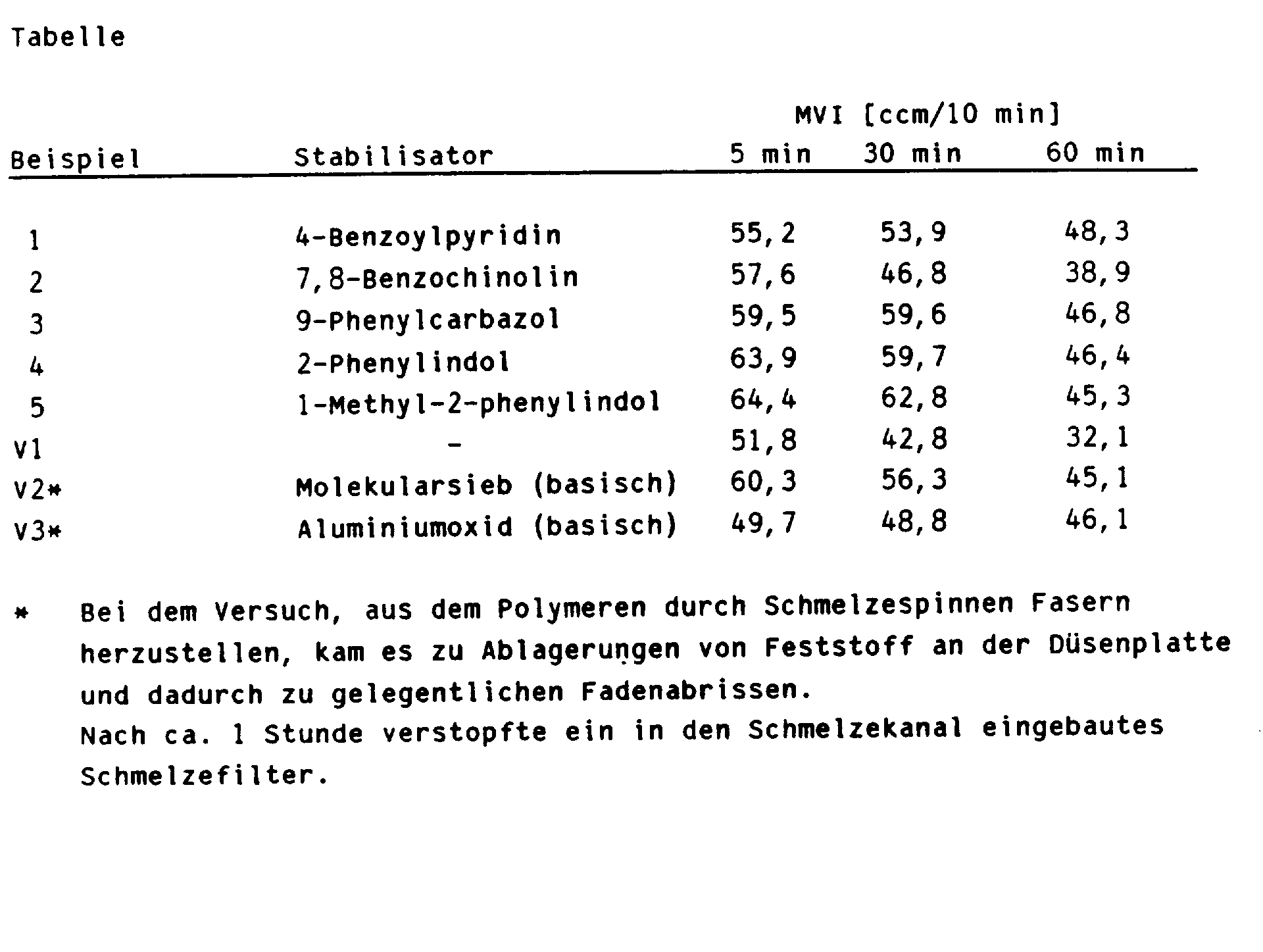
- the measurement was carried out by determining the melt index (MVI) in accordance with DIN 53 735-MFI-B with a device of the MP-D type from Göttfert at 400 ° C. with a bearing weight of 10 kg. Three measurements with 5, 30 and 60 minutes heating time were carried out with each sample. The results of the melt index measurements are summarized in the table.
Landscapes
- Chemical & Material Sciences (AREA)
- Health & Medical Sciences (AREA)
- Chemical Kinetics & Catalysis (AREA)
- Medicinal Chemistry (AREA)
- Polymers & Plastics (AREA)
- Organic Chemistry (AREA)
- Compositions Of Macromolecular Compounds (AREA)
Description
- Die vorliegende Erfindung betrifft stabilisierte Polyaryletherketon-Formmassen, enthaltend als wesentliche Komponenten
- A) 50 bis 99,99 Gew.-% eines durch elektrophile Polykondensation hergestellten Polyaryletherketons, das zu mindestens 50 mol-% aus Einheiten der allgemeinen Formel I'

- B) 0,01 bis 4 Gew.-% mindestens einer organischen Verbindung, die eine Basenkonstante pKb zwischen 2 und 12 aufweist und einen Siedepunkt größer als 300°C hat,
- C) 0 bis 50 Gew.-% eines weiteren, von A) verschiedenen Thermoplasten,
- D) 0 bis 45 Gew.-% faser- oder teilchenförmige Füllstoffe oder deren Mischungen.
- Weiterhin betrifft die Erfindung die Verwendung derartiger stabilisierter Polyaryletherketon-Formmassen zur Herstellung von Fasern, Folien und Formkörpern sowie Fasern, Folien und Formkörper, die diese Polyaryletherketon-Formmassen als wesentliche Komponenten enthalten.
- Polyaryletherketon-Formmassen sind hochwertige Thermoplaste, die sich durch besonders hohe Temperaturbeständigkeit, hohe Zähigkeit, sehr gute mechanische Eigenschaften und Resistenz gegenüber den üblichen Lösungsmitteln auszeichnen.
- Polyaryletherketone können nach zwei unterschiedlichen, an sich bekannten, Verfahren hergestellt werden. Beim sogenannten nucleophilen Polykondensationsverfahren wird die Sauerstoffbrücke gebildet, indem z.B. aromatische Dihydroxyverbindungen mit Difluorketonen unter Basenkatalyse umgesetzt werden. Ein solches Verfahren ist beispielsweise in der EP-A-1879 beschrieben.
- Eine zweite Möglichkeit zur Herstellung von Polyaryletherketonen ist die elektrophile (Friedel-Crafts-)Polykondensation. Hierbei werden zur Bildung der Carbonylbrücke entweder aromatische Dicarbonsäuredichloride oder Phosgen mit Aromaten, welche zwei - durch elektrophile Substitution austauschbare - Wasserstoffatome enthalten, umgesetzt, oder es wird ein aromatisches Carbonsäurechlorid, das sowohl eine Säurechloridgruppe als auch ein substituierbares Wasserstoffatom enthält, mit sich selbst polykondensiert.
- Friedel-Crafts-Reaktionen werden üblicherweise in Gegenwart einer Lewis-Säure als Katalysator in Lösungen durchgeführt, wie es z.B. in der us-A-3 441 538, US-A-3 442 857, US-A-3 953 400, DE-A-3 241 444, DE-A-34 16 445 und der DE-A-34 16 446 beschrieben ist. Die Reaktion in Gegenwart einer Lewis-Säure und einer Lewis-Base ist ebenfalls möglich und beispielsweise in der EP-A-124 276 beschrieben.
- Die durch elektrophile Polykondensation hergestellten Polyetherketone können durch Extraktion mit einem geeigneten Lösungsmittel weitgehend von den vorhandenen Säuren gereinigt werden, Spuren von Säure bleiben jedoch im Polymeren zurück.
- Bei der thermoplastischen Verarbeitung von Polyaryletherketon-Formmassen werden in der Schmelze Temperaturen von 400°C, kurzzeitig sogar Temperaturen um 450°C erreicht. Bei diesen sehr hohen Temperaturen können schon geringe Spuren von Säure das Polymer schädigen. Deshalb wurde in der DE-A 24 19 044 vorgeschlagen, dem Polymer amphotere Metalloxide zuzusetzen. Diese können aufgrund ihrer basischen Eigenschaften die Säurespuren binden oder neutralisieren. Für denselben Zweck wird in der EP-A 197 727 die Verwendung von Molekularsieben vorgeschlagen. Diese Stabilisatoren haben jedoch beide den Nachteil, daß sie sich im Polymer nicht homogen verteilen und auch zu größeren Teilchen agglomerieren können. Bei der Herstellung von sehr feinen Fasern oder Folien können diese Zusätze daher zu großen Verarbeitungsproblemen führen. Als nicht schmelzbare Substanzen können sie zusätzlich das Kristallisationsverhalten von teilkristallinen Polymeren verändern. Weiterhin neigen die genannten Metalloxide und Molekularsiebe dazu, langsam Wasser zu absorbieren, das bei den für Polymere üblichen Trocknungstemperaturen nicht freigesetzt wird. Bei den wesentlich höheren Verarbeitungstemperaturen kann das Wasser dann abgespalten werden und zum Aufschäumen des Polymeren führen.
- Der Erfindung lag daher die Aufgabe zugrunde, den geschilderten Mängeln abzuhelfen.
- Demgemäß wurden die eingangs definierten stabilisierten Polyaryletherketon-Formmassen gefunden. Weiterhin wurde ihre Verwendung zur Herstellung von Fasern, Folien und Formkörpern gefunden.
- Die als Komponente A) eingesetzten Polyaryletherketone bestehen zu mindestens 50 mol-% aus Einheiten der allgemeinen Formel I'

- Insbesondere sind Einheiten der allgemeinen Formel I


s t T Tʹ Ia 0 0 - - Ib 1 0 0 - Ic 0 1 - CO Id 1 0 CO - Ie 1 1 CO CO - Die Komponente A) wird in Mengen von 50 bis 99,99 Gew.-%, bezogen auf das Gesamtgewicht der Formmassen, eingesetzt, bevorzugt 60 bis 99,99 Gew.-%, insbesondere 70 bis 99,99 Gew.-%.
- Die Herstellung der Polyaryletherketone erfolgt durch elektrophile Polykondensation; es wird bei den üblichen, dem Fachmann bekannten, Verfahrensbedingungen gearbeitet. Verwendet man als Ausgangsstoffe aromatische Dicarbonsäuredichloride und Aromaten, die zwei substituierbare Wasserstoffatome aufweisen, so sind beispielsweise Terephthalsäuredichlorid oder 4,4'-Diphenyldicarbonsäuredichlorid sowie Diphenylether, 1,4-Diphenoxybenzol oder 4,4'-Diphenoxybenzophenon zu nennen. Als selbstkondensierbares Monomer ist 4-Phenoxybenzoylchlorid geeignet.
- Die als Stabilisatoren eingesetzte Komponente B) weist eine Basenkonstante pKb zwischen 2 und 12, bevorzugt zwischen 3 und 11 auf, sowie einen Siedepunkt größer als 300°C, vorzugsweise zwischen 320 und 500°C. Beispiele geeigneter Verbindungen sind 2,3-Bipyridin, 4-Benzoylpyridin, 2,6-Diphenylpyridin, 2,6-Bis(benzoylphenyl)pyridin, 2,6-Bis(4-benzoylphenoxy)pyridin, 2,2',6,2"-Terpyridin, Phenazin, 3,4-Benzochinolin, 7,8-Benzochinolin, 2-Phenylchinolin, 2-Phenylindol, 1-Methyl-2-phenylindol, 1,2-Diphenylindol, 9-Phenylcarbazol, Dibenzothiophen und Thioxanthon, wobei 4-Benzoylpyridin, 9-Phenylcarbazol und 2-Phenylindol bevorzugt sind. Mischungen dieser Verbindungen können ebenfalls eingesetzt werden.
- Die Komponente 8) wird in Mengen von 0,01 bis 4 Gew.-%, bevorzugt von 0,1 bis 1 Gew.-%, eingesetzt.
- Zusätzlich können weitere, von der Komponente A) verschiedene, Thermoplasten C) eingemischt werden. Hierbei eignen sich besonders Polyarylethersulfone oder deren Copolymere, Polyetherimide, Polyamidimide, Polyimide, aromatische Polyester, Polyphenylensulfide, Fluor-Polymere und aliphatische oder aromatische Polyamide.
- Entsprechende Produkte sind dem Fachmann bekannt und kommerziell erhältlich.
- Diese Polymeren können in Mengen von 0 bis 50 Gew.-%, bevorzugt von 5 bis 30 Gew.-% zugesetzt werden.
- Weiterhin können die erfindungsgemäßen stabilisierten Polyaryletherketon-Formmassen als Komponente D) faser- oder teilchenförmige Füllstoffe, sowie deren Mischungen, in Mengen von 0 bis 45 Gew.-%, insbesondere von 5 bis 40 Gew.-%, enthalten. Als verstärkend wirkende Füllstoffe seien beispielsweise Asbest oder Fasern aus Aramid, Glas oder Kohlenstoff genannt, die sowohl als Kurzfasern als auch als Endlosfasern eingesetzt werden können. Weiterhin können Pigmente wie Titandioxid, Cadmium- oder Zinksulfid, Bariumsulfat und Ruß zugemischt werden. Als weitere Zusatz- und Hilfsstoffe kommen beispielsweise Flammschutzmittel, weitere von B) verschiedene Stabilisatoren und übliche Verarbeitungshilfsmittel in Betracht.
- Zur Herstellung der erfindungsgemäßen stabilisierten Polyaryletherketon-Formmassen können die Komponenten A) und B) sowie gegebenenfalls C) und D) in einer Mischvorrichtung, vorzugsweise in einem Extruder, bei einer Gehäusetemperatur von 350 bis 450°C, vorzugsweise von 390 bis 420°C, umgesetzt werden. Die Komponente B) ist bei den üblichen Mischungsbedingungen und üblichen Verweilzeiten stabil. Vorzugsweise wird zu einem Strang extrudiert und granuliert.
- Die erfindungsgemäßen stabilisierten Polyaryletherketon-Formmassen sind wesentlich schmelzestabiler als nicht stabilisierte Formmassen. Die beschriebenen Stabilisatoren sind in den Polymeren homogen löslich, neigen nicht zur Agglomeration und verursachen daher keine Verarbeitungsprobleme bei der Herstellung sehr feiner Fasern oder Folien. Die stabilisierten Polyaryletherketon-Formmassen eignen sich daher insbesondere zur Herstellung von Fasern, Folien und Formkörpern.
- Nach der in der EP-A-124 276, Beispiel 13 beschriebenen Methode wurde ein Polyaryletherketon der Struktur Ie

- Das Polyaryletherketon wurde mit je 0,5 Gew.-% Stabilisator versetzt, intensiv gemischt und auf einem Extruder bei einer Gehäusetemperatur von 400°C zu einem Strang extrudiert und granuliert.
-
- V1: Das Polyaryletherketon wurde ohne Zusatz eines Stabilisators wie in den Beispielen 1 bis 5 extrudiert und granuliert
- V2: Es wurde wie in den Beispielen 1 bis 5 gearbeitet, jedoch 0,5 Gew.-% eines kommerziell erhältlichen basischen Molekularsiebs eingearbeitet.
- V3: Es wurde wie in den Beispielen 1 bis 5 gearbeitet, jedoch 0,5 Gew.-% eines basischen Aluminiumoxids eingemischt.
- Aus den jeweiligen Granulaten wurde die Schmelzestabilität bestimmt. Die Messung erfolgte durch Bestimmung des Schmelzindex (MVI) nach DIN 53 735-MFI-B mit einem Gerät des Typs MP-D der Firma Göttfert bei 400°C mit 10 kg Auflagegewicht. Mit jeder Probe wurden drei Messungen mit 5, 30 und 60 Minuten Aufheizzeit durchgeführt. Die Ergebnisse der Schmelzindex-Messungen sind in der Tabelle zusammengestellt.
Claims (9)
- Stabilisierte Polyaryletherketon-Formmassen, enthaltendA) 50 bis 99,99 Gew.-% eines durch elektrophile Polykondensation hergestellten Polyaryletherketons, das zu mindestens 50 mol-% aus Einheiten der allgemeinen Formel I'
 B) 0,01 bis 4 Gew.-% mindestens einer organischen Verbindung, die eine Basenkonstante pKb zwischen 2 und 12 aufweist und einen Siedepunkt größer als 300°C hat,C) 0 bis 30 Gew.-% eines weiteren, von A) verschiedenen Thermoplasten,D) 0 bis 45 Gew.-% faser- oder teilchenförmige Füllstoffe oder deren Mischungen.
 - Stabilisierte Polyaryletherketon-Formmassen nach Anspruch 1, dadurch gekennzeichnet, daß als Komponente A) ein Polyaryletherketon aus den Einheiten I

- Stabilisierte Polyaryletherketon-Formmassen nach den Ansprüchen 1 bis 2, dadurch gekennzeichnet, daß sie die Komponente B) in einer Menge von 0,1 bis 1 Gew.-% enthalten.
- Stabilisierte Polyaryletherketon-Formmassen nach den Ansprüchen 1 bis 3, dadurch gekennzeichnet, daß die Komponente B) ausgewählt ist aus der Gruppe 2,3-Bipyridin, 4-Benzoylpyridin, 2,6-Diphenylpyridin, 2,6-Bis(benzoylphenyl)pyridin, 2,6-Bis(4-benzoylphenoxy)pyridin, 2,2',6,2"-Terpyridin, Phenazin, 3,4-Benzochinolin, 7,8-Benzochinolin, 2-Phenylchinolin, 2-Phenylindol, 1-Methyl-2-phenylindol, 1,2-Diphenylindol, 9-Phenylcarbazol, Dibenzothiophen und Thioxanthon oder deren Mischungen.
- Stabilisierte Polyaryletherketon-Formmassen nach den Ansprüchen 1 bis 4, dadurch gekennzeichnet, daß als Komponente A) ein Polyaryletherketon aus den Einheiten Ie

- Verwendung von stabilisierten Polyaryletherketon-Formmassen gemäß den Ansprüchen 1 bis 5 zur Herstellung von Fasern, Folien und Formkörpern.
- Verwendung organischer Verbindungen, die eine Basenkonstante pKb zwischen 2 und 12 aufweisen und einen Siedepunkt größer als 300°C haben, zur Schmelzestabilisierung von durch elektrophile Polykondensation hergestellten Polyarylenetherketonen, wobei Polyarylenetherketon-Formmassen, enthaltendA) 50 bis 99,99 Gew.-% eines durch elektrophile Polykondensation hergestellten Polyaryletherketons, das zu mindestens 50 mol-% aus Einheiten der allgemeinen Formel I'
 B) 0,01 bis 4 Gew.-% mindestens einer organischen Verbindung, die eine Basenkonstante pKb zwischen 2 und 12 aufweist und einen Siedepunkt größer als 300°C hat,C) 0 bis 30 Gew.-% eines weiteren, von A) verschiedenen Thermoplasten,D) 0 bis 45 Gew.-% faser- oder teilchenförmige Füllstoffe oder deren Mischungenerhalten werden.
 - Verwendung nach Anspruch 8, wobei die Komponente B) 2,3-Bipyridin, 4-Benzoylpyridin, 2,6-Diphenylpyridin, 2,6-Bis(benzoylphenyl)pyridin, 2,6-Bis(4-benzoylphenoxy)pyridin, 2,2',6,2"-Terpyridin, Phenazin, 3,4-Benzochinolin, 7,8-Benzochinolin, 2-Phenylchinolin, 2-Phenylindol, 1-Methyl-2-phenylindol, 1,2-Diphenylindol, 9-Phenylcarbazol, Dibenzothiophen oder Thioxanthon oder deren Mischungen ist.
- Verwendung nach Anspruch 8 oder 9, wobei als Komponente A) ein Polyaryletherketon aus den Einheiten Ie

Applications Claiming Priority (2)
| Application Number | Priority Date | Filing Date | Title |
|---|---|---|---|
| DE4010188 | 1990-03-30 | ||
| DE4010188A DE4010188A1 (de) | 1990-03-30 | 1990-03-30 | Stabilisierte polyaryletherketon-formmassen |
Publications (3)
| Publication Number | Publication Date |
|---|---|
| EP0451556A2 EP0451556A2 (de) | 1991-10-16 |
| EP0451556A3 EP0451556A3 (en) | 1992-11-19 |
| EP0451556B1 true EP0451556B1 (de) | 1996-01-10 |
Family
ID=6403374
Family Applications (1)
| Application Number | Title | Priority Date | Filing Date |
|---|---|---|---|
| EP91104273A Expired - Lifetime EP0451556B1 (de) | 1990-03-30 | 1991-03-20 | Stabilisierte Polyaryletherketon-Formmassen |
Country Status (4)
| Country | Link |
|---|---|
| US (2) | US5208278A (de) |
| EP (1) | EP0451556B1 (de) |
| JP (1) | JPH04224862A (de) |
| DE (2) | DE4010188A1 (de) |
Families Citing this family (10)
| Publication number | Priority date | Publication date | Assignee | Title |
|---|---|---|---|---|
| DE4010188A1 (de) * | 1990-03-30 | 1991-10-02 | Basf Ag | Stabilisierte polyaryletherketon-formmassen |
| DE102008001873A1 (de) * | 2008-05-20 | 2009-11-26 | Evonik Degussa Gmbh | Kerbschlagzähe Polyarylenetherketon-Formmasse |
| US10774215B2 (en) | 2014-08-21 | 2020-09-15 | Ticona Llc | Composition containing a polyaryletherketone and low naphthenic liquid crystalline polymer |
| WO2016028613A1 (en) | 2014-08-21 | 2016-02-25 | Ticona Llc | Polyaryletherketone composition |
| US12258462B2 (en) | 2015-07-22 | 2025-03-25 | Arkema France | Composition made from poly(arylene-ether-ketone) (PAEK) which is stable in the molten state and method for stabilizing such a composition |
| FR3039157B1 (fr) | 2015-07-22 | 2019-06-28 | Arkema France | Composition a base de polyarylene-ether-cetone (paek) stable a l'etat fondu et procede de stabilisation d'une telle composition |
| US11352480B2 (en) | 2016-03-18 | 2022-06-07 | Ticona Llc | Polyaryletherketone composition |
| US11118053B2 (en) | 2018-03-09 | 2021-09-14 | Ticona Llc | Polyaryletherketone/polyarylene sulfide composition |
| CN112638989B (zh) | 2018-06-21 | 2024-05-17 | 索尔维特殊聚合物美国有限责任公司 | 聚(醚酮酮)(pekk)复合材料 |
| CN114364744B (zh) | 2019-09-20 | 2024-01-30 | 东丽株式会社 | 聚芳基醚酮树脂组合物、纤维增强树脂基材及成型品 |
Family Cites Families (8)
| Publication number | Priority date | Publication date | Assignee | Title |
|---|---|---|---|---|
| US4024155A (en) * | 1974-06-05 | 1977-05-17 | Labaz | 2-(3'-Methoxy-4'-hydroxy-phenol)-indole |
| US4954605A (en) * | 1985-05-10 | 1990-09-04 | Hoechst Celanese Corp. | Aromatic polyetherketone fiber product |
| US4616056A (en) * | 1985-05-16 | 1986-10-07 | Raychem Corporation | Poly(aryl ether ketones) containing sulfur |
| US4897307A (en) * | 1987-08-11 | 1990-01-30 | The Dow Chemical Company | Process for the solvent-induced crystallization of amorphous poly(etheretherketone)-type polymers and the article formed thereby |
| DE3730690A1 (de) * | 1987-09-12 | 1989-03-23 | Bayer Ag | Verfahren zur herstellung von aromatischen polyetherketonen |
| US4994511A (en) * | 1987-09-14 | 1991-02-19 | Shell Oil Company | Polyketone stabilization with dihydrocarbyldithiocarbamate salts |
| GB8725886D0 (en) * | 1987-11-04 | 1987-12-09 | Raychem Ltd | Poly(ar-lene ether ketones) |
| DE4010188A1 (de) * | 1990-03-30 | 1991-10-02 | Basf Ag | Stabilisierte polyaryletherketon-formmassen |
-
1990
- 1990-03-30 DE DE4010188A patent/DE4010188A1/de not_active Withdrawn
-
1991
- 1991-03-20 DE DE59107220T patent/DE59107220D1/de not_active Expired - Lifetime
- 1991-03-20 EP EP91104273A patent/EP0451556B1/de not_active Expired - Lifetime
- 1991-03-28 JP JP3064343A patent/JPH04224862A/ja active Pending
- 1991-03-29 US US07/677,336 patent/US5208278A/en not_active Expired - Fee Related
-
1992
- 1992-12-30 US US07/998,730 patent/US5334642A/en not_active Expired - Fee Related
Also Published As
| Publication number | Publication date |
|---|---|
| US5208278A (en) | 1993-05-04 |
| JPH04224862A (ja) | 1992-08-14 |
| EP0451556A3 (en) | 1992-11-19 |
| DE59107220D1 (de) | 1996-02-22 |
| US5334642A (en) | 1994-08-02 |
| EP0451556A2 (de) | 1991-10-16 |
| DE4010188A1 (de) | 1991-10-02 |
Similar Documents
| Publication | Publication Date | Title |
|---|---|---|
| DE2622414C2 (de) | Polybutylenterephthalatabmischungen mit hoher Schlagzähigkeit und ihre Verwendung | |
| DE2623363A1 (de) | Verfahren zum herstellen von verzweigten arylensulfidpolymeren | |
| DE19847627A1 (de) | Mit Kupferkomplexen und organischen Halogenverbindungen stabilisierte Polyamidzusammensetzung | |
| EP0297363A2 (de) | Hochtemperaturbeständige thermoplastische formmassen mit verbesserter Schmelzestabilität | |
| EP0332012B1 (de) | Hochtemperaturbeständige Polyarylethersulfon-/Polyaryletherketon-Formmassen mit verbesserter Phasenbindung | |
| DE2549529A1 (de) | Aromatische polyaethersulfone | |
| EP0327984A2 (de) | Polyaryletherketone mit verbesserter Verarbeitbarkeit | |
| EP0451556A2 (de) | Stabilisierte Polyaryletherketon-Formmassen | |
| DE3883859T2 (de) | Schnellkristallisierende Polyesterzusammensetzungen. | |
| EP0855430B1 (de) | Thermoplastische Formmassen | |
| EP0466002B1 (de) | Stabilisierte Polyaryletherketon-Formmassen | |
| DE3685874T2 (de) | Mit poly(phenylen-ether) verbundener uv-absorber. | |
| EP0327980A2 (de) | Hochtemperaturbeständige Polyarylether mit verbesserter Verarbeitbarkeit | |
| DE3806836A1 (de) | Formmassen bestehend aus einem thermoplastisch verarbeitbaren, aromatischen polyamid | |
| DE2647004B2 (de) | Verfahren zur Herstellung von PoIybenzoxazolen | |
| EP0414124B1 (de) | Mehrkomponentenlegierung mit einer Glastemperatur | |
| EP0308803A2 (de) | Stabilisierte, aromatische Polyetherketone enthaltende Mischung und deren Verwendung zur Herstellung von Formteilen | |
| DE2117820B2 (de) | Verfahren zur herstellung von hochmolekularen, hitzebestaendig, linearen, aromatischen polyaetherthioaether | |
| EP0571398B1 (de) | Ternäre polymerlegierungen auf basis von polyaryletherketonen mit einer glastemperatur | |
| DE4022214A1 (de) | Stabilisierte polyaryletherketon-formmassen | |
| DE4216588A1 (de) | Polyarylenethersulfone mit heller Eigenfarbe und verbesserter Farbkonstanz | |
| EP0400287A2 (de) | Polyarylethersulfone für lichttechnische Anwendungen | |
| DE2203704B2 (de) | Selbstverlöschende Polyamid-Formmassen | |
| DE4122427C2 (de) | Mischungen aus Polyaryletherketon mit Erdalkalititanaten | |
| EP0336159A1 (de) | Hochtemperaturbeständige Cyanophenyleneinheiten gebunden enthaltende Polyarylenethersulfon-Blockcopolykondensate, Verfahren zu ihrer Herstellung und ihre Verwendung |
Legal Events
| Date | Code | Title | Description |
|---|---|---|---|
| PUAI | Public reference made under article 153(3) epc to a published international application that has entered the european phase |
Free format text: ORIGINAL CODE: 0009012 |
|
| AK | Designated contracting states |
Kind code of ref document: A2 Designated state(s): BE DE FR GB NL |
|
| PUAL | Search report despatched |
Free format text: ORIGINAL CODE: 0009013 |
|
| AK | Designated contracting states |
Kind code of ref document: A3 Designated state(s): BE DE FR GB NL |
|
| 17P | Request for examination filed |
Effective date: 19921019 |
|
| 17Q | First examination report despatched |
Effective date: 19950118 |
|
| GRAA | (expected) grant |
Free format text: ORIGINAL CODE: 0009210 |
|
| AK | Designated contracting states |
Kind code of ref document: B1 Designated state(s): BE DE FR GB NL |
|
| REF | Corresponds to: |
Ref document number: 59107220 Country of ref document: DE Date of ref document: 19960222 |
|
| GBT | Gb: translation of ep patent filed (gb section 77(6)(a)/1977) |
Effective date: 19960219 |
|
| ET | Fr: translation filed | ||
| PLBE | No opposition filed within time limit |
Free format text: ORIGINAL CODE: 0009261 |
|
| STAA | Information on the status of an ep patent application or granted ep patent |
Free format text: STATUS: NO OPPOSITION FILED WITHIN TIME LIMIT |
|
| 26N | No opposition filed | ||
| PGFP | Annual fee paid to national office [announced via postgrant information from national office to epo] |
Ref country code: FR Payment date: 19970224 Year of fee payment: 7 |
|
| PGFP | Annual fee paid to national office [announced via postgrant information from national office to epo] |
Ref country code: DE Payment date: 19970314 Year of fee payment: 7 |
|
| PGFP | Annual fee paid to national office [announced via postgrant information from national office to epo] |
Ref country code: GB Payment date: 19970317 Year of fee payment: 7 |
|
| PGFP | Annual fee paid to national office [announced via postgrant information from national office to epo] |
Ref country code: BE Payment date: 19970318 Year of fee payment: 7 |
|
| PGFP | Annual fee paid to national office [announced via postgrant information from national office to epo] |
Ref country code: NL Payment date: 19970320 Year of fee payment: 7 |
|
| PG25 | Lapsed in a contracting state [announced via postgrant information from national office to epo] |
Ref country code: DE Free format text: LAPSE BECAUSE OF THE APPLICANT RENOUNCES Effective date: 19980312 |
|
| PG25 | Lapsed in a contracting state [announced via postgrant information from national office to epo] |
Ref country code: GB Free format text: LAPSE BECAUSE OF NON-PAYMENT OF DUE FEES Effective date: 19980320 |
|
| PG25 | Lapsed in a contracting state [announced via postgrant information from national office to epo] |
Ref country code: FR Free format text: THE PATENT HAS BEEN ANNULLED BY A DECISION OF A NATIONAL AUTHORITY Effective date: 19980331 Ref country code: BE Free format text: LAPSE BECAUSE OF NON-PAYMENT OF DUE FEES Effective date: 19980331 |
|
| BERE | Be: lapsed |
Owner name: BASF A.G. Effective date: 19980331 |
|
| PG25 | Lapsed in a contracting state [announced via postgrant information from national office to epo] |
Ref country code: NL Free format text: LAPSE BECAUSE OF NON-PAYMENT OF DUE FEES Effective date: 19981001 |
|
| GBPC | Gb: european patent ceased through non-payment of renewal fee |
Effective date: 19980320 |
|
| NLV4 | Nl: lapsed or anulled due to non-payment of the annual fee |
Effective date: 19981001 |
|
| REG | Reference to a national code |
Ref country code: FR Ref legal event code: ST |