EP0446925B1 - Verfahren zur Herstellung von beta-Resorcylsäurederivaten - Google Patents
Verfahren zur Herstellung von beta-Resorcylsäurederivaten Download PDFInfo
- Publication number
- EP0446925B1 EP0446925B1 EP91103950A EP91103950A EP0446925B1 EP 0446925 B1 EP0446925 B1 EP 0446925B1 EP 91103950 A EP91103950 A EP 91103950A EP 91103950 A EP91103950 A EP 91103950A EP 0446925 B1 EP0446925 B1 EP 0446925B1
- Authority
- EP
- European Patent Office
- Prior art keywords
- process according
- alkaline earth
- earth metal
- general formula
- methyl
- Prior art date
- Legal status (The legal status is an assumption and is not a legal conclusion. Google has not performed a legal analysis and makes no representation as to the accuracy of the status listed.)
- Expired - Lifetime
Links
- 238000000034 method Methods 0.000 title claims description 49
- UIAFKZKHHVMJGS-UHFFFAOYSA-N 2,4-dihydroxybenzoic acid Chemical class OC(=O)C1=CC=C(O)C=C1O UIAFKZKHHVMJGS-UHFFFAOYSA-N 0.000 title claims description 15
- 238000002360 preparation method Methods 0.000 title claims description 9
- 239000000203 mixture Substances 0.000 claims description 29
- 239000002253 acid Substances 0.000 claims description 23
- -1 carboxylic acid halide Chemical class 0.000 claims description 23
- WYURNTSHIVDZCO-UHFFFAOYSA-N Tetrahydrofuran Chemical compound C1CCOC1 WYURNTSHIVDZCO-UHFFFAOYSA-N 0.000 claims description 20
- 239000002904 solvent Substances 0.000 claims description 18
- 150000001341 alkaline earth metal compounds Chemical class 0.000 claims description 15
- WASQWSOJHCZDFK-UHFFFAOYSA-N diketene Chemical compound C=C1CC(=O)O1 WASQWSOJHCZDFK-UHFFFAOYSA-N 0.000 claims description 14
- XTHFKEDIFFGKHM-UHFFFAOYSA-N Dimethoxyethane Chemical compound COCCOC XTHFKEDIFFGKHM-UHFFFAOYSA-N 0.000 claims description 12
- 238000006243 chemical reaction Methods 0.000 claims description 10
- YLQBMQCUIZJEEH-UHFFFAOYSA-N tetrahydrofuran Natural products C=1C=COC=1 YLQBMQCUIZJEEH-UHFFFAOYSA-N 0.000 claims description 10
- 125000004435 hydrogen atom Chemical group [H]* 0.000 claims description 9
- ODINCKMPIJJUCX-UHFFFAOYSA-N calcium oxide Inorganic materials [Ca]=O ODINCKMPIJJUCX-UHFFFAOYSA-N 0.000 claims description 8
- 239000000292 calcium oxide Substances 0.000 claims description 7
- 125000004432 carbon atom Chemical group C* 0.000 claims description 7
- NCCWCZLEACWJIN-UHFFFAOYSA-N orsellinic acid methyl ester Chemical compound COC(=O)C1=C(C)C=C(O)C=C1O NCCWCZLEACWJIN-UHFFFAOYSA-N 0.000 claims description 7
- 125000000217 alkyl group Chemical group 0.000 claims description 6
- BRPQOXSCLDDYGP-UHFFFAOYSA-N calcium oxide Chemical compound [O-2].[Ca+2] BRPQOXSCLDDYGP-UHFFFAOYSA-N 0.000 claims description 6
- UUQHKWMIDYRWHH-UHFFFAOYSA-N Methyl beta-orcinolcarboxylate Chemical compound COC(=O)C1=C(C)C=C(O)C(C)=C1O UUQHKWMIDYRWHH-UHFFFAOYSA-N 0.000 claims description 5
- 229910000287 alkaline earth metal oxide Inorganic materials 0.000 claims description 5
- 150000004729 acetoacetic acid derivatives Chemical class 0.000 claims description 4
- 229910001860 alkaline earth metal hydroxide Inorganic materials 0.000 claims description 4
- 238000009835 boiling Methods 0.000 claims description 4
- 125000005843 halogen group Chemical group 0.000 claims 1
- 239000000126 substance Substances 0.000 claims 1
- YXFVVABEGXRONW-UHFFFAOYSA-N Toluene Chemical compound CC1=CC=CC=C1 YXFVVABEGXRONW-UHFFFAOYSA-N 0.000 description 18
- XEKOWRVHYACXOJ-UHFFFAOYSA-N Ethyl acetate Chemical compound CCOC(C)=O XEKOWRVHYACXOJ-UHFFFAOYSA-N 0.000 description 15
- 125000002496 methyl group Chemical group [H]C([H])([H])* 0.000 description 12
- RTZKZFJDLAIYFH-UHFFFAOYSA-N Diethyl ether Chemical compound CCOCC RTZKZFJDLAIYFH-UHFFFAOYSA-N 0.000 description 11
- WFDIJRYMOXRFFG-UHFFFAOYSA-N Acetic anhydride Chemical compound CC(=O)OC(C)=O WFDIJRYMOXRFFG-UHFFFAOYSA-N 0.000 description 9
- CSCPPACGZOOCGX-UHFFFAOYSA-N Acetone Chemical compound CC(C)=O CSCPPACGZOOCGX-UHFFFAOYSA-N 0.000 description 9
- YMWUJEATGCHHMB-UHFFFAOYSA-N Dichloromethane Chemical compound ClCCl YMWUJEATGCHHMB-UHFFFAOYSA-N 0.000 description 9
- ZMANZCXQSJIPKH-UHFFFAOYSA-N Triethylamine Chemical compound CCN(CC)CC ZMANZCXQSJIPKH-UHFFFAOYSA-N 0.000 description 9
- BZLVMXJERCGZMT-UHFFFAOYSA-N Methyl tert-butyl ether Chemical compound COC(C)(C)C BZLVMXJERCGZMT-UHFFFAOYSA-N 0.000 description 8
- 239000003205 fragrance Substances 0.000 description 8
- VLKZOEOYAKHREP-UHFFFAOYSA-N n-Hexane Chemical compound CCCCCC VLKZOEOYAKHREP-UHFFFAOYSA-N 0.000 description 8
- HEDRZPFGACZZDS-MICDWDOJSA-N Trichloro(2H)methane Chemical compound [2H]C(Cl)(Cl)Cl HEDRZPFGACZZDS-MICDWDOJSA-N 0.000 description 6
- 150000003254 radicals Chemical class 0.000 description 6
- BTANRVKWQNVYAZ-UHFFFAOYSA-N butan-2-ol Chemical compound CCC(C)O BTANRVKWQNVYAZ-UHFFFAOYSA-N 0.000 description 5
- 238000004519 manufacturing process Methods 0.000 description 5
- 239000012074 organic phase Substances 0.000 description 5
- UHOVQNZJYSORNB-UHFFFAOYSA-N Benzene Chemical compound C1=CC=CC=C1 UHOVQNZJYSORNB-UHFFFAOYSA-N 0.000 description 4
- VEXZGXHMUGYJMC-UHFFFAOYSA-N Hydrochloric acid Chemical compound Cl VEXZGXHMUGYJMC-UHFFFAOYSA-N 0.000 description 4
- QAOWNCQODCNURD-UHFFFAOYSA-N Sulfuric acid Chemical compound OS(O)(=O)=O QAOWNCQODCNURD-UHFFFAOYSA-N 0.000 description 4
- 239000013078 crystal Substances 0.000 description 4
- 150000002148 esters Chemical class 0.000 description 4
- IIFCLXHRIYTHPV-UHFFFAOYSA-N methyl 2,4-dihydroxybenzoate Chemical compound COC(=O)C1=CC=C(O)C=C1O IIFCLXHRIYTHPV-UHFFFAOYSA-N 0.000 description 4
- 238000000425 proton nuclear magnetic resonance spectrum Methods 0.000 description 4
- 239000000725 suspension Substances 0.000 description 4
- 239000008096 xylene Substances 0.000 description 4
- ZWEHNKRNPOVVGH-UHFFFAOYSA-N 2-Butanone Chemical compound CCC(C)=O ZWEHNKRNPOVVGH-UHFFFAOYSA-N 0.000 description 3
- QTBSBXVTEAMEQO-UHFFFAOYSA-N Acetic acid Chemical compound CC(O)=O QTBSBXVTEAMEQO-UHFFFAOYSA-N 0.000 description 3
- LFQSCWFLJHTTHZ-UHFFFAOYSA-N Ethanol Chemical compound CCO LFQSCWFLJHTTHZ-UHFFFAOYSA-N 0.000 description 3
- LYCAIKOWRPUZTN-UHFFFAOYSA-N Ethylene glycol Chemical compound OCCO LYCAIKOWRPUZTN-UHFFFAOYSA-N 0.000 description 3
- OKKJLVBELUTLKV-UHFFFAOYSA-N Methanol Chemical compound OC OKKJLVBELUTLKV-UHFFFAOYSA-N 0.000 description 3
- QCEVKSVMCRLLPS-UHFFFAOYSA-N Methyl 4,6-dihydroxy-2,3-dimethylbenzoate Chemical compound COC(=O)C1=C(C)C(C)=C(O)C=C1O QCEVKSVMCRLLPS-UHFFFAOYSA-N 0.000 description 3
- WRQNANDWMGAFTP-UHFFFAOYSA-N Methylacetoacetic acid Chemical compound COC(=O)CC(C)=O WRQNANDWMGAFTP-UHFFFAOYSA-N 0.000 description 3
- ZMXDDKWLCZADIW-UHFFFAOYSA-N N,N-Dimethylformamide Chemical compound CN(C)C=O ZMXDDKWLCZADIW-UHFFFAOYSA-N 0.000 description 3
- SJRJJKPEHAURKC-UHFFFAOYSA-N N-Methylmorpholine Chemical compound CN1CCOCC1 SJRJJKPEHAURKC-UHFFFAOYSA-N 0.000 description 3
- CTQNGGLPUBDAKN-UHFFFAOYSA-N O-Xylene Chemical compound CC1=CC=CC=C1C CTQNGGLPUBDAKN-UHFFFAOYSA-N 0.000 description 3
- HEMHJVSKTPXQMS-UHFFFAOYSA-M Sodium hydroxide Chemical compound [OH-].[Na+] HEMHJVSKTPXQMS-UHFFFAOYSA-M 0.000 description 3
- TUCNEACPLKLKNU-UHFFFAOYSA-N acetyl Chemical compound C[C]=O TUCNEACPLKLKNU-UHFFFAOYSA-N 0.000 description 3
- 238000001816 cooling Methods 0.000 description 3
- 238000004821 distillation Methods 0.000 description 3
- 238000000605 extraction Methods 0.000 description 3
- 239000011777 magnesium Substances 0.000 description 3
- WCYWZMWISLQXQU-UHFFFAOYSA-N methyl Chemical compound [CH3] WCYWZMWISLQXQU-UHFFFAOYSA-N 0.000 description 3
- 239000003208 petroleum Substances 0.000 description 3
- ISWSIDIOOBJBQZ-UHFFFAOYSA-N phenol group Chemical group C1(=CC=CC=C1)O ISWSIDIOOBJBQZ-UHFFFAOYSA-N 0.000 description 3
- BDERNNFJNOPAEC-UHFFFAOYSA-N propan-1-ol Chemical compound CCCO BDERNNFJNOPAEC-UHFFFAOYSA-N 0.000 description 3
- 239000007858 starting material Substances 0.000 description 3
- 229910009112 xH2O Inorganic materials 0.000 description 3
- CFAKWWQIUFSQFU-UHFFFAOYSA-N 2-hydroxy-3-methylcyclopent-2-en-1-one Chemical compound CC1=C(O)C(=O)CC1 CFAKWWQIUFSQFU-UHFFFAOYSA-N 0.000 description 2
- PFVPJOAAHSOENR-UHFFFAOYSA-N 2-hydroxy-4-methoxy-6-methylbenzoic acid methyl ester Chemical compound COC(=O)C1=C(C)C=C(OC)C=C1O PFVPJOAAHSOENR-UHFFFAOYSA-N 0.000 description 2
- NOTCZLKDULMKBR-UHFFFAOYSA-N 3-Methoxy-5-methylphenol Chemical compound COC1=CC(C)=CC(O)=C1 NOTCZLKDULMKBR-UHFFFAOYSA-N 0.000 description 2
- VTYYLEPIZMXCLO-UHFFFAOYSA-L Calcium carbonate Chemical compound [Ca+2].[O-]C([O-])=O VTYYLEPIZMXCLO-UHFFFAOYSA-L 0.000 description 2
- ZAMOUSCENKQFHK-UHFFFAOYSA-N Chlorine atom Chemical compound [Cl] ZAMOUSCENKQFHK-UHFFFAOYSA-N 0.000 description 2
- IAZDPXIOMUYVGZ-UHFFFAOYSA-N Dimethylsulphoxide Chemical compound CS(C)=O IAZDPXIOMUYVGZ-UHFFFAOYSA-N 0.000 description 2
- YNQLUTRBYVCPMQ-UHFFFAOYSA-N Ethylbenzene Chemical compound CCC1=CC=CC=C1 YNQLUTRBYVCPMQ-UHFFFAOYSA-N 0.000 description 2
- KFZMGEQAYNKOFK-UHFFFAOYSA-N Isopropanol Chemical compound CC(C)O KFZMGEQAYNKOFK-UHFFFAOYSA-N 0.000 description 2
- 241000758789 Juglans Species 0.000 description 2
- 235000009496 Juglans regia Nutrition 0.000 description 2
- JGFZNNIVVJXRND-UHFFFAOYSA-N N,N-Diisopropylethylamine (DIPEA) Chemical compound CCN(C(C)C)C(C)C JGFZNNIVVJXRND-UHFFFAOYSA-N 0.000 description 2
- LRHPLDYGYMQRHN-UHFFFAOYSA-N N-Butanol Chemical compound CCCCO LRHPLDYGYMQRHN-UHFFFAOYSA-N 0.000 description 2
- IMNFDUFMRHMDMM-UHFFFAOYSA-N N-Heptane Chemical compound CCCCCCC IMNFDUFMRHMDMM-UHFFFAOYSA-N 0.000 description 2
- OFBQJSOFQDEBGM-UHFFFAOYSA-N Pentane Chemical compound CCCCC OFBQJSOFQDEBGM-UHFFFAOYSA-N 0.000 description 2
- NBIIXXVUZAFLBC-UHFFFAOYSA-N Phosphoric acid Chemical compound OP(O)(O)=O NBIIXXVUZAFLBC-UHFFFAOYSA-N 0.000 description 2
- XBDQKXXYIPTUBI-UHFFFAOYSA-M Propionate Chemical compound CCC([O-])=O XBDQKXXYIPTUBI-UHFFFAOYSA-M 0.000 description 2
- JUJWROOIHBZHMG-UHFFFAOYSA-N Pyridine Chemical compound C1=CC=NC=C1 JUJWROOIHBZHMG-UHFFFAOYSA-N 0.000 description 2
- KEAYESYHFKHZAL-UHFFFAOYSA-N Sodium Chemical compound [Na] KEAYESYHFKHZAL-UHFFFAOYSA-N 0.000 description 2
- DKGAVHZHDRPRBM-UHFFFAOYSA-N Tert-Butanol Chemical compound CC(C)(C)O DKGAVHZHDRPRBM-UHFFFAOYSA-N 0.000 description 2
- 230000002378 acidificating effect Effects 0.000 description 2
- 229910052784 alkaline earth metal Inorganic materials 0.000 description 2
- RDOXTESZEPMUJZ-UHFFFAOYSA-N anisole Chemical compound COC1=CC=CC=C1 RDOXTESZEPMUJZ-UHFFFAOYSA-N 0.000 description 2
- AYJRCSIUFZENHW-UHFFFAOYSA-L barium carbonate Chemical compound [Ba+2].[O-]C([O-])=O AYJRCSIUFZENHW-UHFFFAOYSA-L 0.000 description 2
- 229940114055 beta-resorcylic acid Drugs 0.000 description 2
- 230000015572 biosynthetic process Effects 0.000 description 2
- 239000011575 calcium Substances 0.000 description 2
- 239000000460 chlorine Substances 0.000 description 2
- 229910052801 chlorine Inorganic materials 0.000 description 2
- MVPPADPHJFYWMZ-UHFFFAOYSA-N chlorobenzene Chemical compound ClC1=CC=CC=C1 MVPPADPHJFYWMZ-UHFFFAOYSA-N 0.000 description 2
- 238000004817 gas chromatography Methods 0.000 description 2
- 238000010438 heat treatment Methods 0.000 description 2
- 229930195733 hydrocarbon Natural products 0.000 description 2
- VOBAPUBTRZTWOO-UHFFFAOYSA-N methyl 2,4-diacetyloxy-6-methylbenzoate Chemical compound COC(=O)C1=C(C)C=C(OC(C)=O)C=C1OC(C)=O VOBAPUBTRZTWOO-UHFFFAOYSA-N 0.000 description 2
- DMSHNIHYQFQGGG-UHFFFAOYSA-N methyl 2,4-dihydroxy-3,5,6-trimethylbenzoate Chemical compound COC(=O)C1=C(C)C(C)=C(O)C(C)=C1O DMSHNIHYQFQGGG-UHFFFAOYSA-N 0.000 description 2
- 150000004702 methyl esters Chemical class 0.000 description 2
- 150000007524 organic acids Chemical class 0.000 description 2
- BWHMMNNQKKPAPP-UHFFFAOYSA-L potassium carbonate Chemical compound [K+].[K+].[O-]C([O-])=O BWHMMNNQKKPAPP-UHFFFAOYSA-L 0.000 description 2
- YKYONYBAUNKHLG-UHFFFAOYSA-N propyl acetate Chemical compound CCCOC(C)=O YKYONYBAUNKHLG-UHFFFAOYSA-N 0.000 description 2
- 239000000376 reactant Substances 0.000 description 2
- 239000011541 reaction mixture Substances 0.000 description 2
- 238000010992 reflux Methods 0.000 description 2
- 239000012312 sodium hydride Substances 0.000 description 2
- 229910000104 sodium hydride Inorganic materials 0.000 description 2
- 238000003786 synthesis reaction Methods 0.000 description 2
- VZGDMQKNWNREIO-UHFFFAOYSA-N tetrachloromethane Chemical compound ClC(Cl)(Cl)Cl VZGDMQKNWNREIO-UHFFFAOYSA-N 0.000 description 2
- 235000020234 walnut Nutrition 0.000 description 2
- XLYOFNOQVPJJNP-UHFFFAOYSA-N water Substances O XLYOFNOQVPJJNP-UHFFFAOYSA-N 0.000 description 2
- UOCLXMDMGBRAIB-UHFFFAOYSA-N 1,1,1-trichloroethane Chemical compound CC(Cl)(Cl)Cl UOCLXMDMGBRAIB-UHFFFAOYSA-N 0.000 description 1
- WSLDOOZREJYCGB-UHFFFAOYSA-N 1,2-Dichloroethane Chemical compound ClCCCl WSLDOOZREJYCGB-UHFFFAOYSA-N 0.000 description 1
- LZDKZFUFMNSQCJ-UHFFFAOYSA-N 1,2-diethoxyethane Chemical compound CCOCCOCC LZDKZFUFMNSQCJ-UHFFFAOYSA-N 0.000 description 1
- RYHBNJHYFVUHQT-UHFFFAOYSA-N 1,4-Dioxane Chemical compound C1COCCO1 RYHBNJHYFVUHQT-UHFFFAOYSA-N 0.000 description 1
- DURPTKYDGMDSBL-UHFFFAOYSA-N 1-butoxybutane Chemical compound CCCCOCCCC DURPTKYDGMDSBL-UHFFFAOYSA-N 0.000 description 1
- RRQYJINTUHWNHW-UHFFFAOYSA-N 1-ethoxy-2-(2-ethoxyethoxy)ethane Chemical compound CCOCCOCCOCC RRQYJINTUHWNHW-UHFFFAOYSA-N 0.000 description 1
- CRWNQZTZTZWPOF-UHFFFAOYSA-N 2-methyl-4-phenylpyridine Chemical compound C1=NC(C)=CC(C=2C=CC=CC=2)=C1 CRWNQZTZTZWPOF-UHFFFAOYSA-N 0.000 description 1
- NZGSNQJCTOMELT-UHFFFAOYSA-N 3,5-dimethylorsellinic acid Chemical compound CC1=C(C)C(C(O)=O)=C(O)C(C)=C1O NZGSNQJCTOMELT-UHFFFAOYSA-N 0.000 description 1
- WKBOTKDWSSQWDR-UHFFFAOYSA-N Bromine atom Chemical compound [Br] WKBOTKDWSSQWDR-UHFFFAOYSA-N 0.000 description 1
- OYPRJOBELJOOCE-UHFFFAOYSA-N Calcium Chemical compound [Ca] OYPRJOBELJOOCE-UHFFFAOYSA-N 0.000 description 1
- 239000004215 Carbon black (E152) Substances 0.000 description 1
- HEDRZPFGACZZDS-UHFFFAOYSA-N Chloroform Chemical compound ClC(Cl)Cl HEDRZPFGACZZDS-UHFFFAOYSA-N 0.000 description 1
- XDTMQSROBMDMFD-UHFFFAOYSA-N Cyclohexane Chemical compound C1CCCCC1 XDTMQSROBMDMFD-UHFFFAOYSA-N 0.000 description 1
- ZAFNJMIOTHYJRJ-UHFFFAOYSA-N Diisopropyl ether Chemical compound CC(C)OC(C)C ZAFNJMIOTHYJRJ-UHFFFAOYSA-N 0.000 description 1
- PXGOKWXKJXAPGV-UHFFFAOYSA-N Fluorine Chemical compound FF PXGOKWXKJXAPGV-UHFFFAOYSA-N 0.000 description 1
- FYYHWMGAXLPEAU-UHFFFAOYSA-N Magnesium Chemical compound [Mg] FYYHWMGAXLPEAU-UHFFFAOYSA-N 0.000 description 1
- NTIZESTWPVYFNL-UHFFFAOYSA-N Methyl isobutyl ketone Chemical compound CC(C)CC(C)=O NTIZESTWPVYFNL-UHFFFAOYSA-N 0.000 description 1
- UIHCLUNTQKBZGK-UHFFFAOYSA-N Methyl isobutyl ketone Natural products CCC(C)C(C)=O UIHCLUNTQKBZGK-UHFFFAOYSA-N 0.000 description 1
- CYTYCFOTNPOANT-UHFFFAOYSA-N Perchloroethylene Chemical group ClC(Cl)=C(Cl)Cl CYTYCFOTNPOANT-UHFFFAOYSA-N 0.000 description 1
- KWYUFKZDYYNOTN-UHFFFAOYSA-M Potassium hydroxide Chemical compound [OH-].[K+] KWYUFKZDYYNOTN-UHFFFAOYSA-M 0.000 description 1
- CDBYLPFSWZWCQE-UHFFFAOYSA-L Sodium Carbonate Chemical class [Na+].[Na+].[O-]C([O-])=O CDBYLPFSWZWCQE-UHFFFAOYSA-L 0.000 description 1
- VMHLLURERBWHNL-UHFFFAOYSA-M Sodium acetate Chemical compound [Na+].CC([O-])=O VMHLLURERBWHNL-UHFFFAOYSA-M 0.000 description 1
- XSTXAVWGXDQKEL-UHFFFAOYSA-N Trichloroethylene Chemical group ClC=C(Cl)Cl XSTXAVWGXDQKEL-UHFFFAOYSA-N 0.000 description 1
- KXKVLQRXCPHEJC-UHFFFAOYSA-N acetic acid trimethyl ester Natural products COC(C)=O KXKVLQRXCPHEJC-UHFFFAOYSA-N 0.000 description 1
- WETWJCDKMRHUPV-UHFFFAOYSA-N acetyl chloride Chemical compound CC(Cl)=O WETWJCDKMRHUPV-UHFFFAOYSA-N 0.000 description 1
- 239000012346 acetyl chloride Substances 0.000 description 1
- 239000003905 agrochemical Substances 0.000 description 1
- 150000001298 alcohols Chemical class 0.000 description 1
- 229910001420 alkaline earth metal ion Inorganic materials 0.000 description 1
- 150000001342 alkaline earth metals Chemical class 0.000 description 1
- 229910000147 aluminium phosphate Inorganic materials 0.000 description 1
- 239000008346 aqueous phase Substances 0.000 description 1
- 229910052788 barium Inorganic materials 0.000 description 1
- DSAJWYNOEDNPEQ-UHFFFAOYSA-N barium atom Chemical compound [Ba] DSAJWYNOEDNPEQ-UHFFFAOYSA-N 0.000 description 1
- GDTBXPJZTBHREO-UHFFFAOYSA-N bromine Substances BrBr GDTBXPJZTBHREO-UHFFFAOYSA-N 0.000 description 1
- 229910052794 bromium Inorganic materials 0.000 description 1
- 244000309464 bull Species 0.000 description 1
- DKPFZGUDAPQIHT-UHFFFAOYSA-N butyl acetate Chemical compound CCCCOC(C)=O DKPFZGUDAPQIHT-UHFFFAOYSA-N 0.000 description 1
- 229910052791 calcium Inorganic materials 0.000 description 1
- 229910000019 calcium carbonate Inorganic materials 0.000 description 1
- 235000010216 calcium carbonate Nutrition 0.000 description 1
- AXCZMVOFGPJBDE-UHFFFAOYSA-L calcium dihydroxide Chemical compound [OH-].[OH-].[Ca+2] AXCZMVOFGPJBDE-UHFFFAOYSA-L 0.000 description 1
- 239000000920 calcium hydroxide Substances 0.000 description 1
- 229910001861 calcium hydroxide Inorganic materials 0.000 description 1
- 239000003054 catalyst Substances 0.000 description 1
- 239000003795 chemical substances by application Substances 0.000 description 1
- 150000008280 chlorinated hydrocarbons Chemical class 0.000 description 1
- 229960001701 chloroform Drugs 0.000 description 1
- 235000009508 confectionery Nutrition 0.000 description 1
- 238000002425 crystallisation Methods 0.000 description 1
- 230000008025 crystallization Effects 0.000 description 1
- 229940019778 diethylene glycol diethyl ether Drugs 0.000 description 1
- SBZXBUIDTXKZTM-UHFFFAOYSA-N diglyme Chemical compound COCCOCCOC SBZXBUIDTXKZTM-UHFFFAOYSA-N 0.000 description 1
- POLCUAVZOMRGSN-UHFFFAOYSA-N dipropyl ether Chemical compound CCCOCCC POLCUAVZOMRGSN-UHFFFAOYSA-N 0.000 description 1
- 239000003814 drug Substances 0.000 description 1
- 239000000839 emulsion Substances 0.000 description 1
- 150000002168 ethanoic acid esters Chemical class 0.000 description 1
- CCGKOQOJPYTBIH-UHFFFAOYSA-N ethenone Chemical compound C=C=O CCGKOQOJPYTBIH-UHFFFAOYSA-N 0.000 description 1
- 150000002170 ethers Chemical class 0.000 description 1
- QUPDWYMUPZLYJZ-UHFFFAOYSA-N ethyl Chemical compound C[CH2] QUPDWYMUPZLYJZ-UHFFFAOYSA-N 0.000 description 1
- 125000001495 ethyl group Chemical group [H]C([H])([H])C([H])([H])* 0.000 description 1
- 229910052731 fluorine Inorganic materials 0.000 description 1
- 239000011737 fluorine Substances 0.000 description 1
- WBJINCZRORDGAQ-UHFFFAOYSA-N formic acid ethyl ester Natural products CCOC=O WBJINCZRORDGAQ-UHFFFAOYSA-N 0.000 description 1
- 229910052736 halogen Inorganic materials 0.000 description 1
- 150000002367 halogens Chemical group 0.000 description 1
- 150000002430 hydrocarbons Chemical class 0.000 description 1
- 150000004679 hydroxides Chemical class 0.000 description 1
- 125000002887 hydroxy group Chemical group [H]O* 0.000 description 1
- 150000002484 inorganic compounds Chemical class 0.000 description 1
- 229910010272 inorganic material Inorganic materials 0.000 description 1
- 229910052500 inorganic mineral Inorganic materials 0.000 description 1
- 239000000543 intermediate Substances 0.000 description 1
- PNDPGZBMCMUPRI-UHFFFAOYSA-N iodine Chemical compound II PNDPGZBMCMUPRI-UHFFFAOYSA-N 0.000 description 1
- INQOMBQAUSQDDS-UHFFFAOYSA-N iodomethane Chemical compound IC INQOMBQAUSQDDS-UHFFFAOYSA-N 0.000 description 1
- 125000000959 isobutyl group Chemical group [H]C([H])([H])C([H])(C([H])([H])[H])C([H])([H])* 0.000 description 1
- 125000001972 isopentyl group Chemical group [H]C([H])([H])C([H])(C([H])([H])[H])C([H])([H])C([H])([H])* 0.000 description 1
- JMMWKPVZQRWMSS-UHFFFAOYSA-N isopropanol acetate Natural products CC(C)OC(C)=O JMMWKPVZQRWMSS-UHFFFAOYSA-N 0.000 description 1
- 229940011051 isopropyl acetate Drugs 0.000 description 1
- GWYFCOCPABKNJV-UHFFFAOYSA-N isovaleric acid Chemical compound CC(C)CC(O)=O GWYFCOCPABKNJV-UHFFFAOYSA-N 0.000 description 1
- 150000002576 ketones Chemical class 0.000 description 1
- 229910052749 magnesium Inorganic materials 0.000 description 1
- 239000001095 magnesium carbonate Substances 0.000 description 1
- 229910000021 magnesium carbonate Inorganic materials 0.000 description 1
- ZLNQQNXFFQJAID-UHFFFAOYSA-L magnesium carbonate Chemical compound [Mg+2].[O-]C([O-])=O ZLNQQNXFFQJAID-UHFFFAOYSA-L 0.000 description 1
- 235000014380 magnesium carbonate Nutrition 0.000 description 1
- 238000002844 melting Methods 0.000 description 1
- 230000008018 melting Effects 0.000 description 1
- UZKWTJUDCOPSNM-UHFFFAOYSA-N methoxybenzene Substances CCCCOC=C UZKWTJUDCOPSNM-UHFFFAOYSA-N 0.000 description 1
- 239000011707 mineral Substances 0.000 description 1
- 235000010755 mineral Nutrition 0.000 description 1
- 150000007522 mineralic acids Chemical class 0.000 description 1
- TVMXDCGIABBOFY-UHFFFAOYSA-N octane Chemical compound CCCCCCCC TVMXDCGIABBOFY-UHFFFAOYSA-N 0.000 description 1
- 150000002894 organic compounds Chemical class 0.000 description 1
- 239000003960 organic solvent Substances 0.000 description 1
- 230000020477 pH reduction Effects 0.000 description 1
- 239000002304 perfume Substances 0.000 description 1
- 229920000642 polymer Polymers 0.000 description 1
- 229910000027 potassium carbonate Inorganic materials 0.000 description 1
- RZWZRACFZGVKFM-UHFFFAOYSA-N propanoyl chloride Chemical compound CCC(Cl)=O RZWZRACFZGVKFM-UHFFFAOYSA-N 0.000 description 1
- UMJSCPRVCHMLSP-UHFFFAOYSA-N pyridine Natural products COC1=CC=CN=C1 UMJSCPRVCHMLSP-UHFFFAOYSA-N 0.000 description 1
- DCKVNWZUADLDEH-UHFFFAOYSA-N sec-butyl acetate Chemical compound CCC(C)OC(C)=O DCKVNWZUADLDEH-UHFFFAOYSA-N 0.000 description 1
- 239000002002 slurry Substances 0.000 description 1
- 239000001632 sodium acetate Substances 0.000 description 1
- 235000017281 sodium acetate Nutrition 0.000 description 1
- 239000011877 solvent mixture Substances 0.000 description 1
- 238000003756 stirring Methods 0.000 description 1
- 229910052712 strontium Inorganic materials 0.000 description 1
- CIOAGBVUUVVLOB-UHFFFAOYSA-N strontium atom Chemical compound [Sr] CIOAGBVUUVVLOB-UHFFFAOYSA-N 0.000 description 1
- 229910000018 strontium carbonate Inorganic materials 0.000 description 1
- LEDMRZGFZIAGGB-UHFFFAOYSA-L strontium carbonate Chemical compound [Sr+2].[O-]C([O-])=O LEDMRZGFZIAGGB-UHFFFAOYSA-L 0.000 description 1
- WMOVHXAZOJBABW-UHFFFAOYSA-N tert-butyl acetate Chemical compound CC(=O)OC(C)(C)C WMOVHXAZOJBABW-UHFFFAOYSA-N 0.000 description 1
- 125000000999 tert-butyl group Chemical group [H]C([H])([H])C(*)(C([H])([H])[H])C([H])([H])[H] 0.000 description 1
- 125000001973 tert-pentyl group Chemical group [H]C([H])([H])C([H])([H])C(*)(C([H])([H])[H])C([H])([H])[H] 0.000 description 1
- 229950011008 tetrachloroethylene Drugs 0.000 description 1
- ILWRPSCZWQJDMK-UHFFFAOYSA-N triethylazanium;chloride Chemical compound Cl.CCN(CC)CC ILWRPSCZWQJDMK-UHFFFAOYSA-N 0.000 description 1
- 150000003738 xylenes Chemical class 0.000 description 1
Classifications
-
- C—CHEMISTRY; METALLURGY
- C07—ORGANIC CHEMISTRY
- C07C—ACYCLIC OR CARBOCYCLIC COMPOUNDS
- C07C67/00—Preparation of carboxylic acid esters
- C07C67/46—Preparation of carboxylic acid esters from ketenes or polyketenes
Definitions
- the invention relates to the production of ⁇ -resorcylic acid derivatives and the use of certain ⁇ -resorcylic acid derivatives as fragrances.
- dihydro- ⁇ -resorcylic acid esters are flavored by heating with acetic anhydride / sulfuric acid to form diacetates and these diacetates are saponified in an alkaline or acidic manner in an additional reaction step.
- These processes have the disadvantage that the starting materials are relatively difficult to access and additional synthesis steps are generally required.
- ⁇ -resorcylic acid esters according to US Pat. No. 4,420,629 can be prepared by reacting ⁇ -pyronyl-6-acetic acid ester with a base, the ⁇ -pyronyl acetic acid ester according to DE-PS 29 16 648 (H. Schmidt; Dynamit Nobel AG; issued November 6, 1980).
- This process has the disadvantage that it is also multi-stage and starts from starting materials that are not easily accessible.
- the object was therefore to provide a process which allows ⁇ -resorcylic acid derivatives to be prepared in a relatively simple manner and with a high yield. This object is achieved by the invention.
- the invention relates to a process for the preparation of ⁇ -resorcylic acid derivatives of the general formula in which R, R2 and R3 can be identical or different and represent hydrogen atom or an alkyl radical and R1 and R4 can be identical or different and represent an alkyl radical, by implementing diketene of the general formula in which R2 and R3 have the meaning given above, with ⁇ -ketocarboxylic acid derivatives of the general formula in which R1 and R4 have the meaning given above, in the presence of an alkaline earth metal compound.
- hydrocarbon radicals having 1 to 5 carbon atoms are methyl, ethyl, n-propyl-iso-propyl, 1-n-butyl, iso-butyl, 2-n-butyl, tert-butyl, n -Pentyl, iso-pentyl, tert-pentyl and neo-pentyl radicals.
- Diketenes of the general formula (II) are particularly preferably used in the process according to the invention, in which R2 and R3 can be identical or different and denote hydrogen atom or alkyl group having 1 to 3 carbon atoms, in particular hydrogen atom and methyl radical.
- radicals R are the radicals mentioned for the radicals R2 and R3.
- Preferred radicals R are hydrogen atom, methyl and ethyl radical, with hydrogen atom and the methyl radical being particularly preferred.
- the diketenes used according to the invention can be a single type of diketene. However, it can also be a mixture of at least two types of such diketenes.
- the diketenes used according to the invention can be prepared by processes known per se. For example, see U.S. Patent 2,238,826 (EI du Pont de Nemours & Co .; issued April 15, 1941) and JD Roberts, J.Am. Chem. Soc. 71 (1949) 843-7.
- the diketenes used in the process according to the invention are preferably prepared by carboxylic acid halide of the general formula wherein X is halogen, such as fluorine, chlorine, bromine or iodine, particularly preferably chlorine, and R5 has one of the meanings of R2 or R3, in the presence of base, such as triethylamine, pyridine, N-methylmorpholine and diisopropylethylamine, particularly preferably triethylamine.
- the carboxylic acid halide used can be a single type of carboxylic acid halide as well as a mixture of at least two types of such carboxylic acid halides.
- derivatives such as, for example, those of the general formulas can also be used as ⁇ -ketocarboxylic acid derivatives with R1 and R4 one of the meanings mentioned above are used, in which case the product obtained after the reaction according to the invention must then be converted into a ⁇ -resorcylic acid derivative according to the general formula (I).
- radicals R1 and R4 are all the examples given for the radicals R2 and R3.
- ⁇ -ketocarboxylic acid derivative is particularly preferred used.
- the ⁇ -ketocarboxylic acid derivatives used according to the invention can be a single type of a ⁇ -ketocarboxylic acid derivative. However, it can also be a mixture of at least two types of such ⁇ -ketocarboxylic acid derivatives.
- ⁇ -ketocarboxylic acid derivatives used in the process according to the invention are commercially available products or can be prepared by methods customary in organic chemistry. For example, see G. Hesse, in Houben-Weyl, Methods of Organic Chemistry, "Enole”; Thieme Verlag, Stuttgart, 1968, 4th edition, Vol. VI / 1d, page 73 ff and EJ Roskamp, J. Org. Chem. 54 (1989) 3258-60.
- the alkaline earth metal compound used in the process according to the invention is preferably organic and inorganic compounds of magnesium, calcium, strontium and barium.
- alkaline earth metal compounds used in the process according to the invention are alkaline earth hydroxides, such as Mg (OH) 2, Ca (OH) 2, Sr (OH) 2 ⁇ xH2O and Ba (OH) 2 ⁇ xH2O, alkaline earth oxides, such as MgO ⁇ xH2O and CaO, alkaline earth metal carbonates , such as MgCO3, MgHCO3, CaCO3, SrCO3 and BaCO3, as well as alkaline earth metal alcoholates, such as Mg (OC2H5) 2.
- alkaline earth hydroxides such as Mg (OH) 2, Ca (OH) 2, Sr (OH) 2 ⁇ xH2O and Ba (OH) 2 ⁇ xH2O
- alkaline earth oxides such as MgO ⁇ xH2O and CaO
- alkaline earth metal carbonates such as MgCO3, MgHCO3, CaCO3, SrCO3 and BaCO3, as well as alkaline earth metal alcoholates, such as M
- the alkaline earth metal compound used according to the invention is particularly preferably alkaline earth metal oxides and alkaline earth metal hydroxides, in particular calcium oxide and calcium hydroxide.
- the alkaline earth metal compound used according to the invention can be a single type of an alkaline earth metal compound. However, it can also be a mixture of at least two types of such alkaline earth metal compounds.
- the molar ratio of diketene according to formula (II) to ⁇ -ketocarboxylic acid derivative according to formula (III) to alkaline earth metal compound in the reaction mass is preferably 1: 1: 1.
- the molar ratio of diketene according to formula (II) to ⁇ -ketocarboxylic acid derivative according to formula (III) to alkaline earth metal compound can also differ slightly from the stoichiometric ratio of 1: 1: 1.
- the process according to the invention can be carried out in the presence or in the absence of solvents, preference being given to the use of organic solvents which are inert with respect to the reaction mass.
- solvents examples include alcohols, such as methanol, ethanol, n-propanol, isopropanol, n-, sec- and tert-butanol, 2-butanol and ethylene glycol; Esters such as methyl acetate, ethyl acetate, n- and iso-propyl acetate, n-, sec- and tert-butyl acetate and ethyl formate; Ethers, such as dioxane, tetrahydrofuran, diethyl ether, di-n-propyl ether, diisopropyl ether, di-n-butyl ether, ethylene glycol diethyl ether, Ethylene glycol dimethyl ether, diethylene glycol dimethyl ether, diethylene glycol diethyl ether, diethylene glycol dibutyl ether and anisole; chlorinated hydrocarbons such as dichloromethane, trichloromethane, carbon
- reaction does not mean that all reaction components have to dissolve in them.
- the reaction can also be carried out in a suspension or emulsion of one or more reactants.
- solvent is preferably used in amounts of 40 to 90 percent by weight, particularly preferably 60 to 70 percent by weight, in each case based on the total weight of the reaction mass.
- the process according to the invention is preferably carried out at a temperature between 0 and 200 ° C., particularly preferably at the boiling point of the solvent used, and a pressure between 900 and 1100 hPa. If desired, higher or lower pressures can also be used.
- diketene according to formula (II), ⁇ -ketocarboxylic acid derivative according to formula (III), alkaline earth metal compound and optionally solvent are mixed in any manner.
- ⁇ -resorcylic acid derivative according to formula (I) with R is alkaline earth metal ion, from which acidification with aqueous mineral acid, such as hydrochloric acid, sulfuric acid and phosphoric acid, or organic acid, such as acetic acid, ⁇ -resorcylic acid ester, respectively Formula (I) with R equal to hydrogen atom is obtained.
- aqueous mineral acid such as hydrochloric acid, sulfuric acid and phosphoric acid
- organic acid such as acetic acid, ⁇ -resorcylic acid ester
- ⁇ -resorcyl derivatives can be formed, the hydroxyl groups of which are partially or completely etherified.
- ⁇ -ketocarboxylic acid derivative of the formula (III) is mixed with the equimolar amount of alkaline earth metal compound and solvent, heated to the boiling point of the solvent and with the equimolar amount, based on the amount of ⁇ -ketocarboxylic acid derivative used, of diketene transferred.
- acetoacetic acid derivative is mixed with the equimolar amount of alkaline earth metal oxide or alkaline earth metal hydroxide and solvent containing tetrahydrofuran and / or ethylene glycol dimethyl ether, heated to the boiling point of the tetrahydrofuran and / or ethylene glycol dimethyl ether based on the amount and with an amount of equimole added acetoacetic acid derivative, a mixture of diketene containing 4-methylene-2-oxetane and 3-methyl-4-methylene-2-oxetane, organic or inorganic acid being added after the reaction.
- the ⁇ -resorcylic acid derivative of the formula (I) prepared by the process according to the invention can be isolated or purified by processes known per se, such as extraction, crystallization, distillation and extraction.
- the process according to the invention has the advantage that ⁇ -resorcylic acid derivatives of the general formula (I) can be prepared in a simple manner and in one synthesis step, it being possible to start from relatively easily accessible starting materials.
- the process according to the invention has the advantage that ⁇ -resorcylic acid derivatives of the general formula (I) are obtained in high yield and with very good olfactory properties.
- ⁇ -resorcylic acid derivatives produced according to the invention can be used wherever ⁇ -resorcylic derivatives have also been used up to now. For example, they can be used directly or as intermediates in the fields of pharmaceuticals, agrochemicals, fragrances and polymers.
- 3,6-Dimethyl- ⁇ -resorcylic acid methyl ester is particularly suitable as a fragrance due to its characteristic oak moss odor.
- Oak moss fragrances are important components in perfumes with chypre and fougère notes. It was found that a mixture of 3,6-dimethyl- ⁇ -resorcylic acid methyl ester and 6-methyl- ⁇ -resorcylic acid methyl ester, which is characterized by a mossy, woody, phenolic odor, is a very good fragrance with oak moss character.
- 6-Methyl- ⁇ -resorcylic acid methyl ester is also suitable for the production of orcinyl, which can be used as a fragrance with oak moss character.
- orcinyl which can be used as a fragrance with oak moss character.
- 6-methyl- ⁇ -resorcylic acid methyl ester can also be used for the production of 4-acetoxy-6-methyl-acetylsalicylic acidic acid methyl ester, which is also known as a fragrance with oak moss character.
- US Pat. No. 3,884,843 (Fritzsche Dodge & Olcott Inc., issued May 20, 1975).
- 6-methyl- ⁇ -resorcylic acid ester thus obtained, it can be recrystallized from petroleum ether / ethyl acetate.
- the 6-methyl- ⁇ -resorcylic acid ester obtained in this way can be used, for example, as follows:
- the resulting ⁇ -resorcylic acid methyl ester mixture shows in the 200 MHz 1H-NMR spectrum in CDCl3 and TMS as the internal standard signals for 5,6-dimethyl- ⁇ -resorcylic acid methyl ester at 11.26 (s, 1H, 2-OH), 6.27 (s, 1H, H3), 5.60 (sb, 1H, OH), 3.93 (s, 3H, COOCH3), 2.45 (s, 3H, 6-CH3), 2.11 ( s, 3H, 5-CH3) ppm and for 3,5,6-trimethyl- ⁇ -resorcylic acid methyl ester at 11.46 (s, 1H, 2-OH) 5.15 (s, 1H, 4-OH), 3, 91 (s, 3H, COOCH3), 2.42 (s, 3H, 6-CH3), 2.13 (s, 6H, 3-and 5-CH3) ppm.
- R f values (petroleum spirit / ethyl acetate 8: 2) for 5,6-dimethyl- ⁇ -resorcylic acid methyl ester: 0.29 and for 3,5,6-trimethyl- ⁇ -resorcylic acid acid methyl ester: 0.40.
Landscapes
- Chemical & Material Sciences (AREA)
- Organic Chemistry (AREA)
- Organic Low-Molecular-Weight Compounds And Preparation Thereof (AREA)
Description
- Die Erfindung betrifft die Herstellung von β-Resorcylsäurederivaten und Verwendung bestimmter β-Resorcylsäurederivate als Riechstoffe.
- Verfahren zur Herstellung von β-Resorcylsäurederivaten sind bereits bekannt. In US-PS 3,944,596 (P.F.W. Beheer B.V., Amersfoort (NL); ausgegeben am 17. März 1976) wird ein Verfahren zur Herstellung von Mono- und Dialkylresorcylsäureestern beschrieben, wobei die entsprechenden Dihydroresorcylsäureester mit N-Halogenamiden als Aromatisierungsmittel umgesetzt werden. Ein ähnliches Verfahren ist in US-PS 4,142,053 (E. Klein, Dragoco Gerberding & Co. GmbH; ausgegeben am 27. Februar 1979) offenbart, wonach die Dihydro-β-Resorcylsäureester durch Erhitzen mit Acetanhydrid/Schwefelsäure unter Bildung von Diacetaten aromatisiert werden und diese Diacetate alkalisch oder sauer in einer zusätzlichen Reaktionsstufe verseift werden. Diese Verfahren haben den Nachteil, daß die Ausgangsstoffe relativ schwer zugänglich sind und in der Regel zusätzliche Syntheseschritte benötigt werden.
- Des weiteren können β-Resorcylsäureester gemäß US-PS 4,420,629 (H. Schmidt, Dynamit Nobel AG; ausgegeben am 13. Dezember 1983) durch Umsetzung von α-Pyronyl-6-essigsäureester mit einer Base hergestellt werden, wobei die α-Pyronyl-essigsäureester gemäß DE-PS 29 16 648 (H. Schmidt; Dynamit Nobel AG; ausgegeben am 6. November 1980) hergestellt werden. Dieses Verfahren hat den Nachteil, daß es ebenfalls mehrstufig ist und von nicht leicht zugänglichen Edukten ausgeht.
- Ferner ist aus einer Veröffentlichung von Tetsuzo Kato und Toyaharu Hozumi in Chem. Pharm. Bull. 20, 7 (1972) 1574-8 ein Verfahren zur Herstellung von 6-Alkyl-β-Resorcylsäureester durch Umsetzung von Diketen (4-Methylen-2-oxetanon) mit β-Ketocarbonsäureester und Natriumhydrid im Molverhältnis 1:1:1 bekannt. Dieses Verfahren führt lediglich zu niedrigen Ausbeuten und hat noch den Nachteil, daß das als Katalysator verwendete Natriumhydrid schwer handhabbar ist.
- Es bestand daher die Aufgabe, ein Verfahren bereitzustellen, welches es erlaubt, β-Resorcylsäurederivate auf relativ einfache Weise und mit einer hohen Ausbeute herzustellen. Diese Aufgabe wird durch die Erfindung gelöst.
- Gegenstand der Erfindung ist ein Verfahren zur Herstellung von β-Resorcylsäurederivaten der allgemeinen Formel

worin R, R² und R³ gleich oder verschieden sein können und Wasserstoffatom oder einen Alkylrest bedeuten und R¹ und R⁴ gleich oder verschieden sein können und einen Alkylrest bedeuten,
durch Umsetzung von Diketen der allgemeinen Formel
in welcher R² und R³ die oben angegebene Bedeutung haben, mit β-Ketocarbonsäurederivaten der allgemeinen Formel
in welcher R¹ und R⁴ die oben angegebene Bedeutung haben, in Anwesenheit von Erdalkalimetallverbindung. - Bei dem erfindungsgemäßen Verfahren werden vorzugsweise solche Diketene der allgemeinen Formel (II) eingesetzt, bei denen R² und R³ gleich oder verschieden sein können und Wasserstoffatom oder Alkylgruppe mit 1 bis 5 Kohlenstoffatomen bedeuten.
- Beispiele für Kohlenwasserstoffreste mit 1 bis 5 Kohlenstoffatomen sind Methyl-, Ethyl-, n-Propyl- iso-Propyl-, 1-n-Butyl-, iso-Butyl-, 2-n-Butyl-, tert.-Butyl-, n-Pentyl-, iso-Pentyl-, tert.-Pentyl- und neo-Pentylreste.
- Besonders bevorzugt werden bei dem erfindungsgemäßen Verfahren Diketene der allgemeinen Formel (II) eingesetzt, bei denen R² und R³ gleich oder verschieden sein können und Wasserstoffatom oder Alkylgruppe mit 1 bis 3 Kohlenstoffatomen, insbesondere Wasserstoffatom und Methylrest, bedeuten.
- Beispiele für Reste R sind die für die Reste R² bzw. R³ genannten Reste.
- Bevorzugte Reste R sind Wasserstoffatom, Methyl- und Ethylrest, wobei Wasserstoffatom und der Methylrest besonders bevorzugt sind.
- Beispiele für die im erfindungsgemäßen Verfahren eingesetzten Diketene gemäß Formel (II) sind

- Beispiele für die im erfindungsgemäßen Verfahren besonders bevorzugt eingesetzten Diketene sind


- Bei den erfindungsgemäß eingesetzten Diketenen kann es sich um eine einzelne Art eines Diketens handeln. Es kann sich aber auch um ein Gemisch aus mindestens zwei Arten derartiger Diketene handeln.
- Die erfindungsgemäß eingesetzten Diketene können nach an sich bekannten Verfahren hergestellt werden. Hierzu sei beispielsweise auf US-PS 2,238,826 (E.I. du Pont de Nemours & Co.; ausgegeben am 15. April 1941) und J.D. Roberts, J.Am. Chem. Soc. 71 (1949) 843-7 verwiesen.
- Vorzugsweise werden die im erfindungsgemäßen Verfahren eingesetzten Diketene dadurch hergestellt, daß Carbonsäurehalogenid der allgemeinen Formel

worin X Halogenatom, wie Fluor, Chlor, Brom oder Jod, besonders bevorzugt Chlor, bedeutet und R⁵ eine der Bedeutungen von R² bzw. R³ hat,
in Anwesenheit von Base, wie beispielsweise Triethylamin, Pyridin, N-Methylmorpholin und Diisopropylethylamin, besonders bevorzugt Triethylamin, umgesetzt wird. Bei dem eingesetzten Carbonsäurehalogenid kann es sich dabei um eine einzelne Art eines Carbonsäurehalogenids wie auch um ein Gemisch aus mindestens zwei Arten derartiger Carbonsäurehalogenide handeln. - Obwohl in Formel (III) nicht angegeben, können als β-Ketocarbonsäurederivate auch Derivate, wie beispielsweise solche der allgemeinen Formeln

mit R¹ und R⁴ gleich eine der obengenannten Bedeutungen eingesetzt werden, wobei dann das nach der erfindungsgemäßen Umsetzung erhaltene Produkt anschließend noch in ein β-Resorcylsäurederivat gemäß der allgemeinen Formel (I) umgearbeitet werden muß. - Bei dem erfindungsgemäßen Verfahren werden vorzugsweise solche β-Ketocarbonsäurederivate der allgemeinen Formel (III) eingesetzt, bei denen R¹ und R⁴ gleich oder verschieden sein können und eine Alkylgruppe mit 1 bis 5 Kohlenstoffatomen bedeuten.
- Beispiele für die Reste R¹ bzw. R⁴ sind alle die für die Reste R² bzw. R³ angegebenen Beispiele.
- Besonders bevorzugt werden bei dem erfindungsgemäßen Verfahren β-Ketocarbonsäurederivate der allgemeinen Formel (III), bei denen R¹ und R⁴ gleich oder verschieden sein können und eine Alkylgruppe mit 1 bis 3 Kohlenstoffatomen, insbesondere den Methylrest, bedeuten, eingesetzt.
- Beispiele für die im erfindungsgemäßen Verfahren eingesetzten β-Ketocarbonsäurederivate gemäß Formel (III) sind

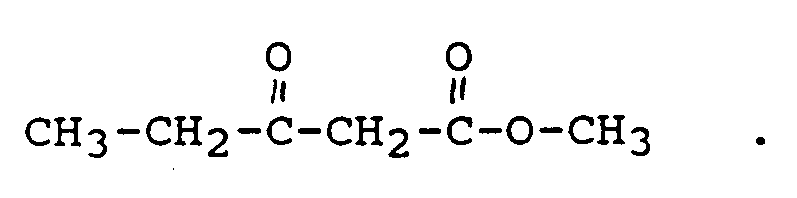
- Im erfindungsgemäßen Verfahren wird als β-Ketocarbonsäurederivat besonders bevorzugt

eingesetzt. - Bei den erfindungsgemäß eingesetzten β-Ketocarbonsäurederivaten kann es sich um eine einzelne Art eines β-Ketocarbonsäurederivats handeln. Es kann sich aber auch um ein Gemisch aus mindestens zwei Arten derartiger β-Ketocarbonsäurederivate handeln.
- Die im erfindungsgemäßen Verfahren eingesetzten β-Ketocarbonsäurederivate sind handelsübliche Produkte bzw. lassen sich nach in der organischen Chemie gängigen Methoden herstellen. Hierzu sei beispielsweise auf G. Hesse, in Houben-Weyl, Methoden der organischen Chemie, "Enole"; Thieme Verlag, Stuttgart, 1968, 4. Auflage, Bd. VI/1d, Seite 73 ff und E.J. Roskamp, J. Org. Chem. 54 (1989) 3258-60 verwiesen.
- Bei der im erfindungsgemäßen Verfahren eingesetzten Erdalkalimetallverbindung handelt es sich vorzugsweise um organische und anorganische Verbindungen des Magnesiums, Calciums, Strontiums und Bariums.
- Beispiele für die im erfindungsgemäßen Verfahren eingesetzten Erdalkalimetallverbindungen sind Erdalkalihydroxide, wie Mg(OH)₂, Ca(OH)₂, Sr(OH)₂·xH₂O und Ba(OH)₂·xH₂O, Erdalkalioxide, wie MgO·xH₂O und CaO, Erdalkalicarbonate, wie MgCO₃, MgHCO₃, CaCO₃, SrCO₃ und BaCO₃, sowie um Erdalkalimetallalkoholate, wie beispielsweise Mg(OC₂H₅)₂.
- Besonders bevorzugt handelt es sich bei der erfindungsgemäß eingesetzten Erdalkalimetallverbindung um Erdalkalimetalloxide und Erdalkalimetallhydroxide, insbesondere um Calciumoxid und Calciumhydroxid.
- Bei der erfindungsgemäß eingesetzten Erdalkalimetallverbindung kann es sich um eine einzelne Art einer Erdalkalimetallverbindung handeln. Es kann sich aber auch um ein Gemisch aus mindestens zwei Arten derartiger Erdalkalimetallverbindungen handeln.
- Bei dem erfindungsgemäßen Verfahren liegt das Molverhältnis von Diketen gemäß Formel (II) zu β-Ketocarbonsäurederivat gemäß Formel (III) zu Erdalkalimetallverbindung in der Reaktionsmasse vorzugsweise bei 1:1:1. Das Molverhältnis von Diketen gemäß Formel (II) zu β-Ketocarbonsäurederivat gemäß Formel (III) zu Erdalkalimetallverbindung kann jedoch auch geringfügig vom stöchiometrischen Verhältnis 1:1:1 abweichen.
- Das erfindungsgemäße Verfahren kann in Anwesenheit oder in Abwesenheit von Lösungsmitteln durchgeführt werden, wobei die Verwendung von in bezug auf die Reaktionsmasse inertem organischen Lösungsmittel bevorzugt wird.
- Beispiele für Lösungsmittel sind Alkohole, wie Methanol, Ethanol, n-Propanol, iso-Propanol, n-, sec.- und tert.-Butanol, 2-Butanol und Ethylenglycol; Ester, wie Methylacetat, Ethylacetat, n- und iso-Propylacetat, n-, sec.- und tert.-Butylacetat und Ethylformiat; Ether, wie Dioxan, Tetrahydrofuran, Diethylether, Di-n-propylether, Diisopropylether, Di-n-butylether, Ethylenglycoldiethylether, Ethylenglycoldimethylether, Diethylenglycoldimethylether, Diethylenglycoldiethylether, Diethylenglycoldibutylether und Anisol; chlorierte Kohlenwasserstoffe, wie Dichlormethan, Trichlormethan, Tetrachlormethan, 1,2-Dichlorethan, 1,1,1-Trichlorethan, Trichlorethylen, Tetrachlorethylen und Chlorbenzol; Kohlenwasserstoffe, wie Pentan, n-Hexan, Hexan-Iso-merengemische, Cyclohexan, Heptan, Octan, Waschbenzin, Petrolether, Benzol, Ethylbenzol, Toluol, Xylole; Ketone, wie Aceton, Methylethylketon und Methylisobutylketon; Dimethylformamid, Dimethylsulfoxid und Gemische dieser Lösungsmittel, wobei Ether und etherhaltige Lösungsmittelgemische, insbesonders Tetrahydrofuran und Ethylenglycoldimethylether, besonders bevorzugt sind.
- Die Bezeichnung Lösungsmittel bedeutet nicht, daß sich alle Reaktionskomponenten in diesen lösen müssen. Die Reaktion kann auch in einer Suspension oder Emulsion eines oder mehrerer Reaktionspartner durchgeführt werden.
- Bei dem erfindungsgemäßen Verfahren wird Lösungsmittel vorzugsweise in Mengen 40 bis 90 Gewichtsprozent, besonders bevorzugt 60 bis 70 Gewichtsprozent, jeweils bezogen auf das Gesamtgewicht der Reaktionsmasse, eingesetzt.
- Das erfindungsgemäße Verfahren wird vorzugsweise bei einer Temperatur zwischen 0 und 200°C, besonders bevorzugt bei der Siedetemperatur des verwendeten Lösungsmittels, und einem Druck zwischen 900 und 1100 hPa durchgeführt. Falls erwünscht, können auch höhere oder niedrigere Drücke angewendet werden.
- Bei dem erfindungsgemäßen Verfahren werden Diketen gemäß Formel (II), β-Ketocarbonsäurederivat gemäß Formel (III), Erdalkalimetallverbindung und gegebenenfalls Lösungsmittel auf beliebige Weise vermischt.
- In der Regel fällt bei dem erfindungsgemäßen Verfahren β-Resorcylsäurederivat gemäß Formel (I) mit R gleich Erdalkalimetallion an, aus welchem durch Ansäuern mit wäßriger Mineralsäure, wie beispielsweise Salzsäure, Schwefelsäure und Phosphorsäure, oder organischer Säure, wie beispielsweise Essigsäure, β-Resorcylsäureester gemäß Formel (I) mit R gleich Wasserstoffatom erhalten wird.
- Falls das erfindungsgemäße Verfahren in Alkanol als Lösungsmittel durchgeführt wird, können β-Resorcylderivate entstehen, deren Hydroxylgruppen teilweise oder vollständig verethert sind.
- Bei einer bevorzugten Ausführungsform des erfindungsgemäßen Verfahrens wird β-Ketocarbonsäurederivat gemäß Formel (III) mit der äquimolaren Menge an Erdalkalimetallverbindung und Lösungsmittel vermischt, auf die Siedetemperatur des Lösungsmittels erhitzt und mit der äquimolaren Menge, bezogen auf die Menge an eingesetztem β-Ketocarbonsäurederivat, an Diketen versetzt.
- Bei einer besonders bevorzugten Ausführungsform des erfindungsgemäßen Verfahrens wird Acetessigsäurederivat mit der äquimolaren Menge an Erdalkalimetalloxid oder Erdalkalimetallhydroxid und Tetrahydrofuran und/oder Ethylenglycoldimethylether enthaltendem Lösungsmittel vermischt, auf die Siedetemperatur des Tetrahydrofuran und/oder Ethylenglycoldimethylether enthaltenden Lösungsmittels erhitzt und mit einer äquimolaren Menge, bezogen auf die Menge an eingesetztem Acetessigsäurederivat, eines Gemisches von Diketen enthaltend 4-Methylen-2-oxetan und 3-Methyl-4-methylen-2-oxetan versetzt, wobei nach der Umsetzung organische oder anorganische Säure zugegeben wird.
- Das nach dem erfindungsgemäßen Verahren hergestellte β-Resorcylsäurederivat gemäß Formel (I) kann nach an sich bekannten Verfahren, wie Extraktion, Kristallisation, Destillation und Extraktion, isoliert bzw. gereinigt werden.
- Das erfindungsgemäße Verfahren hat den Vorteil, daß β-Resorcylsäurederivate der allgemeinen Formel (I) auf einfache Weise und in einem Syntheseschritt hergestellt werden können, wobei von relativ leicht zugänglichen Ausgangsstoffen ausgegangen werden kann.
- Des weitern hat das erfindungsgemäße Verfahren den Vorteil, daß β-Resorcylsäurederivate der allgemeinen Formel (I) in hoher Ausbeute und mit sehr guten olfaktorischen Eigenschaften erhalten werden.
- Die erfindungsgemäß hergestellten β-Resorcylsäurederivate können überall dort eingesetzt werden, wo auch bisher β-Resorcylderivate eingesetzt worden sind. So können sie beispielsweise direkt oder als Intermediate in den Bereichen Pharmazeutika, Agrochemikalien, Riechstoffe und Polymere eingesetzt werden.
- Insbesondere eignet sich 3,6-Dimethyl-β-resorcylsäuremethylester aufgrund ihres charakteristischen Eichenmoosgeruchs als Duftstoffe. Eichenmoosriechstoffe sind wichtige Bestandteile in Parfums mit Chypre- und Fougère-Noten. Es wurde gefunden, daß ein Gemisch aus 3,6-Dimethyl-β-resorcylsäuremethylester und 6-Methyl-β-resorcylsäuremethylester, welches sich durch einen moosig, holzig, phenolischen Geruch auszeichnet, ein sehr guter Riechstoff mit Eichenmooscharakter ist.
- 6-Methyl-β-resorcylsäuremethylester eignet sich auch zur Herstellung von Orcinyl, das als Riechstoff mit Eichenmooscharakter eingesetzt werden kann. Hierzu sei beispielsweise auf G. Nicollier, M. Rebetez, R. Tabacchi, Helv.Chim.Acta 61 Fasc. 8 (1978)-Nr. 275, 2899-904 verwiesen. Des weiteren kann 6-Methyl-β-resorcylsäuremethylester auch zur Herstellung von 4-Acetoxy-6-methyl-acetylsalicylsäuremethylester, der ebenfalls als Riechstoff mit Eichenmooscharakter bekannt ist, eingesetzt werden. Hierzu sei beispielsweise auf US-PS 3,884,843 (Fritzsche Dodge & Olcott Inc., ausgegeben am 20. Mai 1975) verwiesen.
- In den nachstehend beschriebenen Beispielen beziehen sich alle Angaben von Teilen und Prozentsätzen, falls nicht anders angegeben, auf das Gewicht. Sofern nicht anders angegeben, werden die nachstehenden Beispiele bei einem Druck der umgebenden Atmosphäre, also etwa bei 1000 hPa, und bei Raumtemperatur, also bei etwa 23°C, bzw. bei einer Temperatur, die sich beim Zusammengeben der Reaktanden bei Raumtemperatur ohne zusätzliche Heizung oder Kühlung einstellt, durchgeführt.
- Zu einer Suspension von 27,3 g (0,48 Mol) Calciumoxid in 350 ml Tetrahydrofuran werden 55,7 g (0,48 mol) Acetessigsäuremethylester gegeben, auf 50°C erhitzt und 1 Stunde gerührt. Anschließend werden 40,3 g (0,48 mol) 4-Methylen-2-oxetan (herstellbar nach DE-PS 687 065 (Consortium für elektrochemische Industrie GmbH, ausgegeben am 22. Januar 1940)) langsam zugetropft, wobei während des Zutropfens so gekühlt wird, daß die Temperatur des Reaktionsgemisches einen Wert von 40°C nicht übersteigt und zwischen 30 und 40°C liegt, 8 Stunden unter Rückfluß gekocht und nach Abkühlen auf Raumtemperatur das Tetrahydrofuran durch Destillation entfernt. Danach werden 260 ml Methyl-tert.-butylether hinzugegeben und die so erhaltene Mischung mit so viel 2N HCl versetzt bis sich das im Gemisch enthaltene Calciumoxid auflöst. Nach dreimaliger Extraktion mit Methyl-tert.-butylether wird zur organischen Phase Wasser gegeben, die wäßrige Phase mit NaOH (10 %ig) auf pH 6 eingestellt und dreimal mit Methyl-tert.-butylether extrahiert. Aus der organischen Phase erhält man nach Entfernen des Lösungsmittels 77,3 g hellbrauner Kristalle mit einem Reinheitsgrad von 92% (Gaschromatographie), was einer Ausbeute von 83% entspricht, der folgenden Struktur

Der Geruch des so erhaltenen 6-Methyl-β-Resorcylsäuremethylesters kann wie folgt beschrieben werden: moosig, holzig, phenolisch, Eichenmooscharakter. - Der so erhaltene 6-Methyl-β-resorcylsäureester zeigt im 200 MHz-¹H-NMR-Spektrum in CDCl₃ und TMS als innerem Standard Signale bei 11,75 (s, 1H, OH), 6,27 und 6,23 (d, 1H, J3/5 = 2Hz), 5,40 (sb, 1H, OH), 3,92 (s, 3H, COOCH₃) und 2,48 (s, 3H, CH₃).
- Zur weiteren Reinigung des so erhaltenen 6-Methyl-β-resorcylsäureesters kann aus Petroleumbenzin/Ethylacetat umkristallisiert werden. Der so erhaltene 6-Methyl-β-resorcylsäureester kann beispielsweise folgendermaßen weiterverwendet werden:
- 18,55 g des erfindungsgemäß hergestellten 6-Methyl-β-resorcylsäureesters und 14,3 g Kaliumcarbonat (wasserfrei) werden in Aceton vorgelegt, 9,5 ml Methyliodid in Aceton zugetropft und 12 Stunden unter Rückfluß gekocht. Anschließend wird das Aceton abdestilliert, unter Eiskühlung angesäuert und dreimal mit Ethylacetat extrahiert. Es werden 15,71 g (Ausbeute: 79%) 4-Methoxy-6-methyl-salicylsäuremethylester erhalten, dessen Geruch wie folgt charakterisiert werden kann: süß, erdig, Walnuß, moosig.
- 1,0 g des so erhaltenen 4-Methoxy-6-methyl-salicylsäuremethylesters werden mit 35 ml einer wäßrigen Kaliumhydroxydlösung (15 %ig) 8 Stunden unter Rückfluß gekocht. Anschließend wird das Reaktionsgemisch mit verdünnter Salzsäure angesäuert und mit Ethylacetat extrahiert. Es werden 0,70 g (Ausbeute: 70 %) Orcinyl (3-Methoxy-5-methylphenol) erhalten.
- 5 g des erfindungsgemäß hergestellten 6-Methyl-β-resorcylsäureesters, 11,2 g Essigsäureanhydrid, 0,3 g Natriumacetat und 50 ml Xylol werden mehrere Stunden auf 135°C erhitzt, wobei circa 15 ml eines Azeotrops überdestilliert. Anschließend werden das überschüssige Essigsäureanhydrid und Xylol bei 20 mmHg abdestilliert, der Rückstand in 50 ml Toluol gelöst, die organische Phase zweimal mit einer gesättigten Natriumcarbonatlösung und zweimal mit Wasser gewaschen. Der nach Entfernen des Lösungsmittels erhaltene Kristallbrei wird aus Xylol/Propanol umkristallisiert. Es werden 5,2 g 4-Acetoxy-6-methyl-acetylsalicylsäuremethylester (Ausbeute: 71 %; Schmelzpunkt: 48 °C) erhalten.
- 647,7 g (7,0 mol) Propionylchlorid und 549,5 g (7,0 mol) Acetylchlorid werden einem Gemisch aus 1416,7 g (14 mol) Triethylamin in 15 l Methyl-tert.-butylether zugetropft, wobei sich das Gemisch erwärmt. Nach 5-stündigem Rühren bei Raumtemperatur wird das so erhaltene Gemisch auf eine Temperatur von -15°C abgekühlt und anschließend das Triethylaminhydrochlorid durch Absaugen abgetrennt. Die verbleibende Lösung wird auf ein Volumen von ca. 1 l eingeengt und anschließend über eine 30 cm Vigreux-Kolonne feindestilliert. Es werden 609,0 g eines Gemisches mit folgender Zusammensetzung erhalten, was einer Ausbeute von 89% entspricht:


- Die so erhaltenen Diketene zeigen im 200 MHz-¹H-NMR-Spektrum in CDCl₃ und TMS als internem Standard Signale bei:
- DIKE:
- 4,80 (m, 1Hvin), 4,48 (m, 1H, Hvin), 3,88 (m, 2H, CH₂CO) ppm,
- MEDIKE:
- 4,74 (dd, 1H, Hvin, Jgem.= 5 Hz, Jall.= 1 Hz), 4,47 (dd, 1H, Hvin, Jgem.= 5 Hz, Jall. = 1 Hz), 4,0 (q, 1H, CHCH₃CO, J = 8 Hz), 1,47 (d, 3H, CH₃, J = 8 Hz) ppm,
- DIMEDIKE:
- 4,75 (dq, 1H, Hvin, Jvic = 7 Hz, Jall. = 1 Hz), 3,98 (dq, 1H, CHCH₃CO, Jvic = 9,0 Hz, Jall.= 1 Hz), 1,67 (dd, 3H, CH₃-C = C, Jvic = 7 Hz, Jhomoall. = 1 Hz), 1,41 (d, 3H, CH CH₃CO, Jvic = 9,0 Hz) ppm und
- I-MEDIKE:
- 4,75 (q, 1H, Hvin), 4,83 (m, 2H, CH₂ CO), 1,7 (d, 3H, CH₃C=C, J = 7,0 Hz) ppm.
- Das so erhaltene Diketen-Gemisch wird destillativ getrennt. Es werden die folgenden Fraktionen erhalten:

- Zu einer Suspension von 89,6 g (1,60 mol) Calciumoxid in 2,0 l Tetrahydrofuran werden 185,6 g (1,60 mol) Acetessigsäuremethylester gegeben, auf 50°C erhitzt und 1 Stunde gerührt. Anschließend werden 145,7 g (1,60 mol) eines Gemisches aus 48 Prozent DIKE und 52 Prozent MEDIKE, deren Herstellung oben unter a) beschrieben ist, langsam zugetropft und wie in Beispiel 1 beschrieben verfahren. Aus der organischen Phase wird das Lösungsmittel entfernt und aus 1 l Toluol fraktioniert kristallisiert. Es verbleiben 266,5 g farbloser Kristalle mit einem Reinheitsgrad von 95% (Gaschromatographie), was einer Ausbeute von 88% entspricht, der folgenden Struktur
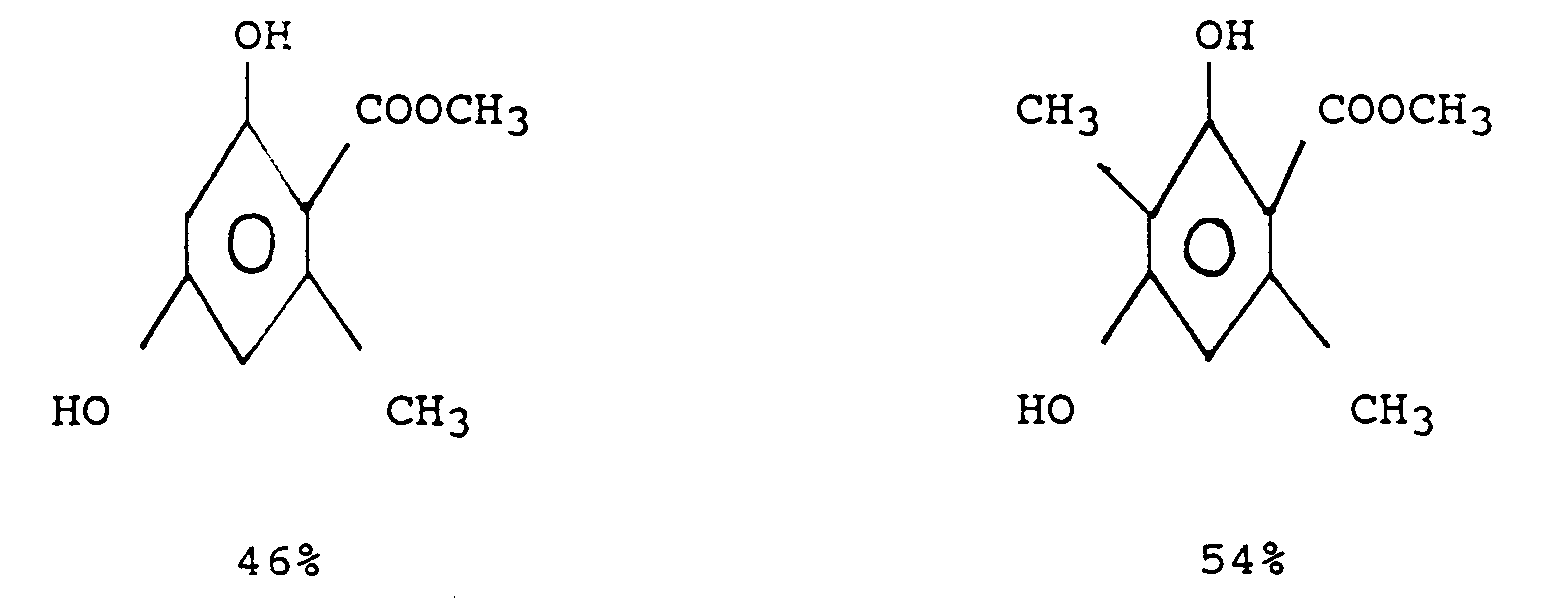
Der Geruch des so erhaltenen Gemisches aus 6-Methyl-β-Resorcylsäuremethylester und 3,6- Dimethyl-β-Resorcylsäuremethylester kann wie folgt beschrieben werden: moosig, holzig, phenolisch. Das Gemisch eignet sich sehr gut als Riechstoff mit Eichenmooscharakter. - Das so erhaltene β-Resorcylsäure-methylestergemisch zeigt im 200 MHz-¹H-NMR-Spektrum in CDCl₃ und TMS als innerem Standard Signale für 6-Methyl-β-resorcylsäuremethylester bei 11,75 (s, 1H, OH), 6,27 und 6,23 (d, 1H, J3/5 = 2Hz), 5,40 (sb, 1H, OH), 3,92 (s, 3H, COOCH₃) und 2,48 (s, 3H, CH₃) ppm und für 3,6-Dimethyl-β-resorcylsäuremethylester bei 12,05 (s, 1H, 2-OH), 6,22 (s, 1H, H⁵), 5,19 (s, 1H, 4-OH), 3,92 (s, 3H, COOCH₃), 2,46 (s, 3H, 6-CH₃), 2,10 (s, 3H, 3-CH₃) ppm.
- Zur weiteren Reinigung des so erhaltenen Gemisches kann noch aus Toluol, Dichlormethan oder Hexan umkristallisiert werden.
- Zu einer Suspension von 89,6 g (1,60 mol) Calciumoxid in 2,0 l Tetrahydrofuran werden 185,6 g (1,60 mol) Acetessigsäuremethylester gegeben, auf 50°C erhitzt und 1 Stunde gerührt. Anschließend werden 1,60 mol eines Gemisches aus 49 Prozent I-MEDIKE und 51 Prozent DIMEDIKE, deren Herstellung in Beispiel 2 unter a) beschrieben ist, langsam zugetropft und wie in Beispiel 1 beschrieben verfahren. Aus der organischen Phase wird das Lösungsmittel entfernt und aus 1 1 Toluol fraktioniert kristallisiert. Es werden farblose Kristalle mit einer Ausbeute von 91 Prozent der folgenden Struktur

erhalten. - Bei dem so erhaltenen Gemisch aus 5,6-Dimethyl-β-Resorcylsäuremethylester (balsamisch, ambriert, fruchtig) und 3,5,6-Trimethyl-β-Resorcylsäuremethylester (Liebstöckl, Walnuß, maple lacton) dominiert der Geruch nach Liebstöckl.
- Das so erhaltene β-Resorcylsäure-methylestergemisch zeigt im 200 MHz-¹H-NMR-Spektrum in CDCl₃ und TMS als innerem Standard Signale für 5,6-Dimethyl-β-resorcylsäuremethylester bei 11,26 (s,1H,2-OH), 6,27 (s, 1H, H³), 5,60 (sb, 1H, OH), 3,93 (s, 3H, COOCH₃), 2,45 (s, 3H, 6-CH₃), 2,11 (s, 3H, 5-CH₃) ppm und für 3,5,6-Trimethyl-β-Resorcylsäuremethylester bei 11,46 (s, 1H, 2-OH) 5,15 (s, 1H, 4-OH), 3,91 (s, 3H, COOCH₃), 2,42 (s, 3H, 6-CH₃), 2,13 (s, 6H, 3-und 5-CH₃) ppm. Rf-Werte (Petroleumbenzin/Ethylacetat 8:2) für 5,6-Dimethyl-β-resorcylsäuremethylester: 0,29 und für 3,5,6-Trimethyl-β-Resorcylsäuremethylester: 0,40.
- Zur weiteren Reinigung des so erhaltenen Gemisches kann noch aus Toluol, Dichlormethan oder Hexan umkristallisiert werden.
Claims (10)
- Verfahren zur Herstellung von β-Resorcylsäurederivaten der allgemeinen Formel

durch Umsetzung von Diketen der allgemeinen Formel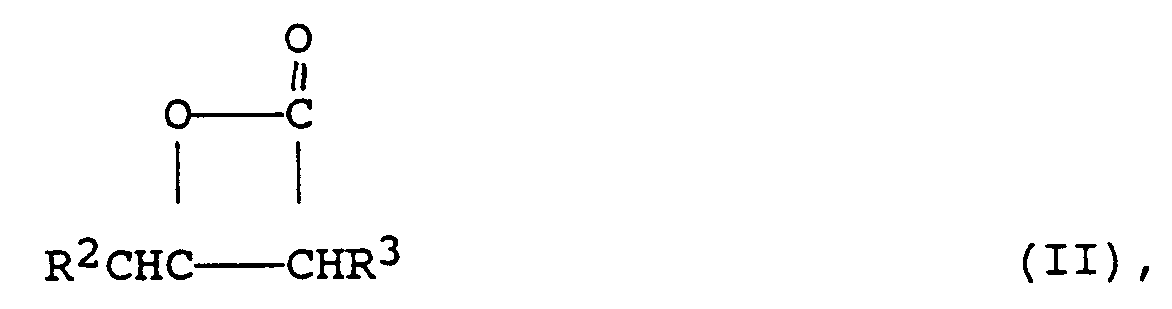

in Anwesenheit von Erdalkalimetallverbindung. - Verfahren nach Anspruch 1, dadurch gekennzeichnet, daß Diketene der allgemeinen Formel (II) eingesetzt werden, bei denen R² und R³ gleich oder verschieden sein können und Wasserstoffatom oder Alkylgruppe mit 1 bis 3 Kohlenstoffatomen bedeuten.
- Verfahren nach Anspruch 1 oder 2, dadurch gekennzeichnet, daß Diketene der allgemeinen Formel (II) durch Umsetzung von carbonsäurehalogenid der allgemeinen Formel

- Verfahren nach einem oder mehreren der Ansprüche 1 bis 3, dadurch gekennzeichnet, daß β-Ketocarbonsäurederivate der allgemeinen Formel (III) eingesetzt werden, bei denen R¹ und R⁴ gleich oder verschieden sein können und Alkylgruppe mit 1 bis 3 Kohlenstoffatomen bedeuten.
- Verfahren nach einem oder mehreren der Ansprüche 1 bis 4, dadurch gekennzeichnet, daß als Erdalkalimetallverbindung Erdalkalimetalloxid eingesetzt wird.
- Verfahren nach einem oder mehreren der Ansprüche 1 bis 5, dadurch gekennzeichnet, daß als Erdalkalimetallverbindung calciumoxid eingesetzt wird.
- Verfahren nach einem oder mehreren der Ansprüche 1 bis 4, dadurch gekennzeichnet, daß als Erdalkalimetallverbindung Erdalkalihydroxid eingesetzt wird.
- Verfahren nach einem oder mehreren der Ansprüche 1 bis 7, dadurch gekennzeichnet, daß die Umsetzung in Anwesenheit von Lösungsmittel durchgeführt wird.
- Verfahren nach einem oder mehreren der Ansprüche 1 bis 8, dadurch gekennzeichnet, daß Acetessigsäurederivat mit der äquimolaren Menge an Erdalkalimetalloxid oder Erdalkalimetallhydroxid und Tetrahydrofuran und/oder Ethylenglycoldimethylether enthaltendem Lösungsmittel vermischt, auf die Siedetemperatur des Tetrahydrofuran und/oder Ethylenglycoldimethylether enthaltenden Lösungsmittels erhitzt und mit einer äquimolaren Menge, bezogen auf die Menge an eingesetztem Acetessigsäurederivat, eines Gemisches von Diketen enthaltend 4-Methylen-2-oxetan und 3-Methyl-4-methylen-2-oxetan versetzt wird.
- Verwendung eines Gemisches enthaltend 6-Methyl-β-resorcylsäuremethylester und 3,6-Dimethyl-β-resorcylsäuremethylester als Riechstoff mit Eichenmooscharakter.
Applications Claiming Priority (2)
| Application Number | Priority Date | Filing Date | Title |
|---|---|---|---|
| DE4008223A DE4008223A1 (de) | 1990-03-15 | 1990-03-15 | Verfahren zur herstellung von ss-resorcylsaeurederivaten |
| DE4008223 | 1990-03-15 |
Publications (3)
| Publication Number | Publication Date |
|---|---|
| EP0446925A2 EP0446925A2 (de) | 1991-09-18 |
| EP0446925A3 EP0446925A3 (en) | 1992-04-22 |
| EP0446925B1 true EP0446925B1 (de) | 1995-06-21 |
Family
ID=6402230
Family Applications (1)
| Application Number | Title | Priority Date | Filing Date |
|---|---|---|---|
| EP91103950A Expired - Lifetime EP0446925B1 (de) | 1990-03-15 | 1991-03-14 | Verfahren zur Herstellung von beta-Resorcylsäurederivaten |
Country Status (5)
| Country | Link |
|---|---|
| US (1) | US5171878A (de) |
| EP (1) | EP0446925B1 (de) |
| JP (1) | JP2520803B2 (de) |
| DE (2) | DE4008223A1 (de) |
| ES (1) | ES2073606T3 (de) |
Families Citing this family (1)
| Publication number | Priority date | Publication date | Assignee | Title |
|---|---|---|---|---|
| JP6518512B2 (ja) * | 2015-05-27 | 2019-05-22 | 上野製薬株式会社 | 4−ヒドロキシ安息香酸長鎖エステルの精製方法 |
Family Cites Families (12)
| Publication number | Priority date | Publication date | Assignee | Title |
|---|---|---|---|---|
| US3634491A (en) * | 1968-08-30 | 1972-01-11 | Int Flavors & Fragrances Inc | Process for the preparation of 3 5-dialkyl resorcylic acids and esters |
| FR2033562A5 (de) * | 1969-02-27 | 1970-12-04 | Rhone Poulenc Sa | |
| US4020098A (en) * | 1972-12-07 | 1977-04-26 | Ciba-Geigy Corporation | Process for the preparation of 5-substituted resorcinols and related intermediates |
| DE2653177A1 (de) * | 1976-11-23 | 1978-05-24 | Dragoco Gerberding Co Gmbh | Verfahren zur herstellung von alkylsubstituierten beta-resorcylsaeureestern |
| US4309563A (en) * | 1980-06-04 | 1982-01-05 | Showa Denko K.K. | Xylylene diol derivative |
| US4339593A (en) * | 1980-12-16 | 1982-07-13 | Fritzsche Dodge & Olcott Inc. | Process for the manufacture of 3,6-dialkyl resorcylic acid esters |
| DE3116913A1 (de) * | 1981-04-29 | 1982-11-18 | Basf Ag, 6700 Ludwigshafen | Verfahren zur herstellung von resorcinderivaten sowie verwendung bestimmter resorcinderivate als riechstoffe |
| DE3136720C2 (de) * | 1981-09-16 | 1986-05-07 | Dynamit Nobel Ag, 5210 Troisdorf | Verfahren zur Herstellung von 3-Alkyl-6-methyl-ß-resorcylsäureestern |
| US4408059A (en) * | 1981-12-04 | 1983-10-04 | University Patents, Inc. | Spiroketals useful as intermediates in the synthesis of milbemycin and avermectin macrolides |
| DE3235019C2 (de) * | 1982-09-22 | 1984-07-12 | Dynamit Nobel Ag, 5210 Troisdorf | Verfahren zur Herstellung von p-Orsellinsäureestern |
| EP0133960A3 (de) * | 1983-08-04 | 1985-12-11 | Roure Bertrand Dupont Société Anonyme | Verfahren zur Herstellung von Estern substituierter Benzoesäuren |
| US5025036A (en) * | 1987-10-01 | 1991-06-18 | Hoffmann-La Roche Inc. | Catechol carboxylic acids |
-
1990
- 1990-03-15 DE DE4008223A patent/DE4008223A1/de not_active Withdrawn
-
1991
- 1991-02-04 US US07/649,895 patent/US5171878A/en not_active Expired - Fee Related
- 1991-03-14 DE DE59105754T patent/DE59105754D1/de not_active Expired - Lifetime
- 1991-03-14 ES ES91103950T patent/ES2073606T3/es not_active Expired - Lifetime
- 1991-03-14 EP EP91103950A patent/EP0446925B1/de not_active Expired - Lifetime
- 1991-03-15 JP JP3228201A patent/JP2520803B2/ja not_active Expired - Lifetime
Also Published As
| Publication number | Publication date |
|---|---|
| DE4008223A1 (de) | 1991-09-19 |
| EP0446925A3 (en) | 1992-04-22 |
| ES2073606T3 (es) | 1995-08-16 |
| DE59105754D1 (de) | 1995-07-27 |
| JPH06206849A (ja) | 1994-07-26 |
| US5171878A (en) | 1992-12-15 |
| JP2520803B2 (ja) | 1996-07-31 |
| EP0446925A2 (de) | 1991-09-18 |
Similar Documents
| Publication | Publication Date | Title |
|---|---|---|
| EP0633258B1 (de) | Verbessertes Verfahren zur Herstellung von Astaxanthin, neue Zwischenprodukte hierfür sowie ein Verfahren zu deren Herstellung | |
| EP0031932A2 (de) | Substituierte Lactone, Pentacarbonsäurederivate und Verfahren zu ihrer Herstellung | |
| EP0463464A1 (de) | Verfahren zur Herstellung von 2-Chlor-5-methyl-pyridin | |
| CH627432A5 (en) | Process for the preparation of vinylcyclopropanecarboxylates | |
| EP0095047B1 (de) | Verfahren zur Herstellung von 3-vinylsubstituierten 2,2-Dimethylcyclopropan-1-carbonsäuren bzw. ihren Estern und neue Zwischenprodukte dafür | |
| DE69707860T2 (de) | Verfahren zur herstellung von tetrahydroindolizinen | |
| EP0414020B1 (de) | Verfahren zur Herstellung von Clausenamid und Neoclausenamid und deren Derivate | |
| EP0446925A2 (de) | Verfahren zur Herstellung von beta-Resorcylsäurederivaten | |
| EP0439745A2 (de) | Verfahren zur Herstellung von 2-Chlor-5-methyl-pyridin | |
| DE69527997T2 (de) | Verfahren zur Herstellung von Isoxazole-3-Carbonsäure | |
| DE2533396C2 (de) | 3-Methyl-3-aryl-brenztraubensäureester und Verfahren zu ihrer Herstellung | |
| DE2452536A1 (de) | Pyrrolidone und verfahren zu ihrer herstellung | |
| DE2410782C2 (de) | Phenylendiessigsäuredialkylester und Verfahren zu deren Herstellung | |
| CH620666A5 (de) | ||
| SU1395141A3 (ru) | Способ получени производных 3-азабицикло 3,3,1 нонана,или их изомеров,или их фармацевтически приемлемых солей присоединени кислот (его варианты) | |
| DE2253089C2 (de) | 9-Oxo-9,10,seco-östran-Derivate und Verfahren zur Herstellung dieser Verbindungen und von 9-Oxo-D-homo-9,10-seco-östran-Derivaten | |
| EP0290903B1 (de) | Beta-Fluoracyl-beta-halogenvinylalkylether | |
| EP0182168B1 (de) | Verfahren zur Herstellung von Hydroxymethylen-alkoxyessigsäureestern | |
| EP0122479A1 (de) | 3-Chlor-1,1-dialkoxyacetone und Verfahren zu ihrer Herstellung | |
| DE2952068A1 (de) | Substituierte lactone und verfahren zu deren herstellung | |
| DE2912052A1 (de) | Verfahren zur herstellung von 2eckige klammer auf 4-(thienylcarbonyl)phenyl eckige klammer zu -propionsaeure | |
| WO2005040087A1 (de) | Verfahren zur herstellung von 6,6,6-trihalo-3,5-dioxohexansäureestern | |
| DE3231815A1 (de) | Dialkoxymethyl-butyrolactone, verfahren zu ihrer herstellung, zwischenprodukte dafuer und ihre verwendung | |
| EP0725055A1 (de) | Verfahren zur Herstellung von 5-Oxo-6-heptensäurealkylestern sowie neue Zwischenprodukte zu ihrer Herstellung | |
| DE2810541A1 (de) | Phenylessigsaeurederivate, verfahren zu ihrer herstellung und ihre verwendung als zwischenprodukte zur herstellung pharmakologisch aktiver phenylessigsaeuren |
Legal Events
| Date | Code | Title | Description |
|---|---|---|---|
| PUAI | Public reference made under article 153(3) epc to a published international application that has entered the european phase |
Free format text: ORIGINAL CODE: 0009012 |
|
| 17P | Request for examination filed |
Effective date: 19910314 |
|
| AK | Designated contracting states |
Kind code of ref document: A2 Designated state(s): CH DE ES FR GB LI NL |
|
| PUAL | Search report despatched |
Free format text: ORIGINAL CODE: 0009013 |
|
| AK | Designated contracting states |
Kind code of ref document: A3 Designated state(s): CH DE ES FR GB LI NL |
|
| 17Q | First examination report despatched |
Effective date: 19940531 |
|
| GRAA | (expected) grant |
Free format text: ORIGINAL CODE: 0009210 |
|
| AK | Designated contracting states |
Kind code of ref document: B1 Designated state(s): CH DE ES FR GB LI NL |
|
| REF | Corresponds to: |
Ref document number: 59105754 Country of ref document: DE Date of ref document: 19950727 |
|
| REG | Reference to a national code |
Ref country code: ES Ref legal event code: FG2A Ref document number: 2073606 Country of ref document: ES Kind code of ref document: T3 |
|
| GBT | Gb: translation of ep patent filed (gb section 77(6)(a)/1977) |
Effective date: 19950731 |
|
| ET | Fr: translation filed | ||
| PLBE | No opposition filed within time limit |
Free format text: ORIGINAL CODE: 0009261 |
|
| STAA | Information on the status of an ep patent application or granted ep patent |
Free format text: STATUS: NO OPPOSITION FILED WITHIN TIME LIMIT |
|
| REG | Reference to a national code |
Ref country code: CH Ref legal event code: PUE Owner name: CONSORTIUM FUER ELEKTROCHEMISCHE INDUSTRIE GMBH -D |
|
| 26N | No opposition filed | ||
| NLS | Nl: assignments of ep-patents |
Owner name: FRAGRANCE RESOURCES AGENCY, S.A. |
|
| REG | Reference to a national code |
Ref country code: FR Ref legal event code: TP |
|
| REG | Reference to a national code |
Ref country code: GB Ref legal event code: 732E |
|
| REG | Reference to a national code |
Ref country code: ES Ref legal event code: PC2A Owner name: FRAGANCE RESOURCES AGENCY S.A. |
|
| PGFP | Annual fee paid to national office [announced via postgrant information from national office to epo] |
Ref country code: FR Payment date: 19970213 Year of fee payment: 7 |
|
| PGFP | Annual fee paid to national office [announced via postgrant information from national office to epo] |
Ref country code: NL Payment date: 19970218 Year of fee payment: 7 |
|
| PGFP | Annual fee paid to national office [announced via postgrant information from national office to epo] |
Ref country code: CH Payment date: 19970219 Year of fee payment: 7 |
|
| PGFP | Annual fee paid to national office [announced via postgrant information from national office to epo] |
Ref country code: GB Payment date: 19970226 Year of fee payment: 7 |
|
| PGFP | Annual fee paid to national office [announced via postgrant information from national office to epo] |
Ref country code: ES Payment date: 19970317 Year of fee payment: 7 |
|
| PGFP | Annual fee paid to national office [announced via postgrant information from national office to epo] |
Ref country code: DE Payment date: 19970327 Year of fee payment: 7 |
|
| PG25 | Lapsed in a contracting state [announced via postgrant information from national office to epo] |
Ref country code: GB Free format text: LAPSE BECAUSE OF NON-PAYMENT OF DUE FEES Effective date: 19980314 |
|
| PG25 | Lapsed in a contracting state [announced via postgrant information from national office to epo] |
Ref country code: ES Free format text: LAPSE BECAUSE OF EXPIRATION OF PROTECTION Effective date: 19980316 |
|
| PG25 | Lapsed in a contracting state [announced via postgrant information from national office to epo] |
Ref country code: LI Free format text: LAPSE BECAUSE OF NON-PAYMENT OF DUE FEES Effective date: 19980331 Ref country code: FR Free format text: THE PATENT HAS BEEN ANNULLED BY A DECISION OF A NATIONAL AUTHORITY Effective date: 19980331 Ref country code: CH Free format text: LAPSE BECAUSE OF NON-PAYMENT OF DUE FEES Effective date: 19980331 |
|
| PG25 | Lapsed in a contracting state [announced via postgrant information from national office to epo] |
Ref country code: NL Free format text: LAPSE BECAUSE OF NON-PAYMENT OF DUE FEES Effective date: 19981001 |
|
| PG25 | Lapsed in a contracting state [announced via postgrant information from national office to epo] |
Ref country code: DE Free format text: LAPSE BECAUSE OF THE APPLICANT RENOUNCES Effective date: 19981103 |
|
| GBPC | Gb: european patent ceased through non-payment of renewal fee |
Effective date: 19980314 |
|
| REG | Reference to a national code |
Ref country code: CH Ref legal event code: PL |
|
| NLV4 | Nl: lapsed or anulled due to non-payment of the annual fee |
Effective date: 19981001 |
|
| REG | Reference to a national code |
Ref country code: FR Ref legal event code: ST |
|
| REG | Reference to a national code |
Ref country code: ES Ref legal event code: FD2A Effective date: 20000301 |