EP0440959A1 - Verfahren zur Herstellung von 2-Alkylthio-1,3,4-thiadiazolen - Google Patents
Verfahren zur Herstellung von 2-Alkylthio-1,3,4-thiadiazolen Download PDFInfo
- Publication number
- EP0440959A1 EP0440959A1 EP90124849A EP90124849A EP0440959A1 EP 0440959 A1 EP0440959 A1 EP 0440959A1 EP 90124849 A EP90124849 A EP 90124849A EP 90124849 A EP90124849 A EP 90124849A EP 0440959 A1 EP0440959 A1 EP 0440959A1
- Authority
- EP
- European Patent Office
- Prior art keywords
- formula
- process according
- mol
- iii
- acid
- Prior art date
- Legal status (The legal status is an assumption and is not a legal conclusion. Google has not performed a legal analysis and makes no representation as to the accuracy of the status listed.)
- Granted
Links
- 238000002360 preparation method Methods 0.000 title claims abstract description 7
- 238000000034 method Methods 0.000 title claims description 30
- XHXFXVLFKHQFAL-UHFFFAOYSA-N phosphoryl trichloride Chemical compound ClP(Cl)(Cl)=O XHXFXVLFKHQFAL-UHFFFAOYSA-N 0.000 claims abstract description 33
- 150000001735 carboxylic acids Chemical class 0.000 claims abstract description 8
- 150000002148 esters Chemical class 0.000 claims abstract description 8
- 125000000217 alkyl group Chemical group 0.000 claims abstract description 7
- 125000003710 aryl alkyl group Chemical group 0.000 claims abstract description 4
- 239000002253 acid Substances 0.000 claims description 7
- 150000001732 carboxylic acid derivatives Chemical class 0.000 claims description 7
- -1 dithiocarbazic acid ester Chemical class 0.000 claims description 6
- 125000002496 methyl group Chemical class [H]C([H])([H])* 0.000 claims description 6
- 238000003756 stirring Methods 0.000 claims description 6
- 125000004178 (C1-C4) alkyl group Chemical group 0.000 claims description 5
- ZAMOUSCENKQFHK-UHFFFAOYSA-N Chlorine atom Chemical group [Cl] ZAMOUSCENKQFHK-UHFFFAOYSA-N 0.000 claims description 5
- 229910052731 fluorine Inorganic materials 0.000 claims description 4
- 239000011737 fluorine Substances 0.000 claims description 4
- 125000001153 fluoro group Chemical group F* 0.000 claims description 4
- 125000001797 benzyl group Chemical group [H]C1=C([H])C([H])=C(C([H])=C1[H])C([H])([H])* 0.000 claims description 3
- 229910052801 chlorine Inorganic materials 0.000 claims description 3
- 239000000460 chlorine Chemical group 0.000 claims description 3
- 229910052736 halogen Inorganic materials 0.000 claims description 3
- 150000002367 halogens Chemical group 0.000 claims description 3
- WKBOTKDWSSQWDR-UHFFFAOYSA-N Bromine atom Chemical compound [Br] WKBOTKDWSSQWDR-UHFFFAOYSA-N 0.000 claims description 2
- GDTBXPJZTBHREO-UHFFFAOYSA-N bromine Substances BrBr GDTBXPJZTBHREO-UHFFFAOYSA-N 0.000 claims description 2
- 229910052794 bromium Inorganic materials 0.000 claims description 2
- 125000000896 monocarboxylic acid group Chemical group 0.000 claims description 2
- 239000000543 intermediate Substances 0.000 abstract description 3
- 125000003178 carboxy group Chemical group [H]OC(*)=O 0.000 abstract description 2
- 239000011814 protection agent Substances 0.000 abstract description 2
- YXFVVABEGXRONW-UHFFFAOYSA-N Toluene Chemical compound CC1=CC=CC=C1 YXFVVABEGXRONW-UHFFFAOYSA-N 0.000 description 18
- JUJWROOIHBZHMG-UHFFFAOYSA-N Pyridine Chemical compound C1=CC=NC=C1 JUJWROOIHBZHMG-UHFFFAOYSA-N 0.000 description 12
- DTQVDTLACAAQTR-UHFFFAOYSA-N Trifluoroacetic acid Chemical compound OC(=O)C(F)(F)F DTQVDTLACAAQTR-UHFFFAOYSA-N 0.000 description 10
- 238000006243 chemical reaction Methods 0.000 description 8
- QAOWNCQODCNURD-UHFFFAOYSA-N sulfuric acid Substances OS(O)(=O)=O QAOWNCQODCNURD-UHFFFAOYSA-N 0.000 description 8
- 239000007858 starting material Substances 0.000 description 7
- UMJSCPRVCHMLSP-UHFFFAOYSA-N pyridine Natural products COC1=CC=CN=C1 UMJSCPRVCHMLSP-UHFFFAOYSA-N 0.000 description 6
- 150000001875 compounds Chemical class 0.000 description 5
- 239000007789 gas Substances 0.000 description 5
- 239000002904 solvent Substances 0.000 description 5
- ILAXBOIRSPXAMM-UHFFFAOYSA-N methyl n-aminocarbamodithioate Chemical compound CSC(=S)NN ILAXBOIRSPXAMM-UHFFFAOYSA-N 0.000 description 4
- 239000000203 mixture Substances 0.000 description 4
- FAIAAWCVCHQXDN-UHFFFAOYSA-N phosphorus trichloride Chemical compound ClP(Cl)Cl FAIAAWCVCHQXDN-UHFFFAOYSA-N 0.000 description 4
- XLYOFNOQVPJJNP-UHFFFAOYSA-N water Substances O XLYOFNOQVPJJNP-UHFFFAOYSA-N 0.000 description 4
- ULROOIOMHZXHRY-UHFFFAOYSA-N 2-methylsulfanyl-5-(trifluoromethyl)-1,3,4-thiadiazole Chemical compound CSC1=NN=C(C(F)(F)F)S1 ULROOIOMHZXHRY-UHFFFAOYSA-N 0.000 description 3
- HEMHJVSKTPXQMS-UHFFFAOYSA-M Sodium hydroxide Chemical compound [OH-].[Na+] HEMHJVSKTPXQMS-UHFFFAOYSA-M 0.000 description 3
- 238000001816 cooling Methods 0.000 description 3
- 239000005457 ice water Substances 0.000 description 3
- 239000000047 product Substances 0.000 description 3
- 239000011541 reaction mixture Substances 0.000 description 3
- HEDRZPFGACZZDS-UHFFFAOYSA-N Chloroform Chemical compound ClC(Cl)Cl HEDRZPFGACZZDS-UHFFFAOYSA-N 0.000 description 2
- UIIMBOGNXHQVGW-UHFFFAOYSA-M Sodium bicarbonate Chemical compound [Na+].OC([O-])=O UIIMBOGNXHQVGW-UHFFFAOYSA-M 0.000 description 2
- 150000001244 carboxylic acid anhydrides Chemical class 0.000 description 2
- 238000004587 chromatography analysis Methods 0.000 description 2
- JXTHNDFMNIQAHM-UHFFFAOYSA-N dichloroacetic acid Chemical compound OC(=O)C(Cl)Cl JXTHNDFMNIQAHM-UHFFFAOYSA-N 0.000 description 2
- QEWYKACRFQMRMB-UHFFFAOYSA-N fluoroacetic acid Chemical compound OC(=O)CF QEWYKACRFQMRMB-UHFFFAOYSA-N 0.000 description 2
- 238000004519 manufacturing process Methods 0.000 description 2
- 239000012074 organic phase Substances 0.000 description 2
- QAEDZJGFFMLHHQ-UHFFFAOYSA-N trifluoroacetic anhydride Chemical compound FC(F)(F)C(=O)OC(=O)C(F)(F)F QAEDZJGFFMLHHQ-UHFFFAOYSA-N 0.000 description 2
- 238000010626 work up procedure Methods 0.000 description 2
- AZUYLZMQTIKGSC-UHFFFAOYSA-N 1-[6-[4-(5-chloro-6-methyl-1H-indazol-4-yl)-5-methyl-3-(1-methylindazol-5-yl)pyrazol-1-yl]-2-azaspiro[3.3]heptan-2-yl]prop-2-en-1-one Chemical compound ClC=1C(=C2C=NNC2=CC=1C)C=1C(=NN(C=1C)C1CC2(CN(C2)C(C=C)=O)C1)C=1C=C2C=NN(C2=CC=1)C AZUYLZMQTIKGSC-UHFFFAOYSA-N 0.000 description 1
- OAWAZQITIZDJRB-UHFFFAOYSA-N 2-chloro-2,2-difluoroacetic acid Chemical compound OC(=O)C(F)(F)Cl OAWAZQITIZDJRB-UHFFFAOYSA-N 0.000 description 1
- 0 CC1=NCN=C(S*)S1 Chemical compound CC1=NCN=C(S*)S1 0.000 description 1
- FOCAUTSVDIKZOP-UHFFFAOYSA-N chloroacetic acid Chemical compound OC(=O)CCl FOCAUTSVDIKZOP-UHFFFAOYSA-N 0.000 description 1
- 229940106681 chloroacetic acid Drugs 0.000 description 1
- 229960005215 dichloroacetic acid Drugs 0.000 description 1
- PBWZKZYHONABLN-UHFFFAOYSA-N difluoroacetic acid Chemical compound OC(=O)C(F)F PBWZKZYHONABLN-UHFFFAOYSA-N 0.000 description 1
- SBZXBUIDTXKZTM-UHFFFAOYSA-N diglyme Chemical compound COCCOCCOC SBZXBUIDTXKZTM-UHFFFAOYSA-N 0.000 description 1
- 239000003085 diluting agent Substances 0.000 description 1
- 125000004494 ethyl ester group Chemical group 0.000 description 1
- 239000000706 filtrate Substances 0.000 description 1
- 239000004009 herbicide Substances 0.000 description 1
- 150000004702 methyl esters Chemical class 0.000 description 1
- 230000003641 microbiacidal effect Effects 0.000 description 1
- 229940124561 microbicide Drugs 0.000 description 1
- 230000007935 neutral effect Effects 0.000 description 1
- 239000003960 organic solvent Substances 0.000 description 1
- 229910000030 sodium bicarbonate Inorganic materials 0.000 description 1
- 235000017557 sodium bicarbonate Nutrition 0.000 description 1
- 239000000126 substance Substances 0.000 description 1
- 238000001308 synthesis method Methods 0.000 description 1
- 238000010189 synthetic method Methods 0.000 description 1
- YNJBWRMUSHSURL-UHFFFAOYSA-N trichloroacetic acid Chemical compound OC(=O)C(Cl)(Cl)Cl YNJBWRMUSHSURL-UHFFFAOYSA-N 0.000 description 1
- 229960004319 trichloroacetic acid Drugs 0.000 description 1
- PNQBEPDZQUOCNY-UHFFFAOYSA-N trifluoroacetyl chloride Chemical compound FC(F)(F)C(Cl)=O PNQBEPDZQUOCNY-UHFFFAOYSA-N 0.000 description 1
Classifications
-
- C—CHEMISTRY; METALLURGY
- C07—ORGANIC CHEMISTRY
- C07D—HETEROCYCLIC COMPOUNDS
- C07D285/00—Heterocyclic compounds containing rings having nitrogen and sulfur atoms as the only ring hetero atoms, not provided for by groups C07D275/00 - C07D283/00
- C07D285/01—Five-membered rings
- C07D285/02—Thiadiazoles; Hydrogenated thiadiazoles
- C07D285/04—Thiadiazoles; Hydrogenated thiadiazoles not condensed with other rings
- C07D285/12—1,3,4-Thiadiazoles; Hydrogenated 1,3,4-thiadiazoles
- C07D285/125—1,3,4-Thiadiazoles; Hydrogenated 1,3,4-thiadiazoles with oxygen, sulfur or nitrogen atoms, directly attached to ring carbon atoms, the nitrogen atoms not forming part of a nitro radical
Definitions
- the invention relates to a new process for the preparation of 2-alkylthio-1,3,4-thiadiazoles, which can be used as intermediates for the production of crop protection agents.
- 2-alkylthio-5-haloalkyl-1,3,4-thiadiazoles such as, for example, 2-methylthio-5-trifluoromethyl-1,3,4-thiadiazole
- 2-methylthio-5-trifluoromethyl-1,3,4-thiadiazole can be obtained if methyl dithiocarbazate with corresponding carboxylic acid anhydrides is obtained.
- trifluoroacetic anhydride see US Pat. No.
- the 2-alkylthio-1,3,4-thiadiazoles of the formula (I) can be prepared in better yields than by the known processes given above , whereby neither the use of an additional solvent or diluent nor the addition of sulfuric acid is required.
- Formula (II) provides a general definition of the carboxylic acids to be used as starting materials in the process according to the invention.
- R.sup.1 preferably or in particular has the meaning which has already been mentioned above in connection with the description of the compounds of the formula (I) to be prepared according to the invention preferably or as particularly preferred for R.sup.1.
- the starting materials of formula (II) are known organic synthetic chemicals.
- Formula (III) provides a general definition of the dithiocarbazate esters to be used further as starting materials in the process according to the invention.
- R 2 preferably or in particular has the meaning which has already been mentioned above in connection with the Description of the compounds of the formula (I) to be prepared according to the invention was given preferably or as particularly preferred for R 2.
- Examples of the starting materials of the formula (III) are: Dithiocarbazinic acid methyl ester, ethyl ester and benzyl ester.
- the starting materials of the formula (III) are known (cf. e.g. DE-A-19 34 809 and DE-A-37 09 414).
- reaction temperatures can be varied within a wide range in the process according to the invention. In general, temperatures between -20 ° C and + 120 ° C, preferably at temperatures between 0 ° C and + 90 ° C.
- the process according to the invention is generally carried out under normal pressure. However, it is also possible to work under elevated or reduced pressure, generally between 0.1 and 10 bar.
- 1 mole of carboxylic acid of the formula (II) is generally between 0.8 and 1.2 mole, preferably between 0.95 and 1.05 mole, of dithiocarbazine acid ester of the formula (III) and between 1 and 10 Mol, preferably between 1.5 and 5.0 mol, phosphoryl chloride.
- reaction components can be combined in any order.
- the carboxylic acid of the formula (II) and the dithiocarbazine acid ester of the formula (III) are initially introduced and the phosphoryl chloride is slowly metered in with stirring.
- the carboxylic acid of the formula (II) is first mixed with the phosphoryl chloride and the dithiocarbazine acid ester of the formula (III) is slowly metered in with stirring.
- the reaction mixture is then stirred, preferably at elevated temperature, until the end of the reaction and then concentrated under reduced pressure.
- the residue is worked up by customary methods. For example, the mixture is stirred with ice water, optionally neutralized approximately, shaken with an organic solvent which is practically immiscible with water, such as, for example, toluene or chloroform, the organic phase is separated off, washed approximately neutral, if appropriate, dried and filtered. The solvent is carefully distilled off from the filtrate under reduced pressure.
- the remaining residue essentially contains the product of formula (I), which generally does not have to be further purified before further processing.
- the 2-alkylthio-1,3,4-thiadiazoles to be prepared by the process according to the invention can be used as intermediates for the preparation of herbicides or microbicides (cf. US Pat. No. 3,562,284, DE-A-3,422,861, DE-A- 3 722 320).
- the compound according to Example 1 can also be produced, for example, as follows:
Landscapes
- Chemical & Material Sciences (AREA)
- Organic Chemistry (AREA)
- Nitrogen- Or Sulfur-Containing Heterocyclic Ring Compounds With Rings Of Six Or More Members (AREA)
- Low-Molecular Organic Synthesis Reactions Using Catalysts (AREA)
Abstract

in welcher
- R¹
- für gegebenenfalls durch Halogen substituiertes Alkyl steht und
- R²
- für Alkyl oder Aralkyl steht,
(welche als Zwischenprodukte zur Herstellung von Pflanzenschutzmitteln verwendet werden können)
erhält man in sehr guten Ausbeuten und hoher Reinheit, indem man Carbonsäuren der allgemeinen Formel (II)
R¹-COOH (II),
mit Dithiocarbazinsäureestern der allgemeinen Formel (III)

in Gegenwart von Phosphorylchlorid (POCl₃) bei Temperaturen zwischen -20°C und +120°C umsetzt.
Description
- Die Erfindung betrifft ein neues Verfahren zur Herstellung von 2-Alkylthio-1,3,4-thiadiazolen, welche als Zwischenprodukte zur Herstellung von Pflanzenschutzmitteln verwendet werden können.
- Es ist bekannt, daß man bestimmte 2-Alkylthio-5-halogenalkyl-1,3,4-thiadiazole, wie z.B. 2-Methylthio-5-trifluormethyl-1,3,4-thiadiazol, erhält, wenn man Dithiocarbazinsäuremethylester mit entsprechenden Carbonsäureanhydriden, wie z.B. Trifluoressigsäureanhydrid (vgl. US-P 3 562 284), oder mit entsprechenden Carbonsäuren, wie z.B. Trifluoressigsäure, in einem Lösungsmittel wie Toluol, in Gegenwart von Phosphortrichlorid und Pyridin unter Zusatz von konzentrierter Schwefelsäure (vgl. DE-A-34 22 861) oder mit entsprechenden Carbonsäurechloriden, wie z.B. Trifluoracetylchlorid, in einem Lösungsmittel wie Diethylenglykol-dimethylether, ebenfalls in Gegenwart von Pyridin und unter Zusatz von konzentrierter Schwefelsäure (vgl. DE-A-37 22 320) umsetzt.
- Wegen der Verwendung von relativ teuren Carbonsäureanhydriden im Überschuß ist die erstgenannte Synthesemethode aus Kostengründen für die Anwendung im industriellen Maßstab wenig geeignet. Die Umsetzung mit Carbonsäuren, Phosphortrichlorid, Pyridin und Schwefelsäure erfordert ebenso wie die Umsetzung mit Carbonsäurechloriden, Pyridin und Schwefelsäure ein Aufarbeitungsverfahren, bei dem das Pyridin nach der Umsetzung abgetrennt und gegebenenfalls wiedergewonnen wird. Phosphortrichlorid bildet zudem bei der Umsetzung schwerlösliche Produkte, die die Durchmischung erschweren. Bei den bekannten Synthesemethoden sind auch die zu erzielenden Ausbeuten nicht ganz zufriedenstellend.
- Es wurde nun gefunden, daß man 2-Alkylthio-1,3,4-thiadiazole der allgemeinen Formel (I)

in welcher - R¹
- für gegebenenfalls durch Halogen substituiertes Alkyl steht und
- R²
- für Alkyl oder Aralkyl steht,
- R¹
- die oben angegebene Bedeutung hat,
- R²
- die oben angegebene Bedeutung hat,
- Überraschenderweise können nach dem erfindungsgemäßen Verfahren, bei dem anstelle der Kombination Phosphortrichlorid/Pyridin nur Phosphorylchlorid eingesetzt wird, die 2-Alkylthio-1,3,4-thiadiazole der Formel (I) durchweg in besseren Ausbeuten als nach den oben angegebenen bekannten Verfahren hergestellt werden, wobei weder die Verwendung eines zusätzlichen Lösungs- bzw. Verdünnungsmittels noch die Zugabe von Schwefelsäure erforderlich ist.
- Vorteile des erfindungsgemäßen Verfahrens liegen demnach vor allem darin, daß es hinsichtlich der Reaktionskomponenten kostengünstiger und hinsichtlich der Umsetzung und Aufarbeitung unkompliziert ist im Vergleich mit den bekannten Verfahren.
- Das erfindungsgemäße Verfahren betrifft vorzugsweise die Herstellung von 2-Alkylthio-1,3,4-thiadiazolen der Formel (I), in welcher
- R¹
- für gegebenenfalls durch Fluor, Chlor und/oder Brom substituiertes C₁-C₄-Alkyl steht und
- R²
- für C₁-C₄-Alkyl oder Benzyl steht.
- Insbesondere betrifft das erfindungsgemäße Verfahren die Herstellung von Verbindungen der Formel (I), in welcher
- R¹
- für einfach bis dreifach durch Fluor und/oder Chlor substituiertes Methyl steht und
- R²
- für Methyl steht.
- Verwendet man beispielsweise Trifluoressigsäure und Dithiocarbazinsäuremethylester als Ausgangsstoffe, so kann der Reaktionsablauf beim erfindungsgemäßen Verfahren durch das folgende Formelschema skizziert werden:

- Die beim erfindungsgemäßen Verfahren als Ausgangsstoffe zu verwendenden Carbonsäuren sind durch die Formel (II) allgemein definiert. In Formel (II) hat R¹ vorzugsweise bzw. insbesondere diejenige Bedeutung, die bereits oben im Zusammenhang mit der Beschreibung der erfindungsgemäß herzustellenden Verbindungen der Formel (I) vorzugsweise bzw. als insbesondere bevorzugt für R¹ angegeben wurde.
- Als Beispiele für die Ausgangsstoffe der Formel (II) seien genannt:
Fluoressigsäure, Difluoressigsäure, Trifluoressigsäure, Chloressigsäure, Dichloressigsäure, Trichloressigsäure, Chlordifluoressigsäure und Fluordichloressigsäure. - Die Ausgangsstoffe der Formel (II) sind bekannte organische Synthesechemikalien.
- Die beim erfindungsgemäßen Verfahren weiter als Ausgangsstoffe zu verwendenden Dithiocarbazinsäureester sind durch die Formel (III) allgemein definiert. In Formel (III) hat R² vorzugsweise bzw. insbesondere diejenige Bedeutung, die bereits oben im Zusammenhang mit der Beschreibung der erfindungsgemäß herzustellenden Verbindungen der Formel (I) vorzugsweise bzw. als insbesondere bevorzugt für R² angegeben wurde.
- Als Beispiele für die Ausgangsstoffe der Formel (III) seien genannt:
Dithiocarbazinsäure-methylester, -ethylester und -benzylester. - Die Ausgangsstoffe der Formel (III) sind bekannt (vgl. z.B. DE-A-19 34 809 und DE-A-37 09 414).
- Die Reaktionstemperaturen können bei dem erfindungsgemäßen Verfahren in einem größeren Bereich variiert werden. Im allgemeinen arbeitet man bei Temperaturen zwischen -20°C und +120°C, vorzugsweise bei Temperaturen zwischen 0°C und +90°C.
- Das erfindungsgemäße Verfahren wird im allgemeinen unter Normaldruck durchgeführt. Es ist jedoch auch möglich, unter erhöhtem oder vermindertem Druck, im allgemeinen zwischen 0,1 und 10 bar, zu arbeiten.
- Zur Durchführung des erfindungsgemäßen Verfahrens setzt man auf 1 Mol Carbonsäure der Formel (II) im allgemeinen zwischen 0,8 und 1,2 Mol, vorzugsweise zwischen 0,95 und 1,05 Mol, Dithiocarbazinsäureester der Formel (III) und zwischen 1 und 10 Mol, vorzugsweise zwischen 1,5 und 5,0 Mol, Phosphorylchlorid ein.
- Die Reaktionskomponenten können in beliebiger Reihenfolge zusammengegeben werden.
- In einer bevorzugten Ausführungsform des erfindungsgemäßen Verfahrens werden die Carbonsäure der Formel (II) und der Dithiocarbazinsäureester der Formel (III) vorgelegt und das Phosphorylchlorid wird unter Rühren langsam eindosiert.
- In einer anderen bevorzugten Variante des erfindungsgemäßen Verfahrens wird zunächst die Carbonsäure der Formel (II) mit dem Phosphorylchlorid vermischt und der Dithiocarbazinsäureester der Formel (III) wird unter Rühren langsam eindosiert.
- In beiden Varianten wird dann das Reaktionsgemisch, vorzugsweise bei erhöhter Temperatur, bis zum Ende der Umsetzung gerührt und dann unter vermindertem Druck eingeengt. Der Rückstand wird nach üblichen Methoden aufgearbeitet. Beispielsweise wird mit Eiswasser verrührt, gegebenenfalls angenähert neutralisiert, mit einem mit Wasser praktisch nicht mischbaren organischen Lösungsmittel, wie z.B. Toluol oder Chloroform, geschüttelt, die organische Phase abgetrennt, gegebenenfalls angenähert neutral gewaschen, gegebenenfalls getrocknet und filtriert. Vom Filtrat wird das Lösungsmittel unter vermindertem Druck sorgfältig abdestilliert. Der verbleibende Rückstand enthält im wesentlichen das Produkt der Formel (I), welches im allgemeinen vor der weiteren Verarbeitung nicht weiter gereinigt werden muß.
- Die nach dem erfindungsgemäßen Verfahren herzustellenden 2-Alkylthio-1,3,4-thiadiazole können als Zwischenprodukte zur Herstellung von Herbiziden oder Mikrobiziden verwendet werden (vgl. US-P 3 562 284, DE-A-3 422 861, DE-A-3 722 320).
-

- Zu 30,5 g (0,25 Mol) Dithiocarbazinsäuremethylester werden 28,5 g (0,25 Mol) Trifluoressigsäure gegeben. Dann werden zu diesem Gemisch unter Rühren und Kühlen 84 g (0,55 Mol) Phosphorylchlorid tropfenweise gegeben, wobei die Innentemperatur unterhalb von 45°C gehalten wird. Dann wird das Reaktionsgemisch langsam - innerhalb von 3 Stunden - auf eine Innentemperatur von 80°C aufgeheizt (Gasentwicklung!). Nach dem Abklingen der Gasentwicklung wird unter vermindertem Druck eingeengt, der Rückstand mit Eiswasser verrührt, mit 2N-Natronlauge auf pH = 6 eingestellt und das Produkt mit 150 ml Toluol extrahiert-Die toluolische Lösung wird mit 5%iger Natriumhydrogencarbonat-Lösung und dann mit Wasser gewaschen; dann wird das Lösungsmittel im Wasserstrahlvakuum bei 50°C (Badtemperatur) sorgfältig abdestilliert.
- Man erhält 62 g eines gelben Öles, das nach gaschromatographischer Analyse 75% 2-Methylthio-5-trifluormethyl-1,3,4-thiadiazol enthält (Rest: Toluol); Ausbeute: 93% der Theorie.
- Analog Beispiel 1 und gemäß der allgemeinen Beschreibung des erfindungsgemäßen Verfahrens können beispielsweise auch die in der nachstehenden Tabelle 1 aufgeführten Verbindungen der Formel (I) hergestellt werden.

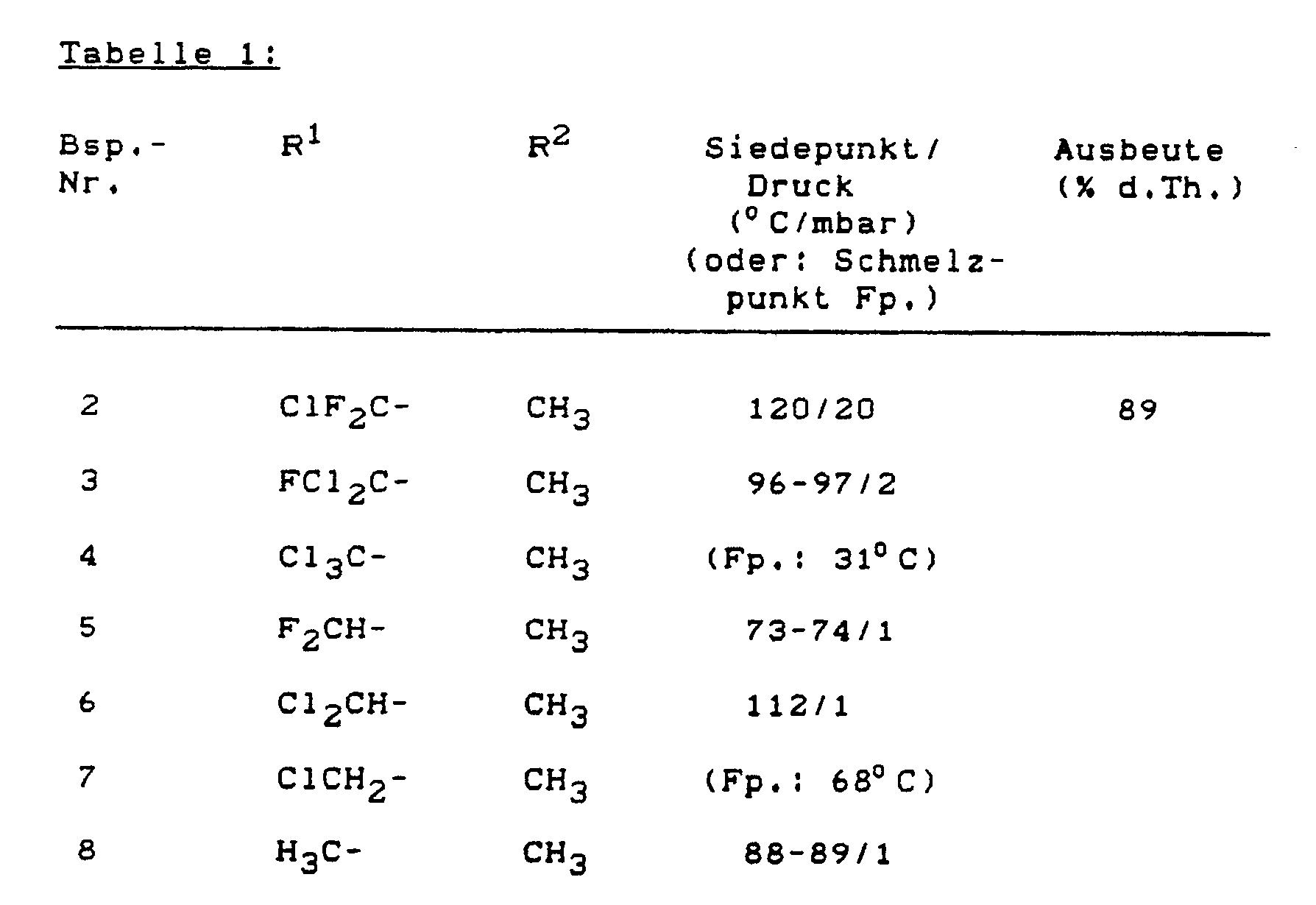
- Die Verbindung gemäß Beispiel 1 kann erfindungsgemäß beispielsweise auch wie folgt hergestellt werden:
-

- In ein Gemisch aus 100 ml Phosphorylchlorid und 57 g (0,5 Mol) Trifluoressigsäure werden unter Rühren und Eiskühlung portionsweise - innerhalb einer halben Stunde - 61 g (0,5 Mol) Dithiocarbazinsäuremethylester eingetragen. Das Reaktionsgemisch wird anschließend 15 Minuten ohne Kühlung gerührt, dann langsam auf 80°C aufgeheizt und bei dieser Temperatur bis zum Abklingen der Gasentwicklung gerührt. Nach Einengen unter vermindertem Druck wird der Rückstand mit Toluol/Eiswasser verrührt; die organische Phase wird anschließend abgetrennt, mit Wasser gewaschen und unter vermindertem Druck eingeengt.
Man erhält 96,5 g eines gelben Öles, das nach gaschromatografischer Analyse 98,5% 2-Methylthio-5-trifluormethyl-1,3,4-thiadiazol enthält;
Ausbeute: 95% der Theorie.
in sehr guten Ausbeuten und in hoher Reinheit erhält, wenn man Carbonsäuren der allgemeinen Formel (II)
R¹-COOH (II),
in welcher
mit Dithiocarbazinsäureestern der allgemeinen Formel (III)

in welcher
in Gegenwart von Phosphorylchlorid (POCl₃) bei Temperaturen zwischen -20°C und +120°C umsetzt.
Claims (10)
- Verfahren zur Herstellung von 2-Alkylthio-1,3,4-thiadiazolen der Formel (I)
 R¹ für gegebenenfalls durch Halogen substituiertes Alkyl steht undR² für Alkyl oder Aralkyl steht,dadurch gekennzeichnet, daß man Carbonsäuren der Formel (II)
R¹-COOH (II),
in welcherR¹ die oben angegebene Bedeutung hat,mit Dithiocarbazinsäureestern der allgemeinen Formel (III) R² die oben angegebene Bedeutung hat,in Gegenwart von Phosphorylchlorid (POCl₃) bei Temperaturen zwischen -20°C und +120°C umsetzt.
 - Verfahren nach Anspruch 1, dadurch gekennzeichnet, daß man bei Temperaturen zwischen 0° und +90°C arbeitet.
- Verfahren nach Anspruch 1, dadurch gekennzeichnet, daß man auf 1 Mol Carbonsäure (II) 0,8 bis 1,2 Mol, vorzugsweise 0,95 bis 1,05 Mol, Dithiocarbazinsäure-ester (III) einsetzt.
- Verfahren nach Anspruch 1, dadurch gekennzeichnet, daß man auf 1 Mol Carbonsäure (II) 1 bis 10 Mol, vorzugsweise 1,5 bis 5 Mol, Phosphorylchlorid (POCl₃) einsetzt.
- Verfahren nach Anspruch 1, dadurch gekennzeichnet, daß man Carbonsäuren der Formel (II) einsetzt, in welcherR¹ für gegebenenfalls durch Fluor, Chlor und/oder Brom substituiertes C₁-C₄-Alkyl steht.
- Verfahren nach Anspruch 5, dadurch gekennzeichnet, daß man Carbonsäuren der Formel (II) einsetzt, in welcherR¹ für einfach bis dreifach durch Fluor und/oder Chlor substituiertes Methyl steht.
- Verfahren nach Anspruch 1, dadurch gekennzeichnet, daß man Dithiocarbazinsäure-ester der Formel (III) einsetzt, in welcherR² für C₁-C₄-Alkyl oder Benzyl steht.
- Verfahren nach Anspruch 7, dadurch gekennzeichnet, daß man Dithiocarbazinsäure-ester der Formel (III) einsetzt, in welcherR² für Methyl steht.
- Verfahren nach Anspruch 1, dadurch gekennzeichnet, daß man die Carbonsäure (II) und den Dithiocarbazinsäure-ester (III) vorlegt und das Phosphorylchlorid unter Rühren langsam eindosiert.
- Verfahren nach Anspruch 1, dadurch gekennzeichnet, daß man zunächst die Carbonsäure (II) mit dem Phosphorylchlorid vermischt und dann den Dithiocarbazinsäure-ester unter Rühren langsam eindosiert.
Applications Claiming Priority (2)
| Application Number | Priority Date | Filing Date | Title |
|---|---|---|---|
| DE4003436A DE4003436A1 (de) | 1990-02-06 | 1990-02-06 | Verfahren zur herstellung von 2-alkylthio-1,3,4-thiadiazolen |
| DE4003436 | 1990-02-06 |
Publications (2)
| Publication Number | Publication Date |
|---|---|
| EP0440959A1 true EP0440959A1 (de) | 1991-08-14 |
| EP0440959B1 EP0440959B1 (de) | 1994-02-16 |
Family
ID=6399499
Family Applications (1)
| Application Number | Title | Priority Date | Filing Date |
|---|---|---|---|
| EP90124849A Expired - Lifetime EP0440959B1 (de) | 1990-02-06 | 1990-12-20 | Verfahren zur Herstellung von 2-Alkylthio-1,3,4-thiadiazolen |
Country Status (5)
| Country | Link |
|---|---|
| US (1) | US5162539A (de) |
| EP (1) | EP0440959B1 (de) |
| JP (1) | JP3040180B2 (de) |
| KR (1) | KR0163599B1 (de) |
| DE (2) | DE4003436A1 (de) |
Cited By (2)
| Publication number | Priority date | Publication date | Assignee | Title |
|---|---|---|---|---|
| EP0926141A1 (de) * | 1997-12-12 | 1999-06-30 | Bayer Corporation | Verfahren zur Herstellung von 2-(Methylthio)-5-(Trifluormethyl)-1,3,4-Thiadiazol ausgehend von Dithiocarbazinsäure-methylester und Trifluoressigsäure |
| EP0926142A1 (de) * | 1997-12-12 | 1999-06-30 | Bayer Corporation | Verfahren zur Herstellung von 2-(Methylthio)-5-(Trifluormethyl)-1,3,4-Thiadiazole ausgehend von Dithiocarbazinsäure-methylester und Trifluoressigsäure |
Families Citing this family (4)
| Publication number | Priority date | Publication date | Assignee | Title |
|---|---|---|---|---|
| US5898074A (en) * | 1997-12-12 | 1999-04-27 | Bayer Corporation | Process for preparing 2-(methylthio)-5-(trifluoromethyl) -1,3,4-thiadiazole using methyldithiocarbazinate and a molar excess of trifluoroacetic acid with recovery of trifluoroacetic acid |
| BR112017003295A2 (pt) | 2014-09-19 | 2018-01-23 | Isagro Spa | 1,3,4-tiadiazóis com uma atividade herbicida, suas composições agronômicas e uso relativo |
| US9816044B2 (en) * | 2016-03-22 | 2017-11-14 | Afton Chemical Corporation | Color-stable transmission fluid compositions |
| CN116102522A (zh) * | 2021-11-09 | 2023-05-12 | 河南省化工研究所有限责任公司 | 一种阳离子蓝染料中间体的制备方法 |
Citations (4)
| Publication number | Priority date | Publication date | Assignee | Title |
|---|---|---|---|---|
| EP0148501A1 (de) * | 1984-01-04 | 1985-07-17 | Bayer Ag | 5-Halogenalkyl-1,3,4-thiadiazol-2-yloxyacetamide |
| EP0165537A2 (de) * | 1984-06-20 | 1985-12-27 | Bayer Ag | Verfahren zur Herstellung von Heteroaryloxyacetamiden |
| EP0348734A1 (de) * | 1988-06-27 | 1990-01-03 | Bayer Ag | Neue Difluormethyl-thiadiazolyl-oxyessigsäureamiden |
| EP0348736A1 (de) * | 1988-06-27 | 1990-01-03 | Bayer Ag | Substituierte Thiadiazolyloxyessigsäureamide |
Family Cites Families (2)
| Publication number | Priority date | Publication date | Assignee | Title |
|---|---|---|---|---|
| US3562284A (en) * | 1968-02-05 | 1971-02-09 | American Cyanamid Co | 2-(substituted) sulfonyl-5-trifluoromethyl-1,3,4-thiadiazoles |
| DE3722320A1 (de) * | 1987-07-07 | 1989-01-19 | Bayer Ag | Mikrobizide mittel |
-
1990
- 1990-02-06 DE DE4003436A patent/DE4003436A1/de not_active Withdrawn
- 1990-12-20 EP EP90124849A patent/EP0440959B1/de not_active Expired - Lifetime
- 1990-12-20 DE DE90124849T patent/DE59004618D1/de not_active Expired - Fee Related
-
1991
- 1991-01-25 US US07/646,563 patent/US5162539A/en not_active Expired - Lifetime
- 1991-02-01 JP JP3031372A patent/JP3040180B2/ja not_active Expired - Fee Related
- 1991-02-04 KR KR1019910001857A patent/KR0163599B1/ko not_active Expired - Fee Related
Patent Citations (4)
| Publication number | Priority date | Publication date | Assignee | Title |
|---|---|---|---|---|
| EP0148501A1 (de) * | 1984-01-04 | 1985-07-17 | Bayer Ag | 5-Halogenalkyl-1,3,4-thiadiazol-2-yloxyacetamide |
| EP0165537A2 (de) * | 1984-06-20 | 1985-12-27 | Bayer Ag | Verfahren zur Herstellung von Heteroaryloxyacetamiden |
| EP0348734A1 (de) * | 1988-06-27 | 1990-01-03 | Bayer Ag | Neue Difluormethyl-thiadiazolyl-oxyessigsäureamiden |
| EP0348736A1 (de) * | 1988-06-27 | 1990-01-03 | Bayer Ag | Substituierte Thiadiazolyloxyessigsäureamide |
Non-Patent Citations (2)
| Title |
|---|
| JUSTUS LIEBIGS ANNALEN DER CHEMIE, Band 660, 31. Dezember 1962, Seiten 144-146, Weinheim, DE; H. GEHLEN et al.: "Darstellung von 2-Amino-1.3.4-Oxdiazolen aus acylierten Semicarbaziden" * |
| W. THEILHEIMER: "Synthetic methods of organic chemistry", Band 16, 1962, Seite 218, S. Karger, Basel, CH * |
Cited By (2)
| Publication number | Priority date | Publication date | Assignee | Title |
|---|---|---|---|---|
| EP0926141A1 (de) * | 1997-12-12 | 1999-06-30 | Bayer Corporation | Verfahren zur Herstellung von 2-(Methylthio)-5-(Trifluormethyl)-1,3,4-Thiadiazol ausgehend von Dithiocarbazinsäure-methylester und Trifluoressigsäure |
| EP0926142A1 (de) * | 1997-12-12 | 1999-06-30 | Bayer Corporation | Verfahren zur Herstellung von 2-(Methylthio)-5-(Trifluormethyl)-1,3,4-Thiadiazole ausgehend von Dithiocarbazinsäure-methylester und Trifluoressigsäure |
Also Published As
| Publication number | Publication date |
|---|---|
| US5162539A (en) | 1992-11-10 |
| EP0440959B1 (de) | 1994-02-16 |
| JP3040180B2 (ja) | 2000-05-08 |
| KR0163599B1 (ko) | 1998-12-01 |
| DE59004618D1 (de) | 1994-03-24 |
| DE4003436A1 (de) | 1991-08-08 |
| KR910015554A (ko) | 1991-09-30 |
| JPH04211072A (ja) | 1992-08-03 |
Similar Documents
| Publication | Publication Date | Title |
|---|---|---|
| CH635066A5 (de) | Verfahren zur herstellung cyclischer aminosaeuren. | |
| DE2528211C3 (de) | Verfahren zur Herstellung von Acylcyaniden | |
| EP0440959A1 (de) | Verfahren zur Herstellung von 2-Alkylthio-1,3,4-thiadiazolen | |
| EP0324174B1 (de) | Verfahren zur Herstellung von 2-Chlor-5-methyl-pyridin | |
| EP0176026B1 (de) | Verfahren zur Herstellung von 2,4-Dichlor-5-fluor-benzoesäure | |
| DE2614241A1 (de) | Verfahren zur herstellung von acylcyaniden | |
| DE2220256A1 (de) | N-(o- bzw. p-nitrobenzoyl)-sulfoximine, verfahren zu ihrer herstellung und verwendung derselben | |
| EP1658259B1 (de) | VERFAHREN ZUR HERSTELLUNG VON a-FLUOR-MALONSÄUREDIALKYLESTERN | |
| EP0003105B1 (de) | Verfahren zur Anilidierung von Carbonsäureestern | |
| EP0546418A1 (de) | Verfahren zur Herstellung von 5-substituierten 2-Chlorpyridinen | |
| DE69711363T2 (de) | Verfahren zur herstellung von n-(3-amino-4-chlorophenyl)acylamiden | |
| DE2142336B2 (de) | Verfahren zur Herstellung von Penicillamin und dessen Derivaten durch Ringspaltung von 2-Isopropyl-5,5-dimethylthiazolidinen | |
| DE3323510A1 (de) | 2-ketosulfonamide und verfahren zu deren herstellung | |
| EP0569701B1 (de) | Verfahren zur Herstellung von 2-Amino-5-methyl-pyridin | |
| DE3431009C2 (de) | ||
| EP0632025A1 (de) | Verfahren zur Herstellung von Chlormethylpyridinen | |
| EP0113429B1 (de) | Verfahren zur Herstellung substituierter Phosphon- und Phosphinsäuren | |
| DE743007C (de) | Verfahren zur Darstellung von Sulfamidderivaten | |
| DE1112521B (de) | Verfahren zur Herstellung der 1, 2, 5-Thiadiazol-3, 4-dicarbonsaeure und ihrer Derivate | |
| EP0166685A1 (de) | Verfahren zur Herstellung von Alpha-Chloracetessigsäuremonomethylamid | |
| DE962886C (de) | Verfahren zur Herstellung von optisch aktiven threo-ª‰, p-Nitrophenylserin-Verbindungen | |
| DE2660213C2 (de) | Verfahren zur Herstellung von Acylcyaniden | |
| DE947370C (de) | Verfahren zur Herstellung von 4-Thionylamino-2-oxy-benzoylchlorid | |
| DE19547075A1 (de) | Verbessertes Verfahren zur Herstellung von 5-Formylthiazol | |
| DE1670921A1 (de) | Verfahren zur Herstellung von 3-Acylamino-1,2-benzisothiazolen |
Legal Events
| Date | Code | Title | Description |
|---|---|---|---|
| PUAI | Public reference made under article 153(3) epc to a published international application that has entered the european phase |
Free format text: ORIGINAL CODE: 0009012 |
|
| 17P | Request for examination filed |
Effective date: 19901220 |
|
| AK | Designated contracting states |
Kind code of ref document: A1 Designated state(s): BE CH DE FR GB IT LI NL |
|
| 17Q | First examination report despatched |
Effective date: 19920602 |
|
| GRAA | (expected) grant |
Free format text: ORIGINAL CODE: 0009210 |
|
| AK | Designated contracting states |
Kind code of ref document: B1 Designated state(s): BE CH DE FR GB IT LI NL |
|
| GBT | Gb: translation of ep patent filed (gb section 77(6)(a)/1977) |
Effective date: 19940217 |
|
| REF | Corresponds to: |
Ref document number: 59004618 Country of ref document: DE Date of ref document: 19940324 |
|
| ITF | It: translation for a ep patent filed | ||
| ET | Fr: translation filed | ||
| PLBE | No opposition filed within time limit |
Free format text: ORIGINAL CODE: 0009261 |
|
| STAA | Information on the status of an ep patent application or granted ep patent |
Free format text: STATUS: NO OPPOSITION FILED WITHIN TIME LIMIT |
|
| 26N | No opposition filed | ||
| ITTA | It: last paid annual fee | ||
| REG | Reference to a national code |
Ref country code: GB Ref legal event code: IF02 |
|
| PGFP | Annual fee paid to national office [announced via postgrant information from national office to epo] |
Ref country code: DE Payment date: 20041112 Year of fee payment: 15 |
|
| PGFP | Annual fee paid to national office [announced via postgrant information from national office to epo] |
Ref country code: CH Payment date: 20041125 Year of fee payment: 15 |
|
| PGFP | Annual fee paid to national office [announced via postgrant information from national office to epo] |
Ref country code: GB Payment date: 20041215 Year of fee payment: 15 Ref country code: FR Payment date: 20041215 Year of fee payment: 15 |
|
| PGFP | Annual fee paid to national office [announced via postgrant information from national office to epo] |
Ref country code: NL Payment date: 20041231 Year of fee payment: 15 Ref country code: BE Payment date: 20041231 Year of fee payment: 15 |
|
| PG25 | Lapsed in a contracting state [announced via postgrant information from national office to epo] |
Ref country code: IT Free format text: LAPSE BECAUSE OF NON-PAYMENT OF DUE FEES;WARNING: LAPSES OF ITALIAN PATENTS WITH EFFECTIVE DATE BEFORE 2007 MAY HAVE OCCURRED AT ANY TIME BEFORE 2007. THE CORRECT EFFECTIVE DATE MAY BE DIFFERENT FROM THE ONE RECORDED. Effective date: 20051220 Ref country code: GB Free format text: LAPSE BECAUSE OF NON-PAYMENT OF DUE FEES Effective date: 20051220 |
|
| PG25 | Lapsed in a contracting state [announced via postgrant information from national office to epo] |
Ref country code: LI Free format text: LAPSE BECAUSE OF NON-PAYMENT OF DUE FEES Effective date: 20051231 Ref country code: CH Free format text: LAPSE BECAUSE OF NON-PAYMENT OF DUE FEES Effective date: 20051231 Ref country code: BE Free format text: LAPSE BECAUSE OF NON-PAYMENT OF DUE FEES Effective date: 20051231 |
|
| PG25 | Lapsed in a contracting state [announced via postgrant information from national office to epo] |
Ref country code: NL Free format text: LAPSE BECAUSE OF NON-PAYMENT OF DUE FEES Effective date: 20060701 Ref country code: DE Free format text: LAPSE BECAUSE OF NON-PAYMENT OF DUE FEES Effective date: 20060701 |
|
| REG | Reference to a national code |
Ref country code: CH Ref legal event code: PL |
|
| GBPC | Gb: european patent ceased through non-payment of renewal fee |
Effective date: 20051220 |
|
| PG25 | Lapsed in a contracting state [announced via postgrant information from national office to epo] |
Ref country code: FR Free format text: LAPSE BECAUSE OF NON-PAYMENT OF DUE FEES Effective date: 20060831 |
|
| NLV4 | Nl: lapsed or anulled due to non-payment of the annual fee |
Effective date: 20060701 |
|
| REG | Reference to a national code |
Ref country code: FR Ref legal event code: ST Effective date: 20060831 |
|
| BERE | Be: lapsed |
Owner name: *BAYER A.G. Effective date: 20051231 |