EP0415305B1 - Verwendung von Acrylatcopolymerisaten als Additive für wässrige kationische Lacksysteme - Google Patents
Verwendung von Acrylatcopolymerisaten als Additive für wässrige kationische Lacksysteme Download PDFInfo
- Publication number
- EP0415305B1 EP0415305B1 EP90116350A EP90116350A EP0415305B1 EP 0415305 B1 EP0415305 B1 EP 0415305B1 EP 90116350 A EP90116350 A EP 90116350A EP 90116350 A EP90116350 A EP 90116350A EP 0415305 B1 EP0415305 B1 EP 0415305B1
- Authority
- EP
- European Patent Office
- Prior art keywords
- weight
- koh
- meth
- additives
- acid
- Prior art date
- Legal status (The legal status is an assumption and is not a legal conclusion. Google has not performed a legal analysis and makes no representation as to the accuracy of the status listed.)
- Expired - Lifetime
Links
- 239000000654 additive Substances 0.000 title claims description 22
- 239000011248 coating agent Substances 0.000 title claims description 15
- 238000000576 coating method Methods 0.000 title claims description 15
- 125000002091 cationic group Chemical group 0.000 title claims description 8
- 229920006243 acrylic copolymer Polymers 0.000 title 1
- 229920001577 copolymer Polymers 0.000 claims description 17
- 239000007787 solid Substances 0.000 claims description 16
- 239000000178 monomer Substances 0.000 claims description 14
- 239000000463 material Substances 0.000 claims description 13
- 239000011230 binding agent Substances 0.000 claims description 11
- YCKRFDGAMUMZLT-UHFFFAOYSA-N Fluorine atom Chemical compound [F] YCKRFDGAMUMZLT-UHFFFAOYSA-N 0.000 claims description 10
- CERQOIWHTDAKMF-UHFFFAOYSA-N Methacrylic acid Chemical compound CC(=C)C(O)=O CERQOIWHTDAKMF-UHFFFAOYSA-N 0.000 claims description 10
- 150000002148 esters Chemical class 0.000 claims description 9
- 239000011737 fluorine Substances 0.000 claims description 9
- 229910052731 fluorine Inorganic materials 0.000 claims description 9
- PPBRXRYQALVLMV-UHFFFAOYSA-N Styrene Chemical compound C=CC1=CC=CC=C1 PPBRXRYQALVLMV-UHFFFAOYSA-N 0.000 claims description 7
- NIXOWILDQLNWCW-UHFFFAOYSA-N acrylic acid group Chemical group C(C=C)(=O)O NIXOWILDQLNWCW-UHFFFAOYSA-N 0.000 claims description 6
- 125000004432 carbon atom Chemical group C* 0.000 claims description 6
- 125000002887 hydroxy group Chemical group [H]O* 0.000 claims description 6
- 150000001412 amines Chemical class 0.000 claims description 4
- BVKZGUZCCUSVTD-UHFFFAOYSA-N carbonic acid Chemical compound OC(O)=O BVKZGUZCCUSVTD-UHFFFAOYSA-N 0.000 claims description 4
- 150000007524 organic acids Chemical class 0.000 claims description 4
- 125000000467 secondary amino group Chemical group [H]N([*:1])[*:2] 0.000 claims description 4
- 125000001302 tertiary amino group Chemical group 0.000 claims description 4
- 150000002009 diols Chemical class 0.000 claims description 3
- 150000001252 acrylic acid derivatives Chemical class 0.000 claims description 2
- 125000000217 alkyl group Chemical group 0.000 claims 1
- 150000001735 carboxylic acids Chemical class 0.000 claims 1
- 239000003973 paint Substances 0.000 description 11
- 239000010410 layer Substances 0.000 description 9
- BDAGIHXWWSANSR-UHFFFAOYSA-N methanoic acid Natural products OC=O BDAGIHXWWSANSR-UHFFFAOYSA-N 0.000 description 8
- 239000000203 mixture Substances 0.000 description 8
- 229920005989 resin Polymers 0.000 description 8
- 239000011347 resin Substances 0.000 description 8
- 238000012360 testing method Methods 0.000 description 8
- 230000007547 defect Effects 0.000 description 7
- QTBSBXVTEAMEQO-UHFFFAOYSA-N Acetic acid Chemical compound CC(O)=O QTBSBXVTEAMEQO-UHFFFAOYSA-N 0.000 description 6
- IISBACLAFKSPIT-UHFFFAOYSA-N bisphenol A Chemical compound C=1C=C(O)C=CC=1C(C)(C)C1=CC=C(O)C=C1 IISBACLAFKSPIT-UHFFFAOYSA-N 0.000 description 6
- 239000000243 solution Substances 0.000 description 6
- NIXOWILDQLNWCW-UHFFFAOYSA-M Acrylate Chemical compound [O-]C(=O)C=C NIXOWILDQLNWCW-UHFFFAOYSA-M 0.000 description 5
- -1 N-dimethyl Inorganic materials 0.000 description 5
- 238000006243 chemical reaction Methods 0.000 description 5
- 239000000047 product Substances 0.000 description 5
- XLYOFNOQVPJJNP-UHFFFAOYSA-N water Substances O XLYOFNOQVPJJNP-UHFFFAOYSA-N 0.000 description 5
- YIWUKEYIRIRTPP-UHFFFAOYSA-N 2-ethylhexan-1-ol Chemical compound CCCCC(CC)CO YIWUKEYIRIRTPP-UHFFFAOYSA-N 0.000 description 4
- OSWFIVFLDKOXQC-UHFFFAOYSA-N 4-(3-methoxyphenyl)aniline Chemical compound COC1=CC=CC(C=2C=CC(N)=CC=2)=C1 OSWFIVFLDKOXQC-UHFFFAOYSA-N 0.000 description 4
- 239000004593 Epoxy Substances 0.000 description 4
- LRHPLDYGYMQRHN-UHFFFAOYSA-N N-Butanol Chemical compound CCCCO LRHPLDYGYMQRHN-UHFFFAOYSA-N 0.000 description 4
- 235000019253 formic acid Nutrition 0.000 description 4
- 125000003055 glycidyl group Chemical group C(C1CO1)* 0.000 description 4
- 239000011229 interlayer Substances 0.000 description 4
- JVTAAEKCZFNVCJ-UHFFFAOYSA-N lactic acid Chemical compound CC(O)C(O)=O JVTAAEKCZFNVCJ-UHFFFAOYSA-N 0.000 description 4
- 238000006386 neutralization reaction Methods 0.000 description 4
- 230000035945 sensitivity Effects 0.000 description 4
- YXFVVABEGXRONW-UHFFFAOYSA-N Toluene Chemical compound CC1=CC=CC=C1 YXFVVABEGXRONW-UHFFFAOYSA-N 0.000 description 3
- ZMANZCXQSJIPKH-UHFFFAOYSA-N Triethylamine Chemical compound CCN(CC)CC ZMANZCXQSJIPKH-UHFFFAOYSA-N 0.000 description 3
- 239000002253 acid Substances 0.000 description 3
- 238000007792 addition Methods 0.000 description 3
- 229920000180 alkyd Polymers 0.000 description 3
- 230000015572 biosynthetic process Effects 0.000 description 3
- 150000001875 compounds Chemical class 0.000 description 3
- 239000008367 deionised water Substances 0.000 description 3
- 229910021641 deionized water Inorganic materials 0.000 description 3
- 238000004070 electrodeposition Methods 0.000 description 3
- 239000003822 epoxy resin Substances 0.000 description 3
- 229920000647 polyepoxide Polymers 0.000 description 3
- 238000002360 preparation method Methods 0.000 description 3
- 239000002966 varnish Substances 0.000 description 3
- ARXJGSRGQADJSQ-UHFFFAOYSA-N 1-methoxypropan-2-ol Chemical compound COCC(C)O ARXJGSRGQADJSQ-UHFFFAOYSA-N 0.000 description 2
- LYCAIKOWRPUZTN-UHFFFAOYSA-N Ethylene glycol Chemical compound OCCO LYCAIKOWRPUZTN-UHFFFAOYSA-N 0.000 description 2
- 229910000831 Steel Inorganic materials 0.000 description 2
- 235000011054 acetic acid Nutrition 0.000 description 2
- 230000000996 additive effect Effects 0.000 description 2
- 239000000853 adhesive Substances 0.000 description 2
- 230000001070 adhesive effect Effects 0.000 description 2
- 150000003973 alkyl amines Chemical group 0.000 description 2
- 150000001732 carboxylic acid derivatives Chemical class 0.000 description 2
- 239000003795 chemical substances by application Substances 0.000 description 2
- NNBZCPXTIHJBJL-UHFFFAOYSA-N decalin Chemical compound C1CCCC2CCCCC21 NNBZCPXTIHJBJL-UHFFFAOYSA-N 0.000 description 2
- SBZXBUIDTXKZTM-UHFFFAOYSA-N diglyme Chemical compound COCCOCCOC SBZXBUIDTXKZTM-UHFFFAOYSA-N 0.000 description 2
- 239000006185 dispersion Substances 0.000 description 2
- 239000004922 lacquer Substances 0.000 description 2
- 239000004310 lactic acid Substances 0.000 description 2
- 235000014655 lactic acid Nutrition 0.000 description 2
- 238000004519 manufacturing process Methods 0.000 description 2
- 239000002184 metal Substances 0.000 description 2
- 230000003472 neutralizing effect Effects 0.000 description 2
- 229920000642 polymer Polymers 0.000 description 2
- 239000002904 solvent Substances 0.000 description 2
- 239000010959 steel Substances 0.000 description 2
- 239000000126 substance Substances 0.000 description 2
- WWFXOQURMTWRBT-UHFFFAOYSA-N 1,1,4,4,4-pentafluorobutyl 2-methylprop-2-enoate Chemical compound CC(=C)C(=O)OC(F)(F)CCC(F)(F)F WWFXOQURMTWRBT-UHFFFAOYSA-N 0.000 description 1
- LHENQXAPVKABON-UHFFFAOYSA-N 1-methoxypropan-1-ol Chemical compound CCC(O)OC LHENQXAPVKABON-UHFFFAOYSA-N 0.000 description 1
- GOXQRTZXKQZDDN-UHFFFAOYSA-N 2-Ethylhexyl acrylate Chemical compound CCCCC(CC)COC(=O)C=C GOXQRTZXKQZDDN-UHFFFAOYSA-N 0.000 description 1
- POAOYUHQDCAZBD-UHFFFAOYSA-N 2-butoxyethanol Chemical class CCCCOCCO POAOYUHQDCAZBD-UHFFFAOYSA-N 0.000 description 1
- CTQNGGLPUBDAKN-UHFFFAOYSA-N O-Xylene Chemical compound CC1=CC=CC=C1C CTQNGGLPUBDAKN-UHFFFAOYSA-N 0.000 description 1
- WYNCHZVNFNFDNH-UHFFFAOYSA-N Oxazolidine Chemical compound C1COCN1 WYNCHZVNFNFDNH-UHFFFAOYSA-N 0.000 description 1
- 229930040373 Paraformaldehyde Natural products 0.000 description 1
- LGRFSURHDFAFJT-UHFFFAOYSA-N Phthalic anhydride Natural products C1=CC=C2C(=O)OC(=O)C2=C1 LGRFSURHDFAFJT-UHFFFAOYSA-N 0.000 description 1
- BZHJMEDXRYGGRV-UHFFFAOYSA-N Vinyl chloride Chemical compound ClC=C BZHJMEDXRYGGRV-UHFFFAOYSA-N 0.000 description 1
- UKLDJPRMSDWDSL-UHFFFAOYSA-L [dibutyl(dodecanoyloxy)stannyl] dodecanoate Chemical compound CCCCCCCCCCCC(=O)O[Sn](CCCC)(CCCC)OC(=O)CCCCCCCCCCC UKLDJPRMSDWDSL-UHFFFAOYSA-L 0.000 description 1
- 238000009825 accumulation Methods 0.000 description 1
- 230000002378 acidificating effect Effects 0.000 description 1
- 150000007513 acids Chemical class 0.000 description 1
- 239000013543 active substance Substances 0.000 description 1
- 150000001298 alcohols Chemical class 0.000 description 1
- 125000003277 amino group Chemical group 0.000 description 1
- LHIJANUOQQMGNT-UHFFFAOYSA-N aminoethylethanolamine Chemical compound NCCNCCO LHIJANUOQQMGNT-UHFFFAOYSA-N 0.000 description 1
- 125000000129 anionic group Chemical group 0.000 description 1
- 238000013459 approach Methods 0.000 description 1
- 239000008346 aqueous phase Substances 0.000 description 1
- JHIWVOJDXOSYLW-UHFFFAOYSA-N butyl 2,2-difluorocyclopropane-1-carboxylate Chemical compound CCCCOC(=O)C1CC1(F)F JHIWVOJDXOSYLW-UHFFFAOYSA-N 0.000 description 1
- 150000007942 carboxylates Chemical group 0.000 description 1
- 239000003054 catalyst Substances 0.000 description 1
- 239000007795 chemical reaction product Substances 0.000 description 1
- 239000011247 coating layer Substances 0.000 description 1
- 238000009833 condensation Methods 0.000 description 1
- 230000005494 condensation Effects 0.000 description 1
- 238000001816 cooling Methods 0.000 description 1
- 230000007797 corrosion Effects 0.000 description 1
- 238000005260 corrosion Methods 0.000 description 1
- 238000004132 cross linking Methods 0.000 description 1
- 125000004985 dialkyl amino alkyl group Chemical group 0.000 description 1
- 239000012975 dibutyltin dilaurate Substances 0.000 description 1
- 238000010790 dilution Methods 0.000 description 1
- 239000012895 dilution Substances 0.000 description 1
- IUNMPGNGSSIWFP-UHFFFAOYSA-N dimethylaminopropylamine Chemical compound CN(C)CCCN IUNMPGNGSSIWFP-UHFFFAOYSA-N 0.000 description 1
- 230000000694 effects Effects 0.000 description 1
- 239000003995 emulsifying agent Substances 0.000 description 1
- 239000000945 filler Substances 0.000 description 1
- NBVXSUQYWXRMNV-UHFFFAOYSA-N fluoromethane Chemical group FC NBVXSUQYWXRMNV-UHFFFAOYSA-N 0.000 description 1
- 238000010528 free radical solution polymerization reaction Methods 0.000 description 1
- 125000004435 hydrogen atom Chemical group [H]* 0.000 description 1
- WGCNASOHLSPBMP-UHFFFAOYSA-N hydroxyacetaldehyde Natural products OCC=O WGCNASOHLSPBMP-UHFFFAOYSA-N 0.000 description 1
- 229910052500 inorganic mineral Inorganic materials 0.000 description 1
- 230000002452 interceptive effect Effects 0.000 description 1
- VQPKAMAVKYTPLB-UHFFFAOYSA-N lead;octanoic acid Chemical compound [Pb].CCCCCCCC(O)=O VQPKAMAVKYTPLB-UHFFFAOYSA-N 0.000 description 1
- WSFSSNUMVMOOMR-NJFSPNSNSA-N methanone Chemical compound O=[14CH2] WSFSSNUMVMOOMR-NJFSPNSNSA-N 0.000 description 1
- 125000002496 methyl group Chemical group [H]C([H])([H])* 0.000 description 1
- 239000011707 mineral Substances 0.000 description 1
- 238000002156 mixing Methods 0.000 description 1
- 150000002762 monocarboxylic acid derivatives Chemical class 0.000 description 1
- QOHMWDJIBGVPIF-UHFFFAOYSA-N n',n'-diethylpropane-1,3-diamine Chemical compound CCN(CC)CCCN QOHMWDJIBGVPIF-UHFFFAOYSA-N 0.000 description 1
- 230000007935 neutral effect Effects 0.000 description 1
- 230000003287 optical effect Effects 0.000 description 1
- 239000003960 organic solvent Substances 0.000 description 1
- 229920002866 paraformaldehyde Polymers 0.000 description 1
- 239000000049 pigment Substances 0.000 description 1
- 238000006116 polymerization reaction Methods 0.000 description 1
- 230000002265 prevention Effects 0.000 description 1
- 239000002994 raw material Substances 0.000 description 1
- 229920006395 saturated elastomer Polymers 0.000 description 1
- 238000007789 sealing Methods 0.000 description 1
- 150000003335 secondary amines Chemical class 0.000 description 1
- 235000015096 spirit Nutrition 0.000 description 1
- 239000004575 stone Substances 0.000 description 1
- 239000000758 substrate Substances 0.000 description 1
- BFKJFAAPBSQJPD-UHFFFAOYSA-N tetrafluoroethene Chemical group FC(F)=C(F)F BFKJFAAPBSQJPD-UHFFFAOYSA-N 0.000 description 1
- 239000004753 textile Substances 0.000 description 1
- 239000012974 tin catalyst Substances 0.000 description 1
- DVKJHBMWWAPEIU-UHFFFAOYSA-N toluene 2,4-diisocyanate Chemical compound CC1=CC=C(N=C=O)C=C1N=C=O DVKJHBMWWAPEIU-UHFFFAOYSA-N 0.000 description 1
- 239000000080 wetting agent Substances 0.000 description 1
- 239000008096 xylene Substances 0.000 description 1
Classifications
-
- C—CHEMISTRY; METALLURGY
- C09—DYES; PAINTS; POLISHES; NATURAL RESINS; ADHESIVES; COMPOSITIONS NOT OTHERWISE PROVIDED FOR; APPLICATIONS OF MATERIALS NOT OTHERWISE PROVIDED FOR
- C09J—ADHESIVES; NON-MECHANICAL ASPECTS OF ADHESIVE PROCESSES IN GENERAL; ADHESIVE PROCESSES NOT PROVIDED FOR ELSEWHERE; USE OF MATERIALS AS ADHESIVES
- C09J133/00—Adhesives based on homopolymers or copolymers of compounds having one or more unsaturated aliphatic radicals, each having only one carbon-to-carbon double bond, and at least one being terminated by only one carboxyl radical, or of salts, anhydrides, esters, amides, imides, or nitriles thereof; Adhesives based on derivatives of such polymers
- C09J133/04—Homopolymers or copolymers of esters
- C09J133/06—Homopolymers or copolymers of esters of esters containing only carbon, hydrogen and oxygen, the oxygen atom being present only as part of the carboxyl radical
- C09J133/08—Homopolymers or copolymers of acrylic acid esters
-
- C—CHEMISTRY; METALLURGY
- C09—DYES; PAINTS; POLISHES; NATURAL RESINS; ADHESIVES; COMPOSITIONS NOT OTHERWISE PROVIDED FOR; APPLICATIONS OF MATERIALS NOT OTHERWISE PROVIDED FOR
- C09D—COATING COMPOSITIONS, e.g. PAINTS, VARNISHES OR LACQUERS; FILLING PASTES; CHEMICAL PAINT OR INK REMOVERS; INKS; CORRECTING FLUIDS; WOODSTAINS; PASTES OR SOLIDS FOR COLOURING OR PRINTING; USE OF MATERIALS THEREFOR
- C09D5/00—Coating compositions, e.g. paints, varnishes or lacquers, characterised by their physical nature or the effects produced; Filling pastes
- C09D5/44—Coating compositions, e.g. paints, varnishes or lacquers, characterised by their physical nature or the effects produced; Filling pastes for electrophoretic applications
- C09D5/4488—Cathodic paints
- C09D5/4492—Cathodic paints containing special additives, e.g. grinding agents
Definitions
- the invention relates to the use of hydroxyl groups and fluorine-containing acrylate copolymers as additives for aqueous cationic coating systems, in particular for cathodically depositable electrocoating materials, for preventing surface defects and for improving the adhesion of subsequent layers, in particular PVC-containing coating materials.
- aqueous systems show an increased sensitivity to foreign substances in the paint material or on the substrate to be painted, which manifests itself in the form of craters, dents or similar surface defects.
- this sensitivity can in some cases be avoided or at least reduced by increasing the pigment content.
- this path is very often not feasible, particularly in the case of decorative lacquers, since it leads to a reduction in the resistance properties or to a loss in the optical properties.
- electrocoating moreover, an increase in the pigment-binder ratio is only possible to a very limited extent for procedural reasons.
- aqueous coating systems to surface defects can also be reduced by adding surface-active substances.
- an accumulation of the additives occurs in the area of the coating surface, as a result of which the interlayer adhesion, ie the adhesion of further coating layers, in particular those based on vinyl chloride (co) polymers, deteriorates significantly becomes.
- PVC-based coatings are known to be used to a large extent as underbody protection in the automotive industry and are applied extensively to the cathodically deposited primer. In order to achieve the required stone chip protection, the interlayer adhesion is of crucial importance with these layers of paint.
- polymeric additives which are copolymers of acidic monomers and neutral ester monomers, mainly of (meth) acrylic monomers, are used in current practice in anionic paints based on water-soluble paint binders containing carboxylate groups. Appropriate coordination of the acid content can achieve optimum effectiveness in these systems, but in this case too there is great sensitivity to overdosing, which leads directly to the liability problems described.
- fluorine-containing monomeric compounds in the production of aqueous polymer dispersions, which are used primarily for coating textiles.
- Most of the fluorine-containing coating agents known from the literature are dispersions of tetrafluoroethylene polymers, special emulsifiers or special film-forming additives being used (see e.g. JP 48/17545 A, DE 28 37 107 A, DE 34 03 880 A, DE 35 33 807 A, EP 173 071 A or EP 193 963).
- EP-A2-0 293 963 describes reactive wetting agents containing fluorocarbon residues.
- acrylate copolymers which are monomers containing protonatable N-basic groups, monoesters of (meth) acrylic acid with diols , (Meth) acrylic acid esters, fluorine-containing esters of (meth) acrylic acid and optionally styrene.
- the additives of the invention both film disturbances, which are caused by the surface tension of the aqueous phase in the paint, and the problems with the interlayer adhesion, i. H. the adhesion of other layers of paint, especially with PVC-containing paint materials as a subsequent layer, is significantly reduced.
- the acrylate copolymers with the composition and characteristics specified in the main claim are prepared in the usual way by solution polymerization in water-miscible or at least water-tolerant solvents, such as lower alcohols, preferably butanol or glycol mono- or diethers. Mixtures of these solvents, e.g. B. butanol with methoxypropanol can be used.
- water-miscible or at least water-tolerant solvents such as lower alcohols, preferably butanol or glycol mono- or diethers.
- solvents e.g. B. butanol with methoxypropanol can be used.
- the basic acrylic monomers (A) used have secondary or tertiary amino groups.
- a preferred group of these monomers are the mono- or dialkylaminoalkyl (meth) acrylates, in particular N, N-dimethyl, N, N-diethyl or N, N-dipropylaminoethyl (meth) acrylate or the N-tert-butylaminoethyl (meth) acrylate.
- reaction products of glycidyl (meth) acrylate and secondary alkylamines or alkanolamines can also be used.
- Secondary or tertiary amino groups are preferably introduced by subsequent polymer-analogous reaction of the glycidyl groups of a corresponding copolymer with primary or preferably secondary amines.
- the basic groups of the acrylate copolymers are neutralized at least 50% with an organic acid.
- Neutralization is preferably carried out with a lower carboxylic acid or hydroxycarboxylic acid. Examples of such neutralizing agents are formic acid, acetic acid or lactic acid.
- the acrylate copolymers are diluted simultaneously with the addition of the neutralizing agent or after neutralization with water to a solids content which is advantageous for the application. Usually it is used as a 50 ⁇ 15% solution.
- the additives according to the invention are used in an amount of 0.5 to 5.0% by weight, preferably 1.0 to 3.0% by weight, calculated on solids and based on the solids content of the binder in the paint.
- the additives according to the invention can be used for all types of paints which are formulated with cationic, water-dilutable binders, which are also referred to as "water-soluble".
- binders can be condensation resins, copolymers of alpha, beta-unsaturated monomers or addition resins, such as modified epoxy resin esters. They usually carry a sufficient number of protonatable groups, the neutralization of which with acids converts the binder into the water-dilutable form.
- the additives according to the invention have proven to be particularly advantageous in the case of cathodically depositable electrocoat materials.
- the additives according to the invention are advantageously tested by mixing small amounts of an interfering substance into the ready-to-use clearcoat Binder.
- Styrene- or vinyltoluene-modified alkyd resins dissolved in mineral spirits and / or other organic solvents, have proven to be particularly suitable for this test.
- the contaminated clear varnish is deposited on a degreased steel sheet and hardened under the conditions required for the binder.
- the interlayer adhesion is checked after application of one or more subsequent layers (PVC layer, filler or top coat) by assessing the entire paint structure using a cross-cut test, if necessary after exposure to corrosion.
- Part I is filled into the reaction vessel and heated to 85 ° C.
- Part II and Part III are added evenly within 5 hours at 85 - 90 ° C. After the additions have ended, the mixture is kept at 90 ° C. for 2 hours and the end of polymerization is checked by determining the solids content.
- copolymers containing glycidyl groups are prepared in a customary manner (analogously to Examples 1-11). At 80 ° C the amine solution is added within 30 minutes (part III a). The temperature is then raised to 100 ° C and held for a further 90 minutes to complete the reaction. The neutralization and dilution are carried out as in Examples 1-11.
- the approaches have the following composition.
- the additives are tested on the one hand for their effectiveness in avoiding surface defects in the film formation of the lacquers, and on the other for their influence on the adhesion of subsequent layers, especially those made of PVC materials.
- the 15% strength aqueous clear coats (1) and (2) prepared in accordance with the information given in (b) are mixed with 5% by weight (based on solid resins) of a styrene- or vinyltoluene-modified alkyd resin in the form of a Ethylene glycol monobutyl ether / xylene (1: 1) to a solids content of 10% diluted solution, mixed and mixed thoroughly.
- a styrene- or vinyltoluene-modified alkyd resin in the form of a Ethylene glycol monobutyl ether / xylene (1: 1) to a solids content of 10% diluted solution, mixed and mixed thoroughly.
- VIALKYD AV 462 supplied in 60% white spirit (VIANOVA, AT) or an equivalent type, can be used as the alkyd resin.
- 500 parts of an epoxy resin based on bisphenol A are dissolved in 214 parts of propylene glycol monomethyl ether and at 110 ° C with 83 parts of a half ester of phthalic anhydride and 2-ethylhexanol in the presence of 0.5 g of triethylamine as a catalyst up to one Acid number of less than 3 mg KOH / g reacts.
- 120 parts of an NH-functional oxazolidine from aminoethylethanolamine, 2-ethylhexyl acrylate and formaldehyde, and 26 parts of dimethylaminopropylamine are added and the mixture is reacted at 80 ° C. to an epoxy value of practically 0.
- the mixture is diluted with 200 parts of propylene glycol monomethyl ether.
- 1400 parts of this solution are mixed with a solution of 190 parts of an epoxy resin based on bisphenol A (epoxy equivalent weight approx. 190) and 250 parts (1 mol) of a glycidyl ester of a saturated, tertiary C9-C11 monocarboxylic acid in 389 parts of diethylene glycol dimethyl ether and at 95 up to 100 ° C up to an epoxy value of 0 unset.
- the product is mixed with 0.6 parts / 100 g of solid resin (calculated as metal) of a tin catalyst, e.g. B. dibutyltin dilaurate, added and diluted after adding 40 millimoles of formic acid per 100 g of solid resin with deionized water to a solids content of 15%.
- a tin catalyst e.g. B. dibutyltin dilaurate
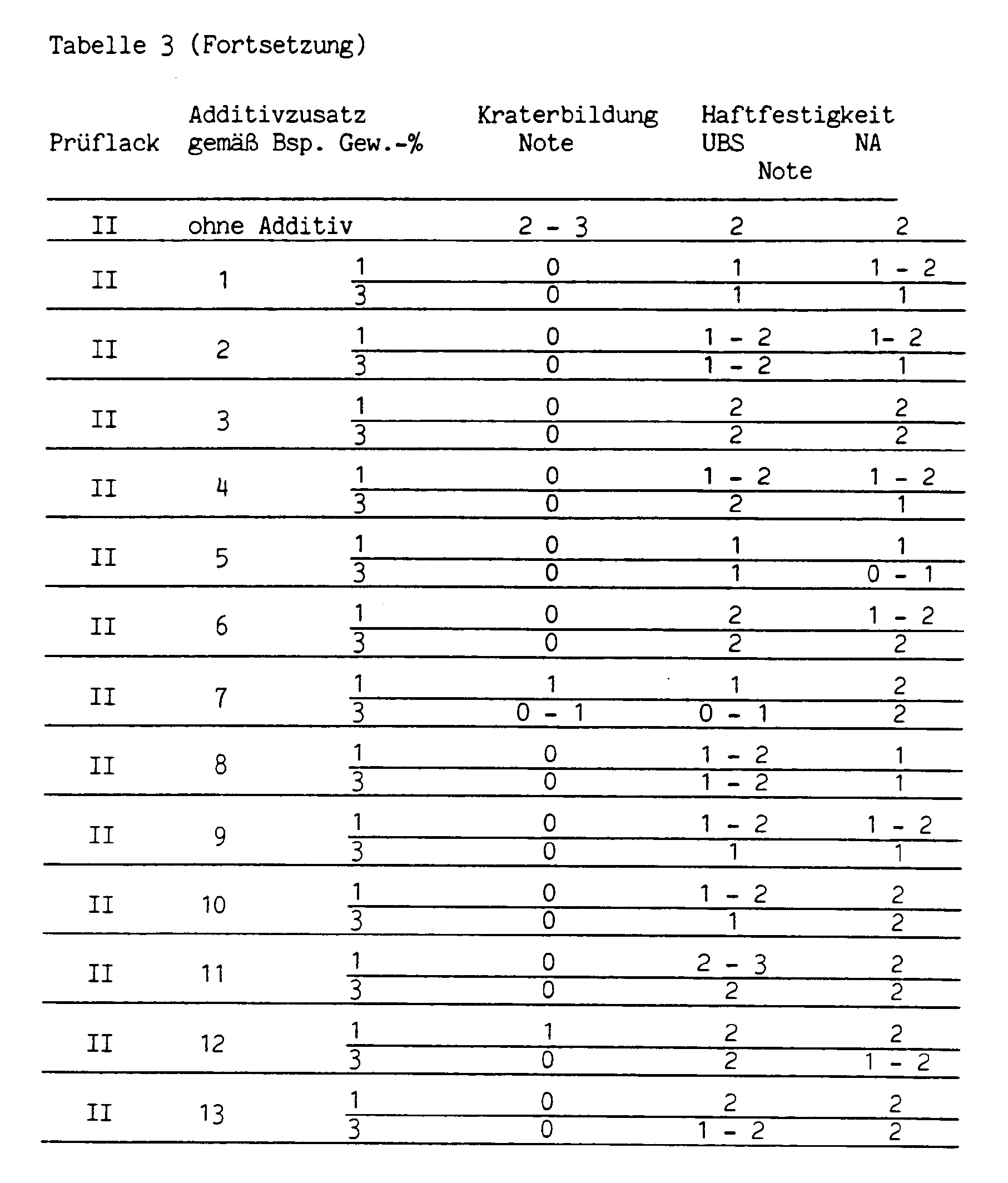
- test sheet and mixtures specified in Table 3 below are deposited cathodically on zinc-phosphated steel sheet and cured at 180 ° C. for 30 minutes.
- the resulting dry film thickness should be 25 ⁇ 5 ⁇ m.
- the film surface is assessed in terms of crater or dent formation (0: no craters, 1: individual craters, 2: significant crater inclination, 3: severe crater formation).
Landscapes
- Chemical & Material Sciences (AREA)
- Life Sciences & Earth Sciences (AREA)
- Organic Chemistry (AREA)
- Health & Medical Sciences (AREA)
- Molecular Biology (AREA)
- Engineering & Computer Science (AREA)
- Materials Engineering (AREA)
- Wood Science & Technology (AREA)
- Paints Or Removers (AREA)
Description
- Die Erfindung betrifft die Verwendung von Hydroxylgruppen und Fluor enthaltenden Acrylatcopolymerisaten als Additive für wäßrige kationische Lacksysteme, insbesonders für kathodisch abscheidbare Elektrotauchlacke, zur Verhinderung von Oberflächenstörungen und zur Verbesserung der Haftung von Folgeschichten, insbesonders von PVC-hältigen Lackmaterialien.
- Bekanntlich zeigen wäßrige Systeme bei der Filmbildung eine erhöhte Empfindlichkeit gegenüber Fremdstoffen im Lackmaterial oder auf dem zu lackierenden Substrat, die sich in Form von Kratern, Dellen oder ähnlichen Oberflächenstörungen äußert. Diese Empfindlichkeit kann bei Grundierungen in manchen Fällen durch Erhöhung des Pigmentanteils vermieden oder zumindest verringert werden. Dieser Weg ist jedoch sehr oft, insbesondere bei dekorativen Lackierungen nicht gangbar, da er zu einer Verminderung der Beständigkeitseigenschaften bzw. zu Einbußen bei den optischen Eigenschaften führt. Bei der Elektrotauchlackierung ist überdies eine Erhöhung des Pigment-Bindemittelverhältnises aus verfahrenstechnischen Gründen nur in einem sehr beschränkten Ausmaß möglich.
- Eine Herabsetzung der Empfindlichkeit wäßriger Lacksysteme gegen Oberflächenstörungen kann auch durch Zusatz von grenzflächenaktiven Substanzen erfolgen. Häufig tritt dabei wegen einer zu großen Unverträglichkeit der Additive mit dem Lackmaterial eine Anreicherung der Additive im Bereich der Lackoberfläche ein, wodurch die Zwischenschichthaftung, d. h. die Haftung weiterer Lackschichten, insbesonders solcher auf Basis von Vinylchlorid-(co)-polymeren, wesentlich verschlechtert wird. Beschichtungen auf PVC-Basis werden bekanntlich in großem Ausmaß als Unterbodenschutz in der Automobilindustrie eingesetzt und werden großflächig auf der kathodisch abgeschiedenen Grundierung appliziert. Zur Erzielung des geforderten Steinschlagschutzes ist die Zwischenschichthaftung bei diesen Lackschichten von ausschlaggebender Bedeutung.
- Zur Vermeidung einer extremen Unverträglichkeit werden in der gegenwärtigen Praxis bei anionischen Lacken auf der Basis von Carboxylatgruppen aufweisenden wasserlöslichen Lackbindemitteln polymere Zusatzmittel eingesetzt, die Copolymere von sauren Monomeren und neutralen Estermonomeren, hauptsächlich von (Meth)acrylmonomeren, darstellen. Durch eine entsprechende Abstimmung des Säureanteils kann bei diesen Systemen eine optimale Wirksamkeit erreicht werden, doch besteht auch in diesem Fall eine große Empfindlichkeit gegenüber überdosierung, die unmittelbar zu den beschriebenen Haftungsschwierigkeiten führt.
- In den AT-PSS 382.385, 383.137 und 382.630 werden kathodisch abscheidbare Bindemittel beansprucht, bei denen eine verbesserte PVC-Haftung aufgrund ihres spezifischen Molekülaufbaus gegeben ist. Eine Wirkung bezüglich der Vermeidung von Oberflächenstörungen kann bei diesen Produkten nicht beobachtet werden.
- Es ist bekannt, fluorhältige monomere Verbindungen bei der Herstellung von wäßrigen Polymerdispersionen einzusetzen, die vor allem zur Beschichtung von Textilien Verwendung finden. Die meisten aus der Literatur bekannten Fluor enthaltenden Überzugsmittel sind Dispersionen von Tetrafluorethylenpolymeren, wobei spezielle Emulgatoren oder besondere filmbildende Zusätze eingesetzt werden (siehe z. B. JP 48/17545 A, DE 28 37 107 A, DE 34 03 880 A, DE 35 33 807 A, EP 173 071 A oder EP 193 963).
- In der EP-A2-0 293 963 werden Fluorkohlenwasserstoffreste enthaltende reaktive Netzmittel beschrieben.
- Es wurde nun gefunden, daß bei kationischen Lacksystemen, insbesonders bei kathodisch abscheidbaren Elektrotauchlacken, die obengenannten Oberflächenstörungen und Haftungsschwierigkeiten überwunden werden können, wenn als Additive Acrylatcopolymerisate eingesetzt werden, die aus protonierbare N-basische Gruppen enthaltenden Monomeren, Monoestern der (Meth)acrylsäure mit Diolen, (Meth)acrylsäureestern, Fluor enthaltenden Estern der (Meth)acrylsäure und gegebenenfalls Styrol, aufgebaut sind.
- Die vorliegende Erfindung betrifft demgemäß die Verwendung von Hydroxylgruppen und Fluor enthaltenden kationischen Acrylatcopolymerisaten, welche aus
- (A) 5 bis 40 Gew.-%
- sekundäre oder tertiäre Aminogruppen aufweisende Acrylmonomere,
- (B) 5 bis 50 Gew.-%
- Monoester der (Meth)acrylsäure mit Diolen, deren Alkylenreste 2 bis 6 C-Atome oder deren Oxyalkylenreste insgesamt 4 bis 12 C-Atome aufweisen,
- (C) 15 bis 89,5 Gew.-%
- (Meth)acrylsäurealkylester, deren Alkylreste 1 bis 12 C-Atome aufweisen,
- (D) 0,5 bis 10 Gew.-%
- Fluor enthaltende Ester der (Meth)acrylsäure,
- (E) bis zu 10 Gew.-%
- Styrol
- Durch die erfindungsgemäßen Additive werden sowohl Filmstörungen, die durch die Oberflächenspannung der wäßrigen Phase im Lack bedingt sind, als auch die Probleme bei der Zwischenschichthaftung, d. h. der Haftung weiterer Lackschichten, insbesonders bei PVC-hältigen Lackmaterialien als Folgeschicht, wesentlich vermindert.
- Die Acrylatcopolymerisate mit der im Hauptanspruch angegebenen Zusammensetzung und Charakteristik werden in üblicher Weise durch Lösungspolymerisation in wassermischbaren oder mindestens wassertoleranten Lösemitteln, wie niedrigen Alkoholen, vorzugsweise Butanol oder Glykolmono- oder -diethern, hergestellt. Es können auch Gemische dieser Lösemittel, z. B. Butanol mit Methoxypropanol, verwendet werden.
- Die Acrylatcopolymerisate werden durch folgende Kennwerte charakterisiert:
- Aminzahl:
- 15 bis 150 mg KOH/g, vorzugsweise 30 bis 120 mg KOH/g,
- Hydroxylzahl:
- 15 bis 250 mg KOH/g, vorzugsweise 20 bis 200 mg KOH/g.
- Die eingesetzten basischen Acrylmonomeren (A) weisen sekundäre oder tertiäre Aminogruppen auf. Eine bevorzugte Gruppe dieser Monomeren sind die Mono- oder Dialkylaminoalkyl(meth)acrylate, insbesondere N,N-Dimethyl-, N,N-Diethyl- oder N,N-Dipropylaminoethyl(meth)acrylat oder das N-tert-Butylaminoethyl(meth)acrylat.
- Anstelle dieser Estermonomeren können auch entsprechende Umsetzungsprodukte aus Glycidyl(meth)acrylat und sekundären Alkylaminen bzw. Alkanolaminen eingesetzt werden. Die Einführung von sekundären oder tertiären Aminogruppen erfolgt dabei vorzugsweise durch nachträgliche polymeranaloge Umsetzung der Glycidylgruppen eines entsprechenden Copolymeren mit primären oder vorzugsweise sekundären Aminen.
- Als fluorhaltige Monomere werden vor allem die 2-Perfluoralkylethylester der (Meth)acrylsäure eingesetzt. Diese Verbindungen der allgemeinen Formel Cn F2n+1 (CH₂)₂ OOC . CR = CH₂, wobei n = 4 - 14 und R ein Wasserstoffatom oder eine Methylgruppe bedeutet, liegen als (Meth)acrylsäureester, z. B. in der handelsüblichen Form, als Gemisch vor, welches zu mehr als 50 % das 2-(Perfluoroctyl)-ethyl(meth)acrylat (entsprechend dem (Meth)acrylsäureheptadecafluordecylester, n = 8) enthält. Ein weiteres Monomer dieser Gruppe ist das Pentafluorbutylmethacrylat (n = 2).
- Die übrigen in den Copolymeren enthaltenen Monomeren sind im Hauptanspruch eindeutig definiert.
- Die basischen Gruppen der Acrylatcopolymerisate werden mindestens zu 50 % mit einer organischen Säure neutralisiert. Vorzugsweise erfolgt die Neutralisation mit einer niederen Carbonsäure oder Hydroxycarbonsäure. Beispiele für solche Neutralisationsmittel sind Ameisensäure, Essigsäure oder Milchsäure.
- Die Acrylatcopolymerisate werden gleichzeitig mit der Zugabe des Neutralisationsmittels oder nach der Neutralisation mit Wasser auf einen für die Anwendung vorteilhaften Festkörpergehalt verdünnt. Üblicherweise erfolgt der Einsatz als 50 ± 15 %ige Lösung.
- Die erfindungsgemäßen Additive werden in einer Menge von 0,5 bis 5,0 Gew.-%, vorzugsweise von 1,0 bis 3,0 Gew.-%, berechnet auf Feststoff und bezogen auf den Feststoffanteil des Bindemittels im Lack, eingesetzt.
- Die erfindungsgemäßen Additive können für alle Typen von Lacken, die mit kationischen, wasserverdünnbaren, auch als "wasserlöslich" bezeichneten, Bindemitteln formuliert werden, verwendet werden. Diese Bindemittel können Kondensationsharze, Copolymerisate aus alpha, beta-ungesättigten Monomeren oder Additionsharze, wie modifizierte Epoxidharzester, sein. Sie tragen üblicherweise eine ausreichende Zahl von protonierbaren Gruppen, durch deren Neutralisation mit Säuren das Bindemittel in die wasserverdünnbare Form übergeführt wird. Als besonders vorteilhaft haben sich die erfindungsgemäßen Additive bei kathodisch abscheidbaren Elektrotauchlacken erwiesen.
- Die Prüfung der erfindungsgemäßen Additive erfolgt vorteilhaft durch Einmischen geringer Mengen einer störenden Substanz in den verarbeitungsfertigen Klarlack des Bindemittels. Als für diesen Test besonders gut geeignet haben sich styrol- bzw. vinyltoluolmodifizierte Alkydharze, gelöst in Lackbenzin und/oder anderen organischen Lösemitteln, erwiesen. Der verunreinigte Klarlack wird auf ein entfettetes Stahlblech abgeschieden und unter den für das Bindemittel erforderlichen Bedingung gehärtet. Die Prüfung der Zwischenschichthaftung erfolgt nach Applikation einer oder mehrerer Folgeschicht(en) (PVC-Schicht, Füller oder Decklack) durch Beurteilung des gesamten Lackaufbaus mittels Gitterschnittprüfung, gegebenenfalls nach Korrosionsbelastung.
- Die folgenden Beispiele erläutern die Erfindung, ohne sie in ihrem Umfang zu beschränken. Alle Angaben in Teilen oder Prozenten beziehen sich, soferne nichts anderes angegeben ist, auf Gewichtseinheiten.
- (Herstellung der Additive unter Verwendung von Alkylaminoethyl(meth)acrylatmonomeren)
- Die Herstellung der Additive erfolgt in der nachstehend angegebenen Weise. Die Mengen der eingesetzten Rohstoffe, sowie die Kennwerte der Produkte, sind in Tab. 1 zusammengefaßt.
- Teil I wird in das Reaktionsgefäß gefüllt und auf 85°C erhitzt. Teil II und Teil III werden innerhalb von 5 Stunden bei 85 - 90°C gleichmäßig zugegeben. Nach Beendigung der Zugaben wird 2 Stunden bei 90°C gehalten und das Polymerisationsende durch Festkörperbestimmung kontrolliert.
- Nach Erreichen des theoretischen Festkörpers werden bei 40°C 100 % der Aminogruppen mit einer niedermolekularen organischen Säure (Ameisensäure, Essigsäure oder Milchsäure) neutralisiert und das Produkt mit deionisiertem Wasser auf einen Festkörpergehalt von 50 % verdünnt (diese 50%ige Additivlösung ist direkt einsetzbar).

- (Herstellung der Additive durch polymeranaloge Umsetzung von glycidylgruppenhaltigen Copolymeren mit sekundären Alkylaminen bzw. Alkanolaminen)
- Die glycidylgruppenhaltigen Copolymeren werden in üblicher Weise hergestellt (analog Beispiele 1 - 11). Bei 80°C erfolgt innerhalb von 30 Minuten die Zugabe der Aminlösung (Teil III a). Die Temperatur wird dann auf 100°C gesteigert und zur Vervollständigung der Reaktion weitere 90 Minuten gehalten. Die Neutralisation und Verdünnung erfolgt wie bei den Beispielen 1 - 11.
- Die Ansätze weisen folgende Zusammensetzung auf.


- Die Prüfung der Additive erfolgt einerseits auf ihre Wirksamkeit bei der Vermeidung von Oberflächenstörungen bei der Filmbildung der Lacke, andererseits auf ihren Einfluß auf die Haftung von Folgeschichten, insbesonders solchen aus PVC-Materialien.
- Die entsprechend den in (b) gemachten Angaben hergestellten 15%igen wäßrigen Klarlacke (1) und (2) werden mit 5 Gew.-% (bezogen auf Festharze) eines styrol- bzw. vinyltoluolmodifizierten Alkydharzes in Form einer mit Ethylenglykolmonobutylether/Xylol (1:1) auf einen Festkörpergehalt von 10 % verdünnten Lösung, versetzt und gründlich gemischt. (Als Alkydharz kann beispielsweise das VIALKYD AV 462, Lieferform 60 % in Testbenzin (VIANOVA, AT) oder eine äquivalente Type verwendet werden.)
- 500 Tle eines Epoxidharzes auf Basis von Bisphenol A (Epoxidäquivalentgewicht ca. 500) werden in 214 Tlen Propylenglykolmonomethylether gelöst und bei 110°C mit 83 Tlen eines Halbesters aus Phthalsäureanhydrid und 2-Ethylhexanol in Gegenwart von 0,5 g Triethylamin als Katalysator bis zu einer Säurezahl von weniger als 3 mg KOH/g reagiert. Dann werden 120 Tle eines NH-funktionellen Oxazolidins aus Aminoethylethanolamin, 2-Ethylhexylacrylat und Formaldehyd, sowie 26 Tle Dimethylaminopropylamin zugefügt und der Ansatz bei 80°C bis zu einem Epoxidwert von praktisch 0 reagiert. Der Ansatz wird mit 200 Tlen Propylenglykolmonomethylether verdünnt.
- 70 Tle (Festharz) dieses Bindemittels werden mit 30 Tlen (Festharz) einer Vernetzungskomponente auf Basis von modifizierten Malonestern, entsprechend Beispiel 1 der AT-PS 379.602 kombiniert. Nach Zugabe von 1 % Blei (berechnet als Metall) in Form von Bleioctoat und 40 Millimol Ameisensäure pro 100 g Festharz wird mit deioniertem Wasser ein 15%iger Klarlack hergestellt.
- 228 Tle Bisphenol A (1 Mol) werden mit 260 Tlen Diethylaminopropylamin (2 Mol) und 66 Tlen Paraformaldehyd, 91 % (2 Mol) in Gegenwart von 131 Tlen Toluol als Azeotropschleppmittel bis zu Abtrennung von 42 Tlen Reaktionswasser umgesetzt. Nach Kühlen auf 30°C werden innerhalb 45 Minuten 608 Tle (2 Mol) eines mit 2-Ethylhexanol halbblockierten Toluylendiisocyanats zugegeben. Sobald ein NCO-Wert von praktisch 0 erreicht ist, wird das Produkt in 152 Tlen Diethylenglykoldimethylether gelöst.
- 1400 Tle dieser Lösung werden mit einer Lösung von 190 Tlen eines Epoxidharzes auf Basis von Bisphenol A (Epoxidäquivalentgewicht ca. 190) und 250 Tlen (1 Mol) eines Glycidylesters einer gesättigten, tertiären C₉ -C₁₁-Monocarbonsäure in 389 Tlen Diethylenglykoldimethylether versetzt und bei 95 bis 100°C bis zu einem Epoxidwert von 0 ungesetzt. Das Produkt wird mit 0,6 Tlen/100 g Festharz (berechnet als Metall) eines Zinn-Katalysators, z. B. Dibutylzinndilaurat, versetzt und nach Zusatz von 40 Millimol Ameisensäure pro 100 g Festharz mit deioniertem Wasser auf einen Festkörpergehalt von 15 % verdünnt.
- Die in der nachfolgenden Tabelle 3 angegebenen Prüflakke und Mischungen werden kathodisch auf zinkphosphatiertes Stahlblech abgeschieden und 30 Minuten bei 180°C gehärtet. Die resultierende Trockenfilmstärke soll 25 ± 5 µm betragen. Die Filmfläche wird in Bezug auf die Krater- bzw. Dellenbildung beurteilt (0 : keine Krater, 1 : einzelne Krater, 2 : deutliche Kraterneigung, 3 : starke Kraterbildung).
- Zur Prüfung der Haftfestigkeit von PVC-Materialien auf dem kathodisch abgeschiedenen Lack wird die PVC-Schicht in Form eines Streifens von 2 mm Dicke und 1 cm Breite 30 Minuten nach dem Einbrennen der K-ETL-Grundierung appliziert und 7 Minuten bei 140°C (Objekttemperatur) gehärtet. Die Prüfung der Haftung erfolgt 1 Stunde nach dem Einbrennen. Beurteilt wird dabei die Abziehbarkeit der PVC-Beschichtung (Note 1 = nicht abziehbar, Beschichtung bricht ohne Ablösung vom Untergrund, Note 5 = leicht abziehbar, Haftung mangelhaft).
- Als PVC-Materialien wurden bei der Prüfung sowohl ein handelsüblicher Unterbodenschutz (UBS) (Stankiewicz 2252 der Fa. Stankiewicz GmbH, Celle, BRD) als auch eine in der Automobilindustrie eingesetzte Nahtabdichtungsmasse (NA) (Dekalin 9003 der Fa. Dekalin, Deutsche Klebstoff-Werke, Hanau, BRD) verwendet.

und gegebenenfalls
bestehen, wobei die Summe der Prozentzahlen der Komponenten (A) bis (E) 100 ergeben muß, und welche eine Aminzahl von 15 bis 150 mg KOH/g, vorzugsweise von 30 bis 120 mg KOH/g, und eine Hydroxylzahl von 15 bis 250 mg KOH/g, vorzugsweise von 20 bis 200 mg KOH/g, aufweisen, und deren protonierbare Gruppen zu mindestens 50 % mit einer organischen Säure, vorzugsweise mit einer niederen Carbonsäure oder Hydroxycarbonsäure, neutralisiert sind, als Additive für wäßrige kationische Lacksysteme zur Verhinderung von Oberflächenstörungen und zur Verbesserung der Haftung von Folgeschichten, insbesonders von PVC-hältigen Lackmaterialien.
Claims (2)
- Verwendung von Hydroxylgruppen und Fluor enthaltenden kationischen Acrylatcopolymerisaten, welche aus(A) 5 bis 40 Gew.-% sekundäre oder tertiäre Aminogruppen aufweisende Acrylmonomere,(B) 5 bis 50 Gew.-% Monoester der (Meth)acrylsäure mit Diolen, deren Alkylreste 2 bis 6 C-Atome oder deren Oxyalkylenreste insgesamt 4 bis 12 C-Atome aufweisen,(C) 15 bis 89,5 Gew.-% (Meth)acrylsäurealkylester, deren Alkylreste 1 bis 12 C-Atome aufweisen,(D) 0,5 bis 10 Gew.-% Fluor enthaltende Ester der (Meth)acrylsäure,und gegebenenfalls(E) bis zu 10 Gew.-% Styrolbestehen, wobei die Summe der Prozentzahlen der Komponenten (A) bis (E) 100 ergeben muß, und welche eine Aminzahl von 15 bis 150 mg KOH/g, vorzugsweise von 30 bis 120 mg KOH/g, und eine Hydroxylzahl von 15 bis 250 mg KOH/g, vorzugsweise von 20 bis 200 mg KOH/g aufweisen, und deren protonierbare Gruppen zu mindestens 50 % mit einer organischen Säure, vorzugsweise mit einer niederen Carbonsäure oder Hydroxycarbonsäure neutralisiert sind, als Additive für wäßrige kationische Lacksysteme zur Verhinderung von Oberflächenstörungen und zur Verbesserung der Haftung von Folgeschichten, insbesonders von PVC-hältigen Lackmaterialien.
- Verwendung von Acrylatcopolymerisaten nach Anspruch 1 in einer Menge von 0,5 bis 5,0 Gew.-%, vorzugsweise von 1,0 bis 3,0 Gew.-%, berechnet auf Feststoff und bezogen auf den Feststoffanteil des Bindemittels im Lack, für den in Anspruch 1 angegebenen Zweck.
Applications Claiming Priority (2)
| Application Number | Priority Date | Filing Date | Title |
|---|---|---|---|
| AT2061/89A AT392478B (de) | 1989-09-01 | 1989-09-01 | Verwendung von acrylatcopolymerisaten als additive fuer waessrige kationische lacksysteme |
| AT2061/89 | 1989-09-01 |
Publications (3)
| Publication Number | Publication Date |
|---|---|
| EP0415305A2 EP0415305A2 (de) | 1991-03-06 |
| EP0415305A3 EP0415305A3 (en) | 1992-04-15 |
| EP0415305B1 true EP0415305B1 (de) | 1994-02-23 |
Family
ID=3526945
Family Applications (1)
| Application Number | Title | Priority Date | Filing Date |
|---|---|---|---|
| EP90116350A Expired - Lifetime EP0415305B1 (de) | 1989-09-01 | 1990-08-27 | Verwendung von Acrylatcopolymerisaten als Additive für wässrige kationische Lacksysteme |
Country Status (7)
| Country | Link |
|---|---|
| US (1) | US5037920A (de) |
| EP (1) | EP0415305B1 (de) |
| JP (1) | JPH0393868A (de) |
| KR (1) | KR910006444A (de) |
| AT (1) | AT392478B (de) |
| CA (1) | CA2024144A1 (de) |
| DE (1) | DE59004668D1 (de) |
Families Citing this family (7)
| Publication number | Priority date | Publication date | Assignee | Title |
|---|---|---|---|---|
| DE4230404A1 (de) * | 1992-09-11 | 1994-03-17 | Herberts Gmbh | Kathodisch abscheidbare wäßrige Elektrotauchlackbäder mit fluorhaltigen Additiven, Verfahren zu deren Herstellung und deren Verwendung für Mehrschichtlackierungen |
| JP4533476B2 (ja) * | 1999-07-07 | 2010-09-01 | 株式会社シミズ | フッ素樹脂含有カチオン電着塗料および製造方法 |
| EP1444302B1 (de) * | 2001-10-17 | 2009-06-17 | Ciba Holding Inc. | Verlauf- und antikratermittel |
| US7041727B2 (en) * | 2002-06-25 | 2006-05-09 | 3M Innovative Properties Company | Latex paint compositions and coatings |
| US6881782B2 (en) * | 2002-11-06 | 2005-04-19 | 3M Innovative Properties Company | Latex paint compositions and coatings |
| KR101132049B1 (ko) * | 2007-12-28 | 2012-04-02 | 다이킨 고교 가부시키가이샤 | 전자 부품용의 수성 코팅제 |
| WO2010110339A1 (ja) * | 2009-03-25 | 2010-09-30 | ダイキン工業株式会社 | 含フッ素ポリマーから成る界面活性剤 |
Family Cites Families (10)
| Publication number | Priority date | Publication date | Assignee | Title |
|---|---|---|---|---|
| US3393186A (en) * | 1965-03-15 | 1968-07-16 | Minnesota Mining & Mfg | Perfluoro-alkenylacrylates and polymers thereof |
| US3822228A (en) * | 1969-11-10 | 1974-07-02 | Air Prod & Chem | Fluorochemical surfactants for latex paints |
| FR2086904A5 (de) * | 1970-04-14 | 1971-12-31 | Ugine Kuhlmann | |
| DE2247111B2 (de) * | 1972-09-26 | 1976-01-02 | Asahi Glass Co. Ltd., Tokio | öl- und wasserabweisendmachendes Mittel für Faserprodukte |
| DE2609462C3 (de) * | 1976-03-08 | 1979-11-29 | Hoechst Ag, 6000 Frankfurt | Perfluoralkyläthylacrylat-Copolymere |
| JPS60238311A (ja) * | 1984-05-10 | 1985-11-27 | Sunstar Giken Kk | 外壁弾性仕上構造用トップ塗料 |
| JPS61103912A (ja) * | 1984-10-25 | 1986-05-22 | Nitto Electric Ind Co Ltd | 樹脂水性エマルジヨン |
| IT1185520B (it) * | 1985-02-22 | 1987-11-12 | Montefluos Spa | Poliacrilati e poliacrilammidi fluorurati a grado di reticolazione controllato e loro procedimento di preparazione |
| CA1314353C (en) * | 1987-05-14 | 1993-03-09 | Donald L. Schmidt | Fluorocarbon containing, reactive polymeric surfactants and coating compositions therefrom |
| AT390444B (de) * | 1988-09-28 | 1990-05-10 | Vianova Kunstharz Ag | Verwendung von acrylatcopolymerisaten als additive fuer waessrige anionische lacksysteme |
-
1989
- 1989-09-01 AT AT2061/89A patent/AT392478B/de active
-
1990
- 1990-08-27 DE DE90116350T patent/DE59004668D1/de not_active Expired - Fee Related
- 1990-08-27 EP EP90116350A patent/EP0415305B1/de not_active Expired - Lifetime
- 1990-08-30 JP JP2226786A patent/JPH0393868A/ja active Pending
- 1990-08-31 KR KR1019900013593A patent/KR910006444A/ko not_active Withdrawn
- 1990-09-04 US US07/577,124 patent/US5037920A/en not_active Expired - Fee Related
- 1990-09-04 CA CA002024144A patent/CA2024144A1/en not_active Abandoned
Also Published As
| Publication number | Publication date |
|---|---|
| CA2024144A1 (en) | 1991-03-02 |
| EP0415305A3 (en) | 1992-04-15 |
| KR910006444A (ko) | 1991-04-29 |
| AT392478B (de) | 1991-04-10 |
| EP0415305A2 (de) | 1991-03-06 |
| US5037920A (en) | 1991-08-06 |
| JPH0393868A (ja) | 1991-04-18 |
| DE59004668D1 (de) | 1994-03-31 |
| ATA206189A (de) | 1990-09-15 |
Similar Documents
| Publication | Publication Date | Title |
|---|---|---|
| EP0259592B1 (de) | Wasserverdünnbare Beschichtungszusammensetzungen | |
| EP0642558B1 (de) | Katalysierte kationische lackbindemittel, verfahren zu ihrer herstellung und ihre verwendung | |
| EP0082291B1 (de) | Wärmehärtbare kationische wasserverdünnbare Bindemittel | |
| DE3123536A1 (de) | Bindemittel fuer kathodisch abscheidbare ueberzugsmassen, verfahren zu ihrer herstellung und ihre verwendung | |
| EP0049369B1 (de) | Bindemittelkombination für kathodisch abscheidbare Lacke | |
| DE2513515B2 (de) | Waessrige ueberzugsmasse | |
| EP0362643B1 (de) | Verwendung von Acrylatcopolymerisaten als Additive für wässrige anionische Lacksysteme | |
| DE2732902B2 (de) | Verfahren zur Herstellung von selbstvernetzenden kationischen Emulsionen für die Elektrotauchlackierung | |
| EP0415305B1 (de) | Verwendung von Acrylatcopolymerisaten als Additive für wässrige kationische Lacksysteme | |
| AT392649B (de) | Verwendung von acrylatcopolymerisaten als additive fuer waessrige kationische lacksysteme | |
| AT397508B (de) | Wasserverdünnbare lackbindemittel auf der basis von acrylatcopolymerisaten und deren verwendung | |
| EP0220440A1 (de) | Verfahren zur Herstellung selbstvernetzender kationischer Lackbindemittel | |
| DE3303930A1 (de) | Verwendung einer waessrigen poly(meth)acrylat-sekundaerdispersion als verdickendes bindemittel fuer buntsteinputz | |
| DE69408186T2 (de) | Antifäulnisfarbe | |
| DE3432482A1 (de) | Verfahren zur herstellung von emulsionen oxidativ trocknender alkydharze | |
| EP0316732B1 (de) | Wässriges Beschichtungsmittel, ein Verfahren zu seiner Herstellung und seine Verwendung | |
| DE2752255A1 (de) | Kathodisch abscheidbare ueberzugsmittel fuer das elektrotauchlackierverfahren | |
| AT390443B (de) | Verwendung von acrylatcopolymerisaten als additive fuer waessrige anionische lacksysteme | |
| EP0302240A1 (de) | Verfahren zur Herstellung eines mehrschichtigen schützenden und/oder dekorativen Überzugs und wasserverdünnbare Beschichtungszusammensetzungen | |
| AT395604B (de) | Verwendung von acrylat-emulsionscopolymerisaten als additive fuer waessrige kationische lacke | |
| AT397820B (de) | Katalysatorhältige kationische lackbindemittel, verfahren zu ihrer herstellung und ihre verwendung | |
| DE20116900U1 (de) | Metallschutzlackzusammensetzung auf Wasserbasis | |
| DE2016223A1 (de) | Lackbindemittel | |
| EP0689569B1 (de) | Kathodisch abscheidbare, polybutadien-pfropfcopolymerisate enthaltende lackbindemittel | |
| EP0272524A2 (de) | Verfahren zur Herstellung von wasserverdünnbaren Lackbindemitteln |
Legal Events
| Date | Code | Title | Description |
|---|---|---|---|
| PUAI | Public reference made under article 153(3) epc to a published international application that has entered the european phase |
Free format text: ORIGINAL CODE: 0009012 |
|
| 17P | Request for examination filed |
Effective date: 19900827 |
|
| AK | Designated contracting states |
Kind code of ref document: A2 Designated state(s): BE DE ES FR GB IT NL SE |
|
| PUAL | Search report despatched |
Free format text: ORIGINAL CODE: 0009013 |
|
| AK | Designated contracting states |
Kind code of ref document: A3 Designated state(s): BE DE ES FR GB IT NL SE |
|
| 17Q | First examination report despatched |
Effective date: 19930517 |
|
| GRAA | (expected) grant |
Free format text: ORIGINAL CODE: 0009210 |
|
| AK | Designated contracting states |
Kind code of ref document: B1 Designated state(s): BE DE ES FR GB IT NL SE |
|
| PG25 | Lapsed in a contracting state [announced via postgrant information from national office to epo] |
Ref country code: IT Free format text: LAPSE BECAUSE OF FAILURE TO SUBMIT A TRANSLATION OF THE DESCRIPTION OR TO PAY THE FEE WITHIN THE PRESCRIBED TIME-LIMIT;WARNING: LAPSES OF ITALIAN PATENTS WITH EFFECTIVE DATE BEFORE 2007 MAY HAVE OCCURRED AT ANY TIME BEFORE 2007. THE CORRECT EFFECTIVE DATE MAY BE DIFFERENT FROM THE ONE RECORDED. Effective date: 19940223 Ref country code: NL Effective date: 19940223 Ref country code: FR Free format text: THE PATENT HAS BEEN ANNULLED BY A DECISION OF A NATIONAL AUTHORITY Effective date: 19940223 Ref country code: BE Effective date: 19940223 Ref country code: ES Free format text: THE PATENT HAS BEEN ANNULLED BY A DECISION OF A NATIONAL AUTHORITY Effective date: 19940223 Ref country code: SE Effective date: 19940223 Ref country code: GB Effective date: 19940223 |
|
| REF | Corresponds to: |
Ref document number: 59004668 Country of ref document: DE Date of ref document: 19940331 |
|
| EN | Fr: translation not filed | ||
| NLV1 | Nl: lapsed or annulled due to failure to fulfill the requirements of art. 29p and 29m of the patents act | ||
| GBV | Gb: ep patent (uk) treated as always having been void in accordance with gb section 77(7)/1977 [no translation filed] |
Effective date: 19940223 |
|
| PLBE | No opposition filed within time limit |
Free format text: ORIGINAL CODE: 0009261 |
|
| STAA | Information on the status of an ep patent application or granted ep patent |
Free format text: STATUS: NO OPPOSITION FILED WITHIN TIME LIMIT |
|
| 26N | No opposition filed | ||
| PGFP | Annual fee paid to national office [announced via postgrant information from national office to epo] |
Ref country code: DE Payment date: 20010718 Year of fee payment: 12 |
|
| PG25 | Lapsed in a contracting state [announced via postgrant information from national office to epo] |
Ref country code: DE Free format text: LAPSE BECAUSE OF NON-PAYMENT OF DUE FEES Effective date: 20030301 |