EP0413138B1 - Verfahren zur Herstellung von Zeolith Y - Google Patents
Verfahren zur Herstellung von Zeolith Y Download PDFInfo
- Publication number
- EP0413138B1 EP0413138B1 EP90113393A EP90113393A EP0413138B1 EP 0413138 B1 EP0413138 B1 EP 0413138B1 EP 90113393 A EP90113393 A EP 90113393A EP 90113393 A EP90113393 A EP 90113393A EP 0413138 B1 EP0413138 B1 EP 0413138B1
- Authority
- EP
- European Patent Office
- Prior art keywords
- zeolite
- nay
- treated
- suspension
- process according
- Prior art date
- Legal status (The legal status is an assumption and is not a legal conclusion. Google has not performed a legal analysis and makes no representation as to the accuracy of the status listed.)
- Expired - Lifetime
Links
Images


Classifications
-
- B—PERFORMING OPERATIONS; TRANSPORTING
- B01—PHYSICAL OR CHEMICAL PROCESSES OR APPARATUS IN GENERAL
- B01J—CHEMICAL OR PHYSICAL PROCESSES, e.g. CATALYSIS OR COLLOID CHEMISTRY; THEIR RELEVANT APPARATUS
- B01J29/00—Catalysts comprising molecular sieves
- B01J29/04—Catalysts comprising molecular sieves having base-exchange properties, e.g. crystalline zeolites
- B01J29/06—Crystalline aluminosilicate zeolites; Isomorphous compounds thereof
- B01J29/08—Crystalline aluminosilicate zeolites; Isomorphous compounds thereof of the faujasite type, e.g. type X or Y
- B01J29/084—Y-type faujasite
Definitions
- the invention relates to a method for producing zeolite Y.
- the concentration of the sodium hydroxide solution can be 0.1 to 15 N.
- the temperature is 0 to 100 ° C, preferably 25 to 75 ° C, while the treatment time is 5 minutes to 5 hours. This treatment increases the accessibility of the inner pores (US-A 3,326,797). These zeolites treated in this way are used as hydrocracking or isomerization catalysts.
- the suspension can have a pH of 10.5 to 14.
- the temperature of the suspension can be 20 to 100 ° C.
- the treatment of the zeolite NaY can be carried out directly after the synthesis in the filter system.
- the dealumination can be carried out according to known methods, for example according to H.K. Beyer et al. in Imelik et al. Catalysis by Zeolites 1980 Elsevier, Scientific Publishing Company, Amsterdam, pp. 203 to 209.
- the process according to the invention has the advantage that in the zeolite treated with sodium hydroxide solution the dealumination takes place more completely and with better retention of the crystallinity.
- the zeolite NaY used as the starting substance has the following physico-chemical parameters:
- 67 g of NaY zeolite are distilled in 100 ml. Water suspended. The pH of this slurry is 10.8. The pH is adjusted to 13 by dropwise addition of 4.8 ml of sodium hydroxide solution (8.3% in aqueous solution) within 15 minutes. The solution is then heated to 60 ° C. for 15 minutes. This temperature is held for a further 15 minutes. The zeolite is then filtered and with 2 l of distilled water. Washed water until the pH of the wash water is ⁇ 10 towards the end of the wash. The filtered zeolite is in Drying cabinet dried at 120 ° C for 14 hours and then calcined at 400 ° C for 1 hour.
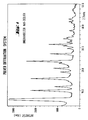
- the X-ray diffractogram is shown in FIG. 2.
- the untreated starting zeolite after treatment with acid, adjusting the pH of the slurry to 6 to 7, showed a constant shift in pH to the alkaline range, which had to be compensated for by further addition of acid.
- Both a NaOH-treated and an untreated NaY-zeolite according to Example 1 are dealuminated with SiCl4 as follows: 50.0 g of zeolite are placed in a horizontally arranged glass tube (inner diameter: 7 cm, length of the reaction zone: 30 cm) under nitrogen (6 l / h) at 450 ° C. in the course of 1.5 hours (measurement in the gas phase above the zeolite ) heated. After a further 30 minutes, 90.0 ml (60.0 g) of SiCl4, which were converted into the gaseous state in an evaporator (75 ° C.), are then passed over the zeolite for 1 hour at this temperature. The zeolite is then allowed to cool in an inert gas stream for 2 hours.
- the cell constant a o is determined to be 24.23 A for the zeolite treated with NaOH and 24.26 A for the untreated zeolite (range of error: ⁇ 0.03 A).
- the X-ray crystallinity of the sample obtained from treated NaY zeolite is higher than that of the sample obtained from untreated NaY zeolite is synthesized. This is also reflected in the adsorption properties.
- the first sample (treated with NaOH) at a p-xylene concentration of 1.0 g / m3 in equilibrium absorbs 18.2%, the other only 14.0% of its weight (20 ° C).
- the water adsorption is 68% rel. Moisture with 0.06 g water per g zeolite lower than in the second with 0.08 g. This is an indication that the dealumination in the treated zeolite was more complete and with better retention of the crystallinity
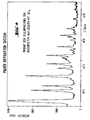
- the drawings show the X-ray diffractograms of the various zeolites NaY.
- the untreated NaY zeolite is represented according to the starting substance or according to Example 2.
- the NaY-treated zeolite NaY corresponding to Examples 1 and 2 is shown.
- the dealumination product of the untreated NaY zeolite according to Example 2 is shown.
- the dealumination product of the treated zeolite NaY according to Example 2 is shown.
Landscapes
- Chemical & Material Sciences (AREA)
- Crystallography & Structural Chemistry (AREA)
- Engineering & Computer Science (AREA)
- Materials Engineering (AREA)
- Organic Chemistry (AREA)
- Chemical Kinetics & Catalysis (AREA)
- Silicates, Zeolites, And Molecular Sieves (AREA)
- Catalysts (AREA)
- Solid-Sorbent Or Filter-Aiding Compositions (AREA)
Description
- Die Erfindung betrifft ein Verfahren zur Herstellung von Zeolith Y.
- Es ist bekannt, Mordenit zur Entfernung von Siliciumdioxid mit wäßriger Lösung von NaOH bei einem pH-Wert von größer als 10,5 zu behandeln.
- Die Konzentration der Natronlauge kann dabei 0,1 bis 15 N betragen. Die Temperatur beträgt 0 bis 100 °C, vorzugsweise 25 bis 75 °C, während die Behandlungsdauer 5 Minuten bis 5 Stunden beträgt. Diese Behandlung erhöht die Zugänglichkeit der inneren Poren (US-A 3,326,797). Diese derart behandelten Zeolithe werden als Hydrocracking- oder Isomerisierungskatalysatoren eingesetzt.
- Gegenstand der Erfindung ist ein Verfahren zur Herstellung eines hydrophoben Zeolithen Y durch Dealuminierung von Zeolith NaY mit einem Verhältnis SiO₂ : Al₂O₃ = 4,0 bis 6,5 mittels Siliciumtetrachlorid bei Temperaturen zwischen 300 und 480 °C, dadurch gekennzeichnet, daß man als Ausgangsmaterial einen Zeolith NaY mit einem SiO₂/Al₂O₃-Verhältnis von 4,0 bis 5,6 einsetzt, der zur Steigerung der inneren Oberfläche in wäßriger Suspension mit Natronlauge behandelt wurde.
- Die Suspension kann einen pH-Wert von 10,5 bis 14 aufweisen.
- Die Temperatur der Suspension kann 20 bis 100 °C betragen.
- In einer bevorzugten Ausführungsform kann man die Behandlung des Zeolithen NaY direkt nach der Synthese in der Filteranlage durchführen.
- Die Durchführung der Dealuminierung kann nach bekannten Verfahren, so zum Beispiel gemäß H. K. Beyer et al. in Imelik et al. Catalysis by Zeolites 1980 Elsevier, Scientific Publishing Company, Amsterdam, S. 203 bis 209, erfolgen.
- Das erfindungsgemäße Verfahren weist den Vorteil auf, daß bei dem mit Natronlauge behandelten Zeolithen die Dealuminierung vollständiger und mit einem besseren Erhalt der Kristallinität verläuft.
- Der als Ausgangssubstanz eingesetzte Zeolith NaY weist die folgenden physikalisch-chemischen Parameter auf:

- Röntgendiffraktogramm siehe Figur 1.
- 67 g NaY-Zeolith werden in 100 ml dest. Wasser suspendiert. Der pH-Wert dieser Aufschlämmung beträgt 10,8. Durch Zutropfen von 4,8 ml Natronlauge (8,3 % in wäßriger Lösung) innerhalb von 15 Minuten wird der pH-Wert auf 13 eingestellt. Danach wird die Lösung auf 60 °C während 15 Minuten aufgeheizt. Diese Temperatur wird weitere 15 Minuten gehalten. Anschließend wird der Zeolith filtriert und mit 2 l dest. Wasser gewaschen bis der pH-Wert des Waschwassers gegen Ende des Waschens < 10 ist. Der filtrierte Zeolith wird im Trockenschrank bei 120 °C während 14 Stunden getrocknet und dann bei 400 °C für 1 Stunde calciniert.

- Das Röntgendifraktogramm zeigt Figur 2.
- Nach der Na-OH-Behandlung wird ein Teil des Zeoliths resuspendiert. Diese Aufschlämmung wird mit 0,6 ml H₂SO₄ (d = 1,16 g/ml auf pH 6,5 angesäuert. Eine pH-Verschiebung wird während der nächsten 6 Stunden nicht beobachtet.
- Der nicht behandelte Ausgangszeolith zeigte nach der Behandlung mit Säure, wobei der pH-Wert der Aufschlämmung auf 6 bis 7 eingestellt wird, eine ständige Verschiebung des pH-Wertes zum alkalischen Bereich, die durch weitere Zugabe an Säure ausgeglichen werden mußte.
- Sowohl ein gemäß Beispiel 1 mit NaOH behandelter als auch unbehandelter NaY-Zeolith werden mit SiCl₄ wie folgt dealuminiert:
50,0 g Zeolith werden in einem horizontal angeordneten Glasrohr (Innendurchmesser: 7 cm, Länge der Reaktonszone: 30 cm) unter Stickstoff (6 l/h) innerhalb von 1,5 Stunden auf 450 °C (Messung in der Gasphase über dem Zeolith) erhitzt. Nach weiteren 30 Minuten werden dann bei dieser Temperatur zusätzlich 90,0 ml (60,0 g) SiCl₄, die in einem Verdampfer (75 °C) in den gasförmigen Zustand überführt wurden, während 1 Stunde über den Zeolith geleitet. Danach läßt man den Zeolith über 2 Stunden im Inertgasstrom abkühlen. 10 g des Produkts werden in 200 ml Wasser suspendiert, 20 Minuten gerührt, filtriert und mit 1 l Wasser gewaschen. Schließlich wird der so erhaltene Zeolith über 14 Stunden im Trockenschrank bei 120 °C getrocknet und dann bei 400 °C 1 Stunde lang calciniert. - Für den mit NaOH behandelten Zeolith wird die Zellkonstante ao zu 24.23 A, für den unbehandelten zu 24.26 A bestimmt (Fehlerbreite: ± 0,03 A). Wie Figur 3 und 4 zeigen, ist die Röntgenkristallinität der Probe, die aus behandeltem NaY-Zeolith erhalten wurde, höher als die der Probe, die aus unbehandeltem NaY-Zeolith synthetisiert wird. Dies schlägt sich auch in den Adsorptionseigenschaften nieder. So nimmt die erste Probe (mit NaOH behandelt) bei einer p-Xylol-Konzentration von 1,0 g/m³ im Gleichgewicht 18,2 %, die andere dagegen nur 14,0 % ihres Gewichts auf (20 °C). Umgekehrt liegt bei der ersten Probe die Wasseradsorption bei 68 % rel. Feuchte mit 0,06 g Wasser pro g Zeolith niedriger als bei der zweiten mit 0,08 g. Dies ist ein Indiz dafür, daß beim behandelten Zeolith die Dealuminierung vollständiger und mit besserem Erhalt der Kristallinität verlaufen ist
- Die Zeichnungen zeigen die Röntgendiffraktogramme der verschiedenen Zeolithe NaY.
Gemäß Figur 1 wird der unbehandelte Zeolith NaY entsprechend der Ausgangssubstanz bzw. gemäß Beispiel 2 dargestellt.
Gemäß Figur 2 wird der mit NaOH behandelte Zeolith NaY entsprechend den Beispielen 1 und 2 dargestellt.
Gemäß Figur 3 wird das Dealuminierungsprodukt des unbehandelten Zeolithen NaY gemäß Beispiel 2 dargestellt.
Gemäß Figur 4 wird das Dealuminierungsprodukt des behandelten Zeolithen NaY gemäß Beispiel 2 dargestellt.
Claims (4)
- Verfahren zur Herstellung eines hydrophoben Zeolithen Y durch Dealuminierung von Zeolith NaY mit einem Verhältnis SiO₂ : Al₂O₃ = 4,0 bis 6,5 mittels Siliciumtetrachlorid bei Temperaturen zwischen 300 und 480 °C, dadurch gekennzeichnet, daß man als Ausgangsmaterial einen Zeolith NaY mit einem SiO₂/Al₂O₃-Verhältnis von 4,0 bis 5,6 einsetzt, der zur Steigerung der inneren Oberfläche in wäßriger Suspension mit Natronlauge behandelt wurde.
- Verfahren nach Anspruch 1, dadurch gekennzeichnet, daß die Suspension einen pH-Wert von 10,5 bis 14 aufweist.
- Verfahren nach Anspruch 1 oder 2, dadurch gekennzeichnet, daß die Suspension eine Temperatur von 10 bis 100 °C aufweist.
- Verfahren nach Anspruch 1 bis 3, dadurch gekennzeichnet, daß man die Behandlung des Zeolithen direkt nach der Synthese in der Filteranlage durchführt.
Priority Applications (1)
| Application Number | Priority Date | Filing Date | Title |
|---|---|---|---|
| AT90113393T ATE86526T1 (de) | 1989-08-16 | 1990-07-13 | Verfahren zur herstellung von zeolith y. |
Applications Claiming Priority (2)
| Application Number | Priority Date | Filing Date | Title |
|---|---|---|---|
| DE3927034A DE3927034A1 (de) | 1989-08-16 | 1989-08-16 | Verfahren zur herstellung von zeolith y |
| DE3927034 | 1989-08-16 |
Publications (2)
| Publication Number | Publication Date |
|---|---|
| EP0413138A1 EP0413138A1 (de) | 1991-02-20 |
| EP0413138B1 true EP0413138B1 (de) | 1993-03-10 |
Family
ID=6387218
Family Applications (1)
| Application Number | Title | Priority Date | Filing Date |
|---|---|---|---|
| EP90113393A Expired - Lifetime EP0413138B1 (de) | 1989-08-16 | 1990-07-13 | Verfahren zur Herstellung von Zeolith Y |
Country Status (4)
| Country | Link |
|---|---|
| EP (1) | EP0413138B1 (de) |
| JP (1) | JPH0710723B2 (de) |
| AT (1) | ATE86526T1 (de) |
| DE (2) | DE3927034A1 (de) |
Families Citing this family (5)
| Publication number | Priority date | Publication date | Assignee | Title |
|---|---|---|---|---|
| EP0519573B1 (de) * | 1991-06-21 | 1995-04-12 | Shell Internationale Researchmaatschappij B.V. | Hydrierungskatalysator und Verfahren |
| TW223029B (de) * | 1991-08-16 | 1994-05-01 | Shell Internat Res Schappej B V | |
| TWI614214B (zh) * | 2012-10-26 | 2018-02-11 | China Petrochemical Technology Co Ltd | 製備分子篩和催化裂化用催化劑的方法和設備 |
| CN104828838B (zh) * | 2014-02-08 | 2017-01-18 | 中国石油化工股份有限公司 | 小晶粒y型分子筛的制备方法 |
| KR101631276B1 (ko) * | 2016-01-28 | 2016-06-16 | 조은산업주식회사 | 보크사이트 잔류물을 이용한 재활용 골재 제조 방법 |
Family Cites Families (5)
| Publication number | Priority date | Publication date | Assignee | Title |
|---|---|---|---|---|
| US3326797A (en) * | 1964-05-22 | 1967-06-20 | Union Oil Co | Hydrocarbon conversion process and catalyst comprising a crystalline alumino-silicate leached with sodium hydroxide |
| US3929669A (en) * | 1972-12-22 | 1975-12-30 | Universal Oil Prod Co | Method for manufacturing an adsorbent useful for olefin separation |
| FR2565847B1 (fr) * | 1984-06-18 | 1986-08-29 | Inst Francais Du Petrole | Synthese et utilisation de zeolithes preformees |
| NZ222697A (en) * | 1986-12-22 | 1989-08-29 | Mobil Oil Corp | Process for removing aluminium from zeolites |
| DE3719049A1 (de) * | 1987-06-06 | 1988-12-15 | Akzo Gmbh | Verfahren zum einbau von silicium-atomen anstelle von aluminiumatomen im kristallgitter eines zeolithen des faujasit-typs |
-
1989
- 1989-08-16 DE DE3927034A patent/DE3927034A1/de not_active Ceased
-
1990
- 1990-07-13 DE DE9090113393T patent/DE59001004D1/de not_active Expired - Fee Related
- 1990-07-13 EP EP90113393A patent/EP0413138B1/de not_active Expired - Lifetime
- 1990-07-13 AT AT90113393T patent/ATE86526T1/de not_active IP Right Cessation
- 1990-08-16 JP JP2215098A patent/JPH0710723B2/ja not_active Expired - Lifetime
Also Published As
| Publication number | Publication date |
|---|---|
| EP0413138A1 (de) | 1991-02-20 |
| DE3927034A1 (de) | 1991-02-28 |
| ATE86526T1 (de) | 1993-03-15 |
| JPH0710723B2 (ja) | 1995-02-08 |
| JPH03141114A (ja) | 1991-06-17 |
| DE59001004D1 (de) | 1993-04-15 |
Similar Documents
| Publication | Publication Date | Title |
|---|---|---|
| DE69221638T2 (de) | Verfahren zur synthese kristalliner microporöser silicoaluminophosphate | |
| DE2643928C2 (de) | ||
| DE69832349T2 (de) | Verfahren zur Herstellung von gebundenen Zeolithen | |
| DE68924640T2 (de) | Zeolithe. | |
| DE69312162T2 (de) | Verfahren zur Herstellung von Zeolithen mit vermindertem Oberflächensäuregehalt | |
| DE3781381T2 (de) | Ferrierite, verfahren zu ihrer herstellung und ihre verwendung. | |
| DE1567714B2 (de) | Kristalliner Aluminosilicatzeolith | |
| DE2140481A1 (de) | Verfahren zur Herstellung eines kristallinen Alumosilikates | |
| DE2145800A1 (de) | Verfahren zur Herstellung eines Zeolith mit hohem Kieselsäuregehalt | |
| DE4310792A1 (de) | Zeolithisches Material, Verfahren zur Regenerierung eines Katalysators für Crackverfahren sowie Verfahren zur Bereitstellung eines zeolithhaltigen Materials | |
| DE69606058T2 (de) | Verfahren zum verändern der porösität von aluminosilikaten und kieselsäuren sowie davon abgeleitete mesoporöse zusammensetzungen | |
| DE3751828T2 (de) | Herstellungsverfahren für stark hydrophoben entaluminierten zeolith y | |
| DE69418388T2 (de) | Verfahren zur Hydroisomerisierung von Wachs | |
| EP0761598B1 (de) | Verfahren zur Herstellung von Zeolith Y | |
| DE69122088T2 (de) | Zeolith vom mtw-typ sowie verfahren zu seiner herstellung | |
| EP0091537A1 (de) | Kristallines Alumosilikat, Verfahren zu seiner Herstellung und Verwendung | |
| DE69705264T2 (de) | Verfahren zur Herstellung von einem Mikro-mesoporösen Material mit hoher spezifischer Oberfläche und kontrollierter Porositätsverteilung | |
| DE69320245T2 (de) | Selektive Dealuminierung von Zeolithen | |
| DE69223680T2 (de) | Verfahren zur Herstellung eines teilchenförmigen Zeoliths | |
| CH493426A (de) | Verfahren zur Verbesserung der physikalischen Eigenschaften von Alumino-Silikat-Zeolithen und deren Verwendung | |
| DE60013733T2 (de) | Verfahren zur Entfernung von Templat aus synthetischen Zeolithen | |
| EP0295471A1 (de) | Verfahren zum Einbau von Silicium-Atomen anstelle von Aluminiumatomen im Kristallgitter eines Zeolithen des Faujasit-Typs | |
| DE3490097T1 (de) | Bindemittelfreie Zeolithkatalysatoren, Verfahren zu ihrer Herstellung und katalytische Reaktion mit ihnen | |
| EP0413138A1 (de) | Verfahren zur Herstellung von Zeolith Y | |
| DE2909930C2 (de) | Neue kristalline SiO&darr;2&darr;-Modifikation und Verfahren zu ihrer Herstellung |
Legal Events
| Date | Code | Title | Description |
|---|---|---|---|
| PUAI | Public reference made under article 153(3) epc to a published international application that has entered the european phase |
Free format text: ORIGINAL CODE: 0009012 |
|
| 17P | Request for examination filed |
Effective date: 19900713 |
|
| AK | Designated contracting states |
Kind code of ref document: A1 Designated state(s): AT BE CH DE DK FR GB LI NL SE |
|
| 17Q | First examination report despatched |
Effective date: 19911002 |
|
| GRAA | (expected) grant |
Free format text: ORIGINAL CODE: 0009210 |
|
| AK | Designated contracting states |
Kind code of ref document: B1 Designated state(s): AT BE CH DE DK FR GB LI NL SE |
|
| REF | Corresponds to: |
Ref document number: 86526 Country of ref document: AT Date of ref document: 19930315 Kind code of ref document: T |
|
| ET | Fr: translation filed | ||
| REF | Corresponds to: |
Ref document number: 59001004 Country of ref document: DE Date of ref document: 19930415 |
|
| GBT | Gb: translation of ep patent filed (gb section 77(6)(a)/1977) |
Effective date: 19930518 |
|
| PG25 | Lapsed in a contracting state [announced via postgrant information from national office to epo] |
Ref country code: DK Effective date: 19930713 Ref country code: AT Effective date: 19930713 |
|
| PLBE | No opposition filed within time limit |
Free format text: ORIGINAL CODE: 0009261 |
|
| STAA | Information on the status of an ep patent application or granted ep patent |
Free format text: STATUS: NO OPPOSITION FILED WITHIN TIME LIMIT |
|
| 26N | No opposition filed | ||
| EAL | Se: european patent in force in sweden |
Ref document number: 90113393.4 |
|
| PGFP | Annual fee paid to national office [announced via postgrant information from national office to epo] |
Ref country code: SE Payment date: 19960611 Year of fee payment: 7 |
|
| PGFP | Annual fee paid to national office [announced via postgrant information from national office to epo] |
Ref country code: DE Payment date: 19960613 Year of fee payment: 7 |
|
| PGFP | Annual fee paid to national office [announced via postgrant information from national office to epo] |
Ref country code: BE Payment date: 19960620 Year of fee payment: 7 |
|
| PGFP | Annual fee paid to national office [announced via postgrant information from national office to epo] |
Ref country code: GB Payment date: 19960704 Year of fee payment: 7 |
|
| PGFP | Annual fee paid to national office [announced via postgrant information from national office to epo] |
Ref country code: CH Payment date: 19960709 Year of fee payment: 7 |
|
| PGFP | Annual fee paid to national office [announced via postgrant information from national office to epo] |
Ref country code: FR Payment date: 19960730 Year of fee payment: 7 |
|
| PGFP | Annual fee paid to national office [announced via postgrant information from national office to epo] |
Ref country code: NL Payment date: 19960731 Year of fee payment: 7 |
|
| PG25 | Lapsed in a contracting state [announced via postgrant information from national office to epo] |
Ref country code: GB Free format text: LAPSE BECAUSE OF NON-PAYMENT OF DUE FEES Effective date: 19970713 |
|
| PG25 | Lapsed in a contracting state [announced via postgrant information from national office to epo] |
Ref country code: SE Effective date: 19970714 |
|
| PG25 | Lapsed in a contracting state [announced via postgrant information from national office to epo] |
Ref country code: LI Free format text: LAPSE BECAUSE OF NON-PAYMENT OF DUE FEES Effective date: 19970731 Ref country code: CH Free format text: LAPSE BECAUSE OF NON-PAYMENT OF DUE FEES Effective date: 19970731 Ref country code: BE Free format text: LAPSE BECAUSE OF NON-PAYMENT OF DUE FEES Effective date: 19970731 |
|
| BERE | Be: lapsed |
Owner name: DEGUSSA A.G. Effective date: 19970731 |
|
| PG25 | Lapsed in a contracting state [announced via postgrant information from national office to epo] |
Ref country code: NL Free format text: LAPSE BECAUSE OF NON-PAYMENT OF DUE FEES Effective date: 19980201 |
|
| GBPC | Gb: european patent ceased through non-payment of renewal fee |
Effective date: 19970713 |
|
| REG | Reference to a national code |
Ref country code: CH Ref legal event code: PL |
|
| PG25 | Lapsed in a contracting state [announced via postgrant information from national office to epo] |
Ref country code: FR Free format text: LAPSE BECAUSE OF NON-PAYMENT OF DUE FEES Effective date: 19980331 |
|
| NLV4 | Nl: lapsed or anulled due to non-payment of the annual fee |
Effective date: 19980201 |
|
| PG25 | Lapsed in a contracting state [announced via postgrant information from national office to epo] |
Ref country code: DE Free format text: LAPSE BECAUSE OF NON-PAYMENT OF DUE FEES Effective date: 19980401 |
|
| EUG | Se: european patent has lapsed |
Ref document number: 90113393.4 |
|
| REG | Reference to a national code |
Ref country code: FR Ref legal event code: ST |