EP0402882A2 - Teig für die Herstellung von Tonern für Elektrophotographie - Google Patents
Teig für die Herstellung von Tonern für Elektrophotographie Download PDFInfo
- Publication number
- EP0402882A2 EP0402882A2 EP90111145A EP90111145A EP0402882A2 EP 0402882 A2 EP0402882 A2 EP 0402882A2 EP 90111145 A EP90111145 A EP 90111145A EP 90111145 A EP90111145 A EP 90111145A EP 0402882 A2 EP0402882 A2 EP 0402882A2
- Authority
- EP
- European Patent Office
- Prior art keywords
- weight
- parts
- amount
- binder resin
- master batch
- Prior art date
- Legal status (The legal status is an assumption and is not a legal conclusion. Google has not performed a legal analysis and makes no representation as to the accuracy of the status listed.)
- Withdrawn
Links
Images

Classifications
-
- G—PHYSICS
- G03—PHOTOGRAPHY; CINEMATOGRAPHY; ANALOGOUS TECHNIQUES USING WAVES OTHER THAN OPTICAL WAVES; ELECTROGRAPHY; HOLOGRAPHY
- G03G—ELECTROGRAPHY; ELECTROPHOTOGRAPHY; MAGNETOGRAPHY
- G03G9/00—Developers
- G03G9/08—Developers with toner particles
- G03G9/0802—Preparation methods
- G03G9/081—Preparation methods by mixing the toner components in a liquefied state; melt kneading; reactive mixing
Definitions
- This invention relates to a master batch for the production of toners used in electrophotography.
- An electrophotographic process is well known wherein an electrostatic image is formed on a photoconductor, and the electrostatic image is then developed with adeveoper which contains toner particles, to provide a toner image, and then the toner image is transferred and fixed on a substrate.
- Two methods are well known for developing an electrostatic image on a photoconductor: a one-component developing method and a two-component developing method.
- the two-component developer is composed of toner particles and carrier particles, and now widely used in a magnetic brush method.
- a full color toner image is produced by forming primary color toner images in layers sequently on a substrate, and accordingly the two-component developing method are mainly employed in the process.
- triboelectricity of toner particles has a great influence upon quality of fixed images either in the one-component or in the two-component developing method.
- toner particles have an insufficient specific electric charge (an electric charge per weight of toners)
- the toner particles have an insufficient electrostatic interaction with the carrier particles, so that the toner contaminates the surrounding of the device, or adheres to areas having no images on a photoconductor, to produce fogs on the resultant toner image.
- toner particles have various additives, in particular, a dye or a pigment, dispersed as finely and evenly as possible therein so that the toner particles are equally electrified, thereby to produce high quality toner images constantly.
- Such a known conventional method of producing toners comprises admixing a binder resin with a dye or a pigment by an effective agitation to form a mixture, melting and kneading the mixture with, for example, a twin screw extruder, a heating kneader or a heating roll, and then cooling and crushing the mixture to a powder.
- a twin screw extruder melting and kneading the mixture with, for example, a twin screw extruder, a heating kneader or a heating roll, and then cooling and crushing the mixture to a powder.
- the powder is screened to a desirable particle size, and the powder is surface-treated with, for example, colloidal silica, so that the powder has a high fluidity.
- binder resins generally have a low polarity
- dyes and pigments generally have a high polarity, so that it is essentially difficult from the chemical standpoint to disperse such dyes or pigments finely and evenly in the binder resins by melt-kneading.
- a further method is disclosed in Japanese Patent Application Laid-open No. 61-156054.
- a part of a binder resin and a charge control agent are dissolved in an organic solvent, and then the solvent is removed, to form a master batch.
- the master batch is then melted and kneaded together with the remainder of the binder resin, and the mixure is cooled and crushed to toner particles.
- this method needs a large amount of solvent and costs a great deal, since the charge control agent is in general rarely soluble in organic solvents.
- an object of the invention to provide a method of producing toner particles, either monochromatic or colored, for use in electrophotography which individually have a dye or a pigment evenly dispersed therein as finely divided particles.
- a method of producing a master batch for the production of toners used in electrophotography which comprises: mixing and kneading a binder resin in an amount of 100 parts by weight, at least one of dyes and pigments in an amount of 1-300 parts by weight and an organic solvent in an amount of 10-500 parts by weight in which the binder resin is soluble, and then, optionally crushing or granulating the mixture.
- the binder resin used is not specifically limited, but any resin may be used which is known in the art of toners for use in electrophotography. There may be mentioned as such a binder resin, for instance, a homo polymers or copolymers of two or more of radical polymerizable monomers such as styrene, o-methylstyrene, m-methylstyrene, p-methylstyrene, p-chlorostyrene, vinyl acetate, vinyl propionate, methyl acrylate, ethyl acrylate, n-butyl acrylate, isobutyl acrylate, n-octyl acrylate, dodecyl acrylate, 2-ethylhexyl acrylate, stearyl acrylate, 2-chlorostearyl acrylate, phenyl acryalte, methyl ⁇ -chloroacrylate, methyl methacrylate, eth
- polystyrene or a styrene-acrylate or methacrylate such as butyl acrylate or butyl methacrylate is preferred.
- a dye or a pigment is used as a coloring agent and/or a charge control agent. It is preferred that the dye or pigment used is oil-soluble and readily wetted with the solvent used.
- a dye or pigment for example, a nigrosine dye represented by: wherein X ⁇ is an anion species, a chromium containing dye represented by; wherein X ⁇ is a cation species, or "Spiron Black TRH" (by Hodogaya Kagaku Kogyo K.K., Japan) represented by: wherein X+ is a cation species.
- Carbon black is preferably used as a coloring agent in the production of monochromatic toner particles whereas a variety of azo dyes or phthalocyanine pigments are preferably used in the production of colored toner particles.
- a master batch is defined as a colored material composed of a resin having a colorant dispersed therein in a high content.
- the master batch is produced by kneading a mixture of a binder resin and at least one of dyes and pigments in the presence of an organic solvent in which the binder resin used is soluble. It is further preferred that the dye or pigment used is readily wetted therewith. Since dyes or pigments have generally a high polarity, it is preferred that the solvent used have polar groups therein.
- polar solvents for example, ketones such as methyl ethyl ketone or methyl isobutyl ketone, esters such as methyl acetate, ethyl acetate, propyl acetate or butyl acetate, alcohols such as propanol or butanol.
- ketones such as methyl ethyl ketone or methyl isobutyl ketone
- esters such as methyl acetate, ethyl acetate, propyl acetate or butyl acetate
- alcohols such as propanol or butanol.
- an aromatic hydrocarbon such as toluene or xylene may be used as the solvent.
- the dye or pigment is used in an amount of 1-300 parts by weight, preferably of 50-150 parts by weight, and the solvent in an amount of 5-500 parts by weight, preferably of 10-50 parts by weight, in relation to 100 parts by weight of the binder resin.
- the binder resin and the dye or pigment may be kneaded together with an organic solvent by means of a two roll kneader, a three roll kneader or a twin screw extruder.
- the mixture is usually kneaded at room temperature, however, the mixture may be kneaded at elevated temperature, if necessary.
- the organic solvent used is such that the binder resin is soluble therein. But, it is not necessary that the binder resin is actually dissolved in the solvent when the mixture is kneaded to produce a master batch. It is sufficient that the binder resin is wetted and swollen with the solvent so that the resin is plasticizable and highly compatible with the dye or pigment wetted with the solvent. Therefore, there is no need of using a large amount of the solvent.
- Substantially all the solvent used is usually evaporated when the mixture is kneaded at room temperature on account of heat generated during the kneading. However, if necessary, the solvent may be removeded, if any, from the mixture after the kneading.
- the kneaded mixture as produced in this manner may be used as a master batch for the production of toner particles used in electrophotography. However, when necessary, the kneaded mixture is then crushed or granulated for easy handling.
- the resultant master batch has a dye or a pigment dispersed therein as finely divided particles of not more than about 5 ⁇ m, and about 1 ⁇ m in a preferred embodiment, even when the dye or pigment contains particles larger in diameter than the preferred toner particles.
- a method of producing toners for use in electrophotography comprises:
- the toner particles may be surface-treated with colloidal silica.
- the second binder resin admixed with the master batch may be either the same as or different from the first binder resin used in the production of the master batch. But when the second binder resin is different from the first, it is preferred that the second binder resin is compatible with the first binder resin.
- the master batch is used in an amount of 2-20 parts by weight, preferably of 4-15 parts by weight, in relation to 100 parts by weight of the second bonder resin.
- the additives are well known in the art of toner production, and are added in an effective amount to the master batch together with the second binder resin.
- the additive may be a magnetic material to provide toners with magnetic properties or a polyolefin wax such as polyethylene wax or polypropylene wax to provide toners antioffset properties.
- Magnetic oxides such as ferrite or magnetite, or other magnetic metals are used as the magnetic material.
- the magnetic material is used in an amount of 30-300 parts by weight, preferably of 30-100 parts by weight, in relation to 100 parts by weight of the binder resin.
- the toner of the invention When used as a two-component developing agent, the toner is mixed with a carrier material such as a powder of iron, ferrite or magnetite as well known in the art of electrophotography.
- the two-component developing agent contains the toner in an amount of 2-20 % by weight, preferably of 5-10% by weight.
- a binder resin and at least one of dyes and pigments are kneaded in the presence of an organic solvent with which the binder resin is wetted and swollen and with which the dye or pigment is readily wetted, so that the binder resin gets highly plasticizable and compatible with the dye or pigment, and the dye or pigment is evenly dispersed as finely divided particles, thereby to provide a master batch particularly suitable for the production of toner particles used in electrophotography.
- toner particles which have a dye or a pigment, or a further additive when used, evenly dispersed therein as finely divided particles by admixing and kneading the master batch with a further amount of a binder resin and an additive.
- the resultant toner particles have a uniform distribution of specific electric charge and coloring agent so that they produces either monochromatic or full color toner images with a sufficient darkness constantly free from fogs or contamination thereon. Further, there arises no problem of filming of toners on a photoconductive body.
- An amount of 100 parts by weight of a styrene-butyl acrylate copolymer, 100 parts by weight of a dye "Spiron Black TRH" (from Hodogaya Kagaku Kogyo K.K.) and 10 parts by weight of methyl isobutyl ketone were kneaded together with a two roll kneader at room temperature, to provide a master batch.
- the master batch was found to contain not more than 1 % by weight of the solvent.
- the master batch was crushed.
- the master batch was further mixed with 95 parts by weight of the same styrene-butyl acrylate copolymer as the above, and kneaded at 150°C, to provide a binder resin-dye composition.
- Fig. 1 is a microphotograph (x920) of the particles of the dye dispersed evenly in the composition as finely divided particles of about 1 ⁇ m.
- the master batch was crushed.
- the master batch was further mixed with 95 parts by weight of the same styrene-butyl acrylate copolymer as above, and kneaded at 150°C, to provide a binder resin- dye composition.
- Fig. 2 is a microphotograph (x920) of the particles of the dye dispersed in the resin. It was found that the dye particles were much larger in size than in the Example 1, and the dye is unevenly dispersed in the resin.
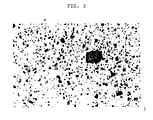
- Fig. 3 is a microphotograph (x920) of the particles of the dye dispersed in the binder resin. It is found that the particles of the dye dispersed in the binder resin have a wide particle size distribution and some of the particles are very large.
- the master batch was crushed.
- the master batch was further mixed with 95 parts by weight of the same styrene-butyl acrylate copolymer as above, and kneaded at 150°C, to provide a binder resin-dye composition.
- the dye was dispersed evenly in the binder resin as finely divided particles of not more than about 1 ⁇ m in size.
- the master batch was crushed.
- the master batch was further mixed with 95 parts by weight of the same styrene-butyl acrylate copolymer as above, and kneaded at 150°C, to provide a binder resin-dye composition.
- the developing agent was applied to an electrostatic copying machine (SFT-1102Z from Sanyo Denki K.K.) and 1000 sheets of copies were continuously produced to evaluate the quality of toner images. It was found that the image had a constant darkness and no ground contamination. There were found neither filming of toners on the photoconductive drum nor contamination of the developing device.
- SFT-1102Z from Sanyo Denki K.K.
- the toner was mixed with the same carrier material as in the Example 4 to provide a two-component developing agent containing the toner in an amount of 6 % by weight.
- the developing agent was applied to the same copying machine as above, and 1000 sheets of copies were continuously produced. It was found that the images had a varied darkness and ground contamination. There were also found filming of toners on the photoconductive drum and contamination of the developing device.
- An amount of 100 parts by weight of a styrene-butyl acrylate copolymer, 100 parts by weight of a bisazo red pigment "TNC-319" (from Sumitomo Kagaku Kogyo K.K.) and 10 parts by weight of methyl isobutyl ketone were kneaded together with a two roll kneader at room temperature, to provide a master batch.
- the master batch was found to contain the solvent in an amount of not more than 1 % by weight.
- the master batch was crushed.
- the master batch was further mixed with 95 parts by weight of the same sytrene-butyl acrylate copolymer as above, and kneaded at 150°C, to provide a binder resin-pigment composition.
- An amount of 100 parts by weight of the same styrene-butyl acrylate copolymer as in the Example 1 and 100 parts by weight of the same pigment as in the Example 5 were kneaded in the absence of a solvent at 150°C, to provide a master batch.
- An amount of 100 parts by weight of the same styrene-butyl acrylate copolymer as in the Example 1 and 100 parts by weight of the same pigment as in the Example 5 were kneaded in the absence of a solvent at 150°C, to provide a master batch.
- the master batch was crushed.
- the master batch was further mixed with 95 parts by weight of the same styrene-butyl acrylate copolymer as above, and kneaded at 150°C, to provide a binder resin-pigment composition.
- An amount of 100 parts by weight of the same styrene-butyl acrylate copolymer as in the Example 1 and 100 parts by weight of a phthalocyanine pigment "TPC-511" (from Sumitomo Kagaku Kogyo K.K.) and 10 parts by weight of methyl isobutyl ketone were kneaded together with a two roll kneader at room temperature, to provide a master batch.
- the master batch was found to contain the solvent in an amount of not more than 1 % by weight.
- the master batch was crushed.
- the master batch was further mixed with 95 parts by weight of the same styrene-butyl acrylate copolymer as above, and kneaded at 150°C, to provide a binder resin-pigment composition.
- the pigment was dispersed evenly in the binder resin as finely divided particles of not more than about 1 ⁇ m in size.
- An amount of 100 parts by weight of the same styrene-butyl acrylate copolymer as in the Example 1 and 100 parts by weight of a bisazo yellow pigment "TNC-113" (from Sumitomo Kagaku Kogyo K.K.) and 10 parts by weight of methyl isobutyl ketone were kneaded together with a two roll kneader at room temperature, to provide a master batch.
- the master batch was found to contain the solvent in an amount of not more than 1 % by weight.
- the master batch was crushed.
- the master batch was further mixed with 95 parts by weight of the same styrene-butyl acrylate copolymer as above, and kneaded at 150°C, to provide a binder resin-pigment composition.
- the developing agent was applied to an electrostatic copying machine (SFT-1102Z from Sanyo Denki K.K.) and 1000 sheets of copies were continuously produced to evaluate the quality of toner images. It was found that the image had a constant darkness and no ground contamination. There were found neither filming of toners on the photoconductive drum nor contamination of the developing device.
- SFT-1102Z from Sanyo Denki K.K.
- the toner was mixed with the same carrier material as before to provide a two-component developing agent containing the toner in an amount of 6 % by weight.
- the developing agent was applied to the same copying machine as above, and 1000 sheets of copies were continuously produced. It was found that the images had a varied darkness and ground contamination. There were also found filming of toners on the photoconductive drum and contamination of the developing device.
Landscapes
- Physics & Mathematics (AREA)
- General Physics & Mathematics (AREA)
- Developing Agents For Electrophotography (AREA)
Applications Claiming Priority (4)
| Application Number | Priority Date | Filing Date | Title |
|---|---|---|---|
| JP15127689 | 1989-06-14 | ||
| JP151276/89 | 1989-06-14 | ||
| JP200981/89 | 1989-08-02 | ||
| JP20098189 | 1989-08-02 |
Publications (2)
| Publication Number | Publication Date |
|---|---|
| EP0402882A2 true EP0402882A2 (de) | 1990-12-19 |
| EP0402882A3 EP0402882A3 (de) | 1991-01-16 |
Family
ID=26480579
Family Applications (1)
| Application Number | Title | Priority Date | Filing Date |
|---|---|---|---|
| EP19900111145 Withdrawn EP0402882A3 (de) | 1989-06-14 | 1990-06-13 | Teig für die Herstellung von Tonern für Elektrophotographie |
Country Status (2)
| Country | Link |
|---|---|
| EP (1) | EP0402882A3 (de) |
| CA (1) | CA2018876A1 (de) |
Cited By (2)
| Publication number | Priority date | Publication date | Assignee | Title |
|---|---|---|---|---|
| EP0458196A1 (de) * | 1990-05-17 | 1991-11-27 | Canon Kabushiki Kaisha | Verfahren zur Herstellung von Tonern |
| EP0718704A1 (de) | 1994-11-29 | 1996-06-26 | Mita Industrial Co. Ltd. | Elektrophotographischer Toner und Enwickler |
Family Cites Families (2)
| Publication number | Priority date | Publication date | Assignee | Title |
|---|---|---|---|---|
| GB2005692B (en) * | 1977-12-21 | 1982-06-23 | Apeco Corp | Prparation of finely comminuted particles of a polymer |
| JPH0812470B2 (ja) * | 1987-07-10 | 1996-02-07 | 三井東圧化学株式会社 | 電子写真用トナ−用樹脂組成物の製造方法 |
-
1990
- 1990-06-13 EP EP19900111145 patent/EP0402882A3/de not_active Withdrawn
- 1990-06-13 CA CA 2018876 patent/CA2018876A1/en not_active Abandoned
Cited By (3)
| Publication number | Priority date | Publication date | Assignee | Title |
|---|---|---|---|---|
| EP0458196A1 (de) * | 1990-05-17 | 1991-11-27 | Canon Kabushiki Kaisha | Verfahren zur Herstellung von Tonern |
| US5376493A (en) * | 1990-05-17 | 1994-12-27 | Canon Kabushiki Kaisha | Process for producing toner |
| EP0718704A1 (de) | 1994-11-29 | 1996-06-26 | Mita Industrial Co. Ltd. | Elektrophotographischer Toner und Enwickler |
Also Published As
| Publication number | Publication date |
|---|---|
| CA2018876A1 (en) | 1990-12-14 |
| EP0402882A3 (de) | 1991-01-16 |
Similar Documents
| Publication | Publication Date | Title |
|---|---|---|
| US5145762A (en) | Processes for the preparation of toners | |
| EP0238130B1 (de) | Entwickler für Elektrophotographie | |
| US5589310A (en) | Method for producing toner for developing electrostatic images | |
| JPH02120865A (ja) | カラートナー粒子 | |
| EP0402882A2 (de) | Teig für die Herstellung von Tonern für Elektrophotographie | |
| US5648192A (en) | Electrophotographic toner | |
| JPS5880649A (ja) | 負電荷潜像現像用磁性現像剤 | |
| JPS63285555A (ja) | 静電荷像現像用トナ− | |
| JPS59197051A (ja) | 現像剤 | |
| EP0412494A1 (de) | Basismaterial für die Herstellung von elektrophotographischen Tonern | |
| JPH0656508B2 (ja) | 静電荷像現像用正摩擦帯電性トナー | |
| JPS5916262B2 (ja) | 静電荷像現像用トナ− | |
| JPS6183546A (ja) | カラ−トナ−キツト | |
| JPH03155568A (ja) | 静電潜像現像用トナー及びそのためのマスターバツチの製造方法 | |
| JPH0372371A (ja) | 静電潜像現像用トナー及びそのためのマスターバツチの製造方法 | |
| JP3635709B2 (ja) | 静電荷像現像用トナー | |
| JPH04186369A (ja) | 静電荷現像用トナー | |
| JPH0656506B2 (ja) | トナ− | |
| JPS5997154A (ja) | 現像剤組成物 | |
| JPH0490558A (ja) | カラー現像剤の製造方法及びカラー現像剤組成物 | |
| JPH0369966A (ja) | 静電潜像現像用トナー及びそのためのマスターバツチの製造方法 | |
| JP2694543B2 (ja) | 静電荷像現像用トナー | |
| JPH04186370A (ja) | 静電荷現像用トナー | |
| JPH02118583A (ja) | 電子写真トナーの製造方法 | |
| JPH025072A (ja) | 二成分現像剤用トナーの製造方法 |
Legal Events
| Date | Code | Title | Description |
|---|---|---|---|
| PUAI | Public reference made under article 153(3) epc to a published international application that has entered the european phase |
Free format text: ORIGINAL CODE: 0009012 |
|
| PUAL | Search report despatched |
Free format text: ORIGINAL CODE: 0009013 |
|
| AK | Designated contracting states |
Kind code of ref document: A2 Designated state(s): BE DE FR GB |
|
| AK | Designated contracting states |
Kind code of ref document: A3 Designated state(s): BE DE FR GB |
|
| 17P | Request for examination filed |
Effective date: 19910614 |
|
| 17Q | First examination report despatched |
Effective date: 19940415 |
|
| STAA | Information on the status of an ep patent application or granted ep patent |
Free format text: STATUS: THE APPLICATION IS DEEMED TO BE WITHDRAWN |
|
| 18D | Application deemed to be withdrawn |
Effective date: 19940826 |