EP0402487B1 - Verfahren zur herstellung von schwarzmachendem material und dessen verwendung - Google Patents
Verfahren zur herstellung von schwarzmachendem material und dessen verwendung Download PDFInfo
- Publication number
- EP0402487B1 EP0402487B1 EP90901660A EP90901660A EP0402487B1 EP 0402487 B1 EP0402487 B1 EP 0402487B1 EP 90901660 A EP90901660 A EP 90901660A EP 90901660 A EP90901660 A EP 90901660A EP 0402487 B1 EP0402487 B1 EP 0402487B1
- Authority
- EP
- European Patent Office
- Prior art keywords
- salt
- coloring material
- black
- chitosan
- black coloring
- Prior art date
- Legal status (The legal status is an assumption and is not a legal conclusion. Google has not performed a legal analysis and makes no representation as to the accuracy of the status listed.)
- Expired - Lifetime
Links
Images






Classifications
-
- C—CHEMISTRY; METALLURGY
- C09—DYES; PAINTS; POLISHES; NATURAL RESINS; ADHESIVES; COMPOSITIONS NOT OTHERWISE PROVIDED FOR; APPLICATIONS OF MATERIALS NOT OTHERWISE PROVIDED FOR
- C09B—ORGANIC DYES OR CLOSELY-RELATED COMPOUNDS FOR PRODUCING DYES, e.g. PIGMENTS; MORDANTS; LAKES
- C09B67/00—Influencing the physical, e.g. the dyeing or printing properties of dyestuffs without chemical reactions, e.g. by treating with solvents grinding or grinding assistants, coating of pigments or dyes; Process features in the making of dyestuff preparations; Dyestuff preparations of a special physical nature, e.g. tablets, films
- C09B67/0097—Dye preparations of special physical nature; Tablets, films, extrusion, microcapsules, sheets, pads, bags with dyes
-
- C—CHEMISTRY; METALLURGY
- C09—DYES; PAINTS; POLISHES; NATURAL RESINS; ADHESIVES; COMPOSITIONS NOT OTHERWISE PROVIDED FOR; APPLICATIONS OF MATERIALS NOT OTHERWISE PROVIDED FOR
- C09B—ORGANIC DYES OR CLOSELY-RELATED COMPOUNDS FOR PRODUCING DYES, e.g. PIGMENTS; MORDANTS; LAKES
- C09B67/00—Influencing the physical, e.g. the dyeing or printing properties of dyestuffs without chemical reactions, e.g. by treating with solvents grinding or grinding assistants, coating of pigments or dyes; Process features in the making of dyestuff preparations; Dyestuff preparations of a special physical nature, e.g. tablets, films
- C09B67/006—Preparation of organic pigments
- C09B67/0061—Preparation of organic pigments by grinding a dyed resin
-
- C—CHEMISTRY; METALLURGY
- C09—DYES; PAINTS; POLISHES; NATURAL RESINS; ADHESIVES; COMPOSITIONS NOT OTHERWISE PROVIDED FOR; APPLICATIONS OF MATERIALS NOT OTHERWISE PROVIDED FOR
- C09B—ORGANIC DYES OR CLOSELY-RELATED COMPOUNDS FOR PRODUCING DYES, e.g. PIGMENTS; MORDANTS; LAKES
- C09B61/00—Dyes of natural origin prepared from natural sources, e.g. vegetable sources
Definitions
- the present invention relates to a process for the preparation of a black coloring material and an application thereof. More particularly, the present invention relates to a process for preparing a finely divided polymeric black coloring material by using this black coloring material, a process for dyeing a fiber with this black coloring material, and a process for modifying black iron oxide with this black coloring material.
- the present invention provides a process for the preparation of a finely divided black coloring material comprising a natural or synthetic polymer as a base, and a process for dyeing a fiber.
- the present invention provides a process for modifying black iron oxide (tri-iron tetroxide) which has been used as a black coloring material.
- the dyestuff of the lithospermum root is extracted from a root of lithospermum [botanical name: Lithospermum erythrorhizon Siebold et Zuccarini (Lithospermum officinale linne var. erythrorhizon Maimowicz)(Borraginacease)], and this dyestuff has been long used from of old as the valuable dye for obtaining a dyeing of a purple color regarded as a "noblest color" in Japan.
- this dyestuff is not subject to discoloration and has a good heat resistance, oxidation resistance and light resistance, and that this dyestuff of the lithospermum root has a high safety and is utilized as the coloring material for foods and cosmetics. Practically, at present, this dyestuff is used in the field of cosmetics as a dyestuff applicable to mucosa, i.e., as coloring materials such as lipsticks and eye shadows, but a process for preparing a black coloring material from the dyestuff of the lithospermum root has not been known.
- the conventional black coloring material there can be mentioned inorganic pigments such as carbon black and black iron oxide, organic pigments such as Aniline Black, tar dyestuffs such as Black dyestuff 401, and various dyes.
- inorganic pigments such as carbon black and black iron oxide
- organic pigments such as Aniline Black
- tar dyestuffs such as Black dyestuff 401
- various dyes there can be mentioned inorganic pigments such as carbon black and black iron oxide, organic pigments such as Aniline Black, tar dyestuffs such as Black dyestuff 401, and various dyes.
- the conventional black-dyeing dyes used for obtaining a finely divided black coloring material from a natural or synthetic polymer as the base or a black fiber have problems in that a heavy metal such as chromium must be used for the dyeing operation and a subsidiary material such as a surface active agent must be used, and some of dyeing methods using these dyes damage the dyed products.
- a heavy metal such as chromium
- a subsidiary material such as a surface active agent
- furnace black obtained by a continuous incomplete combustion of a natural gas or a petroleum or coal type heavy hydrocarbon oil in a reaction furnace and channel black obtained by burning a natural gas or hydrocarbon gas as a low flame, bringing the low flame into contact with the bottom surface of a channel steel, and collecting carbon formed by a continuous flame decomposition. It is reported that furnace black contains benzpyrene, which is a carcinogenic substance, and in Japan only the use of channel black is allowed in the field of cosmetics, and in the United States, the use of both carbon blacks is inhibited. Accordingly, carbon black cannot be regarded as a safe black coloring material.
- Black iron oxide (tri-iron tetroxide, FeO.Fe2O3) is not a black coloring material showing a black color with a satisfactorily low lightness.
- tar type dyestuffs involve a risk of noxiousness on a human body, and the applicable range is strictly restricted.
- Black dyestuff 401 formed by subjecting Naphthol Blue Black, which is a tar type dyestuff, to a lake-forming reaction with aluminum sulfate cannot be used for a product to be applied onto a mucous membrane portion, and use of this dyestuff is greatly restricted.
- tar type dyestuffs have inferior fastness characteristics to inorganic black coloring materials such as black iron oxide, and tar type dyestuffs have problems in that they are slightly eluted into water even under neutral conditions.
- Acid Fast Black VLG color index and number: C.I. Acid Black 25; dyes and pigments will be indicated in the same manner hereinafter
- Acid Black WA C.I. Acid Black 52
- Chrome Black P2B C.I. Mordant Black 7
- Chrome Black T C.I. Mordant Black 11
- Reactive Black B C.I. Reactive Black 5 which has been used for dyeing such substrates as cotton and rayon to a black color.
- Acid Fast Black VLG is a milling type acid dye, for which an addition of a nonionic or amphoteric surface active agent as a subsidiary agent is necessary, and since this dye has a relatively high molecular weight, the dye is suitable for dyeing a coarse fiber but has a poor compatibility with a finely divided substrate.
- Acid Black WA is a 1:1 type chromium complex salt dye and when this dye is used, single-bath dyeing is possible. Nevertheless, since the dyeing operation is carried out at a pH value of about 2, wool or the like is easily damaged, and therefore, this dye is now used only for a limited number of specific articles.
- Each of Chrome Black P2B and Chrome Black T is a chromium dye, and when these dyes are used, a dyeing process is adopted in which a chromium complex is formed on a fiber or other substrate to be dyed by using a dichromate.
- These chromium dyes are disadvantageous in that the use of chromium, a heavy metal, cannot be avoided.
- Reactive Black B is a reactive dyestuff, and this dye has a problem in that, as in the case of other reactive dyestuffs, a long time and a large amount of energy are necessary for the washing operation conducted after the dyeing.
- An object of the present invention is to overcome the above-mentioned defects of the conventional black coloring materials and the conventional processes for the preparation of black coloring materials and provide processes for the preparation of black coloring materials and black fibers having a good fastness and a very low lightness, and a process for modifying black iron oxide.
- a process for the preparation of a black coloring material which comprises treating a chitosan with a dyestuff of the lithospermum root.
- This coloring material is in the finely divided, gelatinous or liquid form.
- a process for the preparation of a finely divided black coloring material which comprises placing the above-mentioned gelatinous black coloring material in contact with an aqueous solution of an alkali.
- a process for the preparation of a finely divided black coloring material which comprises forming a black film of the above-mentioned black coloring material and then pulverizing this black film.
- a process for the preparation of a finely divided black coloring material which comprises dyeing a finely divided natural or synthetic polymeric substance with the above-mentioned gelatinous or liquid black coloring material.
- a process for dyeing a fiber which comprises dyeing a natural or artificial fiber with the above-mentioned gelatinous or liquid black coloring material.
- a process for the modification of black iron oxide which comprises sticking the above-mentioned gelatinous or liquid black coloring material to the surface of black iron oxide.
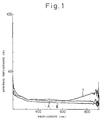
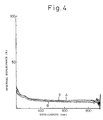
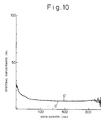
- Figures 1 through 12 are spectral reflectance spectra in the region of 190 nm to 900 nm, as determined by a spectrophotometer using an integrating sphere (Model Ubest-50 supplied by Nippon Bunko Kogyo).
- A shows the reflectance spectrum of black iron oxide (Mapico Black BL-100 supplied by Titanium Kogyo) as the conventional black coloring material and B shows the reflectance spectrum of carbon black (Carbon Black Special 6 supplied by Degussa), and other numbered reflectance spectra are reflectance spectra of black coloring materials, black fibers and modified black iron oxide obtained in the respective examples; the respective spectrum numbers corresponding to the example numbers.
- black iron oxide Mapico Black BL-100 supplied by Titanium Kogyo
- B shows the reflectance spectrum of carbon black (Carbon Black Special 6 supplied by Degussa)
- other numbered reflectance spectra are reflectance spectra of black coloring materials, black fibers and modified black iron oxide obtained in the respective examples; the respective spectrum numbers corresponding to the example numbers.
- chitosan having a chemical structure comprising ⁇ -(1,4)-bonded D-glucosamine units is treated with the dyestuff of the lithospermum root, surprisingly, chitosan is dyed a black color even though the dyestuff of the lithospermum root, which is considered to show a purple color, is used.
- the dyestuff of the lithospermum root used in the present invention, there can be used any of a dyestuff extract obtained by extraction of a root of the gromwell (the lithospermum root), shikonin obtained by the cell culture of the gromwell and synthetic shikonin.
- the compound of general formula (1) in which R is a hydrogen atom is shikonin, and in other shikonin compounds of formula (1), -OR forms an ester.
- the dyestuff extract of the lithospermum root used in the present invention is a concentrate obtained, usually by finely crushing a dry root of the gromwell, charging the crushed root in a cylindrical vessel, adding an extraction solvent thereto in an amount such that the crushed root is completely immersed in the extraction solvent, allowing the immersed crushed root to stand for 2 to 5 days, filtering the extraction solution to remove the gromwell root, and concentrating the filtrate to remove the solvent used for the extraction of the dyestuff by evaporation.
- the extraction solvent used for the extraction of the dyestuff of the lithospermum root there can be mentioned ordinary organic solvents such as methyl alcohol, ethyl alcohol, propyl alcohol, isopropyl alcohol, butyl alcohol, ethylene glycol, propylene glycol, dimethyl ether, diethyl ether, isopropyl ether, dioxane, acetone, methyl isobutyl ketone, methyl ethyl ketone, ethyl acetate, dichloromethane, chloroform, carbon tetrachloride, trichloroethylene, perchloroethylene, benzene, and toluene.
- ordinary organic solvents such as methyl alcohol, ethyl alcohol, propyl alcohol, isopropyl alcohol, butyl alcohol, ethylene glycol, propylene glycol, dimethyl ether, diethyl ether, isopropyl ether, dioxane, acetone,
- a dyestuff extract of the lithospermum root is obtained from a dry root of the gromwell in an amount of about 4 to about 5% (W/W %).
- This dyestuff extract of the lithospermum root contains a dyestuff comprising shikonin and shikonin compounds such as isobutylshikonin, ⁇ , ⁇ -dimethylacrylshikonin, acetylshikonin, teracrylshikonin and ⁇ -hydroxyisovalerylshikonin.
- the dyestuff extract includes impurities such as water-soluble fatty acids and valeric acid, and these impurities emit a smell characteristic of the lithospermum root.
- the extraction temperature and extraction time are preferably adjusted to room temperature and about 2 to about 3 days, respectively.
- a dyestuff of the lithospermum root obtained by further purifying the obtained dyestuff extract of the lithospermum root is preferably used.
- An organic solvent having a relatively low polarity and a boiling point not higher than 50°C/10 to 30 mmHg under a reduced pressure at the time of the concentration is preferably used as the elutant for the purification by the silica gel chromatography, because some shikonin compounds are not stable against heat.
- chlorinated hydrocarbons such as dichloromethane, chloroform, carbon tetrachloride, trichloroethylene and perchloroethylene, and aromatic hydrocarbons such as toluene and benzene, are preferably used.
- the intended blackening of chitosans can be accomplished even if the degree of deacetylation is relatively low, and if a chitosan having a high degree of deacetylation and this purified pigment are used, an intended product having a low lightness and a high blackness can be obtained.
- Shikonin obtained by the cell culture of the gromwell is manufactured by selecting a strain having a high shikonin productivity from a protoplast obtained by an enzyme treatment of a callus (indeterminate cell aggregate) formed from a cut end of the gromwell and subjecting the strain to a two-stage culturing using a cell-propagating culture medium of the first stage and a shikonin-producing culture medium of the second stage. Shikonin produced by this cell culture has already been commercially manufactured.
- Synthetic shikonin is synthesized by using dihydronaphthalene or 2-formyl-1,4,5,8-tetramethoxynaphthalene as the starting material.
- the chitosan comprising ⁇ -(1,4)-bonded D-glucosamine units which is used in the present invention, is formed by deacetylating chitin, which is obtained by removing mineral components such as calcium carbonate and proteins from a shell cuticle of a crustacean present widely available in nature, such as a crab or a lobster, with an alkali such as sodium hydroxide.
- the chitin obtained by removing mineral components and proteins from a shell cuticle of a crustacean is a polysaccharide having a long linear structure comprising many ⁇ -(1,4)-bonded N-acetyl-D-glucosamine residues represented by the following general formula (2):
- the chitosan, used in the present invention is a water-insoluble polymer (polysaccharide) having a long linear structure, resembling that of cellulose, which comprises many ⁇ -(1,4)-bonded D-glucosamine units as represented by the following general formula (3), where the acetamide-group portion bonded at the 2-position of the chitin represented by the above general formula (2) is converted to an amino group by the deacetylation:
- the molecular weight of the chitosan depends on the treatment conditions for separating chitin by removing mineral components and proteins from a shell cuticle of a crustacean and the degree of the cleavage of glycoside bonds among the molecules by
- the usual chitosan is not a completely deacetylated product but contains a certain degree of acetyl groups.
- the chitosan used in the present invention may be either a chitosan in which the acetamide group portion bonded to the 2-position of chitin is deacetylated as represented by general formula (3), or a partially deacetylated chitosan in which an N-acetyl-D-glucosamine residue, as represented by general formula (2), is partially and randomly left in the molecule according to the degree of deacetylation of chitin.
- a high degree of deacetylation is preferable, and a chitosan deacetylated to a degree of almost 90% is especially preferably used. If the present invention is carried out by using a chitosan having a high degree of deacetylation, a low-lightness black coloring material or black fiber and modified black iron oxide, which can absorb rays of the entire visible region (380 to 780 nm), can be obtained.
- a black coloring material is prepared by treating a chitosan with the dyestuff of the lithospermum root according to the present invention
- a water-insoluble chitosan is used as the chitosan
- a finely divided black coloring material can be obtained
- a gelatinous chitosan salt is used as the chitosan
- a gelatinous black coloring material can be prepared.
- a water-soluble chitosan, a chitosan oligosaccharide, or D-glucosamine or an inorganic acid or organic acid salt thereof is used a liquid black coloring material is obtained.
- the gelatinous chitosan salt is prepared by dissolving the above-mentioned water-insoluble chitosan in a dilute aqueous solution of an inorganic acid or organic acid.
- an inorganic acid or organic acid there can be used inorganic acids such as hydrochloric acid, nitric acid and phosphoric acid, and organic acids such as formic acid, oxalic acid, acetic acid, propionic acid, lactic acid, malic acid, succinic acid and adipic acid.
- the concentration of the acid is preferably 0.5 to 5% (W/V %).
- the concentration of the water-insoluble chitosan in the dilute aqueous solution of the acid is not critical, as long as the obtained gel has a degree of flowability, but in general, the concentration of the water-insoluble chitosan in the dilute aqueous solution of the acid is preferably 0.5 to 3% (W/V %).
- the water-soluble chitosan can be obtained by reducing the molecular weight of the water-insoluble chitosan by the hydrolysis or enzyme decomposition, and a water-soluble chitosan having a molecular weight of 200 to 10,000 is generally used.
- a water-soluble chitosan oligosaccharide there can be mentioned those having a chitosan polymerization degree of 2 to 8 [n in the above-mentioned general formula (3) is from 0 to 6], such as chitobiose, chitotriose, chitotetraose, chitopentaose, chitohexaose, chitoheptaose and chitooctaose.
- D-Glucosamine can be obtained by completely hydrolyzing a chitin with concentrated hydrochloric acid or the like.
- These water-soluble chitosan, chitosan oligosaccharide and D-glucosamine can be in the form of inorganic acid or organic acid salts.
- the preparation of a finely divided black coloring material by the treatment of the water-insoluble chitosan with the dyestuff of the lithospermum root is generally accomplished by dispersing a powdery water-insoluble chitosan with stirring in a dyeing bath prepared by adding a solution of the dyestuff of the lithospermum root in an organic solvent to a water bath and heating the mixture.
- the dyeing bath is preferably alkaline, and if the dyeing bath is acidic, the water-insoluble chitosan is dissolved.
- the dyeing bath is weakly acidic and has a pH value of about 4 to about 5, but since the chitosan has a buffering action based on the free amino group, when the water-insoluble chitosan is incorporated into the dyeing bath, the pH value is conveniently shifted to the alkaline side, i.e., to a level of 6 to 8. Accordingly, the chitosan can be dyed in the water-insoluble state even without adjusting the pH value by adding an alkaline aqueous solution.
- the water-insoluble chitosan is blackened.
- An intended finely divided black coloring material can be obtained by recovering the blackened chitosan by filtration, drying the recovered chitosan, and pulverizing the dried chitosan by a wet pulverizer or the like, and even if the obtained black coloring material is finely pulverized, a whitening or increase of the lightness does not occur, and an excellent fastness is manifested.
- the formation of a gelatinous black coloring material by the treatment of a chitosan salt with the dyestuff of the lithospermum root is generally accomplished by adding a solution of the dyestuff of the lithospermum root in an organic solvent to a water bath, adding a gelatinous chitosan salt in the thus-formed dyeing bath under heating and stirring the dyeing bath containing the gelatinous chitosan salt dissolved therein.
- a process can be adopted in which an inorganic acid or organic acid is diluted with water, a predetermined amount of the water-insoluble chitosan is dissolved in this dilution to form a gelatinous chitosan salt, a solution of the dyestuff of the lithospermum root in an organic solvent is added to the above solution, and the formed dyeing bath is heated with stirring.
- the dyeing bath formed by adding the solution of the dyestuff of the lithospermum root in the organic solvent to the water bath is 4 to 5
- the pH value of the gelatinous chitosan salt to be added to this dyeing bath is 4 to 5
- the dyeing is carried out at a dyeing bath pH value of 4 to 5.
- the solution of the gelatinous chitosan salt in the dyeing bath is blackened, and the obtained blackened solution is concentrated by removing the solvent under a reduced pressure until a desired viscosity is attained, whereby an intended gelatinous black coloring material can be obtained.
- the thus-obtained gelatinous black coloring material can be used for (a) preparing a black coloring material by placing the obtained gelatinous black coloring material in contact with an aqueous solution of an alkali, (b) preparing a polymer-based black coloring material by treating a finely divided polymeric substance with the obtained gelatinous black coloring material, (c) dyeing a fiber, and (d) modifying black iron oxide.
- the preparation of a liquid black coloring material by the treatment of the water-soluble chitosan, chitosan oligosaccharide, D-glucosamine or an inorganic or organic acid salt thereof with the dyestuff of the lithospermum root is generally accomplished by incorporating and dissolving the water-soluble chitosan, chitosan oligosaccharide, D-glucosamine or an inorganic or organic acid salt thereof in a dyeing bath formed by adding a solution of the dyestuff of the lithospermum root in an organic solvent to a water bath, heating the mixture, and stirring the dyeing bath.
- a process can be adopted in which the water-soluble chitosan, chitosan oligosaccharide, D-glucosamine or an inorganic or organic acid salt thereof is dissolved in water, a solution of the dyestuff of the lithospermum root in an organic solvent is added to the thus-prepared aqueous solution, and the mixture is heated and stirred.
- the dyeing bath has a pH value of about 7 and is neutral, and when an inorganic acid or organic acid salt thereof is used, the pH value of the dyeing bath is 4 to 5 and the dyeing is carried out in a weakly acidic condition.
- the solution in the dyeing bath is blackened.
- the obtained black solution is directly used as the intended liquid black coloring material, or the obtained black solution is concentrated to a desired concentration by removing the solvent under a reduced pressure, whereby an intended liquid black coloring material is prepared.
- the obtained liquid black coloring material can be directly used for (a) preparing a polymer-based black coloring material by treating a finely divided polymeric substance with the liquid black coloring material, (b) dyeing a fiber, and (c) modifying black iron oxide.
- the obtained extract solution can be directly used without concentrating the extract solution.
- the organic solvent for dissolving the dyestuff extract (concentrate) of the lithospermum root or the shikonin obtained by the cell culture of the lithospermum root there can be preferably used the same organic solvents as mentioned above with respect to the extraction of the lithospermum root dyestuff from the root of the gromwell.
- an organic solvent immiscible with water a heterogeneous solvent system comprising a layer of the used organic solvent and a layer of water is formed, but no problem arises due to the formation of such a heterogeneous solvent system.
- the prepared dyeing bath is a mixed solvent comprising water and the organic solvent used for dissolving the dyestuff of the lithospermum root, and the mixing ratio between water and the organic solvent can be freely selected.
- the amount of the solvent in the dyeing bath comprising the mixture of water and the organic solvent is preferably such that the ratio of the volume of the solvent to the weight of the chitosan is 5 to 30.
- the amount of the lithospermum root dyestuff depends on the deacetylation degree of the chitosan and the kind of the lithospermum root dyestuff.
- the lithospermum root extract concentrate
- the extract is used in an amount of at least 10% (W/W %), preferably at least 20% (W/W %), based on the weight of the chitosan to be dyed.
- the purified dyestuff or shikonin is used in an amount of at least 3% (W/W %), preferably at least 10% (W/W %), based on the weight of the chitosan. Nevertheless, even if the amount of the lithospermum root dyestuff used is small and below the above-mentioned range, by repeating the dyeing operation, a black coloring material having a low lightness can be obtained.
- the dyeing can be carried out at room temperature, but in this case, a along time is required for blackening the chitosan. Accordingly, the dyeing is accomplished by maintaining the dyeing bath at a temperature of 60 to 90°C for 30 minutes to 2 hours.
- the dyeing also can be accomplished by using a dyeing apparatus equipped with a cooling tube or the like while refluxing the solvent, or by using an open system dyeing bath while diffusing the solvent to the outside.
- black coloring materials different in form such as finely divided, gelatinous and liquid coloring materials
- chitosans differing in molecular weight or salts thereof and lithospermum root dyestuff black coloring materials having a very low lightness are obtained by using a chitosan having a high degree of deacetylation, preferably a degree of deacetylation of at least 90%, and a purified lithospermum root dyestuff.
- Another finely divided black coloring material can be prepared by bringing the thus-obtained gelatinous black coloring material in contact with an aqueous solution of an alkali. More specifically, the thus obtained gelatinous black coloring material is added dropwise in an aqueous alkali solution with strong stirring, whereby a powdery black solid is precipitated.
- the precipitated black solid can be easily recovered by filtration, and an intended black coloring material can be obtained by drying and pulverizing the recovered black solid.
- An aqueous solution of sodium hydroxide, potassium hydroxide or sodium carbonate having a concentration of 5 to 20% is used as the aqueous alkali solution.
- the temperature at which the gelatinous black coloring material is brought into contact with the aqueous alkali solution is not particularly critical, but a temperature of 30 to 50°C is preferably adopted.
- the gelatinous black coloring material is added dropwise with a mechanical strong stirring.
- Still another finely divided black coloring material can be prepared by forming a black film from the gelatinous black coloring material obtained in the above-mentioned manner and pulverizing this film.
- the finely divided black coloring material can be obtained by dyeing a gelatinous chitosan salt with shikonin at a predetermined temperature for a predetermined time, and the gelatinous chitosan salt in the blackened dyeing bath is coated on a smooth flat surface, for example, a glass surface, either directly or after concentration and subsequent dilution with an organic acid, drying the coated, surface, and pulverizing the formed film.
- the gelatinous chitosan salt used is preferably a salt of an organic acid.
- An optimum salt is an acetate.
- the obtained powdery black coloring material has substantially no smell and the peculiar smell characteristic of the lithospermum root extract is not encountered at all. Accordingly, the obtained powdery black coloring material is especially preferably used when the smell characteristic of the lithospermum root is repugnant.
- a powdery polymer-based black coloring material can be obtained by dyeing a powdery natural or synthetic polymer with the gelatinous or liquid black coloring material prepared in the above-mentioned manner.
- a black fiber can be obtained by dyeing a natural or artificial fiber with the gelatinous or liquid black coloring material.
- a polymer-based black coloring material or black fiber can be obtained by immersing a finely divided polymer or fiber in a water bath comprising a gelatinous chitosan salt, water-soluble chitosan, chitosan oligosaccharide or D-glucosamine or an inorganic acid or organic acid salt thereof dissolved therein, adding a solution of the lithospermum root dyestuff in an organic solvent into the water bath, and maintaining the dyeing bath at a temperature of 60 to 90°C for 30 minutes to 1 hour.
- a process in which, at the first step, a powdery polymer or fiber to be dyed is immersed in a water bath comprising, dissolved therein, a gelatinous chitosan salt, water-soluble chitosan, chitosan oligosaccharide or D-glucosamine or an inorganic acid or organic acid salt thereof, the water bath is boiled for 10 to 30 minutes and the material to be dyed is taken out, naturally cooled and dried, and at the second step, a solution of.the lithospermum root dyestuff in an organic solvent is added to the water bath, the formed dyeing bath is heated, the material treated at the first step is immersed in the dyeing bath, and the dyeing bath is maintained at a temperature of 60 to 90°C for 30 minutes to 1 hour.
- the dyeing of the powdery polymeric substance is accomplished by stirring the dyeing bath so that the powder is dispersed in the dyeing bath, and the dyeing of the fiber is accomplished by gently stirring the dyeing bath. If the dyeing is carried out at a predetermined temperature for a predetermined time, the powder or fiber in the dyeing bath is colored black, and an intended finely divided black coloring material or black fiber is obtained by taking out the dyed material, washing it with warm water, and drying it with air.
- powders having a size of several microns to scores of microns for example, powders of natural polymers such as cellulose powder and silk powder (silk protein or fibroin) and powders of synthetic polymers such as nylon 6 powder, nylon 12 powder, finely divided polyethylene, finely divided crosslinked polyester, finely divided polypropylene and finely divided crosslinked polystyrene.
- natural polymers such as cellulose powder and silk powder (silk protein or fibroin)
- synthetic polymers such as nylon 6 powder, nylon 12 powder, finely divided polyethylene, finely divided crosslinked polyester, finely divided polypropylene and finely divided crosslinked polystyrene.
- natural fibers such as fibers of cellulose, silk and wool, and artificial fibers of nylon 6, nylon 66, nylon 610, polyester, acrylic polymer, Vinylon, polyethylene, polypropylene, vinylidene polymer, polyurethane, polykural, rayon, polynodik, cupra, acetate, and triacetate.
- the shape of the fiber can be any of a staple, yarn, filament, woven fabric, knitted fabric, and nonwoven fabric.
- the amount of the gelatinous chitosan salt, water-soluble chitosan, chitosan oligosaccharide or D-glucosamine or the inorganic acid or organic acid salt thereof is at least 10% (W/W %), preferably at least 20% (W/W %), based on the powdery polymeric substance or fiber.
- the amount of the gelatinous chitosan salt is calculated from the water-soluble chitosan dissolved in the dilute aqueous solution of the acid for the formation of the gelatinous chitosan salt.
- the amount of the lithospermum root dyestuff is the same as the amount of the lithospermum root dyestuff used for the chitosan for obtaining the above-mentioned gelatinous or liquid black coloring material.
- the pH value of the dyeing bath is neutral value of about 7 when the water-soluble chitosan, chitosan oligosaccharide or D-glucosamine is used, and the dyeing is carried out at a weakly acidic pH value of 4 to 5 when the inorganic acid or organic acid salt of the water-soluble chitosan, chitosan oligosaccharide or D-glucosamine is used.
- the present invention is suitable for black-dyeing wool, silk and nylon having amino groups (-NH2) and carboxyl groups (-COOH) at the ends of the molecule structure and acid amid bonds (-CONH-) in the molecule structure, and a finely divided black coloring material or black fiber having an excellent washing fastness and light fastness can be obtained.
- Black iron oxide can be modified by sticking the gelatinous or liquid black coloring material prepared in the above-mentioned manner to the surface of black iron oxide. More specifically, finely divided black iron oxide is immersed in a water bath formed by dissolving and dispersing a gelatinous chitosan salt, water-soluble chitosan, chitosan oligosaccharide or D-glucosamine or an inorganic acid or organic acid salt thereof in water and a solution of the lithospermum root dyestuff in an organic solvent is added to the water bath, whereby black iron oxide is modified.
- This modification can be carried out in the same manner as described above except that black iron oxide is used instead of the powdery polymer or fiber.
- blackness of black iron oxide in which a satisfactory lightness (blackness) cannot be obtained according to the conventional technique, can be increased and the black iron oxide can be modified to a black coloring material having a required black color. Furthermore, it is expected that new functions will be attained by the modification of black iron oxide, which is a magnetic material, with a chitosan having an affinity with a living body.
- At least one water-soluble salt selected from sodium salts, potassium salts, magnesium salts, calcium salts, barium salts, zirconium salts, iron salts, nickel salts, aluminum salts and silicates is used as the water-soluble metal salt.
- the water-soluble metal salt there can be mentioned sodium chloride, sodium carbonate, sodium hydroxide, sodium laurate, sodium citrate, sodium metasilicate, sodium metaphosphate, sodium tripolyphosphate, potassium chloride, potassium carbonate, potassium hydroxide, magnesium phosphate, magnesium silicate, calcium chloride, calcium acetate, calcium citrate, calcium propionate, calcium silicate, barium chloride, zirconium chloride, ferrous sulfate, nickel sulfate, ammonium hexafluorosilicate, aluminum chloride, aluminum acetate and aluminum hydroxide.
- the water-soluble metal salt is used in the state dissolved in the dyeing bath in an amount of 1 to 2% (W/W %), preferably 3 to 5% (W/W %), based on the chitosan (including D-glucosamine) differing in the molecular weight, which is used according to the intended object.
- the dyeing bath becomes acidic in the case of a certain kind of the water-soluble metal salt, and in this case, when a water-insoluble chitosan is used, sometimes the water-soluble chitosan is dissolved to form a gel.
- a novel finely divided black coloring material can be obtained by treating the gel directly with the lithospermum root dyestuff and bringing the obtained black gelatinous material into contact with an aqueous alkali solution, or forming a black film of the obtained black gelatinous material and pulverizing the film.
- the treatment is carried out in the presence of a water-soluble metal salt in the above-mentioned manner, even when a chitosan having a low degree of deacetylation is used, a deep neat black color capable of absorbing rays of the entire visible region (380 to 780 nm) is obtained, and a black coloring material, black fiber or modified black iron oxide having a low lightness comparable to that of carbon black can be obtained.
- Each of the decomposition temperatures shown in the examples is determined by a differential scanning calorimeter (Model DSC-300 supplied by Seiko Instruments Inc.).
- the diffusion reflectance spectrum of each of the samples obtained in the examples is determined by a visible-ultraviolet spectrophotometer using an integrating sphere (Model Ubest 50 supplied by Nippon Bunko Kogyo).
- the lithospermum root dyestuff obtained by the solvent extraction of a root of the gromwell was prepared in the following manner.
- a stainless steel lidded cylindrical vessel having an inner volume of 20 l was charged with 1 kg of a finely divided dry gromwell root according to the pharmacopeia (gromwell root produced in China; crude drug), 5 l of ethyl alcohol having a purity of 99.5% was added as the extraction solvent, and the mixture was allowed to stand at room temperature for 3 days without sealing the vessel. Then the mixture was filtered to obtain 4,410 ml of an ethyl alcohol extract solution having a dense reddish violet color.
- the content of the lithospermum root dyestuff extract in the ethyl alcohol extract solution was 1.07% (W/V %), and the amount of the lithospermum dyestuff extract obtained from the used dry lithospermum root (gromwell root) was 4.70% (W/W %).
- the extraction of the lithospermum root dyestuff was carried out in the same manner as described in Extract Solution Example 1 except that n-butyl alcohol was used instead of ethyl alcohol. Then, 4.78 g of a lithospermum root dyestuff extract (concentrate) was obtained from 500 ml of the obtained n-butyl alcohol extraction solution.
- the content of the lithospermum dyestuff extract in the n-butyl alcohol extraction solution was 0.95% (W/V %), and the amount of the lithospermum root dyestuff extract obtained from the used dry lithospermum root was 4.56% (W/W %).
- a column fabricated by wet-filling 200 g of a silica gel (Kieselgel 60 supplied by Merk; 70 to 230 mesh) into a glass column having a diameter of 45 mm and a length of 750 mm was charged with 20 g of a lithospermum root dyestuff extract (concentrate) in the form of a dense reddish violet syrup obtained in the same manner as described in Extract Solution Preparation Example 1, and a development was carried out by using chloroform as the eluent. Fractions of eluates having a red color were combined and the mixture was concentrated under a reduced pressure to obtain 7.2 g of a dark red syrup.
- the deacetylation degree of the chitosan used in the present invention is measured according to the IR spectrum method and the colloid titration method.
- the deacetylation degree of the chitosan used as the sample was 78.1%: wherein V represents the titration value (ml) of 1/400 N polyvinyl potassium sulfate and f represents the titer of 1/400 N polyvinyl potassium sulfate.
- a chitosan having a high deacetylation degree can be prepared by further deacetylating a usually available chitosan.
- An example of the deacetylation process will now be described below.
- a chitosan can be prepared from chitin according to the process described below.
- the deacetylation degree of the highly deacetylated chitosan obtained by carrying out the deacetylation two times was measured, and it was found that the deacetylation degree of the highly deacetylated chitosan was 98.1%.
- the deacetylation degree of the chitosan Chotosan PSL supplied by Yaizu Suisankagaku Ind. Co., Ltd.
- the deacetylation degree of the chitosan was 78.1%.
- a three-neck round-bottom flask equipped with a reflux condenser, a thermometer and a stirrer and having a capacity of 500 ml was charged with 200 ml of water, and a solution of 2 g of a lithospermum dyestuff extract prepared in the same manner as described in Extract Solution Preparation Example 1 in 200 ml of ethyl alcohol was added into the flask to form a dyeing bath.
- the pH value of the dyeing bath was 4.6.
- the pH value of the dyeing bath was 6.9.
- the spectral reflectance spectrum of the obtained black coloring material is shown in Fig. 1. Although a reflection of higher than 10% was observed in a long wavelength region of 650 nm or more, this reflection was greatly reduced by repeating the dyeing several times.
- the obtained black coloring material had a black color with a low lightness.
- the spectrum reflectance spectrum of the obtained black coloring material is shown in Fig. 2. It was confirmed that at least 90% of rays in the entire visible region (380 nm to 780 nm) were absorbed.
- the obtained black coloring material had no smell and showed a black color of a low lightness.
- the spectral reflectance spectrum of the obtained black coloring material is shown in Fig. 3. It was confirmed that at least 90% of rays in the entire visible region (380 to 780 nm) were absorbed.
- the obtained black coloring material showed a black color of a low lightness, and when the spectral reflectance was measured, it was confirmed that about 90% of rays in the entire visible region (380 nm to 780 nm) were absorbed.
- the obtained black coloring material showed a black color having a low lightness, and when the spectral reflectance was measured, it was confirmed that about 90% of rays in the entire visible region (380 nm to 780 nm) were observed.
- the obtained black coloring material showed a deep neat black color.
- the spectral reflectance spectrum of the obtained black coloring material is shown in Fig. 4. It was confirmed that at least 92% of rays in the entire visible region (380 nm to 780 nm) were absorbed.
- the obtained black coloring material showed a deep neat black color.
- the spectral reflectance spectrum of the obtained black coloring material is shown in Fig. 5. It was confirmed that at least 90% of rays in the entire visible region (380 nm to 780 nm) were absorbed.
- the obtained black coloring material showed a deep neat black color.
- the spectral reflectance was measured, it was confirmed that at least 90% of rays in the entire visible region (380 to 780 nm) were absorbed.
- the obtained black coloring material showed a deep neat black color.
- the spectral reflectance was measured, it was confirmed that at least about 90% of rays in the entire visible region (380 to 780 nm) were absorbed.
- the obtained black coloring material showed a deep neat black color.
- the spectral reflectance was measured, it was confirmed that at least about 90% of rays in the entire visible region (380 to 780 nm) were absorbed.
- the obtained black coloring material showed a deep black color.
- the spectral reflectance spectrum of the obtained black coloring material is shown in Fig. 6. It was confirmed that at least 90% of rays in the entire visible region (380 to 780 nm) were absorbed.
- the obtained black coloring material had a deep black color.
- the spectral reflectance was measured, it was found that at least about 90% of rays in the entire visible region (380 nm to 780 nm) were absorbed.
- the obtained black coloring material showed a black color.
- the spectral reflectance was measured, it was confirmed that about 90% of rays in the entire visible region (380 nm to 780 nm) were absorbed.
- Example 11 The procedures of Example 11 were repeated in the same manner except that finely divided polypropylene was used instead of the nylon 12 powder used in Example 11, whereby 11.2 g of a finely divided black coloring material was obtained.
- the obtained black coloring material showed a black color.
- the spectral reflectance was measured, it was confirmed that about 90% of rays in the entire visible region (380 nm to 780 nm) were absorbed.
- the obtained black coloring material showed a black color.
- the spectral reflectance was measured, it was confirmed that about 90% of rays in the entire visible region (380 nm to 780 nm) were absorbed.
- silk powder silk protein
- KNEBO SILK POWDER H supplied by Kanebo Kenshi Kyobijin; average particle diameter 6 to 7 ⁇ m
- the obtained black coloring material showed a black color.
- a reflection exceeding 10% was observed in a long wavelength region of 600 nm or more, but this reflection was reduced by repeating the dyeing several times.
- Example 11 The procedures of Example 11 were repeated in the same manner except that a cellulose powder (Avicel PH-M06 supplied by Asahi Chemical Industries Co.) was used instead of the nylon 12 powder used in Example 11, whereby 11.6 g of a finely divided black coloring material was obtained.
- a cellulose powder (Avicel PH-M06 supplied by Asahi Chemical Industries Co.) was used instead of the nylon 12 powder used in Example 11, whereby 11.6 g of a finely divided black coloring material was obtained.
- the obtained black coloring material showed a black color.
- the spectral reflectance was measured, it was confirmed that about 90% of rays in the entire visible region (380 nm to 780 nm) were absorbed.
- the obtained black fiber was evenly dyed black and had an excellent light fastness.
- the spectral reflectance spectrum of the obtained black fiber is shown in Fig. 7. It was confirmed that at least 90% of rays in the entire visible region (380 nm to 780 nm) were absorbed.
- a water-soluble chitosan prepared by the enzyme decomposition
- the obtained black coloring material showed a dense black color.
- the spectral reflectance spectrum of the obtained black coloring material is shown in Fig. 8. It was confirmed that at least 92% of rays in the entire visible region (380 nm to 780 nm) were absorbed.
- the thus modified black iron oxide had a blackness increased over the blackness before the treatment.
- the spectral reflectance spectra of the black iron oxide before and after the treatment are shown in Figs. 9-A and 9-C, respectively. It was confirmed that at least about 95% of rays in the entire visible region (380 nm to 780 nm) were absorbed and the black iron oxide had a black color with a lower lightness than that of the black color of carbon black.
- the black coloring material of the present invention prepared in the same manner as described in Example 2, was placed in a quartz Petri dish and exposed to direct rays of the sun for about 10 months from October 24, 1988 to August 23, 1989.
- spectral reflectance spectra before and after the light exposure are shown in Figs. 10-D and 10-D', respectively. It was confirmed that both of the spectra were in complete agreement with each other, no color fading occurred and the black coloring material of the present invention had an excellent sun light fastness.
- the black coloring material of the present invention prepared in the same manner as described in Example 2, was pulverized by using a paint shaker (wet pulverization), and the spectral reflectance spectra before and after the pulverization to 61 ⁇ m were determined, which are shown in Figs. 11-E and 11-E', respectively. It was confirmed that no whitening was caused at all by fine pulverization in the black coloring material of the present invention.
- a mascara was produced according to the following recipe: (1) Propylene glycol 3 parts by weight (2) Polyvinyl alcohol 2 parts by weight (3) Colloidal hydrous magnesium aluminosilicate 1 part by weight (4) Black coloring material of present invention prepared in Example 2 15 parts by weight (5) Titanium oxide 2 parts by weight (6) Triethanolamine 2 parts by weight (7) Stearic acid 3 parts by weight (8) Bleached bees wax 7 parts by weight (9) Cetyl alcohol 3 parts by weight (10) Carnauba wax 2 parts by weight
- components (1) through (3) were added to 60 parts by weight of purified water and dissolved therein by heating at 80°C, and components (4) through (6) were homogeneously dispersed in the solution and components (7) through (10) were then emulsified therein. Then, the emulsion was uniformly mixed, cooled to room temperature, and filled in a container to obtain a mascara product.
- an antiseptic agent such as butyl p-hydroxybenzoate or methyl p-hydroxybenzoate can be added to the above-mentioned mascara product according to need.
- a partial hair dye was prepared according to the following recipe: (1) Propylene glycol 6 parts by weight (2) Polyvinyl alcohol 2 parts by weight (3) Colloidal hydrous magnesium aluminosilicate 1 part by weight (4) Black coloring material of present invention prepared in Example 2 25 parts by weight (5) Titanium oxide 4 parts by weight (6) Triethanolamine 1.5 parts by weight (7) Potassium hydroxide 0.2 part by weight (8) Stearic acid 3 parts by weight (9) Bleached bees wax 7 parts by weight (10) Cetyl alcohol 3 parts by weight (11) Carnauba wax 2 parts by weight
- components (1) through (3) were dissolved in 25 parts by weight of purified water under heating at 80°C, and components (4) through (7) were uniformly dispersed in the solution and components (8) through (11) were emulsified in the dispersion.
- the emulsion was uniformly mixed and cooled to room temperature, and the cooled mixture was packed into a container to obtain a partial hair dye product.
- An appropriate amount of an antiseptic agent such as butyl p-hydroxybenzoate or methyl p-hydroxybenzoate can be added to the above product according to need.
- the obtained black urethane film was elastic.
- the spectral reflectance spectrum of this black urethane film is shown in Fig. 12-F. It was confirmed that about 95% of rays in the entire visible region (380 nm to 780 nm) were absorbed and the film had a blackness having a lightness lower than that of the blackness of carbon black.
- the black coloring material coated in (1) of Production Example 3 was added to the urethane prepolymer, and the mixture was thoroughly stirred. Then, the mixture was poured into a glass Petri dish and allowed to stand at room temperature half a day, and the mixture was peeled from the dish to obtain a disk-shaped black elastomer having a thickness of about 2 mm.
- each of the mascara and partial hair dye had an excellent adhesion, impression, durability and finish, showed no irritation of the skin and had a black color which did not provide an incompatible feeling, and that each was an excellent makeup cosmetic heretofore unknown.
- the black film-forming urethane material prepared by using the black coloring material of the present invention was a heretofore unknown film-forming material showing a black color having a lightness lower than that of the black color of carbon black.
- finely divided, gelatinous and liquid black coloring materials having a very low lightness comparable to that of carbon black can be obtained by treating chitosans differing in the molecular weight, including D-glucosamine, and salts thereof with a dyestuff of the lithospermum root.
- a powdery polymeric substance is treated with the black coloring material, a finely divided polymer-based black coloring material is obtained, and if a fiber is treated with the black coloring material of the present invention by a simple dip dyeing method, a black fiber having a low lightness is obtained.
- the black coloring material of the present invention can be used in the fields where the conventional black coloring materials are used, and furthermore, since new functions are given to the black coloring material of the present invention, it is expected that the black coloring material will be used in other fields where the conventional black coloring materials have not been used.
Landscapes
- Chemical & Material Sciences (AREA)
- Organic Chemistry (AREA)
- Chemical Kinetics & Catalysis (AREA)
- Coloring (AREA)
- Cosmetics (AREA)
- Polysaccharides And Polysaccharide Derivatives (AREA)
- Compositions Of Macromolecular Compounds (AREA)
- Inks, Pencil-Leads, Or Crayons (AREA)
- Treatments For Attaching Organic Compounds To Fibrous Goods (AREA)
- Dental Preparations (AREA)
- Pigments, Carbon Blacks, Or Wood Stains (AREA)
Claims (13)
- Ein Verfahren zur Herstellung eines schwarzfärbenden Materials, das die Behandlung eines Chitosans mit einem Farbstoff der Lithospermumwurzel umfaßt.
- Ein Verfahren zur Herstellung eines schwarzfärbenden Materials nach Anspruch 1, wobei ein wasserunlösliches Chitosan als Chitosan verwendet wird, um ein feinverteiltes schwarzfärbendes Material zu erhalten.
- Ein Verfahren zur Herstellung eines schwarzfärbenden Materials nach Anspruch 1, wobei ein gelatinöses Chitosansalz als das Chitosan verwendet wird, um ein gelatinöses schwarzfärbendes Material zu erhalten.
- Ein Verfahren zur Herstellung eines schwarzfärbenden Materials nach Anspruch 1, wobei ein wasserlösliches Chitosan, Chitosanoligosaccharid oder D-Glukosamin oder ein Salz davon mit einer anorganischen oder organischen Säure als das Chitosan verwendet wird, um ein flüssiges schwarzfärbendes Material zu erhalten.
- Ein Verfahren zur Herstellung eines schwarzfärbenden Materials nach Anspruch 1, wobei die Behandlung in Gegenwart eines wasserlöslichen Natriumsalzes, Kaliumsalzes oder Magnesiumsalzes, Calciumsalzes, Bariumsalzes, Zirkoniumsalzes, Eisensalzes, Nickelsalzes, Aluminiumsalzes oder Silikates durchgeführt wird.
- Ein Verfahren zur Herstellung eines feinverteilten schwarzfärbenden Materials, das das In-Kontakt-bringen eines gelatinösen schwarzfärbenden Materials, das durch den in Anspruch 3 beanspruchten Prozess erhalten wird, mit einer wäßrigen Lösung eines Alkalimetalls umfaßt.
- Ein Verfahren zur Herstellung eines feinverteilten schwarzfärbenden Materials, das das Bilden eines schwarzen Filmes eines gelatinösen schwarzfärbenden Materials, das durch das in Anspruch 3 beanspruchte Verfahren hergestellt wurde, und Pulverisieren des so gebildeten Filmes umfaßt.
- Ein Verfahren zur Herstellung eines feinverteilten schwarzfärbenden Materials, das das Färben einer feinverteilten natürlichen oder synthetischen polymeren Substanz mit einem gelatinösen oder flüssigen schwarzfärbenden Material, das durch ein Verfahren wie in Anspruch 3 oder 4 beanspruchtes Verfahren hergestellt wurde, umfaßt.
- Ein Verfahren zur Herstellung eines schwarzfärbenden Materials nach Anspruch 8, wobei das Färben in Gegenwart eines wasserlöslichen Natriumsalzes, Kaliumsalzes oder Magnesiumsalzes, Calciumsalzes, Bariumsalzes, Zirkoniumsalzes, Eisensalzes, Nickelsalzes, Aluminiumsalzes oder Silikates durchgeführt wird.
- Ein Verfahren zum Färben einer Faser, das das Färben einer natürlichen oder künstlichen Faser mit einem gelatinösen oder flüssigen schwarzfärbenden Material, das über ein in Anspruch 3 oder 4 beanspruchtes Verfahren hergestellt wird, umfaßt.
- Ein Färbeverfahren nach Anspruch 10, wobei das Färben in Gegenwart eines wasserlöslichen Natriumsalzes, Kaliumsalzes oder Magnesiumsalzes, Calciumsalzes, Bariumsalzes, Zirkoniumsalzes, Eisensalzes, Nickelsalzes, Aluminiumsalzes oder Silikates durchgeführt wird.
- Ein Verfahren für die Modifikation von schwarzem Eisenoxid, das das Aufbringen eines gelatinösen oder flüssigen schwarzfärbenden Materials, das über ein in Anspruch 3 oder 4 beanspruchtes Verfahren hergestellt wurde, auf die Oberfläche von schwarzem Eisenoxid umfaßt.
- Ein Modifikationsverfahren nach Anspruch 12, wobei das Aufbringen in Gegenwart eines wasserlöslichen Natriumsalzes, Kaliumsalzes oder Magnesiumsalzes, Calciumsalzes, Bariumsalzes, Zirkoniumsalzes, Eisensalzes, Nickelsalzes, Aluminiumsalzes oder Silikates durchgeführt wird.
Applications Claiming Priority (3)
| Application Number | Priority Date | Filing Date | Title |
|---|---|---|---|
| JP334712/88 | 1988-12-29 | ||
| JP33471288 | 1988-12-29 | ||
| PCT/JP1990/000004 WO1990007558A1 (en) | 1988-12-29 | 1990-01-04 | Production of blacking material and application thereof |
Publications (3)
| Publication Number | Publication Date |
|---|---|
| EP0402487A1 EP0402487A1 (de) | 1990-12-19 |
| EP0402487A4 EP0402487A4 (en) | 1991-10-30 |
| EP0402487B1 true EP0402487B1 (de) | 1994-04-06 |
Family
ID=18280373
Family Applications (1)
| Application Number | Title | Priority Date | Filing Date |
|---|---|---|---|
| EP90901660A Expired - Lifetime EP0402487B1 (de) | 1988-12-29 | 1990-01-04 | Verfahren zur herstellung von schwarzmachendem material und dessen verwendung |
Country Status (9)
| Country | Link |
|---|---|
| EP (1) | EP0402487B1 (de) |
| JP (1) | JP2815026B2 (de) |
| KR (1) | KR960000644B1 (de) |
| AT (1) | ATE103955T1 (de) |
| CA (1) | CA2024014C (de) |
| DE (1) | DE69007863T2 (de) |
| DK (2) | DK0402487T3 (de) |
| ES (1) | ES2063338T3 (de) |
| WO (1) | WO1990007558A1 (de) |
Families Citing this family (7)
| Publication number | Priority date | Publication date | Assignee | Title |
|---|---|---|---|---|
| JP3020259B2 (ja) | 1990-07-11 | 2000-03-15 | イハラケミカル工業株式会社 | 黒色着色材の製造方法およびその黒色着色材を含有する化粧料ならびにその応用 |
| FR2788688B1 (fr) * | 1999-01-25 | 2002-12-06 | Merck Sa | Composition cosmetique anhydre essentiellement exempte de liant gras et procede de preparation d'une telle composition |
| KR101186081B1 (ko) | 2004-03-17 | 2012-09-26 | 가부시끼가이샤 하야시바라 세이부쓰 가가꾸 겐꾸조 | 기능성 분체 |
| BRPI0801751B1 (pt) | 2007-05-30 | 2016-03-29 | Oreal | composição cosmética de pigmentos funcionalizados de óxidos de metais e com efeitos de deslocamento de cor e de manuseio |
| EP2067467A3 (de) | 2007-09-14 | 2012-12-12 | L'Oréal | Zusammensetzungen und Verfahren zur Behandlung von Keratinsubstraten |
| CN108949275B (zh) * | 2018-06-25 | 2021-02-02 | 湖州红鑫生物质燃料有限公司 | 一种环保洁净型纯生物质烧烤炭 |
| JP2023124673A (ja) * | 2022-02-25 | 2023-09-06 | 北海道曹達株式会社 | 組成物及び複合体の製造方法 |
Family Cites Families (3)
| Publication number | Priority date | Publication date | Assignee | Title |
|---|---|---|---|---|
| JPS55102659A (en) * | 1979-01-30 | 1980-08-06 | Sanyo Kokusaku Pulp Co Ltd | Deep red coloring composition and its preparation |
| DE3140134A1 (de) * | 1981-10-09 | 1983-04-28 | Wella Ag, 6100 Darmstadt | Saure anionentensid-loesung von chitosan und deren verwendung in kosmetischen mitteln |
| JPS63198903A (ja) * | 1987-02-14 | 1988-08-17 | 大日精化工業株式会社 | 種子用着色剤 |
-
1990
- 1990-01-04 WO PCT/JP1990/000004 patent/WO1990007558A1/ja not_active Ceased
- 1990-01-04 DE DE69007863T patent/DE69007863T2/de not_active Expired - Lifetime
- 1990-01-04 KR KR1019900701925A patent/KR960000644B1/ko not_active Expired - Lifetime
- 1990-01-04 ES ES90901660T patent/ES2063338T3/es not_active Expired - Lifetime
- 1990-01-04 DK DK90901660.2T patent/DK0402487T3/da active
- 1990-01-04 JP JP2000002A patent/JP2815026B2/ja not_active Expired - Lifetime
- 1990-01-04 EP EP90901660A patent/EP0402487B1/de not_active Expired - Lifetime
- 1990-01-04 CA CA002024014A patent/CA2024014C/en not_active Expired - Fee Related
- 1990-01-04 AT AT90901660T patent/ATE103955T1/de not_active IP Right Cessation
- 1990-08-29 DK DK206990A patent/DK206990A/da unknown
Also Published As
| Publication number | Publication date |
|---|---|
| EP0402487A1 (de) | 1990-12-19 |
| WO1990007558A1 (en) | 1990-07-12 |
| KR960000644B1 (ko) | 1996-01-10 |
| CA2024014A1 (en) | 1990-06-30 |
| DK206990D0 (da) | 1990-08-29 |
| EP0402487A4 (en) | 1991-10-30 |
| DK0402487T3 (da) | 1994-07-18 |
| DE69007863T2 (de) | 1994-10-06 |
| JPH03220267A (ja) | 1991-09-27 |
| JP2815026B2 (ja) | 1998-10-27 |
| CA2024014C (en) | 1995-12-05 |
| DE69007863D1 (de) | 1994-05-11 |
| DK206990A (da) | 1990-08-29 |
| ES2063338T3 (es) | 1995-01-01 |
| KR910700316A (ko) | 1991-03-14 |
| ATE103955T1 (de) | 1994-04-15 |
Similar Documents
| Publication | Publication Date | Title |
|---|---|---|
| US5244469A (en) | Process for preparation of black coloring materials and application thereof: chitosan treated with black extract of lithospermum root | |
| EP0554776B1 (de) | Neuartige Schuppenpigmente | |
| EP0980406B1 (de) | Gemischte perlglanzpigmente, farbstoffe und hilfsmittel | |
| GB2034730A (en) | Metal oxide platelets as nacreous pigments | |
| EP0779340A1 (de) | Verfahren zur Herstellung von trägerlosen perlmuttartigen Metalloxidpigmenten | |
| EP0193736B1 (de) | Kosmetische Mittel auf der Basis von alkyl-hydroxypropyl-substituierten Chitosanderivaten, neue Chitosanderivate sowie Verfahren zu ihrer Herstellung | |
| US4325741A (en) | Fibroin-coated pigment and processes for producing same | |
| CA2024014C (en) | Process for preparation of black coloring material and application thereof | |
| DE102009026746A1 (de) | Sprühgetrocknete Farbstoffkomposite, Verfahren zu ihrer Herstellung und ihre Verwendung | |
| EP0325484A1 (de) | Farbiges Perlglanzpigment und Herstellungsverfahren | |
| JP2013095888A (ja) | 顔料内包シリカ系粒子の製造方法および顔料内包シリカ系粒子ならびに該粒子を配合した化粧料 | |
| JP3020259B2 (ja) | 黒色着色材の製造方法およびその黒色着色材を含有する化粧料ならびにその応用 | |
| KR102032632B1 (ko) | 자외선 차단용 하이드로젤 나노 복합체 및 이의 제조방법 | |
| JP3241535B2 (ja) | 有機−無機複合顔料を配合してなる化粧料 | |
| US2701211A (en) | Process for production of pigmented film-forming materials | |
| KR20100094370A (ko) | 피부 및 표면적 신체 성장부를 메이커 업하기 위한 화장품 분야에서의 착색물질 및 그 용도 | |
| US2313076A (en) | Color concentrate | |
| US3761297A (en) | Process for the preparation of dyeing pigments | |
| JPH0678212B2 (ja) | メイクアツプ化粧料 | |
| CN118667357A (zh) | 一种多肽-二氧化钛多功能复合颜料及其制备方法 | |
| JPH09296125A (ja) | 赤色顔料、その製造方法及びそれを用いた化粧料 | |
| JPH0472365A (ja) | 黒色着色材の製造方法およびその黒色着色材を含有する化粧料 | |
| CN112535646B (zh) | 一种皮肤外用的防晒化妆组合物 | |
| KR101503925B1 (ko) | 쪽염색 분말을 포함하는 화장료 조성물 | |
| JPH0423870A (ja) | 水溶性染料固定化微粒子、その製造方法およびそれを含有してなる化粧料 |
Legal Events
| Date | Code | Title | Description |
|---|---|---|---|
| PUAI | Public reference made under article 153(3) epc to a published international application that has entered the european phase |
Free format text: ORIGINAL CODE: 0009012 |
|
| AK | Designated contracting states |
Kind code of ref document: A1 Designated state(s): AT BE CH DE DK ES FR GB IT LI LU NL SE |
|
| 17P | Request for examination filed |
Effective date: 19901231 |
|
| A4 | Supplementary search report drawn up and despatched |
Effective date: 19910911 |
|
| AK | Designated contracting states |
Kind code of ref document: A4 Designated state(s): AT BE CH DE DK ES FR GB IT LI LU NL SE |
|
| 17Q | First examination report despatched |
Effective date: 19930714 |
|
| GRAA | (expected) grant |
Free format text: ORIGINAL CODE: 0009210 |
|
| AK | Designated contracting states |
Kind code of ref document: B1 Designated state(s): AT BE CH DE DK ES FR GB IT LI LU NL SE |
|
| REF | Corresponds to: |
Ref document number: 69007863 Country of ref document: DE Date of ref document: 19940511 |
|
| ITF | It: translation for a ep patent filed | ||
| ET | Fr: translation filed | ||
| REG | Reference to a national code |
Ref country code: DK Ref legal event code: T3 |
|
| REG | Reference to a national code |
Ref country code: ES Ref legal event code: FG2A Ref document number: 2063338 Country of ref document: ES Kind code of ref document: T3 |
|
| EAL | Se: european patent in force in sweden |
Ref document number: 90901660.2 |
|
| PLBE | No opposition filed within time limit |
Free format text: ORIGINAL CODE: 0009261 |
|
| STAA | Information on the status of an ep patent application or granted ep patent |
Free format text: STATUS: NO OPPOSITION FILED WITHIN TIME LIMIT |
|
| 26N | No opposition filed | ||
| PGFP | Annual fee paid to national office [announced via postgrant information from national office to epo] |
Ref country code: SE Payment date: 20011210 Year of fee payment: 13 |
|
| PGFP | Annual fee paid to national office [announced via postgrant information from national office to epo] |
Ref country code: AT Payment date: 20011214 Year of fee payment: 13 |
|
| PGFP | Annual fee paid to national office [announced via postgrant information from national office to epo] |
Ref country code: LU Payment date: 20011231 Year of fee payment: 13 |
|
| REG | Reference to a national code |
Ref country code: GB Ref legal event code: IF02 |
|
| PGFP | Annual fee paid to national office [announced via postgrant information from national office to epo] |
Ref country code: GB Payment date: 20020102 Year of fee payment: 13 |
|
| PGFP | Annual fee paid to national office [announced via postgrant information from national office to epo] |
Ref country code: ES Payment date: 20020109 Year of fee payment: 13 |
|
| PGFP | Annual fee paid to national office [announced via postgrant information from national office to epo] |
Ref country code: DK Payment date: 20020115 Year of fee payment: 13 |
|
| PGFP | Annual fee paid to national office [announced via postgrant information from national office to epo] |
Ref country code: BE Payment date: 20020124 Year of fee payment: 13 |
|
| PGFP | Annual fee paid to national office [announced via postgrant information from national office to epo] |
Ref country code: CH Payment date: 20020130 Year of fee payment: 13 |
|
| PGFP | Annual fee paid to national office [announced via postgrant information from national office to epo] |
Ref country code: NL Payment date: 20020131 Year of fee payment: 13 |
|
| PG25 | Lapsed in a contracting state [announced via postgrant information from national office to epo] |
Ref country code: GB Free format text: LAPSE BECAUSE OF NON-PAYMENT OF DUE FEES Effective date: 20030104 Ref country code: AT Free format text: LAPSE BECAUSE OF NON-PAYMENT OF DUE FEES Effective date: 20030104 Ref country code: LU Free format text: LAPSE BECAUSE OF NON-PAYMENT OF DUE FEES Effective date: 20030104 |
|
| PG25 | Lapsed in a contracting state [announced via postgrant information from national office to epo] |
Ref country code: SE Free format text: LAPSE BECAUSE OF NON-PAYMENT OF DUE FEES Effective date: 20030105 |
|
| PG25 | Lapsed in a contracting state [announced via postgrant information from national office to epo] |
Ref country code: ES Free format text: LAPSE BECAUSE OF NON-PAYMENT OF DUE FEES Effective date: 20030107 |
|
| PG25 | Lapsed in a contracting state [announced via postgrant information from national office to epo] |
Ref country code: LI Free format text: LAPSE BECAUSE OF NON-PAYMENT OF DUE FEES Effective date: 20030131 Ref country code: BE Free format text: LAPSE BECAUSE OF NON-PAYMENT OF DUE FEES Effective date: 20030131 Ref country code: DK Free format text: LAPSE BECAUSE OF NON-PAYMENT OF DUE FEES Effective date: 20030131 Ref country code: CH Free format text: LAPSE BECAUSE OF NON-PAYMENT OF DUE FEES Effective date: 20030131 |
|
| PG25 | Lapsed in a contracting state [announced via postgrant information from national office to epo] |
Ref country code: NL Free format text: LAPSE BECAUSE OF NON-PAYMENT OF DUE FEES Effective date: 20030801 |
|
| GBPC | Gb: european patent ceased through non-payment of renewal fee |
Effective date: 20030104 |
|
| EUG | Se: european patent has lapsed | ||
| REG | Reference to a national code |
Ref country code: DK Ref legal event code: EBP |
|
| REG | Reference to a national code |
Ref country code: CH Ref legal event code: PL |
|
| NLV4 | Nl: lapsed or anulled due to non-payment of the annual fee |
Effective date: 20030801 |
|
| REG | Reference to a national code |
Ref country code: FR Ref legal event code: TP |
|
| REG | Reference to a national code |
Ref country code: ES Ref legal event code: FD2A Effective date: 20030107 |
|
| PG25 | Lapsed in a contracting state [announced via postgrant information from national office to epo] |
Ref country code: IT Free format text: LAPSE BECAUSE OF NON-PAYMENT OF DUE FEES;WARNING: LAPSES OF ITALIAN PATENTS WITH EFFECTIVE DATE BEFORE 2007 MAY HAVE OCCURRED AT ANY TIME BEFORE 2007. THE CORRECT EFFECTIVE DATE MAY BE DIFFERENT FROM THE ONE RECORDED. Effective date: 20050104 |
|
| PGFP | Annual fee paid to national office [announced via postgrant information from national office to epo] |
Ref country code: DE Payment date: 20090202 Year of fee payment: 20 |
|
| PGFP | Annual fee paid to national office [announced via postgrant information from national office to epo] |
Ref country code: FR Payment date: 20090127 Year of fee payment: 20 |
|
| PG25 | Lapsed in a contracting state [announced via postgrant information from national office to epo] |
Ref country code: DE Free format text: LAPSE BECAUSE OF EXPIRATION OF PROTECTION Effective date: 20100104 |