EP0402276A1 - Armoire étanche d'appareillage électrique - Google Patents
Armoire étanche d'appareillage électrique Download PDFInfo
- Publication number
- EP0402276A1 EP0402276A1 EP90420242A EP90420242A EP0402276A1 EP 0402276 A1 EP0402276 A1 EP 0402276A1 EP 90420242 A EP90420242 A EP 90420242A EP 90420242 A EP90420242 A EP 90420242A EP 0402276 A1 EP0402276 A1 EP 0402276A1
- Authority
- EP
- European Patent Office
- Prior art keywords
- profile
- cabinet
- panels
- edge
- fold
- Prior art date
- Legal status (The legal status is an assumption and is not a legal conclusion. Google has not performed a legal analysis and makes no representation as to the accuracy of the status listed.)
- Granted
Links
- 229910000746 Structural steel Inorganic materials 0.000 claims abstract description 17
- 238000005192 partition Methods 0.000 claims abstract description 16
- 238000007789 sealing Methods 0.000 claims abstract description 10
- 239000002184 metal Substances 0.000 claims description 5
- 229910052751 metal Inorganic materials 0.000 claims description 5
- 239000011324 bead Substances 0.000 claims description 3
- 238000003780 insertion Methods 0.000 claims description 3
- 230000037431 insertion Effects 0.000 claims description 3
- 239000011800 void material Substances 0.000 claims description 2
- XLYOFNOQVPJJNP-UHFFFAOYSA-N water Substances O XLYOFNOQVPJJNP-UHFFFAOYSA-N 0.000 description 8
- 230000035515 penetration Effects 0.000 description 3
- 238000009825 accumulation Methods 0.000 description 2
- 238000004519 manufacturing process Methods 0.000 description 2
- 238000000034 method Methods 0.000 description 2
- 239000007787 solid Substances 0.000 description 2
- 229910000831 Steel Inorganic materials 0.000 description 1
- 238000004026 adhesive bonding Methods 0.000 description 1
- 230000000712 assembly Effects 0.000 description 1
- 238000000429 assembly Methods 0.000 description 1
- 230000015572 biosynthetic process Effects 0.000 description 1
- 239000000470 constituent Substances 0.000 description 1
- 238000005520 cutting process Methods 0.000 description 1
- 230000006866 deterioration Effects 0.000 description 1
- 238000001125 extrusion Methods 0.000 description 1
- 238000003754 machining Methods 0.000 description 1
- 230000004048 modification Effects 0.000 description 1
- 238000012986 modification Methods 0.000 description 1
- 230000001681 protective effect Effects 0.000 description 1
- 230000000717 retained effect Effects 0.000 description 1
- 238000000926 separation method Methods 0.000 description 1
- 239000010959 steel Substances 0.000 description 1
- 238000003860 storage Methods 0.000 description 1
- 238000003466 welding Methods 0.000 description 1
- 238000009736 wetting Methods 0.000 description 1
Images



Classifications
-
- H—ELECTRICITY
- H02—GENERATION; CONVERSION OR DISTRIBUTION OF ELECTRIC POWER
- H02B—BOARDS, SUBSTATIONS OR SWITCHING ARRANGEMENTS FOR THE SUPPLY OR DISTRIBUTION OF ELECTRIC POWER
- H02B1/00—Frameworks, boards, panels, desks, casings; Details of substations or switching arrangements
- H02B1/26—Casings; Parts thereof or accessories therefor
- H02B1/30—Cabinet-type casings; Parts thereof or accessories therefor
- H02B1/301—Cabinet-type casings; Parts thereof or accessories therefor mainly consisting of a frame onto which plates are mounted
-
- H—ELECTRICITY
- H05—ELECTRIC TECHNIQUES NOT OTHERWISE PROVIDED FOR
- H05K—PRINTED CIRCUITS; CASINGS OR CONSTRUCTIONAL DETAILS OF ELECTRIC APPARATUS; MANUFACTURE OF ASSEMBLAGES OF ELECTRICAL COMPONENTS
- H05K7/00—Constructional details common to different types of electric apparatus
- H05K7/18—Construction of rack or frame
- H05K7/183—Construction of rack or frame support rails therefor
-
- H—ELECTRICITY
- H02—GENERATION; CONVERSION OR DISTRIBUTION OF ELECTRIC POWER
- H02B—BOARDS, SUBSTATIONS OR SWITCHING ARRANGEMENTS FOR THE SUPPLY OR DISTRIBUTION OF ELECTRIC POWER
- H02B1/00—Frameworks, boards, panels, desks, casings; Details of substations or switching arrangements
- H02B1/01—Frameworks
- H02B1/013—Profiles for cabinet frames
-
- H—ELECTRICITY
- H02—GENERATION; CONVERSION OR DISTRIBUTION OF ELECTRIC POWER
- H02B—BOARDS, SUBSTATIONS OR SWITCHING ARRANGEMENTS FOR THE SUPPLY OR DISTRIBUTION OF ELECTRIC POWER
- H02B1/00—Frameworks, boards, panels, desks, casings; Details of substations or switching arrangements
- H02B1/26—Casings; Parts thereof or accessories therefor
- H02B1/28—Casings; Parts thereof or accessories therefor dustproof, splashproof, drip-proof, waterproof or flameproof
Definitions
- the invention relates to an electrical or electronic switchgear cabinet having walls formed by panels or plates fixed on elongated elements arranged at the corners of the cabinet and assembled at their ends to form a support frame, the assembly said angular elements being constituted by identical tubular profiles arranged in the same way and having two orthogonal faces, oriented towards the inside of the cabinet and provided with rows of perforations for fixing the support crosspieces of the apparatus housed at the 'interior of the cabinet, the continuity of sealing at the angular junctions of the panels is ensured by the corresponding profile, which are joined the spaced edges of the panels with the interposition of a seal.
- the imperatives of standardization and mass production require the use of a limited number of elements allowing the production of cabinets of different sizes and meeting the requirements for fixing the equipment and juxtaposition in electrical panels.
- the cabinet is made up of a framework or frame produced by an assembly of standard profiles and by panels generally made of sheet metal fixed on this framework.
- the size of these cabinets is often large by a few meters in height, and the elastic seals inserted between the elements at the level of their assembly are often insufficient to overcome the machining imperfections or the local deformations occurring during assembly. It has already been proposed to separate the support functions and the sealing functions provided by the profiles constituting the framework, by providing extensions on the profile which cooperate with the joints. These profiles are complicated and often asymmetrical, which complicates assembly and can be the cause of incorrect assembly.
- the present invention aims to allow the realization of a cabinet using a standard profile ensuring both the support function and an improved seal at the junctions.
- the cabinet according to the present invention is characterized in that the profile is constituted by an angle whose two sides are arranged inside the cabinet to form said two orthogonal fixing faces, that the longitudinal edge of each side, opposite the edge of the angle iron, is folded in a square towards the inside in a truncated outline, against which the fold is joined the edge of the conjugate panel and that the profile has an external partition connecting said edges of the angle iron and ensuring the tightness of the angular junction by forming a prism whose base is an isosceles right triangle, the profile having a plane of symmetry corresponding to the bisector plane of the angle iron.
- the diagonal external partition delimits the internal watertight zone of the cabinet from the non-watertight external zone.
- the panels are applied against the external edges of the profile with the interposition of a seal, advantageously constituted by an elastic bead interposed between the panel and the edge of the profile.
- the angled fold of the edge of the profile extends parallel to the adjacent panel at a short distance from the latter and constitutes a protective screen for the joint, in particular against water projections coming from outside.
- the panels have folded edges which cover the folds of the profile so as to constitute additional protection by presenting a real labyrinth of access to the joint.
- the folded edges of the panels of course contribute to their rigidity and to the aesthetics of the cabinet.
- the role of the folds of the profiles is particularly useful when these profiles are arranged in upper crosspieces.
- the water flowing from the roof is then collected by the gutter formed by the fold.
- This role of gutter is essential when the adjacent panel is arranged in door, so as to when opening the door, avoid a flow of accumulated water towards the interior of the cabinet.
- the panels can be fixed by any suitable means directly on the profiles or on the folds of the latter, a preferred method of fixing using an intermediate piece, itself attached and fixed to the diagonal partition.
- This intermediate piece is common to the two angular panels, which are fixed by simple screws engaging in threads of the intermediate piece.
- This intermediate piece can be arranged, or carry the hinge of a movable panel constituting a door.
- the profiles are joined to each other by tripod-shaped corner pieces. These corner pieces arranged at the eight corners of the cabinet are just like the profiles, identical symmetrical pieces avoiding any assembly error. The assembly is particularly simple and ensures ease of assembly combined with modularity and optimal rigidity.
- the profiles can be partially nested in pairs, which facilitates storage and transport.
- an electrical equipment housing cabinet is constituted by the assembly of 12 angular elements forming a right rectangular parallelepiped.
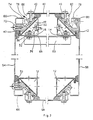
- the sections 10,12,14,16 forming the uprights or vertical angular elements as well as the sections 18,20,22,24 of the upper part of the frame, and the sections 26,28,30,32 of the lower part of the frame are all identical and arranged in the same way.
- the sections 10 to 32 have an angle part 34, the two sides 36,38 of which are orthogonal and have longitudinal edges folded at right angles to obtain a directed fold 40,42 towards the inside.
- the edges 44,46 formed by the folded edges 40,42 are connected by an exterior partition 48 confining with the angle iron 34 a tubular internal space 50 of triangular section.
- the two sides 36, 38 of the angle iron 34 are provided rows of perforations 52 for fixing crosspieces 53 supporting the electrical apparatus housed in the cabinet in a manner well known to specialists.
- the crosspieces 53 are fixed to the angles 34 by bolts, the nuts of which are inserted in the profile.
- the external partition 48 which extends along the hypotenuse of the triangular profile is a solid partition or provided with a limited number of fixing perforations whose usefulness will be described later.
- the frame of the cabinet is covered with panels 54.56 respectively on the rear face and on the front face of the cabinet as well as panels 58.60 on the lateral faces and 62.64 at the base and at the top of the wardrobe.
- These panels are each constituted by a sheet metal plate whose edges 66 are folded at right angles to ensure the rigidity of the panel.
- the sections 10 to 32 are all arranged in the same way with the edge 68 of the angle iron 34, corresponding to the apex of the right angle of the right triangle, oriented towards the inside of the cabinet.
- the panels 54 to 64 cooperate with the edges 44 and 46 of the folded or folded edges 40,42 with the interposition of seals 70 in the form of a bead extending around the periphery of the panel.
- the panels 54 to 64 are fixed to the sections 10 to 32 by screws 72 which are screwed into intermediate pieces 74 attached to the external partition 48.
- the fixing of the intermediate pieces can be carried out by any suitable means, for example by gluing or simply by bolts passing through orifices in the partition 48.
- the same intermediate piece 74 serves to fix the two panels forming the corresponding angle of the cabinet.
- This intermediate piece fits into the external template of the profile and has a cutout 76 for housing the edges 66 of the panels 54 to 64.
- the fixing of the panels 54 to 64 can of course be carried out in a different manner, the screws 72 being able to for example take support on the folds 40,42 or directly on the partition 48.
- the corresponding intermediate piece 78 is shaped to constitute a hinge 80 for supporting the door 56.
- the hinge 80 fits into the external template of the profile.
- the opposite intermediate piece, arranged on the movable side of the door 56, can be identical to the others, or be devoid of one of the fixing points made unnecessary by the presence of the door 56.
- all of the seals 70 cooperating with the vertical sections 10 to 16 cooperate with the edges 44,46, formed by the folded edges 40,42.
- the seal between two adjacent panels, for example the panels 54, 60 being produced by means of the seals 70 and the external partition 48.
- the partition 48 constitutes a separation from a sealed internal zone, in which the sides 36, 38 of the angle iron 34 on which the crosspieces or other rails supporting the apparatus can be fixed.
- On the external side of the partition 48 extends a non-sealed area used for fixing to the intermediate parts 74, 78 with their accessories, such as the hinge 80 or the fixing screws 72.
- the profiles forming horizontal crosspieces can be sealed in the same way by making the seals 70 cooperate with the edges 44, 46 but according to a preferred embodiment of the invention, represented in FIG. 3, the seal 70 above the door 56 or advantageously all the seals 70, interposed between the vertical panels 54,56,58,60 and the horizontal upper sections 18,20,22,24, are slightly offset upwards so as to cooperate with edge 84 folds 40.42. It is easy to see that this offset avoids any accumulation of water between the panels and the folds 40, 42 which could affect the tightness of the cabinet or cause water penetration when the door is opened. 56.
- the sections 10 to 32 are assembled at their ends by cubic pieces 86 having three orthogonal legs which fit into the triangular ends of the sections. These parts are strictly identical, whatever their position. This assembly can of course be carried out in another way, for example by welding.
- the cabinet according to the invention is produced in the following manner:
- the standard sections 10 to 32 of appropriate length are assembled by cubic pieces 86 arranged at the corners of the cabinet, taking care to orient the edge 68 of the angles towards the interior of the cabinet.
- the perfect symmetry of the profiles avoids any assembly error and it is possible to produce a whole range of cupboards, either by cutting the profiles on demand, or by providing a stock of profiles of different length, in particular with a modularity of 25 mm in the three dimensions.
- the profiles 10 to 32 assembled constitute a solid framework or frame used for fixing to the covering panels 54 to 64 as well as to the crosspieces 53 or support rails of the devices housed inside the cabinet.
- the panels 54 to 64 of appropriate dimensions are then fixed to the different faces of the cabinet, taking care to interpose the seals 70 between the profiles and the edges of the panels.
- the door 56 is of course fixed by the hinge 80 carried by the intermediate piece 78, and a lock (not shown) is disposed on the opposite edge of the door 56 in a manner well known to specialists.
- the apparatus can of course be put in place in the cabinet before all or some of the panels 54 to 64 are fixed.
- the dismantling of the panels or of the cabinet is extremely simple and it is possible to attach several frames to each other. to others as well laterally, in depth or in height while maintaining the seal and retaining the same exterior panels.
- Profiles 10 to 32 can be produced by any suitable means, for example by extrusion, but according to a preferred method, they are obtained by folding a sheet metal strip, for example on an automatic roller burnishing machine.
- FIG. 4 represents an embodiment with six folds, the edges of the folded strip being stapled at the level of the fold 40, which has three thicknesses of superposed sheets. Rounded edges are thus obtained capable of cooperating with the seals 70 without risk of deterioration.
- the opposite fold 42 consists of a simple fold and therefore of two sheet thicknesses. The symmetry can be preserved by providing an empty space 86 between the folded parts to give this fold 42 a thickness comparable to or equal to that of the fold 40 with three thicknesses.
- FIG. 5 illustrates an alternative embodiment in which the thickness of the fold 42 is increased by the insertion of a wedge 88 replacing the void 86 between the folded edges of the fold 42.
- the profile has a wing 90 which extends along the edge 68 of the angle iron 34, projecting towards the inside of the cabinet .
- the wing 90 has perforations 92 for fixing the internal elements of the cabinet.
- the wing 90 extends in the plane of one 38 of the sides of the angle iron ( Figure 6) or in any other direction, in particular in the bisector plane of the angle iron ( Figure 7) and it is constituted by a fold of sheet metal as shown on the figures.
- the structure according to the invention gives the profile great rigidity with respect to the weight and provides a seal while retaining the external template of the cabinet allowing easy juxtaposition of several frames.
- FIG. 4 represents a nut 100 mounted in a cage 102 in the shape of a stirrup.
- Profile 10-32 has perforations 104 on the edge 68 at a pitch and at the level of the perforations 52 on the sides 36, 38 to allow introduction of the nut 100 inside the profile while being retained by the stirrup 102 overlapping the side.
- the cage 102 in folded steel has a lug 106, which under the clamping force is embedded in the profile to ensure electrical continuity.
- a folded tab 108 fits into the perforation 52 to center the nut.
Landscapes
- Engineering & Computer Science (AREA)
- Microelectronics & Electronic Packaging (AREA)
- Power Engineering (AREA)
- Casings For Electric Apparatus (AREA)
- Patch Boards (AREA)
- Glass Compositions (AREA)
- Slot Machines And Peripheral Devices (AREA)
- Transmitters (AREA)
- Vacuum Packaging (AREA)
- Connection Of Plates (AREA)
- Preparation Of Clay, And Manufacture Of Mixtures Containing Clay Or Cement (AREA)
- Switch Cases, Indication, And Locking (AREA)
- Sealing Material Composition (AREA)
- Adhesives Or Adhesive Processes (AREA)
- Structure Of Telephone Exchanges (AREA)
- Vending Machines For Individual Products (AREA)
- Electroluminescent Light Sources (AREA)
- Ultra Sonic Daignosis Equipment (AREA)
- Electrotherapy Devices (AREA)
- Structure And Mechanism Of Cameras (AREA)
Abstract
Description
- L'invention est relative à une armoire d'appareillage électrique ou électronique ayant des parois formées par des panneaux ou plaques fixés sur des éléments allongés disposés aux angles de l'armoire et assemblés à leurs extrémités pour constituer une ossature de support, l'ensemble desdits éléments angulaires étant constitués par des profilés tubulaires identiques disposés de la même manière et ayant deux faces orthogonales, orientées vers l'intérieur de l'armoire et munies de rangées de perforations pour la fixation de traverses de support de l'appareillage logé à l'intérieur de l'armoire, dont la continuité de l'étanchéité au niveau des jonctions angulaires des panneaux est assurée par le profilé correspondant, auquel sont accolés les bords espacés des panneaux avec interposition d'un joint d'étanchéité.
- Les impératifs de standardisation et de fabrication en série imposent une utilisation d'un nombre limité d'éléments permettant la réalisation d'armoires de taille différente et répondant aux besoins de fixation de l'appareillage et de juxtaposition dans les tableaux électriques. L'armoire est constituée d'une ossature ou charpente réalisée par un assemblage de profilés standards et par des panneaux généralement en tôle fixés sur cette ossature. La taille de ces armoires est souvent importante de quelques mètres de hauteur, et les joints élastiques d'étanchéité insérés entre les éléments au niveau de leur assemblage sont souvent insuffisants pour palier les imperfections d'usinage ou les déformations locales intervenant lors du montage. Il a déjà été proposé de séparer les fonctions de support et les fonctions d'étanchéité assurées par les profilés constituant l'ossature, en ménageant sur le profilé des extensions qui coopèrent avec les joints. Ces profilés sont de formes compliquées et souvent dissymétriques, ce qui complique le montage et peut être à l'origine d'assemblage incorrect.
- La présente invention a pour but de permettre la réalisation d'une armoire utilisant un profilé standard assurant à la fois la fonction de support et une étanchéité améliorée au droit des jonctions.
- L'armoire selon la présente invention est caractérisée en ce que le profilé est constitué par une cornière dont les deux côtés sont disposés à l'intérieur de l'armoire pour former lesdites deux faces orthogonales de fixation, que le bord longitudinal de chaque côté, opposé à l'arête de la cornière, est replié en équerre vers l'intérieur suivant un contour tronqué, contre lequel repli est accolé le bord du panneau conjugué et que le profilé présente une cloison extérieure reliant lesdits bords de la cornière et assurant l'étanchéité de la jonction angulaire en formant un prisme dont la base est un triangle rectangle isocèle, le profilé ayant un plan de symétrie correspondant au plan bissecteur de la cornière.
- La cloison externe en diagonale délimite la zone étanche interne à l'armoire de la zone extérieure non étanche. Les panneaux sont appliqués contre les bords externes du profilé avec interposition d'un joint d'étanchéité, avantageusement constitué par un bourrelet élastique intercalé entre le panneau et le bord du profilé. Le repli en équerre du bord du profilé s'étend parallèlement au panneau adjacent à faible distance de ce dernier et constitue un écran de protection du joint, notamment contre les projections d'eau venant de l'extérieur. Les panneaux présentent des bords rabattus qui coiffent les replis du profilé de manière à constituer une protection additionnelle en présentant un véritable labyrinthe d'accès au joint. Les bords rabattus des panneaux contribuent bien entendu à leur rigidité et à l'esthétique de l'armoire. Le rôle d'écran des replis des profilés est particulièrement utile lorsque ces profilés sont disposés en traverses supérieures. L'eau ruisselant du toit est alors recueillie par la gouttière constituée par le repli. Ce rôle de gouttière est indispensable lorsque le panneau adjacent est agencé en porte, de façon à éviter lors de l'ouverture de la porte un écoulement de l'eau accumulé vers l'intérieur de l'armoire. Dans cette disposition il est avantageux de reporter le joint vers l'extrémité du repli pour empêcher la formation d'une rigole d'accumulation d'eau entre le panneau et le repli du profilé.
- Les panneaux peuvent être fixés par tout moyen approprié directement sur les profilés ou sur les replis de ces derniers, un mode de fixation préférentiel faisant usage d'une pièce intermédiaire, elle-même accolée et fixée à la cloison diagonale. Cette pièce intermédiaire est commune aux deux panneaux angulaires, qui sont fixés par de simples vis s'engageant dans des taraudages de la pièce intermédiaire. Cette pièce intermédiaire peut être agencée, ou porter la charnière d'un panneau mobile constituant une porte. Les profilés sont assemblés les uns aux autres par des pièces d'angle en forme de tripode. Ces pièces d'angle disposées aux huit coins de l'armoire sont tout comme les profilés, des pièces identiques symétriques évitant toute erreur de montage. L'ensemble est particulièrement simple et assure une facilité de montage alliée à une modularité et à une rigidité optimale. Plusieurs ossatures peuvent être accolées et solidarisées les unes aux autres pour constituer des armoires de tailles multiples, le panneau intermédiaire étant bien entendu supprimé de manière à accoler les profilés des deux ossatures adjacentes les uns contre les autres, avec interposition d'un joint d'étanchéité analogue à celui utilisé pour les panneaux. Le contour externe tronqué des profilés contribue à la rigidité de ces assemblages, lesquels comportent des boulons ou éclisses de liaison des profilés. De telles extensions sont réalisables sur toutes les faces de l'armoire tout en conservant une parfaite étanchéité et sans modification des panneaux constitutifs des parois.
- Les profilés peuvent être partiellement emboîtés par paire, ce qui facilite le stockage et le transport.
- D'autres avantages et caractéristiques ressortiront plus clairement de la description qui va suivre d'un mode de mise en oeuvre de l'invention donné à titre d'exemple non limitatif et représenté aux dessins annexés dans lesquels:
- - la figure 1 est une vue schématique en perspective d'une ossature d'une armoire selon l'invention;
- - la figure 2 est une coupe suivant la ligne II-II de la figure 1;
- - la figure 3 est une coupe suivant la ligne III-III de la figure 1;,
- - la figure 4 est une section du profilé constitutif de l'ossature selon la figure 1;
- - la figure 5 est une vue analogue à celle de la figure 4, illustrant une variante de réalisation;
- - les figures 6 et 7 illustrent deux autres variantes de réalisation du profilé.
- Sur les figures, une armoire de logement d'appareillage électrique est constituée par l'assemblage de 12 éléments angulaires formant un parallélépipède rectangle droit. Les profilés 10,12,14,16 formant les montants ou éléments angulaires verticaux ainsi que les profilés 18,20,22,24 de la partie supérieure de l'ossature, et les profilés 26,28,30,32 de la partie inférieure de l'ossature sont tous identiques et disposés de la même manière. En se référant plus particulièrement aux figures 4 et 5, on voit que les profilés 10 à 32 ont une partie en cornière 34 dont les deux côtés 36,38 sont orthogonaux et présentent des bords longitudinaux repliés en équerre pour obtenir un repli 40,42 dirigé vers l'intérieur. Les arêtes 44,46 constituées par les bords repliés 40,42 sont reliées par une cloison d'extérieur 48 confinant avec la cornière 34 un espace interne tubulaire 50 de section triangulaire. Les deux côtés 36,38 de la cornière 34 sont munis de rangées de perforations 52 pour la fixation de traverses 53 de support de l'appareillage électrique logé dans l'armoire d'une manière bien connue des spécialistes. Les traverses 53 sont fixées aux cornières 34 par des boulons dont les écrous sont insérés dans le profilé. La cloison extérieure 48 qui s'étend suivant l'hypoténuse du profilé triangulaire est une cloison pleine ou munie d'un nombre limité de perforations de fixation dont l'utilité sera décrite par la suite.
- L'ossature de l'armoire est habillée de panneaux 54,56 respectivement sur la face arrière et sur la face avant de l'armoire ainsi que de panneaux 58,60 sur les faces latérales et 62,64 à la base et au sommet de l'armoire. Ces panneaux sont chacun constitués par une plaque de tôle dont les bords 66 sont rabattus à angle droit pour assurer la rigidité du panneau. Les profilés 10 à 32 sont tous disposés de la même manière avec l'arête 68 de la cornière 34, correspondant au sommet de l'angle droit du triangle rectangle, orientée vers l'intérieur de l'armoire. Les panneaux 54 à 64 coopèrent avec les arêtes 44 et 46 des bords repliés ou replis 40,42 avec interposition de joints d'étanchéité 70 en forme de bourrelet s'étendant sur le pourtour du panneau. Les panneaux 54 à 64 sont fixés aux profilés 10 à 32 par des vis 72 se vissant dans des pièces intermédiaires 74 accolées à la cloison externe 48. La fixation des pièces intermédiaires peut être réalisée par tout moyen approprié, par exemple par collage ou tout simplement par des boulons traversant des orifices ménagés dans la cloison 48. La même pièce intermédiaire 74 sert de fixation aux deux panneaux formant l'angle correspondant de l'armoire. Cette pièce intermédiaire s'inscrit dans le gabarit externe du profilé et présente une découpe 76 de logement des rebords 66 des panneaux 54 à 64. La fixation des panneaux 54 à 64 peut bien entendu être réalisée d'une manière différente, les vis 72 pouvant par exemple prendre appui sur les replis 40,42 ou directement sur la cloison 48.
- Lorsque l'un des panneaux, notamment le panneau avant 56 est agencé en porte, la pièce intermédiaire correspondante 78 est conformée pour constituer une charnière 80 de support de la porte 56. La charnière 80 s'inscrit dans le gabarit externe du profilé. La pièce intermédiaire opposée, disposée du côté mobile de la porte 56 peut être identique aux autres, ou être dépourvue de l'un des points de fixation rendu inutile par la présence de la porte 56.
- En se référant plus particulièrement à la figure 2, on voit que l'ensemble des joints 70 coopérant avec les profilés verticaux 10 à 16, coopèrent avec les arêtes 44,46, constituées par les bords repliés 40,42. L'étanchéité entre deux panneaux adjacents, par exemple les panneaux 54,60 étant réalisée par l'intermédiaire des joints 70 et de la cloison extérieure 48. La cloison 48 constitue une séparation d'une zone interne étanche, dans laquelle s'étendent les côtés 36,38 de la cornière 34 sur lesquels peuvent être fixées les traverses ou autres rails de support de l'appareillage. Du côté externe de la cloison 48 s'étend une zone non étanche servant de fixation aux pièces intermédiaires 74,78 avec leurs accessoires, tels que la charnière 80 ou les vis de fixation 72. En faisant porter les joints élastiques 70 sur les arêtes 44,46 on obtient une déformation suffisante pour compenser les irrégularités du profil ou autres déformations des éléments de structure de l'armoire. L'écrasement des joints 70 lors du serrage des vis 72 limite l'intervalle entre les panneaux 54 à 64 et les replis 40,42 et réduit les risques de pénétration d'eau et de mouillage des joints 70. Ce risque est de plus amoindri par les rebords 66 des panneaux 54 à 64 qui coiffent les extrémités des replis 40,42 en formant un véritable joint à labyrinthe limitant les risques de pénétration d'eau vers les joints 70. La forme du profilé permet par ailleurs d'assurer l'étanchéité soit avec un joint collé ou clipsé sur les replis 40,42, soit avec un joint collé ou clipsé à l'intérieur des panneaux constituant l'habillage. L'étanchéité des profilés formant des traverses horizontales peut être réalisée de la même manière en faisant coopérer les joints 70 avec les arêtes 44,46 mais selon un mode de mise en oeuvre préféré de l'invention, représenté à la figure 3, le joint 70 au-dessus de la porte 56 ou avantageusement tous les joints 70, intercalés entre les panneaux verticaux 54,56,58,60 et les profilés supérieurs horizontaux 18,20,22,24, sont légèrement décalés vers le haut de manière à coopérer avec la tranche 84 des replis 40,42. Il est facile de voir que ce décalage évite toute accumulation d'eau entre les panneaux et les replis 40,42 susceptibles d'affecter l'étanchéité de l'armoire ou de provoquer une pénétration d'eau lors de l'ouverture de la porte 56. Les profilés 10 à 32 sont assemblés à leurs extrémités par des pièces cubiques 86 ayant trois pieds orthogonaux s'emboîtant dans les extrémités triangulaires des profilés. Ces pièces sont rigoureusement identiques, quelle que soit leur position. Cet assemblage peut bien entendu être réalisé d'une autre manière, par exemple par soudage.
- L'armoire selon l'invention est réalisée de la manière suivante:
- Les profilés standards 10 à 32 de longueur appropriée, sont assemblés par des pièces cubiques 86 disposées aux angles de l'armoire en prenant soin d'orienter l'arête 68 des cornières vers l'intérieur de l'armoire. La parfaite symétrie des profilés évite toute erreur de montage et il est possible de réaliser toute une gamme d'armoire, soit en découpant les profilés à la demande, soit en prévoyant un stock de profilés de longueur différente, notamment avec une modularité de 25 mm dans les trois dimensions. Les profilés 10 à 32 assemblés, constituent une ossature ou charpente solide servant de fixation aux panneaux d'habillage 54 à 64 ainsi qu'aux traverses 53 ou rails de support des appareils logés à l'intérieur de l'armoire. Les panneaux 54 à 64 de dimensions appropriées sont ensuite fixés sur les différentes faces de l'armoire en prenant soin d'interposer les joints 70 entre les profilés et les bords des panneaux. Par vissage des vis 72 sur les pièces intermédiaires 74, préalablement fixées sur les cloisons extérieures 48, il est possible de serrer fortement les panneaux avec un écrasement des joints 70 en appui contre les arêtes 44,46 ou les tranches 84 des replis 40,42. La porte 56 est bien entendu fixée par la charnière 80 portée par la pièce intermédiaire 78, et une serrure (non représentée) est disposée sur le bord opposé de la porte 56 d'une manière bien connue des spécialistes. L'appareillage peut bien entendu être mis en place dans l'armoire avant la fixation de tous ou de certains panneaux 54 à 64. Le démontage des panneaux ou de l'armoire est extrêmement simple et il est possible d'accoler plusieurs ossatures les unes aux autres aussi bien latéralement, en profondeur ou en hauteur en maintenant l'étanchéité et en conservant les mêmes panneaux extérieurs.
- Les profilés 10 à 32 peuvent être réalisés par tout moyen approprié, par exemple par extrusion, mais selon un procédé préférentiel, ils sont obtenus par pliage d'une bande de tôle, par exemple sur une machine automatique de galetage. La figure 4 représente un mode de réalisation à six pliages, les bords de la bande repliée étant agrafés au niveau du repli 40, qui présente trois épaisseurs de tôles superposées. On obtient ainsi des arêtes arrondies susceptibles de coopérer avec les joints d'étanchéité 70 sans risque de détérioration. Le repli opposé 42 est constitué par un simple repli et de ce fait de deux épaisseurs de tôles. La symétrie peut être conservée en ménageant un espace vide 86 entre les parties repliées pour conférer à ce repli 42 une épaisseur comparable ou égale à celle du repli 40 à trois épaisseurs. La figure 5 illustre une variante de réalisation dans laquelle l'épaisseur du repli 42 est accrue par l'insertion d'une cale 88 remplaçant le vide 86 entre les bords repliés du repli 42.
- En se référant aux figures 6 et 7, on voit deux autres variantes de réalisation dans lesquelles le profilé présente une aile 90 qui s'étend le long de l'arête 68 de la cornière 34, en saillie vers l'intérieur de l'armoire. L'aile 90 comporte des perforations 92 pour la fixation d'éléments internes de l'armoire. L'aile 90 s'étend dans le plan de l'un 38 des côtés de la cornière (figure 6) ou selon toute autre direction, notamment dans le plan bissecteur de la cornière (figure 7) et elle est constituée par un repli de la tôle de la manière représentée sur les figures.
- La structure selon l'invention confère au profilé une grande rigidité par rapport au poids et assure une étanchéité tout en conservant le gabarit externe de l'armoire permettant une juxtaposition aisée de plusieurs ossatures.
- Les écrous des boulons de fixation aux profilés 10-32 doivent être introduits à l'intérieur de ces profilés et maintenus en regard de la perforation 52 recevant la vis. Sur la figure 2, on voit un support 94 commun à deux écrous 96, 98 venant en face de deux perforations 52 situées à un même niveau sur les deux ailes de la cornière. L'écrou 98 est monté à pivotement et à coulissement sur le support 94 pour permettre, à partir de la position active, représentée à la figure 4, un coulissement vers le bas et un pivotement pour mettre sur la tranche l'écrou rectangulaire autorisant le retrait par la perforation 52.
- La figure 4 représente un écrou 100 monté dans une cage 102 en forme d'étrier. Le profilé 10-32 comporte sur l'arête 68 des perforations 104 au pas et au niveau des perforations 52 des côtés 36, 38 pour permettre une introduction de l'écrou 100 à l'intérieur du profilé en étant retenu par l'étrier 102 qui chevauche le côté. On voit sur la figure un écrou en place sur l'un des côtés 38 en regard de la perforation 52 et un autre écrou en cours d'insertion pour venir en face de la perforation 52 de l'autre côté 36. La cage 102 en acier plié présente un ergot 106, qui sous l'effort de serrage s'incruste dans le profilé pour assurer la continuité électrique. Une patte repliée 108 s'emboîte dans la perforation 52 pour centrer l'écrou.
Claims (11)
Applications Claiming Priority (2)
| Application Number | Priority Date | Filing Date | Title |
|---|---|---|---|
| FR8907506 | 1989-06-05 | ||
| FR8907506A FR2648005B1 (fr) | 1989-06-05 | 1989-06-05 | Armoire etanche d'appareillage electrique |
Publications (2)
| Publication Number | Publication Date |
|---|---|
| EP0402276A1 true EP0402276A1 (fr) | 1990-12-12 |
| EP0402276B1 EP0402276B1 (fr) | 1993-03-17 |
Family
ID=9382454
Family Applications (1)
| Application Number | Title | Priority Date | Filing Date |
|---|---|---|---|
| EP90420242A Expired - Lifetime EP0402276B1 (fr) | 1989-06-05 | 1990-05-18 | Armoire étanche d'appareillage électrique |
Country Status (19)
| Country | Link |
|---|---|
| US (1) | US5202818A (fr) |
| EP (1) | EP0402276B1 (fr) |
| JP (1) | JPH0322593A (fr) |
| CN (1) | CN1021402C (fr) |
| AT (1) | ATE87169T1 (fr) |
| AU (1) | AU624717B2 (fr) |
| BR (1) | BR9002637A (fr) |
| CA (1) | CA2017594A1 (fr) |
| DE (1) | DE69001096T2 (fr) |
| DK (1) | DK0402276T3 (fr) |
| EG (1) | EG19454A (fr) |
| ES (1) | ES2040581T3 (fr) |
| FI (1) | FI902752A7 (fr) |
| FR (1) | FR2648005B1 (fr) |
| MX (1) | MX174607B (fr) |
| NO (1) | NO902461L (fr) |
| PT (1) | PT94262A (fr) |
| TR (1) | TR24645A (fr) |
| ZA (1) | ZA904255B (fr) |
Cited By (10)
| Publication number | Priority date | Publication date | Assignee | Title |
|---|---|---|---|---|
| FR2681404A1 (fr) * | 1991-09-18 | 1993-03-19 | Legrand Sa | Profile d'ossature sur lequel doit etre rapporte un accessoire d'equipement, et accessoires d'equipement susceptibles d'etre associes a un tel profile d'ossature. |
| ES2039170A2 (es) * | 1991-12-17 | 1993-08-16 | Legrand Sa | Panel, en particular para puerta de armario, y especialmente para puerta de armario electrico. |
| EP0574560A4 (fr) * | 1991-11-27 | 1994-03-30 | Federal-Hoffman, Inc., D/B/A Hoffman Engineering Company | |
| EP0572601A4 (fr) * | 1991-11-27 | 1994-03-30 | Federal-Hoffman, Inc., D/B/A Hoffman Engineering Company | |
| FR2708391A1 (fr) * | 1993-07-27 | 1995-02-03 | Gec Alsthom Equip Basse Tens | Profilé de construction pour chassis d'armoire électrique. |
| WO1995012232A1 (fr) * | 1993-10-25 | 1995-05-04 | Rittal-Werk Rudolf Loh Gmbh & Co. Kg | Bati pour armoire de distribution |
| FR2741231A1 (fr) * | 1995-10-04 | 1997-05-16 | Loh Kg Rittal Werk | Branche d'encadrement pour bati d'encadrement d'une armoire de commutation |
| DE19647723C1 (de) * | 1996-11-19 | 1998-04-09 | Loh Kg Rittal Werk | Rahmengestell für einen Schaltschrank |
| DE4132803C3 (de) * | 1991-10-02 | 2000-03-16 | Loh Kg Rittal Werk | Hohlprofil für ein Rahmengestell eines Schaltschrankes |
| WO2012113551A1 (fr) * | 2011-02-25 | 2012-08-30 | C E S Control Enclosure Systems Gmbh | Élément d'étanchéité et système d'étanchéité pour profilé creux |
Families Citing this family (53)
| Publication number | Priority date | Publication date | Assignee | Title |
|---|---|---|---|---|
| DE4140072A1 (de) * | 1991-12-05 | 1993-06-09 | Rittal-Werk Rudolf Loh Gmbh & Co Kg, 6348 Herborn, De | Schaltschrank mit rahmengestell und montageplatte |
| JP2817527B2 (ja) * | 1992-08-11 | 1998-10-30 | 日本電気株式会社 | フレーム組立 |
| DE4333027C1 (de) * | 1993-09-28 | 1994-10-06 | Loh Kg Rittal Werk | Gestellrahmen |
| FR2711454B1 (fr) * | 1993-10-18 | 1995-11-24 | Merlin Gerin | Liaison d'angle pour armoire, et armoire électrique comportant de telles liaisons. |
| DE4439628C2 (de) * | 1994-11-05 | 1998-11-26 | Loh Kg Rittal Werk | Rahmengestell aus Rahmenschenkeln und Tiefenstreben |
| DE19536950C1 (de) * | 1995-10-04 | 1996-11-21 | Loh Kg Rittal Werk | Rahmenschenkel für ein Rahmengestell eines Schaltschrankes |
| US5673985A (en) * | 1996-06-25 | 1997-10-07 | Mitchell; Jerry B. | Modular electronic components cabinet structure |
| US5964361A (en) * | 1997-02-21 | 1999-10-12 | Frazier Industrial Company | Ergonomic storage racks |
| DE19707929C1 (de) * | 1997-02-27 | 1998-09-03 | Schroff Gmbh | Schrank zur Aufnahme von elektrischen und elektronischen Komponenten |
| US5997117A (en) * | 1997-06-06 | 1999-12-07 | Chatsworth Products, Inc. | Rack frame cabinet |
| DE19813222C1 (de) * | 1998-03-26 | 1999-11-25 | Loh Kg Rittal Werk | Rahmengestell für einen Schaltschrank |
| DE19817916A1 (de) * | 1998-04-17 | 1999-10-21 | Loh Kg Rittal Werk | Rahmenschenkel für ein Rahmengestell eines Schaltschrankes |
| DE19816945A1 (de) * | 1998-04-17 | 1999-10-21 | Loh Kg Rittal Werk | Schaltschrank |
| DE19817245A1 (de) * | 1998-04-18 | 1999-10-28 | Loh Kg Rittal Werk | Schaltschrank |
| DE19818603A1 (de) * | 1998-04-20 | 1999-10-21 | Loh Kg Rittal Werk | Rahmenschenkel für ein Rahmengestell eines Schaltschrankes |
| NO308820B1 (no) * | 1998-04-27 | 2000-10-30 | Efa Elektro As | Skap med i det minste én dør, særlig et elektroskap |
| FR2796519B1 (fr) * | 1999-07-16 | 2003-04-11 | Socomec Sa | Armoire, notamment armoire electronique de commande et armoires juxtaposees |
| US20040183409A1 (en) * | 2001-01-23 | 2004-09-23 | Cooper Technologies Company | Electrical equipment enclosure |
| US6965075B2 (en) * | 2001-03-01 | 2005-11-15 | Nitto Electric Works, Ltd. | Frame for electrical and electronic equipment housing cabinets and a frame joining structure |
| DE10113936C1 (de) * | 2001-03-21 | 2002-10-10 | Rittal Rcs Comm Systems Gmbh & Co Kg | Schaltschrank mit Rahmengestell und Verkleidungselementen |
| DE10113935C1 (de) * | 2001-03-21 | 2002-10-10 | Rittal Rcs Comm Systems Gmbh & Co Kg | Schaltschrank mit Rahmengestell und Verkleidungselementen |
| US6481582B1 (en) | 2001-06-04 | 2002-11-19 | Cooper Technologies Company | Rack |
| US6974036B2 (en) * | 2002-04-01 | 2005-12-13 | Viasystems Group, Inc. | Corner post and manufacturing process for making same |
| BR0301083A (pt) * | 2003-04-03 | 2004-11-03 | Melquisedec Francisquini | Aperfeiçoamento em perfil metálico para composição de estruturas para montagem de quadros elétricos |
| DE10342546A1 (de) * | 2003-09-12 | 2005-06-30 | Abb Patent Gmbh | Schaltschrank für Niederspannungsschaltanlagen |
| US8016126B1 (en) * | 2003-09-30 | 2011-09-13 | Google Inc. | Cabinet structures resistant to racking deformation for rack mounted computing systems |
| US20060059790A1 (en) * | 2004-08-31 | 2006-03-23 | Yeung Hubert K | Systems and methods for modular instrument design and fabrication |
| FR2896631B1 (fr) * | 2006-01-25 | 2009-07-31 | Legrand France | Armoire pour appareils electriques comportant une armature et un clips-ecrou monte sur un profile appartenant a l'armature |
| US7718891B2 (en) * | 2006-03-13 | 2010-05-18 | Panduit Corp. | Network cabinet |
| JP2007312545A (ja) * | 2006-05-19 | 2007-11-29 | Fuji Electric Fa Components & Systems Co Ltd | インバータ装置の筐体構造およびその製造方法 |
| USD630173S1 (en) | 2009-04-20 | 2011-01-04 | Chatsworth Products, Inc. | Cover for electronic equipment cabinet |
| USD632660S1 (en) | 2009-04-20 | 2011-02-15 | Chatsworth Products, Inc. | Cover for electronic equipment cabinet |
| US20110296675A1 (en) * | 2009-08-26 | 2011-12-08 | Roopnarine | Means for rapidly assembling a spacecraft |
| US8403431B2 (en) * | 2009-09-01 | 2013-03-26 | Emerson Network Power, Energy Systems, North America, Inc. | Telecommunications enclosures |
| CN102137553A (zh) * | 2010-01-25 | 2011-07-27 | 鸿富锦精密工业(深圳)有限公司 | 机柜及其装配方法 |
| DE102010034620A1 (de) * | 2010-08-17 | 2012-02-23 | Adc Gmbh | Verteilerschrank |
| ITAN20110079U1 (it) * | 2010-11-23 | 2012-05-24 | Tekpan Teknik Elek K Kumanda Pano Sanayi Ve Turi | Sistema di assemblaggio angolare di profili di costruzione. |
| EP2678489A1 (fr) | 2011-02-25 | 2014-01-01 | C E S Control Enclosure Systems GmbH | Procédé de fabrication d'éléments de paroi rectangulaires ou carrés en tôle plate et éléments de paroi ainsi fabriqués |
| CN103477096B (zh) | 2011-02-25 | 2015-08-19 | Ces控制机柜系统有限公司 | 用于空心型材的角接头 |
| DE102014101404B4 (de) * | 2014-02-05 | 2017-11-16 | Rittal Gmbh & Co. Kg | Rahmengestell für einen Schalt- oder Verteilerschrank |
| DE102014101401A1 (de) * | 2014-02-05 | 2015-08-06 | Rittal Gmbh & Co. Kg | Anreih-Schaltschranksystem |
| GB2529827B (en) * | 2014-09-02 | 2017-01-04 | Cp Cases Ltd | Electronic rack and mounting chassis |
| JP6512939B2 (ja) * | 2015-05-26 | 2019-05-15 | 日東工業株式会社 | 電気機器収納用箱 |
| DE102015121192B4 (de) * | 2015-12-04 | 2019-09-19 | Rittal Gmbh & Co. Kg | Rahmengestell für einen Schaltschrank |
| CN108012471A (zh) * | 2016-10-31 | 2018-05-08 | 鸿富锦精密电子(天津)有限公司 | 服务器立柱 |
| DE102017108335B4 (de) * | 2017-04-19 | 2019-01-03 | Rittal Gmbh & Co. Kg | Befestigungsanordnung und ein entsprechendes Schaltschrankgehäuse |
| CN207219192U (zh) * | 2017-06-05 | 2018-04-10 | 阳光电源股份有限公司 | 户外柜及其顶部结构 |
| EP3979443A4 (fr) * | 2019-05-28 | 2023-06-21 | Melquisedec Francisquini | Profilé pour armoire électrique |
| BR102019010955B1 (pt) * | 2019-05-28 | 2023-04-11 | Melquisedec Francisquini | Perfil estrutural para armário elétrico |
| FR3097714B1 (fr) * | 2019-06-24 | 2023-02-10 | Schneider Electric Ind Sas | Armature pour une armoire électrique, armoire électrique comportant une telle armature |
| BR102020003216A2 (pt) * | 2020-02-14 | 2021-08-31 | Melquisedec Francisquini | Barramento condutor tubular senoidal |
| US11576277B2 (en) * | 2020-02-14 | 2023-02-07 | Quanta Computer Inc. | Rack for supporting servers of varying heights |
| CN114614176A (zh) * | 2022-03-25 | 2022-06-10 | 中创新航科技股份有限公司 | 储能机架 |
Citations (2)
| Publication number | Priority date | Publication date | Assignee | Title |
|---|---|---|---|---|
| DE8335383U1 (de) * | 1983-12-09 | 1984-04-05 | Rittal-Werk Rudolf Loh Gmbh & Co Kg, 6348 Herborn | Rahmengestell für einen Schaltschrank |
| EP0281983A2 (fr) * | 1987-03-12 | 1988-09-14 | Fischbach GmbH & Co.KG | Système d'assemblage pour un bâti d'enceinte |
Family Cites Families (10)
| Publication number | Priority date | Publication date | Assignee | Title |
|---|---|---|---|---|
| FR2278223A1 (fr) * | 1974-07-08 | 1976-02-06 | France Etat | Bati pour equipements electroniques |
| SU586578A1 (ru) * | 1975-03-31 | 1977-12-30 | Предприятие П/Я В-2502 | Шкаф дл радиоэлектронной аппаратуры |
| AU522557B2 (en) * | 1975-10-08 | 1982-06-17 | N.G. Ford | Packaging of electrical or electronic components |
| JPS56118688A (en) * | 1980-02-25 | 1981-09-17 | Matsushita Electric Works Ltd | Alarm clock |
| JPS58156659A (ja) * | 1982-03-15 | 1983-09-17 | 三菱製鋼株式会社 | 緩衝床 |
| CA1312135C (fr) * | 1986-09-26 | 1992-12-29 | Vormet Quality Fabrications Close Corporation | Bati |
| DE3633284A1 (de) * | 1986-09-30 | 1988-04-07 | Loh Kg Rittal Werk | Mehrzweck-tischgehaeuse |
| US4754368A (en) * | 1987-04-09 | 1988-06-28 | General Electric Company | Terminal for watthour meters |
| US4814942A (en) * | 1987-08-10 | 1989-03-21 | Westinghouse Electric Corp. | Drawout switchgear cell frame |
| US5001602A (en) * | 1988-11-28 | 1991-03-19 | Reliance Comm/Tec Corporation | Network interface cabinet for large pair count telephone terminations |
-
1989
- 1989-06-05 FR FR8907506A patent/FR2648005B1/fr not_active Expired - Fee Related
-
1990
- 1990-05-18 DE DE9090420242T patent/DE69001096T2/de not_active Expired - Fee Related
- 1990-05-18 DK DK90420242.1T patent/DK0402276T3/da active
- 1990-05-18 ES ES199090420242T patent/ES2040581T3/es not_active Expired - Lifetime
- 1990-05-18 EP EP90420242A patent/EP0402276B1/fr not_active Expired - Lifetime
- 1990-05-18 AT AT90420242T patent/ATE87169T1/de not_active IP Right Cessation
- 1990-05-25 CA CA002017594A patent/CA2017594A1/fr not_active Abandoned
- 1990-05-29 US US07/529,542 patent/US5202818A/en not_active Expired - Fee Related
- 1990-05-31 MX MX020953A patent/MX174607B/es unknown
- 1990-06-01 AU AU56201/90A patent/AU624717B2/en not_active Ceased
- 1990-06-01 NO NO90902461A patent/NO902461L/no unknown
- 1990-06-01 FI FI902752A patent/FI902752A7/fi not_active IP Right Cessation
- 1990-06-04 PT PT94262A patent/PT94262A/pt not_active Application Discontinuation
- 1990-06-04 CN CN90104072A patent/CN1021402C/zh not_active Expired - Fee Related
- 1990-06-04 ZA ZA904255A patent/ZA904255B/xx unknown
- 1990-06-04 BR BR909002637A patent/BR9002637A/pt not_active IP Right Cessation
- 1990-06-04 JP JP2146041A patent/JPH0322593A/ja active Pending
- 1990-06-05 EG EG33090A patent/EG19454A/xx active
- 1990-06-20 TR TR90/0522A patent/TR24645A/xx unknown
Patent Citations (2)
| Publication number | Priority date | Publication date | Assignee | Title |
|---|---|---|---|---|
| DE8335383U1 (de) * | 1983-12-09 | 1984-04-05 | Rittal-Werk Rudolf Loh Gmbh & Co Kg, 6348 Herborn | Rahmengestell für einen Schaltschrank |
| EP0281983A2 (fr) * | 1987-03-12 | 1988-09-14 | Fischbach GmbH & Co.KG | Système d'assemblage pour un bâti d'enceinte |
Cited By (18)
| Publication number | Priority date | Publication date | Assignee | Title |
|---|---|---|---|---|
| FR2681404A1 (fr) * | 1991-09-18 | 1993-03-19 | Legrand Sa | Profile d'ossature sur lequel doit etre rapporte un accessoire d'equipement, et accessoires d'equipement susceptibles d'etre associes a un tel profile d'ossature. |
| EP0533555A1 (fr) * | 1991-09-18 | 1993-03-24 | Legrand | Profilé d'ossature avec un accessoire d'équipement |
| DE4132803C3 (de) * | 1991-10-02 | 2000-03-16 | Loh Kg Rittal Werk | Hohlprofil für ein Rahmengestell eines Schaltschrankes |
| US5407263A (en) * | 1991-11-27 | 1995-04-18 | Federal-Hoffman, Inc. | Restructurable enclosure with multi-purpose mounting blocks |
| EP0574560A4 (fr) * | 1991-11-27 | 1994-03-30 | Federal-Hoffman, Inc., D/B/A Hoffman Engineering Company | |
| US5380083A (en) * | 1991-11-27 | 1995-01-10 | Federal-Hoffman, Inc. | Multifaceted modular enclosure frame with integral sub-panel guide system |
| EP0572601A4 (fr) * | 1991-11-27 | 1994-03-30 | Federal-Hoffman, Inc., D/B/A Hoffman Engineering Company | |
| US5388903A (en) * | 1991-11-27 | 1995-02-14 | Federal-Hoffman, Inc. | Multifaceted modular enclosure frame with integral sub-panel guide system |
| ES2039170A2 (es) * | 1991-12-17 | 1993-08-16 | Legrand Sa | Panel, en particular para puerta de armario, y especialmente para puerta de armario electrico. |
| FR2708391A1 (fr) * | 1993-07-27 | 1995-02-03 | Gec Alsthom Equip Basse Tens | Profilé de construction pour chassis d'armoire électrique. |
| WO1995012232A1 (fr) * | 1993-10-25 | 1995-05-04 | Rittal-Werk Rudolf Loh Gmbh & Co. Kg | Bati pour armoire de distribution |
| EP0751595A3 (fr) * | 1993-10-25 | 1997-01-15 | Rittal-Werk Rudolf Loh GmbH & Co. KG | Bâti pour une armoire de commutation |
| FR2741231A1 (fr) * | 1995-10-04 | 1997-05-16 | Loh Kg Rittal Werk | Branche d'encadrement pour bati d'encadrement d'une armoire de commutation |
| DE19647723C1 (de) * | 1996-11-19 | 1998-04-09 | Loh Kg Rittal Werk | Rahmengestell für einen Schaltschrank |
| WO2012113551A1 (fr) * | 2011-02-25 | 2012-08-30 | C E S Control Enclosure Systems Gmbh | Élément d'étanchéité et système d'étanchéité pour profilé creux |
| JP2014513779A (ja) * | 2011-02-25 | 2014-06-05 | シー イー エス コントロール エンクロージャー システムズ ゲーエムベーハー | 中空区画のためのシーリング要素及びシーリング・システム |
| RU2582076C2 (ru) * | 2011-02-25 | 2016-04-20 | С Е С Контрол Энкложе Системз Гмбх | Уплотнительный элемент и уплотнительная система для полых профилей |
| US9383016B2 (en) | 2011-02-25 | 2016-07-05 | C E S Control Enclosure Systems Gmbh | Sealing element and a sealing system for hollow sections |
Also Published As
| Publication number | Publication date |
|---|---|
| FI902752A0 (fi) | 1990-06-01 |
| US5202818A (en) | 1993-04-13 |
| DE69001096T2 (de) | 1993-09-16 |
| ZA904255B (en) | 1991-03-27 |
| FI902752A7 (fi) | 1990-12-06 |
| NO902461D0 (no) | 1990-06-01 |
| DK0402276T3 (da) | 1993-07-12 |
| BR9002637A (pt) | 1991-08-20 |
| TR24645A (tr) | 1992-01-01 |
| AU5620190A (en) | 1990-12-06 |
| CA2017594A1 (fr) | 1990-12-05 |
| CN1021402C (zh) | 1993-06-23 |
| ES2040581T3 (es) | 1993-10-16 |
| MX174607B (es) | 1994-05-30 |
| NO902461L (no) | 1990-12-06 |
| CN1048300A (zh) | 1991-01-02 |
| EG19454A (en) | 1995-04-30 |
| FR2648005B1 (fr) | 1993-11-26 |
| ATE87169T1 (de) | 1993-04-15 |
| FR2648005A1 (fr) | 1990-12-07 |
| EP0402276B1 (fr) | 1993-03-17 |
| PT94262A (pt) | 1991-02-08 |
| JPH0322593A (ja) | 1991-01-30 |
| AU624717B2 (en) | 1992-06-18 |
| DE69001096D1 (de) | 1993-04-22 |
Similar Documents
| Publication | Publication Date | Title |
|---|---|---|
| EP0402276B1 (fr) | Armoire étanche d'appareillage électrique | |
| EP0649205B1 (fr) | Liaison d'angle pour armoire, et armoire électrique comportant de telles liaisons | |
| EP0119114B1 (fr) | Dispositif pour réaliser des couvertures ou bardages doubles, pièces porteuses, supports et pinces pour la mise en oeuvre de ce dispositif | |
| FR2683956A1 (fr) | Chassis-cadre pour une armoire electrique. | |
| EP0596820B1 (fr) | Enveloppe de protection et d'isolation à panneaux amovibles pour unité de transfert | |
| CH677688A5 (fr) | ||
| FR2662232A1 (fr) | Chassis metallique d'armoire. | |
| EP0008970A1 (fr) | Armoire métallique | |
| FR2958953A1 (fr) | Couverture photovoltaique integrable constituee de panneaux assembles de maniere etanche et demontable | |
| EP1601074A1 (fr) | Armoire électrique à profilés d'ossature | |
| FR2702314A1 (fr) | Armoire métallique, notamment pour le logement d'un appareillage électrique modulaire. | |
| EP0907587A1 (fr) | Paroi ou enveloppe formee de feuilles de tole tendues sur une ossature ou une charpente et son procede de construction | |
| FR2914117A1 (fr) | Montant ouvert renforce pour armoire electrique | |
| FR2929457A1 (fr) | Assemblage d'un coffret electrique | |
| FR2956198A1 (fr) | Dispositif pour la fixation de panneaux solaires comportant des profiles lateraux munis d'une gorge longitudinale ouverte vers le bas | |
| FR2956681A1 (fr) | Dispositif pour l'integration de panneaux photovoltaiques sur un toit | |
| FR2681405A1 (fr) | Piece d'assemblage pour ossature d'armoire, notamment pour appareillages electriques, et ossature et armoire correspondantes. | |
| FR2961298A1 (fr) | Structure-support pour panneau et installation correspondante. | |
| EP0886354B1 (fr) | Armoire métallique pour appareils électriques | |
| EP2053189A2 (fr) | Châssis comportant un vantail fixe | |
| FR3109399A3 (fr) | Unité de porte en aluminium assemblée et porte en aluminium assemblée | |
| EP2530404A2 (fr) | Dispositif de couverture modulaire | |
| EP1306498A1 (fr) | Dispositif de fixation de panneaux, en particulier de panneaux de toit de véranda et véranda équipée d'un tel dispositif | |
| FR2539336A1 (fr) | Cabine de peinture en panneaux modulaires | |
| FR2956680A1 (fr) | Systeme de fixation d'au moins un panneau photovoltaique sur une toiture en tuiles ou en ardoises. |
Legal Events
| Date | Code | Title | Description |
|---|---|---|---|
| PUAI | Public reference made under article 153(3) epc to a published international application that has entered the european phase |
Free format text: ORIGINAL CODE: 0009012 |
|
| AK | Designated contracting states |
Kind code of ref document: A1 Designated state(s): AT BE CH DE DK ES GB IT LI SE |
|
| 17P | Request for examination filed |
Effective date: 19910522 |
|
| 17Q | First examination report despatched |
Effective date: 19920724 |
|
| GRAA | (expected) grant |
Free format text: ORIGINAL CODE: 0009210 |
|
| AK | Designated contracting states |
Kind code of ref document: B1 Designated state(s): AT BE CH DE DK ES GB IT LI SE |
|
| REF | Corresponds to: |
Ref document number: 87169 Country of ref document: AT Date of ref document: 19930415 Kind code of ref document: T |
|
| REF | Corresponds to: |
Ref document number: 69001096 Country of ref document: DE Date of ref document: 19930422 |
|
| ITF | It: translation for a ep patent filed | ||
| GBT | Gb: translation of ep patent filed (gb section 77(6)(a)/1977) |
Effective date: 19930603 |
|
| REG | Reference to a national code |
Ref country code: DK Ref legal event code: T3 |
|
| REG | Reference to a national code |
Ref country code: ES Ref legal event code: FG2A Ref document number: 2040581 Country of ref document: ES Kind code of ref document: T3 |
|
| PLBI | Opposition filed |
Free format text: ORIGINAL CODE: 0009260 |
|
| 26 | Opposition filed |
Opponent name: RITTAL-WERK RUDOLF LOH GMBH & CO. KG Effective date: 19931124 |
|
| EAL | Se: european patent in force in sweden |
Ref document number: 90420242.1 |
|
| PLBO | Opposition rejected |
Free format text: ORIGINAL CODE: EPIDOS REJO |
|
| PLBO | Opposition rejected |
Free format text: ORIGINAL CODE: EPIDOS REJO |
|
| PLBN | Opposition rejected |
Free format text: ORIGINAL CODE: 0009273 |
|
| STAA | Information on the status of an ep patent application or granted ep patent |
Free format text: STATUS: OPPOSITION REJECTED |
|
| 27O | Opposition rejected |
Effective date: 19960916 |
|
| PGFP | Annual fee paid to national office [announced via postgrant information from national office to epo] |
Ref country code: SE Payment date: 19990414 Year of fee payment: 10 |
|
| PGFP | Annual fee paid to national office [announced via postgrant information from national office to epo] |
Ref country code: GB Payment date: 19990512 Year of fee payment: 10 Ref country code: DK Payment date: 19990512 Year of fee payment: 10 Ref country code: AT Payment date: 19990512 Year of fee payment: 10 |
|
| PGFP | Annual fee paid to national office [announced via postgrant information from national office to epo] |
Ref country code: CH Payment date: 19990526 Year of fee payment: 10 |
|
| PGFP | Annual fee paid to national office [announced via postgrant information from national office to epo] |
Ref country code: BE Payment date: 19990728 Year of fee payment: 10 |
|
| PG25 | Lapsed in a contracting state [announced via postgrant information from national office to epo] |
Ref country code: GB Free format text: LAPSE BECAUSE OF NON-PAYMENT OF DUE FEES Effective date: 20000518 Ref country code: DK Free format text: LAPSE BECAUSE OF NON-PAYMENT OF DUE FEES Effective date: 20000518 Ref country code: AT Free format text: LAPSE BECAUSE OF NON-PAYMENT OF DUE FEES Effective date: 20000518 |
|
| PG25 | Lapsed in a contracting state [announced via postgrant information from national office to epo] |
Ref country code: SE Free format text: LAPSE BECAUSE OF NON-PAYMENT OF DUE FEES Effective date: 20000519 |
|
| PG25 | Lapsed in a contracting state [announced via postgrant information from national office to epo] |
Ref country code: LI Free format text: LAPSE BECAUSE OF NON-PAYMENT OF DUE FEES Effective date: 20000531 Ref country code: CH Free format text: LAPSE BECAUSE OF NON-PAYMENT OF DUE FEES Effective date: 20000531 Ref country code: BE Free format text: LAPSE BECAUSE OF NON-PAYMENT OF DUE FEES Effective date: 20000531 |
|
| BERE | Be: lapsed |
Owner name: MERLIN GERIN Effective date: 20000531 |
|
| GBPC | Gb: european patent ceased through non-payment of renewal fee |
Effective date: 20000518 |
|
| REG | Reference to a national code |
Ref country code: CH Ref legal event code: PL |
|
| EUG | Se: european patent has lapsed |
Ref document number: 90420242.1 |
|
| REG | Reference to a national code |
Ref country code: DK Ref legal event code: EBP |
|
| PG25 | Lapsed in a contracting state [announced via postgrant information from national office to epo] |
Ref country code: IT Free format text: LAPSE BECAUSE OF NON-PAYMENT OF DUE FEES Effective date: 20050518 |
|
| PGFP | Annual fee paid to national office [announced via postgrant information from national office to epo] |
Ref country code: DE Payment date: 20070516 Year of fee payment: 18 |
|
| PGFP | Annual fee paid to national office [announced via postgrant information from national office to epo] |
Ref country code: ES Payment date: 20070621 Year of fee payment: 18 |
|
| PLAB | Opposition data, opponent's data or that of the opponent's representative modified |
Free format text: ORIGINAL CODE: 0009299OPPO |
|
| PG25 | Lapsed in a contracting state [announced via postgrant information from national office to epo] |
Ref country code: DE Free format text: LAPSE BECAUSE OF NON-PAYMENT OF DUE FEES Effective date: 20081202 |
|
| REG | Reference to a national code |
Ref country code: ES Ref legal event code: FD2A Effective date: 20080519 |
|
| PG25 | Lapsed in a contracting state [announced via postgrant information from national office to epo] |
Ref country code: ES Free format text: LAPSE BECAUSE OF NON-PAYMENT OF DUE FEES Effective date: 20080519 |