EP0398658B1 - Katalytischer Wärmeerzeuger - Google Patents
Katalytischer Wärmeerzeuger Download PDFInfo
- Publication number
- EP0398658B1 EP0398658B1 EP90305239A EP90305239A EP0398658B1 EP 0398658 B1 EP0398658 B1 EP 0398658B1 EP 90305239 A EP90305239 A EP 90305239A EP 90305239 A EP90305239 A EP 90305239A EP 0398658 B1 EP0398658 B1 EP 0398658B1
- Authority
- EP
- European Patent Office
- Prior art keywords
- coating layer
- catalyst coating
- heat generator
- heat
- weight
- Prior art date
- Legal status (The legal status is an assumption and is not a legal conclusion. Google has not performed a legal analysis and makes no representation as to the accuracy of the status listed.)
- Expired - Lifetime
Links
Images
Classifications
-
- H—ELECTRICITY
- H05—ELECTRIC TECHNIQUES NOT OTHERWISE PROVIDED FOR
- H05B—ELECTRIC HEATING; ELECTRIC LIGHT SOURCES NOT OTHERWISE PROVIDED FOR; CIRCUIT ARRANGEMENTS FOR ELECTRIC LIGHT SOURCES, IN GENERAL
- H05B3/00—Ohmic-resistance heating
- H05B3/10—Heating elements characterised by the composition or nature of the materials or by the arrangement of the conductor
-
- H—ELECTRICITY
- H05—ELECTRIC TECHNIQUES NOT OTHERWISE PROVIDED FOR
- H05B—ELECTRIC HEATING; ELECTRIC LIGHT SOURCES NOT OTHERWISE PROVIDED FOR; CIRCUIT ARRANGEMENTS FOR ELECTRIC LIGHT SOURCES, IN GENERAL
- H05B3/00—Ohmic-resistance heating
- H05B3/40—Heating elements having the shape of rods or tubes
- H05B3/42—Heating elements having the shape of rods or tubes non-flexible
- H05B3/44—Heating elements having the shape of rods or tubes non-flexible heating conductor arranged within rods or tubes of insulating material
Definitions
- This invention relates to a heat generator for use in room heater, water boiler, drier, etc.
- the conventional heat generators are metal wires such as nichrome wire and kanthal wire in a coiled state or encased in tubes such as a metallic tube, a quartz tube and ceramic tube, or further the tubes being coated with cordierite, clay or glass, as disclosed in U.S.-A-3,179,789 and U.S.-A-4426570, or a highly far infrared radiation material such as nickel oxide, iron oxide, etc., and ceramic heaters containing an electric resistor in sintered ceramics, etc.
- heat generator In room heaters, water boilers and driers, materials are heated by the heat generator through heat conduction, convection and radiation, for example, by direct heating from the heat generator, forced air blowing to the heat generator by a fan to generate heated air, or by providing a reflection plate behind the heat generator to conduct radiation heating.
- the conventional heat generator has the following problems.
- the heat generator heats air in the room and also heats cigarette smoke or smells suspended in the room.
- the higher the temperature the more sensitive to human noses the smelling components.
- the smelling components once adsorbed on the structural material or furnitures in the room are again vaporized and suspended in the room atmosphere. Since the conventional heat generator has no capacity to purify the smelling components, smells are often more sensitive when an electric stove is used in the room than when not. Such a phenomenon has been a problem.
- An object of the present invention is to provide a heat generator capable of removing smells or noxious gases with a simple structure, thereby solving the problem of the prior art.
- the present invention as defined in claim 1 provides a heat generator, which obviates or mitigates the aforesaid problem.
- the heat generator tube Since the heat generator tube is provided with the catalyst coating layer on the tube surface, the heat generator can heat both of a material to be heated and the catalyst coating layer. Furthermore, the heat generator tube is surrounded by the catalyst coating layer, the catalyst coating layer can efficiently absorb heat from the electric resistor by radiation and conduction and thus can be heated to the activation temperature of the catalyst within a short time.
- the present catalyst coating layer contains silica and thus strong adhesion of the layer to the quartz tube can be obtained and also the heat conduction from the quartz tube can be carried out very rapidly.
- the heat generator also heats air around the heat generator and thus an air stream as a convention much circulates around the heat generator. When the air stream contacts the catalyst heated to more than the activation temperature by heating of the heat generator, the smelling components and noxious components in the air are oxidized and purified by the catalytic reaction before leaving the heat generator.
- the electric resistor for use in the present heat generator includes a metal wire, such as a nichrome wire or a kanthal wire, in a coiled form, and a tungsten wire, etc. sealed in a quartz tube together with an inert gas such as an argon gas, etc.
- the quartz tube for use in the present invention is a tube of glass containing at least 95% by weight of silica.
- the present catalyst coating layer contains silica. By inclusion of silica in the catalyst coating layer, strong adhesion of the catalyst coating layer to the quartz tube can be obtained.
- the present catalyst coating layer contains 6 to 40% by weight of silica. Above 40% by weight of silica the catalyst coating layer is liable to crack, resulting in a decrease in the adhesion, whereas below 6% by weight of silica a sufficient effect of silica upon the improvement of adhesion cannot be obtained.
- the present catalyst coating layer has a specific surface area of at least 10 m2/g.
- the far infrared radiation ratio i.e. the amount of far infrared rays to be radiated, increases with increasing specific surface area of the catalyst coating layer, and a sufficient far infrared radiation ratio can be obtained with a specific surface area of at least 10 m2/g.
- the present catalyst coating layer contains cerium oxide.
- cerium oxide By inclusion of cerium oxide in the catalyst coating layer, not only the heat resistance of the catalyst coating layer, but also the catalytic oxidation activity to hydrocarbon compounds can be improved. It is desirable that the catalyst coating layer contains 5 to 30% by weight of cerium oxide. Above 30% by weight of cerium oxide, the heat resistance of the catalyst coating layer is lowered, whereas below 5% by weight a sufficient effect of cerium oxide cannot be obtained.
- the present catalyst coating layer contains barium oxide.
- barium oxide By inclusion of barium oxide in the catalyst coating layer, the heat resistance of the catalyst coating layer can be improved. It is desirable that the present catalyst coating layer contains 1 to 10% by weight of barium oxide. Above 10% by weight of barium oxide, the adhesion of the catalyst coating layer is lowered, whereas below 1% by weight of barium oxide, a sufficient effect of barium oxide cannot be obtained.
- the amount of barium carbonate to be contained in the catalyst coating layer is 1 to 10% by weight in terms of barium oxide.
- the catalyst coating layer contains titanium oxide.
- titanium oxide By inclusion of titanium oxide in the catalyst coating layer, the catalytic oxidation activity to nitrogen compounds such as ammonia, etc. can be improved. It is desirable that the catalyst coating layer contains 4 to 30% by weight of titanium oxide. Above 30% by weight of titanium oxide, the adhesion of the catalyst coating layer is lowered, whereas below 4% by weight of titanium oxide, a sufficient effect of titanium oxide cannot be obtained.
- the present catalyst coating layer on the surface of a quartz tube, it is desirable to roughen the surface of a quartz tube and then provide a catalyst coating layer thereon, or to thoroughly defat the surface of a quartz tube and then provide a catalyst coating layer, whereby adhesion can be improved between the quartz tube and the catalyst coating layer.
- the present catalyst coating layer can be formed in various ways, for example, by spray coating, dip coating, electrostatic coating, roll coating, screen printing, etc.
- the particles in a slurry for forming the present catalyst coating layer have main particle sizes of 1 ⁇ m to 9 ⁇ m. Above 9 ⁇ m, the catalyst coating layer turns soft, whereas below 1 ⁇ m the catalyst coating layer is liable to crack.
- silica means silicon dioxide, and silicic acid can be used in place of silica.
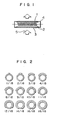
- Fig. 1 is a view showing the structure and action according to one embodiment of the present heat generator.
- Fig. 2 is a views showing various coating coverages of the present catalyst coating layer provided on the surface of a quartz tube.
- a slurry A 1,000 g of active alumina powder, 1,000 g of colloidal alumina containing 10% by weight of alumina, 100 g of aluminum nitrate nonahydrate, 1,000 g of colloidal silica containing 20% by weight of silica, 1,200 g of water, 30 g of chloroplatinic acid in terms of Pt, and 15 g of palladium chloride in terms of Pd were added to a ball mill and thoroughly mixed to prepare a slurry A.
- the thus prepared slurry A was applied to the surface of a quartz tube, 10 mm in outer diameter, 9 mm in inner diameter, 15 cm long, by spray coating, dried at 100°C for 2 hours and then fired at 500°C for one hour to obtain a quartz tube with a catalyst coating layer. From the thus prepared quartz tube, a nichrome wire as an electric resistor and an insulator was prepared a heat generator A of the present invention.
- the amount of the catalyst coating layer was 0.2 g, the amounts of the platinum group metals contained were 5.12 mg of Pt and 2.56 mg of Pd.
- the present heat generator had the structure shown in Fig. 1.
- the present heat generator A comprises a nichrome wire 1 of 300 W, a quartz tube 2 and a catalyst coating layer 3 formed on the surface of the quartz tube 3, the heat generator A being insulated and supported by insulators 4.
- the catalyst coating layer is provided to cover the entire periphery of the quartz tube 2, and thus the catalyst coating layer 3 is irradiated with the heat rays emitted from the nichrome wire 1 in all the radial directions, and the radiation heating of the catalyst coating layer 3 can be efficiently carried out.
- the catalyst is heated to the activation temperature of the catalyst within a short time and the catalyst coating layer can be elevated to a high temperature.
- the heat generator A heats air around the heat generator A, and thus an air stream 5 is caused to circulate as a convention around the heat generator A.
- an air stream 5 contacts the catalyst coating layer heated to the activation temperature by heating of the nichrome wire 1 or is diffused into the catalyst coating layer, smells or noxious components contained in the air around the heat generator A, for example, carbon monoxide (CO) or ammonia (NH3) is purified by the catalytic action.
- CO carbon monoxide
- NH3 ammonia
- Example 1 Slurries were prepared in the same manner as in Example 1, except that the content of colloidal silica was changed between 1% and 60% by weight in terms of silica on the basis of total solid matters of slurry A prepared in Example 1, while correspondingly reducing the alumina content to make up for the silica increment, and heat generators each with 0.2 g of the catalyst coating layers formed on the entire outer surfaces of quartz tubes from the thus prepared individual slurries were prepared in the same manner as in Example 1. The thus prepared heat generators were subjected to a heat shock test to investigate the adhesion of the catalyst coating layers.
- the heat shock test was carried out by passing an electric current through the electric resistor contained in the quartz tube, setting the surface temperature at the center of the heat generator to intervals of 25°C, maintaining the heat generator at each interval for 10 minutes, and then dipping the heat generator into water at room temperature to investigate occurrence of peeling of the catalyst coating layer, and repeating the foregoing procedure until the peeling occurs, where the maximum temperature at which no peeling occurred was defined as a heat shock-resistant temperature.
- Table 1 The results are shown in Table 1.
- heat generators each with the same amount of the catalyst coating layers containing various contents of cerium oxide, as shown in Table 2, as that of the catalyst coating layer of Example 1, formed on the surfaces of quartz tubes, were prepared from the thus prepared slurries in the same manner as in Example 1. Results of heat resistance tests of the heat generators are shown in Table 2.
- the heat resistance test was carried out by firing the heat generator at 800°C in air for 50 hours and then determining CO purification efficiency of the fired heat generators.
- the CO purification efficiency was determined by placing the fired heat generator in a quartz tube, 15 mm in inner diameter, passing air containing 1,000 ppm CO therethrough at a space velocity of 10,000 hr ⁇ on the basis of the volume of the catalyst coating layer, while keeping the catalyst coating layer at 250°C, and measuring CO concentration of the outgoing air, thereby determining CO purification efficiency from the CO concentrations between the incoming air and the outgoing air.
- active alumina powder 1,000 g of wash coat binder containing 10% by weight of alumina, 100 g of aluminum nitrate nonahydrate, 1,000 g of colloidal silica containing 20% by weight of silica, 30 g of chloroplatinic acid in terms of Pt, 15 g of palladium chloride in terms of Pd, and various ratios of barium hydroxide and active alumina powder, sum total of the barium hydroxide in terms of barium oxide and the active alumina being 1,000 g, were added to a ball mill, and thoroughly mixed to prepare slurries containing various amounts of barium.
- heat generators each with the same amount of the catalyst coating layers containing various contents of barium oxide, as shown in Table 3, as that of the catalyst coating layer of Example 1, formed on the surfaces of quartz tubes, were prepared from the thus prepared slurries in the same manner as in Example 1. Results of heat resistance tests and heat shock tests of the heat generators are shown in Table 3. The heat resistance tests were carried out in the same manner as in Example 3 and the heat shock tests were carried out in the same manner as in Example 2.
- the heat resistance of the catalyst coating layers was improved by inclusion of barium oxide in the catalyst coating layers and good effects upon the heat shock resistance and CO purification efficiency were obtained particularly with a barium oxide content of 1 to 10% by weight.
- barium oxide source compounds capable of changing to barium oxide by thermal decomposition such as hydroxide, nitrate, etc. can be used besides the oxide.
- Table 3 Barium oxide content (wt %) Heat shock-resistance temperature (°C) CO purification efficiency (%) 0 700 82 0.5 700 84 0.8 700 86 0.9 700 92 1.5 700 92 2 700 92 5 700 92 8 700 92 10 700 92 11 625 92 12 500 92
- a heat generator with a catalyst coating layer containing 5% by weight of barium carbonate in terms of barium oxide was prepared in the same manner as in Example 4, except that the slurry contained barium carbonate in place of barium hydroxide.
- a heat generator with a catalyst coating layer containing 5% by weight of cerium oxide and 3% by weight of barium oxide was prepared in the same manner as in Examples 3 and 4 and subjected to the heat resistance test. The result is shown in Table 5 in comparison with those of Examples 3 and 4.
- Table 5 Barium oxide content (wt %) Cerium oxide content (wt %) CO purification efficiency (%) 0 8 90 8 0 92 3 5 95
- CO leakage from the heat generators was 10% with single barium oxide and 8% with single cerium oxide, whereas it was reduced to about one-half thereof, that is, 5%, with simultaneous use of the two components, as compared with single use of barium oxide or cerium oxide, and thus the heat resistance could be improved thereby.
- Example 2 Slurries were prepared in the same manner as in Example 1, except that the content of titanium oxide was changed between 0 and 35% by weight on the basis of total solid matters of slurry A prepared in Example 1, while correspondingly reducing the alumina content to make up for the titanium oxide increment, and heat generators each with 0.2 g of the catalyst layers formed on the entire surfaces of quartz tubes from the thus prepared individual slurries were prepared in the same manner as in Example 1.
- the thus prepared heat generators were subjected to an ammonia purification test and a heat shock test to investigate the adhesion of the catalyst coating layer. The results are shown in Table 6.
- Heat generators each with 0.2 g of catalyst coating layers formed on the defatted and cleaned outer surfaces of quartz tubes from the thus prepared slurries were prepared in the same manner as in Example 1.
- the catalyst coating layer became soft above main particle size of 9 ⁇ m, whereas below main particle sizes of 1 ⁇ m, the catalyst coating layer was liable to crack.
- the main particle size of particles in the slurry of the present invention is in a range of 1 to 9 ⁇ m.
- the platinum group metals were added to the present catalyst coating layer by adding the platinum group metal salts to the slurry A and applying the slurry A to the surface of a quartz tube, but an alumina-silica coating layer can be formed on the surface of a quartz tube without adding the platinum group metal salts to the slurry A, and then platinum group metals can be supported on the alumina-silica coating layer by dipping.
- the former procedure i.e. initial addition of platinum group metal salts to slurry A, is desirable because better catalytic properties can be obtained.
- the present heat generator can purify and remove smells or noxious gases such as cigarette smoke, etc. in the atmosphere, in which the heat generator is placed, by its catalytic action.
- the present heat generator can provide an agreeable heating atmosphere.
Landscapes
- Resistance Heating (AREA)
- Catalysts (AREA)
Claims (9)
- Wärmeerzeugungsvorrichtung umfassend ein einen elektrischen Widerstand an der Innenseite aufweisendes Quarzrohr (2) und eine Katalysatorbeschichtungslage (3), die durch Beschichten mit einer aktives Aluminiumoxid und/oder Aluminiumhydroxid, und ein Salz eines Metalls aus der Platingruppe auf der äußeren Oberfläche des Quarzrohrs (2) gefolgt von Trocknen und Brennen gebildet wird, dadurch gekennzeichnet, daß die Paste 6 bis 40 Gew.-% kolloidales Siliciumoxid, bestimmt als Siliciumoxid nach dem Brennen, enthält.
- Wärmeerzeugungsvorrichtung nach Anspruch 1, bei der die Katalysatorbeschichtungslage Bariumoxid oder Bariumkarbonat enthält.
- Wärmeerzeugungsvorrichtung nach Anspruch 2, bei der die Katalysatorbeschichtungslage 1 bis 10 Gew.-% Bariumkarbonat ausgedrückt durch Bariumoxid enthält.
- Wärmeerzeugungsvorrichtung nach einem der vorhergehenden Ansprüche, bei der die Katalysatorbeschichtungslage Ceroxid enthält.
- Wärmeerzeugungsvorrichtung nach Anspruch 4, bei der die Katalysatorbeschichtungslage 5 bis 30 Gew.-% des Ceroxids enthält.
- Wärmeerzeugungsvorrichtung nach einem der Ansprüche 1 bis 5, bei der die Katalysatorbeschichtungslage Titanoxid enthält.
- Wärmeerzeugungsvorrichtung nach Anspruch 6, bei der die Katalysatorlage 4 bis 30 Gew.-% des Titanoxids enthält.
- Wärmeerzeugungsvorrichtung nach Anspruch 1, bei der die Katalysatorbeschichtungslage mehr Umfangsfläche bedeckt, als eine Hälfte der äußeren Oberfläche des Quarzrohrs in Umfangsrichtung.
- Wärmeerzeugungsvorrichtung nach Anspruch 1, bei der die Katalysatorbeschichtungslage gebildet wird durch Aufbringen eines zumindest kolloidales Siliciumoxid, aktives Aluminiumoxid und/oder Aluminiumhydroxid und ein Salz eines Metalls aus der Platingruppe aufweisenden Paste mit eine mittlere Teilchengröße von 1 bis 9 µm aufweisenden Teilchen auf die äußere Oberfläche des den elektrischen Widerstand enthaltenden Quarzrohrs, gefolgt von Trocknen und Brennen.
Applications Claiming Priority (2)
| Application Number | Priority Date | Filing Date | Title |
|---|---|---|---|
| JP12485389 | 1989-05-18 | ||
| JP124853/89 | 1989-05-18 |
Publications (3)
| Publication Number | Publication Date |
|---|---|
| EP0398658A2 EP0398658A2 (de) | 1990-11-22 |
| EP0398658A3 EP0398658A3 (de) | 1991-03-27 |
| EP0398658B1 true EP0398658B1 (de) | 1994-08-10 |
Family
ID=14895716
Family Applications (1)
| Application Number | Title | Priority Date | Filing Date |
|---|---|---|---|
| EP90305239A Expired - Lifetime EP0398658B1 (de) | 1989-05-18 | 1990-05-15 | Katalytischer Wärmeerzeuger |
Country Status (5)
| Country | Link |
|---|---|
| US (1) | US5195165A (de) |
| EP (1) | EP0398658B1 (de) |
| JP (1) | JPH07123069B2 (de) |
| KR (1) | KR950008544B1 (de) |
| DE (1) | DE69011406T2 (de) |
Families Citing this family (26)
| Publication number | Priority date | Publication date | Assignee | Title |
|---|---|---|---|---|
| KR0130128B1 (ko) * | 1991-07-16 | 1998-04-09 | 다니이 아끼오 | 탈취용 발열체 |
| US5350927A (en) * | 1992-06-17 | 1994-09-27 | Mitech Scientific Corp. | Radiation emitting ceramic materials and devices containing same |
| US5472720A (en) * | 1992-06-17 | 1995-12-05 | Mitec Scientific Corporation | Treatment of materials with infrared radiation |
| DE4410484A1 (de) * | 1994-03-25 | 1995-05-04 | Daimler Benz Ag | Heizeinrichtung |
| AT406612B (de) * | 1997-06-20 | 2000-07-25 | Herbert Wallner | Einrichtung zum trocknen einer auf einer oberfläche aufgetragenen schicht |
| RU2121626C1 (ru) * | 1998-04-03 | 1998-11-10 | Ванцов Валерий Матвеевич | Стерилизатор-обогреватель |
| RU2121625C1 (ru) * | 1998-04-03 | 1998-11-10 | Ванцов Валерий Матвеевич | Электропечь |
| CA2240214A1 (en) | 1998-05-05 | 1999-11-05 | James Thomas Beck | Process for the production of hydrogen by solar decomposition of water |
| RU2139135C1 (ru) * | 1998-06-04 | 1999-10-10 | Институт катализа им.Г.К.Борескова СО РАН | Каталитический реактор и способ осуществления сильно экзотермических реакций |
| US6863864B1 (en) * | 1998-12-30 | 2005-03-08 | Us Sterlizer Corp. | Method and apparatus for infrared sterilization |
| MXPA03002305A (es) * | 2000-09-18 | 2003-10-15 | Rothmans Benson & Hedges | Cigarros que generan poco humo de flujo lateral, elaborados con papel combustible. |
| ATE357163T1 (de) * | 2001-02-10 | 2007-04-15 | Wella Ag | Warmluftgerät |
| CN1555434A (zh) | 2001-09-13 | 2004-12-15 | �ָ��š���ɭ������˹����˾ | 锆/金属氧化物纤维 |
| MXPA04008980A (es) * | 2002-03-15 | 2004-11-26 | Rothmans Benson & Hedges | Cigarrillo de humo de corriente lateral baja con papel de combustible que tiene caracteristicas modificadas de ceniza. |
| GB0214038D0 (en) | 2002-06-19 | 2002-07-31 | Ceramaspeed Ltd | Electric heating element |
| JP2005140459A (ja) * | 2003-11-10 | 2005-06-02 | Osada Giken Co Ltd | 家電用ヒーターユニット |
| US20060032846A1 (en) * | 2004-07-27 | 2006-02-16 | Dieter Haas | Infrared heating element and a substrate type vacuum chamber, particularly for vacuum coating facilities |
| JP2006244781A (ja) * | 2005-03-01 | 2006-09-14 | Matsushita Electric Ind Co Ltd | 加熱装置 |
| US7747147B2 (en) * | 2005-11-02 | 2010-06-29 | Panasonic Corporation | Heating unit and heating apparatus |
| US8242045B2 (en) * | 2006-01-12 | 2012-08-14 | Siemens Energy, Inc. | Ceramic wash-coat for catalyst support |
| US20100090794A1 (en) * | 2006-08-25 | 2010-04-15 | Abb Technology Ltd. | A resistor for electric high-voltage apparatus and a method of mounting a resistor |
| JP3175257U (ja) * | 2012-02-16 | 2012-04-26 | 株式会社クレイツ | ヘアドライヤー |
| JP2015532770A (ja) * | 2012-08-30 | 2015-11-12 | クワンタム・テクノロジー・グループ・(シンガポール)・プライベート・リミテッド | 電気発熱素子 |
| DE102014117199B4 (de) * | 2014-11-24 | 2021-06-02 | Heraeus Noblelight Gmbh | Verfahren zur Herstellung eines Reflektors auf einem Reflektor-Basiskörper aus Glas |
| JP5824689B1 (ja) * | 2014-12-05 | 2015-11-25 | 原田 斎 | 輻射ヒーター |
| US10405630B2 (en) * | 2016-07-29 | 2019-09-10 | Spur Concepts Inc | Systems and methods for delivering heat in a battery powered blow dryer |
Family Cites Families (18)
| Publication number | Priority date | Publication date | Assignee | Title |
|---|---|---|---|---|
| US3179789A (en) * | 1963-08-26 | 1965-04-20 | Joseph A Gialanella | Radiant energy generating and distributing apparatus |
| FR1381506A (fr) * | 1963-10-29 | 1964-12-14 | Perfectionnements aux tubes infra-rouges | |
| US3362783A (en) * | 1963-12-23 | 1968-01-09 | Texaco Inc | Treatment of exhaust gases |
| DE1615334A1 (de) * | 1967-08-26 | 1970-10-08 | Inst Schienenfahrzeuge | Hochspannungsheizelement |
| US3779710A (en) * | 1971-03-22 | 1973-12-18 | Smokontrol Corp | Air cleaning apparatus |
| US3930796A (en) * | 1973-09-13 | 1976-01-06 | Universal Oil Products Company | Catalytic fume control device |
| US4023928A (en) * | 1973-09-13 | 1977-05-17 | Uop Inc. | Catalytic fume control device |
| DE2745188C3 (de) * | 1977-10-07 | 1980-05-08 | Deutsche Gold- Und Silber-Scheideanstalt Vormals Roessler, 6000 Frankfurt | Geformter Katalysator, Verfahren zu seiner Herstellung und Verwendung |
| DE2837004A1 (de) * | 1978-08-24 | 1980-03-06 | Bernstein Lennart | Verfahren und heizungskessel zum erwaermen des heizwassers in einer warmwasser-zentralheizungsanlage, insbesondere fuer ein- und mehrfamilienwohnhaeuser |
| AU529792B2 (en) * | 1980-07-09 | 1983-06-23 | Matsushita Electric Industrial Co., Ltd. | Infrared radiative body |
| JPS5784584A (en) * | 1980-11-14 | 1982-05-26 | Hitachi Netsu Kigu Kk | Heater with oxide catalyst |
| FR2556547B1 (fr) * | 1983-12-12 | 1986-09-05 | Acir | Generateur electrique perfectionne de rayons infrarouges constituant epurateur d'atmosphere |
| JPH0754695B2 (ja) * | 1987-05-07 | 1995-06-07 | ウシオ電機株式会社 | ヒ−タランプ |
| JPS63182090U (de) * | 1987-05-14 | 1988-11-24 | ||
| JPS63292591A (ja) * | 1987-05-26 | 1988-11-29 | Toshiba Corp | 赤外線ヒ−タ |
| JPS6427887U (de) * | 1987-08-04 | 1989-02-17 | ||
| JPH0762999B2 (ja) * | 1987-09-18 | 1995-07-05 | ウシオ電機株式会社 | 遠赤外線ヒータランプの製造方法 |
| JPH07123068B2 (ja) * | 1989-03-08 | 1995-12-25 | 松下電器産業株式会社 | 管状ヒータおよびその製造方法 |
-
1990
- 1990-04-24 JP JP2108424A patent/JPH07123069B2/ja not_active Expired - Lifetime
- 1990-05-15 DE DE69011406T patent/DE69011406T2/de not_active Expired - Fee Related
- 1990-05-15 US US07/523,423 patent/US5195165A/en not_active Expired - Lifetime
- 1990-05-15 EP EP90305239A patent/EP0398658B1/de not_active Expired - Lifetime
- 1990-05-16 KR KR1019900007004A patent/KR950008544B1/ko not_active Expired - Fee Related
Also Published As
| Publication number | Publication date |
|---|---|
| KR900019530A (ko) | 1990-12-24 |
| JPH07123069B2 (ja) | 1995-12-25 |
| US5195165A (en) | 1993-03-16 |
| EP0398658A3 (de) | 1991-03-27 |
| EP0398658A2 (de) | 1990-11-22 |
| DE69011406T2 (de) | 1995-03-16 |
| DE69011406D1 (de) | 1994-09-15 |
| JPH0374074A (ja) | 1991-03-28 |
| KR950008544B1 (ko) | 1995-07-31 |
Similar Documents
| Publication | Publication Date | Title |
|---|---|---|
| US5195165A (en) | Quartz tube heat generator with catalytic coating | |
| KR960007587B1 (ko) | 촉매체 및 그 제조방법 | |
| EP0527349B1 (de) | Heizelement für Desodorierung | |
| US3804647A (en) | Porous glass supports for automotive emissions control catalysts | |
| JPH035851B2 (de) | ||
| JP7344505B2 (ja) | Voc処理用触媒の製造方法 | |
| JPH01227951A (ja) | Coセンサ | |
| US4414139A (en) | Catalyst carriers for purification of waste gas and process for preparing the same | |
| JP2517158B2 (ja) | 発熱体 | |
| US4719197A (en) | Process for making a carrier-supported catalyst | |
| JP3270072B2 (ja) | 燃焼用触媒 | |
| JPS5835095B2 (ja) | 燃焼器用触媒体 | |
| EP0261275A1 (de) | Element zur Feststellung von Wasserstoffgas und Verfahren zu dessen Herstellung | |
| JPS58183948A (ja) | 高温燃焼触媒 | |
| JPH07106318B2 (ja) | 発熱体 | |
| JP2542518B2 (ja) | 熱線放射用触媒担体 | |
| JPH05339050A (ja) | マイクロ波吸収発熱体 | |
| JPS61271033A (ja) | 排ガス浄化用触媒担体の製造方法 | |
| JPS6377542A (ja) | 灯油系燃料の燃焼用触媒体 | |
| JPH082408B2 (ja) | ディーゼルパティキュレート捕集用フィルタ | |
| JPH0545294B2 (de) | ||
| JPH0448182A (ja) | 冷蔵庫 | |
| JPS61230736A (ja) | 排ガス浄化用触媒体 | |
| JPH0594866A (ja) | 発熱体 | |
| JPS5845284B2 (ja) | ガス浄化用触媒体の製造法 |
Legal Events
| Date | Code | Title | Description |
|---|---|---|---|
| PUAI | Public reference made under article 153(3) epc to a published international application that has entered the european phase |
Free format text: ORIGINAL CODE: 0009012 |
|
| AK | Designated contracting states |
Kind code of ref document: A2 Designated state(s): DE FR GB |
|
| PUAL | Search report despatched |
Free format text: ORIGINAL CODE: 0009013 |
|
| 17P | Request for examination filed |
Effective date: 19901228 |
|
| AK | Designated contracting states |
Kind code of ref document: A3 Designated state(s): DE FR GB |
|
| 17Q | First examination report despatched |
Effective date: 19921120 |
|
| GRAA | (expected) grant |
Free format text: ORIGINAL CODE: 0009210 |
|
| AK | Designated contracting states |
Kind code of ref document: B1 Designated state(s): DE FR GB |
|
| REF | Corresponds to: |
Ref document number: 69011406 Country of ref document: DE Date of ref document: 19940915 |
|
| ET | Fr: translation filed | ||
| PLBE | No opposition filed within time limit |
Free format text: ORIGINAL CODE: 0009261 |
|
| STAA | Information on the status of an ep patent application or granted ep patent |
Free format text: STATUS: NO OPPOSITION FILED WITHIN TIME LIMIT |
|
| 26N | No opposition filed | ||
| REG | Reference to a national code |
Ref country code: GB Ref legal event code: IF02 |
|
| PGFP | Annual fee paid to national office [announced via postgrant information from national office to epo] |
Ref country code: GB Payment date: 20050511 Year of fee payment: 16 Ref country code: FR Payment date: 20050511 Year of fee payment: 16 |
|
| PGFP | Annual fee paid to national office [announced via postgrant information from national office to epo] |
Ref country code: DE Payment date: 20050512 Year of fee payment: 16 |
|
| PG25 | Lapsed in a contracting state [announced via postgrant information from national office to epo] |
Ref country code: GB Free format text: LAPSE BECAUSE OF NON-PAYMENT OF DUE FEES Effective date: 20060515 |
|
| PG25 | Lapsed in a contracting state [announced via postgrant information from national office to epo] |
Ref country code: DE Free format text: LAPSE BECAUSE OF NON-PAYMENT OF DUE FEES Effective date: 20061201 |
|
| GBPC | Gb: european patent ceased through non-payment of renewal fee |
Effective date: 20060515 |
|
| REG | Reference to a national code |
Ref country code: FR Ref legal event code: ST Effective date: 20070131 |
|
| PG25 | Lapsed in a contracting state [announced via postgrant information from national office to epo] |
Ref country code: FR Free format text: LAPSE BECAUSE OF NON-PAYMENT OF DUE FEES Effective date: 20060531 |