EP0387853B1 - Verfahren zur Entfernung von Arsen und/oder Antimon aus Lösungen, die Arsen und/oder Antimon als Anionische Fluorokomplexe enthalten - Google Patents
Verfahren zur Entfernung von Arsen und/oder Antimon aus Lösungen, die Arsen und/oder Antimon als Anionische Fluorokomplexe enthalten Download PDFInfo
- Publication number
- EP0387853B1 EP0387853B1 EP90104844A EP90104844A EP0387853B1 EP 0387853 B1 EP0387853 B1 EP 0387853B1 EP 90104844 A EP90104844 A EP 90104844A EP 90104844 A EP90104844 A EP 90104844A EP 0387853 B1 EP0387853 B1 EP 0387853B1
- Authority
- EP
- European Patent Office
- Prior art keywords
- antimony
- arsenic
- process according
- precipitation
- precipitation stage
- Prior art date
- Legal status (The legal status is an assumption and is not a legal conclusion. Google has not performed a legal analysis and makes no representation as to the accuracy of the status listed.)
- Expired - Lifetime
Links
Classifications
-
- C—CHEMISTRY; METALLURGY
- C02—TREATMENT OF WATER, WASTE WATER, SEWAGE, OR SLUDGE
- C02F—TREATMENT OF WATER, WASTE WATER, SEWAGE, OR SLUDGE
- C02F1/00—Treatment of water, waste water, or sewage
- C02F1/52—Treatment of water, waste water, or sewage by flocculation or precipitation of suspended impurities
- C02F1/5272—Treatment of water, waste water, or sewage by flocculation or precipitation of suspended impurities using specific organic precipitants
Definitions
- the invention relates to a process for removing arsenic and / or antimony from solutions which contain arsenic and / or antimony as anionic fluorocomplexes, in particular from acid polishing process water, rinse water and neutralization water from the lead crystal and crystal glass industry.
- arsenic trioxide As2O3
- / or antimony trioxide Sb2O3
- the mass fraction of the batch offset is usually less than 1%.
- Part of the arsenic or antimony used escapes from the glass melt as gaseous arsenic or antimony compounds; a mass fraction of approx. 0.2% remains firmly integrated in the glass matrix.
- Some of the arsenic or antimony can be released again in finishing processes in which the glass surface is processed. This is done, for example, in acid polishing, in which glass is treated with a mixture that contains 60 to 70 percent by weight sulfuric acid, 0.5 to 10 percent by weight hydrofluoric acid and the rest water, and partially redissolved.
- the object of the invention is to provide a method for separating arsenic and / or antimony from solutions which contain arsenic and / or antimony as anionic fluorocomplexes, which can be carried out economically and does not cause any new environmental or wastewater problems.
- the invention relates to a method for removing arsenic and / or antimony from solutions which contain arsenic and / or antimony as anionic fluorocomplexes, in particular from acid polishing process water and neutralization water from the lead crystal and crystal glass industry, which is characterized in that one or more water-soluble quaternary ammonium or phosphonium compounds are metered into the solution, which are usually used as cationic surfactants, ie precisely not as precipitation reagents , surprisingly, the negative fluoroarsenate and antimonations are precipitated, and the precipitated solids are separated.
- water-soluble means that the compounds are essentially molecularly dispersed in the water or form a colloid-like dispersion which allows a precipitation reaction.
- One or more water-soluble compounds of the formula are preferably used as precipitants MR4+ X ⁇ used where M is nitrogen or phosphorus, the radicals R are the same or different and straight-chain or branched alkyl having 1 to 30 carbon atoms, straight-chain or branched alkenyl with 2 to 30 C atoms, cycloalkyl, optionally alkyl-substituted aryl or optionally alkyl-substituted arylalkyl and X is an anion, preferably a halide (e.g. chloride or bromide), hydrogen sulfate, methyl sulfate, sulfate or hydroxide anion.
- a halide e.g. chloride or bromide
- radicals R are generally an alkyl group with 1 to 4 C atoms (preferably a methyl group) if a radical R has an alkyl or alkenyl group with more than 8 C atoms.
- Examples of straight-chain or branched alkyl are methyl, ethyl, isopropyl, t-butyl, capryl (C8), palmityl (C16) and melissyl (C30).
- Preferred alkyl radicals contain 1 to 24 carbon atoms.
- Examples of straight-chain or branched alkenyls are ethenyl, vinyl, isobutyl, palmitoleinyl (C16) and linolyl (C18).
- Preferred alkenyl radicals contain 2 to 12 carbon atoms.
- Examples of cycloalkyl are cyclopropyl, cyclopentyl, cyclohexyl and decalinyl.
- Preferred cycloalkyl radicals contain 5 to 10 carbon atoms.
- Examples of aryl are phenyl, naphthyl, phenanthryl (C14) and perylyl (C22).
- Preferred aryl radicals contain 6 to 14 carbon atoms.
- alkyl-substituted aryl means that the aryl radicals as previously defined are substituted with one or more alkyl radicals as defined above, preferably with alkyl radicals of 1 to 6 carbon atoms.
- Arylalkyl is an alkyl group as defined above which is substituted with one or more aryl radicals as defined above, e.g. B. benzyl, naphthylpropyl, phenanthrylcapryl.
- Aryl radicals having 6 to 14 carbon atoms and alkyl radicals having 1 to 6 carbon atoms are preferred.
- optionally alkyl-substituted arylalkyl means that the aryl radicals of the arylalkyl groups as previously defined are optionally substituted with one or more alkyl radicals as defined above, preferably with alkyl radicals of 1 to 6 carbon atoms.
- the invention relates to a two-stage process in which the process described above is coupled to a conventional precipitation process which removes arsenic and / or antimony oxo anions from waste water.
- a precipitation process which removes arsenic and / or antimony oxo anions from waste water.
- Such methods are described for example in DE-A-23 42 729, DE-A-36 33 066, EP-A-139 622, DD-C-54 950 and JP-A-61-68191.
- the precipitant described above is metered into the waste water to be treated. This can be done in solid form, but usually in the form of dilute or concentrated aqueous or alcoholic solution.
- the dosage depends on the proportion of 5-valent fluoroarsenate and / or antimonate in the wastewater, which is determined as follows:
- the total arsenic and / or antimony content of a sample is determined using ICP-AES (Induced Coupled-Plasma Atom Emission Spectroscopy, DIN 38 406, part 22, March 1988), the proportion of oxo anions of arsenic and / or antimony can be quantitatively demonstrated as arsine or stilbin (DIN 38405; part 12, June 1981 and DIN 38 405, part 18, September 1985).
- the difference between the two values is the proportion of fluoroarsenate and / or antimonate in the sample.
- the metering is then carried out with an at least stoichiometric amount with respect to the concentration thus determined, preferably with a 1.2 to 2 times stoichiometric amount and particularly preferably with a 1.5 times stoichiometric amount of the precipitant.
- an at least stoichiometric amount preferably a 1.2 to 2 times stoichiometric amount and particularly preferably a 1.5 times stoichiometric amount with respect to one can of course also be used Maximum experience of these two ions or, for safety reasons, the total arsenic and / or antimony are used.
- the metering takes place at the temperature which the wastewater has due to external conditions. It is possible in the entire pH range, e.g. B. can be added to the strongly acidic acid polish waste water or to an alkaline neutralizing water.
- the precipitant is advantageously metered in before it is neutralized, that is to say in a pH range ⁇ 2, preferably at pH ⁇ 0.
- the small-volume, sparingly soluble, high arsenic-containing precipitates thus obtained are separated off using any known method, e.g. by filtering and squeezing the filter cake, by settling and decanting or by centrifuging, and deposited as special waste. Wastewater and sludge from subsequent cleaning stages then no longer contain any dissolved or easily leachable fluoroarsenate and / or antimonate and generally do not have to be treated as special waste.
- the achievable degrees of purification in relation to the total arsenic and / or antimony concentration depend solely on treatment with the precipitants according to the invention on the proportion of oxo anions of arsenic and / or antimony, since these are not co-precipitated. If this is low, degrees of cleaning of up to more than 99% can be achieved.
- the fluoroarsenates and antimonates are advantageously first precipitated in the pH range ⁇ 2, preferably at pH ⁇ 0.
- the small-volume precipitation sludge is separated as special waste using a conventional method.
- a pH range above 2 preferably in the pH range from 2 to 4 and in particular from 2 to 3, by one of the methods mentioned above, preferably using an iron (III) compound such as iron (III) sulfate, the proportion of oxo anions of arsenic or antimony falls.
- This precipitate only contains poorly soluble iron (III) arsenite / antimonite and - arsenate / antimonate.
- other processes such as neutralization and lead precipitation (eg with CO2) can of course be carried out.
- the waste water is first neutralized, preferably to a pH of 6.5 to 9.5, and only then is the oxoanions of the arsenic and / or antimony precipitated salt with the help of iron (III).
- the water purified in this way can then be circulated in whole or in part and used for washing out any arsenic and / or antimony compounds which may have been precipitated during neutralization from the neutralization sludge.
- This variant offers itself as a solution for companies in which, for reasons of space, a 2-stage cleaning system cannot be installed between the acid polish and the existing neutralization.
- Another advantage of the wastewater treatment method described here is that the precipitation reactions take place quickly. This results in short dwell times for the wastewater in the reaction and settling tanks, which means that their dimensions can be kept small. In most cases, the necessary installations can therefore be easily integrated into existing systems.
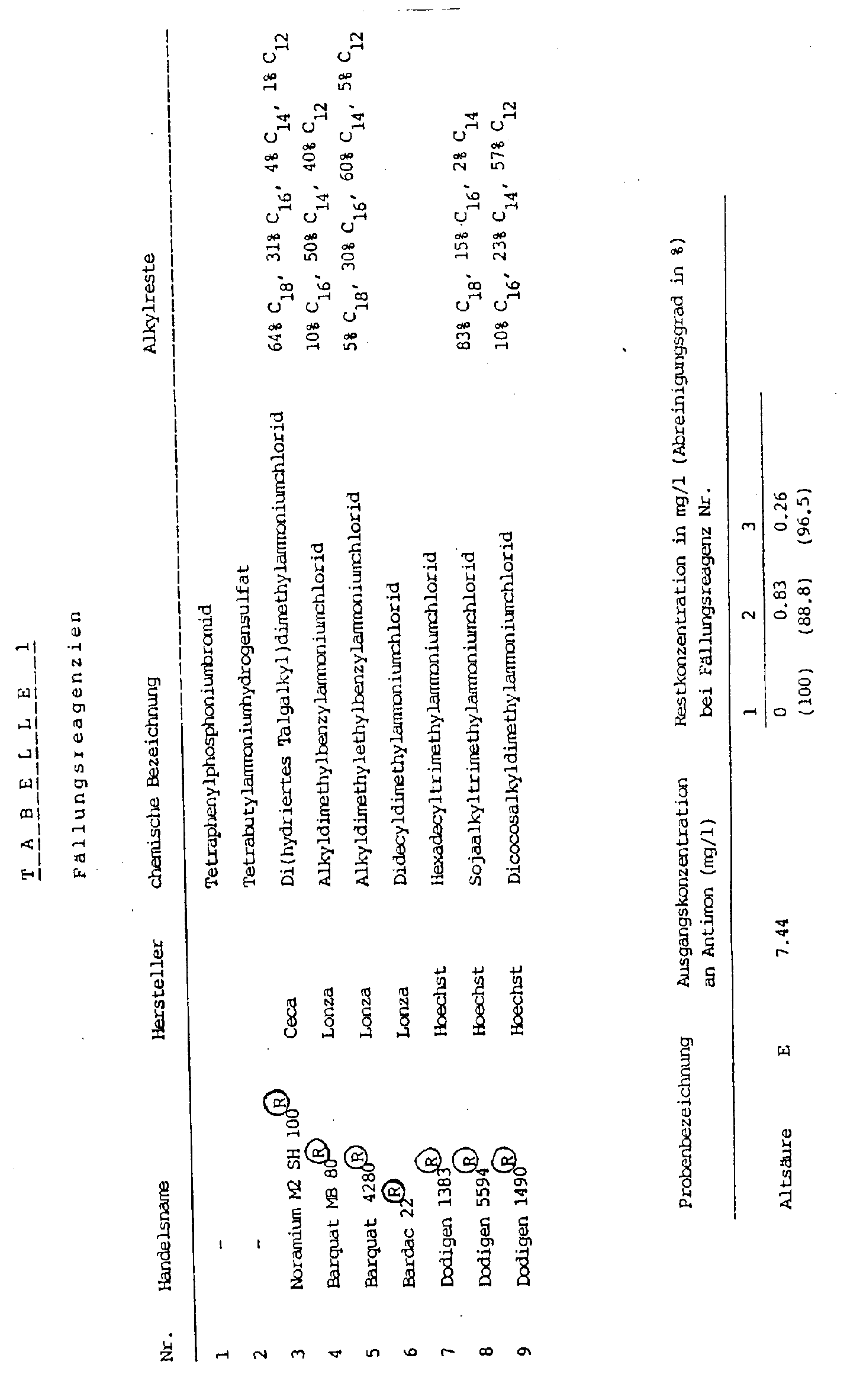
- Table 1 gives a comparative overview of the precipitation efficiency of some representative precipitation agents according to the invention in different samples containing arsenic and antimony.
- the initial total concentrations and the residual concentrations were determined using ICP-AES.
- the precipitants were added in a 1.5-fold stoichiometric amount with respect to the initial total concentration of arsenic and / or antimony in solid form or in the form of an aqueous or alcoholic solution.
- the pH was approximately neutral in experiments A, B and C, and strongly acidic in experiments D and E (pH ⁇ 0). After the precipitation had formed, the clear phase was decanted off.
- Table 2 shows the results of the embodiment of the process according to the invention, in which, in the case of various arsenic and antimony-containing solutions, in addition to the precipitation listed in Example 1, a further precipitation with iron (III) sulfate was carried out.
- the initial total concentrations and the residual concentrations were determined using ICP-AES.
- the precipitant for the fluoroarsenate and antimonations was compound 3 from Example 1. 1.5 times the stoichiometric amount, based on the initial total concentration of arsenic and / or antimony, was metered in as a solid.
- the pH was 7 to 8 in experiments F and G, and strongly acidic in experiments H, I and J (pH ⁇ 0). After the precipitation had formed, the clear phase was decanted off.
- the precipitant for the arsenic and / or antimony oxo anions was iron (III) sulfate [Fe2 (SO4) 3], which in a 50-fold stoichiometric amount with respect to the total initial concentration of arsenic and / or antimony in the form of a concentrated aqueous solution was added after the precipitation with compound 3 at a pH of 7 to 8 (tests F and G) or 2 to 4 (tests H, I, and J). After precipitation, the mixture was filtered.
Landscapes
- Life Sciences & Earth Sciences (AREA)
- Hydrology & Water Resources (AREA)
- Engineering & Computer Science (AREA)
- Environmental & Geological Engineering (AREA)
- Water Supply & Treatment (AREA)
- Chemical & Material Sciences (AREA)
- Organic Chemistry (AREA)
- Removal Of Specific Substances (AREA)
- Inorganic Compounds Of Heavy Metals (AREA)
- Steroid Compounds (AREA)
Description
- Die Erfindung betrifft ein Verfahren zum Entfernen von Arsen und/oder Antimon aus Lösungen, die Arsen und/oder Antimon als anionische Fluorokomplexe enthalten, insbesondere aus Säurepolitur-Betriebswässern, Spülwässern und Neutralisationswässern der Bleikristall- und Kristallglasindustrie.
- Bei der Bleikristallglas- und Kristallglasproduktion wird Arsentrioxid (As₂O₃) und/oder Antimontrioxid (Sb₂O₃) der Glasschmelze als Läutermittel zugesetzt. Der Massenanteil am Gemengeversatz liegt in der Regel bei weniger als 1 %. Ein Teil des eingesetzten Arsens oder Antimons entweicht aus der Glasschmelze als gasförmige Arsen- oder Antimonverbindungen; ein Massenanteil von ca. 0.2 % verbleibt aber fest in der Glasmatrix eingebunden. Das Arsen oder Antimon kann in Veredelungsprozessen, bei denen die Glasoberfläche bearbeitet wird, zum Teil wieder freigesetzt werden. Dies geschieht zum Beispiel in der Säurepolitur, bei der Glas mit einer Mischung, die 60 bis 70 Masseprozent Schwefelsäure, 0,5 bis 10 Masseprozent Flußsäure und den Rest Wasser enthält, behandelt und zum Teil wieder aufgelöst wird.
- Die Säurepoliturabwässer enthalten bis zu 450 mg/l Arsen und/oder Antimon, die wegen des hohen Fluoridgehalts dieser stark sauren Abwässer zumindest zu einem Teil als Fluoroarsenat bzw. Fluoroantimonat vorliegen. Zur Bildung dieser Komplexanionen siehe D. Naumann: Fluor und Fluorverbindungen; in: A. Schneider (Hrsg.): Spezielle anorganische Chemie in Einzeldarstellungen, Bd. 2, S. 64-75, Dr. Dietrich Steinkopff Verlag, Darmstadt, 1980. Diese Ionen werden auch in Spülwässer, mit denen die Glasgegenstände nach der Säurepolitur gespült werden, verschleppt.
- Insbesondere die Fluoroarsenate werden kaum hydrolysiert, siehe W. L. Lockhart et al., J. inorg. nucl. Chem. Bd. 31 (1969), S. 407 - 414. Bei der herkömmlichen Fällung der Oxo-anionen des Arsens und Antimons als Eisen(III)arsenit/at bzw. -antimonit/at oder von Arsen und Antimon als Sulfide werden sie nicht mitgefällt, weshalb mit diesen Methoden bei den genannten Abwässern nur Abreinigungsgrade ([Anfangskonzentration-Endkonzentration]/Anfangskonzentration) von 0 - 10 % erreicht werden. In der Novellierung der 41. Abwasserverwaltungsvorschrift für saure fluoridhaltige Abwässer sind im Gegensatz zu nicht fluoridhaltigen Abwässern aus dem Bereich der Schleifereinur deshalb keine Grenzwerte für Arsen und Antimon genannt, weil für diese schwer fällbaren Anionen noch keine Vermeidungstechnologie existiert. Für die nächste Novellierung ist aber ein Grenzwert von 0,3 mg Arsen bzw. Antimon pro Liter vorgesehen.
- Auch die großvolumigen, feuchten Neutralisationsschlämme dieser Abwässer enthalten leicht auszulaugende Arsen und/oder Antimonverbindungen, deren Konzentrationen so hoch sind, daß eine teure Entsorgung als Sondermüll erforderlich ist. Es besteht also in diesem Bereich sowohl aus ökologischer als auch aus ökonomischer Sicht ein dringender Bedarf an einem Verfahren zur Entfernung von Arsen und Antimon aus fluoridhaltigen Abwässern.
- In Chemical Abstracts, Band 79, 1973, Seite 459, Nr. 111411k, wird über die Löslichkeit und Trennung von Cäsium-, Kalium- und Rubidiumhexafluorophosphat und -arsenat berichtet.
- Aufgabe der Erfindung ist es, ein Verfahren zum Abtrennen von Arsen und/oder Antimon aus Lösungen, die Arsen und/oder Antimon als anionische Fluorokomplexe enthalten, zu schaffen, das wirtschaftlich durchführbar ist und keine neuen Umwelt- bzw. Abwasserprobleme verursacht.
- Gegenstand der Erfindung ist ein Verfahren zum Entfernen von Arsen und/oder Antimon aus Lösungen, die Arsen und/oder Antimon als anionische Fluorokomplexe enthalten, insbesondere aus Säurepolitur-Betriebswässern und Neutralisationswässern der Bleikristall- und Kristallglasindustrie, das dadurch gekennzeichnet ist, daß man der Lösung eine oder mehrere wasserlösliche quartäre Ammonium- oder Phosphoniumverbindungen zudosiert, wobei durch diese, die üblicherweise als kationische Tenside, d. h. gerade nicht als Fällungsreagenzien, eingesetzt werden, überraschenderweise die negativen Fluoroarsenat- und -antimonationen ausgefällt werden, und die ausgefällten Feststoffe abtrennt.
- Wasserlöslich bedeutet in diesem Zusammenhang, daß die Verbindungen im wesentlichen molekulardispers im Wasser verteilt sind oder eine kolloidähnliche Dispersion bilden, die eine Fällungreaktion gestattet.
- Als Fällungsmittel werden vorzugsweise eine oder mehrere wasserlösliche Verbindungen der Formel

M Stickstoff oder Phosphor ist,
die Reste R gleich oder verschieden sind und geradkettiges
oder verzweigtes Alkyl mit 1 bis 30 C-Atomen, geradkettiges
oder verzweigtes Alkenyl mit 2 bis 30 C-Atomen, Cycloalkyl,
gegebenenfalls Alkyl-substituiertes Aryl oder
gegebenenfalls Alkyl-substituiertes Arylalkyl bedeuten
und
X ein Anion ist, vorzugsweise ein Halogenid- (z. B. Chlorid oder Bromid), Hydrogensulfat-, Methylsulfat-, Sulfat- oder Hydroxidanion. - In Hinblick auf die erforderliche Wasserlöslichkeit dieser Verbindungen sind im allgemeinen mindestens 2 Reste R eine Alkylgruppe mit 1 bis 4 C-Atomen (vorzugsweise eine Methylgruppe), wenn ein Rest R eine Alkyl- oder Alkenylgruppe mit mehr als 8 C-Atomen aufweist.
- Beispiele für geradkettiges oder verzweigtes Alkyl sind Methyl, Ethyl, Isopropyl, t-Butyl, Capryl (C₈), Palmityl (C₁₆) und Melissyl (C₃₀). Bevorzugte Alkylreste enthalten 1 bis 24 C-Atome.
Beispiele für geradkettige oder verzweigte Alkenyle sind Ethenyl, Vinyl, iso-Butenyl, Palmitoleinyl (C₁₆) und Linolyl (C₁₈). Bevorzugte Alkenylreste enthalten 2 bis 12 C-Atome.
Beispiele für Cycloalkyl sind Cyclopropyl, Cyclopentyl, Cyclohexyl und Decalinyl. Bevorzugte Cycloalkylreste enthalten 5 bis 10 C-Atome.
Beispiele für Aryl sind Phenyl, Naphthyl, Phenanthryl (C₁₄) und Perylyl (C₂₂). Bevorzugte Arylreste enthalten 6 bis 14 C-Atome. Gegebenefalls Alkyl-substituiertes Aryl bedeutet, daß die wie vorher definierte Arylreste mit einem oder mehreren wie oben definierten Alkylresten substituiert sind, vorzugsweise mit Alkylresten von 1 bis 6 C-Atomen.
Arylalkyl ist eine wie oben definierte Alkylgruppe, die mit einem oder mehreren wie oben definierten Arylresten substituiert ist, z. B. Benzyl, Naphthylpropyl, Phenanthrylcapryl. Bevorzugt sind Arylreste mit 6 bis 14 C-Atomen und Alkylreste mit 1 bis 6 C-Atomen. Gegebenenfalls Alkyl-substituiertes Arylalkyl bedeutet, daß die wie vorher definierten Arylreste der Arylalkylgruppen gegebenenfalls mit einem oder mehreren wie oben definierten Alkylresten substituiert sind, vorzugsweise mit Alkylresten von 1 bis 6 C-Atomen. - In einer weiteren Ausführungsform betrifft die Erfindung ein zweistufiges Verfahren, bei dem das oben beschrieben Verfahren mit einem herkömmlichen Fällungsverfahren gekoppelt wird, das Arsen- und/oder Antimon-Oxoanionen aus Abwässern entfernt. Solche Verfahren sind zum Beispiel in DE-A-23 42 729, DE-A-36 33 066, EP-A-139 622 , DD-C-54 950 und JP-A-61-68191 beschrieben.
- Im erfindungsgemäßen Verfahren wird dem zu behandelnden Abwasser das oben beschrieben Fällungsmittel zudosiert. Dies kann in fester Form, üblicherweise jedoch in Form verdünnter oder konzentrierter wässriger oder alkoholischer Lösung erfolgen. Die Dosierung richtet sich im Prinzip nach dem Anteil an 5-wertigem Fluoroarsenat und/oder -antimonat im Abwasser, der wie folgt ermittelt wird: Der Gesamtarsen- und/oder -antimongehalt einer Probe wird mittels ICP-AES (Induced Coupled-Plasma Atom Emission Spectroscopy, DIN 38 406, Teil 22, März 1988) bestimmt, der Anteil an Oxoanionen des Arsens und/oder Antimons kann als Arsin bzw. Stilbin quantitativ nachgewiesen werden (DIN 38405; Teil 12, Juni 1981 und DIN 38 405, Teil 18, September 1985). Die Differenz der beiden Werte ist der Anteil an Fluoroarsenat und/oder -antimonat in der Probe. Die Zudosierung erfolgt dann mit einer bezüglich der so ermittelten Konzentration mindestens stöchiometrischen Menge, vorzugsweise mit einer 1.2- bis 2-fachen stöchiometrischen Menge und besonders bevorzugt mit einer 1.5-fachen stöchiometrische Menge des Fällungsmittels.
- Da in der Praxis die jeweilige Bestimmung des Anteils an Fluoroarsenat und/oder -antimonat aufwendig ist, kann natürlich auch eine mindestens stöchiometrische Menge, vorzugsweise eine 1.2- bis 2-fache stöchiometrische Menge und besonders bevorzugt eine 1.5-fache stöchiometrische Menge in Bezug auf einen Erfahrungshöchstwert dieser beiden Ionen oder, aus Sicherheitsgründen bevorzugt, des Gesamt-Arsens und/oder -Antimons eingesetzt werden.
- Die Zudosierung erfolgt bei der Temperatur, die die Abwässer durch äußere Gegebenheiten aufweisen. Sie ist im gesamten pH-Bereich möglich, z. B. kann zum stark sauren Säurepoliturabwasser oder zu einem alkalischen Neutralisationswasser zudosiert werden.
- Bei Säurepoliturabwässern erfolgt die Zudosierung des Fällungsmittels vorteilhafterweise vor dessen Neutralisation, also in einem pH-Bereich < 2, vorzugsweise bei pH ≦ 0.
- Die so erhaltenen, kleinvolumigen, schwerlöslichen, stark Arsen-haltigen Niederschläge werden mit einer beliebigen bekannten Methode abgetrennt, z.B. durch Abfiltrieren und Auspressen des Filterkuchens, durch Absetzenlassen und Abdekantieren oder durch Abzentrifugieren, und als Sondermüll deponiert. Abwässer und Schlämme aus nachfolgenden Reinigungsstufen enthalten dann kein gelöstes bzw. leicht auslaugbares Fluoroarsenat und/oder -antimonat mehr und müssen in der Regel nicht als Sondermüll behandelt werden.
- Die erreichbaren Abreinigungsgrade in Bezug auf die Gesamt-Arsen- und/oder -Antimonkonzentration hängen bei einer alleinigen Behandlung mit den erfindungsgemäßen Fällungsmitteln vom Anteil an Oxoanionen des Arsens und/oder Antimons ab, da diese nicht mitgefällt werden. Falls dieser gering ist, können damit Abreinigungsgrade bis zu mehr als 99% erreicht werden.
- Bei der 2-stufigen Verfahrensweise, die das Verfahren zur Fällung von Fluoroarsenat und -antimonat mit einem herkömmlichen Verfahren zur Fällung von Oxoanionen des Arsens und Antimons koppelt, fällt man vorteilhafterweise zuerst die Fluoroarsenate und -antimonate im pH-Bereich < 2, bevorzugt bei pH ≦ 0. Der kleinvolumige Fällungsschlamm wird mit einer herkömmlichen Methode abgetrennt als Sondermüll entsorgt. Dann wird in einem pH-Bereich oberhalb von 2, bevorzugt im pH-Bereich von 2 bis 4 und insbesondere von 2 bis 3, nach einer der oben erwähnten Methoden, vorzugsweise mit einer Eisen(III)-Verbindung wie Eisen(III)sulfat, der Anteil an Oxoanionen des Arsens bzw. Antimons gefällt. Dieser Niederschlag enthält nur noch schwerlösliches Eisen(III)arsenit/antimonit und - arsenat/antimonat. Im Anschluß an die 2-stufige Arsen/Antimon-Ausfällung können natürlich weitere Verfahren, wie Neutralisation und Bleifällung (z. B. mit CO₂), durchgeführt werden.
- In einer weiteren Variante des 2-stufigen Verfahrens neutralisiert man zunächst nach der Fällung der Fluoroarsenate und/oder -antimonate das Abwasser, vorzugsweise auf einen pH-Wert von 6.5 bis 9.5, und führt erst anschließend die Fällung der Oxoanionen des Arsens und/oder Antimons mit Hilfe von Eisen(III)salzen durch. Das so gereinigte Wasser kann dann ganz oder teilweise im Kreislauf geführt und zum Auswaschen eventuell bei der Neutralisation mitgefällter Arsen- und/oder Antimonverbindungen aus dem Neutralisationsschlamm verwendet werden. Diese Variante bietet sich als Lösung für solche Betriebe an, bei denen aus Platzgründen keine 2-stufige Reinigungsanlage zwischen Säurepolitur und bestehender Neutralisation installiert werden kann.
- Mit diesem 2-stufigen Fällungsverfahren sind sehr hohe Abreinigungsgrade bezüglich Gesamt-Arsen und/oder -Antimon erreichbar. Die Restkonzentrationen liegen unter 0.5 mg/l, in den günstigsten Fällen um 0.05 mg/l.
- Ein weiterer Vorteil der hier beschriebenen Abwasserbehandlungsmethode ist, daß die Fällungsreaktionen rasch ablaufen. Daraus ergeben sich kurze Verweilzeiten des Abwassers in den Reaktions- und Absetzbecken, wodurch deren Abmessungen klein gehalten werden können. Daher lassen sich die notwendigen Installationen in den meisten Fällen problemlos in bestehende Anlagen integrieren.
- Mit dem erfindungsgemäßen Verfahren wird also erstmals eine effiziente Reinigung von Fluoroarsenat- und/oder -antimonat-haltigen Abwässern erreicht, die wirtschaftlich vorteilhaft ist, da die erfindungsgemäßen Fällungsmittel zum großen Teil preisgünstige, in großem Maßstab hergestellte quartäre kationische Tenside darstellen.
- In den folgenden Beispielen wird die Erfindung noch näher erläutert.
- Tabelle 1 gibt einen vergleichenden Überblick über die Fällungseffizienz einiger repräsentativer erfindungsgemäßer Fällungsmittel in verschiedenen Arsen- und Antimonhaltigen Proben.
- Die anfänglichen Gesamtkonzentrationen sowie die Restkonzentrationen wurden mit ICP-AES ermittelt. Die Fällungsmittel wurden in 1.5-facher stöchiometrischer Menge bezüglich der anfänglichen Gesamtkonzentration an Arsen und/oder Antimon in fester Form oder in Form einer wäßrigen oder alkoholischen Lösung zudosiert. Der pH-Wert war bei den Versuchen A, B und C annähernd neutral, bei den Versuchen D und E stark sauer (pH ≦ 0). Nach Niederschlagsbildung wurde die Klarphase abdekantiert.
- Die Anteile an Oxoanionen des Arsens und Antimons wurden nicht bestimmt und waren somit, außer bei KAsF₆, wo sie praktisch gleich Null sind, nicht bekannt. Die Restkonzentrationen bei KAsF₆ lassen den Schluß zu, daß die gemessene Gesamt-Restkonzentration bei den übrigen zu reinigenden Lösungen überwiegend bis praktisch ausschließlich auf Oxoanionen des Arsens und/oder Antimons zurückzuführen ist. Bezüglich der Fluorarsenat- und/oder -antimonatkonzentration wird also ein hoher Abreinigungsgrad [(Ausgangskonzentration - Endkonzentration)/Ausgangskonzentration] erreicht.

- In Tabelle 2 sind die Ergebnisse der Ausführungsform des erfinderischen Verfahrens dargestellt, in der bei verschiedenen Arsen- und Antimon-haltigen Lösungen zusätzlich zu der in Beispiel 1 aufgeführten Fällung eine weitere Fällung mit Eisen(III)sulfat durchgeführt wurde.
- Die anfänglichen Gesamtkonzentrationen sowie die Restkonzentrationen wurden mit ICP-AES ermittelt. Das Fällungsmittel für die Fluoroarsenat- und -antimonationen war die Verbindung 3 aus Beispiel 1. Es wurde in 1.5-facher stöchiometrischer Menge bezüglich der anfänglichen Gesamtkonzentration an Arsen und/oder Antimon als Feststoff zudosiert. Der pH-Wert war bei den Versuchen F und G 7 bis 8, bei den Versuchen H, I und J stark sauer (pH ≦ 0). Nach Niederschlagsbildung wurde die Klarphase abdekantiert.
- Das Fällungsmittel für die Arsen- und/oder Antimon-Oxoanionen war Eisen(III)sulfat [Fe₂(SO₄)₃], das in 50-facher stöchiometrischer Menge in Bezug auf die Gesamt-Ausgangskonzentration an Arsen und/oder Antimon in Form einer konzentrierten wäßrigen Lösung im Anschluß an die Fällung mit Verbindung 3 bei einem pH Wert von 7 bis 8 (Versuche F und G) bzw. 2 bis 4 (Versuche H, I, und J) zudosiert wurde. Nach Niederschlagsbildung wurde filtriert.

Claims (10)

M Stickstoff oder Phosphor ist,
die Reste R gleich oder verschieden sind und geradkettiges oder verzweigtes Alkyl mit 1 bis 30 C-Atomen, geradkettiges oder verzweigtes Alkenyl mit 2 bis 30 C-Atomen, Cycloalkyl, gegebenenfalls Alkyl-substituiertes Aryl oder gegebenenfalls Alkyl-substituiertes Arylalkyl bedeuten und
X ein Anion ist.
Priority Applications (1)
| Application Number | Priority Date | Filing Date | Title |
|---|---|---|---|
| AT90104844T ATE73115T1 (de) | 1989-03-15 | 1990-03-14 | Verfahren zur entfernung von arsen und/oder antimon aus loesungen, die arsen und/oder antimon als anionische fluorokomplexe enthalten. |
Applications Claiming Priority (2)
| Application Number | Priority Date | Filing Date | Title |
|---|---|---|---|
| DE3908491A DE3908491A1 (de) | 1989-03-15 | 1989-03-15 | Verfahren zur entfernung von arsen und/oder antimon aus loesungen, die arsen und/oder antimon als anionische fluorokomplexe enthalten |
| DE3908491 | 1989-03-15 |
Publications (2)
| Publication Number | Publication Date |
|---|---|
| EP0387853A1 EP0387853A1 (de) | 1990-09-19 |
| EP0387853B1 true EP0387853B1 (de) | 1992-03-04 |
Family
ID=6376422
Family Applications (1)
| Application Number | Title | Priority Date | Filing Date |
|---|---|---|---|
| EP90104844A Expired - Lifetime EP0387853B1 (de) | 1989-03-15 | 1990-03-14 | Verfahren zur Entfernung von Arsen und/oder Antimon aus Lösungen, die Arsen und/oder Antimon als Anionische Fluorokomplexe enthalten |
Country Status (4)
| Country | Link |
|---|---|
| EP (1) | EP0387853B1 (de) |
| AT (1) | ATE73115T1 (de) |
| DE (2) | DE3908491A1 (de) |
| ES (1) | ES2033552T3 (de) |
Families Citing this family (2)
| Publication number | Priority date | Publication date | Assignee | Title |
|---|---|---|---|---|
| WO1994006716A1 (en) * | 1992-09-17 | 1994-03-31 | Allied-Signal Inc. | Process for converting hexafluoroarsenic acid or any salt thereof to a water insoluble arsenate salt which can then be rendered nonhazardous |
| DE102013206066A1 (de) | 2013-04-05 | 2014-10-09 | Cornelsen Solutions GmbH | Verfahren zur Abtrennung fluorierter organischer Verbindungen aus kontaminierten Fluiden und hierfür verwendetes Adsorbens-Kit |
Family Cites Families (7)
| Publication number | Priority date | Publication date | Assignee | Title |
|---|---|---|---|---|
| DE1043284B (de) * | 1955-05-06 | 1958-11-13 | Bergwerksverband Gmbh | Verfahren zur Verbesserung der Filtrierbarkeit von Trueben |
| DE2063939B2 (de) * | 1970-12-28 | 1979-03-01 | Henkel Kgaa, 4000 Duesseldorf | Koagulationshilfsmittel für die Wasseraufbereitung |
| DE2342729C2 (de) * | 1973-08-24 | 1975-09-11 | Duisburger Kupferhuette, 4100 Duisburg | Verfahren zur Ausfällung und Abtrennung von Arsen aus kupferhaltigen Lösungen |
| IT1031430B (it) * | 1975-02-03 | 1979-04-30 | Fusco R | Metodo per la purificazione di acque di scarico contenent i composti organici di carattere anionico |
| SE452307B (sv) * | 1983-09-12 | 1987-11-23 | Boliden Ab | Forfarande for rening av fororenade vattenlosningar innehallande arsenik och/eller fosfor |
| DE3633066C2 (de) * | 1986-09-29 | 1993-12-02 | Fraunhofer Ges Forschung | Verfahren zum Entfernen von Arsen aus Prozeßwässern der Glasindustrie |
| DE3637643A1 (de) * | 1986-11-05 | 1988-05-11 | Ernst Prof Dr Bayer | Methode zur arsen-dekontamination von waessrigen loesungen |
-
1989
- 1989-03-15 DE DE3908491A patent/DE3908491A1/de active Granted
-
1990
- 1990-03-14 EP EP90104844A patent/EP0387853B1/de not_active Expired - Lifetime
- 1990-03-14 DE DE9090104844T patent/DE59000054D1/de not_active Expired - Lifetime
- 1990-03-14 ES ES199090104844T patent/ES2033552T3/es not_active Expired - Lifetime
- 1990-03-14 AT AT90104844T patent/ATE73115T1/de not_active IP Right Cessation
Also Published As
| Publication number | Publication date |
|---|---|
| DE3908491A1 (de) | 1990-09-20 |
| ATE73115T1 (de) | 1992-03-15 |
| EP0387853A1 (de) | 1990-09-19 |
| DE3908491C2 (de) | 1993-04-29 |
| DE59000054D1 (de) | 1992-04-09 |
| ES2033552T3 (es) | 1993-03-16 |
Similar Documents
| Publication | Publication Date | Title |
|---|---|---|
| DE69613210T2 (de) | Verfahren zum Behandeln von Fluor Ion enthaltenden Abwässern durch koagulierende Sedimentation | |
| DE2447323A1 (de) | Wiedergewinnung von metallen aus abfallschlaemmen | |
| DE2240549A1 (de) | Vorrichtung zum gleichmaessigen verteilen von fluessigkeit | |
| DE2536351A1 (de) | Verfahren zur gewinnung von tantal und/oder niob aus tantal- und niobhaltigen loesungen | |
| EP0584502B1 (de) | Verfahren zur spontanen Fällung von in Wasser gelösten Sulfaten als Calciumaluminiumsulfat und Anwendung dieses Verfahrens zur Herstellung eines chloridarmen, aluminiumoxidhaltigen Gips-Anhydrits | |
| EP0537143B1 (de) | Zusammensetzung und verfahren zum behandeln von metallionen und organische und/oder anorganische verunreinigungen enthaltendem wasser | |
| DE1142443B (de) | Gewinnung von Kupfer aus kupferhaltigen waessrigen Loesungen | |
| EP0575334A1 (de) | Verbessertes verfahren zur entfernung von schwermetallrestgehalten und gegebenenfalls vorliegenden organischen ballaststoffen aus wässrigen phasen | |
| DE69932857T2 (de) | Verfahren zur reinigung von phosphorsäure | |
| DE3908491C2 (de) | ||
| DE3207776A1 (de) | Verfahren zur elektrodialytischen behandlung von galvanisierloesungen | |
| DE2635033A1 (de) | Behandlung von fluorborat enthaltenden loesungen | |
| DE2048445C3 (de) | Kreislaufverfahren zum Behandeln aluminiumhaltiger Waschlösungen | |
| EP0263424B1 (de) | Verfahren zum Entfernen von Arsen aus arsenhaltigen Abwässern | |
| DE69108357T2 (de) | Behandlung von verdünnten säurehaltigen Lösungen. | |
| EP0002016B1 (de) | Verfahren zur Reinigung von Ammoniumfluoridlösungen | |
| DE3218599A1 (de) | Verfahren zum entfernen von cadmium aus sauren, insbesondere p(pfeil abwaerts)2(pfeil abwaerts)0(pfeil abwaerts)5(pfeil abwaerts)-haltigen loesungen | |
| DE3926586C2 (de) | ||
| EP2813475B1 (de) | Verfahren zum entfernen von quecksilber und selen aus sulfathaltigem abwasser | |
| DE60116845T2 (de) | Verfahren zur Behandlung flüssiger Medien, die Schwermetalle und Sulfationen enthalten | |
| DE2930110C2 (de) | Verfahren zur Abtrennung von Kupferionen aus starke komplexbildner- und kupferionenhaltigen Abwässern | |
| EP0250710A2 (de) | Verfahren zur Fällung und Abtrennung von Cadmiumsulfid aus den Raffinaten der Phosphorsäurereinigung | |
| DE69100350T2 (de) | Vorbehandlung von Natrium- und Kaliumionen enthaltenden Abfällen und Resten. | |
| DE10123355A1 (de) | Wässrige Zinknitrit-Lösung und Verfahren zur Herstellung derselben | |
| DE868433C (de) | Verfahren zur Entfernung mehrwertiger Metallionen aus Ionenaustauschern |
Legal Events
| Date | Code | Title | Description |
|---|---|---|---|
| PUAI | Public reference made under article 153(3) epc to a published international application that has entered the european phase |
Free format text: ORIGINAL CODE: 0009012 |
|
| AK | Designated contracting states |
Kind code of ref document: A1 Designated state(s): AT BE CH DE ES FR GB IT LI NL SE |
|
| 17P | Request for examination filed |
Effective date: 19901102 |
|
| 17Q | First examination report despatched |
Effective date: 19910708 |
|
| GRAA | (expected) grant |
Free format text: ORIGINAL CODE: 0009210 |
|
| AK | Designated contracting states |
Kind code of ref document: B1 Designated state(s): AT BE CH DE ES FR GB IT LI NL SE |
|
| REF | Corresponds to: |
Ref document number: 73115 Country of ref document: AT Date of ref document: 19920315 Kind code of ref document: T |
|
| ITF | It: translation for a ep patent filed | ||
| REF | Corresponds to: |
Ref document number: 59000054 Country of ref document: DE Date of ref document: 19920409 |
|
| ET | Fr: translation filed | ||
| GBT | Gb: translation of ep patent filed (gb section 77(6)(a)/1977) | ||
| PLBE | No opposition filed within time limit |
Free format text: ORIGINAL CODE: 0009261 |
|
| STAA | Information on the status of an ep patent application or granted ep patent |
Free format text: STATUS: NO OPPOSITION FILED WITHIN TIME LIMIT |
|
| 26N | No opposition filed | ||
| REG | Reference to a national code |
Ref country code: ES Ref legal event code: FG2A Ref document number: 2033552 Country of ref document: ES Kind code of ref document: T3 |
|
| EAL | Se: european patent in force in sweden |
Ref document number: 90104844.7 |
|
| PGFP | Annual fee paid to national office [announced via postgrant information from national office to epo] |
Ref country code: GB Payment date: 19980226 Year of fee payment: 9 |
|
| PGFP | Annual fee paid to national office [announced via postgrant information from national office to epo] |
Ref country code: SE Payment date: 19980316 Year of fee payment: 9 |
|
| PGFP | Annual fee paid to national office [announced via postgrant information from national office to epo] |
Ref country code: FR Payment date: 19980320 Year of fee payment: 9 |
|
| PGFP | Annual fee paid to national office [announced via postgrant information from national office to epo] |
Ref country code: BE Payment date: 19980324 Year of fee payment: 9 |
|
| PGFP | Annual fee paid to national office [announced via postgrant information from national office to epo] |
Ref country code: NL Payment date: 19980326 Year of fee payment: 9 Ref country code: AT Payment date: 19980326 Year of fee payment: 9 |
|
| PGFP | Annual fee paid to national office [announced via postgrant information from national office to epo] |
Ref country code: CH Payment date: 19980327 Year of fee payment: 9 |
|
| PGFP | Annual fee paid to national office [announced via postgrant information from national office to epo] |
Ref country code: ES Payment date: 19980331 Year of fee payment: 9 |
|
| PGFP | Annual fee paid to national office [announced via postgrant information from national office to epo] |
Ref country code: DE Payment date: 19980523 Year of fee payment: 9 |
|
| PG25 | Lapsed in a contracting state [announced via postgrant information from national office to epo] |
Ref country code: GB Free format text: LAPSE BECAUSE OF NON-PAYMENT OF DUE FEES Effective date: 19990314 Ref country code: AT Free format text: LAPSE BECAUSE OF NON-PAYMENT OF DUE FEES Effective date: 19990314 |
|
| PG25 | Lapsed in a contracting state [announced via postgrant information from national office to epo] |
Ref country code: SE Free format text: LAPSE BECAUSE OF NON-PAYMENT OF DUE FEES Effective date: 19990315 Ref country code: ES Free format text: LAPSE BECAUSE OF NON-PAYMENT OF DUE FEES Effective date: 19990315 |
|
| PG25 | Lapsed in a contracting state [announced via postgrant information from national office to epo] |
Ref country code: LI Free format text: LAPSE BECAUSE OF NON-PAYMENT OF DUE FEES Effective date: 19990331 Ref country code: CH Free format text: LAPSE BECAUSE OF NON-PAYMENT OF DUE FEES Effective date: 19990331 Ref country code: BE Free format text: LAPSE BECAUSE OF NON-PAYMENT OF DUE FEES Effective date: 19990331 |
|
| BERE | Be: lapsed |
Owner name: FRAUNHOFER-GESELLSCHAFT ZUR FORDERUNG DER ANGEWAN Effective date: 19990331 |
|
| PG25 | Lapsed in a contracting state [announced via postgrant information from national office to epo] |
Ref country code: NL Free format text: LAPSE BECAUSE OF NON-PAYMENT OF DUE FEES Effective date: 19991001 |
|
| EUG | Se: european patent has lapsed |
Ref document number: 90104844.7 |
|
| GBPC | Gb: european patent ceased through non-payment of renewal fee |
Effective date: 19990314 |
|
| REG | Reference to a national code |
Ref country code: CH Ref legal event code: PL |
|
| PG25 | Lapsed in a contracting state [announced via postgrant information from national office to epo] |
Ref country code: FR Free format text: LAPSE BECAUSE OF NON-PAYMENT OF DUE FEES Effective date: 19991130 |
|
| NLV4 | Nl: lapsed or anulled due to non-payment of the annual fee |
Effective date: 19991001 |
|
| EUG | Se: european patent has lapsed |
Ref document number: 90104844.7 |
|
| REG | Reference to a national code |
Ref country code: FR Ref legal event code: ST |
|
| PG25 | Lapsed in a contracting state [announced via postgrant information from national office to epo] |
Ref country code: DE Free format text: LAPSE BECAUSE OF NON-PAYMENT OF DUE FEES Effective date: 20000101 |
|
| REG | Reference to a national code |
Ref country code: ES Ref legal event code: FD2A Effective date: 20010910 |
|
| PG25 | Lapsed in a contracting state [announced via postgrant information from national office to epo] |
Ref country code: IT Free format text: LAPSE BECAUSE OF NON-PAYMENT OF DUE FEES;WARNING: LAPSES OF ITALIAN PATENTS WITH EFFECTIVE DATE BEFORE 2007 MAY HAVE OCCURRED AT ANY TIME BEFORE 2007. THE CORRECT EFFECTIVE DATE MAY BE DIFFERENT FROM THE ONE RECORDED. Effective date: 20050314 |