EP0384299B1 - Thermisch stabilisierte Polyacrylonitrilpolymerfasern für die Herstellung von Kohlenstoffasern - Google Patents
Thermisch stabilisierte Polyacrylonitrilpolymerfasern für die Herstellung von Kohlenstoffasern Download PDFInfo
- Publication number
- EP0384299B1 EP0384299B1 EP90102972A EP90102972A EP0384299B1 EP 0384299 B1 EP0384299 B1 EP 0384299B1 EP 90102972 A EP90102972 A EP 90102972A EP 90102972 A EP90102972 A EP 90102972A EP 0384299 B1 EP0384299 B1 EP 0384299B1
- Authority
- EP
- European Patent Office
- Prior art keywords
- precursor
- carbon fiber
- oxygen
- air
- filaments
- Prior art date
- Legal status (The legal status is an assumption and is not a legal conclusion. Google has not performed a legal analysis and makes no representation as to the accuracy of the status listed.)
- Expired - Lifetime
Links
- 229920000049 Carbon (fiber) Polymers 0.000 title claims description 27
- 239000004917 carbon fiber Substances 0.000 title claims description 27
- VNWKTOKETHGBQD-UHFFFAOYSA-N methane Chemical compound C VNWKTOKETHGBQD-UHFFFAOYSA-N 0.000 title claims description 26
- 229920002239 polyacrylonitrile Polymers 0.000 title claims description 24
- 238000004519 manufacturing process Methods 0.000 title claims description 15
- 239000000835 fiber Substances 0.000 title description 42
- 239000002243 precursor Substances 0.000 claims description 54
- IJGRMHOSHXDMSA-UHFFFAOYSA-N Atomic nitrogen Chemical compound N#N IJGRMHOSHXDMSA-UHFFFAOYSA-N 0.000 claims description 32
- 238000006243 chemical reaction Methods 0.000 claims description 27
- QVGXLLKOCUKJST-UHFFFAOYSA-N atomic oxygen Chemical compound [O] QVGXLLKOCUKJST-UHFFFAOYSA-N 0.000 claims description 23
- 239000001301 oxygen Substances 0.000 claims description 23
- 229910052760 oxygen Inorganic materials 0.000 claims description 23
- 238000000034 method Methods 0.000 claims description 16
- 229910052757 nitrogen Inorganic materials 0.000 claims description 15
- 230000008569 process Effects 0.000 claims description 14
- 238000000113 differential scanning calorimetry Methods 0.000 claims description 12
- 238000010438 heat treatment Methods 0.000 claims description 9
- 230000009467 reduction Effects 0.000 claims description 4
- 238000007254 oxidation reaction Methods 0.000 description 28
- 230000003647 oxidation Effects 0.000 description 21
- 230000006641 stabilisation Effects 0.000 description 15
- 238000011105 stabilization Methods 0.000 description 14
- 230000008859 change Effects 0.000 description 9
- 238000002474 experimental method Methods 0.000 description 8
- 230000000977 initiatory effect Effects 0.000 description 8
- 239000012695 Ce precursor Substances 0.000 description 6
- 238000003763 carbonization Methods 0.000 description 6
- 230000003247 decreasing effect Effects 0.000 description 4
- 229920001519 homopolymer Polymers 0.000 description 4
- 230000001590 oxidative effect Effects 0.000 description 4
- 229920000642 polymer Polymers 0.000 description 4
- 238000000354 decomposition reaction Methods 0.000 description 3
- 229920000058 polyacrylate Polymers 0.000 description 3
- 230000009257 reactivity Effects 0.000 description 3
- 230000008707 rearrangement Effects 0.000 description 3
- 238000006462 rearrangement reaction Methods 0.000 description 3
- NIXOWILDQLNWCW-UHFFFAOYSA-N 2-Propenoic acid Natural products OC(=O)C=C NIXOWILDQLNWCW-UHFFFAOYSA-N 0.000 description 2
- NLHHRLWOUZZQLW-UHFFFAOYSA-N Acrylonitrile Chemical compound C=CC#N NLHHRLWOUZZQLW-UHFFFAOYSA-N 0.000 description 2
- BAPJBEWLBFYGME-UHFFFAOYSA-N Methyl acrylate Chemical compound COC(=O)C=C BAPJBEWLBFYGME-UHFFFAOYSA-N 0.000 description 2
- 238000007796 conventional method Methods 0.000 description 2
- 230000004927 fusion Effects 0.000 description 2
- 238000010926 purge Methods 0.000 description 2
- 150000003254 radicals Chemical class 0.000 description 2
- 230000004044 response Effects 0.000 description 2
- 239000000126 substance Substances 0.000 description 2
- 238000004381 surface treatment Methods 0.000 description 2
- 238000002076 thermal analysis method Methods 0.000 description 2
- SMZOUWXMTYCWNB-UHFFFAOYSA-N 2-(2-methoxy-5-methylphenyl)ethanamine Chemical compound COC1=CC=C(C)C=C1CCN SMZOUWXMTYCWNB-UHFFFAOYSA-N 0.000 description 1
- JAHNSTQSQJOJLO-UHFFFAOYSA-N 2-(3-fluorophenyl)-1h-imidazole Chemical compound FC1=CC=CC(C=2NC=CN=2)=C1 JAHNSTQSQJOJLO-UHFFFAOYSA-N 0.000 description 1
- CERQOIWHTDAKMF-UHFFFAOYSA-N Methacrylic acid Chemical compound CC(=C)C(O)=O CERQOIWHTDAKMF-UHFFFAOYSA-N 0.000 description 1
- 230000002411 adverse Effects 0.000 description 1
- 238000004458 analytical method Methods 0.000 description 1
- 238000010000 carbonizing Methods 0.000 description 1
- 239000002131 composite material Substances 0.000 description 1
- 238000006356 dehydrogenation reaction Methods 0.000 description 1
- 238000001938 differential scanning calorimetry curve Methods 0.000 description 1
- 230000000694 effects Effects 0.000 description 1
- 238000005516 engineering process Methods 0.000 description 1
- 239000011261 inert gas Substances 0.000 description 1
- 230000007246 mechanism Effects 0.000 description 1
- LVHBHZANLOWSRM-UHFFFAOYSA-N methylenebutanedioic acid Natural products OC(=O)CC(=C)C(O)=O LVHBHZANLOWSRM-UHFFFAOYSA-N 0.000 description 1
- 239000000843 powder Substances 0.000 description 1
- 238000000197 pyrolysis Methods 0.000 description 1
- 239000013557 residual solvent Substances 0.000 description 1
- 238000005979 thermal decomposition reaction Methods 0.000 description 1
Images






Classifications
-
- D—TEXTILES; PAPER
- D01—NATURAL OR MAN-MADE THREADS OR FIBRES; SPINNING
- D01F—CHEMICAL FEATURES IN THE MANUFACTURE OF ARTIFICIAL FILAMENTS, THREADS, FIBRES, BRISTLES OR RIBBONS; APPARATUS SPECIALLY ADAPTED FOR THE MANUFACTURE OF CARBON FILAMENTS
- D01F9/00—Artificial filaments or the like of other substances; Manufacture thereof; Apparatus specially adapted for the manufacture of carbon filaments
- D01F9/08—Artificial filaments or the like of other substances; Manufacture thereof; Apparatus specially adapted for the manufacture of carbon filaments of inorganic material
- D01F9/12—Carbon filaments; Apparatus specially adapted for the manufacture thereof
- D01F9/14—Carbon filaments; Apparatus specially adapted for the manufacture thereof by decomposition of organic filaments
- D01F9/20—Carbon filaments; Apparatus specially adapted for the manufacture thereof by decomposition of organic filaments from polyaddition, polycondensation or polymerisation products
- D01F9/21—Carbon filaments; Apparatus specially adapted for the manufacture thereof by decomposition of organic filaments from polyaddition, polycondensation or polymerisation products from macromolecular compounds obtained by reactions only involving carbon-to-carbon unsaturated bonds
- D01F9/22—Carbon filaments; Apparatus specially adapted for the manufacture thereof by decomposition of organic filaments from polyaddition, polycondensation or polymerisation products from macromolecular compounds obtained by reactions only involving carbon-to-carbon unsaturated bonds from polyacrylonitriles
-
- D—TEXTILES; PAPER
- D01—NATURAL OR MAN-MADE THREADS OR FIBRES; SPINNING
- D01F—CHEMICAL FEATURES IN THE MANUFACTURE OF ARTIFICIAL FILAMENTS, THREADS, FIBRES, BRISTLES OR RIBBONS; APPARATUS SPECIALLY ADAPTED FOR THE MANUFACTURE OF CARBON FILAMENTS
- D01F9/00—Artificial filaments or the like of other substances; Manufacture thereof; Apparatus specially adapted for the manufacture of carbon filaments
- D01F9/08—Artificial filaments or the like of other substances; Manufacture thereof; Apparatus specially adapted for the manufacture of carbon filaments of inorganic material
- D01F9/12—Carbon filaments; Apparatus specially adapted for the manufacture thereof
- D01F9/14—Carbon filaments; Apparatus specially adapted for the manufacture thereof by decomposition of organic filaments
- D01F9/20—Carbon filaments; Apparatus specially adapted for the manufacture thereof by decomposition of organic filaments from polyaddition, polycondensation or polymerisation products
- D01F9/21—Carbon filaments; Apparatus specially adapted for the manufacture thereof by decomposition of organic filaments from polyaddition, polycondensation or polymerisation products from macromolecular compounds obtained by reactions only involving carbon-to-carbon unsaturated bonds
- D01F9/22—Carbon filaments; Apparatus specially adapted for the manufacture thereof by decomposition of organic filaments from polyaddition, polycondensation or polymerisation products from macromolecular compounds obtained by reactions only involving carbon-to-carbon unsaturated bonds from polyacrylonitriles
- D01F9/225—Carbon filaments; Apparatus specially adapted for the manufacture thereof by decomposition of organic filaments from polyaddition, polycondensation or polymerisation products from macromolecular compounds obtained by reactions only involving carbon-to-carbon unsaturated bonds from polyacrylonitriles from stabilised polyacrylonitriles
Definitions
- This invention relates to a process for manufacturing carbon fiber by carbonizing a precursor comprising a polyacrylonitrile polymer, and more particularly to the stabilization of the precursor prior to carbonization.
- Carbon fiber is useful in a variety of applications for which its mechanical, chemical and electrical properties are uniquely suited, particularly for making lightweight composites comprising the fiber in inorganic or organic matrices.
- Such stabilization through oxidation is rate-limiting because of the risk of fusing the filaments or even causing an uncontrollable self-generating reaction (a "thermal runaway") if the precursor is heated too fast or too high during the stabilization. It is customary to use certain comonomers, such as acrylic acid, in forming the polyacrylonitrile polymer filaments in order to permit initiation of the oxidation reaction at a temperature lower than that otherwise required, e.g. between 200 and 400°C. There is risk of thermal runaway even at such lower temperatures, but the risk is less and there is obviously less risk of fusion of the filaments.
- U.S. Patent 4,104,004 suggests dividing up the stabilization step so that the precursor is heated in separate temperature zones
- U.S. Patents 3,775,520 and 3,954,950 while they suggest driving off residual solvent and producing controlled shrinkage by an initial brief heating step in an inert atmosphere prior to oxidizing the precursor, also limit the initial heating step to prevent stabilization from occurring.
- US-A-3 961 888 discloses a process for the stabilisation of a PAN fiber, in which the fiber is first treated in an inert atmosphere until the reaction is essentially completed and subsequently treated in an oxygen containing atmosphere.
- a process for manufacturing carbon fiber in which a polyacrylonitrile polymer in the form of a multitude of filaments is heated in an oxygen-containing atmosphere to form a stabilized and oxidized precursor that is then carbonized in an atmosphere substantially free of oxygen or a vacuum is characterized in that the polyacrylonitrile filaments are heated in an atmosphere that is substantially free of oxygen or a vacuum until the reduction in residual heat of reaction as measured by differential scanning calorimetry is from 10% to 35% to form a thermally stabilized carbon fiber precursor prior to the step of heating the filaments in an oxygen-containing atmosphere to oxidize the thermally-stabilized precursor.
- the precursor is readily and safely stabilized in a form that is capable of being oxidized for subsequent carbonization below the range of temperatures ordinarily used for oxidation, or alternatively permits the use of conventional oxidation temperatures or even higher temperatures to achieve a faster rate of oxidation.
- the carbonization conditions after oxidation follow the conventional procedures for making carbon fiber from polyacrylonitrile precursor.
- the process of the invention can also be carried out in that the polyacrylonitrile filaments in the form of a band of closely spaced tows are moved in an atmosphere that is substantially free of oxygen or a vacuum through an oven maintained at a first range of temperatures to heat the filaments to form a thermally stabilized carbon fiber precursor and then are moved at a higher line speed in an oxygen-containing atmosphere through an oven maintained at a second range of temperatures to oxidize the thermally-stabilized precursor.
- Polyacrylonitrile polymers conventionally used as precursors for carbon fiber manufacture, and conventional procedures for the manufacture of such precursors are well known, for instance from U.S. Patents 4,001,382, 4,009,248, 4,397,831 and 4,452,860. While the same polyacrylonitrile polymers are preferred as precursors for carbon fiber manufacture according to the invention, a greater variety of polyacrylonitrile polymers may be used. For example, polyacrylonitrile homopolymer may be used as a precursor and is readily stabilized by the process of this invention.
- the atmosphere that is substantially free of oxygen consists essentially of nitrogen or other inert gas, although a vacuum may be also used.
- the temperature to which the precursor is heated is preferably at least about 130°C, more preferably at least about 230°C but may be up to 500°C or higher without risk of thermal runaway.
- one or more tows each comprising a multitude of continuous filaments traveling as a band are heated in a furnace or oven for stabilization in that inert atmosphere according to the invention.
- the stabilization step takes from a few minutes up to about an hour or more depending on the temperature chosen and may be conducted in a series of steps, if desired.
- the duration of the stabilization step may be pre-determined by a conventional technique that measures thermal rearrangement, such as by differential scanning calorimetry (DSC).
- DSC differential scanning calorimetry
- the reduction in residual heat of reaction measured by DSC in an inert atmosphere before and after the stabilization step is an appropriate measure of thermal rearrangement, and is from 10% to 35%, preferably by about 20%.
- the diameter of filaments within the tow preferably ranges between 1 and 10 microns, although the magnitude of such diameter is not critical in accordance with this invention. Moreover, each tow may comprise between 500 and 20,000 filaments per tow. The conventional use of surface treatments on the filaments within the tow does not detract from the benefits of this invention.
- the tows are may be oxidized at temperatures ranging surprisingly as low as room temperature or even lower, but it is preferred that oxidation take place in a gaseous medium containing oxygen such as air at temperatures ranging between 150°C and 300°C for a time sufficient to allow these thermally stabilized tows to be self supporting (i.e. to retain dimensional integrity) during carbonization. Too high a temperature during oxidation is undesirable unless such heating takes place in apparatus for carrying away thermal decomposition products of the fiber being oxidized.
- the band of filaments While undergoing stabilization in the non-oxidizing atmosphere or oxidation, the band of filaments may be stretched to a length longer than its original length, held constant in length or allowed to shrink as desired.
- the thermally stabilized and oxidized precursor tows are carbonized using conventional techniques for making carbon fibers.
- the stabilized and oxidized precursor tow is heated in an inert atmosphere or vacuum at a temperature between about 500°C and 800°C for tar removal followed by heating at higher temperatures, also in nitrogen or other non-oxidizing atmosphere, to yield a carbonized fiber suitable for use with or without surface treatment according to conventional practice.
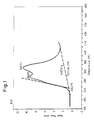
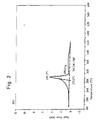
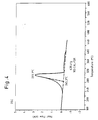
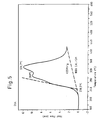
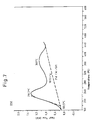
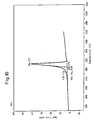
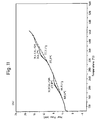
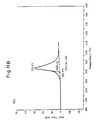
- Figures 1 - 14 graphically display the results of tests made according to the examples.
- the DSC apparatus used was a DuPont 910 DSC Module with a Model 1090 or like controller.
- the X-axis in Figures 1 through 11C is temperature in degrees centigrade.
- the Y-axis is heat flow in milliwatts.
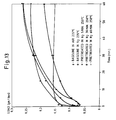
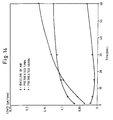
- Figures 13 and 14 show load (tension) in grams per denier versus time in minutes. The degree of reaction is determined using density.
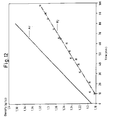
- Figure 12 shows the density versus the time in minutes.
- the sample size in Figure 1 was 1.136 milligrams.
- the rate of temperature increase was 10 degrees centigrade per minute and was in air.
- the sample size in Figure 2 was 1.110 milligrams and the rate of temperature increase was 10 degrees centigrade per minute in nitrogen.
- the sample type and rate of temperature increase are set forth below for the data in Figures 3 - 11C.
- Figures 3 to 11C correspond to reference examples.
- DSC was respectively in air and nitrogen.
- DSC of Figures 3 and 4 was in nitrogen.
- DSC was in air for Figures 5, 6 (both purge) and 7 and 8 (second heating).
- Figure 9 of the DSC was in air (purge) and DSC was in nitrogen (Figure 10) and then in air in Figure 11.
- Figure 11A was run in nitrogen; Figure 11B run in air; and Figure 11C is rerun in air after initial heating in nitrogen.
- ABS Precursor and “CE Precursor, are standard carbon fiber precursors made from acrylonitrile and methacrylic acid (2 weight %) in the case of the AB precursor and acrylonitrile, methylacrylate and itaconic acid in case of the CE precursor.
- the change in H D was 178 cal/g when heated in air after pretreatment in N 2 but only 49 cal/g when heated in N 2 after the same nitrogen pretreatment for the first sample and 277 cal/g when heated in air after pretreatment and only 74 cal/g when heated in N 2 after pretreatment for the second. Since the pretreatment heating was carried out in N 2 , it might be expected that the change in H D would be the same in both air and N 2 . However, from this data at least part of the oxidation reaction is not involved with or linked to the rearrangement reaction. If the sample 1 pretreatment (235°C/55 min) had been run in air instead of N 2 , the residual H D , air would be 740 cal/g.
- the area under the curve was significantly reduced, from about 1000-1100 cal/g to about 250 cal/g for AB Precursor and 335 cal/g for CE Precursor.
- the oxidation-initiation temperature was reduced about 20°C, indicating that the oxidation would be more rapid than non-prestabilized fiber ( Figures 7 and 8).
- the position of the two major thermal peaks shifted. For the AB Precursor the shift was more dramatic, with the lower peak dropping from a typical 228°C to 212°C.
- the position of the higher-temperature peak increased from 326°C to 360°C for AB Precursor while it decreased for CE Precursor from 330°C to 315°C.
- FIG 11A shows the typical DSC curve for this polymer in nitrogen with a heat of decomposition of 124 cal/gm
- Figure 11B shows the thermal curve in air.
- the heat of reaction in air (1103 cal/gm) is typical of other acrylic polymers, but the homopolymer is characterized by a high initiation temperature (250°C) and rapid heat evolution rate (steep slope).
- the initiation temperature drops to 155°C with the single peak splitting into two distinct peaks, the rate of heat evolution drops significantly as evidenced by a change in initial slope (note change in y-axis range between Figures 11B and 11C), and the overall heat of reaction has dropped to 237 cal/gm.
- Those results indicate the polymer may make a much more suitable carbon fiber precursor from the standpoint of ease of processability, safety, and potentially, economics.
- the fiber that has been prestabilized and oxidized does exhibit a higher density than the fiber that has just been oxidized at the same temperature for the same amount of time. This is believed due to the increase in reactivity after prestabilization since prestabilization alone results in a rate of density increase that is less than that due to oxidation in air (Table 2 and Figure 12). Looking at the density difference between the oxidized and prestabilized/oxidized fibers and assuming kinetics similar to the reaction kinetics of the AB Precursor for comparison purposes, the increase in oxidized fiber density due to prestabilization corresponds to a time savings of 40 minutes at 235°C. That is, in order to reach the same oxidized density as the prestabilized/oxidized fiber, the precursor fiber would have to be oxidized for 160 minutes at 235°C instead of stabilized/oxidized for a total of 120 minutes at 235°C.
- Another way to monitor the reaction characteristics of an acrylic based precursor is to follow the tension that is generated as the fiber rearranges and oxidizes at elevated temperatures.
- Tension vs time data were generated for AB and DuPont precursors and prestabilized fibers to further clarify changes in oxidation reaction characteristics that are caused by prestabilization in an inert atmosphere.
- Figure 13 shows load/time data for AB precursor in air at 235°C, N 2 at 235°C, and for AB prestabilized for varying amounts of time and then run in air at 235°C. Comparing the samples run in air and N 2 (no stabilization), both samples show the characteristic drop in tension initially followed by a tension increase as the fiber begins to react. The tension increase due to the shrinkage of the sample run in N 2 is significantly less than in air, the difference presumably being due to the added shrinkage of the oxidation reactions occurring in air.
- the prestabilized fibers show a sudden increase in tension when run in air possibly indicating an initial increase in the degree of reactivity.
- These lower oxidation loads could be due to a lower overall oxidation reactivity for the prestabilized fibers that would agree with DTA results showing lower than expected residual heats of reaction in air after prestabilization.
- the results for the DuPont T-42 type fiber are shown in Figure 14. This fiber is characteristically slower to react than AB as evidenced by the slow load buildup for the AB 10 Precursor. After prestabilization, the shrinkage characteristics of the fiber are greatly altered. The tension increase with time, while not as great as for AB Precursor, is similar in shape, indicating the fiber may oxidize more readily after prestabilization. As with the prestabilized AB Precursor samples, the T-42 type fibers show a rapid initial increase in tension (the greater the degree of prestabilization, the greater the rate of tension buildup).
- the more highly prestabilized fiber has a lower load buildup than the other prestabilized fiber (similar to AB results) but both samples are significantly higher than the baseline indicating the prestabilization (even after as little as five minutes) results in an increase in oxidation reaction rate, but may reduce the number of sites available for reaction.
- a set of AB fibers were stabilized in N 2 at 250°C for times ranging from 5 minutes to 6 hours. In each case, the sample was then divided in half, with half placed in an inert atmosphere and the other half stored in air, both at room temperature. In all cases, the sample in air continued to change color and slowly darken while the sample in N 2 remained golden brown. It was found that this reaction could be suspended by placing the partially darkened sample in N 2 and then reinitiated by exposing again to air. The fibers exposed to air after prestabilization were able to oxidize at room temperature. If oxidation type reactions were indeed occurring, it would be expected that the residual heat of reaction would decrease with increasing time of exposure to air at room temperature. A series of experiments was performed to determine if this was indeed the case.
- a length of AB Precursor was stabilized in N 2 for 2 hours at 250°C; the fiber was divided in half with half exposed to room-temperature air for 3 hours and the other half exposed to air for 24 hours. The samples were then restored in N 2 and submitted for thermal analysis. In all cases, the thermal lab was careful to run the samples as quickly as possible after the N 2 seal was broken.
- a sample of AB Precursor was stabilized for 16 hours at 250°C in N 2 and then divided with parts exposed for 0 hours, 1 hour, 3 hours, and 24 hours in air. Samples were then restored in N 2 and thermally analyzed.
Landscapes
- Chemical & Material Sciences (AREA)
- Chemical Kinetics & Catalysis (AREA)
- General Chemical & Material Sciences (AREA)
- Engineering & Computer Science (AREA)
- Textile Engineering (AREA)
- Inorganic Fibers (AREA)
- Artificial Filaments (AREA)
Claims (6)
- Ein Verfahren für die Herstellung von Kohlenstoffasern, in welchem ein Polyacrylnitril-Polymeres in der Form einer Menge von Filamenten in einer Sauerstoff-enthaltenden Atmosphäre erhitzt wird, zur Bildung eines stabilisierten und oxidierten Precursors, der dann in einer im wesentlichen von Sauerstoff freien Atmosphäre oder in einem Vakuum carbonisiert wird, dadurch gekennzeichnet, daß die Polyacrylnitril-Filamente in einer Atmosphäre, die im wesentlichen frei von Sauerstoff ist, oder in einem Vakuum erhitzt werden, bis die Reduktion in restlicher Reaktionswärme, wie durch differentiale Rasterkalorimetrie gemessen, im Bereich von 10 % bis 35 % liegt, zur Bildung eines thermisch-stabilisierten Kohlenstoffaser-Precursors vor der Stufe des Erhitzens der Filamente in einer Sauerstoff-enthaltenden Atmosphäre zur Oxidation des thermisch-stabilisierten Precursors.
- Ein Verfahren für die Herstellung von Kohlenstoffasern, wie in Anspruch 1 beansprucht, ferner dadurch gekennzeichnet, daß die Temperatur, bis zu welcher die Polyacrylnitril-Filamente in einer Atmosphäre, die im wesentlichen frei von Sauerstoff ist oder in einem Vakuum, erhitzt werden, bevorzugterweise zumindest 230° ist.
- Ein Verfahren für die Herstellung von Kohlenstoffasern, wie in Anspruch 1 beansprucht, ferner dadurch gekennzeichnet, daß die Atmosphäre, die im wesentlichen frei von Sauerstoff ist, Stickstoff ist.
- Ein Verfahren für die Herstellung von Kohlenstoffasern, wie in irgendeinem der vorstehenden Ansprüche beansprucht, ferner dadurch gekennzeichnet, daß die Filamente erhitzt werden, bis die Reduktion in der Restwärme der Reaktion etwa 20 % beträgt.
- Ein Verfahren für die Herstellung von Kohlenstoffasern, wie in irgendeinem der vorstehenden Ansprüche beansprucht, ferner dadurch gekennzeichnet, daß der thermisch-stabilisierte Kohlenstoffaser-Precursor in der Form eines Kabels in einer Sauerstoff-enthaltenden Atmosphäre bei einer Temperatur von 150°C bis 300°C für einen Zeitraum erhitzt wird, ausreichend, um dem Kabel zu ermöglichen, selbsttragend zu sein.
- Ein Verfahren für die Herstellung von Kohlenstoffasern, wie in irgendeinem der vorstehenden Ansprüche beansprucht, ferner dadurch gekennzeichnet, daß die Polyacrylnitril-Filamente in der Form eines Streifens von eng unterteilten Kabeln in einer Atmosphäre bewegt werden, die im wesentlichen frei von Sauerstoff oder ein Vakuum ist, durch einen Ofen, gehalten bei einem ersten Bereich von Temperaturen zum Erhitzen der Filamente zur Bildung eines thermisch-stabilisierten Kohlenstoffaser-Precursors und dann bei einer höheren Kabelgeschwindigkeit in einer Sauerstoff-enthaltenden Atmosphäre durch einen Ofen bewegt werden, gehalten auf einem zweiten Bereich von Temperaturen zur Oxidation des thermisch-stabilisierten Precursors.
Applications Claiming Priority (2)
| Application Number | Priority Date | Filing Date | Title |
|---|---|---|---|
| US31453889A | 1989-02-23 | 1989-02-23 | |
| US314538 | 1989-02-23 |
Publications (3)
| Publication Number | Publication Date |
|---|---|
| EP0384299A2 EP0384299A2 (de) | 1990-08-29 |
| EP0384299A3 EP0384299A3 (de) | 1991-11-06 |
| EP0384299B1 true EP0384299B1 (de) | 1997-11-12 |
Family
ID=23220353
Family Applications (1)
| Application Number | Title | Priority Date | Filing Date |
|---|---|---|---|
| EP90102972A Expired - Lifetime EP0384299B1 (de) | 1989-02-23 | 1990-02-15 | Thermisch stabilisierte Polyacrylonitrilpolymerfasern für die Herstellung von Kohlenstoffasern |
Country Status (7)
| Country | Link |
|---|---|
| EP (1) | EP0384299B1 (de) |
| JP (1) | JPH038812A (de) |
| KR (1) | KR0147849B1 (de) |
| CA (1) | CA2009546C (de) |
| DE (1) | DE69031690T2 (de) |
| ES (1) | ES2109224T3 (de) |
| IL (1) | IL93475A (de) |
Cited By (3)
| Publication number | Priority date | Publication date | Assignee | Title |
|---|---|---|---|---|
| EP2147776A1 (de) | 2008-07-23 | 2010-01-27 | SGL Carbon SE | Verfahren zur Herstellung eines Fasergelege-verstärkten Verbundwerkstoffs, sowie Fasergelege-verstärkte Verbundwerkstoffe und deren Verwendung |
| CN101922065A (zh) * | 2010-09-16 | 2010-12-22 | 中国科学院西安光学精密机械研究所 | 聚丙烯腈基碳纤维原丝的预氧化方法 |
| DE102009047491A1 (de) | 2009-12-04 | 2011-06-09 | Sgl Carbon Se | Herstellung einer 3D-Textilstruktur und Faserhalbzeug aus Faserverbundstoffen |
Families Citing this family (5)
| Publication number | Priority date | Publication date | Assignee | Title |
|---|---|---|---|---|
| US5256344A (en) * | 1989-02-23 | 1993-10-26 | Hercules Incorporated | Process of thermally stabilizing pan fibers |
| DE19517911A1 (de) * | 1995-05-16 | 1996-11-21 | Sgl Technik Gmbh | Verfahren zum Umwandeln von aus Polyacrylnitrilfasern bestehenden mehrdimensionalen flächigen Gebilden in den thermisch stabilisierten Zustand |
| AU2017435381B2 (en) * | 2017-10-10 | 2022-11-10 | Deakin University | Precursor stabilisation process |
| JP7268285B2 (ja) * | 2017-10-10 | 2023-05-08 | ディーキン ユニバーシティ | 炭素繊維の製造に使用されるポリアクリロニトリル(pan)前駆体を事前安定化するための反応器、装置及びシステム |
| CN112708967B (zh) * | 2019-10-24 | 2022-10-11 | 中国石油化工股份有限公司 | 聚丙烯腈基纤维的预氧化方法及碳纤维制备方法 |
Family Cites Families (3)
| Publication number | Priority date | Publication date | Assignee | Title |
|---|---|---|---|---|
| GB1245123A (en) * | 1968-06-04 | 1971-09-08 | Rolls Royce | A method of manufacturing carbon fibres |
| US3961888A (en) * | 1968-09-18 | 1976-06-08 | Celanese Corporation | Acrylic fiber conversion utilizing a stabilization treatment conducted initially in an essentially inert atmosphere |
| US3775520A (en) * | 1970-03-09 | 1973-11-27 | Celanese Corp | Carbonization/graphitization of poly-acrylonitrile fibers containing residual spinning solvent |
-
1990
- 1990-02-07 CA CA002009546A patent/CA2009546C/en not_active Expired - Fee Related
- 1990-02-15 ES ES90102972T patent/ES2109224T3/es not_active Expired - Lifetime
- 1990-02-15 DE DE69031690T patent/DE69031690T2/de not_active Expired - Fee Related
- 1990-02-15 EP EP90102972A patent/EP0384299B1/de not_active Expired - Lifetime
- 1990-02-21 IL IL93475A patent/IL93475A/xx not_active IP Right Cessation
- 1990-02-22 KR KR1019900002219A patent/KR0147849B1/ko not_active Expired - Fee Related
- 1990-02-23 JP JP2044245A patent/JPH038812A/ja active Pending
Cited By (5)
| Publication number | Priority date | Publication date | Assignee | Title |
|---|---|---|---|---|
| EP2147776A1 (de) | 2008-07-23 | 2010-01-27 | SGL Carbon SE | Verfahren zur Herstellung eines Fasergelege-verstärkten Verbundwerkstoffs, sowie Fasergelege-verstärkte Verbundwerkstoffe und deren Verwendung |
| DE102009047491A1 (de) | 2009-12-04 | 2011-06-09 | Sgl Carbon Se | Herstellung einer 3D-Textilstruktur und Faserhalbzeug aus Faserverbundstoffen |
| WO2011067390A1 (de) | 2009-12-04 | 2011-06-09 | Sgl Carbon Se | Herstellung einer 3d-textilstruktur und faserhalbzeug aus faserverbundstoffen |
| CN101922065A (zh) * | 2010-09-16 | 2010-12-22 | 中国科学院西安光学精密机械研究所 | 聚丙烯腈基碳纤维原丝的预氧化方法 |
| CN101922065B (zh) * | 2010-09-16 | 2011-12-07 | 中国科学院西安光学精密机械研究所 | 聚丙烯腈基碳纤维原丝的预氧化方法 |
Also Published As
| Publication number | Publication date |
|---|---|
| KR900013120A (ko) | 1990-09-03 |
| ES2109224T3 (es) | 1998-01-16 |
| IL93475A0 (en) | 1990-11-29 |
| JPH038812A (ja) | 1991-01-16 |
| IL93475A (en) | 1992-08-18 |
| EP0384299A2 (de) | 1990-08-29 |
| DE69031690D1 (de) | 1997-12-18 |
| DE69031690T2 (de) | 1998-03-12 |
| KR0147849B1 (ko) | 1998-08-01 |
| CA2009546A1 (en) | 1990-08-23 |
| CA2009546C (en) | 1996-05-28 |
| EP0384299A3 (de) | 1991-11-06 |
Similar Documents
| Publication | Publication Date | Title |
|---|---|---|
| US3716607A (en) | Heat treatment of molten carbonaceous material prior to its conversion to carbon fibers and other shapes | |
| EP0384299B1 (de) | Thermisch stabilisierte Polyacrylonitrilpolymerfasern für die Herstellung von Kohlenstoffasern | |
| US5256344A (en) | Process of thermally stabilizing pan fibers | |
| US3528774A (en) | Formation of high modulus,high strength graphite yarns | |
| EP0486730A1 (de) | Verbessertes Verfahren zur Herstellung von Mesofasepech | |
| US4474617A (en) | Pitch for carbon fibers | |
| GB2111524A (en) | Starting pitches for carbon fibers | |
| EP0364244A1 (de) | Verfahren zur Herstellung von Mesophasepech | |
| JPS58136838A (ja) | 高性能炭素繊維の製造方法 | |
| KR930000564B1 (ko) | 탄소섬유의 제조방법 | |
| US4009991A (en) | Process for producing carbon fibers | |
| US4574077A (en) | Process for producing pitch based graphite fibers | |
| US4608150A (en) | Pitch material for carbonaceous body and a method for the preparation thereof | |
| JPS6131157B2 (de) | ||
| GB2170491A (en) | Method of producing graphite fiber and product thereof | |
| JPH0150269B2 (de) | ||
| JPH0150275B2 (de) | ||
| US4859381A (en) | Process for preparing pitch-type carbon fibers | |
| Kalashnik | The role of different factors in creation of the structure of stabilized acrylic fibres | |
| US4859382A (en) | Process for preparing carbon fibers elliptical in section | |
| KR960005971B1 (ko) | 탄소섬유 제조방법 | |
| KR19990012606A (ko) | 고연화점 광학적 등방성 핏치의 제조방법 | |
| EP0508318B1 (de) | Verfahren zur Herstellung von optisch isotropem Pech | |
| USRE27794E (en) | Heat treatment of molten carbonaceous material prior to its conversion to carbon fibers and other shapes | |
| KR920000199B1 (ko) | 이방성 액정핏치의 제조방법 |
Legal Events
| Date | Code | Title | Description |
|---|---|---|---|
| PUAI | Public reference made under article 153(3) epc to a published international application that has entered the european phase |
Free format text: ORIGINAL CODE: 0009012 |
|
| AK | Designated contracting states |
Kind code of ref document: A2 Designated state(s): DE ES FR GB |
|
| PUAL | Search report despatched |
Free format text: ORIGINAL CODE: 0009013 |
|
| AK | Designated contracting states |
Kind code of ref document: A3 Designated state(s): DE ES FR GB |
|
| 17P | Request for examination filed |
Effective date: 19920409 |
|
| 17Q | First examination report despatched |
Effective date: 19941124 |
|
| GRAG | Despatch of communication of intention to grant |
Free format text: ORIGINAL CODE: EPIDOS AGRA |
|
| GRAH | Despatch of communication of intention to grant a patent |
Free format text: ORIGINAL CODE: EPIDOS IGRA |
|
| RAP1 | Party data changed (applicant data changed or rights of an application transferred) |
Owner name: HEXCEL CORPORATION |
|
| GRAH | Despatch of communication of intention to grant a patent |
Free format text: ORIGINAL CODE: EPIDOS IGRA |
|
| GRAA | (expected) grant |
Free format text: ORIGINAL CODE: 0009210 |
|
| AK | Designated contracting states |
Kind code of ref document: B1 Designated state(s): DE ES FR GB |
|
| REF | Corresponds to: |
Ref document number: 69031690 Country of ref document: DE Date of ref document: 19971218 |
|
| ET | Fr: translation filed | ||
| REG | Reference to a national code |
Ref country code: ES Ref legal event code: FG2A Ref document number: 2109224 Country of ref document: ES Kind code of ref document: T3 |
|
| PLBE | No opposition filed within time limit |
Free format text: ORIGINAL CODE: 0009261 |
|
| STAA | Information on the status of an ep patent application or granted ep patent |
Free format text: STATUS: NO OPPOSITION FILED WITHIN TIME LIMIT |
|
| 26N | No opposition filed | ||
| PGFP | Annual fee paid to national office [announced via postgrant information from national office to epo] |
Ref country code: ES Payment date: 20000222 Year of fee payment: 11 |
|
| PG25 | Lapsed in a contracting state [announced via postgrant information from national office to epo] |
Ref country code: ES Free format text: LAPSE BECAUSE OF NON-PAYMENT OF DUE FEES Effective date: 20010216 |
|
| REG | Reference to a national code |
Ref country code: GB Ref legal event code: IF02 |
|
| PGFP | Annual fee paid to national office [announced via postgrant information from national office to epo] |
Ref country code: FR Payment date: 20020212 Year of fee payment: 13 |
|
| PGFP | Annual fee paid to national office [announced via postgrant information from national office to epo] |
Ref country code: GB Payment date: 20020213 Year of fee payment: 13 |
|
| PGFP | Annual fee paid to national office [announced via postgrant information from national office to epo] |
Ref country code: DE Payment date: 20020227 Year of fee payment: 13 |
|
| REG | Reference to a national code |
Ref country code: ES Ref legal event code: FD2A Effective date: 20020916 |
|
| PG25 | Lapsed in a contracting state [announced via postgrant information from national office to epo] |
Ref country code: GB Free format text: LAPSE BECAUSE OF NON-PAYMENT OF DUE FEES Effective date: 20030215 |
|
| PG25 | Lapsed in a contracting state [announced via postgrant information from national office to epo] |
Ref country code: DE Free format text: LAPSE BECAUSE OF NON-PAYMENT OF DUE FEES Effective date: 20030902 |
|
| GBPC | Gb: european patent ceased through non-payment of renewal fee | ||
| PG25 | Lapsed in a contracting state [announced via postgrant information from national office to epo] |
Ref country code: FR Free format text: LAPSE BECAUSE OF NON-PAYMENT OF DUE FEES Effective date: 20031031 |
|
| REG | Reference to a national code |
Ref country code: FR Ref legal event code: ST |