EP0367305B1 - Non-metallic polymeric twist tie - Google Patents
Non-metallic polymeric twist tie Download PDFInfo
- Publication number
- EP0367305B1 EP0367305B1 EP19890123945 EP89123945A EP0367305B1 EP 0367305 B1 EP0367305 B1 EP 0367305B1 EP 19890123945 EP19890123945 EP 19890123945 EP 89123945 A EP89123945 A EP 89123945A EP 0367305 B1 EP0367305 B1 EP 0367305B1
- Authority
- EP
- European Patent Office
- Prior art keywords
- ribbon
- polymeric
- twist
- ribbons
- ribbon according
- Prior art date
- Legal status (The legal status is an assumption and is not a legal conclusion. Google has not performed a legal analysis and makes no representation as to the accuracy of the status listed.)
- Expired - Lifetime
Links
- 239000000463 material Substances 0.000 claims abstract description 68
- 229920001971 elastomer Polymers 0.000 claims abstract description 20
- 239000005060 rubber Substances 0.000 claims abstract description 18
- 239000004609 Impact Modifier Substances 0.000 claims abstract description 15
- 239000011521 glass Substances 0.000 claims abstract description 12
- 230000009477 glass transition Effects 0.000 claims description 15
- 229920000139 polyethylene terephthalate Polymers 0.000 claims description 14
- 239000005020 polyethylene terephthalate Substances 0.000 claims description 13
- -1 polyethylene terephthalate Polymers 0.000 claims description 6
- 229920000915 polyvinyl chloride Polymers 0.000 abstract description 13
- 229920000642 polymer Polymers 0.000 abstract description 9
- 239000004014 plasticizer Substances 0.000 abstract description 7
- 239000004793 Polystyrene Substances 0.000 abstract description 4
- 238000000034 method Methods 0.000 abstract description 4
- 229920002285 poly(styrene-co-acrylonitrile) Polymers 0.000 abstract description 4
- 229920002223 polystyrene Polymers 0.000 abstract description 4
- 229920001283 Polyalkylene terephthalate Polymers 0.000 abstract description 3
- 230000001747 exhibiting effect Effects 0.000 abstract description 2
- 239000000203 mixture Substances 0.000 description 21
- 229910052751 metal Inorganic materials 0.000 description 16
- 239000002184 metal Substances 0.000 description 16
- 238000004458 analytical method Methods 0.000 description 14
- 239000004800 polyvinyl chloride Substances 0.000 description 12
- 239000008188 pellet Substances 0.000 description 7
- 229920003023 plastic Polymers 0.000 description 7
- 239000004033 plastic Substances 0.000 description 7
- 229920005669 high impact polystyrene Polymers 0.000 description 6
- 239000004797 high-impact polystyrene Substances 0.000 description 6
- XLYOFNOQVPJJNP-UHFFFAOYSA-N water Substances O XLYOFNOQVPJJNP-UHFFFAOYSA-N 0.000 description 6
- 235000013305 food Nutrition 0.000 description 5
- 229920000620 organic polymer Polymers 0.000 description 5
- 238000002360 preparation method Methods 0.000 description 5
- 239000012815 thermoplastic material Substances 0.000 description 5
- KAKZBPTYRLMSJV-UHFFFAOYSA-N vinyl-ethylene Natural products C=CC=C KAKZBPTYRLMSJV-UHFFFAOYSA-N 0.000 description 5
- 235000008429 bread Nutrition 0.000 description 4
- 238000004806 packaging method and process Methods 0.000 description 4
- 229920001169 thermoplastic Polymers 0.000 description 4
- 229920000459 Nitrile rubber Polymers 0.000 description 3
- NTXGQCSETZTARF-UHFFFAOYSA-N buta-1,3-diene;prop-2-enenitrile Chemical compound C=CC=C.C=CC#N NTXGQCSETZTARF-UHFFFAOYSA-N 0.000 description 3
- 229920001577 copolymer Polymers 0.000 description 3
- 239000002245 particle Substances 0.000 description 3
- 238000005482 strain hardening Methods 0.000 description 3
- IRIAEXORFWYRCZ-UHFFFAOYSA-N Butylbenzyl phthalate Chemical compound CCCCOC(=O)C1=CC=CC=C1C(=O)OCC1=CC=CC=C1 IRIAEXORFWYRCZ-UHFFFAOYSA-N 0.000 description 2
- VTYYLEPIZMXCLO-UHFFFAOYSA-L Calcium carbonate Chemical compound [Ca+2].[O-]C([O-])=O VTYYLEPIZMXCLO-UHFFFAOYSA-L 0.000 description 2
- 229920006385 Geon Polymers 0.000 description 2
- PPBRXRYQALVLMV-UHFFFAOYSA-N Styrene Chemical compound C=CC1=CC=CC=C1 PPBRXRYQALVLMV-UHFFFAOYSA-N 0.000 description 2
- NIXOWILDQLNWCW-UHFFFAOYSA-N acrylic acid group Chemical group C(C=C)(=O)O NIXOWILDQLNWCW-UHFFFAOYSA-N 0.000 description 2
- 239000002390 adhesive tape Substances 0.000 description 2
- 230000015572 biosynthetic process Effects 0.000 description 2
- 239000000806 elastomer Substances 0.000 description 2
- 239000013536 elastomeric material Substances 0.000 description 2
- 235000013410 fast food Nutrition 0.000 description 2
- 229920000578 graft copolymer Polymers 0.000 description 2
- 230000005855 radiation Effects 0.000 description 2
- 150000003839 salts Chemical class 0.000 description 2
- 238000007789 sealing Methods 0.000 description 2
- 238000012360 testing method Methods 0.000 description 2
- 239000004416 thermosoftening plastic Substances 0.000 description 2
- YCMLQMDWSXFTIF-UHFFFAOYSA-N 2-methylbenzenesulfonimidic acid Chemical compound CC1=CC=CC=C1S(N)(=O)=O YCMLQMDWSXFTIF-UHFFFAOYSA-N 0.000 description 1
- NLHHRLWOUZZQLW-UHFFFAOYSA-N Acrylonitrile Chemical compound C=CC#N NLHHRLWOUZZQLW-UHFFFAOYSA-N 0.000 description 1
- 239000004606 Fillers/Extenders Substances 0.000 description 1
- VVQNEPGJFQJSBK-UHFFFAOYSA-N Methyl methacrylate Chemical compound COC(=O)C(C)=C VVQNEPGJFQJSBK-UHFFFAOYSA-N 0.000 description 1
- 239000006057 Non-nutritive feed additive Substances 0.000 description 1
- 229920012485 Plasticized Polyvinyl chloride Polymers 0.000 description 1
- 239000005062 Polybutadiene Substances 0.000 description 1
- 229920000800 acrylic rubber Polymers 0.000 description 1
- 239000000654 additive Substances 0.000 description 1
- 239000000956 alloy Substances 0.000 description 1
- 229910045601 alloy Inorganic materials 0.000 description 1
- 239000003963 antioxidant agent Substances 0.000 description 1
- MTAZNLWOLGHBHU-UHFFFAOYSA-N butadiene-styrene rubber Chemical compound C=CC=C.C=CC1=CC=CC=C1 MTAZNLWOLGHBHU-UHFFFAOYSA-N 0.000 description 1
- CQEYYJKEWSMYFG-UHFFFAOYSA-N butyl acrylate Chemical compound CCCCOC(=O)C=C CQEYYJKEWSMYFG-UHFFFAOYSA-N 0.000 description 1
- 229910000019 calcium carbonate Inorganic materials 0.000 description 1
- 239000003795 chemical substances by application Substances 0.000 description 1
- 239000002131 composite material Substances 0.000 description 1
- 238000005520 cutting process Methods 0.000 description 1
- 238000000113 differential scanning calorimetry Methods 0.000 description 1
- 230000000694 effects Effects 0.000 description 1
- 238000001125 extrusion Methods 0.000 description 1
- 239000000945 filler Substances 0.000 description 1
- 238000009472 formulation Methods 0.000 description 1
- 230000001788 irregular Effects 0.000 description 1
- 239000000314 lubricant Substances 0.000 description 1
- HQKMJHAJHXVSDF-UHFFFAOYSA-L magnesium stearate Chemical class [Mg+2].CCCCCCCCCCCCCCCCCC([O-])=O.CCCCCCCCCCCCCCCCCC([O-])=O HQKMJHAJHXVSDF-UHFFFAOYSA-L 0.000 description 1
- 235000019359 magnesium stearate Nutrition 0.000 description 1
- 229910044991 metal oxide Inorganic materials 0.000 description 1
- 150000004706 metal oxides Chemical class 0.000 description 1
- 239000003921 oil Substances 0.000 description 1
- 239000011368 organic material Substances 0.000 description 1
- 235000021485 packed food Nutrition 0.000 description 1
- 239000008029 phthalate plasticizer Substances 0.000 description 1
- 239000000049 pigment Substances 0.000 description 1
- 229920000058 polyacrylate Polymers 0.000 description 1
- 229920002857 polybutadiene Polymers 0.000 description 1
- 229920001707 polybutylene terephthalate Polymers 0.000 description 1
- SCUZVMOVTVSBLE-UHFFFAOYSA-N prop-2-enenitrile;styrene Chemical compound C=CC#N.C=CC1=CC=CC=C1 SCUZVMOVTVSBLE-UHFFFAOYSA-N 0.000 description 1
- 239000012858 resilient material Substances 0.000 description 1
- 239000003381 stabilizer Substances 0.000 description 1
- 238000010561 standard procedure Methods 0.000 description 1
- 238000007655 standard test method Methods 0.000 description 1
- 238000003860 storage Methods 0.000 description 1
- 229920000638 styrene acrylonitrile Polymers 0.000 description 1
- 229920006132 styrene block copolymer Polymers 0.000 description 1
- 239000000126 substance Substances 0.000 description 1
- 239000003760 tallow Substances 0.000 description 1
- 229920002725 thermoplastic elastomer Polymers 0.000 description 1
- 230000007704 transition Effects 0.000 description 1
- 238000009827 uniform distribution Methods 0.000 description 1
- 229920011532 unplasticized polyvinyl chloride Polymers 0.000 description 1
Images
Classifications
-
- B—PERFORMING OPERATIONS; TRANSPORTING
- B65—CONVEYING; PACKING; STORING; HANDLING THIN OR FILAMENTARY MATERIAL
- B65D—CONTAINERS FOR STORAGE OR TRANSPORT OF ARTICLES OR MATERIALS, e.g. BAGS, BARRELS, BOTTLES, BOXES, CANS, CARTONS, CRATES, DRUMS, JARS, TANKS, HOPPERS, FORWARDING CONTAINERS; ACCESSORIES, CLOSURES, OR FITTINGS THEREFOR; PACKAGING ELEMENTS; PACKAGES
- B65D63/00—Flexible elongated elements, e.g. straps, for bundling or supporting articles
- B65D63/10—Non-metallic straps, tapes, or bands; Filamentary elements, e.g. strings, threads or wires; Joints between ends thereof
- B65D63/12—Joints produced by deformation or tying of ends of elements
-
- A—HUMAN NECESSITIES
- A61—MEDICAL OR VETERINARY SCIENCE; HYGIENE
- A61P—SPECIFIC THERAPEUTIC ACTIVITY OF CHEMICAL COMPOUNDS OR MEDICINAL PREPARATIONS
- A61P13/00—Drugs for disorders of the urinary system
- A61P13/02—Drugs for disorders of the urinary system of urine or of the urinary tract, e.g. urine acidifiers
-
- A—HUMAN NECESSITIES
- A61—MEDICAL OR VETERINARY SCIENCE; HYGIENE
- A61P—SPECIFIC THERAPEUTIC ACTIVITY OF CHEMICAL COMPOUNDS OR MEDICINAL PREPARATIONS
- A61P15/00—Drugs for genital or sexual disorders; Contraceptives
-
- A—HUMAN NECESSITIES
- A61—MEDICAL OR VETERINARY SCIENCE; HYGIENE
- A61P—SPECIFIC THERAPEUTIC ACTIVITY OF CHEMICAL COMPOUNDS OR MEDICINAL PREPARATIONS
- A61P35/00—Antineoplastic agents
-
- A—HUMAN NECESSITIES
- A61—MEDICAL OR VETERINARY SCIENCE; HYGIENE
- A61P—SPECIFIC THERAPEUTIC ACTIVITY OF CHEMICAL COMPOUNDS OR MEDICINAL PREPARATIONS
- A61P35/00—Antineoplastic agents
- A61P35/02—Antineoplastic agents specific for leukemia
-
- A—HUMAN NECESSITIES
- A61—MEDICAL OR VETERINARY SCIENCE; HYGIENE
- A61P—SPECIFIC THERAPEUTIC ACTIVITY OF CHEMICAL COMPOUNDS OR MEDICINAL PREPARATIONS
- A61P5/00—Drugs for disorders of the endocrine system
-
- C—CHEMISTRY; METALLURGY
- C07—ORGANIC CHEMISTRY
- C07J—STEROIDS
- C07J1/00—Normal steroids containing carbon, hydrogen, halogen or oxygen, not substituted in position 17 beta by a carbon atom, e.g. estrane, androstane
- C07J1/0003—Androstane derivatives
- C07J1/0011—Androstane derivatives substituted in position 17 by a keto group
-
- C—CHEMISTRY; METALLURGY
- C07—ORGANIC CHEMISTRY
- C07J—STEROIDS
- C07J41/00—Normal steroids containing one or more nitrogen atoms not belonging to a hetero ring
- C07J41/0005—Normal steroids containing one or more nitrogen atoms not belonging to a hetero ring the nitrogen atom being directly linked to the cyclopenta(a)hydro phenanthrene skeleton
-
- C—CHEMISTRY; METALLURGY
- C07—ORGANIC CHEMISTRY
- C07J—STEROIDS
- C07J41/00—Normal steroids containing one or more nitrogen atoms not belonging to a hetero ring
- C07J41/0005—Normal steroids containing one or more nitrogen atoms not belonging to a hetero ring the nitrogen atom being directly linked to the cyclopenta(a)hydro phenanthrene skeleton
- C07J41/0027—Azides
-
- Y—GENERAL TAGGING OF NEW TECHNOLOGICAL DEVELOPMENTS; GENERAL TAGGING OF CROSS-SECTIONAL TECHNOLOGIES SPANNING OVER SEVERAL SECTIONS OF THE IPC; TECHNICAL SUBJECTS COVERED BY FORMER USPC CROSS-REFERENCE ART COLLECTIONS [XRACs] AND DIGESTS
- Y10—TECHNICAL SUBJECTS COVERED BY FORMER USPC
- Y10S—TECHNICAL SUBJECTS COVERED BY FORMER USPC CROSS-REFERENCE ART COLLECTIONS [XRACs] AND DIGESTS
- Y10S383/00—Flexible bags
- Y10S383/905—Dead fold, ductile, closure element
-
- Y—GENERAL TAGGING OF NEW TECHNOLOGICAL DEVELOPMENTS; GENERAL TAGGING OF CROSS-SECTIONAL TECHNOLOGIES SPANNING OVER SEVERAL SECTIONS OF THE IPC; TECHNICAL SUBJECTS COVERED BY FORMER USPC CROSS-REFERENCE ART COLLECTIONS [XRACs] AND DIGESTS
- Y10—TECHNICAL SUBJECTS COVERED BY FORMER USPC
- Y10T—TECHNICAL SUBJECTS COVERED BY FORMER US CLASSIFICATION
- Y10T24/00—Buckles, buttons, clasps, etc.
- Y10T24/15—Bag fasteners
- Y10T24/153—Plastic band bag tie
-
- Y—GENERAL TAGGING OF NEW TECHNOLOGICAL DEVELOPMENTS; GENERAL TAGGING OF CROSS-SECTIONAL TECHNOLOGIES SPANNING OVER SEVERAL SECTIONS OF THE IPC; TECHNICAL SUBJECTS COVERED BY FORMER USPC CROSS-REFERENCE ART COLLECTIONS [XRACs] AND DIGESTS
- Y10—TECHNICAL SUBJECTS COVERED BY FORMER USPC
- Y10T—TECHNICAL SUBJECTS COVERED BY FORMER US CLASSIFICATION
- Y10T24/00—Buckles, buttons, clasps, etc.
- Y10T24/15—Bag fasteners
- Y10T24/157—Twist-to-close bag tie
-
- Y—GENERAL TAGGING OF NEW TECHNOLOGICAL DEVELOPMENTS; GENERAL TAGGING OF CROSS-SECTIONAL TECHNOLOGIES SPANNING OVER SEVERAL SECTIONS OF THE IPC; TECHNICAL SUBJECTS COVERED BY FORMER USPC CROSS-REFERENCE ART COLLECTIONS [XRACs] AND DIGESTS
- Y10—TECHNICAL SUBJECTS COVERED BY FORMER USPC
- Y10T—TECHNICAL SUBJECTS COVERED BY FORMER US CLASSIFICATION
- Y10T428/00—Stock material or miscellaneous articles
- Y10T428/24—Structurally defined web or sheet [e.g., overall dimension, etc.]
- Y10T428/24008—Structurally defined web or sheet [e.g., overall dimension, etc.] including fastener for attaching to external surface
-
- Y—GENERAL TAGGING OF NEW TECHNOLOGICAL DEVELOPMENTS; GENERAL TAGGING OF CROSS-SECTIONAL TECHNOLOGIES SPANNING OVER SEVERAL SECTIONS OF THE IPC; TECHNICAL SUBJECTS COVERED BY FORMER USPC CROSS-REFERENCE ART COLLECTIONS [XRACs] AND DIGESTS
- Y10—TECHNICAL SUBJECTS COVERED BY FORMER USPC
- Y10T—TECHNICAL SUBJECTS COVERED BY FORMER US CLASSIFICATION
- Y10T428/00—Stock material or miscellaneous articles
- Y10T428/24—Structurally defined web or sheet [e.g., overall dimension, etc.]
- Y10T428/24479—Structurally defined web or sheet [e.g., overall dimension, etc.] including variation in thickness
-
- Y—GENERAL TAGGING OF NEW TECHNOLOGICAL DEVELOPMENTS; GENERAL TAGGING OF CROSS-SECTIONAL TECHNOLOGIES SPANNING OVER SEVERAL SECTIONS OF THE IPC; TECHNICAL SUBJECTS COVERED BY FORMER USPC CROSS-REFERENCE ART COLLECTIONS [XRACs] AND DIGESTS
- Y10—TECHNICAL SUBJECTS COVERED BY FORMER USPC
- Y10T—TECHNICAL SUBJECTS COVERED BY FORMER US CLASSIFICATION
- Y10T428/00—Stock material or miscellaneous articles
- Y10T428/31504—Composite [nonstructural laminate]
- Y10T428/31786—Of polyester [e.g., alkyd, etc.]
Definitions
- the invention of this application relates to non-metallic polymeric twist ties.
- Twist ties comprising a middle wire centrally enclosed in a plastic or paper ribbon are ubiquitously used as closures, for instance to seal plastic bags, to fasten plants to stakes, to secure bundled electric cable, and for other fastening requirements.
- the widespread use of such ties results from the numerous advantageous properties.
- the same twist tie which can be applied mechanically, e.g. to bread bags and the like, in a high speed operation can also be applied manually in a somewhat slower speed operation with little physical exertion other than rotational twisting with the finger tips.
- Such metal twist ties can be multiply refastened with little reduction in fastening capability, for instance such ties can be reused up to ten times or more without failure.
- such ties can be twisted without regard to directional rotation.
- metal twist ties are also functional, i.e. can be tied, untied, retied and will hold with a secure twist, over a wide range of temperatures, e.g. from less than minus 10° to greater than 65°.
- metal twist ties are not universally used, however, for many food packaging applications because of certain disadvantageous properties. For instance, many convenience foods are packaged so that they can be heated in their original packaging in microwave ovens. Metal twist ties however will cause undesirable arcing when subjected to microwave radiation at an intensity common to such ovens.
- polymeric twist ties be prepared from unplasticized polyvinylchloride.
- Kirkpatrick who discloses in U.S. patent 3,565,738 polymeric ties in the form of a semi-rigid tape made of plastic material having a high tensile modulus and dead fold characteristics similar to those of a wire. Polymers disclosed by Kirkpatrick have been found to be unadaptable to mechanical twist tie apparatus.
- An object of this invention is to provide a non-metallic polymeric twist tie which is useful for sealing bags by hand as well as by mechanical twist tie apparatus.
- Another object is to provide polymeric non-metallic twist ties that are functional, i.e. can be tied, untied, retied and will hold fast, over a wide temperature range of expected use.
- Another object is to provide a non-metallic polymeric twist tie that can be subjected to microwave radiation ovens.
- Another object is to provide a polymeric non-metallic twist tie that can be manually untied and retied throughout the common service life of twist ties.
- Another object is to provide a non-metallic polymeric twist tie that can functionally replace metal twist ties in existing automatic tying equipment.
- it is an object that such polymeric non-metallic twist ties will remain fastly twisted when subjected to high, but not uncommon, ambient temperatures. In many cases this is difficult to achieve together with the requirement that such twist ties be equally functional at lower ambient temperatures.
- an essentially organic, non-metallic ribbon comprising a polymeric material having a glass transition temperature greater than about 30° and which exhibits glass/rubber transitional behavior in a temperature range from about 10° to about 40°.
- a polymeric material having a glass transition temperature greater than about 30° and which exhibits glass/rubber transitional behavior in a temperature range from about 10° to about 40°.
- such objectives can be more advantageously realized by providing a ribbon which, when deformed under tensile stress at a strain rate between 0.1 and 0.5 meters per meter per minute (mpmpm), will exhibit strain softening, often characterized as necking.
- such objectives are advantageously realized by providing a ribbon which will deform under tensile stress at least 10% in elongation after yield.
- such objectives can be advantageously realized by providing a ribbon comprising at least about 50% substantially uniform prior to use as a twist tie. It is understood that the cross-sectional area will preferably deform when ribbon is twisted into a tie.
- FIG 4 An especially preferred embodiment is illustrated in Figure 4, where the thin, flat ribbon has a central rib extending from both sides.
- Such ribbon can have a width from about 1 mm to about 10 mm or more, preferably from about 2 mm to about 6 mm.
- the central rib can be rounded, square or pointed and have an overall thickness from about 0.5 mm to about 4 mm or more, preferably from about 1 to about 3 mm.
- such objectives can be advantageously realized by providing a ribbon comprising at least about 50% by weight of one or more thermoplastic polymers selected from the group consisting of polyalkylene terephthalate, styrene acrylonitrile copolymer, polystyrene and polyvinylchloride and, in many preferred embodiments, up to about 50% by weight of a particulate elastomeric impact modifier. It is generally desirable that such ribbons have a cross-sectional area that is substantially uniform over its length, and in many cases that such ribbon have at least one rib along its length.
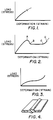
- FIGS 1, 2 and 3 illustrate load/deformation curves useful in characterizing the ribbon of this invention.
- Figure 4 illustrates a partial cross-sectional view of one embodiment of the ribbon of this invention.
- ribbon denotes a filamentary segment which has a length which is very large as compared to its cross-sectional dimensions.
- Such ribbon may be substantially thin and flat, or have an irregular cross-section, such as a thin flat section with one or more ribs.
- Such ribbon can be provided in virtually any length desired for the use intended.
- essentially organic is used to denote material used in the ribbon of this invention that comprises organic polymers, i.e. thermoplastic or elastomeric polymers. Such essentially organic materials may exist as a single phase, e.g. a mixture or blend of compatible organic polymers, or in multi-phases, e.g. as a mixture of non-compatible organic polymers.
- non-metallic denotes a material that is devoid of a reduced metal phase, e.g. a continuous reduced metal phase such as a metal wire.
- the essentially polymeric material used in the ribbon of this invention may however comprise dispersed metal salt or metal oxide, such as extenders, stabilizers, lubricants, processing aids and the like.
- glass transition temperature means the temperature where the polymeric material of the ribbon of this invention undergoes a transition from the glassy state to the rubbery state. Glass transition temperatures are commonly determined by differential scanning calorimetry. Ribbons of this invention will comprise polymeric materials having glass transition temperatures of at least about 30°, or higher. In preferred embodiments, the polymeric materials will have glass transition temperatures of at least about 40°, or even 50°, and more preferably at least about 60° or 65°.
- a glass/rubber transitional state represents a temperature range over which the polymeric material of the ribbon of this invention exhibits fracture behavior in tension which can be illustrated by reference to Figures 1, 2 and 3 of the drawings.
- the ordinates, designated as "load” represent the application of tensile stress which is generally designated in units of mega pascals (MPa) or pounds per square inch (psi).
- the abscissas, denoted as “deformation” represents strain on the polymeric sample which is generally designated as percent elongation, i.e. change in length per unit of original length.
- Load/deformation curves and associated parameters such as tensile strength, yield stress and strain are readily determined in accordance with the American Society of Testing and Materials (ASTM) Standard Test Method D-882, entitled “Standard Methods of Test for Tensile Properties of Thin Plastic Sheeting", incorporated herein by reference.
- Figure 1 illustrates a load/deformation curve for aa brittle polymeric material under tensile deformation.
- the "X" at the end of the curve indicates sample failure, i.e. catastrophic failure of the stressed sample by fracture. Such fracture can result when the intimate molecular forces are overcome in the weakest domains of the bulk of the material.
- Figure 2 illustrates a load/deformation curve for a polymeric material in a glass/rubber transitional state.
- Catastrophic failure of the stressed material i.e. by fracture, may occur after deformation beyond the yield point (denoted by "A"), after deformation in a strain softening, i.e. necking, region (denoted by the region between points "A” and “B”), after de formation in an elongation region (denoted by the region between points "B” and “C”) or during deformation in a strain hardening region (denoted by the region between points "C” and "D”.
- a polymeric material that exhibits elongation as indicated by a substantially horizontal curve in the B-C region, undergoes constant volume deformation without generation of voids. It is further believed that a polymeric material, that exhibits strain hardening as indicated by an upwardly-sloped curve as in the C-D region, undergoes de formation with a volume increase, e.g. by generation of voids, a phenomena generally referred to as "crazing". In some cases both types of deformation may occur simultaneously to various degrees, as indicated by a slightly upwardly-sloped curve in the B-C region.
- Figure 3 illustrates a load/deformation curve for a resilient or rubber-like polymeric material under tensile deformation. Polymeric materials above the glass transition temperature will generally exhibit such rubber-like behavior.
- Polymeric materials above its glass transition temperature e.g. elastomeric materials or highly plasticized thermoplastic materials
- polymeric materials that exhibit such resilient behavior at temperatures below about 30°, or in the case of preferred embodiments below higher temperatures, e.g. 40° or higher, say about 50° are unacceptable for fabricating into ribbons of this invention.
- polymeric materials exhibiting such resilient behavior at below even higher temperatures, say about 60° or 65° are unacceptable for fabricating into ribbon.
- Such ribbons comprising resilient material will not maintain a fastly held twist tie at expected high exposure temperatures for the ribbon.
- other thermoplastic materials e.g. non-elastomeric polymeric materials below the glass transition temperature may exhibit load/deformation curves as illustrated in Figure 1 or 2 depending on the strain rate applied to the polymeric material.
- polymeric materials can be selected for fabricating ribbons that will function as twist ties according to this invention on the basis of exhibited glass/rubber transitional behavior between about 10 and 30°, e.g. at 25°, when subjected to tensile stress at strain rates between about 0.1 ipipm and between about 0.5 ipipm.
- Preferred materials will exhibit such glass/rubber transitional behavior between lower temperatures, say about 0°, or more preferably minus 10° and higher temperatures, say about 40° or 50° and more preferably up to about 60° or 65°.
- polymeric materials that exhibit glass/rubber transitional behavior under tensile stress will exhibit yield at a stress between about 3.5 and 62 MPa (500-6000 psi).
- the polymeric materials will exhibit yield stress between about 7 and 34 MPa (1000-5000 psi).
- the polymeric materials will exhibit yield stress between about 14 and 28 MPa (2000-4000 psi). That is, with reference to Figure 2 and the polymeric materials will exhibit a stress strain deformation curve that at least passes beyond point "A" at the desired temperatures and in the desired range of yield stress.
- the polymeric material in ribbon form will exhibit a load/deformation curve that extends to at least point B of the curve of Figure 2 indicating strain softening, i.e. necking, of the polymeric material under stress.
- the polymeric material in ribbon form will further exhibit elongation after yield as, indicated by region B-C of the curve of Figure 2. Such elongation may vary depending, e.g. on the strain rate.
- the polymeric material can be fabricated into ribbon useful as a twist tie when the amount of deformation in elongation is small, e.g. less than about 30% or even smaller, say less than about 10% or even negligible.
- polymeric material fabricated into ribbons useful as twist ties will exhibit substantial deformation in elongation, e.g. at least about 50% or higher, say about 200% or more. Such deformation can be approximated by total deformation, since the total deformation through yield is often small compared to total deformation through elongation.
- the load/deformation curve exhibited by polymeric material in ribbon form in the elongation region B-C will be substantially horizontal or slightly upwardly-sloped.
- the ribbon be capable of being twisted into a fastly held tie, untwisted and retwisted several times over, at least about 10 times, and preferably at least about 30 times or more.
- the requirement for such retwisting is based on the generally expected manual retying of ribbon to secure packaged materials, e.g. bread wrappers. Ribbons comprising polymeric materials that do not meet this criteria often exhibit fracture failure resulting from fatigue.
- Such fatigue failure can be characterized by a "RETIE" parameter which is determined by manually twisting the ribbon with three full turns in one direction, untying the ribbon and retying with three full turns in the opposite direction and so forth until failure occurs.
- Ribbons of this invention should be capable of being multiply twisted in such alternating directions, e.g. exhibit a RETIE of at least 10 or more without failure. In preferred embodiments, ribbons will exhibit a RETIE of at least 30 without failure.
- DEADFOLD Another method of characterizing fatigue failure is by "DEADFOLD" which is determined by manually folding the ribbon in a 180° bend in alternating directions until fracture failure is observed.
- Polymeric material useful in the ribbons of this invention should exhibit at least 10 full 180° alternating bends before failure, i.e. exhibit a DEADFOLD of at least 10.
- Preferred materials will exhibit a DEADFOLD of at least 30 or more.
- the ribbon of this invention will comprise a polymeric material that will allow the ribbon to exhibit a DEADFOLD of at least 50 or more without fracture failure.
- Materials which have been found useful in preparing the ribbons of this invention will comprise any essentially organic polymeric material that meets the above-described physical criteria when in the form of a ribbon.
- essentially organic polymeric materials in a ribbon form will at least (1) exhibit a glass transition temperature greater than about 30°, (2) exhibit glass/rubber transitional behavior in a temperature range from about 10° to about 40° and (c) will under tensile stress at 25° exhibit yield at a stress between about 3.5 and 62 MPa (500-9000 psi).
- Preferred essentially organic polymeric material will, in a ribbon form, exhibit the more preferred characteristics described above.
- Such essentially organic polymeric materials can include blends, alloys, and mixtures of compatible and non-compatible polymeric materials. It has been found that some organic polymers per se can meet this criteria; other organic polymers require the addition of an impact modifier; and still others will meet this criteria if blended with a plasticizer. With knowledge of the above-described criteria and the exemplary compositions described herein, such materials can be readily formulated by those skilled in the art.
- Useful polymers include polyalkylene terephthalates such as polyethylene terephthalates and polybutylene terephthalates, styrene-acrylonitrile copolymer, polyvinylchloride and polystyrene and mixtures thereof. In many preferred embodiments such polymers are present in amounts of at least about 50% of the polymer and even up to 100%, e.g. at least in the case of certain grades of polyethylene terephthalate and polyvinylchloride.
- particulate rubber impact modifier at levels up to about 50%, for instance 5, 10, 20 or 30% of such impact modifier.
- Such impact modifiers can comprise elastomeric materials such as butadiene copolymer, blends of butadiene-styrene copolymer, butadiene-acrylonitrile copolymer and acrylic elastomers such as butylacrylate copolymers and mixtures thereof.
- a useful butadiene-acrylonitrile elastomeric material comprises a rubber graft copolymer having a rubber core of butadiene-acrylonitrile elastomer bonded to an occluding polymeric surface of styrene-acrylonitrile, such as disclosed in U.S. Patent 4,510,287, Part A of Example 1.
- a useful acrylic elastomeric material comprises a multi-phase composite interpolymer having a rubber core of butylacrylate elastomer bonded to an occluding thermoplastic polymeric surface of methylmethacrylate, such as Acryloid KM-330 available from Rohm and Haas Company.
- Such impact modifiers have often generally been used in polymeric compositions at levels of up to about 10%. It has been surprisingly found that the use of impact modifiers in levels up to about 30% or more, e.g. even up to about 40% or even higher, provide exceptionally desirable properties to the polymeric materials useful in the ribbons of this invention.
- impact modifiers are desirably provided in small particle size to afford uniform distribution of the impact modifier in the generally small cross-sectional shapes of the ribbons of this invention.
- thermoplastic materials e.g. polyvinylchloride
- Polymeric materials used in the ribbons of this invention can also comprise blends of thermoplastic materials, e.g. thermoplastic polymers and impact modifiers, and compatible plasticizers provided that the glass transition temperature of the thermoplastic material is not reduced to below an effective level, e.g. about 30°C or higher, preferably not lower than about 50 or 60°C.
- Polymeric materials will also often advantageously contain other additives such as antioxidants, processing agents, e.g. metal organic salts, such as magnesium stearates, fillers such as calcium carbonate, pigments and the like.
- Polymeric materials are advantageously fabricated into ribbons by extruding a mixed, molten polymer melt of the above-described polymeric materials through a die. In some cases double extrusion is preferred to achieve a more homogenous melt.
- the ribbon is preferably extruded under tension and quenched by passing the ribbon through a water bath, e.g. at a temperature at least about 10° below the glass transition temperature of the polymeric material.
- the quenched ribbon is preferably taken up under tension, e.g. onto spools for storage before use as a twist tie.
- Ribbons according to this invention can also be provided in a perforated sheet form, where a sheet is extruded under similar conditions as used to produce ribbon. Such sheet is desirably perforated to allow discrete lengths of ribbon to be readily separated therefrom.
- ribbon capable of being formed into twist ties have numerous uses.
- a particularly advantageous use is to close and secure bags, e.g. plastic bags containing food products such as bread or microwave-heatable food products.
- Methods of this invention for closing and securing bags comprise gathering an open end of the bag to form a constricted neck which can be encircled with a ribbon according to this invention. The ends of the ribbon are then twisted into a fastly held tie.
- This example illustrates the preparation of a ribbon of this invention comprising polyethylene terephthalate.
- Polyethylene terephthalate designated as KODAPET® PET 7352, Eastman Kodak Company, (“PET”) was dried in an oven at 130° for 12 hours, then melted and extruded through a die into a strand that was quenched in a water bath at about 20°.
- the quenched strand was chopped into pellets which were dried in an oven at 90° for 3 hours.
- the dried pellets were melted and extruded through a die into a ribbon that was quenched in a water bath at about 20°.
- Ribbon having a geometry similar to that illustrated in Figure 4 was taken up under tension on a spool.
- the ribbon had a width of about 3.8 mm and a central rib extending from both sides of the ribbon to an overall thickness of about 1.2 mm.
- the ribbon had a basis weight of about 1.9 g/m.
- the ribbon analyzed for fatigue failure, exhibited RETIE greater than 30 and DEADFOLD greater than 50 without failure.
- the ribbon was utilized in an automatic bag closing and tying machine (model 50-7, Burford Corporation) at packaging rate of 60 bags per minute.
- the machine produced tight ties (“Machine Ties”) having between 1 and 1-1 ⁇ 2 twists.
- Twist ties made from the ribbon were placed in an oven at 65° for 30 minutes; the ties did not untwist ("65° oven”: twist held).
- Examples 2-6 illustrate the preparation of ribbons according to this invention comprising PET and elastomeric impact modifiers.
- PET dried as in Example 1 was mixed with polymeric materials selected from the following group:
- Example 1 the polymeric mixtures were extruded to provide quenched strands which were chopped into pellets; the dried pellets were extruded into ribbons which were quenched and taken up under tension onto spools. Compositions and tensile analysis results of the ribbons are indicated in the following Table 2.
- Table 2 TABLE 2 Example Formulation, wt. % Yield Stress, (a) MPa (psi) Deformation, (a) % 2. 95% PET 26.5 (3850) >250 5% AIM 30.3 (4400) >250 32.5 (4720) 700 3. 70% PET 16.7 (2425) >250 30% AIM 20.0 (2900) >250 26.9 (3900) 600 4.
- Each of the ribbons of Examples 2-6 exhibited RETIE greater than 30 and DEADFOLD greater than 50. All of the ribbons, except those of Examples 4 and 5, held tight twist ties while in an oven at 65° for 30 minutes. Machine ties of the ribbon of Example 2 had 1 ⁇ 2 - 11 ⁇ 2 twists; of Examples 3-5, 11 ⁇ 2 twists; and Examples 6 and 7, 1 - 11 ⁇ 2 twists.
- Examples 7-13 illustrate the preparation of ribbons comprising polyvinylchloride. Ribbons were prepared from among the following group of polymeric materials.
- the polyvinylchloride material was dried in an oven at 130° for 12 hours.
- Polyvinylchloride and mixtures of polyvinylchloride and other polymeric materials were fed to an extruder, melted and extruded into a water bath at 20° to form a ribbon having a geometry similar to that illustrated in Figure 4 which was taken up under tension on a spool.
- Compositions and tensile analysis results of the ribbons are indicated in the following Table 3.
- Examples 14-15 illustrate the preparation of ribbon comprising polystyrene, Lustrex® 4300, a high impact polystyrene, Monsanto Company (“HIPS”) and comprising HIPS and AIM.
- HIPS Monsanto Company
- Example 14 Although the ribbon of Example 14 exhibited yield and glass/rubber transitional behavior, fatigue analysis indicated that the ribbon was too brittle to be acceptable for use as a twist tie.
- the ribbon of Example 15 performed as an acceptable twist tie in machine tie analysis with 1-1 ⁇ 2 twists.
- This example illustrates the preparation of a ribbon comprising a polyblend of a butadiene rubber with a styrene-acrylonitrile copolymer.
- a small particle size (e.g. about 0.18 microns) rubber graft copolymer comprising butadiene, acrylonitrile and styrene was prepared in accordance with Part A of Example 1 of U.S. Patent 4,510,287 ("ABS"). The ABS was dried in an oven at 130° for 12 hours and mixed with AIM (prepared as in Example 2 above).
- the polymeric mixture (90% ABS, 10% AIM) was melted and extruded into a water bath at 20° to form a strand which was chopped into pellets.
- the pellets were dried in an oven at 90° for 3 hours, melted and extruded into a water bath at 20° to form a ribbon which was taken up on a spool.
- the ribbon had a geometry similar to that illustrated in Figure 4.
Landscapes
- Health & Medical Sciences (AREA)
- Chemical & Material Sciences (AREA)
- Organic Chemistry (AREA)
- General Health & Medical Sciences (AREA)
- General Chemical & Material Sciences (AREA)
- Engineering & Computer Science (AREA)
- Veterinary Medicine (AREA)
- Chemical Kinetics & Catalysis (AREA)
- Public Health (AREA)
- Medicinal Chemistry (AREA)
- Nuclear Medicine, Radiotherapy & Molecular Imaging (AREA)
- Pharmacology & Pharmacy (AREA)
- Life Sciences & Earth Sciences (AREA)
- Animal Behavior & Ethology (AREA)
- Bioinformatics & Cheminformatics (AREA)
- Endocrinology (AREA)
- Mechanical Engineering (AREA)
- Hematology (AREA)
- Reproductive Health (AREA)
- Diabetes (AREA)
- Urology & Nephrology (AREA)
- Oncology (AREA)
- Manufacture Of Macromolecular Shaped Articles (AREA)
- Laminated Bodies (AREA)
- Package Frames And Binding Bands (AREA)
- Addition Polymer Or Copolymer, Post-Treatments, Or Chemical Modifications (AREA)
- Ropes Or Cables (AREA)
- Artificial Filaments (AREA)
- Multicomponent Fibers (AREA)
- Bag Frames (AREA)
- Springs (AREA)
- Extrusion Moulding Of Plastics Or The Like (AREA)
- Sealing Devices (AREA)
- Polymerisation Methods In General (AREA)
- Compositions Of Macromolecular Compounds (AREA)
- Supports For Plants (AREA)
- Lining Or Joining Of Plastics Or The Like (AREA)
- Shaping Of Tube Ends By Bending Or Straightening (AREA)
- Storage Of Web-Like Or Filamentary Materials (AREA)
Priority Applications (1)
| Application Number | Priority Date | Filing Date | Title |
|---|---|---|---|
| AT89123945T ATE100050T1 (de) | 1985-11-08 | 1989-12-27 | Nichtmetallischer, polymerer bindedraht. |
Applications Claiming Priority (2)
| Application Number | Priority Date | Filing Date | Title |
|---|---|---|---|
| US796662 | 1985-11-08 | ||
| US06/796,662 US4797313A (en) | 1985-11-08 | 1985-11-08 | Non-metallic polymeric twist tie |
Related Parent Applications (1)
| Application Number | Title | Priority Date | Filing Date |
|---|---|---|---|
| EP86870166.5 Division | 1986-11-07 |
Publications (3)
| Publication Number | Publication Date |
|---|---|
| EP0367305A2 EP0367305A2 (en) | 1990-05-09 |
| EP0367305A3 EP0367305A3 (en) | 1990-05-30 |
| EP0367305B1 true EP0367305B1 (en) | 1994-01-12 |
Family
ID=25168730
Family Applications (2)
| Application Number | Title | Priority Date | Filing Date |
|---|---|---|---|
| EP19890123945 Expired - Lifetime EP0367305B1 (en) | 1985-11-08 | 1986-11-07 | Non-metallic polymeric twist tie |
| EP19860870166 Expired - Lifetime EP0221879B1 (en) | 1985-11-08 | 1986-11-07 | Non-metallic polymeric twist tie |
Family Applications After (1)
| Application Number | Title | Priority Date | Filing Date |
|---|---|---|---|
| EP19860870166 Expired - Lifetime EP0221879B1 (en) | 1985-11-08 | 1986-11-07 | Non-metallic polymeric twist tie |
Country Status (12)
| Country | Link |
|---|---|
| US (1) | US4797313A (da) |
| EP (2) | EP0367305B1 (da) |
| JP (1) | JP2520403B2 (da) |
| AT (2) | ATE59360T1 (da) |
| AU (1) | AU594720B2 (da) |
| CA (1) | CA1294747C (da) |
| DE (2) | DE3689547T2 (da) |
| DK (1) | DK166200C (da) |
| ES (2) | ES2000039B3 (da) |
| GR (1) | GR3001649T3 (da) |
| MX (1) | MX167559B (da) |
| NZ (1) | NZ218212A (da) |
Families Citing this family (44)
| Publication number | Priority date | Publication date | Assignee | Title |
|---|---|---|---|---|
| US4973171A (en) * | 1989-07-05 | 1990-11-27 | Mobil Oil Corporation | Closable plastic bag |
| JP2813994B2 (ja) * | 1989-10-06 | 1998-10-22 | 株式会社 共和 | 無芯ツイストタイおよびその製造方法 |
| WO1994021449A1 (en) * | 1993-03-19 | 1994-09-29 | Bedford Industries, Inc. | Apparatus and method for applying a twist-tie to a packaging container |
| DE4317979A1 (de) * | 1993-05-28 | 1994-12-01 | Minnesota Mining & Mfg | Kunststoffband, dessen Verwendung sowie Verfahren zur Herstellung eines mit einem Kunststoffband umwickelten Körpers |
| US5607748A (en) * | 1994-08-15 | 1997-03-04 | Bedford Industries, Inc. | Wireless polymeric twist tie |
| EP0761845B1 (en) * | 1995-09-11 | 2001-12-12 | Mitsubishi Rayon Co., Ltd. | Flat filaments provided with ribs and raw fibres for pile fabrics |
| JP3779421B2 (ja) * | 1997-05-06 | 2006-05-31 | 三井化学株式会社 | 形状保持体 |
| DE69821770D1 (de) | 1997-09-19 | 2004-03-25 | Burford Corp | Verfahren und vorrichtung zum verdrillen eines drahtlosen bindestreifens |
| US5989683A (en) * | 1997-09-19 | 1999-11-23 | Bedford Industries, Inc. | Wireless polymeric twist tie |
| DE19820600A1 (de) * | 1998-05-08 | 1999-11-11 | Sleven & Laufenberg Gmbh | Kunststoffband zum Verschließen von Beuteln |
| US6372068B1 (en) | 1999-09-21 | 2002-04-16 | Roger S. Kincel | Composite polymeric twist tie |
| US7011879B1 (en) | 1999-09-21 | 2006-03-14 | Johnston International Corp. | Composite polymeric twist tie |
| CA2405500C (en) * | 2000-04-03 | 2006-08-22 | Astenjohnson, Inc. | Pre-crimped tie components |
| US6663809B1 (en) | 2000-07-10 | 2003-12-16 | Bedford Industries, Inc. | Wireless polymeric twist tie |
| JP3706540B2 (ja) * | 2000-12-20 | 2005-10-12 | 住友ゴム工業株式会社 | ゴムストリップ、それを用いて形成されたストリップ製タイヤ構成部材、及びそれを用いた空気入りタイヤ |
| JP2002254507A (ja) * | 2001-02-22 | 2002-09-11 | Kokuho Kagaku Fokun Yugenkoshi | 延伸により製造される非弾性可変性プラスチック製品 |
| US6571564B2 (en) * | 2001-10-23 | 2003-06-03 | Shashank Upadhye | Timed container warmer and cooler |
| EP1308397A1 (en) * | 2001-10-30 | 2003-05-07 | Kuo Paoch Chemical Co., Ltd. | Unmemory cold deformable plastic object prepared by drawing |
| KR100541230B1 (ko) | 2001-12-11 | 2006-01-10 | 에스케이씨 주식회사 | 이축연신 폴리에스테르 필름 |
| ATE479604T1 (de) * | 2003-10-14 | 2010-09-15 | Kyowa Ltd | Nichtmetallischer bindestreifen |
| US7250213B2 (en) * | 2003-10-16 | 2007-07-31 | American Wire Tie Inc. | Textured wire tie and methods of making same |
| ES2370405T3 (es) * | 2004-11-17 | 2011-12-15 | Dentsply International, Inc. | Láminas de plástico para termoconformado de productos dentales. |
| NL1027637C2 (nl) * | 2004-12-01 | 2005-11-22 | Schutte Holding B V | Sluitwerkwijze en sluiting. |
| US20080205799A1 (en) * | 2007-02-28 | 2008-08-28 | Jaime Sendra | Flexible Container with Closure and Method |
| US8236227B2 (en) * | 2009-09-30 | 2012-08-07 | Stratasys, Inc. | Method for building three-dimensional models in extrusion-based digital manufacturing systems using tracked filaments |
| US8221669B2 (en) | 2009-09-30 | 2012-07-17 | Stratasys, Inc. | Method for building three-dimensional models in extrusion-based digital manufacturing systems using ribbon filaments |
| US8439665B2 (en) | 2009-09-30 | 2013-05-14 | Stratasys, Inc. | Ribbon liquefier for use in extrusion-based digital manufacturing systems |
| US20110117268A1 (en) * | 2009-11-19 | 2011-05-19 | Stratasys, Inc. | Consumable materials having encoded markings for use with direct digital manufacturing systems |
| US20110121476A1 (en) * | 2009-11-19 | 2011-05-26 | Stratasys, Inc. | Encoded consumable materials and sensor assemblies for use in additive manufacturing systems |
| US9022769B2 (en) | 2010-07-22 | 2015-05-05 | Stratasys, Inc. | Multiple-zone liquefier assembly for extrusion-based additive manufacturing systems |
| US8815141B2 (en) | 2010-09-22 | 2014-08-26 | Stratasys, Inc. | Method for building three-dimensional models with extrusion-based additive manufacturing systems |
| US8647098B2 (en) | 2010-09-22 | 2014-02-11 | Stratasys, Inc. | Liquefier assembly for use in extrusion-based additive manufacturing systems |
| US9050753B2 (en) | 2012-03-16 | 2015-06-09 | Stratasys, Inc. | Liquefier assembly having inlet liner for use in additive manufacturing system |
| US9102443B2 (en) | 2012-03-30 | 2015-08-11 | Intercontinental Great Brands Llc | Flexible packages incorporating a twistable polymer reclose material |
| US9233506B2 (en) | 2012-12-07 | 2016-01-12 | Stratasys, Inc. | Liquefier assembly for use in additive manufacturing system |
| US9321609B2 (en) | 2012-12-07 | 2016-04-26 | Stratasys, Inc. | Filament drive mechanism for use in additive manufacturing system |
| US9527240B2 (en) | 2013-03-15 | 2016-12-27 | Stratasys, Inc. | Additive manufacturing system and method for printing three-dimensional parts using velocimetry |
| US9950474B2 (en) | 2013-09-13 | 2018-04-24 | Statasys, Inc. | Additive manufacturing system and process with precision substractive technique |
| US10201931B2 (en) | 2013-10-04 | 2019-02-12 | Stratasys, Inc. | Additive manufacturing system and process with material flow feedback control |
| US10086564B2 (en) | 2013-10-04 | 2018-10-02 | Stratsys, Inc. | Additive manufacturing process with dynamic heat flow control |
| US9327447B2 (en) | 2013-10-04 | 2016-05-03 | Stratasys, Inc. | Liquefier assembly for additive manufacturing systems, and methods of use thereof |
| US10131131B2 (en) | 2013-10-04 | 2018-11-20 | Stratasys, Inc. | Liquefier assembly with multiple-zone plate heater assembly |
| US10663577B1 (en) | 2017-11-30 | 2020-05-26 | Bae Systems Information And Electronic Systems Integration Inc. | Electro optical and radio frequency fusion for threat detection |
| NL2025617B1 (en) | 2020-05-19 | 2022-02-17 | Schutte Bagclosures B V | Closure for closing an access side of a flexible packaging, coil comprising a closure strip and use thereof |
Family Cites Families (16)
| Publication number | Priority date | Publication date | Assignee | Title |
|---|---|---|---|---|
| US353746A (en) * | 1886-12-07 | William a | ||
| US3535746A (en) * | 1966-11-07 | 1970-10-27 | Stanley E Thomas Jr | Reusable bag fastener |
| US3565738A (en) * | 1969-03-26 | 1971-02-23 | Union Carbide Corp | Plastic bag and peelable plastic tie closure tape attached thereto |
| US3604066A (en) * | 1969-05-22 | 1971-09-14 | Edward W Moon | Plastic bag tie |
| US3974960A (en) * | 1972-09-11 | 1976-08-17 | Mitchell John R | Plastic trash bag tie bands |
| US3896991A (en) * | 1973-02-28 | 1975-07-29 | Edward C Kozlowski | Composite flexible, semi-rigid materials and process for making same |
| US3945086A (en) * | 1974-02-15 | 1976-03-23 | Hoard Bert V | Closure device |
| US4150184A (en) * | 1975-09-26 | 1979-04-17 | Breveteam S.A. | Tear-off band |
| US4096202A (en) * | 1976-06-09 | 1978-06-20 | Rohm And Haas Company | Impact modified poly(alkylene terephthalates) |
| JPS5852893B2 (ja) * | 1976-07-09 | 1983-11-25 | 大建工業株式会社 | 大型物品の梱包方法 |
| JPS5323372A (en) * | 1976-08-16 | 1978-03-03 | Sekisui Jushi Kk | Process for making thermoplastic bands |
| JPS5936852B2 (ja) * | 1978-02-25 | 1984-09-06 | 宇部日東化成株式会社 | 引締弾力性のある結束用バンド |
| CA1231710A (en) * | 1979-07-19 | 1988-01-19 | Haken Pieter Ten | Heterocyclic compounds having fungicidal, herbicidal and plant-growth regulating properties |
| JPS5768357A (en) * | 1980-10-13 | 1982-04-26 | Sekisui Jushi Kk | Packing band in polyethylene terephthalate resin and its manufacture |
| US4444949A (en) * | 1981-02-26 | 1984-04-24 | General Electric Company | Composition of a polycarbonate, a butadiene-styrene copolymer and a (meth)acrylate interpolymer |
| US4510287A (en) * | 1983-11-21 | 1985-04-09 | Monsanto Company | ABS Compositions and process for preparing same |
-
1985
- 1985-11-08 US US06/796,662 patent/US4797313A/en not_active Expired - Lifetime
-
1986
- 1986-11-07 CA CA 522508 patent/CA1294747C/en not_active Expired - Lifetime
- 1986-11-07 DE DE3689547T patent/DE3689547T2/de not_active Expired - Lifetime
- 1986-11-07 EP EP19890123945 patent/EP0367305B1/en not_active Expired - Lifetime
- 1986-11-07 JP JP26542086A patent/JP2520403B2/ja not_active Expired - Lifetime
- 1986-11-07 ES ES86870166T patent/ES2000039B3/es not_active Expired - Lifetime
- 1986-11-07 NZ NZ21821286A patent/NZ218212A/xx unknown
- 1986-11-07 ES ES89123945T patent/ES2050775T3/es not_active Expired - Lifetime
- 1986-11-07 EP EP19860870166 patent/EP0221879B1/en not_active Expired - Lifetime
- 1986-11-07 DK DK532086A patent/DK166200C/da active
- 1986-11-07 AU AU64943/86A patent/AU594720B2/en not_active Expired
- 1986-11-07 DE DE8686870166T patent/DE3676635D1/de not_active Expired - Lifetime
- 1986-11-07 AT AT86870166T patent/ATE59360T1/de not_active IP Right Cessation
-
1987
- 1987-11-07 MX MX004297A patent/MX167559B/es unknown
-
1989
- 1989-12-27 AT AT89123945T patent/ATE100050T1/de not_active IP Right Cessation
-
1991
- 1991-03-22 GR GR91400362T patent/GR3001649T3/el not_active IP Right Cessation
Also Published As
| Publication number | Publication date |
|---|---|
| EP0221879A3 (en) | 1988-08-03 |
| US4797313A (en) | 1989-01-10 |
| DE3689547T2 (de) | 1994-08-04 |
| DE3689547D1 (de) | 1994-02-24 |
| AU594720B2 (en) | 1990-03-15 |
| DK166200C (da) | 1993-08-16 |
| DK166200B (da) | 1993-03-22 |
| ATE59360T1 (de) | 1991-01-15 |
| DK532086D0 (da) | 1986-11-07 |
| EP0221879B1 (en) | 1990-12-27 |
| CA1294747C (en) | 1992-01-28 |
| EP0367305A2 (en) | 1990-05-09 |
| DE3676635D1 (de) | 1991-02-07 |
| GR3001649T3 (en) | 1992-11-23 |
| AU6494386A (en) | 1987-05-14 |
| DK532086A (da) | 1987-05-09 |
| ATE100050T1 (de) | 1994-01-15 |
| EP0367305A3 (en) | 1990-05-30 |
| ES2000039B3 (es) | 1991-07-01 |
| ES2050775T3 (es) | 1994-06-01 |
| MX167559B (es) | 1993-03-29 |
| NZ218212A (en) | 1989-01-27 |
| JP2520403B2 (ja) | 1996-07-31 |
| EP0221879A2 (en) | 1987-05-13 |
| ES2000039A4 (es) | 1987-10-16 |
| JPS62122965A (ja) | 1987-06-04 |
Similar Documents
| Publication | Publication Date | Title |
|---|---|---|
| EP0367305B1 (en) | Non-metallic polymeric twist tie | |
| US5238631A (en) | Process of making non-metallic polymeric twist ties | |
| US5342687A (en) | Coreless twist-ties | |
| CA2155794C (en) | Wireless polymeric twist tie | |
| EP0052469B1 (en) | Thermoplastic elastomer and electrical plug or connector made therewith | |
| Van Gheluwe et al. | Morphological and mechanical properties of extruded polypropylene/nylon-6 blends | |
| SE460851B (sv) | Utstraeckt termoplastgranulat innehaallande fibrer av rostfritt staal samt av granulatet framstaellda formade produkter | |
| CN1010568B (zh) | 吹塑薄膜的制备方法 | |
| CH649566A5 (en) | Multiphase, thermoplastic composition and process for the preparation thereof | |
| CA1199443A (en) | Blends of butene-1-ethylene copolymers and polypropylene | |
| US5110641A (en) | Melt-dispersible package for melt-processible polymers | |
| DE2812391A1 (de) | Thermoplastische polyolefinfolien | |
| CN114672105A (zh) | 一种耐恶劣环境的机器人拖链电缆用聚氯乙烯材料 | |
| CN105968684A (zh) | 耐候型增强聚丙烯复合材料及其制备方法 | |
| CN1099772A (zh) | 扁丝级增强复合塑料及其制备方法 | |
| DE69932976T2 (de) | Harzzusammensetzungen für Oberflächenschichten und Laminate daraus | |
| DK164173B (da) | 6-substituerede androsta-1,4-dien-3,17-dionderivater, fremgangsmaade til fremstilling deraf og farmaceutiske praeparater indeholdende saadanne forbindelser | |
| CN111718534A (zh) | 一种高拉伸高强度pe缠绕膜及其制备方法 | |
| KR102099774B1 (ko) | 고무제품 포장용 필름의 기능성 소재 조성물 및 그 제조방법 | |
| JP4338241B2 (ja) | プラスチック結束タイ及びその製造方法 | |
| Hamed et al. | Reinforcement of EPDM Elastomers Through Discontinuous Unregenerated Wood Cellulose Fibers | |
| JP3543162B2 (ja) | ターポリン用エチレン−酢酸ビニル共重合体組成物 | |
| CA2233976A1 (en) | Thermoplastic extrusion process | |
| JPS63297460A (ja) | 樹脂組成物 | |
| JPS5887139A (ja) | ゴム配合組成物 |
Legal Events
| Date | Code | Title | Description |
|---|---|---|---|
| PUAI | Public reference made under article 153(3) epc to a published international application that has entered the european phase |
Free format text: ORIGINAL CODE: 0009012 |
|
| PUAL | Search report despatched |
Free format text: ORIGINAL CODE: 0009013 |
|
| AC | Divisional application: reference to earlier application |
Ref document number: 221879 Country of ref document: EP |
|
| AK | Designated contracting states |
Kind code of ref document: A2 Designated state(s): AT BE CH DE ES FR GB GR IT LI LU NL SE |
|
| AK | Designated contracting states |
Kind code of ref document: A3 Designated state(s): AT BE CH DE ES FR GB GR IT LI LU NL SE |
|
| 17P | Request for examination filed |
Effective date: 19901009 |
|
| 17Q | First examination report despatched |
Effective date: 19920217 |
|
| RAP1 | Party data changed (applicant data changed or rights of an application transferred) |
Owner name: KYOWA, LIMITED |
|
| GRAA | (expected) grant |
Free format text: ORIGINAL CODE: 0009210 |
|
| AC | Divisional application: reference to earlier application |
Ref document number: 221879 Country of ref document: EP |
|
| AK | Designated contracting states |
Kind code of ref document: B1 Designated state(s): AT BE CH DE ES FR GB GR IT LI LU NL SE |
|
| REF | Corresponds to: |
Ref document number: 100050 Country of ref document: AT Date of ref document: 19940115 Kind code of ref document: T |
|
| REF | Corresponds to: |
Ref document number: 3689547 Country of ref document: DE Date of ref document: 19940224 |
|
| ITF | It: translation for a ep patent filed | ||
| ET | Fr: translation filed | ||
| REG | Reference to a national code |
Ref country code: ES Ref legal event code: FG2A Ref document number: 2050775 Country of ref document: ES Kind code of ref document: T3 |
|
| REG | Reference to a national code |
Ref country code: GR Ref legal event code: FG4A Free format text: 3011421 |
|
| PLBE | No opposition filed within time limit |
Free format text: ORIGINAL CODE: 0009261 |
|
| STAA | Information on the status of an ep patent application or granted ep patent |
Free format text: STATUS: NO OPPOSITION FILED WITHIN TIME LIMIT |
|
| 26N | No opposition filed | ||
| EAL | Se: european patent in force in sweden |
Ref document number: 89123945.1 |
|
| REG | Reference to a national code |
Ref country code: GB Ref legal event code: IF02 |
|
| PGFP | Annual fee paid to national office [announced via postgrant information from national office to epo] |
Ref country code: IT Payment date: 20050531 Year of fee payment: 20 |
|
| PGFP | Annual fee paid to national office [announced via postgrant information from national office to epo] |
Ref country code: DE Payment date: 20051121 Year of fee payment: 20 Ref country code: GB Payment date: 20051121 Year of fee payment: 20 |
|
| PGFP | Annual fee paid to national office [announced via postgrant information from national office to epo] |
Ref country code: FR Payment date: 20051122 Year of fee payment: 20 |
|
| PGFP | Annual fee paid to national office [announced via postgrant information from national office to epo] |
Ref country code: SE Payment date: 20051123 Year of fee payment: 20 Ref country code: NL Payment date: 20051123 Year of fee payment: 20 Ref country code: CH Payment date: 20051123 Year of fee payment: 20 |
|
| PGFP | Annual fee paid to national office [announced via postgrant information from national office to epo] |
Ref country code: LU Payment date: 20051124 Year of fee payment: 20 |
|
| PGFP | Annual fee paid to national office [announced via postgrant information from national office to epo] |
Ref country code: GR Payment date: 20051125 Year of fee payment: 20 |
|
| PGFP | Annual fee paid to national office [announced via postgrant information from national office to epo] |
Ref country code: AT Payment date: 20051128 Year of fee payment: 20 |
|
| PGFP | Annual fee paid to national office [announced via postgrant information from national office to epo] |
Ref country code: BE Payment date: 20051208 Year of fee payment: 20 |
|
| PGFP | Annual fee paid to national office [announced via postgrant information from national office to epo] |
Ref country code: ES Payment date: 20051216 Year of fee payment: 20 |
|
| PG25 | Lapsed in a contracting state [announced via postgrant information from national office to epo] |
Ref country code: GB Free format text: LAPSE BECAUSE OF EXPIRATION OF PROTECTION Effective date: 20061106 |
|
| PG25 | Lapsed in a contracting state [announced via postgrant information from national office to epo] |
Ref country code: NL Free format text: LAPSE BECAUSE OF EXPIRATION OF PROTECTION Effective date: 20061107 |
|
| PG25 | Lapsed in a contracting state [announced via postgrant information from national office to epo] |
Ref country code: ES Free format text: LAPSE BECAUSE OF EXPIRATION OF PROTECTION Effective date: 20061108 |
|
| REG | Reference to a national code |
Ref country code: GB Ref legal event code: PE20 |
|
| REG | Reference to a national code |
Ref country code: CH Ref legal event code: PL |
|
| NLV7 | Nl: ceased due to reaching the maximum lifetime of a patent |
Effective date: 20061107 |
|
| EUG | Se: european patent has lapsed | ||
| REG | Reference to a national code |
Ref country code: ES Ref legal event code: FD2A Effective date: 20061108 |
|
| BE20 | Be: patent expired |
Owner name: *KYOWA LTD Effective date: 20061107 |