EP0359909A2 - Photochrome, farbregulierende Kosmetika - Google Patents
Photochrome, farbregulierende Kosmetika Download PDFInfo
- Publication number
- EP0359909A2 EP0359909A2 EP89109874A EP89109874A EP0359909A2 EP 0359909 A2 EP0359909 A2 EP 0359909A2 EP 89109874 A EP89109874 A EP 89109874A EP 89109874 A EP89109874 A EP 89109874A EP 0359909 A2 EP0359909 A2 EP 0359909A2
- Authority
- EP
- European Patent Office
- Prior art keywords
- photochromic
- titanium oxide
- color rendering
- regulatory
- weight
- Prior art date
- Legal status (The legal status is an assumption and is not a legal conclusion. Google has not performed a legal analysis and makes no representation as to the accuracy of the status listed.)
- Granted
Links
Images
Classifications
-
- C—CHEMISTRY; METALLURGY
- C09—DYES; PAINTS; POLISHES; NATURAL RESINS; ADHESIVES; COMPOSITIONS NOT OTHERWISE PROVIDED FOR; APPLICATIONS OF MATERIALS NOT OTHERWISE PROVIDED FOR
- C09K—MATERIALS FOR MISCELLANEOUS APPLICATIONS, NOT PROVIDED FOR ELSEWHERE
- C09K9/00—Tenebrescent materials, i.e. materials for which the range of wavelengths for energy absorption is changed as a result of excitation by some form of energy
-
- A—HUMAN NECESSITIES
- A61—MEDICAL OR VETERINARY SCIENCE; HYGIENE
- A61K—PREPARATIONS FOR MEDICAL, DENTAL OR TOILETRY PURPOSES
- A61K8/00—Cosmetics or similar toiletry preparations
- A61K8/18—Cosmetics or similar toiletry preparations characterised by the composition
- A61K8/19—Cosmetics or similar toiletry preparations characterised by the composition containing inorganic ingredients
- A61K8/29—Titanium; Compounds thereof
-
- A—HUMAN NECESSITIES
- A61—MEDICAL OR VETERINARY SCIENCE; HYGIENE
- A61Q—SPECIFIC USE OF COSMETICS OR SIMILAR TOILETRY PREPARATIONS
- A61Q1/00—Make-up preparations; Body powders; Preparations for removing make-up
- A61Q1/02—Preparations containing skin colorants, e.g. pigments
-
- A—HUMAN NECESSITIES
- A61—MEDICAL OR VETERINARY SCIENCE; HYGIENE
- A61Q—SPECIFIC USE OF COSMETICS OR SIMILAR TOILETRY PREPARATIONS
- A61Q1/00—Make-up preparations; Body powders; Preparations for removing make-up
- A61Q1/12—Face or body powders for grooming, adorning or absorbing
-
- A—HUMAN NECESSITIES
- A61—MEDICAL OR VETERINARY SCIENCE; HYGIENE
- A61Q—SPECIFIC USE OF COSMETICS OR SIMILAR TOILETRY PREPARATIONS
- A61Q17/00—Barrier preparations; Preparations brought into direct contact with the skin for affording protection against external influences, e.g. sunlight, X-rays or other harmful rays, corrosive materials, bacteria or insect stings
- A61Q17/04—Topical preparations for affording protection against sunlight or other radiation; Topical sun tanning preparations
-
- A—HUMAN NECESSITIES
- A61—MEDICAL OR VETERINARY SCIENCE; HYGIENE
- A61Q—SPECIFIC USE OF COSMETICS OR SIMILAR TOILETRY PREPARATIONS
- A61Q3/00—Manicure or pedicure preparations
- A61Q3/02—Nail coatings
-
- A—HUMAN NECESSITIES
- A61—MEDICAL OR VETERINARY SCIENCE; HYGIENE
- A61K—PREPARATIONS FOR MEDICAL, DENTAL OR TOILETRY PURPOSES
- A61K2800/00—Properties of cosmetic compositions or active ingredients thereof or formulation aids used therein and process related aspects
- A61K2800/40—Chemical, physico-chemical or functional or structural properties of particular ingredients
- A61K2800/42—Colour properties
- A61K2800/43—Pigments; Dyes
- A61K2800/438—Thermochromatic; Photochromic; Phototropic
Definitions
- This invention relates to a photochromic color rendering regulatory ingredient and cosmetics and in particular, to the improvement of such photochromic agent.
- a substance having the property of changing color when irradiated with light and then returning to its original color when such irradiation is stopped is referred to as a photochromic or phototropic substance.
- this is used in light regulating glass, etc. which contains a photochromic substance.
- Table 1 Type of Foundation Normal Product Color Value -0.2 Color Value -0.5 Indoors: 200 Lux 0 +1.2 +1.3 400 Lux -1.1 0 +1.1 Outdoors: 10,000 Lux or greater -1.3 -1.2 0
- variable color make-up cosmetics which contained photochromic compounds use spiropyrane-based compounds. And the enjoyment of the change in color could be obtained by the cosmetics, but these could not regulate the changes in color rendering of the cosmetics with respect to light intensity. As such, the problem of conventional cosmetics which could make up skin appears attractive indoors but appears excessively white under the rays of the sun still remains unsolved.
- inorganic photochromic agents such as titanium oxide are thought to be unable to obtain a sufficient degree of coloring to be able to regulate color rendering at a fixed level even when blended into ingredients such as foundation due to the color change of the inorganic photochromic agent itself being comparatively small.
- An object of this invention is to provide a photochromic color rendering regulatory ingredient and cosmetics which use such ingredient which is able to maintain color rendering at a constant level even in the presence of changes in light intensity.
- the photochromic color rendering regulatory ingredient described in Claim 1 of this application is characterized in containing an inorganic compound which possesses photochromic properties.
- the photochromic color rendering regulatory ingredient described in claim 2 is characterized in that the inorganic com pound being one or more types of metal oxide, hydrate of the metal oxide, complexes of two or more types of compound of the metal oxide and the hydrate.
- the photochromic color rendering regulatory ingredient described in Claim 3 is characterized in containing titanium oxide possessing photochromic properties, and is able to make color rendering constant with respect to the intensity of irradiated light.
- the photochromic color rendering regulatory ingredient described in Claim 4 is characterized in containing titanium oxide possessing photochromic properties, and being obtained by combining 95.0-99.95% by weight titanium oxide and 0.05-5.0% by weight of 1 or 2 or more types of an iron compound followed by heating at 600-1100°C
- the photochromic color rendering regulatory ingredient described in Claim 5 is characterized in containing from 1% by weight to 50% by weight photochromic titanium oxide.
- the photochromic color rendering regulatory ingredient described in Claim 6 is characterized in containing from 10% by weight to 60% by weight plate-form photochromic titanium oxide.
- the photochromic color rendering regulatory ingredient described in claim 7 is characterized in that the surface of the photochromic inorganic compound being treated.
- the photochromic color rendering regulatory ingredient described in claim 8 is characterized in that the surface of spherical powder being manipulated by the photochromic inorganic compounds.
- the photochromic color rendering regulatory cosmetics described in Claim 9 is characterized in containing an inorganic compound which possesses photochromic properties.
- the photochromic color rendering regulatory cosmetics described in claim 10 is characterized in that the inorganic compounds being one or more types of metal oxide, hydrates of the metal oxide, complexes of two or more compounds of the metal oxide and the hydrates.
- the photochromic color rendering regulatory powdered cosmetics described in Claim 11 is characterized in containing from 1% by weight to 30% by weight titanium oxide possessing photochromic properties.
- the photochromic color rendering regulatory powdered cosmetics described in Claim 12 is characterized in containing from 10% by weight to 60% by weight plate-form photochromic titanium dioxide.
- the photochromic color rendering regulatory liquid cosmetics described in Claim 13 is characterized in containing from 1% by weight to 30% by weight titanium oxide possessing photochromic properties.
- the cosmetics described in Claim 14 is characterized in that the surface of the photochromic inorganic compound being treated.
- the photochromic color rendering regulatory cosmetics described in claim 15 is characterized in that surface of spherical powder being manupulated by the photochromic inorganic compounds.
- examples of inorganic compounds which possess photochromic properties, or complexes which contain said inorganic compound include metal oxides, hydrates of metal oxides, or complexes consisting of 2 or more types of metal oxides and metal hydrates, zinc sulfide and Hg3S2I2, etc.
- metal oxides include titanium oxide, niobium oxide, silicon dioxide, aluminum oxide, zinc oxide, hafnium oxide, thorium oxide, tin oxide, thallium oxide, zirconium oxide, beryllium oxide, cobalt oxide, calcium oxide, magnesium oxide, molybdenum oxide,etc.
- hydrates of metal oxides include titanium oxide hydrate, niobium oxide hydrate, silicon dioxide hydrate, aluminum hydroxide hydrate, zinc oxide hydrate, hafnium oxide hydrate, thorium oxide hydrate, tin oxide hydrate, thallium oxide hydrate, zirconium oxide hydrate, beryllium oxide hydrate, cobalt oxide hydrate, calcium oxide hydrate, magnesium oxide hydrate, molybdenum oxide hydrate,etc.
- titanium oxide, aluminum oxide, zinc oxide, zirconium oxide, calcium oxide, magnesium oxide, or their hydrates are preferred because of these are chemically stable in terms of their being safe to the human body. From among these, titanium oxide as well as titanium oxide complexes are the most preferred because of the large color change with respect to light of 310-420nm wavelength, and because of the rapid rate of return to the original color when irradiation of the above light is discontinued.
- titanium oxide used in this invention examples include titanium dioxide and low-order titanium oxide, etc. These may be mixtures or of the anatase type, rutile type or amorphous. And shape of the titanium oxide can be undefined shape, plate shape, spherical shape. Average particle diameters on the order of 0.005-10um are typical. A titanium oxide blending amount of 95.0-99.95% by weight is favorable in the case of manufacturing of titanium oxide which possesses photochromic properties.
- examples of the metals which are used to give photochromic properties to the titanium oxide include iron, chrome, copper, nickel and manganese, cobalt, molybdenum, etc., and their metal powders themselves, or their salts such as sulfates, chlorides, nitrates, acetates, etc., their oxides or their hydrates, etc.
- metal iron powder and iron compounds are favorable with respect to their being safe to the human body as well as in terms of providing photochromic properties.
- iron powder or iron compound examples include iron salts such as iron sulfate, ferric chloride, iron nitrate and iron acetate, etc., iron oxides, and iron oxide hydrates, etc.
- a blending amount of metal of 0.05-5.0% by weight is favorable, in the case of manufacturing the titanium oxide possessing photochromic properties. If the blending amount of metal is too low, the expression of photochromic properties will be insufficient. When the blending amount is excessive, this is not desirable due to the occurrence of coloring produced by the metal.
- the titanium oxide which possesses photochromic properties that is manufactured from the titanium oxide and iron compounds described above, it refers to that demonstrates photochromic properties in the presence of light from the ultraviolet region to the infrared region.
- the compounds that possess photochromic properties with respect to ultraviolet light are preferred.
- titanium oxide which possesses photochromic properties can be compounded with one type or two or more types of inorganic compounds such as mica, sericite, talc, kaolin, silica, barium sulfate, iron oxide, chromium oxide, copper oxide, nickel oxide, vanadium oxide, manganese oxide, cobalt oxide, calcium oxide, magnesium oxide, molybdenum oxide, zinc oxide, iron, chrome, copper, nickel, vanadium and manganese, etc.,or organic compounds such as nylon, polymethyl methacrylate, polystyrene, epoxy resin and polyethylene, etc., by manipulations such as mixing, coating or sintering, etc.
- inorganic compounds such as mica, sericite, talc, kaolin, silica, barium sulfate, iron oxide, chromium oxide, copper oxide, nickel oxide, vanadium oxide, manganese oxide, cobalt oxide, calcium oxide, magnesium oxide, molybdenum oxide, zinc oxide, iron,
- ordinary titanium oxide may also be compounded with other inorganic or organic compounds, and then it can be given photochromic properties.
- Complexes which contain titanium oxide possessing photochromic properties are obtained by, for example, the method indicated below. Following the addition of 0.05-5.0% by weight of an iron powder or iron compound to a titanium dioxide-coated complex such as titanium-mica or titanium-talc, etc., using a dry method such as a ball mill, or a wet method such as addition in the form of an aqueous solution, the titanium oxide complex is obtained by either heating at 600-1100°C or obtaining the complex allowing metal powder or iron compound to co-exist at the time of formation of a titanium dioxide complex by hydrolysis of titanyl sulfate, etc. followed by heating at 600-1100°C.
- the complex containing titanium oxide possessing photochromic properties may be further used following surface treatment using silicon, surface activator, surface alkoxylation, metal saponification, fatty acid, fluorocarbon resin, wax, etc.
- the photochromic properties can be further improved.
- the blended amount of titanium oxide possessing photochromic properties of this invention is 1.0-50.0% by weight, and preferably, 5.0-20.0% by weight, with respect to the total weight of ingredients.
- the blended amount is less than 1% by weight, the color changing function is unable to be sufficiently demonstrated.
- the blended amount exceeds 50.0% by weight, the degree of color change becomes excessive.
- the titanium oxide possessing photochromic properties using plate-form titanium oxide 10-60% by weight, and preferably, 10-40% by weight of the plate-form titanium oxide is blended with respect to the total weight of ingredients.
- the reason for the blending amounts being larger in comparison to using ordinary titanium oxide for the raw material is that there is a decrease in specific surface area due to the larger particle diameter of plate-form titanium oxide.
- the degree of color change per unit weight is relatively less.
- plate-form titanium oxide for the photochromic titanium oxide, it is desirable to blend 10-60% by weight with respect to the powdered cosmetics.
- ingredients which are used for the ingredients of ordinary cosmetics, etc. can be suitably blended into the ingredients of this invention as necessary.
- examples of such ingredients that can be blended into the ingredients of this invention include inorganic powders such as talc, kaolin, mica, sericite, natural mica, phlogopite, synthetic mica, lepidolite, biotite, lithia mica, vermiculite, magnesium carbonate, calcium carbonate, diatomaceous earth, magnesium silicate, calcium silicate, aluminum silicate, barium silicate, barium sulfate, strontium silicate, metal tungsten, silica, magnesium oxide, calcium oxide, zeolite, boron nitrate, and ceramic powder, etc., organic powders such as nylon powder, polyethylene powder, benzoguanamine powder, polytetrafluoroethylene powder and crystalline cellulose, etc., inorganic white pigment such as titanium dioxide and zinc oxide
- the form of such cosmetics can be powder, cake, pencil, stick, ointment, liquid, emulsion or cream.
- a major characteristic of this invention is that due to the high degree of effectiveness of UV blocking, the invention is able to prevent any detrimental effects on the skin due to excessive ultraviolet rays.
- the invention since the invention has a high level of stability with respect to light, and since there is no occurrence of fatigue phenomena, it is thereby possible to obtain a stable product.
- titanium oxide possessing photochromic properties is much safer in comparison to organic substances possessing phototropic properties.
- this invention can also be applied to paints, memory elements which utilize photosensitivity and sensor base materials.
- Photochromic Titanium Oxide 20% Talc 10% Mica 55.7% Iron Oxide 2% Squalane 10% Vaseline 2% Paraben 0.2% Perfume 0.1% 100%
- the photochromic titanium oxide mentioned above that was prepared by adding 1 part iron hydroxide (FeOOH) to 99 parts titanium oxide followed by heating at 790°C for 6 hours.
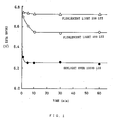
- Fig. 1 indicates the measurements of changes in color value (V) over time under sunlight and under fluorescent light.
- color value decreases approximately 0.2 when irradiated with a 400 lux fluorescent lamp with respect to when irradiated with a 200 lux fluorescent lamp.
- color value decreases 0.5 during irradiation with sunlight at over 10,000 lux with respect to irradiation with a 200 lux fluorescent lamp. Therefore, when this is applied to Table 1 indicated previously, it is understood that natural color rendering is constantly being obtained.
- 1,3,3-trimethylindolino-6′-nitrobenzo-pyrospiropyrane was used for the spiropyrane.
- the foundations prepared according to the recipes above were formed into the shape of disks and the change in color value V was measured before and after irradiation by sunlight for 10 minutes. Further, color difference was subjectively evaluated between a portion of the disks that was irradiated with sunlight for 10 minutes and a portion of the disk that was not irradiated by covering one half of the disk with aluminum foil. Scoring was established as indicated below and the scores were determined to be the average values of the 20 panel members. Score Color Change 1 No change 2 May have changed but hard to tell 3 Changed slightly 4 Changed 5 Changed considerably
- Formed products made by the blending of the respective compounds A and B above were run through a xenon fade meter (Browning Fastness Tester FA-25XW, Toyo Rika Kogyo Ltd. in Japan) for 60 hours and allowed to stand in the dark for 24 hours were used for the samples.
- the difference in color value V was measured for each of the samples by comparing the color value V before and after irradiation for 10 minutes with sunlight.
- titanium oxide-based photochromic pigment demonstrates an extremely high degree of stability in comparison to spiropyrane-based photochromic pigment, and is able to maintain superior color rendering regulatory function in the case of use in cosmetics and paints, etc. as pigment.
- the following examines the blending amount of the titanium oxide-based photochromic pigment related to this invention.
- photochromic titanium oxide causes a change in its color value according to light intensity, such change in color value must be to a degree such that color rendering is subjectively perceived to be constant.
- the favorable content of photochromic titanium oxide is 2% or more in blends when it contained in high covering power such as when total titanium oxide is roughly 20%, and the favorable content of photochromic titanium oxide is 1% or more in blends when it contained in low covering power such as when total titanium oxide is roughly 2%, and in such content, color tone is subjectively perceived to remain nearly constant even during changes in light intensity.
- the maximum amount according to the amount applied on skin or the color tone of the foundation, in general, a value of roughly 20% is favorable.
- the amount of photochromic titanium oxide exceeds 30%, a tendency for it to demonstrate excessive changes in color was observed.
- the blended amount of photochromic titanium oxide in the case when the color of the value of the foundation itself is high, it is preferable adjust the blended amount of photochromic titanium oxide to be slightly lower, and when this value is low, it is preferable to adjust the blended amount of photochromic titanium oxide to be slightly higher.
- substances (1) through (8) were mixed in the blending amounts indicated in the row of Table 6. After adding and mixing in substances (9) through (13) to these mixture by heating and melting, the mixtures were crushed with a pulverizer (Hosokawa Micron Ltd. in Japan). The compounds were then formed into disks to obtain the powder foundations.
- photochromic titanium oxide A manufactured by Example 1, described after which uses typical titanium oxide for its raw material, an amount on the order of 1-30% is suitable for blending into the foundation.
- V and W demonstrated suitable darkening under sunlight.
- (1)-(3) are mixed and a mixture of (4)-(6) which has been heated and melted was added to this followed by crushing. This was molded into a disk to obtain the face powder.
- a face powder was manufactured by substituting titanium oxide A of Embodiment 1 with titanium oxide B which was obtained with Manufacturing Method 2.
- Table 7 Embodiment 1 Embodiment 2 Wavelength(nm) Darkening Fading Time Darkening Fading Time 200 ⁇ - ⁇ - 300 ⁇ - ⁇ - 310 ⁇ 15 sec. ⁇ - 320 ⁇ 15 ⁇ - 330 ⁇ 100 ⁇ - 340 ⁇ 100 ⁇ 350 ⁇ 100 ⁇ - 360 o 120 ⁇ - 370 o 130 ⁇ 5 sec.
- the face powders of Embodiments 1 and 2 of this invention possess excellent photochromic properties.
- a powder foundation in which an equivalent amount of ordinary titanium dioxide was used in place of titanium oxide A possessing photochromic properties of ingredient (1) above was used for Comparative Example 1.
- a powder founda tion in which an equivalent amount of 1,3,5-trimethyl-6′-nitrospiro (2′-H-1-benzopyrane-2,2′-indoline) hydrated polystyrene powder was used in place of the titanium oxide A above was used for Comparative Example 2.
- the scores of the foundation of this invention remained essentially unchanged whether indoors or under sunlight.
- the made up skin appeared natural irrespective of the light environment.
- the powder foundation of this invention demonstrates excellent color rendering of made up skin both indoors and under sunlight. It can also be understood that it demonstrates no photodegradation phenomena and is superior in comparison to the powder foundations of Comparative Examples 1 and 2.
- the dual-purpose foundation related to this embodiment exhibits superior color rendering both indoors and outdoors, and together with resulting in attractive made up skin, also demonstrates excellent ultra-violet screening effects. Approximately twice the blended amount of photochromic titanium oxide was required in order to obtain similar effects without mixing photochromic titanium oxide B with the nylon powder.
- the mixture was degassed to obtain the suntan oil.
- the suntan oil darkened in color under sunlight and also demonstrated excellent effectiveness in screening out ultra-violet rays.
- Paints a, b and c were each applied to a wall. When the brightness of the room was changed, the walls appeared lighter under darker light and had a somewhat darker, refined color tone under bright light.
- the photochromic titanium oxide of paint c demonstrated favorable dispersibility and demonstrated in particular superior color rendering regulatory and ultra-violet ray screening effects.
- hydrophobically-treated photochromic titanium oxide B was manufactured as indicated below.
- Zinc Oxide - Zirconium Oxide Complex Possessing Phototropic Properties 1.0% (2) Stearic Acid 1.5% (3) Isostearic Acid 0.3% (4) Isopropyl Myristate 4.0% (5) Squalane 12.0% (6) POE Stearyl Ether 1.5% (7) Glyceryl Monooleate 0.5% (8) Cetyl Alcohol 0.5% (9) Talc 10.0% (10) Iron Oxide 0.5% (11) Preservative 0.15% (12) Triethanol Amine 0.8% (13) Propylene Glycol 6.0% (14) Montmorillonite 0.5% (15) Purified Water 60.55% (16) Perfume 0.2%
- the nail enamel obtained in this manner changes color under sunlight and together with maintaining constant color rendering, demonstrates excellent resistance to fatigue.
- ingredients related to this invention since such ingredients have been made to contain photochromic titanium oxide, in addition to excellent stability, it is possible to obtain ingredients having color tone that always subjectively appears constant unrelated to light intensity.
Landscapes
- Health & Medical Sciences (AREA)
- Life Sciences & Earth Sciences (AREA)
- Veterinary Medicine (AREA)
- Animal Behavior & Ethology (AREA)
- General Health & Medical Sciences (AREA)
- Public Health (AREA)
- Chemical & Material Sciences (AREA)
- Organic Chemistry (AREA)
- Materials Engineering (AREA)
- Engineering & Computer Science (AREA)
- Inorganic Chemistry (AREA)
- Birds (AREA)
- Epidemiology (AREA)
- Dermatology (AREA)
- Cosmetics (AREA)
Applications Claiming Priority (2)
| Application Number | Priority Date | Filing Date | Title |
|---|---|---|---|
| JP132619/88 | 1988-06-01 | ||
| JP13261988 | 1988-06-01 |
Publications (3)
| Publication Number | Publication Date |
|---|---|
| EP0359909A2 true EP0359909A2 (de) | 1990-03-28 |
| EP0359909A3 EP0359909A3 (en) | 1990-05-09 |
| EP0359909B1 EP0359909B1 (de) | 1995-07-19 |
Family
ID=15085564
Family Applications (1)
| Application Number | Title | Priority Date | Filing Date |
|---|---|---|---|
| EP89109874A Expired - Lifetime EP0359909B1 (de) | 1988-06-01 | 1989-05-31 | Photochrome, farbregulierende Kosmetika |
Country Status (7)
| Country | Link |
|---|---|
| EP (1) | EP0359909B1 (de) |
| KR (1) | KR0162620B1 (de) |
| AU (1) | AU623662B2 (de) |
| CA (1) | CA1339920C (de) |
| DE (1) | DE68923510T2 (de) |
| ES (1) | ES2076171T3 (de) |
| WO (1) | WO1989012084A1 (de) |
Cited By (19)
| Publication number | Priority date | Publication date | Assignee | Title |
|---|---|---|---|---|
| EP0526712A1 (de) * | 1991-06-10 | 1993-02-10 | Shiseido Company Limited | Photochromer UV-Pulverschirm sowie sein Verfahren zur Herstellung und seineAnwendung in Zubereitungen für die Haut |
| EP0612516A1 (de) * | 1993-02-02 | 1994-08-31 | Degussa Aktiengesellschaft | Hautkosmetika |
| US5762913A (en) * | 1994-01-24 | 1998-06-09 | Catalysss & Chemicals Industries Co., Ltd. | Photochromic compound oxide and cosmetic comprising the same |
| EP0847751A1 (de) * | 1996-12-16 | 1998-06-17 | L'oreal | Kosmetische Zubereitungen, die photochrome minerale Verbindungen enthalten |
| FR2758336A1 (fr) * | 1997-01-10 | 1998-07-17 | Oreal | Utilisation d'un composant particulier pour ameliorer le photochromisme d'un compose initialement photochrome |
| EP0899236A1 (de) * | 1997-08-26 | 1999-03-03 | L'oreal | Verfahren zur Herstellung von photochromem Titanoxid, erhaltende Verbindung und eine diese enthaltende Zusammensetzung |
| FR2772266A1 (fr) * | 1997-12-12 | 1999-06-18 | Oreal | Utilisation d'agent de coloration photochrome dans une composition cosmetique, et composition cosmetique le comprenant |
| FR2780275A1 (fr) * | 1998-06-25 | 1999-12-31 | Oreal | Produit de maquillage associant un pigment photochrome et un filtre u.v, ses utilisations |
| US6107390A (en) * | 1996-08-14 | 2000-08-22 | Showa Denko K.K. | Thermoplastic resin composition containing titanium dioxide pigment, and process for preparing same |
| US6468550B1 (en) * | 1997-08-26 | 2002-10-22 | L'oreal, S.A. | Use of an ionic conductor in order to improve photochromism, and composition comprising it |
| WO2010095117A1 (en) * | 2009-02-23 | 2010-08-26 | L'oreal | A method of making up with light-sensitive makeup using a photochromic composition in the already-developed state |
| FR2942405A1 (fr) * | 2009-02-23 | 2010-08-27 | Oreal | Procede de photomaquillage progressif |
| WO2011010041A2 (fr) | 2009-07-20 | 2011-01-27 | L'oreal | Emulsion contenant une dispersion d'oxychlorure de bismuth |
| FR2953397A1 (fr) * | 2009-12-07 | 2011-06-10 | Oreal | Procede de traitement cosmetique |
| WO2011067707A3 (en) * | 2009-12-02 | 2011-08-25 | L'oreal | Cosmetic process involving an active ingredient that can be modified by a stimulus |
| WO2018152298A1 (en) * | 2017-02-16 | 2018-08-23 | Northwestern University | Mercury chalcoiodides for room temperature radiation detection |
| WO2018234530A1 (en) * | 2017-06-22 | 2018-12-27 | Theunseen | Chromic compositions |
| EP3719082A1 (de) * | 2019-04-06 | 2020-10-07 | Koel Colours Pvt. Ltd. | Stabiles reversibles gefärbtes photochromes additiv |
| WO2020208643A1 (en) * | 2019-04-06 | 2020-10-15 | Koel Colours Pvt. Ltd. | A stable reversible coloured photochromic additive |
Families Citing this family (5)
| Publication number | Priority date | Publication date | Assignee | Title |
|---|---|---|---|---|
| JP2915454B2 (ja) * | 1989-11-30 | 1999-07-05 | 株式会社資生堂 | ホトクロミック性肌色顔料およびその製造方法 |
| JP3566050B2 (ja) * | 1997-10-22 | 2004-09-15 | ポーラ化成工業株式会社 | 皮膚外用剤 |
| KR20020096151A (ko) * | 2001-06-18 | 2002-12-31 | 조현화 | 광호변성 매니큐어의 제조방법 |
| JP6671103B2 (ja) * | 2015-02-23 | 2020-03-25 | 共同印刷株式会社 | フォトクロミック光輝性顔料及びその製造方法 |
| EP4221986A1 (de) | 2020-10-01 | 2023-08-09 | Basf Se | Etpe-lasermarkierung |
Family Cites Families (5)
| Publication number | Priority date | Publication date | Assignee | Title |
|---|---|---|---|---|
| JPS4838290A (de) * | 1971-09-17 | 1973-06-05 | ||
| JPS5649312A (en) * | 1979-09-29 | 1981-05-02 | Kanebo Keshohin Kk | Make-up cosmetic capable of changing color |
| JPS56100709A (en) * | 1980-01-16 | 1981-08-12 | Kanebo Keshohin Kk | Novel nail enamel |
| JPH0662387B2 (ja) * | 1985-01-11 | 1994-08-17 | 住友化学工業株式会社 | 化粧料 |
| JPS63132811A (ja) * | 1986-11-21 | 1988-06-04 | Shiseido Co Ltd | 化粧料 |
-
1989
- 1989-05-31 WO PCT/JP1989/000545 patent/WO1989012084A1/ja not_active Ceased
- 1989-05-31 DE DE68923510T patent/DE68923510T2/de not_active Expired - Lifetime
- 1989-05-31 EP EP89109874A patent/EP0359909B1/de not_active Expired - Lifetime
- 1989-05-31 KR KR1019900700222A patent/KR0162620B1/ko not_active Expired - Lifetime
- 1989-05-31 ES ES89109874T patent/ES2076171T3/es not_active Expired - Lifetime
- 1989-05-31 CA CA000601350A patent/CA1339920C/en not_active Expired - Lifetime
- 1989-05-31 AU AU37467/89A patent/AU623662B2/en not_active Expired
Cited By (34)
| Publication number | Priority date | Publication date | Assignee | Title |
|---|---|---|---|---|
| EP0526712A1 (de) * | 1991-06-10 | 1993-02-10 | Shiseido Company Limited | Photochromer UV-Pulverschirm sowie sein Verfahren zur Herstellung und seineAnwendung in Zubereitungen für die Haut |
| EP0612516A1 (de) * | 1993-02-02 | 1994-08-31 | Degussa Aktiengesellschaft | Hautkosmetika |
| US5762913A (en) * | 1994-01-24 | 1998-06-09 | Catalysss & Chemicals Industries Co., Ltd. | Photochromic compound oxide and cosmetic comprising the same |
| US6107390A (en) * | 1996-08-14 | 2000-08-22 | Showa Denko K.K. | Thermoplastic resin composition containing titanium dioxide pigment, and process for preparing same |
| EP0847751A1 (de) * | 1996-12-16 | 1998-06-17 | L'oreal | Kosmetische Zubereitungen, die photochrome minerale Verbindungen enthalten |
| FR2757047A1 (fr) * | 1996-12-16 | 1998-06-19 | Oreal | Composition cosmetique comprenant des composes mineraux photochromes |
| US5989573A (en) * | 1997-01-10 | 1999-11-23 | Oreal | Method for improving the photochromism of a photochromic compound |
| FR2758336A1 (fr) * | 1997-01-10 | 1998-07-17 | Oreal | Utilisation d'un composant particulier pour ameliorer le photochromisme d'un compose initialement photochrome |
| EP0858798A1 (de) * | 1997-01-10 | 1998-08-19 | L'oreal | Verwendung von einer spezifische Verbindung zur verbesserung der Photochromie einer photochromen Verbindung |
| KR100286921B1 (ko) * | 1997-01-10 | 2001-04-16 | 조지안느 플로 | 초기 광호변성화합물의 광호변특성의 향상을 위한 특정성분의 용도 |
| FR2767807A1 (fr) * | 1997-08-26 | 1999-03-05 | Oreal | Procede de preparation d'oxyde de titane photochrome, compose obtenu et composition le comprenant |
| US6468550B1 (en) * | 1997-08-26 | 2002-10-22 | L'oreal, S.A. | Use of an ionic conductor in order to improve photochromism, and composition comprising it |
| US6224884B1 (en) | 1997-08-26 | 2001-05-01 | L'oreal S.A. | Process for the preparation of photochromic titanium oxide, compound obtained and composition comprising it |
| EP0899236A1 (de) * | 1997-08-26 | 1999-03-03 | L'oreal | Verfahren zur Herstellung von photochromem Titanoxid, erhaltende Verbindung und eine diese enthaltende Zusammensetzung |
| EP0938887A1 (de) * | 1997-12-12 | 1999-09-01 | L'oreal | Verwendung von einem photochromischem Farbstoff in einer kosmetischen Zusammensetzung und kosmetische Zusammensetzung enthaltend diesen Farbstoff |
| FR2772266A1 (fr) * | 1997-12-12 | 1999-06-18 | Oreal | Utilisation d'agent de coloration photochrome dans une composition cosmetique, et composition cosmetique le comprenant |
| US6123952A (en) * | 1997-12-12 | 2000-09-26 | L'oreal | Use of photochromic coloring agent in a cosmetic composition, and cosmetic composition comprising it |
| EP0970689A3 (de) * | 1998-06-25 | 2001-01-31 | L'oreal | Schminkprodukt mit einem photochromen Pigment und einem UV-Filter und seine Verwendung |
| FR2780275A1 (fr) * | 1998-06-25 | 1999-12-31 | Oreal | Produit de maquillage associant un pigment photochrome et un filtre u.v, ses utilisations |
| US6080415A (en) * | 1998-06-25 | 2000-06-27 | L'oreal | Make-up product combining a photochromic pigment and a UV screening agent, and uses thereof |
| WO2010095117A1 (en) * | 2009-02-23 | 2010-08-26 | L'oreal | A method of making up with light-sensitive makeup using a photochromic composition in the already-developed state |
| FR2942404A1 (fr) * | 2009-02-23 | 2010-08-27 | Oreal | Procede de photomaquillage utilisant une composition photochromique a l'etat deja revele |
| FR2942405A1 (fr) * | 2009-02-23 | 2010-08-27 | Oreal | Procede de photomaquillage progressif |
| EP2221041A3 (de) * | 2009-02-23 | 2010-11-17 | L'Oréal | Entwickelndes Photomake-up Verfahren |
| EP2826460A1 (de) | 2009-07-20 | 2015-01-21 | L'oreal | Emulsion, die eine Bismutchloridoxid-Dispersion enthält |
| WO2011010041A2 (fr) | 2009-07-20 | 2011-01-27 | L'oreal | Emulsion contenant une dispersion d'oxychlorure de bismuth |
| EP2826459A1 (de) | 2009-07-20 | 2015-01-21 | L'oreal | Emulsion, die eine Bismutchloridoxid-Dispersion enthält |
| WO2011067707A3 (en) * | 2009-12-02 | 2011-08-25 | L'oreal | Cosmetic process involving an active ingredient that can be modified by a stimulus |
| FR2953397A1 (fr) * | 2009-12-07 | 2011-06-10 | Oreal | Procede de traitement cosmetique |
| WO2018152298A1 (en) * | 2017-02-16 | 2018-08-23 | Northwestern University | Mercury chalcoiodides for room temperature radiation detection |
| WO2018234530A1 (en) * | 2017-06-22 | 2018-12-27 | Theunseen | Chromic compositions |
| US11497687B2 (en) | 2017-06-22 | 2022-11-15 | TheUnseen Limited | Chromic compositions |
| EP3719082A1 (de) * | 2019-04-06 | 2020-10-07 | Koel Colours Pvt. Ltd. | Stabiles reversibles gefärbtes photochromes additiv |
| WO2020208643A1 (en) * | 2019-04-06 | 2020-10-15 | Koel Colours Pvt. Ltd. | A stable reversible coloured photochromic additive |
Also Published As
| Publication number | Publication date |
|---|---|
| KR900701957A (ko) | 1990-12-05 |
| ES2076171T3 (es) | 1995-11-01 |
| AU623662B2 (en) | 1992-05-21 |
| EP0359909B1 (de) | 1995-07-19 |
| WO1989012084A1 (fr) | 1989-12-14 |
| DE68923510D1 (de) | 1995-08-24 |
| KR0162620B1 (ko) | 1999-01-15 |
| EP0359909A3 (en) | 1990-05-09 |
| AU3746789A (en) | 1990-01-05 |
| CA1339920C (en) | 1998-06-23 |
| DE68923510T2 (de) | 1996-02-22 |
Similar Documents
| Publication | Publication Date | Title |
|---|---|---|
| EP0359909B1 (de) | Photochrome, farbregulierende Kosmetika | |
| US5628934A (en) | Photochromic color rendering regulatory composition and cosmetics | |
| JP2915454B2 (ja) | ホトクロミック性肌色顔料およびその製造方法 | |
| JP3053667B2 (ja) | ホトクロミック性紫外線遮蔽粉体及びその製造方法、皮膚外用剤 | |
| DE60033492T2 (de) | Kosmetische Zusammensetzung enthaltend hohle plättchenförmige Metalloxid-Pulver | |
| US20080160198A1 (en) | Black brightening flake and cosmetic preparation, coating composition, resin composition, and ink composition each containing the same | |
| EP2954885B1 (de) | Schwarzes eisenoxid zur verwendung mit kosmetika, herstellungsverfahren dafür und kosmetische materialien damit | |
| JP4253346B2 (ja) | 化粧料 | |
| JPS5998009A (ja) | 皮膚化粧料 | |
| JP2635073B2 (ja) | 化粧品組成物 | |
| AU731841B2 (en) | Powder coated with sparingly soluble ultraviolet light absorber | |
| JP3241535B2 (ja) | 有機−無機複合顔料を配合してなる化粧料 | |
| JPH01143821A (ja) | 化粧料 | |
| JPH04139109A (ja) | 化粧料 | |
| JPH0611872B2 (ja) | 二酸化チタン被覆シリカビ−ズ、その製造法および用途 | |
| JPS63132811A (ja) | 化粧料 | |
| JP3506755B2 (ja) | ホトクロミック性複合体、その製造方法及び皮膚外用剤 | |
| JPH07267824A (ja) | 有機−無機複合顔料を配合してなる化粧料 | |
| JPH06116119A (ja) | 紫外線吸収効果の高い化粧料 | |
| JP3677610B2 (ja) | 酸化鉄含有二酸化チタン及びこれを含有する組成物 | |
| JPS60149516A (ja) | 日焼け止め化粧料 | |
| JP3594721B2 (ja) | 表面被覆薄片状粉体、その製造方法及びそれを配合した化粧料 | |
| JP2696257B2 (ja) | ホトクロミック性演色調整組成物、化粧料 | |
| JPWO1989012084A1 (ja) | ホトクロミック性演色調整組成物、化粧料 | |
| JPH08217638A (ja) | 肌色調整用組成物 |
Legal Events
| Date | Code | Title | Description |
|---|---|---|---|
| PUAI | Public reference made under article 153(3) epc to a published international application that has entered the european phase |
Free format text: ORIGINAL CODE: 0009012 |
|
| PUAL | Search report despatched |
Free format text: ORIGINAL CODE: 0009013 |
|
| AK | Designated contracting states |
Kind code of ref document: A2 Designated state(s): DE ES FR GB IT NL |
|
| AK | Designated contracting states |
Kind code of ref document: A3 Designated state(s): DE ES FR GB IT NL |
|
| 17P | Request for examination filed |
Effective date: 19901019 |
|
| 17Q | First examination report despatched |
Effective date: 19920803 |
|
| GRAA | (expected) grant |
Free format text: ORIGINAL CODE: 0009210 |
|
| AK | Designated contracting states |
Kind code of ref document: B1 Designated state(s): DE ES FR GB IT NL |
|
| ET | Fr: translation filed | ||
| REF | Corresponds to: |
Ref document number: 68923510 Country of ref document: DE Date of ref document: 19950824 |
|
| ITF | It: translation for a ep patent filed | ||
| REG | Reference to a national code |
Ref country code: ES Ref legal event code: FG2A Ref document number: 2076171 Country of ref document: ES Kind code of ref document: T3 |
|
| PLBE | No opposition filed within time limit |
Free format text: ORIGINAL CODE: 0009261 |
|
| STAA | Information on the status of an ep patent application or granted ep patent |
Free format text: STATUS: NO OPPOSITION FILED WITHIN TIME LIMIT |
|
| 26N | No opposition filed | ||
| REG | Reference to a national code |
Ref country code: GB Ref legal event code: IF02 |
|
| PGFP | Annual fee paid to national office [announced via postgrant information from national office to epo] |
Ref country code: ES Payment date: 20080529 Year of fee payment: 20 Ref country code: DE Payment date: 20080523 Year of fee payment: 20 |
|
| PGFP | Annual fee paid to national office [announced via postgrant information from national office to epo] |
Ref country code: NL Payment date: 20080515 Year of fee payment: 20 |
|
| PGFP | Annual fee paid to national office [announced via postgrant information from national office to epo] |
Ref country code: IT Payment date: 20080527 Year of fee payment: 20 |
|
| PGFP | Annual fee paid to national office [announced via postgrant information from national office to epo] |
Ref country code: GB Payment date: 20080522 Year of fee payment: 20 |
|
| REG | Reference to a national code |
Ref country code: GB Ref legal event code: PE20 Expiry date: 20090530 |
|
| REG | Reference to a national code |
Ref country code: ES Ref legal event code: FD2A Effective date: 20090601 |
|
| PG25 | Lapsed in a contracting state [announced via postgrant information from national office to epo] |
Ref country code: NL Free format text: LAPSE BECAUSE OF EXPIRATION OF PROTECTION Effective date: 20090531 |
|
| NLV7 | Nl: ceased due to reaching the maximum lifetime of a patent |
Effective date: 20090531 |
|
| PG25 | Lapsed in a contracting state [announced via postgrant information from national office to epo] |
Ref country code: ES Free format text: LAPSE BECAUSE OF EXPIRATION OF PROTECTION Effective date: 20090601 |
|
| PG25 | Lapsed in a contracting state [announced via postgrant information from national office to epo] |
Ref country code: GB Free format text: LAPSE BECAUSE OF EXPIRATION OF PROTECTION Effective date: 20090530 |
|
| PGFP | Annual fee paid to national office [announced via postgrant information from national office to epo] |
Ref country code: FR Payment date: 20080425 Year of fee payment: 20 |