EP0352845B1 - Verfahren zur Herstellung aromatischer thermotroper Copolyesteramide sowie entsprechende Copolyesteramide. - Google Patents
Verfahren zur Herstellung aromatischer thermotroper Copolyesteramide sowie entsprechende Copolyesteramide. Download PDFInfo
- Publication number
- EP0352845B1 EP0352845B1 EP89201883A EP89201883A EP0352845B1 EP 0352845 B1 EP0352845 B1 EP 0352845B1 EP 89201883 A EP89201883 A EP 89201883A EP 89201883 A EP89201883 A EP 89201883A EP 0352845 B1 EP0352845 B1 EP 0352845B1
- Authority
- EP
- European Patent Office
- Prior art keywords
- unit
- copolyesteramides
- preparation
- units
- aromatic thermotropic
- Prior art date
- Legal status (The legal status is an assumption and is not a legal conclusion. Google has not performed a legal analysis and makes no representation as to the accuracy of the status listed.)
- Expired - Lifetime
Links
- 238000002360 preparation method Methods 0.000 title claims abstract description 13
- 238000000034 method Methods 0.000 title claims abstract description 10
- 230000008569 process Effects 0.000 title claims abstract description 10
- 125000003118 aryl group Chemical group 0.000 title claims abstract description 9
- 239000000178 monomer Substances 0.000 claims abstract description 6
- 239000012298 atmosphere Substances 0.000 claims abstract description 4
- FJKROLUGYXJWQN-UHFFFAOYSA-N 4-hydroxybenzoic acid Chemical compound OC(=O)C1=CC=C(O)C=C1 FJKROLUGYXJWQN-UHFFFAOYSA-N 0.000 claims description 7
- PLIKAWJENQZMHA-UHFFFAOYSA-N 4-aminophenol Chemical compound NC1=CC=C(O)C=C1 PLIKAWJENQZMHA-UHFFFAOYSA-N 0.000 claims description 6
- 239000002253 acid Substances 0.000 claims description 6
- 239000002243 precursor Substances 0.000 claims description 6
- 238000006116 polymerization reaction Methods 0.000 claims description 5
- 229940090248 4-hydroxybenzoic acid Drugs 0.000 claims description 3
- 125000003277 amino group Chemical group 0.000 claims description 3
- VCCBEIPGXKNHFW-UHFFFAOYSA-N biphenyl-4,4'-diol Chemical group C1=CC(O)=CC=C1C1=CC=C(O)C=C1 VCCBEIPGXKNHFW-UHFFFAOYSA-N 0.000 claims description 3
- 125000002915 carbonyl group Chemical group [*:2]C([*:1])=O 0.000 claims description 3
- 150000002531 isophthalic acids Chemical class 0.000 claims description 2
- 150000003504 terephthalic acids Chemical class 0.000 claims description 2
- 238000001125 extrusion Methods 0.000 abstract description 3
- 238000002347 injection Methods 0.000 abstract description 3
- 239000007924 injection Substances 0.000 abstract description 3
- 230000000379 polymerizing effect Effects 0.000 abstract 1
- QQVIHTHCMHWDBS-UHFFFAOYSA-N isophthalic acid Chemical compound OC(=O)C1=CC=CC(C(O)=O)=C1 QQVIHTHCMHWDBS-UHFFFAOYSA-N 0.000 description 24
- 229920000642 polymer Polymers 0.000 description 17
- 238000012360 testing method Methods 0.000 description 17
- CSCPPACGZOOCGX-UHFFFAOYSA-N Acetone Chemical compound CC(C)=O CSCPPACGZOOCGX-UHFFFAOYSA-N 0.000 description 12
- 239000000203 mixture Substances 0.000 description 8
- -1 2,6-naphthalenedioyl units Chemical group 0.000 description 6
- IJGRMHOSHXDMSA-UHFFFAOYSA-N Atomic nitrogen Chemical compound N#N IJGRMHOSHXDMSA-UHFFFAOYSA-N 0.000 description 6
- KKEYFWRCBNTPAC-UHFFFAOYSA-N Terephthalic acid Chemical compound OC(=O)C1=CC=C(C(O)=O)C=C1 KKEYFWRCBNTPAC-UHFFFAOYSA-N 0.000 description 6
- 238000006243 chemical reaction Methods 0.000 description 5
- 238000002844 melting Methods 0.000 description 5
- 230000008018 melting Effects 0.000 description 5
- 229920000728 polyester Polymers 0.000 description 4
- 229920006149 polyester-amide block copolymer Polymers 0.000 description 4
- 239000004952 Polyamide Substances 0.000 description 3
- 230000008570 general process Effects 0.000 description 3
- 229910052757 nitrogen Inorganic materials 0.000 description 3
- 229920002647 polyamide Polymers 0.000 description 3
- ALYNCZNDIQEVRV-UHFFFAOYSA-N 4-aminobenzoic acid Chemical compound NC1=CC=C(C(O)=O)C=C1 ALYNCZNDIQEVRV-UHFFFAOYSA-N 0.000 description 2
- 229920013683 Celanese Polymers 0.000 description 2
- 239000003153 chemical reaction reagent Substances 0.000 description 2
- 238000001816 cooling Methods 0.000 description 2
- 230000000694 effects Effects 0.000 description 2
- 239000012299 nitrogen atmosphere Substances 0.000 description 2
- 230000003287 optical effect Effects 0.000 description 2
- 239000000243 solution Substances 0.000 description 2
- 239000000126 substance Substances 0.000 description 2
- 238000007669 thermal treatment Methods 0.000 description 2
- MHCVCKDNQYMGEX-UHFFFAOYSA-N 1,1'-biphenyl;phenoxybenzene Chemical compound C1=CC=CC=C1C1=CC=CC=C1.C=1C=CC=CC=1OC1=CC=CC=C1 MHCVCKDNQYMGEX-UHFFFAOYSA-N 0.000 description 1
- PKQYSCBUFZOAPE-UHFFFAOYSA-N 1,2-dibenzyl-3-methylbenzene Chemical compound C=1C=CC=CC=1CC=1C(C)=CC=CC=1CC1=CC=CC=C1 PKQYSCBUFZOAPE-UHFFFAOYSA-N 0.000 description 1
- JQCVPZXMGXKNOD-UHFFFAOYSA-N 1,2-dibenzylbenzene Chemical class C=1C=CC=C(CC=2C=CC=CC=2)C=1CC1=CC=CC=C1 JQCVPZXMGXKNOD-UHFFFAOYSA-N 0.000 description 1
- CBCKQZAAMUWICA-UHFFFAOYSA-N 1,4-phenylenediamine Chemical compound NC1=CC=C(N)C=C1 CBCKQZAAMUWICA-UHFFFAOYSA-N 0.000 description 1
- GDBUZIKSJGRBJP-UHFFFAOYSA-N 4-acetoxy benzoic acid Chemical compound CC(=O)OC1=CC=C(C(O)=O)C=C1 GDBUZIKSJGRBJP-UHFFFAOYSA-N 0.000 description 1
- DHGNWPKWMIRMMO-UHFFFAOYSA-N CC(C=O)c1cccc(N(C)O)c1 Chemical compound CC(C=O)c1cccc(N(C)O)c1 DHGNWPKWMIRMMO-UHFFFAOYSA-N 0.000 description 1
- 229960004050 aminobenzoic acid Drugs 0.000 description 1
- 239000004760 aramid Substances 0.000 description 1
- 229920003235 aromatic polyamide Polymers 0.000 description 1
- 150000001875 compounds Chemical class 0.000 description 1
- 238000009833 condensation Methods 0.000 description 1
- 230000005494 condensation Effects 0.000 description 1
- 229920001577 copolymer Polymers 0.000 description 1
- 238000001035 drying Methods 0.000 description 1
- 230000007613 environmental effect Effects 0.000 description 1
- 235000012438 extruded product Nutrition 0.000 description 1
- 239000012530 fluid Substances 0.000 description 1
- 239000007789 gas Substances 0.000 description 1
- 238000010438 heat treatment Methods 0.000 description 1
- 239000001257 hydrogen Substances 0.000 description 1
- 229910052739 hydrogen Inorganic materials 0.000 description 1
- 125000004435 hydrogen atom Chemical class [H]* 0.000 description 1
- 239000007788 liquid Substances 0.000 description 1
- 230000002535 lyotropic effect Effects 0.000 description 1
- 239000005267 main chain polymer Substances 0.000 description 1
- 238000004519 manufacturing process Methods 0.000 description 1
- 239000000155 melt Substances 0.000 description 1
- SYSQUGFVNFXIIT-UHFFFAOYSA-N n-[4-(1,3-benzoxazol-2-yl)phenyl]-4-nitrobenzenesulfonamide Chemical class C1=CC([N+](=O)[O-])=CC=C1S(=O)(=O)NC1=CC=C(C=2OC3=CC=CC=C3N=2)C=C1 SYSQUGFVNFXIIT-UHFFFAOYSA-N 0.000 description 1
- 229920000139 polyethylene terephthalate Polymers 0.000 description 1
- 239000005020 polyethylene terephthalate Substances 0.000 description 1
- 239000000843 powder Substances 0.000 description 1
- 230000002035 prolonged effect Effects 0.000 description 1
- 230000001105 regulatory effect Effects 0.000 description 1
- 238000000926 separation method Methods 0.000 description 1
- 239000010454 slate Substances 0.000 description 1
- 238000003756 stirring Methods 0.000 description 1
- 238000012345 traction test Methods 0.000 description 1
- 230000009466 transformation Effects 0.000 description 1
Classifications
-
- C—CHEMISTRY; METALLURGY
- C08—ORGANIC MACROMOLECULAR COMPOUNDS; THEIR PREPARATION OR CHEMICAL WORKING-UP; COMPOSITIONS BASED THEREON
- C08G—MACROMOLECULAR COMPOUNDS OBTAINED OTHERWISE THAN BY REACTIONS ONLY INVOLVING UNSATURATED CARBON-TO-CARBON BONDS
- C08G69/00—Macromolecular compounds obtained by reactions forming a carboxylic amide link in the main chain of the macromolecule
- C08G69/44—Polyester-amides
Definitions
- the present invention fits in the technical field of the preparation of aromatic thermotropic copolyesteramides that have optical anisotropy upon melting. These compounds are useful for the preparation of filaments with high tensile strenght and high tensile modulus, as well as for the preparation of products molded by extrusion or injection and also for the preparation of films.
- Aromatic polyamides and polyesters which form anisotropic solutions or melts are well known for their good mechanical properties. These properties are due precisely to the macromolecular orientation that can be induced in their mesomorphous state and to the possibility of maintaining this orientation once they are transformed in usable articles or products.
- aromatic thermotropic polyesters are capable of developing a mesomorphous state upon melting, while totally aromatic lyotropic polyamides develop a mesomorphous slate in solutions. It can also be pointed out, in general, that mesomorphic polyamides give rise to products or articles with high mechanical properties with molecular weights lower than the ones necessary for the case of aromatic polyesters due to the effect of the intermolecular bridges of the amidic hydrogen (see, for example, M. G.
- Copolyesteramides of which few examples are known, have properties of the two types of the polymers indicated, and, in some cases such as the present invention, they have a thermotropic nature, which makes them extremely interesting with regards their transformation.
- U.S. patent no. 4,567,227 granted to CELANESE describes the mechanical properties of a blend of a (poly(terephthaloyl-co-oxiphenylen-amide-co-2-oxi-6-naphthoyl)) polyesteramide and a (poly(p-oxi-benzoyl-co-2-oxi-6-naphthoyl)) polyester.
- thermotropic polyesteramides made out of p-oxibenzoyl and 2,6-naphthalenedioyl units and other moities.
- Japanese patent no. 59 47.229 granted to MITSUBISHI CHEMICAL describes mixtures of polyamides with thermotropic polyesteramides obtained from poly-(ethyleneterephthalate) and p-hydroxybenzoic acid with 5 parts (molar over the total) of p-aminobenzoic acid.
- thermotropic polyesteramides made out of 2-oxi-6-naphthoyl units in which 3-acetoxiacetanilide is used as a carrier monomer of this bond.
- European patent application EP-A-230545 discloses copolyesteramides made of at least five units, the first of which is for example based on tert.butyl hydrochinone, the second on 4,4′ dihydroxybiphenyl, the third on tercphthalic acid, the fourth on p-hydroxylbenzoic acid and the fifth on 4-aminophenol and/or p-phenyldiamine.
- the present invention is intended to prepare copolyesteramides with a molecular weight suitable for forming fibres showing optical anistropy upon melting and which consist of only four basic units.
- the copolyesteramides according to the invention are useful to form filaments with high tensile strength and high tensile modulus, as well as injection or extrusion molded products and films.
- copolyesteramides according to the invention consist of units having the following structural formulae:
- the number of carbonyl groups is equal to the sum of oxi and amino groups.
- the invention also includes the filaments and molded or extruded products as well as films manufactured from said copolyesteramides.
- Unit I of the copolyesteramides of the invention is 4-oxibenzoyl.
- Unit II is 4,4′-dioxibiphenyl.
- Unit III is 4-aminophenoxy and unit IV is isophthaloyl and/or terephthaloyl.
- the suitable precursors of these units are the following:
- the precursor reagents are generally combined in proportions which correspond to the molar proportions of the units desired in the copolyesteramides, except that a slight molar excess of the most volatile reagents can be used.
- the process of the present invention comprises subjecting to polymerization reaction the mixture of precursor monomers of above cited units (I) to (IV), either melted, or else dissolved in a fluid medium which does not take part in the reaction, such as for example, a medium made out of isomers of dibenzyl benzene and benzilbenzene, for example: Dowtherm or Marlotherm S (registered trade marks of Dow Chemical, USA and Hüls, A.G. West Germany).
- the reaction is carried out in an inert atmosphere, generally nitrogen, during a period of time between 2 and 18 hours and at a temperature between 220 and 350°C.
- a vacuum can be applied (0.0006798 - 0.0013590 at), in the last phase of the process to obtain copolymers with a high molecular weight. It is also possible in other cases to effect a curing in an inert atmosphere upon the polymer in powder or filament form at temperatures below the melting point.
- copolyesteramides A series of copolyesteramides have been prepared and mechanical tests of the same have been effected in order to determine their properties.
- the copolyesteramides have been prepared in accordance with the following general process:
- the mixture of precursor monomers is introduced in the proportions pointed out in the following examples, in a reactor provided with a regulated heating system, a metallic bath, a condensation column, a stirring system, a nitrogen inlet and a gas outlet.
- the process is carried out in a nitrogen atmosphere and with the monomers dispersed in the inert medium of reaction above mentioned.
- the reaction is carried out in steps: 2 h at 250° C, 2 h at 280° C, 2 h at 300° C and finally, 12 h at 320° C.
- the polymerization can be carried out for a total of 2-3 h modifying the temperature sequentially between 220 and 350° C.
- the reaction mass is left to cool in a nitrogen atmosphere. Afterwards, the polymerization product is washed with acetone, is dried and ground to an adequate size, after which it is washed repeatedly with acetone. Finally, the product is subjected to prolonged drying under vacuum.
- the resulting polymer from the general process described above is extruded in the form of rather cylindrical test pieces, with a thickness between 0.25 and 0.75 mm. of diameter, processing the anisotropic melted mass at the adequate temperature for each case, usually around 350° C and cooling the extruded mass in the air.
- a piston extruder which applies a constant pressure on the melted polymer at a temperature in which this has a nematic mesophase ( ⁇ 350°). It flows in these conditions and the nematic domaines orientate themselves upon passing through a die designed for this purpose. The cooling of the extruded polymer freezes this orientation, which is the one which the mechanical tests described in the following examples are carried out.
- Dies of 0.35, 0.5 or 0.7 mm, of inside diameter can be used with which extruded filaments with a diameter of 0.3 to 0.7 mm can be obtained.
- the test pieces which are used for the mechanical test are prepared from these extruded filaments. The results of these mechanical test are reflected in the examples described hereafter.
- test pieces thus prepared are separated into two groups, one for the obtainment of the mechanical original values and the other that is subjected to a thermal treatment of 72h at 240° C in nitrogen stream and which is also subjected to mechanical tests.
- the traction speed in all the tests has been constant and has been 10 mm/min.
- the separation of the jaws in the testing machine has been 50 mm.
- the polymers are decribed, for example, as P.B.IT.T. PA (50:15:7:18:10) indicating that they contain 50 moles % of 4-oxybenzoyl units, 15 moles % of 4,4′-dioxibiphenyl, 7 moles % of isophthaloyl units, 18 moles % of therephthaloyl units and 10 moles % of 4-amino-phenoxy units.
- the precursors of these units are introduced in the reactor in the same molar proportions which are desired to have in the final polymer.
- the polymer of composition P.B.T.PA (50:15:25:10) is prepared by introducing in the reactor 22.5 g. of P (0.125 mol) 10.125 g. of B (0.0375 mol) 10.375 g. af T (0.0625 mol) 4,325 g. of PA (0.025 mol)
- the polymer of composition P.B.IT.PA (60:18:20:2) is prepared by introducing in the reactor: 27 g. of P (0.15 mol) 12.15 g. of B (0.045 mol) 8.3 g. of IT (0.05 mol) 0.965 g. of PA (0.005 mol)
- the polymer of composition P.B.IT.T.PA (50:15:12.5:12.5:10) is prepared by introducing in the reactor: 22.5 g. of P (0.125 mol) 10.125 g. of B (0.0375 mol) 5.187 g. of IT (0.03125 mol) 5.187 g. of T (0.03125 mol) 4.825 g. of PA (0.025 mol)
- the polymer obtained was washed with acetone, dried and ground. It was extruded at 360° C to prepare test pieces in the above described manner.
- the polymer of composition P.B.IT.T.PA (50:20:12.5:12.5:5) is prepared by introducing in the reactor: 22.5 g. of P (0.125 mol) 13.5 g. of B (0.05 mol) 5.187 g. of IT (0.03125 mol) 5.187 g. of T (0.03125 mol) 2.41 g. of PA (0.0125 mol)
- the polymer obtained was washed with acetone, dried and ground. It was extruded at 340° C to prepare test pieces in the above described manner.
Landscapes
- Chemical & Material Sciences (AREA)
- Health & Medical Sciences (AREA)
- Chemical Kinetics & Catalysis (AREA)
- Medicinal Chemistry (AREA)
- Polymers & Plastics (AREA)
- Organic Chemistry (AREA)
- Polyamides (AREA)
- Compounds Of Unknown Constitution (AREA)
- Artificial Filaments (AREA)
Claims (4)
- Verfahren zur Werstellung von aromatischen thermotropen Copolyesteramiden, die sich aus monomeren Einheiten mit den folgenden Strukturformeln:


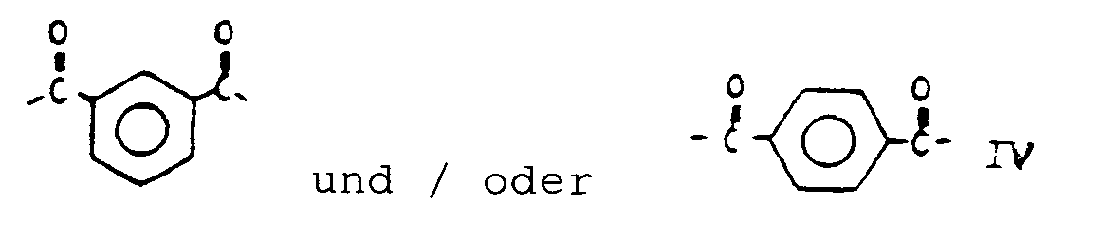
- Verfahren zur Werstellung von neuen aromatischen termotropen Copolyesteramiden nach Anspruch 1, dadurch gekennzeichnet, dass Einheit IV entweder Isophthaloyl und/ oder Terephtaloyl mit einem molaren Verhältnis von 0:30 bis 30:0 und insbesondere mit im wesentlichen äquimolaren Verhältnis ist.
- Verwendung der durch das Verfahren von Anspruch 1 erhaltenen Copolyesteramide zur Werstellung von Filamenten mit einer hohen Zugfestigkeit und einem hohen Zugmodul.
- Aromatische thermotrope Copolyesteramide, die sich aus monomeren Einheiten mit den folgenden Strukturformeln:


Priority Applications (1)
| Application Number | Priority Date | Filing Date | Title |
|---|---|---|---|
| AT89201883T ATE85353T1 (de) | 1988-07-27 | 1989-07-19 | Verfahren zur herstellung aromatischer thermotroper copolyesteramide sowie entsprechende copolyesteramide. |
Applications Claiming Priority (2)
| Application Number | Priority Date | Filing Date | Title |
|---|---|---|---|
| ES8802366 | 1988-07-27 | ||
| ES8802366A ES2010297A6 (es) | 1988-07-27 | 1988-07-27 | Un procedimiento para la preparacion de nuevas copoliesteramidas termotropas aromaticas. |
Publications (2)
| Publication Number | Publication Date |
|---|---|
| EP0352845A1 EP0352845A1 (de) | 1990-01-31 |
| EP0352845B1 true EP0352845B1 (de) | 1993-02-03 |
Family
ID=8257514
Family Applications (1)
| Application Number | Title | Priority Date | Filing Date |
|---|---|---|---|
| EP89201883A Expired - Lifetime EP0352845B1 (de) | 1988-07-27 | 1989-07-19 | Verfahren zur Herstellung aromatischer thermotroper Copolyesteramide sowie entsprechende Copolyesteramide. |
Country Status (6)
| Country | Link |
|---|---|
| US (1) | US4966956A (de) |
| EP (1) | EP0352845B1 (de) |
| JP (1) | JPH0286623A (de) |
| AT (1) | ATE85353T1 (de) |
| DE (1) | DE68904709T2 (de) |
| ES (1) | ES2010297A6 (de) |
Families Citing this family (16)
| Publication number | Priority date | Publication date | Assignee | Title |
|---|---|---|---|---|
| US5204443A (en) * | 1991-04-19 | 1993-04-20 | Hoechst Celanese Corp. | Melt processable poly(ester-amide) capable of forming an anisotropic melt containing an aromatic moiety capable of forming an amide linkage |
| WO1995033803A1 (en) * | 1994-06-06 | 1995-12-14 | Hoechst Celanese Corporation | Thermotropic liquid crystalline poly(esteramides) |
| US5854376A (en) * | 1995-03-09 | 1998-12-29 | Sekisui Kaseihin Kogyo Kabushiki Kaisha | Aliphatic ester-amide copolymer resins |
| US5731401A (en) * | 1996-09-30 | 1998-03-24 | Hoechst Celanese Corp. | Process for the preparation of thermotropic aromatic polyesters directly from dialkyl aromatic esters |
| US6207790B1 (en) | 2000-01-14 | 2001-03-27 | Ticona Llc | Process for producing amorphous anisotropic melt-forming polymers having a high degree of stretchability and polymers produced by same |
| US6132884A (en) * | 2000-01-14 | 2000-10-17 | Ticona Llc | Process for producing amorphous anisotrophic melt-forming polymers having a high degree of stretchability and polymers produced by same |
| US6294640B1 (en) | 2000-01-14 | 2001-09-25 | Ticona Llc | Stretchable polymers and shaped articles produced by same |
| US6222000B1 (en) | 2000-01-14 | 2001-04-24 | Ticona Llc | Process for producing amorphous anisotropic melt-forming polymers having a high degree of stretchability |
| US6666990B2 (en) | 2001-02-14 | 2003-12-23 | Ticona Llc | Stretchable liquid crystal polymer composition |
| US6514611B1 (en) | 2001-08-21 | 2003-02-04 | Ticona Llc | Anisotropic melt-forming polymers having a high degree of stretchability |
| JP2003105082A (ja) * | 2001-09-27 | 2003-04-09 | Sumitomo Chem Co Ltd | 芳香族ポリエステルアミド |
| KR101111645B1 (ko) * | 2009-06-17 | 2012-03-13 | 삼성정밀화학 주식회사 | 용융점도가 일정한 전방향족 액정 폴리에스테르 수지의 제조방법 및 전방향족 액정 폴리에스테르 수지 컴파운드의 제조방법 |
| CN108026269A (zh) * | 2015-10-21 | 2018-05-11 | 宝理塑料株式会社 | 全芳香族聚酯酰胺和其制造方法 |
| WO2018074155A1 (ja) * | 2016-10-21 | 2018-04-26 | ポリプラスチックス株式会社 | 複合樹脂組成物、及び当該複合樹脂組成物から成形された電子部品 |
| WO2018074156A1 (ja) * | 2016-10-21 | 2018-04-26 | ポリプラスチックス株式会社 | 複合樹脂組成物、及び当該複合樹脂組成物から成形されたコネクター |
| WO2018116888A1 (ja) * | 2016-12-21 | 2018-06-28 | ポリプラスチックス株式会社 | 表面実装リレー用液晶性樹脂組成物及びそれを用いた表面実装リレー |
Family Cites Families (10)
| Publication number | Priority date | Publication date | Assignee | Title |
|---|---|---|---|---|
| US4330457A (en) * | 1980-12-09 | 1982-05-18 | Celanese Corporation | Poly(ester-amide) capable of forming an anisotropic melt phase derived from 6-hydroxy-2-naphthoic acid, dicarboxylic acid, and aromatic monomer capable of forming an amide linkage |
| US4351917A (en) * | 1981-04-06 | 1982-09-28 | Celanese Corporation | Poly(ester-amide) capable of forming an anisotropic melt phase derived from 6-hydroxy-2-naphthoic acid, aromatic monomer capable of forming an amide linkage, and other aromatic hydroxyacid |
| US4351918A (en) * | 1981-04-06 | 1982-09-28 | Celanese Corporation | Poly(ester-amide) capable of forming an anisotropic melt phase derived from 6-hydroxy-2-naphthoic acid, other aromatic hydroxyacid, carbocyclic dicarboxylic acid, and aromatic monomer capable of forming an amide linkage |
| US4355132A (en) * | 1981-04-07 | 1982-10-19 | Celanese Corporation | Anisotropic melt phase forming poly(ester-amide) derived from p-hydroxybenzoic acid, 2,6-naphthalenedicarboxylic acid, aromatic monomer capable of forming an amide linkage, and, optionally, hydroquinone and additional carbocyclic dicarboxylic acid |
| EP0081900B1 (de) * | 1981-11-16 | 1987-05-13 | Imperial Chemical Industries Plc | Anisotrope Polymere, die bei erhöhten Temperaturen ein verbessertes Beibehalten der physikalischen Eigenschaften besitzen, und Verfahren zu ihrer Herstellung |
| JPS5947228A (ja) * | 1982-09-10 | 1984-03-16 | Teijin Chem Ltd | 分岐ポリカ−ボネ−トの製造方法 |
| US4567227A (en) * | 1984-11-13 | 1986-01-28 | Celanese Corporation | Blend of wholly aromatic polyester and poly(ester-amide) capable of exhibiting an anisotropic melt phase |
| DE3542779A1 (de) * | 1985-12-04 | 1987-06-11 | Basf Ag | Vollaromatische mesomorphe polyesteramide, deren herstellung und verwendung |
| JPH0717748B2 (ja) * | 1986-12-19 | 1995-03-01 | 川崎製鉄株式会社 | 芳香族ポリエステルアミド |
| CA1333736C (en) * | 1987-01-30 | 1994-12-27 | Kenji Yoshino | Copolyesters, copolyesteramides, preparation of molded articles therefrom, and compositions thereof |
-
1988
- 1988-07-27 ES ES8802366A patent/ES2010297A6/es not_active Expired
-
1989
- 1989-07-19 EP EP89201883A patent/EP0352845B1/de not_active Expired - Lifetime
- 1989-07-19 AT AT89201883T patent/ATE85353T1/de not_active IP Right Cessation
- 1989-07-19 DE DE8989201883T patent/DE68904709T2/de not_active Expired - Fee Related
- 1989-07-24 US US07/384,277 patent/US4966956A/en not_active Expired - Fee Related
- 1989-07-27 JP JP1197900A patent/JPH0286623A/ja active Pending
Also Published As
| Publication number | Publication date |
|---|---|
| JPH0286623A (ja) | 1990-03-27 |
| DE68904709T2 (de) | 1993-05-19 |
| ES2010297A6 (es) | 1989-11-01 |
| EP0352845A1 (de) | 1990-01-31 |
| ATE85353T1 (de) | 1993-02-15 |
| DE68904709D1 (de) | 1993-03-18 |
| US4966956A (en) | 1990-10-30 |
Similar Documents
| Publication | Publication Date | Title |
|---|---|---|
| EP0352845B1 (de) | Verfahren zur Herstellung aromatischer thermotroper Copolyesteramide sowie entsprechende Copolyesteramide. | |
| US4351917A (en) | Poly(ester-amide) capable of forming an anisotropic melt phase derived from 6-hydroxy-2-naphthoic acid, aromatic monomer capable of forming an amide linkage, and other aromatic hydroxyacid | |
| EP0067032B1 (de) | Eine anisotrope Schmelzphase bildendes, aus p-Hydroxybenzolsäure, 2,6-Dihydroxynaphthalin, einer carbocyclischen Dicarbonsäure, einem eine Amid-Verbindung zu bilden fähigen aromatischen Monomer und wahlweise einem zusätzlichen aromatischen Diol hergestelltes Poly(ester-amid) | |
| US4330457A (en) | Poly(ester-amide) capable of forming an anisotropic melt phase derived from 6-hydroxy-2-naphthoic acid, dicarboxylic acid, and aromatic monomer capable of forming an amide linkage | |
| JP3105281B2 (ja) | 溶融加工可能なポリエステル | |
| US4355132A (en) | Anisotropic melt phase forming poly(ester-amide) derived from p-hydroxybenzoic acid, 2,6-naphthalenedicarboxylic acid, aromatic monomer capable of forming an amide linkage, and, optionally, hydroquinone and additional carbocyclic dicarboxylic acid | |
| US4356300A (en) | Polyetherpolyamide copolymers | |
| US4479999A (en) | Fabric comprised of fusible and infusible fibers, the former comprising a polymer which is capable of forming an anisotropic melt phase | |
| CA1261515A (en) | Blend of wholly aromatic polyester and poly (ester-amide) capable of exhibiting an anisotropic melt phase | |
| CA1167996A (en) | Polyamides | |
| EP0423311A1 (de) | Mit vollaromatischen polyesterfasern verstärktes thermoplastisches material für hohe leistung und verfahren zu dessen herstellung. | |
| JPH0149804B2 (de) | ||
| EP0631594A4 (de) | Vollaromatische flüssigkristalline polymere, die ionische monomereinheiten enthalten und verbundstoffe daraus. | |
| FI73711C (fi) | Flerfasiga kompositioner av polyamider och polyesteramider. | |
| EP2726537B1 (de) | Verzweigtes polyamid mit verschiedenen blöcken | |
| JPS58208324A (ja) | グラフトおよびブロツクコポリマ−の製造法 | |
| US3294758A (en) | Amorphous polyamides from a mixture of an alkyl substituted aliphatic diamine and unsubstituted aliphatic diamine | |
| CA2177240A1 (en) | Production of aromatic polyamide | |
| US5162484A (en) | Thermotropic semialiphatic copolyesteramides | |
| JPS58104924A (ja) | 芳香族の溶融加工しうる(コ)ポリエステル | |
| JP2004519532A (ja) | 溶融性ポリエステルの製造方法 | |
| JPH0571056B2 (de) | ||
| EP0372627B1 (de) | Verfahren zur Herstellung von halbaromatischen Copolyamiden und Copolyesteramiden. | |
| East et al. | Thermotropic poly (ester-amides) based on naphthalene monomers | |
| EP0066359A1 (de) | Poly(ester-amid) abgeleitet von Dihydroxyanthrachinon, Hydroxybenzoesäure, Dicarbonsäure und einem eine Amidbindung bildenden aromatischen Monomer |
Legal Events
| Date | Code | Title | Description |
|---|---|---|---|
| PUAI | Public reference made under article 153(3) epc to a published international application that has entered the european phase |
Free format text: ORIGINAL CODE: 0009012 |
|
| AK | Designated contracting states |
Kind code of ref document: A1 Designated state(s): AT BE CH DE FR GB GR IT LI LU NL SE |
|
| 17P | Request for examination filed |
Effective date: 19900711 |
|
| 17Q | First examination report despatched |
Effective date: 19920122 |
|
| RTI1 | Title (correction) | ||
| GRAA | (expected) grant |
Free format text: ORIGINAL CODE: 0009210 |
|
| AK | Designated contracting states |
Kind code of ref document: B1 Designated state(s): AT BE CH DE FR GB GR IT LI LU NL SE |
|
| PG25 | Lapsed in a contracting state [announced via postgrant information from national office to epo] |
Ref country code: GR Free format text: LAPSE BECAUSE OF FAILURE TO SUBMIT A TRANSLATION OF THE DESCRIPTION OR TO PAY THE FEE WITHIN THE PRESCRIBED TIME-LIMIT Effective date: 19930203 |
|
| REF | Corresponds to: |
Ref document number: 85353 Country of ref document: AT Date of ref document: 19930215 Kind code of ref document: T |
|
| REF | Corresponds to: |
Ref document number: 68904709 Country of ref document: DE Date of ref document: 19930318 |
|
| ET | Fr: translation filed | ||
| ITF | It: translation for a ep patent filed | ||
| PG25 | Lapsed in a contracting state [announced via postgrant information from national office to epo] |
Ref country code: GB Effective date: 19930719 Ref country code: AT Effective date: 19930719 |
|
| PG25 | Lapsed in a contracting state [announced via postgrant information from national office to epo] |
Ref country code: SE Effective date: 19930720 |
|
| REG | Reference to a national code |
Ref country code: GR Ref legal event code: FG4A Free format text: 3007779 |
|
| PG25 | Lapsed in a contracting state [announced via postgrant information from national office to epo] |
Ref country code: LU Free format text: LAPSE BECAUSE OF NON-PAYMENT OF DUE FEES Effective date: 19930731 Ref country code: LI Effective date: 19930731 Ref country code: CH Effective date: 19930731 Ref country code: BE Effective date: 19930731 |
|
| PLBE | No opposition filed within time limit |
Free format text: ORIGINAL CODE: 0009261 |
|
| STAA | Information on the status of an ep patent application or granted ep patent |
Free format text: STATUS: NO OPPOSITION FILED WITHIN TIME LIMIT |
|
| 26N | No opposition filed | ||
| BERE | Be: lapsed |
Owner name: S.A. CABLES DE COMUNICACIONES Effective date: 19930731 |
|
| PG25 | Lapsed in a contracting state [announced via postgrant information from national office to epo] |
Ref country code: NL Effective date: 19940201 |
|
| GBPC | Gb: european patent ceased through non-payment of renewal fee |
Effective date: 19930719 |
|
| NLV4 | Nl: lapsed or anulled due to non-payment of the annual fee | ||
| PG25 | Lapsed in a contracting state [announced via postgrant information from national office to epo] |
Ref country code: FR Effective date: 19940331 |
|
| REG | Reference to a national code |
Ref country code: CH Ref legal event code: PL |
|
| PG25 | Lapsed in a contracting state [announced via postgrant information from national office to epo] |
Ref country code: DE Effective date: 19940401 |
|
| REG | Reference to a national code |
Ref country code: FR Ref legal event code: ST |
|
| REG | Reference to a national code |
Ref country code: GR Ref legal event code: MM2A Free format text: 3007779 |
|
| EUG | Se: european patent has lapsed |
Ref document number: 89201883.9 Effective date: 19940210 |
|
| PG25 | Lapsed in a contracting state [announced via postgrant information from national office to epo] |
Ref country code: IT Free format text: LAPSE BECAUSE OF NON-PAYMENT OF DUE FEES;WARNING: LAPSES OF ITALIAN PATENTS WITH EFFECTIVE DATE BEFORE 2007 MAY HAVE OCCURRED AT ANY TIME BEFORE 2007. THE CORRECT EFFECTIVE DATE MAY BE DIFFERENT FROM THE ONE RECORDED. Effective date: 20050719 |