EP0351677A2 - Passivierter P-N-Übergang in einer Mesa-Halbleiterstruktur - Google Patents
Passivierter P-N-Übergang in einer Mesa-Halbleiterstruktur Download PDFInfo
- Publication number
- EP0351677A2 EP0351677A2 EP89112512A EP89112512A EP0351677A2 EP 0351677 A2 EP0351677 A2 EP 0351677A2 EP 89112512 A EP89112512 A EP 89112512A EP 89112512 A EP89112512 A EP 89112512A EP 0351677 A2 EP0351677 A2 EP 0351677A2
- Authority
- EP
- European Patent Office
- Prior art keywords
- junction
- mesa
- oxidizing
- steps
- sidewall
- Prior art date
- Legal status (The legal status is an assumption and is not a legal conclusion. Google has not performed a legal analysis and makes no representation as to the accuracy of the status listed.)
- Granted
Links
Images



Classifications
-
- H—ELECTRICITY
- H10—SEMICONDUCTOR DEVICES; ELECTRIC SOLID-STATE DEVICES NOT OTHERWISE PROVIDED FOR
- H10D—INORGANIC ELECTRIC SEMICONDUCTOR DEVICES
- H10D8/00—Diodes
- H10D8/01—Manufacture or treatment
-
- H—ELECTRICITY
- H10—SEMICONDUCTOR DEVICES; ELECTRIC SOLID-STATE DEVICES NOT OTHERWISE PROVIDED FOR
- H10D—INORGANIC ELECTRIC SEMICONDUCTOR DEVICES
- H10D62/00—Semiconductor bodies, or regions thereof, of devices having potential barriers
- H10D62/10—Shapes, relative sizes or dispositions of the regions of the semiconductor bodies; Shapes of the semiconductor bodies
- H10D62/113—Isolations within a component, i.e. internal isolations
- H10D62/114—PN junction isolations
-
- H—ELECTRICITY
- H10—SEMICONDUCTOR DEVICES; ELECTRIC SOLID-STATE DEVICES NOT OTHERWISE PROVIDED FOR
- H10D—INORGANIC ELECTRIC SEMICONDUCTOR DEVICES
- H10D30/00—Field-effect transistors [FET]
- H10D30/80—FETs having rectifying junction gate electrodes
-
- H—ELECTRICITY
- H10—SEMICONDUCTOR DEVICES; ELECTRIC SOLID-STATE DEVICES NOT OTHERWISE PROVIDED FOR
- H10D—INORGANIC ELECTRIC SEMICONDUCTOR DEVICES
- H10D62/00—Semiconductor bodies, or regions thereof, of devices having potential barriers
- H10D62/10—Shapes, relative sizes or dispositions of the regions of the semiconductor bodies; Shapes of the semiconductor bodies
- H10D62/117—Shapes of semiconductor bodies
-
- H—ELECTRICITY
- H10—SEMICONDUCTOR DEVICES; ELECTRIC SOLID-STATE DEVICES NOT OTHERWISE PROVIDED FOR
- H10D—INORGANIC ELECTRIC SEMICONDUCTOR DEVICES
- H10D62/00—Semiconductor bodies, or regions thereof, of devices having potential barriers
- H10D62/10—Shapes, relative sizes or dispositions of the regions of the semiconductor bodies; Shapes of the semiconductor bodies
- H10D62/124—Shapes, relative sizes or dispositions of the regions of semiconductor bodies or of junctions between the regions
- H10D62/125—Shapes of junctions between the regions
-
- H—ELECTRICITY
- H10—SEMICONDUCTOR DEVICES; ELECTRIC SOLID-STATE DEVICES NOT OTHERWISE PROVIDED FOR
- H10D—INORGANIC ELECTRIC SEMICONDUCTOR DEVICES
- H10D64/00—Electrodes of devices having potential barriers
- H10D64/01—Manufacture or treatment
- H10D64/013—Manufacture or treatment of electrodes having a conductor capacitively coupled to a semiconductor by an insulator
- H10D64/01302—Manufacture or treatment of electrodes having a conductor capacitively coupled to a semiconductor by an insulator the insulator being formed after the semiconductor body, the semiconductor being silicon
- H10D64/01354—Manufacture or treatment of electrodes having a conductor capacitively coupled to a semiconductor by an insulator the insulator being formed after the semiconductor body, the semiconductor being silicon passivation or protection of the electrode, e.g. using re-oxidation
-
- H—ELECTRICITY
- H10—SEMICONDUCTOR DEVICES; ELECTRIC SOLID-STATE DEVICES NOT OTHERWISE PROVIDED FOR
- H10P—GENERIC PROCESSES OR APPARATUS FOR THE MANUFACTURE OR TREATMENT OF DEVICES COVERED BY CLASS H10
- H10P14/00—Formation of materials, e.g. in the shape of layers or pillars
- H10P14/20—Formation of materials, e.g. in the shape of layers or pillars of semiconductor materials
- H10P14/34—Deposited materials, e.g. layers
- H10P14/3402—Deposited materials, e.g. layers characterised by the chemical composition
- H10P14/3424—Deposited materials, e.g. layers characterised by the chemical composition being Group IIB-VIA materials
- H10P14/3426—Oxides
-
- H—ELECTRICITY
- H10—SEMICONDUCTOR DEVICES; ELECTRIC SOLID-STATE DEVICES NOT OTHERWISE PROVIDED FOR
- H10P—GENERIC PROCESSES OR APPARATUS FOR THE MANUFACTURE OR TREATMENT OF DEVICES COVERED BY CLASS H10
- H10P32/00—Diffusion of dopants within, into or out of wafers, substrates or parts of devices
-
- H—ELECTRICITY
- H10—SEMICONDUCTOR DEVICES; ELECTRIC SOLID-STATE DEVICES NOT OTHERWISE PROVIDED FOR
- H10W—GENERIC PACKAGES, INTERCONNECTIONS, CONNECTORS OR OTHER CONSTRUCTIONAL DETAILS OF DEVICES COVERED BY CLASS H10
- H10W10/00—Isolation regions in semiconductor bodies between components of integrated devices
- H10W10/01—Manufacture or treatment
- H10W10/031—Manufacture or treatment of isolation regions comprising PN junctions
-
- Y—GENERAL TAGGING OF NEW TECHNOLOGICAL DEVELOPMENTS; GENERAL TAGGING OF CROSS-SECTIONAL TECHNOLOGIES SPANNING OVER SEVERAL SECTIONS OF THE IPC; TECHNICAL SUBJECTS COVERED BY FORMER USPC CROSS-REFERENCE ART COLLECTIONS [XRACs] AND DIGESTS
- Y10—TECHNICAL SUBJECTS COVERED BY FORMER USPC
- Y10S—TECHNICAL SUBJECTS COVERED BY FORMER USPC CROSS-REFERENCE ART COLLECTIONS [XRACs] AND DIGESTS
- Y10S438/00—Semiconductor device manufacturing: process
- Y10S438/914—Doping
- Y10S438/92—Controlling diffusion profile by oxidation
-
- Y—GENERAL TAGGING OF NEW TECHNOLOGICAL DEVELOPMENTS; GENERAL TAGGING OF CROSS-SECTIONAL TECHNOLOGIES SPANNING OVER SEVERAL SECTIONS OF THE IPC; TECHNICAL SUBJECTS COVERED BY FORMER USPC CROSS-REFERENCE ART COLLECTIONS [XRACs] AND DIGESTS
- Y10—TECHNICAL SUBJECTS COVERED BY FORMER USPC
- Y10S—TECHNICAL SUBJECTS COVERED BY FORMER USPC CROSS-REFERENCE ART COLLECTIONS [XRACs] AND DIGESTS
- Y10S438/00—Semiconductor device manufacturing: process
- Y10S438/965—Shaped junction formation
Definitions
- the invention relates generally to processes for forming P-N junctions in semiconductor devices, and to the resultant devices.
- the invention relates more particularly to a process for forming a passivated P-N junction in a mesa structure.
- the passivation layer is formed by growing silicon dioxide on the mesa sidewall.
- This invention relates more specifically to a method to compensate for the curvature in the P-N junction which occurs during the oxidation and thus keep the P-N junction relatively plane.
- U.S. Patent No. 4,740,477 to Einthoven et al issued April 26, 1988 discloses a semiconductor device having a P+/N ⁇ /N+junction in a mesa structure, which patent is hereby incorporated by reference as part of the present disclosure.
- the mesa can be formed by an anisotropic etch, and the walls of the mesa slope outwardly from a top surface thereof toward the N ⁇ /P+ junction. After the mesa is etched, the highly concentrated N+ region is diffused more deeply into the mesa but not below the base of the mesa, and the diffusion adjacent to the sidewall of the mesa takes on a generally concave shape relative to the N ⁇ layer as it penetrates into the N ⁇ layer.
- the result is that the thickness of the lightly doped N ⁇ region adjacent to the sidewall of the mesa is greater than the thickness of the lightly doped region at the interior regions. Consequently, electric fields adjacent to the sidewall of the mesa are reduced and the tendency for surface breakdown is reduced.
- the mesa also includes a grown silicon dioxide layer surrounding its sidewall to passivate the device.
- a general object of the present invention is to provide a process for making a P-N junction with a greater breakdown voltage adjacent to the oxide layer than exhibited by the aforesaid diffused P-N junction portion, for a given bulk breakdown.
- Another general object of the present invention is to provide a P-N junction of the foregoing type in a mesa structure which structure is passivated with a grown silicon dioxide layer around its sidewall.
- Another general object of the present invention is to provide semiconductor devices of the foregoing types which are useful as zener and other types of diodes that in essence exhibit avalanche breakdown in the bulk region.
- Another general object of the present invention is to compensate the curving of the diffused P-N junction portion adjacent to the oxide layer by subsequent diffusions and oxidations which curve the P-N junction in opposite directions.
- the invention resides in a process for forming a semiconductor device as well as the resultant device.
- the process begins by diffusing a shallow, relatively high concentration, N+ layer in a relatively low concentration, P region to form a P-N junction.
- the wafer is etched from the N+ layer into the P region to form a plurality of mesa semiconductor structures, each having a P-N junction intersecting a sidewall of the mesa structure.
- an oxide layer is grown on the sidewall of the mesa to passivate the device.
- the oxidizing step curves the P-N junction toward the P region in the vicinity of the oxide layer.
- the P-N junction is diffused deeper into the mesa with a diffusion front which tends to curve the P-N junction toward the N+ layer in the vicinity of the passifying oxidation.
- the diffusion is carried out to such an extent as to compensate for the curvature caused by the oxidizing step and thereby substantially flatten the P-N junction.
- Either the oxidizing and diffusing steps can be carried out separately, or they can be carried out as one continuous step. Alternately, the order of the oxidizing and second diffusing steps can be reversed with the result that the curvatures caused by these steps offset one another. Subsequent oxidation and diffusion steps are carried out to improve the compensation for the curvature still further.
- the resultant semiconductor device comprises a mesa semiconductor structure having a substantially flat P-N junction which intersects the sidewall of the mesa structure and a grown oxide layer on the sidewall of the mesa structure to passivate the device.
- the P-N junction in the vicinity of the passifying oxide layer exhibits a curvature which generally resembles a cosine wave, with the number of cycles dependent on the number of successive oxidation and diffusion steps carried out.
- Figure 1 illustrates a P-type wafer 12 and an N+ dopant layer 14 forming a P-N semiconductor junction generally designated 10. As described in more detail below, rectifiers according to the present invention are formed from this junction.
- Wafer 12 preferably has a resistivity in the range of .003 ohm centimeters to 0.1 ohm centimeters, but can also have a high resistivity estimated as high as 10 ohm centimeters.
- P-N junction 10 is formed by depositing at 920° for 40 minutes phosphorus from POCl3 on a P-type, boron doped wafer having a resistivity of approximately .05 ohm centimeters. This yields a sheet resistance in the N+ layer which is approximately 16 ohms/sq. at the surface.
- a first stage of a first diffusion step is carried out by subjecting the wafer to 1100°C for 5 hours (e.g., in nitrogen gas). This yields a preliminary P-N junction (not shown) which is approximately 6 microns deep and an N+ phosphorus layer 14 having a sheet resistance of approximately 1.5 ohms/sq.
- a final stage of the first diffusion step is carried out as follows. The phosphorus oxide layer created on the surface of the wafer during the first stage of the first diffusion step is stripped, a protecting nitride layer is deposited on the entire surface of the wafer, and the wafer is subjected to 1250°C in nitrogen gas to two additional hours to yield P-N junction 10.
- the wafer is initially placed in a relatively cool furnace and then the temperature of the furnace is raised gradually, for example, 5°C/minute to prevent thermal shock. Similarly, after each step is completed, the furnace temperature is gradually cooled.
- the duration specified herein for each step begins when the temperature reaches the specified level and ends when the temperature drops below the specified level even though some activity takes place during warm-up and cool-down.
- the concentration profiles 100 of both the N+ and P impurities in the wafer are illustrated in Figure 2.
- the surface of the wafer has an N+ concentration of approximately 1020 atoms/cm3, which concentration decreases beneath the surface.
- the N+ concentration equals the P concentration with a net concentration of zero.
- the net concentration is proportional to the distance from the junction, and this range is referred to as the "linear region" of a "linearly graded" junction.
- the concentration gradient in the linear region is preferably in the range 1018 to 1024 atoms/cm4 (more preferably 1020 to 1024 atoms/cm4), and in the aforesaid example is approximately 1022 atoms/cm4. It is also preferable for the present invention that the depletion region at breakdown does not spread beyond the linear region so that the slope of the concentration profile at the junction determines the breakdown voltage. Generally, the steeper the slope, the lower the breakdown voltage. It is also desirable to provide a junction which is plane or flat because such a junction has a higher breakdown voltage than a curved junction. As a result of the first diffusion step described above, junction 10 is plane or flat. This results from the fact that the diffusion is uniform across the surface of the wafer.
- a silicon nitride layer 18 is deposited on top of the N+ region 14.
- such deposition is provided by low pressure chemical vapor deposition and yields a layer 2000 angstroms thick.
- the island pattern in silicon nitride layer 18 results from the removal of silicon nitride in the areas designated 20, so that the silicon nitride 18 remains only in the areas shown.
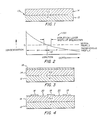
- the wafer is isotropically etched using the silicon nitride layer 18 as a mask to yield three-dimensional mesas 22 as shown in Figure 5.
- the etching utilizes an acid comprising 5 parts nitric acid, 3 parts hydrofluoric acid, and 3 parts acetic acid.
- the wafer is exposed to the acid for 1-1/2 minutes at approximately 15°C. This yields moats which are approximately 30-35 microns deep, and extend below the P-N junction.
- the P-N junction lies between 1/3 and 2/3 of the height of the mesa.
- the mesas are concave and generally frustum-shaped with a sidewall slope of approximately 10° - 20° from vertical.
- each mesa in the plane parallel to the wafer is determined by the mask island pattern in the silicon nitride layer 18. If the mask island pattern comprises a multiplicity of circular islands as illustrated in Figure 5, then each mesa has a circular cross-section in the aforesaid plane. However, if a square mask pattern is utilized, each mesa will have a generally square cross-section with rounded corners in the aforesaid plane. Other cross-sectional shapes of the mesa are feasible.
- each of the mesas comprises an upper silicon nitride layer 18, an adjacent, underlying N+ region 14, and a P region 12 of the wafer underlying the N+ layer. Also, the P-N junction within each mesa is flat, even at the sidewall of the mesa.
- overhanging portions 23 of the silicon nitride layers 18 are removed by a mechanical operation such as scrubbing.
- the wafer is subjected to steam at 1100°C for 8 hours to yield the grown oxide layer. It should be noted that the oxide layer grows only on the exposed silicon but does not grow on the silicon nitride 18. The result is illustrated in Figure 6 which shows silicon dioxide layer 26 on the walls of each mesa and in the valleys between the mesas.
- each mesa passivates the device because silicon dioxide can withstand significantly high electrical fields than silicon, and the surface of each mesa sidewall is rendered impervious to harmful environmental effects, making the surface electrically stable. This helps to prevent parasitic breakdown at the surface of the silicon.
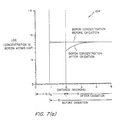
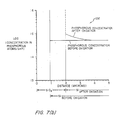
- the oxidizing step changes the shape of the P-N junction.
- Figure 7(c) also shows that the concentration gradient of the junction adjacent to the oxide is lower than the concentration gradient in the bulk. This means an increased breakdown voltage adjacent to the oxide layer. This increase will work opposite the decrease in breakdown due to the curvature of the junction. Under some circumstances the decrease in breakdown voltage due to the curvature will be larger. In other circumstances the increase in breakdown voltage due to the reduction in concentration gradient can completely compensate for the decrease.
- the N+ layer 14 is driven or diffused deeper into the mesa.
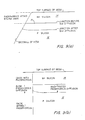
- this second diffusion step is implemented at 1250° C for 45 minutes in nitrogen gas and tends to flatten the P-N junction for two reasons. Firstly, as described in U.S. Patent No. 4,740,477, the slope of the mesa sidewalls tends to curve the P-N junction toward the N+ layer as shown in Figure 9(a). Secondly, the oxide layer impedes the progress of the phosphorus front adjacent to the oxide layer as shown in Figure 9(b). Thus, the progress of the phosphorus front proceeds more slowly adjacent to the surface of the mesa than in the middle or bulk of the mesa.
- a curved portion 27 a of line 27 represents the lag of the diffusion front adjacent to the oxide layer relative to the progress of the diffusion front in the bulk of the silicon. Also, some of the phosphorus of portion 27 a of the front moves into the oxide layer. The overall result is that the phosphorus front progresses more slowly along the oxide than in the bulk of the silicon. This compensates for the concave curvature of the P-N junction which existed before the second diffusion step to yield a new, substantially flat P-N junction 28 illustrated in Figure 9(c).
- the second diffusion step is carried out on P-N junction 10 with curved portion 10 a , and Figures 9(a) and 9(b) with their flat junctions are included only for the purpose of explaining the general effect of the second diffusion step.
- portions 28 a and 28 b of the P-N junction Adjacent to the oxide layer, portions 28 a and 28 b of the P-N junction have slight curvatures. Portion 28 a is concave relative to the N+ layer and portion 28 b is convex relative to the N+ layer.
- the maximum dip is preferably less than or equal to 2 microns from the plane of the P-N junction 28 within the bulk of the mesa and, in the aforesaid example, is approximately 0.2 microns below the bulk plane.
- the silicon nitride island masks 18 are removed, for example, by a plasma etch, and then the upper exposed surface of N+ layer 14 and the lower exposed surface of P layer 12 are metalized to provide electrodes 32 and 34. Then, the substrate may be divided between the mesas 22 to yield individual rectifiers.
- the following second embodiment of the invention has not been tested.
- all of the materials and the steps of the first embodiment from the beginning until and including the oxidation step are performed except that the oxidation is protracted, for example 10 hours at 1200°C instead of 8 hours at 1100°C. Consequently, the oxidation step accomplishes not only the oxidation step but also the second diffusion step.
- the oxidation/diffusion step primarily oxidation occurs, and the oxidation tends to yield a concave P-N junction relative to the N+ layer similar to 10 a of Figure 8.
- little oxidation occurs because the oxide layer is already thick, and substantial diffusion occurs.
- a third embodiment of the present invention utilizes the same materials and the same deposition step and first stage of the first diffusion step as in the first embodiment described above. However, there is no second or final stage of the first diffusion step as in the first embodiment. Rather, after implementing the first stage of the first diffusion step, the silicon nitride layer deposition step and masking step are implemented as in the first embodiment. Then, the wafer is etched as in the first embodiment, but only for one minute instead of 1-1/2 minutes. This yields mesas having moats which are 20-25 microns deep. Then, the mesa sidewalls are oxidized as in the first embodiment, but only for 3 hours at 1100°C instead of 8 hours at 1100°C. This yields a 1.1 micron thick oxide layer.
- the oxidation step causes a second diffusion as in the second embodiment.
- the reason that the relatively short oxidation step provides an adequate second diffusion to re-curve and thereby flatten the P-N junction adjacent to the oxide layer is because the P-N junction immediately before the oxidizing step is relatively near to the top surface of the mesa; the lack of the second stage of the first diffusion step left the P-N junction shallow.
- the resultant device of the third embodiment of the present invention has a P-N junction shaped as illustrated in Figure 9(c), which junction has an approximately 6.8 volt breakdown.
- one technique utilized to flatten the P-N junction is the provision of a second diffusion step after an oxidizing step to compensate for the curvature of the P-N junction caused by the oxidation.
- a second diffusion step after an oxidizing step to compensate for the curvature of the P-N junction caused by the oxidation.
- the second diffusion step can be carried out continuously with the oxidation step as in the second and third embodiments.
- the breakdown voltage is based on the total diffusion time of both diffusion steps while the duration of the second diffusion step is selected to compensate for the curvature caused by the oxidizing step. For example, by making the second diffusion step 1 hour longer and the first diffusion step 1 hour shorter, the same bulk breakdown can be expected, while the breakdown voltage adjacent to the oxide will be much different.
- a passivated, substantially flat P-N junction can also be produced as follows. Perform all the steps of the first embodiment in the aforesaid order except shorten the duration of the final stage of the first diffusion step to 1 hour (at 1250°C) instead of two hours; switch the order of the second diffusion and oxidizing steps, i.e., carry out the second diffusion step before the oxidizing step (but after the etching step); extend the duration of the second diffusion step to 1 hour 45 minutes (at 1250°C) instead of 45 minutes; and extend the duration of the oxidizing step to 16 hours (at 1100°C) instead of 8 hours.
- the second diffusion step curves a plane P-N junction toward the N+ layer.
- the slope of the mesa sidewall causes, in part, the curvature.
- the oxidizing step substantially flattens the P-N junction by curving the junction away from the N+ layer for the reasons noted above in the description of the first embodiment. The result is similar to P-N junction 28 illustrated in Figure 9(c).
- the P-N junction 28 resulting from the oxidation/diffusion steps set forth above can be compared to a half cycle of a cosine wave. Further compensation for the curve caused by the initial oxidation step, resulting in an even flatter P-N junction, can be accomplished by providing additional oxidation and diffusion steps. For example, after the formation of the mesa structure as described above, two separate oxidation/diffusion steps can be undertaken to provide an improved, flatter P-N junction 80 as shown in Figure 15.
- the shape of the P-N junction adjacent mesa sidewall 84 resembles a cosine wave of 1-1/2 cycles, formed by portions 82 a , 82 b , and 82 c . This structure is substantially flatter than the compensation designated at 28 a , 28 b , and 28 c , of Figure 9(c).
- the mesa is prepared in the same way described above in connection with Figures 1-6.
- the following oxidation and diffusion steps are carried out: Oxidation 1100°C, 6 hrs, Steam Diffusion 1250°C, 20 min, N2 Oxidation 1100°C, 2 hrs, Steam Diffusion 1250°C, 25 min, N2 Additional compensation can be provided through the use of subsequent oxidation and compensating diffusion steps to further flatten the P-N junction adjacent the mesa sidewall.
- the optimal number of oxidation and compensating diffusion steps to be carried out after the formation of the mesa will depend upon cost and performance tradeoffs applicable to a particular device to be fabricated, as will be appreciated by those skilled in the art.
- mesas with vertical sidewalls instead of the inclined sidewalls may be provided by a plasma etch in a gas environment with electrical charges to accelerate the gas molecules.
- a P-N junction corresponding to that of Figure 1 could be formed by first diffusing a P layer or region into an N wafer, and then diffusing an N+ layer into the P layer. In this case, the subsequent mesa etches would penetrate entirely through the N+ layer and partially through the P layer.
- another P-N junction corresponding to that of Figure 1 could be formed by first diffusing a P+ layer or region into a P wafer and then diffusing an N++ layer into the P+ layer. In this case, the subsequent mesa etches would penetrate entirely through the N++ layer and partially through the P+ layer.
- the second diffusion step can be partially mismatched relative to the oxidation as illustrated in Figures 12, 13 and 14.
- Ends 58 c and 60 c of the P-N junctions adjacent to the associated oxide layers are below the bulk plane of the junction, and end 62 c of the P-N junction adjacent to the associated oxide layer is above the bulk plane of the junction.
- ends 58 c and 60 c are less than 0.5 microns below the bulk plane but can be up to 2 microns below the bulk plane, and normally end 62 c is less than 0.5 microns above the bulk plane but can be up to 4 microns above the bulk plane.
- the curvature includes a concave portion 58 a , 60 a or 62 a relative to the N+ layer, and a convex portion 58 b , 60 b or 62 b relative to the N+ layer.
- the breakdown voltage adjacent the oxide layer is higher than the bulk breakdown. It is also higher than it would be without the second diffusion, but less than it would be with a perfect match.
- the oxidation is carried out at other temperatures preferably greater than 1,000°C. Therefore, the invention has been disclosed by way of illustration and not limitation, and reference should be made to the following claims to determine the scope of the invention.
Landscapes
- Formation Of Insulating Films (AREA)
- Bipolar Transistors (AREA)
- Thyristors (AREA)
- Crystals, And After-Treatments Of Crystals (AREA)
- Element Separation (AREA)
Priority Applications (1)
| Application Number | Priority Date | Filing Date | Title |
|---|---|---|---|
| EP97114631A EP0820094A3 (de) | 1988-07-18 | 1989-07-08 | Passivierter P-N-Übergang in einer Mesa-Halbleiterstruktur |
Applications Claiming Priority (4)
| Application Number | Priority Date | Filing Date | Title |
|---|---|---|---|
| US21907188A | 1988-07-18 | 1988-07-18 | |
| US219071 | 1988-07-18 | ||
| US365519 | 1989-06-13 | ||
| US07/365,519 US4980315A (en) | 1988-07-18 | 1989-06-13 | Method of making a passivated P-N junction in mesa semiconductor structure |
Related Child Applications (1)
| Application Number | Title | Priority Date | Filing Date |
|---|---|---|---|
| EP97114631A Division EP0820094A3 (de) | 1988-07-18 | 1989-07-08 | Passivierter P-N-Übergang in einer Mesa-Halbleiterstruktur |
Publications (3)
| Publication Number | Publication Date |
|---|---|
| EP0351677A2 true EP0351677A2 (de) | 1990-01-24 |
| EP0351677A3 EP0351677A3 (de) | 1990-08-16 |
| EP0351677B1 EP0351677B1 (de) | 1998-04-08 |
Family
ID=26913531
Family Applications (2)
| Application Number | Title | Priority Date | Filing Date |
|---|---|---|---|
| EP97114631A Withdrawn EP0820094A3 (de) | 1988-07-18 | 1989-07-08 | Passivierter P-N-Übergang in einer Mesa-Halbleiterstruktur |
| EP89112512A Expired - Lifetime EP0351677B1 (de) | 1988-07-18 | 1989-07-08 | Herstellungsverfahren für einen passivierten P-N-Übergang in einer Mesa-Halbleiterstruktur |
Family Applications Before (1)
| Application Number | Title | Priority Date | Filing Date |
|---|---|---|---|
| EP97114631A Withdrawn EP0820094A3 (de) | 1988-07-18 | 1989-07-08 | Passivierter P-N-Übergang in einer Mesa-Halbleiterstruktur |
Country Status (7)
| Country | Link |
|---|---|
| US (1) | US4980315A (de) |
| EP (2) | EP0820094A3 (de) |
| JP (2) | JPH06101569B2 (de) |
| KR (1) | KR0142091B1 (de) |
| AT (1) | ATE164969T1 (de) |
| DE (1) | DE68928636T2 (de) |
| ES (1) | ES2118056T3 (de) |
Cited By (2)
| Publication number | Priority date | Publication date | Assignee | Title |
|---|---|---|---|---|
| EP1096576A1 (de) * | 1999-10-27 | 2001-05-02 | Mitsubishi Denki Kabushiki Kaisha | Halbleiterbauelement |
| CN112909078A (zh) * | 2021-02-08 | 2021-06-04 | 临沂卓芯电子有限公司 | 一种高压超快恢复二极管芯片及其制造方法 |
Families Citing this family (15)
| Publication number | Priority date | Publication date | Assignee | Title |
|---|---|---|---|---|
| US5166769A (en) * | 1988-07-18 | 1992-11-24 | General Instrument Corporation | Passitvated mesa semiconductor and method for making same |
| JPH04216682A (ja) * | 1990-12-18 | 1992-08-06 | Sumitomo Electric Ind Ltd | 受光素子 |
| US5268310A (en) * | 1992-11-25 | 1993-12-07 | M/A-Com, Inc. | Method for making a mesa type PIN diode |
| US6043548A (en) * | 1993-04-14 | 2000-03-28 | Yeda Research And Development Co., Ltd. | Semiconductor device with stabilized junction |
| EP1169739A1 (de) * | 1999-12-08 | 2002-01-09 | Koninklijke Philips Electronics N.V. | Halbleiteranordnung mit einer diode und verfahren zur herstellung |
| JP4208172B2 (ja) * | 2000-10-31 | 2009-01-14 | シャープ株式会社 | フォトダイオードおよびそれを用いた回路内蔵受光素子 |
| US6600204B2 (en) * | 2001-07-11 | 2003-07-29 | General Semiconductor, Inc. | Low-voltage punch-through bi-directional transient-voltage suppression devices having surface breakdown protection and methods of making the same |
| US6489660B1 (en) * | 2001-05-22 | 2002-12-03 | General Semiconductor, Inc. | Low-voltage punch-through bi-directional transient-voltage suppression devices |
| KR100927256B1 (ko) * | 2004-07-09 | 2009-11-16 | 엘지전자 주식회사 | 제너다이오드가 집적된 발광소자 서브마운트 제작방법 |
| US8445917B2 (en) | 2009-03-20 | 2013-05-21 | Cree, Inc. | Bidirectional silicon carbide transient voltage suppression devices |
| US8502273B2 (en) | 2010-10-20 | 2013-08-06 | National Semiconductor Corporation | Group III-nitride HEMT having a well region formed on the surface of substrate and contacted the buffer layer to increase breakdown voltage and the method for forming the same |
| US8513703B2 (en) | 2010-10-20 | 2013-08-20 | National Semiconductor Corporation | Group III-nitride HEMT with multi-layered substrate having a second layer of one conductivity type touching a top surface of a first layers of different conductivity type and a method for forming the same |
| US11705490B2 (en) * | 2021-02-08 | 2023-07-18 | Applied Materials, Inc. | Graded doping in power devices |
| CN114335190A (zh) * | 2021-12-21 | 2022-04-12 | 南通康芯半导体科技有限公司 | 一种简化制程的刀刮二极管芯片及其制作方法 |
| CN114171385A (zh) * | 2022-02-14 | 2022-03-11 | 浙江里阳半导体有限公司 | 一种低压瞬态抑制二极管及其制造方法 |
Family Cites Families (40)
| Publication number | Priority date | Publication date | Assignee | Title |
|---|---|---|---|---|
| NL246742A (de) * | 1958-12-24 | |||
| US3089794A (en) * | 1959-06-30 | 1963-05-14 | Ibm | Fabrication of pn junctions by deposition followed by diffusion |
| NL262701A (de) * | 1960-03-25 | |||
| NL268758A (de) * | 1960-09-20 | |||
| GB1074287A (en) * | 1963-12-13 | 1967-07-05 | Mullard Ltd | Improvements in and relating to semiconductor devices |
| US3333326A (en) * | 1964-06-29 | 1967-08-01 | Ibm | Method of modifying electrical characteristic of semiconductor member |
| US3491434A (en) * | 1965-01-28 | 1970-01-27 | Texas Instruments Inc | Junction isolation diffusion |
| GB1068392A (en) * | 1965-05-05 | 1967-05-10 | Lucas Industries Ltd | Semi-conductor devices |
| US3378915A (en) * | 1966-03-31 | 1968-04-23 | Northern Electric Co | Method of making a planar diffused semiconductor voltage reference diode |
| US3432919A (en) * | 1966-10-31 | 1969-03-18 | Raytheon Co | Method of making semiconductor diodes |
| DE2031831A1 (de) * | 1969-06-27 | 1972-03-02 | Hitachi Ltd | Halbleiterdiode und Verfahren zu ihrer Herstellung |
| US3701696A (en) * | 1969-08-20 | 1972-10-31 | Gen Electric | Process for simultaneously gettering,passivating and locating a junction within a silicon crystal |
| US3663321A (en) * | 1969-11-14 | 1972-05-16 | Trw Inc | Alloy diode characteristics control method |
| US3669773A (en) * | 1970-02-24 | 1972-06-13 | Alpha Ind Inc | Method of producing semiconductor devices |
| GB1315479A (en) * | 1970-06-24 | 1973-05-02 | Licentia Gmbh | Method for manufacturing diodes |
| US3706129A (en) * | 1970-07-27 | 1972-12-19 | Gen Electric | Integrated semiconductor rectifiers and processes for their fabrication |
| US3674995A (en) * | 1970-08-31 | 1972-07-04 | Texas Instruments Inc | Computer controlled device testing and subsequent arbitrary adjustment of device characteristics |
| US3746587A (en) * | 1970-11-04 | 1973-07-17 | Raytheon Co | Method of making semiconductor diodes |
| US3685141A (en) * | 1971-04-05 | 1972-08-22 | Trw Inc | Microalloy epitaxial varactor |
| US3689993A (en) * | 1971-07-26 | 1972-09-12 | Texas Instruments Inc | Fabrication of semiconductor devices having low thermal inpedance bonds to heat sinks |
| US3767485A (en) * | 1971-12-29 | 1973-10-23 | A Sahagun | Method for producing improved pn junction |
| US3832246A (en) * | 1972-05-22 | 1974-08-27 | Bell Telephone Labor Inc | Methods for making avalanche diodes |
| US3849789A (en) * | 1972-11-01 | 1974-11-19 | Gen Electric | Schottky barrier diodes |
| DE2324780C3 (de) * | 1973-05-16 | 1978-07-27 | Siemens Ag, 1000 Berlin Und 8000 Muenchen | Verfahren zum Herstellen eines Halbleiterbauelements |
| US3895429A (en) * | 1974-05-09 | 1975-07-22 | Rca Corp | Method of making a semiconductor device |
| US3954524A (en) * | 1974-07-26 | 1976-05-04 | Texas Instruments Incorporated | Self-aligning photoresist process for selectively opening tops of mesas in mesa-diode-array structures |
| GB1485015A (en) * | 1974-10-29 | 1977-09-08 | Mullard Ltd | Semi-conductor device manufacture |
| JPS5227274A (en) * | 1975-08-25 | 1977-03-01 | Hitachi Ltd | Semiconductor unit and its manufacturing process |
| US4064620A (en) * | 1976-01-27 | 1977-12-27 | Hughes Aircraft Company | Ion implantation process for fabricating high frequency avalanche devices |
| JPS5313366A (en) * | 1976-07-22 | 1978-02-06 | Fujitsu Ltd | Manufacture of mesa-type semiconductor device |
| DE2755168A1 (de) * | 1977-12-10 | 1979-06-13 | Itt Ind Gmbh Deutsche | Verfahren zur herstellung von halbleiterbauelementen |
| US4138280A (en) * | 1978-02-02 | 1979-02-06 | International Rectifier Corporation | Method of manufacture of zener diodes |
| US4373255A (en) * | 1979-06-19 | 1983-02-15 | The United States Of America As Represented By The Secretary Of The Air Force | Method of making oxide passivated mesa epitaxial diodes with integral plated heat sink |
| JPS57166078A (en) * | 1981-04-06 | 1982-10-13 | Nippon Telegr & Teleph Corp <Ntt> | Semiconductor device |
| JPS58103177A (ja) * | 1981-12-15 | 1983-06-20 | Nec Corp | 半導体装置 |
| JPS59100563A (ja) * | 1982-11-30 | 1984-06-09 | Sharp Corp | メサ型半導体装置の製造方法 |
| JPS6084871A (ja) * | 1983-10-14 | 1985-05-14 | Matsushita Electric Works Ltd | メサ形半導体 |
| JPS60186071A (ja) * | 1984-03-05 | 1985-09-21 | Nec Corp | 半導体装置の製造方法 |
| JPS6232646A (ja) * | 1985-08-05 | 1987-02-12 | Mitsubishi Electric Corp | ゲ−トタ−ンオフサイリスタの製造方法 |
| US4740477A (en) * | 1985-10-04 | 1988-04-26 | General Instrument Corporation | Method for fabricating a rectifying P-N junction having improved breakdown voltage characteristics |
-
1989
- 1989-06-13 US US07/365,519 patent/US4980315A/en not_active Expired - Lifetime
- 1989-07-08 ES ES89112512T patent/ES2118056T3/es not_active Expired - Lifetime
- 1989-07-08 EP EP97114631A patent/EP0820094A3/de not_active Withdrawn
- 1989-07-08 DE DE68928636T patent/DE68928636T2/de not_active Expired - Lifetime
- 1989-07-08 EP EP89112512A patent/EP0351677B1/de not_active Expired - Lifetime
- 1989-07-08 AT AT89112512T patent/ATE164969T1/de not_active IP Right Cessation
- 1989-07-15 KR KR1019890010113A patent/KR0142091B1/ko not_active Expired - Lifetime
- 1989-07-18 JP JP1183806A patent/JPH06101569B2/ja not_active Expired - Lifetime
-
1994
- 1994-01-31 JP JP06025942A patent/JP3061997B2/ja not_active Expired - Lifetime
Cited By (4)
| Publication number | Priority date | Publication date | Assignee | Title |
|---|---|---|---|---|
| EP1096576A1 (de) * | 1999-10-27 | 2001-05-02 | Mitsubishi Denki Kabushiki Kaisha | Halbleiterbauelement |
| US6614087B1 (en) | 1999-10-27 | 2003-09-02 | Mitsubishi Denki Kabushiki Kaisha | Semiconductor device |
| CN112909078A (zh) * | 2021-02-08 | 2021-06-04 | 临沂卓芯电子有限公司 | 一种高压超快恢复二极管芯片及其制造方法 |
| CN112909078B (zh) * | 2021-02-08 | 2022-11-29 | 临沂卓芯电子有限公司 | 一种高压超快恢复二极管芯片及其制造方法 |
Also Published As
| Publication number | Publication date |
|---|---|
| JPH06101569B2 (ja) | 1994-12-12 |
| KR900002433A (ko) | 1990-02-28 |
| JP3061997B2 (ja) | 2000-07-10 |
| US4980315A (en) | 1990-12-25 |
| DE68928636T2 (de) | 1998-10-29 |
| JPH0287579A (ja) | 1990-03-28 |
| EP0820094A3 (de) | 1998-03-11 |
| HK1008450A1 (en) | 1999-05-07 |
| ES2118056T3 (es) | 1998-09-16 |
| JPH07147419A (ja) | 1995-06-06 |
| EP0351677B1 (de) | 1998-04-08 |
| ATE164969T1 (de) | 1998-04-15 |
| EP0351677A3 (de) | 1990-08-16 |
| DE68928636D1 (de) | 1998-05-14 |
| EP0820094A2 (de) | 1998-01-21 |
| KR0142091B1 (ko) | 1998-06-01 |
Similar Documents
| Publication | Publication Date | Title |
|---|---|---|
| US4980315A (en) | Method of making a passivated P-N junction in mesa semiconductor structure | |
| US5792675A (en) | Method for manufacturing an accelerometer sensor of crystalline material | |
| US7446018B2 (en) | Bonded-wafer superjunction semiconductor device | |
| US6673662B2 (en) | Epitaxial edge termination for silicon carbide Schottky devices and methods of fabricating silicon carbide devices incorporating same | |
| US3970486A (en) | Methods of producing a semiconductor device and a semiconductor device produced by said method | |
| EP0341075B1 (de) | Symmetrische sperrende Hochdurchbruchspannungshalbleiteranordnung und Verfahren zur Herstellung | |
| US4028140A (en) | Semiconductor device manufacture | |
| EP0217780B1 (de) | Anisotroper Gleichrichter und Verfahren zu seiner Herstellung | |
| US4771328A (en) | Semiconductor device and process | |
| KR0154702B1 (ko) | 항복전압을 향상시킨 다이오드 제조 방법 | |
| WO2003015248A2 (en) | Low-voltage punch-through bi-directional transient-voltage suppression devices having surface breakdown protection and methods of making the same | |
| US5166769A (en) | Passitvated mesa semiconductor and method for making same | |
| US4171997A (en) | Method of producing polycrystalline silicon components, particularly solar elements | |
| EP0211174B1 (de) | Monolitische temperaturkompensierte Spannungsreferenzdiode und Verfahren zu ihrer Herstellung | |
| US6403447B1 (en) | Reduced substrate capacitance high performance SOI process | |
| US3685141A (en) | Microalloy epitaxial varactor | |
| HK1008263A (en) | Passivated p-n junction in mesa semiconductor structure | |
| HK1008450B (en) | Process for forming a passivated p-n junction in mesa semiconductor structure | |
| US4963509A (en) | Gold diffusion method for semiconductor devices of high switching speed | |
| US3363151A (en) | Means for forming planar junctions and devices | |
| US4701998A (en) | Method for fabricating a bipolar transistor | |
| US5093283A (en) | Method of manufacturing a semiconductor device | |
| EP0137195A1 (de) | Dielektrisch isolierte Schaltung und Verfahren zur Herstellung |
Legal Events
| Date | Code | Title | Description |
|---|---|---|---|
| PUAI | Public reference made under article 153(3) epc to a published international application that has entered the european phase |
Free format text: ORIGINAL CODE: 0009012 |
|
| AK | Designated contracting states |
Kind code of ref document: A2 Designated state(s): AT BE CH DE ES FR GB GR IT LI NL SE |
|
| PUAL | Search report despatched |
Free format text: ORIGINAL CODE: 0009013 |
|
| AK | Designated contracting states |
Kind code of ref document: A3 Designated state(s): AT BE CH DE ES FR GB GR IT LI NL SE |
|
| 17P | Request for examination filed |
Effective date: 19901102 |
|
| 17Q | First examination report despatched |
Effective date: 19930201 |
|
| RAP1 | Party data changed (applicant data changed or rights of an application transferred) |
Owner name: GI CORPORATION |
|
| RAP1 | Party data changed (applicant data changed or rights of an application transferred) |
Owner name: GENERAL INSTRUMENT CORPORATION OF DELAWARE |
|
| GRAG | Despatch of communication of intention to grant |
Free format text: ORIGINAL CODE: EPIDOS AGRA |
|
| GRAG | Despatch of communication of intention to grant |
Free format text: ORIGINAL CODE: EPIDOS AGRA |
|
| GRAH | Despatch of communication of intention to grant a patent |
Free format text: ORIGINAL CODE: EPIDOS IGRA |
|
| GRAH | Despatch of communication of intention to grant a patent |
Free format text: ORIGINAL CODE: EPIDOS IGRA |
|
| GRAA | (expected) grant |
Free format text: ORIGINAL CODE: 0009210 |
|
| AK | Designated contracting states |
Kind code of ref document: B1 Designated state(s): AT BE CH DE ES FR GB GR IT LI NL SE |
|
| DX | Miscellaneous (deleted) | ||
| REF | Corresponds to: |
Ref document number: 164969 Country of ref document: AT Date of ref document: 19980415 Kind code of ref document: T |
|
| REG | Reference to a national code |
Ref country code: CH Ref legal event code: EP |
|
| ITF | It: translation for a ep patent filed | ||
| REF | Corresponds to: |
Ref document number: 68928636 Country of ref document: DE Date of ref document: 19980514 |
|
| ET | Fr: translation filed | ||
| REG | Reference to a national code |
Ref country code: GB Ref legal event code: 732E |
|
| REG | Reference to a national code |
Ref country code: ES Ref legal event code: FG2A Ref document number: 2118056 Country of ref document: ES Kind code of ref document: T3 |
|
| PLBE | No opposition filed within time limit |
Free format text: ORIGINAL CODE: 0009261 |
|
| STAA | Information on the status of an ep patent application or granted ep patent |
Free format text: STATUS: NO OPPOSITION FILED WITHIN TIME LIMIT |
|
| 26N | No opposition filed | ||
| PGFP | Annual fee paid to national office [announced via postgrant information from national office to epo] |
Ref country code: AT Payment date: 19990622 Year of fee payment: 11 |
|
| PGFP | Annual fee paid to national office [announced via postgrant information from national office to epo] |
Ref country code: BE Payment date: 19990715 Year of fee payment: 11 |
|
| PGFP | Annual fee paid to national office [announced via postgrant information from national office to epo] |
Ref country code: GR Payment date: 19990730 Year of fee payment: 11 |
|
| PGFP | Annual fee paid to national office [announced via postgrant information from national office to epo] |
Ref country code: SE Payment date: 20000620 Year of fee payment: 12 |
|
| PGFP | Annual fee paid to national office [announced via postgrant information from national office to epo] |
Ref country code: CH Payment date: 20000621 Year of fee payment: 12 |
|
| PG25 | Lapsed in a contracting state [announced via postgrant information from national office to epo] |
Ref country code: AT Free format text: LAPSE BECAUSE OF NON-PAYMENT OF DUE FEES Effective date: 20000708 |
|
| PG25 | Lapsed in a contracting state [announced via postgrant information from national office to epo] |
Ref country code: BE Free format text: LAPSE BECAUSE OF NON-PAYMENT OF DUE FEES Effective date: 20000731 Ref country code: GR Free format text: LAPSE BECAUSE OF NON-PAYMENT OF DUE FEES Effective date: 20000731 |
|
| BERE | Be: lapsed |
Owner name: GENERAL INSTRUMENT CORP. OF DELAWARE Effective date: 20000731 |
|
| PG25 | Lapsed in a contracting state [announced via postgrant information from national office to epo] |
Ref country code: SE Free format text: LAPSE BECAUSE OF NON-PAYMENT OF DUE FEES Effective date: 20010709 |
|
| PG25 | Lapsed in a contracting state [announced via postgrant information from national office to epo] |
Ref country code: LI Free format text: LAPSE BECAUSE OF NON-PAYMENT OF DUE FEES Effective date: 20010731 Ref country code: CH Free format text: LAPSE BECAUSE OF NON-PAYMENT OF DUE FEES Effective date: 20010731 |
|
| REG | Reference to a national code |
Ref country code: GB Ref legal event code: IF02 |
|
| EUG | Se: european patent has lapsed |
Ref document number: 89112512.2 |
|
| REG | Reference to a national code |
Ref country code: CH Ref legal event code: PL |
|
| PGFP | Annual fee paid to national office [announced via postgrant information from national office to epo] |
Ref country code: GB Payment date: 20020613 Year of fee payment: 14 |
|
| PGFP | Annual fee paid to national office [announced via postgrant information from national office to epo] |
Ref country code: ES Payment date: 20020729 Year of fee payment: 14 |
|
| PG25 | Lapsed in a contracting state [announced via postgrant information from national office to epo] |
Ref country code: GB Free format text: LAPSE BECAUSE OF NON-PAYMENT OF DUE FEES Effective date: 20030708 |
|
| PG25 | Lapsed in a contracting state [announced via postgrant information from national office to epo] |
Ref country code: ES Free format text: LAPSE BECAUSE OF NON-PAYMENT OF DUE FEES Effective date: 20030709 |
|
| GBPC | Gb: european patent ceased through non-payment of renewal fee |
Effective date: 20030708 |
|
| REG | Reference to a national code |
Ref country code: ES Ref legal event code: FD2A Effective date: 20030709 |
|
| PG25 | Lapsed in a contracting state [announced via postgrant information from national office to epo] |
Ref country code: IT Free format text: LAPSE BECAUSE OF NON-PAYMENT OF DUE FEES;WARNING: LAPSES OF ITALIAN PATENTS WITH EFFECTIVE DATE BEFORE 2007 MAY HAVE OCCURRED AT ANY TIME BEFORE 2007. THE CORRECT EFFECTIVE DATE MAY BE DIFFERENT FROM THE ONE RECORDED. Effective date: 20050708 |
|
| PGFP | Annual fee paid to national office [announced via postgrant information from national office to epo] |
Ref country code: DE Payment date: 20080717 Year of fee payment: 20 |
|
| PGFP | Annual fee paid to national office [announced via postgrant information from national office to epo] |
Ref country code: NL Payment date: 20080703 Year of fee payment: 20 Ref country code: FR Payment date: 20080718 Year of fee payment: 20 |
|
| NLV7 | Nl: ceased due to reaching the maximum lifetime of a patent |
Effective date: 20090708 |
|
| PG25 | Lapsed in a contracting state [announced via postgrant information from national office to epo] |
Ref country code: NL Free format text: LAPSE BECAUSE OF EXPIRATION OF PROTECTION Effective date: 20090708 |