EP0347853A2 - Semiconductor integrated circuit - Google Patents
Semiconductor integrated circuit Download PDFInfo
- Publication number
- EP0347853A2 EP0347853A2 EP89111233A EP89111233A EP0347853A2 EP 0347853 A2 EP0347853 A2 EP 0347853A2 EP 89111233 A EP89111233 A EP 89111233A EP 89111233 A EP89111233 A EP 89111233A EP 0347853 A2 EP0347853 A2 EP 0347853A2
- Authority
- EP
- European Patent Office
- Prior art keywords
- circuit
- mats
- semiconductor integrated
- integrated circuit
- accordance
- Prior art date
- Legal status (The legal status is an assumption and is not a legal conclusion. Google has not performed a legal analysis and makes no representation as to the accuracy of the status listed.)
- Granted
Links
Images





Classifications
-
- H—ELECTRICITY
- H10—SEMICONDUCTOR DEVICES; ELECTRIC SOLID-STATE DEVICES NOT OTHERWISE PROVIDED FOR
- H10D—INORGANIC ELECTRIC SEMICONDUCTOR DEVICES
- H10D89/00—Aspects of integrated devices not covered by groups H10D84/00 - H10D88/00
- H10D89/10—Integrated device layouts
-
- H—ELECTRICITY
- H10—SEMICONDUCTOR DEVICES; ELECTRIC SOLID-STATE DEVICES NOT OTHERWISE PROVIDED FOR
- H10W—GENERIC PACKAGES, INTERCONNECTIONS, CONNECTORS OR OTHER CONSTRUCTIONAL DETAILS OF DEVICES COVERED BY CLASS H10
- H10W72/00—Interconnections or connectors in packages
- H10W72/50—Bond wires
- H10W72/541—Dispositions of bond wires
- H10W72/547—Dispositions of multiple bond wires
- H10W72/5473—Dispositions of multiple bond wires multiple bond wires connected to a common bond pad
Definitions
- the power supply lines 2 and the ground lines 3 are provided above the P+ separation regions 17.
- the ground lines 3 penetrate the silicon oxide film 20 along the longitudinal direction thereof and they are in ohmic contact with the P+ separation regions 17, so that the substrate 15 is stably set at a ground potential.
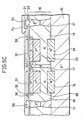
- Figs. 5B and 5C show schematic sectional views taken along the lines 5B-5B and 5C-5C in Fig. 5A, respectively.
- P ⁇ semiconductor substrate 15, an epitaxial N layer 16, P+ separation regions 17, N islands 18, burried N+ layers 19, a silicon oxide film 20 and an insulating film 21 of such as polyimide resin are formed in the same manner as in Fig. 3B.
- P+ diffusion regions 38 are formed on respective surfaces of N islands 18 and P diffusion regions 39 overlapping with main portions of the P+ regions 38 are further formed.
- the P regions 38 and 39 constitute the lower capacitor electrodes opposed to the upper capacitor electrodes 31 and they are connected to the respective connectors 36.
Landscapes
- Semiconductor Integrated Circuits (AREA)
- Design And Manufacture Of Integrated Circuits (AREA)
Abstract
Description
- The present invention relates to semiconductor integrated circuits (ICs) and particularly to a semiconductor IC having a pattern layout applicable to various custom ICs.
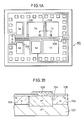
- Fig. 1A is a schematic top view showing an example of a pattern layout of a conventional semiconductor IC and Fig. 1B is a schematic sectional view taken along the
line 1B-1B in Fig. 1A. Referring to those figures, asemiconductor chip 101 comprisescircuit blocks 1a to 1f. Each of those circuit blocks is formed in anepitaxial N layer 103 on a P⁻semiconductor substrate 102 and surrounded by P⁺separation regions 104. Theepitaxial layer 103 is covered with anoxide film 105.Ground lines 106 penetrate theoxide film 105 and they are in ohmic contact with the P⁺separation regions 104, whereby potentials of the P⁺separation regions 104 and P⁻substrate 102 are stably set to a ground potential. - A bundle of
ground lines 106 extend from a ground bonding pad GND provided on the left of thesemiconductor chip 101 through a central region of thesemiconductor chip 101 and theground lines 106 are distributed from the bundle to thecorresponding circuit blocks 1a to 1f. Power supply lines extend from a power supply bonding pad Vcc provided on the right of thesemiconductor chip 101 to peripheral regions of thesemiconductor chip 101 so that they are connected to the corresponding circuit blocks. - In general, signals processed in the
circuit blocks 1a to 1f have different frequencies and amplitude levels and thosecircuit blocks 1a to 1f have different functions. Thus, thecircuit blocks 1a to 1f have different numbers of circuit elements and they have different areas. Accordingly, it is not easy to arrange efficiently thecircuit blocks 1a to 1f having different areas in a small area. In addition, if thecircuit block 1a for example is replaced by a modified circuit block (having a different area from thecircuit block 1a) or a new circuit block is added, it is often necessary to rearrange all thecircuit blocks 1a to 1f in order to set such a modified or new circuit block efficiently in a reduced area. - Further, in the case of arranging the circuit blocks, it is desirable to reduce the total area occupied by those circuit blocks and at the same time it is necessary to take measures to minimize undesirable mutual interferences of the circuit blocks. Consequently, for example in the case of changing part of a certain IC device in compliance with a request of a user, it is often necessary to entirely change the design of the circuit block pattern, which takes time and involves considerable cost.
- In view of the above described prior art, an object of the present invention is to provide a semiconductor IC having a pattern layout applicable to various custom ICs.
- Another object of the present invention is to provide a semiconductor IC in which mutual interferences of circuit blocks are minimized.
- A semiconductor IC according to the present invention includes: a semiconductor chip; a plurality of mat regions including a plurality of circuit elements, formed on the semiconductor chip and surrounded by separation regions; partition regions for separating the plurality of mat regions from each other; and a pair of power supply line and ground line provided on each of the partition regions. An electronic circuit formed on the semiconductor chip includes circuit blocks having different functions and the electronic circuit is designed by using a mat as a unit, not a circuit block as a unit.
- The foregoing and other objects, features, aspects and advantages of the present invention will become more apparent from the following detailed description of the present invention when taken in conjunction with the accompanying drawings.
-
- Fig. 1A is a schematic top view showing an example of a pattern layout of a conventional semiconductor IC.
- Fig. 1B is a schematic sectional view taken along the
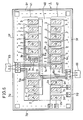
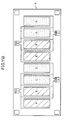
line 1B-1B in Fig. 1A. - Fig. 2 is a top view showing schematically a pattern layout of a semiconductor IC according to an embodiment of the present invention.
- Fig. 3A is a an enlarged detailed view of a part of Fig. 2.
- Fig. 3B is sectional view taken along the
line 3B-3B in Fig. 3A. - Fig. 4 is a circuit block diagram showing an example of an AM/FM stereo tuner.
- Fig. 5A is an enlarged detailed view of a part of Fig. 2.
- Fig. 5B is a sectional view taken along the
line 5B-5B in Fig. 5A. - Fig. 5C is a sectional view taken along the line 5C-5C in Fig. 5A.
- Fig. 6 is a schematic top view of a semiconductor IC according to another embodiment of the present invention.
- Fig. 7A is a sub block diagram showing details of an AM tuner block.
- Fig. 7B is a sub block diagram showing details of an FM front end block and an FM-IF block.
- Fig. 7C is a sub block diagram showing details of a multiplex decoder block.
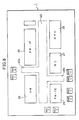
- Fig. 8 is a top view showing a positional relation of circuit blocks of an AM/FM tuner formed on a semiconductor chip.
- Fig. 9 is a top view showing an arrangement of a plurality of elongate dummy islands.
- Fig. 10 is a top view showing schematically a 2-level crossing of power supply lines and ground lines in the semiconductor IC of Fig. 6.
- Fig. 11A is a schematic top view of a semiconductor IC according to a further embodiment of the present invention.
- Fig. 11B is a schematic top view of a semiconductor IC according to a still further embodiment of the present invention.
- Referring to Fig. 2, a surface pattern of a semiconductor IC according to an embodiment of the present invention is schematically shown. Mats A to J separated from each other by
partition belts 4 are provided on asemiconductor chip 1 and a plurality of circuit elements are formed in each of those mats A to J.Power supply lines 2 andground lines 3 parallel to each other are normally provided on therespective partition belts 4. Apower supply line 2 is provided adjacent to the left side of each of the mats A to J and aground line 3 is provided adjacent to the right side thereof. Accordingly, only one power supply line exists on the left side of the mat A at the left end and only oneground line 3 exists on the right side of the mat J at the right end. - A
bundle 5 of power supply lines extends from a power supply pad Vcc along an upper side of thesemiconductor chip 1 in the figure and each of thepower supply lines 2 on thepartition belts 4 is connected to the corresponding power supply line of thebundle 5. Similarly, abundle 6 of ground lines extends from a ground pad GND along a lower side of thesemiconductor chip 1 and each of theground lines 3 on thepartition belts 4 is connected to the corresponding one of the ground lines of thebundle 6. In other words, the power supply lines and the ground lines have comb-like forms and those two comb-like forms are opposed to each other with the teeth of one of them being inserted between the respective adjacent teeth of the other. Accordingly, pluralities of mats, power supply lines, ground lines and the like can be arranged efficiently in a compact manner in a small area. - Those
power supply lines ground lines power supply lines 5 andground lines 6 are partially continuous with each other through a second layer in order to accomplish 2-level crossing. The small black dots at the respective ends of the broken lines represent connections of the conductors of the first and second layers. - The mats A to J have substantially the same rectangular form and size. For example, a shorter side of each mat is set to a dimension making it possible to arrange six bipolar transistors. A longer side of each mat is set to a dimension making it possible for the mat to contain about 100 circuit elements, easy to handle in design. However, the mat size can be set to an arbitrary size which can contain a preferable number of circuit elements according to circuit blocks incorporated in an IC device.
- Circuit elements such as transistors, diodes, resistors and capacitors can be integrated in each mat and those circuit elements are separated from each other by normal PN junction. The circuit elements are interconnected substantially by the conductors in the first layer and partially by the conductors in the second layer to accomplish the 2-level crossing.
- The circuit elements in the different mats are interconnected substantially through the conductors in the second layer as shown by the
broken lines 7a in Fig. 2 and thoseconductors 7a cross over thepower supply lines 2 and the ground lines 3. Theconductors 7a in the second layer can be also connected by means ofconductor segments 7b in the first layer represented as short solid lines between thepower supply lines 2 andground lines 3 parallel with each other in order to attain the 2-level crossing between theconductors 7a, while avoiding mutual interference with the circuit elements in the mats. - Referring to Fig. 3A, a top view of a region near the mat B is partially shown in an enlarged manner. The
conductors conductors 7a smudged and surrounded by the solid lines exist in the second layer. Theconductors conductors 7a in the second layer can be connected through contact regions represented by the marks x. The mat B exists between thepower supply line 2 on the left side and theground line 3 on the right side and the circuit elements such astransistors 10,diodes 11,resistors 12 andcapacitors 13 represented by the broken lines are formed in the mat B. Although thosecircuit elements 10 to 13 are roughly shown for the purpose of clarifying the drawing, they are in reality integrated with high density. - As described above, the
conductors 7a in the second layer are used for the interconnections of the mats, e.g., signal lines or feedback lines. Theconductors 7a in the second layer are arranged in parallel with each other in order to avoid mutual crossing on the plane. In order to make possible the 2-level crossing of thoseconductors 7a, theconductor segments 7b between thepower supply lines 2 and theground lines 3 in thepartition belts 4 can be utilized. If it is necessary to prevent mutual interference between the respective adjacent twoconductor segments 7b,conductors 3a derived from the ground line 3 (or the power supply line 2) are provided between the respective twoadjacent conductor segments 7b so that the mutual interference can be reduced. Further, thepower supply line 2 and theground line 3 serve to reduce mutual interference between theconductor segments 7b and the mat adjacent thereto. - Referring to Fig. 3B, a sectional view taken along the
line 3B-3B in Fig. 3A is schematically shown. AnN epitaxial layer 16 is formed on a P⁻semiconductor substrate 15. A large number ofislands 18 surrounded by P⁺separation regions 17 are formed in theepitaxial layer 16. Each of the circuit elements such as theNPN transistors 10, thediodes 11, theresistors 12 and thecapacitors 13 is formed in each one of thoseislands 18. A burried N⁺region 19 is formed between acollector N region 18 of eachNPN transistor 10 and the P⁻ substrate. Theepitaxial layer 16 is covered with asilicon oxide film 20 formed by chemical vapor deposition (CVD) for example.Conductors silicon oxide film 20 and those conductors are covered with an insulatingfilm 21 of polyimide resin or the like.Conductors 7a in the second layer are formed on the insulatingfilm 21. - The
power supply lines 2 and theground lines 3 are provided above the P⁺separation regions 17. The ground lines 3 penetrate thesilicon oxide film 20 along the longitudinal direction thereof and they are in ohmic contact with the P⁺separation regions 17, so that thesubstrate 15 is stably set at a ground potential. - In the following, an example of a relation between the electronic circuit blocks and the mats A to J incorporated in the semiconductor chip in Fig. 2 will be described.
- Fig. 4 is a circuit block diagram showing an example of an AM/FM stereo tuner. An FM
front end block 25 includes about 250 circuit elements and it receives an FM broadcasting signal of several tens of MHz to several hundreds of MHz and convert it to an intermediate frequency signal of 10.7 MHZ. An FM-IF block 26 includes about 430 circuit elements and it amplifies the intermediate frequency signal and detects the amplified signal so that an audio signal is obtained. A noise canceller block 27 includes about 270 circuit elements and it removes pulse noise such as ignition noise. Amultiplex decoder block 28 includes about 390 circuit elements and it divides a stereo composite signal into right and left channel signals so as to output a stereo signal. AnAM tuner block 29 includes about 350 circuit elements and it converts a received AM signal to an intermediate frequency signal (of 450 KHz) and detects the converted signal so that an audio output is obtained. - When the
multiplex decoder block 28 and the FM-IF block 26 are to be incorporated in the semiconductor chip shown in Fig. 2, themultiplex decoder block 28 including about 390 circuit elements is divided into four portions each including less than 100 circuit elements and each of those four portions is formed in the corresponding one of the mats A, B, C, D. As described previously, the mats A to D are interconnected by means of theconductors IF block 26 including about 430 circuit elements is divided into five portions each including less than 100 circuit elements and each of those five portions is formed in the corresponding one of the mats E, F, G, H, I. The remaining mat J can be used for an optional circuit requested by the user and, for example, it can be used for a circuit for improving characteristics of an arbitrary circuit block. -
Capacitors 13 included in the FM-IF block 26 are integrated in the mat E. Referring to Fig. 2, 11 capacitors are schematically shown by the broken lines in the matE. Ground lines capacitors 13. A plurality ofground lines 3c having a comb teeth form for enhancing efficiency of absorption of the leakage current extend from theground lines 3a. - Referring to Fig. 5A, a part of the mat E in Fig. 2 is shown in an enlarged manner. A plurality of metal-oxide semiconductor (MOS)
capacitors 13 are formed between theground lines ground lines capacitors 13 representupper capacitor electrodes 31. Theupper capacitor electrodes 31 are formed in the first conductor layer and they are connected to theconductors 7a in the second layer represented by the solid lines throughcontact regions 32 shown by the marks x. Theconductors 7a in the second layer cross over theground lines 3b and extend rightward so as to be introduced into any of the mats F-I. - Lower capacitor electrodes (shown in Figs. 5B and 5C) opposed to the
upper capacitor electrodes 31 are connected to lowercapacitor electrode connectors 36 throughcontact regions 34 and theconnectors 36 are connected to theconductors 7a in the second layer throughcontact regions 37. - Figs. 5B and 5C show schematic sectional views taken along the
lines 5B-5B and 5C-5C in Fig. 5A, respectively. Referring to Figs. 5B and 5C, P⁻semiconductor substrate 15, anepitaxial N layer 16, P⁺separation regions 17,N islands 18, burried N⁺ layers 19, asilicon oxide film 20 and an insulatingfilm 21 of such as polyimide resin are formed in the same manner as in Fig. 3B. However, P⁺diffusion regions 38 are formed on respective surfaces ofN islands 18 andP diffusion regions 39 overlapping with main portions of the P⁺regions 38 are further formed. Thus, theP regions upper capacitor electrodes 31 and they are connected to therespective connectors 36. - In vicinities of the
MOS capacitor 13 thus formed, leakage currents from junction capacitors formed by reverse bias of the PN junctions between theseparation regions 17 and theislands 18, between thesubstrate 15 and theislands 18 and between thesubstrate 15 and the burried layers 19 can be absorbed reliably by theground lines capacitors 13 never exert any adverse influence on the circuit elements of the adjacent mats D and F. - Referring to Fig. 6, a surface pattern of a semiconductor IC according to another embodiment of the present invention is schematically shown. The semiconductor IC in Fig. 6 is similar to that in Fig. 2, except that the
semiconductor chip 1 is divided into equal regions, i.e., first andsecond regions division region 40 shown by the double-dot chain lines. Mats A to J are formed in thefirst region 41 and mats K to T are formed in thesecond region 42. All circuit blocks 25 to 29 of the AM-FM stereo tuner shown in Fig. 4 are integrated in thissemiconductor chip 1. - The FM
front end block 25 including about 250 circuit elements is formed in the mats K, L, M. The FM-IF block 26 including about 430 circuit elements is formed in the mats E, F, G, H, I. The noise canceller block 27 including about 270 circuit elements is formed in the mats N, O, P. Themultiplex decoder block 28 including about 390 circuit elements is formed in the mats Q, R, S, T. TheAM tuner block 29 including about 350 circuit elements is formed in the mats A, B, C, D. Theconductors - Referring to Figs. 7A, 7B and 7C, each of the
AM block 29, the FMfront end block 25, the FM-IF block 26 and themultiplex decoder block 28 is represented by a plurality of circuit sub blocks. - An
oscillation circuit 45 in theAM tuner block 29 in Fig. 7A is formed in the mat A. A mixingcircuit 46 is formed in the mat B. An automatic gain control circuit 47, a highfrequency amplifying circuit 48 and an intermediatefrequency amplifying circuit 49 are formed in the mat C.A detecting circuit 50 is formed in the mat D. Apower supply line 2 extending along each of the mats A to D is connected to the corresponding one of the power supply lines of thebundle 5a extending along the upper side of thesemiconductor chip 1 and connected to the first power supply pad Vcc1. Aground line 3 extending along each of the mats A to D is connected to the corresponding one of the ground lines of thebundle 6a extending along the upper side of thedivision region 40. Eachground line 6a on thedivision region 40 extends from the first ground pad GND1 through the mats M and N and it is connected to the corresponding one of the ground lines of thebundle 6b extending toward thedivision region 40. - As shown in Fig. 7B, the FM
front end block 25 includes a high frequency amplifying circuit 51, a mixingcircuit 52 and anoscillating circuit 53 and it processes a signal of a very low level such as several µV. Accordingly, the FMfront end block 25 is liable to be adversely affected by other circuit blocks, particularly by the FM-IF block 26 and therefore the FMfront end block 25 and the FM-IF block 26 are conventionally formed on different semiconductor chips. On the other hand, theoscillating circuit 53 in the FMfront end block 25 might cause unnecessary radiation to exert adverse effect on other circuit blocks. Therefore, the mats K to M where the FMfront end block 25 is formed are sufficiently spaced in a diagonal direction of thesemiconductor chip 1 from the mats E to I where the FM-IF block 26 is formed. - The
oscillating circuit 53 in the FMfront end block 25 is formed in the mat K in the left lower corner of thesemiconductor chip 1 in order to avoid mutual interference with other circuit blocks. Further, thepower supply line 2b and theground line 3a provided for the mat K are connected to a second power supply pad Vcc2 different from the first power supply pad Vcc1 and to a second ground pad GND2 different from the first ground pad GND1, respectively, in order to avoid mutual interference with other mats. Thepower supply line 2c and theground line 3e extending along each of the mats L and M are connected to a third power supply pad Vcc3 and to a third ground pad GND3, respectively. - The FM-
IF block 26 includes an intermediatefrequency amplifying circuit 54, a detectingcircuit 55 and anS meter 56. The detectingcircuit 55 is formed in the mat I and theS meter 56 is formed in the mat G. A limiter circuit, a muting circuit and the like included in the intermediatefrequency amplifying circuit 54 are formed in the mats E, F, G. Capacitors included in the limiter circuit for removing an AM signal component contained in an FM signal are collected and formed in the mat E in the same manner as in the semiconductor device in Fig. 2. However, theground line 3a extending along the left side of the mat E is connected to aground line 3f extending along peripheral regions of thesemiconductor chip 1 in the counterclockwise direction from a fourth pad GND4 adjacent to the first ground pad GND1. - Since the
ground line 3f is in ohmic contact with the underlying P⁺ separation region along the longitudinal direction thereof, it not only receives the leakage current of the mat E absorbed by thegrounds line semiconductor chip 1. Similarly, aground line 3g extending along peripheral regions of thesemiconductor chip 1 in the clockwise direction from the first ground pad GND1 absorbs leakage current in the peripheral regions of thesemiconductor chip 1. - The limiter circuit included in the intermediate
frequency amplifying circuit 54 in the mats E to G has a very high gain of 80dB to 100dB. The detectingcircuit 55 in the mat I and theS meter 56 in the mat H have high signal levels. Consequently, an undesirable feedback signal generated from the detectingcircuit 55 and the S meter to the intermediatefrequency amplifying circuit 54 might cause oscillation. Such oscillation would affect adversely the characteristics of the detectingcircuit 55 and theS meter 56. Therefore, in order to prevent such adverse effect, twopower supply lines 2 extending along the mats F and G including the intermediatefrequency amplifying circuit 54 are connected to one of the power supply lines of thebundle 5a extending along the upper side of thesemiconductor chip 1, while twopower supply lines 2 extending along the mat I including theS meter 56 and along the mat H including the detectingcircuit 50 are connected to another line of thebundle 5a. In addition, apower supply line 2 extending along the mat J where an optional circuit desired by the user is formed is connected to a further line of thebundle 5a. - Similarly, two
ground lines 3 along the mats F and G are connected to one of the ground lines of thebundle 6a on thedivision region 40 and the twoground lines 3 along the mats H and I are connected to another line of thebundle 6a. Theground line 3 along the mat J is connected to a further line of thebundle 6a. - A
DC amplifying circuit 57, adecoder circuit 58 and aramp driver circuit 59 included in themultiplex decoder block 28 in Fig. 7C are formed in the mats Q and R. The remainingphase comparing circuit 60, low-pass filter 61,voltage control oscillator 62, frequency-dividingcircuit 63 and detecting circuit 64 are formed in the mats S and T. The two power supply lines extending along the mats Q and R are connected to one of the power supply lines of thebundle 5b extending along the lower side of thedivision region 40, while the two power supply lines extending along the mats S and T are connected to another line of thebundle 5b. The threepower supply lines 2 extending along the mats N, O and P including the noise canceller block are connected to a further line of thebundle 5b. Each line of thebundle 5b is connected to the corresponding one of theground lines 5c extending from a fourth power line pad Vcc4 adjacent to the first power supply pad Vcc1 to thedivision region 40 through a region between the mats D and E. - Similarly, the two
ground lines 3 extending along the mats Q and R are connected to one of the ground lines of the bundle 6c extending along the lower side of thesemiconductor chip 1 from the fourth ground line GND4 and the twoground lines 3 extending along the mats S and T are connected to another line of the bundle 6c. The three ground lines extending along the mats N, O, P are connected to still another line of the bundle 6c. - The separate fourth power supply pad Vcc4 adjacent to the first power supply pad Vcc1 and the separate fourth ground pad GND4 adjacent to the first ground pad GND1 are provided to reduce mutual interference between the circuit blocks. Each of the first and fourth power supply pads Vcc1 and Vcc4 is connected to a
power supply lead 65 through a fine metallic wire. Consequently, even if a pulse noise occurs in either of the first and fourth power supply pads Vcc1 and Vcc4, the pulse noise is attenuated by impedance of the two fine metallic wires and accordingly influence on the other power supply pad can be reduced. Similarly, the first and fourth ground pads GND1 and GND4 are connected to aground lead 66 through respective fine metallic wires. - As described above, a sufficient space (where the
bundle 5c of power supply lines extends) is provided between the mats D and E and a sufficient space (where thebundle 6b of ground lines extends) is provided between the mats M and N. Accordingly, the FMfront end block 25 included in the mats K to M is sufficiently spaced from other circuit blocks, particularly, from the FM-IF block 26 included in the mats E to I, whereby mutual interference between the circuit blocks can be prevented. Further, thebundle 5c of power supply lines serves to shield from the above described unnecessary radiation. Since at least one line of each of thebundles - Referring to Fig. 8, a positional relation of circuit blocks of an AM/FM tuner formed on the
semiconductor chip 1 is shown. The FMfront end block 25 and the FM-IF block 26 where it is particularly necessary to prevent mutual interference are spaced sufficiently from each other in a diagonal direction of thesemiconductor chip 1. Thedivision region 40 may include anadditional division region 40a extending between theAM tuner block 29 and the FM-IF block 26 and it may further include anadditional division region 40b extending between the FMfront end block 25 and thenoise canceller block 27. Thus, the noise canceller block 27 and themultiplex decoder block 28 are also spaced sufficiently from the FMfront end block 25 and the FM-IF block 26. In addition, theAM tuner block 29 is also spaced sufficiently from other circuit blocks 25 to 28. - Referring to Fig. 9, a plurality of elongate dummy islands for enhancing the effect of preventing mutual interference of the circuit blocks are shown. The plurality of elongate
N dummy islands 70 represented as being smudged are provided in spaces in thedivision regions front end block 25 is formed may be surrounded by adummy island 71. In addition, adummy island portion 72 may be added so that only the mat K including theoscillation circuit 53 may be surrounded entirely by the dummy islands. - Since the
AM tuner block 29 does not operate simultaneously with the FM circuit section, it is not necessary to take account of mutual interference with the FM circuit section. Accordingly, theAM tuner block 29 included in the mats A to D and the FM-IF block 26 included in the mats E to I utilize in common the first power supply pad Vcc1, the first ground pad GND1 and thebundle 6b of ground lines. In consequence, the areas occupied by the bonding pads and conductors can be reduced. - The portions shown by the broken lines in the
bundle 5a of power supply lines and thebundle 6a of ground lines in Fig. 6 represent conductors in the second layer as in Fig. 2. - Referring to Fig. 10, the 2-level crossing of the power supply lines and the ground lines in Fig. 6 is schematically illustrated. The conductors represented by the single-dot chain lines exist in the first layer and the conductors represented by the solid lines exist in the second layer. The conductors in the first and second layers are connected through contact regions shown by the marks x. In consequence, the
bundle 5a of power supply lines and thebundle 6a of ground lines cross over thebundle 5c of power supply lines. - If the
AM tuner block 29 is not required, themultiplex decoder block 28 can be shifted from the mats Q to T to the mats A to D. In that case, it is not needed to entirely change the arrangements of the circuit elements and conductors in themultiplex decoder block 28 and only the conductors between the circuit blocks need to be rearranged. Similarly, if the circuits in the mats I and J are shifted to the vacant mats Q and R, the four mats I, J, S and T at the right end are not required. - If an improvement is made only in the mat F of the FM-
IF block 26 for example, it is only necessary to redesign the mat F and no change is required for the other mats. - In addition, if a user desires an additional circuit block in addition to the optional mat J, only a necessary number of mats need to be added.
- Thus, according to the present invention, since mats of the substantially same size are arranged in a line form or a matrix form on the semiconductor chip, it is easy to change, add and delete circuit blocks as required. Accordingly, circuit blocks to be used in an electronic circuit of a large scale can be individually designed and stocked. As a result the time required for design of a large-scale electronic circuit can be considerably reduced and a high reliability can be maintained.
- In addition, if capacitors each having a relatively large area are formed in one mat, forms and arrangements of other circuit elements such as transistors, diodes and resistors do not need to be taken into account and thus it becomes easy to design the capacitors. In consequence, it is not needed to take account of leakage current from the capacitors in the mats not including the capacitors and it becomes easy to design circuits in those mats.
- Referring to Fig. 11A, a semiconductor IC according to a further embodiment of the present invention is schematically shown. In this figure, interconnections between the mats are not shown for the purpose of simplification of the illustration. An electronic circuit often includes first and second circuit sections which do not operate simultaneously, as in the above described case of the AM and FM sections in the AM/FM stereo tuner. It is often necessary to prevent mutual interference between circuit blocks in the same section. The embodiment in Fig. 11A is preferable for such cases. The semiconductor IC of Fig. 11A is similar to that of Fig. 2, except that alternate mats A, C, E and G include a circuit block in a first circuit section and the other alternate mats B, D, F and H include a circuit block in a second circuit section. More specifically, one of the mats of the second circuit section is located between the adjacent mats of the first circuit section and one of the mats of the first circuit section is located between the adjacent mats of the second circuit section.
- When the mats A, C, E, G including the first circuit section are in operation, the mats B, D, F of the second circuit section between the corresponding ones of the mats A, C, E, G are not operated and they are in a high impedance state. Thus, mutual interference between the respective mats A, C, E, G of the first circuit section is suppressed. On the other hand, when the mats B, D, F, H including the second circuit sections are in operation, the mats C, E, G of the first circuit section are not operated and in a high impedance state. Accordingly, mutual interference between the mats B, D, F, H of the second circuit section is suppressed.
- The mats not in operation each function as a large capacitor of a PN junction type per se and serve to remove high frequency noise. For example, even if high frequency noise enters the P⁻
semiconductor substrate 15 through the mat A, the mat B functions as a large PN junction type capacitor and the noise is absorbed through thepower supply line 2 connected to the mat B. As a result, mutual interference between the mats A and C due to the high frequency noise can be prevented. - In addition, since the
power supply line 2 for the mat A and thepower supply line 2 for the mat C for example are connected in parallel with each other to the first power supply pad Vcc1, any change in the potential in the mat A is not transmitted directly to the mat C. - Referring to Fig. 11B, a semiconductor IC according to a still further embodiment of the invention is schematically shown. Although the semiconductor IC of Fig. 11B is similar to that of Fig. 11A, there are differences in that a circuit block in the first circuit section is formed in the mats A, B, E, F and that a circuit block in the second circuit section is formed in the mats C, D, G, H. Thus, two mats of the first circuit section and two mats of the second circuit section are arranged in turn. In the semiconductor IC of Fig. 11B, the group of the mats A and B and that of the mats E and F of the first circuit section can be spaced sufficiently. Similarly, the group of the mats C and D and that of the mats G and H of the second circuit section can be spaced sufficiently.
- Although the present invention has been described and illustrated in detail, it is clearly understood that the same is by way of illustration and example only and is not to be taken by way of limitation, the spirit and scope of the present invention being limited only by the terms of the appended claims.
Claims (27)
a semiconductor chip (1),
a plurality of mats (A to T) of a substantially equal size formed on said semiconductor chip, each of said plurality of mats including a plurality of circuit elements (10 to 13),
partition regions (4) for separating said plurality of mats (A to T) from each other, and
a pair of power supply line (2) and ground line (3) provided on each of said partition regions (4),
an electronic circuit formed on said semiconductor chip including circuit blocks having different functions but being designed by using each of said mats (A to T) as a unit, not each of the circuit blocks as a unit.
the power supply lines (2) on said partition regions (4) extend from a bundle (5, 5a, 5b) of power supply lines in a comb-teeth form and the ground lines (3) on said partition regions (4) also extend from a bundle (6, 6a, 6c) of ground lines in a comb-teeth form, the comb-teeth form of said power supply lines (2, 5, 5a, 5b) and the comb-teeth form of said ground lines (3, 6, 6a, 6c) being opposite to each other.
said power supply lines (2, 5, 5a, 5b) and said ground lines (3, 6, 6a, 6c are formed substantially by conductors in a first conductor layer.
circuit elements in each of said mats (A to T) are interconnected substantially by conductors (8) in the first conductor layer and said mats (A to T) are interconnected substantially by conductors (7a) in a second conductor layer.
said mats (A to T) are interconnected by the conductors (7a) in the second conductor layer connected to both ends of a conductor segment (7b) in the first conductor layer provided between the power supply line (2) and the ground line (3) of said pair.
said semiconductor chip (1) is divided into first and second regions (41, 42) spaced from each other by a division region 40) and said plurality of mats are formed in said first and second regions.
at least one mat of said plurality of mats (A to T) is a capacitor mat (E) including only capacitors (13) as circuit elements.
ground lines (3a, 3b, 3f, 6a are provided on at least one side of said capacitor mat (E) and said ground lines (3a, 3b, 3f, 6a) along the total lengths thereof are in ohmic conduct with separation regions (17) lying thereunder.
each of said capacitors (13) is formed in an island (18) surrounded by separation regions (17).
ground lines (3c) are further provided to extend in a comb-teeth form from at least one of the ground lines (3a) on at least one side of said capacitor mat (E) and said ground lines (3c) in the comb-teeth form are in ohmic contact with underlying separation regions (17).
said capacitor mat (E) is disposed at one end of a group of the mats (E to I) where one circuit block is formed.
the two circuit blocks (25, 26) where it is necessary to prevent mutual interference are formed in the two groups of mats (E to I and K to M) spaced from each other in a diagonal direction of said semiconductor chip (1).
said electronic circuit is an AM/FM stereo tuner and the two circuit blocks where it is necessary to prevent mutual interference are an FM front end block (25) and an FM-IF block (26).
an oscillating circuit (53) included in said FM front end block (25) is formed in the mat (K) at a corner of said semiconductor chip (1).
spaces are provided in which a bundle (5c, 6b) of conductors is disposed between adjacent two mats (D, E; M, N) in adjacent groups of mats (A to D, E to I; K to M, N to P) in either said first region or said second region (41, 42) out of the groups of mats where the circuit blocks are formed.
one or more elongate dummy islands are provided in said division region (40).
one or more elongate dummy islands are provided under each said space where said bundle of conductors (5c, 6b are disposed.
the mat group (K to M) including said FM front end block (25) is surrounded by dummy islands (71).
the mat including the oscillating circuit (53) included in said FM front end block (25) is entirely surrounded by dummy islands (71, 72).
said electronic circuit includes first and second circuit blocks (29, 26) not operating simultaneously and a third circuit block 28 operating at all times, the mats (a to D, E to I) including said first and second circuit blocks (29, 26) utilize in common a first power supply pad (Vcc1) and a first ground pad (GND1) on said semiconductor chip (1), and the mats (Q to T) including said third circuit block utilize a second power supply pad (Vcc4) and a second ground pad (GND4).
said semiconductor integrated circuit further comprises a power supply lead (65) and a ground lead (66), said first and second power supply pads (Vcc1, Vcc4) are disposed adjacent to each other on said semiconductor chip (1) and each of said pads is connected to said power supply lead (65) by a single fine metallic wire, and said first and second ground pads (GND1, GND4) are provided adjacent to each other and each of said pads is connected to said ground lead (66) by a single fine metallic wire.
said electronic circuit includes first and second circuit sections not operating simultaneously, each of said circuit sections includes one or more circuit blocks and one or more mats where one or more circuit blocks of one of said circuit sections are formed between the mats including the circuit block of the other circuit section where it is necessary to prevent mutual interference.
the mats of said first circuit section and the mats of said second circuit section are formed alternately.
a semiconductor chip (1) having a substantially rectangular form,
an FM front end circuit block (25) provided near a first corner of said semiconductor chip (1),
an FM-IF circuit block (26) provided near a second corner of said semiconductor chip (1), spaced from said FM front end circuit block (20) in a diagonal direction of said semiconductor chip (1), and
a multiplex decoder circuit block (28) and an AM tuner circuit block provided near third and fourth corners, respectively, spaced from each other in other diagonal direction on said semiconductor chip, whereby
said respective circuit blocks (25, 26, 28, 29) being sufficiently spaced from each other.
a semiconductor chip (1)
a region (E) where only a plurality of capacitors are formed on said semiconductor chip (1),
ground lines (3a, 3b, 3f, 6a) provided at least along one side of said region (E), and
separation regions (17) under said ground lines, being in ohmic contact with said ground lines (3a, 3b, 3f, 6a) along the total length thereof.
ground lines (3c) are further provided to extend in a comb-teeth form into said region (E) from the ground line (3a) along at least one side of said region (E) and said ground lines (3c) in the comb-teeth form are also in ohmic contact with separation regions thereunder.
Applications Claiming Priority (24)
| Application Number | Priority Date | Filing Date | Title |
|---|---|---|---|
| JP15312288 | 1988-06-21 | ||
| JP63153122A JPH0638452B2 (en) | 1988-06-21 | 1988-06-21 | Linear semiconductor integrated circuit |
| JP153122/88 | 1988-06-21 | ||
| JP63173010A JPH0666415B2 (en) | 1988-07-12 | 1988-07-12 | Semiconductor integrated circuit for FM / AM tuner |
| JP63173009A JP2675338B2 (en) | 1988-07-12 | 1988-07-12 | Semiconductor integrated circuit |
| JP173003/88 | 1988-07-12 | ||
| JP17300488 | 1988-07-12 | ||
| JP173005/88 | 1988-07-12 | ||
| JP17300388 | 1988-07-12 | ||
| JP17301088 | 1988-07-12 | ||
| JP173004/88 | 1988-07-12 | ||
| JP63173004A JPH0628285B2 (en) | 1988-07-12 | 1988-07-12 | Linear semiconductor integrated circuit |
| JP173010/88 | 1988-07-12 | ||
| JP173009/88 | 1988-07-12 | ||
| JP63173003A JPH0223659A (en) | 1988-07-12 | 1988-07-12 | Semiconductor integrated circuit |
| JP17300588 | 1988-07-12 | ||
| JP17300988 | 1988-07-12 | ||
| JP63173005A JPH0648708B2 (en) | 1988-07-12 | 1988-07-12 | Semiconductor integrated circuit |
| JP202196/88 | 1988-08-12 | ||
| JP20219688 | 1988-08-12 | ||
| JP20219688A JPH0628289B2 (en) | 1988-08-12 | 1988-08-12 | Semiconductor integrated circuit |
| JP63235828A JPH0719843B2 (en) | 1988-09-20 | 1988-09-20 | Semiconductor integrated circuit |
| JP235828/88 | 1988-09-20 | ||
| JP23582888 | 1988-09-20 |
Publications (3)
| Publication Number | Publication Date |
|---|---|
| EP0347853A2 true EP0347853A2 (en) | 1989-12-27 |
| EP0347853A3 EP0347853A3 (en) | 1992-04-22 |
| EP0347853B1 EP0347853B1 (en) | 2000-02-02 |
Family
ID=27573235
Family Applications (1)
| Application Number | Title | Priority Date | Filing Date |
|---|---|---|---|
| EP89111233A Expired - Lifetime EP0347853B1 (en) | 1988-06-21 | 1989-06-20 | Semiconductor integrated circuit |
Country Status (2)
| Country | Link |
|---|---|
| EP (1) | EP0347853B1 (en) |
| DE (1) | DE68929148T2 (en) |
Cited By (4)
| Publication number | Priority date | Publication date | Assignee | Title |
|---|---|---|---|---|
| EP0505248A1 (en) * | 1991-03-18 | 1992-09-23 | Fujitsu Limited | Method of manufacturing semiconductor device having unit circuit-blocks and semiconductor devices produced thereby |
| WO2006068286A1 (en) * | 2004-12-24 | 2006-06-29 | Semiconductor Energy Laboratory Co., Ltd. | Semiconductor device |
| US7906424B2 (en) | 2007-08-01 | 2011-03-15 | Advanced Micro Devices, Inc. | Conductor bump method and apparatus |
| US8314474B2 (en) | 2008-07-25 | 2012-11-20 | Ati Technologies Ulc | Under bump metallization for on-die capacitor |
Family Cites Families (1)
| Publication number | Priority date | Publication date | Assignee | Title |
|---|---|---|---|---|
| JPS492798B1 (en) * | 1969-04-16 | 1974-01-22 |
-
1989
- 1989-06-20 EP EP89111233A patent/EP0347853B1/en not_active Expired - Lifetime
- 1989-06-20 DE DE68929148T patent/DE68929148T2/en not_active Expired - Lifetime
Cited By (9)
| Publication number | Priority date | Publication date | Assignee | Title |
|---|---|---|---|---|
| EP0505248A1 (en) * | 1991-03-18 | 1992-09-23 | Fujitsu Limited | Method of manufacturing semiconductor device having unit circuit-blocks and semiconductor devices produced thereby |
| US5539224A (en) * | 1991-03-18 | 1996-07-23 | Fujitsu Limited | Semiconductor device having unit circuit-blocks in a common chip as a first layer with electrical interconnections therebetween provided exclusively in a second, upper, interconnection layer formed on the first layer |
| US5696013A (en) * | 1991-03-18 | 1997-12-09 | Fujitsu Limited | Method of manufacturing semiconductor device having unit circuit-blocks |
| WO2006068286A1 (en) * | 2004-12-24 | 2006-06-29 | Semiconductor Energy Laboratory Co., Ltd. | Semiconductor device |
| CN101088158B (en) * | 2004-12-24 | 2010-06-23 | 株式会社半导体能源研究所 | Semiconductor device |
| US8716834B2 (en) | 2004-12-24 | 2014-05-06 | Semiconductor Energy Laboratory Co., Ltd. | Semiconductor device including antenna |
| US7906424B2 (en) | 2007-08-01 | 2011-03-15 | Advanced Micro Devices, Inc. | Conductor bump method and apparatus |
| US8294266B2 (en) | 2007-08-01 | 2012-10-23 | Advanced Micro Devices, Inc. | Conductor bump method and apparatus |
| US8314474B2 (en) | 2008-07-25 | 2012-11-20 | Ati Technologies Ulc | Under bump metallization for on-die capacitor |
Also Published As
| Publication number | Publication date |
|---|---|
| DE68929148D1 (en) | 2000-03-09 |
| EP0347853B1 (en) | 2000-02-02 |
| EP0347853A3 (en) | 1992-04-22 |
| DE68929148T2 (en) | 2000-09-21 |
Similar Documents
| Publication | Publication Date | Title |
|---|---|---|
| KR920005802B1 (en) | Semiconductor intergrated circuit | |
| US3373323A (en) | Planar semiconductor device with an incorporated shield member reducing feedback capacitance | |
| US5155570A (en) | Semiconductor integrated circuit having a pattern layout applicable to various custom ICs | |
| JPH0151065B2 (en) | ||
| EP0354512B1 (en) | Semiconductor integrated circuit | |
| US5300798A (en) | Semiconductor integrated circuit device | |
| EP0347853B1 (en) | Semiconductor integrated circuit | |
| KR930004982B1 (en) | Semiconductor integrated circuit | |
| JPH0691226B2 (en) | Semiconductor integrated circuit | |
| JPH0638452B2 (en) | Linear semiconductor integrated circuit | |
| JPH0648708B2 (en) | Semiconductor integrated circuit | |
| JPH0474866B2 (en) | ||
| JPH0251253A (en) | Semiconductor integrated circuit | |
| JPH0719843B2 (en) | Semiconductor integrated circuit | |
| JP2675338B2 (en) | Semiconductor integrated circuit | |
| JPH0666414B2 (en) | Semiconductor integrated circuit | |
| JPH0628286B2 (en) | Linear semiconductor integrated circuit | |
| JPH0628285B2 (en) | Linear semiconductor integrated circuit | |
| JP2638544B2 (en) | Semiconductor integrated circuit | |
| JPH0652771B2 (en) | Linear semiconductor integrated circuit | |
| JPH0639454Y2 (en) | Semiconductor integrated circuit | |
| JPH0316163A (en) | Semiconductor integrated circuit | |
| JPH063840B2 (en) | Semiconductor device | |
| JPH0628287B2 (en) | Linear semiconductor integrated circuit | |
| JPH1075146A (en) | Noise filter |
Legal Events
| Date | Code | Title | Description |
|---|---|---|---|
| PUAI | Public reference made under article 153(3) epc to a published international application that has entered the european phase |
Free format text: ORIGINAL CODE: 0009012 |
|
| AK | Designated contracting states |
Kind code of ref document: A2 Designated state(s): DE FR GB |
|
| 17P | Request for examination filed |
Effective date: 19901228 |
|
| PUAL | Search report despatched |
Free format text: ORIGINAL CODE: 0009013 |
|
| AK | Designated contracting states |
Kind code of ref document: A3 Designated state(s): DE FR GB |
|
| 17Q | First examination report despatched |
Effective date: 19930708 |
|
| APAD | Appeal reference recorded |
Free format text: ORIGINAL CODE: EPIDOS REFNE |
|
| APAB | Appeal dossier modified |
Free format text: ORIGINAL CODE: EPIDOS NOAPE |
|
| GRAG | Despatch of communication of intention to grant |
Free format text: ORIGINAL CODE: EPIDOS AGRA |
|
| GRAH | Despatch of communication of intention to grant a patent |
Free format text: ORIGINAL CODE: EPIDOS IGRA |
|
| GRAH | Despatch of communication of intention to grant a patent |
Free format text: ORIGINAL CODE: EPIDOS IGRA |
|
| GRAH | Despatch of communication of intention to grant a patent |
Free format text: ORIGINAL CODE: EPIDOS IGRA |
|
| GRAA | (expected) grant |
Free format text: ORIGINAL CODE: 0009210 |
|
| AK | Designated contracting states |
Kind code of ref document: B1 Designated state(s): DE FR GB |
|
| REF | Corresponds to: |
Ref document number: 68929148 Country of ref document: DE Date of ref document: 20000309 |
|
| ET | Fr: translation filed | ||
| PLBE | No opposition filed within time limit |
Free format text: ORIGINAL CODE: 0009261 |
|
| STAA | Information on the status of an ep patent application or granted ep patent |
Free format text: STATUS: NO OPPOSITION FILED WITHIN TIME LIMIT |
|
| 26N | No opposition filed | ||
| REG | Reference to a national code |
Ref country code: GB Ref legal event code: IF02 |
|
| APAH | Appeal reference modified |
Free format text: ORIGINAL CODE: EPIDOSCREFNO |
|
| PGFP | Annual fee paid to national office [announced via postgrant information from national office to epo] |
Ref country code: DE Payment date: 20080626 Year of fee payment: 20 |
|
| PGFP | Annual fee paid to national office [announced via postgrant information from national office to epo] |
Ref country code: FR Payment date: 20080617 Year of fee payment: 20 |
|
| PGFP | Annual fee paid to national office [announced via postgrant information from national office to epo] |
Ref country code: GB Payment date: 20080625 Year of fee payment: 20 |
|
| REG | Reference to a national code |
Ref country code: GB Ref legal event code: PE20 Expiry date: 20090619 |
|
| PG25 | Lapsed in a contracting state [announced via postgrant information from national office to epo] |
Ref country code: GB Free format text: LAPSE BECAUSE OF EXPIRATION OF PROTECTION Effective date: 20090619 |