EP0347595B1 - Procédé pour exploiter une station d'épuration d'eau usée - Google Patents
Procédé pour exploiter une station d'épuration d'eau usée Download PDFInfo
- Publication number
- EP0347595B1 EP0347595B1 EP89109210A EP89109210A EP0347595B1 EP 0347595 B1 EP0347595 B1 EP 0347595B1 EP 89109210 A EP89109210 A EP 89109210A EP 89109210 A EP89109210 A EP 89109210A EP 0347595 B1 EP0347595 B1 EP 0347595B1
- Authority
- EP
- European Patent Office
- Prior art keywords
- sewage
- amount
- treatment plant
- sewage treatment
- measured
- Prior art date
- Legal status (The legal status is an assumption and is not a legal conclusion. Google has not performed a legal analysis and makes no representation as to the accuracy of the status listed.)
- Expired - Lifetime
Links
Images
Classifications
-
- C—CHEMISTRY; METALLURGY
- C02—TREATMENT OF WATER, WASTE WATER, SEWAGE, OR SLUDGE
- C02F—TREATMENT OF WATER, WASTE WATER, SEWAGE, OR SLUDGE
- C02F3/00—Biological treatment of water, waste water, or sewage
- C02F3/006—Regulation methods for biological treatment
-
- C—CHEMISTRY; METALLURGY
- C02—TREATMENT OF WATER, WASTE WATER, SEWAGE, OR SLUDGE
- C02F—TREATMENT OF WATER, WASTE WATER, SEWAGE, OR SLUDGE
- C02F1/00—Treatment of water, waste water, or sewage
- C02F1/006—Water distributors either inside a treatment tank or directing the water to several treatment tanks; Water treatment plants incorporating these distributors, with or without chemical or biological tanks
-
- C—CHEMISTRY; METALLURGY
- C02—TREATMENT OF WATER, WASTE WATER, SEWAGE, OR SLUDGE
- C02F—TREATMENT OF WATER, WASTE WATER, SEWAGE, OR SLUDGE
- C02F2209/00—Controlling or monitoring parameters in water treatment
- C02F2209/40—Liquid flow rate
Definitions
- the invention relates to a method for operating a sewage treatment plant, which is supplied with wastewater loaded with cargo, which is mixed with groundwater and optionally with surface water.
- the wastewater loaded with cargo from private households, restaurants, hotels and industrial companies is fed into the sewage treatment plant via a sewer system. It cannot be avoided that groundwater penetrates into the sewer system and reaches the sewage treatment plant together with the waste water. This also applies to surface water, which is attempted in particular by rain and the amount of which increases considerably in the event of heavy rain.
- the maximum amount of wastewater to be fed into a sewage treatment plant is determined on the one hand by the capacity of the sewage treatment plant. On the other hand, this amount of wastewater is also specified by official requirements. It is calculated by the authority based on empirical values, which include, among other things, the area of the catchment area, the number of people in households and industrial companies and other values. This method, which has been used for years, is unsatisfactory because it works on the basis of empirically determined values that the actual conditions do not may take into account. Changes in the data on which the calculation is based can also hardly be taken into account.
- the invention has for its object to provide a method with which the amount of wastewater to be supplied to a sewage treatment plant can be dimensioned according to the actual circumstances of the catchment area.
- an up-to-date value that corresponds to the actual conditions in the catchment area of the sewage treatment plant is used to determine the amount of wastewater to be fed to the sewage treatment plant. It is assumed that the fresh water used in the catchment area reaches the sewage system of the sewage plant in almost the same amount as waste water.
- the measured quantity of fresh water can be used with a corresponding time delay of, for example, 3 hours for the continuous regulation of the quantity of waste water to be fed to the sewage treatment plant.
- This method is also advantageous in the event that an increased amount of surface water occurs, for example due to heavy rain. Since the ratio of wastewater with cargo to groundwater in the total amount of wastewater is known due to the measurements in the dry season, sufficiently precise values also result for the additional surface water. This is again of interest from an economic point of view, since the clarification of surface water requires less effort and costs than the clarification of waste water loaded with cargo.
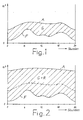
- the quantity F of fresh water used in the catchment area of the sewage treatment plant is measured continuously. A typical curve course over 24 hours can be seen from FIGS. 1 and 2.
- the amount A of the total wastewater flowing to the sewage treatment plant is measured. Both measured values are evaluated. They can be recorded in tabular form or in the form of a curve. If fresh water and waste water are measured in a longer drying period, i.e. in the drying time according to FIG. 1, then the difference between the two measured values corresponds with great accuracy to the amount of groundwater G flowing to the sewage treatment plant, which is actually not to be clarified.
- the groundwater quantity G corresponds to the area hatched in FIG. 1. It is assumed that the fresh water used in the catchment area of the sewage treatment plant reaches the sewage treatment plant almost completely after a delay time which is dependent on the local conditions. Only this portion of the wastewater has to be clarified and is therefore subject to a fee.
- the locks or valves in front of the sewage treatment plant or the speed of the pump delivering the waste water can thus be controlled in accordance with the measured fresh water quantity F.
- the wastewater treatment plant is supplied with a constantly changing amount of waste water.
- the time delay between the measurement of the fresh water quantity and the control of the waste water quantity corresponding to this measurement can be, for example, 3 hours. As already mentioned, it depends on the local conditions and can therefore also have a different value.
- the part of the wastewater that is not fed into the wastewater treatment plant is clean enough to be able to be fed directly to a receiving water.
- the fresh water quantity F By measuring the fresh water quantity F, it is also possible to supply a constant amount of waste water to the sewage treatment plant. From that during a certain For a period of, for example, 24 hours of fresh water consumption measured, the arithmetic mean is used, which is used as the amount of wastewater that is constantly fed to the sewage treatment plant by means of a feed pump.
- the mixing channel in front of the sewage treatment plant can be used as storage space, in which too much waste water can be accumulated at times. It is known that there is more wastewater in the morning and evening than in the intervening times. The accumulated wastewater can be broken down in times of reduced seizures.
- the mixing channel can be emptied quickly by increasing the output of the feed pump. All that is required is a rain detector, whose signal can be used to increase the speed of the feed pump.
- the amount of waste water A increased by the rain is also measured in front of the treatment plant.
- the corresponding curve shape is shown in FIG. 2.
- the hatched area corresponds to the groundwater quantity G and the rainwater quantity R.
- the fresh water curve is the same as in Fig. 1. Since the dry season values indicate the ratio of waste water loaded with cargo to groundwater in the entire waste water, this can also be done by forming the difference Rain or Surface water volume can be determined at any time. If the amount of rain fallen per m2 is measured elsewhere in the municipality belonging to the sewage treatment plant, the sealing area of the catchment area of the sewage treatment plant can be calculated. It results from the difference between the amount of rain fallen per m2 and the amount of rain arriving at the sewage treatment plant. The part of the rain that does not flow to the sewage treatment plant has seeped away in green and other open spaces.
Landscapes
- Life Sciences & Earth Sciences (AREA)
- Hydrology & Water Resources (AREA)
- Engineering & Computer Science (AREA)
- Environmental & Geological Engineering (AREA)
- Water Supply & Treatment (AREA)
- Chemical & Material Sciences (AREA)
- Organic Chemistry (AREA)
- Health & Medical Sciences (AREA)
- Molecular Biology (AREA)
- Biodiversity & Conservation Biology (AREA)
- Microbiology (AREA)
- Sewage (AREA)
- Activated Sludge Processes (AREA)
- Separation Of Suspended Particles By Flocculating Agents (AREA)
Claims (6)
Priority Applications (1)
| Application Number | Priority Date | Filing Date | Title |
|---|---|---|---|
| AT89109210T ATE75214T1 (de) | 1988-06-22 | 1989-05-23 | Verfahren zum betreiben einer klaeranlage. |
Applications Claiming Priority (2)
| Application Number | Priority Date | Filing Date | Title |
|---|---|---|---|
| DE3821009 | 1988-06-22 | ||
| DE3821009A DE3821009A1 (de) | 1988-06-22 | 1988-06-22 | Verfahren zum betreiben einer klaeranlage |
Publications (2)
| Publication Number | Publication Date |
|---|---|
| EP0347595A1 EP0347595A1 (fr) | 1989-12-27 |
| EP0347595B1 true EP0347595B1 (fr) | 1992-04-22 |
Family
ID=6356974
Family Applications (1)
| Application Number | Title | Priority Date | Filing Date |
|---|---|---|---|
| EP89109210A Expired - Lifetime EP0347595B1 (fr) | 1988-06-22 | 1989-05-23 | Procédé pour exploiter une station d'épuration d'eau usée |
Country Status (3)
| Country | Link |
|---|---|
| EP (1) | EP0347595B1 (fr) |
| AT (1) | ATE75214T1 (fr) |
| DE (2) | DE3821009A1 (fr) |
-
1988
- 1988-06-22 DE DE3821009A patent/DE3821009A1/de not_active Withdrawn
-
1989
- 1989-05-23 DE DE8989109210T patent/DE58901229D1/de not_active Expired - Lifetime
- 1989-05-23 AT AT89109210T patent/ATE75214T1/de not_active IP Right Cessation
- 1989-05-23 EP EP89109210A patent/EP0347595B1/fr not_active Expired - Lifetime
Also Published As
| Publication number | Publication date |
|---|---|
| EP0347595A1 (fr) | 1989-12-27 |
| ATE75214T1 (de) | 1992-05-15 |
| DE3821009A1 (de) | 1989-12-28 |
| DE58901229D1 (de) | 1992-05-27 |
Similar Documents
| Publication | Publication Date | Title |
|---|---|---|
| DE2855324A1 (de) | Verfahren und vorrichtung zur regelung der wasserzugabe bei der betonbereitung | |
| EP0108337B1 (fr) | Dispositif pour le sablage de routes | |
| DE3146177A1 (de) | Steuerung und regelung eines anaeroben filters | |
| DE2730404A1 (de) | Verfahren zur steuerung der einem anschwemmfilter waehrend des filtrierbetriebes pro zeiteinheit zugefuehrten filterhilfsstoffmenge und vorrichtung zur durchfuehrung des verfahrens | |
| DE3102417A1 (de) | "filterband-entwaesserungsvorrichtung" | |
| DE69602826T2 (de) | Wasserreingungseinrichtung mit Spülung der Membrankammer | |
| DE3608890C2 (fr) | ||
| EP0347595A1 (fr) | Procédé pour exploiter une station d'épuration d'eau usée | |
| EP0056033B1 (fr) | Procede pour le dosage de la farine et/ou du (des) liquides dans le petrisseur lors de la fabrication de la pate et installation pour la mise en oeuvre de ce procede | |
| DE2843294A1 (de) | Verfahren und vorrichtung zum einstellen einer waehlbaren erniedrigung der karbonathaerte | |
| DE2704080A1 (de) | Verfahren und vorrichtung zur steuerung der flockungsmittelmenge bei der wasseraufbereitung | |
| DE3142701C2 (fr) | ||
| DE2432609A1 (de) | Verfahren zur chargenweisen herstellung von frischbeton | |
| DE4333579A1 (de) | Verfahren zum Steuern von Mengen chemischer Hilfs- und Flockmittel in Abhängigkeit einer on-line Massen-/Feststoffmessung für Klär- und Entwässerungsprozesse aller Art, sowie Anlage zur Durchführung des Verfahrens | |
| DE2827659A1 (de) | Anlage zur regelung einer durchflussmenge | |
| DE4436582C2 (de) | Verfahren zur Regelung einer Feuchtmittelmenge für eine Druckform einer laufenden Offsetrotationsdruckmaschine | |
| DE3743428A1 (de) | Verfahren zum konditionieren und entwaessern von schlaemmen | |
| EP3808536B1 (fr) | Procédé de réglage d'un point de travail d'une installation d'étirage de feuille et installation d'étirage de feuille destinée à la fabrication d'un feuille en matière plastique | |
| DE69726183T2 (de) | Abwassersystem | |
| DE69907941T2 (de) | Verbesserungen an belebtschlammverfahren | |
| DE3801658A1 (de) | Verfahren zur erfassung einer stroemenden fluessigkeitsmenge | |
| DE2843074A1 (de) | Verfahren zur regelung und/oder steuerung einer biologischen klaeranlage | |
| DE29714704U1 (de) | Vorrichtung zum Dosieren von Fasern für die Herstellung von beispielsweise Faserzementmörtel, insbesondere Faserdosieranlage für Glas-, Kunststoff- oder Stahlfasern | |
| DE102004024430A1 (de) | Verfahren zum Behandeln verunreinigter Flüssigkeit, insbesondere Abwasser | |
| DE1507887A1 (de) | Verfahren und Vorrichtung zum Herstellen eines bestimmten Mischungsverhaeltnisses verschiedener Komponenten |
Legal Events
| Date | Code | Title | Description |
|---|---|---|---|
| PUAI | Public reference made under article 153(3) epc to a published international application that has entered the european phase |
Free format text: ORIGINAL CODE: 0009012 |
|
| 17P | Request for examination filed |
Effective date: 19891011 |
|
| AK | Designated contracting states |
Kind code of ref document: A1 Designated state(s): AT BE CH DE ES FR GB GR IT LI LU NL SE |
|
| 17Q | First examination report despatched |
Effective date: 19900821 |
|
| GRAA | (expected) grant |
Free format text: ORIGINAL CODE: 0009210 |
|
| AK | Designated contracting states |
Kind code of ref document: B1 Designated state(s): AT BE CH DE ES FR GB GR IT LI LU NL SE |
|
| PG25 | Lapsed in a contracting state [announced via postgrant information from national office to epo] |
Ref country code: IT Free format text: LAPSE BECAUSE OF FAILURE TO SUBMIT A TRANSLATION OF THE DESCRIPTION OR TO PAY THE FEE WITHIN THE PRESCRIBED TIME-LIMIT;WARNING: LAPSES OF ITALIAN PATENTS WITH EFFECTIVE DATE BEFORE 2007 MAY HAVE OCCURRED AT ANY TIME BEFORE 2007. THE CORRECT EFFECTIVE DATE MAY BE DIFFERENT FROM THE ONE RECORDED. Effective date: 19920422 Ref country code: NL Effective date: 19920422 Ref country code: GR Free format text: LAPSE BECAUSE OF FAILURE TO SUBMIT A TRANSLATION OF THE DESCRIPTION OR TO PAY THE FEE WITHIN THE PRESCRIBED TIME-LIMIT Effective date: 19920422 Ref country code: SE Effective date: 19920422 Ref country code: ES Free format text: THE PATENT HAS BEEN ANNULLED BY A DECISION OF A NATIONAL AUTHORITY Effective date: 19920422 Ref country code: FR Effective date: 19920422 Ref country code: BE Effective date: 19920422 Ref country code: GB Effective date: 19920422 |
|
| REF | Corresponds to: |
Ref document number: 75214 Country of ref document: AT Date of ref document: 19920515 Kind code of ref document: T |
|
| PG25 | Lapsed in a contracting state [announced via postgrant information from national office to epo] |
Ref country code: AT Effective date: 19920523 |
|
| REF | Corresponds to: |
Ref document number: 58901229 Country of ref document: DE Date of ref document: 19920527 |
|
| PG25 | Lapsed in a contracting state [announced via postgrant information from national office to epo] |
Ref country code: LI Effective date: 19920531 Ref country code: LU Free format text: LAPSE BECAUSE OF NON-PAYMENT OF DUE FEES Effective date: 19920531 Ref country code: CH Effective date: 19920531 |
|
| EN | Fr: translation not filed | ||
| NLV1 | Nl: lapsed or annulled due to failure to fulfill the requirements of art. 29p and 29m of the patents act | ||
| GBV | Gb: ep patent (uk) treated as always having been void in accordance with gb section 77(7)/1977 [no translation filed] | ||
| REG | Reference to a national code |
Ref country code: CH Ref legal event code: PL |
|
| PLBE | No opposition filed within time limit |
Free format text: ORIGINAL CODE: 0009261 |
|
| STAA | Information on the status of an ep patent application or granted ep patent |
Free format text: STATUS: NO OPPOSITION FILED WITHIN TIME LIMIT |
|
| 26N | No opposition filed | ||
| PGFP | Annual fee paid to national office [announced via postgrant information from national office to epo] |
Ref country code: DE Payment date: 19960704 Year of fee payment: 8 |
|
| PG25 | Lapsed in a contracting state [announced via postgrant information from national office to epo] |
Ref country code: DE Free format text: LAPSE BECAUSE OF NON-PAYMENT OF DUE FEES Effective date: 19980203 |