EP0347595B1 - Process for running a waste water plant - Google Patents
Process for running a waste water plant Download PDFInfo
- Publication number
- EP0347595B1 EP0347595B1 EP89109210A EP89109210A EP0347595B1 EP 0347595 B1 EP0347595 B1 EP 0347595B1 EP 89109210 A EP89109210 A EP 89109210A EP 89109210 A EP89109210 A EP 89109210A EP 0347595 B1 EP0347595 B1 EP 0347595B1
- Authority
- EP
- European Patent Office
- Prior art keywords
- sewage
- amount
- treatment plant
- sewage treatment
- measured
- Prior art date
- Legal status (The legal status is an assumption and is not a legal conclusion. Google has not performed a legal analysis and makes no representation as to the accuracy of the status listed.)
- Expired - Lifetime
Links
Images
Classifications
-
- C—CHEMISTRY; METALLURGY
- C02—TREATMENT OF WATER, WASTE WATER, SEWAGE, OR SLUDGE
- C02F—TREATMENT OF WATER, WASTE WATER, SEWAGE, OR SLUDGE
- C02F3/00—Biological treatment of water, waste water, or sewage
- C02F3/006—Regulation methods for biological treatment
-
- C—CHEMISTRY; METALLURGY
- C02—TREATMENT OF WATER, WASTE WATER, SEWAGE, OR SLUDGE
- C02F—TREATMENT OF WATER, WASTE WATER, SEWAGE, OR SLUDGE
- C02F1/00—Treatment of water, waste water, or sewage
- C02F1/006—Water distributors either inside a treatment tank or directing the water to several treatment tanks; Water treatment plants incorporating these distributors, with or without chemical or biological tanks
-
- C—CHEMISTRY; METALLURGY
- C02—TREATMENT OF WATER, WASTE WATER, SEWAGE, OR SLUDGE
- C02F—TREATMENT OF WATER, WASTE WATER, SEWAGE, OR SLUDGE
- C02F2209/00—Controlling or monitoring parameters in water treatment
- C02F2209/40—Liquid flow rate
Definitions
- the invention relates to a method for operating a sewage treatment plant, which is supplied with wastewater loaded with cargo, which is mixed with groundwater and optionally with surface water.
- the wastewater loaded with cargo from private households, restaurants, hotels and industrial companies is fed into the sewage treatment plant via a sewer system. It cannot be avoided that groundwater penetrates into the sewer system and reaches the sewage treatment plant together with the waste water. This also applies to surface water, which is attempted in particular by rain and the amount of which increases considerably in the event of heavy rain.
- the maximum amount of wastewater to be fed into a sewage treatment plant is determined on the one hand by the capacity of the sewage treatment plant. On the other hand, this amount of wastewater is also specified by official requirements. It is calculated by the authority based on empirical values, which include, among other things, the area of the catchment area, the number of people in households and industrial companies and other values. This method, which has been used for years, is unsatisfactory because it works on the basis of empirically determined values that the actual conditions do not may take into account. Changes in the data on which the calculation is based can also hardly be taken into account.
- the invention has for its object to provide a method with which the amount of wastewater to be supplied to a sewage treatment plant can be dimensioned according to the actual circumstances of the catchment area.
- an up-to-date value that corresponds to the actual conditions in the catchment area of the sewage treatment plant is used to determine the amount of wastewater to be fed to the sewage treatment plant. It is assumed that the fresh water used in the catchment area reaches the sewage system of the sewage plant in almost the same amount as waste water.
- the measured quantity of fresh water can be used with a corresponding time delay of, for example, 3 hours for the continuous regulation of the quantity of waste water to be fed to the sewage treatment plant.
- This method is also advantageous in the event that an increased amount of surface water occurs, for example due to heavy rain. Since the ratio of wastewater with cargo to groundwater in the total amount of wastewater is known due to the measurements in the dry season, sufficiently precise values also result for the additional surface water. This is again of interest from an economic point of view, since the clarification of surface water requires less effort and costs than the clarification of waste water loaded with cargo.
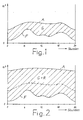
- the quantity F of fresh water used in the catchment area of the sewage treatment plant is measured continuously. A typical curve course over 24 hours can be seen from FIGS. 1 and 2.
- the amount A of the total wastewater flowing to the sewage treatment plant is measured. Both measured values are evaluated. They can be recorded in tabular form or in the form of a curve. If fresh water and waste water are measured in a longer drying period, i.e. in the drying time according to FIG. 1, then the difference between the two measured values corresponds with great accuracy to the amount of groundwater G flowing to the sewage treatment plant, which is actually not to be clarified.
- the groundwater quantity G corresponds to the area hatched in FIG. 1. It is assumed that the fresh water used in the catchment area of the sewage treatment plant reaches the sewage treatment plant almost completely after a delay time which is dependent on the local conditions. Only this portion of the wastewater has to be clarified and is therefore subject to a fee.
- the locks or valves in front of the sewage treatment plant or the speed of the pump delivering the waste water can thus be controlled in accordance with the measured fresh water quantity F.
- the wastewater treatment plant is supplied with a constantly changing amount of waste water.
- the time delay between the measurement of the fresh water quantity and the control of the waste water quantity corresponding to this measurement can be, for example, 3 hours. As already mentioned, it depends on the local conditions and can therefore also have a different value.
- the part of the wastewater that is not fed into the wastewater treatment plant is clean enough to be able to be fed directly to a receiving water.
- the fresh water quantity F By measuring the fresh water quantity F, it is also possible to supply a constant amount of waste water to the sewage treatment plant. From that during a certain For a period of, for example, 24 hours of fresh water consumption measured, the arithmetic mean is used, which is used as the amount of wastewater that is constantly fed to the sewage treatment plant by means of a feed pump.
- the mixing channel in front of the sewage treatment plant can be used as storage space, in which too much waste water can be accumulated at times. It is known that there is more wastewater in the morning and evening than in the intervening times. The accumulated wastewater can be broken down in times of reduced seizures.
- the mixing channel can be emptied quickly by increasing the output of the feed pump. All that is required is a rain detector, whose signal can be used to increase the speed of the feed pump.
- the amount of waste water A increased by the rain is also measured in front of the treatment plant.
- the corresponding curve shape is shown in FIG. 2.
- the hatched area corresponds to the groundwater quantity G and the rainwater quantity R.
- the fresh water curve is the same as in Fig. 1. Since the dry season values indicate the ratio of waste water loaded with cargo to groundwater in the entire waste water, this can also be done by forming the difference Rain or Surface water volume can be determined at any time. If the amount of rain fallen per m2 is measured elsewhere in the municipality belonging to the sewage treatment plant, the sealing area of the catchment area of the sewage treatment plant can be calculated. It results from the difference between the amount of rain fallen per m2 and the amount of rain arriving at the sewage treatment plant. The part of the rain that does not flow to the sewage treatment plant has seeped away in green and other open spaces.
Landscapes
- Life Sciences & Earth Sciences (AREA)
- Hydrology & Water Resources (AREA)
- Engineering & Computer Science (AREA)
- Environmental & Geological Engineering (AREA)
- Water Supply & Treatment (AREA)
- Chemical & Material Sciences (AREA)
- Organic Chemistry (AREA)
- Health & Medical Sciences (AREA)
- Molecular Biology (AREA)
- Biodiversity & Conservation Biology (AREA)
- Microbiology (AREA)
- Sewage (AREA)
- Activated Sludge Processes (AREA)
- Separation Of Suspended Particles By Flocculating Agents (AREA)
Abstract
Description
Die Erfindung betrifft ein Verfahren zum Betreiben einer Kläranlage, welcher mit Fracht beladenes Abwasser zugeführt wird, das mit Grundwasser und gegebenenfalls mit Oberflächenwasser gemischt ist.The invention relates to a method for operating a sewage treatment plant, which is supplied with wastewater loaded with cargo, which is mixed with groundwater and optionally with surface water.
Das aus privaten Haushalten, Restaurants, Hotels und Industriebetrieben anfallende, mit Fracht beladene Abwasser wird über ein Kanalsystem der Kläranlage zugeführt. Dabei ist es nicht zu vermeiden, daß Grundwasser in das Kanalsystem eindringt und zusammen mit dem Abwasser in die Kläranlage gelangt. Das gilt auch für Oberflächenwasser, das insbesondere durch Regen versucht wird und dessen Menge bei starkem Regenfall erheblich zunimmt.The wastewater loaded with cargo from private households, restaurants, hotels and industrial companies is fed into the sewage treatment plant via a sewer system. It cannot be avoided that groundwater penetrates into the sewer system and reaches the sewage treatment plant together with the waste water. This also applies to surface water, which is attempted in particular by rain and the amount of which increases considerably in the event of heavy rain.
Die einer Kläranlage zuzuführende maximale Abwassermenge bestimmt sich einerseits nach dem Fassungsvermögen der Kläranlage. Diese Abwassermenge wird andererseits aber auch durch behördliche Auflagen vorgegeben. Sie wird von der Behörde nach Erfahrungswerten berechnet, in die unter anderem die Fläche des Einzugsgebiets sowie die Anzahl der sich in Haushalten und Industriebetrieben aufhaltenden Personen und andere Werte eingehen. Dieses seit Jahren angewendete Verfahren ist nicht befriedigend, da es auf Grundlage von empirisch ermittelten Werten arbeitet, die die tatsächlichen Verhältnisse nicht berücksichtigen können. Änderungen bei den der Berechnung zugrundegelegten Daten können außerdem kaum berücksichtigt werden.The maximum amount of wastewater to be fed into a sewage treatment plant is determined on the one hand by the capacity of the sewage treatment plant. On the other hand, this amount of wastewater is also specified by official requirements. It is calculated by the authority based on empirical values, which include, among other things, the area of the catchment area, the number of people in households and industrial companies and other values. This method, which has been used for years, is unsatisfactory because it works on the basis of empirically determined values that the actual conditions do not may take into account. Changes in the data on which the calculation is based can also hardly be taken into account.
Der Erfindung liegt die Aufgabe zugrunde, ein Verfahren anzugeben, mit dem die einer Kläranlage zuzuführende Abwassermenge den tatsächlichen Gegebenheiten des Einzugsbereichs entsprechend bemessen werden kann.The invention has for its object to provide a method with which the amount of wastewater to be supplied to a sewage treatment plant can be dimensioned according to the actual circumstances of the catchment area.
Diese Aufgabe wird bei einem Verfahren der eingangs geschilderten Art gemäß der Erfindung dadurch gelöst,
- daß die im Einzugsgebiet der Kläranlage verbrauchte Menge an Frischwasser ständig gemessen wird und
- daß der daraus gewonnene Wert zur Steuerung der der Kläranlage zuzuführenden Abwassermenge verwendet wird.
- that the amount of fresh water consumed in the catchment area of the sewage treatment plant is constantly measured and
- that the value obtained from this is used to control the amount of waste water to be supplied to the sewage treatment plant.
Bei Anwendung dieses Verfahrens wird für die Bestimmung der der Kläranlage zuzuführenden Abwassermenge ein stets aktueller, den tatsächlichen Verhältnissen im Einzugsgebiet der Kläranlage entsprechender Wert verwendet. Es wird dabei davon ausgegangen, daß das im Einzugsgebiet verbrauchte Frischwasser nahezu in gleicher Menge als Abwasser in das Kanalsystem der Kläranlage gelangt.When using this method, an up-to-date value that corresponds to the actual conditions in the catchment area of the sewage treatment plant is used to determine the amount of wastewater to be fed to the sewage treatment plant. It is assumed that the fresh water used in the catchment area reaches the sewage system of the sewage plant in almost the same amount as waste water.
Die gemessene Frischwassermenge kann mit entsprechender zeitlicher Verzögerung von beispielsweise 3 Stunden zur kontinuierlichen Regelung der der Kläranlage zuzuführenden Abwassermenge verwendet werden. Es ist jedoch auch möglich, aus dem gemessenen Frischwasserverbrauch einen Mittelwert zu bilden und der Kläranlage eine diesem Mittelwert entsprechende konstante Abwassermenge zuzuführen.The measured quantity of fresh water can be used with a corresponding time delay of, for example, 3 hours for the continuous regulation of the quantity of waste water to be fed to the sewage treatment plant. However, it is also possible to form an average value from the measured fresh water consumption and to supply the sewage treatment plant with a constant amount of waste water corresponding to this average value.
Von besonderem Vorteil ist bei diesem Verfahren, daß durch die sehr genau meßbare Frischwassermenge ein entsprechend genauer Wert für den Mengenanteil von mit Fracht beladenem Abwasser an der gesamten Abwassermenge gegeben ist, die der Kläranlage zufließt. Damit ist in Trockenzeiten relativ genau festzustellen, wie groß der an sich saubere und daher nicht zu klärende Grundwasseranteil des Abwassers ist. Das ist auch aus wirtschaftlicher Sicht von Bedeutung, da für das Grundwasser keine Gebühren anfallen. Es könnte eigentlich an der Kläranlage vorbeigeführt und direkt einem Vorfluter aufgegeben werden. Kosten entstehen nur für den jetzt bekannten Mengenanteil von tatsächlich mit Fracht beladenem Abwasser.It is of particular advantage in this method that, due to the very precisely measurable quantity of fresh water, a correspondingly precise value for the proportion of with Freight loaded wastewater is given to the total amount of wastewater that flows into the sewage treatment plant. In dry seasons it can be determined relatively precisely how large the share of groundwater in the wastewater, which is clean and therefore not to be clarified. This is also important from an economic point of view, since there are no fees for the groundwater. It could actually be passed the sewage treatment plant and given directly to a receiving water. Costs only arise for the now known proportion of wastewater actually loaded with freight.
Auch für den Fall, daß beispielsweise durch starken Regen eine erhöhte Menge von Oberflächenwasser anfällt, ist dieses Verfahren von Vorteil. Da wegen der Messungen in der Trockenzeit das Verhältnis von Abwasser mit Fracht zu Grundwasser in der gesamten Abwassermenge bekannt ist, ergeben sich auch für das zusätzliche Oberflächenwasser ausreichend genaue Werte. Das ist wieder aus wirtschaftlicher Sicht von Interesse, da die Klärung von Oberflächenwasser weniger Aufwand und Kosten erfordert als die Klärung von mit Fracht beladenem Abwasser.This method is also advantageous in the event that an increased amount of surface water occurs, for example due to heavy rain. Since the ratio of wastewater with cargo to groundwater in the total amount of wastewater is known due to the measurements in the dry season, sufficiently precise values also result for the additional surface water. This is again of interest from an economic point of view, since the clarification of surface water requires less effort and costs than the clarification of waste water loaded with cargo.
Aus der Kenntnis der in das Kanalsystem der Kläranlage gelangenden Menge an Oberflächenwasser können außerdem auch Rückschlüsse auf die sogenannte Versiegelungsfläche des Einzugsgebiets der Kläranlage gezogen werden. Es ergeben sich genaue Erkenntnisse darüber, wieviel Regen in die Kanäle gelangt und welche Menge desselben in Grünflächen oder anderen offenen Flächen im Erdboden versickert.From the knowledge of the amount of surface water entering the sewage system of the sewage treatment plant, conclusions can also be drawn about the so-called sealing surface of the catchment area of the sewage treatment plant. There are precise insights into how much rain gets into the channels and how much of it seeps into green areas or other open areas in the ground.
Das Verfahren nach der Erfindung wird im folgenden an Hand der Zeichnungen beispielsweise erläutert.The method according to the invention is explained below with reference to the drawings, for example.
Es zeigen:
- Fig. 1 ein Diagramm für eine Trockenzeit.
- Fig. 2 ein Diagramm für eine Regenzeit.
- Fig. 1 is a diagram for a dry season.
- Fig. 2 is a diagram for a rainy season.
Die Menge F des im Einzugsgebiet der Kläranlage verbrauchten Frischwassers wird kontinuierlich gemessen. Ein typischer Kurvenverlauf über 24 Stunden ist aus den Fig. 1 und 2 zu ersehen. Zusätzlich wird die Menge A des der Kläranlage insgesamt zufließenden Abwassers gemessen. Beide Meßwerte werden ausgewertet. Sie können tabellarisch oder in Kurvenform aufgezeichnet werden. Wenn Frischwasser und Abwasser in einer längeren Trockenperiode, also in der Trockenzeit gemäß Fig. 1, gemessen werden, dann entspricht die Differenz der beiden Meßwerte mit großer Genauigkeit der zur Kläranlage fließenden Grundwassermenge G, die eigentlich nicht zu klären ist. Die Grundwassermenge G entspricht der in Fig. 1 schraffierten Fläche. Es wird dabei davon ausgegangen, daß das im Einzugsgebiet der Kläranlage verbrauchte Frischwasser nahezu vollständig nach einer von den örtlichen Gegebenheiten abhängigen Verzögerungszeit als mit Fracht beladenes Abwasser zur Kläranlage gelangt. Nur dieser Anteil des Abwassers ist zu klären und dementsprechend gebührenpflichtig.The quantity F of fresh water used in the catchment area of the sewage treatment plant is measured continuously. A typical curve course over 24 hours can be seen from FIGS. 1 and 2. In addition, the amount A of the total wastewater flowing to the sewage treatment plant is measured. Both measured values are evaluated. They can be recorded in tabular form or in the form of a curve. If fresh water and waste water are measured in a longer drying period, i.e. in the drying time according to FIG. 1, then the difference between the two measured values corresponds with great accuracy to the amount of groundwater G flowing to the sewage treatment plant, which is actually not to be clarified. The groundwater quantity G corresponds to the area hatched in FIG. 1. It is assumed that the fresh water used in the catchment area of the sewage treatment plant reaches the sewage treatment plant almost completely after a delay time which is dependent on the local conditions. Only this portion of the wastewater has to be clarified and is therefore subject to a fee.
Die Schleusen oder Ventile vor der Kläranlage bzw. die Drehzahl der das Abwasser fördernde Pumpe können also nach Maßgabe der gemessenen Frischwassermenge F gesteuert werden. Dadurch wird der Kläranlage eine sich dauernd ändernde Abwassermenge zugeführt. Die zeitliche Verzögerung zwischen der Messung der Frischwassermenge und der dieser Messung entsprechenden Steuerung der Abwassermenge kann beispielsweise 3 Stunden betragen. Sie ist - wie bereits erwähnt - von den örtlichen Gegebenenheiten abhängig und kann daher auch einen anderen Wert haben. Die nicht der Kläranlage aufgegebene Teilmenge des Abwassers ist sauber genug, um direkt einem Vorfluter zugeführt werden zu können.The locks or valves in front of the sewage treatment plant or the speed of the pump delivering the waste water can thus be controlled in accordance with the measured fresh water quantity F. As a result, the wastewater treatment plant is supplied with a constantly changing amount of waste water. The time delay between the measurement of the fresh water quantity and the control of the waste water quantity corresponding to this measurement can be, for example, 3 hours. As already mentioned, it depends on the local conditions and can therefore also have a different value. The part of the wastewater that is not fed into the wastewater treatment plant is clean enough to be able to be fed directly to a receiving water.
Durch die Messung der Frischwassermenge F ist auch eine Zufuhr einer konstant bleibenden Abwassermenge an die Kläranlage möglich. Aus dem während einer bestimmten Zeitdauer von beispielsweise 24 Stunden gemessenen Frischwasserverbrauch wird das arithmetische Mittel gebildet, das als Abwassermenge verwendet wird, die der Kläranlage mittels einer Förderpumpe ständig zugeführt wird. Der vor der Kläranlage befindliche Mischkanal kann dabei als Stauraum verwendet werden, in welchem zeitweise zu viel anfallendes Abwasser gestaut werden kann. Es ist bekannt, daß morgens und abends mehr Abwasser als in den dazwischen liegenden Zeiten anfällt. Das gestaute Abwasser kann in Zeiten mit vermindertem Anfall abgebaut werden.By measuring the fresh water quantity F, it is also possible to supply a constant amount of waste water to the sewage treatment plant. From that during a certain For a period of, for example, 24 hours of fresh water consumption measured, the arithmetic mean is used, which is used as the amount of wastewater that is constantly fed to the sewage treatment plant by means of a feed pump. The mixing channel in front of the sewage treatment plant can be used as storage space, in which too much waste water can be accumulated at times. It is known that there is more wastewater in the morning and evening than in the intervening times. The accumulated wastewater can be broken down in times of reduced seizures.
Wenn durch Regen eine zusätzliche Abwassermenge zur Kläranlage strömt, kann der Mischkanal durch erhöhte Leistung der Förderpumpe schnell geleert werden. Dazu ist nur ein Regenmelder erforderlich, dessen Signal zur Erhöhung der Drehzahl der Förderpumpe verwendet werden kann.If an additional amount of wastewater flows to the sewage treatment plant due to rain, the mixing channel can be emptied quickly by increasing the output of the feed pump. All that is required is a rain detector, whose signal can be used to increase the speed of the feed pump.
Auch die durch den Regen erhöhte Abwassermenge A wird vor der Kläranlage gemessen. Der entsprechende Kurvenverlauf geht aus Fig. 2 hervor. Die schraffierte Fläche entspricht hier der Grundwassermenge G und der Regenwassermenge R. Die Frischwasserkurve ist die gleiche wie in Fig. 1. Da aus den Werten der Trockenzeit das Verhältnis von mit Fracht beladenem Abwasser zu Grundwasser im gesamten Abwasser bekannt ist, kann durch Differenzbildung auch die Regen- bzw.
Oberflächenwassermenge jederzeit bestimmt werden. Wenn an anderer Stelle der zur Kläranlage gehörenden Gemeinde die pro m² gefallene Regenmenge gemessen wird, läßt sich hierdurch die Versiegelungsfläche des Einzugsgebiets der Kläranlage berechnen. Sie ergibt sich aus der Differenz der pro m² gefallenen Regenmenge und der bei der Kläranlage ankommenden Regenmenge. Der nicht zur Kläranlage fließende Teil des Regens ist in Grün- und anderen Freiflächen versickert.The amount of waste water A increased by the rain is also measured in front of the treatment plant. The corresponding curve shape is shown in FIG. 2. The hatched area corresponds to the groundwater quantity G and the rainwater quantity R. The fresh water curve is the same as in Fig. 1. Since the dry season values indicate the ratio of waste water loaded with cargo to groundwater in the entire waste water, this can also be done by forming the difference Rain or
Surface water volume can be determined at any time. If the amount of rain fallen per m² is measured elsewhere in the municipality belonging to the sewage treatment plant, the sealing area of the catchment area of the sewage treatment plant can be calculated. It results from the difference between the amount of rain fallen per m² and the amount of rain arriving at the sewage treatment plant. The part of the rain that does not flow to the sewage treatment plant has seeped away in green and other open spaces.
Claims (6)
Priority Applications (1)
| Application Number | Priority Date | Filing Date | Title |
|---|---|---|---|
| AT89109210T ATE75214T1 (en) | 1988-06-22 | 1989-05-23 | PROCEDURE FOR OPERATING A SEWAGE TREATMENT PLANT. |
Applications Claiming Priority (2)
| Application Number | Priority Date | Filing Date | Title |
|---|---|---|---|
| DE3821009 | 1988-06-22 | ||
| DE3821009A DE3821009A1 (en) | 1988-06-22 | 1988-06-22 | METHOD FOR OPERATING A WASTEWATER PLANT |
Publications (2)
| Publication Number | Publication Date |
|---|---|
| EP0347595A1 EP0347595A1 (en) | 1989-12-27 |
| EP0347595B1 true EP0347595B1 (en) | 1992-04-22 |
Family
ID=6356974
Family Applications (1)
| Application Number | Title | Priority Date | Filing Date |
|---|---|---|---|
| EP89109210A Expired - Lifetime EP0347595B1 (en) | 1988-06-22 | 1989-05-23 | Process for running a waste water plant |
Country Status (3)
| Country | Link |
|---|---|
| EP (1) | EP0347595B1 (en) |
| AT (1) | ATE75214T1 (en) |
| DE (2) | DE3821009A1 (en) |
-
1988
- 1988-06-22 DE DE3821009A patent/DE3821009A1/en not_active Withdrawn
-
1989
- 1989-05-23 DE DE8989109210T patent/DE58901229D1/en not_active Expired - Lifetime
- 1989-05-23 AT AT89109210T patent/ATE75214T1/en not_active IP Right Cessation
- 1989-05-23 EP EP89109210A patent/EP0347595B1/en not_active Expired - Lifetime
Also Published As
| Publication number | Publication date |
|---|---|
| EP0347595A1 (en) | 1989-12-27 |
| ATE75214T1 (en) | 1992-05-15 |
| DE3821009A1 (en) | 1989-12-28 |
| DE58901229D1 (en) | 1992-05-27 |
Similar Documents
| Publication | Publication Date | Title |
|---|---|---|
| DE2855324A1 (en) | METHOD AND DEVICE FOR REGULATING THE ADDED WATER IN CONCRETE PREPARATION | |
| EP0108337B1 (en) | Road gritting and salting machine | |
| DE3146177A1 (en) | CONTROL AND REGULATION OF AN ANAEROBIC FILTER | |
| DE2730404A1 (en) | METHOD FOR CONTROLLING THE AMOUNT OF FILTER SUBSTANCES SUPPLIED PER TIME UNIT TO A SCOOTING FILTER DURING FILTERING OPERATION AND DEVICE FOR PERFORMING THE METHOD | |
| DE3102417A1 (en) | "FILTER BAND DRAINAGE DEVICE" | |
| DE69602826T2 (en) | Water cleaning device with flushing of the membrane chamber | |
| DE3608890C2 (en) | ||
| EP0347595A1 (en) | Process for running a waste water plant | |
| EP0056033B1 (en) | Method for metering flour and/or liquid(s) in the kneader during the production of dough and installation for implementing such process | |
| DE2843294A1 (en) | Controlling carbonate hardness of water for use in brewing - by removing carbonate by ion exchange and stripping, and filtering through calcium carbonate | |
| DE2704080A1 (en) | Flocculating agent feed control - using as datum quantity, the amt. producing greatest turbidity difference in flake formation phase | |
| DE3142701C2 (en) | ||
| DE2432609A1 (en) | METHOD FOR Batch Manufacture Of Fresh Concrete | |
| DE4333579A1 (en) | Process for controlling amounts of chemical auxiliaries and flocculating agents in dependence on an on-line mass/solid measurement for clarification and dewatering processes of all types, and plant for carrying out the process | |
| DE2827659A1 (en) | SYSTEM FOR REGULATING A FLOW RATE | |
| DE4436582C2 (en) | Method for controlling an amount of dampening solution for a printing form of a running offset rotary printing press | |
| DE3743428A1 (en) | Process for conditioning and draining sludges | |
| EP3808536B1 (en) | Method for adjusting a working point of a film stretching system and film stretching system for producing a plastic film | |
| DE69726183T2 (en) | SEWAGE SYSTEM | |
| DE69907941T2 (en) | IMPROVEMENTS TO ACTIVATED SLUDGE PROCESSES | |
| DE3801658A1 (en) | Method for determining a quantity of flowing liquid | |
| DE2843074A1 (en) | METHOD FOR REGULATING AND / OR CONTROLLING A BIOLOGICAL WASTEWATER PLANT | |
| DE29714704U1 (en) | Device for dosing fibers for the production of, for example, fiber cement mortar, in particular fiber dosing system for glass, plastic or steel fibers | |
| DE102004024430A1 (en) | Sequential batch reactor water effluent treatment process is regulated by reference to an upstream parameter following e.g. rainfall | |
| DE1507887A1 (en) | Method and device for producing a certain mixing ratio of different components |
Legal Events
| Date | Code | Title | Description |
|---|---|---|---|
| PUAI | Public reference made under article 153(3) epc to a published international application that has entered the european phase |
Free format text: ORIGINAL CODE: 0009012 |
|
| 17P | Request for examination filed |
Effective date: 19891011 |
|
| AK | Designated contracting states |
Kind code of ref document: A1 Designated state(s): AT BE CH DE ES FR GB GR IT LI LU NL SE |
|
| 17Q | First examination report despatched |
Effective date: 19900821 |
|
| GRAA | (expected) grant |
Free format text: ORIGINAL CODE: 0009210 |
|
| AK | Designated contracting states |
Kind code of ref document: B1 Designated state(s): AT BE CH DE ES FR GB GR IT LI LU NL SE |
|
| PG25 | Lapsed in a contracting state [announced via postgrant information from national office to epo] |
Ref country code: IT Free format text: LAPSE BECAUSE OF FAILURE TO SUBMIT A TRANSLATION OF THE DESCRIPTION OR TO PAY THE FEE WITHIN THE PRESCRIBED TIME-LIMIT;WARNING: LAPSES OF ITALIAN PATENTS WITH EFFECTIVE DATE BEFORE 2007 MAY HAVE OCCURRED AT ANY TIME BEFORE 2007. THE CORRECT EFFECTIVE DATE MAY BE DIFFERENT FROM THE ONE RECORDED. Effective date: 19920422 Ref country code: NL Effective date: 19920422 Ref country code: GR Free format text: LAPSE BECAUSE OF FAILURE TO SUBMIT A TRANSLATION OF THE DESCRIPTION OR TO PAY THE FEE WITHIN THE PRESCRIBED TIME-LIMIT Effective date: 19920422 Ref country code: SE Effective date: 19920422 Ref country code: ES Free format text: THE PATENT HAS BEEN ANNULLED BY A DECISION OF A NATIONAL AUTHORITY Effective date: 19920422 Ref country code: FR Effective date: 19920422 Ref country code: BE Effective date: 19920422 Ref country code: GB Effective date: 19920422 |
|
| REF | Corresponds to: |
Ref document number: 75214 Country of ref document: AT Date of ref document: 19920515 Kind code of ref document: T |
|
| PG25 | Lapsed in a contracting state [announced via postgrant information from national office to epo] |
Ref country code: AT Effective date: 19920523 |
|
| REF | Corresponds to: |
Ref document number: 58901229 Country of ref document: DE Date of ref document: 19920527 |
|
| PG25 | Lapsed in a contracting state [announced via postgrant information from national office to epo] |
Ref country code: LI Effective date: 19920531 Ref country code: LU Free format text: LAPSE BECAUSE OF NON-PAYMENT OF DUE FEES Effective date: 19920531 Ref country code: CH Effective date: 19920531 |
|
| EN | Fr: translation not filed | ||
| NLV1 | Nl: lapsed or annulled due to failure to fulfill the requirements of art. 29p and 29m of the patents act | ||
| GBV | Gb: ep patent (uk) treated as always having been void in accordance with gb section 77(7)/1977 [no translation filed] | ||
| REG | Reference to a national code |
Ref country code: CH Ref legal event code: PL |
|
| PLBE | No opposition filed within time limit |
Free format text: ORIGINAL CODE: 0009261 |
|
| STAA | Information on the status of an ep patent application or granted ep patent |
Free format text: STATUS: NO OPPOSITION FILED WITHIN TIME LIMIT |
|
| 26N | No opposition filed | ||
| PGFP | Annual fee paid to national office [announced via postgrant information from national office to epo] |
Ref country code: DE Payment date: 19960704 Year of fee payment: 8 |
|
| PG25 | Lapsed in a contracting state [announced via postgrant information from national office to epo] |
Ref country code: DE Free format text: LAPSE BECAUSE OF NON-PAYMENT OF DUE FEES Effective date: 19980203 |