EP0347552A2 - Verfahren zur Herstellung einer Aluminiumnitrid-Keramik - Google Patents
Verfahren zur Herstellung einer Aluminiumnitrid-Keramik Download PDFInfo
- Publication number
- EP0347552A2 EP0347552A2 EP89107240A EP89107240A EP0347552A2 EP 0347552 A2 EP0347552 A2 EP 0347552A2 EP 89107240 A EP89107240 A EP 89107240A EP 89107240 A EP89107240 A EP 89107240A EP 0347552 A2 EP0347552 A2 EP 0347552A2
- Authority
- EP
- European Patent Office
- Prior art keywords
- powder
- gel
- sintering
- nitride
- nickel
- Prior art date
- Legal status (The legal status is an assumption and is not a legal conclusion. Google has not performed a legal analysis and makes no representation as to the accuracy of the status listed.)
- Granted
Links
Images


Classifications
-
- C—CHEMISTRY; METALLURGY
- C04—CEMENTS; CONCRETE; ARTIFICIAL STONE; CERAMICS; REFRACTORIES
- C04B—LIME, MAGNESIA; SLAG; CEMENTS; COMPOSITIONS THEREOF, e.g. MORTARS, CONCRETE OR LIKE BUILDING MATERIALS; ARTIFICIAL STONE; CERAMICS; REFRACTORIES; TREATMENT OF NATURAL STONE
- C04B35/00—Shaped ceramic products characterised by their composition; Ceramics compositions; Processing powders of inorganic compounds preparatory to the manufacturing of ceramic products
- C04B35/515—Shaped ceramic products characterised by their composition; Ceramics compositions; Processing powders of inorganic compounds preparatory to the manufacturing of ceramic products based on non-oxide ceramics
- C04B35/58—Shaped ceramic products characterised by their composition; Ceramics compositions; Processing powders of inorganic compounds preparatory to the manufacturing of ceramic products based on non-oxide ceramics based on borides, nitrides, i.e. nitrides, oxynitrides, carbonitrides or oxycarbonitrides or silicides
- C04B35/584—Shaped ceramic products characterised by their composition; Ceramics compositions; Processing powders of inorganic compounds preparatory to the manufacturing of ceramic products based on non-oxide ceramics based on borides, nitrides, i.e. nitrides, oxynitrides, carbonitrides or oxycarbonitrides or silicides based on silicon nitride
-
- C—CHEMISTRY; METALLURGY
- C04—CEMENTS; CONCRETE; ARTIFICIAL STONE; CERAMICS; REFRACTORIES
- C04B—LIME, MAGNESIA; SLAG; CEMENTS; COMPOSITIONS THEREOF, e.g. MORTARS, CONCRETE OR LIKE BUILDING MATERIALS; ARTIFICIAL STONE; CERAMICS; REFRACTORIES; TREATMENT OF NATURAL STONE
- C04B35/00—Shaped ceramic products characterised by their composition; Ceramics compositions; Processing powders of inorganic compounds preparatory to the manufacturing of ceramic products
- C04B35/515—Shaped ceramic products characterised by their composition; Ceramics compositions; Processing powders of inorganic compounds preparatory to the manufacturing of ceramic products based on non-oxide ceramics
- C04B35/58—Shaped ceramic products characterised by their composition; Ceramics compositions; Processing powders of inorganic compounds preparatory to the manufacturing of ceramic products based on non-oxide ceramics based on borides, nitrides, i.e. nitrides, oxynitrides, carbonitrides or oxycarbonitrides or silicides
- C04B35/581—Shaped ceramic products characterised by their composition; Ceramics compositions; Processing powders of inorganic compounds preparatory to the manufacturing of ceramic products based on non-oxide ceramics based on borides, nitrides, i.e. nitrides, oxynitrides, carbonitrides or oxycarbonitrides or silicides based on aluminium nitride
-
- C—CHEMISTRY; METALLURGY
- C04—CEMENTS; CONCRETE; ARTIFICIAL STONE; CERAMICS; REFRACTORIES
- C04B—LIME, MAGNESIA; SLAG; CEMENTS; COMPOSITIONS THEREOF, e.g. MORTARS, CONCRETE OR LIKE BUILDING MATERIALS; ARTIFICIAL STONE; CERAMICS; REFRACTORIES; TREATMENT OF NATURAL STONE
- C04B35/00—Shaped ceramic products characterised by their composition; Ceramics compositions; Processing powders of inorganic compounds preparatory to the manufacturing of ceramic products
- C04B35/515—Shaped ceramic products characterised by their composition; Ceramics compositions; Processing powders of inorganic compounds preparatory to the manufacturing of ceramic products based on non-oxide ceramics
- C04B35/58—Shaped ceramic products characterised by their composition; Ceramics compositions; Processing powders of inorganic compounds preparatory to the manufacturing of ceramic products based on non-oxide ceramics based on borides, nitrides, i.e. nitrides, oxynitrides, carbonitrides or oxycarbonitrides or silicides
- C04B35/584—Shaped ceramic products characterised by their composition; Ceramics compositions; Processing powders of inorganic compounds preparatory to the manufacturing of ceramic products based on non-oxide ceramics based on borides, nitrides, i.e. nitrides, oxynitrides, carbonitrides or oxycarbonitrides or silicides based on silicon nitride
- C04B35/593—Shaped ceramic products characterised by their composition; Ceramics compositions; Processing powders of inorganic compounds preparatory to the manufacturing of ceramic products based on non-oxide ceramics based on borides, nitrides, i.e. nitrides, oxynitrides, carbonitrides or oxycarbonitrides or silicides based on silicon nitride obtained by pressure sintering
Definitions
- the present invention is concerned with a method for producing a ceramic and especially concerned with producing a ceramic from a nitride being suitable as substrate for electronic circuits.
- Ceramic materials presently suggested are those produced from carbides and/or nitrides including silicon carbide, silicon nitride, and aluminum nitride.
- the fabrication processes could stand improvement. This is particularly so with respect to the sintering rate and/or sintering temperature of such procedures that are not entirely satisfactory.
- liquid phase sintering of the ceramics suffer from a problem of reduced density exhibited by the final ceramic. This problem associated with reduced density is believed caused by vaporization or volatilization as evidenced by large weight losses during the thermal decomposition of the nitride during sintering at high temperatures.
- the dissociation/decomposition of nitrides, particularly AlN creates the formation of defective structures and diffusion of oxygen into the crystal lattice.
- the incorporation of oxygen in the crystal lattice of AlN reduces the thermal conductivity.
- the lowering of sintering temperture and enhancing the sintering rate are desirable for the fabrication of nitride ceramics having high thermal conductivity, particularly in view of the above-discussed problems associated with high temperature. Moreover, the lowering of sintering temperature will allow the co-firing of metal layer with the ceramics such as AlN to fabricate multi-layer ceramic substrates.
- the method of the present invention provides for improved densification of the ceramic along with the ability to employ lower sintering temperatures.
- the powder of a nitride is contacted with with a sol of organometallic compounds and/or inorganic metal salts which subsequently form a gel.
- the gel produced at the boundaries of the powders primarily as coatings eventually transforms into a melt or liquid phase during the sintering stage and forms a low contact angle with the powder and acts as a sintering aid.
- the present invention is concerned with producing ceramics from nitrides that exhibit increased density.
- the preferred ceramics produced by the present invention are those based upon aluminum nitride and silicon nitride with the most preferred being aluminum nitride.
- a powder of the nitride is provided.
- the particle size of the powder is usually from about 1 ⁇ m (microns) to about 12 ⁇ m and preferably about 2 ⁇ m to about 5 ⁇ m with the most preferred average particle size of about 2 ⁇ m.
- the particle size distribution curve of the powders employed shows a median of about 2 ⁇ m.
- the powder is contacted with a sol of organo-metallic compounds and/or inorganic salts.
- the sol transforms into a gel.
- the gel composition is such that on subsequent heat treatment during the drying and sintering stages, the gel will decompose to create a reducing environment due to the presence of residual organics which assist in the reduction of oxide layer on the nitrides.
- the gel wll produce in situ a melt or liquid phase. It is essential that the gel-derived grain boundary melt form a low contact angle with the powder in the grain of the nitride.
- the melt thus acts as a sintering aid for nitride material which, in turn, results in increasing the sintering rate.
- composition and reactivity of the gel layer is effective in reacting with the nitrogen released during the sintering step to form nitrides and thus the pressure which is generated at the pores of the grain boundary is reduced, consequently, the sintering is enhanced.
- organo- metallic compounds and/or inorganic salts of transition metals and/or rare earth metals are employed.
- the rare earth elements and group IV transition elements which these stable nitrides and enhance the sintering rate.
- the metallic material be employed in the form of a sol-gel.
- the sol-gel process allows a uniform distribution of the sintering aids as highly reactive products chemically bonded to the powder surface.
- the distribution, composition, and reactivity of the grain boundary layers which play a major role in liquid phase sintering are controlled by the appropriate use of sol-gel processing.
- the nitride powders can be contacted with the sol (in a non-aqueous solvent) by applying the sol as a gel coating to the powder.
- the technique used is based on the percolation of the sol through ceramic powders.
- the powder can be contacted with the gel by first dispersing the powder in a non-aqueous medium that contains the sol of organo-metallic compounds that are capable of forming a gel and then converting the dispersion into a gel containing the sintering additives and the powder.
- the nitride powders are usually at least about 90% by weight of the combined solids from the powder and metallic compound and more usually from about 90% to about 99.5% and preferably about 95% to about 99% by weight.
- the additive materials employed in order to facilitate the sintering readily wet the nitride, that is, exhibit a low contact angle (about 40° to about 0°) with the nitride power to be sintered.
- a discussion of various nickel alloys and their ability to wet aluminium nitride can be found, for instance, in Trontelj, et al., "Wetting of Aluminum Nitride by Nickel Alloys", Journal of the American Ceramic Society, Volume 61, No. 5-6, pages 204-207, May-June 1978. The work of Trontelj, et al.
- Metallic materials suitable for sintering aids according to the present invention include alloys of nickel and/or cobalt, with rare earth elements such as yttrium lanthanum, scandium, and cerium, and alloys of nickel and/or cobalt with transition elements such as hafnium, zirconium, and titanium.
- the alloys contain about 90% to 30% by weight of nickel and/or cobalt and about 10% to about 70% by weight of the alloying metal.
- the metallic material be employed in the form of a sol which assures uniform distribution of the metallic materials in the microstructure of the powder. This, in turn, assures for increased sintering rate while, at the same time, making it possible to lower the temperature of the subsequent sintering. Moreover, the sintered ceramic will exhibit enhanced density characteristics and uniform microstructures.
- sol-gels of metallic compounds is well known and detailed fabrication methods can be readily determined by persons skilled in the art once aware of the present disclosure.
- sols and/or sol-gels are discussed in U.S. Patents 4,397,666 to Mishima, et al., 4,429,051 to Davidge, et al.; 4,517,037 to Francis, et al.; and 4,574,063 to Scherer.
- a sol is generally a multicomponent colloidal system that is semi-solid and includes a predominant amount of liquid.
- the gelling component is normally present in amounts less than about 10% by weight.
- a sol or partially polymerized solution of the metal-organic precursors of sintering aids are formed and subsequently transformed in to a "gel" by controlling the gel processing parameters such as pH, concentration, and catalysts.
- the precursors used were metal alkoxides, metal acetylacetonate metal nitrates, and acetates.
- the gel can contain NiO-Y2O3.
- the sols are generally in non-aqueous solvents such as alcohols including ethanol and isopropyl alcohol and aromatic hydrocarbons such as benzene and toluene, cyclohexane, methylisobutyl ketone.
- non-aqueous solvents such as alcohols including ethanol and isopropyl alcohol and aromatic hydrocarbons such as benzene and toluene, cyclohexane, methylisobutyl ketone.
- aromatic hydrocarbons such as benzene and toluene, cyclohexane, methylisobutyl ketone.
- a mixture of polar and non-polar solvents is used to dissolve the precursors of different chemical nature.
- the compounds employed provide highly reactive oxide materials that are uniformly distributed with the nitride powder.
- the selection of the precursor compounds used for the sol-gel preparation are made on the basis of the following factors:
- NiO-Y2O3 gel NiO-Y2O3 gel :
- the precursor for the NiO gel is nickel nitrate dissolved in ethanol or isopropanol.
- the precursor for Y2O3 is either yttrium nitrate or yttrium isopropoxide.
- Yttrium nitrate solution is prepared by dissolving Y2O3 in nitric acid solution. The solution is then evaporated to dryness to prepare yttrium nitrate which is then dissolved in ethanol or isopropanol at a pH of about 3.
- yttrium sol is prepared by dissolving yttrium isopropoxide in isopropanol.
- the solutions of nickel nitrate and yttrium nitrate or yttrium isopropoxide are mixed together at a pH of about 3. This stock sol is used to either prepare the gel coating on the AlN powders or to make a composite powder containing AlN and gel.
- the organics employed in the gel are mostly received by thermal treatment of 150°C up to about 350°C, thereby resulting in a porous reactive surface oxide layer.
- some residual organics remain which provide a reducing atmosphere during subsequent fixing stages at higher temperatures in nitrogen atmosphere.
- the powders thus obtained after calcining at 350°C to about 600°C are subjected to sintering process.
- the powder compacts obtained with the gel-coated samples are subjected to sintering at a temperature of about 1500°C to about 1900°C and preferably about 1600°C to 1800°C, typical of which is about 1700°C.
- the gel-coated powders are heated up to about 600°C in N2 atmosphere and are subsequently placed into a cylindrical graphite die of 1.27 cm (0.5") inner diameter.
- the pistons, also of graphite, were lined with a graphite foil to facilitate the removal of the hot-pressed specimen from the die.
- the powder is cold compacted at about 5 MPa and then placed in a tungsten mesh furnace.
- the hot pressing experiments are carried out at about 1600°C and about 1700°C in a nitrogen atmosphere.
- the heat-up time for the furnace is approximately 1 hour. During this period, a load of about 1-2 MPa is maintained on the powder.
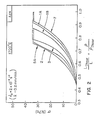
- th is the theoretical density of aluminum nitride (3.26 gm/cm3)
- L is the length of the specimen when its density is .
- the hot-pressing tests were carried out at constant cross-head velocity.
- the magnitude of the strain rate therefore, changed (increased) with densification.
- curve noted as “1B” contains only yttrium and those identified as 2 and 3 contain only nickel. As can be appreciated, such exhibit significantly inferior properties to those containing both yttrium and nickel in the gel-sol.
- a powder compact without any binder is made by cold compaction at about 137 880 bar(2000 psi) for about 1 minute.
- the pellet is heated in a furnace which is evacuated to 100 microns or less and then back-filled with nitrogen three times prior to heating cycle.
- the pellet is heated to about 1880°C at a heating rate of about 580°C per hour and is sintered at about 1880°C for about 2 hours (completely dense bodies were obtained).
- the pressureless sintering is usually completed in about 1/2 hour to 2 hours and preferably 1 to about 2 hours.
- the temperature is in the range of about 1700°C to about 1900°C.
- the final sintering is carried out under N2 atmosphere.
- An initial thermal treatment with NH3 gas up to a temperature of about 1500°C is employed.
- the function of the NH3 gas is to reduce the gel-layer to form metallic and/or nitrides which helps in wetting of the grain boundary.
- the gel layer which is chemically an oxide containing residual organics subsequently changes chemically and physically during subsequent steps used for sintering. It is critical to the present invention that a gel of a metallic material be employed that forms a low contact angle with the powder. This, as discussed above, can be achieved by using a combination of nickel and/or cobalt with rare earth oxides and/or Group IV transition metal oxides as sintering aid. Although rare earth oxides and Group IV transition metal oxides individually have been suggested, such do not form the low contact angle as required by the present invention.
Landscapes
- Engineering & Computer Science (AREA)
- Chemical & Material Sciences (AREA)
- Ceramic Engineering (AREA)
- Manufacturing & Machinery (AREA)
- Materials Engineering (AREA)
- Structural Engineering (AREA)
- Organic Chemistry (AREA)
- Ceramic Products (AREA)
Applications Claiming Priority (2)
| Application Number | Priority Date | Filing Date | Title |
|---|---|---|---|
| US19302388A | 1988-05-12 | 1988-05-12 | |
| US193023 | 1988-05-12 |
Publications (3)
| Publication Number | Publication Date |
|---|---|
| EP0347552A2 true EP0347552A2 (de) | 1989-12-27 |
| EP0347552A3 EP0347552A3 (en) | 1990-04-18 |
| EP0347552B1 EP0347552B1 (de) | 1995-07-05 |
Family
ID=22711976
Family Applications (1)
| Application Number | Title | Priority Date | Filing Date |
|---|---|---|---|
| EP89107240A Expired - Lifetime EP0347552B1 (de) | 1988-05-12 | 1989-04-21 | Verfahren zur Herstellung einer Aluminiumnitrid-Keramik |
Country Status (3)
| Country | Link |
|---|---|
| EP (1) | EP0347552B1 (de) |
| JP (1) | JPH0662340B2 (de) |
| DE (1) | DE68923326T2 (de) |
Cited By (1)
| Publication number | Priority date | Publication date | Assignee | Title |
|---|---|---|---|---|
| US5756042A (en) * | 1994-02-22 | 1998-05-26 | Hoechst Aktiengesellschaft | Process for producing non-oxidic ceramic having a defined thermal conductivity |
Family Cites Families (4)
| Publication number | Priority date | Publication date | Assignee | Title |
|---|---|---|---|---|
| JPS6191066A (ja) * | 1984-10-11 | 1986-05-09 | 旭化成株式会社 | 希土類元素の酸化物を表面に付着した窒化ケイ素粉体の製法 |
| JPS61266359A (ja) * | 1985-05-20 | 1986-11-26 | 日本碍子株式会社 | 窒化珪素焼結体の製造法 |
| JPH0788258B2 (ja) * | 1985-08-01 | 1995-09-27 | ジ−・テイ−・イ−・ラボラトリ−ズ・インコ−ポレイテツド | 焼結性の良好な窒化珪素粉末を製造する方法 |
| ZA877802B (en) * | 1986-11-20 | 1989-06-28 | Minnesota Mining & Mfg | Aluminum oxide/aluminum oxynitride/group ivb metal nitride abrasive particles derived from a sol-gel process |
-
1989
- 1989-04-14 JP JP1093260A patent/JPH0662340B2/ja not_active Expired - Lifetime
- 1989-04-21 DE DE1989623326 patent/DE68923326T2/de not_active Expired - Fee Related
- 1989-04-21 EP EP89107240A patent/EP0347552B1/de not_active Expired - Lifetime
Cited By (1)
| Publication number | Priority date | Publication date | Assignee | Title |
|---|---|---|---|---|
| US5756042A (en) * | 1994-02-22 | 1998-05-26 | Hoechst Aktiengesellschaft | Process for producing non-oxidic ceramic having a defined thermal conductivity |
Also Published As
| Publication number | Publication date |
|---|---|
| DE68923326T2 (de) | 1996-03-07 |
| EP0347552B1 (de) | 1995-07-05 |
| EP0347552A3 (en) | 1990-04-18 |
| DE68923326D1 (de) | 1995-08-10 |
| JPH01305864A (ja) | 1989-12-11 |
| JPH0662340B2 (ja) | 1994-08-17 |
Similar Documents
| Publication | Publication Date | Title |
|---|---|---|
| JPH02279575A (ja) | 緻密なセラミック膜を有するセラミック焼結体の製造方法 | |
| US4541975A (en) | Method for producing high strength sintered silicon carbide | |
| EP2189432B1 (de) | Aluminiumnitridgesinterter Körper mit hoher thermischer Leitfähigkeit | |
| US4988646A (en) | Method for producing a ceramic | |
| JPH0555465B2 (de) | ||
| KR960016070B1 (ko) | 질화알루미늄 소결체 및 그 제조방법 | |
| JP3472585B2 (ja) | 窒化アルミニウム焼結体 | |
| Giachello et al. | Post-sintering of reaction-bonded silicon nitride | |
| JP2968539B2 (ja) | 窒化アルミニウム構造物の製造方法 | |
| JPH0822782B2 (ja) | 繊維強化セラミックスの製造方法 | |
| EP0504441A1 (de) | Keramisches Verbundgefüge hoher Festigkeit und Verfahren zu seiner Herstellung | |
| EP0347552B1 (de) | Verfahren zur Herstellung einer Aluminiumnitrid-Keramik | |
| US6605556B1 (en) | High temperature composite material formed from nanostructured powders | |
| KR20170109515A (ko) | 다공성 질화규소 소결체 및 이의 제조 방법 | |
| CN111470866A (zh) | 金刚石-碳化硅复合材料及其制备方法、电子设备 | |
| CN117534468A (zh) | 一种铝碳化硅复合材料结构件的制备方法 | |
| JP3606923B2 (ja) | 窒化アルミニウム焼結体およびその製造方法 | |
| JP2003002760A (ja) | セラミックス多孔体の製造方法 | |
| Cao | Preparation and characterization of alpha'-SiAlON ceramics | |
| JP2001354479A (ja) | 窒化アルミニウム焼結体およびその製造方法 | |
| JP7615652B2 (ja) | 窒化シリコン用グリーンシート、および、その製造方法 | |
| JPH08157262A (ja) | 窒化アルミニウム焼結体およびその製造方法 | |
| JPH03146471A (ja) | 窒化アルミニウム焼結体の製造方法 | |
| JPH06166569A (ja) | 窒化珪素焼結体の製造方法 | |
| JPS63277572A (ja) | 窒化アルミニウム焼結体の製造方法 |
Legal Events
| Date | Code | Title | Description |
|---|---|---|---|
| PUAI | Public reference made under article 153(3) epc to a published international application that has entered the european phase |
Free format text: ORIGINAL CODE: 0009012 |
|
| AK | Designated contracting states |
Kind code of ref document: A2 Designated state(s): DE FR GB |
|
| PUAL | Search report despatched |
Free format text: ORIGINAL CODE: 0009013 |
|
| AK | Designated contracting states |
Kind code of ref document: A3 Designated state(s): DE FR GB |
|
| 17P | Request for examination filed |
Effective date: 19900326 |
|
| 17Q | First examination report despatched |
Effective date: 19920205 |
|
| GRAA | (expected) grant |
Free format text: ORIGINAL CODE: 0009210 |
|
| AK | Designated contracting states |
Kind code of ref document: B1 Designated state(s): DE FR GB |
|
| REF | Corresponds to: |
Ref document number: 68923326 Country of ref document: DE Date of ref document: 19950810 |
|
| ET | Fr: translation filed | ||
| PGFP | Annual fee paid to national office [announced via postgrant information from national office to epo] |
Ref country code: GB Payment date: 19960325 Year of fee payment: 8 |
|
| PLBE | No opposition filed within time limit |
Free format text: ORIGINAL CODE: 0009261 |
|
| STAA | Information on the status of an ep patent application or granted ep patent |
Free format text: STATUS: NO OPPOSITION FILED WITHIN TIME LIMIT |
|
| 26N | No opposition filed | ||
| PG25 | Lapsed in a contracting state [announced via postgrant information from national office to epo] |
Ref country code: FR Effective date: 19961227 |
|
| PG25 | Lapsed in a contracting state [announced via postgrant information from national office to epo] |
Ref country code: DE Effective date: 19970101 |
|
| REG | Reference to a national code |
Ref country code: FR Ref legal event code: ST |
|
| PG25 | Lapsed in a contracting state [announced via postgrant information from national office to epo] |
Ref country code: GB Effective date: 19970421 |
|
| GBPC | Gb: european patent ceased through non-payment of renewal fee |
Effective date: 19970421 |