EP0346280B1 - Dicyanobenzanthronverbindungen - Google Patents
Dicyanobenzanthronverbindungen Download PDFInfo
- Publication number
- EP0346280B1 EP0346280B1 EP89810404A EP89810404A EP0346280B1 EP 0346280 B1 EP0346280 B1 EP 0346280B1 EP 89810404 A EP89810404 A EP 89810404A EP 89810404 A EP89810404 A EP 89810404A EP 0346280 B1 EP0346280 B1 EP 0346280B1
- Authority
- EP
- European Patent Office
- Prior art keywords
- radical
- formula
- substituted
- phenyl
- compound according
- Prior art date
- Legal status (The legal status is an assumption and is not a legal conclusion. Google has not performed a legal analysis and makes no representation as to the accuracy of the status listed.)
- Expired - Lifetime
Links
- QIXVWHPSTHOMCD-UHFFFAOYSA-N 7-oxobenzo[a]phenalene-1,2-dicarbonitrile Chemical class C1=CC(C(=O)C=2C3=CC=CC=2)=C2C3=C(C#N)C(C#N)=CC2=C1 QIXVWHPSTHOMCD-UHFFFAOYSA-N 0.000 title description 6
- 229920000728 polyester Polymers 0.000 claims description 30
- 150000001875 compounds Chemical class 0.000 claims description 20
- 239000000463 material Substances 0.000 claims description 20
- 238000000034 method Methods 0.000 claims description 18
- 238000004043 dyeing Methods 0.000 claims description 15
- 125000001997 phenyl group Chemical group [H]C1=C([H])C([H])=C(*)C([H])=C1[H] 0.000 claims description 14
- 229910052739 hydrogen Inorganic materials 0.000 claims description 11
- 239000001257 hydrogen Substances 0.000 claims description 11
- 239000004753 textile Substances 0.000 claims description 11
- 125000003118 aryl group Chemical group 0.000 claims description 9
- 125000004435 hydrogen atom Chemical group [H]* 0.000 claims description 9
- 125000004178 (C1-C4) alkyl group Chemical group 0.000 claims description 8
- 230000002209 hydrophobic effect Effects 0.000 claims description 8
- 125000000951 phenoxy group Chemical group [H]C1=C([H])C([H])=C(O*)C([H])=C1[H] 0.000 claims description 8
- 238000002360 preparation method Methods 0.000 claims description 8
- 229910052736 halogen Inorganic materials 0.000 claims description 7
- 150000002367 halogens Chemical group 0.000 claims description 7
- 125000000229 (C1-C4)alkoxy group Chemical group 0.000 claims description 6
- 239000000835 fiber Substances 0.000 claims description 5
- XJDNKRIXUMDJCW-UHFFFAOYSA-J titanium tetrachloride Chemical compound Cl[Ti](Cl)(Cl)Cl XJDNKRIXUMDJCW-UHFFFAOYSA-J 0.000 claims description 5
- 125000001931 aliphatic group Chemical group 0.000 claims description 4
- 125000004169 (C1-C6) alkyl group Chemical group 0.000 claims description 3
- 239000012442 inert solvent Substances 0.000 claims description 3
- 125000000449 nitro group Chemical group [O-][N+](*)=O 0.000 claims description 3
- 150000003512 tertiary amines Chemical class 0.000 claims description 3
- KHUFHLFHOQVFGB-UHFFFAOYSA-N 1-aminoanthracene-9,10-dione Chemical class O=C1C2=CC=CC=C2C(=O)C2=C1C=CC=C2N KHUFHLFHOQVFGB-UHFFFAOYSA-N 0.000 claims description 2
- 125000000217 alkyl group Chemical group 0.000 claims description 2
- MDFFNEOEWAXZRQ-UHFFFAOYSA-N aminyl Chemical group [NH2] MDFFNEOEWAXZRQ-UHFFFAOYSA-N 0.000 claims description 2
- 150000002431 hydrogen Chemical group 0.000 claims 2
- 229910052760 oxygen Inorganic materials 0.000 claims 1
- 229910052717 sulfur Inorganic materials 0.000 claims 1
- 239000000975 dye Substances 0.000 description 56
- -1 aliphatic radical Chemical class 0.000 description 34
- 150000003254 radicals Chemical group 0.000 description 12
- XLYOFNOQVPJJNP-UHFFFAOYSA-N water Substances O XLYOFNOQVPJJNP-UHFFFAOYSA-N 0.000 description 11
- YMWUJEATGCHHMB-UHFFFAOYSA-N Dichloromethane Chemical compound ClCCl YMWUJEATGCHHMB-UHFFFAOYSA-N 0.000 description 9
- KKEYFWRCBNTPAC-UHFFFAOYSA-N Terephthalic acid Chemical compound OC(=O)C1=CC=C(C(O)=O)C=C1 KKEYFWRCBNTPAC-UHFFFAOYSA-N 0.000 description 8
- 239000000203 mixture Substances 0.000 description 8
- WFDIJRYMOXRFFG-UHFFFAOYSA-N Acetic anhydride Chemical compound CC(=O)OC(C)=O WFDIJRYMOXRFFG-UHFFFAOYSA-N 0.000 description 6
- LYCAIKOWRPUZTN-UHFFFAOYSA-N Ethylene glycol Chemical compound OCCO LYCAIKOWRPUZTN-UHFFFAOYSA-N 0.000 description 6
- JUJWROOIHBZHMG-UHFFFAOYSA-N Pyridine Chemical compound C1=CC=NC=C1 JUJWROOIHBZHMG-UHFFFAOYSA-N 0.000 description 6
- 239000002270 dispersing agent Substances 0.000 description 6
- RTZKZFJDLAIYFH-UHFFFAOYSA-N Diethyl ether Chemical compound CCOCC RTZKZFJDLAIYFH-UHFFFAOYSA-N 0.000 description 5
- 239000002657 fibrous material Substances 0.000 description 5
- 239000002245 particle Substances 0.000 description 5
- 239000000243 solution Substances 0.000 description 4
- 238000000859 sublimation Methods 0.000 description 4
- 230000008022 sublimation Effects 0.000 description 4
- QTBSBXVTEAMEQO-UHFFFAOYSA-N Acetic acid Chemical compound CC(O)=O QTBSBXVTEAMEQO-UHFFFAOYSA-N 0.000 description 3
- ZAMOUSCENKQFHK-UHFFFAOYSA-N Chlorine atom Chemical compound [Cl] ZAMOUSCENKQFHK-UHFFFAOYSA-N 0.000 description 3
- WSFSSNUMVMOOMR-UHFFFAOYSA-N Formaldehyde Chemical compound O=C WSFSSNUMVMOOMR-UHFFFAOYSA-N 0.000 description 3
- OKKJLVBELUTLKV-UHFFFAOYSA-N Methanol Chemical compound OC OKKJLVBELUTLKV-UHFFFAOYSA-N 0.000 description 3
- IMNFDUFMRHMDMM-UHFFFAOYSA-N N-Heptane Chemical compound CCCCCCC IMNFDUFMRHMDMM-UHFFFAOYSA-N 0.000 description 3
- 239000004952 Polyamide Substances 0.000 description 3
- HEMHJVSKTPXQMS-UHFFFAOYSA-M Sodium hydroxide Chemical compound [OH-].[Na+] HEMHJVSKTPXQMS-UHFFFAOYSA-M 0.000 description 3
- ZMANZCXQSJIPKH-UHFFFAOYSA-N Triethylamine Chemical compound CCN(CC)CC ZMANZCXQSJIPKH-UHFFFAOYSA-N 0.000 description 3
- 229910052801 chlorine Inorganic materials 0.000 description 3
- 239000000460 chlorine Substances 0.000 description 3
- 239000006185 dispersion Substances 0.000 description 3
- 150000002148 esters Chemical class 0.000 description 3
- 239000004744 fabric Substances 0.000 description 3
- 239000008187 granular material Substances 0.000 description 3
- 229920002647 polyamide Polymers 0.000 description 3
- 239000004417 polycarbonate Substances 0.000 description 3
- 229920000515 polycarbonate Polymers 0.000 description 3
- 238000006068 polycondensation reaction Methods 0.000 description 3
- 229920000139 polyethylene terephthalate Polymers 0.000 description 3
- 239000000843 powder Substances 0.000 description 3
- UMJSCPRVCHMLSP-UHFFFAOYSA-N pyridine Natural products COC1=CC=CN=C1 UMJSCPRVCHMLSP-UHFFFAOYSA-N 0.000 description 3
- 229920005989 resin Polymers 0.000 description 3
- 239000011347 resin Substances 0.000 description 3
- 159000000000 sodium salts Chemical class 0.000 description 3
- 125000006273 (C1-C3) alkyl group Chemical group 0.000 description 2
- ZMESHQOXZMOOQQ-UHFFFAOYSA-N 1-(naphthalen-1-ylmethyl)naphthalene Chemical compound C1=CC=C2C(CC=3C4=CC=CC=C4C=CC=3)=CC=CC2=C1 ZMESHQOXZMOOQQ-UHFFFAOYSA-N 0.000 description 2
- WKBOTKDWSSQWDR-UHFFFAOYSA-N Bromine atom Chemical compound [Br] WKBOTKDWSSQWDR-UHFFFAOYSA-N 0.000 description 2
- 229920002284 Cellulose triacetate Polymers 0.000 description 2
- HEDRZPFGACZZDS-UHFFFAOYSA-N Chloroform Chemical compound ClC(Cl)Cl HEDRZPFGACZZDS-UHFFFAOYSA-N 0.000 description 2
- VEXZGXHMUGYJMC-UHFFFAOYSA-N Hydrochloric acid Chemical compound Cl VEXZGXHMUGYJMC-UHFFFAOYSA-N 0.000 description 2
- OFBQJSOFQDEBGM-UHFFFAOYSA-N Pentane Chemical compound CCCCC OFBQJSOFQDEBGM-UHFFFAOYSA-N 0.000 description 2
- 239000002202 Polyethylene glycol Substances 0.000 description 2
- 239000004793 Polystyrene Substances 0.000 description 2
- 229920002125 Sokalan® Polymers 0.000 description 2
- XSQUKJJJFZCRTK-UHFFFAOYSA-N Urea Chemical compound NC(N)=O XSQUKJJJFZCRTK-UHFFFAOYSA-N 0.000 description 2
- NNLVGZFZQQXQNW-ADJNRHBOSA-N [(2r,3r,4s,5r,6s)-4,5-diacetyloxy-3-[(2s,3r,4s,5r,6r)-3,4,5-triacetyloxy-6-(acetyloxymethyl)oxan-2-yl]oxy-6-[(2r,3r,4s,5r,6s)-4,5,6-triacetyloxy-2-(acetyloxymethyl)oxan-3-yl]oxyoxan-2-yl]methyl acetate Chemical compound O([C@@H]1O[C@@H]([C@H]([C@H](OC(C)=O)[C@H]1OC(C)=O)O[C@H]1[C@@H]([C@@H](OC(C)=O)[C@H](OC(C)=O)[C@@H](COC(C)=O)O1)OC(C)=O)COC(=O)C)[C@@H]1[C@@H](COC(C)=O)O[C@@H](OC(C)=O)[C@H](OC(C)=O)[C@H]1OC(C)=O NNLVGZFZQQXQNW-ADJNRHBOSA-N 0.000 description 2
- YIMQCDZDWXUDCA-UHFFFAOYSA-N [4-(hydroxymethyl)cyclohexyl]methanol Chemical compound OCC1CCC(CO)CC1 YIMQCDZDWXUDCA-UHFFFAOYSA-N 0.000 description 2
- 239000002253 acid Substances 0.000 description 2
- PYKYMHQGRFAEBM-UHFFFAOYSA-N anthraquinone Natural products CCC(=O)c1c(O)c2C(=O)C3C(C=CC=C3O)C(=O)c2cc1CC(=O)OC PYKYMHQGRFAEBM-UHFFFAOYSA-N 0.000 description 2
- 239000007864 aqueous solution Substances 0.000 description 2
- LLEMOWNGBBNAJR-UHFFFAOYSA-N biphenyl-2-ol Chemical compound OC1=CC=CC=C1C1=CC=CC=C1 LLEMOWNGBBNAJR-UHFFFAOYSA-N 0.000 description 2
- GDTBXPJZTBHREO-UHFFFAOYSA-N bromine Substances BrBr GDTBXPJZTBHREO-UHFFFAOYSA-N 0.000 description 2
- 229910052794 bromium Inorganic materials 0.000 description 2
- 125000004432 carbon atom Chemical group C* 0.000 description 2
- 239000000969 carrier Substances 0.000 description 2
- 238000006243 chemical reaction Methods 0.000 description 2
- 150000008280 chlorinated hydrocarbons Chemical class 0.000 description 2
- 239000003086 colorant Substances 0.000 description 2
- 238000004040 coloring Methods 0.000 description 2
- 239000000470 constituent Substances 0.000 description 2
- 229920001577 copolymer Polymers 0.000 description 2
- 239000000986 disperse dye Substances 0.000 description 2
- 150000002334 glycols Chemical class 0.000 description 2
- 238000000227 grinding Methods 0.000 description 2
- 229920000591 gum Polymers 0.000 description 2
- WGCNASOHLSPBMP-UHFFFAOYSA-N hydroxyacetaldehyde Natural products OCC=O WGCNASOHLSPBMP-UHFFFAOYSA-N 0.000 description 2
- 239000000155 melt Substances 0.000 description 2
- 125000002496 methyl group Chemical group [H]C([H])([H])* 0.000 description 2
- VLKZOEOYAKHREP-UHFFFAOYSA-N n-Hexane Chemical compound CCCCCC VLKZOEOYAKHREP-UHFFFAOYSA-N 0.000 description 2
- LQNUZADURLCDLV-UHFFFAOYSA-N nitrobenzene Chemical compound [O-][N+](=O)C1=CC=CC=C1 LQNUZADURLCDLV-UHFFFAOYSA-N 0.000 description 2
- 239000004584 polyacrylic acid Substances 0.000 description 2
- 229920001223 polyethylene glycol Polymers 0.000 description 2
- 239000005020 polyethylene terephthalate Substances 0.000 description 2
- 229920002223 polystyrene Polymers 0.000 description 2
- 229920000915 polyvinyl chloride Polymers 0.000 description 2
- 239000004800 polyvinyl chloride Substances 0.000 description 2
- 239000000047 product Substances 0.000 description 2
- 238000009987 spinning Methods 0.000 description 2
- 229920002994 synthetic fiber Polymers 0.000 description 2
- KKEYFWRCBNTPAC-UHFFFAOYSA-L terephthalate(2-) Chemical compound [O-]C(=O)C1=CC=C(C([O-])=O)C=C1 KKEYFWRCBNTPAC-UHFFFAOYSA-L 0.000 description 2
- VZGDMQKNWNREIO-UHFFFAOYSA-N tetrachloromethane Chemical compound ClC(Cl)(Cl)Cl VZGDMQKNWNREIO-UHFFFAOYSA-N 0.000 description 2
- 210000002268 wool Anatomy 0.000 description 2
- 125000002030 1,2-phenylene group Chemical group [H]C1=C([H])C([*:1])=C([*:2])C([H])=C1[H] 0.000 description 1
- 125000001989 1,3-phenylene group Chemical group [H]C1=C([H])C([*:1])=C([H])C([*:2])=C1[H] 0.000 description 1
- 125000004955 1,4-cyclohexylene group Chemical group [H]C1([H])C([H])([H])C([H])([*:1])C([H])([H])C([H])([H])C1([H])[*:2] 0.000 description 1
- 125000001140 1,4-phenylene group Chemical group [H]C1=C([H])C([*:2])=C([H])C([H])=C1[*:1] 0.000 description 1
- XISUNQFYAWKYSI-UHFFFAOYSA-N 1-(18-phenyloctadecyl)benzimidazole-2,4-disulfonic acid Chemical compound OS(=O)(=O)C1=NC2=C(S(O)(=O)=O)C=CC=C2N1CCCCCCCCCCCCCCCCCCC1=CC=CC=C1 XISUNQFYAWKYSI-UHFFFAOYSA-N 0.000 description 1
- KHQXWRKQIDCICP-UHFFFAOYSA-N 1-[(1-hydroxy-2-methylpropyl)amino]anthracene-9,10-dione Chemical compound O=C1C2=CC=CC=C2C(=O)C2=C1C=CC=C2NC(O)C(C)C KHQXWRKQIDCICP-UHFFFAOYSA-N 0.000 description 1
- IXPNQXFRVYWDDI-UHFFFAOYSA-N 1-methyl-2,4-dioxo-1,3-diazinane-5-carboximidamide Chemical compound CN1CC(C(N)=N)C(=O)NC1=O IXPNQXFRVYWDDI-UHFFFAOYSA-N 0.000 description 1
- 125000004343 1-phenylethyl group Chemical group [H]C1=C([H])C([H])=C(C([H])=C1[H])C([H])(*)C([H])([H])[H] 0.000 description 1
- NOGFHTGYPKWWRX-UHFFFAOYSA-N 2,2,6,6-tetramethyloxan-4-one Chemical compound CC1(C)CC(=O)CC(C)(C)O1 NOGFHTGYPKWWRX-UHFFFAOYSA-N 0.000 description 1
- ZNQVEEAIQZEUHB-UHFFFAOYSA-N 2-ethoxyethanol Chemical compound CCOCCO ZNQVEEAIQZEUHB-UHFFFAOYSA-N 0.000 description 1
- BSKHPKMHTQYZBB-UHFFFAOYSA-N 2-methylpyridine Chemical compound CC1=CC=CC=N1 BSKHPKMHTQYZBB-UHFFFAOYSA-N 0.000 description 1
- 125000000094 2-phenylethyl group Chemical group [H]C1=C([H])C([H])=C(C([H])=C1[H])C([H])([H])C([H])([H])* 0.000 description 1
- QLIQIXIBZLTPGQ-UHFFFAOYSA-N 4-(2-hydroxyethoxy)benzoic acid Chemical compound OCCOC1=CC=C(C(O)=O)C=C1 QLIQIXIBZLTPGQ-UHFFFAOYSA-N 0.000 description 1
- RXFMBLQSAZGCCM-UHFFFAOYSA-N 6-chloro-1-[(1-hydroxy-2-methylpropyl)amino]anthracene-9,10-dione Chemical compound O=C1C2=CC(Cl)=CC=C2C(=O)C2=C1C=CC=C2NC(O)C(C)C RXFMBLQSAZGCCM-UHFFFAOYSA-N 0.000 description 1
- 244000215068 Acacia senegal Species 0.000 description 1
- QTBSBXVTEAMEQO-UHFFFAOYSA-M Acetate Chemical compound CC([O-])=O QTBSBXVTEAMEQO-UHFFFAOYSA-M 0.000 description 1
- 241000416162 Astragalus gummifer Species 0.000 description 1
- 125000003830 C1- C4 alkylcarbonylamino group Chemical group 0.000 description 1
- XSJPOXLRMWUUSJ-UHFFFAOYSA-N C1C2C3=CC3CC12 Chemical compound C1C2C3=CC3CC12 XSJPOXLRMWUUSJ-UHFFFAOYSA-N 0.000 description 1
- 0 CC1(*)C=CC(c(c(C#N)c2N)c(c(C3O)c(*****)cc4)c4c2C#N)=C3C=C1 Chemical compound CC1(*)C=CC(c(c(C#N)c2N)c(c(C3O)c(*****)cc4)c4c2C#N)=C3C=C1 0.000 description 1
- 229920002134 Carboxymethyl cellulose Polymers 0.000 description 1
- 229920003043 Cellulose fiber Polymers 0.000 description 1
- 229920001634 Copolyester Polymers 0.000 description 1
- 229920000742 Cotton Polymers 0.000 description 1
- 239000005696 Diammonium phosphate Substances 0.000 description 1
- VGGSQFUCUMXWEO-UHFFFAOYSA-N Ethene Chemical compound C=C VGGSQFUCUMXWEO-UHFFFAOYSA-N 0.000 description 1
- 239000001856 Ethyl cellulose Substances 0.000 description 1
- ZZSNKZQZMQGXPY-UHFFFAOYSA-N Ethyl cellulose Chemical compound CCOCC1OC(OC)C(OCC)C(OCC)C1OC1C(O)C(O)C(OC)C(CO)O1 ZZSNKZQZMQGXPY-UHFFFAOYSA-N 0.000 description 1
- 239000005977 Ethylene Substances 0.000 description 1
- PXGOKWXKJXAPGV-UHFFFAOYSA-N Fluorine Chemical compound FF PXGOKWXKJXAPGV-UHFFFAOYSA-N 0.000 description 1
- 229920000084 Gum arabic Polymers 0.000 description 1
- 229920000663 Hydroxyethyl cellulose Polymers 0.000 description 1
- 239000004354 Hydroxyethyl cellulose Substances 0.000 description 1
- 229920001612 Hydroxyethyl starch Polymers 0.000 description 1
- 229920000161 Locust bean gum Polymers 0.000 description 1
- OFOBLEOULBTSOW-UHFFFAOYSA-N Malonic acid Chemical compound OC(=O)CC(O)=O OFOBLEOULBTSOW-UHFFFAOYSA-N 0.000 description 1
- 229920000877 Melamine resin Polymers 0.000 description 1
- 239000000020 Nitrocellulose Substances 0.000 description 1
- YGYAWVDWMABLBF-UHFFFAOYSA-N Phosgene Chemical compound ClC(Cl)=O YGYAWVDWMABLBF-UHFFFAOYSA-N 0.000 description 1
- 239000004698 Polyethylene Substances 0.000 description 1
- 239000004743 Polypropylene Substances 0.000 description 1
- 229920001615 Tragacanth Polymers 0.000 description 1
- GSEJCLTVZPLZKY-UHFFFAOYSA-N Triethanolamine Chemical compound OCCN(CCO)CCO GSEJCLTVZPLZKY-UHFFFAOYSA-N 0.000 description 1
- BFKVXNPJXXJUGQ-UHFFFAOYSA-N [CH2]CCCC Chemical compound [CH2]CCCC BFKVXNPJXXJUGQ-UHFFFAOYSA-N 0.000 description 1
- YUDRVAHLXDBKSR-UHFFFAOYSA-N [CH]1CCCCC1 Chemical compound [CH]1CCCCC1 YUDRVAHLXDBKSR-UHFFFAOYSA-N 0.000 description 1
- CIUQDSCDWFSTQR-UHFFFAOYSA-N [C]1=CC=CC=C1 Chemical compound [C]1=CC=CC=C1 CIUQDSCDWFSTQR-UHFFFAOYSA-N 0.000 description 1
- 235000010489 acacia gum Nutrition 0.000 description 1
- 239000000205 acacia gum Substances 0.000 description 1
- 125000004423 acyloxy group Chemical group 0.000 description 1
- 235000010443 alginic acid Nutrition 0.000 description 1
- 229920000615 alginic acid Polymers 0.000 description 1
- 150000001338 aliphatic hydrocarbons Chemical class 0.000 description 1
- 229920000180 alkyd Polymers 0.000 description 1
- 125000003277 amino group Chemical group 0.000 description 1
- 229920003180 amino resin Polymers 0.000 description 1
- 238000004458 analytical method Methods 0.000 description 1
- 125000000129 anionic group Chemical group 0.000 description 1
- 239000011260 aqueous acid Substances 0.000 description 1
- 150000004982 aromatic amines Chemical class 0.000 description 1
- 150000001491 aromatic compounds Chemical class 0.000 description 1
- 150000005840 aryl radicals Chemical group 0.000 description 1
- 238000000889 atomisation Methods 0.000 description 1
- 239000011324 bead Substances 0.000 description 1
- 125000001797 benzyl group Chemical group [H]C1=C([H])C([H])=C(C([H])=C1[H])C([H])([H])* 0.000 description 1
- 230000015572 biosynthetic process Effects 0.000 description 1
- 239000006227 byproduct Substances 0.000 description 1
- 239000004202 carbamide Substances 0.000 description 1
- BVKZGUZCCUSVTD-UHFFFAOYSA-N carbonic acid Chemical compound OC(O)=O BVKZGUZCCUSVTD-UHFFFAOYSA-N 0.000 description 1
- 239000001768 carboxy methyl cellulose Substances 0.000 description 1
- 235000010948 carboxy methyl cellulose Nutrition 0.000 description 1
- 239000008112 carboxymethyl-cellulose Substances 0.000 description 1
- 229940105329 carboxymethylcellulose Drugs 0.000 description 1
- 239000005018 casein Substances 0.000 description 1
- BECPQYXYKAMYBN-UHFFFAOYSA-N casein, tech. Chemical compound NCCCCC(C(O)=O)N=C(O)C(CC(O)=O)N=C(O)C(CCC(O)=N)N=C(O)C(CC(C)C)N=C(O)C(CCC(O)=O)N=C(O)C(CC(O)=O)N=C(O)C(CCC(O)=O)N=C(O)C(C(C)O)N=C(O)C(CCC(O)=N)N=C(O)C(CCC(O)=N)N=C(O)C(CCC(O)=N)N=C(O)C(CCC(O)=O)N=C(O)C(CCC(O)=O)N=C(O)C(COP(O)(O)=O)N=C(O)C(CCC(O)=N)N=C(O)C(N)CC1=CC=CC=C1 BECPQYXYKAMYBN-UHFFFAOYSA-N 0.000 description 1
- 235000021240 caseins Nutrition 0.000 description 1
- 230000003197 catalytic effect Effects 0.000 description 1
- 229920002678 cellulose Polymers 0.000 description 1
- 229920002301 cellulose acetate Polymers 0.000 description 1
- 229920001727 cellulose butyrate Polymers 0.000 description 1
- 229920003086 cellulose ether Polymers 0.000 description 1
- 239000003795 chemical substances by application Substances 0.000 description 1
- 238000009833 condensation Methods 0.000 description 1
- 230000005494 condensation Effects 0.000 description 1
- 239000007859 condensation product Substances 0.000 description 1
- 239000013078 crystal Substances 0.000 description 1
- 125000004122 cyclic group Chemical group 0.000 description 1
- 125000001511 cyclopentyl group Chemical group [H]C1([H])C([H])([H])C([H])([H])C([H])(*)C1([H])[H] 0.000 description 1
- MNNHAPBLZZVQHP-UHFFFAOYSA-N diammonium hydrogen phosphate Chemical compound [NH4+].[NH4+].OP([O-])([O-])=O MNNHAPBLZZVQHP-UHFFFAOYSA-N 0.000 description 1
- 229910000388 diammonium phosphate Inorganic materials 0.000 description 1
- 235000019838 diammonium phosphate Nutrition 0.000 description 1
- 238000010790 dilution Methods 0.000 description 1
- 239000012895 dilution Substances 0.000 description 1
- 150000002009 diols Chemical class 0.000 description 1
- YDEXUEFDPVHGHE-GGMCWBHBSA-L disodium;(2r)-3-(2-hydroxy-3-methoxyphenyl)-2-[2-methoxy-4-(3-sulfonatopropyl)phenoxy]propane-1-sulfonate Chemical compound [Na+].[Na+].COC1=CC=CC(C[C@H](CS([O-])(=O)=O)OC=2C(=CC(CCCS([O-])(=O)=O)=CC=2)OC)=C1O YDEXUEFDPVHGHE-GGMCWBHBSA-L 0.000 description 1
- 238000005108 dry cleaning Methods 0.000 description 1
- 238000001035 drying Methods 0.000 description 1
- 230000000694 effects Effects 0.000 description 1
- 229920001971 elastomer Polymers 0.000 description 1
- 150000002170 ethers Chemical class 0.000 description 1
- 125000005745 ethoxymethyl group Chemical group [H]C([H])([H])C([H])([H])OC([H])([H])* 0.000 description 1
- 229920001249 ethyl cellulose Polymers 0.000 description 1
- 235000019325 ethyl cellulose Nutrition 0.000 description 1
- 125000001495 ethyl group Chemical group [H]C([H])([H])C([H])([H])* 0.000 description 1
- 238000005562 fading Methods 0.000 description 1
- 238000007380 fibre production Methods 0.000 description 1
- 239000012065 filter cake Substances 0.000 description 1
- 238000001914 filtration Methods 0.000 description 1
- 229910052731 fluorine Inorganic materials 0.000 description 1
- 239000011737 fluorine Substances 0.000 description 1
- 239000011521 glass Substances 0.000 description 1
- 150000005171 halobenzenes Chemical class 0.000 description 1
- 238000009998 heat setting Methods 0.000 description 1
- 125000002887 hydroxy group Chemical group [H]O* 0.000 description 1
- 150000005165 hydroxybenzoic acids Chemical class 0.000 description 1
- 235000019447 hydroxyethyl cellulose Nutrition 0.000 description 1
- 229940071826 hydroxyethyl cellulose Drugs 0.000 description 1
- 229940050526 hydroxyethylstarch Drugs 0.000 description 1
- 239000000976 ink Substances 0.000 description 1
- 125000004491 isohexyl group Chemical group C(CCC(C)C)* 0.000 description 1
- 125000001972 isopentyl group Chemical group [H]C([H])([H])C([H])(C([H])([H])[H])C([H])([H])C([H])([H])* 0.000 description 1
- 125000001449 isopropyl group Chemical group [H]C([H])([H])C([H])(*)C([H])([H])[H] 0.000 description 1
- 239000004922 lacquer Substances 0.000 description 1
- 150000002605 large molecules Chemical class 0.000 description 1
- 235000010420 locust bean gum Nutrition 0.000 description 1
- 239000000711 locust bean gum Substances 0.000 description 1
- JDSHMPZPIAZGSV-UHFFFAOYSA-N melamine Chemical compound NC1=NC(N)=NC(N)=N1 JDSHMPZPIAZGSV-UHFFFAOYSA-N 0.000 description 1
- 238000002074 melt spinning Methods 0.000 description 1
- 230000005012 migration Effects 0.000 description 1
- 238000013508 migration Methods 0.000 description 1
- 125000004108 n-butyl group Chemical group [H]C([H])([H])C([H])([H])C([H])([H])C([H])([H])* 0.000 description 1
- 125000001280 n-hexyl group Chemical group C(CCCCC)* 0.000 description 1
- 125000004123 n-propyl group Chemical group [H]C([H])([H])C([H])([H])C([H])([H])* 0.000 description 1
- 229930014626 natural product Natural products 0.000 description 1
- 239000000025 natural resin Substances 0.000 description 1
- 230000007935 neutral effect Effects 0.000 description 1
- 229920001220 nitrocellulos Polymers 0.000 description 1
- 239000011368 organic material Substances 0.000 description 1
- 239000003960 organic solvent Substances 0.000 description 1
- 235000010292 orthophenyl phenol Nutrition 0.000 description 1
- 239000003973 paint Substances 0.000 description 1
- 229920001568 phenolic resin Polymers 0.000 description 1
- 239000000049 pigment Substances 0.000 description 1
- 230000000485 pigmenting effect Effects 0.000 description 1
- 229920003023 plastic Polymers 0.000 description 1
- 239000004033 plastic Substances 0.000 description 1
- 229920002401 polyacrylamide Polymers 0.000 description 1
- 229920002239 polyacrylonitrile Polymers 0.000 description 1
- 229920000573 polyethylene Polymers 0.000 description 1
- 229920000151 polyglycol Polymers 0.000 description 1
- 239000010695 polyglycol Substances 0.000 description 1
- 238000006116 polymerization reaction Methods 0.000 description 1
- 229920000098 polyolefin Polymers 0.000 description 1
- 229920001155 polypropylene Polymers 0.000 description 1
- 229920001296 polysiloxane Polymers 0.000 description 1
- 229920002635 polyurethane Polymers 0.000 description 1
- 239000004814 polyurethane Substances 0.000 description 1
- 229920002451 polyvinyl alcohol Polymers 0.000 description 1
- 235000019422 polyvinyl alcohol Nutrition 0.000 description 1
- WYVAMUWZEOHJOQ-UHFFFAOYSA-N propionic anhydride Chemical compound CCC(=O)OC(=O)CC WYVAMUWZEOHJOQ-UHFFFAOYSA-N 0.000 description 1
- 238000000425 proton nuclear magnetic resonance spectrum Methods 0.000 description 1
- 239000011541 reaction mixture Substances 0.000 description 1
- 239000005060 rubber Substances 0.000 description 1
- 125000002914 sec-butyl group Chemical group [H]C([H])([H])C([H])([H])C([H])(*)C([H])([H])[H] 0.000 description 1
- 229920002050 silicone resin Polymers 0.000 description 1
- 235000010413 sodium alginate Nutrition 0.000 description 1
- 239000000661 sodium alginate Substances 0.000 description 1
- 229940005550 sodium alginate Drugs 0.000 description 1
- RPACBEVZENYWOL-XFULWGLBSA-M sodium;(2r)-2-[6-(4-chlorophenoxy)hexyl]oxirane-2-carboxylate Chemical compound [Na+].C=1C=C(Cl)C=CC=1OCCCCCC[C@]1(C(=O)[O-])CO1 RPACBEVZENYWOL-XFULWGLBSA-M 0.000 description 1
- 239000002904 solvent Substances 0.000 description 1
- 238000001694 spray drying Methods 0.000 description 1
- 239000008107 starch Substances 0.000 description 1
- 235000019698 starch Nutrition 0.000 description 1
- 238000003756 stirring Methods 0.000 description 1
- 239000000126 substance Substances 0.000 description 1
- 125000001424 substituent group Chemical group 0.000 description 1
- 125000000547 substituted alkyl group Chemical group 0.000 description 1
- 239000000758 substrate Substances 0.000 description 1
- 239000000725 suspension Substances 0.000 description 1
- 210000004243 sweat Anatomy 0.000 description 1
- 230000008961 swelling Effects 0.000 description 1
- 238000003786 synthesis reaction Methods 0.000 description 1
- 239000012209 synthetic fiber Substances 0.000 description 1
- 229920003002 synthetic resin Polymers 0.000 description 1
- 239000000057 synthetic resin Substances 0.000 description 1
- 239000004758 synthetic textile Substances 0.000 description 1
- 125000000999 tert-butyl group Chemical group [H]C([H])([H])C(*)(C([H])([H])[H])C([H])([H])[H] 0.000 description 1
- 229920001169 thermoplastic Polymers 0.000 description 1
- 239000002562 thickening agent Substances 0.000 description 1
- 235000010487 tragacanth Nutrition 0.000 description 1
- 239000000196 tragacanth Substances 0.000 description 1
- 229940116362 tragacanth Drugs 0.000 description 1
Classifications
-
- C—CHEMISTRY; METALLURGY
- C07—ORGANIC CHEMISTRY
- C07C—ACYCLIC OR CARBOCYCLIC COMPOUNDS
- C07C255/00—Carboxylic acid nitriles
- C07C255/45—Carboxylic acid nitriles having cyano groups bound to carbon atoms of rings other than six-membered aromatic rings
- C07C255/47—Carboxylic acid nitriles having cyano groups bound to carbon atoms of rings other than six-membered aromatic rings to carbon atoms of rings being part of condensed ring systems
-
- C—CHEMISTRY; METALLURGY
- C09—DYES; PAINTS; POLISHES; NATURAL RESINS; ADHESIVES; COMPOSITIONS NOT OTHERWISE PROVIDED FOR; APPLICATIONS OF MATERIALS NOT OTHERWISE PROVIDED FOR
- C09B—ORGANIC DYES OR CLOSELY-RELATED COMPOUNDS FOR PRODUCING DYES, e.g. PIGMENTS; MORDANTS; LAKES
- C09B3/00—Dyes with an anthracene nucleus condensed with one or more carbocyclic rings
- C09B3/02—Benzathrones
- C09B3/04—Preparation by synthesis of the nucleus
Definitions
- the present invention relates to new dicyanobenzanthrone compounds, processes for their preparation and their use as dyes for dyeing and printing semi-synthetic or synthetic hydrophobic material.
- the new dicyanobenzanthrone compounds correspond to the formula wherein X is hydrogen, halogen, nitro or NH2, R represents hydrogen or a radical -COR1, in which R1 represents an optionally substituted alkyl or aryl group, Is YO or S, m is 1, 2 or 3 and A is an aliphatic, aromatic or araliphatic radical, where if R is hydrogen, YO, X is hydrogen or a halogen bonded in position 6 or 7 and A is an aliphatic radical, A may only be C2-C5alkylene.
- X is halogen, then e.g. To understand bromine or especially chlorine.
- the halogen can be in the 6 or 7 position.
- X is preferably hydrogen.
- Y means -S- or preferably -O-.
- Dyes of the formula (1) in which R denotes a radical -COR1, represent a preferred embodiment of the present invention.
- R1 is an alkyl radical, it is an optionally substituted unbranched or branched alkyl radical or a cycloalkyl radical.
- the cycloalkyl radical preferably has 5 to 8 carbon atoms, and the open-chain alkyl radical preferably has 1 to 8 carbon atoms.
- unbranched or branched open-chain alkyl radicals are in question: methyl, ethyl, n- and iso-propyl, n-, sec- or tert-butyl, n- and iso-pentyl, n- and iso-hexyl or 2-ethylhexyl.
- alkyl radicals can be substituted one or more times, for example by C1 ⁇ C4alkoxy, phenyl or phenoxy, the phenyl group in the latter two radicals being e.g. can be substituted by C1-C4-alkyl, C1-C4-alkoxy, or phenoxy.
- Suitable residues of this type are, for example: ethoxymethyl, benzyl, 1-phenylethyl, 2-phenylethyl, 1-methyl-2-phenylethyl, 1-iso-butyl-3-phenylpropyl, 1,5-diphenylpentyl-3 or 1-methyl-2 -phenoxyethyl.
- R1 is an optionally substituted C5-C8 cycloalkyl radical, it is primarily the cyclopentyl and cyclohexyl radical; as substituents are especially C1-C die alkyl groups, especially the CH3 group, in question.
- R1 is an aryl radical, it is primarily a naphthyl radical and in particular a phenyl radical, these radicals can be substituted, e.g. by C1-C4-alkyl, C1-C4-alkoxy, halogen such as fluorine, chlorine or bromine, nitro, C1-C4-alkylcarbonylamino or C1-C4-alkoxycarbonyl.
- Dyes of the formula (1) in which R1 is C1-C3-alkyl or phenyl are particularly preferred.
- Preferred dyes of formula (1) contain 1 or 2, especially 1 radical -Y-R.
- the bridge member A is an aliphatic, aromatic or araliphatic radical to which 1 to 3 groups -Y-R are bonded.
- Suitable aliphatic radicals are, for example, straight-chain or branched C2-C8alkylene or cyclic C5-C8alkylene, for example ethylene, 1,3- or 1,2-propylene, 1,4-, 2,3- or 2,4-butylene , 2-methyl-1,3-propylene, 2-methyl-2,4-pentylene, 2,2-dimethyl-1,3-propylene, 1,6- or 2,5-hexylene, 1-methyl-2, 6-heptylene, 1,3- or 1,4-cyclohexylene.
- Suitable aromatic residues are e.g. 1,3- or 1,4-phenylene, 1,4- or 1,5-naphthylene.
- Suitable araliphatic radicals are: o-, m- and p-phenylene methylene, o-, m- and p-phenylene-ethylene-2, phenylethylene-1,2, 1-phenylpropylene-1,3, 2-phenylpropylene- 1,3, 1-phenylpropylene-1,2 and 1-phenylpropylene-2,3, where the radicals -YR can be bound to the aliphatic and / or aromatic part.
- A is preferably a C2-C5-alkylene radical or a phenylene-C2-C5-alkylene radical, particularly preferably a propylene, butylene, phenyleneethylene or phenylene propylene radical.
- dyes are of the formula wherein A1 is a C2-C5 alkylene radical or a phenyl-C2-C5 alkylene radical and R2 is C1-C3 alkyl or phenyl means, particularly preferred.
- the new dicyanobenzanthrone compounds of the formula (1) are obtained, for example, by using a substituted aminoanthraquinone of the formula wherein X, Y, A, m and R have the meaning given under the formula (1), in an inert solvent in the presence of titanium tetrachloride and a tert-amine with malodinitrile.
- Suitable inert solvents are aliphatic hydrocarbons such as n-pentane, n-hexane or n-heptane, chlorinated hydrocarbons such as methylene chloride, chloroform or carbon tetrachloride, ethers such as diethyl ether, or aromatic compounds such as nitrobenzene or halobenzenes.
- a chlorinated hydrocarbon, especially methylene chloride is preferably used.
- aliphatic amines such as triethylamine or especially aromatic amines such as picoline or pyridine are used as tertiary amines.
- At least 2 mol, but preferably 2.2 to 3 mol, of malodinitrile are used per mol of anthraquinone compound of the formula (3). A larger excess is generally not harmful, but is inappropriate.
- the amount of titanium tetrachloride is preferably 2 to 10 moles, in particular 3 to 6 moles, per mole of anthraquinone compound of the formula (3).
- the tertiary amine is used at least in the amount necessary to bind the acid formed. In general, however, an excess is used, preferably 2 to 6 moles per mole of titanium tetrachloride.
- the reaction temperature is generally between about -10 ° and + 60 ° C, preferably between 0 ° and 25 ° C.
- the dye is isolated in a manner known per se, e.g. by distilling off the volatile constituents of the reaction mixture, treating the residue with dilute aqueous acid, filtering and optionally recrystallizing.
- Dyes of the formula (1) in which R is a radical represents can also be obtained by first reacting a compound of formula (3), wherein R is hydrogen, as described under formula (3) to the dicyanobenzanthrone compound and then acylating it in a conventional manner.
- the compounds of formula (1) according to the invention can be used as dyes for dyeing and printing semi-synthetic and, in particular, synthetic hydrophobic fiber materials, especially textile materials. Textile materials from blended fabrics which contain such semi-synthetic or synthetic hydrophobic textile materials can also be dyed or printed with the aid of the compounds according to the invention.
- Cellulose-2 in particular comes as semi-synthetic textile materials 1 2nd -Acetate and cellulose triacetate in question.
- Synthetic hydrophobic textile materials consist primarily of linear, aromatic polyesters, for example those made of terephthalic acid and glycols, especially ethylene glycol or condensation products made of terephthalic acid and 1,4-bis (hydroxymethyl) hexahydrobenzene; from polycarbonates, e.g. those from ⁇ , ⁇ -dimethyl-4,4'-dihydroxy-diphenylmethane and phosgene, from fibers based on polyvinyl chloride and polyamide.
- polyester fiber materials are dyed in the exhaust process from an aqueous dispersion in the presence of customary anionic or nonionic dispersants and optionally conventional swelling agents (carriers) at temperatures between 80 and 140 ° C.
- Cellulose-2 1 2nd Acetate is preferably dyed between about 65 to 85 ° C and cellulose triacetate at temperatures up to 115 ° C.
- the new dyes do not or only slightly stain the wool and cotton present in the dye bath at the same time (very good reserve), so that they can also be used well for dyeing the polyester content in polyester / wool and polyester / cellulose fiber mixtures.
- EP-A-238,443 Dicyanobenzanthrone compounds are already known from EP-A-238,443. These differ from the compounds of formula (1) according to the invention by the substituted amino group. EP-A-238,443 does not disclose any compounds with a radical -Y-R according to the present invention.
- the dyes according to the invention containing at least one group -Y-R, are distinguished by significantly improved extensibility on polyester material. While the known dyes are only of limited suitability for the aqueous exhaust process, especially for dyeing in deep shades, the dyes according to the invention also give very good fixing yields in the exhaust process.
- the dyes of the formula (1) according to the invention are also suitable for dyeing by the thermosol process and for textile printing.
- the textile material mentioned can be in a wide variety of processing forms, e.g. as fiber, thread or fleece, as woven or knitted fabric.
- the dyes according to the invention are converted into a dye preparation before they are used.
- the dye is ground so that its particle size is on average between 0.01 and 10 micrometers.
- the grinding can take place in the presence of dispersants.
- the dried dye is ground with a dispersant or in paste form with a dispersant kneaded and then dried in vacuo or by atomization.
- the preparations thus obtained can be used for dyeing and printing after adding water.
- the usual thickeners will be used for printing, e.g. modified or unmodified natural products, for example alginates, British gum, gum arabic, crystal gum, locust bean gum, tragacanth, carboxymethyl cellulose, hydroxyethyl cellulose, starch or synthetic products, for example polyacrylamides, polyacrylic acid or their copolymers or polyvinyl alcohols.
- modified or unmodified natural products for example alginates, British gum, gum arabic, crystal gum, locust bean gum, tragacanth, carboxymethyl cellulose, hydroxyethyl cellulose, starch or synthetic products, for example polyacrylamides, polyacrylic acid or their copolymers or polyvinyl alcohols.
- the dyes according to the invention are practically insensitive to carriers and impart level, bluish red to violet shades of very good usability, such as, above all, good light fastness, good sublimation fastness, heat setting, pleating, chlorine and wet fastness to the materials mentioned, especially the polyester material like water, sweat and wash fastness; the colorations are also characterized by good pH stability and very good fastness to rubbing. In addition, very strong colorations are achieved which show no "catalytic fading".
- the dyes according to the invention can also be used well to produce mixed shades together with other dyes. Mixtures of the dyes according to the invention can of course also be used with one another.
- the new dyes are also suitable for dyeing and pigmenting high molecular weight organic materials, for example cellulose ethers and esters, such as ethyl cellulose, nitrocellulose, cellulose acetate, cellulose butyrate, natural resins or synthetic resins, such as polymerization resins or condensation resins, for example aminoplasts, in particular urea and melamine.
- cellulose ethers and esters such as ethyl cellulose, nitrocellulose, cellulose acetate, cellulose butyrate
- natural resins or synthetic resins such as polymerization resins or condensation resins, for example aminoplasts, in particular urea and melamine.
- Formaldehyde resins alkyd resins, phenoplasts, polycarbonates, polyolefins, such as polystyrene, polyvinyl chloride, polyethylene, polypropylene, polyacrylonitrile, polyacrylic acid esters, polyamides, polyurethanes or polyesters, rubber, casein, silicone and silicone resins, individually or in mixtures.
- the dyes can be used in the form in which they are obtained in the synthesis. In a lightly ground form, they provide opaque colors. However, they can also be subjected to more intensive grinding and then transparent colorations, such as strong metallic effect paintwork, are obtained.
- Thermoplastic plastics that can be colored in the melt with the new dyes of the formula (1) are polystyrene and their copolymers, polycarbonates, polyamides, but especially linear polyesters.
- Linear polyesters which may be mentioned are those which, by polycondensation of terephthalic acid or its esters with glycols of the formula HO- (CH2) n -OH, where n is 2-10, or with 1,4-di (hydroxymethyl) cyclohexane or by polycondensation of glycol ethers of hydroxybenzoic acids, for example p- ( ⁇ -hydroxyethoxy) benzoic acid.
- the term linear polyester also includes copolyesters obtained by partially replacing the terephthalic acid with another dicarboxylic acid or a hydroxycarboxylic acid and / or by partially replacing the glycol with another diol.
- polyethylene terephthalates are of particular interest.
- the linear polyesters to be dyed are expediently intimately mixed with the dye in the form of powder, chips or granules. This can be done for example by breading the polyester particles with the finely divided dry dye powder or by treating the polyester particles with a solution or suspension of the dye in an organic solvent and subsequent removal of the solvent.
- the substance to be colored can also be added directly to the molten polyester or before or during the polycondensation of the polyethylene terephthalate.
- the ratio of dye to polyester can vary within wide limits, depending on the desired color strength. In general, the use of 0.01-2 parts of dye per 100 parts of polyester is recommended.
- polyester particles treated in this way are melted in the extruder according to known processes and pressed out to give objects, in particular films or fibers, or cast into plates.
- Objects are obtained which are uniformly and intensely bluish-red to violet-colored objects of high light or migration fastness.
- the dyed fibers available according to the process are also characterized by excellent wet and dry cleaning fastness properties.
- a particular advantage of the dyes to be used according to the invention is that they dissolve in the polyester melt and withstand high temperatures of up to 300 ° C. without decomposing, so that significantly clearer colors are obtained than when using insoluble pigments.
- the abovementioned uses of the dicyanobenzanthrone compounds of the formula (1) according to the invention are also objects of the present invention, as is a process for dyeing or printing semisynthetic or synthetic fiber material, in particular textile material, which consists of one or more compounds of the formula (1) on the apply mentioned material or incorporate it into it.
- the hydrophobic fiber material mentioned is preferably textile polyester material.
- Another object of the invention is the hydrophobic fiber material, preferably polyester textile material, dyed or printed by the method mentioned.
- Example 1 To a mixture consisting of 11.8 g of the compound of the formula 7 g of malodinitrile and 250 ml of methylene chloride are allowed to drop in 23 ml of titanium tetrachloride at a temperature of 0-5 ° with vigorous stirring within 30 minutes and then 70 ml of pyridine at the same temperature within 30 minutes. The mixture is then stirred for a further 2 hours, the temperature being allowed to rise to 20 °. The volatile constituents are now removed in a rotary evaporator in vacuo, whereupon the residue is treated with 200 ml of 2N HCl, filtered off and washed with 2N HCl. The filter cake is then washed with water until neutral and then with methanol to remove brown by-products. After intermediate drying, the product is recrystallized from 10 parts of ethyl cellosolve. The dye is obtained as a dark violet powder.
- the dye corresponds to the formula which is in agreement with the elementary analysis, the mass, the proton nuclear magnetic resonance spectrum.
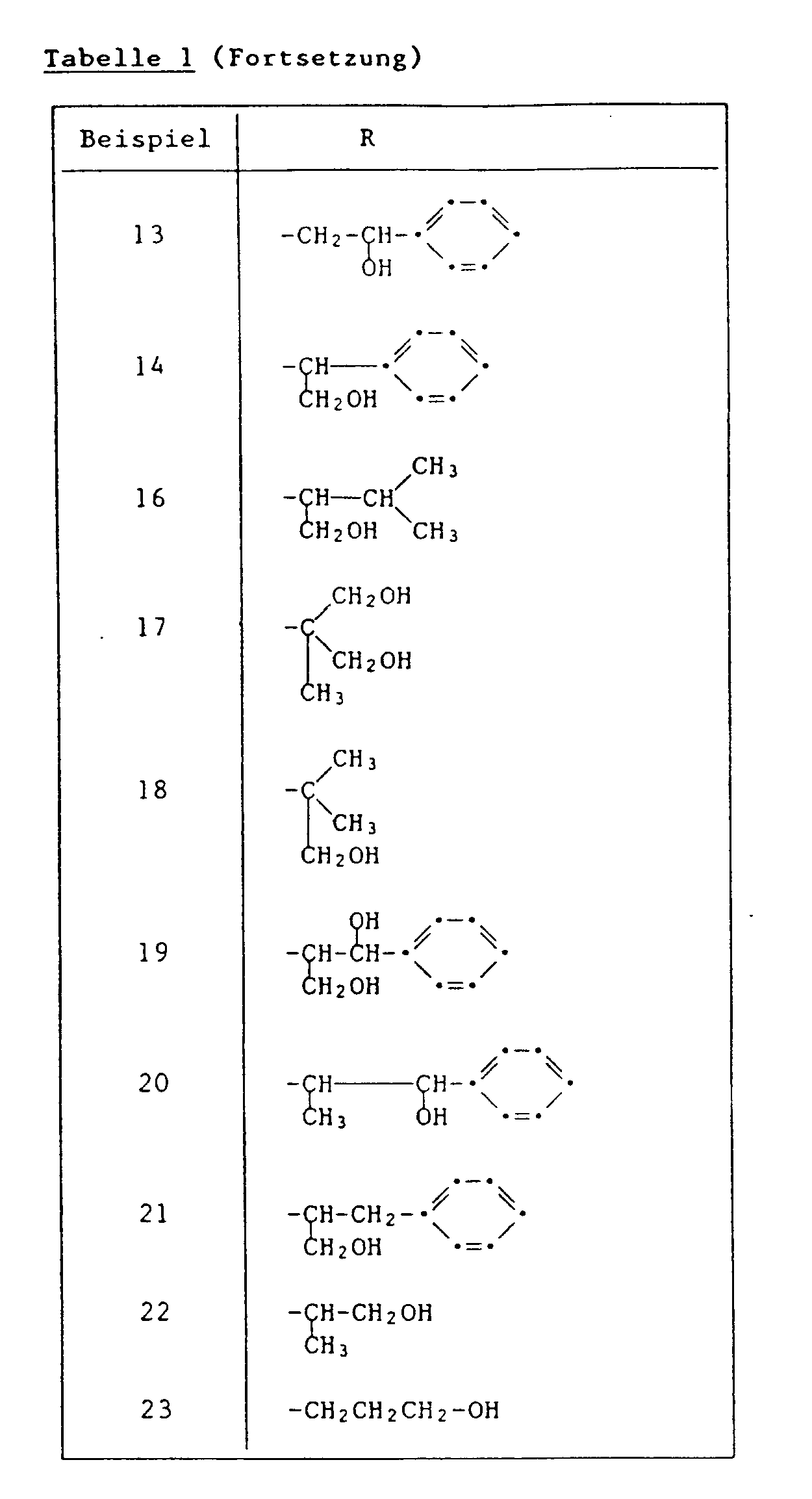
- Examples 2-23 If, using the same procedure, the corresponding 1-alkylamino, 1-aralkylamino or arylaminoanthraquinones substituted by OH groups, the dyes listed in the following table are obtained, which have similar properties and Dye polyester in bluish red shades.
- Example 24 3.6 g of the dye according to Example 1 are dissolved in 50 ml of pyridine and mixed with 1.8 ml of acetic anhydride at 20 ° C. The mixture is stirred for a further 15 hours at 20 ° C. and diluted with 50 ml of water.
- the unusual dye of the formula is suctioned off, washed with water and dried.
- Example 91 If the procedure described in Example 1 is followed, but instead of 11.8 g of 1-hydroxyisobutylaminoanthraquinone, an equivalent amount of 6-chloro-1-hydroxyisobutylaminoanthraquinone is used, the dye of the formula is obtained when the procedure is otherwise the same which polyester dyes in bluish red shades with good fastness properties.
- Example 92 1 part of the dry, coupage-free dye according to Example 24 is mixed in a glass bead mill together with 1 part of dinaphthylmethane disulfonate (Na salt) and water, and the mixture is ground until a particle size of about 2 ⁇ or less is achieved.
- the resulting paste consisting of the dye, dispersant and water, is then mixed with 3 parts of sodium lignin sulfonate.
- the paste obtained is then subjected to spray drying, a powdery coloring preparation being obtained.
- This dye preparation can be used for dyeing polyester materials, e.g. by the HT method, are used, the dye bath having good dispersion stability. A bluish-red polyester dyeing with good lightfastness is obtained.
- Example 93 2 parts of the dye obtained in Example 24 are dispersed in 4000 parts of water. 12 parts of the sodium salt of o-phenylphenol and 12 parts of diammonium phosphate are added to this dispersion and 100 parts of yarn made from polyethylene glycol terephthalate are dyed in this liquor at 95 to 98 ° for 90 minutes.
- the dyeing is then rinsed and aftertreated with aqueous sodium hydroxide solution and a dispersant. A brilliant light and sublimation-fast bluish red color is obtained.
- Example 94 1 part of the dye obtained in Example 24 is wet-ground with 2 parts of a 50% strength aqueous solution of the sodium salt of dinaphthylmethane disulfonic acid and dried.
- This dye preparation is stirred with 40 parts of a 10% aqueous solution of the sodium salt of N-benzylheptadecylbenzimidazole disulfonic acid and 4 parts of a 40% acetic acid solution are added.
- a dye bath of 4000 parts is prepared from this by dilution with water.
- Example 95 Polyethylene glycol terephthalate fabric is impregnated on a pad at 40 ° with a liquor of the following composition: 20 parts of the dye obtained in Example 24 finely dispersed in 10 parts of sodium alginate, 20 parts of triethanolamine, 20 parts of octylphenol polyglycol ether and 930 parts of water.
- the tissue squeezed to approx. 100% is dried at 100 ° and then fixed at a temperature of 210 ° for 30 seconds.
- the dyed goods are rinsed with water, soaped and dried. A brilliant, lightfast bluish red color is obtained.
- Example 96 A non-matted polyethylene terephthalate granulate suitable for fiber production is placed in a sealable vessel together with 1% of the dye according to Example 24 on a shaker Shaken for 15 minutes. The uniformly colored granules are spun into threads on a melt spinning system (285 ° C ⁇ 3 °, dwell time in the spinning machine approx. 5 minutes), which are drawn and wound up on a draw twisting system. A brilliant bluish red color is obtained, which is distinguished by excellent lightfastness and sublimation fastness.
Landscapes
- Chemical & Material Sciences (AREA)
- Organic Chemistry (AREA)
- Coloring (AREA)
- Hydrogenated Pyridines (AREA)
- Organic Low-Molecular-Weight Compounds And Preparation Thereof (AREA)
- Plural Heterocyclic Compounds (AREA)
- Heterocyclic Carbon Compounds Containing A Hetero Ring Having Nitrogen And Oxygen As The Only Ring Hetero Atoms (AREA)
Description
- Die vorliegende Erfindung betrifft neue Dicyanobenzanthronverbindungen, Verfahren zu deren Herstellung sowie deren Verwendung als Farbstoffe zum Färben und Bedrucken von halbsynthetischem oder synthetischem hydrophobem Material.
- Die neuen Dicyanobenzanthronverbindungen entsprechen der Formel

worin
X Wasserstoff, Halogen, Nitro oder NH₂ ist,
R Wasserstoff oder einen Rest -COR¹ bedeutet, worin R¹ eine gegebenenfalls substituierte Alkyl- oder Arylgruppe darstellt,
Y O oder S ist,
m 1, 2 oder 3 ist und
A einen aliphatischen, aromatischen oder araliphatischen Rest bedeutet, wobei falls R Wasserstoff, Y O, X Wasserstoff oder ein in der Position 6 oder 7 gebundenes Halogen und A ein aliphatischer Rest sind, darf A nur C₂- C₅-Alkylen bedeuten. - Bedeutet X Halogen, so ist darunter z.B. Brom oder vor allem Chlor zu verstehen. Das Halogen kann sich in 6- oder 7-Position befinden.
- Vorzugsweise bedeutet X jedoch Wasserstoff.
- Y bedeutet -S- oder vorzugsweise -O-.
- Farbstoffe der Formel (1), bei denen R einen Rest -COR¹ bedeutet, stellen eine bevorzugte Ausführungsform der vorliegenden Erfindung dar.
- Bedeutet R¹ einen Alkylrest, so handelt es sich um einen gegebenenfalls substituierten unverzweigten oder verzweigten Alkylrest oder um einen Cycloalkylrest. Der Cycloalkylrest weist vorzugsweise 5 bis 8 C-Atome, der offenkettige Alkylrest vorzugsweise 1 bis 8 C-Atome auf.
- Als unverzweigte oder verzweigte offenkettige Alkylreste kommen z.B. in Frage: Methyl, Ethyl, n- und iso-Propyl, n-, sec.- oder tert.Butyl, n-und iso-Pentyl, n- und iso-Hexyl oder 2-Ethylhexyl.
- Diese Alkylreste können ein- oder mehrmals substituiert sein, beispielsweise durch C₁₋C₄-Alkoxy, Phenyl oder Phenoxy, wobei die Phenylgruppe in den beiden letztgenannten Resten z.B. durch C₁-C₄-Alkyl, C₁-C₄-Alkoxy, oder Phenoxy substituiert sein kann. Geeignete Reste dieser Art sind z.B.: Ethoxymethyl, Benzyl, 1-Phenylethyl, 2-Phenylethyl, 1-Methyl-2-phenylethyl, 1-iso-Butyl-3-phenylpropyl, 1,5-Diphenylpentyl-3 oder 1-Methyl-2-phenoxyethyl.
- Bedeutet R¹ einen gegebenenfalls substituierten C₅-C₈-Cycloalkylrest, so handelt es sich vor allem um den Cyclopentyl- und Cyclohexylrest; als Substituenten kommen vor allem C₁-C₄-Alkylgruppen, insbesondere die CH₃-Gruppe, in Frage.
- Bedeutet R¹ einen Arylrest, so handelt es sich vor allem um einen Naphthylrest und insbesondere um einen Phenylrest, wobei diese Reste substituiert sein können, z.B. durch C₁-C₄-Alkyl, C₁-C₄-Alkoxy, Halogen, wie Fluor, Chlor oder Brom, Nitro, C₁-C₄-Alkylcarbonylamino oder C₁-C₄-Alkoxycarbonyl.
- In bevorzugten Farbstoffen der Formel (1) bedeutet
- R¹
- C₁-C₆-Alkyl, welches unsubstituiert ist oder durch Phenyl oder Phenoxy substituiert ist, wobei die Phenylgruppe in den beiden letztgenannten Resten durch C₁-C₄-Alkyl, C₁-C₄-Alkoxy oder Phenoxy substituiert sein kann, oder Phenyl, welches unsubstituiert ist oder durch C₁-C₄-Alkyl substituiert ist.
- Besonders bevorzugt sind Farbstoffe der Formel (1) bei denen R¹ C₁-C₃-Alkyl oder Phenyl bedeutet.
- Bevorzugte Farbstoffe der Formel (1) enthalten 1 oder 2, vor allem 1 Rest -Y-R.
- Das Brückenglied A ist ein aliphatischer, aromatischer oder araliphatischer Rest, an welchen 1 bis 3 Gruppen -Y-R gebunden sind.
- Geeignete aliphatische Reste sind beispielsweise geradkettiges oder verzweigtes C₂-C₈-Alkylen oder cyclisches C₅-C₈-Alkylen, beispielsweise Ethylen, 1,3- oder 1,2-Propylen, 1,4-, 2,3- oder 2,4-Butylen, 2-Methyl-1,3-propylen, 2-Methyl-2,4-pentylen, 2,2-Dimethyl-1,3-propylen, 1,6- oder 2,5-Hexylen, 1-Methyl-2,6-heptylen, 1,3- oder 1,4-Cyclohexylen. Geeignete aromatische Reste sind z.B. 1,3- oder 1,4-Phenylen, 1,4- oder 1,5-Naphthylen.
- Als araliphatische Reste kommen beispielsweise in Frage: o-, m- und p-Phenylenmethylen, o-, m- und p-Phenylen-ethylen-2, Phenylethylen-1,2, 1-Phenylpropylen-1,3, 2-Phenylpropylen-1,3, 1-Phenylpropylen-1,2 und 1-Phenylpropylen-2,3, wobei die Reste -Y-R am aliphatischen und/oder aromatischen Teil gebunden sein können.
- Vorzugsweise stellt A einen C₂-C₅-Alkylenrest dar oder einen Phenylen-C₂-C₅-alkylenrest, besonders bevorzugt einen Propylen-, Butylen-, Phenylenethylen- oder Phenylenpropylenrest.
- Wegen ihrer guten färberischen Eigenschaften, insbesondere wegen des guten Ausziehvermögens aus wässrigem Färbebad, sind Farbstoffe der Formel

worin
A¹ einen C₂-C₅-Alkylenrest oder einen Phenyl-C₂-C₅-Alkylenrest und
R² C₁-C₃-Alkyl oder Phenyl
bedeutet, besonders bevorzugt. - Die neuen Dicyanobenzanthronverbindungen der Formel (1) erhält man z.B., indem man ein substituiertes Aminoanthrachinon der Formel

worin X, Y, A, m und R die unter der Formel (1) angegebene Bedeutung aufweisen, in einem inerten Lösungsmittel in Gegenwart von Titantetrachlorid und einem tert.Amin mit Malodinitril umsetzt. - Als inerte Lösungsmittel kommen z.B. aliphatische Kohlenwasserstoffe, wie n-Pentan, n-Hexan oder n-Heptan, chlorierte Kohlenwasserstoffe, wie Methylenchlorid, Chloroform oder Tetrachlormethan, Ether, wie z.B. Diethylether, oder aromatische Verbindungen, wie z.B. Nitrobenzol oder Halogenbenzole in Betracht. Vorzugsweise verwendet man einen chlorierten Kohlenwasserstoff, vor allem Methylenchlorid.
Als tert.Amin werden z.B. aliphatische Amine, wie Triethylamin oder vor allem aromatische Amine, wie z.B. Picolin oder Pyridin verwendet. - Pro Mol Anthrachinonverbindung der Formel (3) setzt man mindestens 2 Mol, vorzugsweise jedoch 2,2 bis 3 Mol Malodinitril ein. Ein grösserer Ueberschuss ist im allgemeinen nicht schädlich, jedoch unzweckmässig.
- Die Menge an Titantetrachlorid beträgt vorzugsweise 2 bis 10 Mol, insbesondere 3 bis 6 Mol pro Mol Anthrachinonverbindung der Formel (3).
- Das tertiäre Amin wird mindestens in der Menge eingesetzt, die erforderlich ist, um die entstehende Säure zu binden. Im allgemeinen verwendet man jedoch einen Ueberschuss, vorzugsweise 2 bis 6 Mol pro Mol Titantetrachlorid.
- Die Reaktionstemperatur liegt im allgemeinen etwa zwischen -10° und +60°C, vorzugsweise zwischen 0° und 25°C.
- Nach Beendigung der Reaktion wird der Farbstoff auf an sich bekannte Weise isoliert, z.B. indem man die flüchtigen Anteile der Reaktionsmischung abdestilliert, den Rückstand mit verdünnter wässriger Säure behandelt, abfiltriert und gegebenenfalls umkristallisiert.
- Farbstoffe der Formel (1), bei denen R einen Rest
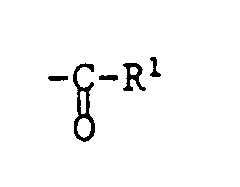
darstellt, können auch erhalten werden, indem man zunächst eine Verbindung der Formel (3), worin R Wasserstoff ist, wie unter der Formel (3) beschrieben zur Dicyanobenzanthronverbindung umsetzt und diese anschliessend auf übliche Weise acyliert. - Die erfindungsgemässen Verbindungen der Formel (1) können als Farbstoffe zum Färben und Bedrucken von halbsynthetischen und, insbesondere, synthetischen hydrophoben Fasermaterialien, vor allem Textilmaterialien, verwendet werden. Textilmaterialien aus Mischgeweben, die derartige halbsynthetische bzw. synthetische hydrophobe Textilmaterialien enthalten, können ebenfalls mit Hilfe der erfindungsgemässen Verbindungen gefärbt oder bedruckt werden.
- Als halbsynthetische Textilmaterialien kommen vor allem Cellulose-2

- Synthetische hydrophobe Textilmaterialien bestehen vor allem aus linearen, aromatischen Polyestern, beispielsweise solchen aus Terephthalsäure und Glykolen, besonders Ethylenglykol oder Kondensationsprodukten aus Terephthalsäure und 1,4-Bis-(hydroxymethyl)-hexahydrobenzol; aus Polycarbonaten, z.B. solchen aus α,α-Dimethyl-4,4'-dihydroxy-diphenylmethan und Phosgen, aus Fasern auf Polyvinylchlorid- sowie Polyamid-Basis.
- Die Applikation der erfindungsgemässen Verbindungen auf die Textilmaterialien erfolgt nach bekannten Färbeverfahren. Beispielsweise färbt man Polyesterfasermaterialien im Ausziehverfahren aus wässriger Dispersion in Gegenwart von üblichen anionischen oder nichtionischen Dispergiermitteln und gegebenenfalls üblichen Quellmitteln (Carrier) bei Temperaturen zwischen 80 und 140°C. Cellulose-2

- Die neuen Farbstoffe färben im Färbebad gleichzeitig anwesende Wolle und Baumwolle nicht oder nur wenig an (sehr gute Reserve), so dass sie auch gut zum Färben des Polyesteranteils in Polyester/Wolle-und Polyester/Cellulosefaser-Mischungen verwendet werden können.
- Aus der EP-A-238.443 sind bereits Dicyanobenzanthronverbindungen bekannt. Diese unterscheiden sich von den erfindungsgemässen Verbindungen der Formel (1) durch die substituierte Aminogruppe. In der EP-A-238.443 sind keine Verbindungen mit einem Rest -Y-R gemäss vorliegender Erfindung offenbart.
- Gegenüber den bekannten Farbstoffen zeichnen sich die erfindungsgemässen Farbstoffe, enthaltend mindestens eine Gruppe -Y-R, durch erheblich verbessertes Ausziehvermögen auf Polyestermaterial aus. Während die bekannten Farbstoffe für das wässrige Ausziehverfahren, vor allem zum Färben in tiefen Nuancen, nur bedingt geeignet sind, ergeben die erfindungsgemässen Farbstoffe auch im Ausziehverfahren sehr gute Fixierausbeuten.
- Die erfindungsgemässen Farbstoffe der Formel (1) eignen sich auch zum Färben nach dem Thermosol-Verfahren und für den Textildruck.
- Das genannte Textilmaterial kann in den verschiedensten Verarbeitungsformen vorliegen, wie z.B. als Faser, Faden oder Vlies, als Gewebe oder Gewirke.
- Es ist vorteilhaft, die erfindungsgemässen Farbstoffe vor ihrer Verwendung in ein Farbstoffpräparat überzuführen. Hierzu wird der Farbstoff vermahlen, so dass seine Teilchengrösse im Mittel zwischen 0,01 und 10 Mikrometer beträgt. Das Vermahlen kann in Gegenwart von Dispergiermitteln erfolgen. Beispielsweise wird der getrocknete Farbstoff mit einem Dispergiermittel gemahlen oder in Pastenform mit einem Dispergiermittel geknetet und hierauf im Vakuum oder durch Zerstäuben getrocknet. Mit den so erhaltenen Präparaten kann man nach Zugabe von Wasser färben und bedrucken.
- Beim Bedrucken wird man die üblichen Verdickungsmittel verwenden, z.B. modifizierte oder nichtmodifizierte natürliche Produkte, beispielsweise Alginate, Britishgummi, Gummi arabicum, Kristallgummi, Johannisbrotkernmehl, Tragant, Carboxymethylcellulose, Hydroxyethylcellulose, Stärke oder synthetische Produkte, beispielsweise Polyacrylamide, Polyacrylsäure oder deren Copolymere oder Polyvinylalkohole.
- Die erfindungsgemässen Farbstoffe sind praktisch unempfindlich gegen Carrier und verleihen den genannten Materialien, vor allem dem Polyestermaterial egale blaustichig rot bis violette Farbtöne von sehr guten Gebrauchs-Echtheiten, wie vor allem guter Lichtechtheit, guter Sublimierechtheit, Thermofixier-, Plissier-, Chlor- und Nassechtheit wie Wasser-, Schweiss- und Waschechtheit; die Ausfärbungen sind ferner gekennzeichnet durch eine gute pH-Stabilität und sehr gute Reibechtheit. Es werden ausserdem sehr farbstarke Färbungen erzielt, die kein "catalytic fading" zeigen.
- Die erfindungsgemässen Farbstoffe können auch gut verwendet werden zur Herstellung von Mischnuancen zusammen mit anderen Farbstoffen. Selbstverständlich können auch Mischungen der erfindungsgemässen Farbstoffe untereinander verwendet werden.
- Die neuen Farbstoffe eignen sich auch zum Färben und Pigmentieren von hochmolekularen organischen Materialien, z.B. von Celluloseäthern und -estern, wie Aethylcellulose, Nitrocellulose, Celluloseacetat, Cellulosebutyrat, natürlichen Harzen oder Kunstharzen, wie Polymerisationsharzen oder Kondensationsharzen, z.B. Aminoplasten, insbesondere Harnstoff- und Melamin-Formaldehydharzen, Alkydharzen, Phenoplasten, Polycarbonaten, Polyolefinen, wie Polystyrol, Polyvinylchlorid, Polyethylen, Polypropylen, Polyacrylnitril, Polyacrylsäureester, Polyamiden, Polyurethanen oder Polyestern, Gummi, Casein, Silikon und Silikonharzen, einzeln oder in Mischungen.
- Dabei spielt es keine Rolle, ob die erwähnten hochmolekularen Verbindungen als plastische Massen, Schmelzen oder in Form von Spinnlösungen, Lacken, Anstrichstoffen oder Druckfarben vorliegen. Je nach Verwendungszweck erweist es sich als vorteilhaft, die neuen Farbstoffe als Toner oder in Form von Präparaten zu verwenden.
- Die Farbstoffe können in der Form, wie sie in der Synthese anfallen, eingesetzt werden. In leicht gemahlener Form liefern sie opake Ausfärbungen. Man kann sie aber auch einer intensiveren Mahlung unterziehen und erhält dann transparente Ausfärbungen, wie beispielsweise farbstarke Metalleffektlackierung.
- Thermoplastische Kunststoffe, die mit den neuen Farbstoffen der Formel (1) in der Schmelze gefärbt werden können, sind Polystyrol und deren Mischpolymerisate, Polycarbonate, Polyamide, insbesondere aber lineare Polyester.
Als lineare Polyester seien insbesondere jene erwähnt, die durch Polykondensation von Terephthalsäure oder deren Estern mit Glykolen der Formel HO-(CH₂)n-OH, worin n die Zahl 2-10 bedeutet, oder mit 1,4-Di(hydroxymethyl)-cyclohexan oder durch Polykondensation von Glykolethern von Hydroxybenzoesäuren, beispielsweise p-(β-Hydroxyethoxy)-benzoesäure erhalten werden. Der Begriff lineare Polyester umfasst auch Copolyester, die durch teilweisen Ersatz der Terephthalsäure durch eine andere Dicarbonsäure oder eine Hydroxycarbonsäure und/oder durch teilweisen Ersatz des Glykols durch ein anderes Diol erhalten werden. - Von besonderem Interesse sind jedoch die Polyethylen-terephthalate.
- Die zu färbenden linearen Polyester werden zweckmässig in Form von Pulver, Schnitzeln oder Granulaten mit dem Farbstoff innig vermischt. Dies kann beispielsweise durch Panieren der Polyesterteilchen mit dem fein verteilten trockenen Farbstoffpulver oder durch Behandeln der Polyesterteilchen mit einer Lösung oder Suspension des Farbstoffes in einem organischen Lösungsmittel und nachherige Entfernung des Lösungsmittels geschehen.
- Schliesslich kann die zu färbende Substanz auch direkt dem geschmolzenen Polyester oder auch vor oder während der Polykondensation des Polyethylenterephthalates zugegeben werden.
- Das Verhältnis von Farbstoff zu Polyester kann, je nach der gewünschten Farbstärke, innerhalb weiter Grenzen schwanken. Im allgemeinen empfiehlt sich die Verwendung von 0,01-2 Teilen Farbstoff auf 100 Teile Polyester.
- Die so behandelten Polyesterteilchen werden nach bekannten Verfahren im Extruder geschmolzen und zu Gegenständen, insbesondere Folien oder Fasern, ausgepresst oder zu Platten gegossen.
- Man erhält gleichmässig und intensiv blaustichig rot bis violett gefärbte Gegenstände von hoher Licht- oder Migrationsechtheit. Die verfahrensgemäss erhältlichen gefärbten Fasern zeichnen sich ausserdem durch hervorragende Nass- und Trockenreinigungsechtheiten aus.
- Ein besonderer Vorteil der erfindungsgemäss zu verwendenden Farbstoffe besteht darin, dass sie sich in der Polyesterschmelze lösen und hohe Temperaturen bis 300°C aushalten, ohne sich zu zersetzen, so dass bedeutend klarere Färbungen erhalten werden als bei Verwendung unlöslicher Pigmente.
- Die vorstehend genannten Verwendungen der erfindungsgemässen Dicyanobenzanthronverbindungen der Formel (1) stellen ebenso Gegenstände der vorliegenden Erfindung dar wie ein Verfahren zum Färben oder Bedrucken von halbsynthetischem oder synthetischem Fasermaterial, insbesondere Textilmaterial, das darin besteht, eine oder mehrere Verbindungen der Formel (1) auf das genannte Material aufzubringen oder es diesem einzuverleiben. Das genannte hydrophobe Fasermaterial ist vorzugsweise textiles Polyestermaterial. Weitere Substrate, die durch das erfindungsgemässe Verfahren behandelt werden können sowie bevorzugte Verfahrensbedingungen sind vorstehend bei der näheren Erläuterung der Verwendung der erfindungsgemässen Verbindungen zu finden.
- Ein weiterer Gegenstand der Erfindung ist das durch das genannte Verfahren gefärbte bzw. bedruckte hydrophobe Fasermaterial, vorzugsweise Polyester-Textilmaterial.
- Die folgenden Beispiele veranschaulichen die Erfindung weiter. Teile und Prozente beziehen sich, sofern nicht anderes angegeben ist, auf das Gewicht. Die Temperaturen sind in Grad Celsius angegeben.
- Beispiel 1: Zu einem Gemisch, bestehend aus 11,8 g der Verbindung der Formel
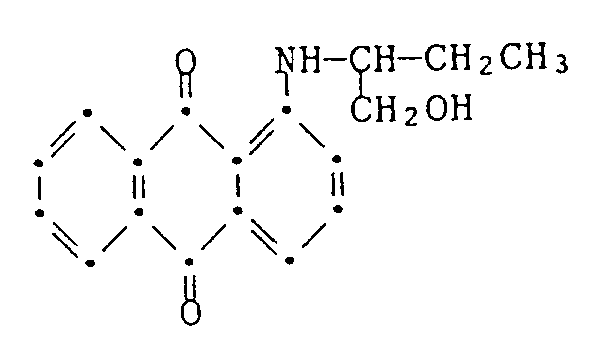
7 g Malodinitril und 250 ml Methylenchlorid lässt man bei einer Temperatur von 0-5° unter intensivem Rühren innerhalb von 30 Minuten 23 ml Titantetrachlorid zutropfen und anschliessend bei derselben Temperatur innerhalb von 30 Minuten 70 ml Pyridin. Man rührt das Gemisch anschliessend noch während 2 Stunden, wobei man die Temperatur auf 20° ansteigen lässt. Man entfernt nun die flüchtigen Anteile in einem Rotationsverdampfer im Vakuum, worauf man den Rückstand mit 200 ml 2n-HCl behandelt, abfiltriert und mit 2n-HCl nachwäscht. Man wäscht hierauf das Nutschgut mit Wasser bis zum neutralen Ablauf und anschliessend mit Methanol zur Entfernung brauner Nebenprodukte. Nach Zwischentrocknung wird das Produkt aus 10 Teilen Ethylcellosolve umkristallisiert. Man erhält den Farbstoff als dunkelviolettes Pulver. - Der Farbstoff entspricht der Formel

welche sich in Uebereinstimmung befindet mit der Elementaranalyse, dem Massen-, dem Protonen-Kernresonanz-Spektrum. - Als Dispersionsfarbstoff nach den üblichen Ausziehverfahren auf Polyester appliziert erhält man brillante blaustichigrote Färbungen mit guten Echtheitseigenschaften, insbesondere mit guten Sublimations- und Lichtechtheiten bei hohem Ausziehgrad.
- Beispiele 2-23: Verwendet man, bei ansonst gleichem Vorgehen, entsprechende durch OH-Gruppen substituierte 1-Alkylamino-, 1-Aralkylamino- bzw. Arylamino-Anthrachinone, so erhält man die in der folgenden Tabelle aufgeführten Farbstoffe, welche ähnliche Eigenschaften aufweisen und Polyester in blaustichig roten Nuancen färben.

- Beispiel 24: 3,6 g des Farbstoffes gemäss Beispiel 1 werden in 50 ml Pyridin gelöst und bei 20°C mit 1,8 ml Essigsäureanhydrid versetzt. Man rührt noch 15 Std. bei 20°C und verdünnt mit 50 ml Wasser.
- Der ausgefallene Farbstoff der Formel

wird abgesaugt mit Wasser gewaschen und getrocknet. - Als Dispersionsfarbstoff nach den üblichen Verfahren auf Polyester appliziert erhält man brillante blaustichig-rote Färbungen mit guten Echtheitseigenschaften, insbesondere mit guten Sublimations- und Lichtechtheiten und sehr gutem Ausziehgrad.
- Ersetzt man im obigen Beispiel das Essigsäureanhydrid durch Propionsäure- oder Benzoesäureanhydrid so erhält man ähnliche Farbstoffe mit gleich guten Eigenschaften.
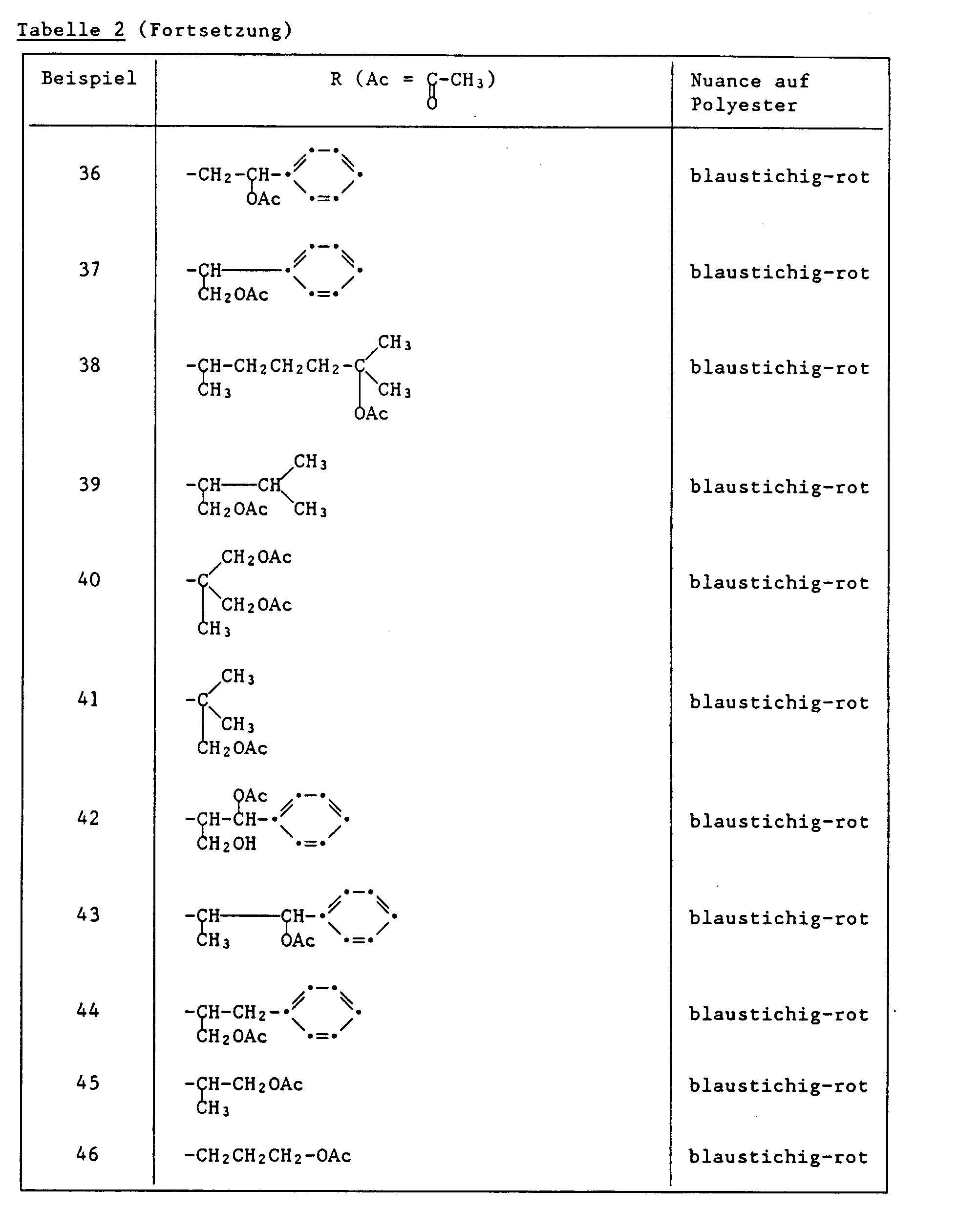
- Beispiele 25-90: Verwendet man, bei ansonst gleichem Vorgehen, entsprechende durch Acyloxy-Gruppen substituierte 1-Alkylamino- bzw. 1-Aryl-oder 1-Aralkylaminoanthrachinone, so erhält man die in der folgenden Tabelle aufgeführten Farbstoffe, welche ähnliche Eigenschaften aufweisen und Polyester in der angegebenen Nuance färben.



- Beispiel 91: Arbeitet man wie im Beispiel 1 beschrieben, setzt jedoch anstelle von 11,8 g 1-Hydroxyisobutylaminoanthrachinon eine äquivalente Menge 6-Chlor-1-hydroxyisobutylaminoanthrachinon ein, so erhält man bei ansonsten gleichem Arbeiten den Farbstoff der Formel

welcher Polyester in blaustichig roten Farbtönen mit guten Echtheiten färbt. - Beispiel 92: Man mischt 1 Teil des trockenen, coupagefreien Farbstoffs gemäss Beispiel 24 in einer Glasperlmühle zusammen mit 1 Teil Dinaphthylmethandisulfonat (Na-Salz) und Wasser und mahlt das Gemisch so lange, bis eine Korngrösse von etwa 2 µ oder kleiner erreicht ist. Die entstehende Paste, bestehend aus dem Farbstoff, Dispergator und Wasser, wird anschliessend mit 3 Teilen Natriumligninsulfonat versetzt. Die erhaltene Paste wird sodann der Sprühtrocknung unterworfen, wobei ein pulverförmiges Färbepräparat erhalten wird.
- Dieses Färbepräparat kann zum Färben von Polyestermaterialien, z.B. nach dem HT-Verfahren, verwendet werden, wobei das Färbebad eine gute Dispersionsstabilität aufweist. Man erhält eine blaustichig-rote Polyesterfärbung mit guter Lichtechtheit.
- Beispiel 93: 2 Teile des gemäss Beispiel 24 erhaltenen Farbstoffs werden in 4000 Teilen Wasser dispergiert. Zu dieser Dispersion gibt man 12 Teile des Natriumsalzes von o-Phenylphenol sowie 12 Teile Diammoniumphosphat und färbt 100 Teile Garn aus Polyethylenglykolterephthalat 90 Minuten lang bei 95 bis 98° in dieser Flotte.
- Die Färbung wird anschliessend gespült und mit wässriger Natronlauge und einem Dispergator nachbehandelt. Man erhält so eine brillante licht- und sublimierechte blaustichig rote Färbung.
- Beispiel 94: 1 Teil des gemäss Beispiel 24 erhaltenen Farbstoffs wird mit 2 Teilen einer 50%igen wässerigen Lösung des Natriumsalzes der Dinaphthylmethandisulfonsäure nass vermahlen und getrocknet.
- Dieses Farbstoffpräparat wird mit 40 Teilen einer 10%igen wässrigen Lösung des Natriumsalzes der N-Benzylheptadecyl-benzimidazoldisulfonsäure verrührt und 4 Teile einer 40%igen Essigsäurelösung zugegeben. Durch Verdünnen mit Wasser wird daraus ein Färbebad von 4000 Teilen bereitet.
- In dieses Bad geht man bei 50° mit 100 Teilen eines Polyesterfaserstoffes ein, steigert die Temperatur innert einer halben Stunde auf 120 bis 130° und färbt eine Stunde in geschlossenem Gefäss bei dieser Temperatur. Anschliessend wird gut gespült. Man erhält eine brillante blaustichig rote Färbung von guter Lichtechtheit.
- Beispiel 95: Polyethylenglykolterephthalatgewebe wird auf einem Foulard bei 40° mit einer Flotte folgender Zusammensetzung imprägniert:
20 Teile des gemäss Beispiel 24 erhaltenen Farbstoffes fein dispergiert in
10 Teilen Natriumalginat,
20 Teilen Triethanolamin,
20 Teilen Octylphenolpolyglykoläther und
930 Teilen Wasser. - Das auf ca. 100 % abgequetschte Gewebe wird bei 100° getrocknet und anschliessend während 30 Sekunden bei einer Temperatur von 210° fixiert. Die gefärbte Ware wird mit Wasser gespült, geseift und getrocknet. Man erhält eine brillante, lichtechte blaustichig rote Färbung.
- Beispiel 96: Ein zur Faserherstellung geeignetes unmattiertes Polyäthylenterephthalat-Granulat wird in einem verschliessbaren Gefäss zusammen mit 1 % Farbstoff gemäss Beispiel 24 auf einer Schüttelmaschine 15 Minuten geschüttelt. Die gleichmässig gefärbten Granulatkörner werden auf einer Schmelzspinnanlage (285°C ± 3°, Verweilzeit in der Spinnmaschine ca. 5 Minuten) zu Fäden versponnen, die auf einer Streckzwirnanlage verstreckt und aufgespult werden. Man erhält eine brillante blaustichig rote Färbung, die sich durch hervorragende Lichtechtheit und Sublimationsechtheit auszeichnet.
Claims (12)
- Verbindungen der Formel

X Wasserstoff, Halogen, Nitro oder NH₂ ist,
R Wasserstoff oder einen Rest -COR¹ bedeutet, worin R¹ eine gegebenenfalls substituierte Alkyl- oder Arylgruppe darstellt,
Y O oder S ist,
m 1, 2 oder 3 ist und
A einen aliphatischen, aromatischen oder araliphatischen Rest bedeutet, wobei falls R Wasserstoff,
Y O, X Wasserstoff oder ein in der Position 6 oder 7 gebundenes Halogen und A ein aliphatischer Rest sind, darf A nur C₂- C₅-Alkylen bedeuten. - Verbindungen gemäss Anspruch 1, worin X Wasserstoff bedeutet.
- Verbindungen gemäss einem der Ansprüche 1 oder 2, worin Y -O-bedeutet.
- Verbindungen gemäss einem der Ansprüche 1-3, worin R einen Rest

- Verbindungen gemäss einem der Ansprüche 1-4, worin R¹ C₁-C₆-Alkyl, welches unsubstituiert ist oder durch Phenyl oder Phenoxy substituiert ist, wobei die Phenylgruppe in den beiden letztgenannten Resten durch C₁-C₄-Alkyl, C₁-C₄-Alkoxy oder Phenoxy substituiert sein kann, oder Phenyl, welches unsubstituiert ist oder durch C₁-C₄-Alkyl substituiert ist, bedeutet.
- Verbindungen gemäss Anspruch 5, worin R¹ C₁-C₃-Alkyl oder Phenyl bedeutet.
- Verbindungen gemäss einem der Ansprüche 1-6, worin m 1 oder 2, vor allem 1 bedeutet.
- Verbindungen gemäss einem der Ansprüche 1-7, worin A einen C₂-C₅-Alkylenrest oder einen Phenylen-C₂-C₅-alkylenrest bedeutet.
- Verbindungen der Formel

A¹ einen C₂-C₅-Alkylenrest oder einen Phenylen-C₂-C₅-Alkylenrest und
R² C₁-C₃-Alkyl oder Phenyl bedeutet. - Verfahren zur Herstellung der Verbindungen der Formel (1) gemäss Anspruch 1, dadurch gekennzeichnhet, dass man ein substituiertes Aminoanthrachinon der Formel
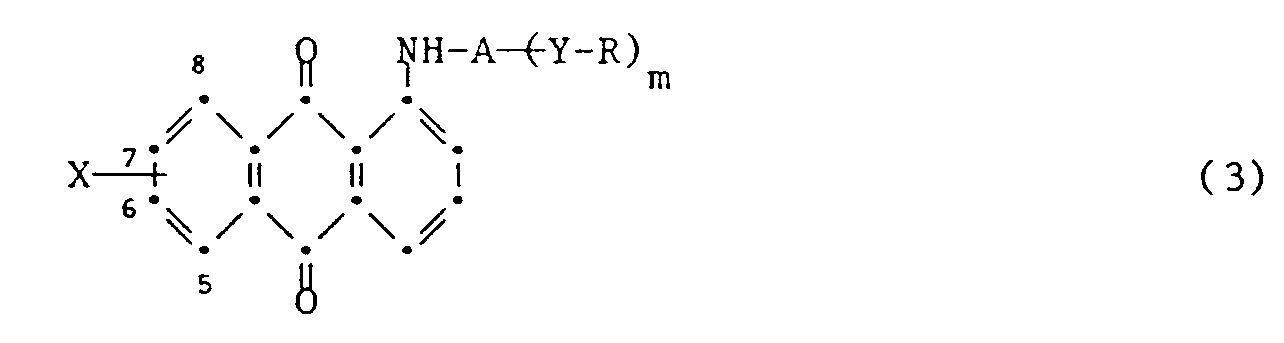
- Verwendung der Verbindungen der Formel (1) gemäss Anspruch 1 zum Färben oder Bedrucken von halbsynthetischen oder synthetischen hydrophoben Fasermaterialien, insbesondere Textilmaterialien aus linearen aromatischen Polyestern.
- Das gemäss Anspruch 11 gefärbte oder bedruckte hydrophobe Material.
Applications Claiming Priority (2)
| Application Number | Priority Date | Filing Date | Title |
|---|---|---|---|
| CH213688 | 1988-06-06 | ||
| CH2136/88 | 1988-06-06 |
Publications (3)
| Publication Number | Publication Date |
|---|---|
| EP0346280A2 EP0346280A2 (de) | 1989-12-13 |
| EP0346280A3 EP0346280A3 (de) | 1991-01-23 |
| EP0346280B1 true EP0346280B1 (de) | 1994-11-09 |
Family
ID=4226716
Family Applications (1)
| Application Number | Title | Priority Date | Filing Date |
|---|---|---|---|
| EP89810404A Expired - Lifetime EP0346280B1 (de) | 1988-06-06 | 1989-05-30 | Dicyanobenzanthronverbindungen |
Country Status (6)
| Country | Link |
|---|---|
| US (1) | US4992569A (de) |
| EP (1) | EP0346280B1 (de) |
| JP (1) | JPH0232162A (de) |
| KR (1) | KR910000605A (de) |
| BR (1) | BR8902597A (de) |
| DE (1) | DE58908619D1 (de) |
Families Citing this family (2)
| Publication number | Priority date | Publication date | Assignee | Title |
|---|---|---|---|---|
| DE4136566C1 (de) * | 1991-11-07 | 1993-04-22 | Gmn Georg Mueller Nuernberg Ag, 8500 Nuernberg, De | |
| EP0601970A1 (de) * | 1992-12-03 | 1994-06-15 | Ciba-Geigy Ag | Anthrachinonfarbstoffe, Verfahren zu deren Herstellung und deren Verwendung |
Family Cites Families (1)
| Publication number | Priority date | Publication date | Assignee | Title |
|---|---|---|---|---|
| US4801406A (en) * | 1986-03-18 | 1989-01-31 | Ciba-Geigy Corporation | Dicyanobenzanthrone compounds |
-
1989
- 1989-05-30 DE DE58908619T patent/DE58908619D1/de not_active Expired - Fee Related
- 1989-05-30 EP EP89810404A patent/EP0346280B1/de not_active Expired - Lifetime
- 1989-06-01 US US07/360,579 patent/US4992569A/en not_active Expired - Fee Related
- 1989-06-05 BR BR898902597A patent/BR8902597A/pt unknown
- 1989-06-05 KR KR1019890007687A patent/KR910000605A/ko not_active Withdrawn
- 1989-06-06 JP JP1142299A patent/JPH0232162A/ja active Pending
Also Published As
| Publication number | Publication date |
|---|---|
| EP0346280A2 (de) | 1989-12-13 |
| US4992569A (en) | 1991-02-12 |
| EP0346280A3 (de) | 1991-01-23 |
| BR8902597A (pt) | 1990-01-23 |
| JPH0232162A (ja) | 1990-02-01 |
| KR910000605A (ko) | 1991-01-29 |
| DE58908619D1 (de) | 1994-12-15 |
Similar Documents
| Publication | Publication Date | Title |
|---|---|---|
| EP0238443B1 (de) | Dicyanobenzanthronverbindungen | |
| EP0346280A2 (de) | Dicyanobenzanthronverbindungen | |
| EP0083313B1 (de) | Farbstoffmischung, Verfahren zu ihrer Herstellung und Verwendung zum Färben und Bedrucken von hydrophobem Fasermaterial | |
| EP0776948B1 (de) | Mischungen von Monoazopyridonfarbstoffen | |
| CH689980A5 (de) | Mischungen von Monoazopyridonfarbstoffen. | |
| EP0152005A2 (de) | Mischungen von Monoazofarbstoffen | |
| EP0284560A2 (de) | Dispersionsfarbstoffe, enthaltend eine Tricyanovinylgruppierung | |
| EP0085823B1 (de) | Farbstoffmischung, Verfahren zu ihrer Herstellung und Verwendung zum Färben und Bedrucken von hydrophobem Textilmaterial | |
| EP0041042B1 (de) | Azoverbindungen | |
| EP0336163A1 (de) | Mischungen von Monoazofarbstoffen | |
| EP0439057B1 (de) | Monoazofarbstoffe, ihre Herstellung und Verwendung | |
| EP0546366B1 (de) | Monoazofarbstoffe und diese enthaltende Mischungen | |
| DE2905653C3 (de) | Disperse Anthrachinonfarbstoffe, deren Gemische, deren Herstellung und deren Verwendung | |
| EP0185207B1 (de) | Farbstoffmischungen, Verfahren zu ihrer Herstellung und Verfahren zum Färben und Bedrucken von hydrophoben Fasermaterialien | |
| CH615211A5 (de) | ||
| EP0708152B1 (de) | Mischungen blauer Dispersionsazofarbstoffe | |
| EP0258180A2 (de) | Dispersionsfarbstoffe | |
| CH689832A5 (de) | Mischungen von Monoazopyridonfarbstoffen. | |
| EP0073369A1 (de) | Farbstoffe, Farbstoffzubereitung und Verfahren zum Färben und Bedrucken von hochmolekularen hydrophoben Materialien | |
| EP0554695A1 (de) | Monoazofarbstoffe und diese enthaltende Mischungen | |
| DE4238231A1 (de) | ||
| DE2607966A1 (de) | Benzothioxanthene, verfahren zu ihrer herstellung und ihre verwendung als farbstoffe | |
| EP0050587A2 (de) | Mischung von Farbstoffen | |
| DE1807492A1 (de) | Dispersionsfarbstoffe der Anthrachinonreihe,ihre Herstellung und Verwendung | |
| EP0346277A1 (de) | Mischungen von Dicyanobenzanthronverbindungen |
Legal Events
| Date | Code | Title | Description |
|---|---|---|---|
| PUAI | Public reference made under article 153(3) epc to a published international application that has entered the european phase |
Free format text: ORIGINAL CODE: 0009012 |
|
| 17P | Request for examination filed |
Effective date: 19890601 |
|
| AK | Designated contracting states |
Kind code of ref document: A2 Designated state(s): CH DE FR GB IT LI |
|
| PUAL | Search report despatched |
Free format text: ORIGINAL CODE: 0009013 |
|
| AK | Designated contracting states |
Kind code of ref document: A3 Designated state(s): CH DE FR GB IT LI |
|
| 17Q | First examination report despatched |
Effective date: 19930521 |
|
| GRAA | (expected) grant |
Free format text: ORIGINAL CODE: 0009210 |
|
| AK | Designated contracting states |
Kind code of ref document: B1 Designated state(s): CH DE FR GB IT LI |
|
| ET | Fr: translation filed | ||
| REF | Corresponds to: |
Ref document number: 58908619 Country of ref document: DE Date of ref document: 19941215 |
|
| GBT | Gb: translation of ep patent filed (gb section 77(6)(a)/1977) |
Effective date: 19941207 |
|
| ITF | It: translation for a ep patent filed | ||
| PGFP | Annual fee paid to national office [announced via postgrant information from national office to epo] |
Ref country code: FR Payment date: 19950407 Year of fee payment: 7 |
|
| PGFP | Annual fee paid to national office [announced via postgrant information from national office to epo] |
Ref country code: DE Payment date: 19950424 Year of fee payment: 7 |
|
| PGFP | Annual fee paid to national office [announced via postgrant information from national office to epo] |
Ref country code: GB Payment date: 19950427 Year of fee payment: 7 |
|
| PG25 | Lapsed in a contracting state [announced via postgrant information from national office to epo] |
Ref country code: LI Effective date: 19950531 Ref country code: CH Effective date: 19950531 |
|
| PLBE | No opposition filed within time limit |
Free format text: ORIGINAL CODE: 0009261 |
|
| STAA | Information on the status of an ep patent application or granted ep patent |
Free format text: STATUS: NO OPPOSITION FILED WITHIN TIME LIMIT |
|
| 26N | No opposition filed | ||
| REG | Reference to a national code |
Ref country code: CH Ref legal event code: PL |
|
| PG25 | Lapsed in a contracting state [announced via postgrant information from national office to epo] |
Ref country code: GB Effective date: 19960530 |
|
| GBPC | Gb: european patent ceased through non-payment of renewal fee |
Effective date: 19960530 |
|
| PG25 | Lapsed in a contracting state [announced via postgrant information from national office to epo] |
Ref country code: FR Effective date: 19970131 |
|
| PG25 | Lapsed in a contracting state [announced via postgrant information from national office to epo] |
Ref country code: DE Effective date: 19970201 |
|
| REG | Reference to a national code |
Ref country code: FR Ref legal event code: ST |
|
| PG25 | Lapsed in a contracting state [announced via postgrant information from national office to epo] |
Ref country code: IT Free format text: LAPSE BECAUSE OF NON-PAYMENT OF DUE FEES;WARNING: LAPSES OF ITALIAN PATENTS WITH EFFECTIVE DATE BEFORE 2007 MAY HAVE OCCURRED AT ANY TIME BEFORE 2007. THE CORRECT EFFECTIVE DATE MAY BE DIFFERENT FROM THE ONE RECORDED. Effective date: 20050530 |