EP0050587A2 - Mischung von Farbstoffen - Google Patents
Mischung von Farbstoffen Download PDFInfo
- Publication number
- EP0050587A2 EP0050587A2 EP81810410A EP81810410A EP0050587A2 EP 0050587 A2 EP0050587 A2 EP 0050587A2 EP 81810410 A EP81810410 A EP 81810410A EP 81810410 A EP81810410 A EP 81810410A EP 0050587 A2 EP0050587 A2 EP 0050587A2
- Authority
- EP
- European Patent Office
- Prior art keywords
- formula
- dye mixture
- dye
- mixture according
- formulas
- Prior art date
- Legal status (The legal status is an assumption and is not a legal conclusion. Google has not performed a legal analysis and makes no representation as to the accuracy of the status listed.)
- Granted
Links
Classifications
-
- C—CHEMISTRY; METALLURGY
- C09—DYES; PAINTS; POLISHES; NATURAL RESINS; ADHESIVES; COMPOSITIONS NOT OTHERWISE PROVIDED FOR; APPLICATIONS OF MATERIALS NOT OTHERWISE PROVIDED FOR
- C09B—ORGANIC DYES OR CLOSELY-RELATED COMPOUNDS FOR PRODUCING DYES, e.g. PIGMENTS; MORDANTS; LAKES
- C09B67/00—Influencing the physical, e.g. the dyeing or printing properties of dyestuffs without chemical reactions, e.g. by treating with solvents grinding or grinding assistants, coating of pigments or dyes; Process features in the making of dyestuff preparations; Dyestuff preparations of a special physical nature, e.g. tablets, films
- C09B67/0033—Blends of pigments; Mixtured crystals; Solid solutions
- C09B67/0046—Mixtures of two or more azo dyes
- C09B67/0051—Mixtures of two or more azo dyes mixture of two or more monoazo dyes
-
- C—CHEMISTRY; METALLURGY
- C09—DYES; PAINTS; POLISHES; NATURAL RESINS; ADHESIVES; COMPOSITIONS NOT OTHERWISE PROVIDED FOR; APPLICATIONS OF MATERIALS NOT OTHERWISE PROVIDED FOR
- C09B—ORGANIC DYES OR CLOSELY-RELATED COMPOUNDS FOR PRODUCING DYES, e.g. PIGMENTS; MORDANTS; LAKES
- C09B29/00—Monoazo dyes prepared by diazotising and coupling
- C09B29/06—Monoazo dyes prepared by diazotising and coupling from coupling components containing amino as the only directing group
- C09B29/08—Amino benzenes
- C09B29/0805—Amino benzenes free of acid groups
- C09B29/0807—Amino benzenes free of acid groups characterised by the amino group
- C09B29/0808—Amino benzenes free of acid groups characterised by the amino group unsubstituted amino group
-
- C—CHEMISTRY; METALLURGY
- C09—DYES; PAINTS; POLISHES; NATURAL RESINS; ADHESIVES; COMPOSITIONS NOT OTHERWISE PROVIDED FOR; APPLICATIONS OF MATERIALS NOT OTHERWISE PROVIDED FOR
- C09B—ORGANIC DYES OR CLOSELY-RELATED COMPOUNDS FOR PRODUCING DYES, e.g. PIGMENTS; MORDANTS; LAKES
- C09B29/00—Monoazo dyes prepared by diazotising and coupling
- C09B29/06—Monoazo dyes prepared by diazotising and coupling from coupling components containing amino as the only directing group
- C09B29/08—Amino benzenes
- C09B29/0805—Amino benzenes free of acid groups
- C09B29/0807—Amino benzenes free of acid groups characterised by the amino group
- C09B29/0809—Amino benzenes free of acid groups characterised by the amino group substituted amino group
- C09B29/0811—Amino benzenes free of acid groups characterised by the amino group substituted amino group further substituted alkylamino, alkenylamino, alkynylamino, cycloalkylamino aralkylamino or arylamino
- C09B29/0813—Amino benzenes free of acid groups characterised by the amino group substituted amino group further substituted alkylamino, alkenylamino, alkynylamino, cycloalkylamino aralkylamino or arylamino substituted by OH, O-C(=X)-R, O-C(=X)-X-R, O-R (X being O,S,NR; R being hydrocarbonyl)
-
- C—CHEMISTRY; METALLURGY
- C09—DYES; PAINTS; POLISHES; NATURAL RESINS; ADHESIVES; COMPOSITIONS NOT OTHERWISE PROVIDED FOR; APPLICATIONS OF MATERIALS NOT OTHERWISE PROVIDED FOR
- C09B—ORGANIC DYES OR CLOSELY-RELATED COMPOUNDS FOR PRODUCING DYES, e.g. PIGMENTS; MORDANTS; LAKES
- C09B43/00—Preparation of azo dyes from other azo compounds
- C09B43/11—Preparation of azo dyes from other azo compounds by introducing hydrocarbon radicals or substituted hydrocarbon radicals on primary or secondary amino groups
Definitions
- the invention relates to a mixture of dyes, processes for producing this dye mixture and their use for dyeing and printing semi-synthetic and synthetic textile materials, especially polyester materials.
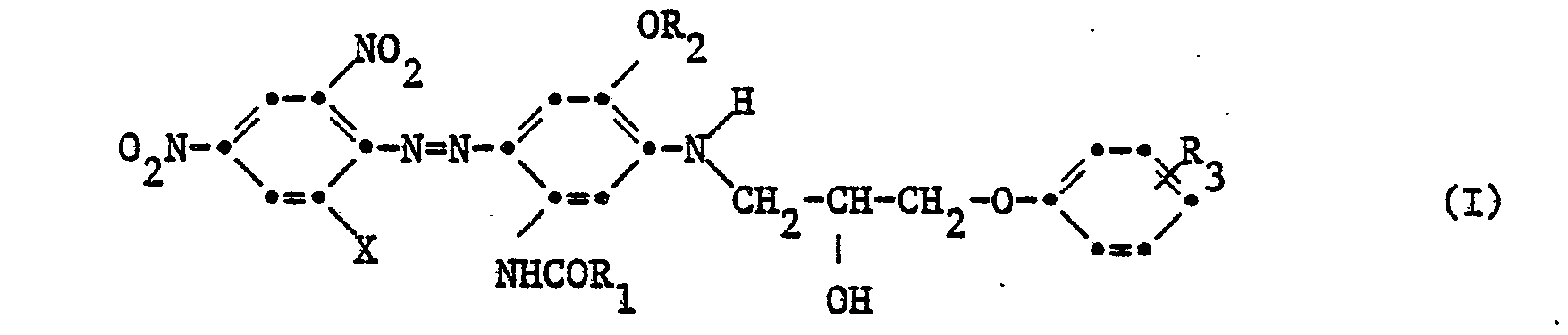
- water-insoluble monoazo dyes of the following formula I which give blue colorations on polyester materials; however, these dyes are not entirely satisfactory in terms of their dye build-up capacity and the depth of color that can be achieved.
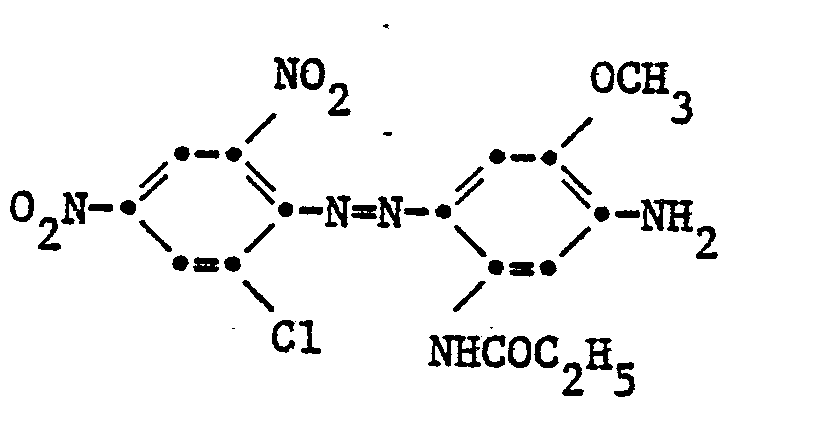
- dyes of the following formula II are also known from F-PS 1 572 585, but with which no navy blue colorations are obtained on polyester materials; in addition, they have only a very low ability to build up dyes.
- a particularly interesting mixture since it gives bright navy blue colors with a very good dye build-up on polyester materials, consists of a dye mixture of the formulas and
- Preferred mixtures consist of 30-80% by weight, in particular 55-70% by weight, of the dye of the formula I and 70-20% by weight, in particular 45-30% by weight of the dye of the formula II.
- the procedure is expediently such that the monoazo dye is reacted with a deficit of the epoxy compound of the formula VI; 1 mole of the monoazo dye and 0.7 mole of the epoxide of the formula VI are advantageously used.
- the diazotization and coupling reactions are also carried out in a known manner, e.g. described in Ullmann's Encyclopedia of Industrial Chemistry, Vol. 5 (1954) page 783 ff.
- the dye mixtures according to the invention are used for dyeing, padding or printing semi-synthetic and, above all, synthetic textile materials.
- the semi-synthetic textile materials used are, in particular, cellulose 2 1/2 acetate and cellulose triacetate.
- Synthetic textile materials consist primarily of linear, aromatic polyesters, for example those made from terephthalic acid and glycols, especially ethylene glycol or condensation products made from taraphthalic acid and 1,4-bis (hydroxymethyl) hexahydrobenzene; Polycarbonates, for example those made from a, a-dimethyl-4,4'-dihydroxy-diphenylmethane and phosgene, fibers based on polyvinyl chloride and polyamide.
- the textile material mentioned can be in a wide variety of processing forms, e.g. as fiber, thread or fleece, as woven or knitted fabric.
- polyester fiber materials are dyed in the exhaust process from an aqueous dispersion in the presence of customary anionic or nonionic dispersants agents and optionally conventional swelling agents (carriers) at temperatures between 80 and 125 ° C or in the absence of carriers under pressure at about 100 to 140 ° C (HT process).
- carriers optionally conventional swelling agents
- Cellulose-2 1/2 acetate is preferably dyed between about 65 to 85 ° C and cellulose triacetate at temperatures up to 115 ° C.
- the dye mixtures according to the invention are also suitable for dyeing by the thermosol process; they do not stain wool and cotton present in the dyebath at the same time or only slightly (very good reserve) so that they can be used well for dyeing polyester / wool and polyester / cellulose fiber blended fabrics.
- the dye mixture according to the invention is ground so that its particle size is on average between 0.01 and 10 microns.
- the grinding can take place in the presence of dispersants.
- the dried dye mixture is ground with a dispersant or kneaded in paste form with a dispersant and then dried in vacuo or by atomization. With the preparations obtained in this way, dyeing, padding or printing can be carried out after adding water.
- the usual thickening agents will be used for padding and printing, e.g. modified or unmodified natural products, for example alginates, British gum, gum arabic, crystal gum, locust bean gum, tragacanth, carboxymethyl cellulose, hydroxyethyl cellulose, starch or synthetic products, for example polyacrylamides or polyvinyl alcohols.
- modified or unmodified natural products for example alginates, British gum, gum arabic, crystal gum, locust bean gum, tragacanth, carboxymethyl cellulose, hydroxyethyl cellulose, starch or synthetic products, for example polyacrylamides or polyvinyl alcohols.
- the dye mixtures according to the invention give the above-mentioned materials, especially the polyester material, navy blue shades of very good fastness properties, above all very good fastness to light, good fastness to sublimation, fastness to heat setting, pleating, chlorine and water, such as water, sweat and wash fastness; the colorations are further characterized by good pH stability.
- the dye mixtures according to the invention can also be used well to produce mixed shades, especially in the black and brown areas.
- Example 1 21.75 parts of 2,4-dinitro-6-chloroaniline are diazotized with nitrosylsulfuric acid. This diazo solution is, at a temperature of 0-5 ° with the addition of ice, to a mixture of 17.2 T 3-N ( ⁇ -oxy-y-phenoxy) propylamino-4-methoxy-propionylanilide and 9.7 T 4- Propionyl-amido-2-aminoanisole dissolved in 90 T acetic acid was added dropwise. After the coupling has ended, the mixture is filtered and washed neutral with water. The moist filter cake is then refluxed in 500 T of water and 1 T of a surfactant for 3-5 hours and filtered hot.
- the mixture described can also be obtained by mixing the separately prepared individual dyes.
- Example 2 1 part of the dye mixture obtained according to Example 1 is wet-ground with 2 parts of a 50% aqueous solution of the sodium salt of dinaphthylmethane disulfonic acid and dried.
- This dye preparation is stirred with 40 parts of a 10% aqueous solution of the sodium salt of N-benzylheptadecylbenzimidazole disulfonic acid and 4 parts of a 40% acetic acid solution are added.
- a dye bath of 4000 T is prepared from this by dilution with water.
- Example 3 2 parts of the dye mixture obtained in Example 1 are dispersed in 4000 parts of water. 12 T of the sodium salt of o-phenylphenol and 12 T of diammonium phosphate are added to this dispersion and 100 T of yarn made from polyethylene glycol terephthalate are dyed in this liquor for 90 minutes at 95 to 98 °.
- the dyed material is then rinsed and aftertreated with aqueous sodium hydroxide solution and a dispersant. This gives a navy blue color with very good fastness to light and sublimation.
- the tissue squeezed to approx. 100% is dried at 100 ° and then fixed at a temperature of 210 ° for 30 seconds.
- the dyed goods are rinsed with water, soaped and dried. A navy blue color is obtained with very good fastness to light and sublimation.
Landscapes
- Chemical & Material Sciences (AREA)
- Organic Chemistry (AREA)
- Chemical Kinetics & Catalysis (AREA)
- Coloring (AREA)
Abstract
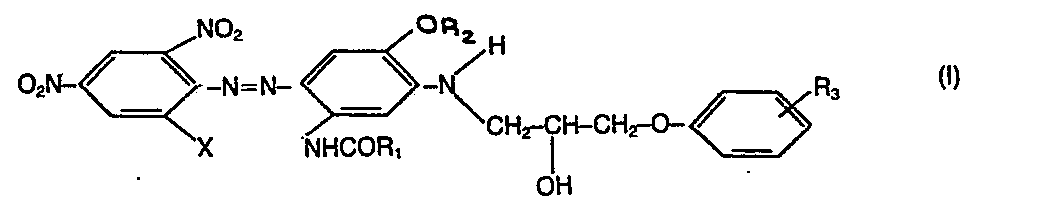

- X ein Halogenatom,
- R1 und R2 unabhängig voneinander eine C1-C4-Alkylgruppe, und
- R3 Wasserstoff, Halogen oder C1-C4-Alkyl sowie Verfahren zur Herstellung dieser Farbstoffmischung. Verwendung findet diese Farbstoffmischung vorallem zum Färben und Bedrukken von halbsynthetischen und synthetischen Textilmaterialien wie Polyestermaterialien, wobei man marineblaue Ausfärbungen erhält, die gekennzeichnet sind durch ihre Farbkraft und gutem Aufbauvermögen der Farbstoffe.
Description
- Die Erfindung betrifft eine Mischung von Farbstoffen, Verfahren zur Herstellung dieser Farbstoffmischung und deren Verwendung zum Färben und Bedrucken von halbsynthetische und synthetischen Textilmaterialien, vor allem Polyestermaterialien.
- Aus der DE-AS 1644305 sind wasserunlösliche Monoazofarbstoffe der folgenden Formel I bekannt die blaue Ausfärbungen auf Polyestermaterialien ergeben; diese Farbstoffe sind jedoch bezüglich ihres Farbstoffaufbauvermögens und der erzielbaren Farbtiefe nicht ganz zufriedenstellend.
- Andererseits sind auch Farbstoffe der folgenden Formel II aus der F-PS 1 572 585 bekannt, mit denen aber auf Polyestermaterialien keine marineblauen Ausfärbungen erhalten werden; zudem haben sie nur ein sehr geringes Farbstoffaufbauvermögen.
- Es wurde nun gefunden, dass man mit einer Mischung der beiden Farbstoffe I und II-auf Polyestermaterialien überraschenderweise farbkräftige, marineblaue Ausfärbungen erhält, wobei die Farbstoffmischung sowohl ein ausgezeichnetes Aufbauvermögen besitzt als auch farbstarke Ausfärbungen mit ausgezeichneten Gesamtechtheiten ergibt die derjenigen der Einzelfarbstoffe I oder II deutlich überlegen ist.
- Die Erfindung betrifft somit eine Farbstoffmischung der Formeln


- X ein Halogenatom,
- R1 und R2 unabhängig voneinander eine C1-C4-Alkylgruppe, und
- R3 Wasserstoff, Halogen oder C1-C4-Alkyl.
- X und R3 in der Bedeutung eines Halogenatoms stellt ein Fluor, Chlor oder Bromatom dar. In den bevorzugten Mischungen bedeutet X je Chlor.
- R1, R2 und R3 in der Bedeutung einer C1-C4-Alkylgruppe stellt sowohl eine unverzweigte als auch verzweigte Alkylgruppe dar. Es handelt sich beispielsweise um die Methyl-, Aethyl-, n- und iso-Propyl und n-, sec- oder tert.Butylgruppe. In den bevorzugten Mischungen bedeutet R1 Aethyl, R2 Methyl und R3 Wasserstoff.
- Eine besonders interessante Mischung, da sie farbkräftige marineblaue Ausfärbungen mit einem sehr guten Farbstoffaufbauvermögen auf Polyestermaterialien ergibt,besteht aus einer Farbstoffmischung der Formeln


- Bevorzugte Mischungen bestehen aus 30-80 Gew.-% insbesondere 55-70 Gew.-% des Farbstoffes der Formel I und 70-20 Gew.-% insbesondere 45-30 Gew.-% des Farbstoffes der Formel II.
- Die Herstellung der Mischung der Farbstoffe I und II erfolgt nach bekannten Methoden, beispielsweise derart, dass man:
- a) die Farbstoffe der Formeln I und II miteinander mischt, wobei die Farbstoffe der Formeln I und II hergestellt werden, indem man in an sich bekannter Weise ein Amin der Formel V


- b) indem man ein Amin der Formel V


- c) indem man auf einen Monoazofarbstoff der Formel II


- Was die bevorzugte Verfahrensvariante b) betrifft, so sind die Amine der Formel V bekannt und können nach bekannten Methoden hergestellt werden; ebenso die Amine der Formel IV, und die Verbindungen der Formel III. Letztere können erhalten werden, indem man ein Amin der Formel IV mit einer Epoxyverbindung der Formel VI

- 3-N-(ß-oxy-y-phenoxy)-propylamino-4-methoxy-aaetylanilid,
- 3-N-(ß-oxy-γ-[o-methyl]-phenoxy)-propylamino-4-methoxy-propionylanilid,
- 3-N-(β-oxy-γ-[3'-chlor]-phenoxy)-propylamino-4-methoxy-acetylanilid,
- 3-N-(β-oxy-γ-[4'-methyl]-phenoxy)-propylamino-4-methoxy-acetylanilid,
- 3-N-(β-oxy-γ-phenoxy)-propylamino-4-methoxy-propionylanilid,
- 3-N(β-oxy-γ-phenoxy)-propylamino-4-äthoxyacetylanilid,
- 3-N-(β-oxy-γ-phenoxy)-propylamino-4-äthoxypropionylanilid, und
- 3-N-(β-oxy-γ-phenoxy)-propylamino-4-n-propoxyacetylanilid.
- Was die Verfahrensvariante c) betrifft, so geht man zweckmässig derart vor, dass man den Monoazofarbstoff mit einem Unterschuss der Epoxyverbindung der Formel VI zur Umsetzung bringt; vorteilhaft verwendet man 1 Mol des Monoazofarbstoffes und 0,7 Mol des Epoxyds der Formel VI.
- Die Diazotierungs- und Kupplungsreaktionen erfolgen ebenfalls nach bekannter Art und Weise wie z.B. beschrieben in Ullmanns Encyklopädie der technischen Chemie, Bd. 5 (1954) Seite 783 ff.
- Verwendung finden die erfindungsgemässen Farbstoffmischungen zum Färben, Klotzen oder Bedrucken von halbsynthetischen und vorallem synthetischen Textilmaterialien. Als halbsynthetische Textilmaterialien kommen vorallem Cellulose 2 1/2 Acetat und Cellulosetriacetat in Frage. Synthetische Textilmaterialien bestehen vor allem aus linearen, aromatischen Polyestern, beispielsweise solchen aus Terephthalsäure und Glykolen, besonders Aethylenglykol oder Kondensationsprodukten aus Taraphthalsäure und 1,4-Bis-(hydroxymethyl)-hexahydrobenzol; Polycarbonate, zum Beispiel solchen aus a,a-Dimethyl-4,4'-dihydroxy-diphenylmethan und Phosgen, Fasern auf Polyvinylchlorid-Basis sowie Polyamid-Basis.
- Das genannte Textilmaterial kann dabei in den verschiedensten Verarbeitungsformen vorliegen wie z.B. als Faser, Faden oder Vlies, als Gewebe oder Gewirke.
- Die Applikation der erfindungsgemässen Farbstoffmischungen erfolgt nach bekannten Färbeverfahren. Beispielsweise färbt man Polyesterfasermaterialien im Ausziehverfahren aus wässriger Dispersion in Gegenwart von üblichem anionischen oder nicht-ionischen Dispergiermitteln und gegebenenfalls üblichen Quellmitteln (Carrier) bei Temperaturen zwischen 80 und 125°C oder in Abwesenheit von Carrier unter Druck bei etwa 100 bis 140°C (HT-Verfahren). Cellulose-2 1/2-acetat färbt man vorzugsweise zwischen ungefähr 65 bis 85°C und Cellulosetriacetat bei Temperaturen bis zu 115°C. Die erfindungsgemässen Farbstoffmischungen eignen sich ferner zum Färben nach dem ThermosolVerfahren; sie färben gleichzeitig im Färbebad anwesende Wolle und Baumwolle nicht oder nur wenig an (sehr gute Reserve) sodass sie gut zum Färben von Polyester/Wolle- und Polyester/Cellulosefaser-Mischgeweben verwendet werden können.
- Es ist vorteilhaft die erfindungsgemässe Farbstoffmischung vor ihrer Verwendung in ein Farbstoffpräparat überzuführen. Hierzu wird die Farbstoffmischung vermahlen, sodass ihre Teilchengrösse im Mittel zwischen 0.01 und 10 Mikron beträgt. Das Vermahlen kann in Gegenwart von Dispergiermitteln erfolgen. Beispielsweise wird die getrocknete Farbstoffmischung mit einem Dispergiermittel gemahlen oder in Pastenform mit einem Dispergiermittel geknetet und hierauf im Vakuum oder durch Zerstäuben getrocknet. Mit den so erhaltenen Präparaten kann man, nach Zugabe von Wasser färben, klotzen oder bedrucken.
- Beim Klotzen und Bedrucken wird man die üblichen Verdickungsmittel verwenden, z.B. modifizierte oder nichtmodifizierte natürliche Produkte, beispielsweise Alginate, Britishgummi, Gummi arabicum, Kristallgummi, Johannisbrotkernmehl, Tragant, Carboxymethylcellulose, Hydroxyäthylcellulose, Stärke oder synthetische Produkte beispielsweise Polyacrylamide oder Polyvinylalkohole.
- Die erfindungsgeinässen Farbstoffmischungen verleihen den genannten Materialien vorallem dem Polyestermaterial marineblaue Farbtöne von sehr guten Echtheiten wie vorallem sehr guter Lichtechtheit, guter Sublimierechtheit, Thermofixier-, Plissier-, Chlor- und Nassechtheit wie Wasser-, Schweiss- und Waschechtheit; die Ausfärbungen sind ferner gekennzeichnet durch eine gute pH-Stabilität.
- Die erfindungsgemässen Farbstoffmischungen können auch gut verwendet werden zur Herstellung von Mischnuancen, vor allem im Schwarz- und Braunbereich.
- Die folgenden Beispiele veranschaulichen die Erfindung ohne sie darauf zu limitieren; Temperaturen sind in Grad Celsius angegeben; Teile (T) bedeuten, sofern nichts anderes angegeben ist, Gewichtsteile.
- Beispiel 1: 21,75 T 2,4-Dinitro-6-chloranilin werden mit Nitrosylschwefelsäure diazotiert. Diese Diazolösung wird, bei einer Temperatur von 0-5° unter Zusatz von Eis zu einem Gemisch von 17,2 T 3-N(ß-oxy- y-phenoxy)propylamino-4-methoxy-propionylanilid und 9,7 T 4-Propionyl- amido-2-aminoanisol gelöst in 90 T Essigsäure eingetropft. Nach beendeter Kupplung wird filtriert und mit Wasser neutral gewaschen. Das feuchte Nutschgut wird anschliessend in 500 T Wasser und 1 T eines Tensids 3-5 Std. am Rückfluss gekocht und heiss filtriert.
- Man erhält eine Farbstoffmischung folgender Zusammensetzung

- Die beschriebene Mischung kann auch durch Mischen der separat hergestellten Einzelfarbstoffe erhalten werden.
- Zu einer Mischung mit ebenso guten färberischen Eigenschaften gelangt man, wenn man bei im übrigen gleicher Arbeitsweise anstelle der 17.2 T 3-N-(β-oxy-γ-phenoxy)-propylamino-4-methoxy-propionylanilid 17.4 T 3-N-(β-oxy-γ-[o-methyl]-phenoxy)-propylamino-4-methoxy-propionylanilid verwendet.
- Beispiel 2: 1 T des gemäss Beispiel 1 erhaltenen Farbstoffgemisches wird mit 2 T einer 50%igen wässerigen Lösung des Natriumsalzes der Dinaphthylmethandisulfonsäure nass vermahlen und getrocknet.
- Dieses Farbstoffpräparat wird mit 40 T einer 10%igen wässerigen Lösung des Natriumsalzes der N-Benzylheptadecyl-benzimidazoldisulfonsäure verrührt und 4 T einer 40%igen Essigsäurelösung zugegeben. Durch Verdünnen mit Wasser wird daraus ein Färbebad von 4000 T bereitet.
- In dieses Bad geht man bei 50° mit 100 T eines Polyesterfaserstoffes ein, steigert die Temperatur innert einer halben Stunde auf 120 bis 130° und färbt eine Stunde in geschlossenem Gefäss bei dieser Temperatur. Anschliessend wird gut gespült. Man erhält eine sehr tiefe und kräftige marineblaue Färbung mit sehr guter Licht- und Sublimierechtheit.
- Beispiel 3: 2 T des gemäss Beispiel 1 erhaltenen Farbstoffgemisches werden in 4000 T Wasser dispergiert. Zu dieser Dispersion gibt man 12 T des Natriumsalzes von o-Phenylphenol sowie 12 T Diammoniumphosphat und färbt 100 T Garn aus Polyäthylenglykolterephthalat 90 Minuten lang bei 95 bis 98° in dieser Flotte.
- Das gefärbte Material wird anschliessend gespült und mit wässeriger Natronlauge und einem Dispergator nachbehandelt. Man erhält so eine marineblaue Färbung, mit sehr guter Licht- und Sublimierechtheit.
- Beispiel 4: Polyäthylenglykolterephthalatgewebe wird auf einem Foulard bei 40° mit einer Flotte folgender Zusammensetzung imprägniert:
- 20 T des gemäss Beispiel 1 erhaltenen Farbstoffgemisches fein dispergiert in
- 10 T Natriumalginat ;
- 20 T Triäthanolamin
- 20 T Octylphenolpolyglykoläther und
- 930 T Wasser.
- Das auf ca. 100% abgequetschte Gewebe wird bei 100° getrocknet und anschliessend während 30 Sekunden bei einer Temperatur von 210° fixiert. Die gefärbte Ware wird mit Wasser gespült, geseift und getrocknet. Man erhält eine marineblaue Färbung mit sehr guter Licht-und Sublimierechtheit.
Claims (12)




Applications Claiming Priority (2)
| Application Number | Priority Date | Filing Date | Title |
|---|---|---|---|
| CH7773/80 | 1980-10-17 | ||
| CH777380 | 1980-10-17 |
Publications (3)
| Publication Number | Publication Date |
|---|---|
| EP0050587A2 true EP0050587A2 (de) | 1982-04-28 |
| EP0050587A3 EP0050587A3 (en) | 1983-03-16 |
| EP0050587B1 EP0050587B1 (de) | 1985-04-03 |
Family
ID=4330249
Family Applications (1)
| Application Number | Title | Priority Date | Filing Date |
|---|---|---|---|
| EP19810810410 Expired EP0050587B1 (de) | 1980-10-17 | 1981-10-12 | Mischung von Farbstoffen |
Country Status (3)
| Country | Link |
|---|---|
| EP (1) | EP0050587B1 (de) |
| JP (1) | JPS603429B2 (de) |
| DE (1) | DE3169710D1 (de) |
Cited By (1)
| Publication number | Priority date | Publication date | Assignee | Title |
|---|---|---|---|---|
| US4678476A (en) * | 1985-11-09 | 1987-07-07 | Cassella Aktiengesellschaft | Mixtures of blue mono-azo disperse dyestuffs and their use for dyeing polyester |
Families Citing this family (1)
| Publication number | Priority date | Publication date | Assignee | Title |
|---|---|---|---|---|
| JPS62228117A (ja) * | 1986-03-28 | 1987-10-07 | Sekisui Chem Co Ltd | 液面レベル検出装置 |
Family Cites Families (3)
| Publication number | Priority date | Publication date | Assignee | Title |
|---|---|---|---|---|
| US3632569A (en) * | 1967-06-07 | 1972-01-04 | Ciba Ltd | Monazo dyestuffs containing a metaacylamino-para-amino aniline group |
| US3955919A (en) * | 1969-11-05 | 1976-05-11 | Mitsui Toatsu Chemicals, Incorporated | Dyestuff mixtures and process for dyeing polyester fiber therewith |
| GB1360482A (en) * | 1972-02-22 | 1974-07-17 | Ici Ltd | Colouration process |
-
1981
- 1981-10-12 DE DE8181810410T patent/DE3169710D1/de not_active Expired
- 1981-10-12 EP EP19810810410 patent/EP0050587B1/de not_active Expired
- 1981-10-17 JP JP16495481A patent/JPS603429B2/ja not_active Expired
Cited By (2)
| Publication number | Priority date | Publication date | Assignee | Title |
|---|---|---|---|---|
| US4678476A (en) * | 1985-11-09 | 1987-07-07 | Cassella Aktiengesellschaft | Mixtures of blue mono-azo disperse dyestuffs and their use for dyeing polyester |
| USRE33908E (en) * | 1985-11-09 | 1992-05-05 | Cassella Aktiengesellschaft | Mixtures of blue mono-azo disperse dyestuffs and their use for dyeing polyester |
Also Published As
| Publication number | Publication date |
|---|---|
| EP0050587A3 (en) | 1983-03-16 |
| EP0050587B1 (de) | 1985-04-03 |
| DE3169710D1 (en) | 1985-05-09 |
| JPS5796053A (en) | 1982-06-15 |
| JPS603429B2 (ja) | 1985-01-28 |
Similar Documents
| Publication | Publication Date | Title |
|---|---|---|
| EP1141138B1 (de) | Phthalimidyl-azofarbstoffe, verfahren zu deren herstellung und deren verwendung | |
| EP0894830B1 (de) | Dispersionsfarbstoffe | |
| EP0699718A2 (de) | Azothiophenfarbstoffe mit einer 2,4,6-Triamino-3-cyanpyridin Kupplungskomponente | |
| DE19618586B4 (de) | Monoazo-Dispersionsfarbstoffe | |
| EP0043795B1 (de) | Monoazoverbindungen | |
| DE1644343B2 (de) | Dispersions-Monoazofarbstoffe, Verfahren zu ihrer Herstellung und ihre Verwendung | |
| EP0463995B1 (de) | Azofarbstoffe mit 2-Alkylamino-3-cyan-4,6-diaminopyridinen als Kupplungskomponenten | |
| EP0826741B1 (de) | Dispersionsfarbstoffe | |
| EP0050587B1 (de) | Mischung von Farbstoffen | |
| EP0085823B1 (de) | Farbstoffmischung, Verfahren zu ihrer Herstellung und Verwendung zum Färben und Bedrucken von hydrophobem Textilmaterial | |
| EP0083313B1 (de) | Farbstoffmischung, Verfahren zu ihrer Herstellung und Verwendung zum Färben und Bedrucken von hydrophobem Fasermaterial | |
| EP0776948B1 (de) | Mischungen von Monoazopyridonfarbstoffen | |
| CH689980A5 (de) | Mischungen von Monoazopyridonfarbstoffen. | |
| EP0284560B1 (de) | Dispersionsfarbstoffe, enthaltend eine Tricyanovinylgruppierung | |
| EP0041042B1 (de) | Azoverbindungen | |
| EP0040582B1 (de) | Azoverbindungen | |
| EP1085055B1 (de) | Azofarbstoff, Verfahren zu dessen Herstellung und dessen Verwendung zum Färben oder Bedrucken von hydrophoben Fasermaterialien | |
| DE19646430A1 (de) | Mischungen von Monoazopyridonfarbstoffen | |
| CH644621A5 (en) | Azo compounds | |
| EP0952190B1 (de) | Dispersionsfarbstoffe | |
| EP1085058B1 (de) | Azofarbstoffmischungen | |
| DE4001671A1 (de) | Monoazofarbstoffe, ihre herstellung und verwendung | |
| EP0111450A1 (de) | Monoazoverbindungen | |
| DE3300914A1 (de) | Rhodanphenyl-azofarbstoffe, ihre herstellung und ihre verwendung | |
| DE19647869A1 (de) | Mischungen von Monoazopyridonfarbstoffen |
Legal Events
| Date | Code | Title | Description |
|---|---|---|---|
| PUAI | Public reference made under article 153(3) epc to a published international application that has entered the european phase |
Free format text: ORIGINAL CODE: 0009012 |
|
| 17P | Request for examination filed |
Effective date: 19811014 |
|
| AK | Designated contracting states |
Designated state(s): CH DE FR GB IT |
|
| PUAL | Search report despatched |
Free format text: ORIGINAL CODE: 0009013 |
|
| AK | Designated contracting states |
Designated state(s): CH DE FR GB IT LI |
|
| ITF | It: translation for a ep patent filed | ||
| GRAA | (expected) grant |
Free format text: ORIGINAL CODE: 0009210 |
|
| AK | Designated contracting states |
Designated state(s): CH DE FR GB IT LI |
|
| REF | Corresponds to: |
Ref document number: 3169710 Country of ref document: DE Date of ref document: 19850509 |
|
| ET | Fr: translation filed | ||
| PLBE | No opposition filed within time limit |
Free format text: ORIGINAL CODE: 0009261 |
|
| STAA | Information on the status of an ep patent application or granted ep patent |
Free format text: STATUS: NO OPPOSITION FILED WITHIN TIME LIMIT |
|
| 26N | No opposition filed | ||
| PGFP | Annual fee paid to national office [announced via postgrant information from national office to epo] |
Ref country code: GB Payment date: 19910802 Year of fee payment: 11 |
|
| PGFP | Annual fee paid to national office [announced via postgrant information from national office to epo] |
Ref country code: FR Payment date: 19910823 Year of fee payment: 11 |
|
| PGFP | Annual fee paid to national office [announced via postgrant information from national office to epo] |
Ref country code: DE Payment date: 19910909 Year of fee payment: 11 |
|
| ITTA | It: last paid annual fee | ||
| PGFP | Annual fee paid to national office [announced via postgrant information from national office to epo] |
Ref country code: CH Payment date: 19911126 Year of fee payment: 11 |
|
| PG25 | Lapsed in a contracting state [announced via postgrant information from national office to epo] |
Ref country code: GB Effective date: 19921012 |
|
| PG25 | Lapsed in a contracting state [announced via postgrant information from national office to epo] |
Ref country code: LI Effective date: 19921031 Ref country code: CH Effective date: 19921031 |
|
| GBPC | Gb: european patent ceased through non-payment of renewal fee |
Effective date: 19921012 |
|
| PG25 | Lapsed in a contracting state [announced via postgrant information from national office to epo] |
Ref country code: FR Effective date: 19930630 |
|
| REG | Reference to a national code |
Ref country code: CH Ref legal event code: PL |
|
| PG25 | Lapsed in a contracting state [announced via postgrant information from national office to epo] |
Ref country code: DE Effective date: 19930701 |
|
| REG | Reference to a national code |
Ref country code: FR Ref legal event code: ST |