EP0346038A1 - Ternär Metallmatrix-Verbundwerkstoff - Google Patents
Ternär Metallmatrix-Verbundwerkstoff Download PDFInfo
- Publication number
- EP0346038A1 EP0346038A1 EP89305635A EP89305635A EP0346038A1 EP 0346038 A1 EP0346038 A1 EP 0346038A1 EP 89305635 A EP89305635 A EP 89305635A EP 89305635 A EP89305635 A EP 89305635A EP 0346038 A1 EP0346038 A1 EP 0346038A1
- Authority
- EP
- European Patent Office
- Prior art keywords
- composite
- metal matrix
- ternary metal
- metal
- silicon
- Prior art date
- Legal status (The legal status is an assumption and is not a legal conclusion. Google has not performed a legal analysis and makes no representation as to the accuracy of the status listed.)
- Withdrawn
Links
Images
Classifications
-
- C—CHEMISTRY; METALLURGY
- C22—METALLURGY; FERROUS OR NON-FERROUS ALLOYS; TREATMENT OF ALLOYS OR NON-FERROUS METALS
- C22C—ALLOYS
- C22C32/00—Non-ferrous alloys containing at least 5% by weight but less than 50% by weight of oxides, carbides, borides, nitrides, silicides or other metal compounds, e.g. oxynitrides, sulfides, whether added as such or formed in situ
- C22C32/0047—Non-ferrous alloys containing at least 5% by weight but less than 50% by weight of oxides, carbides, borides, nitrides, silicides or other metal compounds, e.g. oxynitrides, sulfides, whether added as such or formed in situ with carbides, nitrides, borides or silicides as the main non-metallic constituents
- C22C32/0052—Non-ferrous alloys containing at least 5% by weight but less than 50% by weight of oxides, carbides, borides, nitrides, silicides or other metal compounds, e.g. oxynitrides, sulfides, whether added as such or formed in situ with carbides, nitrides, borides or silicides as the main non-metallic constituents only carbides
- C22C32/0063—Non-ferrous alloys containing at least 5% by weight but less than 50% by weight of oxides, carbides, borides, nitrides, silicides or other metal compounds, e.g. oxynitrides, sulfides, whether added as such or formed in situ with carbides, nitrides, borides or silicides as the main non-metallic constituents only carbides based on SiC
-
- H—ELECTRICITY
- H05—ELECTRIC TECHNIQUES NOT OTHERWISE PROVIDED FOR
- H05K—PRINTED CIRCUITS; CASINGS OR CONSTRUCTIONAL DETAILS OF ELECTRIC APPARATUS; MANUFACTURE OF ASSEMBLAGES OF ELECTRICAL COMPONENTS
- H05K1/00—Printed circuits
- H05K1/02—Details
- H05K1/03—Use of materials for the substrate
- H05K1/05—Insulated conductive substrates, e.g. insulated metal substrate
-
- Y—GENERAL TAGGING OF NEW TECHNOLOGICAL DEVELOPMENTS; GENERAL TAGGING OF CROSS-SECTIONAL TECHNOLOGIES SPANNING OVER SEVERAL SECTIONS OF THE IPC; TECHNICAL SUBJECTS COVERED BY FORMER USPC CROSS-REFERENCE ART COLLECTIONS [XRACs] AND DIGESTS
- Y10—TECHNICAL SUBJECTS COVERED BY FORMER USPC
- Y10T—TECHNICAL SUBJECTS COVERED BY FORMER US CLASSIFICATION
- Y10T428/00—Stock material or miscellaneous articles
- Y10T428/12—All metal or with adjacent metals
- Y10T428/12486—Laterally noncoextensive components [e.g., embedded, etc.]
Definitions
- This invention relates to a ternary metal matrix composite comprising a metal matrix reinforced with an insoluble ceramic and a semi-metal.
- the ternary metal matrix composite of the present invention has a lower, more consistent coefficient of thermal expanson than binary composites using similar materials, while exhibiting low density and good formability.
- Composite materials are well-known and commonly used.
- a composite may be defined as a man-made material in which two or more constituents are combined to create a material having properties different than those of either constituents.
- One form of known composite is a binary metal matrix composite, which consists of a metal matrix and a reinforcement material distributed in, and bound together by, the matrix.
- the reinforcement usually is in the form of fibers, whiskers or particles.
- Typical metal matrix binding materials include aluminum, cobalt, iron, magnesium, titanium, or alloys of these materials.
- Typical reinforcement materials include ceramics, such as silicon carbide, boron carbide, aluminium oxide, tungsten carbide, and other borides, carbides, oxides, nitride, silicides, aluminides, selenides, sulfides and germanides. These binary metal matrix composites are stronger and stiffer than conventional alloys and are particularly abrasion resistant.
- a metal core is often employed to constrain the epoxy-glass of circuit boards which have surface mounted ceramic components.
- This metal core is generally composed of copper-clad Invar, molybdenum, or copper-tungsten composites. The overall weight of these materials makes them undesirable for aeronautical and aerospace applications and other uses where light weight is critically important.
- the metal core of the circuit boards is required to have a low coefficient of thermal expansion to reduce the stresses on the solder joints bonding the ceramic components to the printed circuit board. Without a low coefficient of thermal expansion core, the solder joints could fail due to the differences in the expansion of the ceramic component and the epoxy-glass circuit board.
- the metal core of the circuit board also serves to remove heat from the circuit.
- Invar is a very poor thermal conductor, it must be clad with copper which increases cost and limits availability.
- Invar, tungsten and molybdenum are heavy materials. Molybdenum has a density of 10.2 g/cc and Invar 8.4 g/cc.
- the thermal conductivity is about 150 W/mK for copper-clad Invar and 160 W/mK for molybdenum.
- the present invention is a ternary metal matrix composite comprising a metallic binding matrix material and a reinforcement material consisting essentially of an insoluble ceramic and a semi-metal.
- Semi-metals are elements from groups IIIA through VIIA of the Periodic Table of the Elements. These elements display some of the characteristic properties of metals combined with properties of non-metals.
- the ternary metal matrix composite of the invention has a coefficient of thermal expansion which is lower and more consistent than that of known binary composites using similar materials. The coefficient of thermal expansion may be tailored to meet specific application needs.
- the invention also has a low density, good thermal conductivity, dimensional stability, and formability.
- the metal matrix of the present invention comprises 40 to 60% of the composite with a most preferred range of 45 to 55 volume percent.
- the insoluble ceramic comprises 10-50 volume percent of the composite with a most preferred range of 30-40 volume percent.
- the semi-metal comprises 10-40 volume percent of the composite, with a most preferred range of 10-25 volume percent.
- the insoluble ceramic and semi-metal contain the same element.
- the ternary metal matrix composite comprises an aluminum alloy matrix and a reinforcement material of silicon carbide and silicon.
- the present invention is directed to a metal matrix reinforced with an insoluble ceramic and a semi-metal.
- the resulting ternary metal matrix composite may be tailored to match the coefficient of thermal expansion of certain ceramic materials, such as aluminum oxide, and other materials having a low coefficient of thermal expansion.
- the ternary composite is light weight and has a density of approximately 2.7-3.0 g/cc. Thus, it is significantly lighter in weight than other known materials with a low coefficient of thermal expansion, such as copper-clad-Invar, copper-tungsten, or molybdenum.
- the invention has a coefficient of thermal expansion range much lower than that of aluminum or aluminum alloys.
- the thermal conductivity of the preferred form of the invention is about 120 W/mK.
- the metal matrix of the present invention is aluminum or aluminum alloy.
- Magnesium and its alloys or titanium and its alloys may also be used for the metal matrix.
- Any insoluble ceramic having a low coefficient of thermal expansion and a high bulk modulus can be used in the ternary metal matrix composite of the present invention.
- Typical examples of a suitable insoluble ceramic are silicon carbide, silicon nitride, aluminum nitride, boron silicide, and boron carbide.
- the preferred semi-metals are silicon, boron, and germanium.
- the insoluble ceramic and semi-metal may be advantages in some applications for the insoluble ceramic and semi-metal to contain the same element. For example, if silicon carbide is selected as the insoluble ceramic, silicon could be selected as the semi-metal; whereas, if boron carbide is selected as the insoluble ceramic, boron could be selected as the semi-metal.
- the ternary composition of the present invention has a lower, more consistent coefficient of thermal expansion for a given volume loading of reinforcement material. Additionally, the ternary metal matrix of the present invention has better or equal formability than is attained by reinforcing aluminum or aluminum alloys with equal amounts of either silicon or insoluble ceramic alone.
- the preferred range of the ternary composition of the present invention is 40-60 volume percent metal matrix with a combination of semi-metal and insoluble ceramic making up the balance as the reinforcement material.
- Preferably 10-50 volume percent of the reinforcement material should be insoluble ceramic and 10-40 volume percent semi-metal.
- the most preferred composition and range is 45-55 volume percent aluminum or aluminum alloy matrix, with the reinforcement material being 30-40 volume percent insoluble ceramic and 10-25 volume percent semi-metal.
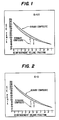
- the coefficients of thermal expansion for materials 1 and 2 in Table 1 are compared in Figures 1 and 2 to the measured coefficient of thermal expansion for binary composites of aluminum-silicon carbide and aluminum-silicon, respectively.
- the range of coefficient of thermal expansion values measured for the binary composites is shown as shaded lines in these figures.
- the coefficient of thermal expansion of material 1 is shown at point 1 in Figures 1 and 2; material 2 is shown at point 2.
- Both Figures 1 and 2 show that for a given volume loading, the coefficient of thermal expansion of the ternary metal matrix composite of the present invention is measurably lower than those of the Al/SiC and Al/Si binary-composites.
- both silicon and silicon carbide as constituents of the ternary metal matrix composite of the present invention, an advantage is gained over using either silicon or silicon carbide singularly.
- Aluminum with silicon and silicon carbide has a lower melting point than does aluminum with silicon carbide alone. Because of this lower melting point, lower temperatures are used in the consolidation of the new material than in the consolidation of aluminum-silicon carbide.
- a lower consolidation temperature may allow for finer grain structures in some of the aluminum alloys. A finer grain structure improves properties such as ductility and strength. Even though the consolidation temperature is lower for the ternary metal matrix composite of the present invention, the pressure required for consolidation is not increased.
- silicon in the range of this invention
- Silicon is used not only to lower the melting point but also because silicon has a lower coefficient of thermal expansion and lower density than silicon carbide and will therefore lower the coefficient of thermal expansion and density of the ternary composite.
- the silicon carbide reduces the embrittling influence of the silicon metal on the aluminum. Because of this the ternary composite is much less brittle with better formability and machineability than aluminum with an equivalent loading of silicon alone.
- the preferred aluminum-silicon-silicon carbide ternary composite of the present invention may be made by preparing powder blends within the composition range and vacuum hot pressing the powder into full density billets. This material could also be manufactured by hot isostatic pressing, cold pressing and sintering, casting, forging, injection molding and other standard metallurgical techniques.
Landscapes
- Chemical & Material Sciences (AREA)
- Engineering & Computer Science (AREA)
- Materials Engineering (AREA)
- Mechanical Engineering (AREA)
- Metallurgy (AREA)
- Organic Chemistry (AREA)
- Manufacture Of Alloys Or Alloy Compounds (AREA)
Applications Claiming Priority (2)
| Application Number | Priority Date | Filing Date | Title |
|---|---|---|---|
| US204233 | 1988-06-09 | ||
| US07/204,233 US5006417A (en) | 1988-06-09 | 1988-06-09 | Ternary metal matrix composite |
Publications (1)
| Publication Number | Publication Date |
|---|---|
| EP0346038A1 true EP0346038A1 (de) | 1989-12-13 |
Family
ID=22757139
Family Applications (1)
| Application Number | Title | Priority Date | Filing Date |
|---|---|---|---|
| EP89305635A Withdrawn EP0346038A1 (de) | 1988-06-09 | 1989-06-05 | Ternär Metallmatrix-Verbundwerkstoff |
Country Status (4)
| Country | Link |
|---|---|
| US (1) | US5006417A (de) |
| EP (1) | EP0346038A1 (de) |
| JP (1) | JPH0257659A (de) |
| DE (1) | DE346038T1 (de) |
Cited By (5)
| Publication number | Priority date | Publication date | Assignee | Title |
|---|---|---|---|---|
| WO1997013274A1 (en) * | 1995-09-29 | 1997-04-10 | Aea Technology Plc | A support for electronic components |
| RU2124064C1 (ru) * | 1997-02-12 | 1998-12-27 | Московский государственный институт стали и сплавов (технологический университет) | Композиционный материал |
| EP0805727A4 (de) * | 1995-09-29 | 1999-10-20 | Alyn Corp | Verbesserte mmc |
| RU2183687C1 (ru) * | 2000-10-11 | 2002-06-20 | Московский государственный институт стали и сплавов (технологический университет) | Металломатричный композит |
| WO2018077941A1 (de) * | 2016-10-26 | 2018-05-03 | Deutsches Zentrum für Luft- und Raumfahrt e.V. | Elektrisch-optischer aufbau |
Families Citing this family (20)
| Publication number | Priority date | Publication date | Assignee | Title |
|---|---|---|---|---|
| US5040588A (en) * | 1988-11-10 | 1991-08-20 | Lanxide Technology Company, Lp | Methods for forming macrocomposite bodies and macrocomposite bodies produced thereby |
| JPH05507317A (ja) * | 1990-05-09 | 1993-10-21 | ランキサイド テクノロジー カンパニー,リミティド パートナーシップ | マクロ複合体及び製法 |
| US5435825A (en) * | 1991-08-22 | 1995-07-25 | Toyo Aluminum Kabushiki Kaisha | Aluminum matrix composite powder |
| US5511603A (en) * | 1993-03-26 | 1996-04-30 | Chesapeake Composites Corporation | Machinable metal-matrix composite and liquid metal infiltration process for making same |
| US5722033A (en) * | 1994-01-19 | 1998-02-24 | Alyn Corporation | Fabrication methods for metal matrix composites |
| US5980602A (en) * | 1994-01-19 | 1999-11-09 | Alyn Corporation | Metal matrix composite |
| JP2866917B2 (ja) * | 1994-10-05 | 1999-03-08 | 工業技術院長 | 溶湯攪拌法によるセラミックス粒子強化マグネシウム基複合材料に対する超塑性発現法 |
| US5744254A (en) * | 1995-05-24 | 1998-04-28 | Virginia Tech Intellectual Properties, Inc. | Composite materials including metallic matrix composite reinforcements |
| US6051045A (en) * | 1996-01-16 | 2000-04-18 | Ford Global Technologies, Inc. | Metal-matrix composites |
| JP4080030B2 (ja) * | 1996-06-14 | 2008-04-23 | 住友電気工業株式会社 | 半導体基板材料、半導体基板、半導体装置、及びその製造方法 |
| JP4304749B2 (ja) | 1998-02-24 | 2009-07-29 | 住友電気工業株式会社 | 半導体装置用部材の製造方法 |
| US6503572B1 (en) | 1999-07-23 | 2003-01-07 | M Cubed Technologies, Inc. | Silicon carbide composites and methods for making same |
| US7658781B1 (en) | 1999-07-23 | 2010-02-09 | Marlene Rossing, legal representative | Silicon-containing composite bodies, and methods for making same |
| US20090130435A1 (en) | 1999-07-23 | 2009-05-21 | Aghajanian Michael K | Intermetallic-containing composite bodies, and methods for making same |
| JP3207841B1 (ja) * | 2000-07-12 | 2001-09-10 | 三菱重工業株式会社 | アルミニウム複合粉末およびその製造方法、アルミニウム複合材料、使用済み燃料貯蔵部材およびその製造方法 |
| US8128861B1 (en) | 2000-07-21 | 2012-03-06 | M Cubed Technologies, Inc. | Composite materials and methods for making same |
| JP4289775B2 (ja) * | 2000-09-29 | 2009-07-01 | 日本碍子株式会社 | 多孔質金属基複合材料 |
| JP4113971B2 (ja) * | 2002-07-30 | 2008-07-09 | 株式会社豊田自動織機 | 低膨張材料及びその製造方法 |
| JP5048266B2 (ja) * | 2006-04-27 | 2012-10-17 | 株式会社アライドマテリアル | 放熱基板とその製造方法 |
| US11486651B2 (en) * | 2020-08-20 | 2022-11-01 | Huang-Chieh Metal Composite Material Tech. Co., Lt | Vapor chamber |
Citations (6)
| Publication number | Priority date | Publication date | Assignee | Title |
|---|---|---|---|---|
| FR2072815A5 (de) * | 1969-12-02 | 1971-09-24 | Castolin Sa | |
| EP0188704A2 (de) * | 1985-01-21 | 1986-07-30 | Toyota Jidosha Kabushiki Kaisha | Faserverstärkter Metall-Verbundwerkstoff |
| DE3522166C1 (de) * | 1985-06-21 | 1986-08-07 | Daimler-Benz Ag, 7000 Stuttgart | Verwendung von Aluminium und einer Aluminiumlegierung zur Herstellung von faserverstaerkten Aluminiumgussteilen |
| US4605440A (en) * | 1985-05-06 | 1986-08-12 | The United States Of America As Represented By The United States Department Of Energy | Boron-carbide-aluminum and boron-carbide-reactive metal cermets |
| EP0213615A2 (de) * | 1985-09-02 | 1987-03-11 | Toyota Jidosha Kabushiki Kaisha | Verbundwerkstoff, verstärkt mittels kurzer Fasern aus Siliziumkarbid und/oder Siliziumnitrid und mit einer Matrize aus einer Aluminiumlegierung mit Kupfer und eine ziemlich niedrige Menge Silizium |
| EP0223478A2 (de) * | 1985-11-14 | 1987-05-27 | Imperial Chemical Industries Plc | Faserverstärkter Verbundwerkstoff mit Metallmatrix |
Family Cites Families (16)
| Publication number | Priority date | Publication date | Assignee | Title |
|---|---|---|---|---|
| DE3000171C2 (de) * | 1980-01-04 | 1982-04-29 | Vereinigte Aluminium-Werke Ag, 5300 Bonn | Faserverstärkter Verbundwerkstoff und Verfahren zu seiner Herstellung |
| JPS5798647A (en) * | 1980-12-09 | 1982-06-18 | Nissan Motor Co Ltd | Aluminum alloy material with superior wear resistance |
| US4463058A (en) * | 1981-06-16 | 1984-07-31 | Atlantic Richfield Company | Silicon carbide whisker composites |
| JPS59162242A (ja) * | 1983-03-05 | 1984-09-13 | Riken Corp | 耐摩耗性アルミニウム・珪素押出成形体およびその製造方法 |
| US4499156A (en) * | 1983-03-22 | 1985-02-12 | The United States Of America As Represented By The Secretary Of The Air Force | Titanium metal-matrix composites |
| JPS59173234A (ja) * | 1983-03-22 | 1984-10-01 | Nissan Motor Co Ltd | ブレ−キロ−タ用アルミニウム合金 |
| JPS6050138A (ja) * | 1983-08-30 | 1985-03-19 | Riken Corp | 硬質粒子分散型耐熱耐摩耗性高力アルミニウム合金部材とその製造方法 |
| JPS6050137A (ja) * | 1983-08-30 | 1985-03-19 | Riken Corp | 硬質粒子分散型耐熱耐摩耗性高力アルミニウム合金部材 |
| US4565744A (en) * | 1983-11-30 | 1986-01-21 | Rockwell International Corporation | Wettable coating for reinforcement particles of metal matrix composite |
| JPS60245761A (ja) * | 1984-05-19 | 1985-12-05 | Kobe Steel Ltd | 複合繊維により強化された金属基複合材 |
| JPS6135423A (ja) * | 1984-07-27 | 1986-02-19 | Tanaka Kikinzoku Kogyo Kk | 眼鏡フレ−ム用複合素材 |
| US4836982A (en) * | 1984-10-19 | 1989-06-06 | Martin Marietta Corporation | Rapid solidification of metal-second phase composites |
| US4682744A (en) * | 1985-04-08 | 1987-07-28 | Rca Corporation | Spacecraft structure |
| JPS61240979A (ja) * | 1985-04-19 | 1986-10-27 | 小口 昭宣 | スキ− |
| US4699849A (en) * | 1985-07-17 | 1987-10-13 | The Boeing Company | Metal matrix composites and method of manufacture |
| JPS62174377A (ja) * | 1986-01-24 | 1987-07-31 | Mitsubishi Heavy Ind Ltd | タ−ビン翼 |
-
1988
- 1988-06-09 US US07/204,233 patent/US5006417A/en not_active Expired - Lifetime
-
1989
- 1989-06-05 DE DE198989305635T patent/DE346038T1/de active Pending
- 1989-06-05 EP EP89305635A patent/EP0346038A1/de not_active Withdrawn
- 1989-06-09 JP JP1148187A patent/JPH0257659A/ja active Pending
Patent Citations (6)
| Publication number | Priority date | Publication date | Assignee | Title |
|---|---|---|---|---|
| FR2072815A5 (de) * | 1969-12-02 | 1971-09-24 | Castolin Sa | |
| EP0188704A2 (de) * | 1985-01-21 | 1986-07-30 | Toyota Jidosha Kabushiki Kaisha | Faserverstärkter Metall-Verbundwerkstoff |
| US4605440A (en) * | 1985-05-06 | 1986-08-12 | The United States Of America As Represented By The United States Department Of Energy | Boron-carbide-aluminum and boron-carbide-reactive metal cermets |
| DE3522166C1 (de) * | 1985-06-21 | 1986-08-07 | Daimler-Benz Ag, 7000 Stuttgart | Verwendung von Aluminium und einer Aluminiumlegierung zur Herstellung von faserverstaerkten Aluminiumgussteilen |
| EP0213615A2 (de) * | 1985-09-02 | 1987-03-11 | Toyota Jidosha Kabushiki Kaisha | Verbundwerkstoff, verstärkt mittels kurzer Fasern aus Siliziumkarbid und/oder Siliziumnitrid und mit einer Matrize aus einer Aluminiumlegierung mit Kupfer und eine ziemlich niedrige Menge Silizium |
| EP0223478A2 (de) * | 1985-11-14 | 1987-05-27 | Imperial Chemical Industries Plc | Faserverstärkter Verbundwerkstoff mit Metallmatrix |
Non-Patent Citations (1)
| Title |
|---|
| PATENT ABSTRACTS OF JAPAN, vol. 12, no. 338 (C-527)[3185], 12th September 1988; & JP-A-63 096229 (HONDA MOTOR CO., LTD) 27-04-1988 * |
Cited By (6)
| Publication number | Priority date | Publication date | Assignee | Title |
|---|---|---|---|---|
| WO1997013274A1 (en) * | 1995-09-29 | 1997-04-10 | Aea Technology Plc | A support for electronic components |
| EP0805727A4 (de) * | 1995-09-29 | 1999-10-20 | Alyn Corp | Verbesserte mmc |
| RU2124064C1 (ru) * | 1997-02-12 | 1998-12-27 | Московский государственный институт стали и сплавов (технологический университет) | Композиционный материал |
| RU2183687C1 (ru) * | 2000-10-11 | 2002-06-20 | Московский государственный институт стали и сплавов (технологический университет) | Металломатричный композит |
| WO2018077941A1 (de) * | 2016-10-26 | 2018-05-03 | Deutsches Zentrum für Luft- und Raumfahrt e.V. | Elektrisch-optischer aufbau |
| US11032902B2 (en) | 2016-10-26 | 2021-06-08 | Deutsches Zentrum für Luft- und Raumfahrt e.V. | Electro-optical structure |
Also Published As
| Publication number | Publication date |
|---|---|
| DE346038T1 (de) | 1990-06-13 |
| JPH0257659A (ja) | 1990-02-27 |
| US5006417A (en) | 1991-04-09 |
Similar Documents
| Publication | Publication Date | Title |
|---|---|---|
| EP0346038A1 (de) | Ternär Metallmatrix-Verbundwerkstoff | |
| Zweben | Metal-matrix composites for electronic packaging | |
| US4788627A (en) | Heat sink device using composite metal alloy | |
| Premkumar et al. | Aluminum composite materials for multichip modules | |
| US4715892A (en) | Cermet substrate with glass adhesion component | |
| EP1000915B1 (de) | Siliziumkarbid-Verbundwerkstoff, Verfahren zu seiner Herstellung und Wärmeableitungsanordnung, die diesen verwendet | |
| JP4080030B2 (ja) | 半導体基板材料、半導体基板、半導体装置、及びその製造方法 | |
| US5070591A (en) | Method for clad-coating refractory and transition metals and ceramic particles | |
| US6737168B1 (en) | Composite material and semiconductor device using the same | |
| Jiang et al. | Advanced thermal management materials | |
| US5184662A (en) | Method for clad-coating ceramic particles | |
| US6884522B2 (en) | Metal matrix composite structure and method | |
| US6742700B2 (en) | Adhesive composition for bonding different kinds of members | |
| US4793967A (en) | Cermet substrate with spinel adhesion component | |
| US20060263584A1 (en) | Composite material, electrical circuit or electric module | |
| US4743299A (en) | Cermet substrate with spinel adhesion component | |
| US4756754A (en) | Cermet composite | |
| US20050223846A1 (en) | Isotropic zero CTE reinforced composite materials | |
| EP0839078B1 (de) | Verfahren zur Herstellung von Si-Al Legierungen zur Verpackung von electronischen Bauteilen | |
| Zweben | Thermal management and electronic packaging applications | |
| Chien et al. | Processing and properties of high volume fraction aluminium/silicon composites | |
| JP3449683B2 (ja) | セラミックス回路基板とその製造方法 | |
| Occhionero et al. | AlSiC for optoelectronic thermal management and packaging designs | |
| JPH11116361A (ja) | 炭化珪素質複合体とそれを用いた放熱部品 | |
| US7364692B1 (en) | Metal matrix composite material with high thermal conductivity and low coefficient of thermal expansion |
Legal Events
| Date | Code | Title | Description |
|---|---|---|---|
| PUAI | Public reference made under article 153(3) epc to a published international application that has entered the european phase |
Free format text: ORIGINAL CODE: 0009012 |
|
| AK | Designated contracting states |
Kind code of ref document: A1 Designated state(s): AT BE CH DE ES FR GB GR IT LI LU NL SE |
|
| ITCL | It: translation for ep claims filed |
Representative=s name: JACOBACCI CASETTA & PERANI S.P.A. |
|
| TCNL | Nl: translation of patent claims filed | ||
| 17P | Request for examination filed |
Effective date: 19890826 |
|
| STAA | Information on the status of an ep patent application or granted ep patent |
Free format text: STATUS: THE APPLICATION HAS BEEN WITHDRAWN |
|
| DET | De: translation of patent claims | ||
| 18W | Application withdrawn |
Withdrawal date: 19900410 |
|
| R18W | Application withdrawn (corrected) |
Effective date: 19900410 |