EP0343526B1 - Polymere, deren Herstellung und Verwendung - Google Patents
Polymere, deren Herstellung und Verwendung Download PDFInfo
- Publication number
- EP0343526B1 EP0343526B1 EP89109032A EP89109032A EP0343526B1 EP 0343526 B1 EP0343526 B1 EP 0343526B1 EP 89109032 A EP89109032 A EP 89109032A EP 89109032 A EP89109032 A EP 89109032A EP 0343526 B1 EP0343526 B1 EP 0343526B1
- Authority
- EP
- European Patent Office
- Prior art keywords
- polymer
- group
- formula
- carbon atoms
- chain
- Prior art date
- Legal status (The legal status is an assumption and is not a legal conclusion. Google has not performed a legal analysis and makes no representation as to the accuracy of the status listed.)
- Expired - Lifetime
Links
- 229920000642 polymer Polymers 0.000 title claims description 164
- 238000002360 preparation method Methods 0.000 title description 4
- ZCYVEMRRCGMTRW-UHFFFAOYSA-N 7553-56-2 Chemical group [I] ZCYVEMRRCGMTRW-UHFFFAOYSA-N 0.000 claims description 26
- 239000000203 mixture Substances 0.000 claims description 19
- 125000004432 carbon atom Chemical group C* 0.000 claims description 16
- XUIMIQQOPSSXEZ-UHFFFAOYSA-N Silicon Chemical compound [Si] XUIMIQQOPSSXEZ-UHFFFAOYSA-N 0.000 claims description 15
- 229910052710 silicon Inorganic materials 0.000 claims description 15
- 150000001875 compounds Chemical class 0.000 claims description 12
- 125000004435 hydrogen atom Chemical group [H]* 0.000 claims description 12
- 239000010703 silicon Substances 0.000 claims description 12
- 125000000217 alkyl group Chemical group 0.000 claims description 10
- 229920002313 fluoropolymer Polymers 0.000 claims description 10
- 239000004811 fluoropolymer Substances 0.000 claims description 10
- 238000000034 method Methods 0.000 claims description 9
- LFQSCWFLJHTTHZ-UHFFFAOYSA-N Ethanol Chemical compound CCO LFQSCWFLJHTTHZ-UHFFFAOYSA-N 0.000 claims description 8
- 239000011248 coating agent Substances 0.000 claims description 7
- 238000000576 coating method Methods 0.000 claims description 7
- 229920001577 copolymer Polymers 0.000 claims description 7
- 239000003795 chemical substances by application Substances 0.000 claims description 6
- UUAGAQFQZIEFAH-UHFFFAOYSA-N chlorotrifluoroethylene Chemical compound FC(F)=C(F)Cl UUAGAQFQZIEFAH-UHFFFAOYSA-N 0.000 claims description 6
- 125000005843 halogen group Chemical group 0.000 claims description 6
- 230000008569 process Effects 0.000 claims description 6
- 125000001931 aliphatic group Chemical group 0.000 claims description 5
- 125000000962 organic group Chemical group 0.000 claims description 5
- 125000002029 aromatic hydrocarbon group Chemical group 0.000 claims description 4
- BFKJFAAPBSQJPD-UHFFFAOYSA-N tetrafluoroethene Chemical compound FC(F)=C(F)F BFKJFAAPBSQJPD-UHFFFAOYSA-N 0.000 claims description 4
- 230000000737 periodic effect Effects 0.000 claims description 3
- 238000007789 sealing Methods 0.000 claims description 3
- DKGAVHZHDRPRBM-UHFFFAOYSA-N Tert-Butanol Chemical compound CC(C)(C)O DKGAVHZHDRPRBM-UHFFFAOYSA-N 0.000 claims description 2
- 239000007822 coupling agent Substances 0.000 claims description 2
- 125000004428 fluoroalkoxy group Chemical group 0.000 claims description 2
- 125000003709 fluoroalkyl group Chemical group 0.000 claims description 2
- 125000001183 hydrocarbyl group Chemical group 0.000 claims description 2
- 125000005010 perfluoroalkyl group Chemical group 0.000 claims description 2
- 229930195735 unsaturated hydrocarbon Natural products 0.000 claims description 2
- 238000004519 manufacturing process Methods 0.000 claims 2
- OKKJLVBELUTLKV-UHFFFAOYSA-N Methanol Chemical compound OC OKKJLVBELUTLKV-UHFFFAOYSA-N 0.000 description 57
- 238000006243 chemical reaction Methods 0.000 description 27
- 239000000047 product Substances 0.000 description 19
- 238000002329 infrared spectrum Methods 0.000 description 16
- 229910052740 iodine Inorganic materials 0.000 description 16
- IJGRMHOSHXDMSA-UHFFFAOYSA-N Atomic nitrogen Chemical compound N#N IJGRMHOSHXDMSA-UHFFFAOYSA-N 0.000 description 15
- LYCAIKOWRPUZTN-UHFFFAOYSA-N Ethylene glycol Chemical compound OCCO LYCAIKOWRPUZTN-UHFFFAOYSA-N 0.000 description 12
- 239000011521 glass Substances 0.000 description 12
- HCHKCACWOHOZIP-UHFFFAOYSA-N Zinc Chemical compound [Zn] HCHKCACWOHOZIP-UHFFFAOYSA-N 0.000 description 11
- BOSAWIQFTJIYIS-UHFFFAOYSA-N 1,1,1-trichloro-2,2,2-trifluoroethane Chemical compound FC(F)(F)C(Cl)(Cl)Cl BOSAWIQFTJIYIS-UHFFFAOYSA-N 0.000 description 10
- 239000000463 material Substances 0.000 description 9
- 239000000460 chlorine Substances 0.000 description 8
- LSXWFXONGKSEMY-UHFFFAOYSA-N di-tert-butyl peroxide Chemical compound CC(C)(C)OOC(C)(C)C LSXWFXONGKSEMY-UHFFFAOYSA-N 0.000 description 8
- ZQBFAOFFOQMSGJ-UHFFFAOYSA-N hexafluorobenzene Chemical compound FC1=C(F)C(F)=C(F)C(F)=C1F ZQBFAOFFOQMSGJ-UHFFFAOYSA-N 0.000 description 8
- 238000006116 polymerization reaction Methods 0.000 description 8
- 239000002904 solvent Substances 0.000 description 8
- GQIUQDDJKHLHTB-UHFFFAOYSA-N trichloro(ethenyl)silane Chemical compound Cl[Si](Cl)(Cl)C=C GQIUQDDJKHLHTB-UHFFFAOYSA-N 0.000 description 8
- 239000011630 iodine Substances 0.000 description 7
- 229910052757 nitrogen Inorganic materials 0.000 description 7
- 238000003756 stirring Methods 0.000 description 7
- 229920006250 telechelic polymer Polymers 0.000 description 7
- 239000005050 vinyl trichlorosilane Substances 0.000 description 7
- OZAIFHULBGXAKX-UHFFFAOYSA-N 2-(2-cyanopropan-2-yldiazenyl)-2-methylpropanenitrile Chemical compound N#CC(C)(C)N=NC(C)(C)C#N OZAIFHULBGXAKX-UHFFFAOYSA-N 0.000 description 6
- YCKRFDGAMUMZLT-UHFFFAOYSA-N Fluorine atom Chemical compound [F] YCKRFDGAMUMZLT-UHFFFAOYSA-N 0.000 description 6
- 238000004458 analytical method Methods 0.000 description 6
- 229910052731 fluorine Inorganic materials 0.000 description 6
- 239000011737 fluorine Substances 0.000 description 6
- 239000007788 liquid Substances 0.000 description 6
- 229920013730 reactive polymer Polymers 0.000 description 6
- CURLTUGMZLYLDI-UHFFFAOYSA-N Carbon dioxide Chemical compound O=C=O CURLTUGMZLYLDI-UHFFFAOYSA-N 0.000 description 5
- 238000010521 absorption reaction Methods 0.000 description 5
- 229920001296 polysiloxane Polymers 0.000 description 5
- 238000011282 treatment Methods 0.000 description 5
- KFZMGEQAYNKOFK-UHFFFAOYSA-N Isopropanol Chemical compound CC(C)O KFZMGEQAYNKOFK-UHFFFAOYSA-N 0.000 description 4
- VYPSYNLAJGMNEJ-UHFFFAOYSA-N Silicium dioxide Chemical compound O=[Si]=O VYPSYNLAJGMNEJ-UHFFFAOYSA-N 0.000 description 4
- 238000007259 addition reaction Methods 0.000 description 4
- 238000004132 cross linking Methods 0.000 description 4
- NUHSROFQTUXZQQ-UHFFFAOYSA-N isopentenyl diphosphate Chemical compound CC(=C)CCO[P@](O)(=O)OP(O)(O)=O NUHSROFQTUXZQQ-UHFFFAOYSA-N 0.000 description 4
- -1 polytetrafluoroethylene Polymers 0.000 description 4
- 239000000758 substrate Substances 0.000 description 4
- PPDADIYYMSXQJK-UHFFFAOYSA-N trichlorosilicon Chemical compound Cl[Si](Cl)Cl PPDADIYYMSXQJK-UHFFFAOYSA-N 0.000 description 4
- XTHFKEDIFFGKHM-UHFFFAOYSA-N Dimethoxyethane Chemical compound COCCOC XTHFKEDIFFGKHM-UHFFFAOYSA-N 0.000 description 3
- UFHFLCQGNIYNRP-UHFFFAOYSA-N Hydrogen Chemical class [H][H] UFHFLCQGNIYNRP-UHFFFAOYSA-N 0.000 description 3
- KWYUFKZDYYNOTN-UHFFFAOYSA-M Potassium hydroxide Chemical compound [OH-].[K+] KWYUFKZDYYNOTN-UHFFFAOYSA-M 0.000 description 3
- 239000012298 atmosphere Substances 0.000 description 3
- 239000000839 emulsion Substances 0.000 description 3
- 230000009969 flowable effect Effects 0.000 description 3
- 239000013067 intermediate product Substances 0.000 description 3
- 229920000098 polyolefin Polymers 0.000 description 3
- 238000012545 processing Methods 0.000 description 3
- 230000009257 reactivity Effects 0.000 description 3
- 239000000126 substance Substances 0.000 description 3
- 239000003039 volatile agent Substances 0.000 description 3
- 239000011701 zinc Substances 0.000 description 3
- 229910052725 zinc Inorganic materials 0.000 description 3
- RRZIJNVZMJUGTK-UHFFFAOYSA-N 1,1,2-trifluoro-2-(1,2,2-trifluoroethenoxy)ethene Chemical compound FC(F)=C(F)OC(F)=C(F)F RRZIJNVZMJUGTK-UHFFFAOYSA-N 0.000 description 2
- BQCIDUSAKPWEOX-UHFFFAOYSA-N 1,1-Difluoroethene Chemical compound FC(F)=C BQCIDUSAKPWEOX-UHFFFAOYSA-N 0.000 description 2
- CSCPPACGZOOCGX-UHFFFAOYSA-N Acetone Chemical compound CC(C)=O CSCPPACGZOOCGX-UHFFFAOYSA-N 0.000 description 2
- 239000004215 Carbon black (E152) Substances 0.000 description 2
- LRHPLDYGYMQRHN-UHFFFAOYSA-N N-Butanol Chemical compound CCCCO LRHPLDYGYMQRHN-UHFFFAOYSA-N 0.000 description 2
- WYURNTSHIVDZCO-UHFFFAOYSA-N Tetrahydrofuran Chemical compound C1CCOC1 WYURNTSHIVDZCO-UHFFFAOYSA-N 0.000 description 2
- 125000003545 alkoxy group Chemical group 0.000 description 2
- 229910052782 aluminium Inorganic materials 0.000 description 2
- XAGFODPZIPBFFR-UHFFFAOYSA-N aluminium Chemical compound [Al] XAGFODPZIPBFFR-UHFFFAOYSA-N 0.000 description 2
- 230000015572 biosynthetic process Effects 0.000 description 2
- 239000001569 carbon dioxide Substances 0.000 description 2
- 229910002092 carbon dioxide Inorganic materials 0.000 description 2
- 125000003178 carboxy group Chemical group [H]OC(*)=O 0.000 description 2
- 238000009833 condensation Methods 0.000 description 2
- 230000005494 condensation Effects 0.000 description 2
- 238000007796 conventional method Methods 0.000 description 2
- 239000003431 cross linking reagent Substances 0.000 description 2
- 239000011243 crosslinked material Substances 0.000 description 2
- 238000005831 deiodination reaction Methods 0.000 description 2
- 150000002148 esters Chemical class 0.000 description 2
- 239000000706 filtrate Substances 0.000 description 2
- 239000008246 gaseous mixture Substances 0.000 description 2
- 229910052736 halogen Inorganic materials 0.000 description 2
- 150000002367 halogens Chemical class 0.000 description 2
- 229930195733 hydrocarbon Natural products 0.000 description 2
- 150000002430 hydrocarbons Chemical class 0.000 description 2
- 229910052739 hydrogen Inorganic materials 0.000 description 2
- 239000001257 hydrogen Substances 0.000 description 2
- 239000012535 impurity Substances 0.000 description 2
- 229910010272 inorganic material Inorganic materials 0.000 description 2
- 239000011147 inorganic material Substances 0.000 description 2
- 239000010985 leather Substances 0.000 description 2
- 239000007791 liquid phase Substances 0.000 description 2
- ARYZCSRUUPFYMY-UHFFFAOYSA-N methoxysilane Chemical compound CO[SiH3] ARYZCSRUUPFYMY-UHFFFAOYSA-N 0.000 description 2
- 239000000178 monomer Substances 0.000 description 2
- 239000012299 nitrogen atmosphere Substances 0.000 description 2
- 239000010702 perfluoropolyether Substances 0.000 description 2
- 239000012071 phase Substances 0.000 description 2
- 229920001343 polytetrafluoroethylene Polymers 0.000 description 2
- 239000004810 polytetrafluoroethylene Substances 0.000 description 2
- BWHMMNNQKKPAPP-UHFFFAOYSA-L potassium carbonate Chemical compound [K+].[K+].[O-]C([O-])=O BWHMMNNQKKPAPP-UHFFFAOYSA-L 0.000 description 2
- 239000000843 powder Substances 0.000 description 2
- BDERNNFJNOPAEC-UHFFFAOYSA-N propan-1-ol Chemical compound CCCO BDERNNFJNOPAEC-UHFFFAOYSA-N 0.000 description 2
- BWJUFXUULUEGMA-UHFFFAOYSA-N propan-2-yl propan-2-yloxycarbonyloxy carbonate Chemical compound CC(C)OC(=O)OOC(=O)OC(C)C BWJUFXUULUEGMA-UHFFFAOYSA-N 0.000 description 2
- 239000005871 repellent Substances 0.000 description 2
- SCPYDCQAZCOKTP-UHFFFAOYSA-N silanol Chemical compound [SiH3]O SCPYDCQAZCOKTP-UHFFFAOYSA-N 0.000 description 2
- 239000000377 silicon dioxide Substances 0.000 description 2
- 239000002210 silicon-based material Substances 0.000 description 2
- 239000007858 starting material Substances 0.000 description 2
- ZDHXKXAHOVTTAH-UHFFFAOYSA-N trichlorosilane Chemical compound Cl[SiH](Cl)Cl ZDHXKXAHOVTTAH-UHFFFAOYSA-N 0.000 description 2
- 239000005052 trichlorosilane Substances 0.000 description 2
- 238000005406 washing Methods 0.000 description 2
- XLYOFNOQVPJJNP-UHFFFAOYSA-N water Substances O XLYOFNOQVPJJNP-UHFFFAOYSA-N 0.000 description 2
- JIAARYAFYJHUJI-UHFFFAOYSA-L zinc dichloride Chemical compound [Cl-].[Cl-].[Zn+2] JIAARYAFYJHUJI-UHFFFAOYSA-L 0.000 description 2
- 125000000027 (C1-C10) alkoxy group Chemical group 0.000 description 1
- 125000000008 (C1-C10) alkyl group Chemical group 0.000 description 1
- 125000006832 (C1-C10) alkylene group Chemical group 0.000 description 1
- KHXKESCWFMPTFT-UHFFFAOYSA-N 1,1,1,2,2,3,3-heptafluoro-3-(1,2,2-trifluoroethenoxy)propane Chemical compound FC(F)=C(F)OC(F)(F)C(F)(F)C(F)(F)F KHXKESCWFMPTFT-UHFFFAOYSA-N 0.000 description 1
- JILAKKYYZPDQBE-UHFFFAOYSA-N 1,1,2,2,3,3,4,4-octafluoro-1,4-diiodobutane Chemical compound FC(F)(I)C(F)(F)C(F)(F)C(F)(F)I JILAKKYYZPDQBE-UHFFFAOYSA-N 0.000 description 1
- KOMNUTZXSVSERR-UHFFFAOYSA-N 1,3,5-tris(prop-2-enyl)-1,3,5-triazinane-2,4,6-trione Chemical compound C=CCN1C(=O)N(CC=C)C(=O)N(CC=C)C1=O KOMNUTZXSVSERR-UHFFFAOYSA-N 0.000 description 1
- 238000004293 19F NMR spectroscopy Methods 0.000 description 1
- WKBOTKDWSSQWDR-UHFFFAOYSA-N Bromine atom Chemical compound [Br] WKBOTKDWSSQWDR-UHFFFAOYSA-N 0.000 description 1
- OKTJSMMVPCPJKN-UHFFFAOYSA-N Carbon Chemical compound [C] OKTJSMMVPCPJKN-UHFFFAOYSA-N 0.000 description 1
- ZAMOUSCENKQFHK-UHFFFAOYSA-N Chlorine atom Chemical compound [Cl] ZAMOUSCENKQFHK-UHFFFAOYSA-N 0.000 description 1
- 229920001875 Ebonite Polymers 0.000 description 1
- 239000004606 Fillers/Extenders Substances 0.000 description 1
- VEXZGXHMUGYJMC-UHFFFAOYSA-N Hydrochloric acid Chemical compound Cl VEXZGXHMUGYJMC-UHFFFAOYSA-N 0.000 description 1
- 239000005062 Polybutadiene Substances 0.000 description 1
- 239000004793 Polystyrene Substances 0.000 description 1
- BLRPTPMANUNPDV-UHFFFAOYSA-N Silane Chemical compound [SiH4] BLRPTPMANUNPDV-UHFFFAOYSA-N 0.000 description 1
- GWEVSGVZZGPLCZ-UHFFFAOYSA-N Titan oxide Chemical compound O=[Ti]=O GWEVSGVZZGPLCZ-UHFFFAOYSA-N 0.000 description 1
- RTAQQCXQSZGOHL-UHFFFAOYSA-N Titanium Chemical compound [Ti] RTAQQCXQSZGOHL-UHFFFAOYSA-N 0.000 description 1
- 238000004833 X-ray photoelectron spectroscopy Methods 0.000 description 1
- UAYWVJHJZHQCIE-UHFFFAOYSA-L Zinc iodide Inorganic materials I[Zn]I UAYWVJHJZHQCIE-UHFFFAOYSA-L 0.000 description 1
- 150000001298 alcohols Chemical class 0.000 description 1
- 150000004703 alkoxides Chemical class 0.000 description 1
- PNEYBMLMFCGWSK-UHFFFAOYSA-N aluminium oxide Inorganic materials [O-2].[O-2].[O-2].[Al+3].[Al+3] PNEYBMLMFCGWSK-UHFFFAOYSA-N 0.000 description 1
- 238000009835 boiling Methods 0.000 description 1
- GDTBXPJZTBHREO-UHFFFAOYSA-N bromine Substances BrBr GDTBXPJZTBHREO-UHFFFAOYSA-N 0.000 description 1
- 229910052794 bromium Inorganic materials 0.000 description 1
- 229910052799 carbon Inorganic materials 0.000 description 1
- CREMABGTGYGIQB-UHFFFAOYSA-N carbon carbon Chemical compound C.C CREMABGTGYGIQB-UHFFFAOYSA-N 0.000 description 1
- 235000011089 carbon dioxide Nutrition 0.000 description 1
- 239000011203 carbon fibre reinforced carbon Substances 0.000 description 1
- 239000004568 cement Substances 0.000 description 1
- 239000007795 chemical reaction product Substances 0.000 description 1
- 229910052801 chlorine Inorganic materials 0.000 description 1
- 229910052681 coesite Inorganic materials 0.000 description 1
- 229910052906 cristobalite Inorganic materials 0.000 description 1
- 230000018044 dehydration Effects 0.000 description 1
- 238000006297 dehydration reaction Methods 0.000 description 1
- 230000006866 deterioration Effects 0.000 description 1
- 239000012933 diacyl peroxide Substances 0.000 description 1
- YLJJAVFOBDSYAN-UHFFFAOYSA-N dichloro-ethenyl-methylsilane Chemical compound C[Si](Cl)(Cl)C=C YLJJAVFOBDSYAN-UHFFFAOYSA-N 0.000 description 1
- 229910001873 dinitrogen Inorganic materials 0.000 description 1
- 239000006185 dispersion Substances 0.000 description 1
- 238000004821 distillation Methods 0.000 description 1
- 238000009826 distribution Methods 0.000 description 1
- 230000000694 effects Effects 0.000 description 1
- 229920001971 elastomer Polymers 0.000 description 1
- 238000005516 engineering process Methods 0.000 description 1
- FWDBOZPQNFPOLF-UHFFFAOYSA-N ethenyl(triethoxy)silane Chemical compound CCO[Si](OCC)(OCC)C=C FWDBOZPQNFPOLF-UHFFFAOYSA-N 0.000 description 1
- 125000002573 ethenylidene group Chemical group [*]=C=C([H])[H] 0.000 description 1
- 125000001495 ethyl group Chemical group [H]C([H])([H])C([H])([H])* 0.000 description 1
- 239000000945 filler Substances 0.000 description 1
- 239000011888 foil Substances 0.000 description 1
- 239000007789 gas Substances 0.000 description 1
- HCDGVLDPFQMKDK-UHFFFAOYSA-N hexafluoropropylene Chemical group FC(F)=C(F)C(F)(F)F HCDGVLDPFQMKDK-UHFFFAOYSA-N 0.000 description 1
- 229920001519 homopolymer Polymers 0.000 description 1
- IXCSERBJSXMMFS-UHFFFAOYSA-N hydrogen chloride Substances Cl.Cl IXCSERBJSXMMFS-UHFFFAOYSA-N 0.000 description 1
- 229910000041 hydrogen chloride Inorganic materials 0.000 description 1
- XMBWDFGMSWQBCA-UHFFFAOYSA-N hydrogen iodide Chemical compound I XMBWDFGMSWQBCA-UHFFFAOYSA-N 0.000 description 1
- 230000007062 hydrolysis Effects 0.000 description 1
- 238000006460 hydrolysis reaction Methods 0.000 description 1
- 125000002887 hydroxy group Chemical group [H]O* 0.000 description 1
- 239000011261 inert gas Substances 0.000 description 1
- 239000003999 initiator Substances 0.000 description 1
- 238000009413 insulation Methods 0.000 description 1
- 239000012263 liquid product Substances 0.000 description 1
- 125000002496 methyl group Chemical group [H]C([H])([H])* 0.000 description 1
- SNVLJLYUUXKWOJ-UHFFFAOYSA-N methylidenecarbene Chemical compound C=[C] SNVLJLYUUXKWOJ-UHFFFAOYSA-N 0.000 description 1
- 239000003607 modifier Substances 0.000 description 1
- 239000004570 mortar (masonry) Substances 0.000 description 1
- 238000000465 moulding Methods 0.000 description 1
- 125000004108 n-butyl group Chemical group [H]C([H])([H])C([H])([H])C([H])([H])C([H])([H])* 0.000 description 1
- 239000003921 oil Substances 0.000 description 1
- 125000001037 p-tolyl group Chemical group [H]C1=C([H])C(=C([H])C([H])=C1*)C([H])([H])[H] 0.000 description 1
- 229960004624 perflexane Drugs 0.000 description 1
- ZJIJAJXFLBMLCK-UHFFFAOYSA-N perfluorohexane Chemical compound FC(F)(F)C(F)(F)C(F)(F)C(F)(F)C(F)(F)C(F)(F)F ZJIJAJXFLBMLCK-UHFFFAOYSA-N 0.000 description 1
- 238000005191 phase separation Methods 0.000 description 1
- 125000001997 phenyl group Chemical group [H]C1=C([H])C([H])=C(*)C([H])=C1[H] 0.000 description 1
- 239000004033 plastic Substances 0.000 description 1
- 229920003023 plastic Polymers 0.000 description 1
- 229920002493 poly(chlorotrifluoroethylene) Polymers 0.000 description 1
- 229920000058 polyacrylate Polymers 0.000 description 1
- 229920002857 polybutadiene Polymers 0.000 description 1
- 239000005023 polychlorotrifluoroethylene (PCTFE) polymer Substances 0.000 description 1
- 229920000193 polymethacrylate Polymers 0.000 description 1
- 229920002223 polystyrene Polymers 0.000 description 1
- 229920000915 polyvinyl chloride Polymers 0.000 description 1
- 239000004800 polyvinyl chloride Substances 0.000 description 1
- 229910000027 potassium carbonate Inorganic materials 0.000 description 1
- 125000001436 propyl group Chemical group [H]C([*])([H])C([H])([H])C([H])([H])[H] 0.000 description 1
- 238000010926 purge Methods 0.000 description 1
- 238000000746 purification Methods 0.000 description 1
- 239000011541 reaction mixture Substances 0.000 description 1
- 239000005060 rubber Substances 0.000 description 1
- 239000000565 sealant Substances 0.000 description 1
- 239000004065 semiconductor Substances 0.000 description 1
- 229910000077 silane Inorganic materials 0.000 description 1
- 125000005372 silanol group Chemical group 0.000 description 1
- 150000003377 silicon compounds Chemical class 0.000 description 1
- 235000012239 silicon dioxide Nutrition 0.000 description 1
- 150000003384 small molecules Chemical class 0.000 description 1
- 230000006641 stabilisation Effects 0.000 description 1
- 238000011105 stabilization Methods 0.000 description 1
- 229910052682 stishovite Inorganic materials 0.000 description 1
- QAOWNCQODCNURD-UHFFFAOYSA-N sulfuric acid Substances OS(O)(=O)=O QAOWNCQODCNURD-UHFFFAOYSA-N 0.000 description 1
- HIFJUMGIHIZEPX-UHFFFAOYSA-N sulfuric acid;sulfur trioxide Chemical compound O=S(=O)=O.OS(O)(=O)=O HIFJUMGIHIZEPX-UHFFFAOYSA-N 0.000 description 1
- 230000002195 synergetic effect Effects 0.000 description 1
- 238000010189 synthetic method Methods 0.000 description 1
- 238000012360 testing method Methods 0.000 description 1
- YLQBMQCUIZJEEH-UHFFFAOYSA-N tetrahydrofuran Natural products C=1C=COC=1 YLQBMQCUIZJEEH-UHFFFAOYSA-N 0.000 description 1
- 229910052719 titanium Inorganic materials 0.000 description 1
- 239000010936 titanium Substances 0.000 description 1
- OGIDPMRJRNCKJF-UHFFFAOYSA-N titanium oxide Inorganic materials [Ti]=O OGIDPMRJRNCKJF-UHFFFAOYSA-N 0.000 description 1
- 238000005809 transesterification reaction Methods 0.000 description 1
- 238000012546 transfer Methods 0.000 description 1
- 229910052905 tridymite Inorganic materials 0.000 description 1
- PZJJKWKADRNWSW-UHFFFAOYSA-N trimethoxysilicon Chemical group CO[Si](OC)OC PZJJKWKADRNWSW-UHFFFAOYSA-N 0.000 description 1
- 239000002966 varnish Substances 0.000 description 1
- 125000000391 vinyl group Chemical group [H]C([*])=C([H])[H] 0.000 description 1
- 229920002554 vinyl polymer Polymers 0.000 description 1
- UKRDPEFKFJNXQM-UHFFFAOYSA-N vinylsilane Chemical compound [SiH3]C=C UKRDPEFKFJNXQM-UHFFFAOYSA-N 0.000 description 1
- 239000011592 zinc chloride Substances 0.000 description 1
- 235000005074 zinc chloride Nutrition 0.000 description 1
Images


Classifications
-
- C—CHEMISTRY; METALLURGY
- C08—ORGANIC MACROMOLECULAR COMPOUNDS; THEIR PREPARATION OR CHEMICAL WORKING-UP; COMPOSITIONS BASED THEREON
- C08F—MACROMOLECULAR COMPOUNDS OBTAINED BY REACTIONS ONLY INVOLVING CARBON-TO-CARBON UNSATURATED BONDS
- C08F8/00—Chemical modification by after-treatment
- C08F8/26—Removing halogen atoms or halogen-containing groups from the molecule
-
- C—CHEMISTRY; METALLURGY
- C08—ORGANIC MACROMOLECULAR COMPOUNDS; THEIR PREPARATION OR CHEMICAL WORKING-UP; COMPOSITIONS BASED THEREON
- C08F—MACROMOLECULAR COMPOUNDS OBTAINED BY REACTIONS ONLY INVOLVING CARBON-TO-CARBON UNSATURATED BONDS
- C08F8/00—Chemical modification by after-treatment
- C08F8/42—Introducing metal atoms or metal-containing groups
Definitions
- the present invention relates to a novel polymer and its preparation and use. More particularly, the present invention relates to a novel polymer which has a terminal group containing an iodine atom and a silicon atom, its preparation and use.
- Such crosslinking is applied to fluorine-containing polymers including
- the polymers in the group (2) contain the -SiR' x -X' 3-x group which are randomly bonded to the backbone, while the polymers in the groups (1) and (3) are so-called telechelic polymers which contain said group mainly at the ends of backbones.
- the polymers in the group (3) are called "hybrid silicone" and attracting attentions.
- EP-A-0 228 365 discloses a polymer represented by the formula wherein P is a polyolefin having a number average molecular weight of from 2,500 to 50,000, R1 is a C1-C10 alkylene group, s may be 1, R2, R3 and R4 can be hydrogen, halogen, hydroxyl, C1-C10 alkyl or C1-C10 alkoxy group, with the proviso that at least one of R2, R3 and R4 must be hydrogen, halogen or alkoxy.
- FR-A-1 294 410 includes a process for the stabilization of polyolefins wherein the vinyl and/or vinylidene groups present in the molecule of the polyolefin are reacted with silicon compounds in which every silicon atom is bonded to at least one hydrogen atom.
- One object of the present invention is to provide a polymer which is a kind of telechelic hybrid silicone, particularly a polymer having a group of the formula: -CH2CYI-(CH2) n -Si-R x X 3-x wherein X is a monovalent, hydrolyzable group, Y is a hydrogen atom or an alkyl group having 1-4 C-atoms, R is a hydrogen atom or an inactive monovalent organic group, x is an integer of 0 to 3, and n is 0, 1 or 2 at the ends of backbones.
- Another object of the present invention is to provide a process for producing such telechelic hybrid silicone.
- Further object of the present invention is to provide use of such telechelic hybrid silicone.
- the present invention provides a polymer of the formula: PC-[CH2CYI-(CH2) n -SiR x X 3-x ] m (I) wherein PC is a polymer chain, X is a monovalent, hydrolyzable group, Y is a hydrogen atom or an alkyl group having 1-4 C-atoms, R is a hydrogen atom or an inactive monovalent organic group, x is an integer of 0 to 3, excluding polymers wherein x is 3 and each R is an inactive monovalent organic group, m is a positive integer which is not larger than the number of ends of the polymer chain PC, and n is 0, 1 or 2, having a molecular weight of 5 x 10² to 5 x 10⁶.
- halogen atom e.g. chlorine, fluorine, bromine and iodine
- Z C(R)2 or in which R' is a divalent aliphatic hydrocarbon group having 3 to 6 carbon atoms, R'' is a hydrogen atom or a lower alkyl group, and R is the same as defined above.
- aliphatic hydrocarbon groups having 1 to 4 carbon atoms or aromatic hydrocarbon groups having 6 to 8 carbon atoms are preferred.
- Specific examples of the aliphatic or aromatic hydrocarbon groups are methyl, ethyl, propyl, n-butyl, phenyl, and p-tolyl.
- the "lower" alkyl group is intended to mean an alkyl group having 1 to 4 carbon atoms.
- the fluoropolymers have not only good heat resistance and chemical resistance but also peculiar functions such as water- and oil-repellency and a low refractive index.
- fluorine-containing ones not only have such general characteristics of the fluoropolymers but also provide novel reactive polymers which has good cross-linkability and improved mechanical properties due to the synergistic effect of the iodine atom and the silicon atom in the above end groups.
- other polymers of the present invention are also reactive polymers having the same cross-linkability and improved mechanical properties as the fluorine-containing ones.
- the reactivity of the polymer is improved by the function of the iodine atoms present in the end group.
- the polymer of the present invention is cross linked at two different cross linking sites, namely the silicon-containing groups and the iodine atoms, brittleness of the polymer which is not satisfactorily overcome by the conventional hybrid silicone can be overcome by the polymer of the present invention, when it is cross-linked optionally in the presence of a cross linking agent such as triallylisocyanurate.
- the addition reaction can be radically performed by utilizing the radical chain transfer reactivity of the terminal iodine atom(s) of the polymer (II), and the highly pure product can be obtained in a high yield.
- the addition reaction can be carried out at a temperature of -20°C to +150°C under autogenous pressure or in an atmosphere of an inert gas such as nitrogen.
- radical generating compounds such as fluorine-containing diacylperoxide, diisopropyl peroxydicarbonate (IPP), azobisisobutyronitrile (AIBN) and di-tert.-butylperoxide (DTBP) as well as light can be used.
- the silicon-containing compound (III) is preferably used at least in an equivalent amount to the iodine contained in the terminally iodinated polymer (II), although the silicon-containing compound (III) may be used in a smaller amount.
- the terminally iodinated polymer (II) examples include fluorine-containing polymers but also hydrocarbon polymers can be used as the terminally iodinated polymer (II).
- the hydrocarbon polymer examples include ethylene-propylene copolymers, polybutadiene, polyvinyl chloride, polystyrene, polyacrylate and polymethacrylate, both end of which polymer molecule are blocked with iodine atoms.
- any polymer having terminal iodine atoms to which the unsaturated compound (III) can be added may be advantageously used in the present invention.
- the molecular weight of such polymer is selected from a wide range, it is preferred to use a low molecular weight polymer in view of processability as the reactive polymer.
- the polymer has a number average molecular weight of about 500 to 50,000. Insofar as the polymer is soluble in a solvent, it may have a larger molecular weight, for example, up to 5,000,000.
- the reaction to prepare the polymer having the SiR x X 3-x group is carried out at a polymer concentration at which no problem is caused by excessive viscosity of the reaction system.
- the viscosity can be controlled through the adjustment of concentration of the solution and/or temperatures for processing or application. If desired, the reaction in the present invention and the processing or application of the polymer of the present invention can be facilitated by the use of a non-aqueous emulsion.
- the molecular structure or the synthetic method of the reactive polymer of the present invention depend on the kind of the iodinated polymer to be used as the starting material.
- the molecular structure of the iodinated polymer is disclosed in, for example, Japanese Patent Kokai Publication No. 125491/1978 and Japanese Patent Publication Nos. 4728/1983 and 57324/1986.
- the basic reaction in the present invention is as follows: In some cases, the bonded iodine atom is not necessary and may be removed.
- the iodine atom can be removed by treating the iodinated polymer with an alcohol and an element in the II or III group of the Periodic Table, preferably zinc. By this reaction, the iodine atom is replaced with a hydrogen atom, and X may be changed to an alkoxy group.
- This deiodination reaction is represented by following reaction formula: Also, the removal of the iodine atom can be carried out stepwise.
- the reactions can be represented by the following reaction formulae: or
- zinc is used in an equivalent amount or more to the iodine atom
- the alcohol is used in an equivalent amount or more to the halogen atom when X in the SiR x X 3-x group is the halogen atom.
- the alcohol are monohydric lower alcohols such as methanol, ethanol, n-propanol, isopropanol, and n-butanol
- the reaction temperature is usually from -20°C to +100°C, preferably +10°C to +40°C.
- the polymer of the present invention can be stored for a long time without any deterioration when kept in a dry state. Once it is exposed to the air, it forms a siloxane bond through dehydration condensation of a silanol which is formed by hydrolysis of the SiR x X 3-x , whereby the molecular weight increases and further three dimensional cross linkings are formed to proceed curing the polymer.
- the polymer of the present invention is generally flowable at room temperature and easily molded in a mold or coated on a substrate.
- the polymer has the large molecular weight and is not flowable, it is dissolved in a suitable solvent or dispersed in a solvent in which the polymer is insoluble to form an organosol or emulsion.
- the polymer of the invention is used as a coating by utilizing the property of the silicon-containing group, it has good adhesivity to the substrate.
- the polymer of the present invention has improved affinity with inorganic materials such as SiO2 and it can be well blended with such the inorganic materials in the coating.
- the above properties of the polymer of the present invention make it possible to use it as a sealant, a sealing compound, a coating, a coupling agent and a finishing agent.
- the polymer is the fluoropolymer, it has excellent performances due to thermal and chemical stability of the fluoropolymer chain and the siloxane bonds.
- the polymer When the polymer is used as the finishing agent, it is useful to form a low-energy surface, that is, it can impart water- and oil-repellency to the substrate surface or a release property to a mold for molding plastics.
- the polymer of the present invention comprises the fluoropolymer chain, it has less humidity resistance and good electrical properties such as a small dielectric constant and insulation properties, and therefore it is useful as a coating or sealing agent for electric parts or semiconductor devices.
- a curing composition comprising the polymer of the present invention may contain fine power fillers (e.g. silica, alumina, titanium oxide, carbon, cement, etc.); alkoxides of titanium, aluminum and silicon; and fine powder of fluororesins (e.g. low molecular weight polytetrafluoroethylene, and (tetrafluoroethylene/hexafluoropropylene copolymer, .) as hardness modifiers or extenders.
- fine power fillers e.g. silica, alumina, titanium oxide, carbon, cement, etc.
- alkoxides of titanium, aluminum and silicon e.g. low molecular weight polytetrafluoroethylene, and (tetrafluoroethylene/hexafluoropropylene copolymer, .
- fluororesins e.g. low molecular weight polytetrafluoroethylene, and (tetrafluoroethylene/hexafluoropropylene copolymer,
- the cured film was not deteriorated or discolored or peeled off when dipped in boiling water, concentrated sulfuric acid at 100°C or 30 % fuming sulfuric acid at 40°C for 72 hours. These tests showed that the cured polymer was highly chemically stable.
- the critical surface tension of the cured film was 1,38 ⁇ 10 ⁇ 5 kg/cm (13.5 dyne/cm).
- a sheet of paper treated with a 50 % solution of the polymer in trichlorotrifluoroethane had good water-and oil-repellency and the hand touch feeling of the treated paper remained unchanged.
- the polymer obtained in the step (3) was overcoated on an automobile coating to form a film having a thickness of 10 ⁇ m or less. After six months, the film had the original water-repellency and stainproofness.
- the treatment of the goods with the polymer of the present invention requires no after-treatment.
- the polymer can be applied to the goods only by coating the polymer or polymer solution thereon.
- the polymer of the present invention is useful in water-repellent and stainproofing treatment of play suits, clothing, rain wears and umbrellas.
- the cured film was in the hard rubber state and not dissolved in a solvent such as acetone.
- the IR spectrum of this polymer is shown in Fig. 4.
- the characteristic absorption peaks attributed to the Si-OCH3 bonds appeared at 2,950, 2,850 and 810 cm ⁇ 1 but disappeared as the curing proceeded. According to the elementary analysis, no iodine was contained in the polymer.
- the trichlorosilyl groups can be converted to the trialkoxy groups by reacting the polymer with methanol in an excess amount of trichlorotrifluoroethane, removing methanol, trichlorotrifluoroethane and generated hydrogen chloride, dissolving the intermediate product in dimethoxyethane, reacting the product with zinc powder in the solution and then treating the product with a mixture of methanol and ethylene glycol.
- the IR spectrum of the product produced by this method is substantially the same as Fig. 4.
- the intermediate product is stable unless it is exposed to the air, but once it is exposed to the air, it is quickly cured. For example, a film of 0.2 mm or less in thickness is cured in several seconds.
- the product produced by treating the cured intermediate product with methanol is very unstable and cured without exposing to the air. This curing manner can be utilized in the preparation of varnish.
- Example 3 The cured polymer of Example 3 is harder but more fragile than those obtained in Examples 1 and 2.
- the cured material of the polymer was very hard and tough.
- Example 4 Although the methoxysilane type polymer produced from the above polymer in the same manners as in Example 1 could be cured, the curing rate was smaller than that in Example 4 and the cured material was slightly weak and less fragile than that in Example 4. This means that the mechanical properties of the cured material of the polyfunctional telechelic polymer are better.
- Example 2 In the same manner as in Example 1 but using vinylmethyldichlorosilane in place of vinyltrichlorosilane, a polymer having the trimethoxysllane groups at both ends of the molecule was prepared. This polymer gave a cross linked material which is softer and more rubbery elastic than the polymer of Example 1.
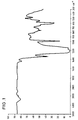
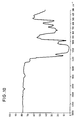
- the IR spectra of the polymer of the trichlorosilyl type and the trimethoxysilyl type are shown in Figs. 9 and 10, respectively.
- the prepared polymers give softer cured materials.
- the prepolymer was prepared.
- a solution of the prepolymer in dimethoxyethane was reacted with zinc powder and then diluted with trichlorotrifluoroethane to precipitate a white material.
- the precipitated material was filtered off, and the filtrate was concentrated in an evaporator to give a polymer, which had good curing characteristics.
- a copolymer (6 g) which consisted of 68 % by mole of TFE and the rest of the perfluorovinyl ether of the formula: and had a molecular weight of 3.6 x 10⁴ and iodine atoms at the molecular ends was finely dispersed in perfluorohexane (50 g) with a homogenizer. Then, to a 100 ml flask, the dispersion was charged together with vinyltrichlorosilane (5 g) and IPP (0.1 g) and heated to 40°C in a nitrogen stream while stirring followed by reaction at the same temperature for 5 hours. The product was mixed with methanol (100 ml) in the homogenizer in a nitrogen stream and then treated with an evaporator at room temperature under reduced pressure to obtain a rubbery mass (5 g)
- the rubbery mass was placed between a pair of aluminum foils and pressed at 100°C to obtain a sheet of 0.5 mm in thickness, which was in the state of a soft raw rubber. After kept standing at room temperature for one week, the sheet was cured to exhibit properties of the cross linked material, although the elongation was about 50 % so that the cured material seemed to be fragile.
- Perfluoropolyether having the carboxyl group at both ends of the molecule [HOOCCF2CF2-(OCF2CF2CF2) d -OCF2CF2-COOH in which d is about 35 on the average] was neutralized with potassium hydroxide and dried. Then, the dried polymer (100 g) was mixed with potassium carbonate fine powder (20 g) and iodine (20 g) in a mortar. Then, to a 500 ml flask equipped with stirring blades made of PTFE, the mixture was charged together with Cl(CF2CFCl)2Cl (20 ml) and Cl(CF2CFCl)3Cl (100 ml) and gradually heated on an oil bath from 100°C.
- the reaction was started to generate carbon dioxide. Over 4 hours, the mixture was gradually heated up to 220°C. When the generation of carbon dioxide substantially ceased, the mixture was cooled to room temperature. Then, the reaction mixture was filtered through a glass filter while washing with trichlorotrifluoroethane. The filtrate was evaporated with a vacuum evaporator to obtain an oily product (92 g), 80 % or more of which was perfluoropolyether having iodine atoms at both ends of the molecule and about 10 % of which was the polymer having the CF2H group at the molecular end.
- a trichlorosilane type telechelic polymer was prepared in the same manner as in Example 1.
- the telechelic polymer was cured slowly on a glass plate to give a rubbery cured material, which had such good low temperature properties that it was not frozen in dry ice.
Landscapes
- Chemical & Material Sciences (AREA)
- Organic Chemistry (AREA)
- Health & Medical Sciences (AREA)
- Chemical Kinetics & Catalysis (AREA)
- Medicinal Chemistry (AREA)
- Polymers & Plastics (AREA)
- General Chemical & Material Sciences (AREA)
- Addition Polymer Or Copolymer, Post-Treatments, Or Chemical Modifications (AREA)
- Paints Or Removers (AREA)
- Sealing Material Composition (AREA)
- Compositions Of Macromolecular Compounds (AREA)
- Polyethers (AREA)
- Silicon Polymers (AREA)
Claims (13)
- Polymer der Formel:
PC-[CH₂CYJ-(CH₂)n-SiRxX3-x]m
worin PC eine Polymerkette, X eine einwertige hydrolysierbare Gruppe, Y ein Wasserstoffatom oder eine Alkylgruppe mit 1-4 C-Atomen, R ein Wasserstoffatom oder eine inaktive einwertige organische Gruppe, x eine ganze Zahl von 0 bis 3, ausschließlich von Polymeren, in denen x 3 und jedes R eine inaktive einwertige organische Gruppe sind, m eine positive ganze Zahl, die nicht größer als die Anzahl der Endstellen der Polymerkette PC ist, und n 0, 1 oder 2 sind, wobei das Polymer ein Molekulargewicht von 5 x 10² bis 5 x 10⁶ aufweist. - Polymer gemäß Anspruch 1, worin die Gruppe X ein Halogenatom oder eine Gruppe der Formel:
-OR,
-OCOR,

-ON=Z
ist, worin R wie oben definiert, Z =C(R)₂ oder
- Polymer gemäß Anspruch 1, worin R eine aliphatische oder aromatische Kohlenwasserstoffgruppe ist.
- Polymer gemäß Anspruch 1, worin die Polymerkette PC eine Fluorpolymerkette ist.
- Polymer gemäß Anspruch 4, worin das Fluorpolymer ein Polymer aus mindestens einer ethylenisch ungesättigten fluorierten Verbindung, ausgewählt aus der Gruppe, bestehend aus C₂F₄, C₂F₃Cl, C₃F₆, CF₂=CFORf, worin Rf eine Perfluoralkylgruppe mt 1 bis 16 Kohlenstoffatomen, ω-Hydroperfluoralkylgruppe mit 1 bis 16 Kohlenstoffatomen oder eine Fluoralkoxygruppe der Formel:

- Verfahren zur Herstellung eines Polymers gemäß Anspruch 1, wobei man ein Poymer der Formel:
PC-(J)m (II)
worin PC und m wie in Anspruch 1 definiert sind, mit einer Silizium enthaltenden ungesättigten Verbindung der Formel:
CH₂=CY-(CH₂)n-SiRxX3-x (III)
zur Reaktion bringt, worin R, X, Y, n und x wie in Anspruch 1 definiert sind. - Verfahren zur Modifizierung eines Polymers von Anspruch 1, wobei mindestens ein Teil der Jodatome und der hydrolysierbaren Gruppen X in eine inaktive Gruppe überführt ist, wobei man das Polymer gemäß Anspruch 1 mit einem Alkohol und einem Element der Gruppen II und III des Periodensystems behandelt.
- Verfahren zur Herstellung eines Polymers der Formel:
PC-[(CH₂)n+2-Si(OR''')₃]m
worin PC eine Polymerkette, R''' eine Alkylgruppe mit 1 bis 4 Kohlenstoffatomen, m eine positive ganze Zahl, die nicht größer als die Anzahl der Endpunktstellen der Polymerkette PC ist, und n 0, 1 oder 2 sind, wobei man ein Polymer gemäß Anspruch 1 mit einem Alkohol der Formel R'''OH, worin R''' wie vorstehend definiert ist, und einem Element der Gruppen II oder III des Periodensystems behandelt, vorausgesetzt, daß R''' OH nicht t-Butanol ist. - Härtbare Polymerzusammensetzung, enthaltend ein Polymer gemäß Anspruch 1.
- Versiegelungsmittel, enthaltend ein Polymer gemäß Anspruch 1.
- Überzug, enthaltend ein Polymer gemäß Anspruch 1.
- Kupplungsmittel, enthaltend ein Polymer gemäß Anspruch 1.
- Endbehandlungsmittel, enthaltend ein Polymer gemäß Anspruch 1.
Applications Claiming Priority (2)
| Application Number | Priority Date | Filing Date | Title |
|---|---|---|---|
| JP124620/88 | 1988-05-21 | ||
| JP63124620A JP2705105B2 (ja) | 1988-05-21 | 1988-05-21 | 新規ポリマーおよびその製法と用途 |
Publications (3)
| Publication Number | Publication Date |
|---|---|
| EP0343526A2 EP0343526A2 (de) | 1989-11-29 |
| EP0343526A3 EP0343526A3 (en) | 1990-06-20 |
| EP0343526B1 true EP0343526B1 (de) | 1993-09-15 |
Family
ID=14889926
Family Applications (1)
| Application Number | Title | Priority Date | Filing Date |
|---|---|---|---|
| EP89109032A Expired - Lifetime EP0343526B1 (de) | 1988-05-21 | 1989-05-19 | Polymere, deren Herstellung und Verwendung |
Country Status (4)
| Country | Link |
|---|---|
| US (1) | US5081192A (de) |
| EP (1) | EP0343526B1 (de) |
| JP (1) | JP2705105B2 (de) |
| DE (1) | DE68909108T2 (de) |
Families Citing this family (36)
| Publication number | Priority date | Publication date | Assignee | Title |
|---|---|---|---|---|
| US5210143A (en) * | 1987-10-09 | 1993-05-11 | Minnesota Mining And Manufacturing Company | Condensed phase polymers |
| US5763061A (en) * | 1995-06-15 | 1998-06-09 | Sumitomo Chemical Company, Limited | Antireflection filter |
| DE69624923T2 (de) * | 1995-08-11 | 2003-08-21 | Daikin Industries, Ltd. | Silizium enthaltende organische fluorpolymere und ihre verwendung |
| JP2000511949A (ja) * | 1996-05-03 | 2000-09-12 | ワーナー―ランバート・コンパニー | ポリマー支持クェンチによる迅速精製 |
| WO1998049218A1 (en) | 1997-04-30 | 1998-11-05 | Daikin Industries, Ltd. | Fluoropolymer, process for preparing the same, and use thereof |
| US6277485B1 (en) * | 1998-01-27 | 2001-08-21 | 3M Innovative Properties Company | Antisoiling coatings for antireflective surfaces and methods of preparation |
| CA2365605A1 (en) | 1999-04-02 | 2000-10-12 | Kaneka Corporation | Method of treating polymer |
| TWI302549B (en) | 2001-10-05 | 2008-11-01 | Shinetsu Chemical Co | Perfluoropolyether-modified silane, surface treating agent, and antireflection filter |
| US6881445B1 (en) | 2001-10-29 | 2005-04-19 | Innovation Chemical Technologies, Ltd. | Forming thin films on substrates using a porous carrier |
| AU2003225227A1 (en) * | 2002-05-01 | 2003-11-17 | Innovation Chemical Technologies, Ltd. | Invisible logos using hydrophobic and hydrophilic coatings on substrates |
| US7388054B2 (en) * | 2005-12-23 | 2008-06-17 | 3M Innovative Properties Company | Fluoropolymer curing co-agent compositions |
| US7754837B1 (en) | 2007-03-09 | 2010-07-13 | Clemson University Research Foundation | Flourinated aryl ether polymers exhibiting dual fluoroolefin functionality and methods of forming same |
| US8288492B2 (en) * | 2007-10-23 | 2012-10-16 | E I Du Pont De Nemours And Company | Difunctional oligomers of perfluoro(methyl vinyl ether) |
| US20100102025A1 (en) * | 2008-10-28 | 2010-04-29 | Essilor International (Compagnie Generale D'optique) | Method and apparatus for marking coated ophthalmic substrates or lens blanks having one or more electrically conductive layers |
| FR2938931B1 (fr) | 2008-11-27 | 2011-03-18 | Essilor Int | Procede de fabrication d'un article d'optique a proprietes antireflets |
| FR2943798B1 (fr) | 2009-03-27 | 2011-05-27 | Essilor Int | Article d'optique revetu d'un revetement antireflet ou reflechissant comprenant une couche electriquement conductrice a base d'oxyde d'etain et procede de fabrication |
| US8138274B2 (en) * | 2009-12-08 | 2012-03-20 | Le Centre National De La Recherche Scien | Process for preparation of fluorosilicon polymer |
| KR20130001226A (ko) | 2010-01-28 | 2013-01-03 | 프레지던트 앤드 펠로우즈 오브 하바드 칼리지 | 미생물 부착 방지용 구조 |
| EP2534108B1 (de) | 2010-02-08 | 2021-12-22 | Essilor International | Optischer artikel mit antireflektierender beschichtung mit beschlagschutzeigenschaften |
| FR2968774B1 (fr) | 2010-12-10 | 2013-02-08 | Essilor Int | Article d'optique comportant un revetement antireflet a faible reflexion dans le domaine ultraviolet et le domaine visible |
| WO2014110511A1 (en) | 2013-01-11 | 2014-07-17 | President And Fellows Of Harvard College | Protective barriers for preventing or reducing transfer of microorganisms |
| EP2985307B1 (de) * | 2013-04-09 | 2019-10-02 | Nichias Corporation | Verfahren zur herstellung von vernetztem fluorelastomer |
| US9772509B2 (en) | 2013-07-05 | 2017-09-26 | Essilor International (Compagnie Generale D'optique) | Optical article comprising an antireflective coating with a very low reflection in the visible region |
| TW201546115A (zh) | 2013-12-26 | 2015-12-16 | Daikin Ind Ltd | 含有含全氟(聚)醚基之矽烷化合物的表面處理劑 |
| WO2015200003A1 (en) * | 2014-06-23 | 2015-12-30 | 3M Innovative Properties Company | Silicon-containing polymer and method of making a silicon-containing polymer |
| FR3024673B1 (fr) | 2014-08-05 | 2016-09-09 | Essilor Int | Procede pour diminuer ou eviter la degradation d'une couche antisalissure d'un article d'optique |
| FR3031195B1 (fr) | 2014-12-24 | 2017-02-10 | Essilor Int | Article optique comportant un revetement interferentiel a forte reflexion dans le domaine de l'ultraviolet |
| EP3045940B1 (de) | 2014-12-31 | 2025-08-20 | Essilor International | Ophthalmische Linse mit einem antireflektiven Film für lichtarme Bedingungen |
| EP3185050A1 (de) | 2015-12-23 | 2017-06-28 | Essilor International (Compagnie Générale D'Optique) | Optischer artikel mit einer mehrschichtigen interferenzbeschichtung aus einem organischen vorläufer oder einer mischung aus organischen vorläufern |
| FR3055157B1 (fr) | 2016-08-19 | 2018-09-07 | Essilor International | Lentille ophtalmique a revetement multicouche reflechissant et anti-abrasion, et son procede de fabrication. |
| EP3581675A1 (de) | 2018-06-15 | 2019-12-18 | Corporation de L'Ecole Polytechnique de Montreal | Optischer artikel mit direktionaler mikro- oder nanostrukturierter dünnschichtbeschichtung und dessen verfahren |
| CN119654231A (zh) | 2022-07-26 | 2025-03-18 | 依视路国际公司 | 用于获得具有至少一种预定光学特性的定制光学制品的方法和系统 |
| EP4528340A1 (de) | 2023-09-22 | 2025-03-26 | Essilor International | Optischer artikel mit einer sehr hochreflektierenden beschichtung im band-35-380 uv |
| EP4571371A1 (de) | 2023-12-14 | 2025-06-18 | Essilor International | Optischer artikel mit interferenzieller beschichtung mit farbrobustheit |
| WO2025132924A1 (en) | 2023-12-19 | 2025-06-26 | Essilor International | Optical article comprising an electrochromic stack offering a modulation both in transmission and in reflection |
| EP4628947A1 (de) | 2024-04-04 | 2025-10-08 | Essilor International | Optischer artikel mit polarer beschichtung und dessen herstellung |
Family Cites Families (6)
| Publication number | Priority date | Publication date | Assignee | Title |
|---|---|---|---|---|
| FR1294410A (fr) * | 1960-06-11 | 1962-05-26 | Hoechst Ag | Procédé de stabilisation de polyoléfines |
| US3929850A (en) * | 1971-11-19 | 1975-12-30 | Huels Chemische Werke Ag | Process for the production of polymeric hydrocarbons having reactive silyl end groups |
| US4020043A (en) * | 1975-03-07 | 1977-04-26 | Minnesota Mining And Manufacturing Company | Vulcanizable alkoxysilyl capped polymer composition |
| US4191714A (en) * | 1977-12-29 | 1980-03-04 | Kanegafuchi Kagaku Kogyo Kabushiki Kaisha | Curable polyester oligomer and a process for producing same |
| WO1987004144A1 (en) * | 1986-01-03 | 1987-07-16 | Exxon Chemical Patents, Inc. | Composition for preparing cement-adhesive reinforcing fibers |
| US4861836A (en) * | 1986-12-23 | 1989-08-29 | Daikin Industries Ltd. | Novel, iodine-containing compound, preparation thereof and block copolymer comprising the same |
-
1988
- 1988-05-21 JP JP63124620A patent/JP2705105B2/ja not_active Expired - Fee Related
-
1989
- 1989-05-19 EP EP89109032A patent/EP0343526B1/de not_active Expired - Lifetime
- 1989-05-19 DE DE89109032T patent/DE68909108T2/de not_active Expired - Lifetime
- 1989-05-19 US US07/354,287 patent/US5081192A/en not_active Expired - Lifetime
Also Published As
| Publication number | Publication date |
|---|---|
| DE68909108D1 (de) | 1993-10-21 |
| JP2705105B2 (ja) | 1998-01-26 |
| EP0343526A3 (en) | 1990-06-20 |
| EP0343526A2 (de) | 1989-11-29 |
| JPH01294709A (ja) | 1989-11-28 |
| US5081192A (en) | 1992-01-14 |
| DE68909108T2 (de) | 1994-04-07 |
Similar Documents
| Publication | Publication Date | Title |
|---|---|---|
| EP0343526B1 (de) | Polymere, deren Herstellung und Verwendung | |
| US5367023A (en) | Modified fluorohydrocarbon polymers | |
| US7915361B2 (en) | Fluorocopolymer, process for producing fluorocopolymer, fluorocopolymer curable composition, and cured object | |
| US5712335A (en) | Aqueous fluorine-containing polymer dispersion | |
| RU2152962C1 (ru) | Вулканизуемая фторэластомерная композиция | |
| CN105324412A (zh) | 含氟聚醚-聚硅氧烷弹性体组合物和成型制品 | |
| FR2463785A1 (fr) | Nouveaux elastomeres fluores contenant des segments polymeres fluores et des segments d'organopolysiloxane | |
| AU2012350856A1 (en) | Crosslinkable vinylidene fluoride and trifluoroethylene polymers | |
| JPS58167606A (ja) | ラジカル共重合によるグラフト共重合体の製造方法 | |
| JP2004514777A (ja) | ヒドロシロキサンまたはヒドロシラザンを含む硬化性フルオロエラストマー組成物 | |
| CN102782015B (zh) | 用于制备氟硅聚合物的方法 | |
| JPH0579248B2 (de) | ||
| EP0424000B1 (de) | Silikonpolymere, Copolymere und Blockcopolymere und Verfahren zu deren Herstellung | |
| EP0520608B1 (de) | Durch kationische Photoinitiatoren vernetzbare, periphere Vinyläther Seitengruppen-enthaltende Silikone, deren Anwendung für Beschichtungen und Anti-Adhäsifbehandlung von Papier | |
| CN105358594B (zh) | 可湿固化的组合物、使用方法以及复合制品 | |
| JPH10237130A (ja) | 含フッ素ニトリルおよびその重合体 | |
| JP3485650B2 (ja) | 含フッ素ビニルエーテル共重合体 | |
| JPH0345724B2 (de) | ||
| US20060160972A1 (en) | Functionalized fluoromonomers and their copolymers with vinylidende fluoride | |
| JPH02196792A (ja) | 加水分解性シリル基含有アゾ系化合物 | |
| JPH02196801A (ja) | 加水分解性シリル基含有ビニル系重合体の製造方法 | |
| JPH03212464A (ja) | フッ素系塗料 | |
| JPH09176321A (ja) | 水酸基含有ポリシルセスキオキサンおよびその製造方法並びに樹脂変性剤 | |
| JPH10158376A (ja) | 含フッ素ポリエステル | |
| JP2005171054A (ja) | フッ素ポリマーの製造方法 |
Legal Events
| Date | Code | Title | Description |
|---|---|---|---|
| PUAI | Public reference made under article 153(3) epc to a published international application that has entered the european phase |
Free format text: ORIGINAL CODE: 0009012 |
|
| AK | Designated contracting states |
Kind code of ref document: A2 Designated state(s): DE FR GB IT |
|
| PUAL | Search report despatched |
Free format text: ORIGINAL CODE: 0009013 |
|
| AK | Designated contracting states |
Kind code of ref document: A3 Designated state(s): DE FR GB IT |
|
| 17P | Request for examination filed |
Effective date: 19901204 |
|
| 17Q | First examination report despatched |
Effective date: 19910424 |
|
| GRAA | (expected) grant |
Free format text: ORIGINAL CODE: 0009210 |
|
| AK | Designated contracting states |
Kind code of ref document: B1 Designated state(s): DE FR GB IT |
|
| ITF | It: translation for a ep patent filed | ||
| REF | Corresponds to: |
Ref document number: 68909108 Country of ref document: DE Date of ref document: 19931021 |
|
| ET | Fr: translation filed | ||
| PLBE | No opposition filed within time limit |
Free format text: ORIGINAL CODE: 0009261 |
|
| STAA | Information on the status of an ep patent application or granted ep patent |
Free format text: STATUS: NO OPPOSITION FILED WITHIN TIME LIMIT |
|
| 26N | No opposition filed | ||
| REG | Reference to a national code |
Ref country code: GB Ref legal event code: IF02 |
|
| PGFP | Annual fee paid to national office [announced via postgrant information from national office to epo] |
Ref country code: DE Payment date: 20080522 Year of fee payment: 20 |
|
| PGFP | Annual fee paid to national office [announced via postgrant information from national office to epo] |
Ref country code: IT Payment date: 20080527 Year of fee payment: 20 |
|
| PGFP | Annual fee paid to national office [announced via postgrant information from national office to epo] |
Ref country code: GB Payment date: 20080521 Year of fee payment: 20 |
|
| REG | Reference to a national code |
Ref country code: GB Ref legal event code: PE20 Expiry date: 20090518 |
|
| PG25 | Lapsed in a contracting state [announced via postgrant information from national office to epo] |
Ref country code: GB Free format text: LAPSE BECAUSE OF EXPIRATION OF PROTECTION Effective date: 20090518 |
|
| PGFP | Annual fee paid to national office [announced via postgrant information from national office to epo] |
Ref country code: FR Payment date: 20080514 Year of fee payment: 20 |