EP0343522B1 - Procédé et machine de reliure automatique pour exemplaires uniques - Google Patents
Procédé et machine de reliure automatique pour exemplaires uniques Download PDFInfo
- Publication number
- EP0343522B1 EP0343522B1 EP89109000A EP89109000A EP0343522B1 EP 0343522 B1 EP0343522 B1 EP 0343522B1 EP 89109000 A EP89109000 A EP 89109000A EP 89109000 A EP89109000 A EP 89109000A EP 0343522 B1 EP0343522 B1 EP 0343522B1
- Authority
- EP
- European Patent Office
- Prior art keywords
- book
- station
- binding
- data set
- block
- Prior art date
- Legal status (The legal status is an assumption and is not a legal conclusion. Google has not performed a legal analysis and makes no representation as to the accuracy of the status listed.)
- Expired - Lifetime
Links
Images

Classifications
-
- B—PERFORMING OPERATIONS; TRANSPORTING
- B42—BOOKBINDING; ALBUMS; FILES; SPECIAL PRINTED MATTER
- B42C—BOOKBINDING
- B42C19/00—Multi-step processes for making books
Definitions
- the invention relates to a method and a system for automatic bookbinding for unique and individual books, the invention, however, does not relate to large-scale production.
- Type stamping, self-made, high-quality sleeves, etc. because the series production is based exclusively on newly printed paper without glue residues, creases and format fluctuations, and because the cycle times for such a series book line are so short that extensive conversions at the individual stations are not possible Purchase can be made.
- Document D1 German printer, Volume 24, No. 6, February 18, 1988, Alfred Furler Modular production system for the flexible and rational hardcover book production "concerns a modular production system for the flexible and rational hardcover book production in the industrial bookbinding technology for the automatic book production in large series production up to small series.
- This system comprises a bookbinding system, an acceptance station with a process computer, a book block production station , a blanket manufacturing station, a sleeve station, a capital station, a trailer station, a rounding station and a pasting station.
- the object of the invention is to provide a method and a production line or a production system with which it is possible to bind unique items and individual books in a quality that is in no way inferior to the art of manual bookbinding without the use of specimen copies in order preparation. to make the possible variations and the variety of volumes to be bound as extensive as possible in automatic production and to reduce the time and cost of binding a single piece in comparison to conventional manual bookbinding.
- all the data required for binding the individual book is created and saved, i.e. the customer and signature are entered, for example, on data carriers, the cover type is selected, the dimensions and colors required in the form of the back notch dimension, the dimension for head , Foot and front cut, by thickness measurement and the cover color entered, the preparation process carried out, namely the correction of binding material and endpaper, printing and adding the code note and storing it in a container, as well as entering the embossing including searching in the memory, selecting the font, designing the embossing, saving the embossing and storing the book.
- a specialist specifies all the bookbinding details for creating the book block, the cover and for hanging the book block in the cover, and that, based on this definition, the components required in the corresponding workstations are automatically called up in the bookbinding system, performed the necessary work steps on them and, if necessary, work processes that take time are cached as partially manufactured elements.
- the binding material is pushed against a contact angle at the measuring station, for example, with the help of laser light walls, the later position of the back separating notch cut, the head, foot and front cut is marked.
- the height of the stack to be bound is determined with the aid of a thickness measuring device. All dimensions are digitally encrypted, for example at the push of a button, entered into the computer and the markings are retrieved and set using an identifier.
- the computer determines the dimensions of the cover; these dimensions are displayed on the screen, for example.
- the individual criteria such as rounding, cover material, joint width, corner radius, capital band, font, font size, etc.
- the desired imprint is displayed on the screen and positioned in the desired manner. If, for example, there are hard cover pages inside the book that make processing difficult, these hard covers must be shortened depending on the planned back notch cut and through a tough, supple material with the help of a suitable device be extended again. Finally, a bar code is printed out in the acceptance station and coupled with the double sheets of paper enclosed with the book. The book is then placed on a mobile book shelf or book container. The data for an order, for example 100 single books, are saved on a data carrier and added to the container. Instead of using such a data carrier, other types of data transmission can also be used.
- the data record assigned to the respective book block is entered into a process computer, the book address is e.g. read in with a reading pen and the book block is inserted into the back separating machine and processed there.
- the section size is set and the end sheets are inserted into side receptacles.
- the first cut reduces the slope and the book block is tightened using a clamping device, e.g. Clamp, lowered and notched.
- the knife shape used for the back cutting notching machine has trapezoidal notches, which channels in a spine of e.g. Notch 1.8 x 0.6 mm in the transverse direction (however, the invention is in no way limited to these dimensions of the notch channels).
- Thread-stitched book blocks are read and entered in the book block production station, but are not processed on the spine.
- the tension clamps are also links in a transport chain. After the back separation notches, the tensioning clamp is moved further with a transport chain of this type, for example hydraulically, and finally fed to the fan gluing machine, in which the open sheet edges are bent and glued. Pressure strips are integrated in the clamping clip system, which ensure forced contact with the glue layer. This solves a problem that was previously unsolved with fan gluing. This process is repeated several times, depending on the type of paper, and then the book block in the binding area is pressed together by pressure strips and with the tensioning clip through a drying tunnel guided. Moisture must be extracted from the glue in this drying tunnel without the polymerization process being hindered or prematurely interrupted.
- the glue must have optimal contact with the surface, which requires a dust-free back scoring machine. On the other hand, the glue must not run into the book block. It must also be resistant to aging, which is achieved with the aid of a water-soluble dispersion, but on the other hand must not lose too much volume because the adhesive threads in the channels can no longer fulfill their cross-binding function if the shrinkage is too great.
- the adhesive to be used must therefore meet a variety of conditions in terms of heating, moisture, airflow, air drying, feed, glue composition and energy consumption. Furthermore, it is necessary to guide the pressure strips so that the slope on the spine does not exceed a certain, permissible range.
- the book block is transferred to a cutting machine, such as a rotary gripper, in a precisely positioned position.
- a cutting machine such as a rotary gripper
- the gripper area must be small, but that the gripper must nevertheless move heavy and protruding books perfectly sideways, turn twice 90 ° damped and comply with tolerances of the order of 1/10 millimeter.
- the gripper must not build upwards because the frame of the cutting machine opposes this.
- the book block is handed over to a rich person and reaches, for example, an interim storage facility, where it is made available for hanging in the cover; however, the book block can also be hung in the cover at this point without being transferred to an intermediate storage facility.
- the book blocks are transferred undisturbed to the hanging street; If the book block is removed from the clipboard for further processing or for hanging in the book cover, the book block must be read in again and transferred to the hanging street in a precisely positioned position. Since freshly produced or hardened book blocks arrive from the interim storage facility, uniform conditions can only be achieved by heating to approx. 55 ° to manufacture. Then the spine of the book block must be made flexible by bending and rolling over, which also exaggerates the slope and compresses it again to the required extent. The set incline is stabilized, for example, by gluing with a tape and with the help of the selected stabilizing elements.
- the inside surfaces of the cover are glued together with the back and pressed against the book block.
- the book block can remain in the bracket until the end.
- the front surfaces are glued; it is difficult to reach the joint area of the book, to release the book from the bracket in good time and still to guide it precisely.
- the preferred procedure for "pasting" presupposes that no support fabric has yet been applied to the book block spine, that the stabilizing element is already glued in the cover, that the incline is set, that the book block spine is made supple, and that the rounding of the book block, eg with the help of compressed air.
- Pneumatic rounding is a particularly gentle and therefore preferred rounding process.
- the straight book is sealed with a glued cover with the help of press plates and sealing packages at the head and foot cut as well as with a hood around the press plates and pressed into the book cover by compressed air.
- the degree of rounding is determined by the slope previously realized and taken into account in the cover.
- the rounded book block must harden and dry out under moderate pressure. This will be in a finished goods warehouse carried out.
- Another possibility of binding is that the cover is understood as a form into which the book block is pressed mechanically or with compressed air.
- the ceiling production machine glues the covers or uses glued (preferably heat-sealable) covers, puts on cardboard blanks and folds in the edges.
- the raw cardboard formats are selected from a material store by the computer, trimmed on the outside by a computer-controlled cutting device (which can work on the basis of a water jet, a laser or the like) and cut into symmetrical halves. It can also be used to produce rounded corners with different profiles.
- a computer-controlled cutting device which can work on the basis of a water jet, a laser or the like
- the line path selected by the computer e.g. pulled off and held taut by a series of laterally arranged grippers which switch on one after the other.
- Glue e.g.
- the cardboard cuts and the cut back insert are positioned on the glued, stretched book linen, and the benefit is cut out (e.g. again with the help of a water jet cutting device or the like).
- the cover covered so far is brought into the next working position, in which the wraps are programmed to be turned over and pressed or ironed on.
- the wraps are programmed to be turned over and pressed or ironed on.
- the finished whole-fabric blankets are rubbed or ironed on and placed in a buffer that simultaneously removes moisture.
- the cover is transferred from the manufacturing station and the drying station to the embossing station.
- High demands are placed on the embossing process or the embossing press.
- a temperature control with a control range between 80 and 150 ° C for example, there are about 1000 different types six fonts, each in two different sizes, six different color foils, a temperature control with a control range between 80 and 150 ° C, a type and material-dependent print control, a print time control between 0.05 and 0.5 seconds, a ceiling guide in the X-axis , the Y-axis and the Z-axis and a material thickness control is required.
- the overall system makes it necessary that the embossing is largely freely programmable and that pixels can be introduced into the material in depth.
- the stabilizing element e.g. stabilization or reco sleeve according to DE-OS 35 11 646
- the stabilizing element is selected, provided with the capital band and glued into the flat cover.
- externally manufactured cover blankets e.g. publishing blankets
- the back inlays of such blankets which are often very susceptible to kinking, are also made flexible by the water-containing adhesives.
- the headband is provided in different colors and is preferably used as a heat-sealable band.
- the book that has been completed so far will be stored in a repository. Following this, for example, a production control is provided, in which the book is booked out via the bar code and transferred to the transport container. The production data is delivered back to the acceptance station together with the order and from there to the customer.
- the customer data, the signature of the book, etc. are entered in a receiving station 1 by manual input or by Access to the memory or via data medium if the receiving station is supplied via auxiliary receiving stations that are spatially distant from the receiving station.
- the cover type is selected, the calculation scheme is defined and the device method is selected depending on the customer.
- the required dimensions and colors are entered in data form, namely the back notch size, head, foot and front cut, the thickness and the cover color (whereby you can choose from 24 different colors, for example).
- the preparation includes cutting the book covers and the end paper, printing and folding the code slip, and storing them in the container.
- the embossing process is entered in the acceptance station by possibly reading in the data again or visiting the memory, selecting the desired font, writing and designing the embossing, and storing it.
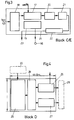
- the binding material is retrieved from the warehouse 2 and fed to the further processing (block binding 4) via the acceptance station 1.
- block binding 4 the binding material is fed from the acceptance station 1 to a stapling station 3, from which the stapled book block is also transferred to the block binding station 4.
- the data are read into this block binding station 4 and the control or the computer is acted upon in accordance with this data.
- thread-stitching and adhesive-binding books the volumes to be stitched are issued for further processing, there is a rebooking, if necessary, a repeat program runs.
- the book block is input into a back separating notch device 13, in which the back of the book block is automatically trimmed, a fan-binding and gluing is performed automatically in the gluing station 14, the incline is forced, the drying performance after the gluing in the drying section 15 is monitored, the transfer of the book block to the cutting machine 5 is carried out, the cut is carried out automatically, and the book block is transferred to the suspension road 7.
- special cases can be controlled into a special treatment station 6.
- the cover covers are introduced into the ceiling hanging device 17.
- the book blocks arrive in an incline setting station 18, in which the calculated incline, which is ideal for the corresponding book, is set.
- the capital band and the stabilizing element are cut to length in conjunction with the ceiling production.
- the book block and cover are glued together, the book block is rounded in the compression station 20 and the folds are burned in in the station 21.
- the book block passes through a drying section 22, in which the applied glue is dried.
- the book block is transferred to a dry store 23.
- the book is transported through the individual stations here with the aid of a conveyor belt, a conveyor chain or the like transport device (designated by 24).
- Fig. 4 the blanket manufacturing and embossing station is shown in the block diagram.
- Cardboard and linen are introduced from a raw material store 25 into a cardboard cutting station 26 and a linen cutting station 27, in which the materials are cut. Special cases are also sorted out here.
- the cut components including the stabilizing sleeve and the headband, are transferred to the blanket production station 28, in which the gluing, placing and wrapping of the cardboard parts and the drawing in of the corners takes place.
- the blanket thus produced is then transferred to the embossing station 29, in which the blanket is embossed fully automatically in an embossing machine.
- the embossed cover blanket is stored in a blanket intermediate storage 30, e.g. on a conveyor belt, cached.
- 31 denotes the input of the data that takes place in the acceptance station, which can be arranged spatially separate from the system.
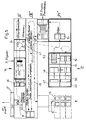
- the sheet stack 32 is glued in a gluing device 33 on the block spine and introduced into a fan adhesive binding device 34, in which the glued sheet stack is bound to form a book block.
- the back separating notch device 35 the back separating notch of the book block takes place.
- the (preferably hydraulic) overall drive is designated 36.
- the book block is then passed through a cutting machine 37, which performs a final trimming of the book block. At the end of station B, the book block just finished is now available.
- the book block is hung in the cover.
- External blankets are inserted into the system at 39, turned over and transferred to the CE station at 40, connected to a Reco sleeve at 41 on the back and provided with a tie at 42.
- the endless reco sleeve (e.g. in 20 widths) is automatically cut to length, as is the headband.
- the blanket thus produced is connected to the finished book block, the incline of the book block is set at 43 and the back is rounded at 44, for example with the aid of compressed air.
- the cover with the suspended book block is then temporarily stored, for example on a conveyor chain 45 with a long conveying path, and introduced into a distribution station 46, for example a shelf, where the individual finished bound volumes are prepared for shipping and packed in containers.
- the ceiling production takes place within the overall system.
- the required sizes of cardboard are automatically cut to the desired dimensions from a cardboard magazine 47 in a cardboard trimming device 48, and the stabilizing sleeves are cut to the appropriate length in a sleeve magazine, and in parallel the lines are cut from a linen magazine 49 via a glue squeegee 50 in a trimming device 51 cut to the desired size and automatically connected to the cut cardboard.
- This product then passes into the wrapping device 52 and from there into the blanket store 53, from which the finished blankets are temporarily stored and, if necessary, inserted into an embossing device 54, embossed and fed to the further processing which is carried out in the compact line CE, so that from here the further processing sequence corresponds to that of the third-party ceilings.
Landscapes
- Folding Of Thin Sheet-Like Materials, Special Discharging Devices, And Others (AREA)
- Labeling Devices (AREA)
- Making Paper Articles (AREA)
- General Factory Administration (AREA)
- Automatic Assembly (AREA)
Claims (8)
- Relieuse destinée à relier totalement automatiquement des exemplaires uniques ou des livres individuels pourvue d'une station de transfert du livre non relié, une station d'encollage du dos du livre, une station de découpage du dos, une station d'encollage, une station de pliage, une station de séchage, une presse pour le livre non relié, une découpeuse automatique et une station de fabrication du livre qui comprend l'encollage, l'application d'une tranchefile, l'encollage par ruban adhésif, l'épreuve, l'application d'une couverture, la compression, dans laquellea) une station de réception (1), dans laquelle toutes les données relatives au livre nécessaires à la reliure du livre sont établies et stockées sous la forme d'un article sur l'écran et sans exemple d'échantillon, dans laquelle à savoir le client et la signature sont donnés par l'intermédiaire de supports de données, le type de reliure est choisi, les dimensions et couleurs requises en termes de dimension de la découpure du dos, de dimension de la coupe de la tête, du pied et de l'avant, de l'épaisseur et la couleur de la reliure sont données, où le processus du dispositif est exécuté, l'impression et l'adjonction d'une étiquette codée pourvue d'un code barres de même que l'adjonction d'un estampage, en ce compris la recherche dans la mémoire, le choix du caractère, la formation de l'estampage, le stockage de ce dernier et le dépôt du livre relié sont définis et stockés, et l'article est transmis à un ordinateur industriel,b) une station de fabrication (4; 34) du livre non relié, dans laquelle l'article correspondant au livre non relié est transmis à un ordinateur industriel, le découpage du dos (13) et l'encollage (14) des parties du livre non relié sont effectués, le livre non relié est pressé dans la zone de reliure et guidé à travers un canal de séchage (15) de même que le livre non relié est transmis à un dispositif de coupe (5), connecté au canal de séchage, destiné à couper les trois faces,c) une station de fabrication de la couverture (8, 9; 40, 48), dans laquelle, conformément à l'article, des cartons et de la toile sont découpés et transmis à partir d'une unité de stockage matérielle, les formats bruts des cartons sont choisis par l'ordinateur, sont découpés à la forme voulue et la doublure découpée du dos est positionnée sur la toile du livre de même que les plis sont rabattus et fixés,d) une station de serrage (19, 41), dans laquelle, conformément à l'article, la couverture est renforcée au moyen d'un élément de stabilisation sélectionné et détaché et est garnie d'une tranchefile,e) une station destinée à tranchefiler (19, 42), dans laquelle, conformément à l'article, la tranchefile est mise à longueur et collée aux deux extrémités sur l'intérieur du matériau de serrage,f) une station d'application de la couverture (17, 18; 43), dans laquelle, conformément à l'article, le dos du livre non relié est assoupli par cintrage et retournement respectivement la pente est ajustée, la pente nécessaire est pressée de la manière déterminée par l'article à la dimension requise et le dos du livre non relié est collé à la couverture préparée à cet effet,g) une station d'arrondissage (20; 44), dans laquelle, par commande de l'article, le livre non relié est pressé contre le dos de la couverture collée et arrondi en utilisant la pente de même qu'il est maintenu dans un système de pinces et séché, les plis étant alors brûlés (21),h) une station d'encollage (29), dans laquelle les faces externes de garde sont collées aux faces de la couverture, eti) une station de stockage (46), dans laquelle le livre fabriqué jusque là est emmagasiné, soumis à un contrôle de fabrication, classé par l'intermédiaire du code barres de même que les données de production avec la commande sont ramenées à la station de réception.
- Relieuse selon la revendication 1, caractérisée en ce que la toile est conçue de manière à pouvoir être thermosoudée et les plis sont repassés.
- Relieuse selon la revendication 1, caractérisée en ce que la tranchefile est conçue de manière à pouvoir être thermosoudée et repassée sur l'intérieur du matériau de serrage.
- Relieuse selon la revendication 1, caractérisée par une station d'estampage pour la fabrication individuelle dans laquelle le processus d'estampage est effectué et à laquelle sont amenées les couvertures à partir des stations de fabrication et de séchage.
- Relieuse selon la revendication 1, caractérisée en ce que un dispositif d'estampage est prévu en dehors de l'installation.
- Procédé destiné à relier totalement automatiquement des exemplaires uniques ou des livres individuels caractérisé en ce quea) toutes les données relatives au livre nécessaires à la reliure du livre sont établies et stockées sous la forme d'un article sur l'écran et sans exemple d'échantillon, à savoir le client et la signature sont donnés par l'intermédiaire de supports de données, le type de reliure est choisi, les dimensions et couleurs requises en termes de dimension de la découpure du dos, de dimension de la coupe de la tête, du pied et de l'avant, de l'épaisseur et la couleur de la reliure sont données, où le processus du dispositif est exécuté, l'impression et l'adjonction d'une étiquette codée pourvue d'un code barres de même que l'adjonction d'un estampage, en ce compris la recherche dans la mémoire, le choix du caractère, la formation de l'estampage, le stockage de ce dernier et le dépôt du livre relié sont définis et stockés, et l'article est transmis à un ordinateur industriel,b) le découpage du dos (13) et l'encollage (14) des parties du livre non relié sont effectués, le livre non relié est pressé dans la zone de reliure et guidé à travers un canal de séchage (15) de même que le livre non relié est transmis à un dispositif de coupe (5), connecté au canal de séchage (15), destiné à couper les trois faces,c) des cartons et de la toile sont découpés et transmis à partir d'une unité de stockage matérielle, les formats bruts des cartons sont choisis par l'ordinateur, sont découpés à la forme voulue et la doublure découpée du dos est positionnée sur la toile du livre de même que les plis sont rabattus et fixés,d) la couverture est renforcée au moyen d'un élément de stabilisation sélectionné et détaché et est garnie d'une tranchefile,e) la tranchefile, conformément à l'article, est mise à longueur et collée aux deux extrémités sur l'intérieur du matériau de serrage,f) le dos du livre non relié est assoupli, conformément à l'article, par cintrage et retournement respectivement la pente est ajustée, la pente nécessaire est pressée de la manière déterminée par l'article à la dimension requise et le dos du livre non relié est collé à la couverture préparée à cet effet,g) le livre non relié, par commande de l'article, est pressé contre le dos de la couverture collée et arrondi en utilisant la pente de même qu'il est maintenu dans un système de pinces et séché, les plis étant alors brûlés (21),h) les faces externes de garde sont collées aux faces de la couverture, eti) le livre fabriqué jusque là est emmagasiné dans une station de stockage (46), soumis à un contrôle de fabrication, classé par l'intermédiaire du code barres de même que les données de production avec la commande sont ramenées à la station de réception.
- Procédé selon la revendication 1, caractérisé en ce que la toile est thermosoudée et les plis sont repassés.
- Procédé selon la revendication 1, caractérisé en ce que la tranchefile est thermosoudée et repassée sur l'intérieur du matériau de serrage.
Applications Claiming Priority (2)
| Application Number | Priority Date | Filing Date | Title |
|---|---|---|---|
| DE3817463 | 1988-05-21 | ||
| DE3817463A DE3817463A1 (de) | 1988-05-21 | 1988-05-21 | Verfahren und selbsttaetig arbeitende buchbindeanlage fuer unikate und kleinserien |
Publications (3)
| Publication Number | Publication Date |
|---|---|
| EP0343522A2 EP0343522A2 (fr) | 1989-11-29 |
| EP0343522A3 EP0343522A3 (fr) | 1990-07-18 |
| EP0343522B1 true EP0343522B1 (fr) | 1997-03-05 |
Family
ID=6354930
Family Applications (1)
| Application Number | Title | Priority Date | Filing Date |
|---|---|---|---|
| EP89109000A Expired - Lifetime EP0343522B1 (fr) | 1988-05-21 | 1989-05-19 | Procédé et machine de reliure automatique pour exemplaires uniques |
Country Status (3)
| Country | Link |
|---|---|
| EP (1) | EP0343522B1 (fr) |
| AT (1) | ATE149430T1 (fr) |
| DE (2) | DE3817463A1 (fr) |
Families Citing this family (7)
| Publication number | Priority date | Publication date | Assignee | Title |
|---|---|---|---|---|
| DE19741755A1 (de) * | 1997-09-22 | 1999-06-24 | Kolbus Gmbh & Co Kg | Verfahren zum Einstellen einer Buchbindemaschine |
| DE10209090A1 (de) * | 2002-03-01 | 2003-09-11 | Heidelberger Druckmasch Ag | Vorrichtung zur digitalen Werkzeugkennung für Druckend- oder Druckweiterbearbeitungsvorrichtungen |
| DE102007018023A1 (de) * | 2007-04-17 | 2008-10-23 | Peter Schmidkonz | Verfahren und Einrichtung zum maschinellen Herstellen von Buchdecken für Einzelbücher und Kleinstauflagen unterschiedlicher Formatgrößen |
| DE102010024232B4 (de) † | 2010-06-18 | 2024-11-07 | Kolbus Gmbh & Co. Kg | Verfahren und Vorrichtung zur Herstellung von Buchdecken |
| DE102015203006B4 (de) * | 2015-02-19 | 2020-06-18 | Bundesdruckerei Gmbh | Verfahren zur Herstellung von buchartigen Sicherheitsdokumenten mit farblich zum Sicherheitsmerkmal korrespondierendem Einband |
| DE102015213547A1 (de) * | 2015-07-17 | 2017-01-19 | Cewe Stiftung & Co. Kgaa | Herstellungssystem zum Herstellen von Büchern |
| DE102022120062A1 (de) * | 2022-08-09 | 2024-02-15 | Müller Martini Holding AG | Vorrichtung zur Herstellung von Druckerzeugnissen in niedrigen Auflagen |
Family Cites Families (2)
| Publication number | Priority date | Publication date | Assignee | Title |
|---|---|---|---|---|
| US3816866A (en) * | 1973-05-07 | 1974-06-18 | Harris Intertype Corp | Apparatus for making books |
| FR2502547B1 (fr) * | 1981-03-25 | 1985-06-14 | Ccmc | Machine automatique a relier des documents, notamment des documents comptables, sous forme de fascicules, de differentes natures et de differents formats se succedant dans un ordre quelconque |
-
1988
- 1988-05-21 DE DE3817463A patent/DE3817463A1/de not_active Withdrawn
-
1989
- 1989-05-19 DE DE58909781T patent/DE58909781D1/de not_active Expired - Fee Related
- 1989-05-19 AT AT89109000T patent/ATE149430T1/de not_active IP Right Cessation
- 1989-05-19 EP EP89109000A patent/EP0343522B1/fr not_active Expired - Lifetime
Non-Patent Citations (1)
| Title |
|---|
| Deutscher Drucker;N°29;18.09.86;Seiten W14,W16,W21;Alfred Furler; "Neue Maschinenentwicklungen für die Hardcover-Produktion". * |
Also Published As
| Publication number | Publication date |
|---|---|
| EP0343522A2 (fr) | 1989-11-29 |
| ATE149430T1 (de) | 1997-03-15 |
| DE3817463A1 (de) | 1989-11-30 |
| DE58909781D1 (de) | 1997-04-10 |
| EP0343522A3 (fr) | 1990-07-18 |
Similar Documents
| Publication | Publication Date | Title |
|---|---|---|
| DE69231626T2 (de) | Vorrichtung und verfahren zur herstellung von flächenförmigen gegenständen | |
| DE3148443A1 (de) | Schachtel mit sichtfenster sowie verfahren und vorrichtung zur herstellung einer solchen schachtel | |
| EP2508353A2 (fr) | Machine destinée à la fabrication de livres, notamment livres photo et/ou livres illustrés | |
| EP3515719B1 (fr) | Système et procédé permettant de produire un document d'identité, de valeur ou de sécurité en forme de livret | |
| EP3515724B1 (fr) | Procédé, dispositifs et système de production d'un document d'identité, de valeur ou de sécurité se présentant sous la forme d'un livret | |
| DE3215298A1 (de) | Gebundenes buch sowie verfahren zu seiner herstellung | |
| EP0343522B1 (fr) | Procédé et machine de reliure automatique pour exemplaires uniques | |
| EP2190675A1 (fr) | Procédé et dispositif de réalisation commandée par logiciel de couvertures de livres destinées à des livres individuels et des tirages limités de différents formats | |
| DE69413802T2 (de) | Stauchfalzmaschine | |
| EP3515721B1 (fr) | Dispositif et procédé de séparation et de tri de pages doubles pour document d'identité, de valeur ou de sécurité en forme de livre, procédé et système de fabrication d'un document d'identité, de valeur ou de sécurité en forme de livre | |
| DE69223812T2 (de) | Vorrichtung und verfahren zum herstellen von akten | |
| DE2242576C2 (de) | Verfahren und Vorrichtung zum Falten mehrerer übereinanderliegender, klammergehefteter Papierbogen | |
| EP1834804B1 (fr) | Procédé et dispositif destinés à l'installation d'une enveloppe | |
| DE60317844T2 (de) | Gerät zur automatischen Bindung von Heften mit variabeler Dicke mit zumindestens zwei Zufuhrvorrichtungen | |
| WO2003022596A1 (fr) | Procede et dispositif pour relier automatiquement mecaniquement des corps d'ouvrage dans un cycle de travail | |
| US5087162A (en) | Process for binding pamphlets and the like | |
| DE3723814C2 (fr) | ||
| DE102018103625A1 (de) | System zur herstellung und bearbeitung eines buchförmigen ausweis-, wert- oder sicherheitsdokuments und herstellverfahren | |
| DE102016218045B4 (de) | Verfahren und Vorrichtung zur Herstellung eines Passbuchblocks für ein buchartigen Ausweis-, Wert- oder Sicherheitsdokument, System zur Herstellung eines buchartigen Ausweis-, Wert- oder Sicherheitsdokument und buchartiges Ausweis-, Wert- oder Sicherheitsdokument | |
| DE60121090T2 (de) | Verfahren zur Herstellung von Gruppen von gedruckten Seiten, zum Vorbereiten von Büchern, und damit hergestellten Gruppen von gedruckten Seiten | |
| DE102016218044B4 (de) | Zusammenstellvorrichtung und ein Verfahren zum Vereinzeln und Sortieren von Doppelseiten für ein buchförmiges Ausweis-, Wert- oder Sicherheitsdokuments, Verfahren und System zur Herstellung eines buchförmiges Ausweis-, Wert- oder Sicherheitsdokuments | |
| AT526431B1 (de) | Drucker-Anordnung sowie ein Verfahren zum Bedrucken eines vorgebundenen Buches in einer derartigen Drucker-Anordnung | |
| JPH0858267A (ja) | 製本装置及び製本方法 | |
| DE3312931A1 (de) | Verfahren zur herstellung von wenigstens sechzehn seiten aufweisenden broschueren aus einem bogen | |
| DE102018106126A1 (de) | Herstellung eines buchförmigen Ausweis-, Wert- oder Sicherheitsdokumentes mittels Fräsens |
Legal Events
| Date | Code | Title | Description |
|---|---|---|---|
| PUAI | Public reference made under article 153(3) epc to a published international application that has entered the european phase |
Free format text: ORIGINAL CODE: 0009012 |
|
| AK | Designated contracting states |
Kind code of ref document: A2 Designated state(s): AT BE CH DE ES FR GB GR IT LI LU NL SE |
|
| RBV | Designated contracting states (corrected) |
Designated state(s): AT BE CH DE ES FR GB IT LI NL SE |
|
| PUAL | Search report despatched |
Free format text: ORIGINAL CODE: 0009013 |
|
| AK | Designated contracting states |
Kind code of ref document: A3 Designated state(s): AT BE CH DE ES FR GB IT LI NL SE |
|
| 17P | Request for examination filed |
Effective date: 19901103 |
|
| 17Q | First examination report despatched |
Effective date: 19920709 |
|
| GRAG | Despatch of communication of intention to grant |
Free format text: ORIGINAL CODE: EPIDOS AGRA |
|
| GRAH | Despatch of communication of intention to grant a patent |
Free format text: ORIGINAL CODE: EPIDOS IGRA |
|
| GRAH | Despatch of communication of intention to grant a patent |
Free format text: ORIGINAL CODE: EPIDOS IGRA |
|
| GRAA | (expected) grant |
Free format text: ORIGINAL CODE: 0009210 |
|
| AK | Designated contracting states |
Kind code of ref document: B1 Designated state(s): AT BE CH DE ES FR GB IT LI NL SE |
|
| PG25 | Lapsed in a contracting state [announced via postgrant information from national office to epo] |
Ref country code: IT Free format text: LAPSE BECAUSE OF FAILURE TO SUBMIT A TRANSLATION OF THE DESCRIPTION OR TO PAY THE FEE WITHIN THE PRE;WARNING: LAPSES OF ITALIAN PATENTS WITH EFFECTIVE DATE BEFORE 2007 MAY HAVE OCCURRED AT ANY TIME BEFORE 2007. THE CORRECT EFFECTIVE DATE MAY BE DIFFERENT FROM THE ONE RECORDED.SCRIBED TIME-LIMIT Effective date: 19970305 Ref country code: ES Free format text: THE PATENT HAS BEEN ANNULLED BY A DECISION OF A NATIONAL AUTHORITY Effective date: 19970305 Ref country code: NL Free format text: LAPSE BECAUSE OF FAILURE TO SUBMIT A TRANSLATION OF THE DESCRIPTION OR TO PAY THE FEE WITHIN THE PRESCRIBED TIME-LIMIT Effective date: 19970305 |
|
| REF | Corresponds to: |
Ref document number: 149430 Country of ref document: AT Date of ref document: 19970315 Kind code of ref document: T |
|
| REG | Reference to a national code |
Ref country code: CH Ref legal event code: EP |
|
| REF | Corresponds to: |
Ref document number: 58909781 Country of ref document: DE Date of ref document: 19970410 |
|
| PG25 | Lapsed in a contracting state [announced via postgrant information from national office to epo] |
Ref country code: SE Effective date: 19970605 |
|
| GBT | Gb: translation of ep patent filed (gb section 77(6)(a)/1977) |
Effective date: 19970610 |
|
| EN | Fr: translation not filed | ||
| NLV1 | Nl: lapsed or annulled due to failure to fulfill the requirements of art. 29p and 29m of the patents act | ||
| ET | Fr: translation filed | ||
| REG | Reference to a national code |
Ref country code: FR Ref legal event code: FC Ref country code: FR Ref legal event code: RN |
|
| PLBE | No opposition filed within time limit |
Free format text: ORIGINAL CODE: 0009261 |
|
| STAA | Information on the status of an ep patent application or granted ep patent |
Free format text: STATUS: NO OPPOSITION FILED WITHIN TIME LIMIT |
|
| 26N | No opposition filed | ||
| PGFP | Annual fee paid to national office [announced via postgrant information from national office to epo] |
Ref country code: GB Payment date: 20010503 Year of fee payment: 13 |
|
| PGFP | Annual fee paid to national office [announced via postgrant information from national office to epo] |
Ref country code: FR Payment date: 20010518 Year of fee payment: 13 |
|
| PGFP | Annual fee paid to national office [announced via postgrant information from national office to epo] |
Ref country code: AT Payment date: 20010521 Year of fee payment: 13 |
|
| PGFP | Annual fee paid to national office [announced via postgrant information from national office to epo] |
Ref country code: CH Payment date: 20010607 Year of fee payment: 13 |
|
| PGFP | Annual fee paid to national office [announced via postgrant information from national office to epo] |
Ref country code: BE Payment date: 20010627 Year of fee payment: 13 |
|
| PGFP | Annual fee paid to national office [announced via postgrant information from national office to epo] |
Ref country code: DE Payment date: 20010721 Year of fee payment: 13 |
|
| REG | Reference to a national code |
Ref country code: GB Ref legal event code: IF02 |
|
| PG25 | Lapsed in a contracting state [announced via postgrant information from national office to epo] |
Ref country code: AT Free format text: LAPSE BECAUSE OF NON-PAYMENT OF DUE FEES Effective date: 20020519 Ref country code: GB Free format text: LAPSE BECAUSE OF NON-PAYMENT OF DUE FEES Effective date: 20020519 |
|
| PG25 | Lapsed in a contracting state [announced via postgrant information from national office to epo] |
Ref country code: LI Free format text: LAPSE BECAUSE OF NON-PAYMENT OF DUE FEES Effective date: 20020531 Ref country code: BE Free format text: LAPSE BECAUSE OF NON-PAYMENT OF DUE FEES Effective date: 20020531 Ref country code: CH Free format text: LAPSE BECAUSE OF NON-PAYMENT OF DUE FEES Effective date: 20020531 |
|
| PG25 | Lapsed in a contracting state [announced via postgrant information from national office to epo] |
Ref country code: DE Free format text: LAPSE BECAUSE OF NON-PAYMENT OF DUE FEES Effective date: 20021203 |
|
| GBPC | Gb: european patent ceased through non-payment of renewal fee |
Effective date: 20020519 |
|
| REG | Reference to a national code |
Ref country code: CH Ref legal event code: PL |
|
| PG25 | Lapsed in a contracting state [announced via postgrant information from national office to epo] |
Ref country code: FR Free format text: LAPSE BECAUSE OF NON-PAYMENT OF DUE FEES Effective date: 20030131 |
|
| REG | Reference to a national code |
Ref country code: FR Ref legal event code: ST |