EP0342467B1 - Dispositif d'épissage bout à bout des bandes de remplissage en élastomère appliquées sur les tringles de pneus - Google Patents
Dispositif d'épissage bout à bout des bandes de remplissage en élastomère appliquées sur les tringles de pneus Download PDFInfo
- Publication number
- EP0342467B1 EP0342467B1 EP89108236A EP89108236A EP0342467B1 EP 0342467 B1 EP0342467 B1 EP 0342467B1 EP 89108236 A EP89108236 A EP 89108236A EP 89108236 A EP89108236 A EP 89108236A EP 0342467 B1 EP0342467 B1 EP 0342467B1
- Authority
- EP
- European Patent Office
- Prior art keywords
- filler
- pliers
- primary
- fact
- mobile
- Prior art date
- Legal status (The legal status is an assumption and is not a legal conclusion. Google has not performed a legal analysis and makes no representation as to the accuracy of the status listed.)
- Expired - Lifetime
Links
- 239000000945 filler Substances 0.000 title claims description 71
- 239000011324 bead Substances 0.000 title claims description 34
- 241000254043 Melolonthinae Species 0.000 claims description 10
- 239000012530 fluid Substances 0.000 claims description 9
- 230000009471 action Effects 0.000 claims description 6
- 230000002093 peripheral effect Effects 0.000 claims description 3
- 238000000926 separation method Methods 0.000 claims description 3
- 238000000034 method Methods 0.000 description 4
- 239000013536 elastomeric material Substances 0.000 description 3
- 239000004744 fabric Substances 0.000 description 2
- 230000009467 reduction Effects 0.000 description 2
- 230000007480 spreading Effects 0.000 description 2
- 230000015572 biosynthetic process Effects 0.000 description 1
- 230000006835 compression Effects 0.000 description 1
- 238000007906 compression Methods 0.000 description 1
- 238000001125 extrusion Methods 0.000 description 1
- 239000000463 material Substances 0.000 description 1
- 229910052751 metal Inorganic materials 0.000 description 1
- 230000008569 process Effects 0.000 description 1
- 230000002787 reinforcement Effects 0.000 description 1
Images
Classifications
-
- B—PERFORMING OPERATIONS; TRANSPORTING
- B29—WORKING OF PLASTICS; WORKING OF SUBSTANCES IN A PLASTIC STATE IN GENERAL
- B29D—PRODUCING PARTICULAR ARTICLES FROM PLASTICS OR FROM SUBSTANCES IN A PLASTIC STATE
- B29D30/00—Producing pneumatic or solid tyres or parts thereof
- B29D30/06—Pneumatic tyres or parts thereof (e.g. produced by casting, moulding, compression moulding, injection moulding, centrifugal casting)
- B29D30/48—Bead-rings or bead-cores; Treatment thereof prior to building the tyre
-
- B—PERFORMING OPERATIONS; TRANSPORTING
- B29—WORKING OF PLASTICS; WORKING OF SUBSTANCES IN A PLASTIC STATE IN GENERAL
- B29D—PRODUCING PARTICULAR ARTICLES FROM PLASTICS OR FROM SUBSTANCES IN A PLASTIC STATE
- B29D30/00—Producing pneumatic or solid tyres or parts thereof
- B29D30/06—Pneumatic tyres or parts thereof (e.g. produced by casting, moulding, compression moulding, injection moulding, centrifugal casting)
- B29D30/38—Textile inserts, e.g. cord or canvas layers, for tyres; Treatment of inserts prior to building the tyre
- B29D30/42—Endless textile bands without bead-rings
-
- B—PERFORMING OPERATIONS; TRANSPORTING
- B29—WORKING OF PLASTICS; WORKING OF SUBSTANCES IN A PLASTIC STATE IN GENERAL
- B29D—PRODUCING PARTICULAR ARTICLES FROM PLASTICS OR FROM SUBSTANCES IN A PLASTIC STATE
- B29D30/00—Producing pneumatic or solid tyres or parts thereof
- B29D30/06—Pneumatic tyres or parts thereof (e.g. produced by casting, moulding, compression moulding, injection moulding, centrifugal casting)
- B29D30/48—Bead-rings or bead-cores; Treatment thereof prior to building the tyre
- B29D2030/482—Applying fillers or apexes to bead cores
Definitions
- the present invention concerns a device for splicing the ends of elastomeric fillers applied on bead cores of pneumatic tires, said filler extending along a circumferential outer chafer of a bead core and having its own ends mutually faced diverging the one with respect to the other on moving away from the peripheral chafer of the bead core according to a substantially "V" configuration, said device being of the type comprising two primary pliers systems, each one acting on one of the opposed ends of the filler through at least two faced gripping elements placed on opposite parts at the side of the filler itself and mobile the one with respect to the other from an opening position in which they are laterally separated by the filler, to a closing position in which they work against the opposite sides of the filler exerting opposed thrust forces, said primary pliers systems being angularly mobile around an axis of rotation near the point in which the "V" configuration of the filler ends converges to be led from a rest position in which they are mutually separated to permit the locking of the filler
- bead cores annular metal elements, usually called “bead cores”, which, in the finished pneumatic tire are inserted into the bead defining its circumferential development; said bead cores substantially have the function of supporting the whole pneumatic tire structure.
- an elastomeric filler generally having a very elongate triangular section is applied along the outer circumferential chafer of the bead core, said filler acting also as reinforcement for the bead on the finished tire.
- the filler produced in a previous extrusion process and cut, orthogonally to its longitudinal development, into segments of suitable length, is applied on the circumferential outer chafer of the bead core as this latter is rotated around its own axis.
- the filler extends according to the whole circumferential development of the bead core, but in consequence of the difference between the radii according to which the circumferential inner chafer and the circumferential outer chafer of the filler are turned up, the respective opposite ends of the filler are faced diverging on moving away from the bead core according to a substantially "V" configuration.
- each one works in proximity of one of the filler ends enclosing the opposite sides of this latter between two gripping elements mutually approachable and parallely oriented to the development plane of the corresponding end of the filler itself.
- the pliers systems get near through a movement of angular rotation according to an axis which passes near the convergence point of the "V" formed at the beginning by the filler ends.
- the pliers systems On accomplishing this movement the pliers systems, and therefore the respective gripping elements, rotate the one with respect to the other according to an angle substantially equal to the angulation presented by the "V" formed by the filler ends. Said ends, held by the gripping elements and pulled into the movement of the pliers systems, are therefore brought near and pushed the one against the other so as to be butt-spliced.
- the aim of the present invention is substantially that of avoiding the drawbacks found in the known technique, by means of a device which is able to butt-splice the ends of the filler in a reliable manner and without causing expansion of the section of the filler itself in the splicing zone.
- a device for splicing the ends of elastomeric fillers applied on the bead cores of pneumatic tires characterized by the fact that said primary pliers systems, on translating from the rest position to the splicing position, rotate the one with respect to the other according to an angulation greater than the angle formed by the "V" configuration of the filler ends when the pliers systems themselves are in rest position and by the fact that the clamping elements of each primary pliers systems work on the filler through respective contacting surfaces having respective deviation portions which are offset with respect to the deviation portions of the contacting surfaces belonging to the other primary pliers systems and are suitable to act on a circumferential outer zone of the filler to mutually place side by side the ends of this latter at said circumferential outer zone in consequence of the translation of the pliers systems in the splicing position, said device comprising moreover at least an ancillary pliers system arranged between said primary pliers systems and
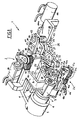
- the reference numeral 1 indicates the whole device for splicing the ends of the elastomeric fillers applied on bead cores of pneumatic tires according to the present invention.
- the device 1 comprises two primary pliers systems 2, 2a respectively opposite and supported by respective arms 3, 3a which on their turn are engaged in a rotating manner, around a common axis, with a stationary sleeve 4 rigidly engaged with a collar 5 integral with a supporting frame 6, shown only in part.
- an arm 3, associated to the first pliers system 2 is fastened to a hub 7 splined on a driving small shaft 8, while the second arm 3a is fastened to a mobile sleeve 9 engaged in a rotating manner with the stationary sleeve 4 and engaging on its turn, in a rotating manner, the hub 7 of the first arm 3.
- the primary pliers systems 2, 2a are realized in a substantially like manner. Therefore, for sake of brevity of exposition, in the structural description, reference will be made only to the first pliers system 2, except for different needs.
- the members of the second pliers system 2a will be marked with the same reference numeral as that used for the corresponding members of the first pliers system 2, with the addition of the suffix "a".
- the first primary pliers system 2 comprises a supporting block 10 integral with the first arm 3 which is engaged with at least a first and a second clamping element 11, 12 mutually opposed and disposed on the part turned toward the second primary pliers system 2a. More particularly the clamping elements 11, 12 are engaged in an oscillating manner with the supporting block 10 through respective pins 13, 14, each one integral with one end of the respective clamping element and crossing in a rotating manner the supporting block itself.
- a first gear wheel is splined, said gear wheel engaging when working with a second like gear wheel 16 splined on the pin 14 associated to the second clamping element 12.
- the gear wheels 15 and 16 mutually connect the clamping elements 11 and 12, so that to an angular rotation of one of the clamping elements, an angular rotation of equal entity but in opposite sense of the other clamping element corresponds.
- a control lever 17 is fastened on the pin 13 belonging to the first clamping element 11; a first fluid mechanics cylinder 18 mounted on the supporting block 10 works on said control lever.
- Said first fluid mechanics cylinder 18 is apt to provide a mutual approaching or separation of the clamping elements 11, 12.
- the clamping elements 11 and 12 face each other by means of the respective contacting surfaces 19 having respective deviation portions 20 which are suitably offset with respect to the development plane of the deviation portions 20a presented by the clamping elements 11a, 12a belonging to the second primary pliers system 2a.
- the deviation portions 20 are obtained consecutively to respective centering portions 21 presented by the contacting surface 19 in proximity of the free ends of the corresponding clamping elements 11, 12 and arranged coplanarly with respect to the centering portions 21a belonging to the second pliers system 2a.
- the deviation portions 20 belonging respectively to the first and second clamping element 11, 12 are offset with respect to the development plane in the same direction as the corresponding centering portion 21.
- the deviation portions 20 of the first clamping element 11 forms a surface reduction with respect to the corresponding centering portion 21
- the deviation portion of the second clamping element 12 forms a surface relief countershaped to the above said reduction.
- the geometric characteristics and the dimensional ratios between the deviation portions and the centering portions must be time by time chosen according to the type of filler on which the splicing operation has to be effected.
- the contacting surfaces 19 are obtained on interchangeable plates 22 releasably fastened to the clamping elements 11 and 12 through threaded elements 23.
- the device 1 is moreover provided with at least an ancillary pliers system 24 symmetrically arranged between the primary pliers systems 2, 2a and comprising a first and second gripping element 25, 26 rotatably engaged on a stationary pin 27 connected between a first and second supporting plate 28, 29 integral with the supporting structure 6 and extending in a substantially parallel direction.
- an ancillary pliers system 24 symmetrically arranged between the primary pliers systems 2, 2a and comprising a first and second gripping element 25, 26 rotatably engaged on a stationary pin 27 connected between a first and second supporting plate 28, 29 integral with the supporting structure 6 and extending in a substantially parallel direction.
- the gripping elements 25, 26 have respective contacting surfaces 30 substantially flat, disposed coplanarly to said centering portions 21, 21a and obtained preferably on respective interchangeable plates 31 releasably fastened to the gripping elements through threaded elements 32.
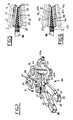
- the gripping elements 25, 26 have moreover respective continuations 33, 34 that, as better stressed in figure 2, diverge symmetrically when moving away from the stationary pin 27 to be rotatably engaged, at the respective free ends, with corresponding control rods 35, 36 mutually connected by a mobile pin 37.
- the mobile pin 37 is guided in a sliding manner by previous possible interposition of ball bearings or the like, through one or both the supporting plates 28, 29 along guiding slots 38 (only one is partially visible in figure 1) obtained in the plates themselves and extending according to the axis of alignment between the mobile pin and the stationary pin 27.
- the mobile pin 37 is translated along the guiding slots 38 through at least a return plate 39 provided with a shaped opening 40 in which a small block 41 connected on its turn to the mobile pin is guided in a sliding manner transversely of the development direction of the guiding slot 38.
- the return plate 39 is integral with a control pin 42 which crosses in a rotating manner the supporting plates 28, 29 and is rigidly engaged on the part opposite to the return plate, by a control lever 43; a driving fluid mechanics cylinder 44 (figure 1) connected to the first supporting plate 28 works on said control lever 43.
- control lever 43 is provided with a continuation 43a in the form of a plate disposed parallely to the return plate 39 and provided with a respective shaped opening (not shown) which, as said with reference to the opening 40, engages in a sliding manner a small block connected to the mobile pin 37.
- the device 1 can indifferently be associated to a conventional apparatus apt to apply a filler 45 on the bead core 46 of a pneumatic tire, or can work as an unit apart on the filler applied to the bead core during a previous processing.
- the filler 45 is in the form of a strip of elastomeric material in uncured condition with a substantially isosceles triangle section having a very accentuated height and joined at its base on the circumferential outer chafer of the bead core 46.
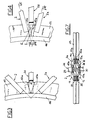
- the opposite ends 45a, 45b of the filler 45 mutually face diverging the one from the other on moving away from the peripheral chafer of the bead core 46. More particularly the ends 45a and 45b diverge according to a determinate angle ⁇ , so as to form a substantially "V" configuration.
- the bead core 46 provided with a filler 45 arranged as described, is positioned in such a way that the part of its circumferential development comprising the ends 45a and 45b is symmetrically interposed between the gripping and clamping elements of the primary pliers systems 2, 2a and ancillary system 24.
- the first fluid mechanics cylinders 18, 18a are set in action and acting on the respective control levers 17, 17a rotate angularly the corresponding clamping elements 11, 12 and 11a, 12a for a mutual approaching. More particularly, in this step the clamping elements 11, 12 and 11a, 12a are translated from an opening position where, as shown with a dashed line in figures 5 and 6, are laterally separated by the filler 45, to a closing position where, as shown with a continuous line in the above said figures, they work against the opposite ends of the filler itself exerting opposed thrust forces.
- the centering portions 21 and 21a of the respective contacting surfaces 20 work on a circumferential inner zone "I" of the filler 45, so that the positioning of said zones is maintained symmetric with respect to the development median plane of the bead core 46.
- the deviation portions 20 and 20a work on a circumferential outer zone "E" of the filler so as to move it lightly away with respect to the development median plane of the bead core 46. It has to be noted that the deviation portions 20 and 20a belonging respectively to the first and second pliers systems 2, 2a offset the corresponding circumferential outer zones "E" in opposite senses, so that they will better appear later on.
- the arms 3 and 4 are rotated angularly around their common pivoting axis to lead the pliers systems 2a and 2b from a rest position where, as shown in figure 3, are mutually spaced for permitting the engagement of the filler 45 by the clamping elements themselves, to an operative position in which, as shown in figure 4, the pliers systems are mutually approached to splice the ends 45a and 45b.
- the movement of the arms 3 and 4 can be obtained for instance through a not shown fluid mechanics cylinder, working between the driving small shaft 8 and the mobile sleeve 9 so as to rotate the one with respect to the other
- the pivoting axis of the arms 3 and 4 namely the axis around which the primary pliers systems 2, 2a rotate angularly, passes in proximity of the point in which the "V", configuration of the ends 45a and 45b converges.
- the above axis of rotation results lightly moved toward the center of the bead core with respect to the converging point of the "V".
- the primary pliers systems 2 and 2a rotate the one with respect to the other according to an angulation of figure 4 which is greater than the angle ⁇ formed by the ends 45a, 45b.
- the stem 44a of the fluid mechanics cylinder 44 is removed from the cylinder itself to cause, through the control pin 42, a rotation of the return plate 39 according to the direction of the arrow A of figure 2.
- the mobile pin 37 is moved along the guiding slots 38 toward the stationary pin 27, determining through the control rods 35, 36 a mutual spreading out of the continuations 33 and 34 presented by the gripping elements 25, 26.
- a mutual approaching of the gripping elements 25, 26 corresponds to the spreading out of the continuations33, 34. Consequently, the circumferential outer zones "E" of the ends 45a and 45b, mutually placed side by side, are compressed the one against the other between the contacting surfaces 30 of the gripping elements 25, 26.
- the present invention achieves thus the aimed purposes.
- the lateral compression made on the ends of the filler by the ancillary pliers system eliminates the drawbacks given, in the known technique, by the unavoidable expansion of the filler section at the splicing zone.
Landscapes
- Engineering & Computer Science (AREA)
- Mechanical Engineering (AREA)
- Textile Engineering (AREA)
- Tyre Moulding (AREA)
Claims (7)
- Dispositif d'épissage bout à bout des bandes de remplissage en élastomère appliquées sur les tringles de talons (46) de pneumatiques, lesdites bandes de remplissage (45) s'étendant le long de la bande de renfort extérieure circonférentielle d'une tringle (46) et dont les propres extrémités (45a, 45b) tournées mutuellement face à face, divergent l'une par rapport à l'autre en s'écartant progressivement à partir de la bande de renfort périphérique de la tringle, en suivant sensiblement une configuration en "V", ledit dispositif comprenant deux systèmes de pinces primaires (2, 2a), chacune d'elles agissant sur l'une des extrémités opposées (45a, 45b) de la bande de remplissage, par l'intermédiaire d'au moins deux éléments de prise ou de serrage (25, 26) disposés face à face, placés sur les parties opposées, sur le côté de la bande de remplissage (45) et mobiles l'un par rapport à l'autre à partir d'une position ouverte, dans laquelle ils sont séparés latéralement par la bande de remplissage (45), jusqu'à une position fermée, dans laquelle ils agissent contre les côtés opposés de la bande de remplissage en exerçant des forces de poussée opposées, lesdits systèmes de pince primaires (2, 2a) étant mobiles angulairement autour d'un axe de rotation voisin du point de convergence de la configuration en "V" ou en chevron des extrémités des bandes de remplissage, à partir d'une position de repos dans laquelle ils sont mutuellement séparés, pour permettre le blocage des extrémités de la bande de remplissage (45a, 45b) entre lesdits éléments de prise, jusqu'à une position d'épissage dans laquelle ils sont mutuellement rapprochés pour épisser lesdites extrémités (45a, 45b) lorsque ces dernières sont maintenues par les éléments de prise (25, 26) en position rapprochée, caractérisé en ce que lesdits systèmes de pinces primaires (2, 2a), lors de la translation de la position de repos à la position d'épissage, tournent l'un par rapport à l'autre en formant un angle supérieur à l'angle formé par la configuration en "V" des extrémités des bandes de remplissage (45a, 45b) lorsque les systèmes de pinces sont eux-mêmes en position de repos, et que les moyens de serrage (11, 12; 11a, 12a) de chaque système de pinces (2, 2a) agissent sur la bande de remplissage par l'intermédiaire de surfaces de contact respectives (19) comportant des parties déviées correspondantes (20), décalées par rapport aux parties déviées (20a) des surfaces de contact appartenant à l'autre système de pinces primaires, et aptes à agir sur la zone extérieure circonférentielle de la bande de remplissage pour placer mutuellement côte à côte les extrémités de celle-ci sur ladite zone extérieure circonférentielle en conséquence de la translation du système de pinces en position d'épissage, ledit dispositif comprenant également, au moins, un système de pinces auxiliaire (24) agencé entre ledit système de pinces primaires et pourvu d'éléments de de prise ou de serrage respectifs (25, 26) disposés symétriquement côte à côte par rapport aux côtés opposés de la bande de remplissage et mobiles pour effectuer une course d'approche mutuelle afin de comprimer mutuellement les extrémités de la bande de remplissage qui ont été rapprochées par la manoeuvre des systèmes de pinces primaires.
- Dispositif selon la revendication 1, caractérisé en ce que les parties déviées (20, 20a) que présentent les éléments de prise ou de serrage de chaque système de pinces primaires sont ménagées après les parties centrées respectives (21, 21a) présentées par lesdites surfaces de contact (19) et agencées aux extrémités libres des éléments de serrage, coplanairement par rapport aux portées de centrage présentées par les éléments de l'autre système de pinces primaires.
- Dispositif selon la revendication 1, caractérisé en ce que l'axe de rotation des systèmes de pinces primaires (2, 2a) est légèrement déplacé vers le centre de la tringle, par rapport au point de convergence de la configuration en "V" formée par les extrémités libres de la bande de remplissage .
- Dispositif selon la revendication 1, caractérisé en ce que chaque système de pinces primaires (2) comprend un bloc formant support (10), incorporé monobloc, muni d'un bras (3) monté à rotation dans ledit axe de rotation, une paire d'axes (13, 14) montés à rotation, traversant le bloc de support et venant en prise sur les éléments de serrage (11, 12) dans la partie tournée vers l'autre système de pinces primaires (2a), deux pignons d'engrenage (15, 16), chacun d'eux en prise sur l'un desdits axes, sur la partie opposée aux éléments de serrage et venant mutuellement en prise, un levier de commande (17) intégré monobloc à l'un desdits axes et un cylindre hydraulique (18) monté sur le bloc de support (10) et agissant sur ledit levier de commande (17) pour commander l'approche et la séparation mutuelle des éléments de serrage.
- Dispositif selon la revendication 1, caractérisé en ce que lesdits systèmes de pinces primaires sont supportés, respectivement, par un premier bras (3) incorporé monobloc à un moyeu (7) claveté sur un petit arbre d'entraînement et par un second bras (3a) intégré monobloc à un manchon mobile (9), entraînant ledit moyeu à rotation et entraîné lui-même à rotation sur un manchon fixe (4), relié rigidement à une structure formant support.
- Dispositif selon la revendication 1, caractérisé en ce que ledit système de pinces auxiliaires (24) comprend un axe fixe (27) monté entre une première et une deuxième plaque de support (28, 29) et entraînant à rotation lesdits éléments de prise (25, 26), une paire de biellettes de commande (35, 36), chacune d'elles montée à rotation sur une extension (33, 34) de l'un desdits éléments de prise et un axe mobile (37) venant en prise sur la tige de commande et monté glissant le long d'au moins une fente de guidage (38) ménagée dans l'une desdites plaques de support (28) et disposée dans l'axe d'alignement entre l'axe mobile et l'axe fixe, ledit axe mobile (37) pouvant effectuer une translation le long desdites fentes de guidage pour assurer conjointement le rapprochement et la séparation des éléments de prise ou de serrage par suite de la manoeuvre desdites biellettes de commande.
- Dispositif selon la revendication 6, caractérisé en ce que ledit axe mobile (37) peut effectuer une translation à la suite de la manoeuvre d'une plaque de rappel (39) munie d'une ouverture profilée, dans laquelle une petite cale de commande (41), sollicitant en prise l'axe mobile, est montée glissante dans la direction transversale à la direction de développement des fentes de guidage, ladite plaque de rappel (39) étant incorporée monobloc à l'axe de commande (42), monté à rotation dans la plaque de support (28, 29) et venant rigidement en prise, dans la partie opposée à la plaque de rappel, sur un levier de commande (43) sollicité par un cylindre hydraulique (44) venant en prise sur l'une desdites plaques de support.
Applications Claiming Priority (2)
| Application Number | Priority Date | Filing Date | Title |
|---|---|---|---|
| IT2062188 | 1988-05-18 | ||
| IT20621/88A IT1217631B (it) | 1988-05-18 | 1988-05-18 | Dispositivo per giuntare le estremita' di riempitivi elastomerici applicati su cerchietti di pneumatici |
Publications (3)
| Publication Number | Publication Date |
|---|---|
| EP0342467A2 EP0342467A2 (fr) | 1989-11-23 |
| EP0342467A3 EP0342467A3 (fr) | 1991-11-06 |
| EP0342467B1 true EP0342467B1 (fr) | 1993-06-09 |
Family
ID=11169677
Family Applications (1)
| Application Number | Title | Priority Date | Filing Date |
|---|---|---|---|
| EP89108236A Expired - Lifetime EP0342467B1 (fr) | 1988-05-18 | 1989-05-08 | Dispositif d'épissage bout à bout des bandes de remplissage en élastomère appliquées sur les tringles de pneus |
Country Status (6)
| Country | Link |
|---|---|
| US (2) | US4994136A (fr) |
| EP (1) | EP0342467B1 (fr) |
| JP (1) | JP2667905B2 (fr) |
| AR (1) | AR241877A1 (fr) |
| DE (1) | DE68906958T2 (fr) |
| IT (1) | IT1217631B (fr) |
Families Citing this family (14)
| Publication number | Priority date | Publication date | Assignee | Title |
|---|---|---|---|---|
| US5221409A (en) * | 1992-01-06 | 1993-06-22 | The Goodyear Tire & Rubber Company | Apparatus for butt splicing ply stock |
| JP2524059B2 (ja) * | 1992-09-29 | 1996-08-14 | 住友ゴム工業株式会社 | ビ―ド・エ―ペックス自動アッセンブル方法及びその装置 |
| AU6946900A (en) * | 1999-09-03 | 2001-04-10 | Bartell Machinery Systems, Llc | Apparatus for stitching and seaming elastomeric fillers to tire beads |
| JP4501265B2 (ja) * | 2000-09-25 | 2010-07-14 | 横浜ゴム株式会社 | ビードフィラーの圧着方法及びその装置 |
| JP2006186318A (ja) * | 2004-11-30 | 2006-07-13 | Nidec Tosok Corp | リードフレーム押出装置 |
| JP4746100B2 (ja) * | 2006-07-21 | 2011-08-10 | 東洋ゴム工業株式会社 | タイヤ用ビードの製造方法及び装置 |
| KR101015917B1 (ko) * | 2008-12-04 | 2011-02-23 | 한국타이어 주식회사 | 타이어 재단설비에서 카카스 원단에 부착되는 사이드 필링 테이프 부착장치 |
| FR2953444B1 (fr) * | 2009-12-09 | 2012-01-13 | Michelin Soc Tech | Procede de fabrication d'une tringle destinee a la realisation d'un pneumatique |
| NL2009946C2 (en) | 2012-12-10 | 2014-06-11 | Vmi Holland Bv | Tyre building machine for forming a bead-apex assembly. |
| NL2010201C2 (en) * | 2013-01-30 | 2014-08-04 | Vmi Holland Bv | Apparatus for forming an annular apex filler. |
| KR102059600B1 (ko) | 2013-10-03 | 2019-12-26 | 후지 세이코 가부시키가이샤 | 비드 코어에 대한 필러의 장착 방법 및 장착 장치 |
| US9126340B2 (en) | 2013-10-18 | 2015-09-08 | Bartell Machinery Systems, L.L.C. | Systems and methods for gripping and handling a bead apex |
| CN106103067B (zh) * | 2014-03-24 | 2019-07-23 | 不二精工株式会社 | 轮胎用胎圈三角胶芯的卷绕方法和卷绕装置 |
| NL2027901B1 (en) * | 2021-04-01 | 2022-10-17 | Vmi Holland Bv | Method for positioning a strip for splicing, gripper for supplying said strip for splicing and tire building machine comprising said gripper |
Family Cites Families (15)
| Publication number | Priority date | Publication date | Assignee | Title |
|---|---|---|---|---|
| US2309305A (en) * | 1941-03-10 | 1943-01-26 | Carborundum Co | Abrasive article |
| US2565703A (en) * | 1948-05-22 | 1951-08-28 | Goodrich Co B F | Apparatus for splicing cushion tires |
| US2497461A (en) * | 1949-04-19 | 1950-02-14 | Dunlop Tire & Rubber Corp | Apparatus for splicing inner tubes of tires |
| US2647555A (en) * | 1950-12-12 | 1953-08-04 | Us Rubber Co | Method and apparatus for splicing |
| US2679888A (en) * | 1953-02-06 | 1954-06-01 | William K Bohon | Belt splicer |
| US3026569A (en) * | 1959-02-16 | 1962-03-27 | Philip B Keller | Method of fabricating omicron-rings |
| NL6802950A (fr) * | 1968-03-01 | 1969-09-03 | ||
| US3976534A (en) * | 1973-07-28 | 1976-08-24 | Howaldtswerke-Deutsche Werft Aktiengesellschaft Hamburg Und Kiel | Device for use in uniting the adjacent ends of radially split sealing rings |
| IT1115688B (it) * | 1977-12-15 | 1986-02-03 | Pirelli | Dispositivo per l'applicazione di un riempitivo elastomerico ad un cerchietto di pneumatico |
| IT1094441B (it) * | 1978-04-19 | 1985-08-02 | Pirelli | Miglioramenti ad applicatrice di riempitivo elastomerico a cerchietto di pneumatico |
| IT1124588B (it) * | 1979-10-09 | 1986-05-07 | Pirelli | Perfezionamenti nelle apparecchiatura per l'applicazione di riempitivi elastomerici a cerchietti di pneumatici |
| US4452660A (en) * | 1982-09-27 | 1984-06-05 | The Goodyear Tire & Rubber Company | Bead jamming or crimping apparatus |
| US4484975A (en) * | 1984-01-23 | 1984-11-27 | Mcelroy Manufacturing, Inc. | Hand held apparatus for joining small diameter plastic pipe |
| JPS6490736A (en) * | 1987-09-30 | 1989-04-07 | Sumitomo Rubber Ind | Apex mounting and its device |
| US5006385A (en) * | 1988-07-22 | 1991-04-09 | Signode Corporation | Strapping joint and method for forming same |
-
1988
- 1988-05-18 IT IT20621/88A patent/IT1217631B/it active
-
1989
- 1989-05-01 US US07/345,299 patent/US4994136A/en not_active Expired - Lifetime
- 1989-05-08 DE DE89108236T patent/DE68906958T2/de not_active Expired - Lifetime
- 1989-05-08 EP EP89108236A patent/EP0342467B1/fr not_active Expired - Lifetime
- 1989-05-16 AR AR89313932A patent/AR241877A1/es active
- 1989-05-18 JP JP1125478A patent/JP2667905B2/ja not_active Expired - Fee Related
-
1990
- 1990-12-27 US US07/634,715 patent/US5133817A/en not_active Expired - Lifetime
Also Published As
| Publication number | Publication date |
|---|---|
| IT1217631B (it) | 1990-03-30 |
| DE68906958D1 (de) | 1993-07-15 |
| EP0342467A2 (fr) | 1989-11-23 |
| US4994136A (en) | 1991-02-19 |
| EP0342467A3 (fr) | 1991-11-06 |
| DE68906958T2 (de) | 1994-01-20 |
| AR241877A1 (es) | 1993-01-29 |
| JPH0220331A (ja) | 1990-01-23 |
| US5133817A (en) | 1992-07-28 |
| IT8820621A0 (it) | 1988-05-18 |
| JP2667905B2 (ja) | 1997-10-27 |
Similar Documents
| Publication | Publication Date | Title |
|---|---|---|
| EP0342467A2 (fr) | Dispositif d'épissage bout à bout des bandes de remplissage en élastomère appliquées sur les tringles de pneus | |
| US3674604A (en) | Tire building drum | |
| IE40287B1 (en) | Improvements in or relating to a method and apparatus for producing a cowtinuous band of rubberised fabric | |
| US5466182A (en) | Machine for scraping tires with controllable relative positioning of tire and work tool | |
| US20060037708A1 (en) | Method for pressure bonding of a breaker-tread assembly with a carcass assembly by means of stitching in the manufacture of green tyres and device for accomplishment of such method | |
| JP2579530B2 (ja) | ヘミング成形方法 | |
| EP0345633B1 (fr) | Dispositif pour appliquer un élément de remplissage en élastomère sur le talon d'un pneumatique | |
| US4120714A (en) | Apparatus for setting bead rings on the carcass of a vehicle tire | |
| US3332820A (en) | Band support | |
| US4584049A (en) | Radial tire forming blank supply apparatus | |
| GB1597199A (en) | Device for the application of elastomeric fillers on bead cores of pneumatic tyres | |
| EP0387455A2 (fr) | Procédé et dispositif pour appliquer un élément en forme de ceinture sur un tambour de formage | |
| EP0405350A1 (fr) | Dispositif ajustable pour le rechapage de pneumatiques | |
| US4565084A (en) | Method and a tool for bending the edge of thick sheet metal | |
| US2489324A (en) | Splicing apparatus | |
| JPH03143625A (ja) | ゴムベルト製造用成形機 | |
| US5379667A (en) | Pinch cutting method and apparatus | |
| US2510715A (en) | Curing bag splicing machine | |
| JPH03218818A (ja) | タイヤ成形機におけるトレッド貼付け方法 | |
| US4896711A (en) | Apparatus for mounting and dismounting of tires | |
| US2971563A (en) | Method and apparatus for applying tread to rubber tires | |
| US4670082A (en) | Machine for retreading pneumatic tires | |
| US4682641A (en) | System for manufacture of high-lug tires | |
| CN121245326B (zh) | 一种钢结构焊接设备及焊接工艺 | |
| JPH0862101A (ja) | 自動車用車輪のタイヤのフィッティング装置 |
Legal Events
| Date | Code | Title | Description |
|---|---|---|---|
| PUAI | Public reference made under article 153(3) epc to a published international application that has entered the european phase |
Free format text: ORIGINAL CODE: 0009012 |
|
| AK | Designated contracting states |
Kind code of ref document: A2 Designated state(s): DE FR GB |
|
| PUAL | Search report despatched |
Free format text: ORIGINAL CODE: 0009013 |
|
| AK | Designated contracting states |
Kind code of ref document: A3 Designated state(s): DE FR GB |
|
| 17P | Request for examination filed |
Effective date: 19920416 |
|
| 17Q | First examination report despatched |
Effective date: 19921027 |
|
| GRAA | (expected) grant |
Free format text: ORIGINAL CODE: 0009210 |
|
| AK | Designated contracting states |
Kind code of ref document: B1 Designated state(s): DE FR GB |
|
| REF | Corresponds to: |
Ref document number: 68906958 Country of ref document: DE Date of ref document: 19930715 |
|
| ET | Fr: translation filed | ||
| PLBE | No opposition filed within time limit |
Free format text: ORIGINAL CODE: 0009261 |
|
| STAA | Information on the status of an ep patent application or granted ep patent |
Free format text: STATUS: NO OPPOSITION FILED WITHIN TIME LIMIT |
|
| 26N | No opposition filed | ||
| REG | Reference to a national code |
Ref country code: GB Ref legal event code: IF02 |
|
| PGFP | Annual fee paid to national office [announced via postgrant information from national office to epo] |
Ref country code: FR Payment date: 20060517 Year of fee payment: 18 |
|
| PGFP | Annual fee paid to national office [announced via postgrant information from national office to epo] |
Ref country code: GB Payment date: 20060525 Year of fee payment: 18 |
|
| GBPC | Gb: european patent ceased through non-payment of renewal fee |
Effective date: 20070508 |
|
| REG | Reference to a national code |
Ref country code: FR Ref legal event code: ST Effective date: 20080131 |
|
| PG25 | Lapsed in a contracting state [announced via postgrant information from national office to epo] |
Ref country code: GB Free format text: LAPSE BECAUSE OF NON-PAYMENT OF DUE FEES Effective date: 20070508 |
|
| PG25 | Lapsed in a contracting state [announced via postgrant information from national office to epo] |
Ref country code: FR Free format text: LAPSE BECAUSE OF NON-PAYMENT OF DUE FEES Effective date: 20070531 |
|
| PGFP | Annual fee paid to national office [announced via postgrant information from national office to epo] |
Ref country code: DE Payment date: 20080630 Year of fee payment: 20 |