EP0341306B1 - Beschleunigungsmesser mit vorrichtung zur unterdrückung von gleichtakteingangssignalen - Google Patents
Beschleunigungsmesser mit vorrichtung zur unterdrückung von gleichtakteingangssignalen Download PDFInfo
- Publication number
- EP0341306B1 EP0341306B1 EP89901226A EP89901226A EP0341306B1 EP 0341306 B1 EP0341306 B1 EP 0341306B1 EP 89901226 A EP89901226 A EP 89901226A EP 89901226 A EP89901226 A EP 89901226A EP 0341306 B1 EP0341306 B1 EP 0341306B1
- Authority
- EP
- European Patent Office
- Prior art keywords
- axis
- proof mass
- transducer
- isolator
- hinge axis
- Prior art date
- Legal status (The legal status is an assumption and is not a legal conclusion. Google has not performed a legal analysis and makes no representation as to the accuracy of the status listed.)
- Expired - Lifetime
Links
Images

Classifications
-
- G—PHYSICS
- G01—MEASURING; TESTING
- G01P—MEASURING LINEAR OR ANGULAR SPEED, ACCELERATION, DECELERATION, OR SHOCK; INDICATING PRESENCE, ABSENCE, OR DIRECTION, OF MOVEMENT
- G01P15/00—Measuring acceleration; Measuring deceleration; Measuring shock, i.e. sudden change of acceleration
- G01P15/02—Measuring acceleration; Measuring deceleration; Measuring shock, i.e. sudden change of acceleration by making use of inertia forces using solid seismic masses
- G01P15/08—Measuring acceleration; Measuring deceleration; Measuring shock, i.e. sudden change of acceleration by making use of inertia forces using solid seismic masses with conversion into electric or magnetic values
- G01P15/097—Measuring acceleration; Measuring deceleration; Measuring shock, i.e. sudden change of acceleration by making use of inertia forces using solid seismic masses with conversion into electric or magnetic values by vibratory elements
Definitions
- the present invention relates to accelerometers and, in particular, to an accelerometer in which movement of a proof mass is constrained by force transducers.
- a primary source of common mode errors in most vibrating beam accelerometers is related to mismatched coefficients of thermal expansion.
- Crystalline quartz in the crystalline axis orientation commonly used for force transducers, has a relatively nonlinear expansion coefficient as a function of temperature. It is extremely difficult to find metals with the proper qualities for flexures which also match the thermal expansion of crystalline quartz. Even if a perfect match were made at a given temperature, the nonlinearities of crystalline quartz expansion would cause mismatches to occur at the operating temperature extremes.
- the zero stress point of crystal attachment it is common for the zero stress point of crystal attachment to be at a temperature substantially above the accelerometer operating range. This is typical for epoxies, anodic bonding, brazing, and glass frit bonding. Thus the resulting accelerometer will have thermal expansion mismatch that will cause common mode stress on the crystals.
- the member which is mechanically isolated from the support and to which the force transducers are connected is referred to herein as an isolator.
- US-A-4658174 there is a disclosure of a mechanical isolator in a vibrating beam force transducer, but that is an isolator mass the function of which is to prevent the transfer of energy from the vibrating member of a resonator to a support. There is no equivalent of the suspension means of this invention.
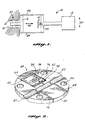
- the accelerometer 10 comprises proof mass 12 that is mounted to support 14 such that the proof mass is rotatable about hinge axis HA that is normal to the plane of the drawing.
- the accelerometer further comprises isolator 16 that is mounted to a different portion of support 14 by an isolator suspension system generally indicated by reference numeral 20.
- the isolator suspension system symbolized by four rollers in FIGURE 1, is compliant along a transducer axis TA that is perpendicular to sensitive axis SA and to hinge axis HA, and is noncompliant for rotation about hinge axis HA.
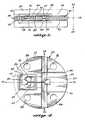
- Isolator 42 is formed by making a pair of interlocking C-shaped slots 54 and 56, the slots resulting in the formation of isolator 42 connected to support 52 by beams 60 and 62.
- the sizes and positions of slots 54 and 56 are adjusted such that beams 60 and 62 have comparatively small dimensions along a transducer axis TA, and comparatively large dimensions along the hinge axis and sensitive axis.
- isolator 42 is relatively compliant for translational motion along the transducer axis, and is comparatively noncompliant for other degrees of freedom, including rotation about hinge axis HA.
- the upper and lower surfaces of isolator 42 include cutout sections 70 and 72 that are provided to reduce the mass of the isolator, for reasons discussed below.
- the upper surfaces of isolator 42, beam 62 and support 52 include recessed areas 74, 76 and 78, respectively, and the lower surfaces of the corresponding elements include similar recessed sections. These recessed sections permit attachment of force sensing crystals 80 and 82 between isolator 42 and proof mass 40.
- Upper support 30, proof mass assembly 34 and lower support 32 are fastened together by four screws (not shown) that pass through openings (not shown) in the upper and lower plates, and through openings 86 in support 52.
- the upper and lower plates include recessed areas 88 above and below the force sensing crystals, to accommodate the crystals and the lead wires connected thereto.
- the crystals could also be mounted on pedestals, or recessed into the proof mass assembly to adjust scaling and natural frequency.
- the portions of the upper and lower plates adjacent to proof mass 40 may be machined such that these surfaces are set slightly back from the proof mass, to provide suitable shock clearances at interfaces 90 between the proof mass and the adjacent surfaces of the upper and lower plates.
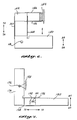
- FIGURE 6 A second embodiment of the accelerometer of the present invention is illustrated schematically in FIGURE 6.
- proof mass 150 is mounted to a support by suitable means (not shown) such that the proof mass can rotate about hinge axis HA that is normal to the plane of the drawing in FIGURE 6.
- Isolator 152 is mounted to support 154 by an isolator suspension system illustrated as a pair of flexures 156, such that isolator 152 is relatively compliant for translational movement along a transducer axis TA that for this embodiment is parallel to sensitive axis SA.
- flexures 156 prevent rotation of isolator 152 about hinge axis HA.
- a pair of force sensing crystals 160 and 162 extend between proof mass 150 and isolator 152, parallel to transducer axis TA.
- acceleration along sensitive axis SA tends to rotate proof mass 150 about hinge axis HA, thereby putting one force sensing crystal in tension and the other force sensing crystal in compression.
- differential thermal expansion or contraction of the force sensing crystals with respect to the other accelerometer components causes translational movement of isolator 152 along transducer axis TA. Because of the high compliance of the isolator along the transducer axis, differential thermal expansion causes a relatively small common mode force on the crystals.
- Force sensing crystals 176 and 178 extend along transducer axis TA between proof mass 170 and isolator 174, on opposite sides of hinge axis HA.
- Transducer axis TA is perpendicular to both the hinge axis and to sensitive axis SA.
- acceleration along sensitive axis SA tends to rotate proof mass 170 about hinge axis HA, thereby putting one force sensing crystal in tension and the other in compression.
- differential thermal expansion of the force sensing crystals tends to rotate isolator 174 about pivot axis 176, producing a small common mode force on the crystals.
- the mass of isolator 42 and the nonlinearities in the crystals lead to a slight cross axis acceleration sensitivity, even though the loading is common mode.
- One way to reduce this error source is to reduce the mass of the isolator as much as possible, such as by means of recesses 70 and 72.
- Another option is to use an accelerometer such as the one shown in FIGURE 6, wherein the mass of isolator 152 adds common mode loading only due to sensitive axis acceleration. In this case, the error is removed by the calibration process for the accelerometer.
- Another option is to use an accelerometer such as the one shown in FIGURE 7, wherein isolator 174 is supported at its center of mass, so that it is uneffected by linear acceleration.
- connection of two vibrating beam force transducers to a single proof mass introduces a potential problem of crosstalk between the transducers.
- force sensing crystals that have center frequencies that are spaced far enough apart so that the frequency operating ranges of the crystals do not overlap.
- the use of crystals having different center frequencies can mean that the stiffnesses of the crystals will be different from one another, and that the forces sensed by the crystals for a given acceleration input will be different from one another.
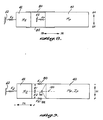
- FIGURE 9 A simplified model for the accelerometer of FIGURES 2-4 is presented in FIGURE 9.
- the model of FIGURE 9 includes proof mass 40 having moment of inertia I P about hinge axis HA, isolator 42 having mass M I , and isolation suspension system 20 that has a spring constant K I along transducer axis TA.
- F2 -K2 ( ⁇ ⁇ R2 + Z)
- ⁇ is the angle of rotation of the proof mass about the hinge axis
- Z is the distance of movement of the isolator along the transducer axis
- forces F1 and F2 are equal for any given acceleration input, i.e., for any given rotation of proof mass 10.
- F1 and F2 will be unequal due to differences between K1 and K2 and/or differences between R1 and R2 .
- K1 M I I P K1R 1 2 + K2R 2 2
- K1 spring constant K1
- K1 M I I P K1R 1 2 + K2R 2 2
- the value of K1 determined by Equation (3) is the tuned condition at which the resonant frequency of the isolator mass and isolator suspension system absent crystals 80 and 82 is the same as the fundamental system resonance, i.e., the resonant frequency of the proof mass and the force sensing crystals, assuming no isolator movement.
- isolator movement will tend to reduce the force differences between the crystals, and will therefore improve the vibration rectification coefficient.
- the isolator suspension system is therefore preferably designed such that K1 satisfies Equation (3), particularly for systems in which crystals having different center frequencies are used.
Landscapes
- Physics & Mathematics (AREA)
- General Physics & Mathematics (AREA)
- Pressure Sensors (AREA)
- Manipulator (AREA)
- Measurement Of Mechanical Vibrations Or Ultrasonic Waves (AREA)
Claims (10)
- Beschleunigungsmesser zur Messung der Beschleunigung in einer Empfindlichkeitsachse (SA) enthaltend:
einen Halter (14);
eine Probemasse (12);
eine Befestigungseinrichtung zur Befestigung der Probemasse (12) an dem Halter (14) drehbar um eine Gelenkachse (HA) rechtwinklig zur Empfindlichkeitsachse (SA), und zwei Kraftaufnehmer (22, 24), die parallel zu einer Aufnehnerachse (TA) normal zur Gelenkachse (HA) zwischen die Probemasse (12) und ein von dem Halter (14) mechanisch isoliertes Teil (16) geschaltet und die auf einander gegenüberliegenden Seiten der Gelenkachse (HA) so angeordnet sind, daß eine Drehbewegung der Probemasse (12) um die Gelenkachse (HA) einen Kraftaufnehmer (22) unter Zug und den anderen Kraftaufnehmer (24) unter Druck setzt, dadurch gekennzeichnet, daß die Einrichtung, die das Teil (16) von dem Halter (14) mechanisch isoliert, eine Aufhängung (20) umfasst, die relativ nachgiebig für eine Bewegung des Teiles (16) parallel zur Aufnehmerachse und relativ unnachgiebig gegenüber einer Drehbewegung des Teiles (16) um die Gelenkachse (HA) ist. - Beschleunigungsmesser nach Anspruch 1, bei dem die Aufnehmerachse (TA) senkrecht zur Emplindlichkeitsachse (SA) liegt.
- Beschleunigungsmesser nach Anspruch 2, bei dem die Aufhängung (20) relativ nachgiebig ist für eine Drehung des Teiles (16) um eine Drehachse (136, 176), die parallel zur Gelenkachse (HA) liegt, jedoch in senkrechter Richtung von dieser beabstandet ist.
- Beschleunigungsmesser nach Anspruch 1, bei dem die Aufnehmerachse (TA) parallel zur Empfindlichkeitsachse (SA) liegt.
- Beschleunigungsmesser nach Anspruch 1, bei dem die Aufhängung (20) einen ersten und einen zweiten Balken (60, 62; 104, 106; 121, 122, 123, 124) enthält, die auf gegenüberliegenden Seiten des Teiles (16) entlang der Aufnehmerachse (TA) sich parallel zur Gelenkachse (HA) erstreckend angeordnet, jeweils mit dem Halter (14) und dem Teil (16) verbunden und jeweils relativ nachgiebig für Biegung entlang der Aufnehmerachse (TA) und relativ unnachgiebig gegenüber Biegung entlang der Empfindlichkeitsachse (SA) sind.
- Beschleunigungsmesser nach Anspruch 1, bei dem die Befestigungseinrichtung (20) einen eine kreisbogenförmige Krümmung aufweisenden Biegebereich umfaßt.
- Beschleunigungsmesser nach einem der vorhergehenden Ansprüche, bei dem der rechtwinklige Abstand (R₁) zwischen jedem Kraftaufnehmer (80) und der Gelenkachse (HA) gleich dem rechtwinkligen Abstand (R₂) zwischen dem anderen Kraftaufnehmer (82) und der Gelenkachse (HA) ist.
- Beschleunigungsmesser nach einem der vorhergehenden Ansprüche, bei dem die Masse (Mp) der Probemasse (12) geteilt durch die Nachgiebigkeit (Kp) der Befestigungseinrichtung entlang der Aufnehmerachse (TA) gleich der Masse (Ml) des Teiles (16) geteilt durch die Nachgiebigkeit (Kl) der Aufhängung (20) entlang der Aufnehmerachse (TA) ist.
- Beschleunigungsmesser nach einem der vorhergehenden Ansprüche, bei dem die Federkonstante der Aufhängung (20) zur Bewegung des Teiles (16) entlang der Aufnehmerachse (TA) so gewählt ist, daß die Resonanzfrequenz der Schwingung des Teiles (16) entlang der Aufnehemerachse (TA) unabhängig von den Kraftaufnehmern und der Probemasse im wesentlichen gleich der Resonanzfrequenz der Schwingung der Probemasse bei festgehaltenem Teil (16) um die Gelenkachse (HA) ist.
- Beschleunigungsmesser nach einem der vorhergehenden Ansprüche, bei dem der Halter (14), die Probemasse (12), der Befestigungseinrichtung für die Probemasse, das Teil (16) und die Aufhängung (20) zusammen eine Probemassenbaugruppe (30) bilden, die zwischen mit dem Halter (14) verbundene obere und untere Plattenteile (30, 32) eingelegt ist.
Applications Claiming Priority (2)
| Application Number | Priority Date | Filing Date | Title |
|---|---|---|---|
| US111984 | 1980-01-14 | ||
| US07/111,984 US4766768A (en) | 1987-10-22 | 1987-10-22 | Accelerometer with isolator for common mode inputs |
Publications (3)
| Publication Number | Publication Date |
|---|---|
| EP0341306A1 EP0341306A1 (de) | 1989-11-15 |
| EP0341306A4 EP0341306A4 (en) | 1991-05-08 |
| EP0341306B1 true EP0341306B1 (de) | 1993-02-24 |
Family
ID=22341504
Family Applications (1)
| Application Number | Title | Priority Date | Filing Date |
|---|---|---|---|
| EP89901226A Expired - Lifetime EP0341306B1 (de) | 1987-10-22 | 1988-10-10 | Beschleunigungsmesser mit vorrichtung zur unterdrückung von gleichtakteingangssignalen |
Country Status (6)
| Country | Link |
|---|---|
| US (1) | US4766768A (de) |
| EP (1) | EP0341306B1 (de) |
| JP (1) | JPH0648277B2 (de) |
| DE (1) | DE3878683T2 (de) |
| IL (1) | IL87989A (de) |
| WO (1) | WO1989003998A1 (de) |
Families Citing this family (50)
| Publication number | Priority date | Publication date | Assignee | Title |
|---|---|---|---|---|
| US5274797A (en) * | 1986-05-30 | 1993-12-28 | Bull Hn Information Systems Inc. | Multiprocessor system with centralized initialization, testing and monitoring of the system and providing centralized timing |
| FR2627592B1 (fr) * | 1988-02-22 | 1990-07-27 | Sagem | Accelerometre pendulaire non asservi a poutre resonante |
| US4872343A (en) * | 1988-08-10 | 1989-10-10 | Sundstrand Data Control, Inc. | Matched pairs of force transducers |
| US4945765A (en) * | 1988-08-31 | 1990-08-07 | Kearfott Guidance & Navigation Corp. | Silicon micromachined accelerometer |
| US4879914A (en) * | 1989-02-27 | 1989-11-14 | Sundstrand Data Control, Inc. | Unitary push-pull force transducer |
| US5165279A (en) * | 1989-07-06 | 1992-11-24 | Sundstrand Corporation | Monolithic accelerometer with flexurally mounted force transducer |
| FR2650895B1 (fr) * | 1989-08-08 | 1991-10-11 | Onera (Off Nat Aerospatiale) | Capteur accelerometrique a poutres vibrant en flexion |
| US5058430A (en) * | 1989-12-29 | 1991-10-22 | Honeywell Inc. | Sensor capsule mounting |
| WO1991019986A1 (en) * | 1990-06-11 | 1991-12-26 | Sundstrand Data Control, Inc. | Accelerometer with flexure isolation |
| CN1027011C (zh) * | 1990-07-12 | 1994-12-14 | 涂相征 | 一种硅梁压阻加速度传感器及其制造方法 |
| JPH0644008B2 (ja) * | 1990-08-17 | 1994-06-08 | アナログ・ディバイセス・インコーポレーテッド | モノリシック加速度計 |
| US5314572A (en) * | 1990-08-17 | 1994-05-24 | Analog Devices, Inc. | Method for fabricating microstructures |
| US5326726A (en) * | 1990-08-17 | 1994-07-05 | Analog Devices, Inc. | Method for fabricating monolithic chip containing integrated circuitry and suspended microstructure |
| US5417111A (en) * | 1990-08-17 | 1995-05-23 | Analog Devices, Inc. | Monolithic chip containing integrated circuitry and suspended microstructure |
| US5111694A (en) * | 1990-08-17 | 1992-05-12 | Sundstrand Corporation | Accelerometer with rebalance coil stress isolation |
| US5205171A (en) * | 1991-01-11 | 1993-04-27 | Northrop Corporation | Miniature silicon accelerometer and method |
| US5168756A (en) * | 1991-02-08 | 1992-12-08 | Sundstrand Corporation | Dithering coriolis rate and acceleration sensor utilizing a permanent magnet |
| US5331853A (en) * | 1991-02-08 | 1994-07-26 | Alliedsignal Inc. | Micromachined rate and acceleration sensor |
| US5243278A (en) * | 1991-02-08 | 1993-09-07 | Sundstrand Corporation | Differential angular velocity sensor that is sensitive in only one degree of freedom |
| US5241861A (en) * | 1991-02-08 | 1993-09-07 | Sundstrand Corporation | Micromachined rate and acceleration sensor |
| US5396797A (en) * | 1991-02-08 | 1995-03-14 | Alliedsignal Inc. | Triaxial angular rate and acceleration sensor |
| FR2685964B1 (fr) * | 1992-01-06 | 1996-06-07 | Onera (Off Nat Aerospatiale) | Capteur accelerometrique miniature a lames vibrant en flexion. |
| US5442146A (en) | 1992-04-03 | 1995-08-15 | Weigh-Tronix, Inc. | Counting scale and load cell assembly therefor |
| US5313023A (en) | 1992-04-03 | 1994-05-17 | Weigh-Tronix, Inc. | Load cell |
| US5391844A (en) | 1992-04-03 | 1995-02-21 | Weigh-Tronix Inc | Load cell |
| US5336854A (en) | 1992-04-03 | 1994-08-09 | Weigh-Tronix, Inc. | Electronic force sensing load cell |
| US5456110A (en) * | 1993-11-12 | 1995-10-10 | Alliedsignal Inc. | Dual pendulum vibrating beam accelerometer |
| US5594170A (en) * | 1994-06-15 | 1997-01-14 | Alliedsignal Inc. | Kip cancellation in a pendulous silicon accelerometer |
| EP0693690B1 (de) * | 1994-06-29 | 1999-04-28 | New Sd, Inc. | Beschleunigungsmesser sowie Verfahren zu seiner Herstellung |
| JP3114580B2 (ja) * | 1995-08-24 | 2000-12-04 | 株式会社村田製作所 | 加速度センサ |
| EP0904544B1 (de) * | 1996-06-11 | 2003-01-15 | AlliedSignal Inc. | Kompensation von nichtlinearitäten zweiter ordnung in sensoren mit doppelend-stimmgabeln |
| US6723284B1 (en) * | 1997-04-11 | 2004-04-20 | University Of Pittsburgh | Membrane apparatus with enhanced mass transfer, heat transfer and pumping capabilities via active mixing |
| US6106776A (en) * | 1997-04-11 | 2000-08-22 | University Of Pittsburgh | Membrane apparatus with enhanced mass transfer via active mixing |
| US6217826B1 (en) | 1997-04-11 | 2001-04-17 | University Of Pittsburgh | Membrane apparatus with enhanced mass transfer, heat transfer and pumping capabilities via active mixing |
| US5905201A (en) * | 1997-10-28 | 1999-05-18 | Alliedsignal Inc. | Micromachined rate and acceleration sensor and method |
| US6351891B1 (en) | 1997-12-18 | 2002-03-05 | Honeywell International, Inc. | Miniature directional indication instrument |
| US6301965B1 (en) | 1999-12-14 | 2001-10-16 | Sandia Corporation | Microelectromechanical accelerometer with resonance-cancelling control circuit including an idle state |
| US6393913B1 (en) | 2000-02-08 | 2002-05-28 | Sandia Corporation | Microelectromechanical dual-mass resonator structure |
| EP1330657A2 (de) * | 2000-10-31 | 2003-07-30 | Honeywell International Inc. | Aufhängung mit kompensierendem stress-isolator |
| US6595056B2 (en) | 2001-02-07 | 2003-07-22 | Litton Systems, Inc | Micromachined silicon gyro using tuned accelerometer |
| US6474160B1 (en) | 2001-05-24 | 2002-11-05 | Northrop Grumman Corporation | Counterbalanced silicon tuned multiple accelerometer-gyro |
| US6619121B1 (en) | 2001-07-25 | 2003-09-16 | Northrop Grumman Corporation | Phase insensitive quadrature nulling method and apparatus for coriolis angular rate sensors |
| US6874363B1 (en) | 2003-10-31 | 2005-04-05 | Honeywell International, Inc. | Trapped charge field bias vibrating beam accelerometer |
| US7467553B2 (en) * | 2005-12-22 | 2008-12-23 | Honeywell International Inc. | Capacitively coupled resonator drive |
| US7444883B2 (en) * | 2005-12-22 | 2008-11-04 | Honeywell International Inc. | Vibrating beam force transducer |
| CN100397086C (zh) * | 2007-07-09 | 2008-06-25 | 北京信息工程学院 | 新型压电石英加速度计 |
| US8499629B2 (en) * | 2008-10-10 | 2013-08-06 | Honeywell International Inc. | Mounting system for torsional suspension of a MEMS device |
| JP2012242343A (ja) * | 2011-05-24 | 2012-12-10 | Seiko Epson Corp | 加速度センサー及び加速度検出装置 |
| US9164117B2 (en) * | 2012-10-19 | 2015-10-20 | Honeywell International Inc. | Stress reduction components for sensors |
| US10859596B2 (en) | 2018-07-20 | 2020-12-08 | Honeywell International Inc. | Mechanically-isolated in-plane pendulous vibrating beam accelerometer |
Family Cites Families (4)
| Publication number | Priority date | Publication date | Assignee | Title |
|---|---|---|---|---|
| US4221131A (en) * | 1979-05-29 | 1980-09-09 | The Singer Company | Vibrating beam accelerometer |
| US4517841A (en) * | 1983-01-06 | 1985-05-21 | Sundstrand Data Control, Inc. | Accelerometer with beam resonator force transducer |
| US4658174A (en) * | 1986-03-20 | 1987-04-14 | The Singer Company-Kearfott Division | Vibrating beam force transducer with angled isolator springs |
| US4718275A (en) * | 1986-06-27 | 1988-01-12 | Sundstrand Data Control, Inc. | Accelerometer with floating beam temperature compensation |
-
1987
- 1987-10-22 US US07/111,984 patent/US4766768A/en not_active Expired - Lifetime
-
1988
- 1988-10-10 EP EP89901226A patent/EP0341306B1/de not_active Expired - Lifetime
- 1988-10-10 WO PCT/US1988/003486 patent/WO1989003998A1/en not_active Ceased
- 1988-10-10 IL IL87989A patent/IL87989A/xx active Protection Beyond IP Right Term
- 1988-10-10 DE DE8989901226T patent/DE3878683T2/de not_active Expired - Lifetime
- 1988-10-10 JP JP1501183A patent/JPH0648277B2/ja not_active Expired - Lifetime
Also Published As
| Publication number | Publication date |
|---|---|
| JPH01503414A (ja) | 1989-11-16 |
| IL87989A (en) | 1991-12-15 |
| DE3878683D1 (de) | 1993-04-01 |
| EP0341306A1 (de) | 1989-11-15 |
| US4766768A (en) | 1988-08-30 |
| DE3878683T2 (de) | 1993-06-09 |
| WO1989003998A1 (en) | 1989-05-05 |
| EP0341306A4 (en) | 1991-05-08 |
| JPH0648277B2 (ja) | 1994-06-22 |
Similar Documents
| Publication | Publication Date | Title |
|---|---|---|
| US4766768A (en) | Accelerometer with isolator for common mode inputs | |
| EP0419596B1 (de) | Beschleunigungsmesser mit koplanaren symmetrischen kraftübertragern | |
| EP0441910B1 (de) | Monolithischer beschleunigungsmesser mit biegsam montiertem kraftwandler | |
| US4872342A (en) | Translational accelerometer and accelerometer assembly method | |
| US5165279A (en) | Monolithic accelerometer with flexurally mounted force transducer | |
| US5020370A (en) | Vibrating beam force-frequency transducer and pendulous accelerator comprising application thereof | |
| US4299122A (en) | Force transducer | |
| US4656383A (en) | Vibrating beam force transducer with single isolator spring | |
| US4306456A (en) | Elastic wave accelerometer | |
| US4750364A (en) | Angular velocity and acceleration sensor | |
| US5962786A (en) | Monolithic accelerometric transducer | |
| US6311556B1 (en) | Micro-accelerometer with capacitive resonator | |
| US4838369A (en) | Load cell having digital output | |
| JP2534721B2 (ja) | 加速度計用保証質量懸垂装置 | |
| EP0270664B1 (de) | Temperaturkompensation bei einem beschleunigungsmesser | |
| EP0052318A1 (de) | Kraftaufnehmer | |
| US4446394A (en) | Linearizing mechanism for a vibrating beam force transducer | |
| US5574220A (en) | Vibrating beam force-frequency transducer | |
| US4599896A (en) | High accuracy accelerometer | |
| WO1988000352A1 (en) | Accelerometer with floating beam temperature compensation | |
| US20030188577A1 (en) | Isolated resonator gyroscope with isolation trimming using a secondary element | |
| EP0273048B1 (de) | Translationsbeschleunigungsmesser | |
| US4703216A (en) | Oscillating crystal transducer systems | |
| GB2123953A (en) | Elastic surface wave accelerometers | |
| JPS62124462A (ja) | 振動要素付き加速度計 |
Legal Events
| Date | Code | Title | Description |
|---|---|---|---|
| PUAI | Public reference made under article 153(3) epc to a published international application that has entered the european phase |
Free format text: ORIGINAL CODE: 0009012 |
|
| 17P | Request for examination filed |
Effective date: 19890703 |
|
| AK | Designated contracting states |
Kind code of ref document: A1 Designated state(s): CH DE FR GB LI NL SE |
|
| A4 | Supplementary search report drawn up and despatched |
Effective date: 19910322 |
|
| AK | Designated contracting states |
Kind code of ref document: A4 Designated state(s): CH DE FR GB LI NL SE |
|
| 17Q | First examination report despatched |
Effective date: 19920102 |
|
| RAP1 | Party data changed (applicant data changed or rights of an application transferred) |
Owner name: SUNDSTRAND CORPORATION |
|
| GRAA | (expected) grant |
Free format text: ORIGINAL CODE: 0009210 |
|
| AK | Designated contracting states |
Kind code of ref document: B1 Designated state(s): CH DE FR GB LI NL SE |
|
| PG25 | Lapsed in a contracting state [announced via postgrant information from national office to epo] |
Ref country code: SE Effective date: 19930224 Ref country code: NL Effective date: 19930224 |
|
| REF | Corresponds to: |
Ref document number: 3878683 Country of ref document: DE Date of ref document: 19930401 |
|
| ET | Fr: translation filed | ||
| NLV1 | Nl: lapsed or annulled due to failure to fulfill the requirements of art. 29p and 29m of the patents act | ||
| PLBE | No opposition filed within time limit |
Free format text: ORIGINAL CODE: 0009261 |
|
| STAA | Information on the status of an ep patent application or granted ep patent |
Free format text: STATUS: NO OPPOSITION FILED WITHIN TIME LIMIT |
|
| 26N | No opposition filed | ||
| REG | Reference to a national code |
Ref country code: GB Ref legal event code: 732E |
|
| REG | Reference to a national code |
Ref country code: GB Ref legal event code: IF02 |
|
| PGFP | Annual fee paid to national office [announced via postgrant information from national office to epo] |
Ref country code: GB Payment date: 20070918 Year of fee payment: 20 |
|
| PGFP | Annual fee paid to national office [announced via postgrant information from national office to epo] |
Ref country code: DE Payment date: 20071031 Year of fee payment: 20 |
|
| PGFP | Annual fee paid to national office [announced via postgrant information from national office to epo] |
Ref country code: CH Payment date: 20071009 Year of fee payment: 20 |
|
| PGFP | Annual fee paid to national office [announced via postgrant information from national office to epo] |
Ref country code: FR Payment date: 20071004 Year of fee payment: 20 |
|
| REG | Reference to a national code |
Ref country code: CH Ref legal event code: PL |
|
| REG | Reference to a national code |
Ref country code: GB Ref legal event code: PE20 Expiry date: 20081009 |
|
| PG25 | Lapsed in a contracting state [announced via postgrant information from national office to epo] |
Ref country code: GB Free format text: LAPSE BECAUSE OF EXPIRATION OF PROTECTION Effective date: 20081009 |