EP0341249B1 - Developing system and a method of using the developing system for detection of carboxylic acids - Google Patents
Developing system and a method of using the developing system for detection of carboxylic acids Download PDFInfo
- Publication number
- EP0341249B1 EP0341249B1 EP88900528A EP88900528A EP0341249B1 EP 0341249 B1 EP0341249 B1 EP 0341249B1 EP 88900528 A EP88900528 A EP 88900528A EP 88900528 A EP88900528 A EP 88900528A EP 0341249 B1 EP0341249 B1 EP 0341249B1
- Authority
- EP
- European Patent Office
- Prior art keywords
- metal
- chromogen
- acid complexes
- developing system
- metal salt
- Prior art date
- Legal status (The legal status is an assumption and is not a legal conclusion. Google has not performed a legal analysis and makes no representation as to the accuracy of the status listed.)
- Expired - Lifetime
Links
Images
Classifications
-
- G—PHYSICS
- G01—MEASURING; TESTING
- G01N—INVESTIGATING OR ANALYSING MATERIALS BY DETERMINING THEIR CHEMICAL OR PHYSICAL PROPERTIES
- G01N33/00—Investigating or analysing materials by specific methods not covered by groups G01N1/00 - G01N31/00
- G01N33/48—Biological material, e.g. blood, urine; Haemocytometers
- G01N33/50—Chemical analysis of biological material, e.g. blood, urine; Testing involving biospecific ligand binding methods; Immunological testing
- G01N33/52—Use of compounds or compositions for colorimetric, spectrophotometric or fluorometric investigation, e.g. use of reagent paper and including single- and multilayer analytical elements
-
- Y—GENERAL TAGGING OF NEW TECHNOLOGICAL DEVELOPMENTS; GENERAL TAGGING OF CROSS-SECTIONAL TECHNOLOGIES SPANNING OVER SEVERAL SECTIONS OF THE IPC; TECHNICAL SUBJECTS COVERED BY FORMER USPC CROSS-REFERENCE ART COLLECTIONS [XRACs] AND DIGESTS
- Y10—TECHNICAL SUBJECTS COVERED BY FORMER USPC
- Y10T—TECHNICAL SUBJECTS COVERED BY FORMER US CLASSIFICATION
- Y10T436/00—Chemistry: analytical and immunological testing
- Y10T436/20—Oxygen containing
- Y10T436/200833—Carbonyl, ether, aldehyde or ketone containing
- Y10T436/201666—Carboxylic acid
Definitions
- This invention relates generally to detection of carboxylic acids in a specimen, and more particularly relates to a catalytic method of detecting free fatty acid (FFA) metabolites produced by intestinal helminths in a host.
- FFA free fatty acid
- the intestinal parasitic helminths thus differ metabolically from their host in a very significant way
- the helminths exist in a largely anaerobic environment and rely almost completely on anaerobic glycolysis as an energy source.
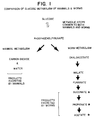
- the inventors herein have found no evidence that the parasites use lipids or amino acids for energy; helminths and their hosts differ in glycolytic capacity after a key metabolic branch point is reached, as illustrated in Figure 1.
- the host converts phosphoenolpyruvate (PEP) into pyruvate, carbon dioxide and water via the tricarboxylic acid cycle and electron transport chain
- helminths are unable to use these last two pathways because of limited oxygen availability. Instead, they excrete large amounts of free fatty acids, including fumaric, succinic, acetic and propionic acids.
- helminths combine acetic and propionic acids to form FFA products with four, five and six carbon atoms.
- the resulting carbon chains can be linear or branched, and typically include n-butyric, i-butyric, valeric, 2-methyl butyric, caproic, 2-methyl valeric, 2-methyl caproic, tiglic and 3-methyl butyric acids. Some of these acids are absorbed and metabolized by the host, while some are excreted in the urine and feces.
- the five and six-carbon, straight and branched chain free fatty acids are not synthesized by vertebrates and are found in serum, urine, salivary or fecal samples only if helminth infestation is present. It is highly desirable, therefore, to develop a diagnostic test based on excretion of these five and six-carbon free fatty acids which strongly correlates with helminth infestation.
- the present invention is directed to a method of detecting infestation by the major intestinal helminths, including nematodes such as round, hook and whipworms, and cestodes such as tapeworms, by detecting the corresponding end-product five and six-carbon FFA metabolites.
- the present method is also useful in detecting other carboxylic acids.
- the present method is specific for five and six-carbon FFA metabolites and succinate.
- the method provides a number of advantages, including (1) specificity for the five and six-carbon FFA products as well as for succinate; (2) physical and chemical stability of reagents used; (3) high sensitivity and specificity such that small samples may be used and false positives are substantially eliminated; and (4) detection of FFA at concentrations between about 0.05 and 10 mM, i.e. at concentrations which may be found in serum, fecal, urine and salivary specimens from helminth infested mammals.
- the present invention provides a method of detecting carboxylic acids in a specimen, comprising:
- the method is used to detect intestinal helminth infestation by detecting the presence of certain intestinal helminth metabolites.
- the metabolites detected are free fatty acids which are produced by intestinal helminths but not by vertebrates, and which are thus found in serum, fecal, urine and salivary specimens only when infestation is present.
- These free fatty acids include five and six-carbon branched and unbranched acids as well as succinic acid.
- the developing system which contacts the specimen contains an organic solvent selected so that metal-fatty acid complexes formed from these particular acids may be isolated therein and detected independently of any other fatty acids which may be present.
- a solid phase diagnostic method in which (a) a solid support such as filter paper or the like is provided on which a serum, fecal, urine or salivary sample has been smeared, and (b) the specimen on the support is contacted with a developing system so that, as above, metal-carboxylic acid complexes will form and be detected colorimetrically.
- a metal salt is present either on the solid support or in an aqueous phase of the developing system.
- a developing system for use in detecting carboxylic acids comprising (a) a metal salt reactive with carboxylic acids to form metal-carboxylic acid complexes; (b) an organic phase containing a solvent in which selected metal-carboxylic acid complexes are substantially soluble and in which the metal salt is substantially insoluble; (c) a chromogen; and (d) an oxidant capable of oxidizing the chromogen to a colored compound in the presence of metal-carboxylic acid complexes.
- the developing system may further include a solid support on which the metal salt is present or an aqueous phase in which the metal salt is substantially dissolved.
- the chromogen may also be present on the solid support, or it may be dissolved in the organic solvent.
- FIG. 1 is a flow chart comparing the glucose metabolism of a vertebrate with that of an intestinal helminth.
- the helminth metabolites listed may further combine to form longer-chain free fatty acids.
- FFA Free fatty acids
- Table 1 Helminthic Metabolite Production ACID TYPE OF WORM ROUND HOOK WHIP TAPE Formate + + Acetate + + + + Proponate + + + + + n-Butyrate + + i-Butyrate + Valerate + + + 2-Methyl Butyrate + + Caproate 2-Methyl Valerate + + + 2-Methyl Caproate + Tiglate + + 3-Methyl Butyrate + + Succinate + + Long Chain FFA + Lactic Acid + + The subset of these FFA which in a preferred embodiment is detected by the present method includes acids which are produced by helminths but not by vertebrates, so will be present in a specimen only when helminth infestation is present.
- Carboxylic acids which are detectable by the present method include any carboxylic acids that form metal-acid complexes with the metal salts used herein, the metal-acid complexes so formed being substantially soluble in the selected organic solvent, catalytically active in the present method, and preferably mobile on a solid support.
- the carboxylic acids also (1) are substantially soluble in aqueous solution, (2) are of a structure such that steric considerations are not problematic in metal-acid complex formation, (3) are not substantially reactive with other components of the developing system, and (4) are relatively chemically and physically stable for a period of time at least sufficient to be detected by the present method.
- a "developing system” is one which will react with a specimen so as to produce a positive test when carboxylic acids are present and a negative test otherwise.
- the positive test is typically a color change that is visible to the naked eye.
- a "chromogen” is a compound which is capable of producing a colored substance under certain conditions. Normally, the compound is colorless in a reduced state, and upon oxidation with a suitable oxidant, becomes colored in the oxidized state.
- Substantially soluble metal-carboxylic acid complexes are those acids which, at concentrations typically found in serum, fecal, urine or salivary specimens, are soluble in a solvent to an extent that they are detectable by the method presented herein.
- Metal salts which are "substantially insoluble” in an organic solvent are insufficiently extracted into the organic phase to be colorimetrically detected therein.
- a "substantially water-immiscible" organic solvent is one which will sufficiently phase separate from an aqueous layer so that extraction of metal-carboxylic acid complexes into an organic phase from an aqueous layer is possible.
- Catalytically active metal salts and metal-carboxylic acid complexes are capable of oxidizing a chromogen in the presence of an oxidant.
- the metal salts and complexes formed therefrom catalyze the oxidation of guaiac in the presence of cumene hydroperoxide.
- catalytically active metal-carboxylic acid complexes are formed from catalytically active metal salts.
- a specimen to be analyzed is initially contacted with a metal salt reactive with carboxylic acids in the specimen to form metal-carboxylic acid complexes which catalyze a colorimetric reaction.
- metal-carboxylic acid complexes which catalyze a colorimetric reaction.
- These complexes are thus detected by monitoring of their catalytic activity.
- the complexes are detected by their activity in catalyzing oxidation of a chromogen by an oxidant to a colored state.
- the metal salt is preferably a catalytically active compound selected from the group consisting of iron, silver and copper salts.
- Particularly preferred metal salts for use herein are iron, silver and copper chlorides, sulfates and nitrates, although organic salts (e.g., acetate, propionate) of these metals maybe used as well.
- the organic salts should not, clearly, be formed from any of the carboxylic acids to be detected, nor should they interfere with the detection in any other way.
- the organic salts should not be reactive with any of the components of the developing system, nor should they present steric, solubility or stability problems.
- the metal salt is initially present in the developing system.
- the developing system contains an aqueous phase in which the metal salt is substantially dissolved; in an alternative embodiment, the developing system contains a solid support on which the metal salt is provided.
- preferred concentrations of metal salt in solution range from about 0.5 to about 50 mM; particularly preferred concentrations range from about 1.0 to about 10 mM.
- the water contained in the specimen is sufficient to form a suitable aqueous phase.
- the solvent is chosen so as to selectively dissolve certain metal-carboxylic acid complexes and not others.
- suitable solvents include organic solvents (1) in which metal-carboxylic acid complexes formed from selected carboxylic acids are substantially soluble, (2) in which the metal salt is substantially insoluble, (3) are water immiscible; and (4) substantially dissolve other reagents present, including the chromogen and oxidant.
- the free fatty acids typically produced by intestinal helminths are set forth in Table 1. It should be noted that by varying the solvent selected for use in the developing system, entirely different groups of free fatty acids may be detected. As may be seen in Table 1, certain patterns of FFA produced can correspond to infestation by different intestinal helminths; the method herein may thus be used to distinguish between these helminths.
- helminth metabolites are detected including valeric, caproic, tiglic, and 2-. and 3-methyl butyric acids.
- Succinic acid is detected as well.
- suitable solvents include toluene, halogenated hydrocarbons such as 1,1,1trichloroethane, benzyl alcohol, isopropyl benzyl alcohol, dichloromethane, ethyl acetate, octyl acetate, cumene, benzyl benzoate, alcohols having from about six to about eleven carbon atoms (e.g., hexanol), and mixtures thereof. Alcohols with twelve or more carbon atoms are typically solids at room temperature and are thus excluded from use in the present method.
- the diagnostic method also involves contacting the specimen with a chromogen and an oxidant capable of oxidizing the chromogen.
- a chromogen and an oxidant capable of oxidizing the chromogen.
- both the chromogen and the oxidant are present in the organic phase of the developing solution.
- Chromogens are selected so that a definite color change is visible to the naked eye upon oxidation.
- Suitable chromogens are selected from the group consisting of guaiac, 4-chloro-1-naphthol, ortho -phenylenediamine, tetramethylbenzidine, leucomalachite green, 2,2-azinobis (3-methoxy diphenylamine), ortho -dianisidine, 5-amino salicylic acid, and mixtures thereof.
- a particularly preferred chromogen is guaiac, which is colorless in its reduced state and deep blue in its oxidized state.
- the chromogen may be purified prior to use, e.g. by solvent extraction.
- chromogen concentration will range from about 0.01 wt.% to about 2.0 wt.%. Lower concentrations in this range are appropriate for a hexanol system, while higher concentrations are preferable for trichloroethane systems or for a toluene/hexane mixture.
- Suitable oxidants include hydrogen peroxide or organic hydroperoxides such as cumene hydroperoxide, t -butyl hydroperoxide, diisopropylbenzene hydroperoxide, 2,5-dimethylhexane hydroperoxide and mixtures thereof.
- Organic hydroperoxides are preferred, and a particularly preferred oxidant is cumene hydroperoxide.
- oxidant concentration will vary with the particular solvent system chosen. Typically, oxidant concentration will range from about 0.02 wt.% to about 1.0 wt.%, the lower concentrations in this range corresponding to hexanol systems or to a toluene/hexanol mixture, and the higher concentrations corresponding to a pure toluene or trichloroethane system.
- the specimen to be analyzed for carboxylic acids is provided on a solid support, and optionally acidified prior to development.
- the specimen is then contacted with the developing system for a time sufficient to allow full color development, i.e. to allow observation of any color change due to the presence of metal-carboxylic acid complexes.
- the colored product will be noticeable in less than about one minute, although longer incubation times are sometimes employed so as to ensure detection of lower carboxylic acid concentrations. Incubation times are preferably shorter than about 1 minute, but may, if desired, be extended for 15 minutes or more to ensure detection of low concentrations of carboxylic acids. Shorter development times are preferred.
- the pH of the developing system may vary, although neither a very low pH nor a very high pH is desirable.
- the method herein is effective in a pH range of about 4 to about 11, and a preferred pH is about 7.
- the developing system may be buffered to a particular pH, e.g. 7, with suitable buffering agents.
- the sensitivity of the present method is substantially higher than that which is the minimum necessary to detect helminth infestation.
- free fatty acid concentrations as low as 0.05 mM can be detected with the method, while the ability to detect concentrations on the order of 1 to 10 mM can be sufficient to detect infestation.
- the metal salt, chromogen and oxidant may all be present on a solid support.
- one or more of these reagents may be present in solution, the metal salt in aqueous solution and the chromogen or oxidant or both present in the organic solvent.
- a solid phase diagnostic method in which (a) a solid support such as filter paper or the like is provided on which a serum, fecal, urine or salivary sample has been smeared or spotted, and (b) the specimen on the support is contacted with a developing system so that, as above, metal-carboxylic acid complexes will form and be detected colorimetrically.
- the reagents necessary to effect this diagnostic method are as above, i.e.
- a developing system which includes a metal salt reactive with carboxylic acids, which salt may be present either on the solid support or in an aqueous phase, a chromogen, an oxidant, and an organic solvent in which selected metal-carboxylic acid complexes are substantially soluble and in which the metal salt is substantially insoluble.
- a metal salt reactive with carboxylic acids which salt may be present either on the solid support or in an aqueous phase
- a chromogen, an oxidant and an organic solvent in which selected metal-carboxylic acid complexes are substantially soluble and in which the metal salt is substantially insoluble.
- the chromogen and oxidant may be present on the solid support, or in the organic solvent.
- a developing system which is useful in detecting carboxylic acids, e.g. the free fatty acid metabolites produced in intestinal helminth infestation.
- the developing system comprises a metal salt reactive with carboxylic acids to form metal-carboxylic acid complexes, an organic phase containing a solvent in which selected metal-fatty acid complexes are substantially soluble and in which the metal salt is substantially insoluble, a chromogen, and an oxidant capable of oxidizing the chromogen.
- the developing system may further include a solid support on which the metal salt is provided, or an aqueous phase in which the metal salt is substantially dissolved.
- One or both of the chromogen and oxidant may be present on a solid support, or in the organic solvent.
- the metal salt is a copper salt
- the chromogen is guaiac
- the oxidant is cumene hydroperoxide.
- Color developing reagent was prepared as follows. 0.200 ml of 0.375 wt.% guaiac solution in ethanol were added to individual clean test tubes and the ethanol evaporated. Four ml of a given solvent as indicated in Table 2 were added and the guaiac was allowed to dissolve to the extent possible. Solubility of guaiac in each solvent was noted visually and is set forth in Table 2.
- Solvents which dissolved essentially all of the deposited guaiac produced a distinct yellow-brown color (+++); those which dissolved an intermediate amount of guaiac produced a medium yellow color (++); and those which dissolved only a small amount of the guaiac produced a light yellow color (+): Solvents which dissolved essentially none of the guaiac remained colorless (-).
- Tests evaluating color development were conducted by adding 50 »l of test sample, 30 »l 1 mM cupric sulfate and 100 »l color developing reagent to microtiter plate wells.
- Fatty acid test samples were 100 mM in distilled water and titrated with dilute sodium hydroxide to produce a final pH of 7.0.
- Example 1 Based on the initial screening of Example 1, four solvent systems were selected for further testing: toluene, 1,1,1-trichloroethane ("TCE"), n-hexanol and a 90:10 v/v toluene/hexanol solvent mixture. These solvents were tested for their ability to selectively extract copper ion-fatty acid complexes formed from FFA of varying chain length. 100 »l copper sulfate solution (800 mM) and 100 »l fatty acid solution (100 mM, titrated with sodium hydroxide to a pH of 7 or 100 »l sodium chloride (100 mM) were added to a clean test tube.
- TCE 1,1,1-trichloroethane
- Metal salts were provided in aqueous solutions having concentrations of 0.001 M and 1.0 M. These solutions were admixed with 20 »l 100 mM butyric acid, titrated with sodium hydroxide to a pH of 7.0, and 100 »l of a color developing reagent containing 0.5 wt.% guaiac and 5 wt.% cumene hydroperoxide in hexanol, and color formation was monitored as in the previous examples. Results are set forth in Table 4.
- Table 5 COLOR INTENSITY AT 5 MINUTES TEST SOLUTION TEST IONS .001M CuSO4 1.0 M AgNO3 0.1 M Butyrate 10 8 0.1 M Succinate 8 0
- the results summarized in Table 5 illustrate that the choice of metal salt may be useful in differential diagnosis, i.e. where different color intensities are produced upon reaction of a metal salt (here, AgNO3) with different free fatty acids.
- a metal salt here, AgNO3
- chromogen and oxidant were determined for two time intervals: (1) a two-minute incubation time; and (2) a ten-minute incubation time.
- the chromogen in each of these tests was guaiac, at concentrations varying from 0.001 wt.% to 2.0 wt.% as shown in Tables 6a-6h.
- the oxidant was cumene hydroperoxide, also at varying concentrations as indicated. Optimum concentration ranges were evaluated according to the following protocol.
- Optimum concentrations of various components were determined as follows: (1) where FFA were not present, a color intensity of less than 2 at 2 minutes incubation time was required; and (2) where FFA were present, a color intensity of at least 5 after 10 minutes incubation time was required.
- concentration ranges for various components are as follows: Table 8 GUAIAC CHP COPPER SOLVENT (%) (%) (mM) TOLUENE 2.0 0.4-1.0 1.0-50.0 HEXANOL 0.01-2.0 0.02-1.0 0.5-10.0 TCE 0.1-2.0 0.2-1.0 0.5-50.0 TOL/HEX 0.1-2.0 0.02-1.0 0.5-50.0 These concentrations ranges, however, are not necessarily suitable for all types of specimens. Various factors such as adsorption to the specimen may influence the final concentration of a given component. The ranges should thus be redefined for each specimen type according to the procedures outlined above.
- the method is effective over a fairly broad pH range, including over the physiological pH range of 4.5 to 7.4 anticipated with serum, urine, fecal or salivary samples. Only at very low pH (1-3) or at very high pH (1 ⁇ 211) was a deterioration of reagent performance observed. Thus, while buffering of the system may be desirable, it is not mandated by pH sensitivity of the method.
- Caproic acid was selected for preliminary sensitivity testing because it is one of the FFA shown to be of diagnostic importance in Ascaris infestations. Monteoliva, M., et al.; Rev. Iberica Parasit. 41 (3):333-340 (1981); Soprunov, et al., supra .
- Caproic acid titrated with sodium hydroxide to a pH of 7.0, at concentrations varying from 0.05 mM to 100 mM (or water in the case of blanks) was admixed with 60 »l 1 mM cupric sulfate and 100 »l color developing reagent containing 0.5 wt.% guaiac and 1.0 wt.% cumene hydroperoxide in various solvents as indicated.
- canine feces spiked with 2-methyl valerate was analyzed as follows. A filter paper was spotted with 20 »l of 20 mM cupric sulfate and dried. Approximately 30 »l feces treated 1:1 w/w with either distilled water ("DW”) or 40 mM 2-methyl valeric acid (“2MV”) was placed on the dried filter paper, and allowed to stand for 10 minutes. The sample was then eluted by placing 30 »l aliquots of solvent (90/10 v/v toluene:hexanol) at the center of the sample on the side opposite feces.
- solvent 90/10 v/v toluene:hexanol
- Saliva spiked with 2-methyl valeric acid was analyzed substantially according to the method of the preceding example.
- Filter paper was spotted with 20 »l of 20 mM cupric sulfate and dried.
- 30 »l saliva spiked 1:1 v/v with either distilled water or 20 mM 2-methyl valeric acid was added.
- the sample was allowed to stand 10 minutes, after which time the sample was eluted by addition of 30 »l aliquots of solvent (90/10 v/v toluene/hexanol) at the center of the sample on the same side as the specimen.
- test system was most sensitive to 2-MV. Varying degrees of sensitivity were observed for the other acids.
Landscapes
- Health & Medical Sciences (AREA)
- Life Sciences & Earth Sciences (AREA)
- Hematology (AREA)
- Immunology (AREA)
- Engineering & Computer Science (AREA)
- Molecular Biology (AREA)
- Biomedical Technology (AREA)
- Chemical & Material Sciences (AREA)
- Urology & Nephrology (AREA)
- Food Science & Technology (AREA)
- Biochemistry (AREA)
- Cell Biology (AREA)
- Biotechnology (AREA)
- Medicinal Chemistry (AREA)
- Physics & Mathematics (AREA)
- Analytical Chemistry (AREA)
- Microbiology (AREA)
- General Health & Medical Sciences (AREA)
- General Physics & Mathematics (AREA)
- Pathology (AREA)
- Investigating Or Analyzing Non-Biological Materials By The Use Of Chemical Means (AREA)
- Investigating Or Analysing Biological Materials (AREA)
- Investigating Or Analysing Materials By The Use Of Chemical Reactions (AREA)
- Plural Heterocyclic Compounds (AREA)
Applications Claiming Priority (3)
| Application Number | Priority Date | Filing Date | Title |
|---|---|---|---|
| US06/940,775 US4777143A (en) | 1986-12-12 | 1986-12-12 | Method of detecting carboxylic acids in a specimen |
| US940775 | 1986-12-12 | ||
| PCT/US1987/003348 WO1988004427A1 (en) | 1986-12-12 | 1987-12-14 | Developing system and a method of using the developing system for detection of carboxylic acids |
Publications (3)
| Publication Number | Publication Date |
|---|---|
| EP0341249A1 EP0341249A1 (en) | 1989-11-15 |
| EP0341249A4 EP0341249A4 (en) | 1990-12-05 |
| EP0341249B1 true EP0341249B1 (en) | 1994-07-13 |
Family
ID=25475401
Family Applications (1)
| Application Number | Title | Priority Date | Filing Date |
|---|---|---|---|
| EP88900528A Expired - Lifetime EP0341249B1 (en) | 1986-12-12 | 1987-12-14 | Developing system and a method of using the developing system for detection of carboxylic acids |
Country Status (7)
| Country | Link |
|---|---|
| US (1) | US4777143A (ja) |
| EP (1) | EP0341249B1 (ja) |
| JP (2) | JP2665249B2 (ja) |
| AT (1) | ATE108552T1 (ja) |
| CA (1) | CA1306931C (ja) |
| DE (1) | DE3750229D1 (ja) |
| WO (1) | WO1988004427A1 (ja) |
Families Citing this family (7)
| Publication number | Priority date | Publication date | Assignee | Title |
|---|---|---|---|---|
| US4777143A (en) * | 1986-12-12 | 1988-10-11 | Litmus Concepts Inc. | Method of detecting carboxylic acids in a specimen |
| US5238817A (en) * | 1991-07-12 | 1993-08-24 | E. I. Du Pont De Nemours And Company | Chromogenic substrates for improving detection in a peroxidase-based assay |
| US5744365A (en) * | 1997-03-18 | 1998-04-28 | Texaco Inc. | Method for measuring the level of carboxylate anion in engine coolant |
| EP1714699B1 (en) * | 1998-01-12 | 2010-08-18 | Massachusetts Institute of Technology | System for analyzing a plurality of samples |
| JP2008249573A (ja) * | 2007-03-30 | 2008-10-16 | Miura Co Ltd | 水溶性アミン化合物の検出方法 |
| US11971398B2 (en) | 2018-08-17 | 2024-04-30 | Ita International, Llc | Methods for detection of lead in water |
| CN117233131B (zh) * | 2023-09-01 | 2024-11-29 | 广州爱索达生物医药技术有限公司 | 一种卤代乙腈的检测试剂及检测方法 |
Family Cites Families (18)
| Publication number | Priority date | Publication date | Assignee | Title |
|---|---|---|---|---|
| US2283262A (en) * | 1940-10-02 | 1942-05-19 | Miles Lab | Diagnostic composition and method |
| SE173761C1 (ja) * | 1956-11-07 | 1960-12-20 | ||
| US2990253A (en) * | 1959-05-21 | 1961-06-27 | Miles Lab | Diagnostic composition |
| US3386806A (en) * | 1964-11-25 | 1968-06-04 | Isolated Beef Protein Suppleme | Assay method |
| US3490874A (en) * | 1966-04-04 | 1970-01-20 | Chugai Pharmaceutical Co Ltd | Colorimetric method for the quantitative determination of oxalacetic acid |
| US3485588A (en) * | 1966-04-22 | 1969-12-23 | Celanese Corp | Method for continuous peracetic acid analysis |
| JPS5323630B2 (ja) * | 1972-07-07 | 1978-07-15 | ||
| SU424052A1 (ru) * | 1972-09-28 | 1974-04-15 | Л. М. Лаврентьева , М. П. тницкий | Способ количественного определения лимонной кислоты в табаке |
| US3915643A (en) * | 1973-07-12 | 1975-10-28 | Pierce Chemical Co | Determination of salicylate |
| US3980433A (en) * | 1973-10-17 | 1976-09-14 | Zenzo Tamura | Method for determining carboxylic acid and system for carrying out the method |
| JPS5813862B2 (ja) * | 1974-02-08 | 1983-03-16 | ワコウジユンヤクコウギヨウ カブシキガイシヤ | セイタイシリヨウチユウ ノ ユウリシボウサン ノ テイリヨウヨウソセイブツ |
| SU640203A1 (ru) * | 1976-11-26 | 1978-12-30 | Центральный научно-исследовательский и проектный институт лесохимической промышленности | Способ количественного определени малеопимаровой кислоты |
| SU828083A1 (ru) * | 1979-07-09 | 1981-05-07 | Читинский Медицинский Институт | Способ определени мефенаминовойКиСлОТы |
| IT1148771B (it) * | 1980-02-26 | 1986-12-03 | Sclavo Inst Sieroterapeut | Composizione colorimetrica di metalli |
| US4486536A (en) * | 1982-05-28 | 1984-12-04 | Smithkline Diagnostics, Inc. | Specimen slide for occult blood testing |
| ZA841078B (en) * | 1983-03-01 | 1984-09-26 | Warner Lambert Co | Peroxidase activity detection composition |
| US4615982A (en) * | 1984-12-11 | 1986-10-07 | Lawrence Paul J | Fecal occult blood test |
| US4777143A (en) * | 1986-12-12 | 1988-10-11 | Litmus Concepts Inc. | Method of detecting carboxylic acids in a specimen |
-
1986
- 1986-12-12 US US06/940,775 patent/US4777143A/en not_active Expired - Lifetime
-
1987
- 1987-12-14 DE DE3750229T patent/DE3750229D1/de not_active Expired - Lifetime
- 1987-12-14 AT AT88900528T patent/ATE108552T1/de not_active IP Right Cessation
- 1987-12-14 EP EP88900528A patent/EP0341249B1/en not_active Expired - Lifetime
- 1987-12-14 WO PCT/US1987/003348 patent/WO1988004427A1/en not_active Ceased
- 1987-12-14 JP JP63501202A patent/JP2665249B2/ja not_active Expired - Lifetime
- 1987-12-14 CA CA000554228A patent/CA1306931C/en not_active Expired - Fee Related
-
1996
- 1996-09-25 JP JP8253469A patent/JPH09166592A/ja active Pending
Also Published As
| Publication number | Publication date |
|---|---|
| JPH02501857A (ja) | 1990-06-21 |
| ATE108552T1 (de) | 1994-07-15 |
| DE3750229D1 (de) | 1994-08-18 |
| WO1988004427A1 (en) | 1988-06-16 |
| EP0341249A1 (en) | 1989-11-15 |
| US4777143A (en) | 1988-10-11 |
| CA1306931C (en) | 1992-09-01 |
| JPH09166592A (ja) | 1997-06-24 |
| EP0341249A4 (en) | 1990-12-05 |
| JP2665249B2 (ja) | 1997-10-22 |
Similar Documents
| Publication | Publication Date | Title |
|---|---|---|
| JP3118029B2 (ja) | ケトン体の検定のための組成物及び方法 | |
| CA1157749A (en) | System for the determination of glucose in fluids | |
| AU645902B2 (en) | Ascorbate interference-resistant composition, device and method of assaying for a predetermined analyte | |
| DE69013882T2 (de) | Zusammensetzung, Vorrichtung und Verfahren zur Untersuchung einer peroxidativ aktiven Substanz. | |
| EP0068356B1 (de) | Mittel und Verfahren zum Nachweis von Wasserstoffperoxid oder Peroxidasen | |
| JPS6326869B2 (ja) | ||
| CA1144455A (en) | Ascorbate resistant composition, test device and method for detecting a component in a liquid test sample | |
| US4525452A (en) | Enzyme immunoassay with step of immersing sample in deionized water | |
| JP2606721B2 (ja) | 色原体クリプタヘミスフエランドと水性検査試料中の電解質検出へのその使用 | |
| EP0341249B1 (en) | Developing system and a method of using the developing system for detection of carboxylic acids | |
| US5510245A (en) | Composition and method of assaying for ketone bodies | |
| US3859047A (en) | Standard for serum cholesterol determination | |
| US5182213A (en) | Method for detecting the presence of peroxidatively active substance in basic media | |
| CA1143634A (en) | Interference-resistant test device for determining a peroxidately active substance in a test sample and method for preparing it | |
| EP1022566A2 (en) | Assay for the detection of creatinine | |
| Knight et al. | Improved colorimetry of urinary 3-methoxy-4-hydroxyphenylacetic acid (homovanillic acid). | |
| US5281393A (en) | Multilayered device containing a polymer-copper complex to control interference of biological substances in colorimetric test systems | |
| DE69806567T2 (de) | Kompetitive Apoperoxidase-Bestimmung | |
| JPH0870893A (ja) | 犬の糖尿病診断法、1,5−アンヒドログルシトールの定量法及びキット | |
| CN2651751Y (zh) | 一种尿十二联试纸条 | |
| KR950002926B1 (ko) | 마약계 검출지의 제조방법 | |
| EP0095302A1 (en) | Improved specimen slide for occult blood testing | |
| Hilty | Pharmaceuticals and Natural Drugs | |
| Melzi d'Eril | A bichromatic technique for serum iron on the CentrifiChem 400 | |
| Postnov et al. | Bioassay techniques: Problems concerning the selectivity and sensitivity of determining biologically active substances |
Legal Events
| Date | Code | Title | Description |
|---|---|---|---|
| PUAI | Public reference made under article 153(3) epc to a published international application that has entered the european phase |
Free format text: ORIGINAL CODE: 0009012 |
|
| 17P | Request for examination filed |
Effective date: 19890612 |
|
| AK | Designated contracting states |
Kind code of ref document: A1 Designated state(s): AT BE CH DE FR GB IT LI LU NL SE |
|
| A4 | Supplementary search report drawn up and despatched |
Effective date: 19901015 |
|
| AK | Designated contracting states |
Kind code of ref document: A4 Designated state(s): AT BE CH DE FR GB IT LI LU NL SE |
|
| 17Q | First examination report despatched |
Effective date: 19920818 |
|
| GRAA | (expected) grant |
Free format text: ORIGINAL CODE: 0009210 |
|
| AK | Designated contracting states |
Kind code of ref document: B1 Designated state(s): AT BE CH DE FR GB IT LI LU NL SE |
|
| PG25 | Lapsed in a contracting state [announced via postgrant information from national office to epo] |
Ref country code: IT Free format text: LAPSE BECAUSE OF FAILURE TO SUBMIT A TRANSLATION OF THE DESCRIPTION OR TO PAY THE FEE WITHIN THE PRESCRIBED TIME-LIMIT;WARNING: LAPSES OF ITALIAN PATENTS WITH EFFECTIVE DATE BEFORE 2007 MAY HAVE OCCURRED AT ANY TIME BEFORE 2007. THE CORRECT EFFECTIVE DATE MAY BE DIFFERENT FROM THE ONE RECORDED. Effective date: 19940713 Ref country code: LI Effective date: 19940713 Ref country code: FR Effective date: 19940713 Ref country code: NL Effective date: 19940713 Ref country code: CH Effective date: 19940713 Ref country code: BE Effective date: 19940713 Ref country code: AT Effective date: 19940713 |
|
| REF | Corresponds to: |
Ref document number: 108552 Country of ref document: AT Date of ref document: 19940715 Kind code of ref document: T |
|
| REF | Corresponds to: |
Ref document number: 3750229 Country of ref document: DE Date of ref document: 19940818 |
|
| PG25 | Lapsed in a contracting state [announced via postgrant information from national office to epo] |
Ref country code: SE Effective date: 19941013 |
|
| PG25 | Lapsed in a contracting state [announced via postgrant information from national office to epo] |
Ref country code: DE Effective date: 19941014 |
|
| REG | Reference to a national code |
Ref country code: CH Ref legal event code: PL |
|
| EN | Fr: translation not filed | ||
| NLV1 | Nl: lapsed or annulled due to failure to fulfill the requirements of art. 29p and 29m of the patents act | ||
| PG25 | Lapsed in a contracting state [announced via postgrant information from national office to epo] |
Ref country code: LU Free format text: LAPSE BECAUSE OF NON-PAYMENT OF DUE FEES Effective date: 19941231 |
|
| PLBE | No opposition filed within time limit |
Free format text: ORIGINAL CODE: 0009261 |
|
| STAA | Information on the status of an ep patent application or granted ep patent |
Free format text: STATUS: NO OPPOSITION FILED WITHIN TIME LIMIT |
|
| 26N | No opposition filed | ||
| REG | Reference to a national code |
Ref country code: GB Ref legal event code: IF02 |
|
| PGFP | Annual fee paid to national office [announced via postgrant information from national office to epo] |
Ref country code: GB Payment date: 20061106 Year of fee payment: 20 |
|
| REG | Reference to a national code |
Ref country code: GB Ref legal event code: PE20 |
|
| PG25 | Lapsed in a contracting state [announced via postgrant information from national office to epo] |
Ref country code: GB Free format text: LAPSE BECAUSE OF EXPIRATION OF PROTECTION Effective date: 20071213 |