EP0333529B1 - Zusammensetzung zur Beschichtung der Aussenoberfläche von Sportbällen und so erhaltene Bälle - Google Patents
Zusammensetzung zur Beschichtung der Aussenoberfläche von Sportbällen und so erhaltene Bälle Download PDFInfo
- Publication number
- EP0333529B1 EP0333529B1 EP89400414A EP89400414A EP0333529B1 EP 0333529 B1 EP0333529 B1 EP 0333529B1 EP 89400414 A EP89400414 A EP 89400414A EP 89400414 A EP89400414 A EP 89400414A EP 0333529 B1 EP0333529 B1 EP 0333529B1
- Authority
- EP
- European Patent Office
- Prior art keywords
- substance
- binder
- sports ball
- composition
- hydrophilic
- Prior art date
- Legal status (The legal status is an assumption and is not a legal conclusion. Google has not performed a legal analysis and makes no representation as to the accuracy of the status listed.)
- Expired - Lifetime
Links
- 239000000203 mixture Substances 0.000 title claims description 31
- 238000000576 coating method Methods 0.000 title description 28
- 239000011248 coating agent Substances 0.000 title description 23
- 239000011230 binding agent Substances 0.000 claims abstract description 43
- 239000000126 substance Substances 0.000 claims abstract description 40
- 238000000034 method Methods 0.000 claims abstract description 19
- 230000002209 hydrophobic effect Effects 0.000 claims abstract description 14
- 239000011256 inorganic filler Substances 0.000 claims abstract description 14
- 229910003475 inorganic filler Inorganic materials 0.000 claims abstract description 14
- 239000008199 coating composition Substances 0.000 claims abstract description 10
- 239000011159 matrix material Substances 0.000 claims description 13
- 239000002245 particle Substances 0.000 claims description 12
- VYPSYNLAJGMNEJ-UHFFFAOYSA-N Silicium dioxide Chemical compound O=[Si]=O VYPSYNLAJGMNEJ-UHFFFAOYSA-N 0.000 claims description 11
- 229920002635 polyurethane Polymers 0.000 claims description 11
- 239000004814 polyurethane Substances 0.000 claims description 11
- 239000011521 glass Substances 0.000 claims description 10
- 239000000945 filler Substances 0.000 claims description 9
- 229910021485 fumed silica Inorganic materials 0.000 claims description 6
- 239000000463 material Substances 0.000 claims description 6
- NIXOWILDQLNWCW-UHFFFAOYSA-N acrylic acid group Chemical group C(C=C)(=O)O NIXOWILDQLNWCW-UHFFFAOYSA-N 0.000 claims description 4
- 239000000377 silicon dioxide Substances 0.000 claims description 4
- 125000001931 aliphatic group Chemical group 0.000 claims description 3
- MTAZNLWOLGHBHU-UHFFFAOYSA-N butadiene-styrene rubber Chemical compound C=CC=C.C=CC1=CC=CC=C1 MTAZNLWOLGHBHU-UHFFFAOYSA-N 0.000 claims description 3
- 150000001875 compounds Chemical class 0.000 claims description 3
- 239000000839 emulsion Substances 0.000 claims description 3
- 229920000058 polyacrylate Polymers 0.000 claims description 3
- 229920000193 polymethacrylate Polymers 0.000 claims description 3
- 238000003892 spreading Methods 0.000 claims description 3
- 239000003381 stabilizer Substances 0.000 claims description 3
- 230000009974 thixotropic effect Effects 0.000 claims description 3
- XLYOFNOQVPJJNP-UHFFFAOYSA-N water Substances O XLYOFNOQVPJJNP-UHFFFAOYSA-N 0.000 claims description 3
- 230000000694 effects Effects 0.000 claims description 2
- 229910010272 inorganic material Inorganic materials 0.000 claims description 2
- KAKZBPTYRLMSJV-UHFFFAOYSA-N Butadiene Chemical compound C=CC=C KAKZBPTYRLMSJV-UHFFFAOYSA-N 0.000 claims 4
- NLHHRLWOUZZQLW-UHFFFAOYSA-N Acrylonitrile Chemical compound C=CC#N NLHHRLWOUZZQLW-UHFFFAOYSA-N 0.000 claims 2
- 239000005388 borosilicate glass Substances 0.000 claims 1
- 150000002484 inorganic compounds Chemical class 0.000 claims 1
- 239000005368 silicate glass Substances 0.000 claims 1
- 238000007650 screen-printing Methods 0.000 abstract description 4
- 230000003746 surface roughness Effects 0.000 description 5
- 229920004482 WACKER® Polymers 0.000 description 4
- 239000000049 pigment Substances 0.000 description 4
- -1 fumed silica compound Chemical class 0.000 description 3
- 239000010410 layer Substances 0.000 description 3
- 239000000758 substrate Substances 0.000 description 3
- 235000005749 Anthriscus sylvestris Nutrition 0.000 description 2
- 239000002585 base Substances 0.000 description 2
- 230000015556 catabolic process Effects 0.000 description 2
- 238000007906 compression Methods 0.000 description 2
- 230000006835 compression Effects 0.000 description 2
- 239000000470 constituent Substances 0.000 description 2
- 238000006731 degradation reaction Methods 0.000 description 2
- 239000010419 fine particle Substances 0.000 description 2
- 238000009472 formulation Methods 0.000 description 2
- 239000010985 leather Substances 0.000 description 2
- 238000004519 manufacturing process Methods 0.000 description 2
- 239000004005 microsphere Substances 0.000 description 2
- 238000007649 pad printing Methods 0.000 description 2
- 239000002904 solvent Substances 0.000 description 2
- 239000002966 varnish Substances 0.000 description 2
- 229920000459 Nitrile rubber Polymers 0.000 description 1
- 239000002174 Styrene-butadiene Substances 0.000 description 1
- 239000000654 additive Substances 0.000 description 1
- 239000002671 adjuvant Substances 0.000 description 1
- 239000003513 alkali Substances 0.000 description 1
- NTXGQCSETZTARF-UHFFFAOYSA-N buta-1,3-diene;prop-2-enenitrile Chemical compound C=CC=C.C=CC#N NTXGQCSETZTARF-UHFFFAOYSA-N 0.000 description 1
- 239000011247 coating layer Substances 0.000 description 1
- 238000004040 coloring Methods 0.000 description 1
- 230000000295 complement effect Effects 0.000 description 1
- 238000009826 distribution Methods 0.000 description 1
- 239000011147 inorganic material Substances 0.000 description 1
- 239000007788 liquid Substances 0.000 description 1
- 238000010907 mechanical stirring Methods 0.000 description 1
- 238000012986 modification Methods 0.000 description 1
- 230000004048 modification Effects 0.000 description 1
- 230000008520 organization Effects 0.000 description 1
- 239000003973 paint Substances 0.000 description 1
- 239000002985 plastic film Substances 0.000 description 1
- 239000004848 polyfunctional curative Substances 0.000 description 1
- 239000004800 polyvinyl chloride Substances 0.000 description 1
- 229920000915 polyvinyl chloride Polymers 0.000 description 1
- 239000000843 powder Substances 0.000 description 1
- 230000005855 radiation Effects 0.000 description 1
- 239000004576 sand Substances 0.000 description 1
- 150000004760 silicates Chemical class 0.000 description 1
- 239000007787 solid Substances 0.000 description 1
- 238000005507 spraying Methods 0.000 description 1
- 239000011115 styrene butadiene Substances 0.000 description 1
- 229920003048 styrene butadiene rubber Polymers 0.000 description 1
- 230000008961 swelling Effects 0.000 description 1
- 229920002994 synthetic fiber Polymers 0.000 description 1
- 230000000007 visual effect Effects 0.000 description 1
Images
Classifications
-
- C—CHEMISTRY; METALLURGY
- C08—ORGANIC MACROMOLECULAR COMPOUNDS; THEIR PREPARATION OR CHEMICAL WORKING-UP; COMPOSITIONS BASED THEREON
- C08L—COMPOSITIONS OF MACROMOLECULAR COMPOUNDS
- C08L75/00—Compositions of polyureas or polyurethanes; Compositions of derivatives of such polymers
- C08L75/04—Polyurethanes
-
- C—CHEMISTRY; METALLURGY
- C09—DYES; PAINTS; POLISHES; NATURAL RESINS; ADHESIVES; COMPOSITIONS NOT OTHERWISE PROVIDED FOR; APPLICATIONS OF MATERIALS NOT OTHERWISE PROVIDED FOR
- C09D—COATING COMPOSITIONS, e.g. PAINTS, VARNISHES OR LACQUERS; FILLING PASTES; CHEMICAL PAINT OR INK REMOVERS; INKS; CORRECTING FLUIDS; WOODSTAINS; PASTES OR SOLIDS FOR COLOURING OR PRINTING; USE OF MATERIALS THEREFOR
- C09D5/00—Coating compositions, e.g. paints, varnishes or lacquers, characterised by their physical nature or the effects produced; Filling pastes
-
- A—HUMAN NECESSITIES
- A63—SPORTS; GAMES; AMUSEMENTS
- A63B—APPARATUS FOR PHYSICAL TRAINING, GYMNASTICS, SWIMMING, CLIMBING, OR FENCING; BALL GAMES; TRAINING EQUIPMENT
- A63B41/00—Hollow inflatable balls
- A63B41/08—Ball covers; Closures therefor
-
- C—CHEMISTRY; METALLURGY
- C09—DYES; PAINTS; POLISHES; NATURAL RESINS; ADHESIVES; COMPOSITIONS NOT OTHERWISE PROVIDED FOR; APPLICATIONS OF MATERIALS NOT OTHERWISE PROVIDED FOR
- C09D—COATING COMPOSITIONS, e.g. PAINTS, VARNISHES OR LACQUERS; FILLING PASTES; CHEMICAL PAINT OR INK REMOVERS; INKS; CORRECTING FLUIDS; WOODSTAINS; PASTES OR SOLIDS FOR COLOURING OR PRINTING; USE OF MATERIALS THEREFOR
- C09D7/00—Features of coating compositions, not provided for in group C09D5/00; Processes for incorporating ingredients in coating compositions
- C09D7/40—Additives
- C09D7/60—Additives non-macromolecular
- C09D7/61—Additives non-macromolecular inorganic
-
- C—CHEMISTRY; METALLURGY
- C09—DYES; PAINTS; POLISHES; NATURAL RESINS; ADHESIVES; COMPOSITIONS NOT OTHERWISE PROVIDED FOR; APPLICATIONS OF MATERIALS NOT OTHERWISE PROVIDED FOR
- C09D—COATING COMPOSITIONS, e.g. PAINTS, VARNISHES OR LACQUERS; FILLING PASTES; CHEMICAL PAINT OR INK REMOVERS; INKS; CORRECTING FLUIDS; WOODSTAINS; PASTES OR SOLIDS FOR COLOURING OR PRINTING; USE OF MATERIALS THEREFOR
- C09D7/00—Features of coating compositions, not provided for in group C09D5/00; Processes for incorporating ingredients in coating compositions
- C09D7/40—Additives
- C09D7/66—Additives characterised by particle size
- C09D7/67—Particle size smaller than 100 nm
-
- A—HUMAN NECESSITIES
- A63—SPORTS; GAMES; AMUSEMENTS
- A63B—APPARATUS FOR PHYSICAL TRAINING, GYMNASTICS, SWIMMING, CLIMBING, OR FENCING; BALL GAMES; TRAINING EQUIPMENT
- A63B2243/00—Specific ball sports not provided for in A63B2102/00 - A63B2102/38
- A63B2243/0025—Football
-
- C—CHEMISTRY; METALLURGY
- C08—ORGANIC MACROMOLECULAR COMPOUNDS; THEIR PREPARATION OR CHEMICAL WORKING-UP; COMPOSITIONS BASED THEREON
- C08K—Use of inorganic or non-macromolecular organic substances as compounding ingredients
- C08K3/00—Use of inorganic substances as compounding ingredients
- C08K3/34—Silicon-containing compounds
- C08K3/36—Silica
-
- C—CHEMISTRY; METALLURGY
- C08—ORGANIC MACROMOLECULAR COMPOUNDS; THEIR PREPARATION OR CHEMICAL WORKING-UP; COMPOSITIONS BASED THEREON
- C08K—Use of inorganic or non-macromolecular organic substances as compounding ingredients
- C08K7/00—Use of ingredients characterised by shape
- C08K7/16—Solid spheres
- C08K7/18—Solid spheres inorganic
Definitions
- the invention belongs to the field of sports and leisure articles. It relates more particularly to a composition which finds application for the coating of the external surface of sports balls, in order to confer on them improved properties, especially in wet or wet playing conditions.
- the invention also relates to the balloons thus obtained.
- balloons which are distinguished in particular by the nature of their internal structure (monocoque carcass or bladder) or of their external coating (balloons sewn by hand or not sewn by hand).
- the constituent materials of the outer surfaces of the balloons are also very diverse, from traditional materials, such as leather, to synthetic materials, such as polyurethanes and polyvinyl chloride.
- the external coatings serve as wear layers and also have an aesthetic function. They also improve the "ball touch" properties which are very important for users.
- DE-A-1 504 730 describes a process for the production of plastic sheets with improved mechanical properties.
- GB-A-1 457 869 describes a method for conferring sliding properties or the opposite to a surface of an object.
- the object of the invention is to treat the external surface of the balloons, so as to give them an improved grip and also to allow their optimal use in wet or wet conditions, in particular to give them a more regular glide and avoid them "fuse" on the ground.
- the invention relates to a method of treating the external surface of sports balls, which consists in applying to said external surface a composition based on a binder or matrix capable of firmly adhering to the surface of the ball. and containing an inorganic filler in particles comprising at least one substance having a hydrophilic character, a high specific surface greater than 40 m2 / g and an apparent density less than 100 g / l.
- the invention in a second aspect, relates to a composition for implementing the method, said composition being based on a binder or matrix capable of firmly adhering to the surface of the flask and containing an inorganic filler in particles comprising at least a substance having a hydrophilic character, a high specific surface greater than 40 m2 / g and an apparent density less than 100 g / l.
- the surface of the ball becomes rough, especially in wet or wet playing conditions.
- binders or matrices of various natures can be used.
- the first condition to fulfill is that the binder is able to adhere firmly to the surface of the balloon and, in most cases, it is used in liquid form, of suitable viscosity to allow application.
- This type of binder may or may not contain solvents and, when these are present, they leave, after application, a resistant film on the surface of the substrate, in this case the balloon. If one wishes to obtain good characteristics of use for outdoor sports, it is preferred that the binders or matrices used are practically non-sensitive to water, which means that their properties are not fundamentally modified in playing conditions on wet or damp terrain, or even in the event of slush.
- the binder must have sufficient stability in the presence of water and, for example, not undergo swelling or other similar modifications. It may also be advantageous that, due to its chemical nature, the binder has good resistance to cold. A person skilled in the art has a fairly large number of products to achieve such objectives, these products being in particular available in the field of paints or varnish.
- the binder can also be transparent or colored, although in general it is preferred, in order to preserve the external aesthetic appearance of the surface of the balloon, using transparent binders or matrices.
- binders or matrices which can be used, mention may be made of products based on polyurethane, in solution or in emulsion, products based on styrene-butadiene, butadiene-acrylonitrile, or products based acrylic such as polyacrylates or polymethacrylates.
- binders based on polyurethane in particular with NCO groups originating from aliphatic bases.
- Such binders are transparent, have high elasticity, good characteristics, adhesion, excellent cold stability. They can also be easily applied in a solvent medium. Examples of products which have given satisfaction are: the transparent varnishes 870 428/5 (supplier, company Keck Chimie) associated with Hardener D33 from the same company. It has also been found that such products exhibit good stability to ultraviolet radiation.
- An essential constituent of the composition according to the invention is the inorganic filler in particles, which is uniformly distributed within the binder. It comprises at least one substance having a hydrophilic character, thanks to which the binder becomes thixotropic, so that at the places where the composition is applied, the spreading is limited and one then obtains a relief effect on the surface of the film.
- Another interesting function of the substance having a hydrophilic nature or tendency is to contribute to obtaining optimum surface roughness under wet or wet conditions.
- the inorganic substance should have a high specific surface, which means that this specific surface is greater than 40 m2 / g, preferably 200 m2 / g, for example close to 150 m2 / g.
- Another characteristic is the low density, which means that the apparent density (or not packed) of the substance must be less than 100 g / l, preferably 50-70 g / l, for example l '' order of 50 g / l.
- Another parameter to take into account is the fineness of the particles of the filler. In fact, the particles must remain on the surface of the ball and, in addition, the roughness must not be excessive, although it is sensitive to the touch and that it increases in playing conditions on wet grounds or wet. Fine particles will therefore preferably be used, having an average dimension of 4 to 50 nanometers, in particular from 5 to 30 nanometers approximately.
- the coating according to the invention gave the balloons markedly improved properties, especially in playing conditions on wet and humid grounds and possibly in slush.
- the glide is more regular, as is the rebound behavior.
- the grip is better, which is felt favorably by the goalkeepers, in the case of the application of the invention to footballs.
- a composition for coating the external surface of sports balls based on a binder or matrix, capable of firmly adhering to the surface of the balloon and containing an inorganic filler in particles, comprising the combination of at least one substance of hydrophilic character, with high specific surface and of at least one substance of hydrophobic character, these two substances having a low apparent density.
- the invention proposes to combine with the substance of hydrophilic nature or tendency, described above, another filler whose function is to integrate into the film applied to the balloon and to give it an optimal roughness of hydrophobic nature.
- the density of this second substance will also be low, that is to say less than 0.4 kg / dm3, preferably 0.2 kg / dm3 and for example of the order of 0.1 to 0.2 kg / dm3, not packed.
- the hydrophobic substance is in the form of fine particles, the average size of which is 10 to 200 microns, in particular 50 to 120 microns, for example of the order of 60 ⁇ in diameter.
- Inorganic substances which have given excellent results are substances based on glass or silica, presented in the form of microspherules, filled with air and resistant to compression. Such products are accessible to those skilled in the art, for example under the name Q CELL 600 (The P.Q. Corporation) and B 23/500 or B 28/750 from the company 3M.
- Q CELL hollow microspherules is as follows, the figures being expressed in% by weight:
- inorganic fillers for example a compound of fumed silica and glass microspherules, allows optimum results to be obtained for coating balls, in particular footballs, which can be used on fields. wet or damp.
- the binder or matrix could be transparent or colored.
- other adjuvants such as pigments or stabilizers.
- the choice of such additives is within the reach of those skilled in the art, depending on the nature of the binder with which they must be combined.
- the use of a pigment can also contribute to the aesthetic function, by highlighting, in a visible manner, the places on the surface of the balloon on which the coating film has been applied.
- the external surface of the balloons of the invention can therefore also be distinguished by the presence of discontinuous coatings offering a different appearance and coloring compared to the rest of the surface.
- the composition according to the invention is easy to use. It is prepared by introducing the inorganic filler into the binder or matrix and dispersing it in a uniform manner, for example by mechanical stirring.
- the filler comprises two substances, a substance of hydrophilic nature or tendency and a substance of hydrophobic character
- the introduction into the binder or matrix takes place in an indifferent order. If a pigment or stabilizer is used, it is also introduced into the binder at any stage of the manufacture of the composition.
- the outer surface of the balloon is coated with the composition according to the invention according to a known general technique.
- the coating can be carried out on the balloon already inflated, but preferably, the panels are coated flat which will then be used as an outer coating layer.
- the actual coating technique is that of screen printing or that of pad printing, the latter consisting in bringing the substrate to be coated in rapid contact with an applicator pad.
- a screen is placed on the surface comprising more or less regularly distributed orifices and the composition is applied through this screen, by any appropriate means, for example by brush, doctor blade, or by spraying.
- the number and size of the screen orifices are within the reach of those skilled in the art. If one wishes to obtain good behavior on wet or damp ground, it is important to carry out a sufficiently dense network of punctual coatings, for example by using a screen having a mesh opening of 20 to 300 microns and a mesh density of 20 to 200 per centimeter.
- a film generally having a thickness of 15 to 100 microns and comprising at preferably regularly distributed locations, slightly rough patterns whose shape and number correspond to the characteristics (orifices) of the screen used during coating.
- orifices of generally triangular shape, providing a discontinuous network of elements of approximately 12 to 15 mm 2, separated by approximately 2 to 5 mm, these elements having a roughness greater than that of the parts of the surface of the balloon which separate them.
- the coating areas have a limited surface area without spreading and the roughness of the filler is manifested on the surface of the film, the filler being only partially coated and protected in the film.
- One application of the present invention consists in using the composition for coating a coating complex combining an external layer of traditional material and an undercoat comprising at least one microalveolar material.
- the coating in a single pass of the composition according to the invention is sufficient to obtain the desired results on the surface of the balloon. However, there is nothing to prevent the coating operation from being repeated if necessary.
- the conditions of practical application of the composition according to the invention will vary according to the formulations thereof, and in particular according to the solid content.
- quantity of inorganic filler its quantity by weight relative to the weight of binder or matrix, will also depend on the nature of the formulation as well as on the fact that the substance of hydrophilic nature or tendency is combined or not with a hydrophobic substance.
- polyurethane binders and inorganic fillers comprising a fumed silica compound
- the amount of filler is approximately 30 to 70 g / kg.
- the inorganic filler comprises microspheres of glass or silica, as indicated above, their quantity is of the order of 10 to 50 g / kg relative to the total weight of the binder.
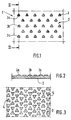
- part 1 of the surface of the balloon has a traditional coating 2 and zones 3 obtained by coating the composition according to the invention, for example 3a, 3b, 3c, with greater roughness to the rest of the surface.
- the section of Figure 2 illustrates, in a schematic and enlarged manner, the roughness 3a, 3b, 3c of the coating applied to the structure 2 of the balloon.
- this structure can be arbitrary (leather, polyurethane).
- Figure 3 shows a variant corresponding to the balloons that gave the best results.
- the organization of the asperities 4 is somewhat different on the surface 2 of the balloon from that illustrated in FIG. 1.
- the relative orientations of the generally triangular zones are in accordance with the drawing.
- composition of the invention was used for the coating of footballs comprising panels sewn by hand.
- Figure 3 illustrates asperities 4, of generally triangular shape, but any other shape could be adopted.
- the asperities 4 are distributed, in an arrangement corresponding to that of the screen, which was used during the coating according to the general technique of screen printing or pad printing.
- the composition according to the invention included, as a binder, a transparent two-component polyurethane solution, with an aliphatic base.
- This product is marketed by the company KECK CHIMIE under the name Vernis Transparent 870428/5. It has a perfect ability to adhere to the surface of the ball, especially as it is made of polyurethane. It also has high elasticity and excellent cold stability.
- the composition also contains an inorganic filler formed of 10 g / kg of a fumed silica compound and 40 g / kg of glass microspherules.
- the fumed silica compound is that put on the market by the company WACKER CHEMIE under the name WACKER HDK V 15, having an average particle size of 5 to 30 nanometers, a specific surface of approximately 150 m2 / g and a density d 'about 50 g / l. It was found that, during coating, the polyurethane-based coating was then confined to zones 3 corresponding to the mesh openings of the screen, the charge of hydrophilic character giving the film a thixotropic character.
- the roughness of the asperities 4 is further improved by the presence of glass microspherules, in an amount of 40 g / kg of binder.
- this charge consisted of the product called Q CELL 600 from the company P.Q. CORPORATION.
- Q CELL 600 from the company P.Q. CORPORATION.
- the application of the coating composition according to the invention was carried out in one operation with a screen having a mesh opening of 143 microns.
- Soccer balls thus obtained were tested by a team of professional players in particularly difficult playing conditions on soggy ground, and even in the presence of slush. It was found that the behavior of the balloon was much more regular than that of traditional uncoated balloons.
- the balloons according to the invention glided over the wet ground in a regular manner, without giving rise to completely random trajectories that are known with the usual balloons.
- the rebound behavior was also more normal and logical.
- the surface roughness also made it easier to catch the ball (goalies stopped).
Landscapes
- Chemical & Material Sciences (AREA)
- Engineering & Computer Science (AREA)
- Organic Chemistry (AREA)
- Wood Science & Technology (AREA)
- Life Sciences & Earth Sciences (AREA)
- Materials Engineering (AREA)
- Health & Medical Sciences (AREA)
- Nanotechnology (AREA)
- General Health & Medical Sciences (AREA)
- Physical Education & Sports Medicine (AREA)
- Inorganic Chemistry (AREA)
- Chemical Kinetics & Catalysis (AREA)
- Medicinal Chemistry (AREA)
- Polymers & Plastics (AREA)
- Paints Or Removers (AREA)
- Acyclic And Carbocyclic Compounds In Medicinal Compositions (AREA)
Claims (26)
- Verfahren zur Behandlung der Außenoberfläche von Sportbällen,
dadurch gekennzeichnet,
daß auf die Außenoberfläche eine Zusammensetzung auf der Grundlage eines Bindemittels oder einer Matrix aufgebracht wird, das bzw. die auf der Balloberfläche fest haftfähig ist und ein anorganisches teilchenförmiges Füllmittel enthält, welches zumindest eine Substanz mit hydrophiler Eigenschaft umfasst und eine hohe spezifische Oberfläche über 40 m²/g sowie eine Schüttdichte unter 100 g/l hat. - Verfahren nach Anspruch 1,
dadurch gekennzeichnet,
daß das Bindemittel oder die Matrix praktisch unempfindlich gegenüber Wasser ist. - Verfahren nach einem der Ansprüche 1 und 2,
dadurch gekennzeichnet,
daß das Bindemittel oder die Matrix Stoffe auf Polyurethan-Basis, als Lösung oder als Emulsion, Stoffe auf Styrol-Butadien-Basis oder Butadien-Acrylnitril-Basis oder Stoffe auf Acrylbasis wie Polyacrylate oder Polymethacrylate umfasst. - Verfahren nach Anspruch 3,
dadurch gekennzeichnet,
daß das Bindemittel oder die Matrix aus Bindemitteln auf Polyurethan-Basis, insbesondere von aliphatischen Basen abstammenden und NCO-Gruppen aufweisenden, ausgewählt ist. - Verfahren nach einem der Ansprüche 1 bis 4,
dadurch gekennzeichnet,
daß die Substanz mit hydrophiler Eigenschaft dem Bindemittel bei dem Aufbringen der Zusammensetzung thixotrope Eigenschaften vermittelt, die eine Begrenzung des Ausbreitens der Zusammensetzung und die Erzielung eines Reliefeffekts auf der Oberfläche der Schicht ermöglichen. - Verfahren nach einem der Ansprüche 1 bis 5,
dadurch gekennzeichnet,
daß die Substanz mit hydrophiler Eigenschaft eine spezifische Oberfläche von etwa 150 m²/g hat. - Verfahren nach einem der Ansprüche 1 bis 6,
dadurch gekennzeichnet,
daß die Substanz mit hydrophiler Eigenschaft eine Schüttdichte von etwa 50 - 70 g/l hat. - Verfahren nach einem der Ansprüche 1 bis 7,
dadurch gekennzeichnet,
daß die Substanz mit hydrophiler Eigenschaft eine mittlere Teilchengrösse von 4 - 50 Nanometer, insbesondere etwa 5 - 30 Nanometer, aufweist. - Verfahren nach einem der Ansprüche 1 bis 8,
dadurch gekennzeichnet,
daß die Substanz mit hydrophiler Eigenschaft pyrogene Siliziumverbindungen umfasst. - Zusammensetzung zur Durchführung des Verfahrens nach einem der Ansprüche 1 bis 9,
dadurch gekennzeichnet,
daß sie auf einem auf der Balloberfläche fest haftfähigen Bindemittel oder einer Matrix aufbaut. die ein anorganisches teilchenförmiges Füllmittel enthält, welches eine Kombination von mindestens einer Substanz mit hydrophiler Eigenschaft gemäß Anspruch 1 und mindestens einer Substanz mit hydrophober Eigenschaft mit einer Schüttdichte unter 100 g/l umfasst. - Zusammensetzung nach Anspruch 10,
dadurch gekennzeichnet,
daß die Substanz mit hydrophober Eigenschaft eine mittlere Teilchengrösse von 10 - 200 µ, insbesondere von 50 - 120 µ und beispielsweise 60 µ Durchmesser hat. - Sportball, dessen Außenoberfläche örtlich in einer Vielzahl von über diese Oberfläche verteilten Zonen mit einer auf der Ballaußenfläche fest haftfähigen Beschichtungs-Zusammensetzung überzogen ist und der in den Bereichen außerhalb dieser Zonen mit dieser Zusammensetzung nicht beschichtet ist, wobei die Beschichtungs-Zusammensetzung ein Bindemittel umfasst, das zumindest ein anorganisches teilchenförmiges Füllmittel in Form einer Substanz mit hydrophiler Eigenschaft enthält, und das hydrophile Material eine hohe spezifische Oberfläche über 40 m²/g und eine Schüttdichte unter 100 g/l hat, und wobei die Beschichtungs-Zusammensetzung sich von der Außenoberfläche als Rauhigkeit abhebt und dem Sportball im Bereich der genannten Zonen eine grössere Griffigkeit als in den übrigen Bereichen der Außenoberfläche vermittelt.
- Sportball nach Anspruch 12,
dadurch gekennzeichnet,
daß die Beschichtungs-Zusammensetzung zumindest ein Füllmittel enthält, das eine Substanz mit hydrophober Eigenschaft ist und eine Dichte von etwa 0,1 bis höchstens 0,4 kg/dm³ hat. - Sportball nach Anspruch 12,
dadurch gekennzeichnet,
daß das Bindemittel zumindest eine Verbindung aus der Gruppe Stoffe auf Polyurethan-Basis, Stoffe auf Styrol-Butadien-Basis, Stoffe auf Butadien-Acrylnitril-Basis und Stoffe auf Acryl-Basis, z.B. Polyacrylate und Polymethacrylate, ist. - Sportball nach Anspruch 12,
dadurch gekennzeichnet,
daß die hydrophile Substanz eine Teilchengrösse mit einem Durchmesser von etwa 4 bis 50 Nanometer aufweist. - Sportball nach Anspruch 15,
dadurch gekennzeichnet,
daß die hydrophile Substanz mindestens eine anorganische Verbindung aus der Gruppe von Glas und pyrogenem Silizium ist - Sportball nach Anspruch 16,
dadurch gekennzeichnet,
daß die hydrophile Substanz in dem Bindemittel in einem Verhältnis von hydrophile Substanz/Bindemittel von etwa 30 bis 70 g/kg vorliegt. - Sportball nach Anspruch 13,
dadurch gekennzeichnet,
daß das hydrophobe Material eine Teilchengrösse mit einem Durchmesser von etwa 10 bis 200 µ aufweist. - Sportball nach Anspruch 18,
dadurch gekennzeichnet,
daß die hydrophobe Substanz mit Luft gefüllt ist und mindestens eine anorganische Substanz aus der Gruppe luftgefüllte Mikro-Glaskugeln und luftgefüllte Mikro-Siliziumkugeln ist. - Sportball nach Anspruch 19,
dadurch gekennzeichnet,
daß das Glas ein Alkali- oder Erdalkali-Silikatglas oder ein Bor-Silikatglas ist. - Sportball nach Anspruch 19,
dadurch gekennzeichnet,
daß die hydrophobe Substanz in dem Bindemittel in einem Verhältnis von hydrophobe Substanz/Bindemittel von etwa 10 bis 50 g/kg vorliegt. - Sportball nach Anspruch 12.
dadurch gekennzeichnet,
daß jede Zone eine Breite von etwa 20 bis 200 µ hat, jede Rauhigkeit nach außen um etwa 15 bis 100 µ, ausgehend von der Außenoberfläche, vorspringt und die genannten Vorsprünge einen Abstand voneinander von etwa 2 bis 5 mm haben. - Sportball nach Anspruch 12,
dadurch gekennzeichnet,
daß das Bindemittel weitgehend transparent ist. - Sportball nach Anspruch 12,
dadurch gekennzeichnet,
daß die Beschichtungs-Zusammensetzung weiterhin eine dem Bindemittel zugemischte Matrix enthält und eine Färbung aufweist, die ihre visuelle Unterscheidung von der Außenoberfläche erlaubt. - Sportball nach Anspruch 12,
dadurch gekennzeichnet,
daß die Beschichtungs-Zusammensetzung ein Stabilisierungsmittel für das Bindemittel enthält. - Sportball nach Anspruch 12,
dadurch gekennzeichnet,
daß es ein Fußball ist.
Priority Applications (1)
| Application Number | Priority Date | Filing Date | Title |
|---|---|---|---|
| AT89400414T ATE87959T1 (de) | 1988-02-19 | 1989-02-14 | Zusammensetzung zur beschichtung der aussenoberflaeche von sportbaellen und so erhaltene baelle. |
Applications Claiming Priority (2)
| Application Number | Priority Date | Filing Date | Title |
|---|---|---|---|
| FR8802031 | 1988-02-09 | ||
| FR8802031A FR2627503B1 (fr) | 1988-02-19 | 1988-02-19 | Composition pour l'enduction de la surface externe de ballons de sport et ballons ainsi obtenus |
Publications (2)
| Publication Number | Publication Date |
|---|---|
| EP0333529A1 EP0333529A1 (de) | 1989-09-20 |
| EP0333529B1 true EP0333529B1 (de) | 1993-04-07 |
Family
ID=9363446
Family Applications (1)
| Application Number | Title | Priority Date | Filing Date |
|---|---|---|---|
| EP89400414A Expired - Lifetime EP0333529B1 (de) | 1988-02-19 | 1989-02-14 | Zusammensetzung zur Beschichtung der Aussenoberfläche von Sportbällen und so erhaltene Bälle |
Country Status (8)
| Country | Link |
|---|---|
| US (1) | US5040795A (de) |
| EP (1) | EP0333529B1 (de) |
| JP (1) | JPH0277474A (de) |
| KR (1) | KR890013129A (de) |
| AT (1) | ATE87959T1 (de) |
| DE (1) | DE68905850T2 (de) |
| ES (1) | ES2039886T3 (de) |
| FR (1) | FR2627503B1 (de) |
Families Citing this family (36)
| Publication number | Priority date | Publication date | Assignee | Title |
|---|---|---|---|---|
| US6490730B1 (en) | 1989-09-20 | 2002-12-10 | Robert M. Lyden | Shin-guard, helmet, and articles of protective equipment including light cure material |
| JPH042790U (de) * | 1990-04-21 | 1992-01-10 | ||
| US5405469A (en) * | 1993-10-15 | 1995-04-11 | Lin; Shen-Lai | Method for forming globe map on rubber basketball |
| DE19758546C2 (de) | 1997-07-30 | 2003-11-27 | Adidas Int Marketing Bv | Fußball |
| US6024661A (en) * | 1997-10-28 | 2000-02-15 | Wilson Sporting Goods Co. | Sweat-absorbing game ball |
| US5931752A (en) * | 1998-01-15 | 1999-08-03 | Wilson Sporting Goods Co. | Inflatable game ball with laid-in channel or logo |
| US6123633A (en) * | 1998-09-03 | 2000-09-26 | Wilson Sporting Goods Co. | Inflatable game ball with a lobular carcass and a relatively thin cover |
| US6681403B2 (en) | 2000-03-13 | 2004-01-27 | Robert M. Lyden | Shin-guard, helmet, and articles of protective equipment including light cure material |
| US6645099B2 (en) * | 2002-03-14 | 2003-11-11 | Wilson Sporting Goods Co. | Moisture-absorbing rubber-covered game ball |
| USD491240S1 (en) | 2002-10-25 | 2004-06-08 | Rawlings Sporting Goods Company, Inc. | Pyramid pebble football |
| USD488524S1 (en) | 2002-10-25 | 2004-04-13 | Rawlings Sporting Goods Company, Inc. | Pyramid pebble football with textured lacing |
| DE10255092B4 (de) * | 2002-11-26 | 2010-11-11 | Molten Corp. | Verfahren zur Herstellung von Teilstücken eines Balls |
| DE102004045176B4 (de) * | 2004-09-17 | 2011-07-21 | Adidas International Marketing B.V. | Blase |
| GB2420984A (en) * | 2004-12-07 | 2006-06-14 | Grays Of Cambridge Ltd | Arrangement of protuberances on a ball |
| USD520086S1 (en) | 2005-01-27 | 2006-05-02 | Adidas International Marketing B.V. | Surface decoration for a ball or a ball panel |
| USD527432S1 (en) | 2005-01-27 | 2006-08-29 | Adidas International Marketing B.V. | Ball |
| USD529107S1 (en) | 2005-01-27 | 2006-09-26 | Adidas International Marketing B.V. | Decorated panel assembly for a ball |
| WO2007099207A1 (fr) * | 2006-03-03 | 2007-09-07 | Decathlon | Enveloppe externe de ballon, et ballon correspondant, notamment pour le basket |
| US8251846B2 (en) * | 2006-08-02 | 2012-08-28 | Wilson Sporting Goods Co. | Game ball having optimally positioned grooves |
| WO2009125758A1 (ja) * | 2008-04-10 | 2009-10-15 | 株式会社クラレ | グリップ性に優れた皮革様シートおよびそれを用いた人工皮革製品 |
| JP5443067B2 (ja) * | 2009-06-11 | 2014-03-19 | 帝人コードレ株式会社 | ボール用表皮材 |
| JP5202466B2 (ja) * | 2009-07-27 | 2013-06-05 | 帝人コードレ株式会社 | 野球ボール用表皮材 |
| US8393979B2 (en) | 2010-06-24 | 2013-03-12 | Nike, Inc. | Golf ball with hydrophilic coating layer |
| JP2012087107A (ja) * | 2010-10-22 | 2012-05-10 | Natural Invention Kk | シリカ含有ゲル組成物と抗炎症剤、保水剤並びに化粧料 |
| US8602915B2 (en) * | 2010-11-01 | 2013-12-10 | Nike, Inc. | Golf ball with changeable dimples |
| DE102013202485B4 (de) | 2013-02-15 | 2022-12-29 | Adidas Ag | Ball für eine Ballsportart |
| US9849361B2 (en) | 2014-05-14 | 2017-12-26 | Adidas Ag | Sports ball athletic activity monitoring methods and systems |
| US10523053B2 (en) | 2014-05-23 | 2019-12-31 | Adidas Ag | Sport ball inductive charging methods and systems |
| US9802082B1 (en) | 2014-08-28 | 2017-10-31 | Christopher J. Calandro | Textured sports ball |
| AU2016209114A1 (en) | 2015-01-22 | 2017-08-10 | Swax Lax Llc | Sports training ball and method of manufacturing a sports training ball |
| DE102015106819A1 (de) * | 2015-03-30 | 2016-10-06 | Fritz Lange Gmbh | Schutzlackierung mit Antiaufklebereffekt sowie Verfahren zum Aufbringen einer Schutzlackierung |
| EP3485946B1 (de) * | 2016-07-12 | 2022-03-16 | Molten Corporation | Ball |
| US10512824B2 (en) * | 2016-09-07 | 2019-12-24 | Swax Lax Llc | Sports training ball with enhanced gripping surface |
| US12151143B2 (en) | 2020-03-12 | 2024-11-26 | Swax Lax Llc | Sports training ball having embossed design |
| US12383927B2 (en) * | 2021-07-01 | 2025-08-12 | Chalkless LLC | Devices and methods for applying a substance to a sports ball |
| AU2025201630B1 (en) * | 2024-10-17 | 2025-06-26 | ALX Consulting Pty Ltd | Leather ball |
Family Cites Families (6)
| Publication number | Priority date | Publication date | Assignee | Title |
|---|---|---|---|---|
| US2078881A (en) * | 1933-03-20 | 1937-04-27 | Rohm & Haas | Process for coating rubber and product |
| FR1406021A (fr) * | 1964-06-04 | 1965-07-16 | Pechiney Saint Gobain | Procédé pour la fabrication de feuilles antidérapantes, produits obtenus par mise en oeuvre du procédé et application de ces produits |
| BE793736A (fr) * | 1972-01-05 | 1973-05-02 | Dymo Industries Inc | Composition de revetement |
| GB1457869A (en) * | 1972-09-12 | 1976-12-08 | Parkinson A R | Compositions having a non-slip or anti-skid surface |
| JPS5465638A (en) * | 1977-11-02 | 1979-05-26 | Bridgestone Corp | Golf ball with high surface strength |
| US4285846A (en) * | 1980-04-28 | 1981-08-25 | Cabot Corporation | Flatted water-reducible coating compositions and method for producing same |
-
1988
- 1988-02-19 FR FR8802031A patent/FR2627503B1/fr not_active Expired - Lifetime
-
1989
- 1989-02-14 AT AT89400414T patent/ATE87959T1/de not_active IP Right Cessation
- 1989-02-14 EP EP89400414A patent/EP0333529B1/de not_active Expired - Lifetime
- 1989-02-14 ES ES198989400414T patent/ES2039886T3/es not_active Expired - Lifetime
- 1989-02-14 DE DE89400414T patent/DE68905850T2/de not_active Expired - Fee Related
- 1989-02-17 JP JP1036414A patent/JPH0277474A/ja active Pending
- 1989-02-18 KR KR1019890001899A patent/KR890013129A/ko not_active Withdrawn
-
1990
- 1990-02-22 US US07/483,453 patent/US5040795A/en not_active Expired - Fee Related
Also Published As
| Publication number | Publication date |
|---|---|
| FR2627503A1 (fr) | 1989-08-25 |
| DE68905850D1 (de) | 1993-05-13 |
| DE68905850T2 (de) | 1993-10-14 |
| EP0333529A1 (de) | 1989-09-20 |
| JPH0277474A (ja) | 1990-03-16 |
| KR890013129A (ko) | 1989-09-21 |
| ES2039886T3 (es) | 1993-10-01 |
| US5040795A (en) | 1991-08-20 |
| ATE87959T1 (de) | 1993-04-15 |
| FR2627503B1 (fr) | 1990-08-10 |
Similar Documents
| Publication | Publication Date | Title |
|---|---|---|
| EP0333529B1 (de) | Zusammensetzung zur Beschichtung der Aussenoberfläche von Sportbällen und so erhaltene Bälle | |
| AT397600B (de) | Sporthandschuh, insbesondere torwarthandschuh | |
| LU85985A1 (fr) | Article de matiere polymere synthetique et matiere polymere synthetique pouvant etre mise en forme,charge(e)de perles de verre;perles de verre destinees a leur preparation | |
| DE60032115T2 (de) | Schmutzabweisender und rutschfester Kunststoffbodenbelag | |
| EP1666541A4 (de) | Schwarzaufhellpigment und es enthaltende kosmetische, beschichtungs-, harz- und tintenzusammensetzung | |
| DE102011116342B3 (de) | Verwendung von Graphen zur Modifikation der tribologischen Gleiteigenschaften von Wintersportgeräten | |
| EP2531568B1 (de) | Polyamidpulver und verfahren zur beschichtung eines objekts durch schmelzen dieses pulvers | |
| EP3866628A1 (de) | Halterung zur befestigung eines zubehörteils zum dekorieren oder verschönern des körpers einer person | |
| FR2574085A1 (fr) | Materiaux decoratifs comprenant des fragments froisses formant marbrures, revetements tels que des structures de revetement de sol vinylique comprenant de telles marbrures, et procede pour preparer de tels revetements | |
| KR20180136315A (ko) | 커버력 및 밀착성이 우수한 색조 파우더 화장료 조성물 및 이의 제조 방법 | |
| JP7245253B2 (ja) | 粉末芯を製造する方法および該芯を用いて製造される製品 | |
| FI77987B (fi) | Skidbotten. | |
| DE102014119567B4 (de) | Gleitmittel für den Gebrauch auf Gleitflächen von Wintersportgeräten und dessen Verwendung | |
| FR2751854A1 (fr) | Houppette eponge de maquillage | |
| CA2099004A1 (fr) | Materiau comportant des pigments, notamment luminescents, et son procede d'obtention | |
| EP1329340A1 (de) | Gegenstand für die Dekoration der Hautoberfläche | |
| FR2622223A1 (fr) | Revetement de sol et procede pour le preparer | |
| CH622687A5 (en) | Smokeable substance | |
| WO2020239785A1 (fr) | Composition solide pour former des revetements de surface | |
| FR2765517A1 (fr) | Article en matiere plastique, procede de fabrication et composition de moulage | |
| JPS5857300B2 (ja) | 化粧板の製造方法 | |
| JPH08511473A (ja) | ラッカー損傷の除去法 | |
| CH620468A5 (en) | Lacquers and paints with high hiding power, ultrarapid drying and prolonged pot life and process for their preparation | |
| FR3004622A1 (fr) | Procede de finition de perles | |
| KR101939314B1 (ko) | 심미성이 향상된 옻칠 유기의 제조방법 및 이에 의해 제조된 옻칠 유기 |
Legal Events
| Date | Code | Title | Description |
|---|---|---|---|
| PUAI | Public reference made under article 153(3) epc to a published international application that has entered the european phase |
Free format text: ORIGINAL CODE: 0009012 |
|
| AK | Designated contracting states |
Kind code of ref document: A1 Designated state(s): AT BE CH DE ES FR GB GR IT LI LU NL SE |
|
| 17P | Request for examination filed |
Effective date: 19891020 |
|
| 17Q | First examination report despatched |
Effective date: 19910314 |
|
| GRAA | (expected) grant |
Free format text: ORIGINAL CODE: 0009210 |
|
| RAP1 | Party data changed (applicant data changed or rights of an application transferred) |
Owner name: ADIDAS SARRAGAN FRANCE S.A.R.L. |
|
| AK | Designated contracting states |
Kind code of ref document: B1 Designated state(s): AT BE CH DE ES FR GB GR IT LI LU NL SE |
|
| REF | Corresponds to: |
Ref document number: 87959 Country of ref document: AT Date of ref document: 19930415 Kind code of ref document: T |
|
| REF | Corresponds to: |
Ref document number: 68905850 Country of ref document: DE Date of ref document: 19930513 |
|
| GBT | Gb: translation of ep patent filed (gb section 77(6)(a)/1977) |
Effective date: 19930429 |
|
| ITF | It: translation for a ep patent filed | ||
| REG | Reference to a national code |
Ref country code: GR Ref legal event code: FG4A Free format text: 3008197 |
|
| REG | Reference to a national code |
Ref country code: ES Ref legal event code: FG2A Ref document number: 2039886 Country of ref document: ES Kind code of ref document: T3 |
|
| PGFP | Annual fee paid to national office [announced via postgrant information from national office to epo] |
Ref country code: FR Payment date: 19940106 Year of fee payment: 6 |
|
| PGFP | Annual fee paid to national office [announced via postgrant information from national office to epo] |
Ref country code: SE Payment date: 19940114 Year of fee payment: 6 |
|
| PGFP | Annual fee paid to national office [announced via postgrant information from national office to epo] |
Ref country code: CH Payment date: 19940118 Year of fee payment: 6 |
|
| PGFP | Annual fee paid to national office [announced via postgrant information from national office to epo] |
Ref country code: GR Payment date: 19940119 Year of fee payment: 6 |
|
| PGFP | Annual fee paid to national office [announced via postgrant information from national office to epo] |
Ref country code: GB Payment date: 19940120 Year of fee payment: 6 |
|
| PGFP | Annual fee paid to national office [announced via postgrant information from national office to epo] |
Ref country code: ES Payment date: 19940125 Year of fee payment: 6 |
|
| PGFP | Annual fee paid to national office [announced via postgrant information from national office to epo] |
Ref country code: LU Payment date: 19940131 Year of fee payment: 6 Ref country code: BE Payment date: 19940131 Year of fee payment: 6 |
|
| PGFP | Annual fee paid to national office [announced via postgrant information from national office to epo] |
Ref country code: DE Payment date: 19940203 Year of fee payment: 6 |
|
| PGFP | Annual fee paid to national office [announced via postgrant information from national office to epo] |
Ref country code: AT Payment date: 19940204 Year of fee payment: 6 |
|
| PLBE | No opposition filed within time limit |
Free format text: ORIGINAL CODE: 0009261 |
|
| STAA | Information on the status of an ep patent application or granted ep patent |
Free format text: STATUS: NO OPPOSITION FILED WITHIN TIME LIMIT |
|
| PGFP | Annual fee paid to national office [announced via postgrant information from national office to epo] |
Ref country code: NL Payment date: 19940228 Year of fee payment: 6 |
|
| EPTA | Lu: last paid annual fee | ||
| 26N | No opposition filed | ||
| EAL | Se: european patent in force in sweden |
Ref document number: 89400414.2 |
|
| PG25 | Lapsed in a contracting state [announced via postgrant information from national office to epo] |
Ref country code: LU Free format text: LAPSE BECAUSE OF NON-PAYMENT OF DUE FEES Effective date: 19950214 Ref country code: GB Effective date: 19950214 Ref country code: AT Effective date: 19950214 |
|
| PG25 | Lapsed in a contracting state [announced via postgrant information from national office to epo] |
Ref country code: SE Effective date: 19950215 Ref country code: ES Free format text: LAPSE BECAUSE OF NON-PAYMENT OF DUE FEES Effective date: 19950215 |
|
| PG25 | Lapsed in a contracting state [announced via postgrant information from national office to epo] |
Ref country code: LI Effective date: 19950228 Ref country code: CH Effective date: 19950228 Ref country code: BE Effective date: 19950228 |
|
| BERE | Be: lapsed |
Owner name: ADIDAS SARRAGAN FRANCE S.A.R.L. Effective date: 19950228 |
|
| PG25 | Lapsed in a contracting state [announced via postgrant information from national office to epo] |
Ref country code: GR Free format text: THE PATENT HAS BEEN ANNULLED BY A DECISION OF A NATIONAL AUTHORITY Effective date: 19950831 |
|
| PG25 | Lapsed in a contracting state [announced via postgrant information from national office to epo] |
Ref country code: NL Effective date: 19950901 |
|
| GBPC | Gb: european patent ceased through non-payment of renewal fee |
Effective date: 19950214 |
|
| PG25 | Lapsed in a contracting state [announced via postgrant information from national office to epo] |
Ref country code: FR Effective date: 19951031 |
|
| REG | Reference to a national code |
Ref country code: GR Ref legal event code: MM2A Free format text: 3008197 |
|
| NLV4 | Nl: lapsed or anulled due to non-payment of the annual fee |
Effective date: 19950901 |
|
| PG25 | Lapsed in a contracting state [announced via postgrant information from national office to epo] |
Ref country code: DE Effective date: 19951101 |
|
| EUG | Se: european patent has lapsed |
Ref document number: 89400414.2 |
|
| REG | Reference to a national code |
Ref country code: FR Ref legal event code: ST |
|
| REG | Reference to a national code |
Ref country code: ES Ref legal event code: FD2A Effective date: 19990301 |
|
| PG25 | Lapsed in a contracting state [announced via postgrant information from national office to epo] |
Ref country code: IT Free format text: LAPSE BECAUSE OF NON-PAYMENT OF DUE FEES;WARNING: LAPSES OF ITALIAN PATENTS WITH EFFECTIVE DATE BEFORE 2007 MAY HAVE OCCURRED AT ANY TIME BEFORE 2007. THE CORRECT EFFECTIVE DATE MAY BE DIFFERENT FROM THE ONE RECORDED. Effective date: 20050214 |