EP0326337B1 - Process for improving the corrosion resistance of brazing sheet - Google Patents
Process for improving the corrosion resistance of brazing sheet Download PDFInfo
- Publication number
- EP0326337B1 EP0326337B1 EP89300668A EP89300668A EP0326337B1 EP 0326337 B1 EP0326337 B1 EP 0326337B1 EP 89300668 A EP89300668 A EP 89300668A EP 89300668 A EP89300668 A EP 89300668A EP 0326337 B1 EP0326337 B1 EP 0326337B1
- Authority
- EP
- European Patent Office
- Prior art keywords
- core
- alloy
- brazing
- band
- manganese
- Prior art date
- Legal status (The legal status is an assumption and is not a legal conclusion. Google has not performed a legal analysis and makes no representation as to the accuracy of the status listed.)
- Expired - Lifetime
Links
Images
Classifications
-
- B—PERFORMING OPERATIONS; TRANSPORTING
- B23—MACHINE TOOLS; METAL-WORKING NOT OTHERWISE PROVIDED FOR
- B23K—SOLDERING OR UNSOLDERING; WELDING; CLADDING OR PLATING BY SOLDERING OR WELDING; CUTTING BY APPLYING HEAT LOCALLY, e.g. FLAME CUTTING; WORKING BY LASER BEAM
- B23K35/00—Rods, electrodes, materials, or media, for use in soldering, welding, or cutting
- B23K35/22—Rods, electrodes, materials, or media, for use in soldering, welding, or cutting characterised by the composition or nature of the material
- B23K35/24—Selection of soldering or welding materials proper
-
- B—PERFORMING OPERATIONS; TRANSPORTING
- B32—LAYERED PRODUCTS
- B32B—LAYERED PRODUCTS, i.e. PRODUCTS BUILT-UP OF STRATA OF FLAT OR NON-FLAT, e.g. CELLULAR OR HONEYCOMB, FORM
- B32B15/00—Layered products comprising a layer of metal
- B32B15/01—Layered products comprising a layer of metal all layers being exclusively metallic
- B32B15/016—Layered products comprising a layer of metal all layers being exclusively metallic all layers being formed of aluminium or aluminium alloys
-
- B—PERFORMING OPERATIONS; TRANSPORTING
- B23—MACHINE TOOLS; METAL-WORKING NOT OTHERWISE PROVIDED FOR
- B23K—SOLDERING OR UNSOLDERING; WELDING; CLADDING OR PLATING BY SOLDERING OR WELDING; CUTTING BY APPLYING HEAT LOCALLY, e.g. FLAME CUTTING; WORKING BY LASER BEAM
- B23K35/00—Rods, electrodes, materials, or media, for use in soldering, welding, or cutting
- B23K35/22—Rods, electrodes, materials, or media, for use in soldering, welding, or cutting characterised by the composition or nature of the material
- B23K35/24—Selection of soldering or welding materials proper
- B23K35/28—Selection of soldering or welding materials proper with the principal constituent melting at less than 950°C
- B23K35/286—Al as the principal constituent
-
- Y—GENERAL TAGGING OF NEW TECHNOLOGICAL DEVELOPMENTS; GENERAL TAGGING OF CROSS-SECTIONAL TECHNOLOGIES SPANNING OVER SEVERAL SECTIONS OF THE IPC; TECHNICAL SUBJECTS COVERED BY FORMER USPC CROSS-REFERENCE ART COLLECTIONS [XRACs] AND DIGESTS
- Y10—TECHNICAL SUBJECTS COVERED BY FORMER USPC
- Y10T—TECHNICAL SUBJECTS COVERED BY FORMER US CLASSIFICATION
- Y10T428/00—Stock material or miscellaneous articles
- Y10T428/12—All metal or with adjacent metals
- Y10T428/12458—All metal or with adjacent metals having composition, density, or hardness gradient
-
- Y—GENERAL TAGGING OF NEW TECHNOLOGICAL DEVELOPMENTS; GENERAL TAGGING OF CROSS-SECTIONAL TECHNOLOGIES SPANNING OVER SEVERAL SECTIONS OF THE IPC; TECHNICAL SUBJECTS COVERED BY FORMER USPC CROSS-REFERENCE ART COLLECTIONS [XRACs] AND DIGESTS
- Y10—TECHNICAL SUBJECTS COVERED BY FORMER USPC
- Y10T—TECHNICAL SUBJECTS COVERED BY FORMER US CLASSIFICATION
- Y10T428/00—Stock material or miscellaneous articles
- Y10T428/12—All metal or with adjacent metals
- Y10T428/12493—Composite; i.e., plural, adjacent, spatially distinct metal components [e.g., layers, joint, etc.]
- Y10T428/12736—Al-base component
- Y10T428/12764—Next to Al-base component
Definitions
- This invention relates to brazed aluminum, and particularly to a process for improving the corrosion resistance of brazed aluminum products, as well as composite sheet materials for use in making such brazed products.
- Non-corrosive flux brazing and vacuum brazing have an important advantage over the traditional flux brazing in that they avoid the need for expensive cleaning operations normally associated with flux brazing.
- Corrosion resistance is a concern common to components produced by all brazing methods. For example, road salt and moisture are sufficiently corrosive to often cause perforation of automotive radiators. In many cases corrosion problems originate in the brazing technique itself, e.g., through penetration of an element of the brazing alloy (particularly silicon) into the core alloy. This may occur along the grain boundaries of the core alloy during the brazing heat cycle and results in a sensitization of the core to intergranular attack.
- Furukawa Aluminum Japanese Published Patent Application Serial No. 61-82,992, published April 26, 1986, describes an aluminum alloy brazing sheet containing a core of 0.25-1% Cu, 0.3-1.5% Mn, ⁇ 0-2% Si, ⁇ 0.2% Fe, optionally ⁇ 0.3% Mg, ⁇ 0.3% Cr, ⁇ 0.3% Zr, balance aluminium.
- the core material is cast as ingot and then heat treated prior to being coated with brazing metal containing silicon.
- the core must be substantially magnesium free and the as-cast core ingots are subjected to heat treatments before brazing alloy claddings are applied.
- this invention provides a process for producing an aluminium composite sheet product for use in brazing, which comprises:
- the core material used in the composite sheet product of this invention is an aluminium-based alloy containing no more than 0.4% iron, no more than 0.15% silicon, from 0.1% to 0.6% copper and from 0.7% to 1.5% manganese.
- the core alloy may also contain no more than 0.8% magnesium and/or from 0.05% to 0.25% zirconium.
- the above core alloy is clad with aluminium-based brazing alloy, with hot rolling to form a sheet product.
- This sheet product is then, without any interanneal, cold rolled to final gauge. After the cold rolling, the composite sheet is usually annealed, either partially or fully.
- a further embodiment of the invention is an aluminium alloy composite sheet material suitable for forming into parts to be assembled and brazed comprising (a) a cast aluminium-base core containing no more than 0.4% iron, no more than 0.15% silicon, from 0.1% to 0.6% copper and from 0.7% to 1.5% manganese and (b) an aluminium-base brazing alloy cladding on at least one side of said core, characterised in that the cladding of the composite sheet material is applied to the as-cast core and the sheet material is non-interannealed such that the manganese in the core is substantially in solid solution and/or in the form of a fine, uniformly distributed precipitate of manganese-containing particles having sizes in the range of 0.03 to 0.1 ⁇ m.
- the cladding is applied to an as-cast core and the sheet material is substantially non-homogenised and non-interannealed such that the manganese in the core is substantially in solid solution and/or in the form of a fine, uniformly distributed precipitate of manganese-containing particles having sizes in the range of 0.03 to 0.1 ⁇ m.
- a still further feature of the invention is the above composite-sheet material in brazed form.
- the invention provides a brazed aluminium assembly produced from a brazable composite comprising (a) a cast aluminium-base core containing no more than 0.4% iron, no more than 0.15% silicon, from 0.1% to 0.6% copper and from 0.7% to 1.5% manganese and (b) an aluminium-base brazing alloy clad on at least one side of said core, characterised by a silicon-rich band of dense precipitate formed in the core alloy immediately adjacent the brazing alloy cladding, said band having a thickness of 20-50 ⁇ m and substantially less manganese in solid solution in the band than in the core outside the band.
- the above particles (which are often called dispersoids) are fine and numerous, having sizes in the order of 0.03 to 0.1 ⁇ m.
- the smaller particles dissolve and some manganese precipitates on the surviving coarser particles, increasing their size to between 0.1 and 0.4 ⁇ m.
- the band of dense precipitate typically has a thickness of 20-50 ⁇ m, with a thickness of 25-40 ⁇ m being preferred.
- the as-cast core material is preferably heated to a temperature between 425 and 525°C prior to hot rolling and held at this temperature for the minimum time required to ensure temperature uniformity.
- the cladding is applied during the first stage of hot rolling. While it is preferred not to anneal the material, if annealing is required to obtain the desired mechanical properties, then the annealing temperature should be no higher than about 450°C for a full anneal and no higher than about 350°C for a partial anneal, and the anneal should be carried out after the material is rolled to final gauge.
- the core alloy is typically of the type of the 3XXX series of Aluminum Association designated alloys. However, it must be within the composition ranges stated above, and it is preferred that these alloys contain no more than 0.2% iron, no more than 0.1% silicon, from 0.2% to 0.4% copper, from 0.2% to 0.4% magnesium, from 0.9% to 1.1% manganese and optionally from 0.1% to 0.15% zirconium. Thus, it was found that with regular 3003 or 3005-type of core alloys containing 0.6% iron and 0.3% silicon, a faint band was formed in the brazed sheet which was insufficient to provide the desired corrosion protection. On the other hand, when a purer base is used within the limits of the present invention, a definitive and effective band of dense precipitate is formed in the brazed sheet.
- the copper is added to increase the strength as well as the nobility of the core alloy. Since the cladding does not contain copper, during annealing and brazing there is copper diffusion from the band region of the core to the cladding with a net effect that the dense band is impoverished in copper relative to the rest of the core and this reduces the nobility of the band, thereby augmenting the effectiveness of the band of dense precipitate.
- the manganese plays a primordial role in the band formation and a high manganese content is essential.
- Magnesium is added for strengthening the alloy and facilitating vacuum brazing. Titanium may be added as grain refiner, but it does not contribute to the band formation. Zirconium may be added to increase sag resistance at brazing temperatures.
- the core alloy When the core alloy is clad on both sides with brazing alloy, a dense band is formed on each side and corrosion protection exists for either side. For some applications, such as tube stock and header stock, only one side is clad with the brazing alloy. In that case, particularly if the core alloy has a high copper content, it is customary to clad the inside with an AA 1050-1070 pure metal layer for the purpose of improving internal corrosion.
- the cladding or brazing alloy may be any aluminum alloy capable of flow under typical brazing conditions to form fillets at the contact points of the assembly sufficient to produce a sturdy bond.
- Such alloys will generally contain silicon as the primary alloying element, preferably at a concentration ranging from about 5% to about 15% by weight. Examples of such alloys are those of the AA 4XXX series.
- alloys of the AA 3XXX series are typically homogenized at high temperatures. This is normally done by heating to 550-625°C and soaking for several hours. This treatment is followed by either a second soak at a lower temperature or a slow cooling to a similar temperature. Furthermore, it is common practice to interanneal at some stage during the fabrication of the sheet. With the alloy composition of the core and the processing route of the present invention, it has been found that both homogenization and interannealing are detrimental to the corrosion resistance of the brazed product.
- brazing sheet with a core having the composition of the present invention and processed according to the procedure of the present invention possesses not only superior as-brazed corrosion resistance, but also superior sag resistance when compared to materials processed in accordance with the prior art. It is believed that the superior sag resistance resulting from the present invention is in part due to the creation of large pancake-shaped grains in the core during the brazing cycle or, if annealed, during the annealing cycle. "Pancake” is defined as a grain having much larger dimensions in the plane of the sheet than in the thickness of the sheet. It is known in the art that brazing sheet with this type of grain structure has superior brazeability and sag resistance when compared to materials with finer equiaxial grains such as would result from conventional processing.
- the formation of the pancake-type grains in brazing sheet produced by the present invention is due, in part, to the state of Mn-bearing particles that precipatate during hot rolling and annealing.
- Mn-bearing particles that precipatate during hot rolling and annealing.
- the core is cast by any suitable commercial casting process, with the direct chill method being preferred.
- the ingot formed is then scalped and this core alloy with the desired brazing alloy liner plates is preheated in the range 425-525°C and hot rolled to bond the plates to the core and to reduce the thickness to an acceptable value for subsequent cold rolling.
- a temperature in the range of 475-500°C is preferred, with long soak periods at temperature being avoided.
- the idea is to keep the manganese in the core alloy as much as possible in solid solution or in very small precipitate particles which are small enough to be unstable when later exposed to brazing temperatures of the order of 600°C.
- the hot rolled stock is preferably cold rolled directly to final gauge without any interannealing.
- the amount of cold reduction can be as high as the alloy can stand without excessive edge cracking and cold reductions in the order of about 50 to 90% have been successful.
- the composite sheet Before brazing, the composite sheet is usually formed into the desired part.
- Cold rolled sheet has poor formability and it is often necessary to anneal or partially anneal to increase the formability of the material enough to enable the parts to be formed.
- annealing temperatures and times should be kept at a minimum to avoid the formation of coarse Mn-containing precipitate particles. Full annealing is typically carried out at about 350-425°C, while partial annealing is typically carried out at about 250-350°C.
- anneal and the high temperature treatment are also possible to combine the anneal and the high temperature treatment (brazing step) provided sufficiently high heating and cooling rates are used to prevent precipitation growth. For instance, a rate of 30°C/min is suitable. This makes it possible to use the process to provide corrosion resistance to other products, such as tubes used in heat exchangers.
- the alloy IRD was prepared according to the present invention using industrial ingot and the other samples were prepared in the laboratory. These alloys were cast in 3 3/4" x 9" DC sheet ingot, scalped, clad with AA 4047 with 0.2% Mg, preheated to 500°C and hot rolled to 0.2". After cold rolling to 0.015", sheet samples were partially annealed at 300°C and, thereafter, submitted to a simulated brazing cycle.
- An alloy was prepared containing 0.32% copper, 0.17% iron, 0.44% magnesium, 1.06% manganese, 0.05% silicon and 0.013% titanium. All percentages are by weight, with the balance being aluminum and incidental impurities.
- the alloy was either homogenized at 550°C for 4 hours or simply preheated to 500°C and hot rolled as described in Example 1.
- the alloy was clad with AA 4045 containing 0.2% magnesium and cold rolled to 0.050". Some samples obtained were interannealed and others were not, and all were cold rolled to 0.013" final gauge. After a final partial anneal, coupons cut from the samples were submitted to a vacuum brazing cycle and exposed to SWAAT corrosion tests.
- This example demonstrates the role of the band of dense precipitate in corrosion resistance.
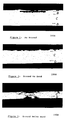
- a core alloy was prepared containing 0.31% copper, 0.19% iron, 0.27% magnesium, 1.11% manganese, 0.05% silicon, 0.008% titanium, 0.01% zinc and the balance aluminum. This was cast and formed into a sheet by the same procedure as used in Example 1. It was clad on one side with AA 4045 and clad on the other side with AA 1070. The final sheet was 0.0125" thick and a 2" x 6" sample was exposed to a vacuum braze cycle while in a vertical position. Three coupons were punched out of the sheet and the AA 1070 side was glued to Bakelite mounts. One sample remained as brazed while the other two were ground on 400 grit silicon carbide paper to expose the band of dense precipitate in one case and the main core alloy in the other case.
- the three mounts were placed in a SWAAT cabinet and subjected to corrosive atmosphere for 48 hours.
- the three sheets were then separated from the Bakelite mounts and two sections from each were prepared for metallographic examination.
- the results are shown in Figures 1-3 in which the cladding is shown as A, the band of dense precipitate as B, the main core alloy as C and the AA 1070 layer as D.
- These examinations showed that the band of dense precipitate B had a beneficial effect in delaying corrosion of the core material C. It also showed that once the clad A and the band layer B had been removed or corroded away, the main portion of the bare core C perforated in less than 48 hours. This performance was similar to standard core alloys such as AA 3005.
- a core alloy having the same composition as that of Example 3 was prepared in the same manner as described in Example 1. Samples of the alloy were examined before and after braze. One examination was a TEM examination of matrix and constituents composition, in and out of the band of dense precipitates. It was found that before brazing, the Mn-containing precipitate particles (often called dispersoids) were small and numerous with sizes in the order of 0.03 to 0.1 ⁇ m. During the brazing cycle, outside the band the smaller dispersoids dissolved and a few larger ones coarsened to a size of about 0.1 to 0.4 ⁇ m. In the band of dense precipitate, however, the small constituent particles were found to be still numerous; there was some coarsening but many small particles survived the brazing temperatures with sizes in the range of 0.03 to 0.2 ⁇ m.
- dispersoids Mn-containing precipitate particles
- the precipitate particles before brazing contained Al, Mn and Si, but after brazing, the particles away from the band were coarsened by further manganese precipitation and contained mostly Al and Mn. In the band, after brazing, the particles had a higher average silicon content than in the original particles.
- the manganese in the core prior to brazing is substantially in solid solution and/or in the form of said fine particles, with at least 0.6% manganese preferably being in the above form.
- the brazed product there is substantially less manganese in solid solution in the band than in the core outside the band, with the core outside the band preferably containing at least 0.3% manganese in solid solution.
Landscapes
- Engineering & Computer Science (AREA)
- Mechanical Engineering (AREA)
- Laminated Bodies (AREA)
- Pressure Welding/Diffusion-Bonding (AREA)
- Metal Rolling (AREA)
- Electroplating Methods And Accessories (AREA)
- Parts Printed On Printed Circuit Boards (AREA)
- Secondary Cells (AREA)
Applications Claiming Priority (2)
| Application Number | Priority Date | Filing Date | Title |
|---|---|---|---|
| CA557720 | 1988-01-29 | ||
| CA000557720A CA1309322C (en) | 1988-01-29 | 1988-01-29 | Process for improving the corrosion resistance of brazing sheet |
Publications (2)
| Publication Number | Publication Date |
|---|---|
| EP0326337A1 EP0326337A1 (en) | 1989-08-02 |
| EP0326337B1 true EP0326337B1 (en) | 1994-05-25 |
Family
ID=4137351
Family Applications (1)
| Application Number | Title | Priority Date | Filing Date |
|---|---|---|---|
| EP89300668A Expired - Lifetime EP0326337B1 (en) | 1988-01-29 | 1989-01-25 | Process for improving the corrosion resistance of brazing sheet |
Country Status (9)
| Country | Link |
|---|---|
| US (1) | US5041343A (enExample) |
| EP (1) | EP0326337B1 (enExample) |
| JP (1) | JP2656104B2 (enExample) |
| KR (1) | KR970010892B1 (enExample) |
| AT (1) | ATE106032T1 (enExample) |
| AU (1) | AU612231B2 (enExample) |
| CA (1) | CA1309322C (enExample) |
| DE (1) | DE68915461T2 (enExample) |
| ES (1) | ES2052898T3 (enExample) |
Cited By (1)
| Publication number | Priority date | Publication date | Assignee | Title |
|---|---|---|---|---|
| DE102008059450A1 (de) | 2008-11-28 | 2010-06-02 | Behr Gmbh & Co. Kg | Aluminiumband, Lötbauteil, Herstellungsverfahren und Wärmetauscher und Verwendung |
Families Citing this family (35)
| Publication number | Priority date | Publication date | Assignee | Title |
|---|---|---|---|---|
| CA1309322C (en) * | 1988-01-29 | 1992-10-27 | Paul Emile Fortin | Process for improving the corrosion resistance of brazing sheet |
| GB9012810D0 (en) * | 1990-06-08 | 1990-08-01 | British Petroleum Co Plc | Method of treatment of metal matrix composites |
| US5476725A (en) * | 1991-03-18 | 1995-12-19 | Aluminum Company Of America | Clad metallurgical products and methods of manufacture |
| JPH07112625B2 (ja) * | 1991-04-04 | 1995-12-06 | 日本電装株式会社 | アルミニウムの真空ろう付方法および真空ろう付炉と、真空ろう付用アルミニウムブレージングシート |
| US5232788A (en) * | 1992-02-12 | 1993-08-03 | Alcan International Limited | Aluminum brazing sheet |
| US5356725A (en) * | 1993-09-09 | 1994-10-18 | Kaiser Aluminum & Chemical Corporation | Corrosion-resistant aluminum alloy brazing composite |
| DE69531229T2 (de) * | 1994-12-19 | 2004-06-03 | Corus Aluminium Walzprodukte Gmbh | Hartlotfolie |
| GB2321255B (en) * | 1995-11-21 | 2000-03-08 | Alcan Int Ltd | Heat exchanger |
| US5725695A (en) * | 1996-03-26 | 1998-03-10 | Reynolds Metals Company | Method of making aluminum alloy foil and product therefrom |
| WO1998024571A1 (en) * | 1996-12-03 | 1998-06-11 | Hoogovens Aluminium Walzprodukte Gmbh | Multilayer metal composite products obtained by compound strand casting |
| FR2797454B1 (fr) * | 1999-08-12 | 2001-08-31 | Pechiney Rhenalu | Bande ou tube en alliage d'aluminium pour la fabrication d'echangeurs de chaleur brases |
| EP2065180A1 (en) | 2002-04-18 | 2009-06-03 | Alcoa Inc. | Ultra-longlife, high formability brazing sheet |
| US7255932B1 (en) * | 2002-04-18 | 2007-08-14 | Alcoa Inc. | Ultra-longlife, high formability brazing sheet |
| EP1638715B2 (en) | 2003-06-24 | 2019-02-27 | Novelis, Inc. | Method for casting composite ingot |
| US7374827B2 (en) * | 2004-10-13 | 2008-05-20 | Alcoa Inc. | Recovered high strength multi-layer aluminum brazing sheet products |
| CN101072673B (zh) * | 2004-10-19 | 2013-04-24 | 阿勒里斯铝业科布伦茨有限公司 | 生产铝合金钎焊薄板和轻质钎焊热交换器组件的方法 |
| US8846209B2 (en) | 2004-11-16 | 2014-09-30 | Aleris Aluminum Duffel Bvba | Aluminium composite sheet material |
| EP1852250A1 (en) | 2006-05-02 | 2007-11-07 | Aleris Aluminum Duffel BVBA | Clad sheet product |
| US20080115493A1 (en) * | 2006-11-17 | 2008-05-22 | Wolf Eric P | Diesel combustion engine having a low pressure exhaust gas recirculation system employing a corrosion resistant aluminum charge air cooler |
| US20090266530A1 (en) | 2008-04-24 | 2009-10-29 | Nicholas Charles Parson | Aluminum Alloy For Extrusion And Drawing Processes |
| EP2236240B1 (en) | 2009-03-31 | 2018-08-08 | MAHLE Behr GmbH & Co. KG | Method for manufacturing an aluminium device, comprising a brazing and a preheating step |
| KR101605594B1 (ko) * | 2010-12-22 | 2016-03-22 | 노벨리스 인크. | 태양 에너지 흡수재 유닛 및 그것을 포함하는 태양 에너지 장치 |
| PL2852494T3 (pl) * | 2012-05-23 | 2022-10-17 | Gränges Finspång AB | Ultra odporny na ugięcie oraz topnienie materiał żeber o bardzo dużej wytrzymałości |
| JP6554416B2 (ja) | 2012-07-27 | 2019-07-31 | グランジェス・スウェーデン・アーべー | ろう付け後に優れた耐食性を有するストリップ |
| US9545777B2 (en) | 2013-03-13 | 2017-01-17 | Novelis Inc. | Corrosion-resistant brazing sheet package |
| EP2969308B2 (en) | 2013-03-13 | 2021-06-23 | Novelis, Inc. | Brazing sheet core alloy for heat exchanger |
| US20140272463A1 (en) | 2013-03-15 | 2014-09-18 | Novelis Inc. | Clad sheet alloys for brazing applications |
| MX2017003021A (es) | 2014-09-12 | 2017-05-12 | Novelis Inc | Aleaciones para productos de aluminio de alta conformacion y metodos de obtenerlas. |
| WO2020178508A1 (fr) | 2019-03-04 | 2020-09-10 | Constellium Neuf-Brisach | Bande en alliage d'aluminium pour la fabrication d'echangeurs de chaleur brases |
| FR3093448A1 (fr) | 2019-03-04 | 2020-09-11 | Constellium Neuf-Brisach | Bande en alliage d’aluminium pour la fabrication d’échangeurs de chaleur brasés |
| WO2020178507A1 (fr) | 2019-03-04 | 2020-09-10 | Constellium Neuf-Brisach | Bande en alliage d'aluminium pour la fabrication d'échangeurs de chaleur brasés |
| FR3093450A1 (fr) | 2019-03-04 | 2020-09-11 | Constellium Neuf-Brisach | Bande en alliage d’aluminium pour la fabrication d’échangeurs de chaleur brasés |
| EP3972775B1 (en) | 2019-05-19 | 2024-08-14 | Novelis, Inc. | Aluminum alloys for fluxless brazing applications, methods of making the same, and uses thereof |
| CN112122825B (zh) * | 2020-08-17 | 2022-03-18 | 深圳市兴鸿泰锡业有限公司 | 一种5g通讯锡基带涂层无卤素预成型焊片的制备方法 |
| DE102023124479A1 (de) * | 2023-04-06 | 2024-10-10 | Mahle International Gmbh | Wärmetauscher für ein Kraftfahrzeug mit einer Aluminiumlegierung und Verfahren zur Herstellung eines Wärmetauschers für ein Kraftfahrzeug mit einer Aluminiumlegierung |
Family Cites Families (19)
| Publication number | Priority date | Publication date | Assignee | Title |
|---|---|---|---|---|
| US2821014A (en) * | 1951-05-31 | 1958-01-28 | Aluminum Co Of America | Composite aluminous metal article |
| US3788824A (en) * | 1971-10-05 | 1974-01-29 | Reynolds Metals Co | Aluminous metal brazing materials |
| DE2450777C2 (de) * | 1974-10-25 | 1983-03-24 | Daimler-Benz Ag, 7000 Stuttgart | Einrichtung zur Steuerung eines Meßstrahls und/oder eines Lichtstrahls bei Kraftfahrzeugen |
| CA1031514A (en) * | 1974-10-31 | 1978-05-23 | Philip R. Sperry | Composite aluminum brazing sheet |
| US4039298A (en) * | 1976-07-29 | 1977-08-02 | Swiss Aluminium Ltd. | Aluminum brazed composite |
| JPS5383952A (en) * | 1976-12-29 | 1978-07-24 | Sumitomo Precision Prod Co | Fluxless brazing method of aluminium structure |
| US4093782A (en) * | 1977-03-03 | 1978-06-06 | Swiss Aluminium Ltd. | Brazed aluminum composite |
| US4146164A (en) * | 1977-11-09 | 1979-03-27 | Aluminum Company Of America | Production of aluminum brazing sheet |
| JPS6034617B2 (ja) * | 1980-03-28 | 1985-08-09 | 株式会社神戸製鋼所 | ろう付用Al材料 |
| JPS57169073A (en) * | 1981-04-13 | 1982-10-18 | Mitsubishi Alum Co Ltd | Manufacture of brazing sheet for material of fin of heat exchanger showing superior sagging resistance during brazing |
| JPS5939502B2 (ja) * | 1981-08-19 | 1984-09-25 | 住友軽金属工業株式会社 | ろう付け性と耐食性にすぐれたブレ−ジングシ−トの製造法 |
| JPS60211056A (ja) * | 1984-04-05 | 1985-10-23 | Furukawa Alum Co Ltd | ブレ−ジング用アルミニウム薄板の製造方法 |
| US4586964A (en) * | 1984-07-26 | 1986-05-06 | Kaiser Aluminum & Chemical Corporation | Corrosion resistant vacuum brazing sheet |
| JPS6182992A (ja) * | 1984-09-28 | 1986-04-26 | Furukawa Alum Co Ltd | Al合金ブレ−ジングシ−ト |
| US4649087A (en) * | 1985-06-10 | 1987-03-10 | Reynolds Metals Company | Corrosion resistant aluminum brazing sheet |
| US4699674A (en) * | 1986-03-18 | 1987-10-13 | Kaiser Aluminum & Chemical Corporation | Thermal treatment of brazed products for improved corrosion resistance |
| US4828936A (en) * | 1987-06-09 | 1989-05-09 | Mitsubishi Aluminum Kabushiki Kaisha | Aluminum alloy sheet excellent in high-temperature sagging resistance and sacrificial anode property and having high room-temperature strength |
| CA1309322C (en) * | 1988-01-29 | 1992-10-27 | Paul Emile Fortin | Process for improving the corrosion resistance of brazing sheet |
| CA1307175C (en) * | 1988-02-03 | 1992-09-08 | Paul Emile Fortin | Aluminum products having improved corrosion resistance |
-
1988
- 1988-01-29 CA CA000557720A patent/CA1309322C/en not_active Expired - Lifetime
-
1989
- 1989-01-25 EP EP89300668A patent/EP0326337B1/en not_active Expired - Lifetime
- 1989-01-25 ES ES89300668T patent/ES2052898T3/es not_active Expired - Lifetime
- 1989-01-25 DE DE68915461T patent/DE68915461T2/de not_active Expired - Lifetime
- 1989-01-25 AT AT89300668T patent/ATE106032T1/de not_active IP Right Cessation
- 1989-01-25 US US07/301,653 patent/US5041343A/en not_active Expired - Lifetime
- 1989-01-28 KR KR1019890000980A patent/KR970010892B1/ko not_active Expired - Fee Related
- 1989-01-30 JP JP1020653A patent/JP2656104B2/ja not_active Expired - Fee Related
- 1989-02-03 AU AU29577/89A patent/AU612231B2/en not_active Ceased
Cited By (1)
| Publication number | Priority date | Publication date | Assignee | Title |
|---|---|---|---|---|
| DE102008059450A1 (de) | 2008-11-28 | 2010-06-02 | Behr Gmbh & Co. Kg | Aluminiumband, Lötbauteil, Herstellungsverfahren und Wärmetauscher und Verwendung |
Also Published As
| Publication number | Publication date |
|---|---|
| CA1309322C (en) | 1992-10-27 |
| DE68915461D1 (de) | 1994-06-30 |
| KR890011670A (ko) | 1989-08-21 |
| AU612231B2 (en) | 1991-07-04 |
| ATE106032T1 (de) | 1994-06-15 |
| AU2957789A (en) | 1990-08-09 |
| DE68915461T2 (de) | 1994-09-08 |
| JPH01284498A (ja) | 1989-11-15 |
| KR970010892B1 (ko) | 1997-07-02 |
| JP2656104B2 (ja) | 1997-09-24 |
| ES2052898T3 (es) | 1994-07-16 |
| US5041343A (en) | 1991-08-20 |
| EP0326337A1 (en) | 1989-08-02 |
Similar Documents
| Publication | Publication Date | Title |
|---|---|---|
| CA1309322C (en) | Process for improving the corrosion resistance of brazing sheet | |
| EP0327245B1 (en) | Aluminum products having improved corrosion resistance | |
| JP4141835B2 (ja) | アルミニウムを内部層に有する多重層化された熱処理可能な蝋着シート | |
| EP2877317B2 (en) | Strip material with excellent corrosion resistance after brazing | |
| EP1648694B1 (en) | High strength aluminium alloy brazing sheet | |
| CN100528458C (zh) | 高强度铝合金钎焊薄板,钎焊组件及其制造方法 | |
| CN100475999C (zh) | 可焊高强度Al-Mg-Si合金 | |
| CA2159191C (en) | Aluminum alloy brazing sheet | |
| US7255932B1 (en) | Ultra-longlife, high formability brazing sheet | |
| JP2005523164A (ja) | 高寿命、高成形性ブレージングシート | |
| EP0492796B1 (en) | Corrosion-resistant clad material made of aluminum alloy | |
| EP1078108B1 (en) | Aluminium alloy for use in a brazed assembly | |
| WO2007131727A1 (en) | Method of producing a clad aluminum alloy sheet for brazing purposes and sheet produced by said method | |
| JP2003293060A (ja) | ろう付け用アルミニウム合金複合材 | |
| CN120116553B (zh) | 一种具有腐蚀电位梯度层状分布的四层铝合金板材及其制备方法与应用 | |
| JP2002294377A (ja) | ろう付け用アルミニウム合金複合材 | |
| CN120362786A (zh) | 一种钎焊用铝合金板材及其制备方法 |
Legal Events
| Date | Code | Title | Description |
|---|---|---|---|
| PUAI | Public reference made under article 153(3) epc to a published international application that has entered the european phase |
Free format text: ORIGINAL CODE: 0009012 |
|
| AK | Designated contracting states |
Kind code of ref document: A1 Designated state(s): AT BE CH DE ES FR GB IT LI NL SE |
|
| 17P | Request for examination filed |
Effective date: 19900130 |
|
| 17Q | First examination report despatched |
Effective date: 19910717 |
|
| GRAA | (expected) grant |
Free format text: ORIGINAL CODE: 0009210 |
|
| ITF | It: translation for a ep patent filed | ||
| AK | Designated contracting states |
Kind code of ref document: B1 Designated state(s): AT BE CH DE ES FR GB IT LI NL SE |
|
| REF | Corresponds to: |
Ref document number: 106032 Country of ref document: AT Date of ref document: 19940615 Kind code of ref document: T |
|
| REF | Corresponds to: |
Ref document number: 68915461 Country of ref document: DE Date of ref document: 19940630 |
|
| REG | Reference to a national code |
Ref country code: ES Ref legal event code: FG2A Ref document number: 2052898 Country of ref document: ES Kind code of ref document: T3 |
|
| ET | Fr: translation filed | ||
| EAL | Se: european patent in force in sweden |
Ref document number: 89300668.4 |
|
| PLBI | Opposition filed |
Free format text: ORIGINAL CODE: 0009260 |
|
| 26 | Opposition filed |
Opponent name: ELECTROLUX AB Effective date: 19950224 |
|
| NLR1 | Nl: opposition has been filed with the epo |
Opponent name: ELECTROLUX AB |
|
| PLBO | Opposition rejected |
Free format text: ORIGINAL CODE: EPIDOS REJO |
|
| PLBN | Opposition rejected |
Free format text: ORIGINAL CODE: 0009273 |
|
| STAA | Information on the status of an ep patent application or granted ep patent |
Free format text: STATUS: OPPOSITION REJECTED |
|
| 27O | Opposition rejected |
Effective date: 19960212 |
|
| NLR2 | Nl: decision of opposition | ||
| REG | Reference to a national code |
Ref country code: GB Ref legal event code: IF02 |
|
| REG | Reference to a national code |
Ref country code: GB Ref legal event code: 732E |
|
| REG | Reference to a national code |
Ref country code: CH Ref legal event code: PUE Owner name: NOVELIS, INC. Free format text: ALCAN INTERNATIONAL LIMITED#1188 SHERBROOKE STREET WEST#MONTREAL/QUEBEC (CA) -TRANSFER TO- NOVELIS, INC.#70 YORK STREET, SUITE 1510#TORONTO, ONTARIO M5J 1S9 (CA) |
|
| PGFP | Annual fee paid to national office [announced via postgrant information from national office to epo] |
Ref country code: AT Payment date: 20070104 Year of fee payment: 19 |
|
| PGFP | Annual fee paid to national office [announced via postgrant information from national office to epo] |
Ref country code: NL Payment date: 20070124 Year of fee payment: 19 |
|
| PGFP | Annual fee paid to national office [announced via postgrant information from national office to epo] |
Ref country code: GB Payment date: 20070125 Year of fee payment: 19 |
|
| PGFP | Annual fee paid to national office [announced via postgrant information from national office to epo] |
Ref country code: ES Payment date: 20070126 Year of fee payment: 19 |
|
| PGFP | Annual fee paid to national office [announced via postgrant information from national office to epo] |
Ref country code: CH Payment date: 20070129 Year of fee payment: 19 Ref country code: SE Payment date: 20070129 Year of fee payment: 19 |
|
| NLS | Nl: assignments of ep-patents |
Owner name: NOVELIS, INC. Effective date: 20061124 |
|
| PGFP | Annual fee paid to national office [announced via postgrant information from national office to epo] |
Ref country code: BE Payment date: 20070301 Year of fee payment: 19 |
|
| REG | Reference to a national code |
Ref country code: FR Ref legal event code: TP |
|
| REG | Reference to a national code |
Ref country code: CH Ref legal event code: PFA Owner name: NOVELIS, INC. Free format text: NOVELIS, INC.#70 YORK STREET, SUITE 1510#TORONTO, ONTARIO M5J 1S9 (CA) -TRANSFER TO- NOVELIS, INC.#70 YORK STREET, SUITE 1510#TORONTO, ONTARIO M5J 1S9 (CA) |
|
| PGFP | Annual fee paid to national office [announced via postgrant information from national office to epo] |
Ref country code: IT Payment date: 20070523 Year of fee payment: 19 |
|
| PGFP | Annual fee paid to national office [announced via postgrant information from national office to epo] |
Ref country code: FR Payment date: 20070117 Year of fee payment: 19 |
|
| BERE | Be: lapsed |
Owner name: NOVELIS INC. Effective date: 20080131 |
|
| PGFP | Annual fee paid to national office [announced via postgrant information from national office to epo] |
Ref country code: DE Payment date: 20080229 Year of fee payment: 20 |
|
| REG | Reference to a national code |
Ref country code: CH Ref legal event code: PL |
|
| EUG | Se: european patent has lapsed | ||
| GBPC | Gb: european patent ceased through non-payment of renewal fee |
Effective date: 20080125 |
|
| NLV4 | Nl: lapsed or anulled due to non-payment of the annual fee |
Effective date: 20080801 |
|
| PG25 | Lapsed in a contracting state [announced via postgrant information from national office to epo] |
Ref country code: LI Free format text: LAPSE BECAUSE OF NON-PAYMENT OF DUE FEES Effective date: 20080131 Ref country code: CH Free format text: LAPSE BECAUSE OF NON-PAYMENT OF DUE FEES Effective date: 20080131 Ref country code: NL Free format text: LAPSE BECAUSE OF NON-PAYMENT OF DUE FEES Effective date: 20080801 |
|
| PG25 | Lapsed in a contracting state [announced via postgrant information from national office to epo] |
Ref country code: AT Free format text: LAPSE BECAUSE OF NON-PAYMENT OF DUE FEES Effective date: 20080125 |
|
| REG | Reference to a national code |
Ref country code: FR Ref legal event code: ST Effective date: 20081029 |
|
| PG25 | Lapsed in a contracting state [announced via postgrant information from national office to epo] |
Ref country code: GB Free format text: LAPSE BECAUSE OF NON-PAYMENT OF DUE FEES Effective date: 20080125 |
|
| PG25 | Lapsed in a contracting state [announced via postgrant information from national office to epo] |
Ref country code: SE Free format text: LAPSE BECAUSE OF NON-PAYMENT OF DUE FEES Effective date: 20080126 |
|
| PG25 | Lapsed in a contracting state [announced via postgrant information from national office to epo] |
Ref country code: BE Free format text: LAPSE BECAUSE OF NON-PAYMENT OF DUE FEES Effective date: 20080131 |
|
| REG | Reference to a national code |
Ref country code: ES Ref legal event code: FD2A Effective date: 20080126 |
|
| PG25 | Lapsed in a contracting state [announced via postgrant information from national office to epo] |
Ref country code: FR Free format text: LAPSE BECAUSE OF NON-PAYMENT OF DUE FEES Effective date: 20080131 |
|
| PG25 | Lapsed in a contracting state [announced via postgrant information from national office to epo] |
Ref country code: ES Free format text: LAPSE BECAUSE OF NON-PAYMENT OF DUE FEES Effective date: 20080126 |
|
| PG25 | Lapsed in a contracting state [announced via postgrant information from national office to epo] |
Ref country code: IT Free format text: LAPSE BECAUSE OF NON-PAYMENT OF DUE FEES Effective date: 20080125 |