EP0321852B1 - 1-Olefinpolymerwachs und Verfahren zu seiner Herstellung - Google Patents
1-Olefinpolymerwachs und Verfahren zu seiner Herstellung Download PDFInfo
- Publication number
- EP0321852B1 EP0321852B1 EP88120951A EP88120951A EP0321852B1 EP 0321852 B1 EP0321852 B1 EP 0321852B1 EP 88120951 A EP88120951 A EP 88120951A EP 88120951 A EP88120951 A EP 88120951A EP 0321852 B1 EP0321852 B1 EP 0321852B1
- Authority
- EP
- European Patent Office
- Prior art keywords
- formula
- metallocene
- olefin
- aluminoxane
- polymerization
- Prior art date
- Legal status (The legal status is an assumption and is not a legal conclusion. Google has not performed a legal analysis and makes no representation as to the accuracy of the status listed.)
- Expired - Lifetime
Links
- 238000004519 manufacturing process Methods 0.000 title description 6
- 229920013639 polyalphaolefin Polymers 0.000 title 1
- 239000001257 hydrogen Substances 0.000 claims description 29
- 229910052739 hydrogen Inorganic materials 0.000 claims description 29
- -1 alkyl radical Chemical class 0.000 claims description 25
- UFHFLCQGNIYNRP-UHFFFAOYSA-N Hydrogen Chemical compound [H][H] UFHFLCQGNIYNRP-UHFFFAOYSA-N 0.000 claims description 24
- 238000006116 polymerization reaction Methods 0.000 claims description 22
- 239000003054 catalyst Substances 0.000 claims description 19
- 238000000034 method Methods 0.000 claims description 16
- 229920000098 polyolefin Polymers 0.000 claims description 15
- 238000002844 melting Methods 0.000 claims description 14
- 230000008018 melting Effects 0.000 claims description 14
- 239000004215 Carbon black (E152) Substances 0.000 claims description 10
- 229930195733 hydrocarbon Natural products 0.000 claims description 10
- 238000009826 distribution Methods 0.000 claims description 9
- 125000004432 carbon atom Chemical group C* 0.000 claims description 6
- 125000005843 halogen group Chemical group 0.000 claims description 5
- 125000004429 atom Chemical group 0.000 claims description 4
- 125000004122 cyclic group Chemical group 0.000 claims description 4
- 125000005842 heteroatom Chemical group 0.000 claims description 4
- 229910052751 metal Inorganic materials 0.000 claims description 4
- 239000002184 metal Substances 0.000 claims description 4
- 229920006395 saturated elastomer Polymers 0.000 claims description 4
- VGGSQFUCUMXWEO-UHFFFAOYSA-N Ethene Chemical compound C=C VGGSQFUCUMXWEO-UHFFFAOYSA-N 0.000 claims description 3
- 239000005977 Ethylene Substances 0.000 claims description 3
- 239000000155 melt Substances 0.000 claims description 3
- 150000003254 radicals Chemical class 0.000 claims description 3
- 229910052723 transition metal Inorganic materials 0.000 claims description 3
- 150000003624 transition metals Chemical class 0.000 claims description 3
- 150000001336 alkenes Chemical class 0.000 claims description 2
- 229910052799 carbon Inorganic materials 0.000 claims description 2
- 239000007789 gas Substances 0.000 claims description 2
- 230000000737 periodic effect Effects 0.000 claims description 2
- 239000000725 suspension Substances 0.000 claims description 2
- 239000012190 activator Substances 0.000 claims 2
- JRZJOMJEPLMPRA-UHFFFAOYSA-N olefin Natural products CCCCCCCC=C JRZJOMJEPLMPRA-UHFFFAOYSA-N 0.000 claims 2
- 125000000008 (C1-C10) alkyl group Chemical group 0.000 claims 1
- 125000004169 (C1-C6) alkyl group Chemical group 0.000 claims 1
- 125000006374 C2-C10 alkenyl group Chemical group 0.000 claims 1
- 125000000041 C6-C10 aryl group Chemical group 0.000 claims 1
- 125000000217 alkyl group Chemical group 0.000 claims 1
- 238000007334 copolymerization reaction Methods 0.000 claims 1
- 150000003623 transition metal compounds Chemical class 0.000 claims 1
- 125000000391 vinyl group Chemical group [H]C([*])=C([H])[H] 0.000 claims 1
- 239000001993 wax Substances 0.000 description 37
- 239000004743 Polypropylene Substances 0.000 description 36
- YXFVVABEGXRONW-UHFFFAOYSA-N Toluene Chemical compound CC1=CC=CC=C1 YXFVVABEGXRONW-UHFFFAOYSA-N 0.000 description 36
- 230000000694 effects Effects 0.000 description 20
- 239000000243 solution Substances 0.000 description 13
- 229920001155 polypropylene Polymers 0.000 description 12
- 238000001953 recrystallisation Methods 0.000 description 12
- 238000002474 experimental method Methods 0.000 description 11
- 238000001816 cooling Methods 0.000 description 9
- QQONPFPTGQHPMA-UHFFFAOYSA-N propylene Natural products CC=C QQONPFPTGQHPMA-UHFFFAOYSA-N 0.000 description 9
- 125000004805 propylene group Chemical group [H]C([H])([H])C([H])([*:1])C([H])([H])[*:2] 0.000 description 9
- 230000000052 comparative effect Effects 0.000 description 8
- 229920000642 polymer Polymers 0.000 description 7
- IJGRMHOSHXDMSA-UHFFFAOYSA-N Atomic nitrogen Chemical compound N#N IJGRMHOSHXDMSA-UHFFFAOYSA-N 0.000 description 6
- 238000010438 heat treatment Methods 0.000 description 6
- 150000002430 hydrocarbons Chemical class 0.000 description 6
- 238000005259 measurement Methods 0.000 description 6
- CPOFMOWDMVWCLF-UHFFFAOYSA-N methyl(oxo)alumane Chemical compound C[Al]=O CPOFMOWDMVWCLF-UHFFFAOYSA-N 0.000 description 6
- 229910052782 aluminium Inorganic materials 0.000 description 5
- 150000002431 hydrogen Chemical class 0.000 description 5
- 239000000203 mixture Substances 0.000 description 5
- 238000001644 13C nuclear magnetic resonance spectroscopy Methods 0.000 description 4
- IMNFDUFMRHMDMM-UHFFFAOYSA-N N-Heptane Chemical compound CCCCCCC IMNFDUFMRHMDMM-UHFFFAOYSA-N 0.000 description 4
- 238000006243 chemical reaction Methods 0.000 description 4
- 150000001875 compounds Chemical class 0.000 description 4
- 239000007788 liquid Substances 0.000 description 4
- 239000002904 solvent Substances 0.000 description 4
- XLYOFNOQVPJJNP-UHFFFAOYSA-N water Substances O XLYOFNOQVPJJNP-UHFFFAOYSA-N 0.000 description 4
- 0 CCC(CC)(*N)OI Chemical compound CCC(CC)(*N)OI 0.000 description 3
- ZAMOUSCENKQFHK-UHFFFAOYSA-N Chlorine atom Chemical compound [Cl] ZAMOUSCENKQFHK-UHFFFAOYSA-N 0.000 description 3
- XUIMIQQOPSSXEZ-UHFFFAOYSA-N Silicon Chemical compound [Si] XUIMIQQOPSSXEZ-UHFFFAOYSA-N 0.000 description 3
- NINIDFKCEFEMDL-UHFFFAOYSA-N Sulfur Chemical compound [S] NINIDFKCEFEMDL-UHFFFAOYSA-N 0.000 description 3
- XAGFODPZIPBFFR-UHFFFAOYSA-N aluminium Chemical compound [Al] XAGFODPZIPBFFR-UHFFFAOYSA-N 0.000 description 3
- 239000000460 chlorine Substances 0.000 description 3
- 229910052801 chlorine Inorganic materials 0.000 description 3
- 238000002425 crystallisation Methods 0.000 description 3
- 230000008025 crystallization Effects 0.000 description 3
- 229910052735 hafnium Inorganic materials 0.000 description 3
- VBJZVLUMGGDVMO-UHFFFAOYSA-N hafnium atom Chemical compound [Hf] VBJZVLUMGGDVMO-UHFFFAOYSA-N 0.000 description 3
- VLKZOEOYAKHREP-UHFFFAOYSA-N n-Hexane Chemical compound CCCCCC VLKZOEOYAKHREP-UHFFFAOYSA-N 0.000 description 3
- OFBQJSOFQDEBGM-UHFFFAOYSA-N n-pentane Natural products CCCCC OFBQJSOFQDEBGM-UHFFFAOYSA-N 0.000 description 3
- 229910052757 nitrogen Inorganic materials 0.000 description 3
- 238000006384 oligomerization reaction Methods 0.000 description 3
- 229910052710 silicon Inorganic materials 0.000 description 3
- 238000003756 stirring Methods 0.000 description 3
- JLTRXTDYQLMHGR-UHFFFAOYSA-N trimethylaluminium Chemical group C[Al](C)C JLTRXTDYQLMHGR-UHFFFAOYSA-N 0.000 description 3
- 229910052845 zircon Inorganic materials 0.000 description 3
- GFQYVLUOOAAOGM-UHFFFAOYSA-N zirconium(iv) silicate Chemical compound [Zr+4].[O-][Si]([O-])([O-])[O-] GFQYVLUOOAAOGM-UHFFFAOYSA-N 0.000 description 3
- 125000006656 (C2-C4) alkenyl group Chemical group 0.000 description 2
- ATUOYWHBWRKTHZ-UHFFFAOYSA-N Propane Chemical compound CCC ATUOYWHBWRKTHZ-UHFFFAOYSA-N 0.000 description 2
- RTAQQCXQSZGOHL-UHFFFAOYSA-N Titanium Chemical compound [Ti] RTAQQCXQSZGOHL-UHFFFAOYSA-N 0.000 description 2
- GHNLLKNVWYRCCG-UHFFFAOYSA-L [Cl-].[Cl-].C=C.C1=CC2=CC=CC=C2C1[Hf+2]C1C2=CC=CC=C2C=C1 Chemical compound [Cl-].[Cl-].C=C.C1=CC2=CC=CC=C2C1[Hf+2]C1C2=CC=CC=C2C=C1 GHNLLKNVWYRCCG-UHFFFAOYSA-L 0.000 description 2
- QSZGOMRHQRFORD-UHFFFAOYSA-L [Cl-].[Cl-].C=C.C1=CC2=CC=CC=C2C1[Zr+2]C1C2=CC=CC=C2C=C1 Chemical compound [Cl-].[Cl-].C=C.C1=CC2=CC=CC=C2C1[Zr+2]C1C2=CC=CC=C2C=C1 QSZGOMRHQRFORD-UHFFFAOYSA-L 0.000 description 2
- 150000001335 aliphatic alkanes Chemical class 0.000 description 2
- 125000001931 aliphatic group Chemical group 0.000 description 2
- AZDRQVAHHNSJOQ-UHFFFAOYSA-N alumane Chemical class [AlH3] AZDRQVAHHNSJOQ-UHFFFAOYSA-N 0.000 description 2
- 125000003710 aryl alkyl group Chemical group 0.000 description 2
- 230000008030 elimination Effects 0.000 description 2
- 238000003379 elimination reaction Methods 0.000 description 2
- 230000004927 fusion Effects 0.000 description 2
- 125000002496 methyl group Chemical group [H]C([H])([H])* 0.000 description 2
- UAEPNZWRGJTJPN-UHFFFAOYSA-N methylcyclohexane Chemical compound CC1CCCCC1 UAEPNZWRGJTJPN-UHFFFAOYSA-N 0.000 description 2
- 239000000178 monomer Substances 0.000 description 2
- 229910052760 oxygen Inorganic materials 0.000 description 2
- 230000036961 partial effect Effects 0.000 description 2
- 239000004033 plastic Substances 0.000 description 2
- 229920003023 plastic Polymers 0.000 description 2
- 239000010703 silicon Substances 0.000 description 2
- 229910052717 sulfur Inorganic materials 0.000 description 2
- 239000011593 sulfur Substances 0.000 description 2
- 229910052719 titanium Inorganic materials 0.000 description 2
- 239000010936 titanium Substances 0.000 description 2
- 229910052720 vanadium Inorganic materials 0.000 description 2
- 125000006273 (C1-C3) alkyl group Chemical group 0.000 description 1
- 125000004178 (C1-C4) alkyl group Chemical group 0.000 description 1
- YBYIRNPNPLQARY-UHFFFAOYSA-N 1H-indene Natural products C1=CC=C2CC=CC2=C1 YBYIRNPNPLQARY-UHFFFAOYSA-N 0.000 description 1
- WSSSPWUEQFSQQG-UHFFFAOYSA-N 4-methyl-1-pentene Chemical compound CC(C)CC=C WSSSPWUEQFSQQG-UHFFFAOYSA-N 0.000 description 1
- WKBOTKDWSSQWDR-UHFFFAOYSA-N Bromine atom Chemical compound [Br] WKBOTKDWSSQWDR-UHFFFAOYSA-N 0.000 description 1
- PAMIQIKDUOTOBW-UHFFFAOYSA-N CN1CCCCC1 Chemical compound CN1CCCCC1 PAMIQIKDUOTOBW-UHFFFAOYSA-N 0.000 description 1
- XDTMQSROBMDMFD-UHFFFAOYSA-N Cyclohexane Chemical compound C1CCCCC1 XDTMQSROBMDMFD-UHFFFAOYSA-N 0.000 description 1
- NHTMVDHEPJAVLT-UHFFFAOYSA-N Isooctane Chemical compound CC(C)CC(C)(C)C NHTMVDHEPJAVLT-UHFFFAOYSA-N 0.000 description 1
- 150000001338 aliphatic hydrocarbons Chemical class 0.000 description 1
- DIZPMCHEQGEION-UHFFFAOYSA-H aluminium sulfate (anhydrous) Chemical compound [Al+3].[Al+3].[O-]S([O-])(=O)=O.[O-]S([O-])(=O)=O.[O-]S([O-])(=O)=O DIZPMCHEQGEION-UHFFFAOYSA-H 0.000 description 1
- 150000004945 aromatic hydrocarbons Chemical class 0.000 description 1
- 239000003849 aromatic solvent Substances 0.000 description 1
- QVGXLLKOCUKJST-UHFFFAOYSA-N atomic oxygen Chemical compound [O] QVGXLLKOCUKJST-UHFFFAOYSA-N 0.000 description 1
- 230000015572 biosynthetic process Effects 0.000 description 1
- GDTBXPJZTBHREO-UHFFFAOYSA-N bromine Substances BrBr GDTBXPJZTBHREO-UHFFFAOYSA-N 0.000 description 1
- 229910052794 bromium Inorganic materials 0.000 description 1
- 239000001273 butane Substances 0.000 description 1
- 230000003197 catalytic effect Effects 0.000 description 1
- 238000004140 cleaning Methods 0.000 description 1
- 229910000365 copper sulfate Inorganic materials 0.000 description 1
- ARUVKPQLZAKDPS-UHFFFAOYSA-L copper(II) sulfate Chemical compound [Cu+2].[O-][S+2]([O-])([O-])[O-] ARUVKPQLZAKDPS-UHFFFAOYSA-L 0.000 description 1
- JZCCFEFSEZPSOG-UHFFFAOYSA-L copper(II) sulfate pentahydrate Chemical compound O.O.O.O.O.[Cu+2].[O-]S([O-])(=O)=O JZCCFEFSEZPSOG-UHFFFAOYSA-L 0.000 description 1
- 239000013078 crystal Substances 0.000 description 1
- 125000000058 cyclopentadienyl group Chemical group C1(=CC=CC1)* 0.000 description 1
- 238000000354 decomposition reaction Methods 0.000 description 1
- BUACSMWVFUNQET-UHFFFAOYSA-H dialuminum;trisulfate;hydrate Chemical compound O.[Al+3].[Al+3].[O-]S([O-])(=O)=O.[O-]S([O-])(=O)=O.[O-]S([O-])(=O)=O BUACSMWVFUNQET-UHFFFAOYSA-H 0.000 description 1
- 239000002283 diesel fuel Substances 0.000 description 1
- JVSWJIKNEAIKJW-UHFFFAOYSA-N dimethyl-hexane Natural products CCCCCC(C)C JVSWJIKNEAIKJW-UHFFFAOYSA-N 0.000 description 1
- 125000001495 ethyl group Chemical group [H]C([H])([H])C([H])([H])* 0.000 description 1
- 239000011521 glass Substances 0.000 description 1
- 125000001072 heteroaryl group Chemical group 0.000 description 1
- 125000004435 hydrogen atom Chemical group [H]* 0.000 description 1
- 238000005984 hydrogenation reaction Methods 0.000 description 1
- 230000007062 hydrolysis Effects 0.000 description 1
- 238000006460 hydrolysis reaction Methods 0.000 description 1
- 125000003454 indenyl group Chemical group C1(C=CC2=CC=CC=C12)* 0.000 description 1
- 239000011261 inert gas Substances 0.000 description 1
- 239000012442 inert solvent Substances 0.000 description 1
- 230000002401 inhibitory effect Effects 0.000 description 1
- 238000001746 injection moulding Methods 0.000 description 1
- 125000000959 isobutyl group Chemical group [H]C([H])([H])C([H])(C([H])([H])[H])C([H])([H])* 0.000 description 1
- 239000003446 ligand Substances 0.000 description 1
- 239000007791 liquid phase Substances 0.000 description 1
- 239000000463 material Substances 0.000 description 1
- 239000012968 metallocene catalyst Substances 0.000 description 1
- GYNNXHKOJHMOHS-UHFFFAOYSA-N methyl-cycloheptane Natural products CC1CCCCCC1 GYNNXHKOJHMOHS-UHFFFAOYSA-N 0.000 description 1
- IJDNQMDRQITEOD-UHFFFAOYSA-N n-butane Chemical compound CCCC IJDNQMDRQITEOD-UHFFFAOYSA-N 0.000 description 1
- 229910052758 niobium Inorganic materials 0.000 description 1
- 239000010955 niobium Substances 0.000 description 1
- GUCVJGMIXFAOAE-UHFFFAOYSA-N niobium atom Chemical compound [Nb] GUCVJGMIXFAOAE-UHFFFAOYSA-N 0.000 description 1
- 150000002902 organometallic compounds Chemical class 0.000 description 1
- 239000001301 oxygen Substances 0.000 description 1
- 239000012071 phase Substances 0.000 description 1
- 230000037048 polymerization activity Effects 0.000 description 1
- 239000000843 powder Substances 0.000 description 1
- XOJVVFBFDXDTEG-UHFFFAOYSA-N pristane Chemical compound CC(C)CCCC(C)CCCC(C)CCCC(C)C XOJVVFBFDXDTEG-UHFFFAOYSA-N 0.000 description 1
- 239000001294 propane Substances 0.000 description 1
- 230000005855 radiation Effects 0.000 description 1
- 230000035484 reaction time Effects 0.000 description 1
- 230000002829 reductive effect Effects 0.000 description 1
- 230000004043 responsiveness Effects 0.000 description 1
- 229930195734 saturated hydrocarbon Natural products 0.000 description 1
- 230000035945 sensitivity Effects 0.000 description 1
- 238000000926 separation method Methods 0.000 description 1
- 239000007787 solid Substances 0.000 description 1
- 238000007711 solidification Methods 0.000 description 1
- 230000008023 solidification Effects 0.000 description 1
- 239000012798 spherical particle Substances 0.000 description 1
- 238000003860 storage Methods 0.000 description 1
- 239000000126 substance Substances 0.000 description 1
- 150000003464 sulfur compounds Chemical class 0.000 description 1
- 239000000375 suspending agent Substances 0.000 description 1
- 238000003786 synthesis reaction Methods 0.000 description 1
- 229910052715 tantalum Inorganic materials 0.000 description 1
- GUVRBAGPIYLISA-UHFFFAOYSA-N tantalum atom Chemical compound [Ta] GUVRBAGPIYLISA-UHFFFAOYSA-N 0.000 description 1
- LMBFAGIMSUYTBN-MPZNNTNKSA-N teixobactin Chemical compound C([C@H](C(=O)N[C@@H]([C@@H](C)CC)C(=O)N[C@@H](CO)C(=O)N[C@H](CCC(N)=O)C(=O)N[C@H]([C@@H](C)CC)C(=O)N[C@@H]([C@@H](C)CC)C(=O)N[C@@H](CO)C(=O)N[C@H]1C(N[C@@H](C)C(=O)N[C@@H](C[C@@H]2NC(=N)NC2)C(=O)N[C@H](C(=O)O[C@H]1C)[C@@H](C)CC)=O)NC)C1=CC=CC=C1 LMBFAGIMSUYTBN-MPZNNTNKSA-N 0.000 description 1
- 230000036962 time dependent Effects 0.000 description 1
- GPPXJZIENCGNKB-UHFFFAOYSA-N vanadium Chemical compound [V]#[V] GPPXJZIENCGNKB-UHFFFAOYSA-N 0.000 description 1
Classifications
-
- C—CHEMISTRY; METALLURGY
- C08—ORGANIC MACROMOLECULAR COMPOUNDS; THEIR PREPARATION OR CHEMICAL WORKING-UP; COMPOSITIONS BASED THEREON
- C08F—MACROMOLECULAR COMPOUNDS OBTAINED BY REACTIONS ONLY INVOLVING CARBON-TO-CARBON UNSATURATED BONDS
- C08F110/00—Homopolymers of unsaturated aliphatic hydrocarbons having only one carbon-to-carbon double bond
- C08F110/04—Monomers containing three or four carbon atoms
- C08F110/06—Propene
-
- C—CHEMISTRY; METALLURGY
- C08—ORGANIC MACROMOLECULAR COMPOUNDS; THEIR PREPARATION OR CHEMICAL WORKING-UP; COMPOSITIONS BASED THEREON
- C08F—MACROMOLECULAR COMPOUNDS OBTAINED BY REACTIONS ONLY INVOLVING CARBON-TO-CARBON UNSATURATED BONDS
- C08F10/00—Homopolymers and copolymers of unsaturated aliphatic hydrocarbons having only one carbon-to-carbon double bond
-
- C—CHEMISTRY; METALLURGY
- C08—ORGANIC MACROMOLECULAR COMPOUNDS; THEIR PREPARATION OR CHEMICAL WORKING-UP; COMPOSITIONS BASED THEREON
- C08F—MACROMOLECULAR COMPOUNDS OBTAINED BY REACTIONS ONLY INVOLVING CARBON-TO-CARBON UNSATURATED BONDS
- C08F4/00—Polymerisation catalysts
- C08F4/42—Metals; Metal hydrides; Metallo-organic compounds; Use thereof as catalyst precursors
- C08F4/44—Metals; Metal hydrides; Metallo-organic compounds; Use thereof as catalyst precursors selected from light metals, zinc, cadmium, mercury, copper, silver, gold, boron, gallium, indium, thallium, rare earths or actinides
- C08F4/60—Metals; Metal hydrides; Metallo-organic compounds; Use thereof as catalyst precursors selected from light metals, zinc, cadmium, mercury, copper, silver, gold, boron, gallium, indium, thallium, rare earths or actinides together with refractory metals, iron group metals, platinum group metals, manganese, rhenium technetium or compounds thereof
- C08F4/62—Refractory metals or compounds thereof
- C08F4/64—Titanium, zirconium, hafnium or compounds thereof
- C08F4/659—Component covered by group C08F4/64 containing a transition metal-carbon bond
- C08F4/65912—Component covered by group C08F4/64 containing a transition metal-carbon bond in combination with an organoaluminium compound
-
- C—CHEMISTRY; METALLURGY
- C08—ORGANIC MACROMOLECULAR COMPOUNDS; THEIR PREPARATION OR CHEMICAL WORKING-UP; COMPOSITIONS BASED THEREON
- C08F—MACROMOLECULAR COMPOUNDS OBTAINED BY REACTIONS ONLY INVOLVING CARBON-TO-CARBON UNSATURATED BONDS
- C08F4/00—Polymerisation catalysts
- C08F4/42—Metals; Metal hydrides; Metallo-organic compounds; Use thereof as catalyst precursors
- C08F4/44—Metals; Metal hydrides; Metallo-organic compounds; Use thereof as catalyst precursors selected from light metals, zinc, cadmium, mercury, copper, silver, gold, boron, gallium, indium, thallium, rare earths or actinides
- C08F4/60—Metals; Metal hydrides; Metallo-organic compounds; Use thereof as catalyst precursors selected from light metals, zinc, cadmium, mercury, copper, silver, gold, boron, gallium, indium, thallium, rare earths or actinides together with refractory metals, iron group metals, platinum group metals, manganese, rhenium technetium or compounds thereof
- C08F4/62—Refractory metals or compounds thereof
- C08F4/64—Titanium, zirconium, hafnium or compounds thereof
- C08F4/659—Component covered by group C08F4/64 containing a transition metal-carbon bond
- C08F4/6592—Component covered by group C08F4/64 containing a transition metal-carbon bond containing at least one cyclopentadienyl ring, condensed or not, e.g. an indenyl or a fluorenyl ring
- C08F4/65922—Component covered by group C08F4/64 containing a transition metal-carbon bond containing at least one cyclopentadienyl ring, condensed or not, e.g. an indenyl or a fluorenyl ring containing at least two cyclopentadienyl rings, fused or not
- C08F4/65927—Component covered by group C08F4/64 containing a transition metal-carbon bond containing at least one cyclopentadienyl ring, condensed or not, e.g. an indenyl or a fluorenyl ring containing at least two cyclopentadienyl rings, fused or not two cyclopentadienyl rings being mutually bridged
-
- Y—GENERAL TAGGING OF NEW TECHNOLOGICAL DEVELOPMENTS; GENERAL TAGGING OF CROSS-SECTIONAL TECHNOLOGIES SPANNING OVER SEVERAL SECTIONS OF THE IPC; TECHNICAL SUBJECTS COVERED BY FORMER USPC CROSS-REFERENCE ART COLLECTIONS [XRACs] AND DIGESTS
- Y10—TECHNICAL SUBJECTS COVERED BY FORMER USPC
- Y10S—TECHNICAL SUBJECTS COVERED BY FORMER USPC CROSS-REFERENCE ART COLLECTIONS [XRACs] AND DIGESTS
- Y10S526/00—Synthetic resins or natural rubbers -- part of the class 520 series
- Y10S526/905—Polymerization in presence of transition metal containing catalyst in presence of hydrogen
-
- Y—GENERAL TAGGING OF NEW TECHNOLOGICAL DEVELOPMENTS; GENERAL TAGGING OF CROSS-SECTIONAL TECHNOLOGIES SPANNING OVER SEVERAL SECTIONS OF THE IPC; TECHNICAL SUBJECTS COVERED BY FORMER USPC CROSS-REFERENCE ART COLLECTIONS [XRACs] AND DIGESTS
- Y10—TECHNICAL SUBJECTS COVERED BY FORMER USPC
- Y10S—TECHNICAL SUBJECTS COVERED BY FORMER USPC CROSS-REFERENCE ART COLLECTIONS [XRACs] AND DIGESTS
- Y10S526/00—Synthetic resins or natural rubbers -- part of the class 520 series
- Y10S526/943—Polymerization with metallocene catalysts
Definitions
- the invention relates to a 1-olefin polymer wax of high isotacticity with a narrow molar mass distribution M w / M n and excellent grain morphology and a process for its production.
- a MgCl z carrier contact is also known, which leads to crystalline PP waxes with a narrow molar mass distribution (cf. JP 59/206 409).
- This catalyst also has the typical disadvantages of catalyst systems which have been developed for the production of high molecular weight polyolefin plastics and thus have very poor hydrogen responsiveness. Very large amounts of hydrogen are required to produce waxes. This results in poor space-time yield and low activity. Furthermore, an undesirable mixture of isotactic and atactic chains is also present in the wax product.
- isotactic PP using a soluble stereorigid chiral Zr compound and an aluminoxane is also known (cf. EP-A 185918).
- a polymer with a narrow molar mass distribution is obtained, which is advantageous for certain fields of application, for example for high-performance injection molding.
- the catalyst system has a number of shortcomings. Because of the low activity, complex cleaning of the polymer is necessary in order to remove the large amounts of catalyst. The bulk density of the polymer is too low, the grain morphology and the grain size distribution are unsatisfactory.
- a further disadvantage for the use of polyolefins which have been produced by means of metallocene / aluminoxane systems is the fact that the chain ends which arise when the chain is terminated always have an unsaturated group.
- organometallic compounds such as AIR 3 or ZnR 2
- AIR 3 or ZnR 2 can also trigger chain termination reactions in connection with metallocene / aluminoxane systems.
- the catalytic activity usually drops drastically and, in addition, the undesirable residual ash content in wax rises sharply due to the necessary addition of larger amounts of these molecular weight regulators.
- Al (CH 3 ) 3 increases the contact activity, but the effect as a molecular weight regulator is unsatisfactory and the necessary use of large amounts also leads to an increase in the residual ash content in the polymer.
- the object was to find a process which can be used to produce polyolefin waxes with saturated chain ends in direct synthesis using metallocene / aluminoxane catalysts.
- metallocene catalysts can be used for the process according to the invention.
- Stereorigid, chiral metallocenes are used to prepare highly isotactic 1-olefin polymer waxes.
- These metallocenes are, for example, those of the formula (I) In this formula is
- Me is a metal from group IV b or V b of the periodic table of the elements, ie titanium, zircon, hafnium, vanadium, niobium, tantalum, preferably titanium, zircon and hafnium, in particular zircon and hafnium.
- R 'and R 2 are identical or different and denote a Ci-Cio, preferably C 1 -C 3 alkyl group, a C 6 -Cio, preferably C 6 -C 6 aryl group, a C 2 -C 10 -, preferably C 2 -C 4 alkenyl group, a C 7 -C 40 -, preferably C 7 -C 10 aralkyl group, a C 8 -C 40 -, preferably C 8 -C 12 aralkenyl group or a halogen atom, preferably chlorine.
- R 3 is a linear C i -C 4 , preferably C 1 -C 3 hydrocarbon radical or a cyclic C 4 -C 6 hydrocarbon radical; these hydrocarbon radicals can contain at least one heteroatom as a bridge unit in the chain. R 3 can also consist of one or up to four heteroatoms, the further valences of which are saturated by hydrocarbon radicals, hydrogen or halogen atoms.
- R 4 and R 5 are the same or different, preferably the same. They are mono- or polynuclear hydrocarbon residues, which together with the central atom can form a sandwich structure.
- examples of such radicals are the indenyl, tetrahydroindenyl or cyclopentadienyl group and heteroaromatic ligands.
- Particularly preferred metallocenes are bisindenyldimethylsilylzirconium dichloride, ethylene bisindenylzirconium dichloride and ethylene bisindenylhafnium dichloride.
- optically active metallocenes are used as a racemate.
- the pure D or L shape can also be used. With these pure stereoisomeric forms, optically active wax can be produced.
- the meso form of the metallocenes must be separated, since the polymerization-active center (the metal atom) in these compounds is no longer chiral due to mirror symmetry at the central metal. The separation of the stereoisomers is known in principle.
- the metallocene Before being used in the polymerization reaction, the metallocene is preactivated with an aluminoxane.
- This aluminoxane is a compound of formula II for the linear type and / or the formula (III) for the cyclic type.
- R 7 is a C i -C 6 alkyl group, preferably methyl, ethyl or isobutyl, in particular methyl, and p is an integer from 5 to 40, preferably 15 to 35.
- the aluminoxane can be made in a number of ways.
- finely powdered copper sulfate pentahydrate is slurried in toluene and so much aluminum trialkyl is added in a glass flask under inert gas at about -20 C that about 1 mol of CuSO 4 .5H 2 O is available for every 4 Al atoms.
- the reaction solution is left at room temperature for 24 to 48 hours, cooling if necessary so that the temperature does not rise above 30 ° C.
- the aluminoxane dissolved in the toluene is then filtered off from the copper sulfate and the toluene is distilled off under vacuum. It is believed that in this manufacturing process, the low molecular weight aluminoxanes condense to higher oligomers with elimination of aluminum trialkyl.
- aluminoxanes are obtained if one is inert at a temperature of from -20 to 100.degree aliphatic or aromatic solvent, preferably heptane or toluene, dissolved aluminum trialkyl, preferably aluminum trimethyl, with aluminum salts containing water of crystallization, preferably aluminum sulfate.
- the volume ratio between solvent and the aluminum alkyl used is 1: 1 to 50: 1 - preferably 5: 1 - and the reaction time, which can be controlled by splitting off the alkane, is 1 to 200 hours - preferably 10 to 40 hours.
- Aluminum salts containing water of crystallization those which have a high content of water of crystallization are used in particular.
- Aluminum sulfate hydrate is particularly preferred, especially the compounds Al 2 (SO 4 ) 3 • 18H 2 O and Al 2 (SO 4 ) 3 • 16H 2 O with the particularly high crystal water content of 18 or 16 mol H 2 O / mol Al 2 (SO 4 ) 3 .
- the preactivation is carried out in solution.
- the metallocene is preferably dissolved in a solution of the aluminoxane in an inert hydrocarbon.
- Aliphatic and aromatic hydrocarbons are suitable as inert hydrocarbons.
- Toluene is preferably used.
- the concentration of the aluminoxane in the solution is in the range from about 1% by weight to the saturation limit, preferably from 5 to 30% by weight, based in each case on the total solution.
- the metallocene can be used in the same concentration, but preferably it is used in an amount of from 10- 4 to 1 per mole of aluminoxane.
- the preactivation time is 5 minutes to 60 minutes, preferably 10 to 20 minutes.
- a significantly longer preactivation is possible, but it normally has neither an activity-increasing nor an activity-inhibiting effect and, in particular, has no influence on the molar mass of the polyolefin wax produced, but can certainly be useful for storage purposes.
- the preactivation is carried out at a temperature of -78 to 100 ° C, preferably 0 to 70 ° C.
- the preactivation can take place both in the absence of light and in the case of light irradiation, since the metallocenes, which are generally light-sensitive, are stabilized by the aluminoxane. It is preferred, however, to exclude direct light radiation, especially in the case of longer preactivation times and in the case of particularly sensitive heteroatom-substituted metallocenes.
- the second component of the catalyst to be used according to the invention is an aluminoxane of the formula (II) and / or (III).
- the same aluminoxane is preferably used for the preactivation and for the polymerization.
- the catalyst is also used to copolymerize these olefins with one another and with ethylene, it being possible for more than 50% by weight of ethylene to be copolymerized.
- the polymerization is carried out in a known manner in liquid monomer, in solution, in suspension or in the gas phase, continuously or batchwise, in one or more stages at a temperature of -50 to 200 ° C., preferably -20 to 120, in particular -20 to 80 ° C.
- the catalyst system to be used according to the invention has an unexpectedly high sensitivity to hydrogen.
- Hydrogen is added as a molecular weight regulator.
- the hydrogen partial pressure is between 0.05 and 50 bar, preferably 0.1 to 25 bar, in particular 0.2 to 10 bar.
- the molar ratio of 1-olefin to hydrogen is 3 to 3000, preferably 6 to 1500, in particular 15 to 300.
- the total pressure in the polymerization system is therefore 0.5 to 120 bar.
- Polymerization in the technically particularly interesting pressure range from 5 to 100 bar is preferred.
- the metallocene compound is used in a concentration, based on the transition metal, of 10- 3 to 10- 7 , preferably 10- 4 to 10- 6 mol, transition metal per dm 3 solvent or per dm 3 reactor volume.
- the aluminoxane is used in a concentration of 10- 4 to 10 -1 mol, preferably 10- 3 to 2 ⁇ 10 -2 mol per dm 3 solvent or per dm 3 reactor volume. In principle, however, higher concentrations are also possible. It is advantageous to stir the aluminoxane together with the polymerization liquid phase for a few minutes before adding the metallocene to the polymerization system.
- the stirring time is preferably 10 to 30 minutes. However, it can be stirred for a shorter time without major losses. A longer stirring time has no significant effect on the result of the polymerization.
- the polymerization is carried out in an inert solvent customary for the Ziegler low-pressure process, for example in an aliphatic or cycloaliphatic hydrocarbon; such as, for example, butane, pentane, hexane, heptane, isooctane, cyclohexane, methylcyclohexane.
- an inert solvent customary for the Ziegler low-pressure process for example in an aliphatic or cycloaliphatic hydrocarbon; such as, for example, butane, pentane, hexane, heptane, isooctane, cyclohexane, methylcyclohexane.
- a gasoline or hydrogenated diesel oil fraction that is carefully made of oxygen, sulfur compound and moisture has been removed.
- Toluene can also be used.
- the monomer to be polymerized is preferably used as a solvent or suspending agent.
- the duration of the polymerization is arbitrary, since the catalyst system to be used according to the invention shows only a slight time-dependent drop in the polymerization activity.
- the use of hydrogen as a molecular weight regulator leads to a drastic increase in the catalyst activity.
- the molar mass can be precisely controlled in the desired range.
- the polymers formed are of high chemical uniformity, the molecular weight distribution M w / M n is extremely narrow with values between 1.8 and 4.0. This leads to sharp melting points and solidification points.
- the use of hydrogen according to the invention also leads to a significant reduction in the residual ash content.
- the process according to the invention can also be used to produce a polyolefin wax which is highly isotactic and highly crystalline and is therefore distinguished by a particular hardness.
- the chain ends are made up of saturated hydrocarbon groups.
- the process according to the invention can be used to produce colorless, transparent waxes which consist of compact spherical particles with a narrow grain size distribution and a high bulk density.
- the wax powder is characterized by a very good flowability and can therefore be handled optimally.
- the polyolefin wax according to the invention thus represents a new class of material.
- It has a molecular weight of 1000 to 25000, preferably 2000 to 10000, a molecular weight distribution M w / M n of 1.8 to 4.0, preferably 1.8 to 3.0, a viscosity number from 2 to 60 cm 3 / g, a melting range from 120 to 160, preferably 125 to 155 ° C, a melting enthalpy AH greater than 80, preferably greater than 100 J / g, a dropping point range from 120 to 160 ° C and a melting viscosity of 100 to 20000, preferably 100 to 10000 mPa's at 170 ° C.
- Example 5 was repeated, but no hydrogen was used.
- Example 6 was repeated, but no hydrogen was used.
- a dry 16-dm 3 kettle was flushed with nitrogen and filled with 10 dm 3 of liquid propylene.
- Comparative experiment D was repeated, instead of 50 mmol of aluminum trimethyl, 50 mmol of Al-triethyl were used and the polymerization time was extended to 2 h.
- Comparative experiment D was repeated, instead of 50 mmol of Al (CH 3 ) 3 , 50 mmol of Zn (C 2 H 5 ) 2 were used and the polymerization time was extended to 2 h.
Landscapes
- Chemical & Material Sciences (AREA)
- Health & Medical Sciences (AREA)
- Chemical Kinetics & Catalysis (AREA)
- Medicinal Chemistry (AREA)
- Polymers & Plastics (AREA)
- Organic Chemistry (AREA)
- Transition And Organic Metals Composition Catalysts For Addition Polymerization (AREA)
- Addition Polymer Or Copolymer, Post-Treatments, Or Chemical Modifications (AREA)
Description
- Die Erfindung bezieht sich auf ein 1-Olefinpolymerwachs hoher Isotaktizität mit enger Molmassenverteilung Mw/Mn und exzellenter Kornmorphologie und ein Verfahren zu seiner Herstellung.
- Die Herstellung von höherisotaktischen Polyolefinwachsen (Isotakt. Index 80 bis 85 %, Schmelzenthalpie 63 J/g, Mischungen aus ataktischen und isotaktischen Polyolefinketten) mittels Trägerkatalysator, Cokatalysator und Stereoregulator bei Temperaturen von über 95 C ist bekannt (vgl. DE-A 31 48 229). Als Molmassenregler müssen jedoch große Mengen Wasserstoff eingesetzt werden, da derartige Katalysatorsysteme ihre größte Wirksamkeit im Bereich hochmolekularer Polyolefinkunststoffe entfalten. Zum Erreichen von für Wachse typischen Polymerisationsgraden werden Partialdruckverhältnisse Propylen : Wasserstoff von ≦ 1 benötigt.
- Ferner ist auch ein MgClz-Trägerkontakt bekannt, der zu kristallinen PP-Wachsen mit enger Molmassenverteilung führt (vgl. JP 59/206 409). Auch dieser Katalysator weist die typischen Nachteile von Katalysatorsystemen auf, die für die Herstellung hochmolekularer Polyolefinkunststoffe entwickelt wurden und somit eine sehr schlechte Wasserstoffansprechbarkeit aufweisen. Um Wachse herzustellen, sind sehr große Mengen Wasserstoff erforderlich. Daraus resultiert eine schlechte Raumzeitausbeute sowie eine geringe Aktivität. Ferner ist auch hier im Wachsprodukt eine unerwünschte Mischung aus isotaktischen und ataktischen Ketten vorhanden.
- Außerdem ist bekannt, daß bei solch hohen Wasserstoff/Propylen-Verhältnissen unter Ziegler-Polymerisationsbedingungen Hydrierung von Propylen zu Propan in nennenswertem Umfang auftritt, was zu deutlichen Propylenverlusten führt.
- Bedingt durch die geringen Katalysatoraktivitäten unter den notwendigen Reaktionsbedingungen werden in den Polymerwachsen relativ hohe Chlorgehalte von teilweise über 1000 ppm gefunden, sofern die Katalysatorrückstände nicht durch eine spezielle Nachbehandlung entfernt werden.
- Bekannt ist auch die Herstellung von isotaktischem PP unter Verwendung einer löslichen stereorigiden chiralen Zr-Verbindung und einem Aluminoxan (vgl. EP-A 185918). Man erhält ein Polymer mit einer engen Molmassenverteilung, was für bestimmte Anwendungsgebiete, beispielsweise für den Hochleistungsspritzguß, von Vorteil ist. Gleichzeitig besitzt das Katalysatorsystem eine Reihe von Mängeln. Wegen der geringen Aktivität ist eine aufwendige Reinigung des Polymers erforderlich, um die großen Restmengen an Katalysator zu entfernen. Die Schüttdichte des Polymers ist zu gering, die Kornmorphologie und die Korngrößenverteilung unbefriedigend.
- Es wurde auch eine spezielle Voraktivierungsmethode des Metallocens mit einem Aluminoxan vorgeschlagen, welche zu einer beachtlichen Steigerung der Aktivität des Katalysatorsystems und zu einer deutlichen Verbesserung der Kornmorphologie des Polymeren führt (vgl. DE 37 26 067).
- Ferner ist aus der Literatur bekannt, daß die Molmasse von Polyolefinen, die mit Metallocen/Aluminoxan hergestellt werden, über die Polymerisationstemperatur gesteuert werden kann. Eine hohe Polymersationstemperatur führt dabei zu einer niedrigen Molmasse. Versuche haben nun gezeigt, daß bei Metallocen/Aluminoxan-Katalysatoren der technisch zur Verfügung stehende Temperaturbereich nicht ausreicht, um den für Wachstypen wichtigen Molmassenbereich zu erfassen und zu überdecken.
- Ein weiterer Nachteil für die Verwendung von Polyolefinen, die mittels Metallocen/Aluminoxan-Systemen hergestellt wurden, ist die Tatsache, daß die beim Kettenabbruch entstehenden Kettenenden immer eine ungesättigte Gruppe aufweisen.
- Aus der Literatur ist bekannt, daß metallorganische Verbindungen, wie etwa AIR3 oder ZnR2 auch in Verbindung mit Metallocen/Aluminoxan-Systemen Kettenabbruchreaktionen auslösen können. Versuche haben jedoch gezeigt, daß die Katalysatoraktivitäten meist drastisch absinken und zudem durch die notwendige Zugabe größerer Mengen dieser Molmassenregulatoren der unerwünschte Restaschegehalt in Wachs stark ansteigt. Einzig Al(CH3)3 läßt die Kontaktaktivität ansteigen, die Wirkung als Molmassenregulator ist jedoch unbefriedigend und der notwendige Einsatz großer Mengen führt ebenfalls zu einem Anstieg des Restaschegehalts im Polymeren.
- Es bestand die Aufgabe, ein Verfahren zu finden, mit dessen Hilfe in Direktsynthese unter Verwendung von Metallocen/Aluminoxan-Katalysatoren Polyolefinwachse mit gesättigten Kettenenden hergestellt werden können.
- Gefunden wurde, daß die Aufgabe gelöst werden kann, wenn als Molmassenregler Wasserstoff in einem bestimmten Molverhältnis 1-Olefin/H2 verwendet wird.
- Die Erfindung betrifft somit ein 1-Olefinpolymerwachs mit gesättigten kettenenden, bestehend aus Einheiten, welche sich von einem 1-Olefin der Formel RCH = CH2, worin R einen Alkylrest mit 1 bis 28 C-Atomen bedeutet, ableiten, mit einer Molmasse Mw von 1000 bis 25000, einer Molmassenverteilung Mw/Mn von 1,8 bis 4,0, einer Viskositätszahl von 2 bis 60 cm3/g, einem Schmelzbereich von 120 bis 160° C, einer Schmelzenthalpie ΔH größer 80 J/g, einem Tropfpunktbereich von 120 bis 160°C und einer Schmelzviskosität von 100 bis 20000 mPa•s bei 170° C.
- Für das erfindungsgemäße Verfahren können verschiedene Metallocen-Katalysatoren verwendet werden. Zur Herstellung von hochisotaktischen 1-Olefinpolymerwachsen werden stereorigide, chirale Metallocene verwendet. Diese Metallocene sind beispielsweise solche der Formel (I)
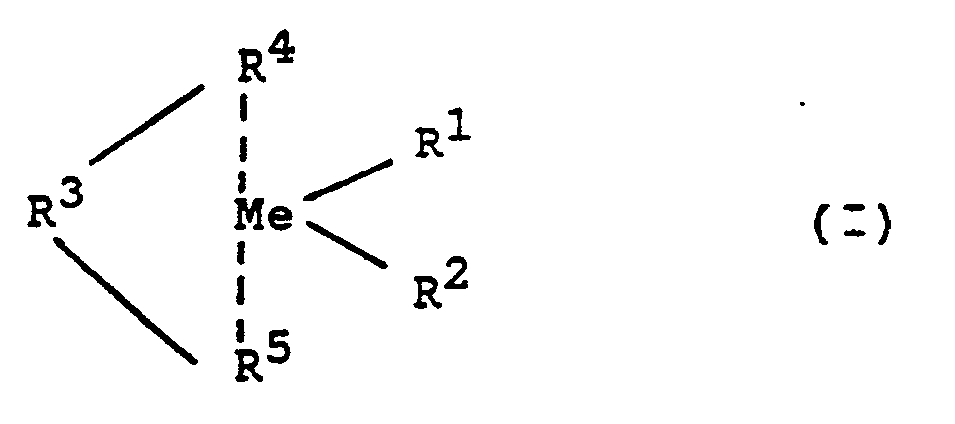
- Me ein Metall der Gruppe IV b oder V b des Periodensystems der Elemente, also Titan, Zirkon, Hafnium, Vanadium, Niob, Tantal, vorzugsweise Titan, Zirkon und Hafnium, insbesondere Zirkon und Hafnium.
- R' und R2 sind gleich oder verschieden und bedeuten eine Ci-Cio-, vorzugsweise C1-C3-Alkylgruppe, eine C6-Cio-, vorzugsweise C6-C6-Arylgruppe, eine C2-C10-, vorzugsweise C2-C4-Alkenylgruppe, eine C7-C40-, vorzugsweise C7-C10-Aralkylgruppe, eine C8-C40-, vorzugsweise C8-C12-Aralkenylgruppe oder ein Halogenatom, vorzugsweise Chlor.
- R3 ist ein linearer Ci-C4-, vorzugsweise C1-C3-Kohlenwasserstoffrest oder eine cyclischer C4-C6-Kohlenwasserstoffrest; diese Kohlenwasserstoffreste können mindestens ein Heteroatom als Brückeneinheit in der Kette enthalten. R3 kann auch aus einem oder bis zu vier Heteroatomen bestehen, deren weitere Valenzen durch Kohlenwasserstoffreste, Wasserstoff oder Halogenatome abgesättigt sind.
- Beispiele für eingliedrige Brückeneinheiten sind -CR2-,-O-, -S-, -SO-, -Se-, SeO-, -NR6-, -PR6-, -AsR6, -BR6-, -AIR6-, SiR-, -GeR
 -, SnR, wobei R6 ein Wasserstoffatom, eine C1-C10-, vorzugsweise C1-C4-Alkylgruppe, eine C6-Cio-, vorzugsweise C6-C8-Arylgruppe, eine C2-C10-, vorzugsweise C2-C4-Alkenylgruppe, eine C7-C40-, vorzugsweise C7-C10-Aralkylgruppe, eine C8-C40-, vorzugsweise C8-C12-Aralkenylgruppe oder ein Halogenatom, vorzugsweise Chlor oder Brom ist. Die Kohlenwasserstoffreste R6 können auch Heteroatom-substituiert sein. Bevorzugt sind -CR- und Silizium und Schwefel enthaltende Brückeneinheiten.
 - Beispiele für zweigliedrige Brückeneinheiten sind
- -(CR)2-, -SS-, -SeSe-, -SiR6 2 SiR6 2 - und -SiR6 2 CR6 2 -.
- Beispiele für mehrgliedrige Brückeneinheiten sind
- -(CR)3-, -(CR)4-, -SiROSiR, -SiR(CR)nSiR-, -SiR(CR>2 6<6)n-, -S(CR)nS-, -S(CR)n-, -NR6- (CR)nNR6-, -NR6(R)n-, -PR6 (CR)PR6-, -PR6(CR)n- mit n = 1 oder 2, -AIR6OAIR6-, wobei R6 die vorstehend genannte Bedeutung hat. Bevorzugt sind -(CR2)2- und Silizium und Schwefel enthaltende Brückeneineiten.
- R4 und R5 sind gleich oder verschieden, vorzugsweise gleich. Sie sind ein- oder mehrkernige Kohlenwasserstoffreste, welche zusammen mit dem Zentralatom eine Sandwichstruktur bilden können. Beispiele für derartige Reste sind die Indenyl-, Tetrahydroindenyl- oder Cyclopentadienylgruppe und Heteroaromatenliganden. Besonders bevorzugte Metallocene sind Bisindenyldimethylsilylzirkondichlorid, Ethylenbisindenylzirkondichlorid und Ethylenbisindenylhafniumdichlorid.
- Die optisch aktiven Metallocene werden als Racemat eingesetzt. Verwendet werden kann aber auch die reine D- oder L-Form. Mit diesen reinen stereoisomeren Formen ist optisch aktives Wachs herstellbar. Abgetrennt werden muß jedoch die meso-Form der Metallocene, da das polymerisationsaktive Zentrum (das Metallatom) in diesen Verbindungen wegen Spiegelsymmetrie am Zentralmetall nicht mehr chiral ist. Die Trennung der Stereoisomeren ist im Prinzip bekannt.
- Die vorstehend beschriebenen stereorigiden, chiralen Metallocene können nach folgendem Reaktionsschema hergestellt werden:


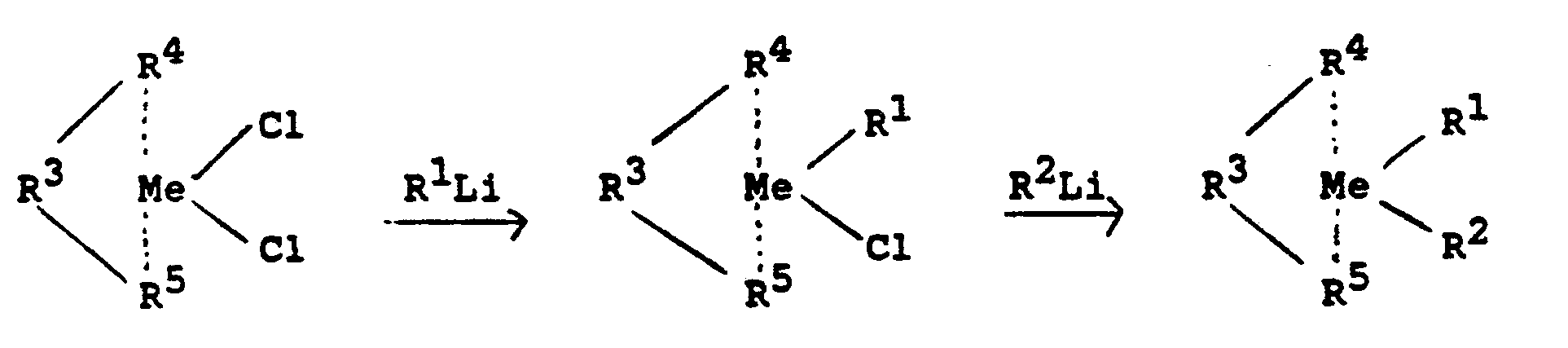
- Vor dem Einsatz in der Polymerisationsreaktion wird das Metallocen mit einem Aluminoxan voraktiviert. Dieses Aluminoxan ist eine Verbindung der Formel II


- Das Aluminoxan kann auf verschiedene Art und Weise hergestellt werden.
- Bei einem der Verfahren wird fein gepulvertes Kupfersulfatpentahydrat in Toluol aufgeschlämmt und in einem Glaskolben unter Inertgas bei etwa -20 C mit soviel Aluminiumtrialkyl versetzt, daß für je 4 AI-Atome etwa 1 mol CuSO4•5H2O zur Verfügung steht. Nach langsamer Hydrolyse unter Alkan-Abspaltung wird die Reaktionslösung 24 bis 48 Stunden bei Zimmertemperatur belassen, wobei gegebenenfalls gekühlt werden muß, damit die Temperatur nicht über 30° C ansteigt. Anschließend wird das im Toluol gelöste Aluminoxan von dem Kupfersulfat abfiltriert und das Toluol unter Vakuum abdestilliert. Es wird angenommen, daß bei diesem Herstellungsverfahren die niedermolekularen Aluminoxane unter Abspaltung von Aluminiumtrialkyl zu höheren Oligomeren kondensieren.
- Weiterhin erhält man Aluminoxane, wenn man bei einer Temperatur von -20 bis 100 C in einem inerten aliphatischen oder aromatischen Lösungsmittel, vorzugsweise Heptan oder Toluol, gelöstes Aluminiumtrialkyl, vorzugsweise Aluminiumtrimethyl, mit kristallwasserhaltigen Aluminiumsalzen, vorzugsweise Aluminiumsulfat, zur Reaktion bringt. Dabei beträgt das Volumenverhältnis zwischen Lösemittel und dem verwendeten Aluminiumalkyl 1 : 1 bis 50 : 1 - vorzugsweise 5 : 1 - und die Reaktionszeit, die durch Abspaltung des Alkans kontrolliert werden kann, 1 bis 200 Stunden - vorzugsweise 10 bis 40 Stunden.
- Von den kristallwasserhaltigen Aluminiumsalzen werden insbesondere jene verwendet, die einen hohen Gehalt an Kristallwasser aufweisen. Besonders bevorzugt ist Aluminiumsulfat-Hydrat, vor allem die Verbindungen Al2(SO4)3•18H2O und Al2(SO4)3•16H2O mit dem besonders hohen Kristallwassergehalt von 18 bzw. 16 mol H2O/mol Al2(SO4)3.
- Die Voraktivierung wird in Lösung vorgenommen. Bevorzugt wird dabei das Metallocen in einer Lösung des Aluminoxans in einem inerten Kohlenwasserstoff aufgelöst. Als inerte Kohlenwasserstoffe eignen sich aliphatische und aromatische Kohlenwasserstoffe.
- Bevorzugt wird Toluol verwendet.
- Die Konzentration des Aluminoxans in der Lösung liegt im Bereich von ca. 1 Gew.-% bis zur Sättigungsgrenze, vorzugsweise von 5 bis 30 Gew.-%, jeweils bezogen auf die Gesamtlösung. Das Metallocen kann in der gleichen Konzentration eingesetzt werden, vorzugsweise wird es jedoch in einer Menge von 10-4 bis 1 mol pro mol Aluminoxan eingesetzt. Die Voraktivierungszeit beträgt 5 Minuten bis 60 Minuten, vorzugsweise 10 bis 20 Minuten.
- Eine deutlich längere Voraktivierung ist möglich, sie wirkt sich normalerweise jedoch weder aktivitätssteigernd noch aktivitätshemmend aus und hat insbesondere auf die Molmasse des erzeugten Polyolefinwachses keinen Einfluß, kann jedoch zu Lagerzwecken durchaus sinnvoll sein.
- Die Voraktivierung wird bei einer Temperatur von -78 bis 100°C, vorzugsweise 0 bis 70 C durchgeführt.
- Die Voraktivierung kann sowohl unter Ausschluß von Licht, als auch bei Lichteinstrahlung erfolgen, da die in der Regel lichtempfindlichen Metallocene durch das Aluminoxan stabilisiert werden. Bevorzugt ist trotzdem, besonders bei längeren Voraktivierungszeiten und bei besonders empfindlichen heteroatomsubstituierten Metallocenen direkte Lichteinstrahlung auszuschließen.
- Die zweite Komponente des erfindungsgemäß zu verwendenden Katalysators ist ein Aluminoxan der Formel (II) und/oder (III). Vorzugsweise wird das gleiche Aluminoxan zur Voraktivierung und zur Polymerisation verwendet.
- Der erfindungsgemäß zu verwendende Katalysator wird zur Polymerisation von 1-Olefinen der Formel R-CH = CHz, in der R einen Alkylrest mit 1 bis 28 C-Atomen, vorzugsweise 1 bis 10 C-Atomen, insbesondere einem C-Atom bedeutet, eingesetzt, beispielsweise Propylen, Buten-(1), Hexen-(1), 4-Methylpenten-(1), Octen-(1). Besonders bevorzugt ist Propylen. Ferner wird der Katalysator auch zur Copolymerisation dieser Olefine untereinander und mit Ethylen eingesetzt, wobei mehr als 50 Gew.-% Ethylen einpolymerisiert werden können.
- Die Polymerisation wird in bekannter Weise in flüssigem Monomeren, in Lösung, in Suspension oder in der Gasphase, kontinuierlich oder diskontinuierlich, ein- oder mehrstufig bei einer Temperatur von -50 bis 200° C, vorzugsweise -20 bis 120, insbesondere -20 bis 80° C, durchgeführt.
- Das erfindungsgemäß zu verwendende Katalysatorsystem weist eine unerwartet hohe Empfindlichkeit gegenüber Wasserstoff auf.
- Als Molmassenregulator wird Wasserstoff zugegeben. Der Wasserstoffpartialdruck liegt dabei zwischen 0,05 und 50 bar, vorzugsweise 0,1 bis 25 bar, insbesondere 0,2 bis 10 bar. Das Molverhältnis 1-Olefin zu Wasserstoff beträgt 3 bis 3000, vorzugsweise 6 bis 1500, insbesondere 15 bis 300.
- Der Gesamtdruck im Polymerisationssystem beträgt somit 0,5 bis 120 bar. Bevorzugt ist die Polymerisation in dem technisch besonders interessanten Druckbereich von 5 bis 100 bar.
- Die Metallocenverbindung wird in einer Konzentration, bezogen auf das Übergangsmetall, von 10-3 bis 10-7, vorzugsweise 10-4 bis 10-6 mol Übergangsmetall pro dm3 Lösemittel bzw. pro dm3 Reaktorvolumen angewendet. Das Aluminoxan wird in einer Konzentration von 10-4 bis 10-1 mol, vorzugsweise 10-3 bis 2•10-2 mol pro dm3 Lösemittel bzw. pro dm3 Reaktorvolumen verwendet. Prinzipiell sind aber auch höhere Konzentrationen möglich. Es ist vorteilhaft, das Aluminoxan vor Zugabe des Metallocens in das Polymerisationssystem erste einige Minuten zusammen mit der Polymerisationsflüssigphase zu rühren. Die Rührzeit beträgt vorzugsweise 10 bis 30 Minuten. Es kann jedoch ohne größere Einbußen auch kürzere Zeit gerührt werden. Eine längere Rührzeit hat auf das Ergebnis der Polymerisation keine nennenswerte Wirkung.
- Die Polymerisation wird in einem für das Ziegler-Niederdruckverfahren gebräuchlichen inerten Lösemittel durchgeführt, beispielsweise in einem aliphatischen oder cycloaliphatischen Kohlenwasserstoff; als solcher sei beispielsweise Butan, Pentan, Hexan, Heptan, Isooctan, Cyclohexan, Methylcyclohexan genannt. Weiterhin kann eine Benzin- bzw. hydrierte Dieselölfraktion, die sorgfältig von Sauerstoff, Schwefelverbindungen und Feuchtigkeit befreit worden ist, benutzt werden. Brauchbar ist auch Toluol. Bevorzugt wird das zu polymerisierende Monomere als Lösemittel oder Suspensionsmittel eingesetzt.
- Die Dauer der Polymerisation ist beliebig, da das erfindungsgemäß zu verwendende Katalysatorsystem einen nur geringen zeitabhängigen Abfall der Polymerisationsaktivität zeigt. Im erfindungsgemäßen Verfahren führt die Verwendung von Wasserstoff als Molmassenregulator zu einer drastischen Erhöhung der Katalysatoraktivität. Gleichzeitig kann die Molmasse im gewünschten Bereich exakt gesteuert werden. Die gebildeten Polymeren sind von hoher chemischer Einheitlichkeit, die Molmassenverteilung Mw/Mn ist dabei mit Werten zwischen 1,8 und 4,0 extrem eng. Dies führt zu scharfen Schmelzpunkten und Erstarrungspunkten. Die erfindungsgemäße Verwendung von Wasserstoff führt gleichzeitig zu einer deutlichen Erniedrigung des Restaschegehalts. Es kann mit dem erfindungsgemäßen Verfahren ferner ein Polyolefinwachs hergestellt werden, das hochisotaktisch und hochkristallin ist und sich somit durch eine besondere Härte auszeichnet. Generell sind die Kettenenden aus gesättigten Kohlenwasserstoffgruppen aufgebaut. Mit dem erfindungsgemäßen Verfahren können farblos transparente Wachse hergestellt werden, die aus kompakten kugelförmigen Teilchen mit einer engen Korngrößenverteilung und einer hohen Schüttdichte bestehen. Das Wachspulver zeichnet sich durch eine sehr gute Rieselfähigkeit aus und läßt sich somit optimal handhaben. Das erfindungsgemäße Polyolefinwachs stellt somit eine neue Werkstoffklasse dar. Es hat eine Molmasse von 1000 bis 25000, vorzugsweise 2000 bis 10000, eine Molmassenverteilung Mw/Mn von 1,8 bis 4,0 vorzugsweise 1,8 bis 3,0, eine Viskositätszahl von 2 bis 60 cm3/g, einen Schmelzbereich von 120 bis 160, vorzugsweise 125 bis 155°C, eine Schmelzenthalpie AH größer 80, vorzugsweise größer 100 J/g, einen Tropfpunktsbereich von 120 bis 160°C und eine Schmelzviskosität von 100 bis 20000, vorzugsweise 100 bis 10000 mPa's bei 170° C.
- Die nachfolgenden Beispiele sollen die Erfindung erläutern. Es bedeuten




- Ein trockener 16-dm3-Kessel wurde mit Stickstoff gespült und mit 80 Ndm3 (entspr. 5 bar) Wasserstoff sowie mit 10 dm3 flüssigem Propylen befüllt. Dann wurden 70 cm3 toluolische Methylaluminoxanlösung (entsprechend 68 mmol Al, mittlerer Oligomerisierungsgrad des Methylaluminoxans n = 30) zugegeben und der Ansatz bei 30° C 15 Minuten gerührt.
- Parallel dazu wurden 9 mg (0,02 mmol) Bisindenyldimethylsilylzirkondichlorid in 35 cm3 toluolischer Methylaluminoxanlösung (34 mmol Al) gelöst und durch 15-minütiges Stehenlassen voraktiviert. Die orangerote Lösung wurde dann in den Kessel gegeben. Das Polymerisationssystem wurde auf eine Temperatur von 70° C gebracht und dann durch entsprechende Kühlung 30 Minuten bei dieser Temperatur gehalten.
- Es wurden 2,88 kg Polypropylenwachs erhalten. Die Aktivität des Metallocens betrug somit 286,7 kg PP-Wachs/mmol Zr x h oder 640 kg PP-Wachs/g Metallocen x h.
- VZ = 22,4 cm3/g; Mw = 6660, Mn = 2870, Mw/Mn = 2,3;
- SD = 536 g/dm3; II = 97,1 %;
keine ungesättigten Kettenenden (bestimmt nach '3C-NMR); Tropfpunkt = 143° C; SV = 142 mPa. S. DSC-Messung (20°C/min Aufheizung/Abkühlung): Schmp. 142 C, Schmelzenthalpie AH = 101,4 J/g, Rekristallisationspunkt: 100° C; Halbwertsbreiten Schmelzpeak = 8°C, Rekristallisationspeak = 7°C. - Es wurde analog zu Beispiel 1 verfahren, jedoch statt 80 Ndm3 (entsp. 5 bar) Wasserstoff wurden 40 Ndm3 (entsprechend 2,5 bar) Wasserstoff in den Kessel gegeben.
- Es wurden 2,44 kg Polypropylenwachs erhalten. Die Aktivität des Metallocens betrug somit 242,9 kg PP-Wachs/mmol Zr x h oder 542 kg PP-Wachs/g Metallocen x h.
- VZ = 24,3 cm3/g; Mw = 8300, Mn = 3230, Mw/Mn = 2,6;
- SD = 470 g/dm3; II = 97,4 %;
keine ungesättigten Kettenenden; Tropfpunkt = 144°C; SV = 239 mPa. s; DSC-Messung (20°C/min Aufheizung/Abkühlung): Schmp. 143°C, Schemelzenthalphie ΔH = 104,2 J/g, Rekristallisationspunkt: 98° C; Halbwertsbreiten Schmelzpeak = 8°C, Rekristallisationspeak = 6°C. - Es wurde analog zu Beispiel 1 verfahren, jedoch statt 80 Ndm3 (entsp. 5 bar) Wasserstoff wurden 16 Ndm3 (entsprechend 1 bar) Wasserstoff in den Kessel gegeben.
- Es wurden 2,35 kg Polypropylenwachs erhalten. Die Aktivität des Metallocens betrug somit 2434 kg PP-Wachs/mmol Zr x h oder 522 kg PP-Wachs/g Metallocen x h.
- VZ = 31,9 cm3/g; Mw = 10900, Mn = 3700, Mw/Mn = 2,9;
- SD = 498 g/dm3; II = 97,9 %;
keine ungesättigten Kettenenden; Tropfpunkt = 143°C, SV = 760 mPa. S; DSC-Messung (20°C/min Aufheizung/Abkühlung): Schmp. 142°C, Schemelzenthalphie ΔH = 100,5 J/g, Rekristallisationspunkt: 100° C; Halbwertsbreiten Schmelzpeak = 7°C, Rekristallisationspeak = 7°C. - Es wurde analog zu Beispiel 1 verfahren, jedoch statt 80 Ndm3 (entsp. 5 bar) Wasserstoff wurden 8 Ndm3 (entsprechend 0,25 bar) Wasserstoff in den Kessel gegeben.
- Es wurden 2,10 kg Polypropylenwachs erhalten. Die Aktivität des Metallocens betrug somit 209,0 kg PP-Wachs/mmol Zr x h oder 467 kg PP-Wachs/g Metallocen x h.
- VZ = 34,5 cm3/g; Mw = 13700, Mn = 4540, Mw/Mn = 3,0;
- SD = 473 g/dm3; II = 97,0 %;
keine ungesättigten Kettenenden; Tropfpunkt = 144° C; SV = 1307 mPa. s; DSC-Messung (20°C/min Aufheizung/Abkühlung): Schmp. 141°C, Schemelzenthalphie ΔH = 106,7 J/g, Rekristallisationspunkt: 97,5 C; Halbwertsbreiten Schmelzpeak = 6,5 C, Rekristallisationspeak = 6°C. - Es wurde analog zu Beispiel 1 verfahren, jedoch statt 80 Ndm3 (entsp. 5 bar) Wasserstoff wurde kein Wasserstoff in den Kessel gegeben.
- Es wurden 1,62 kg Polypropylen erhalten. Die Aktivität des Metallocens betrug somit 161,2 kg PP/mmol Zr x h oder 360 kg PP/g Metallocen x h.
- VZ = 49,1 cm3/g; Mw = 42000, Mn = 16800, Mw/Mn = 2,5;
- SD = 492 g/dm3; ll = 97,0 %;
pro Polypropylenkette ein ungesättigtes Kettenende (bestimmt nach 13C-NMR). - Es wurde analog zu Beispiel 1 verfahren, jedoch statt 80 Ndm3 (entsp. 5 bar) Wasserstoff wurden 40 Ndm3 (entsprechend 2,5 bar) Wasserstoff in den Kessel gegeben.
- Ferner wurden statt 9 mg (0,02 mmol) Bisindenyldimethylsilylzirkondichlorid 8,4 mg (0,02 mmol) Ethylenbisindenylzirkondichlorid verwendet.
- Es wurden 2,59 kg Polypropylenwachs erhalten. Die Aktivität des Metallocens betrug somit 259,0 kg PP-Wachs/mmol Zr x h oder 617 kg PP-Wachs/g Metallocen x h.
- VZ = 12,8 cm3/g; Mw = 6170, Mn = 2810, Mw/Mn = 2,2;
- SD = 447 g/dm3; II = 96,4 %;
keine ungesättigten Kettenenden; Tropfpunkt = 142°C; SV = 133 mPa·s; - DSC-Messung (20°C/min Aufheizung/Abkühlung): Schmp. 137° C, Schemelzenthalphie ΔH = 105,8 J/g, Rekristallisationspunkt: 97° C; Halbwertsbreiten Schmelzpeak = 8°C, Rekristallisationspeak = 6°C.
- Beispiel 5 wurde wiederholt, es wurde jedoch kein Wasserstoff verwendet.
- Es wurden 1,98 kg Polypropylen erhalten. Die Aktivität des Metallocens betrug somit 198 kg PP/mmol Zr x h oder 471 kg PP/g Metallocen x h.
- VZ = 35 cm3/g; Mw = 25500, Mn = 11200, Mw/Mn = 2,3;
- SD = 485 g/dm3; II = 97,1 %;
pro Polypropylenkette ein ungesättigtes Kettenende. - Ein trockener 16-dm3-Kessel wurde mit Stickstoff gespült und mit 40 Ndm3 (entsprechend 2,5 bar) Wasserstoff sowie mit 10 dm3 flüssigem Propylen befüllt. Dann wurden 70 cm3 toluolische Methylaluminoxanlösung (entsprechend 68 mmol Al, mittlerer Oligomerisierungsgrad n = 30) zugegeben und der Ansatz bei 30° C 15 Minuten gerührt.
- Parallel dazu wurden 24 mg (0,047 mmol) Ethylenbisindenylhafniumdichlorid in 35 cm3 toluolischer Methylaluminoxanlösung (34 mmol AI) gelöst und durch 15-minütiges Stehenlassen voraktiviert. Die gelbe Lösung wurde dann in den Kessel gegeben. Das Polymerisationssystem wurde auf eine Temperatur von 60° C gebracht und dann durch entsprechende Kühlung 5 h bei dieser Temperatur gehalten.
- Es wurden 3,05 kg Polypropylenwachs erhalten. Die Aktivität des Metallocens betrug somit 12,9 kg PP-Wachs/mmol Hf x h oder 25,4 kg PP-Wachs/g Metallocen x h.
- VZ = 13,4 cm3/g; Mw = 6340, Mn = 2680, Mw/Mn = 2,4;
- SD = 425 g/dm3; II = 98,1 %;
keine ungesättigten Kettenenden; Tropfpunkt = 139° C; SV = 193 mPa.s; DSC-Messung (20°C/min Aufheizung/Abkühlung): Schmp. 137° C, Schemelzenthalphie ΔH = 97,5 J/g, Rekristallisationspunkt: 97° C; Halbwertsbreiten Schmelzpeak = 9°C, Rekristallisationspeak = 7°C. - Beispiel 6 wurde wiederholt, es wurde jedoch kein Wasserstoff verwendet.
- Es wurden 2,03 kg Polypropylen erhalten. Die Aktivität des Metallocens betrug somit 8,5 kg PP/mmol Hf x h oder 16,9 kg PP/g Metallocen x h.
- VZ = 95,0 cm3/g; Mw = 102100, Mn = 50650, Mw/Mn = 2,0;
- SD = 410 g/dm3; II = 97,7 %;
pro Polypropylenkette ein ungesättigtes Kettenende. - Ein trockener 16-dm3-Kessel wurde mit Stickstoff gespült und mit 10 dm3 flüssigem Propylen befüllt. Dazu wurden 50 mmol Aluminiumtrimethyl in 50 cm3 Toluol und 70 cm3 toluolische Methylaluminoxanlösung (entsprechend 68 mmol Al, mittlerer Oligomerisierungsgrad n = 30) zugegeben und der Ansatz bei 30 C 15 Minuten gerührt.
- Das weitere Vorgehen war wie in Beispiel 1. Es wurden 2,75 kg Polypropylen erhalten. Die Aktivität des Metallocens betrug somit 273,8 kg PP/mmol Zr x h oder 611 kg PP/g Metallocen x h. VZ = 34,9 cm3/g; Mw = 24350, Mn = 8700, Mw/Mn = 2,8.
- Der Versuch zeigt, daß mit AlMe3 die Molmasse zwar in gewisser Weise absenkbar ist, das Niveau der H2-Versuche jedoch nicht erreicht wird. Gleichzeitig steigt jedoch der Restaschegehalt an.
- Vergleichsversuch D wurde wiederholt, statt 50 mmol Aluminiumtrimethyl wurden 50 mmol Al-triethyl verwendet und die Polymerisationsdauer wurde auf 2 h verlängert.
- Polypropylen war nur in Spuren gebildet worden. Im überwiegenden Maße handelte es sich bei dem isolierten Feststoff um Zersetzungsprodukte des Aluminoxans, bzw. AI-triethyls.
- Vergleichsversuch D wurde wiederholt, statt 50 mmol Al(CH3)3 wurden 50 mmol Zn(C2H5)2 verwendet und die Polymerisationsdauer auf 2 h verlängert.
- Es wurden 0,21 kg Polypropylen erhalten. Die Aktivität des Metallocens betrug somit 5,2 kg PP/mmol Zr x h oder 11,7 kg PP/g Metallocen x h.
- VZ = 27,9 cm3/g; MW = 14900, Mn = 5750, Mw/Mn = 2,6.
- Bedingt durch den hohen Restaschegehalt (ca. 4,8 Gew.-%) war die Herstellung einer klaren, farblosen Schmelze aus diesem Produkte nicht möglich, das Produkt war somit für eine Wachsanwendung ungeeignet.
Claims (2)


Applications Claiming Priority (2)
| Application Number | Priority Date | Filing Date | Title |
|---|---|---|---|
| DE3743321 | 1987-12-21 | ||
| DE19873743321 DE3743321A1 (de) | 1987-12-21 | 1987-12-21 | 1-olefinpolymerwachs und verfahren zu seiner herstellung |
Publications (2)
| Publication Number | Publication Date |
|---|---|
| EP0321852A1 EP0321852A1 (de) | 1989-06-28 |
| EP0321852B1 true EP0321852B1 (de) | 1991-12-18 |
Family
ID=6343134
Family Applications (1)
| Application Number | Title | Priority Date | Filing Date |
|---|---|---|---|
| EP88120951A Expired - Lifetime EP0321852B1 (de) | 1987-12-21 | 1988-12-15 | 1-Olefinpolymerwachs und Verfahren zu seiner Herstellung |
Country Status (8)
| Country | Link |
|---|---|
| US (1) | US4962262A (de) |
| EP (1) | EP0321852B1 (de) |
| JP (1) | JP3058419B2 (de) |
| AU (1) | AU617394B2 (de) |
| CA (1) | CA1315468C (de) |
| DE (2) | DE3743321A1 (de) |
| ES (1) | ES2040824T3 (de) |
| ZA (1) | ZA889476B (de) |
Cited By (23)
| Publication number | Priority date | Publication date | Assignee | Title |
|---|---|---|---|---|
| US7351871B2 (en) | 2001-10-20 | 2008-04-01 | Cognis Deutschland Gmbh & Co. Kg | Processes for producing poly-alpha-olefins, and poly-alpha-olefins produced thereby |
| US7989670B2 (en) | 2005-07-19 | 2011-08-02 | Exxonmobil Chemical Patents Inc. | Process to produce high viscosity fluids |
| US8071835B2 (en) | 2006-07-19 | 2011-12-06 | Exxonmobil Chemical Patents Inc. | Process to produce polyolefins using metallocene catalysts |
| US8207390B2 (en) | 2005-07-19 | 2012-06-26 | Exxonmobil Chemical Patents Inc. | Process to produce low viscosity poly-alpha-olefins |
| US8247358B2 (en) | 2008-10-03 | 2012-08-21 | Exxonmobil Research And Engineering Company | HVI-PAO bi-modal lubricant compositions |
| US8299007B2 (en) | 2006-06-06 | 2012-10-30 | Exxonmobil Research And Engineering Company | Base stock lubricant blends |
| US8394746B2 (en) | 2008-08-22 | 2013-03-12 | Exxonmobil Research And Engineering Company | Low sulfur and low metal additive formulations for high performance industrial oils |
| US8501675B2 (en) | 2006-06-06 | 2013-08-06 | Exxonmobil Research And Engineering Company | High viscosity novel base stock lubricant viscosity blends |
| US8513478B2 (en) | 2007-08-01 | 2013-08-20 | Exxonmobil Chemical Patents Inc. | Process to produce polyalphaolefins |
| US8530712B2 (en) | 2009-12-24 | 2013-09-10 | Exxonmobil Chemical Patents Inc. | Process for producing novel synthetic basestocks |
| US8535514B2 (en) | 2006-06-06 | 2013-09-17 | Exxonmobil Research And Engineering Company | High viscosity metallocene catalyst PAO novel base stock lubricant blends |
| US8598103B2 (en) | 2010-02-01 | 2013-12-03 | Exxonmobil Research And Engineering Company | Method for improving the fuel efficiency of engine oil compositions for large low, medium and high speed engines by reducing the traction coefficient |
| US8642523B2 (en) | 2010-02-01 | 2014-02-04 | Exxonmobil Research And Engineering Company | Method for improving the fuel efficiency of engine oil compositions for large low and medium speed engines by reducing the traction coefficient |
| US8716201B2 (en) | 2009-10-02 | 2014-05-06 | Exxonmobil Research And Engineering Company | Alkylated naphtylene base stock lubricant formulations |
| US8728999B2 (en) | 2010-02-01 | 2014-05-20 | Exxonmobil Research And Engineering Company | Method for improving the fuel efficiency of engine oil compositions for large low and medium speed engines by reducing the traction coefficient |
| US8748362B2 (en) | 2010-02-01 | 2014-06-10 | Exxonmobile Research And Engineering Company | Method for improving the fuel efficiency of engine oil compositions for large low and medium speed gas engines by reducing the traction coefficient |
| US8759267B2 (en) | 2010-02-01 | 2014-06-24 | Exxonmobil Research And Engineering Company | Method for improving the fuel efficiency of engine oil compositions for large low and medium speed engines by reducing the traction coefficient |
| US8834705B2 (en) | 2006-06-06 | 2014-09-16 | Exxonmobil Research And Engineering Company | Gear oil compositions |
| US8865959B2 (en) | 2008-03-18 | 2014-10-21 | Exxonmobil Chemical Patents Inc. | Process for synthetic lubricant production |
| US8921291B2 (en) | 2005-07-19 | 2014-12-30 | Exxonmobil Chemical Patents Inc. | Lubricants from mixed alpha-olefin feeds |
| US8921290B2 (en) | 2006-06-06 | 2014-12-30 | Exxonmobil Research And Engineering Company | Gear oil compositions |
| US9365663B2 (en) | 2008-03-31 | 2016-06-14 | Exxonmobil Chemical Patents Inc. | Production of shear-stable high viscosity PAO |
| US9469704B2 (en) | 2008-01-31 | 2016-10-18 | Exxonmobil Chemical Patents Inc. | Utilization of linear alpha olefins in the production of metallocene catalyzed poly-alpha olefins |
Families Citing this family (100)
| Publication number | Priority date | Publication date | Assignee | Title |
|---|---|---|---|---|
| DE3743320A1 (de) * | 1987-12-21 | 1989-06-29 | Hoechst Ag | 1-olefinstereoblockpolymerwachs und verfahren zu seiner herstellung |
| DE3844282A1 (de) * | 1988-12-30 | 1990-07-05 | Hoechst Ag | Bisindenyl-derivat und verfahren zu seiner herstellung |
| DE3904468A1 (de) * | 1989-02-15 | 1990-08-16 | Hoechst Ag | Polypropylenwachs und verfahren zu seiner herstellung |
| DE3916555A1 (de) * | 1989-05-20 | 1990-11-22 | Hoechst Ag | Verfahren zur herstellung von ethylenpolymeren |
| DE3929693A1 (de) * | 1989-09-07 | 1991-03-14 | Hoechst Ag | Verfahren zur herstellung eines polyolefinwachses |
| JP2936172B2 (ja) * | 1990-03-07 | 1999-08-23 | 東ソー株式会社 | シンジオタクチック芳香族ビニル化合物重合体製造用触媒およびシンジオタクチック芳香族ビニル化合物重合体の製造方法 |
| US5030791A (en) * | 1990-05-21 | 1991-07-09 | Texaco Chemical Company | Process for co-oligomerizing 1,3-di-isopropenyl benzene and alpha-olefins to prepare synthetic lubricant base stocks having improved properties |
| DE69130403T2 (de) * | 1990-04-18 | 1999-04-15 | Mitsui Chemicals, Inc., Tokio/Tokyo | Syndiotaktisches Propylencopolymer, Herstellung davon und dieses Copolymer enthaltende Zusammensetzung |
| US5171904A (en) * | 1990-05-31 | 1992-12-15 | Texaco Chemical Company | Synthetic lubricant base stocks having an improved pour point |
| US5169550A (en) * | 1990-06-06 | 1992-12-08 | Texaco Chemical Company | Synthetic lubricant base stocks having an improved viscosity |
| US5202040A (en) * | 1990-06-12 | 1993-04-13 | Texaco Chemical Company | Synthetic lubricant base stocks by co-reaction of olefins and anisole compounds |
| USH1407H (en) | 1990-09-10 | 1995-01-03 | Texaco Chemical Company | Synthetic lubricant base stocks by co-reaction of vinylcyclohexene and long-chain olefins |
| DE4030379A1 (de) * | 1990-09-26 | 1992-04-02 | Basf Ag | Polymerwachse des propylens mit hoher haerte und kristallinitaet |
| US5180866A (en) * | 1991-03-28 | 1993-01-19 | Texaco Chemical Company | Process for preparing synthetic lubricant base stocks having improved viscosity from vinylcyclohexene and long-chain olefins |
| US5180869A (en) * | 1991-05-14 | 1993-01-19 | Texaco Chemical Company | Process for co-reacting poly(isobutylene) and linear olefins to prepare synthetic lubricant base stocks having improved properties |
| US5146030A (en) * | 1991-07-22 | 1992-09-08 | Texaco Chemical Company | Process for oligomerizing olefins using halogen-free titanium salts or halogen-free zirconium salts on clays |
| US5191139A (en) * | 1991-11-04 | 1993-03-02 | Texaco Chemical Company | Process for oligomerizing olefins using sulfate-activated group IV oxides |
| TW304963B (de) * | 1992-01-27 | 1997-05-11 | Hoechst Ag | |
| US5807949A (en) * | 1992-03-19 | 1998-09-15 | Exxon Chemical Patents Inc. | Polymers and additive compositions |
| GB9205996D0 (en) * | 1992-03-19 | 1992-04-29 | Exxon Chemical Patents Inc | Polymers and additive compositions |
| TW285680B (de) * | 1992-03-31 | 1996-09-11 | Hoechst Ag | |
| EP0563834B1 (de) * | 1992-04-01 | 1995-10-11 | MITSUI TOATSU CHEMICALS, Inc. | Syndiotaktischen Polypropylen, Wachs, Verfahren zur Herstellung derselbe und ihre Anwendung in eine Wärmefixiertonerzusammensetzung für geheizte Walze |
| EP0571882B1 (de) * | 1992-05-26 | 1997-03-12 | Hoechst Aktiengesellschaft | Verfahren zur Herstellung von Polyolefinwachsen |
| EP0586777B1 (de) * | 1992-08-31 | 1999-04-28 | Fina Research S.A. | Verfahren zur Herstellung von flüssigen statistischen Copolymerisaten des Typs Ethylen |
| US5750813A (en) * | 1992-12-15 | 1998-05-12 | Clarian & Gmbh | Process for the preparation of polyolefin waxes |
| TW322495B (de) * | 1992-12-15 | 1997-12-11 | Hoechst Ag | |
| US5332706A (en) * | 1992-12-28 | 1994-07-26 | Mobil Oil Corporation | Process and a catalyst for preventing reactor fouling |
| US5608019A (en) * | 1992-12-28 | 1997-03-04 | Mobil Oil Corporation | Temperature control of MW in olefin polymerization using supported metallocene catalyst |
| US5602067A (en) * | 1992-12-28 | 1997-02-11 | Mobil Oil Corporation | Process and a catalyst for preventing reactor fouling |
| US5420220A (en) * | 1993-03-25 | 1995-05-30 | Mobil Oil Corporation | LLDPE films |
| US5455741A (en) * | 1993-10-26 | 1995-10-03 | Pulse Engineering, Inc. | Wire-lead through hole interconnect device |
| US5614456A (en) * | 1993-11-15 | 1997-03-25 | Mobil Oil Corporation | Catalyst for bimodal molecular weight distribution ethylene polymers and copolymers |
| US6184328B1 (en) | 1994-09-07 | 2001-02-06 | Showa Denko Kabushiki Kaisha | Propylene-based polymer, method for its production, composition thereof, catalyst component for polymerization, and method for its production |
| EP0821012B1 (de) * | 1994-05-12 | 1999-01-13 | Showa Denko Kabushiki Kaisha | Polymer auf Propylenbasis, Verfahren zu seiner Herstellung und Zusammensetzungen davon |
| CN1100069C (zh) * | 1994-05-12 | 2003-01-29 | 昭和电工株式会社 | 丙烯系聚合物及其制法 |
| US5622906A (en) * | 1994-09-16 | 1997-04-22 | Phillips Petroleum Company | Compositions useful for olefin polymerization and processes therefor and therewith |
| US5525678A (en) * | 1994-09-22 | 1996-06-11 | Mobil Oil Corporation | Process for controlling the MWD of a broad/bimodal resin produced in a single reactor |
| DE4446923A1 (de) * | 1994-12-28 | 1996-07-04 | Hoechst Ag | Polyolefinwachs |
| FR2729393B1 (fr) * | 1995-01-18 | 1997-03-21 | Bp Chemicals Snc | Procede de polymerisation d'olefine |
| JPH08325327A (ja) * | 1995-06-02 | 1996-12-10 | Chisso Corp | 高立体規則性ポリプロピレン |
| US5882750A (en) * | 1995-07-03 | 1999-03-16 | Mobil Oil Corporation | Single reactor bimodal HMW-HDPE film resin with improved bubble stability |
| US6486089B1 (en) | 1995-11-09 | 2002-11-26 | Exxonmobil Oil Corporation | Bimetallic catalyst for ethylene polymerization reactions with uniform component distribution |
| ID16442A (id) * | 1996-01-22 | 1997-10-02 | Dow Chemical Co | Polimer etilena berat molekul ultra rendah |
| DE19608814A1 (de) | 1996-03-07 | 1997-10-02 | Hoechst Ag | Verfahren zur Herstellung von Indenen |
| US6417130B1 (en) | 1996-03-25 | 2002-07-09 | Exxonmobil Oil Corporation | One pot preparation of bimetallic catalysts for ethylene 1-olefin copolymerization |
| CA2259999A1 (en) * | 1996-07-15 | 1998-01-22 | Mobil Oil Corporation | Comonomer pretreated bimetallic catalyst for blow molding and film applications |
| DE19648895A1 (de) * | 1996-11-26 | 1998-05-28 | Clariant Gmbh | Polar modifizierte Polypropylen-Wachse |
| US6005463A (en) * | 1997-01-30 | 1999-12-21 | Pulse Engineering | Through-hole interconnect device with isolated wire-leads and component barriers |
| GB9712663D0 (en) | 1997-06-16 | 1997-08-20 | Borealis As | Process |
| DE19729833A1 (de) * | 1997-07-11 | 1999-01-14 | Clariant Gmbh | Polypropylenwachs |
| ES2209008T3 (es) | 1997-07-11 | 2004-06-16 | Clariant Gmbh | Procedimiento para la oxidacion de ceras polietilenicas. |
| US6051525A (en) * | 1997-07-14 | 2000-04-18 | Mobil Corporation | Catalyst for the manufacture of polyethylene with a broad or bimodal molecular weight distribution |
| US6153551A (en) | 1997-07-14 | 2000-11-28 | Mobil Oil Corporation | Preparation of supported catalyst using trialkylaluminum-metallocene contact products |
| DE19750663A1 (de) * | 1997-11-15 | 1999-05-20 | Clariant Gmbh | Verwendung von Polyolefinwachsen in Lösemittelpasten |
| BR0208785A (pt) * | 2001-04-13 | 2004-06-22 | Pirelli | Pneu para rodas de veìculo, banda de rodagem para os pneus de rodas de veìculo, composição elastomérica, e, produto fabricado elastomérico reticulado |
| JP2004523644A (ja) * | 2001-04-13 | 2004-08-05 | ピレリ・プネウマティチ・ソチエタ・ペル・アツィオーニ | 架橋性エラストマー組成物を調製するための細分割形態の生成物 |
| US20040192816A1 (en) * | 2001-04-13 | 2004-09-30 | Maurizio Galimberti | Product in subdivided form for preparing crosslinkable elastomeric compositions |
| BR0208762B1 (pt) * | 2001-04-13 | 2012-10-30 | pneu para rodas de veìculo, banda de rodagem de pneu para rodas de veìculo, composição elastomérica, e, produto manufaturado elastomérico reticulado. | |
| WO2003009989A1 (en) | 2001-07-25 | 2003-02-06 | Pirelli Pneumatici S.P.A. | Process and apparatus for continuously producing an elastomeric composition |
| US20050085582A1 (en) * | 2001-10-30 | 2005-04-21 | Maurizio Galimberti | Tyre with low rolling resistance, tread band and elastomeric composition used therein |
| KR20050035183A (ko) | 2001-11-30 | 2005-04-15 | 엑손모빌 케미칼 패턴츠 인코포레이티드 | 비-단일 부위/단일 부위 촉매 복합물을 이용하여 제조된에틸렌/알파-올레핀 공중합체, 이의 제조 방법 및 용도 |
| US7964128B2 (en) | 2001-12-19 | 2011-06-21 | Pirelli Pneumatici S.P.A. | Process and apparatus for continuously producing an elastomeric composition |
| BR0210762A (pt) * | 2002-04-29 | 2004-07-20 | Pirelli & C Spa | Cabo, composição, e, método para manter a capacidade de isolamento em um cabo sob condições de fogo |
| CN100389949C (zh) | 2002-07-11 | 2008-05-28 | 倍耐力轮胎公司 | 用于连续生产弹性体组合物的方法和装置 |
| CN1681858A (zh) * | 2002-09-20 | 2005-10-12 | 埃克森美孚化学专利公司 | 超临界聚合方法和由其生产的聚合物 |
| US8008412B2 (en) | 2002-09-20 | 2011-08-30 | Exxonmobil Chemical Patents Inc. | Polymer production at supersolution conditions |
| DE10347046A1 (de) * | 2003-10-07 | 2005-05-04 | Sasol Wax Gmbh | Verfahren zur Herstellung von mikrokristallinen Paraffinen |
| DE502005002132D1 (de) * | 2004-05-13 | 2008-01-17 | Clariant Produkte Deutschland | Expandierbares Polystyrol |
| CN101124235B (zh) * | 2004-07-08 | 2010-12-15 | 埃克森美孚化学专利公司 | 烯烃聚合催化剂体系及其使用方法 |
| DE102004035837A1 (de) | 2004-07-23 | 2006-02-16 | Clariant Gmbh | Verwendung von Polyolefinwachsen in Polykondensaten |
| DE102004056875A1 (de) * | 2004-11-25 | 2006-06-01 | Clariant Gmbh | Verwendung von polar modifizierten Polyolefinwachsen zur Verbesserung der Haftung von Dichtstoffen auf Pulverlacken |
| DE102006033148A1 (de) * | 2006-07-18 | 2008-01-24 | Clariant International Limited | Formstabile Klebemasse und ihre Verwendung für Klebestifte |
| DE102006049089A1 (de) | 2006-10-18 | 2008-04-30 | Clariant International Limited | Heißschmelzklebemasse |
| US8143352B2 (en) * | 2006-12-20 | 2012-03-27 | Exxonmobil Research And Engineering Company | Process for fluid phase in-line blending of polymers |
| US8242237B2 (en) * | 2006-12-20 | 2012-08-14 | Exxonmobil Chemical Patents Inc. | Phase separator and monomer recycle for supercritical polymerization process |
| US8080610B2 (en) | 2007-03-06 | 2011-12-20 | Exxonmobil Research And Engineering Company | Monomer recycle process for fluid phase in-line blending of polymers |
| WO2008150572A1 (en) | 2007-06-04 | 2008-12-11 | Exxonmobil Chemical Patents Inc. | Super-solution homogeneous propylene polymerization |
| DE102007031967A1 (de) * | 2007-07-10 | 2009-01-15 | Clariant International Limited | Baumaterialien auf Polyolefin-Basis |
| DE102007036792A1 (de) * | 2007-08-03 | 2009-02-05 | Clariant International Limited | Hochkristalline Polypropylenwachse |
| US7910637B2 (en) * | 2007-09-13 | 2011-03-22 | Exxonmobil Research And Engineering Company | In-line blending of plasticizers with a base polymer |
| US7928162B2 (en) * | 2007-09-13 | 2011-04-19 | Exxonmobil Research And Engineering Company | In-line process for producing plasticized polymers and plasticized polymer blends |
| DE102007052965A1 (de) | 2007-11-07 | 2009-05-14 | Clariant International Limited | Vergussmassen enthaltend Wachse speziell auf Basis von metallocen-katalysierten Polyolefinen insbesondere zur Verkapselung von elektronischen Geräten und Bauteilen |
| DE102007054614A1 (de) | 2007-11-15 | 2009-05-20 | Clariant International Ltd. | Metallocene-katalysierte Polyolefine enthaltende Wachs- und Polymerformulierungen mit und ohne Füllstoff, welche sich besonders für spanabhebende Modellerzeugungsverfahren eignen sowie deren Verwendung für Genauguss-Prozesse, Hohlkernerzeugung speziell im Dental-, Schmuck- und Feinwerktechnikbereich |
| DE102007056533A1 (de) | 2007-11-23 | 2009-05-28 | Clariant International Limited | Wachsartige Ionomere |
| CN103254497B (zh) * | 2007-12-20 | 2015-11-18 | 埃克森美孚研究工程公司 | 生产聚丙烯和乙烯-丙烯共聚物的共混物的在线共混方法 |
| US7910679B2 (en) * | 2007-12-20 | 2011-03-22 | Exxonmobil Research And Engineering Company | Bulk homogeneous polymerization process for ethylene propylene copolymers |
| EP2231779B1 (de) * | 2007-12-20 | 2012-06-06 | ExxonMobil Research and Engineering Company | In-line-verfahren zur herstellung von pelletstabilen polyolefinen |
| JP5578854B2 (ja) * | 2008-01-11 | 2014-08-27 | 三井化学株式会社 | 変性プロピレン樹脂 |
| US8318875B2 (en) | 2008-01-18 | 2012-11-27 | Exxonmobil Chemical Patents Inc. | Super-solution homogeneous propylene polymerization and polypropylenes made therefrom |
| EP2113541A1 (de) | 2008-04-28 | 2009-11-04 | Borealis AG | Haftzusammensetzung aus Propylenpolymer für Extrusionsbeschichtung von Papiersubstraten |
| DE602008006421D1 (de) | 2008-11-06 | 2011-06-01 | Clariant Finance Bvi Ltd | Verfahren zur Herstellung von organischen polymerischen Profilen |
| HUE030729T2 (en) | 2008-11-06 | 2017-05-29 | Clariant Int Ltd | Composition containing propylene olefin copolymer waxes and carbon black |
| US8022154B2 (en) * | 2008-11-06 | 2011-09-20 | Exxonmobil Chemical Patents Inc. | Ethylene polymers, their production and use |
| EP2184324A1 (de) | 2008-11-06 | 2010-05-12 | Clariant International Ltd. | Zusammensetzungen mit Propylen-Olefin-Copolymerwachsen und Kohlennanoröhrchen |
| US9815915B2 (en) | 2010-09-03 | 2017-11-14 | Exxonmobil Chemical Patents Inc. | Production of liquid polyolefins |
| CA2849093C (en) | 2011-10-10 | 2016-12-06 | Exxonmobil Chemical Patents Inc. | Poly alpha olefin compositions and process to produce poly alpha olefin compositions |
| RU2015143202A (ru) | 2013-03-12 | 2017-04-17 | Сауди Бейсик Индастриз Корпорейшн | Бис(2-инденил)металлоценовый комплекс |
| DE102014001432A1 (de) | 2014-02-05 | 2015-08-06 | Clariant lnternational Ltd | Wässrige Wachsdispersionen für Oberflächenbeschichtungen |
| US9982099B2 (en) | 2014-04-16 | 2018-05-29 | Costas Tzoganakis | Method for modifying polyolefin to increase long chain branching |
| CN112723430A (zh) * | 2019-10-29 | 2021-04-30 | 中国石油化工股份有限公司 | 一种聚烯烃催化剂生产废液处理回收的方法 |
Family Cites Families (14)
| Publication number | Priority date | Publication date | Assignee | Title |
|---|---|---|---|---|
| JPS55164206A (en) * | 1979-06-11 | 1980-12-20 | Mitsui Petrochem Ind Ltd | Preparation of wax |
| DE3127133A1 (de) * | 1981-07-09 | 1983-01-27 | Hoechst Ag, 6000 Frankfurt | Verfahren zur herstellung von polyolefinen und deren copolymerisaten |
| DE3148229A1 (de) * | 1981-12-05 | 1983-06-09 | Hoechst Ag, 6230 Frankfurt | Verfahren zur herstellung von polyolefinwachsen |
| JPS59206409A (ja) * | 1983-05-11 | 1984-11-22 | Mitsui Petrochem Ind Ltd | ポリオレフインワツクスの製造方法 |
| US4522982A (en) * | 1983-06-06 | 1985-06-11 | Exxon Research & Engineering Co. | Isotactic-stereoblock polymers of alpha-olefins and process for producing the same |
| DE3443087A1 (de) * | 1984-11-27 | 1986-05-28 | Hoechst Ag, 6230 Frankfurt | Verfahren zur herstellung von polyolefinen |
| US4704491A (en) * | 1985-03-26 | 1987-11-03 | Mitsui Petrochemical Industries, Ltd. | Liquid ethylene-alpha-olefin random copolymer, process for production thereof, and use thereof |
| JPH0753767B2 (ja) * | 1985-11-22 | 1995-06-07 | 三井石油化学工業株式会社 | α−オレフイン系ランダム共重合体の製造法 |
| JPS62129303A (ja) * | 1985-12-02 | 1987-06-11 | Mitsui Petrochem Ind Ltd | エチレン系ランダム共重合体ワックス |
| DE3640948A1 (de) * | 1986-11-29 | 1988-06-01 | Hoechst Ag | Verfahren zur herstellung eines 1-olefin-stereoblockpolymers |
| DE3640984A1 (de) * | 1986-12-01 | 1988-06-16 | Hellermann Gmbh P | Verfahren und vorrichtung zum herstellen einer quasi endlosen reihe von einem traegerband gehaltenen formlingen |
| EP0310734B1 (de) * | 1987-09-11 | 1994-11-23 | Fina Technology, Inc. | Katalysatorsystem für Polyolefinproduktion mit breiter Molekulargewichtsverteilung |
| DE3743322A1 (de) * | 1987-12-21 | 1989-06-29 | Hoechst Ag | Polyethylenwachs und verfahren zu seiner herstellung |
| DE3743320A1 (de) * | 1987-12-21 | 1989-06-29 | Hoechst Ag | 1-olefinstereoblockpolymerwachs und verfahren zu seiner herstellung |
-
1987
- 1987-12-21 DE DE19873743321 patent/DE3743321A1/de not_active Withdrawn
-
1988
- 1988-12-15 ES ES198888120951T patent/ES2040824T3/es not_active Expired - Lifetime
- 1988-12-15 EP EP88120951A patent/EP0321852B1/de not_active Expired - Lifetime
- 1988-12-15 DE DE8888120951T patent/DE3867053D1/de not_active Expired - Lifetime
- 1988-12-19 US US07/286,743 patent/US4962262A/en not_active Expired - Lifetime
- 1988-12-20 AU AU27321/88A patent/AU617394B2/en not_active Ceased
- 1988-12-20 ZA ZA889476A patent/ZA889476B/xx unknown
- 1988-12-20 CA CA000586514A patent/CA1315468C/en not_active Expired - Fee Related
- 1988-12-20 JP JP63319654A patent/JP3058419B2/ja not_active Expired - Fee Related
Cited By (27)
| Publication number | Priority date | Publication date | Assignee | Title |
|---|---|---|---|---|
| US7351871B2 (en) | 2001-10-20 | 2008-04-01 | Cognis Deutschland Gmbh & Co. Kg | Processes for producing poly-alpha-olefins, and poly-alpha-olefins produced thereby |
| US8748361B2 (en) | 2005-07-19 | 2014-06-10 | Exxonmobil Chemical Patents Inc. | Polyalpha-olefin compositions and processes to produce the same |
| US7989670B2 (en) | 2005-07-19 | 2011-08-02 | Exxonmobil Chemical Patents Inc. | Process to produce high viscosity fluids |
| US9593288B2 (en) | 2005-07-19 | 2017-03-14 | Exxonmobil Chemical Patents Inc. | Lubricants from mixed alpha-olefin feeds |
| US8207390B2 (en) | 2005-07-19 | 2012-06-26 | Exxonmobil Chemical Patents Inc. | Process to produce low viscosity poly-alpha-olefins |
| US8921291B2 (en) | 2005-07-19 | 2014-12-30 | Exxonmobil Chemical Patents Inc. | Lubricants from mixed alpha-olefin feeds |
| US9409834B2 (en) | 2005-07-19 | 2016-08-09 | Exxonmobil Chemical Patents Inc. | Low viscosity poly-alpha-olefins |
| US8834705B2 (en) | 2006-06-06 | 2014-09-16 | Exxonmobil Research And Engineering Company | Gear oil compositions |
| US8501675B2 (en) | 2006-06-06 | 2013-08-06 | Exxonmobil Research And Engineering Company | High viscosity novel base stock lubricant viscosity blends |
| US8921290B2 (en) | 2006-06-06 | 2014-12-30 | Exxonmobil Research And Engineering Company | Gear oil compositions |
| US8535514B2 (en) | 2006-06-06 | 2013-09-17 | Exxonmobil Research And Engineering Company | High viscosity metallocene catalyst PAO novel base stock lubricant blends |
| US8299007B2 (en) | 2006-06-06 | 2012-10-30 | Exxonmobil Research And Engineering Company | Base stock lubricant blends |
| US8071835B2 (en) | 2006-07-19 | 2011-12-06 | Exxonmobil Chemical Patents Inc. | Process to produce polyolefins using metallocene catalysts |
| US8513478B2 (en) | 2007-08-01 | 2013-08-20 | Exxonmobil Chemical Patents Inc. | Process to produce polyalphaolefins |
| US9469704B2 (en) | 2008-01-31 | 2016-10-18 | Exxonmobil Chemical Patents Inc. | Utilization of linear alpha olefins in the production of metallocene catalyzed poly-alpha olefins |
| US8865959B2 (en) | 2008-03-18 | 2014-10-21 | Exxonmobil Chemical Patents Inc. | Process for synthetic lubricant production |
| US9365663B2 (en) | 2008-03-31 | 2016-06-14 | Exxonmobil Chemical Patents Inc. | Production of shear-stable high viscosity PAO |
| US8394746B2 (en) | 2008-08-22 | 2013-03-12 | Exxonmobil Research And Engineering Company | Low sulfur and low metal additive formulations for high performance industrial oils |
| US8476205B2 (en) | 2008-10-03 | 2013-07-02 | Exxonmobil Research And Engineering Company | Chromium HVI-PAO bi-modal lubricant compositions |
| US8247358B2 (en) | 2008-10-03 | 2012-08-21 | Exxonmobil Research And Engineering Company | HVI-PAO bi-modal lubricant compositions |
| US8716201B2 (en) | 2009-10-02 | 2014-05-06 | Exxonmobil Research And Engineering Company | Alkylated naphtylene base stock lubricant formulations |
| US8530712B2 (en) | 2009-12-24 | 2013-09-10 | Exxonmobil Chemical Patents Inc. | Process for producing novel synthetic basestocks |
| US8598103B2 (en) | 2010-02-01 | 2013-12-03 | Exxonmobil Research And Engineering Company | Method for improving the fuel efficiency of engine oil compositions for large low, medium and high speed engines by reducing the traction coefficient |
| US8759267B2 (en) | 2010-02-01 | 2014-06-24 | Exxonmobil Research And Engineering Company | Method for improving the fuel efficiency of engine oil compositions for large low and medium speed engines by reducing the traction coefficient |
| US8748362B2 (en) | 2010-02-01 | 2014-06-10 | Exxonmobile Research And Engineering Company | Method for improving the fuel efficiency of engine oil compositions for large low and medium speed gas engines by reducing the traction coefficient |
| US8728999B2 (en) | 2010-02-01 | 2014-05-20 | Exxonmobil Research And Engineering Company | Method for improving the fuel efficiency of engine oil compositions for large low and medium speed engines by reducing the traction coefficient |
| US8642523B2 (en) | 2010-02-01 | 2014-02-04 | Exxonmobil Research And Engineering Company | Method for improving the fuel efficiency of engine oil compositions for large low and medium speed engines by reducing the traction coefficient |
Also Published As
| Publication number | Publication date |
|---|---|
| AU2732188A (en) | 1989-06-22 |
| ES2040824T3 (es) | 1993-11-01 |
| JP3058419B2 (ja) | 2000-07-04 |
| EP0321852A1 (de) | 1989-06-28 |
| DE3743321A1 (de) | 1989-06-29 |
| ZA889476B (en) | 1989-08-30 |
| JPH01203404A (ja) | 1989-08-16 |
| DE3867053D1 (de) | 1992-01-30 |
| CA1315468C (en) | 1993-03-30 |
| AU617394B2 (en) | 1991-11-28 |
| US4962262A (en) | 1990-10-09 |
Similar Documents
| Publication | Publication Date | Title |
|---|---|---|
| EP0321852A1 (de) | 1-Olefinpolymerwachs und Verfahren zu seiner Herstellung | |
| EP0336128B1 (de) | Verfahren zur Herstellung eines 1-Olefinpolymers | |
| EP0384264B1 (de) | Polypropylenwachs und Verfahren zu seiner Herstellung | |
| EP0416566B1 (de) | Verfahren zur Herstellung eines Polyolefinwachses | |
| EP0321853B1 (de) | 1-Olefinstereoblockpolymerwachs und Verfahren zu seiner Herstellung | |
| EP0399347B1 (de) | Verfahren zur Herstellung eines Syndio-Isoblockpolymeren | |
| EP0387690B1 (de) | Verfahren zur Herstellung eines syndiotaktischen Polyolefins | |
| EP0387691B1 (de) | Verfahren zur Herstellung eines syndiotaktischen Polyolefins | |
| EP0302424B1 (de) | Verfahren zur Herstellung von 1-Olefinpolymeren | |
| DE69617543T3 (de) | Metallocenverbindungen, verfahren zu ihrer herstellung und ihre verwendung in katalysatoren für die olefinpolymerisierung | |
| EP0399348B1 (de) | Verfahren zur Herstellung von Ethylenpolymeren | |
| DE4344688A1 (de) | Metallocenverbindung | |
| DE4344689A1 (de) | Metallocenverbindung | |
| EP0485822A2 (de) | Verfahren zur Herstellung eines hochmolekularen Olefinpolymers | |
| EP0490256A1 (de) | Metallocene mit bicyclischen Cyclopentadienderivaten als Liganden, Verfahren zu ihrer Herstellung und ihre Verwendung als Katalysatoren | |
| EP0516019A2 (de) | Verfahren zur Herstellung von syndiotaktischen Polyolefinen mit breiter Molmassenverteilung | |
| EP0459185A2 (de) | Verfahren zur Herstellung eines Polyolefins | |
| EP0355446A2 (de) | 1-Olefin Isoblockpolymer und Verfahren zu seiner Herstellung | |
| EP0480390B1 (de) | Verfahren zur Herstellung eines Polyolefins | |
| EP0336127B2 (de) | Verfahren zur Herstellung von 1-Olefinpolymeren | |
| EP0384263B1 (de) | Verfahren zur Herstellung eines statistischen Propylen-Copolymers | |
| EP0433987B1 (de) | Verfahren zur Herstellung eines syndiotaktischen Propylen-Copolymers | |
| EP0836608B1 (de) | Metallocene mit silylsubstituierten brücken und deren einsatz für die olefinpolymerisation | |
| EP0742225A1 (de) | Organometallverbindung | |
| DE3825814A1 (de) | Verfahren zur herstellung von l-olefinpolymeren |
Legal Events
| Date | Code | Title | Description |
|---|---|---|---|
| PUAI | Public reference made under article 153(3) epc to a published international application that has entered the european phase |
Free format text: ORIGINAL CODE: 0009012 |
|
| AK | Designated contracting states |
Kind code of ref document: A1 Designated state(s): BE DE ES GB IT NL |
|
| 17P | Request for examination filed |
Effective date: 19890808 |
|
| 17Q | First examination report despatched |
Effective date: 19901114 |
|
| GRAA | (expected) grant |
Free format text: ORIGINAL CODE: 0009210 |
|
| AK | Designated contracting states |
Kind code of ref document: B1 Designated state(s): BE DE ES GB IT NL |
|
| ITF | It: translation for a ep patent filed | ||
| REF | Corresponds to: |
Ref document number: 3867053 Country of ref document: DE Date of ref document: 19920130 |
|
| GBT | Gb: translation of ep patent filed (gb section 77(6)(a)/1977) | ||
| PLBE | No opposition filed within time limit |
Free format text: ORIGINAL CODE: 0009261 |
|
| STAA | Information on the status of an ep patent application or granted ep patent |
Free format text: STATUS: NO OPPOSITION FILED WITHIN TIME LIMIT |
|
| 26N | No opposition filed | ||
| REG | Reference to a national code |
Ref country code: ES Ref legal event code: FG2A Ref document number: 2040824 Country of ref document: ES Kind code of ref document: T3 |
|
| BECA | Be: change of holder's address |
Free format text: 19991028 *CLARIANT G.M.B.H.:BRUENINGSTRASSE 50, 65929 FRANKFURT AM MAIN |
|
| NLS | Nl: assignments of ep-patents |
Owner name: CLARIANT GMBH |
|
| REG | Reference to a national code |
Ref country code: GB Ref legal event code: 732E |
|
| REG | Reference to a national code |
Ref country code: GB Ref legal event code: IF02 |
|
| PGFP | Annual fee paid to national office [announced via postgrant information from national office to epo] |
Ref country code: NL Payment date: 20061020 Year of fee payment: 19 |
|
| PGFP | Annual fee paid to national office [announced via postgrant information from national office to epo] |
Ref country code: DE Payment date: 20061024 Year of fee payment: 19 |
|
| PGFP | Annual fee paid to national office [announced via postgrant information from national office to epo] |
Ref country code: ES Payment date: 20061026 Year of fee payment: 19 |
|
| PGFP | Annual fee paid to national office [announced via postgrant information from national office to epo] |
Ref country code: BE Payment date: 20061120 Year of fee payment: 19 |
|
| PGFP | Annual fee paid to national office [announced via postgrant information from national office to epo] |
Ref country code: GB Payment date: 20061129 Year of fee payment: 19 |
|
| PGFP | Annual fee paid to national office [announced via postgrant information from national office to epo] |
Ref country code: IT Payment date: 20061231 Year of fee payment: 19 |
|
| BERE | Be: lapsed |
Owner name: *CLARIANT PRODUKTE DEUTSCHLAND G.M.B.H. Effective date: 20071231 |
|
| GBPC | Gb: european patent ceased through non-payment of renewal fee |
Effective date: 20071215 |
|
| NLV4 | Nl: lapsed or anulled due to non-payment of the annual fee |
Effective date: 20080701 |
|
| PG25 | Lapsed in a contracting state [announced via postgrant information from national office to epo] |
Ref country code: BE Free format text: LAPSE BECAUSE OF NON-PAYMENT OF DUE FEES Effective date: 20071231 |
|
| PG25 | Lapsed in a contracting state [announced via postgrant information from national office to epo] |
Ref country code: DE Free format text: LAPSE BECAUSE OF NON-PAYMENT OF DUE FEES Effective date: 20080701 |
|
| PG25 | Lapsed in a contracting state [announced via postgrant information from national office to epo] |
Ref country code: NL Free format text: LAPSE BECAUSE OF NON-PAYMENT OF DUE FEES Effective date: 20080701 |
|
| PG25 | Lapsed in a contracting state [announced via postgrant information from national office to epo] |
Ref country code: GB Free format text: LAPSE BECAUSE OF NON-PAYMENT OF DUE FEES Effective date: 20071215 |
|
| REG | Reference to a national code |
Ref country code: ES Ref legal event code: FD2A Effective date: 20071217 |
|
| PG25 | Lapsed in a contracting state [announced via postgrant information from national office to epo] |
Ref country code: ES Free format text: LAPSE BECAUSE OF NON-PAYMENT OF DUE FEES Effective date: 20071217 |
|
| PG25 | Lapsed in a contracting state [announced via postgrant information from national office to epo] |
Ref country code: IT Free format text: LAPSE BECAUSE OF NON-PAYMENT OF DUE FEES Effective date: 20071215 |