EP0321239A2 - Verfahren zum Herstellen einer Halbleiteranordnung - Google Patents
Verfahren zum Herstellen einer Halbleiteranordnung Download PDFInfo
- Publication number
- EP0321239A2 EP0321239A2 EP88311869A EP88311869A EP0321239A2 EP 0321239 A2 EP0321239 A2 EP 0321239A2 EP 88311869 A EP88311869 A EP 88311869A EP 88311869 A EP88311869 A EP 88311869A EP 0321239 A2 EP0321239 A2 EP 0321239A2
- Authority
- EP
- European Patent Office
- Prior art keywords
- semiconductor device
- electrode
- wiring
- conductor
- conductor wiring
- Prior art date
- Legal status (The legal status is an assumption and is not a legal conclusion. Google has not performed a legal analysis and makes no representation as to the accuracy of the status listed.)
- Withdrawn
Links
Images

Classifications
-
- H10W74/012—
-
- H10W72/071—
-
- H10W72/30—
-
- H10W74/15—
-
- H—ELECTRICITY
- H01—ELECTRIC ELEMENTS
- H01L—SEMICONDUCTOR DEVICES NOT COVERED BY CLASS H10
- H01L2224/00—Indexing scheme for arrangements for connecting or disconnecting semiconductor or solid-state bodies and methods related thereto as covered by H01L24/00
- H01L2224/73—Means for bonding being of different types provided for in two or more of groups H01L2224/10, H01L2224/18, H01L2224/26, H01L2224/34, H01L2224/42, H01L2224/50, H01L2224/63, H01L2224/71
- H01L2224/732—Location after the connecting process
- H01L2224/73201—Location after the connecting process on the same surface
- H01L2224/73203—Bump and layer connectors
-
- H—ELECTRICITY
- H01—ELECTRIC ELEMENTS
- H01L—SEMICONDUCTOR DEVICES NOT COVERED BY CLASS H10
- H01L2224/00—Indexing scheme for arrangements for connecting or disconnecting semiconductor or solid-state bodies and methods related thereto as covered by H01L24/00
- H01L2224/73—Means for bonding being of different types provided for in two or more of groups H01L2224/10, H01L2224/18, H01L2224/26, H01L2224/34, H01L2224/42, H01L2224/50, H01L2224/63, H01L2224/71
- H01L2224/732—Location after the connecting process
- H01L2224/73201—Location after the connecting process on the same surface
- H01L2224/73203—Bump and layer connectors
- H01L2224/73204—Bump and layer connectors the bump connector being embedded into the layer connector
-
- H—ELECTRICITY
- H01—ELECTRIC ELEMENTS
- H01L—SEMICONDUCTOR DEVICES NOT COVERED BY CLASS H10
- H01L2924/00—Indexing scheme for arrangements or methods for connecting or disconnecting semiconductor or solid-state bodies as covered by H01L24/00
- H01L2924/01—Chemical elements
- H01L2924/01006—Carbon [C]
-
- H—ELECTRICITY
- H01—ELECTRIC ELEMENTS
- H01L—SEMICONDUCTOR DEVICES NOT COVERED BY CLASS H10
- H01L2924/00—Indexing scheme for arrangements or methods for connecting or disconnecting semiconductor or solid-state bodies as covered by H01L24/00
- H01L2924/01—Chemical elements
- H01L2924/01013—Aluminum [Al]
-
- H—ELECTRICITY
- H01—ELECTRIC ELEMENTS
- H01L—SEMICONDUCTOR DEVICES NOT COVERED BY CLASS H10
- H01L2924/00—Indexing scheme for arrangements or methods for connecting or disconnecting semiconductor or solid-state bodies as covered by H01L24/00
- H01L2924/01—Chemical elements
- H01L2924/01015—Phosphorus [P]
-
- H—ELECTRICITY
- H01—ELECTRIC ELEMENTS
- H01L—SEMICONDUCTOR DEVICES NOT COVERED BY CLASS H10
- H01L2924/00—Indexing scheme for arrangements or methods for connecting or disconnecting semiconductor or solid-state bodies as covered by H01L24/00
- H01L2924/01—Chemical elements
- H01L2924/01024—Chromium [Cr]
-
- H—ELECTRICITY
- H01—ELECTRIC ELEMENTS
- H01L—SEMICONDUCTOR DEVICES NOT COVERED BY CLASS H10
- H01L2924/00—Indexing scheme for arrangements or methods for connecting or disconnecting semiconductor or solid-state bodies as covered by H01L24/00
- H01L2924/01—Chemical elements
- H01L2924/01029—Copper [Cu]
-
- H—ELECTRICITY
- H01—ELECTRIC ELEMENTS
- H01L—SEMICONDUCTOR DEVICES NOT COVERED BY CLASS H10
- H01L2924/00—Indexing scheme for arrangements or methods for connecting or disconnecting semiconductor or solid-state bodies as covered by H01L24/00
- H01L2924/01—Chemical elements
- H01L2924/01033—Arsenic [As]
-
- H—ELECTRICITY
- H01—ELECTRIC ELEMENTS
- H01L—SEMICONDUCTOR DEVICES NOT COVERED BY CLASS H10
- H01L2924/00—Indexing scheme for arrangements or methods for connecting or disconnecting semiconductor or solid-state bodies as covered by H01L24/00
- H01L2924/01—Chemical elements
- H01L2924/01046—Palladium [Pd]
-
- H—ELECTRICITY
- H01—ELECTRIC ELEMENTS
- H01L—SEMICONDUCTOR DEVICES NOT COVERED BY CLASS H10
- H01L2924/00—Indexing scheme for arrangements or methods for connecting or disconnecting semiconductor or solid-state bodies as covered by H01L24/00
- H01L2924/01—Chemical elements
- H01L2924/01047—Silver [Ag]
-
- H—ELECTRICITY
- H01—ELECTRIC ELEMENTS
- H01L—SEMICONDUCTOR DEVICES NOT COVERED BY CLASS H10
- H01L2924/00—Indexing scheme for arrangements or methods for connecting or disconnecting semiconductor or solid-state bodies as covered by H01L24/00
- H01L2924/01—Chemical elements
- H01L2924/0105—Tin [Sn]
-
- H—ELECTRICITY
- H01—ELECTRIC ELEMENTS
- H01L—SEMICONDUCTOR DEVICES NOT COVERED BY CLASS H10
- H01L2924/00—Indexing scheme for arrangements or methods for connecting or disconnecting semiconductor or solid-state bodies as covered by H01L24/00
- H01L2924/01—Chemical elements
- H01L2924/01078—Platinum [Pt]
-
- H—ELECTRICITY
- H01—ELECTRIC ELEMENTS
- H01L—SEMICONDUCTOR DEVICES NOT COVERED BY CLASS H10
- H01L2924/00—Indexing scheme for arrangements or methods for connecting or disconnecting semiconductor or solid-state bodies as covered by H01L24/00
- H01L2924/01—Chemical elements
- H01L2924/01079—Gold [Au]
-
- H—ELECTRICITY
- H01—ELECTRIC ELEMENTS
- H01L—SEMICONDUCTOR DEVICES NOT COVERED BY CLASS H10
- H01L2924/00—Indexing scheme for arrangements or methods for connecting or disconnecting semiconductor or solid-state bodies as covered by H01L24/00
- H01L2924/095—Indexing scheme for arrangements or methods for connecting or disconnecting semiconductor or solid-state bodies as covered by H01L24/00 with a principal constituent of the material being a combination of two or more materials provided in the groups H01L2924/013 - H01L2924/0715
- H01L2924/097—Glass-ceramics, e.g. devitrified glass
- H01L2924/09701—Low temperature co-fired ceramic [LTCC]
-
- H—ELECTRICITY
- H01—ELECTRIC ELEMENTS
- H01L—SEMICONDUCTOR DEVICES NOT COVERED BY CLASS H10
- H01L2924/00—Indexing scheme for arrangements or methods for connecting or disconnecting semiconductor or solid-state bodies as covered by H01L24/00
- H01L2924/10—Details of semiconductor or other solid state devices to be connected
- H01L2924/11—Device type
- H01L2924/14—Integrated circuits
-
- H10W72/073—
-
- H10W90/724—
Definitions
- This invention relates to a fabricating method of semiconductor device, and more particularly to a mounting method of LSI chips of multiple electrodes and narrow pitch in microcomputer, gate array, etc.
- a semiconductor device e.g., an IC chip
- a multi-layer metal film is formed and fixed on each electrode pad 12 of semiconductor device 10.
- the multi-layer metal film is made by Cr-Cu, Ti-Pd, etc.
- Metal projection or metal bump 14 is formed on each electrode pad 12 by conventional electro-plating method.
- the metal bump 14 is made by Au, Ag, Cu solder, etc. and its thickness is 3-30 ⁇ m.
- the wiring board 16 includes base 18 and wiring pattern 20 which is formed on the base 18.
- the base 18 is made by glass, ceramic, resin or, metal whose surface is covered by metal oxide, and so on.
- the wiring patterns 20 are formed on a surface of base 18 and designed to receive corresponding metal bumps 14 of semiconductor device 10.
- the wiring patterns 20 include, as principal material, Cu, Al, Au, ITO, etc., and for example, when Cu (which is readily oxidized) is selected as principal material, Au plating, Sn plating, solder plating, etc. is applied thereto.
- insulating synthetic resin 22 is disposed on wiring board 16 at the position to which semiconductor device 10 is attached.
- the resin 22 may be disposed on a bottom surface of semiconductor device 10.
- the resin 22 may be liquid or sheet material, and solidified by light or heat.
- the resin 22 may be a modified acrylate.
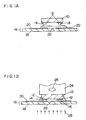
- the semiconductor device 10 is held by a movable tool 24 and positions o metal bumps 14 are adjusted to be in correspondence with wiring patterns 20 of wiring board 16. Then, metal bumps 14 are pressed against wiring pattern 20 by downward movement of tool 24 in the direction of arrow 26. By this pressure applied in the direction of arrow 26, resin 22, which is disposed between metal bump 14 and wiring pattern 20, is pressed to be expanded outwardly so that resin 22 is removed from the area between metal bump 14 and wiring pattern 20 and metal bumps 14 are electrically connected to wiring pattern 20.
- the electrical connection of metal bumps 14 of semiconductor device 10 and wiring pattern 20 of wiring board 16 is accomplished by the application of pressure, and the fixing of semiconductor device 10 and wiring board 16 is accomplished by stiffened resin.
- the resin 22 is of a modified acrylate group.
- the stiffening operation is completed by the application of ultraviolet light of 300-400 nm for approximately 20-60 seconds at an energy of 20 mW/cm2.
- the stiffening operation is completed by application of heat whose temperature is 100°-150° for 5-30 minutes.
- electrical resistance of the connection portion becomes approximately 1-10 mohms.
- insulating resin 22 is of a combination type, e.g., light stiffening and natural stiffening
- light application may be carried out both from the semiconductor device side (upper side in FIG. 1) and from the wiring board side (lower side) because, even if an unstiffened portion of resin 22 remains; it is stiffened by the lapse of time.
- insulating resin 22 is of another combination type, e.g. light stiffening and heat stiffening, a part of the resin is stiffened by light application so that semiconductor device 10 and wiring board 16 are temporarily fixed, and thereafter, they are completely fixed by heat application.
- the fabricating method of semiconductor device of this invention is to keep the bump electrode of LSI chip in elastic deformation when pressing the LSI chip to a wiring board, and to connect the bump electrode of the LSI chip and the conductor wiring.
- This invention possesses the following advantages. Since the bump electrode of the LSI chip is set in contact with the conductor wiring of the wiring board in an elastic deformation state, if a dimensional change due to thermal expansion occurs in the insulating resin, or if a dimensional change between the LSI chip and wiring board occurs, the bump electrodes recovers elastically, so that the contact state of the bump electrode and conductor wiring may be always maintained, and the heat resistance and reliability may be high. It is hence possible to apply into power device or the like.
- a light- or heat-stiffening insulating resin 34 is applied in a region containing a conductor wiring 30 of wiring board 32 possessing a conductor wiring 30 made of glass or ceramic.
- the thickness of the wiring board 32 is about 0.1 to 2.0 mm
- the conductor wiring 30 is CR-Au, Al, ITO, etc., and its thickness is about 0.1 to 10 ⁇ m.
- the insulating resin 34 is an acrylic, epoxy or similar material which is stiffened by ultraviolet rays or both ultraviolet rays and heat, and it is applied by dispenser, screen printing or other means.
- an LSI chip 38 having a bump electrode 36 made of Au or the like is disposed in a region coated with the insualting resin 34 of the wiring board 32 so that the bump electrode 36 and the conductor wiring 30 may coincide with each other.
- the thickness of the bump electrode 36 is about 5 to 30 ⁇ m, and its dimension is about 3 to 50 ⁇ m square.
- the LSI chip 38 is pressed by a pressing tool 40.
- the pressure is about 0.5 g/electrode to 5 g/electrode.
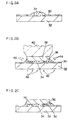
- FIGS. 3A, 3B The state of elastic deformation of the bump electrode 36 is shown in FIGS. 3A, 3B.
- FIG. 3A shows the LSI chip 38 being placed at the position of the wiring board 32
- FIG. 3B denotes the state of pressing the LSI chip 38 and elastically deforming the bump electrode 36. Since the bump electrode 36 is in an elastic deformation state, if the insulating resin 34 is later stiffened and relieved, a restoring force acts on the bump electrode 36, and the contact pressure of the bump electrode f36 on the conductor wiring 30 is strong, and it also follows up the dimensional change due to expansion of the insulating resin 36 after stiffening, the contact resistance remains high even at high temperature, and a high reliability is obtained.
- the insulating resin 34 is forced outward, and the bump electrode 36 of the LSI chip 38 and the conductor wiring 30 electrically contact with each other.
- the insulating resin 34 is heated, and is irradiated with ultraviolet rays 42, 44 at the same time to stiffen the insulating resin 34.
- the wiring board 32 is a glass, it is irradiated with ultraviolet rays 42, or if it is an opaque board such as ceramic, the side face of the LSI chip 38 is irradiated with ultraviolet ray 44.
- a heating mechanism is installed, for example, in the pressing tool 40. Or it may be also possible to heat easily by using infrared rays or hot air.
- the heating time is about 0.5 to 1.0 second. Afterwards, the heating tool 40 is canceled. At this time, the LSI chip is affixed to the wiring board 32 by means of the insulating resin 34, and the bump electrode 36 of the LSI chip and conductor wiring 30 are electrically connected with each other by contact.
Landscapes
- Wire Bonding (AREA)
Applications Claiming Priority (2)
| Application Number | Priority Date | Filing Date | Title |
|---|---|---|---|
| JP319444/87 | 1987-12-17 | ||
| JP62319444A JPH01160029A (ja) | 1987-12-17 | 1987-12-17 | 半導体装置 |
Publications (2)
| Publication Number | Publication Date |
|---|---|
| EP0321239A2 true EP0321239A2 (de) | 1989-06-21 |
| EP0321239A3 EP0321239A3 (de) | 1990-04-25 |
Family
ID=18110268
Family Applications (1)
| Application Number | Title | Priority Date | Filing Date |
|---|---|---|---|
| EP88311869A Withdrawn EP0321239A3 (de) | 1987-12-17 | 1988-12-15 | Verfahren zum Herstellen einer Halbleiteranordnung |
Country Status (3)
| Country | Link |
|---|---|
| EP (1) | EP0321239A3 (de) |
| JP (1) | JPH01160029A (de) |
| KR (1) | KR920002075B1 (de) |
Cited By (5)
| Publication number | Priority date | Publication date | Assignee | Title |
|---|---|---|---|---|
| EP0449496A1 (de) * | 1990-03-20 | 1991-10-02 | Sharp Kabushiki Kaisha | Verfahren zur Montage von einer Halbleiteranordnung |
| EP0644587A1 (de) * | 1993-09-01 | 1995-03-22 | Kabushiki Kaisha Toshiba | Halbleiteraufbau und Verfahren zur Herstellung |
| EP0768712A3 (de) * | 1995-10-13 | 1999-01-07 | Meiko Electronics Co., Ltd. | Höckerkontakt für eine Leiterplatte und Halbleitermodul mit derselben |
| EP0930645A3 (de) * | 1997-12-29 | 2000-04-19 | Ford Motor Company | Lotlöser Flip-Chip-Zusammenbau und Verfahren und Material dafür |
| DE102004030813A1 (de) * | 2004-06-25 | 2006-01-19 | Infineon Technologies Ag | Verfahren zur Verbindung einer integrierten Schaltung mit einem Substrat und entsprechende Schaltungsanordnung |
-
1987
- 1987-12-17 JP JP62319444A patent/JPH01160029A/ja active Pending
-
1988
- 1988-12-15 EP EP88311869A patent/EP0321239A3/de not_active Withdrawn
- 1988-12-16 KR KR1019880016786A patent/KR920002075B1/ko not_active Expired
Cited By (10)
| Publication number | Priority date | Publication date | Assignee | Title |
|---|---|---|---|---|
| EP0449496A1 (de) * | 1990-03-20 | 1991-10-02 | Sharp Kabushiki Kaisha | Verfahren zur Montage von einer Halbleiteranordnung |
| EP0644587A1 (de) * | 1993-09-01 | 1995-03-22 | Kabushiki Kaisha Toshiba | Halbleiteraufbau und Verfahren zur Herstellung |
| US5866950A (en) * | 1993-09-01 | 1999-02-02 | Kabushiki Kaisha Toshiba | Semiconductor package and fabrication method |
| EP0768712A3 (de) * | 1995-10-13 | 1999-01-07 | Meiko Electronics Co., Ltd. | Höckerkontakt für eine Leiterplatte und Halbleitermodul mit derselben |
| US5886877A (en) * | 1995-10-13 | 1999-03-23 | Meiko Electronics Co., Ltd. | Circuit board, manufacturing method therefor, and bump-type contact head and semiconductor component packaging module using the circuit board |
| US6239983B1 (en) | 1995-10-13 | 2001-05-29 | Meiko Electronics Co., Ltd. | Circuit board, manufacturing method therefor, and bump-type contact head and semiconductor component packaging module using the circuit board |
| US6350957B1 (en) | 1995-10-13 | 2002-02-26 | Meiko Electronics, Co., Ltd. | Circuit board, manufacturing method therefor, and bump-type contact head and semiconductor component packaging module using the circuit board |
| EP0930645A3 (de) * | 1997-12-29 | 2000-04-19 | Ford Motor Company | Lotlöser Flip-Chip-Zusammenbau und Verfahren und Material dafür |
| DE102004030813A1 (de) * | 2004-06-25 | 2006-01-19 | Infineon Technologies Ag | Verfahren zur Verbindung einer integrierten Schaltung mit einem Substrat und entsprechende Schaltungsanordnung |
| DE102004030813B4 (de) * | 2004-06-25 | 2007-03-29 | Infineon Technologies Ag | Verfahren zur Verbindung einer integrierten Schaltung mit einem Substrat und entsprechende Schaltungsanordnung |
Also Published As
| Publication number | Publication date |
|---|---|
| KR920002075B1 (ko) | 1992-03-10 |
| JPH01160029A (ja) | 1989-06-22 |
| KR890011079A (ko) | 1989-08-12 |
| EP0321239A3 (de) | 1990-04-25 |
Similar Documents
| Publication | Publication Date | Title |
|---|---|---|
| US4749120A (en) | Method of connecting a semiconductor device to a wiring board | |
| US5666270A (en) | Bump electrode, semiconductor integrated circuit device using the same, multi-chip module having the semiconductor integrated circuit devices and method for producing semicondutcor device having the bump electrode | |
| US5783465A (en) | Compliant bump technology | |
| EP0591862B1 (de) | Halbleitervorrichtung, Bildabtastvorrichtung und Verfahren zu ihrer Herstellung | |
| US5903056A (en) | Conductive polymer film bonding technique | |
| US5508228A (en) | Compliant electrically connective bumps for an adhesive flip chip integrated circuit device and methods for forming same | |
| EP0493131B1 (de) | Verfahren zum Verbinden eines IC-Chips mit einem mit Leitermuster versehenem Substrat | |
| US6107682A (en) | Compliant wirebond packages having wire loop | |
| EP0332402B1 (de) | Verbindungsaufbau und sein Herstellungsverfahren | |
| KR910009780B1 (ko) | 전기적 접속접점과 그 형성방법 및 그것을 사용한 실장기판 | |
| JP2891184B2 (ja) | 半導体装置及びその製造方法 | |
| CA1108305A (en) | Electronic circuit device and method of making the same | |
| US5930603A (en) | Method for producing a semiconductor device | |
| JP2833326B2 (ja) | 電子部品実装接続体およびその製造方法 | |
| EP0810649B1 (de) | Fügemethode für Substrate und Struktur | |
| JPH027180B2 (de) | ||
| US5426266A (en) | Die bonding connector and method | |
| RU2200975C2 (ru) | Электронный модуль для электронной карточки | |
| EP0389756B1 (de) | Verfahren zum Zusammensetzen von Halbleiteranordnungen | |
| Hatada et al. | LED array modules by new technology microbump bonding method | |
| EP0321239A2 (de) | Verfahren zum Herstellen einer Halbleiteranordnung | |
| JPH0357617B2 (de) | ||
| JP3269390B2 (ja) | 半導体装置 | |
| EP0262580A2 (de) | Verfahren zum elektrischen Verbinden von zwei Objekten | |
| KR100244047B1 (ko) | 접착 조성물의 수축으로 인한 파손이 적은 반도체 칩과 기판 사이의 전기적 접속을 갖는 반도체 소자 및 그 실장 방법 |
Legal Events
| Date | Code | Title | Description |
|---|---|---|---|
| PUAI | Public reference made under article 153(3) epc to a published international application that has entered the european phase |
Free format text: ORIGINAL CODE: 0009012 |
|
| AK | Designated contracting states |
Kind code of ref document: A2 Designated state(s): DE FR GB |
|
| PUAL | Search report despatched |
Free format text: ORIGINAL CODE: 0009013 |
|
| AK | Designated contracting states |
Kind code of ref document: A3 Designated state(s): DE FR GB |
|
| 17P | Request for examination filed |
Effective date: 19901023 |
|
| 17Q | First examination report despatched |
Effective date: 19920831 |
|
| STAA | Information on the status of an ep patent application or granted ep patent |
Free format text: STATUS: THE APPLICATION IS DEEMED TO BE WITHDRAWN |
|
| 18D | Application deemed to be withdrawn |
Effective date: 19930112 |