EP0316005A2 - Figurkodierer - Google Patents
Figurkodierer Download PDFInfo
- Publication number
- EP0316005A2 EP0316005A2 EP88118834A EP88118834A EP0316005A2 EP 0316005 A2 EP0316005 A2 EP 0316005A2 EP 88118834 A EP88118834 A EP 88118834A EP 88118834 A EP88118834 A EP 88118834A EP 0316005 A2 EP0316005 A2 EP 0316005A2
- Authority
- EP
- European Patent Office
- Prior art keywords
- closed
- encoder
- extracting
- image memory
- figures
- Prior art date
- Legal status (The legal status is an assumption and is not a legal conclusion. Google has not performed a legal analysis and makes no representation as to the accuracy of the status listed.)
- Withdrawn
Links
Images



Classifications
-
- G—PHYSICS
- G06—COMPUTING OR CALCULATING; COUNTING
- G06T—IMAGE DATA PROCESSING OR GENERATION, IN GENERAL
- G06T9/00—Image coding
- G06T9/20—Contour coding, e.g. using detection of edges
-
- G—PHYSICS
- G06—COMPUTING OR CALCULATING; COUNTING
- G06K—GRAPHICAL DATA READING; PRESENTATION OF DATA; RECORD CARRIERS; HANDLING RECORD CARRIERS
- G06K11/00—Methods or arrangements for graph-reading or for converting the pattern of mechanical parameters, e.g. force or presence, into electrical signal
-
- G—PHYSICS
- G06—COMPUTING OR CALCULATING; COUNTING
- G06T—IMAGE DATA PROCESSING OR GENERATION, IN GENERAL
- G06T11/00—2D [Two Dimensional] image generation
- G06T11/20—Drawing from basic elements, e.g. lines or circles
- G06T11/206—Drawing of charts or graphs
Definitions
- the present invention relates to a figure encoder for encoding figures primarily comprised of lines, such as drawings or maps, so as to facilitate registration of such figures to computers and, more particularly, to such a figure encoder especially suitable for closed figures.
- One conventional method for executing the registration of the figures is to record the figures in an image memory by means of an imaging device and to extract figure data automatically by methods of pattern recognition.
- a sufficiently high standard of accuracy in the pattern recognition has not yet been achieved, so that corrections of recognition errors which requires enormously cumbersome procedures are indispensable.
- types of images that can be handled by this method is still extremely limited.
- a figure encoder comprising: image memory means for recording images; display means for displaying the images recorded in the image memory means; pointing means for providing a way to specify a point on the images displayed on the display means; means for extracting an image of a closed figure enclosing the specified point in accordance with a coordinate of the specified point; and means for symbolizing the extracted image of the closed figure.
- a figure encoder comprising: image memory means for recording images; display means for displaying the images recorded in the image memory means; pointing means for providing a way to specify a point on the images displayed on the display means; means for detecting coordinates of end points of line segments which are indicated to be forming a single closed figure by the pointing means; means for joining the detected end points on the images recorded in the image memory means to produce the single closed figure; and means for symbolizing the extracted image of the closed figure.
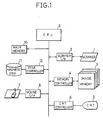
- FIG. 1 there is shown one embodiment of a figure encoder according to the present invention.
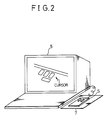
- This figure encoder comprises a scanner 1 including an imaging device for scanning images of figures such as logical diagrams or architectural drafts and producing binary image data in which lines are represented by '1' while backgrounds are represented by '0', a scanner interface 2, an image memory 2 for storing image data produced by the scanner 1, a memory controller 4, a CRT display 5, a CRT controller 6, a mouse as a pointing device 7 which provides ways to control a position of a cursor such as one shown in Fig. 2 on the CRT display 5 and specify a coordinate of the position of the cursor at a desired location when a button S is pressed down, a mouse interface 8, CPU 9 for carrying out an encoding process to be explained below, a main memory 10, a magnetic disk 11, and a disk controller 12.
- Fig. 3 shows a configuration of the image memory 3 which comprises a memory 21 for an original image scanned by the scanner 1 to be displayed on the CRT display 5, a memory 22 for thinned images, a third and memories 23 and 24 to be used in a process of extracting image data of closed figures, and a memory 25 for extracted image data of closed figures.
- the image memory 3 is connected through the memory controller 2 with the CPU 9 so that information can be exchanged freely.
- the CPU 9 to read out the image data stored in the memory 21, and perform various image processings at the CPU 9, and then store the results in an another memory is possible.
- any of the main memory 10 and the memories 23 and 24 of the image memory 3 may be utilized as temporary storing spaces, and for storing the final results any of the main memory 10, the memories 23 and 24 of the image memory 3, and the magnetic disk 11 may be used.
- Fig. 4 shows a schematic flow chart for the operation of this figure encoder.
- the operation is divided into a preliminary step and a main step.
- the preliminary step consists of the step 31 in which the original images are scanned by the scanner 1 and the image data are stored in the memory 21 of the image memory 3, and the step 32 in which a thinning of images are performed and the thinned images are stored in the memory 22 of the image memory 3.
- the main step consists of the step 33 in which the image data of closed figures are extracted from the thinned images, and the step 34 in which the extracted image data of the closed figures are symbolized.
- This symbolization can, for example, be a vectorization or other known methods.
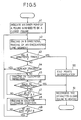
- Fig. 5 shows a detailed flow chart of the step 33.
- a point P inside a figure intended to be a closed figure is specified by an operator by means of the pointing device 7 and the coordinate of the specified point is obtained.
- tracing in eight directions from the point P is performed and when line segments are encountered the line segments are traced as shown in Fig. 6. Namely, the tracing in a direction (1) is performed first, and when a line segment is encountered that line segment is traced.
- the tracing is carried out for 4-connected figures if the thinning at the step 32 is 4-connected, or it is carried out for 8 connected figures if the thinning at the step 32 is 8-connected.
- the tracing of a line segment is performed by writing '1' to the address in the memory 23 of the image memory 3 corresponding to the coordinates of points on the line segment.
- the tracing at each point proceeds by searching a point on the line segment in the clockwise direction with respect to the direction of the tracing (step 45), which is graphically shown in Fig. 7.
- the tracing of the line segment reaches an end point instead of returning to the starting point.
- the tracing in the counterclockwise direction is also carried out (step 48) and the coordinates of an end point A found in the tracing in the clockwise direction (step 46) and an end point B found in the tracing in the counterclockwise direction (step 49) are recorded in an end points table prepared in the main memory 10 such as one shown in Fig. 8.
- the tracing in the direction (2) from the point P is carried out in the similar manner which, however, also terminates when the line segment already traced is encountered (step 44).
- the tracings in the directions (3) to (8) are carried out sequentially until the tracing in all of the eight directions are completed (step 43).
- figure data of the line segments in the memory 23 of the image memory 3 and the end points table in the main memory 10 are obtained.
- the end points originally intended to be connected are interpolated. Namely, as indicated in Fig. 8 by arrows, the end point A of the line segment a is joined with the end point B of the next line segment b , the end point A of the line segment b is joined with the end point B of the next line segment c , and so on.
- the interpolating pieces are 4-connected lines when the thinning is 4-connected, or they are 8-connected lines when the thinning is 8-connected, and they are also recorded in the memory 23 of the image memory 3.
- the resultant closed loop is stored in the memory 25 of the image memory 3 at the step 51. If necessary, this closed loop may be transformed into chain codes to be stored in the main memory 10.
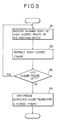
- Fig. 9 shows a flow chart for this process which replaces the flow chart shown in Fig. 5.
- a point inside one of the closed loops is specified by the operator by means of the pointing device 7, and then at the step 62 the extraction of the loop is carried out as before.
- the similar process for the other loops are carried out, one at a time (step 63 ).
- the coordinates of the specified points are stored in the main memory 10.
- the extracted loops are synthesized into a single closed figure.
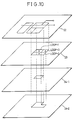
- FIG. 10 An example of this process is illustrated in Fig. 10 in which there is a closed loop divided up into three loops loop-1, loop-2, and loop-3 in the memory 22 which are separately extracted and recorded in the memory 23.
- the initially blank memory 24 is provided on which one of these loops, the loop-1 in Fig. 10, is extracted by means of the tracing from the specified point inside this loop-1.
- the tracing in one direction suffices as the figure is known beforehand as a closed one.
- the exclusive "or" operation of the figures on the memory 23 and the figures on the memory 24 is taken.
- the figure identical to the loop-1 is left on the memory 24, as shown in Fig. 10 as 24-1.
- the operator is required to specify only a point for each closed figure in the images in accordance with which the closed figures are extracted and symbolized, so that an efficiency as well as an accuracy of the figure encoding process can be improved significantly.
- a figure only partially closed by mistake and a figure subdivided into smaller fragments by mistake can be corrected into the closed figures as intended, also in accordance with a point for each closed figure specified by the operator, so that the elaborated error correction process indispensable in the prior art can now be dispensable.
- the figure encoder of the present invention is capable of handling complicated figures that cannot be dealt with by the prior art method utilizing pattern recognitions, so that this figure encoder possesses a much wider range of applicability.
Landscapes
- Engineering & Computer Science (AREA)
- Physics & Mathematics (AREA)
- General Physics & Mathematics (AREA)
- Theoretical Computer Science (AREA)
- Artificial Intelligence (AREA)
- Computer Hardware Design (AREA)
- Computer Vision & Pattern Recognition (AREA)
- Multimedia (AREA)
- Processing Or Creating Images (AREA)
- Image Processing (AREA)
- User Interface Of Digital Computer (AREA)
Applications Claiming Priority (2)
| Application Number | Priority Date | Filing Date | Title |
|---|---|---|---|
| JP285902/87 | 1987-11-12 | ||
| JP62285902A JP2735197B2 (ja) | 1987-11-12 | 1987-11-12 | 図形入力装置 |
Publications (2)
| Publication Number | Publication Date |
|---|---|
| EP0316005A2 true EP0316005A2 (de) | 1989-05-17 |
| EP0316005A3 EP0316005A3 (de) | 1991-03-27 |
Family
ID=17697499
Family Applications (1)
| Application Number | Title | Priority Date | Filing Date |
|---|---|---|---|
| EP19880118834 Withdrawn EP0316005A3 (de) | 1987-11-12 | 1988-11-11 | Figurkodierer |
Country Status (3)
| Country | Link |
|---|---|
| US (1) | US5301264A (de) |
| EP (1) | EP0316005A3 (de) |
| JP (1) | JP2735197B2 (de) |
Families Citing this family (5)
| Publication number | Priority date | Publication date | Assignee | Title |
|---|---|---|---|---|
| US5553219A (en) * | 1991-05-10 | 1996-09-03 | Fuji Xerox Co., Ltd. | Font outline and bit map generator synthesizing filling data with selected outline data or duplicate outline data |
| CN1033110C (zh) * | 1992-09-01 | 1996-10-23 | 寅市和男 | 文字数据、词符-插图数据的输入输出装置及其方法 |
| US5887081A (en) * | 1995-12-07 | 1999-03-23 | Ncr Corporation | Method for fast image identification and categorization of multimedia data |
| JPH09237354A (ja) * | 1996-02-29 | 1997-09-09 | Chokosoku Network Computer Gijutsu Kenkyusho:Kk | 3次元形状データ転送表示方法 |
| KR100395887B1 (ko) * | 2000-10-24 | 2003-08-27 | 한국전력공사 | 지리정보시스템 데이터 베이스 구축작업에 있어서배전설비도면 자동인식방법 |
Family Cites Families (21)
| Publication number | Priority date | Publication date | Assignee | Title |
|---|---|---|---|---|
| US4020463A (en) * | 1976-02-27 | 1977-04-26 | Recognition Equipment Incorporated | Apparatus and a method for storage and retrieval of image patterns |
| JPS5580188A (en) * | 1978-12-12 | 1980-06-17 | Nippon Telegr & Teleph Corp <Ntt> | Linear pattern coding unit |
| JPS57141779A (en) * | 1981-02-26 | 1982-09-02 | Nec Corp | Character cutout system |
| JPS58166348A (ja) * | 1982-03-26 | 1983-10-01 | Dainippon Printing Co Ltd | 印刷用切抜きマスク作成装置 |
| JPS58119076A (ja) * | 1982-01-08 | 1983-07-15 | Toshiba Corp | 画像編集装置 |
| US4566126A (en) * | 1982-04-30 | 1986-01-21 | Fuji Electric Company, Ltd. | Pattern discriminator |
| JPS5947666A (ja) * | 1982-09-13 | 1984-03-17 | Dainippon Screen Mfg Co Ltd | 2値画像のデ−タ圧縮方法 |
| JPS5999576A (ja) * | 1982-11-30 | 1984-06-08 | Toshiba Corp | 画像情報記憶検索システム装置 |
| US4783829A (en) * | 1983-02-23 | 1988-11-08 | Hitachi, Ltd. | Pattern recognition apparatus |
| JPS59191667A (ja) * | 1983-04-16 | 1984-10-30 | Dainippon Printing Co Ltd | 画像デ−タ変換方式 |
| DE3479254D1 (en) * | 1983-07-04 | 1989-09-07 | Karow Rubow Weber Gmbh | Method for automatically digitizing the contours of line graphics, e.g. characters |
| JPS60111490A (ja) * | 1983-11-22 | 1985-06-17 | 富士通株式会社 | プリント板パタ−ン図自動デイジタイズ装置 |
| EP0149457B1 (de) * | 1984-01-13 | 1993-03-31 | Kabushiki Kaisha Komatsu Seisakusho | Identifizierungsverfahren von Konturlinien |
| JPS60196856A (ja) * | 1984-03-20 | 1985-10-05 | Olympus Optical Co Ltd | 画像検索登録装置 |
| JPS61221968A (ja) * | 1985-03-28 | 1986-10-02 | Fuji Electric Co Ltd | 図面読取装置 |
| US4809201A (en) * | 1985-12-02 | 1989-02-28 | Schlumberger Systems, Inc. | Graphic display region defining technique |
| JP2587812B2 (ja) * | 1986-03-10 | 1997-03-05 | 日本電信電話株式会社 | 図形抽出方法 |
| GB2190560B (en) * | 1986-05-08 | 1990-06-20 | Gen Electric Plc | Data compression |
| JPS62269276A (ja) * | 1986-05-19 | 1987-11-21 | Nippon Telegr & Teleph Corp <Ntt> | 会話型図形入力方式 |
| JPH0785271B2 (ja) * | 1986-06-27 | 1995-09-13 | 株式会社日立製作所 | 形状モデリング方法 |
| US4817187A (en) * | 1987-02-19 | 1989-03-28 | Gtx Corporation | Apparatus and method for vectorization of incoming scanned image data |
-
1987
- 1987-11-12 JP JP62285902A patent/JP2735197B2/ja not_active Expired - Fee Related
-
1988
- 1988-11-11 EP EP19880118834 patent/EP0316005A3/de not_active Withdrawn
-
1992
- 1992-07-16 US US07/913,985 patent/US5301264A/en not_active Expired - Fee Related
Also Published As
| Publication number | Publication date |
|---|---|
| EP0316005A3 (de) | 1991-03-27 |
| US5301264A (en) | 1994-04-05 |
| JP2735197B2 (ja) | 1998-04-02 |
| JPH01126774A (ja) | 1989-05-18 |
Similar Documents
| Publication | Publication Date | Title |
|---|---|---|
| EP0534446A2 (de) | System mit Annäherungsmittel zur Erkennung von graphischen Elementen in einer Zeichnung | |
| JPS5923467B2 (ja) | 位置検出方法 | |
| US5301264A (en) | Figure encoder | |
| KR102680424B1 (ko) | 반도체 불량 검사용 고해상도 이미지 합성 방법 | |
| EP1202213A2 (de) | Gerrät und Verfahren zur Bestimmung der Formatierung von Dokumenten | |
| JP2000105813A (ja) | 画像連接システム、および画像連接プログラムを記録した記録媒体 | |
| US5168553A (en) | Line figure encoder | |
| JPH0991410A (ja) | パノラマ画像合成システム | |
| JP2000163599A (ja) | 関心領域設定装置、関心領域設定方法及び輪郭抽出装置 | |
| JP2686479B2 (ja) | 図形識別符号入力装置 | |
| JP2636736B2 (ja) | 指紋合成装置 | |
| JP3657725B2 (ja) | 線図形画像処理方法 | |
| JP2803736B2 (ja) | 文字認識方式 | |
| JP2824372B2 (ja) | 帳票の認識装置 | |
| JP2641249B2 (ja) | シンボル図形配置方法 | |
| JPS63197266A (ja) | 文書イメ−ジ編集装置 | |
| JP2559359B2 (ja) | 画像の構造記憶方法及び画像登録装置 | |
| JP2000339407A (ja) | 画像処理装置及び画像処理方法及びコンピュータ読み取り可能な記憶媒体 | |
| JP2838556B2 (ja) | 画像処理装置 | |
| JP3967400B2 (ja) | 物体認識装置 | |
| JP3080080B2 (ja) | 画像連接システム、および画像連接プログラムを記録した記録媒体 | |
| JPH07129745A (ja) | イメージデータ接続装置及び方法 | |
| JPH06259554A (ja) | 画像輪郭抽出装置 | |
| JPH09319855A (ja) | 地図作成装置及び方法 | |
| JP2019219772A (ja) | テンプレート登録装置および対応領域特定装置 |
Legal Events
| Date | Code | Title | Description |
|---|---|---|---|
| PUAI | Public reference made under article 153(3) epc to a published international application that has entered the european phase |
Free format text: ORIGINAL CODE: 0009012 |
|
| 17P | Request for examination filed |
Effective date: 19881111 |
|
| AK | Designated contracting states |
Kind code of ref document: A2 Designated state(s): DE FR GB IT NL |
|
| PUAL | Search report despatched |
Free format text: ORIGINAL CODE: 0009013 |
|
| AK | Designated contracting states |
Kind code of ref document: A3 Designated state(s): DE FR GB IT NL |
|
| 17Q | First examination report despatched |
Effective date: 19930430 |
|
| STAA | Information on the status of an ep patent application or granted ep patent |
Free format text: STATUS: THE APPLICATION IS DEEMED TO BE WITHDRAWN |
|
| 18D | Application deemed to be withdrawn |
Effective date: 19931111 |