EP0304739B1 - Zubereitung zur abhäsiven Beschichtung von Backblechen, Backformen, Pfannen, Metalltöpfen und dergleichen - Google Patents
Zubereitung zur abhäsiven Beschichtung von Backblechen, Backformen, Pfannen, Metalltöpfen und dergleichen Download PDFInfo
- Publication number
- EP0304739B1 EP0304739B1 EP88113113A EP88113113A EP0304739B1 EP 0304739 B1 EP0304739 B1 EP 0304739B1 EP 88113113 A EP88113113 A EP 88113113A EP 88113113 A EP88113113 A EP 88113113A EP 0304739 B1 EP0304739 B1 EP 0304739B1
- Authority
- EP
- European Patent Office
- Prior art keywords
- radicals
- polysiloxane
- group
- mol
- general formula
- Prior art date
- Legal status (The legal status is an assumption and is not a legal conclusion. Google has not performed a legal analysis and makes no representation as to the accuracy of the status listed.)
- Expired - Lifetime
Links
- 238000000576 coating method Methods 0.000 title claims description 18
- 239000011248 coating agent Substances 0.000 title claims description 13
- 239000000203 mixture Substances 0.000 title abstract description 9
- 241000467686 Eschscholzia lobbii Species 0.000 title 1
- -1 polysiloxane Polymers 0.000 claims abstract description 46
- 229920001296 polysiloxane Polymers 0.000 claims abstract description 42
- LFQSCWFLJHTTHZ-UHFFFAOYSA-N Ethanol Chemical compound CCO LFQSCWFLJHTTHZ-UHFFFAOYSA-N 0.000 claims abstract description 20
- KPUWHANPEXNPJT-UHFFFAOYSA-N disiloxane Chemical class [SiH3]O[SiH3] KPUWHANPEXNPJT-UHFFFAOYSA-N 0.000 claims abstract description 11
- 229920005862 polyol Polymers 0.000 claims abstract description 11
- 150000003077 polyols Chemical class 0.000 claims abstract description 10
- 125000004432 carbon atom Chemical group C* 0.000 claims abstract description 8
- 125000004185 ester group Chemical group 0.000 claims abstract description 8
- 150000005846 sugar alcohols Polymers 0.000 claims abstract description 8
- CIUQDSCDWFSTQR-UHFFFAOYSA-N [C]1=CC=CC=C1 Chemical compound [C]1=CC=CC=C1 CIUQDSCDWFSTQR-UHFFFAOYSA-N 0.000 claims abstract description 5
- OFOBLEOULBTSOW-UHFFFAOYSA-N Malonic acid Chemical compound OC(=O)CC(O)=O OFOBLEOULBTSOW-UHFFFAOYSA-N 0.000 claims abstract description 4
- 125000003545 alkoxy group Chemical group 0.000 claims abstract description 4
- 125000000217 alkyl group Chemical group 0.000 claims abstract description 4
- 125000002947 alkylene group Chemical group 0.000 claims abstract description 3
- 125000003178 carboxy group Chemical group [H]OC(*)=O 0.000 claims abstract description 3
- 125000002993 cycloalkylene group Chemical group 0.000 claims abstract description 3
- 125000002887 hydroxy group Chemical group [H]O* 0.000 claims abstract description 3
- 125000000843 phenylene group Chemical group C1(=C(C=CC=C1)*)* 0.000 claims abstract description 3
- 150000003333 secondary alcohols Chemical class 0.000 claims abstract description 3
- 238000002360 preparation method Methods 0.000 claims description 25
- 238000006243 chemical reaction Methods 0.000 claims description 23
- 125000002496 methyl group Chemical group [H]C([H])([H])* 0.000 claims description 6
- 229910052751 metal Inorganic materials 0.000 claims description 4
- 239000002184 metal Substances 0.000 claims description 4
- 238000000034 method Methods 0.000 claims 2
- 125000000075 primary alcohol group Chemical group 0.000 claims 1
- 150000003138 primary alcohols Chemical class 0.000 abstract description 2
- 238000012360 testing method Methods 0.000 description 16
- 229920005989 resin Polymers 0.000 description 13
- 239000011347 resin Substances 0.000 description 13
- XLYOFNOQVPJJNP-UHFFFAOYSA-N water Substances O XLYOFNOQVPJJNP-UHFFFAOYSA-N 0.000 description 11
- QTBSBXVTEAMEQO-UHFFFAOYSA-N Acetic acid Chemical compound CC(O)=O QTBSBXVTEAMEQO-UHFFFAOYSA-N 0.000 description 8
- 229920005906 polyester polyol Polymers 0.000 description 7
- LYCAIKOWRPUZTN-UHFFFAOYSA-N Ethylene glycol Chemical compound OCCO LYCAIKOWRPUZTN-UHFFFAOYSA-N 0.000 description 6
- 239000003054 catalyst Substances 0.000 description 6
- 239000000243 solution Substances 0.000 description 6
- 0 CC1=*CCCC1 Chemical compound CC1=*CCCC1 0.000 description 5
- GWEVSGVZZGPLCZ-UHFFFAOYSA-N Titan oxide Chemical compound O=[Ti]=O GWEVSGVZZGPLCZ-UHFFFAOYSA-N 0.000 description 5
- 238000010411 cooking Methods 0.000 description 5
- IJGRMHOSHXDMSA-UHFFFAOYSA-N Atomic nitrogen Chemical compound N#N IJGRMHOSHXDMSA-UHFFFAOYSA-N 0.000 description 4
- CTQNGGLPUBDAKN-UHFFFAOYSA-N O-Xylene Chemical compound CC1=CC=CC=C1C CTQNGGLPUBDAKN-UHFFFAOYSA-N 0.000 description 4
- FAPWRFPIFSIZLT-UHFFFAOYSA-M Sodium chloride Chemical compound [Na+].[Cl-] FAPWRFPIFSIZLT-UHFFFAOYSA-M 0.000 description 4
- 239000002253 acid Substances 0.000 description 4
- 239000000853 adhesive Substances 0.000 description 4
- 230000001070 adhesive effect Effects 0.000 description 4
- 238000002845 discoloration Methods 0.000 description 4
- 235000008960 ketchup Nutrition 0.000 description 4
- 238000003756 stirring Methods 0.000 description 4
- 239000002344 surface layer Substances 0.000 description 4
- 239000008096 xylene Substances 0.000 description 4
- ZJCCRDAZUWHFQH-UHFFFAOYSA-N Trimethylolpropane Chemical compound CCC(CO)(CO)CO ZJCCRDAZUWHFQH-UHFFFAOYSA-N 0.000 description 3
- FPCJKVGGYOAWIZ-UHFFFAOYSA-N butan-1-ol;titanium Chemical compound [Ti].CCCCO.CCCCO.CCCCO.CCCCO FPCJKVGGYOAWIZ-UHFFFAOYSA-N 0.000 description 3
- 230000032050 esterification Effects 0.000 description 3
- 238000005886 esterification reaction Methods 0.000 description 3
- 239000004744 fabric Substances 0.000 description 3
- 239000010410 layer Substances 0.000 description 3
- 239000003921 oil Substances 0.000 description 3
- 235000019198 oils Nutrition 0.000 description 3
- 229920001187 thermosetting polymer Polymers 0.000 description 3
- VNAWKNVDKFZFSU-UHFFFAOYSA-N 2-ethyl-2-methylpropane-1,3-diol Chemical compound CCC(C)(CO)CO VNAWKNVDKFZFSU-UHFFFAOYSA-N 0.000 description 2
- FFWSICBKRCICMR-UHFFFAOYSA-N 5-methyl-2-hexanone Chemical compound CC(C)CCC(C)=O FFWSICBKRCICMR-UHFFFAOYSA-N 0.000 description 2
- 240000004160 Capsicum annuum Species 0.000 description 2
- 235000008534 Capsicum annuum var annuum Nutrition 0.000 description 2
- 244000203593 Piper nigrum Species 0.000 description 2
- 229910052782 aluminium Inorganic materials 0.000 description 2
- XAGFODPZIPBFFR-UHFFFAOYSA-N aluminium Chemical compound [Al] XAGFODPZIPBFFR-UHFFFAOYSA-N 0.000 description 2
- 235000013351 cheese Nutrition 0.000 description 2
- 150000001875 compounds Chemical class 0.000 description 2
- 235000020186 condensed milk Nutrition 0.000 description 2
- 238000004821 distillation Methods 0.000 description 2
- 208000028626 extracranial carotid artery aneurysm Diseases 0.000 description 2
- QQVIHTHCMHWDBS-UHFFFAOYSA-N isophthalic acid Chemical compound OC(=O)C1=CC=CC(C(O)=O)=C1 QQVIHTHCMHWDBS-UHFFFAOYSA-N 0.000 description 2
- 238000004519 manufacturing process Methods 0.000 description 2
- 229910052757 nitrogen Inorganic materials 0.000 description 2
- 239000003973 paint Substances 0.000 description 2
- 229920001225 polyester resin Polymers 0.000 description 2
- 239000004645 polyester resin Substances 0.000 description 2
- 239000011780 sodium chloride Substances 0.000 description 2
- 239000000126 substance Substances 0.000 description 2
- 239000010936 titanium Substances 0.000 description 2
- 239000004408 titanium dioxide Substances 0.000 description 2
- IIZPXYDJLKNOIY-JXPKJXOSSA-N 1-palmitoyl-2-arachidonoyl-sn-glycero-3-phosphocholine Chemical compound CCCCCCCCCCCCCCCC(=O)OC[C@H](COP([O-])(=O)OCC[N+](C)(C)C)OC(=O)CCC\C=C/C\C=C/C\C=C/C\C=C/CCCCC IIZPXYDJLKNOIY-JXPKJXOSSA-N 0.000 description 1
- CZMRCDWAGMRECN-UHFFFAOYSA-N 2-{[3,4-dihydroxy-2,5-bis(hydroxymethyl)oxolan-2-yl]oxy}-6-(hydroxymethyl)oxane-3,4,5-triol Chemical compound OCC1OC(CO)(OC2OC(CO)C(O)C(O)C2O)C(O)C1O CZMRCDWAGMRECN-UHFFFAOYSA-N 0.000 description 1
- 235000002566 Capsicum Nutrition 0.000 description 1
- 239000001856 Ethyl cellulose Substances 0.000 description 1
- ZZSNKZQZMQGXPY-UHFFFAOYSA-N Ethyl cellulose Chemical compound CCOCC1OC(OC)C(OCC)C(OCC)C1OC1C(O)C(O)C(OC)C(CO)O1 ZZSNKZQZMQGXPY-UHFFFAOYSA-N 0.000 description 1
- 239000006002 Pepper Substances 0.000 description 1
- LGRFSURHDFAFJT-UHFFFAOYSA-N Phthalic anhydride Natural products C1=CC=C2C(=O)OC(=O)C2=C1 LGRFSURHDFAFJT-UHFFFAOYSA-N 0.000 description 1
- 235000016761 Piper aduncum Nutrition 0.000 description 1
- 235000017804 Piper guineense Nutrition 0.000 description 1
- 235000008184 Piper nigrum Nutrition 0.000 description 1
- TUCNEACPLKLKNU-UHFFFAOYSA-N acetyl Chemical group C[C]=O TUCNEACPLKLKNU-UHFFFAOYSA-N 0.000 description 1
- JHIWVOJDXOSYLW-UHFFFAOYSA-N butyl 2,2-difluorocyclopropane-1-carboxylate Chemical compound CCCCOC(=O)C1CC1(F)F JHIWVOJDXOSYLW-UHFFFAOYSA-N 0.000 description 1
- 239000001511 capsicum annuum Substances 0.000 description 1
- 239000006229 carbon black Substances 0.000 description 1
- 239000003795 chemical substances by application Substances 0.000 description 1
- 230000000052 comparative effect Effects 0.000 description 1
- 238000001816 cooling Methods 0.000 description 1
- 125000001142 dicarboxylic acid group Chemical group 0.000 description 1
- SBZXBUIDTXKZTM-UHFFFAOYSA-N diglyme Chemical compound COCCOCCOC SBZXBUIDTXKZTM-UHFFFAOYSA-N 0.000 description 1
- 235000019325 ethyl cellulose Nutrition 0.000 description 1
- 229920001249 ethyl cellulose Polymers 0.000 description 1
- 125000001495 ethyl group Chemical group [H]C([H])([H])C([H])([H])* 0.000 description 1
- 239000000945 filler Substances 0.000 description 1
- 230000004992 fission Effects 0.000 description 1
- 235000013305 food Nutrition 0.000 description 1
- 239000000787 lecithin Substances 0.000 description 1
- 235000010445 lecithin Nutrition 0.000 description 1
- 229940067606 lecithin Drugs 0.000 description 1
- 239000007788 liquid Substances 0.000 description 1
- 239000010445 mica Substances 0.000 description 1
- 229910052618 mica group Inorganic materials 0.000 description 1
- 235000013336 milk Nutrition 0.000 description 1
- 239000008267 milk Substances 0.000 description 1
- 210000004080 milk Anatomy 0.000 description 1
- 230000004048 modification Effects 0.000 description 1
- 238000012986 modification Methods 0.000 description 1
- 239000004006 olive oil Substances 0.000 description 1
- 235000008390 olive oil Nutrition 0.000 description 1
- 230000035699 permeability Effects 0.000 description 1
- 125000001997 phenyl group Chemical group [H]C1=C([H])C([H])=C(*)C([H])=C1[H] 0.000 description 1
- ACVYVLVWPXVTIT-UHFFFAOYSA-N phosphinic acid Chemical compound O[PH2]=O ACVYVLVWPXVTIT-UHFFFAOYSA-N 0.000 description 1
- 230000000704 physical effect Effects 0.000 description 1
- 239000000049 pigment Substances 0.000 description 1
- 229920000642 polymer Polymers 0.000 description 1
- 229920001343 polytetrafluoroethylene Polymers 0.000 description 1
- 239000004810 polytetrafluoroethylene Substances 0.000 description 1
- 239000000376 reactant Substances 0.000 description 1
- 238000000926 separation method Methods 0.000 description 1
- 239000007787 solid Substances 0.000 description 1
- 239000002904 solvent Substances 0.000 description 1
- 239000000758 substrate Substances 0.000 description 1
- KSBAEPSJVUENNK-UHFFFAOYSA-L tin(ii) 2-ethylhexanoate Chemical compound [Sn+2].CCCCC(CC)C([O-])=O.CCCCC(CC)C([O-])=O KSBAEPSJVUENNK-UHFFFAOYSA-L 0.000 description 1
- OGIDPMRJRNCKJF-UHFFFAOYSA-N titanium oxide Inorganic materials [Ti]=O OGIDPMRJRNCKJF-UHFFFAOYSA-N 0.000 description 1
- 238000005809 transesterification reaction Methods 0.000 description 1
- 238000009736 wetting Methods 0.000 description 1
Classifications
-
- F—MECHANICAL ENGINEERING; LIGHTING; HEATING; WEAPONS; BLASTING
- F24—HEATING; RANGES; VENTILATING
- F24C—DOMESTIC STOVES OR RANGES ; DETAILS OF DOMESTIC STOVES OR RANGES, OF GENERAL APPLICATION
- F24C15/00—Details
- F24C15/005—Coatings for ovens
-
- A—HUMAN NECESSITIES
- A47—FURNITURE; DOMESTIC ARTICLES OR APPLIANCES; COFFEE MILLS; SPICE MILLS; SUCTION CLEANERS IN GENERAL
- A47J—KITCHEN EQUIPMENT; COFFEE MILLS; SPICE MILLS; APPARATUS FOR MAKING BEVERAGES
- A47J36/00—Parts, details or accessories of cooking-vessels
- A47J36/02—Selection of specific materials, e.g. heavy bottoms with copper inlay or with insulating inlay
-
- C—CHEMISTRY; METALLURGY
- C09—DYES; PAINTS; POLISHES; NATURAL RESINS; ADHESIVES; COMPOSITIONS NOT OTHERWISE PROVIDED FOR; APPLICATIONS OF MATERIALS NOT OTHERWISE PROVIDED FOR
- C09D—COATING COMPOSITIONS, e.g. PAINTS, VARNISHES OR LACQUERS; FILLING PASTES; CHEMICAL PAINT OR INK REMOVERS; INKS; CORRECTING FLUIDS; WOODSTAINS; PASTES OR SOLIDS FOR COLOURING OR PRINTING; USE OF MATERIALS THEREFOR
- C09D183/00—Coating compositions based on macromolecular compounds obtained by reactions forming in the main chain of the macromolecule a linkage containing silicon, with or without sulfur, nitrogen, oxygen, or carbon only; Coating compositions based on derivatives of such polymers
- C09D183/10—Block or graft copolymers containing polysiloxane sequences
-
- C—CHEMISTRY; METALLURGY
- C09—DYES; PAINTS; POLISHES; NATURAL RESINS; ADHESIVES; COMPOSITIONS NOT OTHERWISE PROVIDED FOR; APPLICATIONS OF MATERIALS NOT OTHERWISE PROVIDED FOR
- C09D—COATING COMPOSITIONS, e.g. PAINTS, VARNISHES OR LACQUERS; FILLING PASTES; CHEMICAL PAINT OR INK REMOVERS; INKS; CORRECTING FLUIDS; WOODSTAINS; PASTES OR SOLIDS FOR COLOURING OR PRINTING; USE OF MATERIALS THEREFOR
- C09D183/00—Coating compositions based on macromolecular compounds obtained by reactions forming in the main chain of the macromolecule a linkage containing silicon, with or without sulfur, nitrogen, oxygen, or carbon only; Coating compositions based on derivatives of such polymers
- C09D183/14—Coating compositions based on macromolecular compounds obtained by reactions forming in the main chain of the macromolecule a linkage containing silicon, with or without sulfur, nitrogen, oxygen, or carbon only; Coating compositions based on derivatives of such polymers in which at least two but not all the silicon atoms are connected by linkages other than oxygen atoms
-
- Y—GENERAL TAGGING OF NEW TECHNOLOGICAL DEVELOPMENTS; GENERAL TAGGING OF CROSS-SECTIONAL TECHNOLOGIES SPANNING OVER SEVERAL SECTIONS OF THE IPC; TECHNICAL SUBJECTS COVERED BY FORMER USPC CROSS-REFERENCE ART COLLECTIONS [XRACs] AND DIGESTS
- Y10—TECHNICAL SUBJECTS COVERED BY FORMER USPC
- Y10T—TECHNICAL SUBJECTS COVERED BY FORMER US CLASSIFICATION
- Y10T428/00—Stock material or miscellaneous articles
- Y10T428/26—Web or sheet containing structurally defined element or component, the element or component having a specified physical dimension
-
- Y—GENERAL TAGGING OF NEW TECHNOLOGICAL DEVELOPMENTS; GENERAL TAGGING OF CROSS-SECTIONAL TECHNOLOGIES SPANNING OVER SEVERAL SECTIONS OF THE IPC; TECHNICAL SUBJECTS COVERED BY FORMER USPC CROSS-REFERENCE ART COLLECTIONS [XRACs] AND DIGESTS
- Y10—TECHNICAL SUBJECTS COVERED BY FORMER USPC
- Y10T—TECHNICAL SUBJECTS COVERED BY FORMER US CLASSIFICATION
- Y10T428/00—Stock material or miscellaneous articles
- Y10T428/31504—Composite [nonstructural laminate]
- Y10T428/31652—Of asbestos
- Y10T428/31663—As siloxane, silicone or silane
-
- Y—GENERAL TAGGING OF NEW TECHNOLOGICAL DEVELOPMENTS; GENERAL TAGGING OF CROSS-SECTIONAL TECHNOLOGIES SPANNING OVER SEVERAL SECTIONS OF THE IPC; TECHNICAL SUBJECTS COVERED BY FORMER USPC CROSS-REFERENCE ART COLLECTIONS [XRACs] AND DIGESTS
- Y10—TECHNICAL SUBJECTS COVERED BY FORMER USPC
- Y10T—TECHNICAL SUBJECTS COVERED BY FORMER US CLASSIFICATION
- Y10T428/00—Stock material or miscellaneous articles
- Y10T428/31504—Composite [nonstructural laminate]
- Y10T428/31678—Of metal
Definitions
- the invention relates to a preparation for the adhesive coating of baking trays, baking tins, pans, metal pots and the like, which, after baking onto the metal surfaces of the baking and cooking appliances, prevents the foods baked, boiled or fried, in particular containing sugar or fat, in these molds stick on and do not detach from the surface of the containers or sheets.
- the reactive linear polysiloxane is contained in the preparation in an amount of 0.05 to 4% by weight, based on the siloxane resin modified with lower polyhydric alcohols.
- adhesive coatings which are obtained by baking a silicone polyester resin, the addition of 20 to 200 parts by weight of a flaky solid, preferably mica, to 100 parts by weight of the curable silicone polyester resin being essential to the invention .
- a flaky solid preferably mica
- this improves certain physical properties of the hardened surface layer, e.g. their hardness increased and their permeability reduced.
- these improvements are limited by the basic properties of the resin. It is therefore much more desirable to improve the properties of the hardened surface layer by improving the coating resin itself.
- the present invention therefore relates to preparations of the type mentioned at the outset, in which the polysiloxane resin is modified in a special way in order to achieve the desired combination of properties.
- the conversion of the reactants is stopped at a degree of conversion of 25 to 90%. It has been found that a high degree of conversion facilitates the reaction of the modified polysiloxane A obtained with the reactive linear polysiloxane B. It is therefore preferred to carry out the reaction of the polysiloxane A1 with the polyester polyol A2 up to a degree of conversion of 50 to 80%. Despite the high degree of conversion, the modified polysiloxane A is relatively low-viscosity and therefore easy to handle.
- the polysiloxane A1 and the reactive linear polysiloxane B are products known from the prior art and are described, for example, in EU-PS 0 017 958.
- polysiloxane A1 of the general formula OR1 is preferably an OC2H5 group.
- R2 is preferably the methyl and / or phenyl group.
- the index a has the value 1 to 1.5, preferably 1.1 to 1.4.
- the index b has a value from 0.1 to 0.8, preferably from 0.3 to 0.7.
- the index x can be O, but it is preferably> O and in particular has a value from 10 to 500, particularly preferably a value from 15 to 150.
- the preparation according to the invention can be hardened in a manner known per se, e.g. Butyl titanate or tin octoate, pigments and fillers such as e.g. Titanium oxide or carbon black, as well as wetting and leveling agents, e.g. Add lecithin or ethyl cellulose in the usual amounts.
- Butyl titanate or tin octoate pigments and fillers such as e.g. Titanium oxide or carbon black
- wetting and leveling agents e.g. Add lecithin or ethyl cellulose in the usual amounts.
- the preparations are sprayed onto the surface to be coated, knife-coated, brushed on or dipped and then baked, the baking temperature depending on the type of resin and any catalyst added.
- a coating with a layer thickness of approximately 10 to 40 ⁇ m is obtained in this way.
- modified siloxane resin A - I 100 g of modified siloxane resin A - I with 0.4 parts by weight of siloxane B - I of the formula mixed and mixed with stirring with 0.5 parts by weight (BuO) 4-Ti catalyst.
- modified siloxane resin A - II 100 g are mixed with 0.2 part by weight of the siloxane B - II of the formula mixed and mixed with stirring with 0.5 parts by weight (BuO) 4-Ti catalyst.
- 100 g of the preparations Z - I and Z - II are pigmented with 50 g of titanium dioxide.
- the paints are applied with a squeegee to aluminum test panels (Bonder 1401 Al) and cured for 10 minutes at 270 ° C in a convection oven after a flash-off time of 15 minutes.
- the layer thickness is 30 to 35 ⁇ m.
- a coating of the prior art is tested analogously.
- This coating is composed as follows: 100 g of a preparation of a polysiloxane resin, reacted with a mixture of trimethylolpropane and ethylene glycol, with the above-mentioned polysiloxane B-II (according to example 4 of European patent 0 017 958) are pigmented with 50 g of titanium dioxide.
- the paint is applied with a squeegee to aluminum test panels (Bonder 1401 Al) and cured for 10 minutes at 270 ° C in a forced air oven after a flash-off time of 15 minutes.
- the layer thickness is 32 ⁇ m.
Landscapes
- Chemical & Material Sciences (AREA)
- Engineering & Computer Science (AREA)
- Organic Chemistry (AREA)
- Life Sciences & Earth Sciences (AREA)
- Materials Engineering (AREA)
- Wood Science & Technology (AREA)
- Chemical Kinetics & Catalysis (AREA)
- Combustion & Propulsion (AREA)
- Mechanical Engineering (AREA)
- General Engineering & Computer Science (AREA)
- Food Science & Technology (AREA)
- Paints Or Removers (AREA)
- Silicon Polymers (AREA)
- Cookers (AREA)
- Compositions Of Macromolecular Compounds (AREA)
Description
- Die Erfindung betrifft eine Zubereitung zur abhäsiven Beschichtung von Backblechen, Backformen, Pfannen, Metalltöpfen und dergleichen, welche nach dem Einbrennen auf die Metalloberflächen der Back- und Kochgeräte verhindert, daß die in diesen Formen gebackenen, gekochten oder gebratenen, insbesondere zucker- oder fetthaltigen Nahrungsmittel ankleben und sich nicht von der Oberfläche der Behältnisse oder Bleche lösen.
- Die Erfindung betrifft insbesondere eine Zubereitung zur abhäsiven Beschichtung, welche überwiegend aus hitzehärtbarem, mit Polyolen modifiziertem Polysiloxan A und, bezogen auf Polysiloxan A, 0,05 bis 4 Gew.-% eines mit diesem reaktiven linearen Siloxan B besteht, wobei das modifizierte Polysiloxan A durch Umsetzung eines Polysiloxans A1 der allgemeinen Formel

- (OR¹ =
- Alkoxygruppe, abgeleitet von primärem oder sekundärem Alkohol mit 1 bis 4 Kohlenstoffatomen,
- R² =
- Alkyl- und/oder Phenylrest,
- a =
- 1 bis 1,5,
- b =
- 0,1 bis 0,8)
- (R³, R⁴
- gleich oder verschieden, Methyl- oder Phenylreste, wobei aber mindestens 80 Mol-% dieser Reste Methylreste sind,
- R⁵
- gleich oder verschieden, Alkylreste mit 1 bis 4 Kohlenstoffatomen und/oder Phenylreste und/oder zur Reaktion mit den SiOR¹- bzw. COH-Gruppen des modifizierten Polysiloxans A befähigte Gruppen, wobei mindestens ein Rest R⁵ eine solche reaktionsfähige Gruppe ist.
- x
- ≧ 0)
- Die Erfindung betrifft insbesondere eine Zubereitung der vorgenannten Art, welche für mechanisch stark beanspruchte Back- und Kochgeräte besonders geeignet ist und nach dem Einbrennen Beschichtungen ergibt, die hohe Härte aufweisen. Diese hohe Härte soll auch bei Temperaturen, wie sie z.B. beim Braten auftreten, d.h. bei Temperaturen von etwa 180°C und höher, erhalten bleiben.
- In der europäischen Patentschrift 0 017 958 ist eine Zubereitung zur abhäsiven Beschichtung von Back- und Kochgeräten beschrieben, welche überwiegend aus hitzehärtbaren Polysiloxanharzen und mit diesen reaktiven linearen Siloxanen besteht. Dieses Gemisch aus hitzehärtbarem Polysiloxanharz und reaktivem linearen Polysiloxan wird zweckmäßig in Gegenwart üblicher Härtungskatalysatoren bei etwa 200 bis 300°C auf die Oberfläche des Metalles eingebrannt.
- Als hitzehärtbares Siloxanharz kann ein Polymeres verwendet werden, welches dadurch erhältlich ist, daß man Siloxane der allgemeinen Formel

worin - OR5′
- eine Alkoxygruppe von primären oder sekundären aliphatischen Alkoholen mit 1 bis 4 C-Atomen,
- R6′
- ein Alkyl- und/oder Phenylrest ist,
- a
- einen Wert von 1,0 bis 1,5
- b
- einen Wert von 0,1 bis 0,7 hat,
- Als reaktives lineares Polysiloxan wird ein solches der Formel

verwendet, wobei
R1′, R2′ gleich oder verschieden sind und einen Methyl- oder Phenylrest mit der Maßgabe bedeuten, daß mindestens 80 Mol-% dieser Reste Methylreste sind,
die Reste R3′ gleich oder verschieden sind und die Bedeutung eines Restes oder mehrerer Reste aus der Gruppe - a) Alkylreste mit 1 bis 4 Kohlenstoffatomen,
- b) Phenylreste,
- c) zur Reaktion mit den kondensationsfähigen Gruppen des härtbaren Polysiloxanharzes befähigte Reste haben,
- Dabei ist das reaktive lineare Polysiloxan in der Zubereitung in einer Menge von 0,05 bis 4 Gew.-%, bezogen auf das mit niederen mehrwertigen Alkoholen modifizierte Siloxanharz, enthalten.
- Die mit den Zubereitungen der EU-PS 0 017 958 erhaltenen Oberflächenschichten zeigen die gewünschte Abhäsivität. Sie können bereits bei verhältnismäßig niedrigen Temperaturen (200°C) eingebrannt werden. Ihre Thermoplastizität ist, verglichen mit den aus dem Stand der Technik damals bekannten Harzen, gering. Diese Zubereitungen sind insbesondere zur Beschichtung von Backformen gut geeignet, die mechanisch in der Regel nur wenig beansprucht werden. Einer wesentlich höheren mechanischen Beanspruchung sind jedoch Pfannen und Töpfe ausgesetzt, die zum Braten und Kochen verwendet werden. Außerdem werden beim Braten durch heißes Fett oder Öl häufig höhere Temperaturen als beim Backen erreicht.
- Der vorliegenden Erfindung liegt die Aufgabe zugrunde, Zubereitungen zu finden, welche nach dem Einbrennen auf der Metalloberfläche abhäsive Oberflächenschichten mit einer höheren Härte, als dies nach dem Stand der Technik möglich ist, ausbilden. Die höhere Härte soll insbesondere bei Temperaturen von 200°C und darüber erhalten bleiben. Diese sogenannte Heißhärte ist für den Gebrauchswert der beschichteten Gegenstände von besonderer Bedeutung. Die Heißhärte darf sich auch bei häufigen Temperaturwechseln, denen die beschichteten Gegenstände ausgesetzt sind, nicht vermindern. Die Beschichtungen sollen eine hohe mechanische Festigkeit bei gutem Verbund mit dem metallischen Untergrund aufweisen. Zu geringe mechanische Festigkeit ist ein bekannter Nachteil der mit Polytetrafluorethylen beschichteten Gegenstände. Die Beschichtungen sollen ferner bei unbeabsichtigtem Überhitzen der beschichteten Pfannen und Töpfe keine physiologisch bendenklichen Spaltprodukte entwickeln.
- Aus der veröffentlichten britischen Patentanmeldung 2 152 946 sind abhäsive Überzüge bekannt, die durch Einbrennen eines Siliconpolyesterharzes erhalten werden, wobei erfindungswesentlich der Zusatz von 20 bis 200 Gew.-Teilen eines blättchenförmigen Feststoffes, vorzugsweise Glimmer, zu 100 Gew.-Teilen des härtbaren Siliconpolyesterharzes ist. Sicher werden hierdurch bestimmte physikalische Eigenschaften der ausgehärteten Oberflächenschicht verbessert, z.B. deren Härte erhöht und deren Permeabilität verringert. Jedoch sind diesen Verbesserungen durch die Basiseigenschaften des Harzes Grenzen gesetzt. Es ist deshalb vielmehr anzustreben, die Verbesserung der Eigenschaften der aus gehärteten Oberflächenschicht durch eine Verbesserung des Beschichtungsharzes selbst zu erreichen.
- Gegenstand vorliegender Erfindung sind deshalb Zubereitungen der eingangs genannten Art, bei denen das Polysiloxanharz in besonderer Weise modifiziert ist, um die gewünschte Eigenschaftskombination zu erzielen.
- Die erfindungsgemäße Zubereitung, welche aus mit Polyolen modifiziertem Polysiloxan A und reaktivem linearen Polysiloxan B besteht, ist dadurch gekennzeichnet, daß man zur Modifikation des Polysiloxans A1 als mehrwertigen Alkohol A2 ein Estergruppen enthaltendes Polyol der allgemeinen Formel

erhältlich durch Veresterung von 1 Mol Dicarbonsäure HOOC-R⁷-COOH mit 2 Mol Alkohol der Formel R⁶OH, wobei die Reste R⁶ im Molekül gleich oder verschieden sind und die Gruppe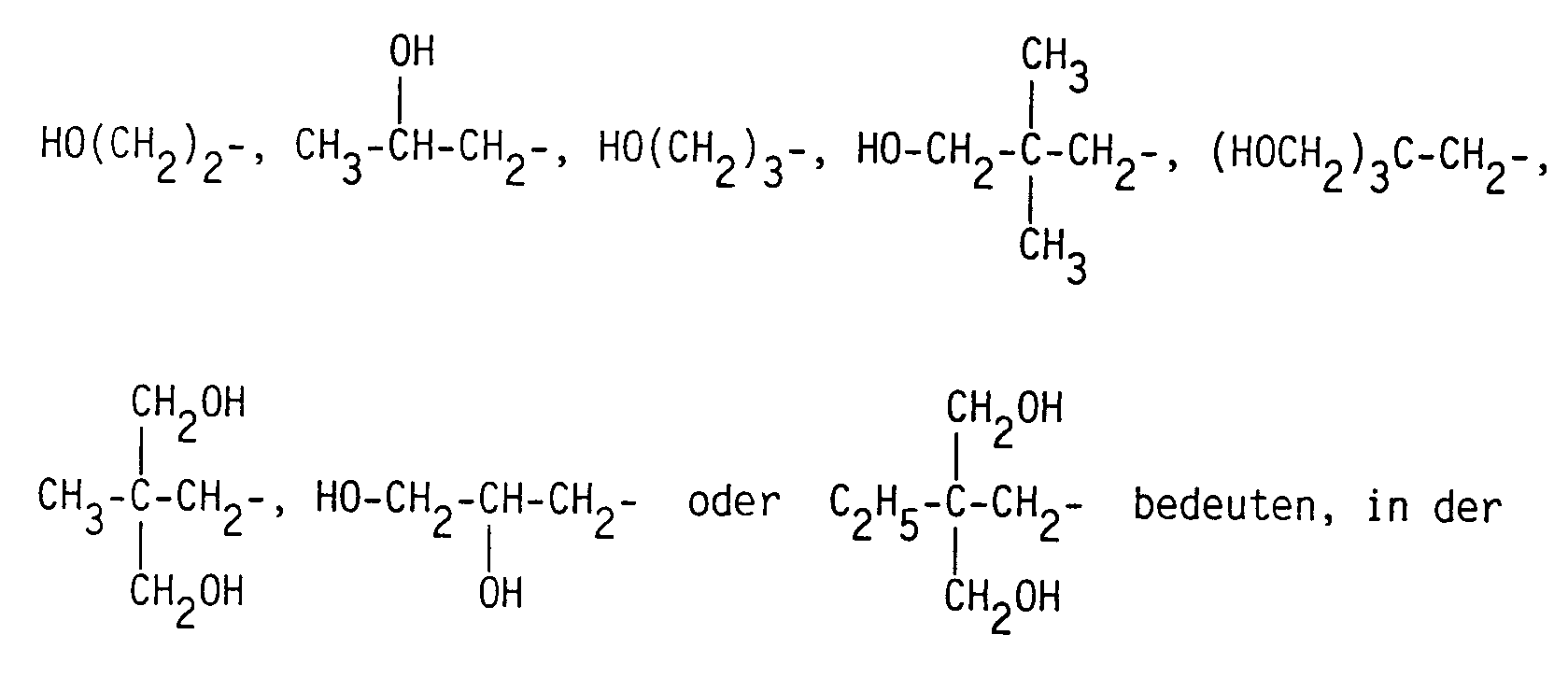
- R⁷
- eine Alkylen-, Cycloalkylen- oder Phenylengruppe ist und wobei das Estergruppen enthaltende Polyol mindestens drei Hydroxylgruppen aufweisen muß,
- Bevorzugt sind als R⁶-Reste die Reste

- Als R⁷-Rest ist der Phenylenrest bevorzugt.
- Die Formel I, durch welche das Estergruppen aufweisende Polyol beschrieben wird, ist als durchschnittliche Formel anzusehen. Bei der Veresterung von 2 Mol R⁶OH mit 1 Mol Dicarbonsäure entstehen in gewissem Umfang auch oligomere Polyesterpolyole, d.h. Verbindungen, bei denen die Dicarbonsäureeinheit mehr als einmal enthalten ist. Diese Verbindungen müssen nicht aus dem Gemisch abgetrennt werden. Die Herstellung der Estergruppen aufweisenden Polyole ist dem Fachmann geläufig.
- Es können die üblichen Veresterungskatalysatoren zur Beschleunigung der Reaktion eingesetzt werden. Hierzu wird zum Stand der Technik auf die EU-PS 0 092 701 verwiesen.
- Besonders bevorzugte Esterpolyole der allgemeinen Formel I sind:

- Die Umsetzung des Polysiloxans A1 mit dem Polyesterpolyol der Formel I erfolgt in einem solchen Mengenverhältnis, daß einer SiOR¹-Gruppe etwa eine COH-Gruppe entspricht. Der Quotient SiOR¹ : COH kann dabei innerhalb der Grenzen von 0,8 bis 1,2 liegen. Bevorzugt ist jedoch ein Quotient von 1.
- Die Umsetzung der Reaktionspartner wird bei einem Umsetzungsgrad von 25 bis 90 % abgebrochen. Es hat sich dabei herausgestellt, daß ein hoher Umsetzungsgrad die Umsetzung des erhaltenen modifizierten Polysiloxans A mit dem reaktiven linearen Polysiloxan B erleichtert. Bevorzugt ist es deshalb, die Umsetzung des Polysiloxans A1 mit dem Polyesterpolyol A2 bis zu einem Umsetzungsgrad von 50 bis 80 % durchzuführen. Das modifizierte Polysiloxan A ist trotz des hohen Umsetzungsgrades relativ niedrigviskos und deshalb gut handhabbar.
- Das Polysiloxan A1 und das reaktive lineare Polysiloxan B sind aus dem Stand der Technik bekannte Produkte und z.B. in der EU-PS 0 017 958 beschrieben.
- Im Polysiloxan A1 der allgemeinen Formel

ist OR¹ vorzugsweise eine OC₂H₅-Gruppe. R² ist bevorzugt die Methyl- und/oder Phenylgruppe. Der Index a hat den Wert 1 bis 1,5, vorzugsweise 1,1 bis 1,4. Der Index b hat einen Wert von 0,1 bis 0,8, vorzugsweise von 0,3 bis 0,7. - Im linearen Siloxan B der allgemeinen Formel

sind R³ und R⁴ vorzugsweise Methylreste, wobei bis zu 20 Mol-% der Methylreste durch Phenylreste ersetzt sein können. Auch R⁵ kann diese Bedeutung annehmen, jedoch muß mindestens ein Rest R⁵ zur Reaktion mit einer SiOR¹- oder COH-Gruppe befähigt sein. Eine solche reaktive Gruppe ist die Cl-, HO-, LiO- oder R⁸O-Gruppe, wobei R⁸ ein niederer Alkylrest mit 1 bis 4 Kohlenstoffatomen oder ein Acylrest ist. Vorzugsweise ist R⁸ ein Methyl-, Ethyl- oder Acetylrest. Es genügt bereits, wenn eine Gruppe R⁵ zur Reaktion mit der SiOR¹- oder COH-Gruppe befähigt ist. Es kann jedoch auch mehr als eine Gruppe R⁵, z.B. zwei, drei oder alle Gruppen R⁵, zur Reaktion befähigt sein. - Der Index x kann O sein, jedoch ist er vorzugsweise > O und hat insbesondere einen Wert von 10 bis 500, besonders bevorzugt einen Wert von 15 bis 150.
- Beispiele solcher Polysiloxane B sind

- Der erfindungsgemäßen Zubereitung kann man in an sich bekannter Weise Härter, wie z.B. Butyltitanat oder Zinnoctoat, Pigmente und Füllstoffe, wie z.B. Titanoxid oder Ruß, sowie Netz- und Verlaufmittel, wie z.B. Lecithin oder Ethylcellulose, in üblichen Mengen zusetzen.
- Die Zubereitungen werden auf den zu beschichtenden Untergrund aufgespritzt, aufgerakelt, aufgestrichen oder getaucht und dann eingebrannt, wobei sich die Einbrenntemperatur nach der Art des Harzes und des gegebenenfalls zugesetzten Katalysators richtet. Man erzielt auf diese Weise eine Beschichtung mit einer Schichtdicke von etwa 10 bis 40 µm.
- Der Gegenstand der vorliegenden Erfindung soll im folgenden durch die Beispiele näher erläutert werden.
- 166 g Isophthalsäure und 268 g 2,2-Di(hydroxymethyl)-butan(1)ol (Trimethylolpropan) werden mit 100 g Xylol auf 120°C erwärmt. Es werden dann, 0,3 g hypophosphorige Säure zugesetzt. Die Temperatur wird inner halb von 3 Stunden auf 190°C gesteigert. Das entstehende Wasser wird azeotrop mit dem Xylol abdestilliert. Nach Erreichen einer Säurezahl von 70 bis 100 wird zum Austreiben des Wassers Stickstoff eingeleitet. Die Temperatur wird innerhalb von 3 Stunden auf 220°C erhöht. Die Reaktion wird bei Erreichen einer Säurezahl < 5 beendet. Das angefallene Destillat besteht aus 36 g Wasser und 100 g Xylol. Die OH-Zahl des Produktes beträgt 560 mg KOH/g Substanz.
- 148 g Phthalsäureanhydrid und 62 g Ethylenglykol werden auf 145°C erwärmt. Bei dieser Temperatur wird gerührt, bis die Säurezahl auf 267 gefallen ist. Nun werden 134 g Trimethylolpropan zugegeben. Unter Einleiten von Stickstoff wird in 4 Stunden auf 220°C weiter aufgeheizt. Nach Erreichen einer Säurezahl < 5 wird die Reaktion beendet. Die Destillatmenge beträgt 18 g. Die OH-Zahl des Produktes beträgt 515 mg KOH/g Substanz.
- 1000 g eines Alkoxypolysiloxans A1 der Formel
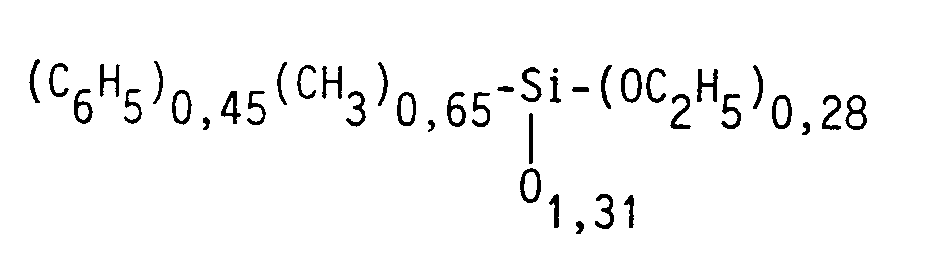
Gehalt an -OC₂H₅-Gruppen = 11,9 Gew.-%
263 g des Polyesterpolyols A2-I, 381 g Diethylenglykoldimethylether, 761 g Xylol und 0,2 g Butyltitanat werden in einer Destillationsapparatur vorgelegt und unter Rühren aufgeheizt. Die Reaktion beginnt bei 135°C. Nachdem 73 g Ethanol abdestilliert sind, wird der Ansatz gekühlt. Die Ethanolmenge entspricht einem Umsatz von 60 %. Der Einbrennrückstand des Produktes nach 1 Stunde bei 180°C beträgt 50 %. Das Produkt hat eine Viskosität von 250 mm²/s. - 1000 g eines Alkoxypolysiloxans A1 der Formel

Gehalt an -OC₂H₅-Gruppen = 14,4 Gew.-%
318 g des Polyesterpolyols A2-II, 1171 g Methylisoamylketon und 0,2 g Butyltitanat werden in einer Destillationsapparatur vorgelegt und unter Rühren aufgeheizt. Die Reaktion beginnt bei 140°C. Nachdem 96 g Ethanol abdestilliert sind, wird der Ansatz gekühlt. Die Ethanolmenge entspricht einem Umsatz von 65 %. Der Einbrennrückstand des Produktes beträgt 50 %. Das Produkt hat eine Viskosität von 120 mm²/s. - 100 g modifiziertes Siloxanharz A--I werden mit 0,4 Gew.-Teilen des Siloxans B--I der Formel

vermischt und unter Rühren mit 0,5 Gew.-Teilen (BuO)₄-Ti-Katalysator versetzt. - 100 g modifiziertes Siloxanharz A--II werden mit 0,2 Gew.-Teilen des Siloxans B--II der Formel

vermischt und unter Rühren mit 0,5 Gew.-Teilen (BuO)₄-Ti-Katalysator versetzt. - Je 100 g der Zubereitungen Z--I und Z--II werden mit 50 g Titandioxid pigmentiert. Die Lacke werden mit einer Rakel auf Aluminiumprüfbleche (Bonder 1401 Al) aufgebracht und nach einer Ablüftzeit von 15 Minuten in einem Umluftofen 10 Minuten bei 270°C ausgehärtet. Die Schichtdicke beträgt 30 bis 35 µm.
- Es werden folgende Prüfungen durchgeführt:
- 1. Bleistifthärte nach ECCA-Norm T4-ISO 3270-ASTM D 3363
- 2. Gitterschnittprüfung nach DIN 53151 ISO 2409
- 3. Öltest:
Das beschichtete Prüfblech wird bei 200°C 3 Stunden in Olivenöl gelagert. Es wird dann der Gitterschnitt-Test durchgeführt und die Bleistifthärte bestimmt. - 4. Steamtest:
Ein beschichtetes Blech wird 2 cm über dem Ausguß eines kleinen Wasserkessels (⌀ des Ausgusses 1,7 cm) so befestigt, daß der Wasserdampf auf die beschichtete Fläche trifft und kondensiert. Die Dauer der Prüfung beträgt 10 Minuten. Dabei verdampfen etwa 140 bis 150 g Wasser. Danach werden auf der beschichteten Fläche mit einem groben Leinenstoff (cheese cloth), der 7mal gefaltet ist, Doppelhübe ohne Druck ausgeführt. Gemessen wird, nach wieviel Doppelhüben die bedampfte Fläche stumpf wird. - 5. Spiegeleiertest:
Ein Spiegelei wird auf dem beschichteten Blech gebraten. Es werden die Trennung des Spiegeleies, die Haftung von Rückständen an dem beschichteten Blech sowie gegebenenfalls Verfärbungen der Beschichtung beurteilt. - 6. Zuckertest:
Auf dem beschichteten Blech wird Zucker so lange erhitzt, bis er flüssig und leicht braun geworden ist. Dann wird die Zuckerschmelze abgekühlt, bis sie erstarrt und mit einem Spatel vom beschichteten Blech geschoben. Beurteilt wird die Menge der verbleibenden Rückstände und gegebenenfalls eine Verfärbung der Beschichtung. - 7. Kondensmilchtest:
Kondensmilch wird auf dem beschichteten Blech so lange erhitzt, bis das Wasser aus der Milch verdampft ist. Dann wird das Blech auf Raumtemperatur abgekühlt und die Haftung der Rückstände und eine etwaige Verfärbung der Beschichtung beurteilt. - 8. Essigsäuretest:
Ein beschichtetes Blech wird 1 Stunde bei 50°C in 5 %iger Essigsäure gelagert. Danach wird der Gitterschnitt beurteilt. - 9. Ketchuptest:
Ein beschichtetes Blech wird 3 Stunden in einer auf 100°C erwärmten Ketchup-Lösung gelagert. Danach wird die Haftung und eine etwaige Verfärbung beurteilt.
Zusammensetzung der Lösung:
Ketchup 600 g
Lösung von NaCl in Wasser 600 g
Paprika 5 g
Pfeffer 5 g - Die Ergebnisse der anwendungstechnischen Prüfung sind in der folgenden Tabelle zusammengefaßt. Zum Vergleich wird analog eine Beschichtung des Standes der Technik geprüft. Diese Beschichtung ist wie folgt zusammengesetzt:
100 g einer Zubereitung aus einem Polysiloxanharz, umgesetzt mit einem Gemisch aus Trimethylolpropan und Ethylenglykol, mit dem obengenannten Polysiloxan B--II (gemäß Beispiel 4 der europäischen Patentschrift 0 017 958) werden mit 50 g Titandioxid pigmentiert. Der Lack wird mit einer Rakel auf Aluminiumprüfbleche (Bonder 1401 Al) aufgebracht und nach einer Ablüftzeit von 15 Minuten in einem Umluftofen 10 Minuten bei 270°C ausgehärtet. Die Schichtdicke beträgt 32 µm.
- Die Ergebnisse zeigen deutlich, daß die Beschichtungen, die aus den erfindungsgemäßen Zubereitungen hergestellt wurden, ausgezeichnete Abhäsivität und Härte auch bei hohen Temperaturen aufweisen und daher für die angegebenen Verwendungszwecke hervorragend verwendbar sind. Das Vergleichsbeispiel zeigt, daß nach dem bisherigen Stand der Technik vor allem bei hohen Temperaturen eine vergleichbare Ölfestigkeit und Widerstandsfähigkeit gegen mechanische Belastung nicht zu erreichen waren.

x = 0 oder eine ganze Zahl > 0 ist.
Claims (2)
- Verfahren zur abhäsiven Beschichtung von Backblechen, Backformen, Pfannen, Metalltöpfen und dergleichen mit einer Zubereitung, welche überwiegend aus hitzehärtbarem, mit Polyolen modifiziertem Polysiloxan A und, bezogen auf Polysiloxan A, 0,05 bis 4 Gew.-% eines mit diesem reaktiven linearen Siloxan B besteht, wobei das modifizierte Polysiloxan A durch Umsetzung eines Polysiloxans A1 der allgemeinen Formel
 (OR¹ = Alkoxygruppe, abgeleitet von primärem oder sekundärem Alkohol mit 1 bis 4 Kohlenstoffatomen,R² = Alkyl- und/oder Phenylrest,a = 1 bis 1,5,b = 0,1 bis 0,8)mit einem mehrwertigen Alkohol A2 erhältlich ist, wobei die Umsetzung in einem solchen Mengenverhältnis durchgeführt wird, daß einer SiOR¹-Gruppe etwa eine COH-Gruppe entspricht und die Umsetzung bei einem Umsetzungsgrad von 25 bis 90 % abgebrochen wird, und das reaktive lineare Polysiloxan B der allgemeinen Formel
 (R³, R⁴ gleich oder verschieden, Methyl- oder Phenylreste, wo bei aber mindestens 80 Mol-% dieser Reste Methylreste sind,R⁵ gleich oder verschieden, Alkylreste mit 1 bis 4 Kohlenstoffatomen und/oder Phenylreste und/oder zur Reaktion mit den SiOR¹- bzw. COH-Gruppen des modifizierten Polysiloxans A befähigte Gruppen, wobei mindestens ein Rest R⁵ eine solche reaktionsfähige Gruppe ist,x ≧ 0)entspricht, dadurch gekennzeichnet, daß man als mehrwertigen Alkohol A2 ein Estergruppen enthaltendes Polyol der allgemeinen Formel

 R⁷ eine Alkylen-, Cycloalkylen- oder Phenylengruppe ist und wobei das Estergruppen enthaltende Polyol mindestens drei Hydroxylgruppen aufweisen muß,verwendet.
 - Verfahren nach Anspruch 1, dadurch gekennzeichnet, daß man eine Zubereitung verwendet, in welcher die ResteR¹ Ethylreste,R² Methyl- und/oder Phenylreste,
 R⁷ Phenylenrestesind.
Priority Applications (1)
| Application Number | Priority Date | Filing Date | Title |
|---|---|---|---|
| AT88113113T ATE75244T1 (de) | 1987-08-26 | 1988-08-12 | Zubereitung zur abhaesiven beschichtung von backblechen, backformen, pfannen, metalltoepfen und dergleichen. |
Applications Claiming Priority (2)
| Application Number | Priority Date | Filing Date | Title |
|---|---|---|---|
| DE3728414A DE3728414C1 (de) | 1987-08-26 | 1987-08-26 | Zubereitung zur abhaesiven Beschichtung von Backblechen,Backformen,Pfannen,Metalltoepfen und dergleichen |
| DE3728414 | 1987-08-26 |
Publications (3)
| Publication Number | Publication Date |
|---|---|
| EP0304739A2 EP0304739A2 (de) | 1989-03-01 |
| EP0304739A3 EP0304739A3 (en) | 1990-10-03 |
| EP0304739B1 true EP0304739B1 (de) | 1992-04-22 |
Family
ID=6334490
Family Applications (1)
| Application Number | Title | Priority Date | Filing Date |
|---|---|---|---|
| EP88113113A Expired - Lifetime EP0304739B1 (de) | 1987-08-26 | 1988-08-12 | Zubereitung zur abhäsiven Beschichtung von Backblechen, Backformen, Pfannen, Metalltöpfen und dergleichen |
Country Status (6)
| Country | Link |
|---|---|
| US (1) | US4898772A (de) |
| EP (1) | EP0304739B1 (de) |
| JP (1) | JPH066098B2 (de) |
| AT (1) | ATE75244T1 (de) |
| DE (2) | DE3728414C1 (de) |
| ES (1) | ES2032208T3 (de) |
Families Citing this family (7)
| Publication number | Priority date | Publication date | Assignee | Title |
|---|---|---|---|---|
| US5491869A (en) * | 1994-03-09 | 1996-02-20 | Sullivan; Frank J. | Silicone rubber utensil |
| DE19934103A1 (de) | 1999-07-21 | 2001-01-25 | Goldschmidt Ag Th | Polyorganosiloxanharze mit Trenneffekt |
| US6489025B2 (en) | 2000-04-12 | 2002-12-03 | Showa Denko K.K. | Fine carbon fiber, method for producing the same and electrically conducting material comprising the fine carbon fiber |
| US6835457B2 (en) * | 2001-05-15 | 2004-12-28 | Markem Corporation | Marking substrates |
| DE10302743A1 (de) * | 2003-01-24 | 2004-07-29 | Goldschmidt Ag | Verwendung von Siliconharzen als Dispergiermittel |
| EP3524651B1 (de) | 2018-02-08 | 2025-11-26 | Evonik Operations GmbH | Wässrige polyorganosiloxanhybridharz-dispersion |
| EP3719076A1 (de) | 2019-04-01 | 2020-10-07 | Evonik Operations GmbH | Wässrige polyorganosiloxanhybridharz-dispersion |
Family Cites Families (4)
| Publication number | Priority date | Publication date | Assignee | Title |
|---|---|---|---|---|
| AU5711380A (en) * | 1979-04-24 | 1980-10-30 | Engelhard Industries Ltd. | Electrodeposition of white gold alloy |
| EP0017958B1 (de) * | 1979-04-24 | 1982-11-10 | Th. Goldschmidt AG | Zubereitung zur abhäsiven Beschichtung von Backblechen, Backformen, Pfannen, Metalltöpfen und dergleichen |
| DE3214984C2 (de) * | 1982-04-22 | 1985-05-15 | Th. Goldschmidt Ag, 4300 Essen | Verfahren zur Herstellung von eines in organischen Lösungsmitteln löslichen, hitzehärtbaren Siliconharzes |
| GB2152946B (en) * | 1984-01-23 | 1987-06-03 | Postans Limited | Non-stick coating |
-
1987
- 1987-08-26 DE DE3728414A patent/DE3728414C1/de not_active Expired
-
1988
- 1988-07-12 JP JP63173633A patent/JPH066098B2/ja not_active Expired - Lifetime
- 1988-08-04 US US07/228,246 patent/US4898772A/en not_active Expired - Lifetime
- 1988-08-12 AT AT88113113T patent/ATE75244T1/de not_active IP Right Cessation
- 1988-08-12 DE DE8888113113T patent/DE3870360D1/de not_active Expired - Lifetime
- 1988-08-12 EP EP88113113A patent/EP0304739B1/de not_active Expired - Lifetime
- 1988-08-12 ES ES198888113113T patent/ES2032208T3/es not_active Expired - Lifetime
Also Published As
| Publication number | Publication date |
|---|---|
| EP0304739A2 (de) | 1989-03-01 |
| DE3870360D1 (de) | 1992-05-27 |
| JPH066098B2 (ja) | 1994-01-26 |
| ES2032208T3 (es) | 1993-01-16 |
| EP0304739A3 (en) | 1990-10-03 |
| DE3728414C1 (de) | 1988-09-08 |
| JPS6462366A (en) | 1989-03-08 |
| US4898772A (en) | 1990-02-06 |
| ATE75244T1 (de) | 1992-05-15 |
Similar Documents
| Publication | Publication Date | Title |
|---|---|---|
| DE3885258T2 (de) | Hydroxyalkylamid-Härtungsmittel für Pulverlacke. | |
| DE3046910C2 (de) | Verfahren zur Herstellung einer flüssigen Zusammensetzung mit hohem Feststoffgehalt | |
| EP0002718B2 (de) | Verwendung eines Lackes auf Basis von Epoxidharz und einem Trimellitsäureanhydridestergemisch zur Innenbeschichtung von Metallbehältern für Lebensmittel oder Getränke | |
| DE2326598A1 (de) | Fluessige, waermehaertende ueberzugsmassen | |
| DE69004307T2 (de) | Flüssige Siliconharzmassen. | |
| CH633032A5 (de) | Verwendung von aus dicarbonsaeure- diol- polyester und gegebenenfalls aus ueberschuessigem diol bestehenden veresterungsprodukten in einbrennueberzugsmassen. | |
| EP0092701B1 (de) | Verfahren zur Herstellung von hitzehärtbaren Siliconharzen | |
| DE2332859A1 (de) | Pulverfoermige anstrichmittel auf polyesterbasis | |
| DE3728414C1 (de) | Zubereitung zur abhaesiven Beschichtung von Backblechen,Backformen,Pfannen,Metalltoepfen und dergleichen | |
| DE1253847B (de) | Bindemittel fuer Einbrennlack | |
| DE2506113C2 (de) | Wässriger Isolierlack | |
| EP0401683A2 (de) | Wärmehärtbare, Siliziumverbindungen enthaltende Zusammensetzungen | |
| DE853353C (de) | Verfahren zur Herstellung permanent homogener synthetischer Kunstharze | |
| WO1997025386A1 (de) | Lösemittelfreie, emissionsarm härtbare beschichtungsmittel | |
| EP1072660B1 (de) | Polyorganosiloxanharze mit Trenneffekt | |
| DE2434952A1 (de) | Organosiloxan-mischpolymerisat | |
| DE2447654C3 (de) | Verfahren zur Herstellung von Organopolysiloxanharzen, die Pyromellitsäurediimidgruppen enthalten | |
| EP0017958B1 (de) | Zubereitung zur abhäsiven Beschichtung von Backblechen, Backformen, Pfannen, Metalltöpfen und dergleichen | |
| DE3537855C2 (de) | ||
| EP0092702B1 (de) | Verfahren zur Herstellung eines mit Wasser verdünnbaren, wärmehärtbaren, mit organischen Polyolen modifizierten Organopolysiloxans | |
| DE2142794A1 (de) | Masse für Schutzüberzüge* | |
| DE2008593C3 (de) | Herstellung von harten Polysiloxanformkörpem oder Überzügen | |
| DE1644801C3 (de) | Einbrennlacke auf Basis selbstvernetzender Alkydharze | |
| DE2107471C3 (de) | Siliciummodifiziertes organisches Harz | |
| DE3707064C1 (de) | Haertbares Beschichtungsmittel |
Legal Events
| Date | Code | Title | Description |
|---|---|---|---|
| PUAI | Public reference made under article 153(3) epc to a published international application that has entered the european phase |
Free format text: ORIGINAL CODE: 0009012 |
|
| 17P | Request for examination filed |
Effective date: 19880817 |
|
| AK | Designated contracting states |
Kind code of ref document: A2 Designated state(s): AT BE CH DE ES FR GB IT LI NL |
|
| PUAL | Search report despatched |
Free format text: ORIGINAL CODE: 0009013 |
|
| AK | Designated contracting states |
Kind code of ref document: A3 Designated state(s): AT BE CH DE ES FR GB IT LI NL |
|
| 17Q | First examination report despatched |
Effective date: 19911014 |
|
| GRAA | (expected) grant |
Free format text: ORIGINAL CODE: 0009210 |
|
| AK | Designated contracting states |
Kind code of ref document: B1 Designated state(s): AT BE CH DE ES FR GB IT LI NL |
|
| REF | Corresponds to: |
Ref document number: 75244 Country of ref document: AT Date of ref document: 19920515 Kind code of ref document: T |
|
| ITF | It: translation for a ep patent filed | ||
| REF | Corresponds to: |
Ref document number: 3870360 Country of ref document: DE Date of ref document: 19920527 |
|
| ET | Fr: translation filed | ||
| GBT | Gb: translation of ep patent filed (gb section 77(6)(a)/1977) | ||
| REG | Reference to a national code |
Ref country code: ES Ref legal event code: FG2A Ref document number: 2032208 Country of ref document: ES Kind code of ref document: T3 |
|
| PLBE | No opposition filed within time limit |
Free format text: ORIGINAL CODE: 0009261 |
|
| STAA | Information on the status of an ep patent application or granted ep patent |
Free format text: STATUS: NO OPPOSITION FILED WITHIN TIME LIMIT |
|
| 26N | No opposition filed | ||
| PGFP | Annual fee paid to national office [announced via postgrant information from national office to epo] |
Ref country code: GB Payment date: 19980803 Year of fee payment: 11 |
|
| PGFP | Annual fee paid to national office [announced via postgrant information from national office to epo] |
Ref country code: AT Payment date: 19980813 Year of fee payment: 11 |
|
| PGFP | Annual fee paid to national office [announced via postgrant information from national office to epo] |
Ref country code: FR Payment date: 19980814 Year of fee payment: 11 Ref country code: ES Payment date: 19980814 Year of fee payment: 11 |
|
| PGFP | Annual fee paid to national office [announced via postgrant information from national office to epo] |
Ref country code: CH Payment date: 19980824 Year of fee payment: 11 |
|
| PGFP | Annual fee paid to national office [announced via postgrant information from national office to epo] |
Ref country code: NL Payment date: 19980827 Year of fee payment: 11 |
|
| PGFP | Annual fee paid to national office [announced via postgrant information from national office to epo] |
Ref country code: BE Payment date: 19981016 Year of fee payment: 11 |
|
| PG25 | Lapsed in a contracting state [announced via postgrant information from national office to epo] |
Ref country code: GB Free format text: LAPSE BECAUSE OF NON-PAYMENT OF DUE FEES Effective date: 19990812 Ref country code: AT Free format text: LAPSE BECAUSE OF NON-PAYMENT OF DUE FEES Effective date: 19990812 |
|
| PG25 | Lapsed in a contracting state [announced via postgrant information from national office to epo] |
Ref country code: ES Free format text: LAPSE BECAUSE OF NON-PAYMENT OF DUE FEES Effective date: 19990813 |
|
| PG25 | Lapsed in a contracting state [announced via postgrant information from national office to epo] |
Ref country code: LI Free format text: LAPSE BECAUSE OF NON-PAYMENT OF DUE FEES Effective date: 19990831 Ref country code: CH Free format text: LAPSE BECAUSE OF NON-PAYMENT OF DUE FEES Effective date: 19990831 Ref country code: BE Free format text: LAPSE BECAUSE OF NON-PAYMENT OF DUE FEES Effective date: 19990831 |
|
| BERE | Be: lapsed |
Owner name: TH. GOLDSCHMIDT A.G. Effective date: 19990831 |
|
| PG25 | Lapsed in a contracting state [announced via postgrant information from national office to epo] |
Ref country code: NL Free format text: LAPSE BECAUSE OF NON-PAYMENT OF DUE FEES Effective date: 20000301 |
|
| GBPC | Gb: european patent ceased through non-payment of renewal fee |
Effective date: 19990812 |
|
| REG | Reference to a national code |
Ref country code: CH Ref legal event code: PL |
|
| PG25 | Lapsed in a contracting state [announced via postgrant information from national office to epo] |
Ref country code: FR Free format text: LAPSE BECAUSE OF NON-PAYMENT OF DUE FEES Effective date: 20000428 |
|
| NLV4 | Nl: lapsed or anulled due to non-payment of the annual fee |
Effective date: 20000301 |
|
| REG | Reference to a national code |
Ref country code: FR Ref legal event code: ST |
|
| REG | Reference to a national code |
Ref country code: ES Ref legal event code: FD2A Effective date: 20000911 |
|
| PG25 | Lapsed in a contracting state [announced via postgrant information from national office to epo] |
Ref country code: IT Free format text: LAPSE BECAUSE OF NON-PAYMENT OF DUE FEES;WARNING: LAPSES OF ITALIAN PATENTS WITH EFFECTIVE DATE BEFORE 2007 MAY HAVE OCCURRED AT ANY TIME BEFORE 2007. THE CORRECT EFFECTIVE DATE MAY BE DIFFERENT FROM THE ONE RECORDED. Effective date: 20050812 |
|
| PGFP | Annual fee paid to national office [announced via postgrant information from national office to epo] |
Ref country code: DE Payment date: 20070822 Year of fee payment: 20 |